

 Shop
ShopThe Porsche 911, Boxster & Cayman represent three decades of flat-six evolution across rear-engine and mid-engine platforms – from the water-cooled 996 that arrived in 1997 through the hybrid-powered 992 GTS T-Hybrid producing 534 hp today. Scopione carries carbon fiber front lip spoilers, rear diffusers, engine covers, grille vents, and fender vent scoops for the Porsche 911 (996 through 992), Boxster 987, and Boxster/Cayman 981 – eighteen components spanning four 911 generations and two Boxster/Cayman generations (2001–2023).
Introduction: Porsche’s Flat-Six Sports Car Lineup
Porsche nearly went bankrupt in the early 1990s. The car that pulled the company back was not the 911 – it was the Boxster. The Type 986 mid-engine roadster arrived in 1996 with a 2.5-liter flat-six, a $40,000 base price, and the kind of production volumes Porsche had never achieved with the 911 alone. Within three years, Porsche was profitable again. The 986 shared its front-end structure with the simultaneously developed Type 996 911, which in 1997 became the first water-cooled 911 in the model’s 34-year history. The Cayman joined as a fixed-roof 987 derivative in 2005, completing a three-model lineup that shares engineering DNA across rear-engine and mid-engine configurations.
Each model occupies distinct territory. The 911 remains the rear-engine icon – over 60 years of continuous production with a flat-six mounted behind the rear axle, available in Carrera, Turbo, and GT variants ranging from 379 to 701 hp in the current 992 generation. The Boxster is the open-top mid-engine roadster, balancing handling purity with open-air driving. The Cayman delivers the chassis rigidity that the Boxster trades for its folding roof, and the GT4 RS proved that the mid-engine platform could match McLaren 570S-level straight-line performance with a naturally aspirated 4.0-liter producing 493 hp at 9,000 rpm.
Together, these three models account for the majority of Porsche’s sports car output. The 996 through 992 generations total over 600,000 911s built. Carbon-fiber demand is strongest for the 991 and 992 Carrera models – high-volume production creates a deep owner base that customizes with aftermarket aero parts. Scopione’s Porsche carbon fiber catalog covers lip spoilers, diffusers, engine covers, grille vents, and fender vent scoops across the 996 Turbo S, 997, 991, 992, Boxster 987, and Boxster/Cayman 981.


The 911: Four Generations of Rear-Engine Evolution (996–992)
Porsche does not abandon the 911 – it refines it. Each generation since the 996 has addressed a specific engineering challenge: water cooling, direct fuel injection, forced induction for base models, and now hybridization. The constants remain: flat-six engine, rear-engine layout, Carrera and Turbo tiers, and GT variants engineered with minimal compromise for the track.
Type 996 (1997–2004): The Water-Cooled Revolution
The 996 ended the air-cooled era. A 3.4-liter flat-six (later 3.6L) introduced VarioCam variable valve timing and delivered 296–320 hp in Carrera form. Critics attacked the “fried egg” headlights and the shared front-end with the 986 Boxster, but the engineering underneath was sound: more than 175,000 units produced across all variants made the 996 one of the highest-volume 911 generations at that point. The 996 Turbo used a 3.6-liter twin-turbo flat-six producing 420 hp (444 hp with the X50 power kit), while the GT2 pushed to 462–483 hp through the same turbocharged engine in rear-wheel-drive-only configuration. Porsche built 21,954 996 Turbos and just 1,287 GT2s.
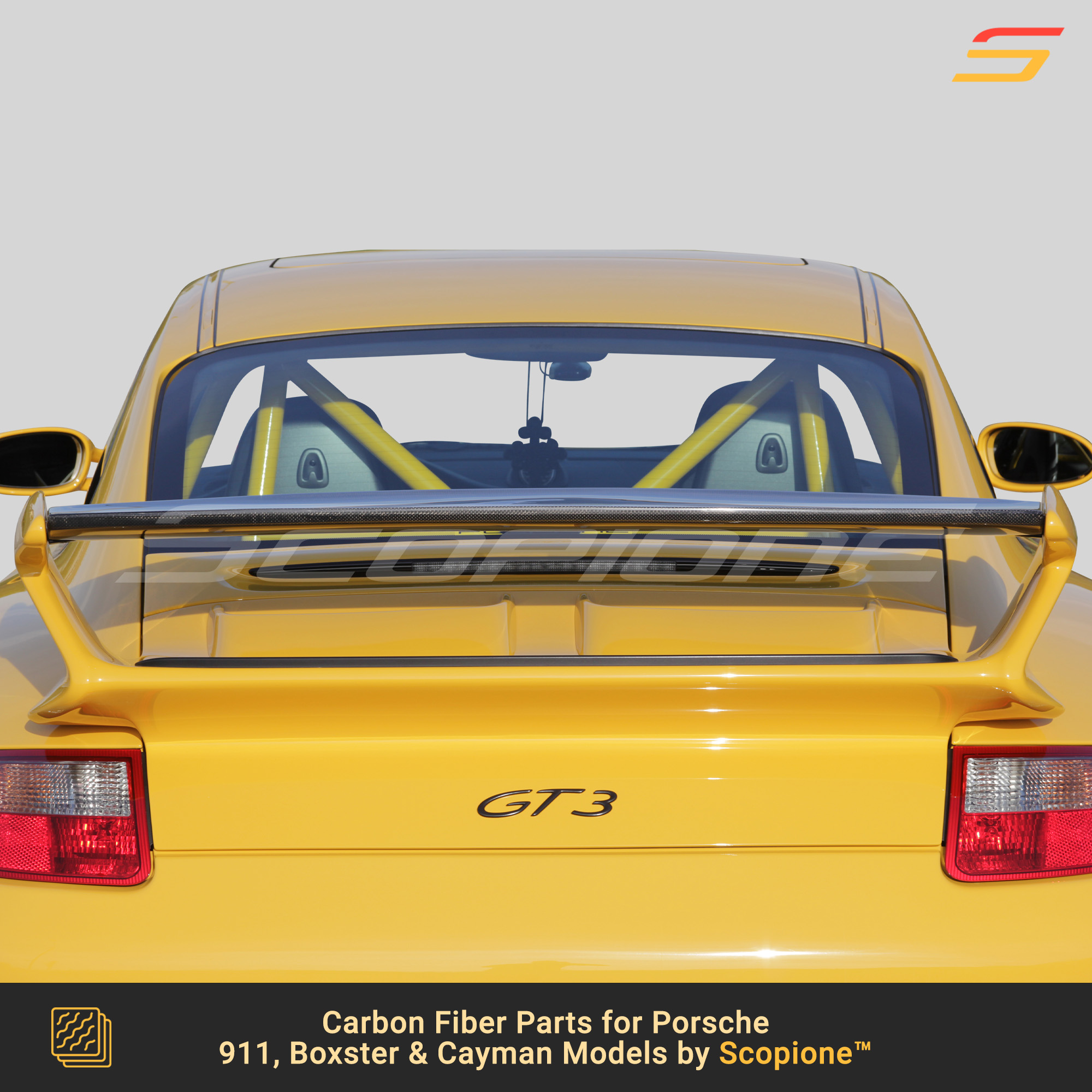
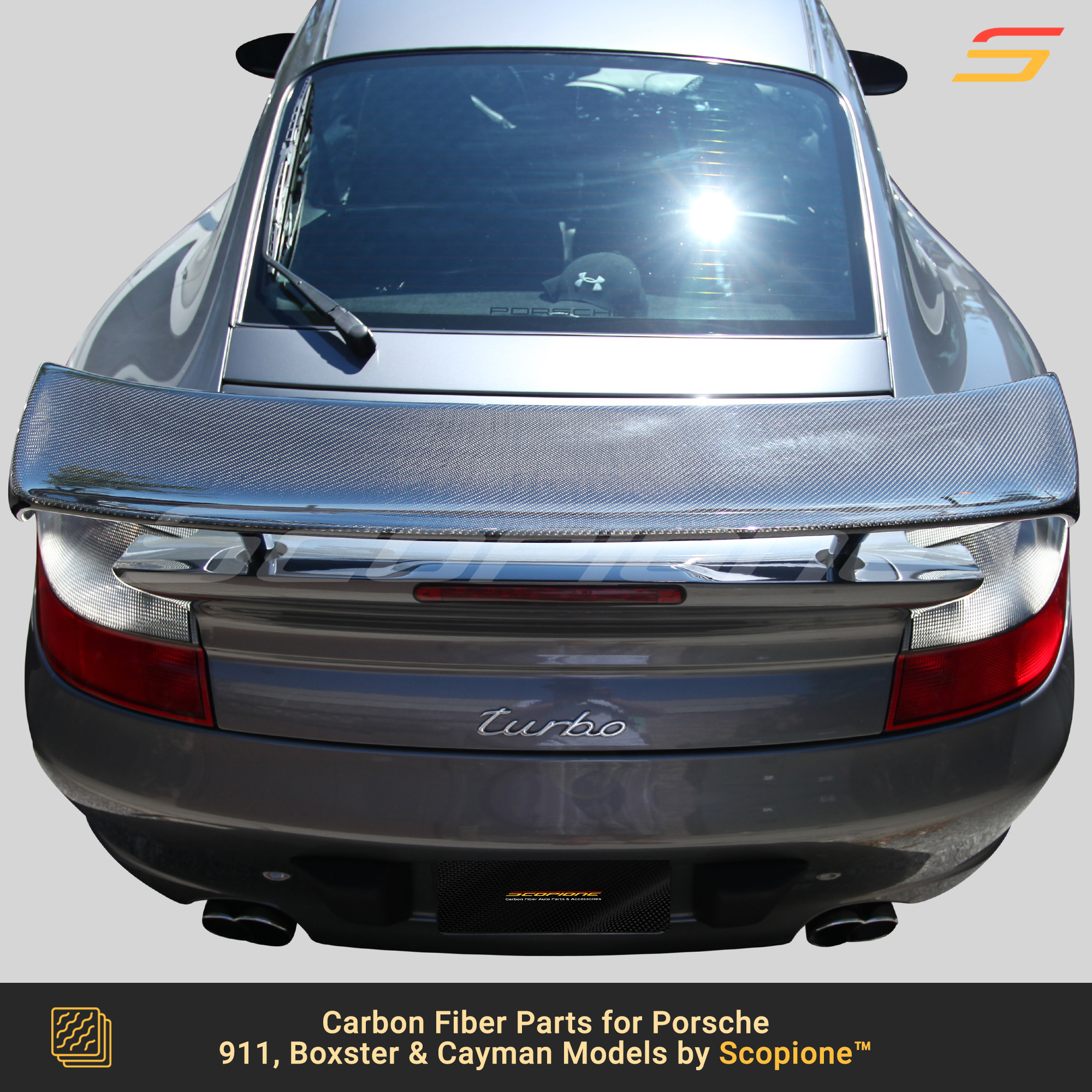
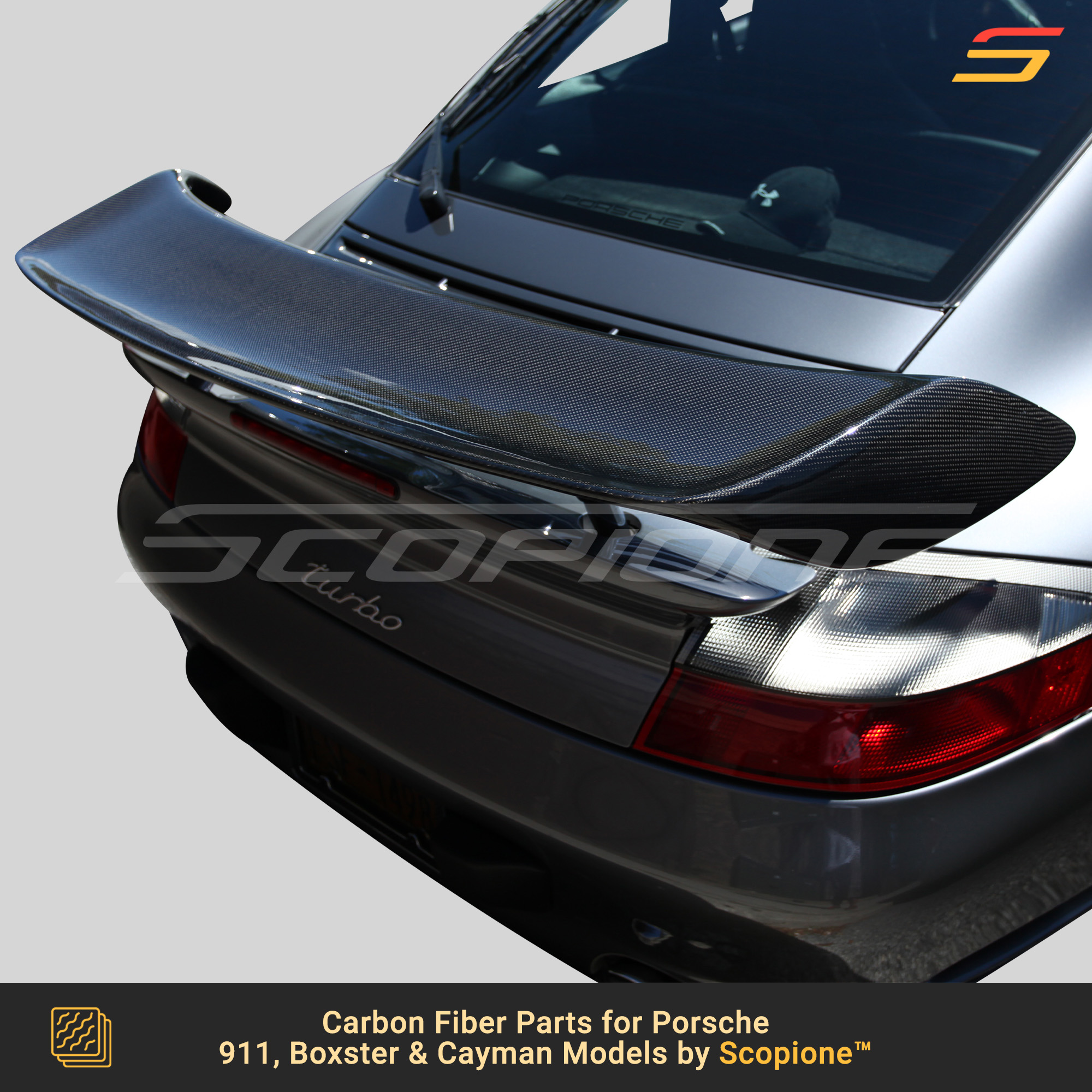
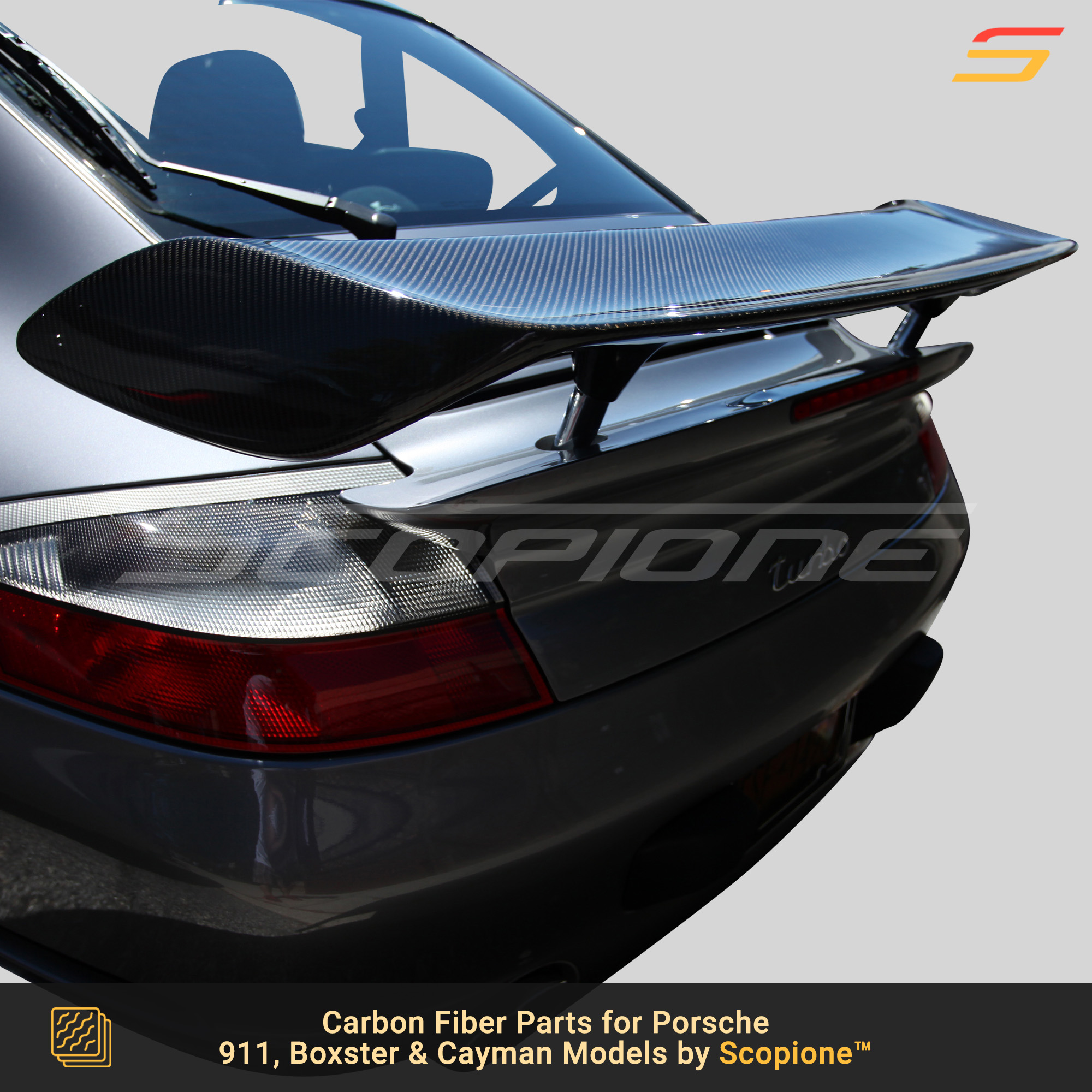
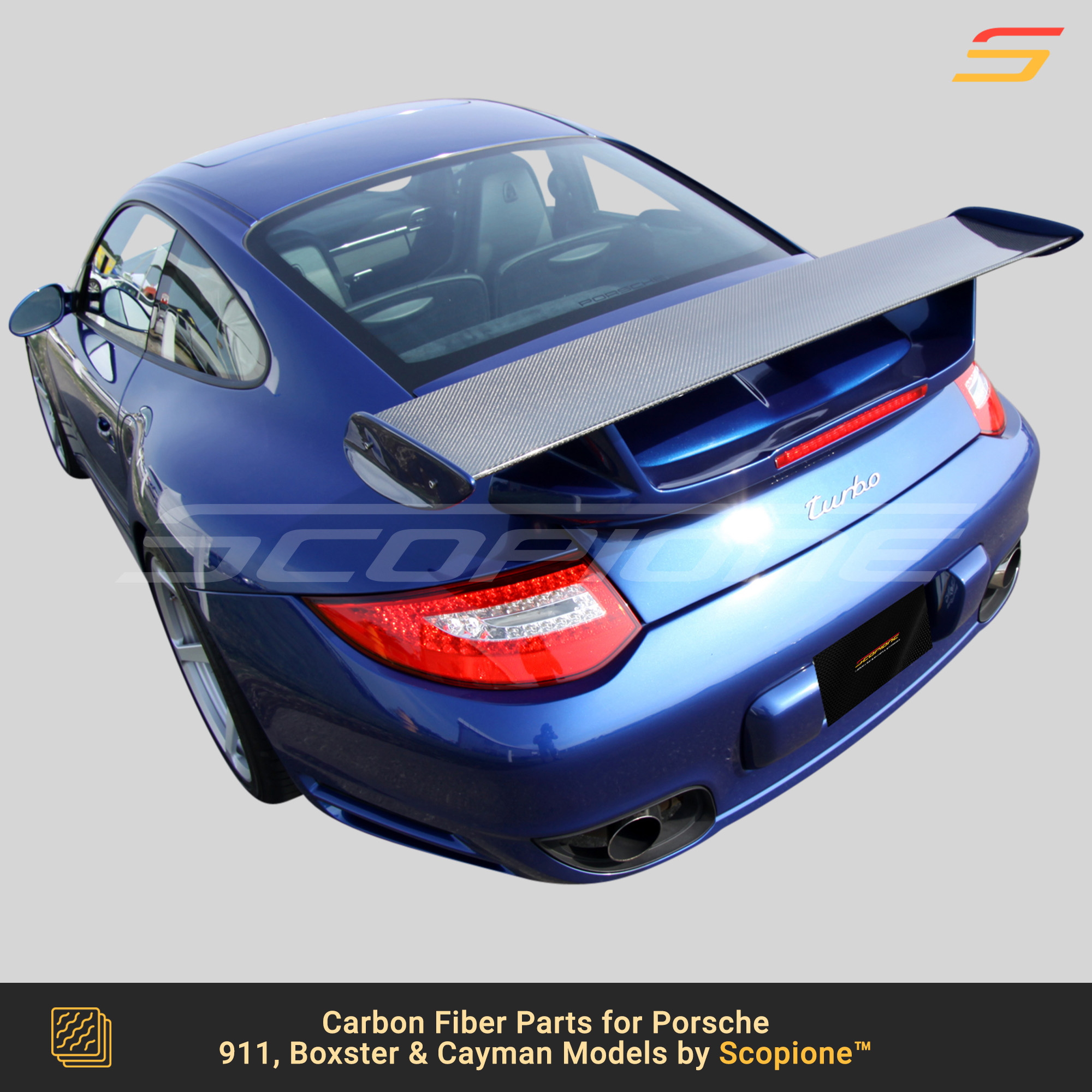
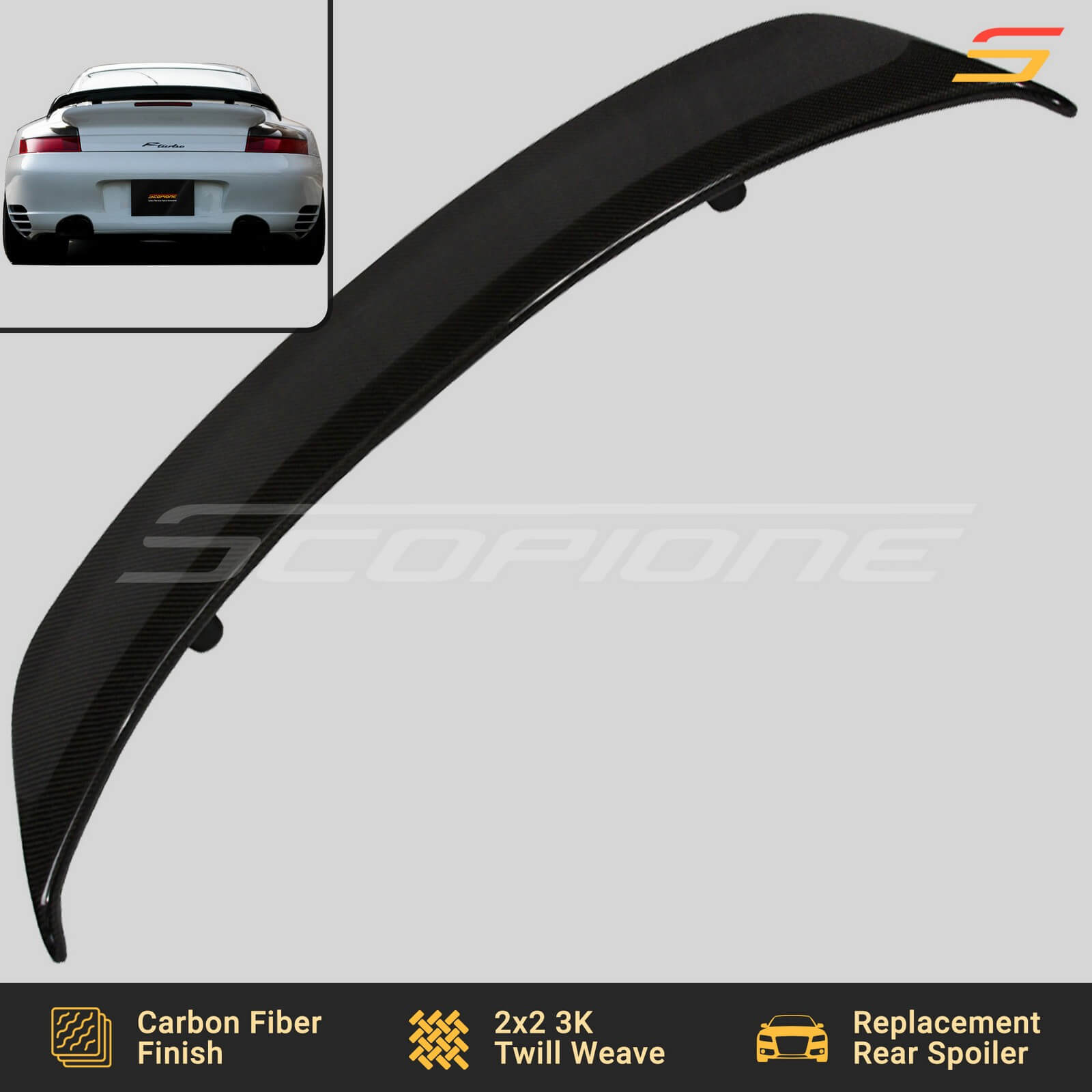
The 996 GT3 brought a race-derived 3.6-liter naturally aspirated engine producing 355–381 hp across two series. The GT3 RS – 682 units, never sold in North America – introduced lightweight body panels and track-focused suspension. One known concern persists in the 996 era: the intermediate shaft (IMS) bearing in M96/M97 engines. Turbo and GT models used the more robust Mezger engine and are unaffected. Scopione offers a carbon-fiber rear trunk spoiler for the 996 Turbo S – one of the earliest Porsche-specific parts in the catalog.
| Model | Base MSRP (When New) | Inflation-Adjusted |
|---|---|---|
| 996 Carrera Coupe (1999) | $65,000–$70,000 | ~$120,000 |
| 996 Turbo Coupe (2001) | $111,000 | ~$195,000 |
| 996 GT2 (2002) | $179,000 | ~$310,000 |
Type 997 (2004–2012): The Analog Benchmark
The 997 corrected the 996’s polarizing design choices. Round headlights returned. Interior materials improved substantially. But the real story is the mechanical evolution between 997.1 and 997.2. The first-generation 997 (2005–2008) carried M96/M97 engines with the same IMS bearing concerns as the 996. The 997.2 (2009–2012) introduced new MA1 direct fuel injection engines that eliminated the IMS issue entirely, produced more power (345 hp Carrera, 385 hp Carrera S), and offered the 7-speed PDK dual-clutch gearbox alongside the traditional six-speed manual.
The 997 Turbo delivered 473–530 hp from a twin-turbo 3.6–3.8-liter Mezger flat-six – competing directly with the Audi R8, which debuted its V10 variant in 2009. The GT3 lineup reached its mechanical zenith with the GT3 RS 4.0: a 4.0-liter naturally aspirated engine producing 500 hp, limited to 600 units, with a carbon-fiber hood and front fenders that shed weight for track duty. The 997 GT2 RS topped the range at 620 hp – a figure that would not be surpassed until the 991 GT2 RS arrived seven years later. Porsche built 213,004 Type 997 911s in total.
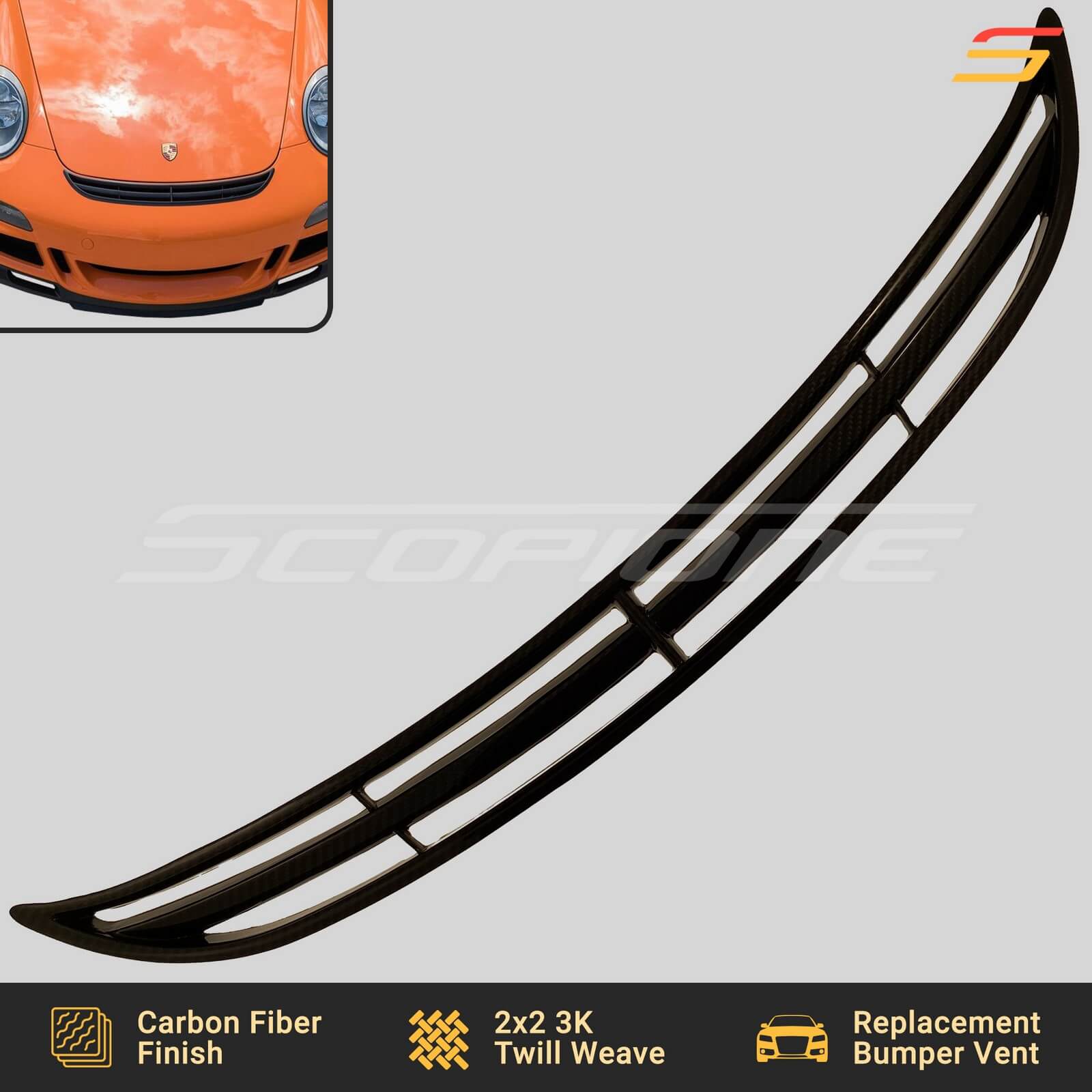
Scopione’s 997-generation carbon fiber lineup includes a front lip spoiler for the Carrera and GT3 RS, a smile grille vent, and rear fender vent scoops for the Turbo S and GT2 RS.
Two other 997 models deserve mention. The Sport Classic (250 units, sold out in 48 hours) wore a fixed ducktail spoiler, double-dome roof, and 44 mm wider rear fenders. The Speedster (356 units, echoing the original 356’s production number) carried a 408 hp flat-six and came in exactly two colors: Pure Blue and Carrara White.
| Model | Base MSRP (When New) | Inflation-Adjusted |
|---|---|---|
| 997 Carrera Coupe (2005) | ~$82,000 | ~$125,000 |
| 997 Carrera S Coupe (2005) | ~$90,000 | ~$140,000 |
| 997 Turbo (2007) | ~$125,000 | ~$186,000 |
| 997 GT2 RS (2011) | ~$245,000 | ~$335,000 |
| 997 GT3 RS 4.0 (2011) | ~$185,000 | ~$253,000 |
Type 991 (2011–2019): The Turbo Transition
The 991 introduced aluminum-intensive construction, a longer wheelbase, and – with the 991.2 facelift in 2016 – turbocharged engines across the entire Carrera range. This was the generation that separated purists from pragmatists. The 991.1 Carrera (3.4L, 350 hp) and Carrera S (3.8L, 400 hp) were the last naturally aspirated base 911s. The 991.2 replaced those engines with 3.0-liter twin-turbo units producing 370–450 hp, trading the NA flat-six’s linear throttle response for broader torque and lower emissions.
The GT division, however, kept naturally aspirated power alive. The 991.2 GT3 introduced a 4.0-liter flat-six with a 9,000 rpm redline and 500 hp – and brought back the manual gearbox alongside PDK. An estimated 9,300 were built. The GT3 RS pushed to 520 hp with Nurburgring Nordschleife laps dipping to 6:56.4. The GT2 RS went further: 700 hp from a 3.8-liter twin-turbo, 2.7 seconds to 60 mph, and a 6:47.3 Nurburgring time that held the production car record until the Lamborghini Aventador SVJ reclaimed it in 2018 with a 6:44.97. The GT2 RS carried a base MSRP of $293,200.
Three limited-production 991 models became instant collector pieces. The 911 R (991 units, manual only, GT3 RS engine without the wing) trades at $480,000–$600,000 today. The 50th Anniversary Edition (1,963 units) wore a wide Carrera 4S body with rear-wheel drive. And the 991 Speedster (1,948 units) closed the generation with a 502 hp 4.0-liter, a six-speed manual, and PCCB brakes standard – at $274,500 before options. Total 991 production: 233,540 units. The 991 era has the deepest Scopione carbon-fiber product range of any Porsche generation, with eight parts covering front lips, diffusers, grille vents, and engine covers.
| Model | Base MSRP (When New) | Inflation-Adjusted |
|---|---|---|
| 991.1 Carrera Coupe (2012) | $84,300 | ~$113,000 |
| 991.2 Carrera S Coupe (2017) | $103,400 | ~$128,000 |
| 991 Turbo S (2017) | $188,100 | ~$233,000 |
| 991.2 GT3 (2018) | $143,600 | ~$175,000 |
| 991.2 GT3 RS (2019) | $188,550 | ~$222,000 |
| 991 GT2 RS (2018) | $293,200 | ~$358,000 |
| 911 R (2016) | $184,900 | ~$236,000 |
Type 992 (2019–Present): Hybrid Power Arrives
The 992 widened the body across all variants, added an 8-speed PDK as standard, and brought digital instrumentation to the 911 cockpit for the first time. The 992.1 Carrera produced 379 hp from a 3.0-liter twin-turbo; the Carrera S reached 443 hp. The 992 Turbo S hit 640 hp and a Porsche-claimed 2.6 seconds to 60 mph, undercutting the Nissan GT-R R35’s 2.9-second benchmark through a rear-engine layout rather than the GT-R’s front-mounted twin-turbo V6 approach. These were evolutionary changes. The 992.2 facelift brought revolution.
The 992.2 GTS T-Hybrid, launched for the 2025 model year, is the first hybrid 911. A new 3.6-liter twin-turbo flat-six mates to an electric motor integrated into the 8-speed PDK, producing a combined 534 hp and 420 lb-ft. A 1.9 kWh battery provides electric assist rather than electric range. The 992.2 Turbo S takes the hybrid system further: 701 hp – no series-production 911 has matched that output.
The GT3 carried the 4.0-liter naturally aspirated engine forward – 502 hp in the 992.1, with a swan-neck rear wing and 6-speed manual option. The GT3 RS pushed to 518 hp with a DRS-style active rear wing generating 860 kg of total downforce at 177 mph. And the S/T (1,963 units, echoing the 911’s 1963 debut year) combined the GT3 RS engine with the Touring body, a six-speed manual, and a mechanical limited-slip differential. At $290,000 base, the S/T commands $500,000–$700,000 on the secondary market.
| Model | MSRP (Current) |
|---|---|
| 992 Carrera Coupe (2025) | $120,100 |
| 992 Carrera S Coupe (2025) | $148,395 |
| 992 GTS T-Hybrid Coupe (2025) | $164,900 |
| 992 GT3 (2024) | ~$172,000 |
| 992 GT3 RS (2024) | ~$229,000 |
| 992 S/T (2024) | ~$290,000 |
| 992 Turbo S (2024) | ~$225,000 |


Boxster & Cayman: The Mid-Engine Platform (986–718)
The Boxster and Cayman share a mid-engine, rear-wheel-drive platform that has evolved through four generations. Where the 911 defines its character through rear-engine weight transfer and oversteer management, the mid-engine cars offer textbook balance – engine centered low between the axles, near-equal weight distribution, and a directness of steering response that experienced drivers routinely rank above the 911 Carrera in pure handling terms. Where the Maserati GranTurismo and Bentley Continental GT prioritize grand touring comfort, the Boxster and Cayman exist purely for driver engagement.
986 Boxster & 987 Boxster/Cayman (1996–2012)
The 986 Boxster (1996–2004) saved Porsche financially and defined the mid-engine roadster segment. A 2.5-liter flat-six (later 2.7L, 225 hp) in a clean mid-engine chassis, priced from roughly $42,000. The Boxster S arrived in 2000 with a 3.2-liter producing 250 hp (258 hp by 2003). Both shared the 996’s front-end structure – a cost-saving measure that diluted the 911’s visual exclusivity but enabled Porsche’s survival.
The 987 generation (2005–2012) brought round headlights and a more distinct identity from the 997 911. The 987.1 carried M96/M97 flat-sixes with the same IMS bearing vulnerability as the 996 and 997.1. When the 987.2 arrived in 2009, DFI engines eliminated that concern while boosting power (Boxster S: 310 hp, Cayman S: 320 hp). The Cayman arrived in 2005 as a fixed-roof 987 derivative, and by the 987.2 generation, it had established itself as the handling benchmark in Porsche’s lineup. The Cayman R (330 hp, 55 kg lighter than the Cayman S) and Boxster Spyder (320 hp, manual canvas roof) signaled the beginning of lightweight, track-oriented thinking for the mid-engine platform.
981 Boxster/Cayman (2012–2016): The GT4 Breakthrough
The 981 was a clean break. 40% greater torsional rigidity than the 987. A 40 mm wider front track. Up to 35 kg lighter. And for the first time, a Cayman received the GT treatment: the Cayman GT4 packed a 3.8-liter flat-six from the 911 Carrera S, producing 385 hp with a six-speed manual only. At $84,600, it offered GT3-derived suspension in a mid-engine package that cost $60,000 less than a GT3. The Boxster Spyder matched it mechanically with a 3.8-liter producing 375 hp and a lightweight manual roof. Both sold out immediately.
The standard 981 Boxster and Cayman ranged from 265 to 340 hp across base, S, and GTS trims – all naturally aspirated flat-sixes. The 981 generation draws strong demand among Scopione customers for carbon-fiber upgrades: rear diffusers, fender vents, and grille covers that complement the 991-generation styling cues Porsche integrated into the mid-engine body. View the full selection on the Scopione Porsche parts page.
718 Boxster/Cayman (2016–2025): Flat-Four Controversy, Flat-Six Redemption
The 718 generation made a controversial decision: turbocharged flat-four engines replaced the naturally aspirated flat-sixes in base and S models. A 2.0-liter turbo (300 hp) and 2.5-liter turbo (350 hp) delivered more torque than their predecessors but lost the flat-six exhaust note that defined the driving experience. Sales reflected the divide – enthusiast reaction was sharp enough that Porsche reintroduced the naturally aspirated 4.0-liter flat-six for the GTS 4.0 (394 hp), Spyder (414 hp), GT4 (414 hp), and ultimately the GT4 RS.
The 718 Cayman GT4 RS became the first Cayman RS model and arguably the highest-performing mid-engine Porsche since the Carrera GT. It used the 992 GT3’s 4.0-liter engine – 493 hp, 9,000 rpm redline – in a car weighing 1,415 kg. Nurburgring lap times fell 23 seconds compared to the standard GT4. A swan-neck rear wing, NACA brake cooling ducts, and PDK-only transmission pointed squarely at track use. Production of the entire 718 range ceased in October 2025, marking the end of an era for the combustion-only mid-engine Porsche sports car.
Explore Scopione’s carbon-fiber parts catalog for Boxster and Cayman models on the Porsche shop page.
Carbon Fiber on the 911, Boxster & Cayman
Porsche has used carbon fiber in its GT-series vehicles for decades. The 997 GT3 RS 4.0 wore a CF hood and front fenders from the factory. The 991 GT2 RS offered a Weissach package that replaced body panels with carbon-fiber equivalents, shedding 30 kg. The 992 GT3 RS uses CF extensively in its DRS-style active rear wing and front splitter elements. But these factory applications exist primarily on limited-production GT cars – vehicles that already carry premium pricing.
For the Carrera, Boxster, and Cayman models that make up the bulk of Porsche production, aftermarket carbon fiber fills the gap between factory specification and the visual impact of GT-level treatment. A 991 Carrera with a carbon-fiber rear diffuser and front lip spoiler from Scopione borrows visual cues from the GT3 without the GT3’s six-figure premium. That principle – GT-inspired aesthetics on a Carrera budget – drives carbon fiber demand across the Porsche lineup.
Exterior Carbon Fiber
Exterior carbon-fiber applications on Porsche sports cars concentrate on three areas: the front bumper, the rear bumper, and the engine cover.
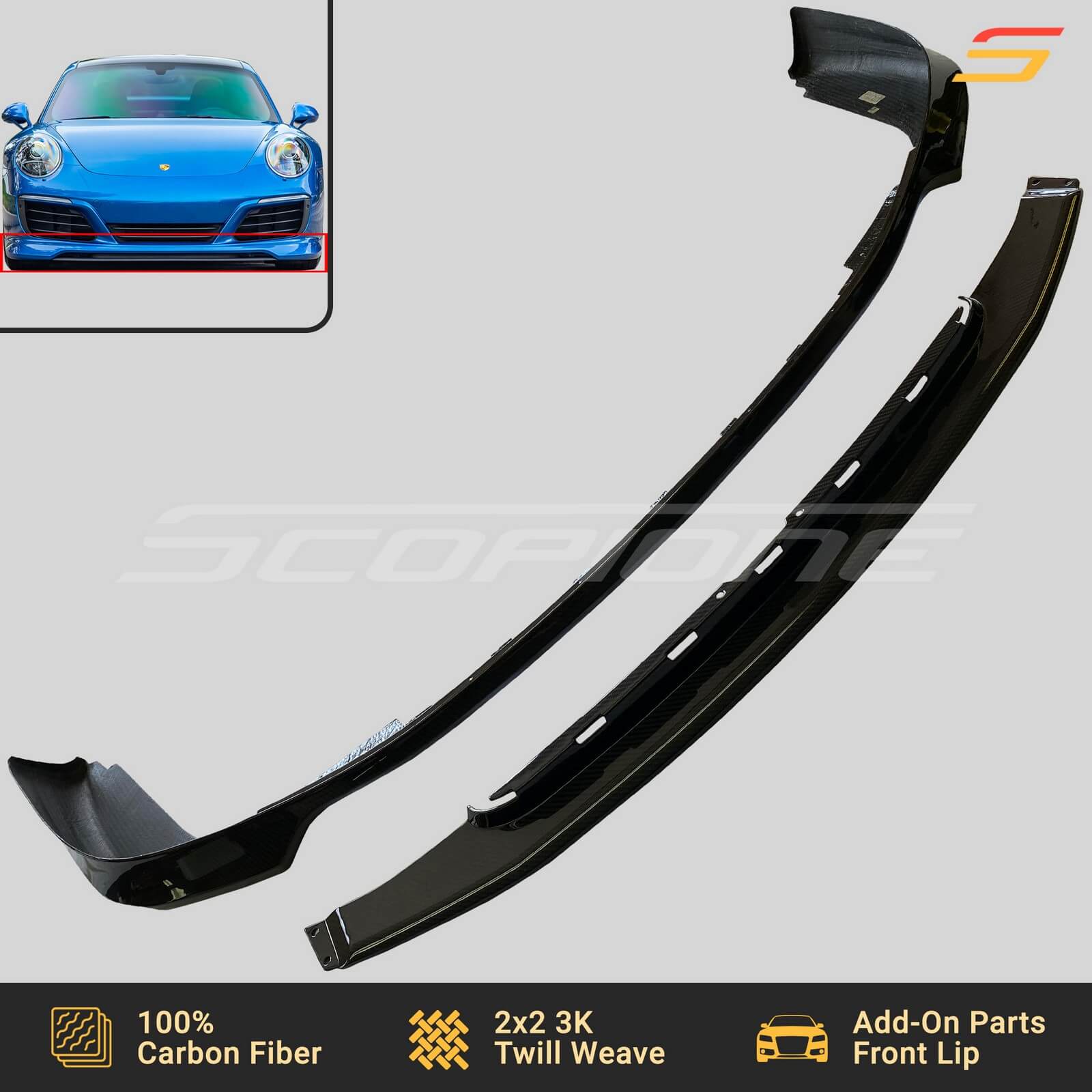
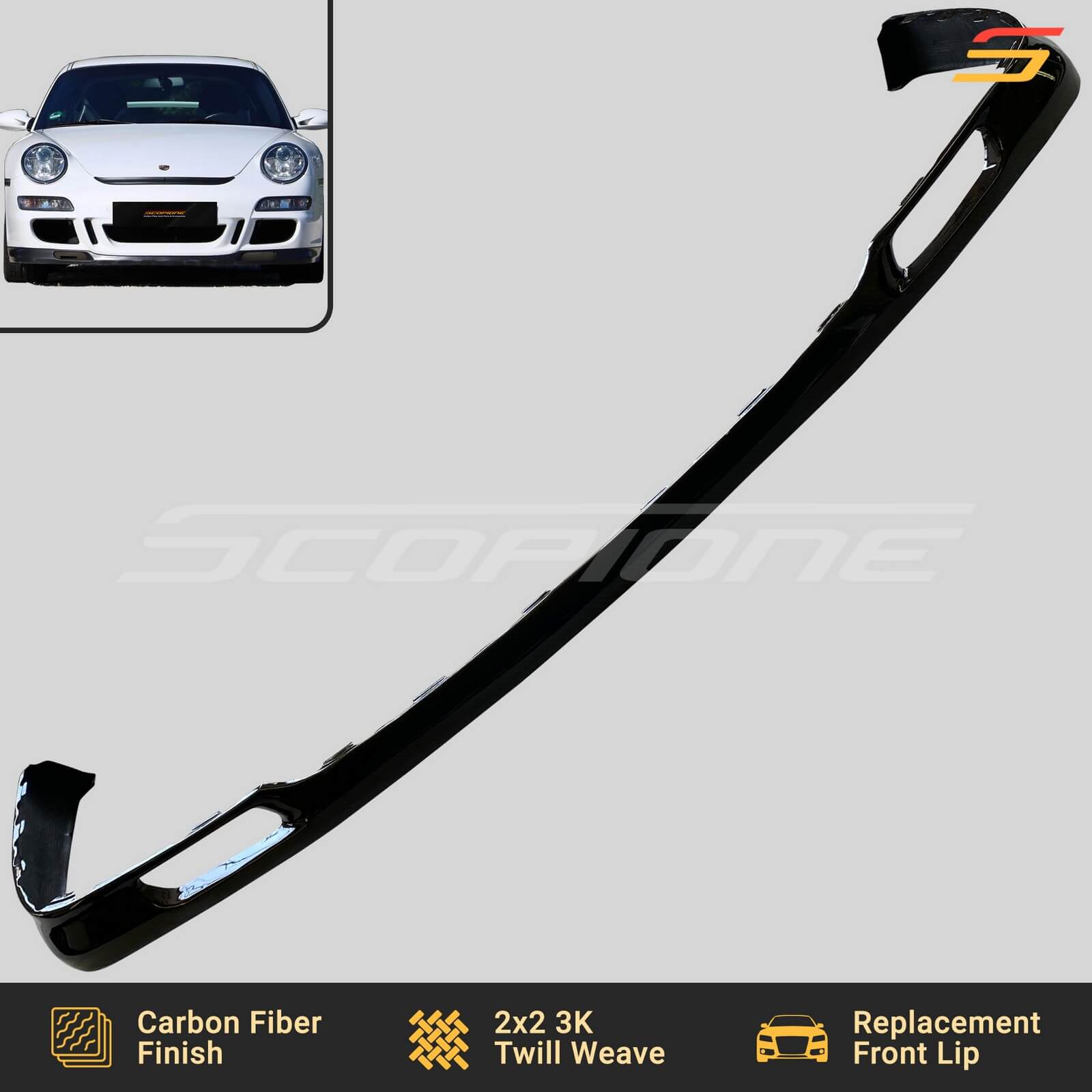
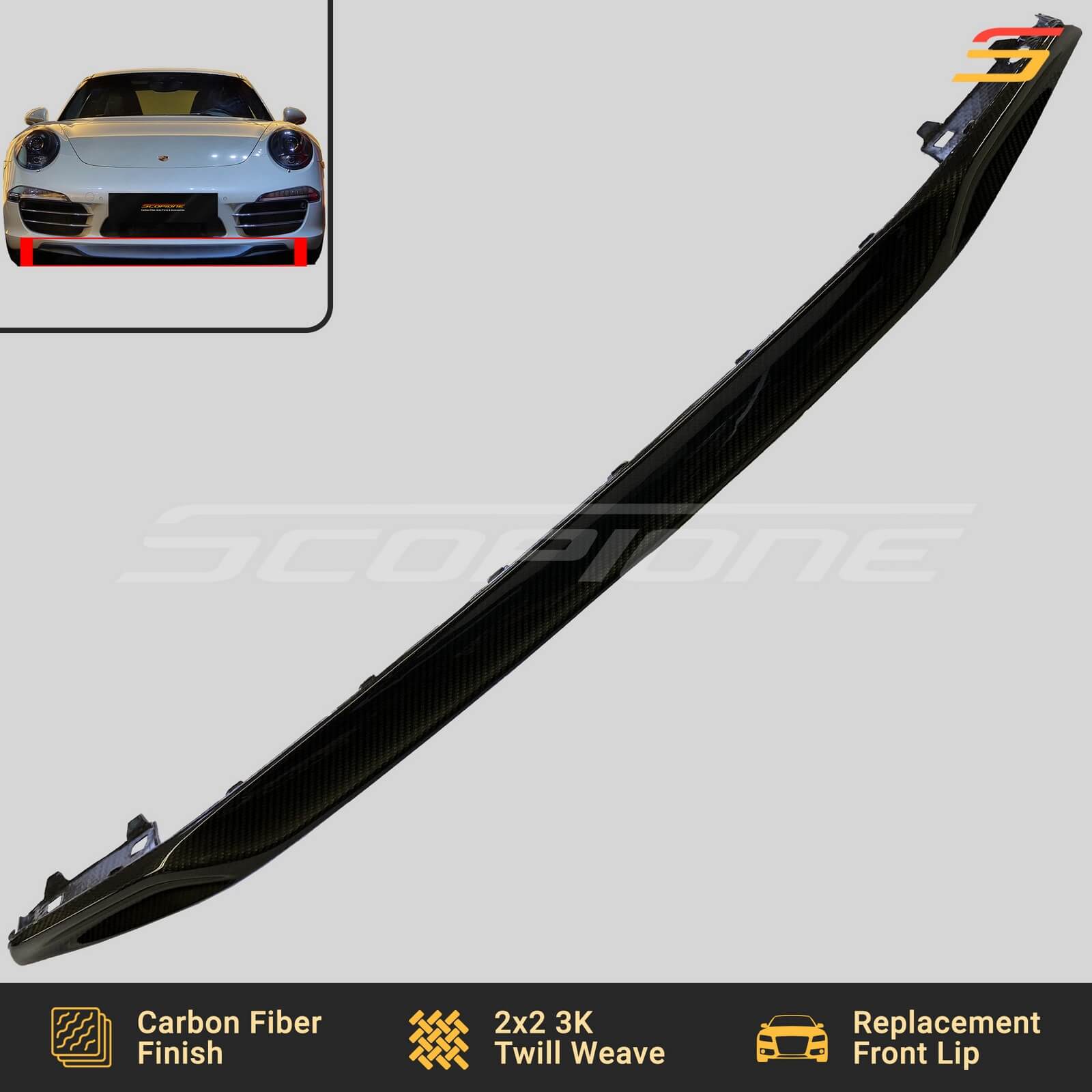
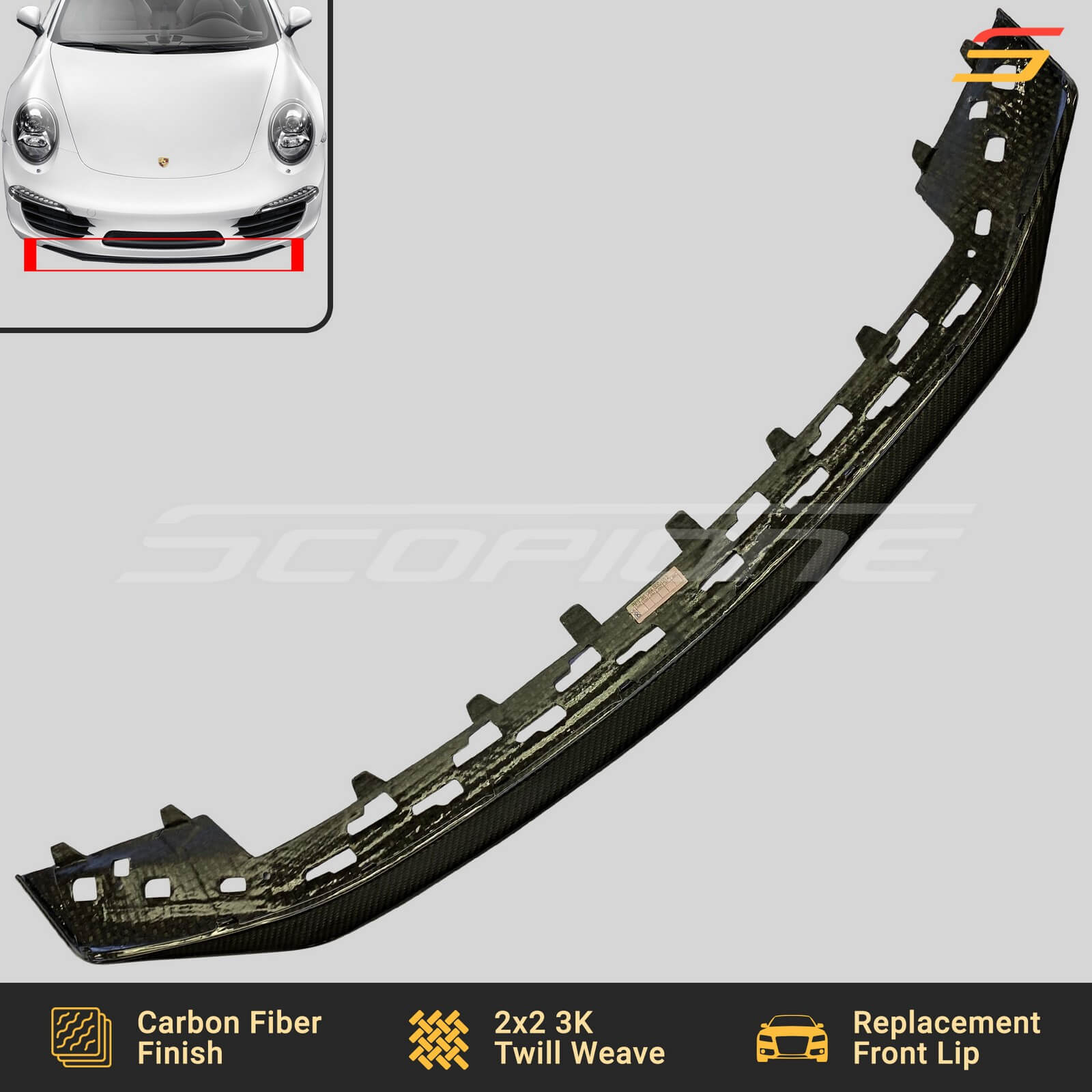
- Front lip spoilers – Available for the 997 Carrera/GT3 RS ($1,100), 991.1 Carrera ($750–$950 standard or V-profile), and 991/991.2 Carrera ($1,500 add-on lip spanning both generations). Each uses 2×2 3K twill-weave carbon fiber with a glossy UV-resistant clear coat. The add-on style mounts to the existing bumper without replacement; the standard lip is a direct swap for the factory component.
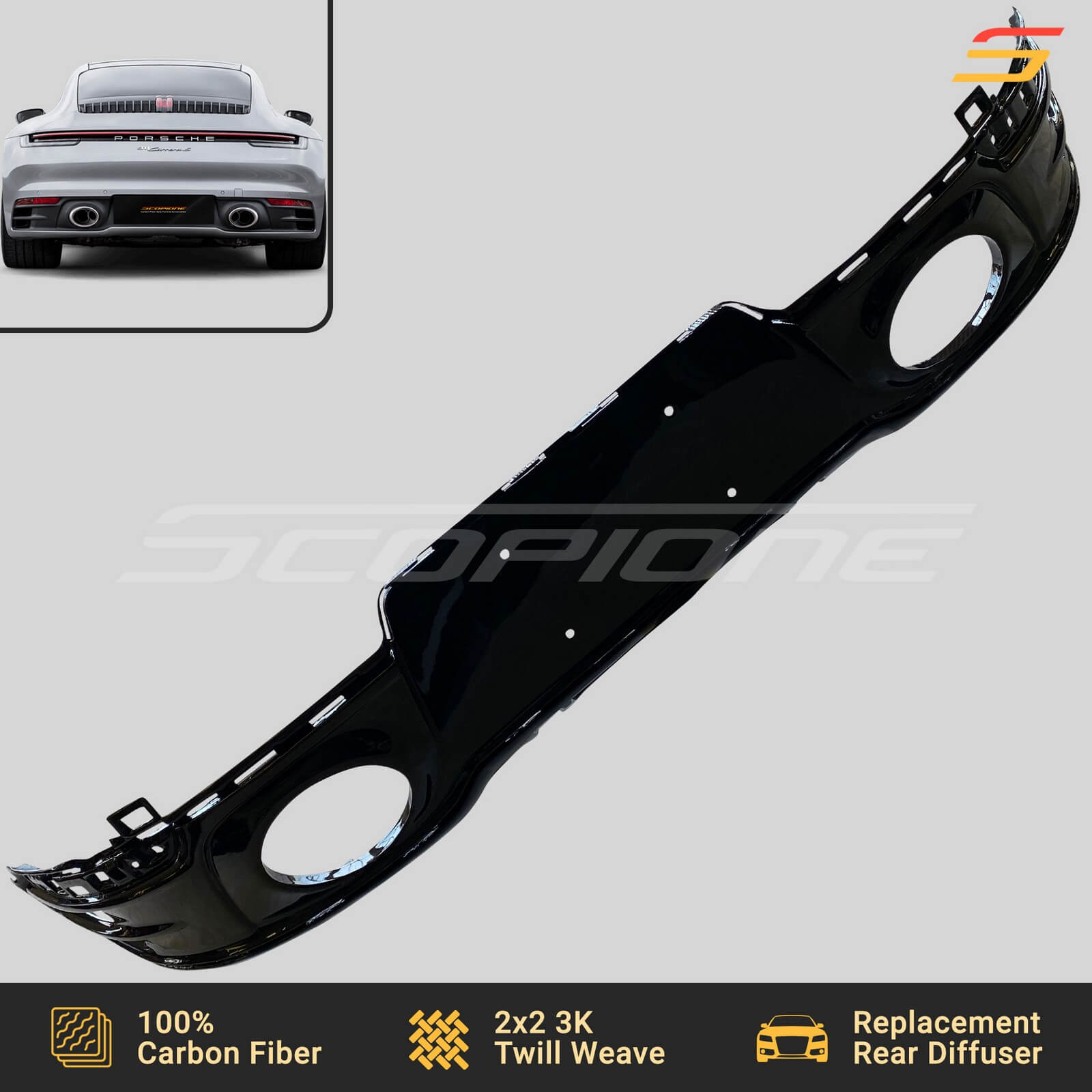
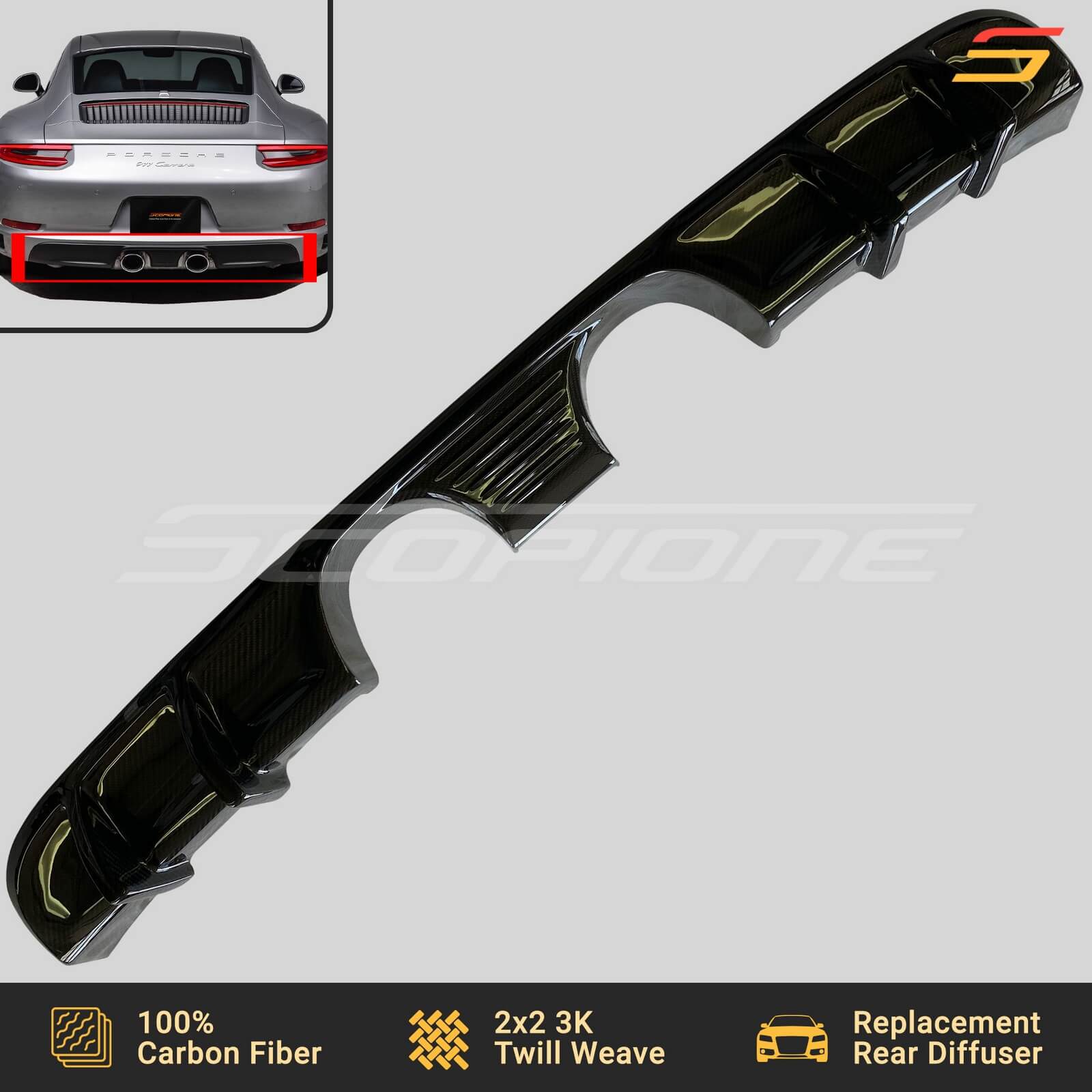
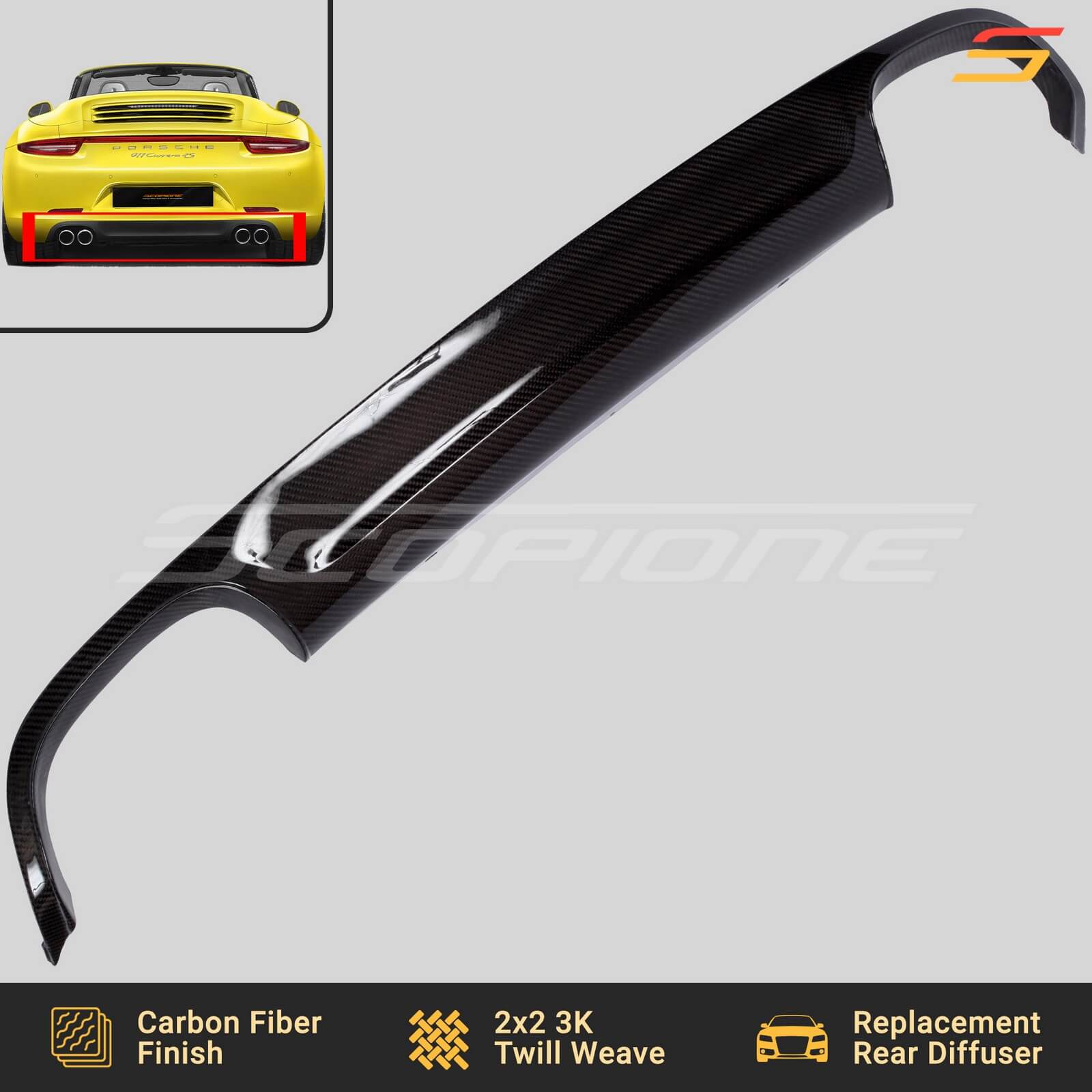
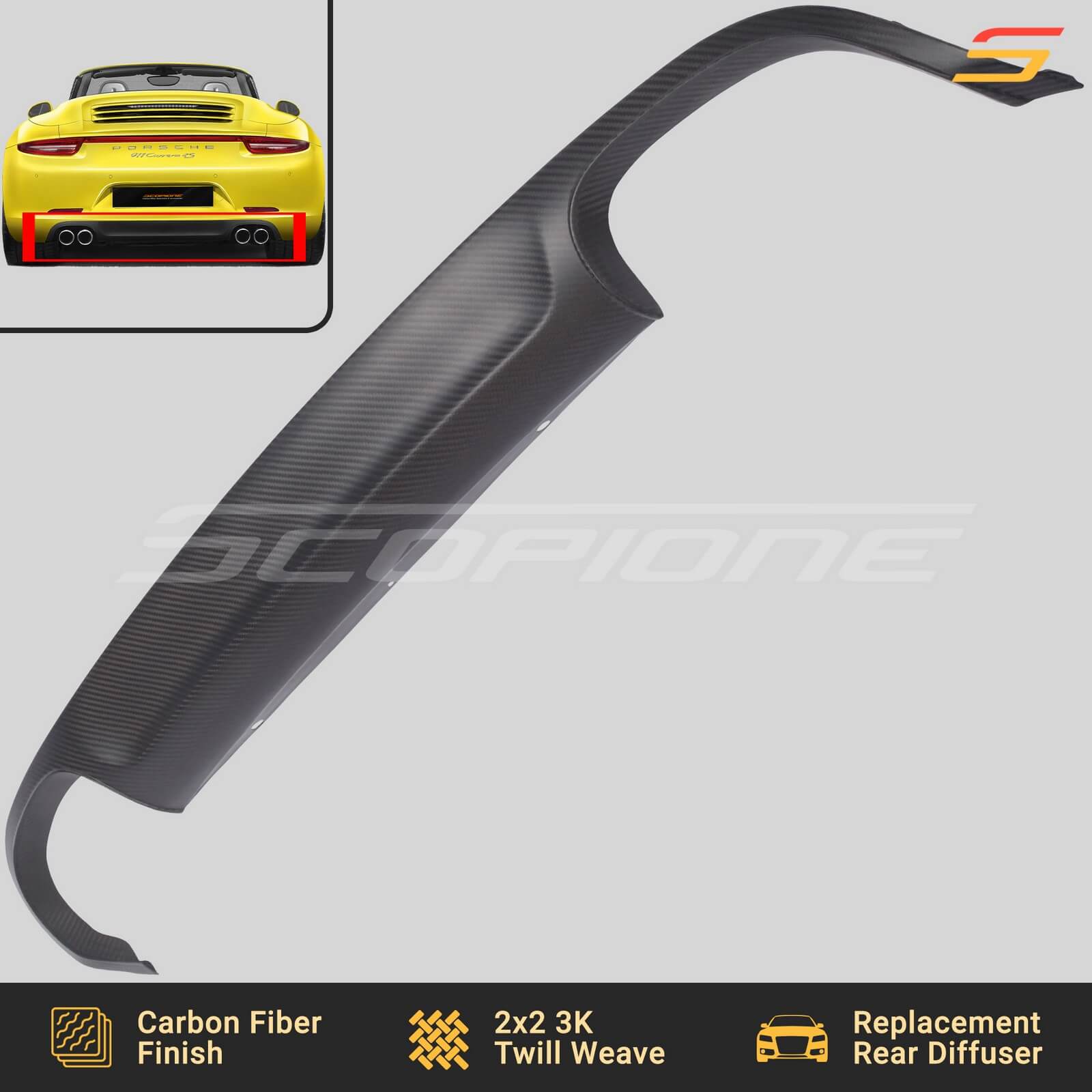
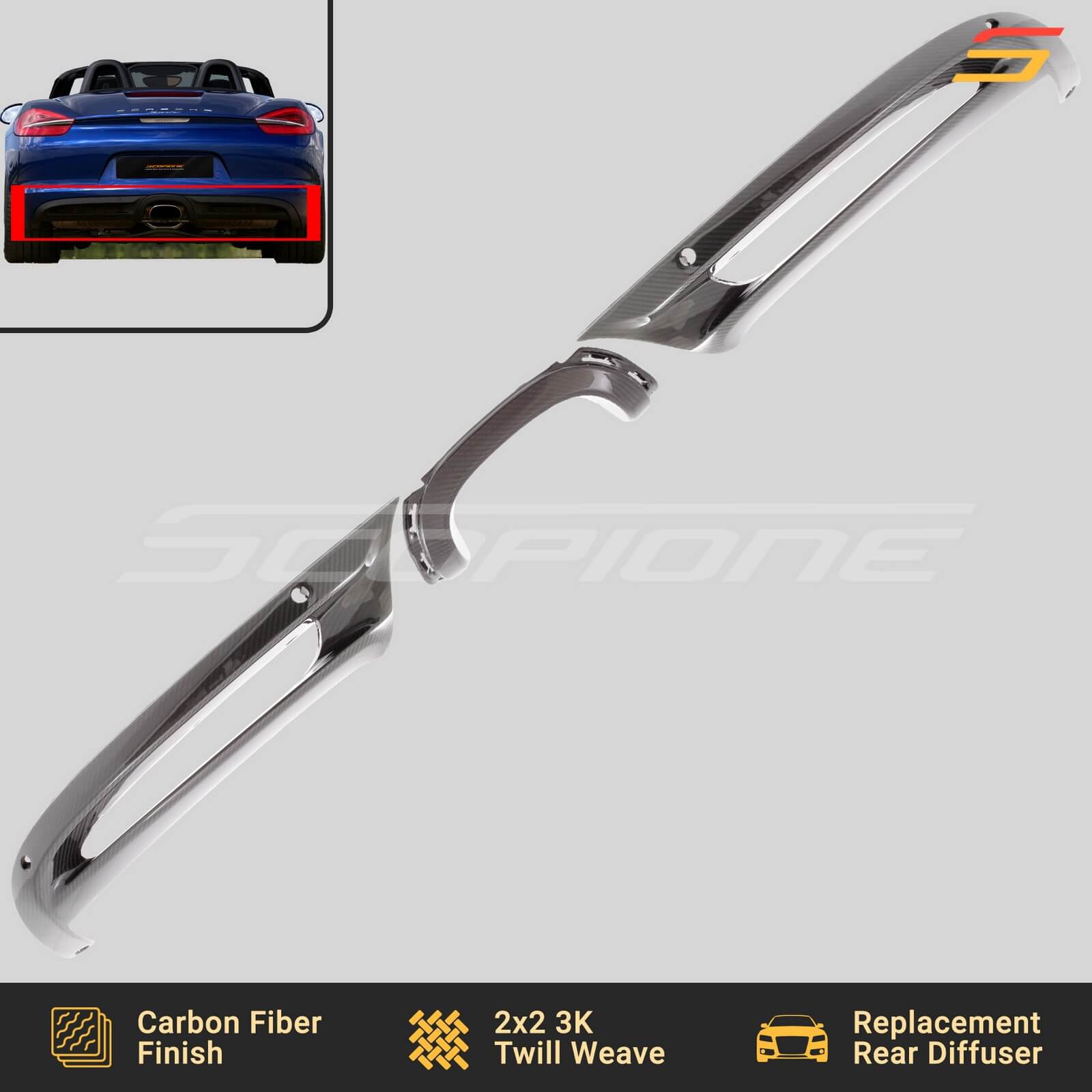
- Rear bumper diffusers – The single highest-impact exterior upgrade. Scopione offers glossy ($1,400) and matte ($1,300) finish options for the 991.1 Carrera, a 991.2-specific fitment ($1,500) for the facelifted bumper, and a current-generation 992 diffuser ($2,300). The Boxster/Cayman 981 gets its own dedicated diffuser ($800). None of these fit GT3, GT2, or Turbo bumpers – those cars use model-specific aerodynamics.
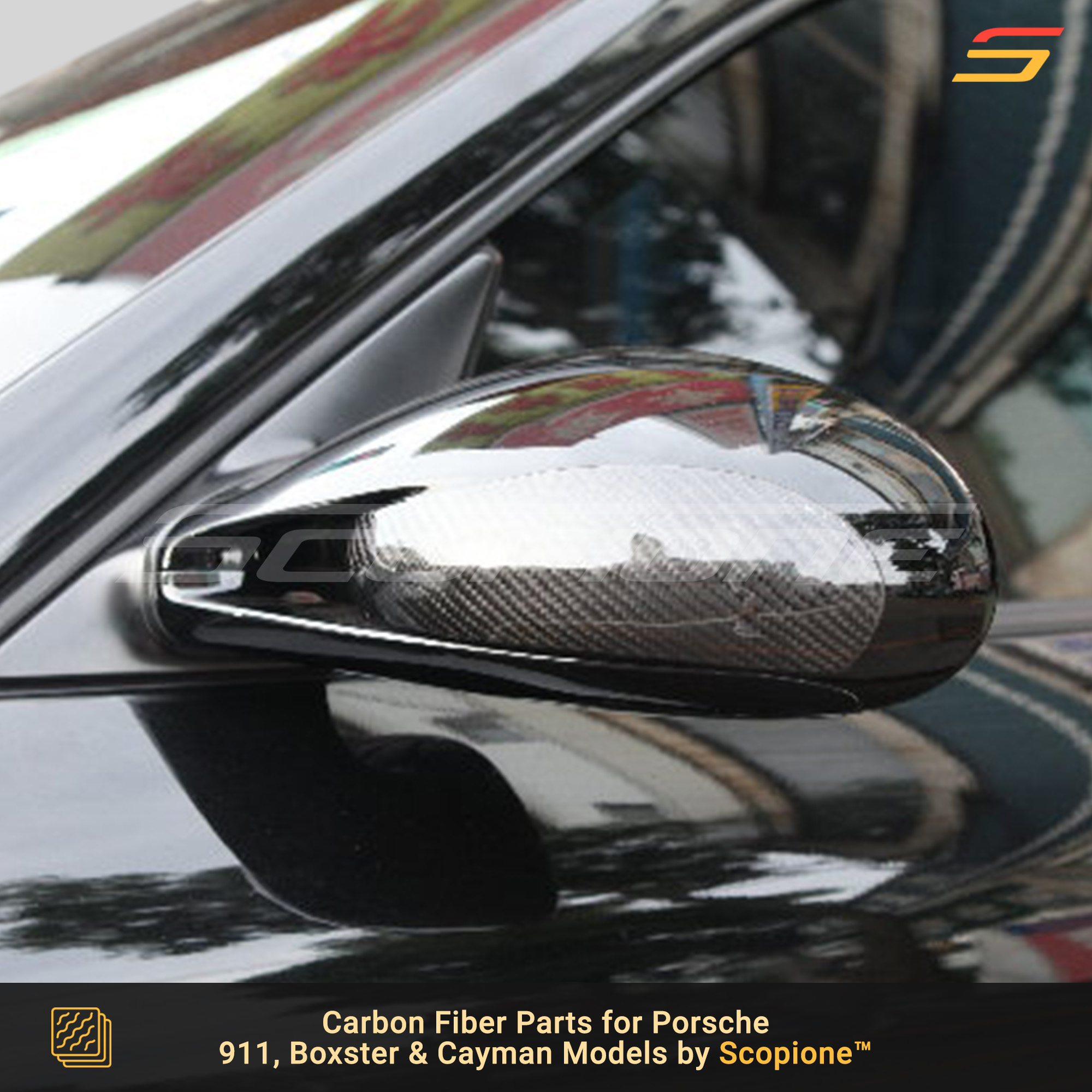
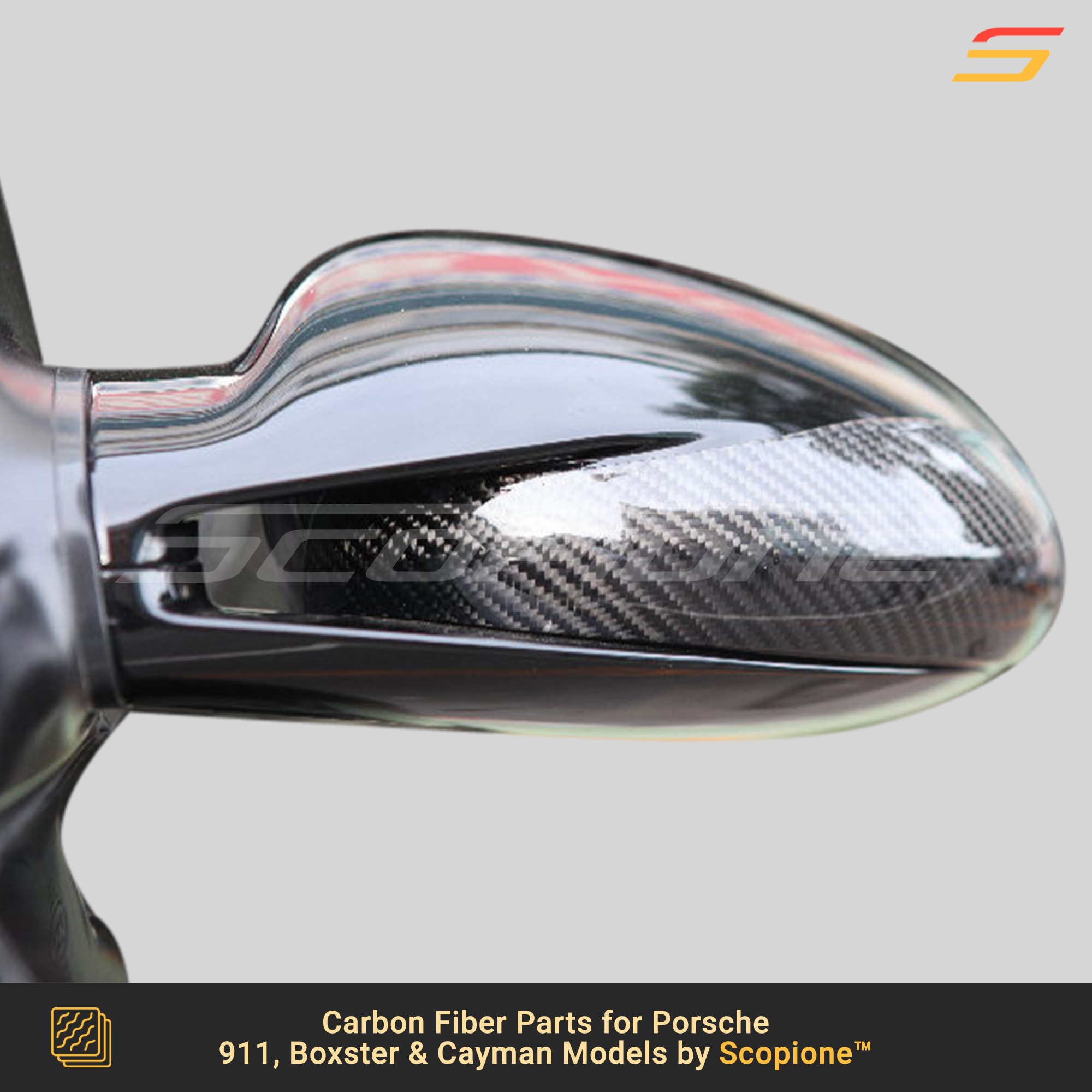
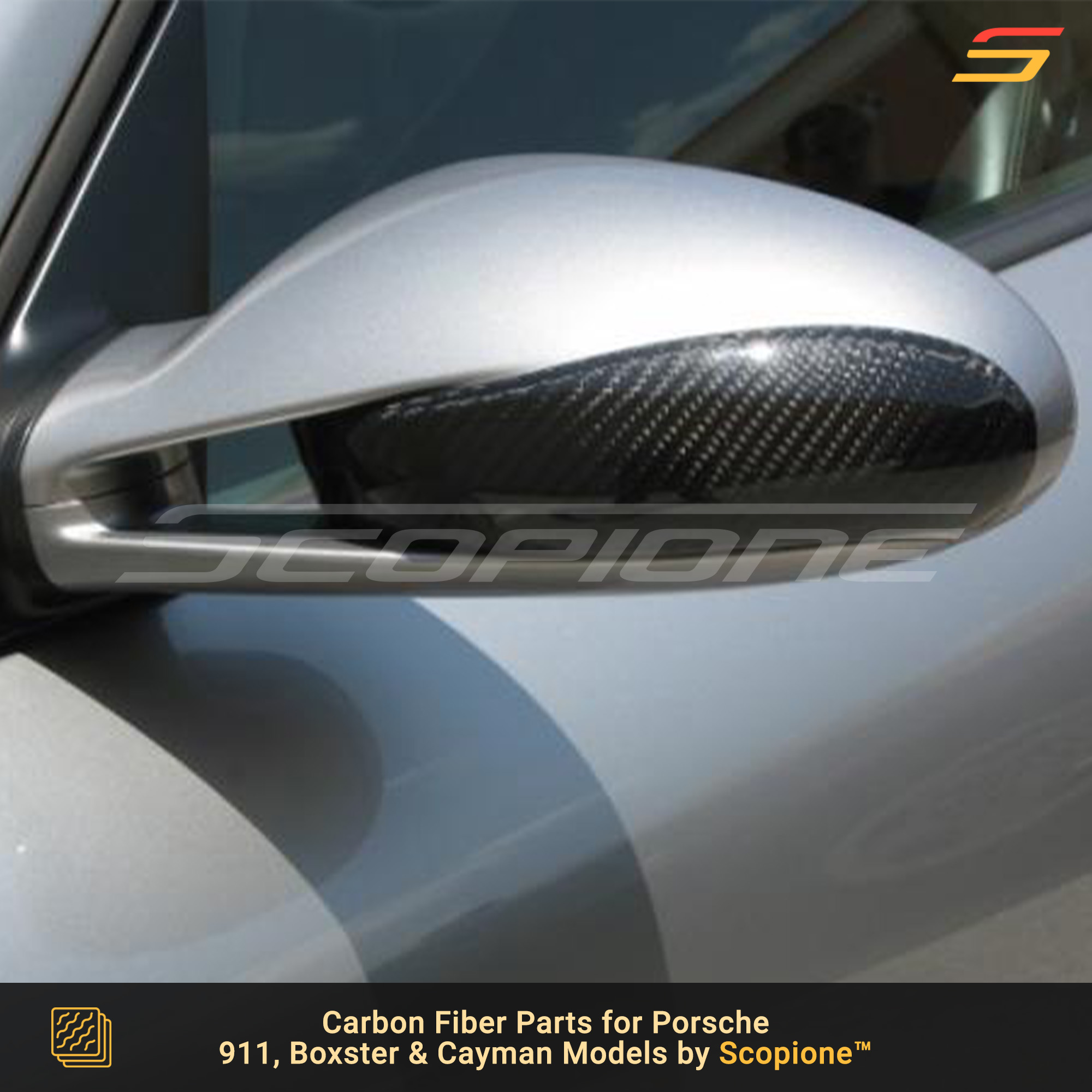
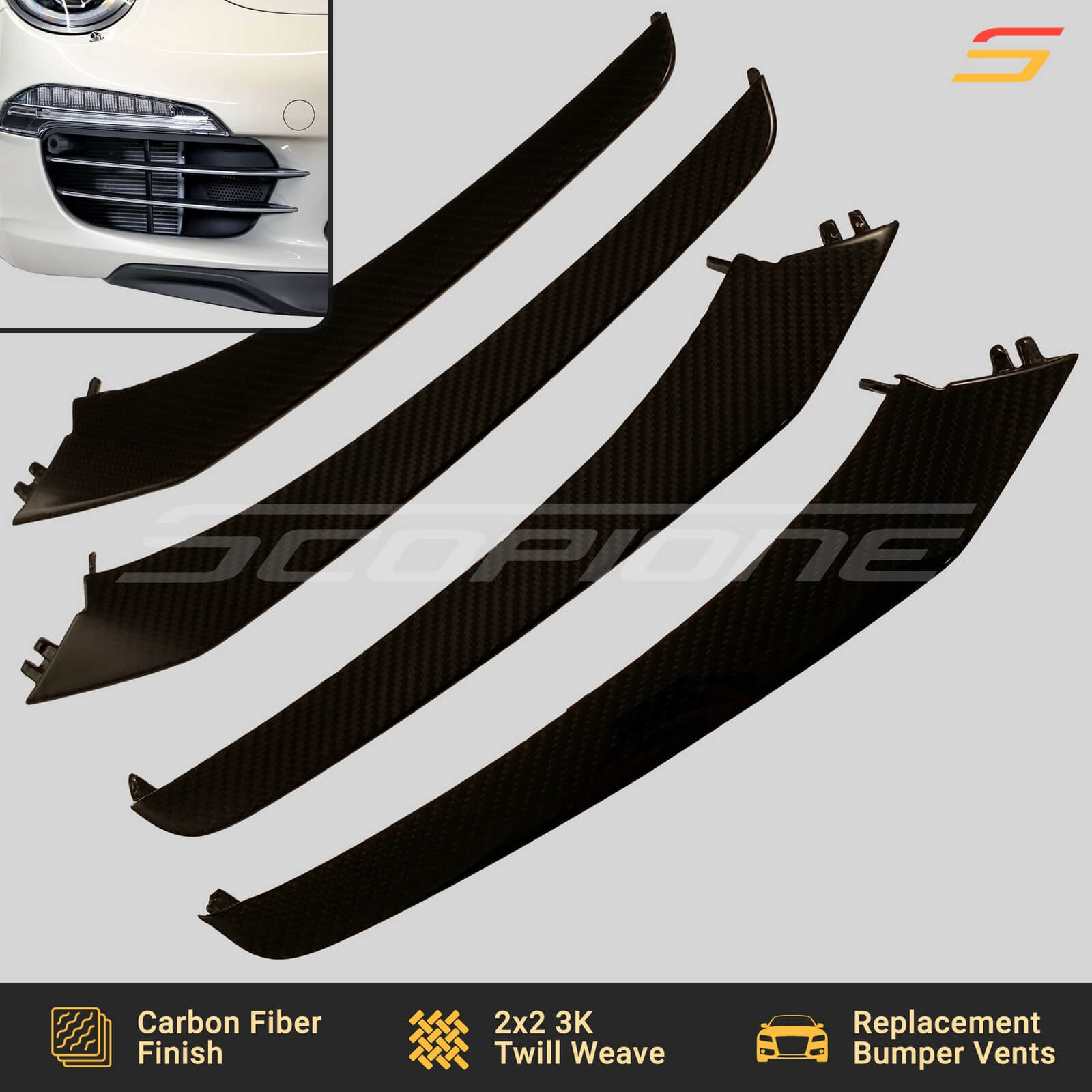
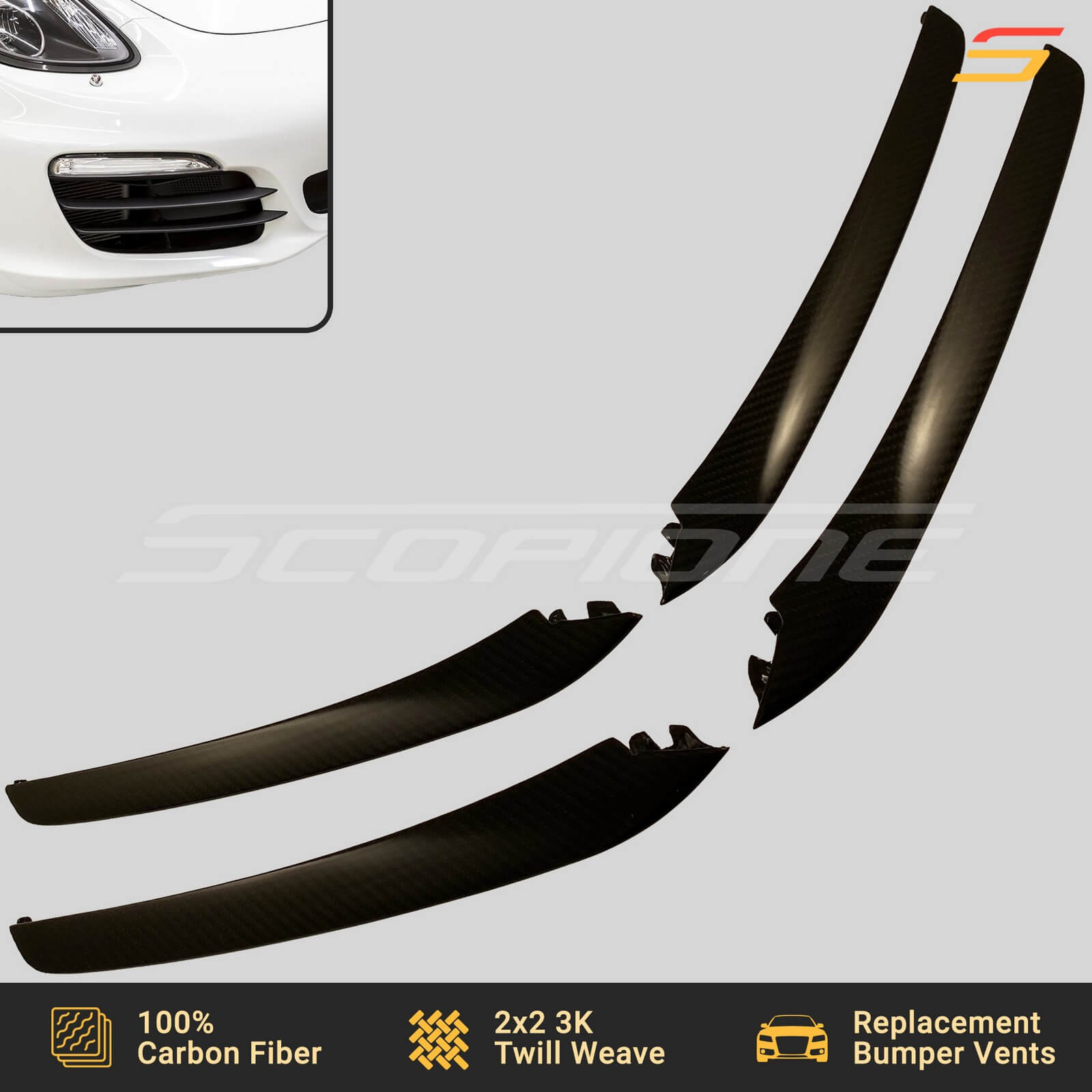
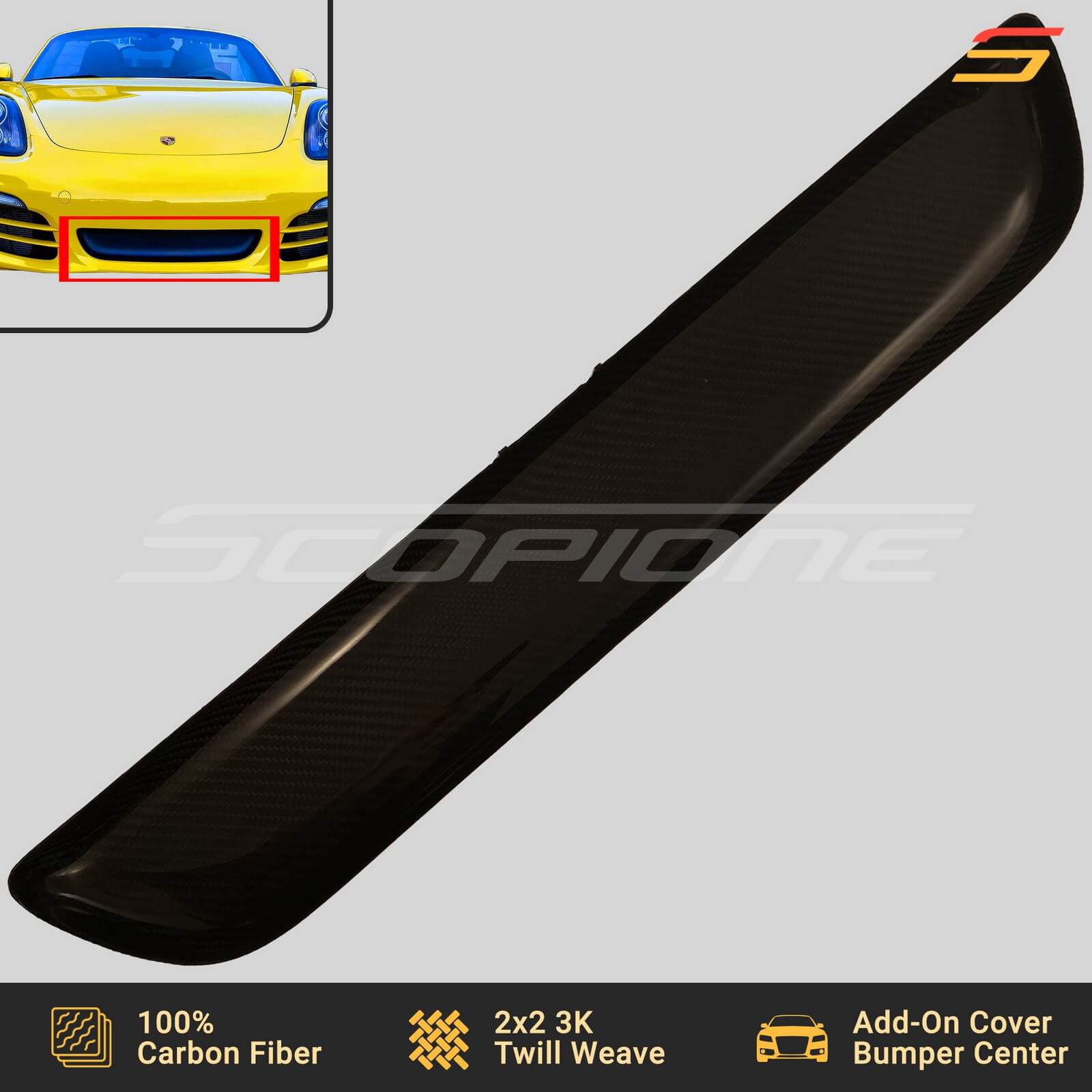
- Grille vents and covers – The 991.1 Carrera S front bumper grille vents ($700), 997 GT3 RS smile grille vent ($650), and Boxster 981 S front center grille cover ($400) and grille vents ($550) replace painted factory inserts with exposed twill-weave carbon fiber. Small components with outsized visual impact.
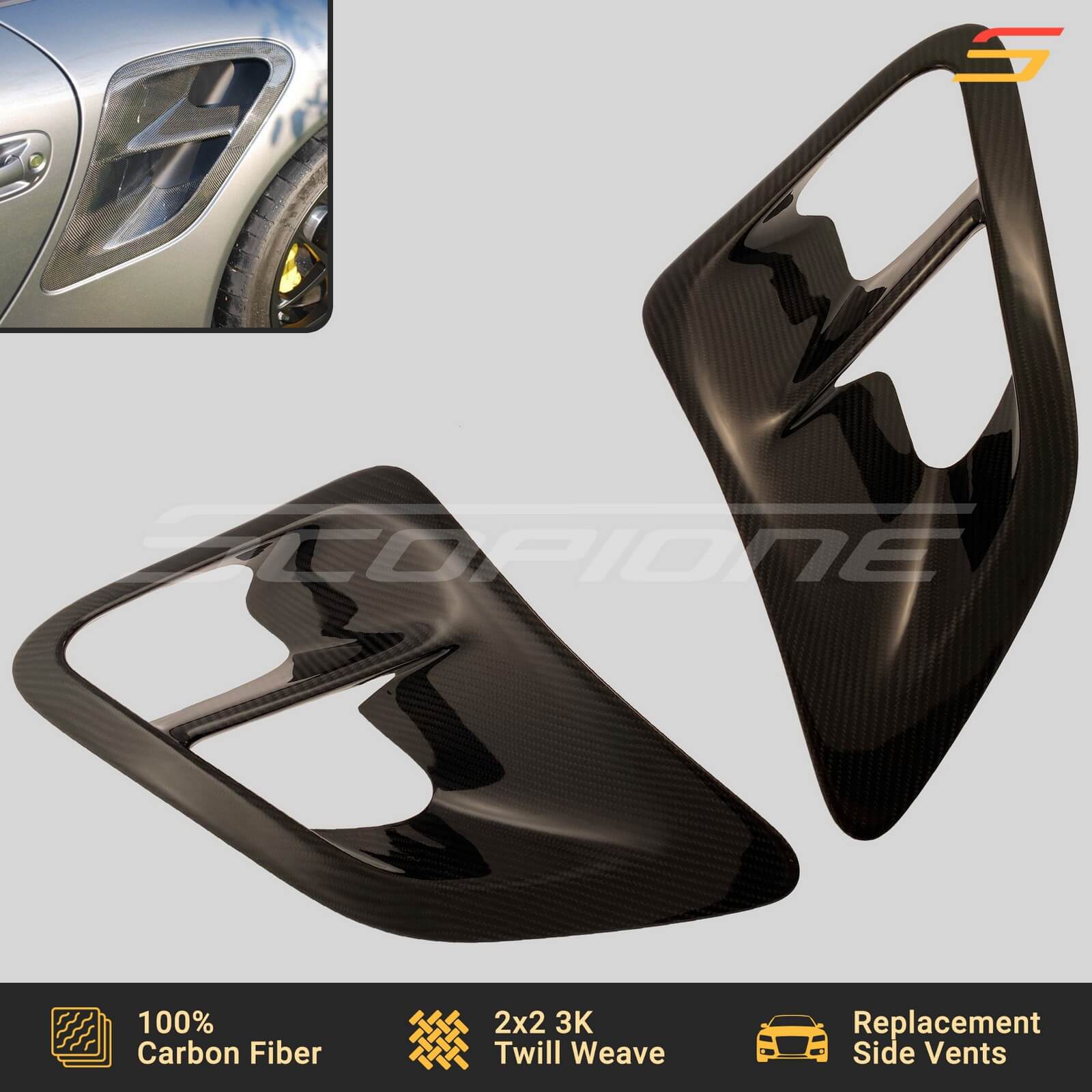
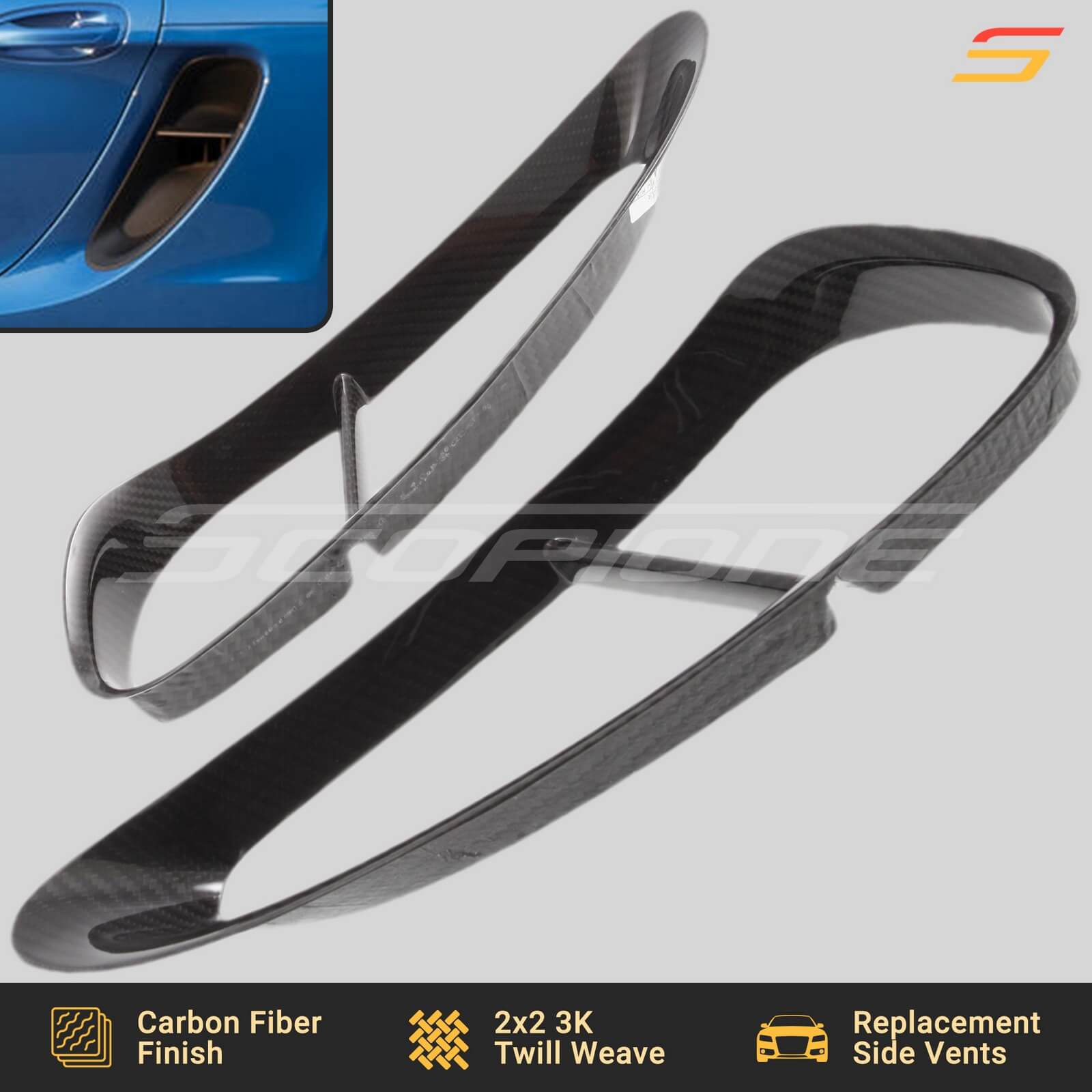
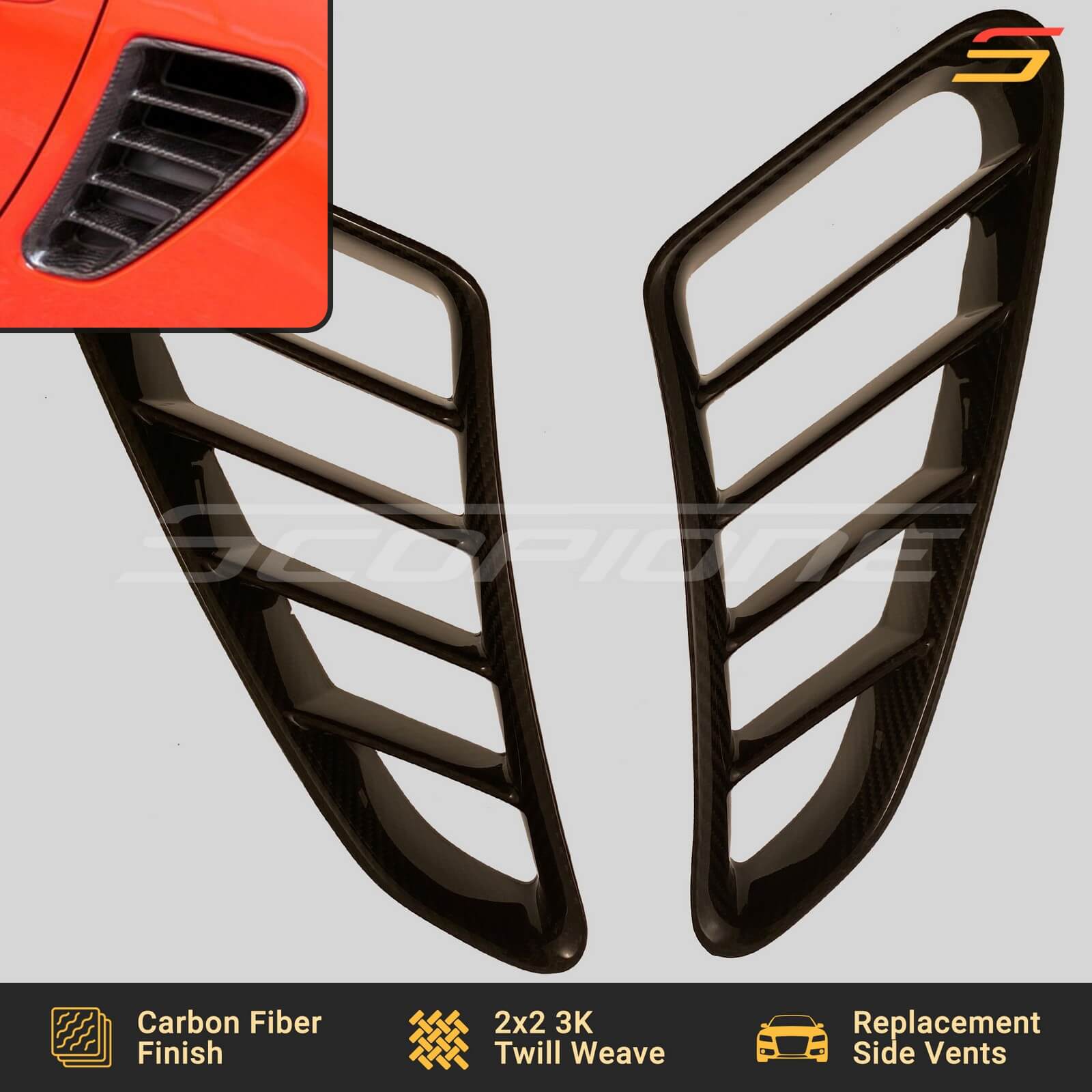
- Fender vent scoops – Carbon-fiber replacements for the 997 Turbo S/GT2 RS rear fender vents ($550), Boxster 987 rear fender vents ($400), and Boxster/Cayman 981 rear fender vents ($400). Direct swaps for factory-painted covers.
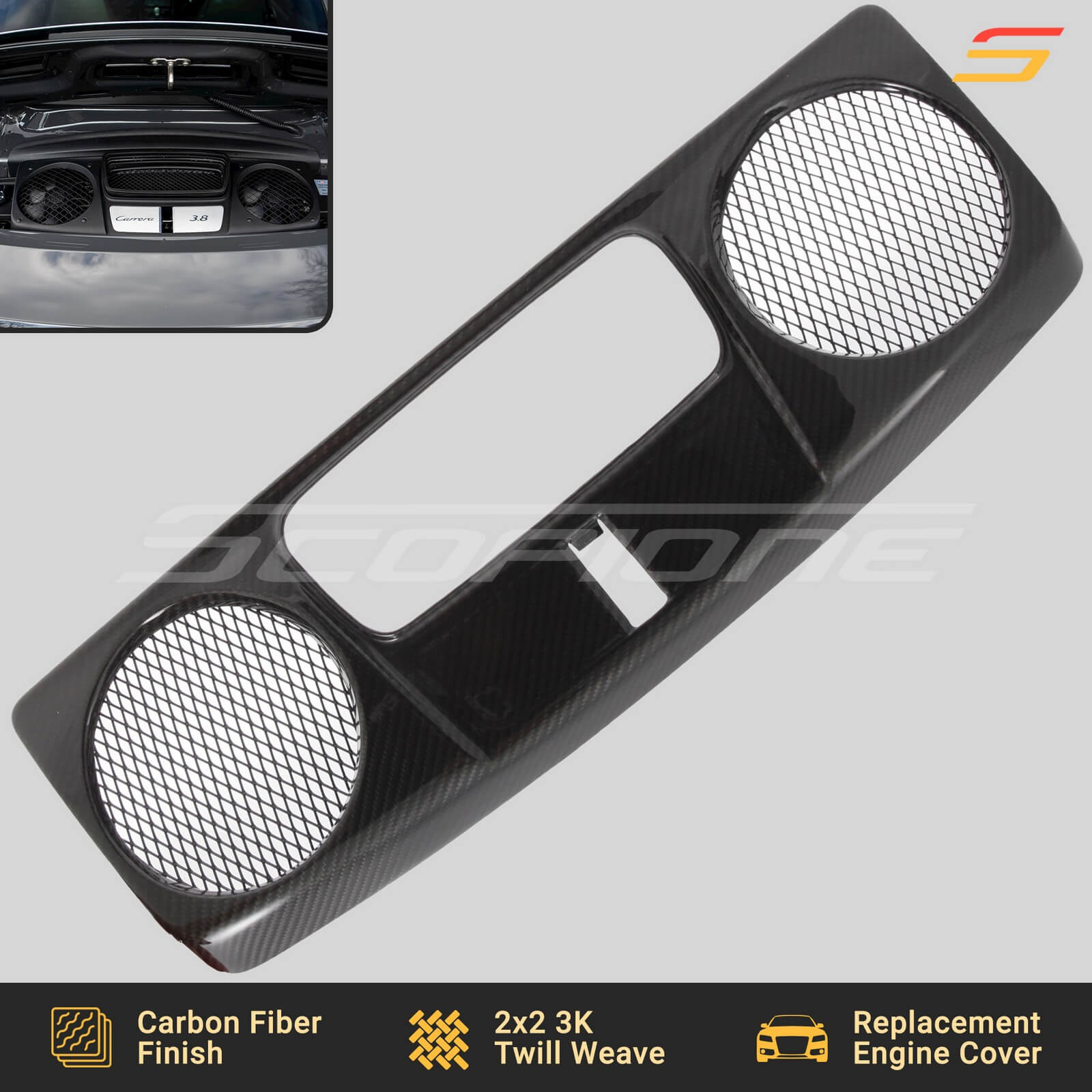
- Engine cover – A full CF replacement engine fan cover for the 991.1 Carrera ($600). One of the largest exposed exterior panels on a rear-engine 911, positioned directly above the flat-six and visible from every angle behind the car.
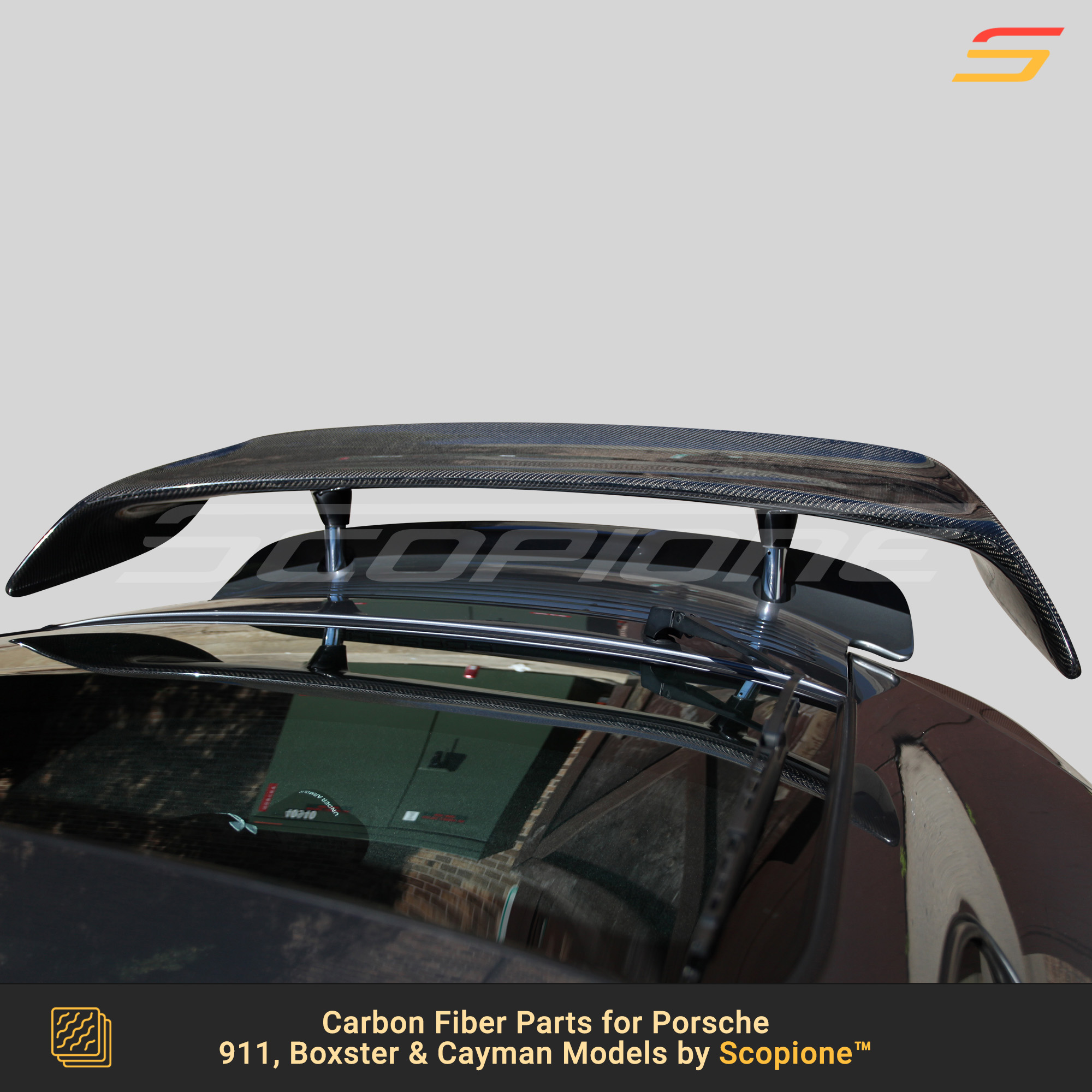
- Rear trunk spoiler – A carbon-fiber trunk spoiler for the 996 Turbo S ($1,400). The oldest Porsche product in Scopione’s catalog and a direct replacement for the factory unit.
Material and Fitment Notes
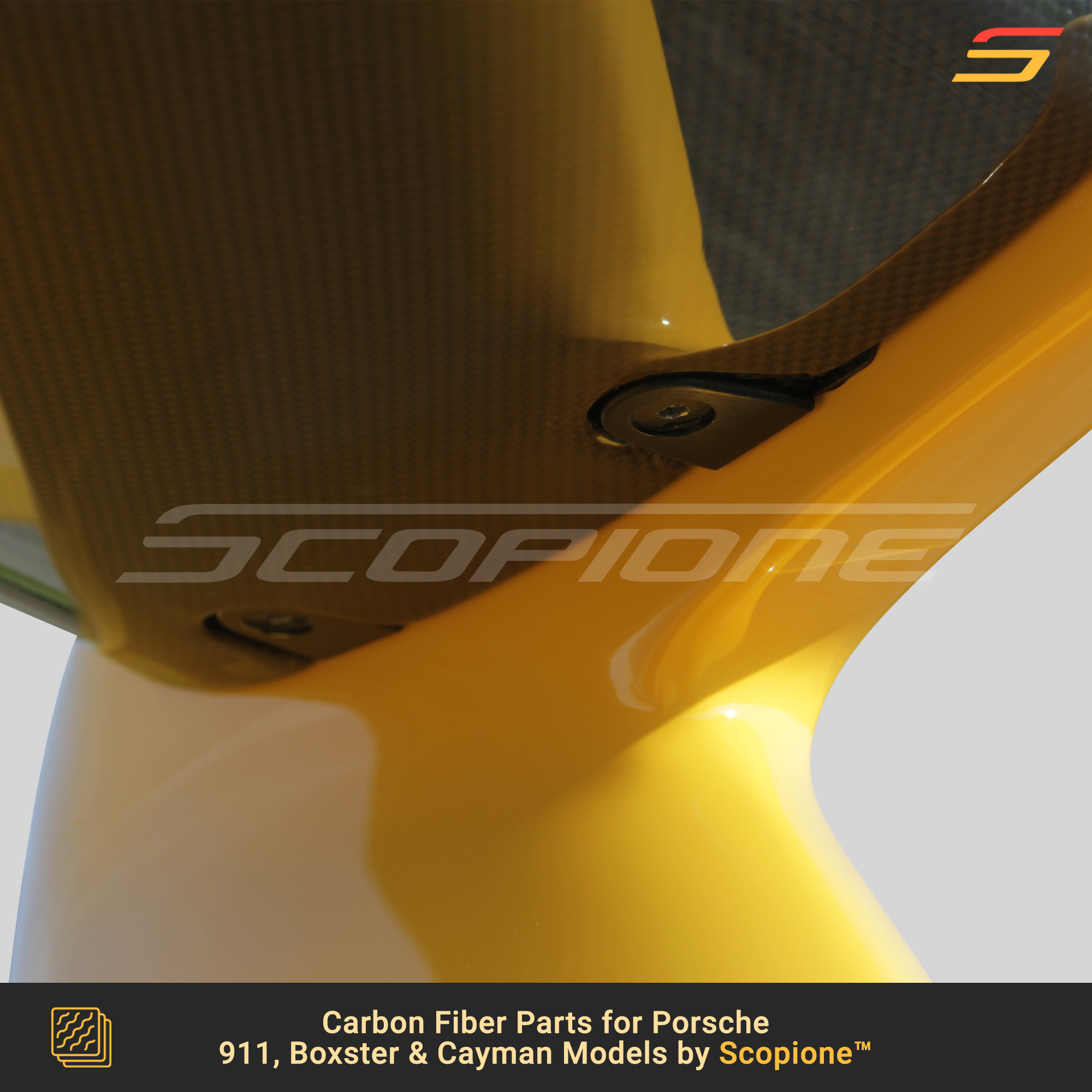
All Scopione Porsche parts use 2×2 3K twill-weave carbon fiber with a UV-resistant glossy clear coat (matte available on the 991.1 diffuser). Fitment is generation-specific: 991.1 parts do not fit the 991.2 facelifted bumper, GT3/GT2/Turbo bumpers use different geometry than Carrera, and the 981 Boxster/Cayman diffuser is not interchangeable with the 911. Installation ranges from 1–4 hours depending on the component. Lip spoilers and grille vents mount to existing hardware; diffusers require removing the factory lower panel. A dry test-fit before final fastening is recommended.
Scopione: Carbon Fiber Upgrades for the Porsche 911, Boxster & Cayman
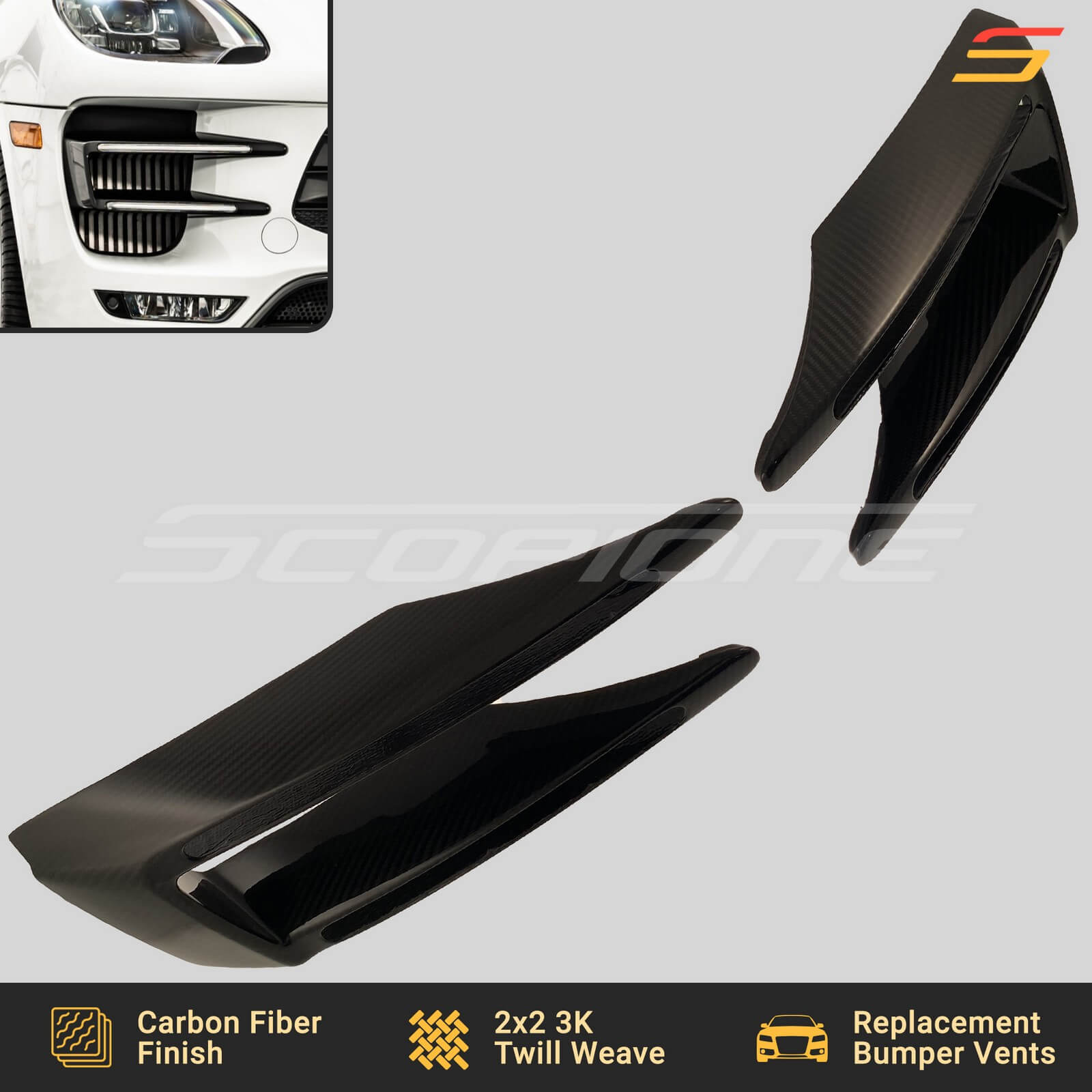
Scopione’s Porsche carbon-fiber catalog covers 18 distinct products across four 911 generations (996, 997, 991, 992) and two Boxster/Cayman generations (987, 981). Pricing ranges from $400 for Boxster fender vents to $2,300 for a 992 Carrera rear bumper diffuser. (A nineteenth part – front bumper fog light trim for the 2015–2019 Macan Turbo, $850 – sits outside the sports-car range.) Every part ships with a protective packaging system and a 12-month limited warranty against delamination and structural defects.
Cost and Value by Generation
| Generation | Products Available | Price Range | Top-Selling Part |
|---|---|---|---|
| 911 Type 996 (2001–2005) | 1 | $1,400 | Rear trunk spoiler (Turbo S) |
| 911 Type 997 (2005–2013) | 3 | $550–$1,100 | Front lip spoiler (GT3/RS) |
| 911 Type 991 (2012–2019) | 8 | $600–$1,500 | Rear bumper diffuser |
| 911 Type 992 (2020–2023) | 1 | $2,300 | Rear bumper diffuser |
| Boxster 987 (2005–2012) | 1 | $400 | Rear fender vents |
| Boxster/Cayman 981 (2013–2016) | 4 | $400–$800 | Rear bumper diffuser |
The 991 generation dominates the catalog with eight products – reflecting both the 991’s production volume (233,540 units) and its position as the most actively customized 911 generation. Six of those eight products fit the 991.1 (2012–2016), one is a dedicated fitment for the 991.2 facelifted bumper, and a cross-generation add-on lip spans both.
Used Market Pricing and Investment Outlook
The Porsche sports car range presents a stratified market. Base Carrera models follow conventional depreciation curves but appear to have reached price floors: the 996 Carrera settles around $20,000–$50,000, the 997 Carrera around $35,000–$75,000. The 991 Carrera currently trades at $55,000–$110,000 depending on spec and mileage. At these price points, a $750–$1,500 Scopione carbon-fiber upgrade represents 1–3% of the car’s value – a modest investment that improves visual presence without affecting mechanical resale factors.
GT models occupy an entirely different tier. The 997 GT2 RS has reached $830,000–$865,000 at auction. The 997 GT3 RS 4.0 (600 built) trades around $500,000–$800,000. The 911 R commands $480,000–$600,000 – more than triple its original $184,900 MSRP. Recent verified auction results:
| Model | Sale Price | Auction / Date |
|---|---|---|
| 2011 997 GT2 RS (379 miles) | $830,000 | Broad Arrow Monterey, Aug 2024 |
| 2011 997 GT2 RS | $865,000 | Jun 2025 (highest recorded) |
| 2016 911 R (1K miles) | $532,991 | Bring a Trailer, Aug 2025 |
| 2016 911 R | $600,000 | Bring a Trailer, Oct 2025 |
| 2024 992 GT3 RS | $417,500 | Worldwide Auctioneers Auburn, Aug 2025 |
| 2018 991 GT2 RS | $395,500 | Worldwide Auctioneers Auburn, Aug 2024 |
| 2007 997 GT3 RS | $341,000 | Mecum Monterey, Aug 2025 |
The mid-engine cars follow their own trajectory. Base 986 Boxsters start at $7,000–$20,000, making them among the most accessible Porsche entry points. The 987 Boxster/Cayman trades at $14,000–$40,000. Flat-six 718 variants (GTS 4.0, GT4, Spyder, GT4 RS) hold significantly stronger residual values than the flat-four base and S models, with the GT4 RS commanding $190,000–$230,000 on the secondary market as the first Cayman RS and the last combustion-only mid-engine Porsche.
Ownership Costs and Known Issues
Annual servicing for Carrera models runs $1,000–$2,500 at independent Porsche specialists, with Porsche Center pricing 30–40% higher. Turbo and GT models cost $2,000–$4,000 annually. The major known maintenance items by generation:
- 996 and 997.1 (M96/M97 engines) – IMS bearing replacement: $2,500–$4,000 preventive. Rear main seal (RMS): $2,000–$3,000. Cars with documented IMS replacement sell for 10–15% more than equivalent cars without. Turbo, GT2, and GT3 models use the Mezger engine and are unaffected by IMS concerns.
- 991 and 992 (direct injection) – Carbon buildup on intake valves requires walnut blasting every 30,000–50,000 miles ($500–$800). PDK service runs $2,000–$3,000 at scheduled intervals.
- All generations – PCCB carbon-ceramic brake replacement: $8,000–$12,000 per axle. Staggered tire replacement: front $300–$500/pair, rear $400–$700/pair. GT3 RS and GT4 RS on semi-slick tires: $1,500–$2,500 per set.
Pricing Factors That Affect Porsche Values
- Manual vs PDK transmission – Manual-equipped 911s carry 10–25% premiums over PDK equivalents in the GT market. The 911 R, S/T, and 997 Sport Classic are manual only. Manual Carrera GTS models from the 997 and 991 generations also hold stronger resale.
- Paint to Sample (PTS) colors – Special-order PTS colors add $20,000–$50,000+ to GT car values. Standard silver, black, and white trade at baseline.
- Flat-four vs flat-six (718 models) – The 718 base and S models with turbo flat-four engines depreciate faster than GTS 4.0, GT4, and Spyder variants equipped with naturally aspirated flat-sixes.
- Weissach package (991.2 GT3 RS, GT2 RS) – Carbon-fiber body panels and magnesium wheels, reducing weight by approximately 30 kg. Weissach-equipped GT2 RS models command $20,000–$40,000 premiums.
- Service history documentation – Porsche Center service records sell for 10–15% more than independent records. For 996 and 997 models, documented IMS and RMS replacement is critical to value.
Which Porsche 911 Generations Fit Scopione Carbon Fiber Parts?
Scopione offers carbon fiber components for four 911 generations. The 996 Turbo S (2001–2005) receives a rear trunk spoiler. The 997 Carrera and GT3 RS (2005–2013) are covered by front lip spoilers, grille vents, and rear fender vents. The 991 Carrera in both 991.1 and 991.2 (2012–2019) has the widest selection: front lips in standard and V-profile, rear diffusers in glossy and matte, grille vents, and a full CF engine cover. The 992 Carrera (2020–2023) receives a rear bumper diffuser. All parts use 2×2 3K twill-weave carbon fiber with UV-resistant clear coat. Fitment is model-specific – 991.1 parts do not fit the 991.2 facelifted bumper, and no parts are designed for GT3, GT2, or Turbo bumpers.
Does Carbon Fiber Affect the Resale Value of a Porsche 911?
Quality carbon-fiber components from documented sources can maintain or enhance resale value on Porsche sports cars. Rear diffusers and front lip spoilers create the highest visual impact on Carrera models. On the 991 and 992, carbon-fiber upgrades align with the same material used on factory GT3 RS and GT2 RS body panels, making aftermarket pieces a natural visual extension of the Porsche carbon-fiber aesthetic. The key is retaining the original factory parts for buyers who prefer stock presentation – reversibility is a selling point.
What Are Common Porsche 911 Maintenance Costs and Known Issues?
Annual service runs $1,000–$2,500 for Carrera models at independent specialists and $2,000–$4,000 for Turbo and GT variants. The 996 and 997.1 generations have a known IMS bearing concern – preventive replacement costs $2,500–$4,000 and cars with documented replacement sell for 10–15% more. The 991 and 992 direct-injection engines require walnut blasting for carbon buildup every 30,000–50,000 miles ($500–$800). PCCB carbon-ceramic brake replacement runs $8,000–$12,000 per axle. All Turbo, GT2, and GT3 models from the 996 and 997 era use the Mezger engine, which is unaffected by IMS bearing issues.
Is a Porsche 911 GT3 or GT2 RS a Good Investment?
GT-series 911s consistently hold or appreciate in value. The 997 GT2 RS has reached $830,000–$865,000 at auction – up from its original $245,000 MSRP. The 911 R trades at $480,000–$600,000, more than triple its $184,900 list price. The 991 GT2 RS commands $360,000–$455,000 as the last purely combustion-powered GT2. The 992 GT3 RS has already cleared $400,000 at auction despite a $229,000 MSRP. Every GT-class 911 from the 997 generation forward has outperformed its original sticker price, with manual-transmission variants and Weissach-package cars commanding the strongest premiums.
What Carbon Fiber Parts Are Available for the Porsche Boxster and Cayman?
Scopione stocks carbon fiber components for two mid-engine Porsche generations. The Boxster 987 (2005–2012) receives rear fender vent scoops ($400). The Boxster/Cayman 981 (2013–2016) has four products: a rear bumper diffuser ($800), rear fender vents ($400), front bumper grille vents for the Boxster S ($550), and a front center grille cover for the Boxster S ($400). All parts use 2×2 3K twill-weave carbon fiber with UV-resistant glossy finish. The 981 diffuser fits both Boxster and Cayman but not the GT4. No parts are currently available for the 986 Boxster or 718 (Type 982) generation.
Browse the complete carbon-fiber lineup and installation photos at the Scopione Porsche carbon fiber page.
Back to Top ↑
Carbon Fiber Parts for the Porsche 911, Boxster and Cayman
The 19 carbon fiber parts Scopione currently lists for the Porsche 911, Boxster and Cayman. Each image links to its product page.
More Scopione Picture Galleries
- Ferrari: 458 Italia & Spider • 488 GTB & Spider • F8 Tributo & Spider • F12 & 812 Superfast • SF90
- Lamborghini: Gallardo • Huracan • Aventador • Urus
- McLaren: MP4-12C & 650S • 720S & 765LT • Sports Series
- BMW: M3, M4, M5 & More
- Audi: R8
- Nissan: GT-R R35 • 350Z, 370Z & Z
- Aston Martin: Vantage, DB9 & DBS
- Bentley: Continental GT & GTC
- Maserati: GranTurismo & GranCabrio
- Toyota: Supra
- Subaru: WRX STI
- Mitsubishi: Lancer Evolution
- Chevrolet: Corvette • Camaro
- Dodge: Viper
Experience the elegance and performance of the Porsche 911, Boxster & Cayman with Scopione. Browse our gallery and get inspired to elevate your supercar with our top-of-the-line carbon fiber upgrades.
Shop now for premium ScopioneCarbon carbon fiber upgrades and experience the ultimate in performance and aesthetics for your Porsche 911, Boxster & Cayman!