

 Shop
ShopThe BMW M division has built over 500,000 performance vehicles since its founding in 1972 – from the M1 supercar through six generations of M3 sedans and coupes, the twin-turbo M5, and the X5 M and X6 M performance SUVs. Scopione carries 117 parts for BMW, covering front splitters, rear diffusers, trunk spoilers, kidney grilles, engine covers, mirror caps, headlight eyelids, and steering wheel covers across more than 20 chassis codes from the E36 3 Series through the F90 M5.
Introduction: BMW M Division & Performance Heritage
BMW Motorsport GmbH started with 35 employees on May 1, 1972. The first M car – the M1 mid-engine supercar – appeared in 1978, and only 453 were built. But the M division’s real impact arrived with the E30 M3 in 1986: a homologation special that won the 1987 DTM championship in its first full racing season and established the template for every performance sedan that followed. Take a production BMW, add a higher-revving engine, wider bodywork, stiffer suspension, and sharper aerodynamics. Keep it usable for daily driving.
That formula has scaled from the compact M2 to the 627 hp M5 CS, and from rear-wheel-drive coupes to the 617 hp X5 M Competition SUV. Across five decades, the M3 alone has sold over 250,000 units worldwide. The M5 has gone from naturally aspirated straight-sixes through a Formula 1-derived V10 to twin-turbo V8s producing over 600 hp. And in 2003, the E46 M3 CSL became the first production BMW with a carbon fiber reinforced plastic (CFRP) roof panel – an engineering decision that would define BMW’s approach to lightweight construction for the next two decades.
Scopione’s BMW catalog spans that entire modern era: carbon-fiber splitters, diffusers, spoilers, and grilles for M cars from the E46 M3 through the F90 M5, plus non-M platforms including the E82 1 Series, E60 5 Series, E65 7 Series, and E85 Z4. Browse the complete Scopione BMW carbon fiber collection to see the full range.
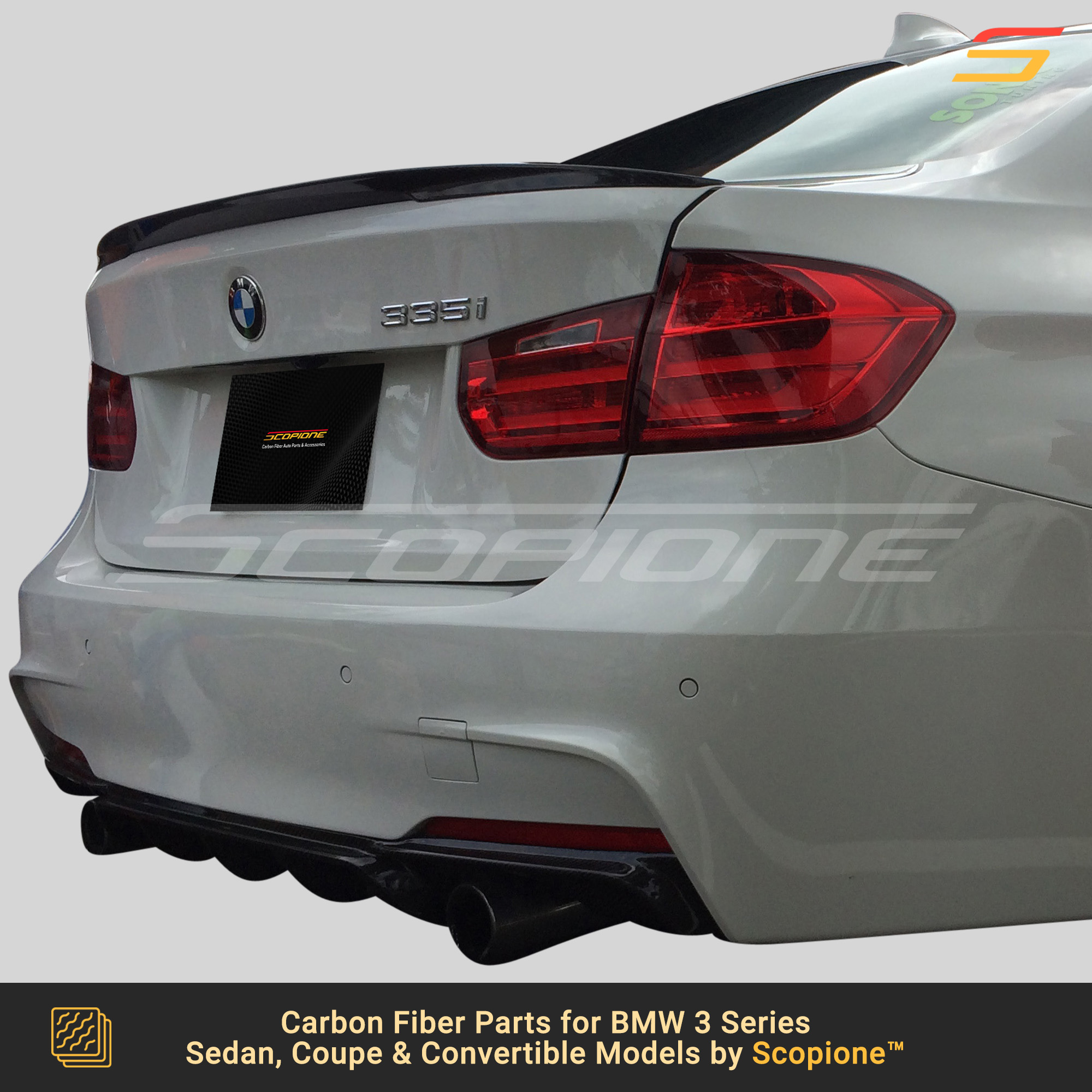
M3 & M4: Five Generations of the Benchmark
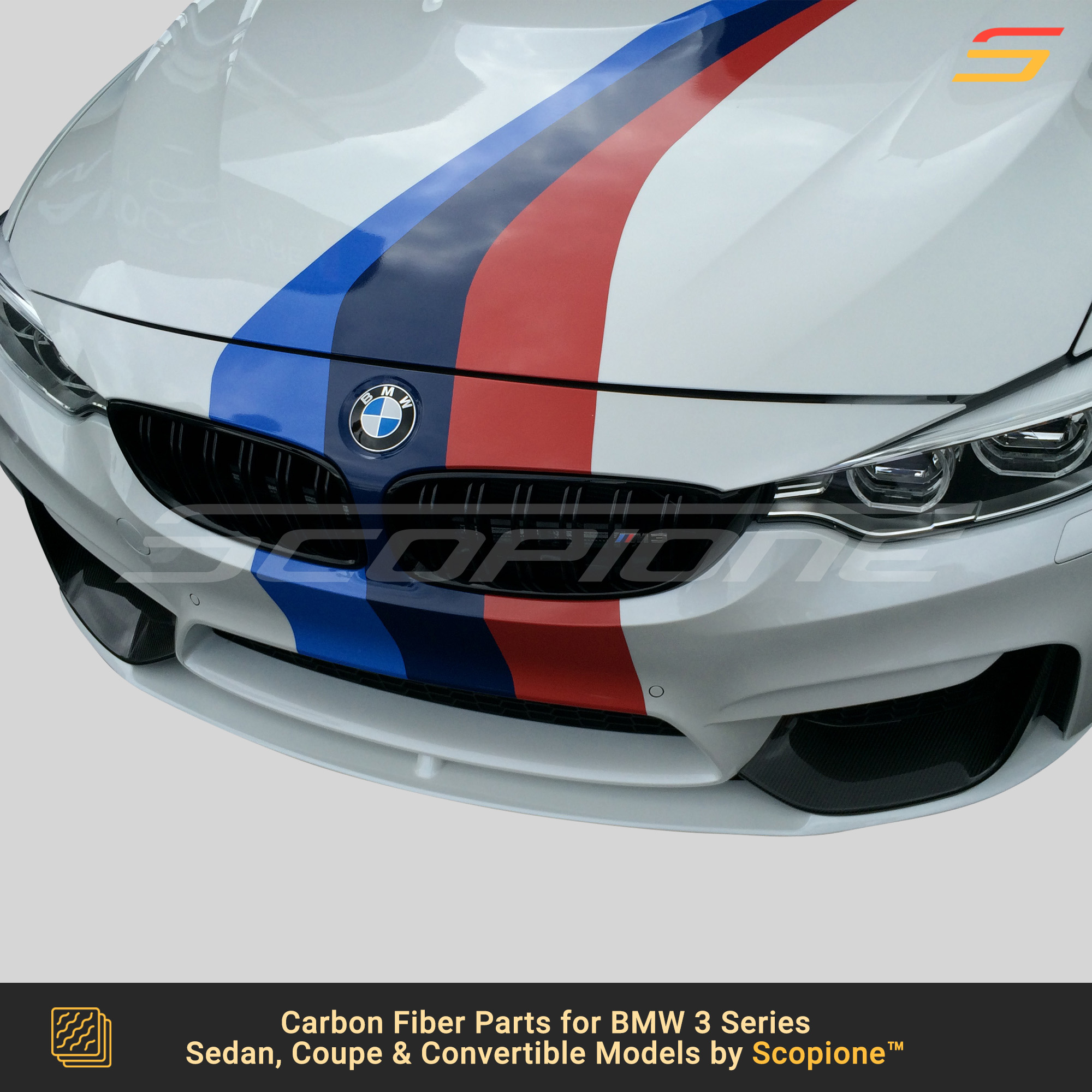
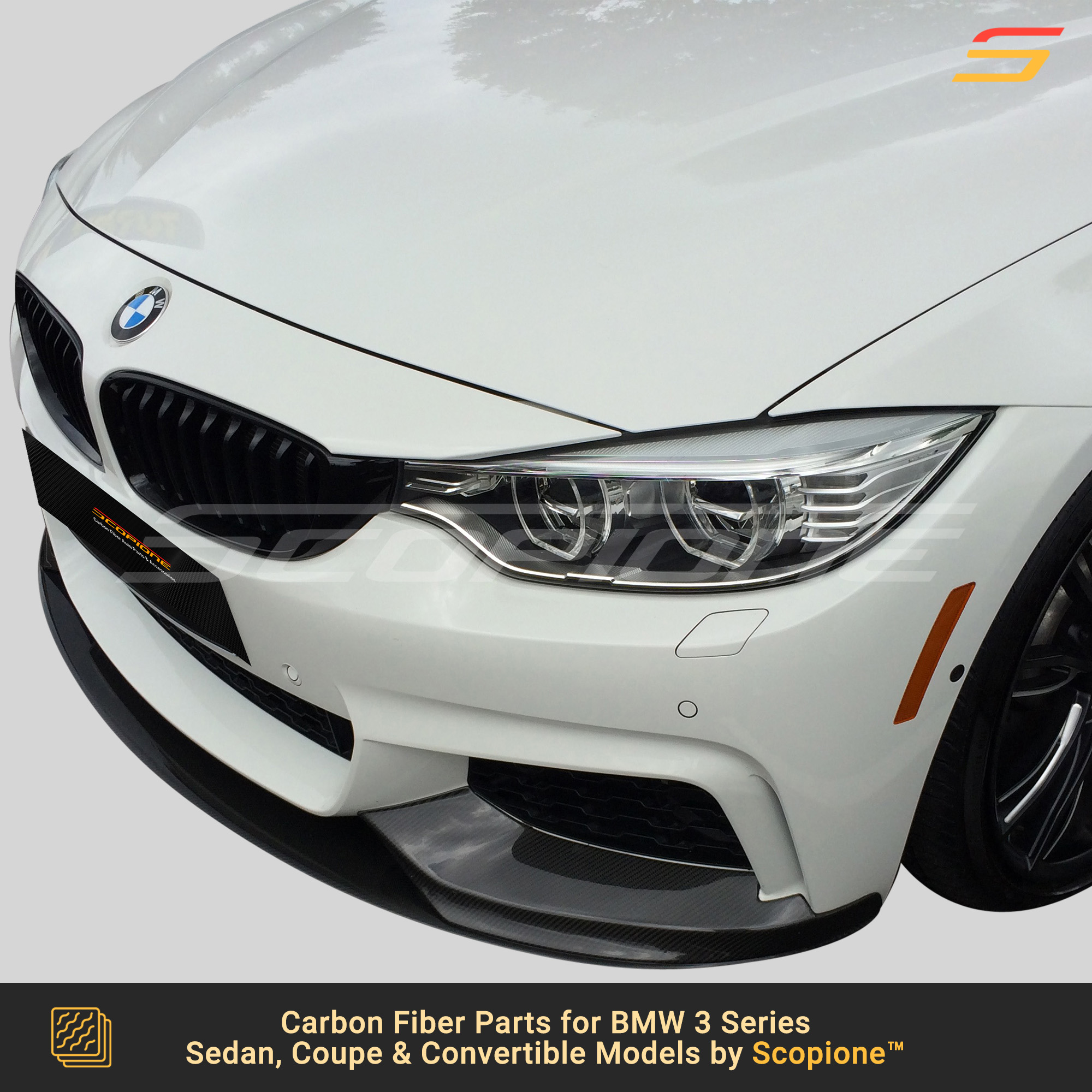
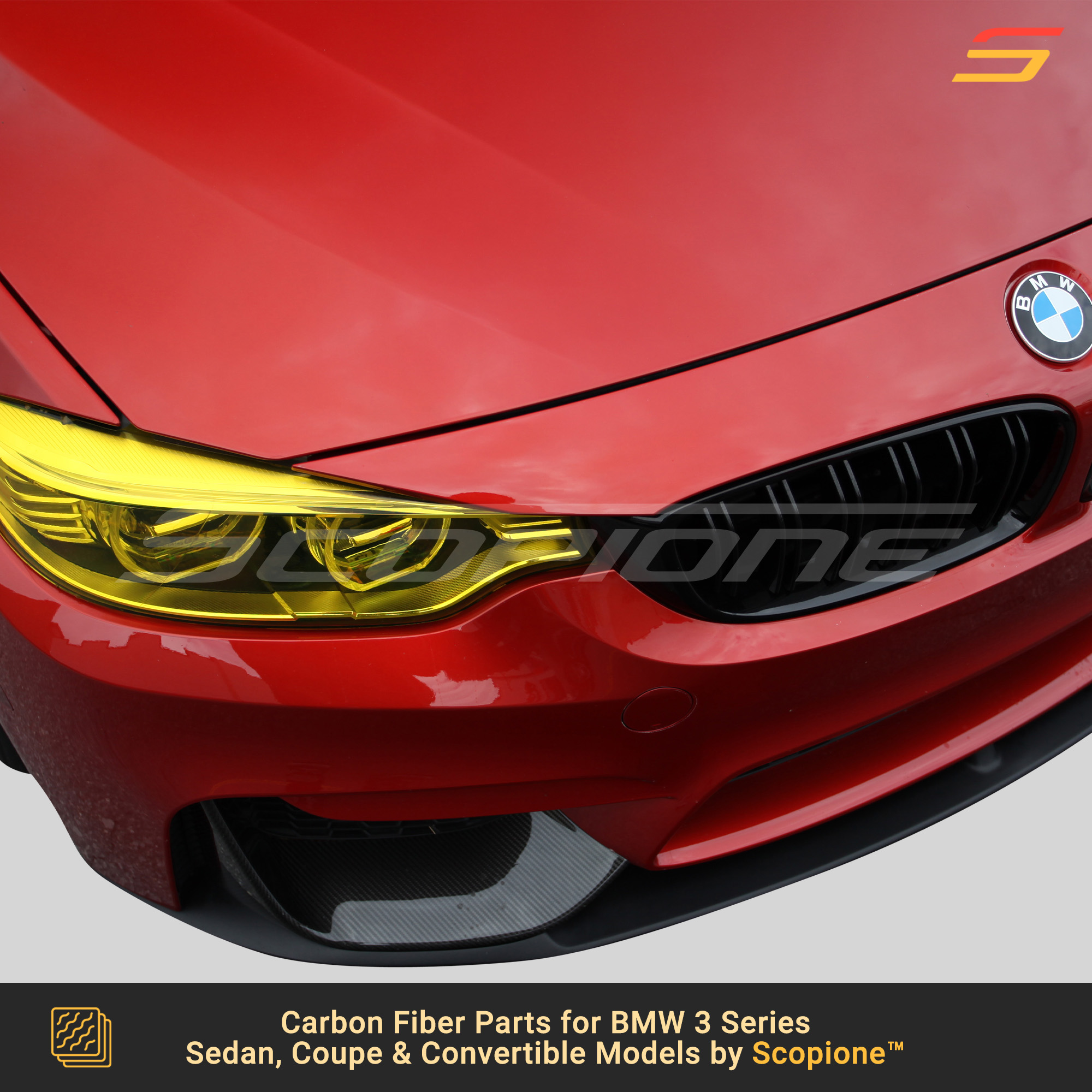
The M3 is the spine of BMW’s performance identity. From a 3.2-liter inline-six with individual throttle bodies to a 543 hp twin-turbo straight-six with available all-wheel drive, five generations of M3 (and its M4 coupe sibling from 2014) have defined the sports sedan category. Scopione carries more than 30 carbon-fiber parts for M3 and M4 variants – the single largest model group in the BMW catalog.
E36 M3 (1992–1999): Where the Legend Scaled
The E30 M3 created the template; the E36 made it accessible. Euro-spec cars received the S50B32 3.2-liter inline-six with 321 hp and individual throttle bodies, while US-market E36 M3s used the S52 with 240 hp – a disparity that fueled a transatlantic engine-swap culture lasting decades. Both shared the same widened E36 body, limited-slip differential, and chassis tuning that made the M3 the dominant car in grassroots road racing and BMW CCA club events through the 1990s.
The E36 M3 Lightweight (1995, 125 units) is the rarest standard-production M3: stripped interior, aluminum doors, fixed rear glass, and roughly 225 lbs removed from the curb weight. Clean Lightweights now trade between $150,000 and $300,000. Standard E36 M3s with manual transmissions have bottomed out in depreciation and are climbing – $18,000 to $35,000 for clean examples.
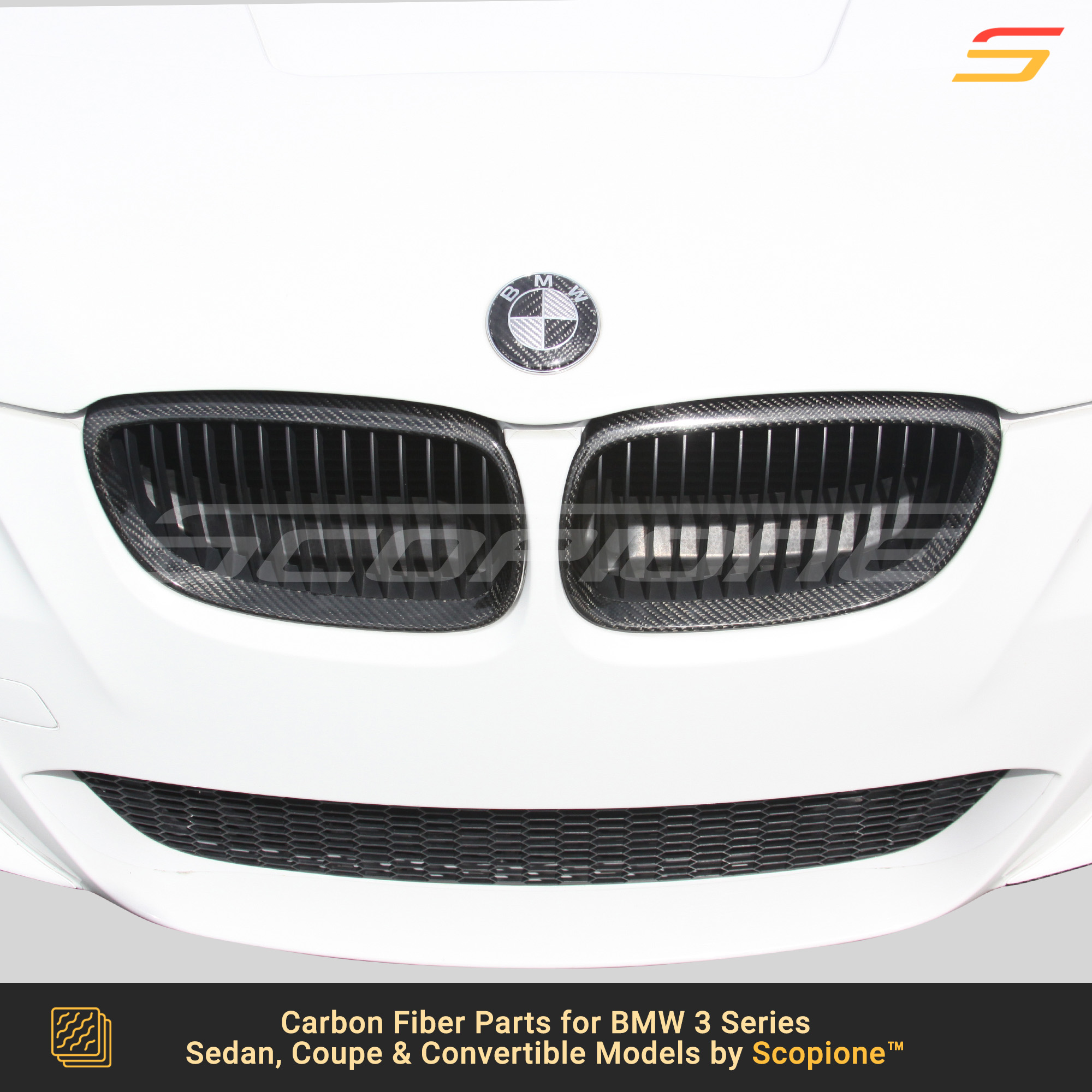
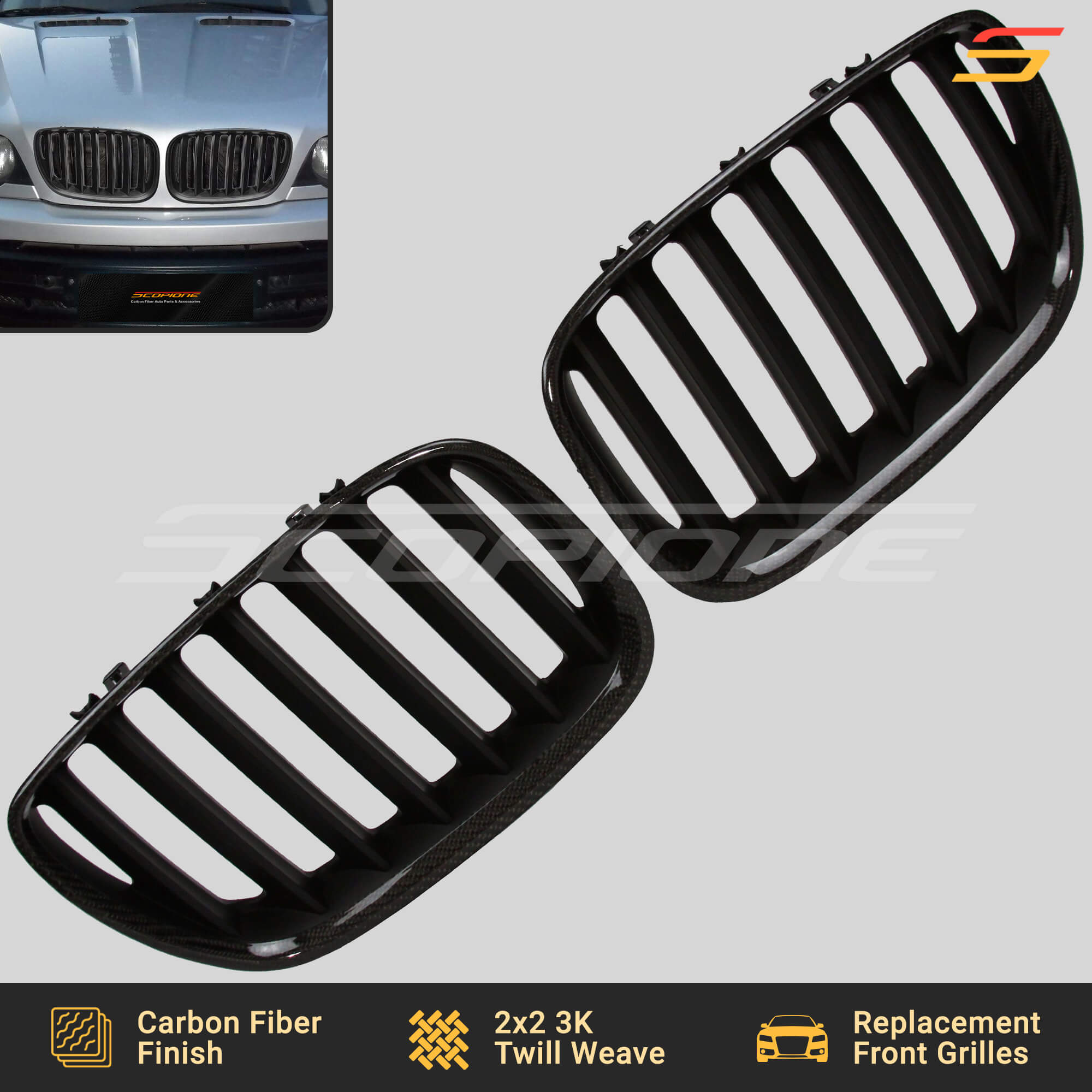
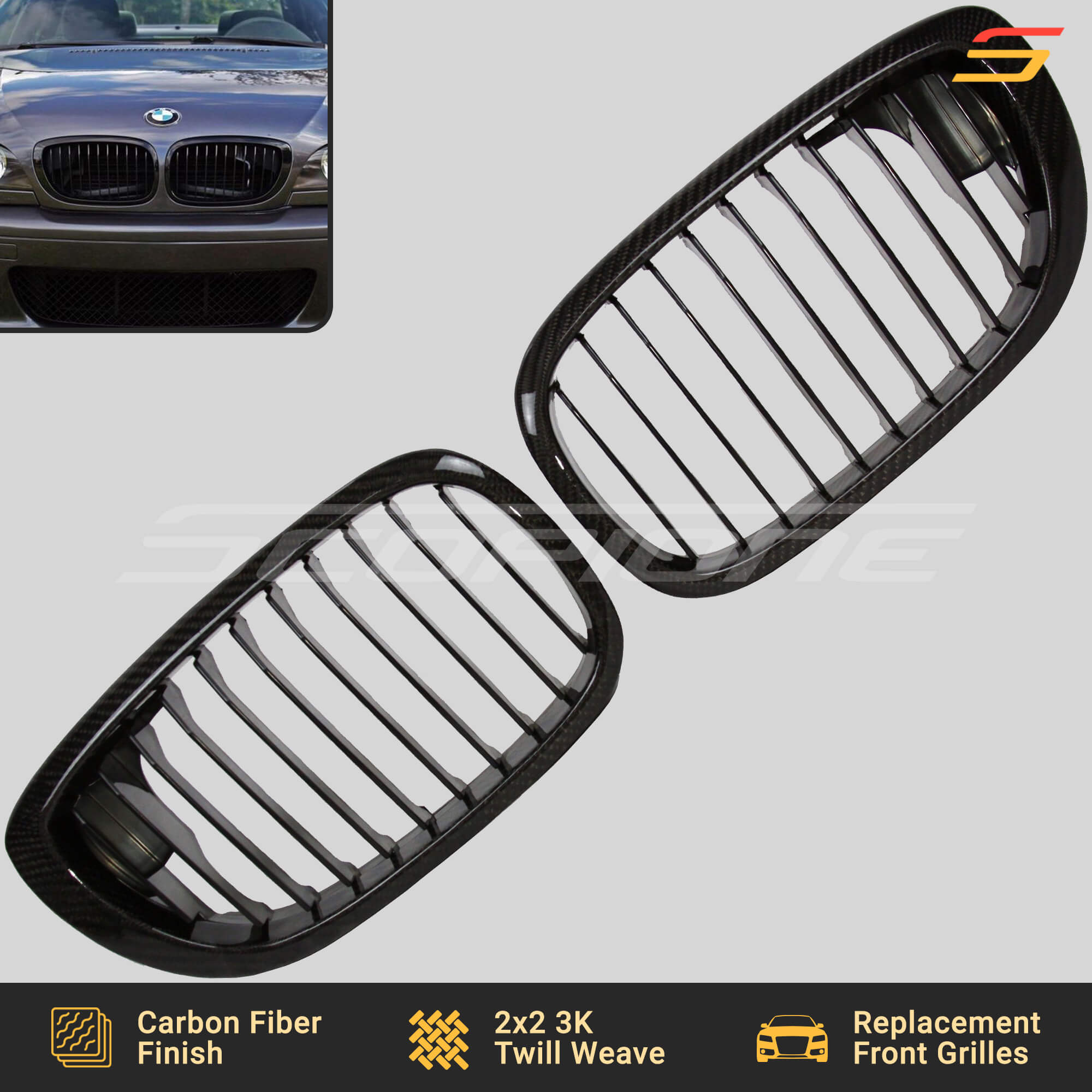
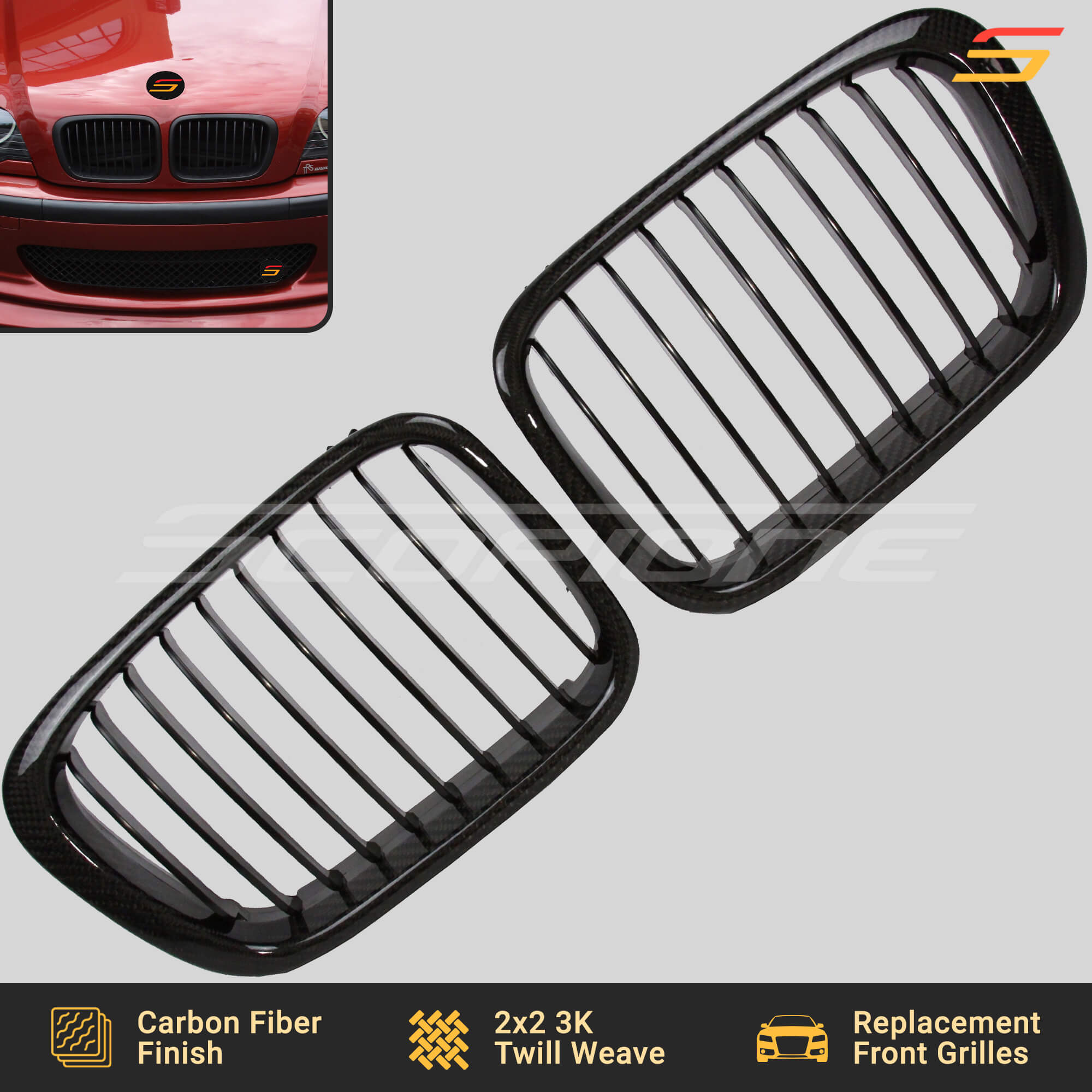
Scopione offers carbon-fiber kidney grilles for both pre-LCI (1991–1996) and LCI (1997–1999) E36 models, including the M3. The pre-LCI and LCI grilles differ in outer frame dimensions, so correct selection depends on the model year.
E46 M3 (2001–2006): The S54 Era
The E46 M3 arrived with the S54 3.2-liter inline-six: 333 hp, individual throttle bodies, and an 8,000 RPM redline that rewarded high-rev driving in a way that few road cars before or since have matched. A six-speed manual was standard. BMW offered the E46 M3 as a coupe and convertible, and the coupe’s clean proportions made it one of the defining shapes of early-2000s automotive design.
Two limited variants cemented the E46 M3’s status. The M3 CSL (2003–2004, 1,383 units) stripped 110 kg from the standard car through a CFRP roof panel, thinner glass, a single-mass flywheel, and deleted rear seats. It produced 360 hp from a revised S54 with a reprofiled intake plenum. The M3 GTR Street Version (2001, 10 units) was built to homologate the ALMS race car and carried a 4.0-liter P60B40 V8 producing 375 hp – the rarest modern M3 by a wide margin.
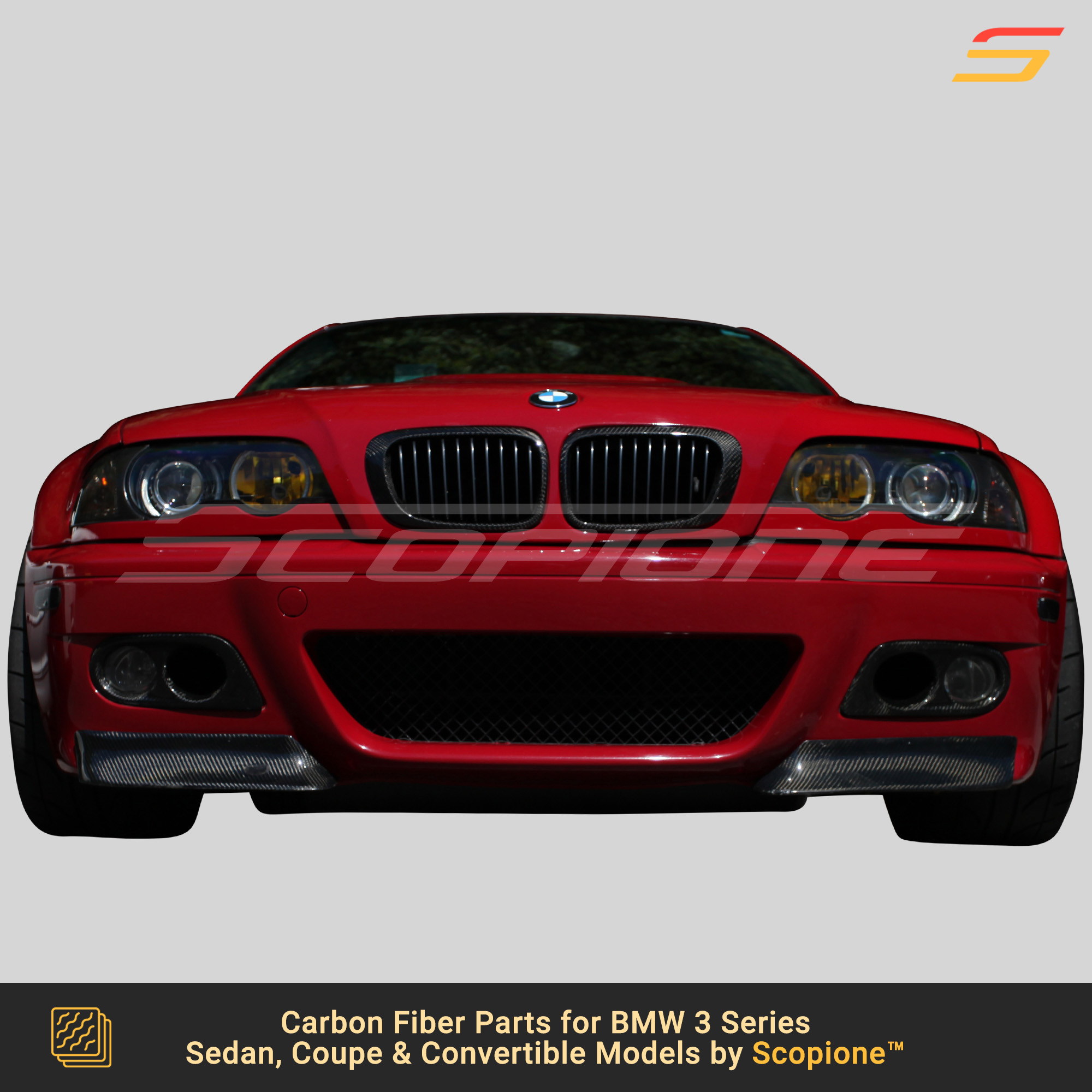
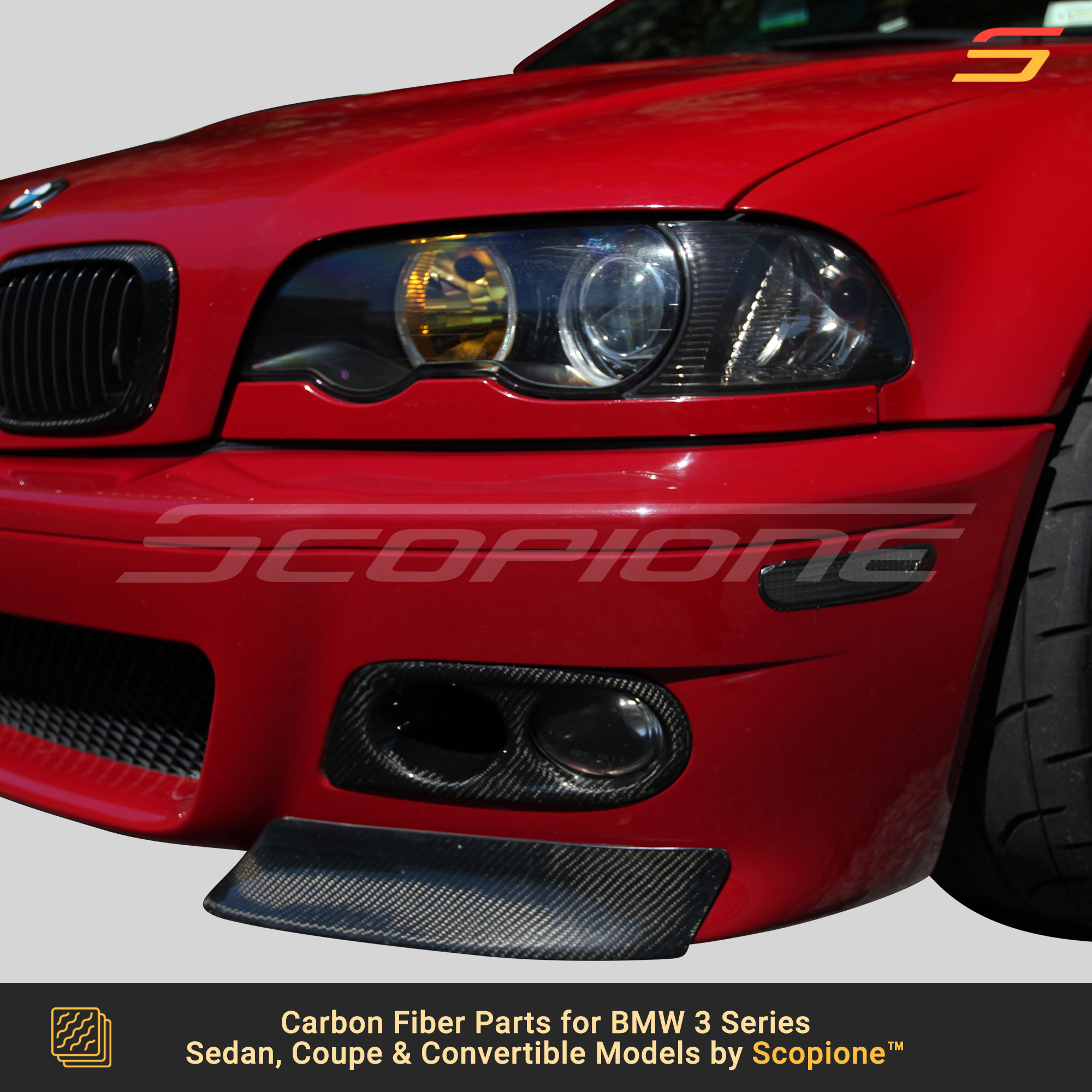
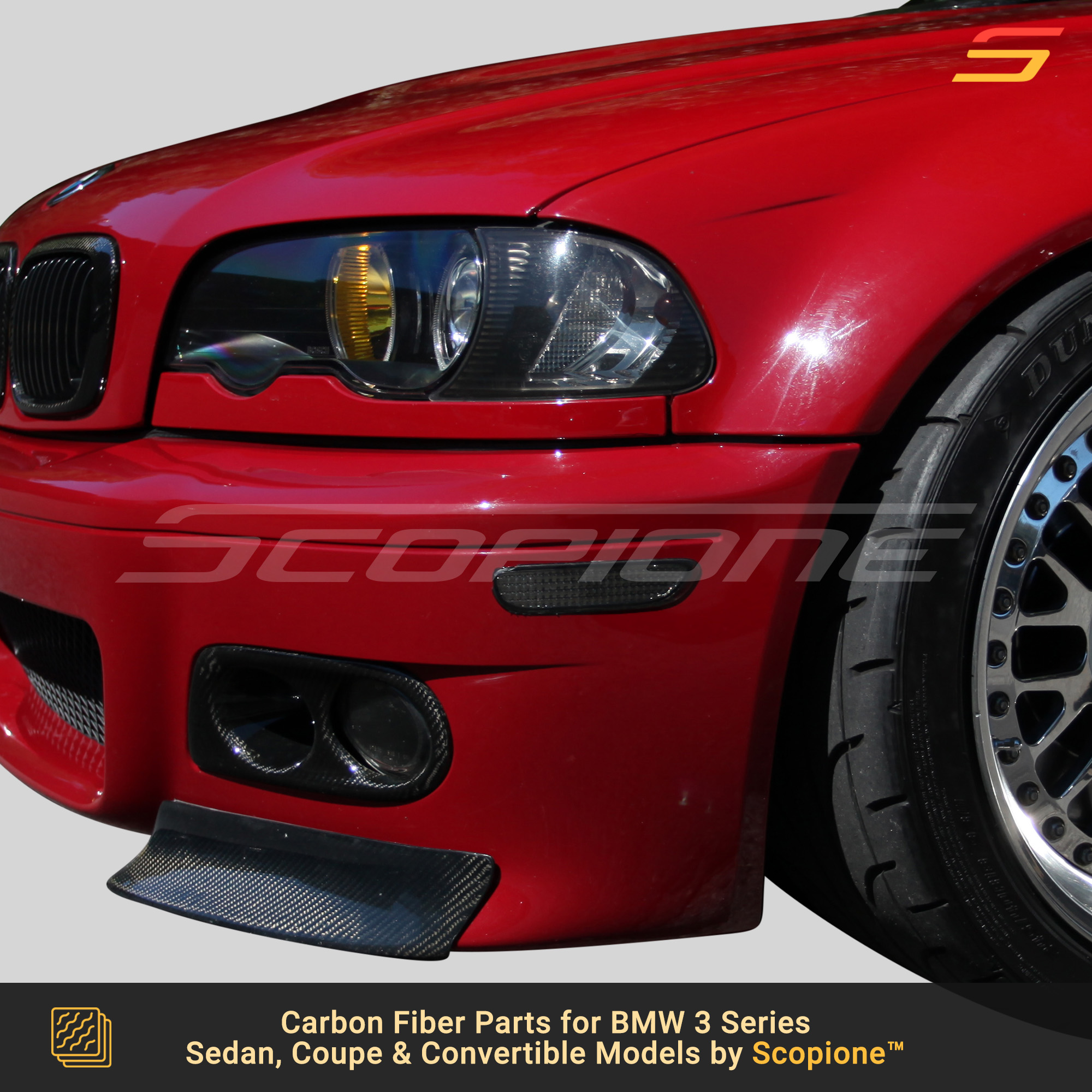
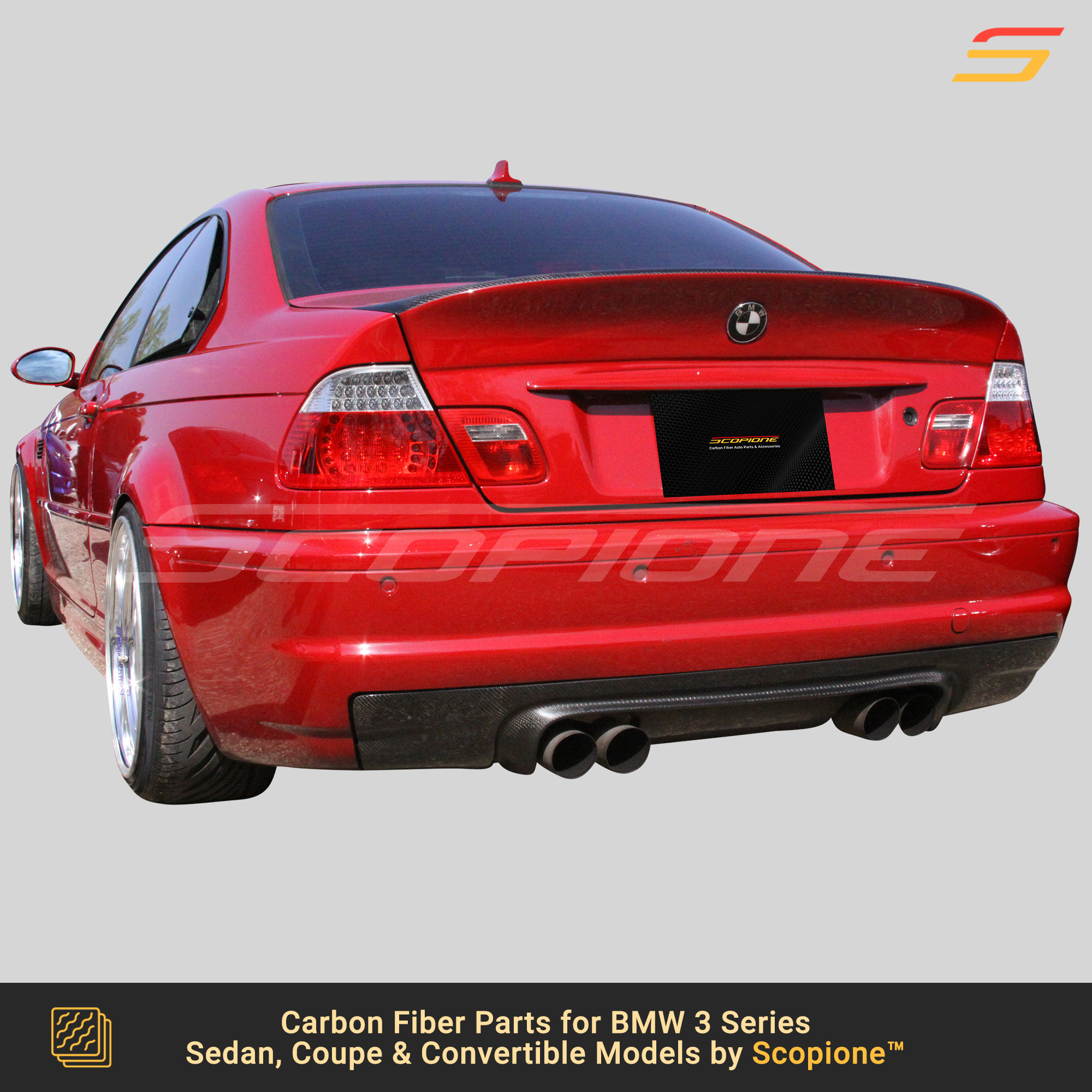
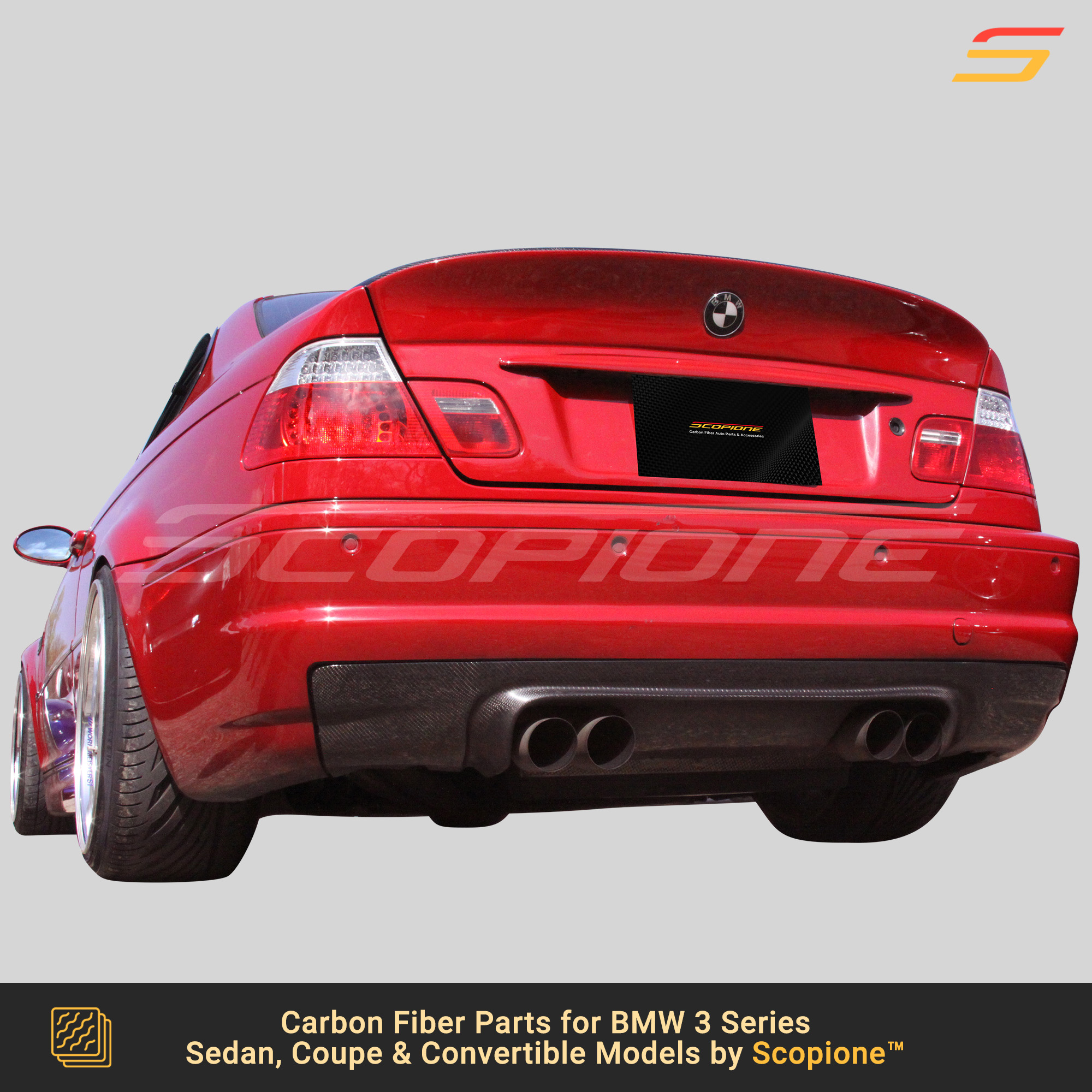
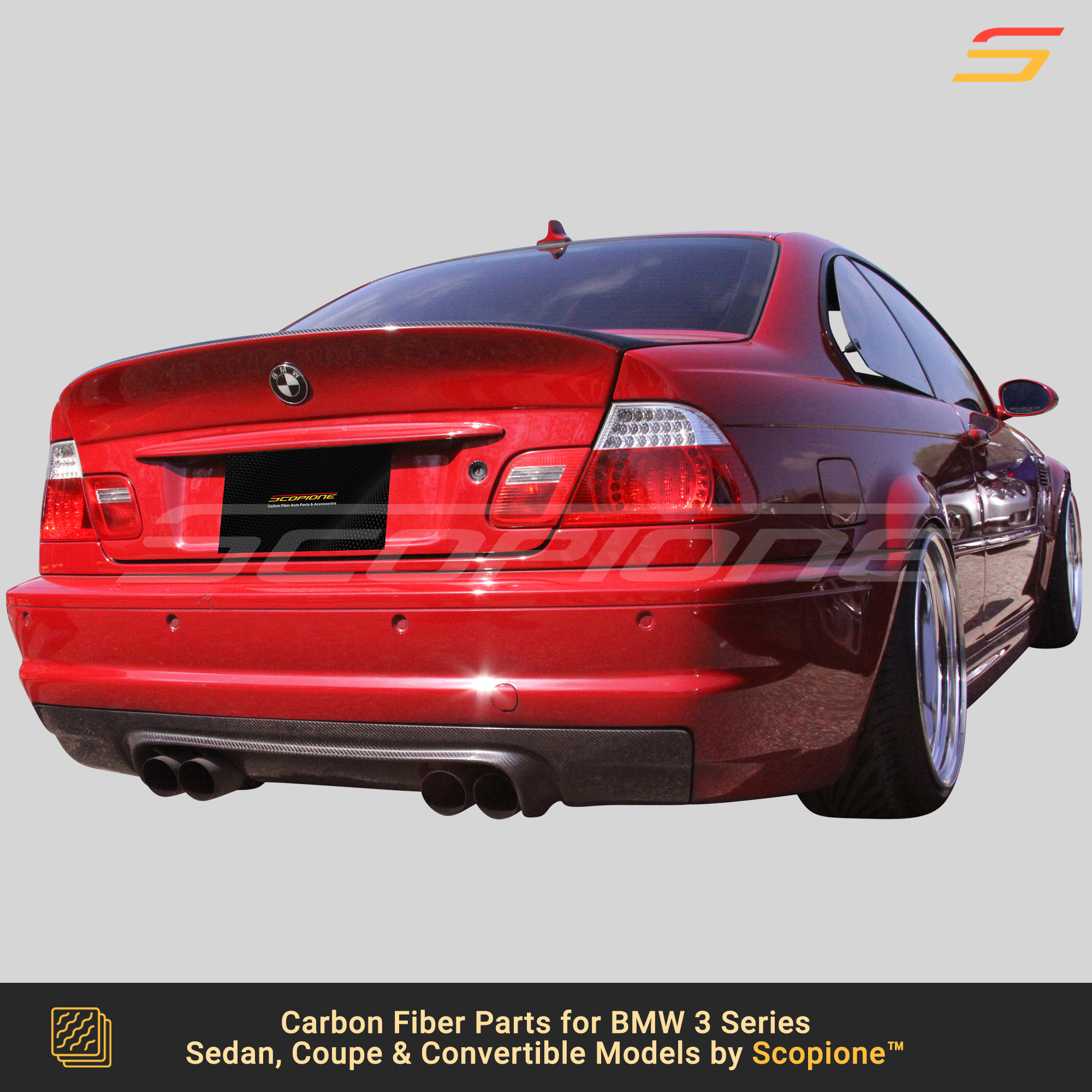
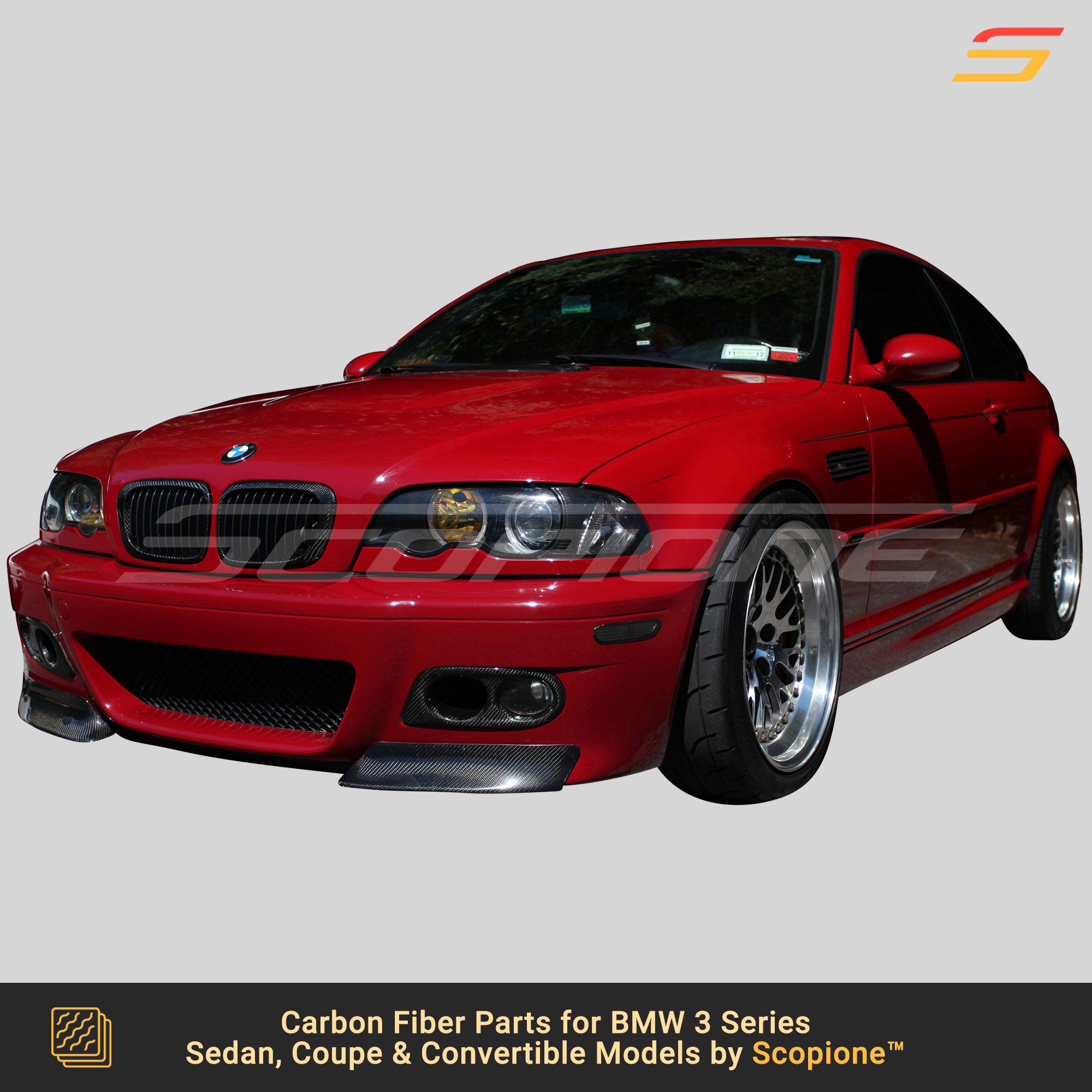
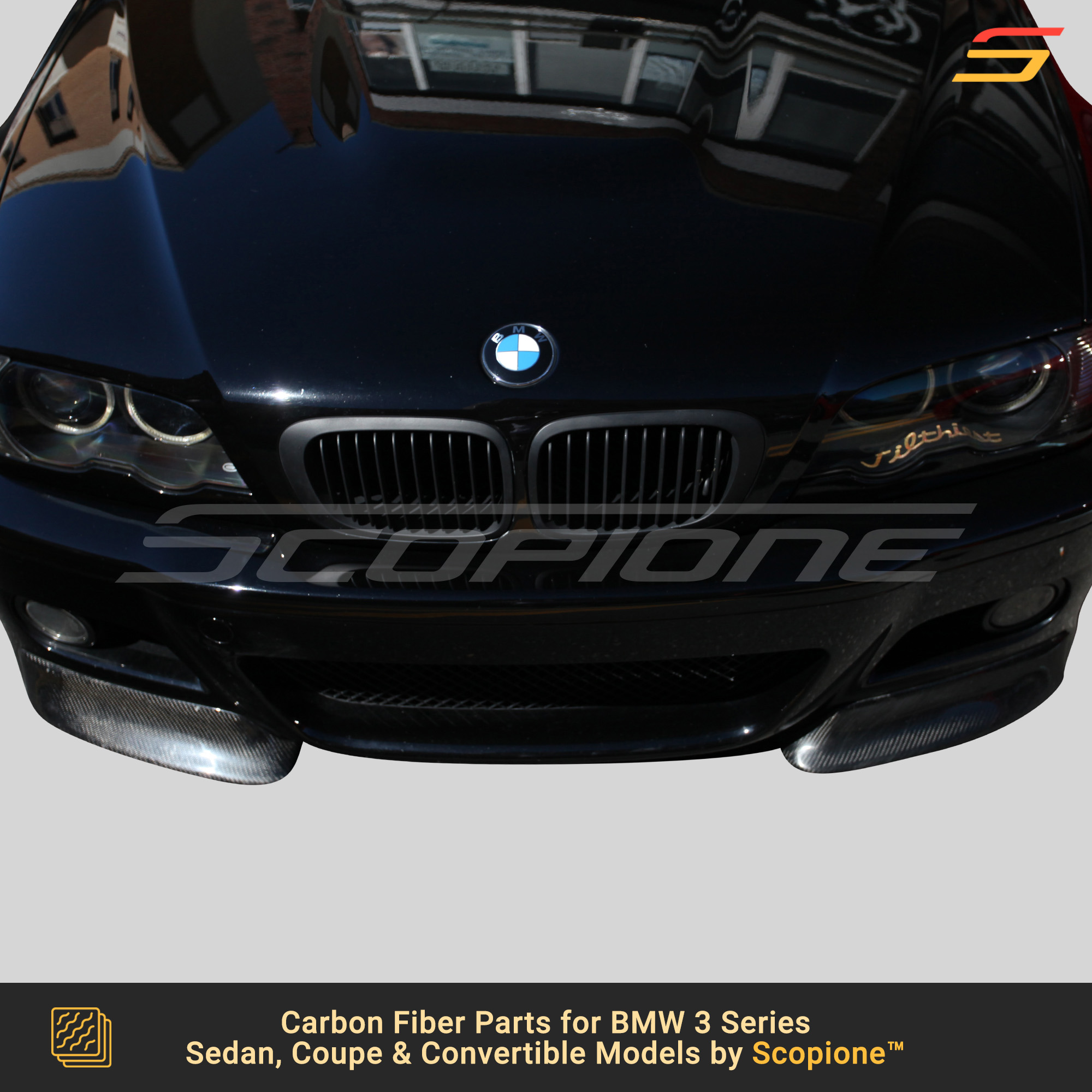
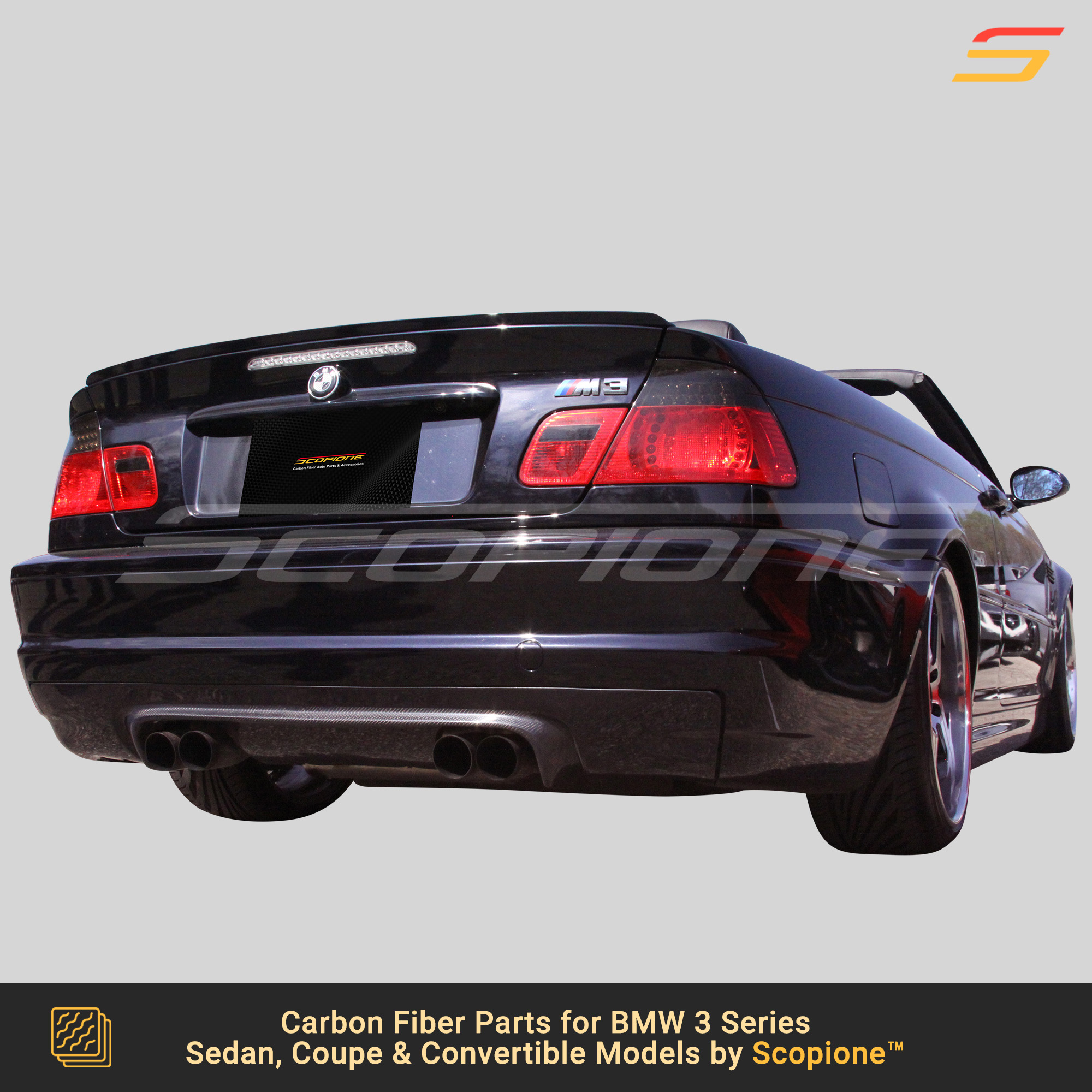
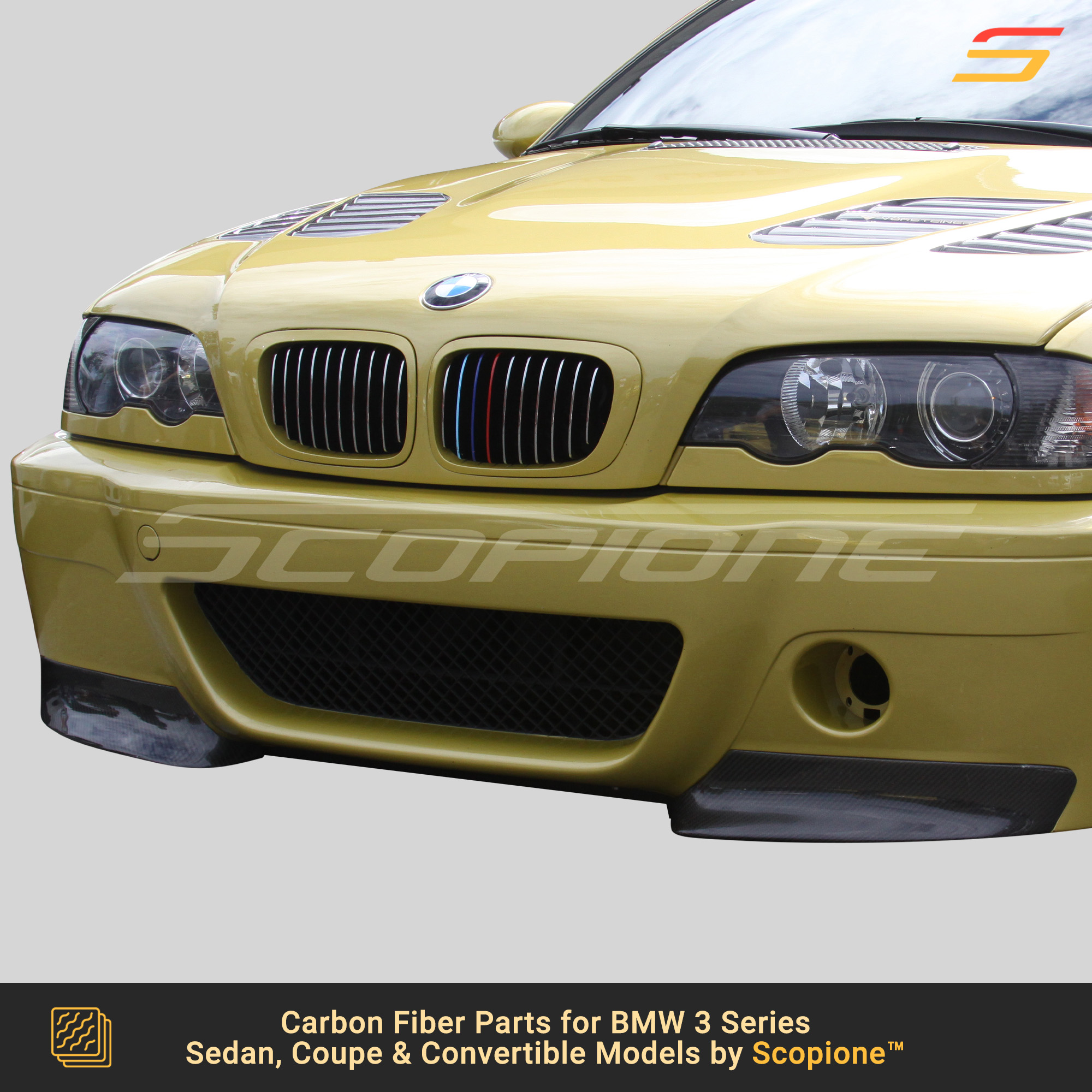
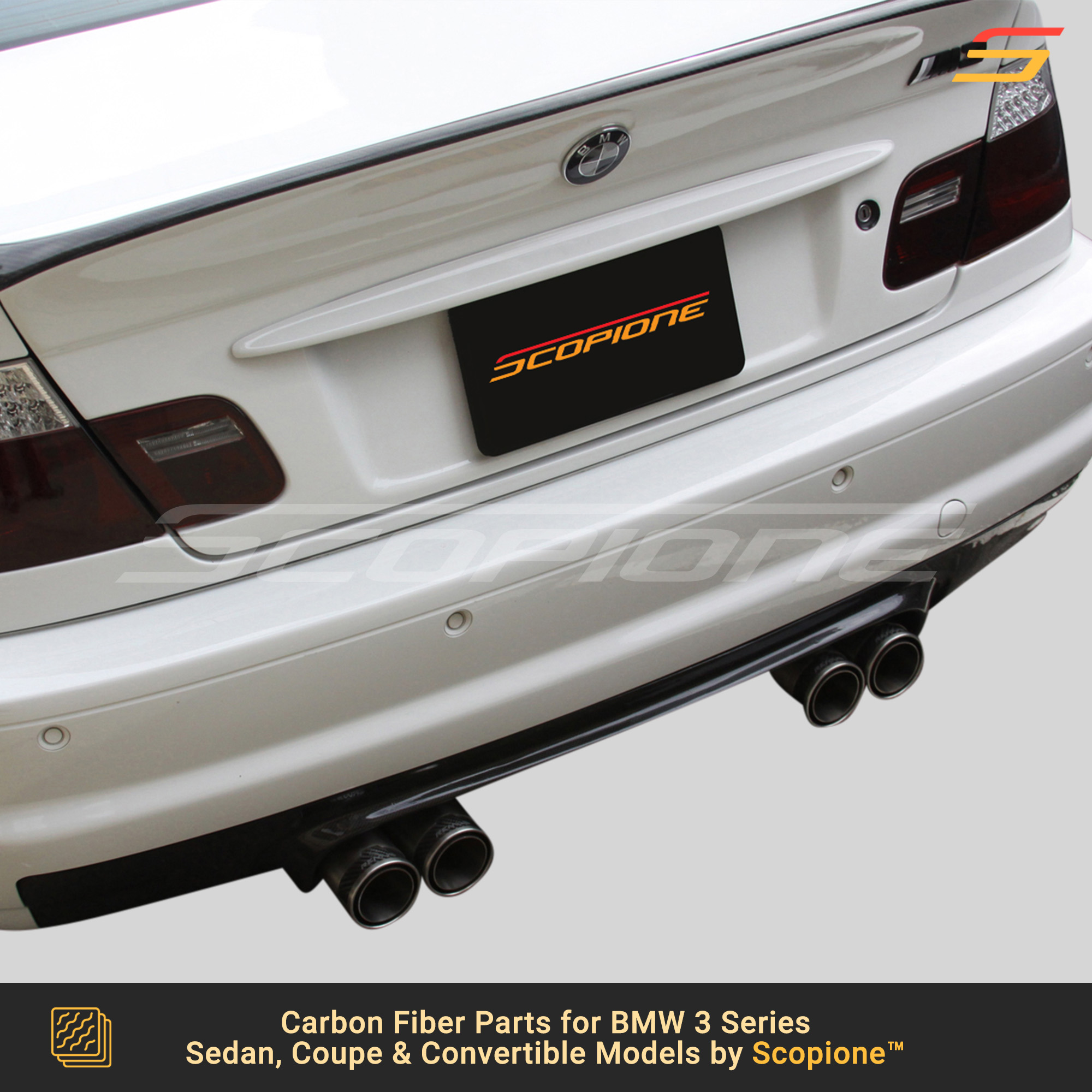
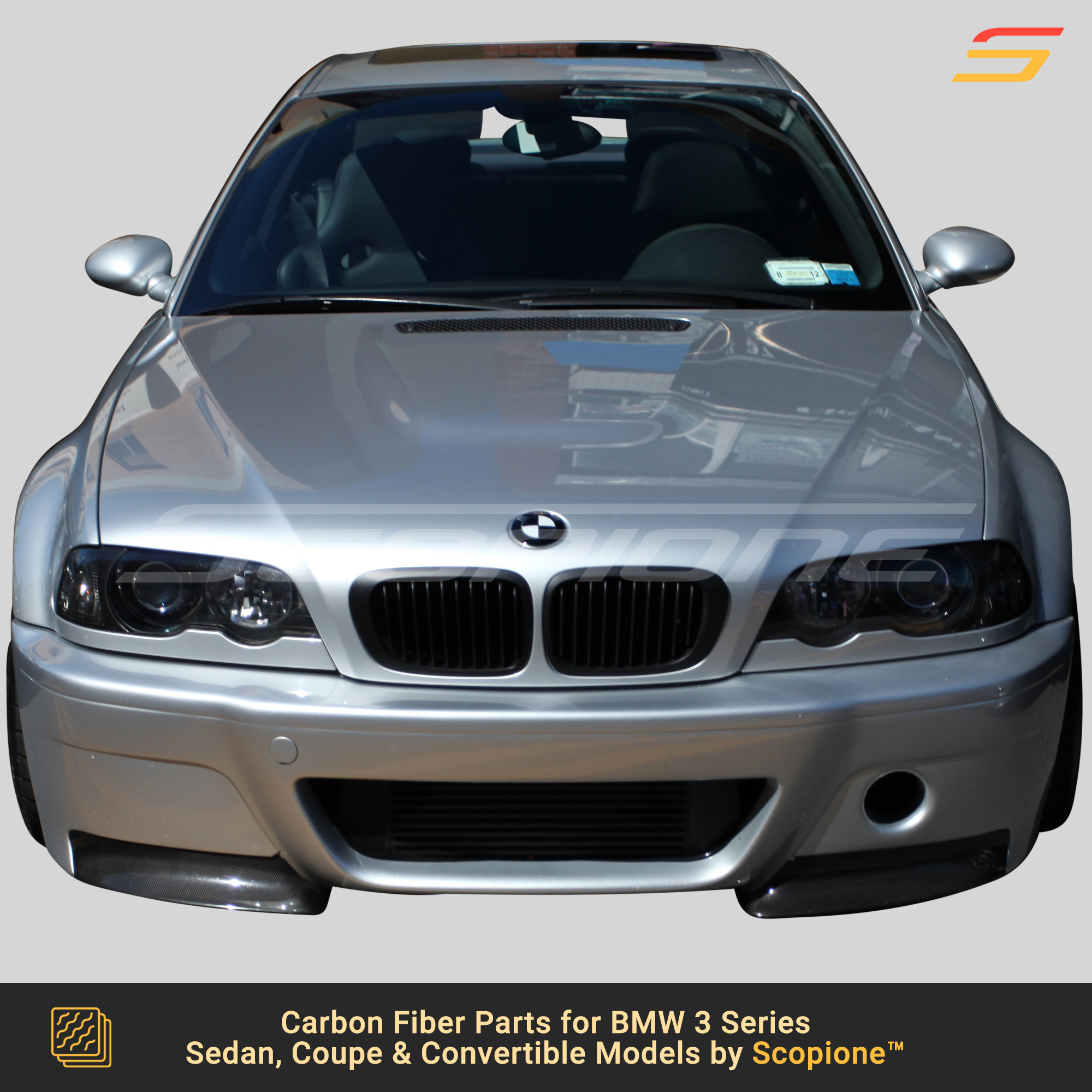
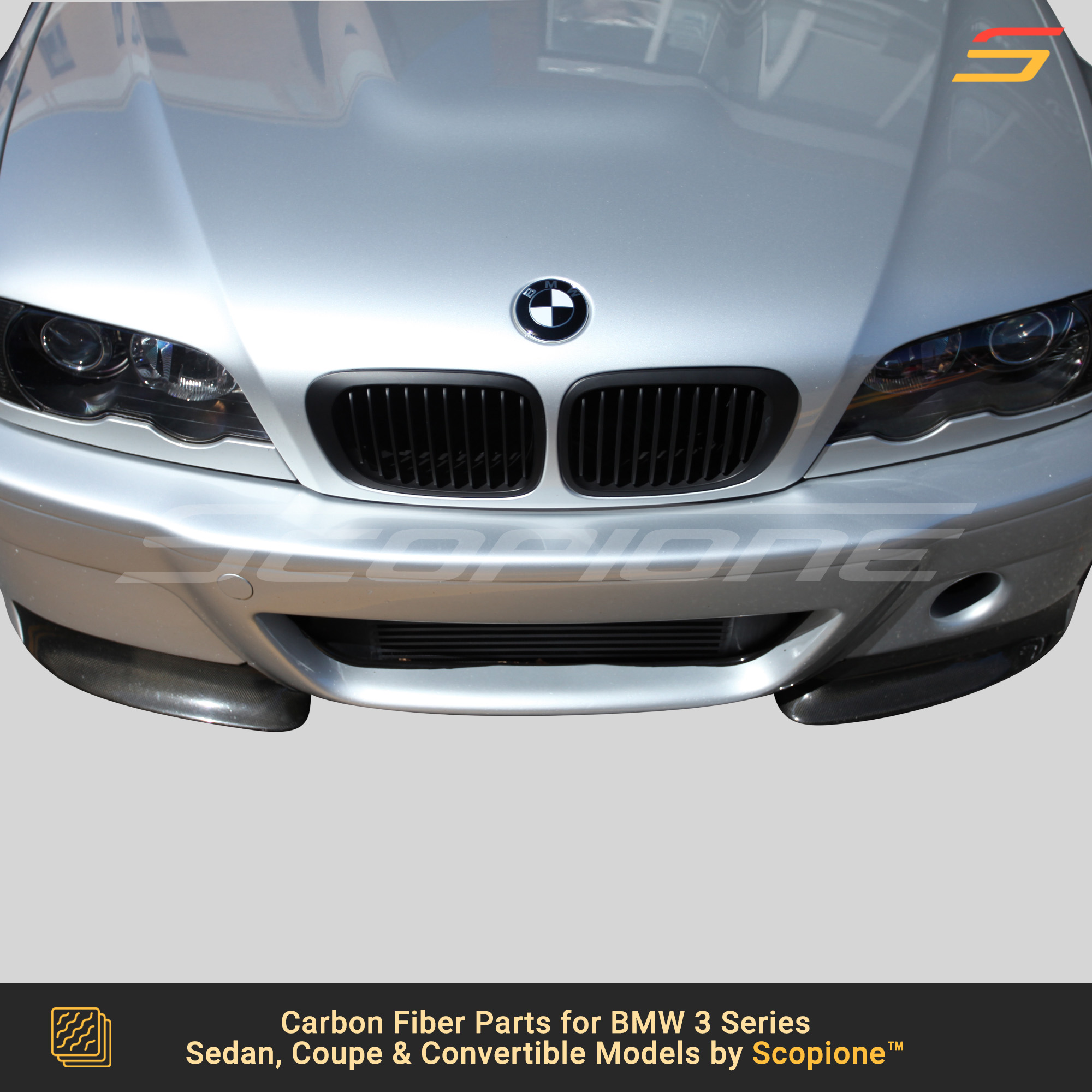
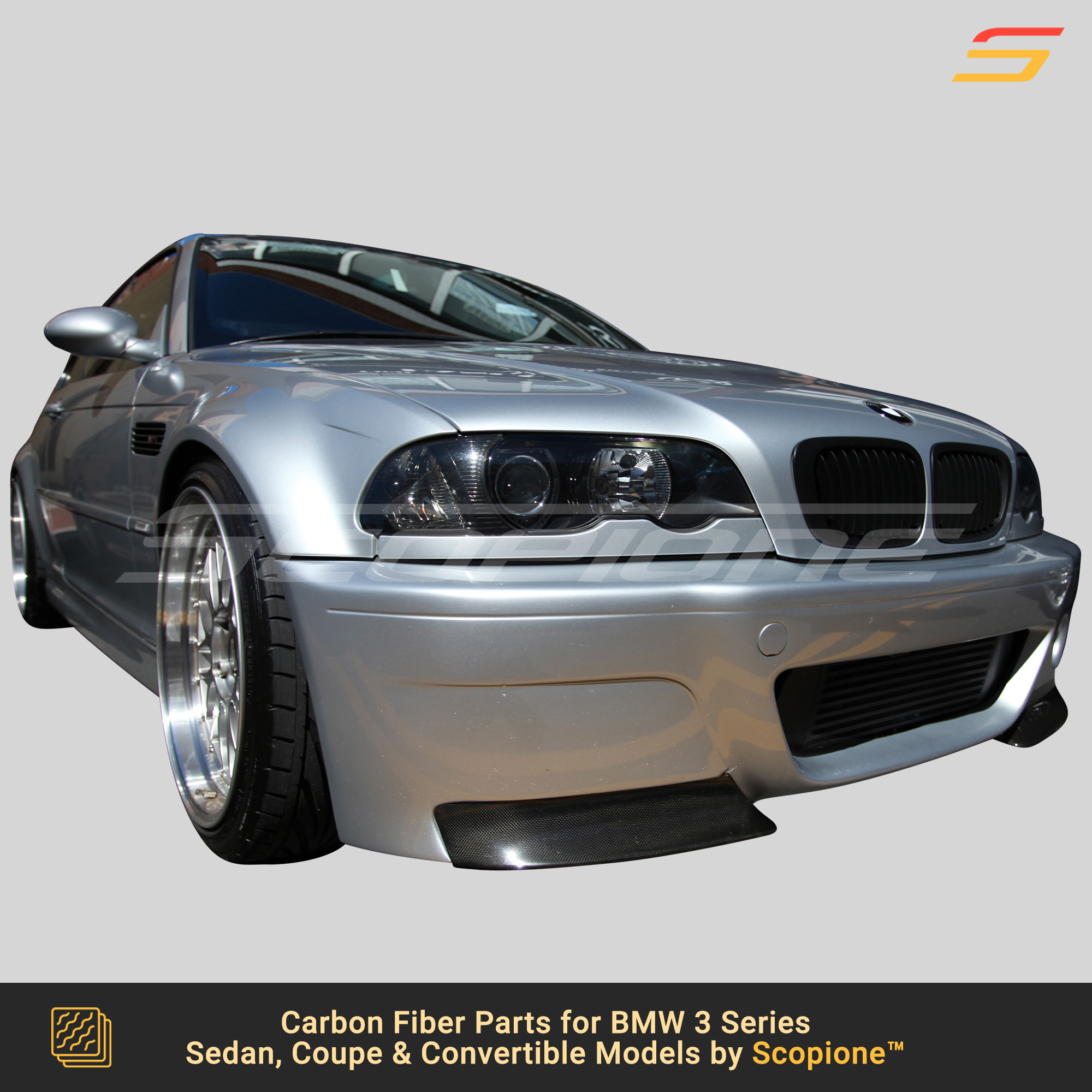
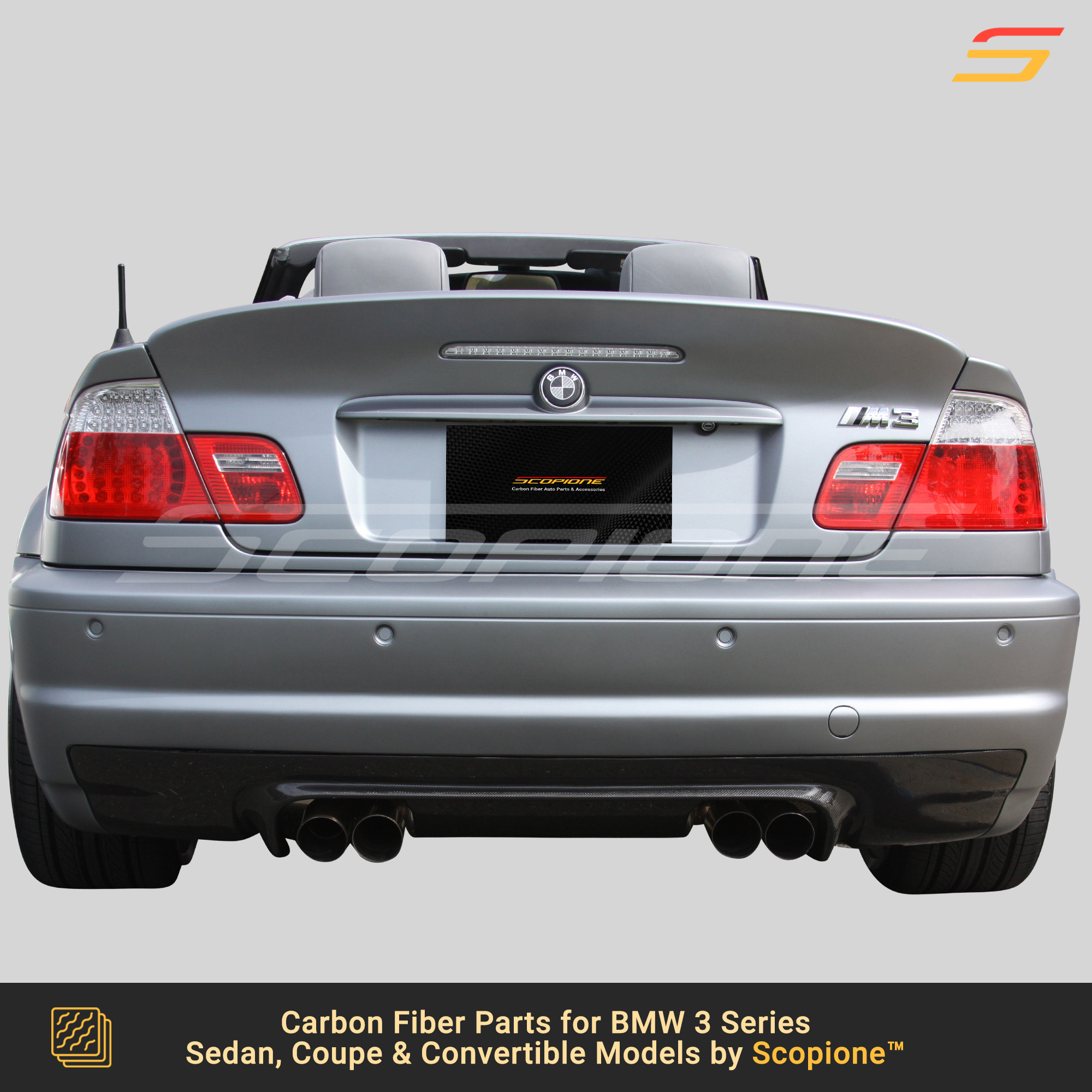
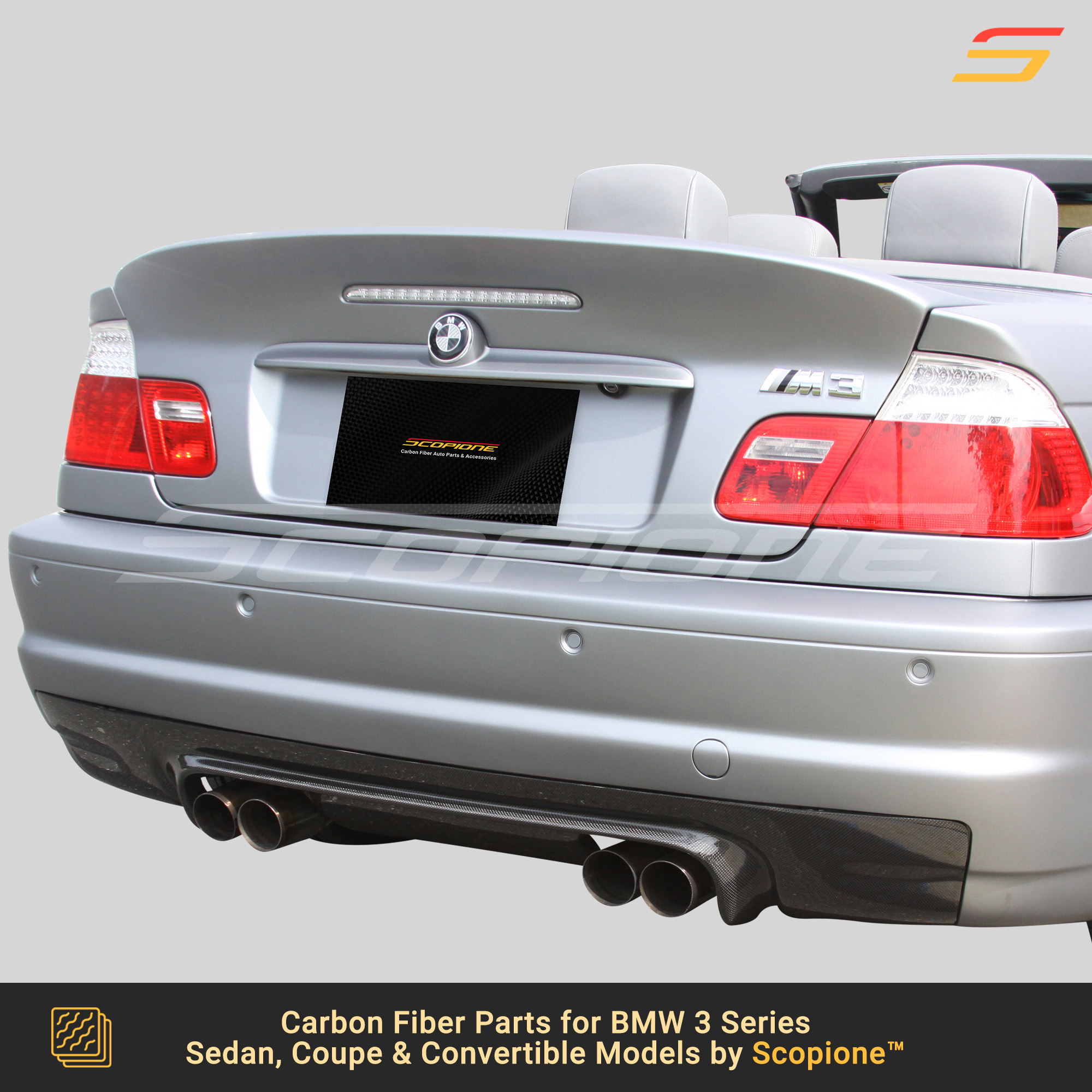
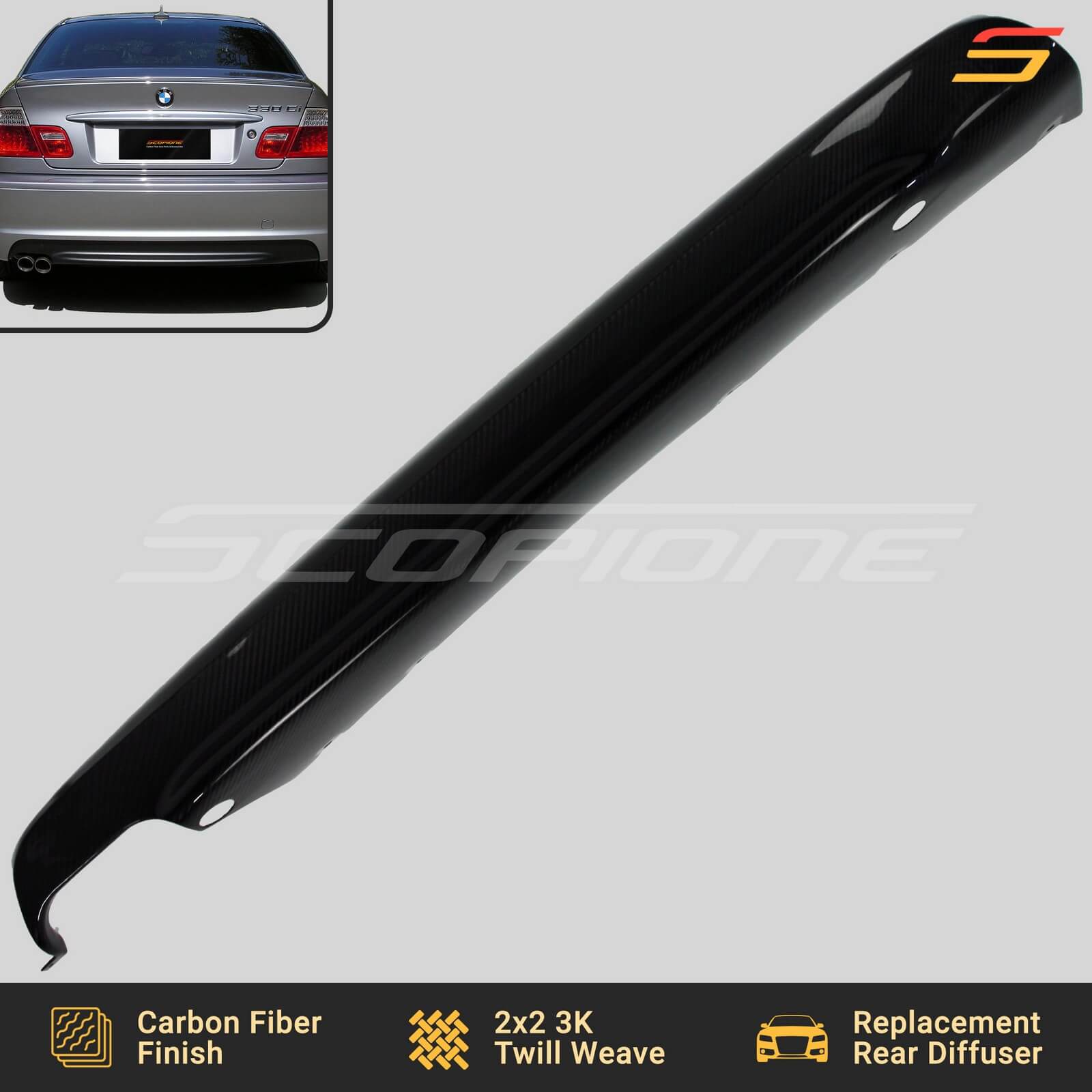
Scopione offers E46 M3 carbon fiber diffusers, fog light covers, trunk spoilers, and engine covers. The S54 engine cover ($260) is one of the catalog’s signature pieces, also fitting the E85/E86 Z4 M. CSL rear diffuser replicas ($400) are available alongside standard-style rear diffusers in glossy ($500) and matte ($600) finishes.
E90/E92/E93 M3 (2007–2013): The V8 Chapter
BMW answered a question nobody asked by putting a 4.0-liter V8 in the M3. The S65 engine – built with high-rev architecture and individual throttle bodies influenced by BMW’s Formula 1 V8 program – produced 414 hp with an 8,300 RPM redline. It was offered in sedan (E90), coupe (E92), and convertible (E93) body styles, with a six-speed manual or seven-speed M-DCT dual clutch. Total E9x M3 production across all three body styles exceeded 57,000 units.
The E92 M3 GTS (2010–2011, 135 units) enlarged the S65 to 4.4 liters for 444 hp, added a bolt-in roll cage, adjustable suspension, and a carbon-fiber rear wing. It lapped the Nurburgring Nordschleife in 7:48. The M3 CRT (67 units, Europe only) applied the same 4.4-liter engine to the E90 sedan body with a CFRP roof and trunk. And the 1 Series M Coupe (1M) – 6,309 units built in 2011 – used an N54 twin-turbo I6 with the M3’s rear differential in the smaller E82 body, creating one of the sharpest-handling BMWs of the decade.
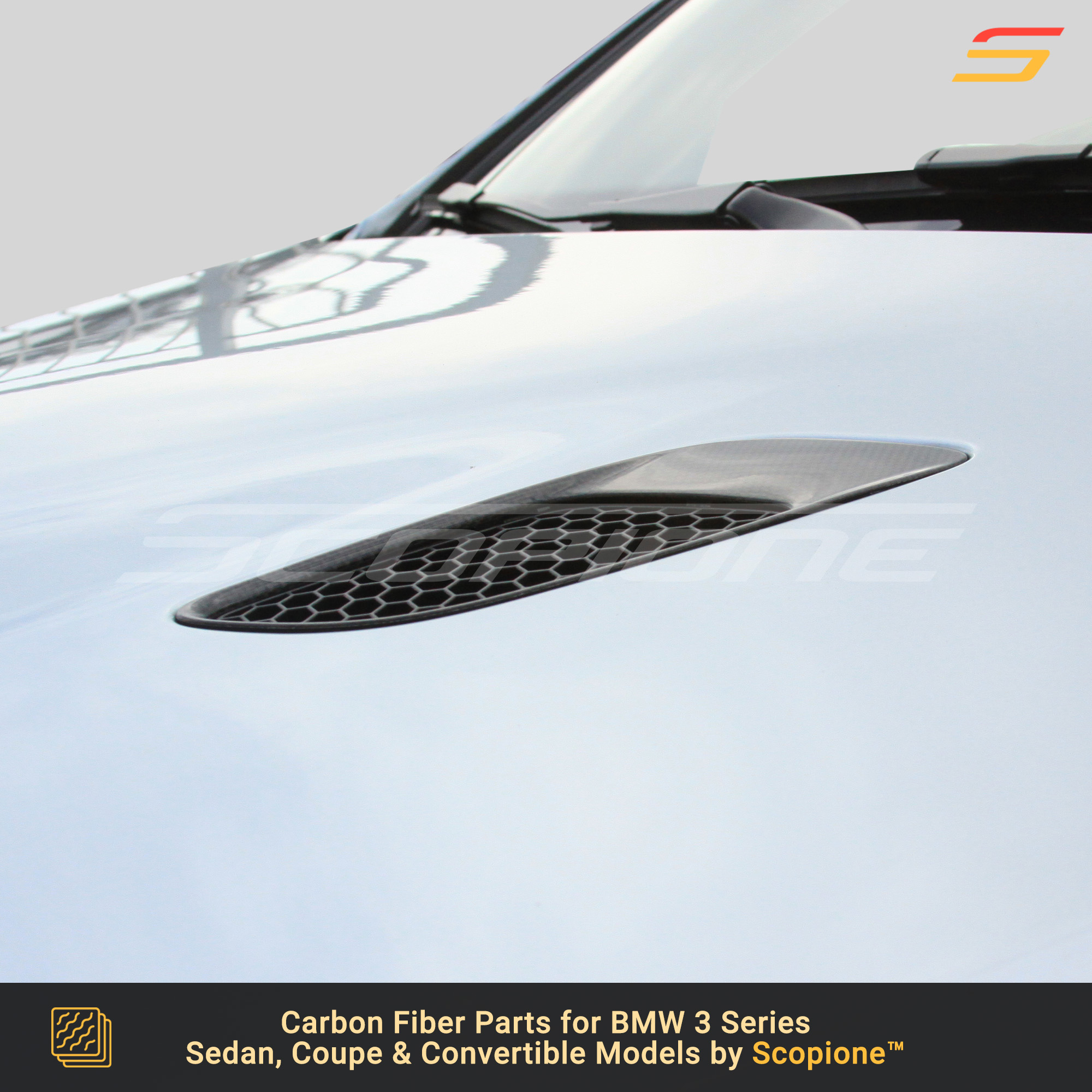
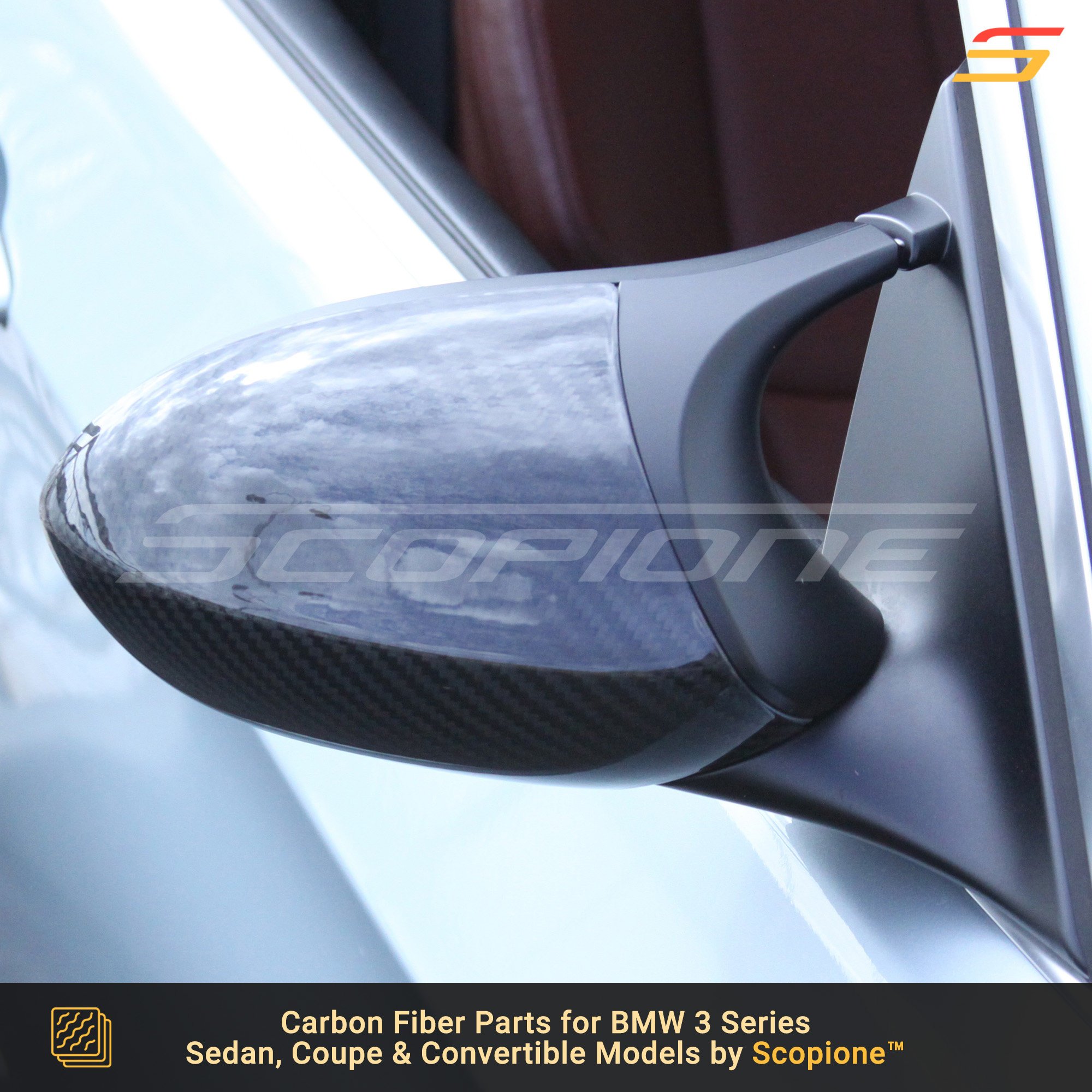
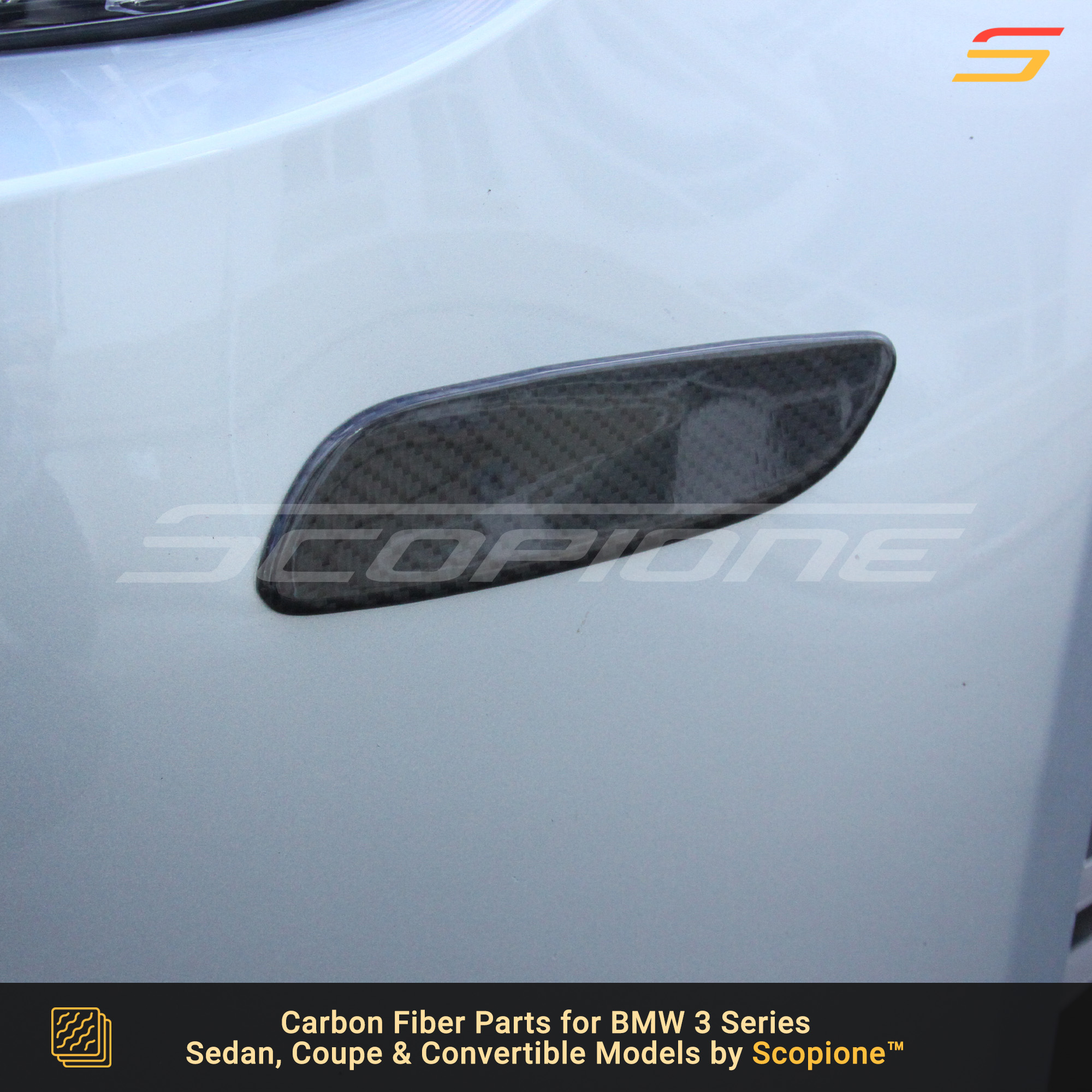
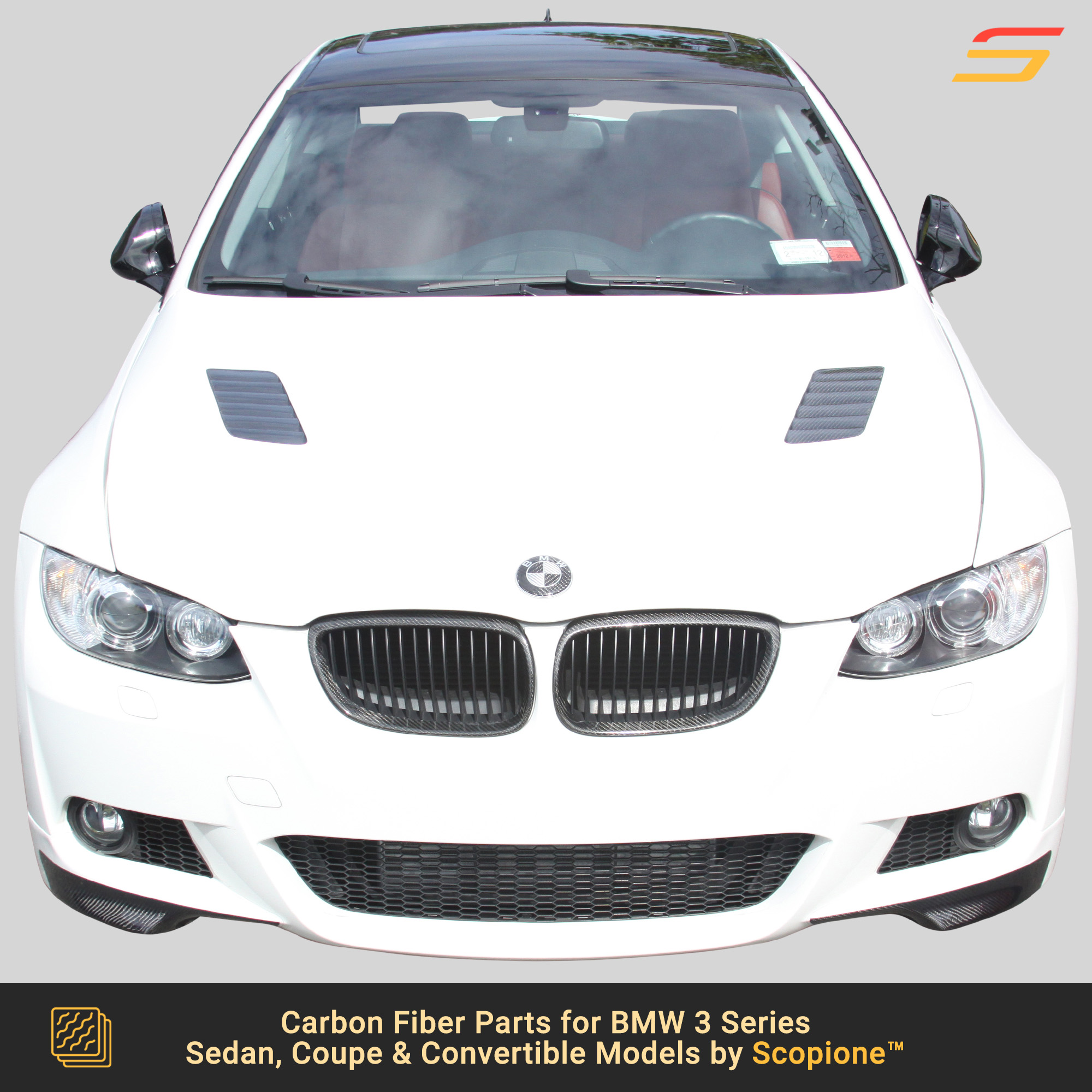
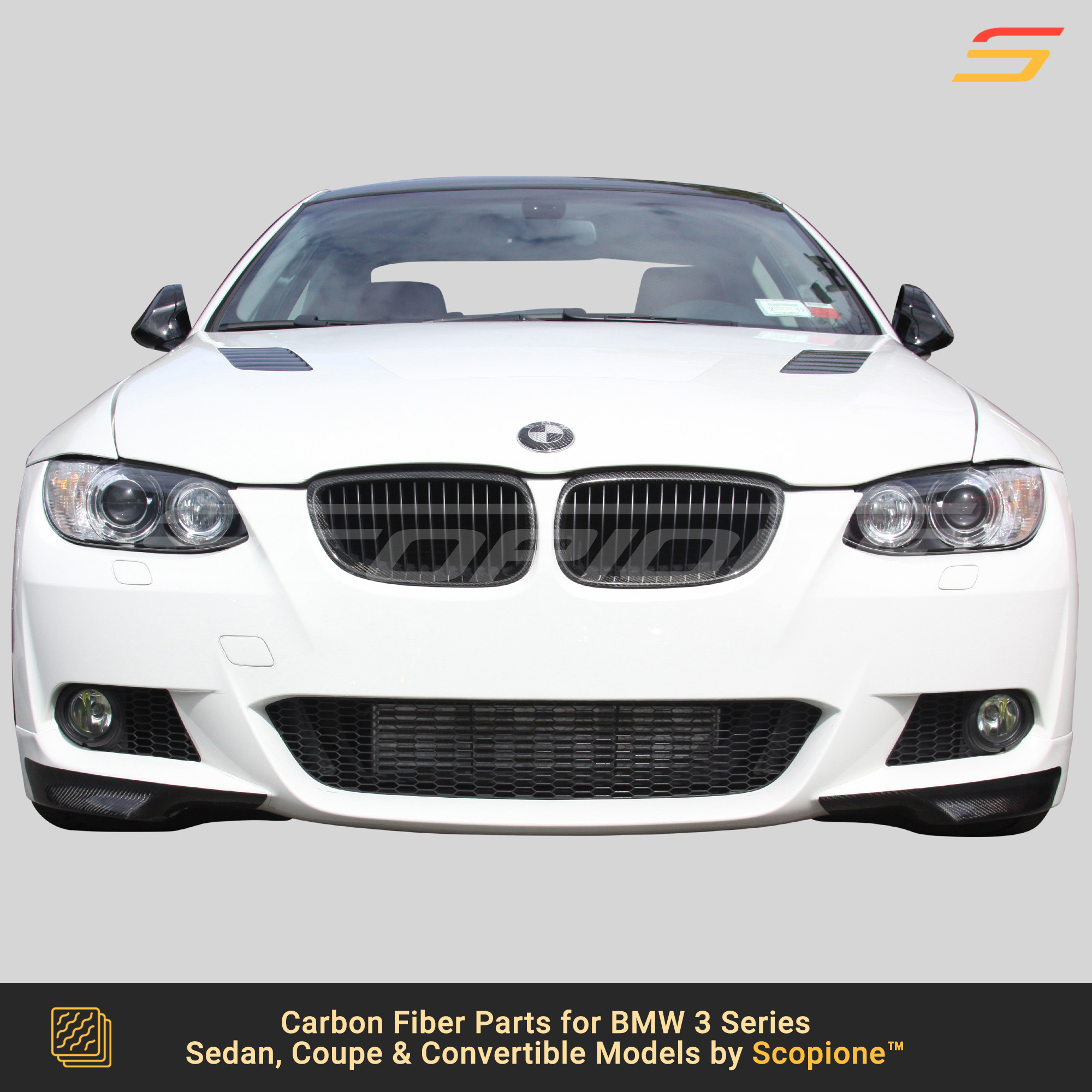
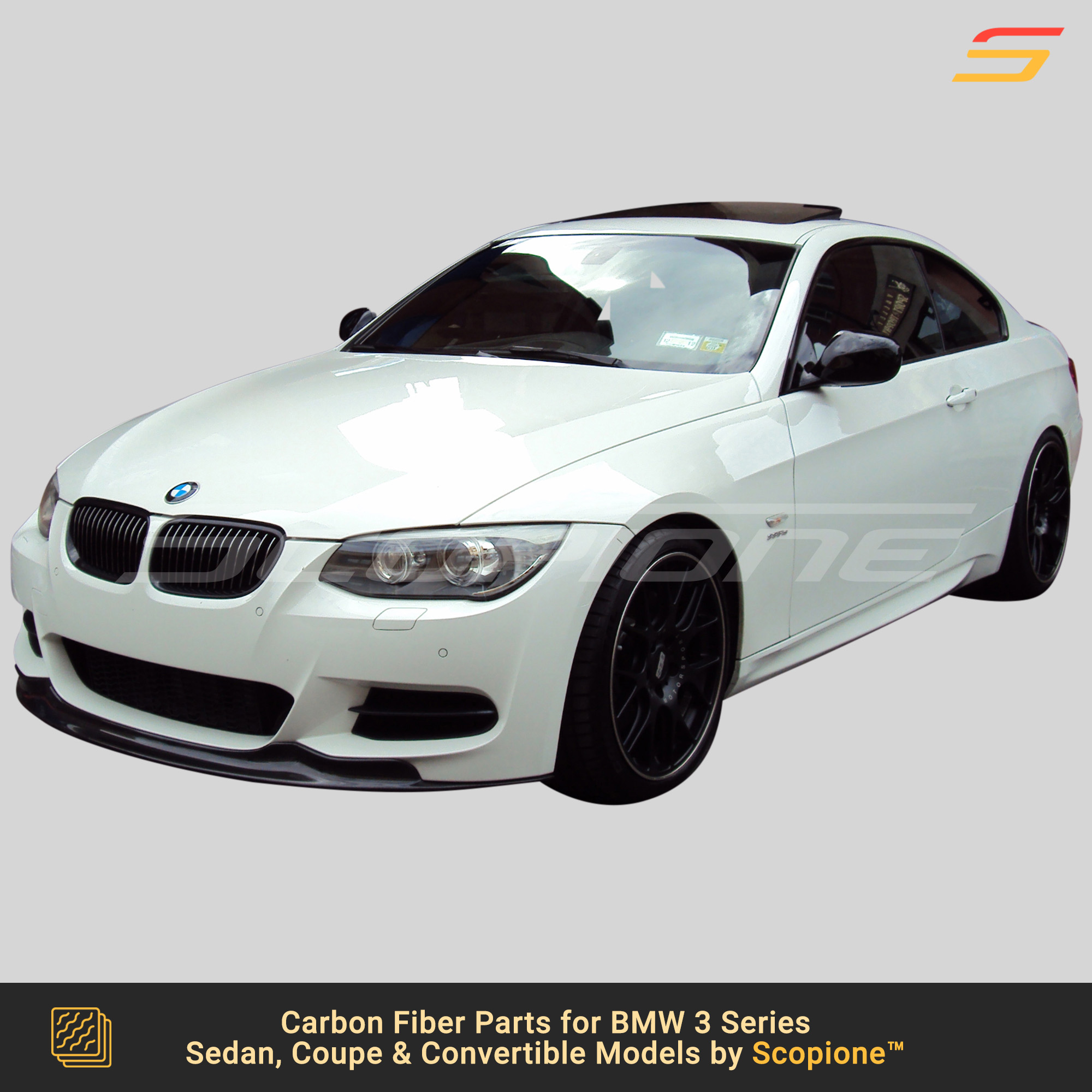
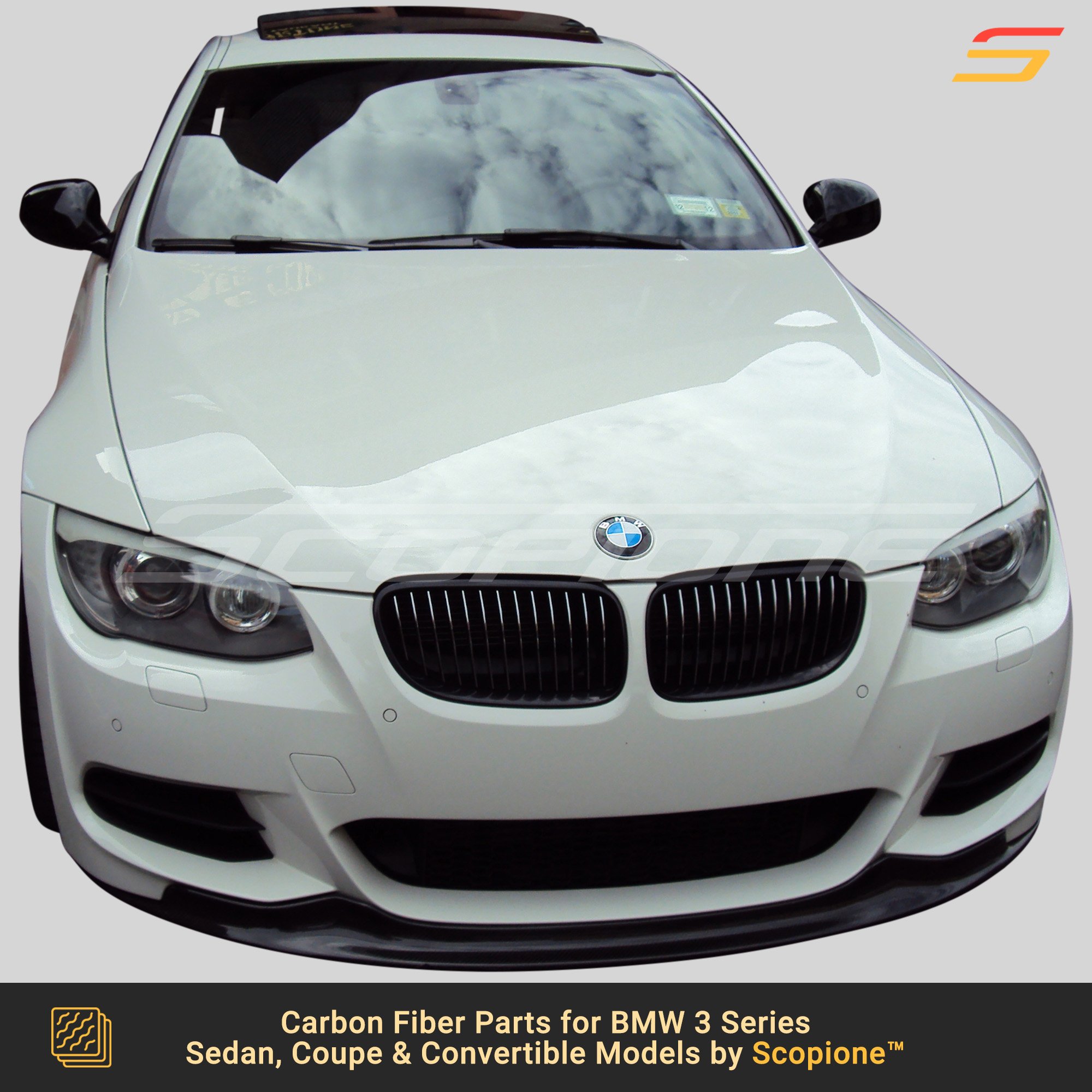
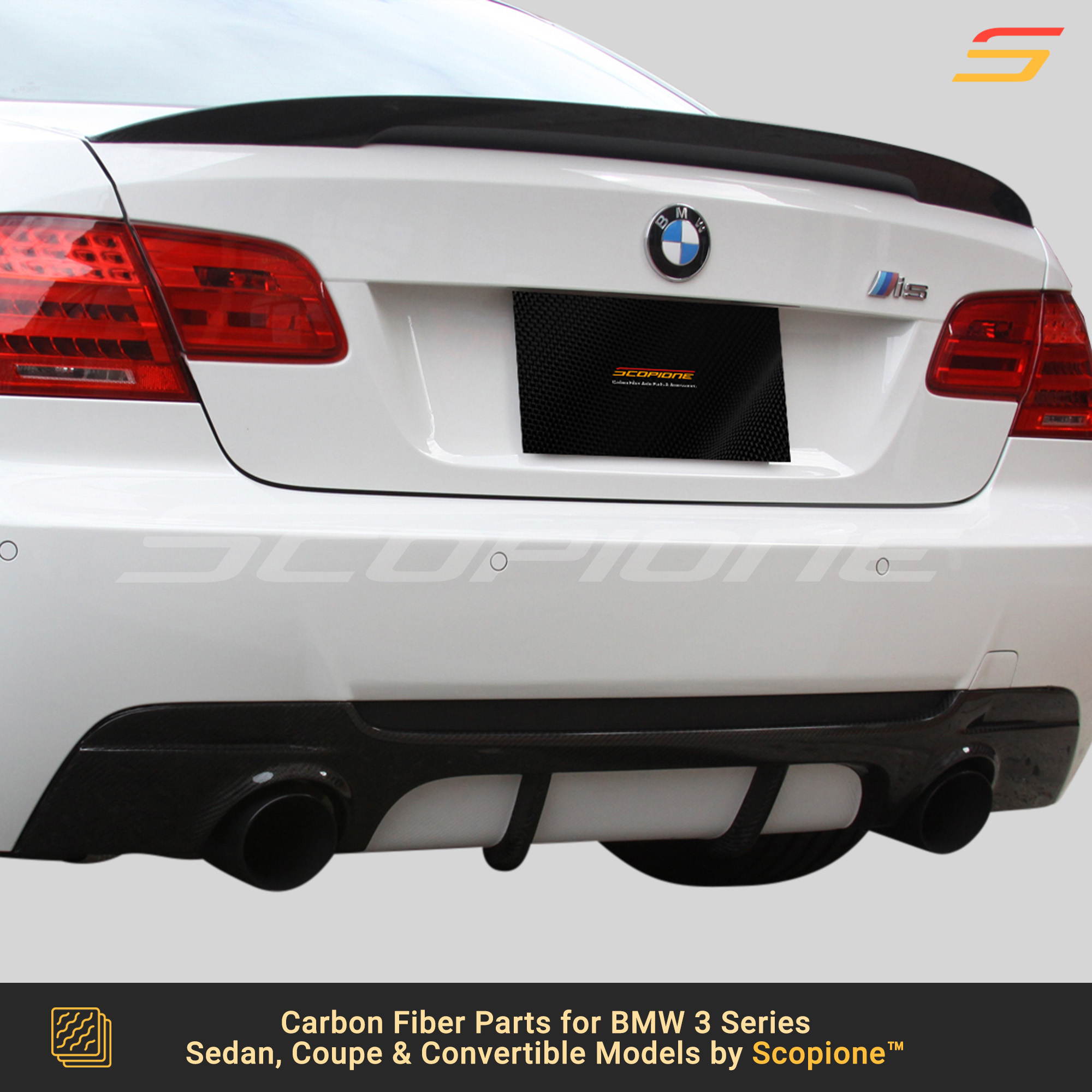
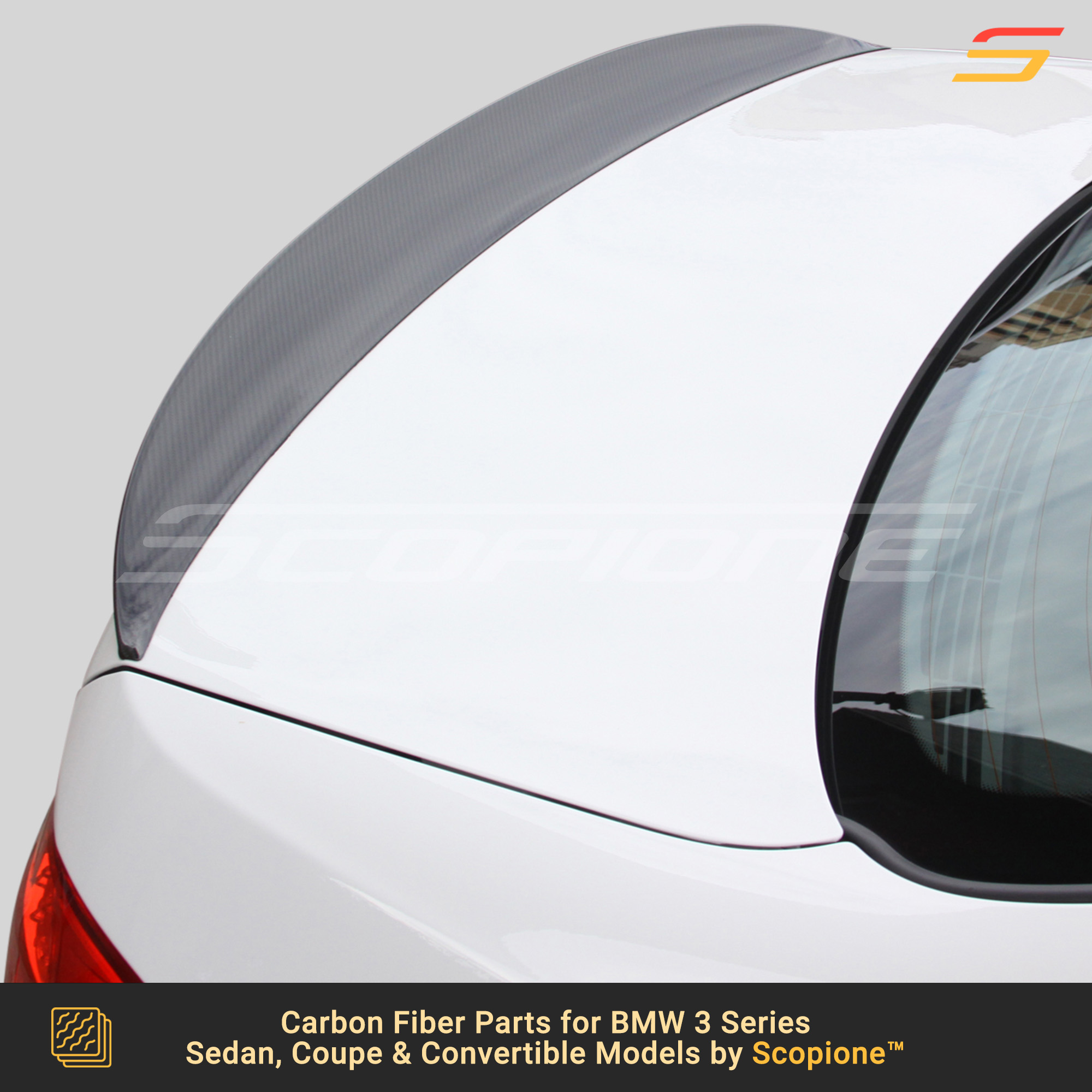
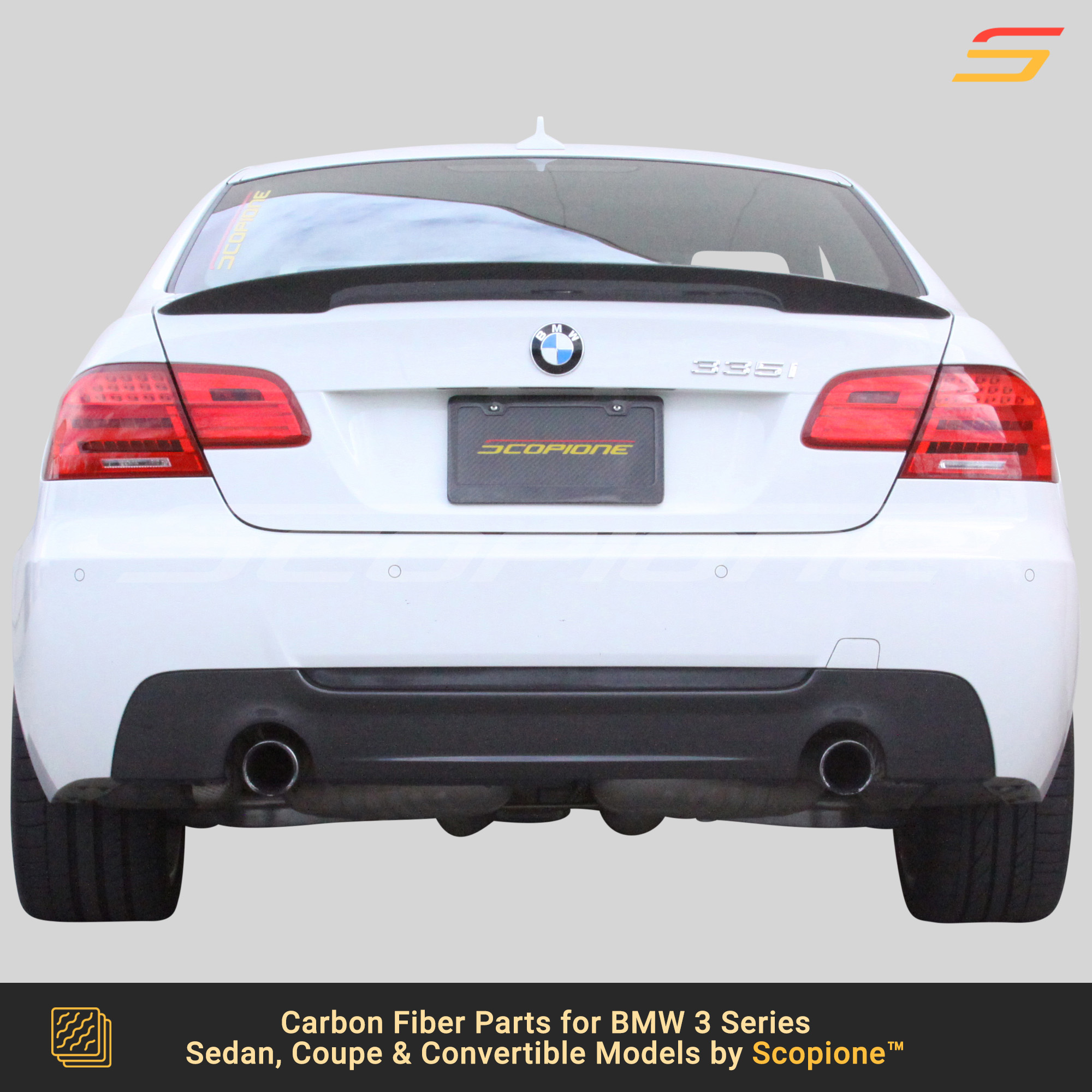
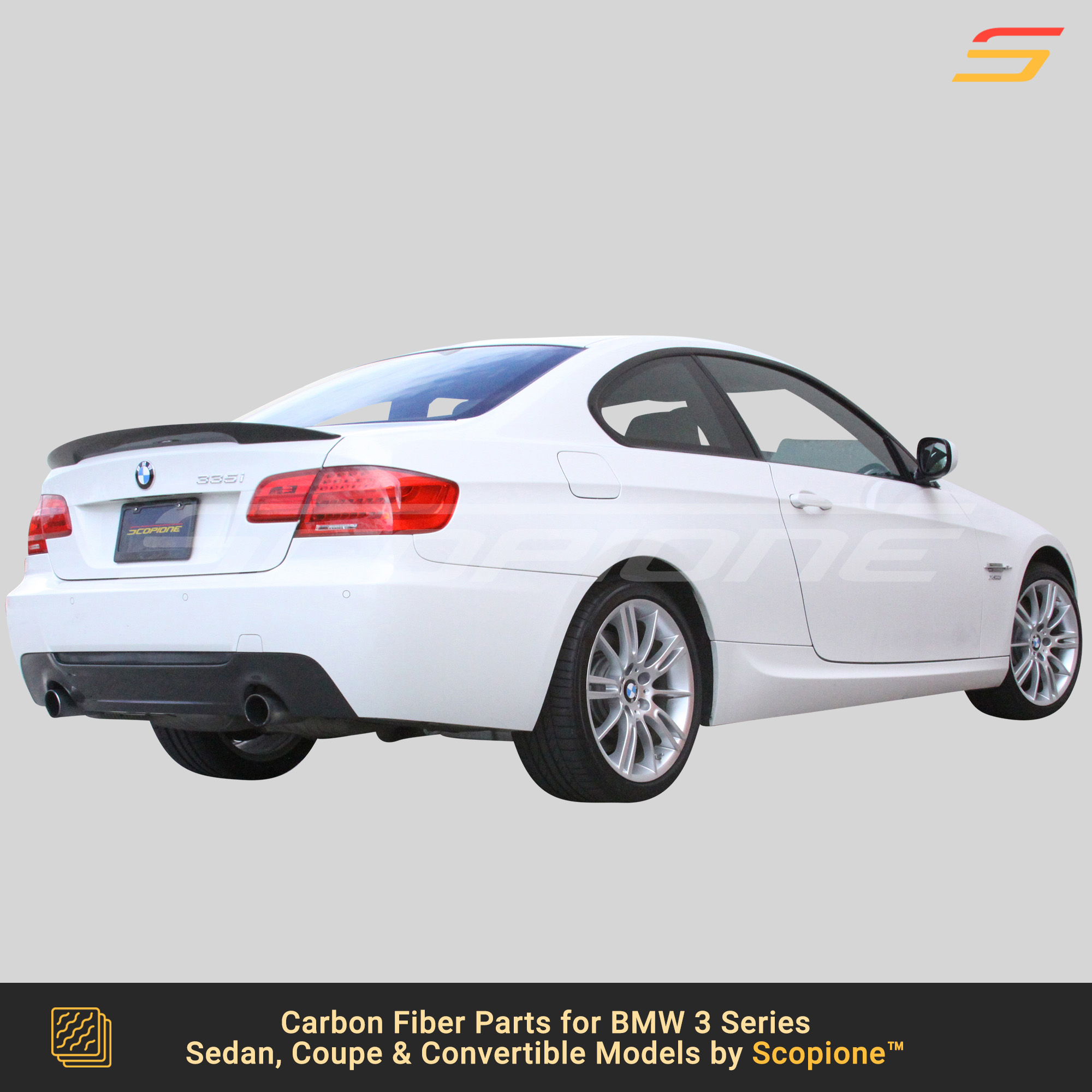
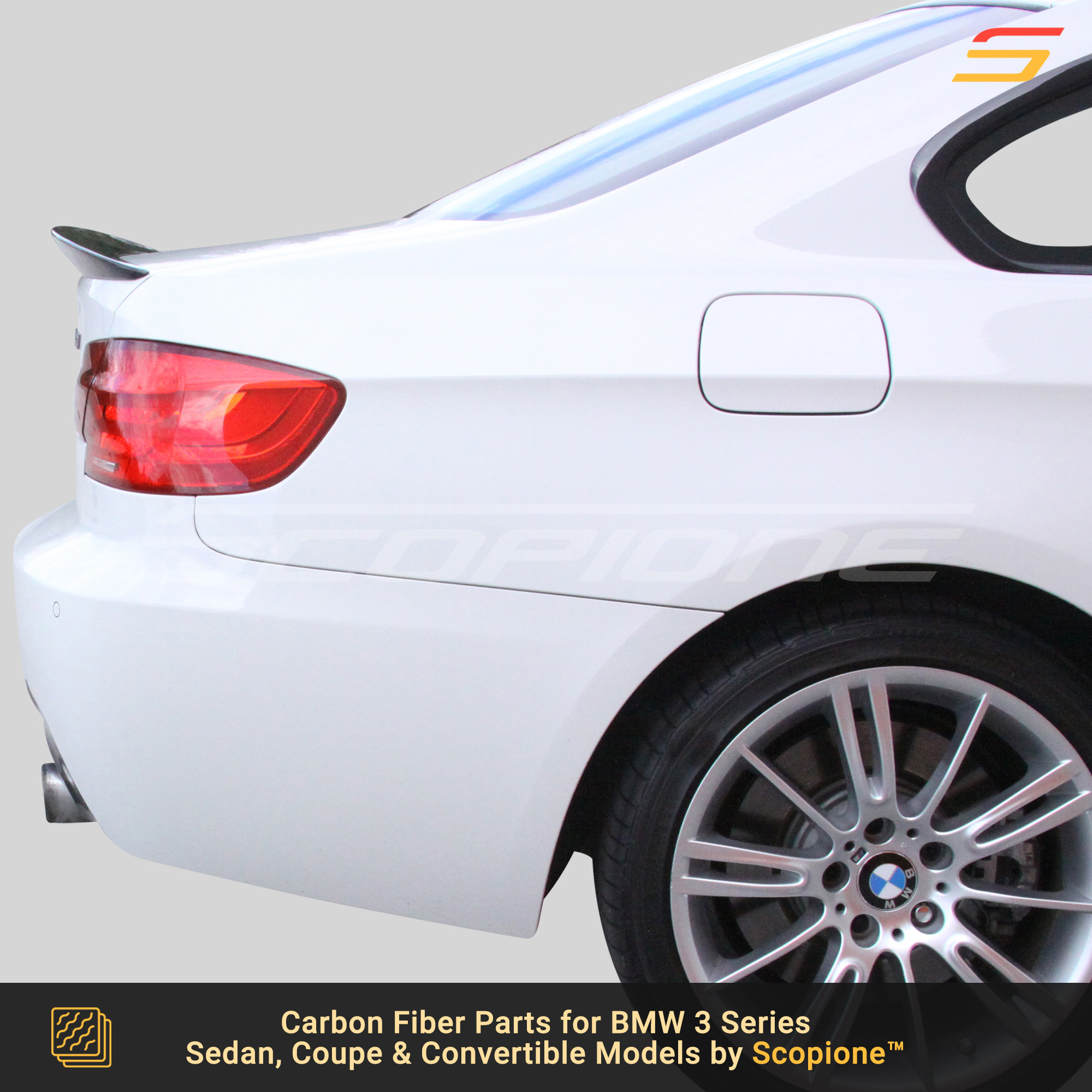
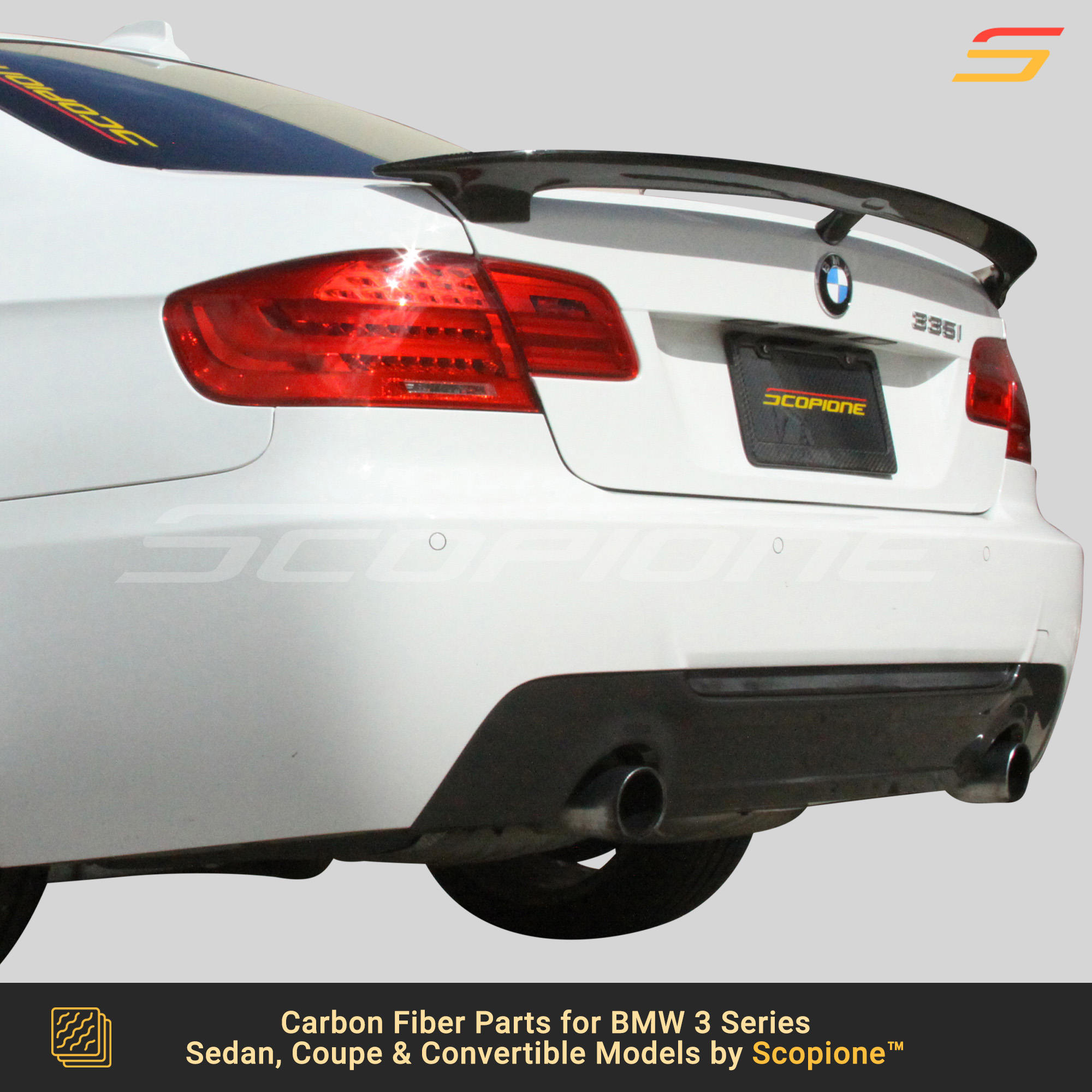
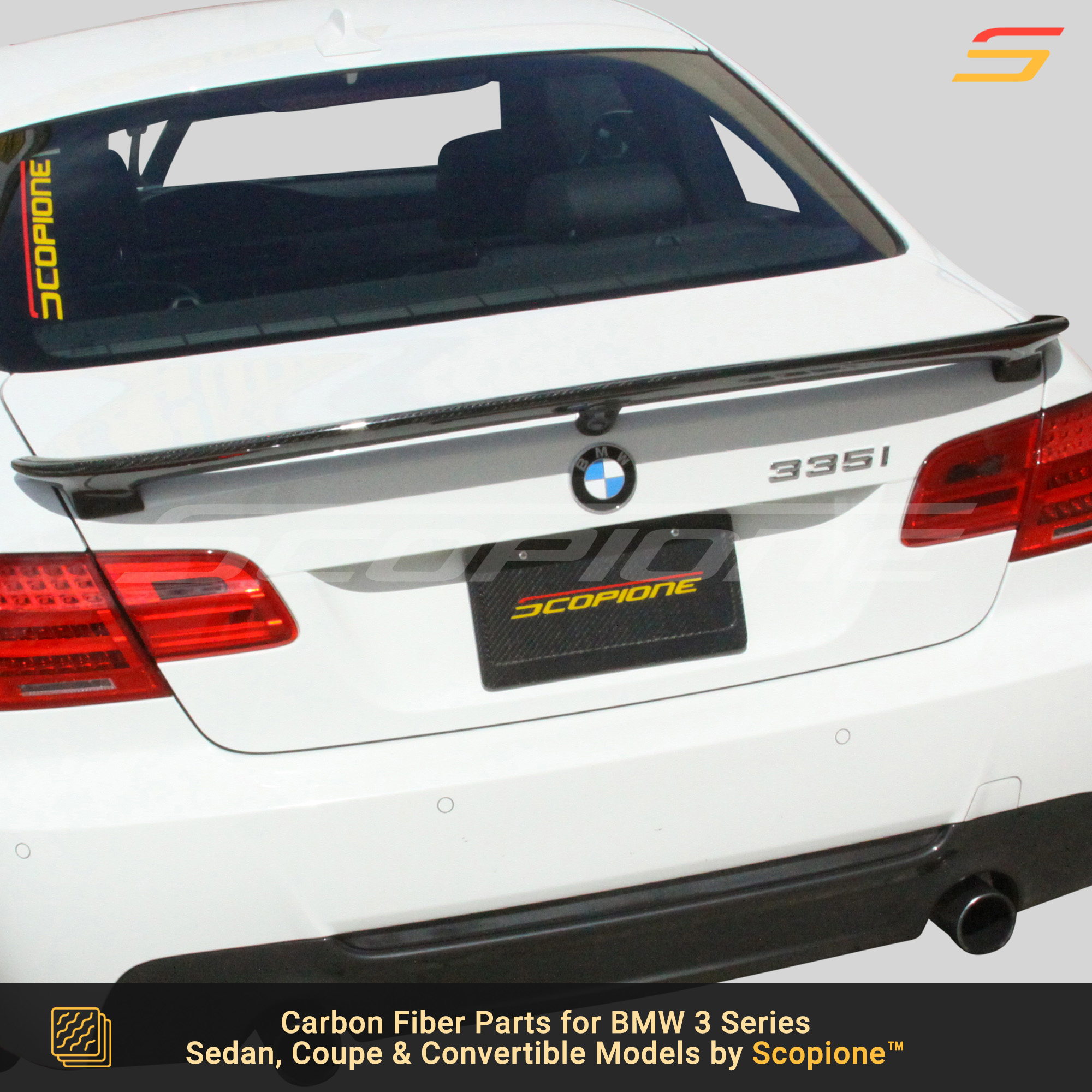
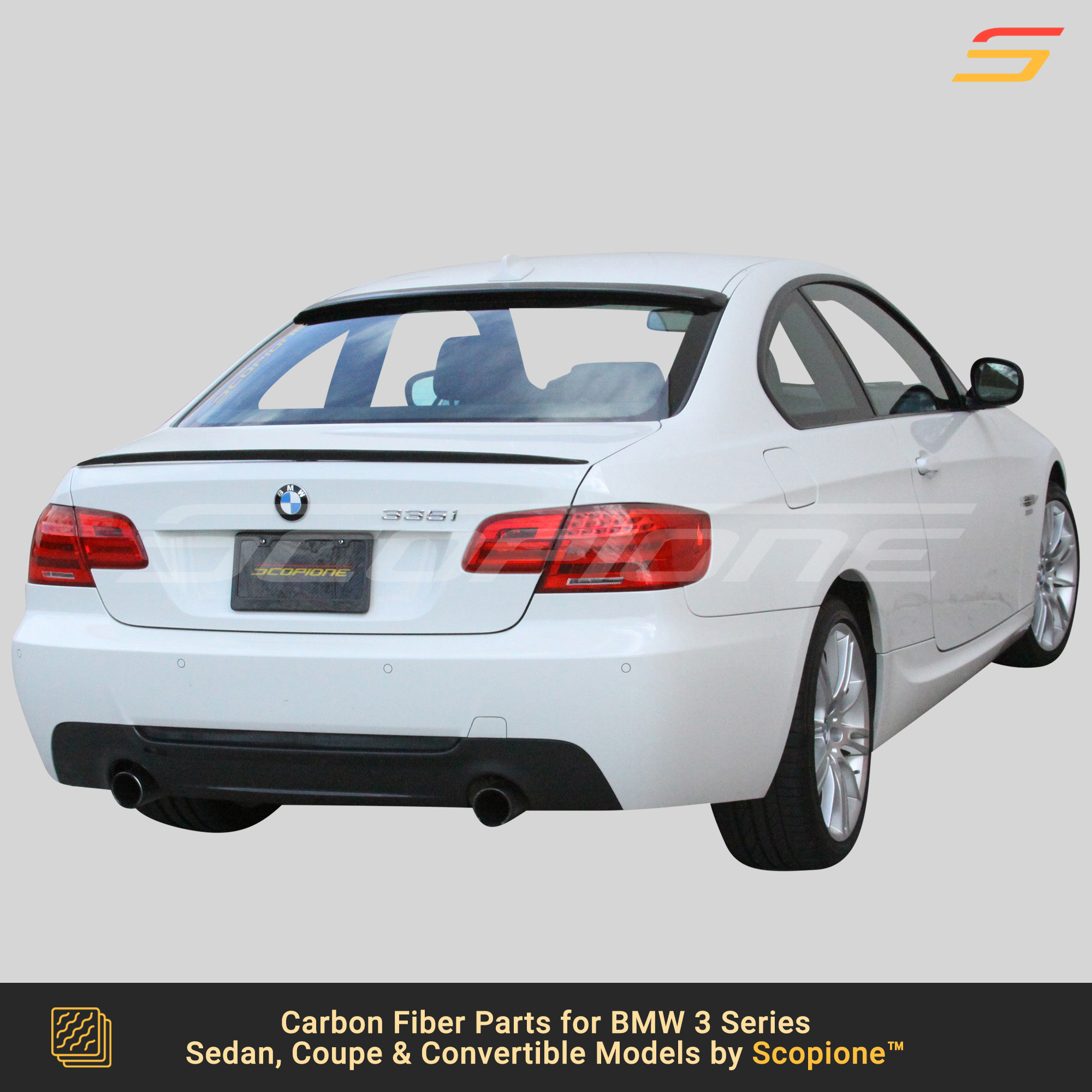
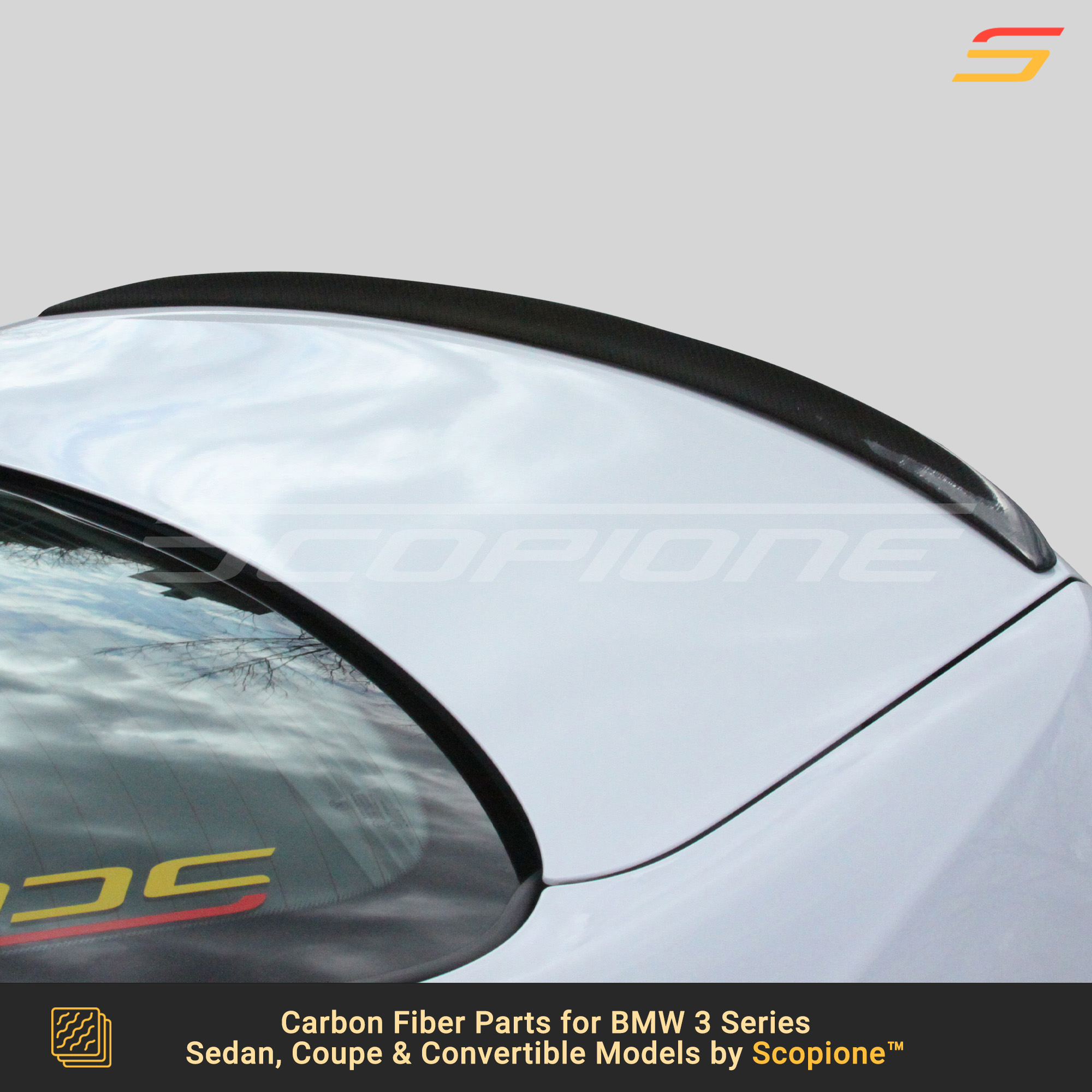
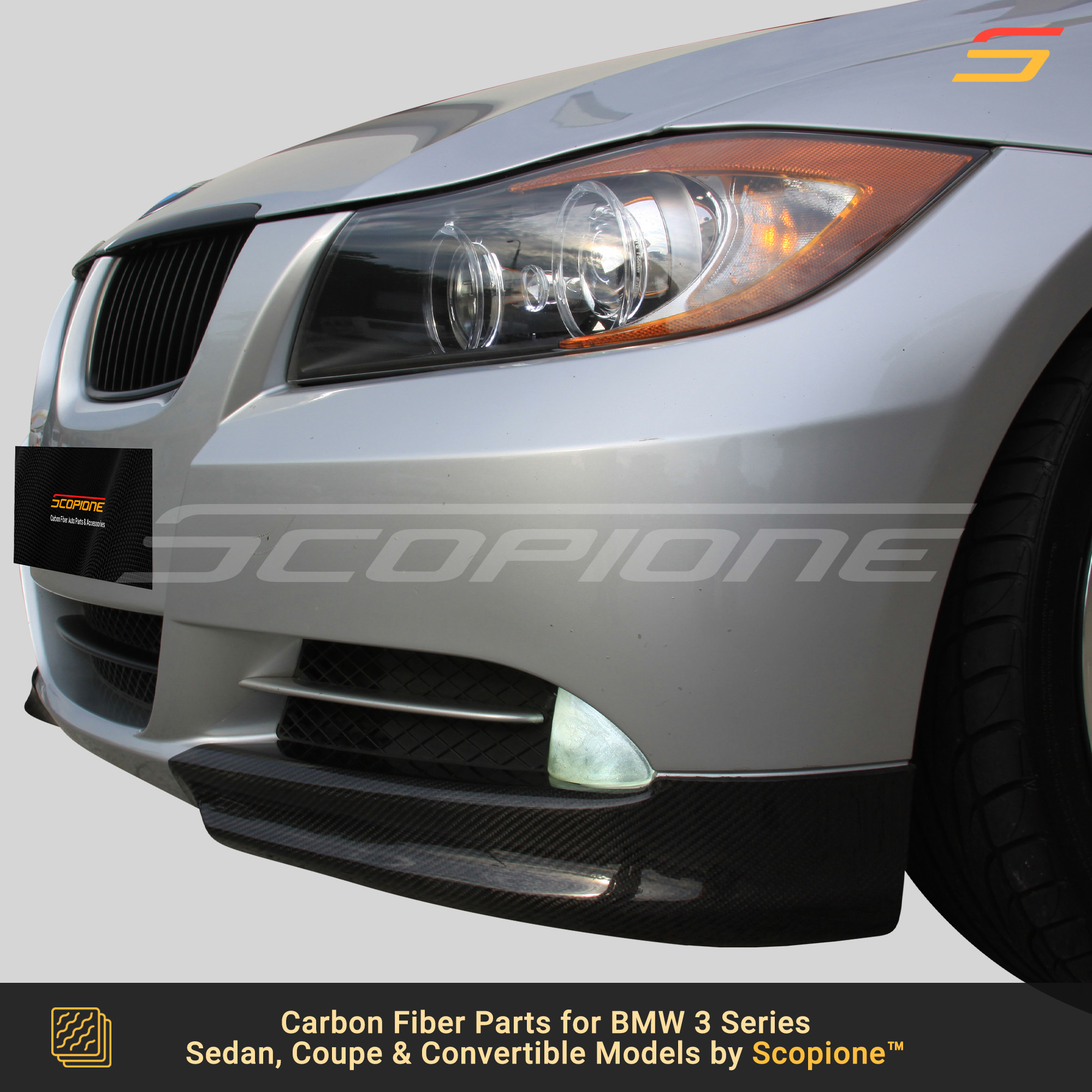
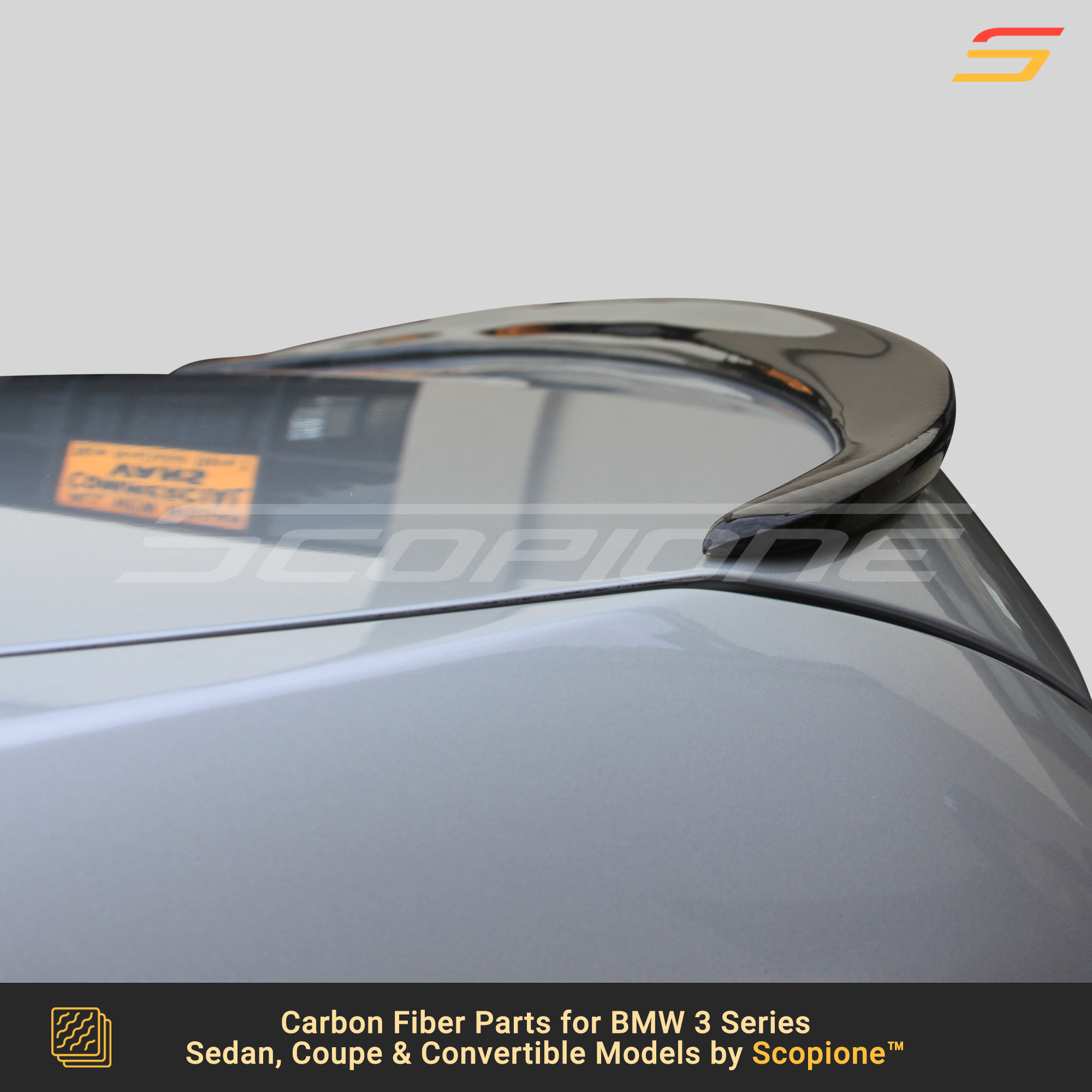
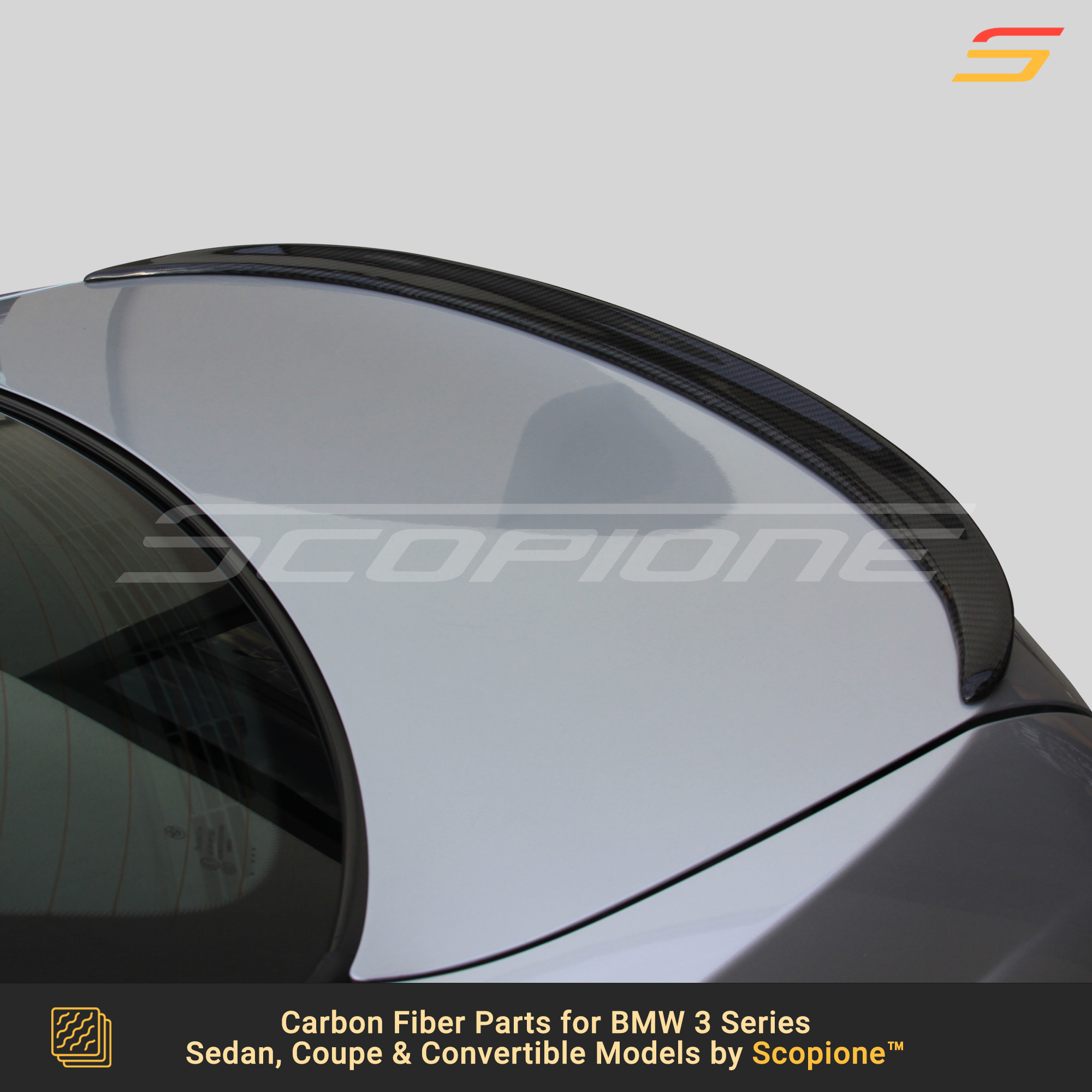
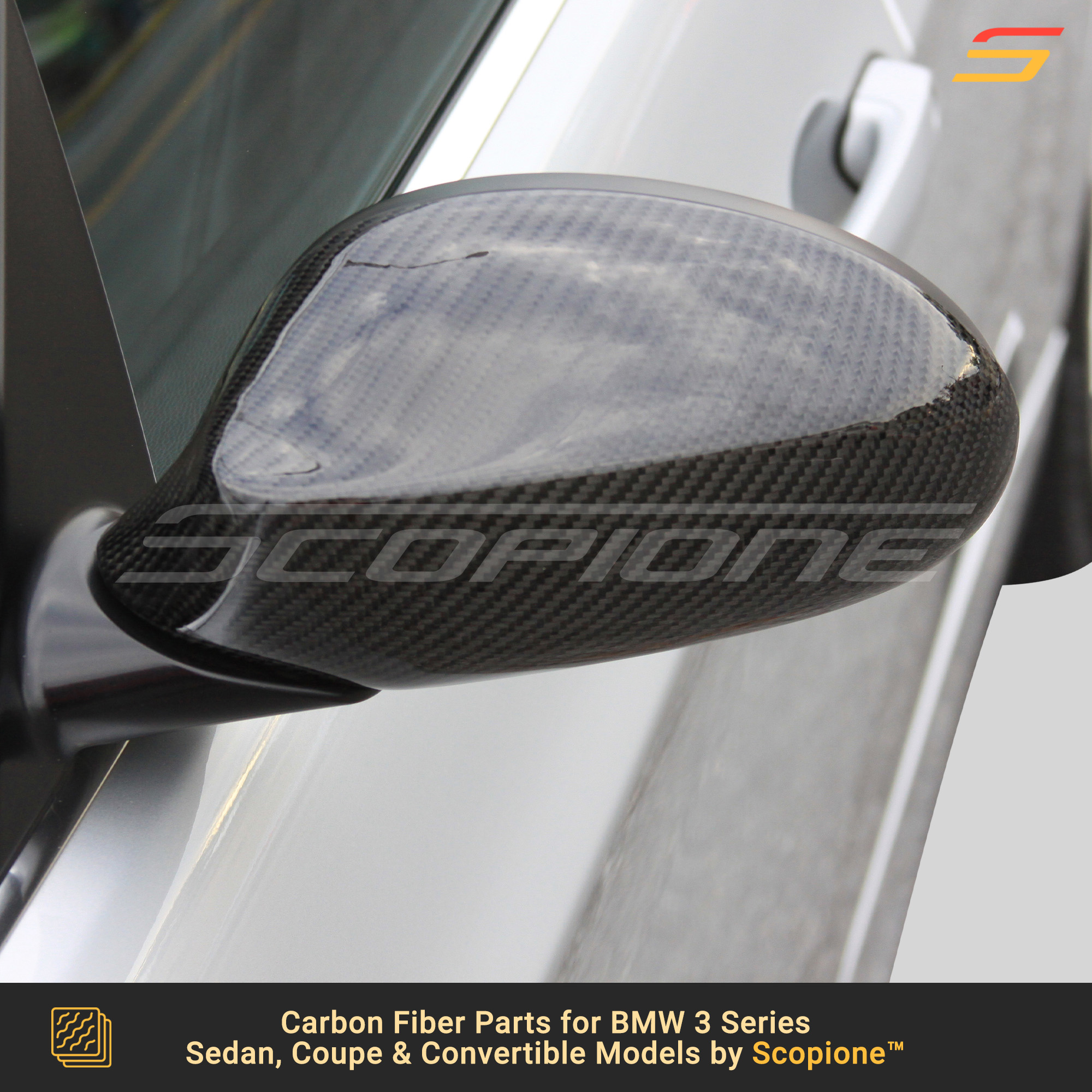
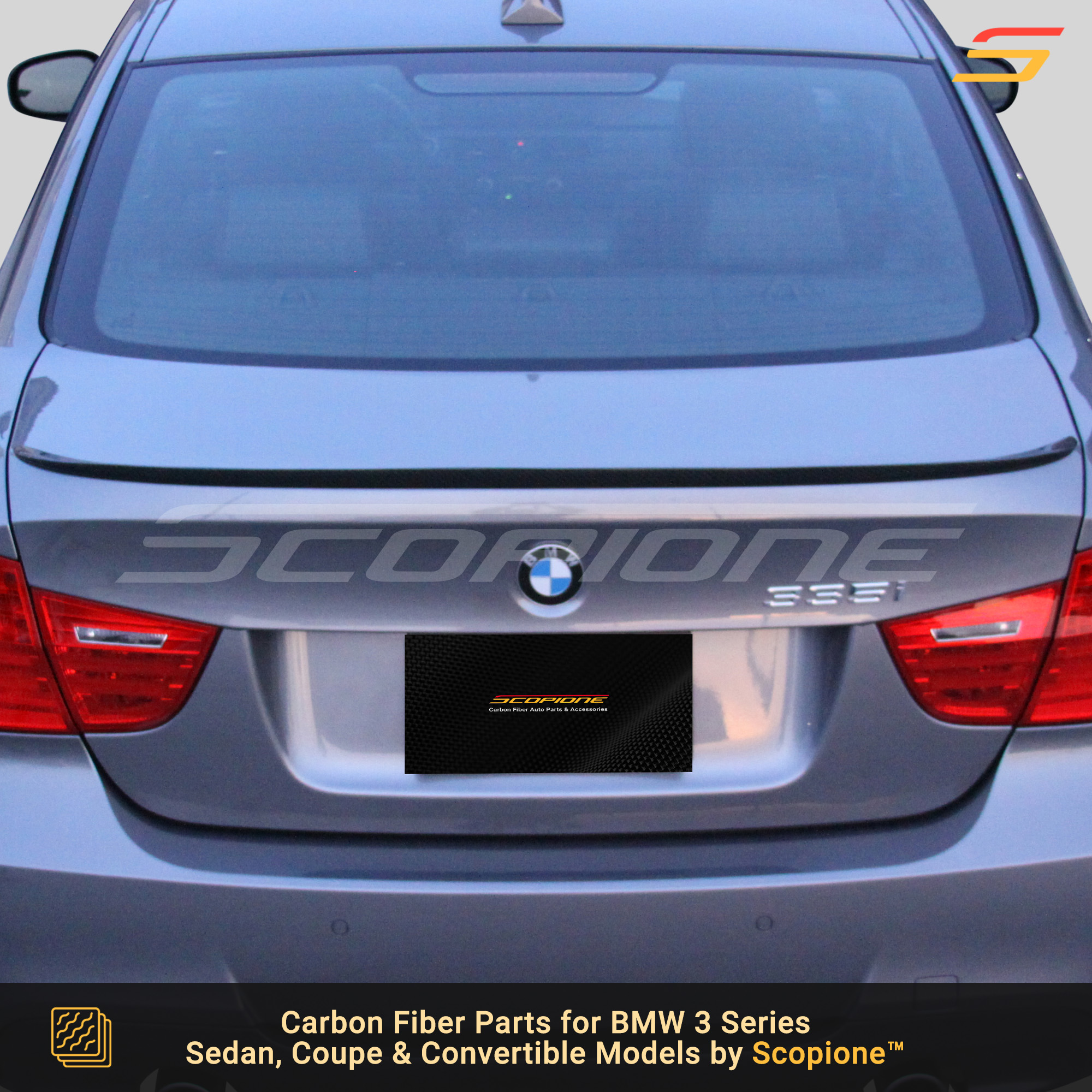
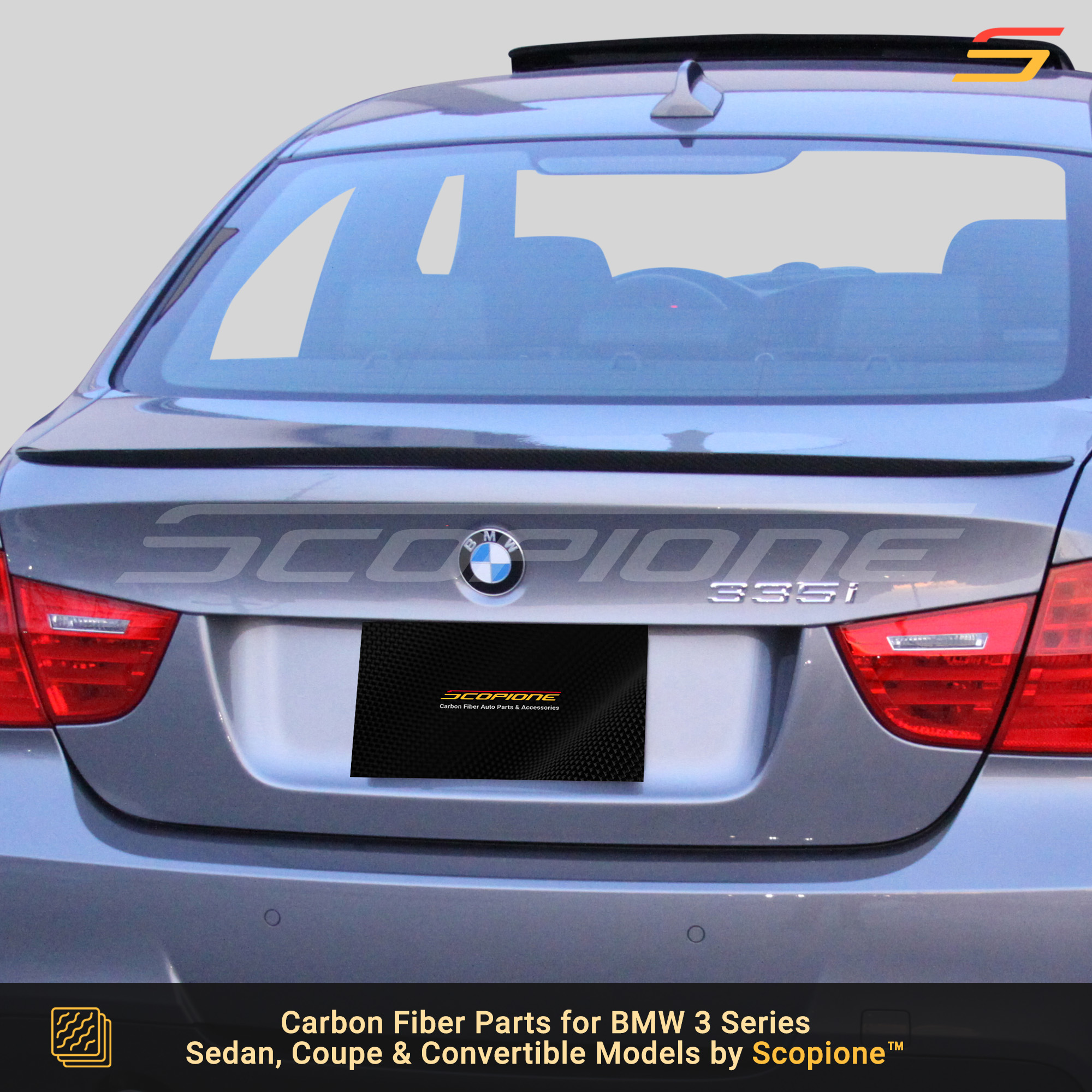
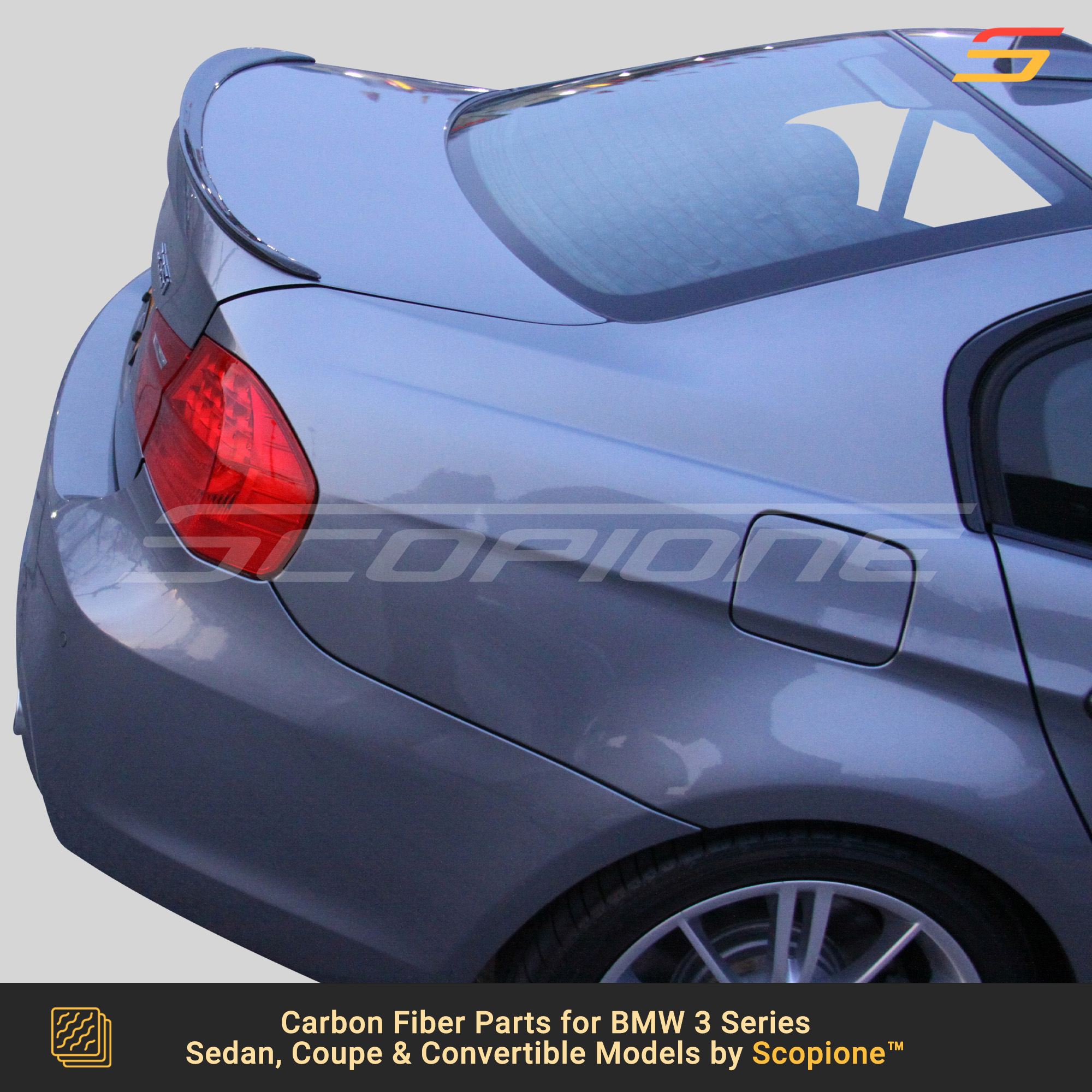
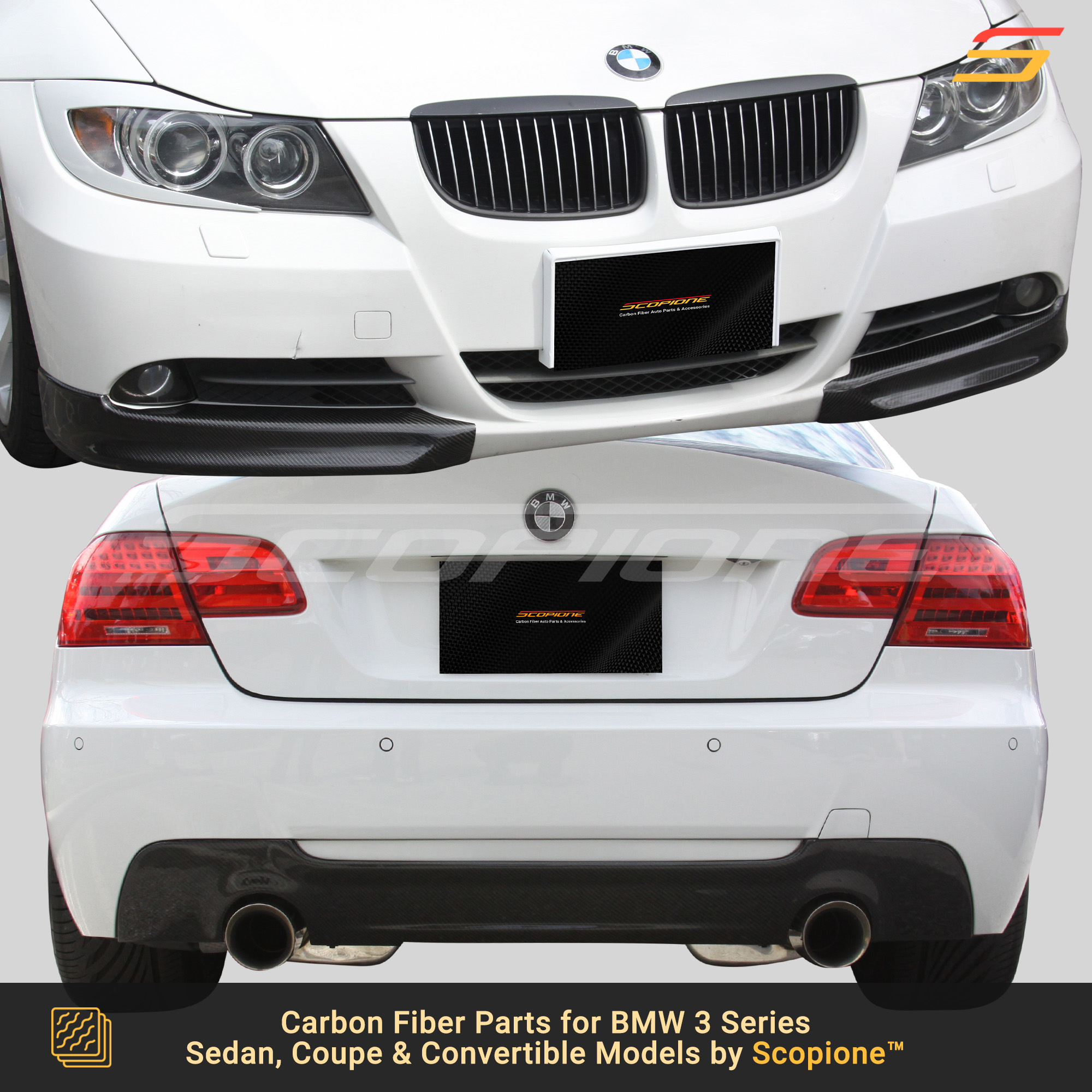
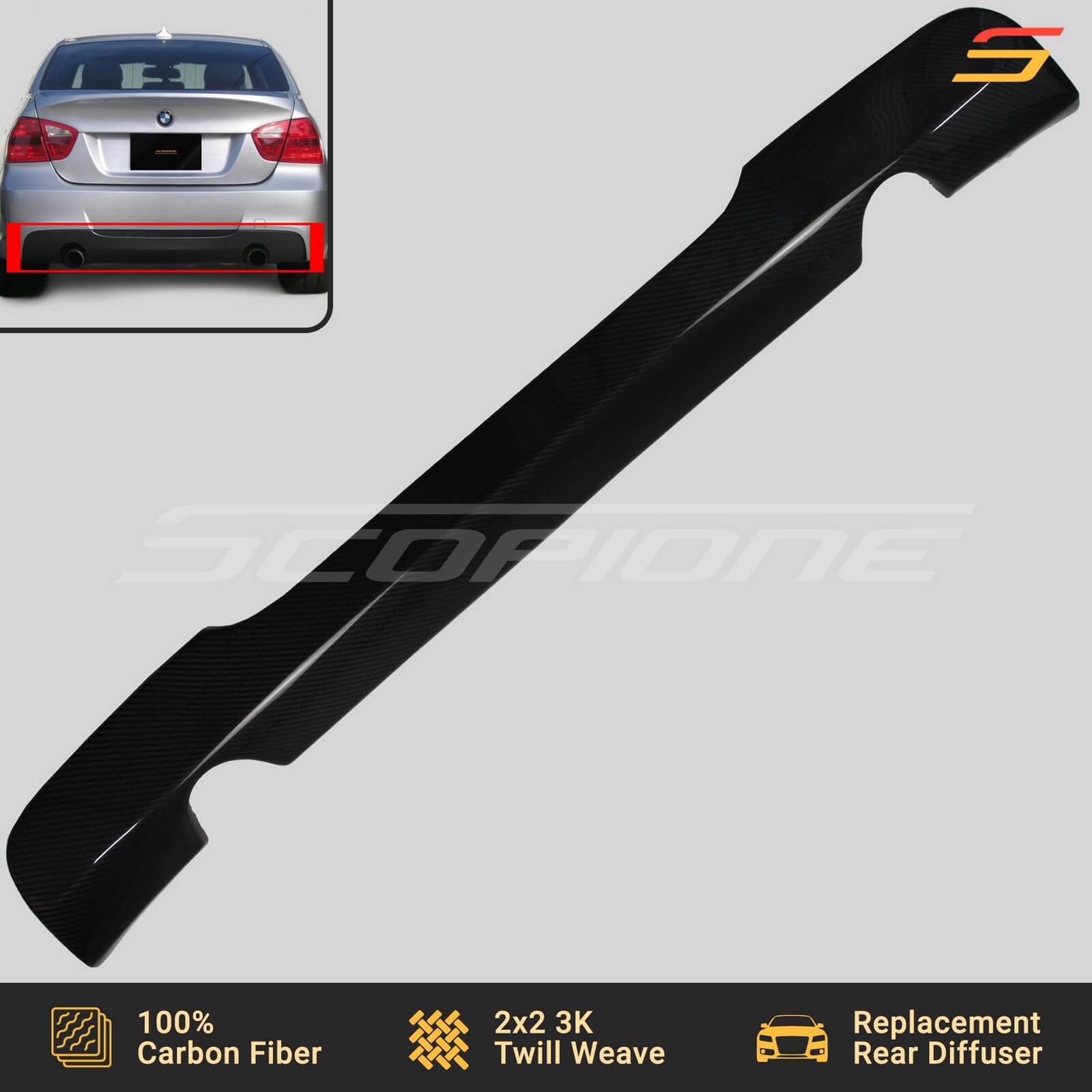
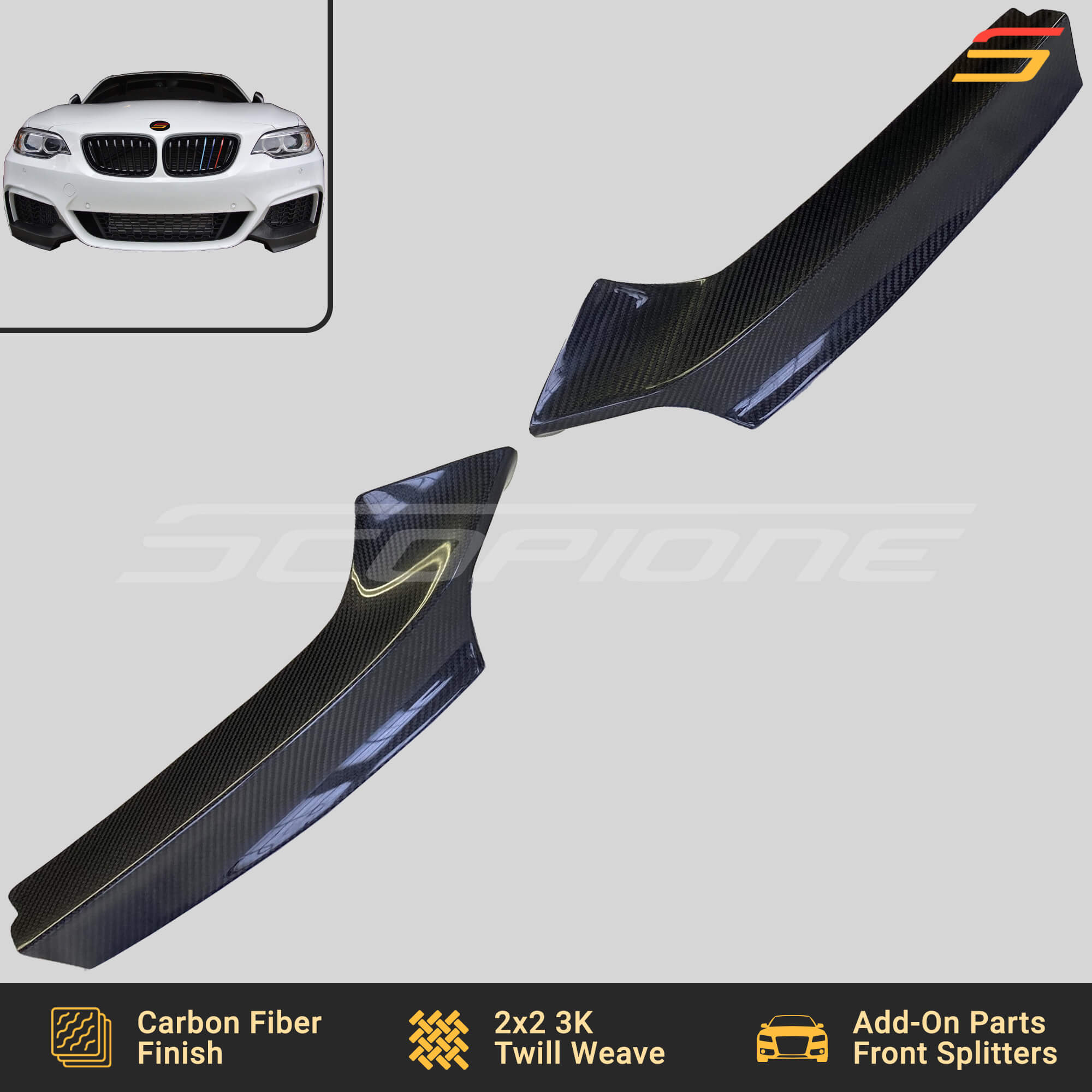
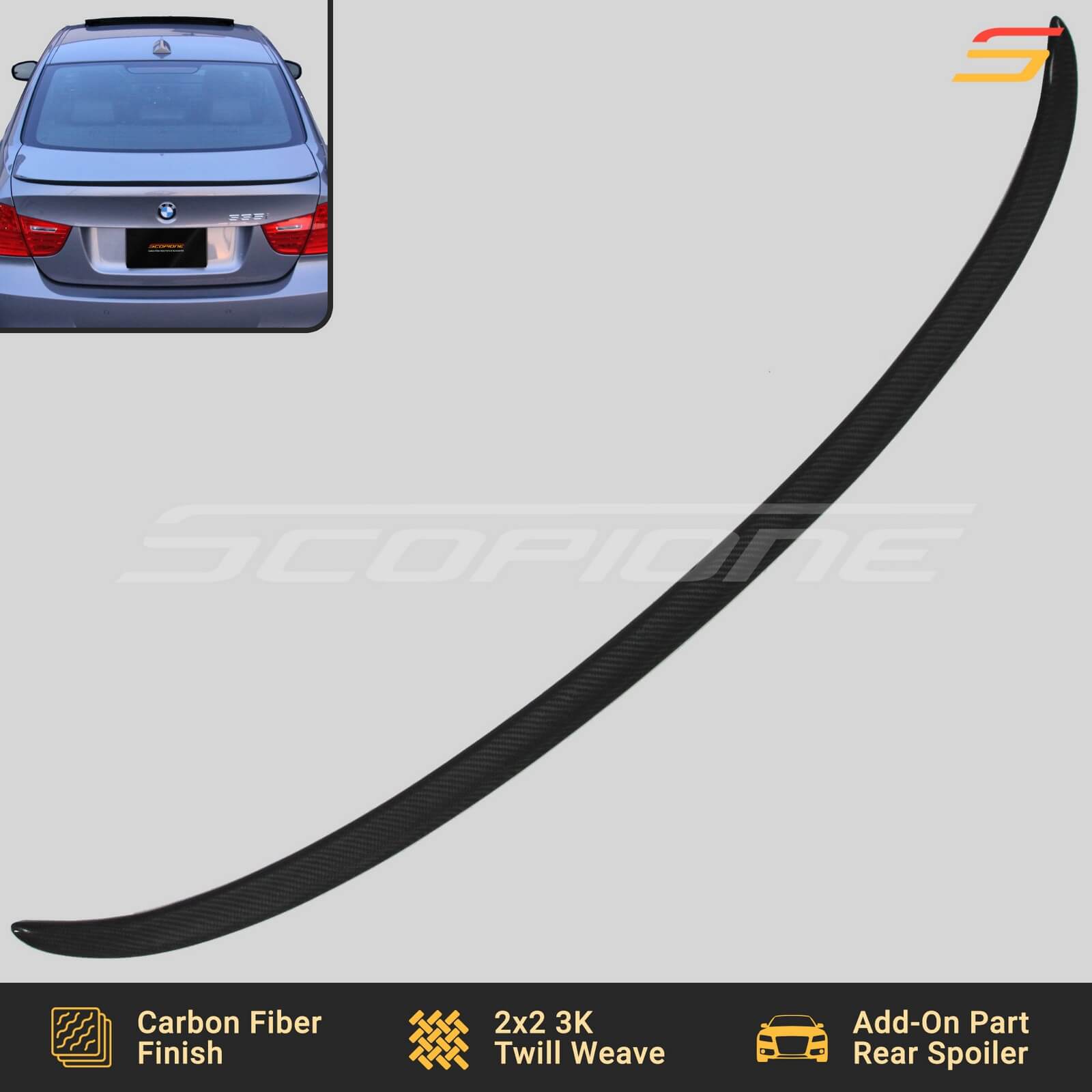
Scopione’s E90/E92 catalog is extensive: front splitters, full front lip spoilers, rear diffusers, hood vents, mirror caps, trunk spoilers, and roof spoilers across both M3 and M-Tech bumper configurations. Front splitters start at $170. Multiple spoiler designs offer distinct profiles – SC2 and SC5 for the E92 coupe trunk line, SC1 through SC5 for the E90 sedan.
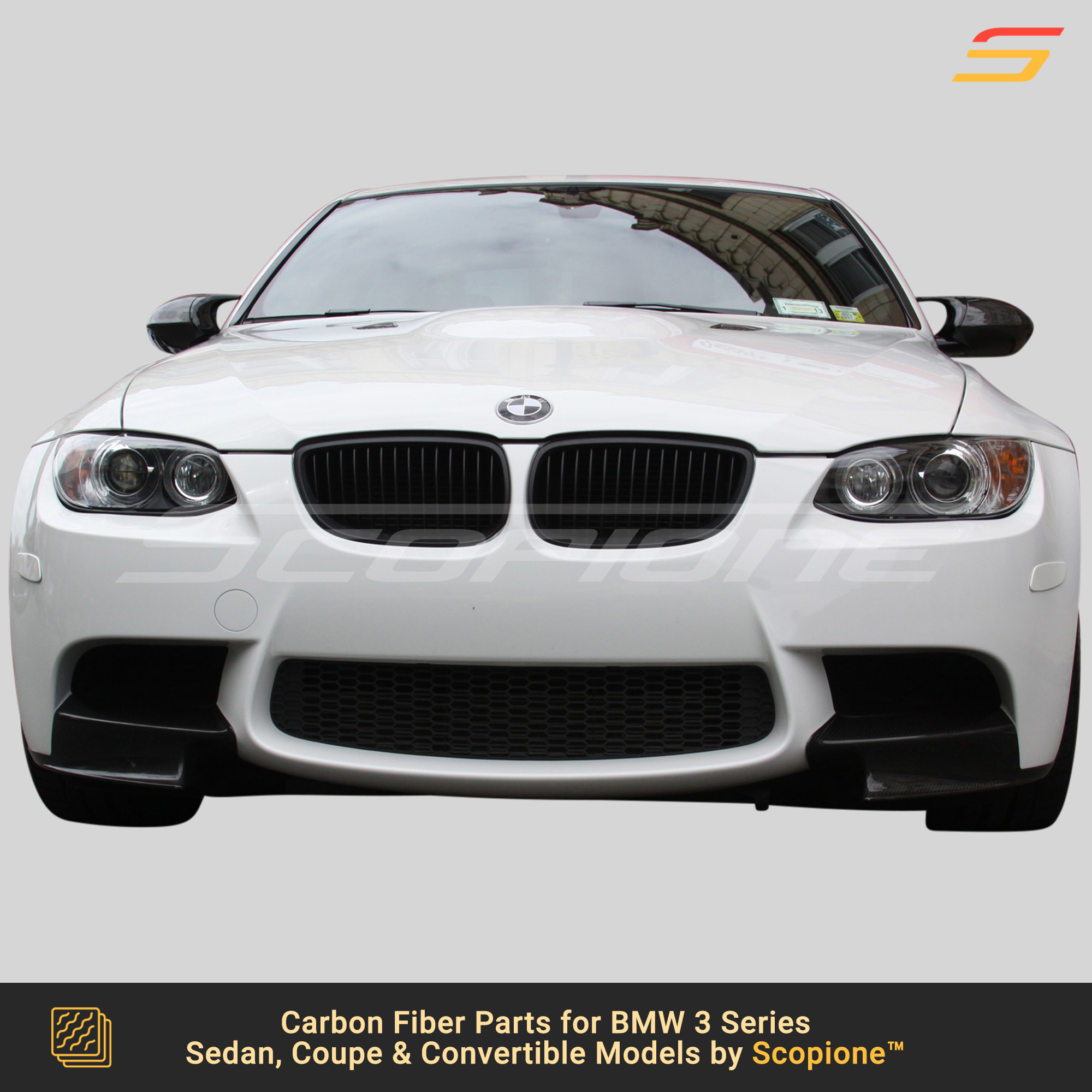
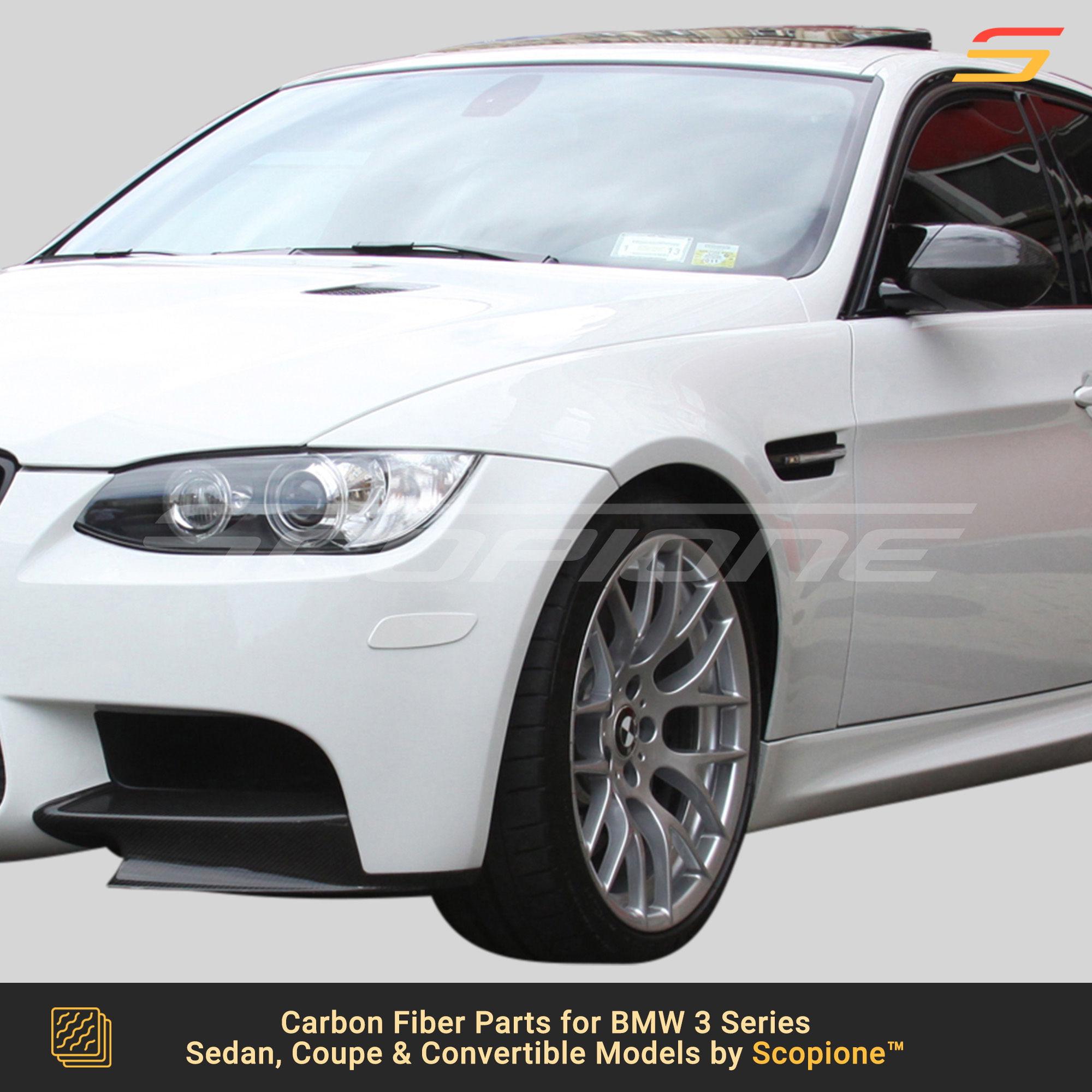
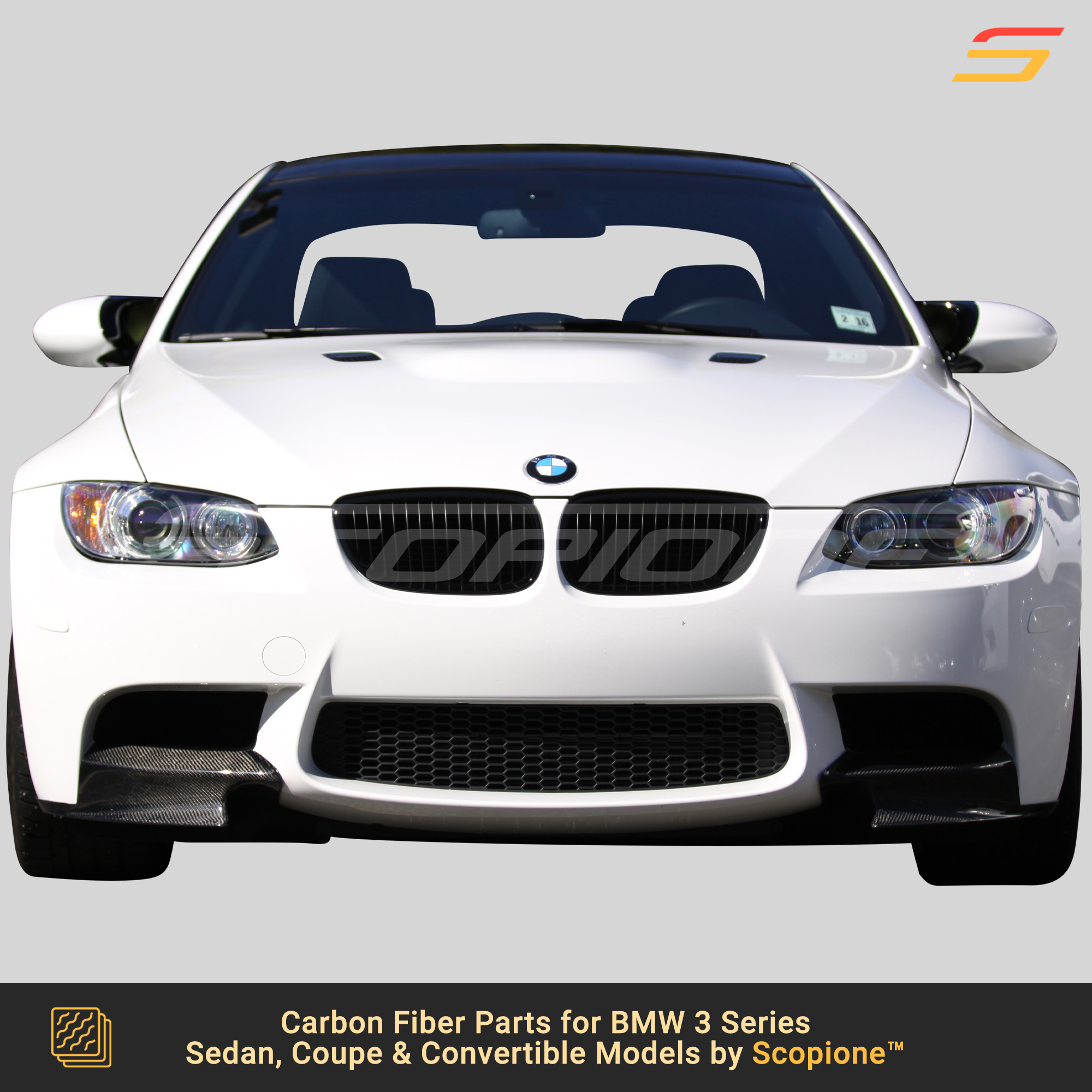
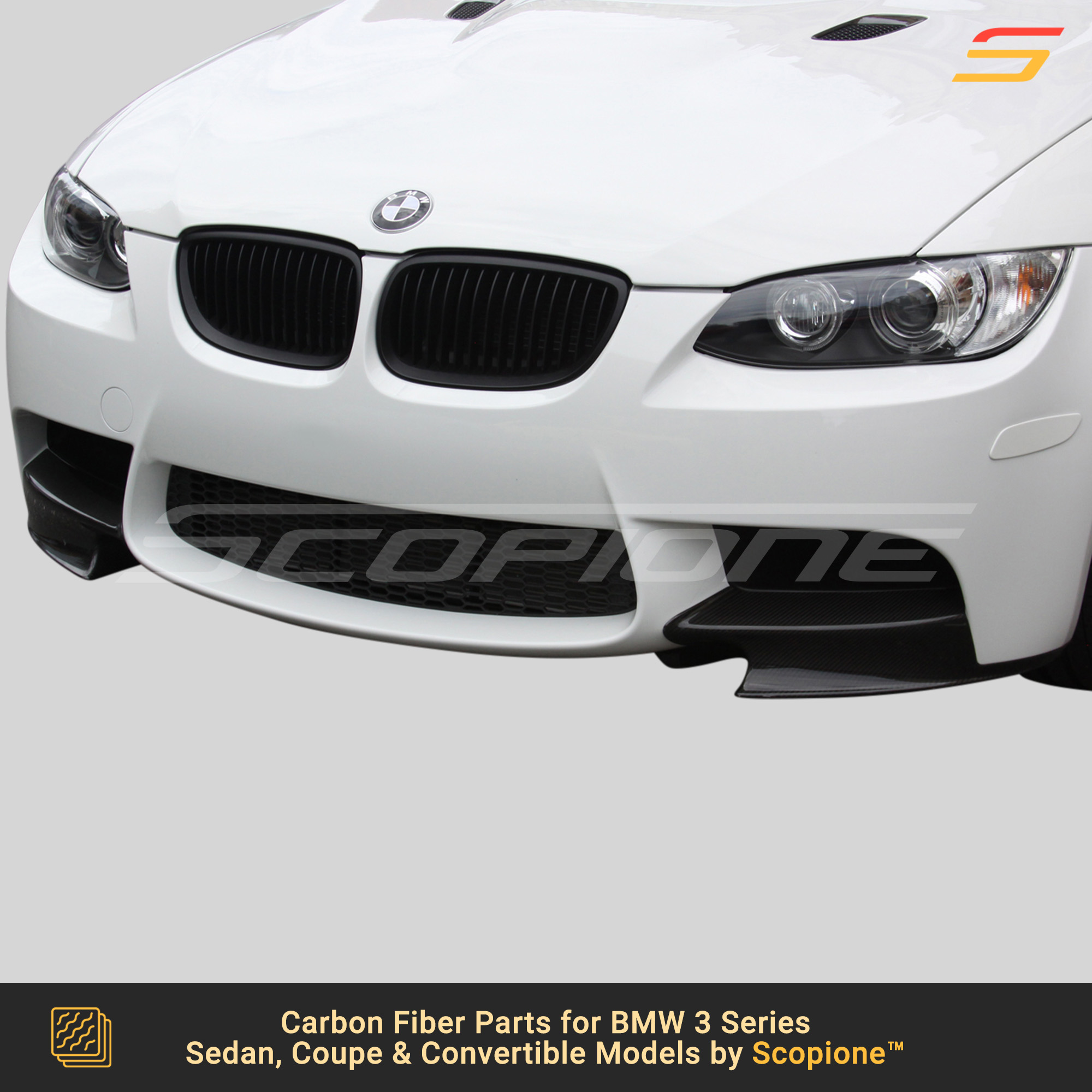

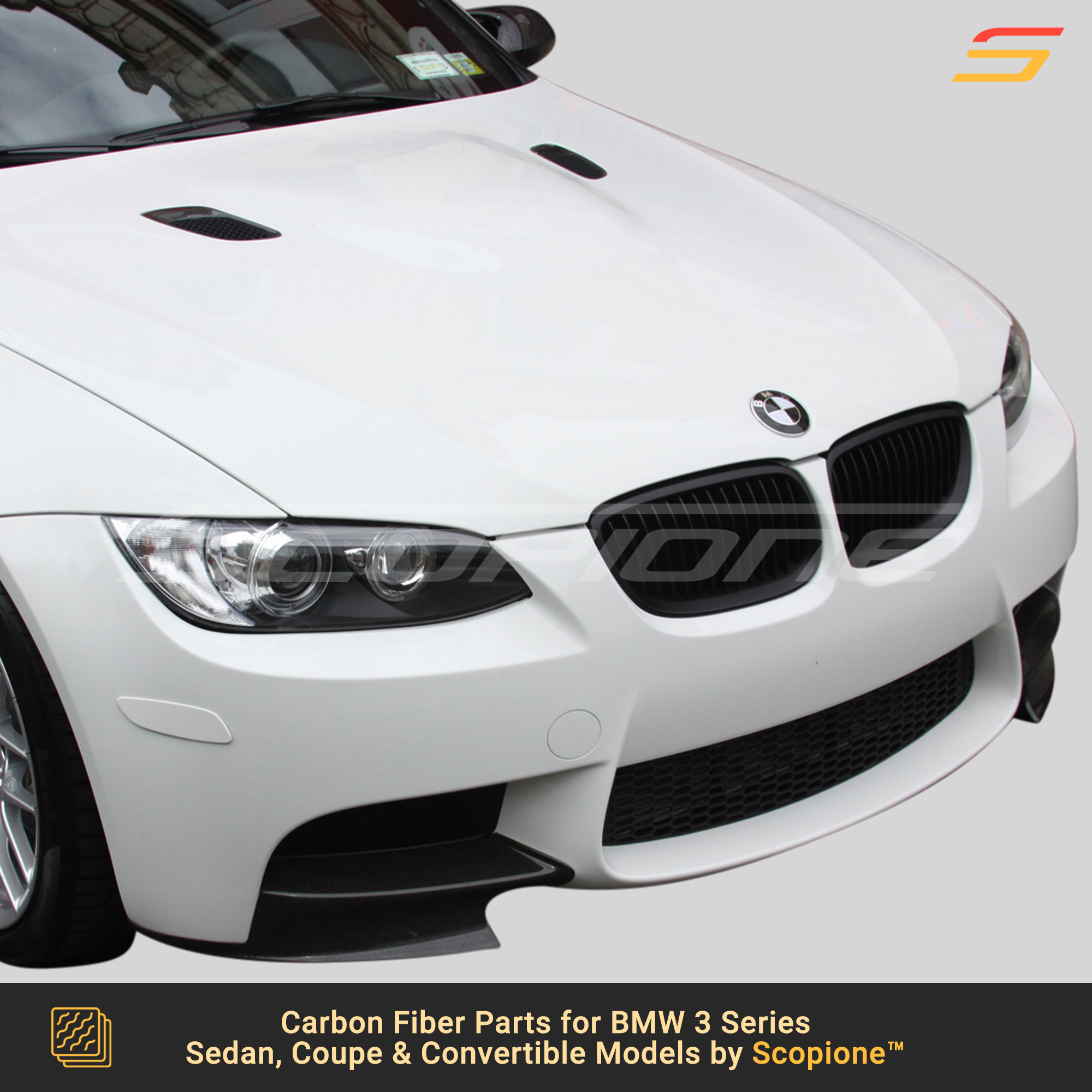
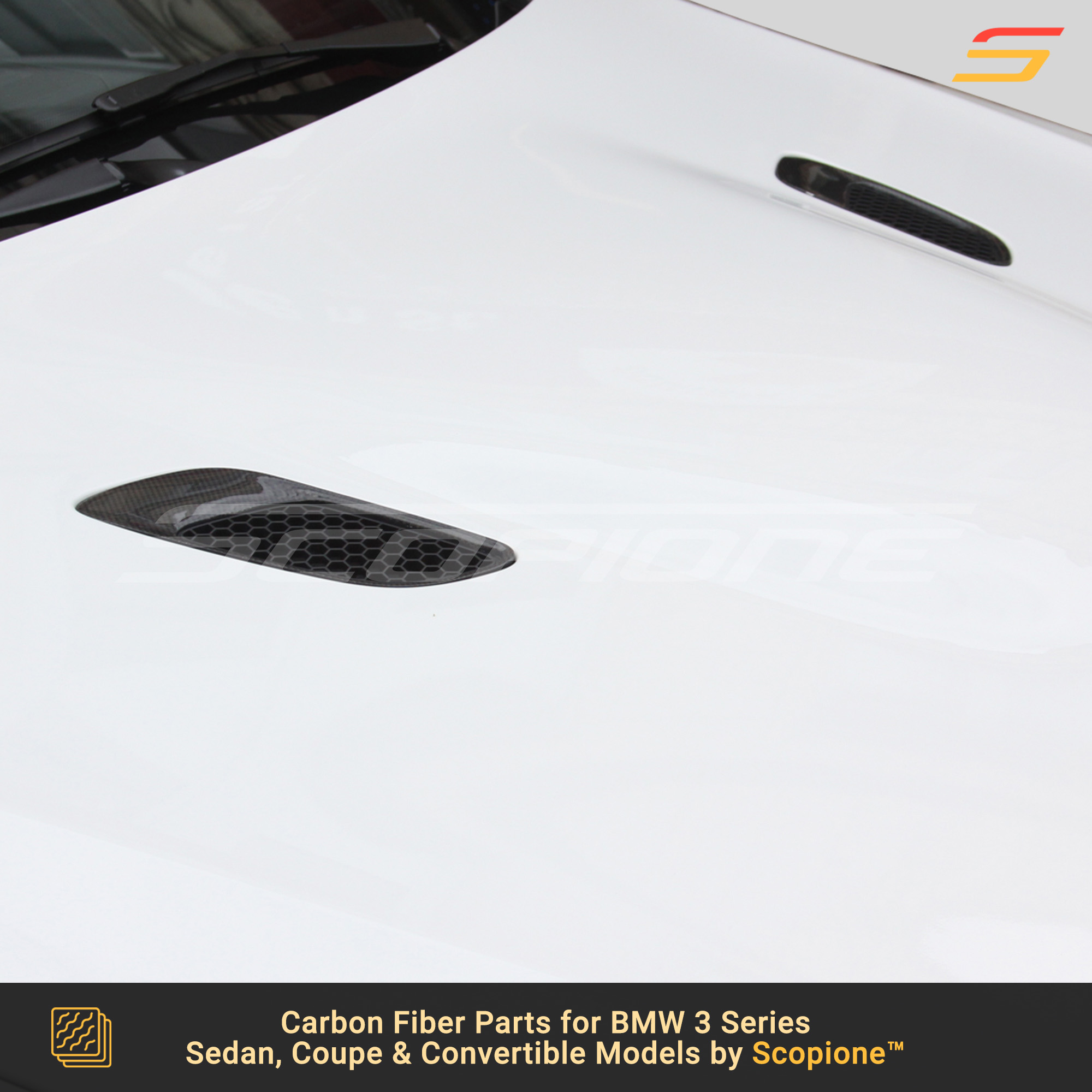
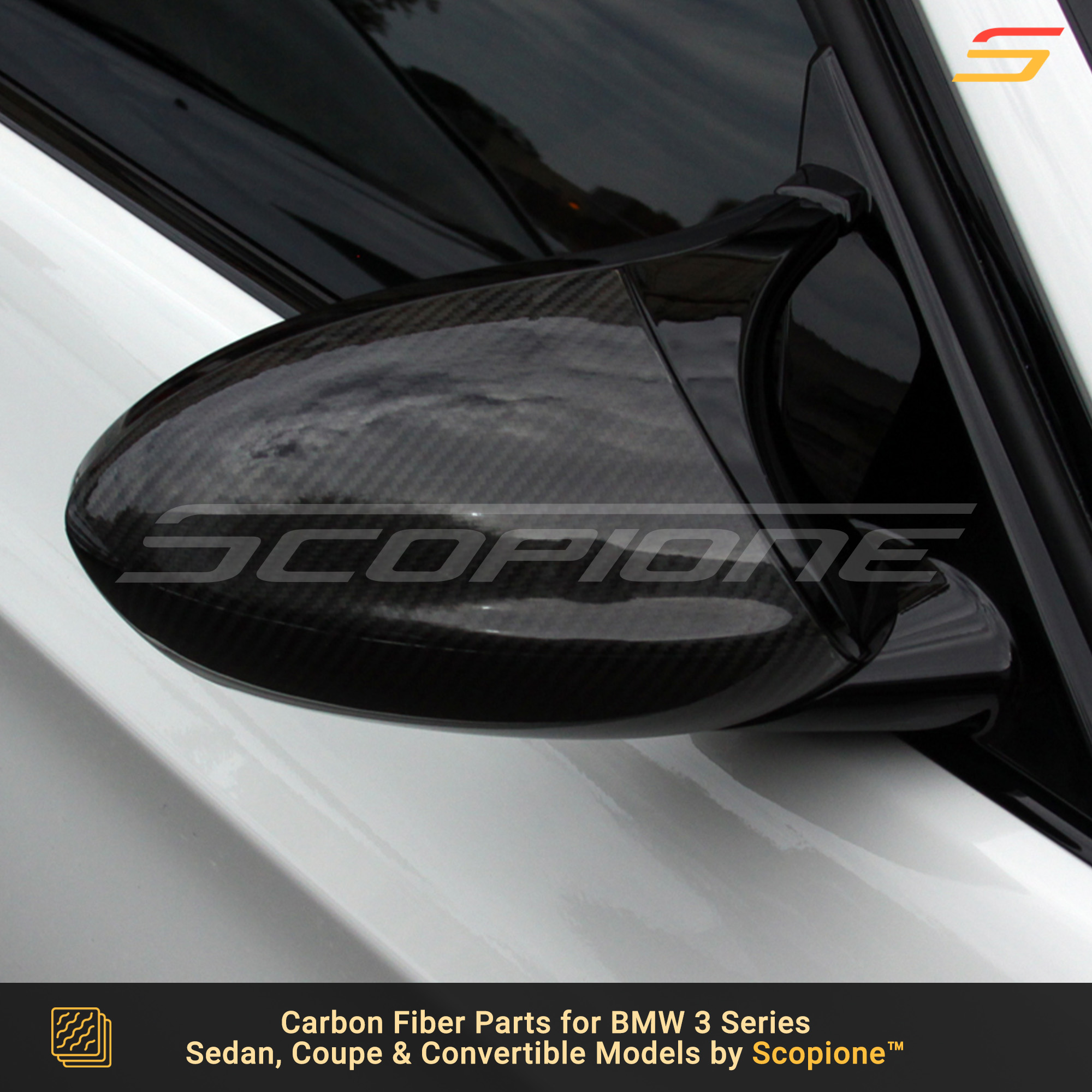
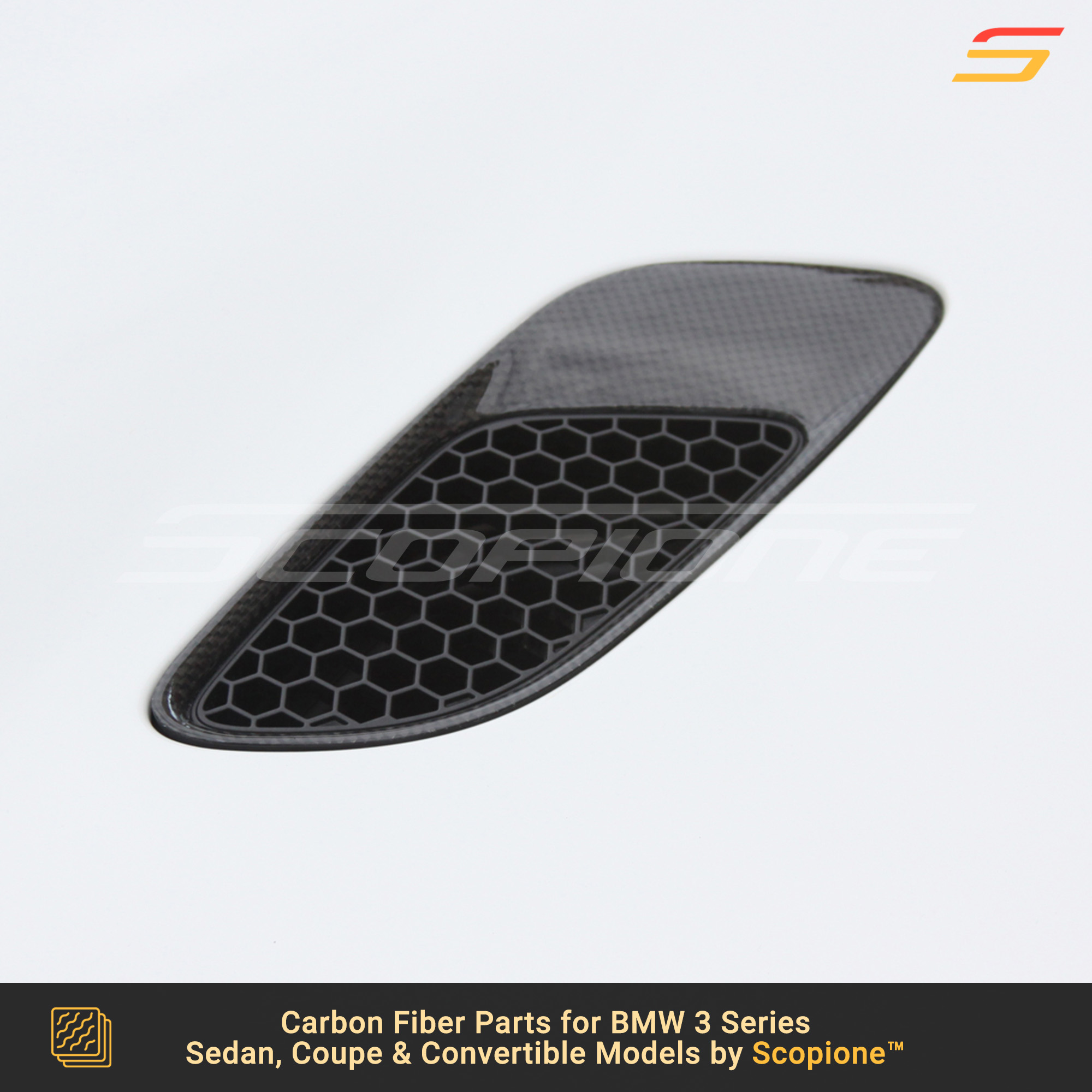
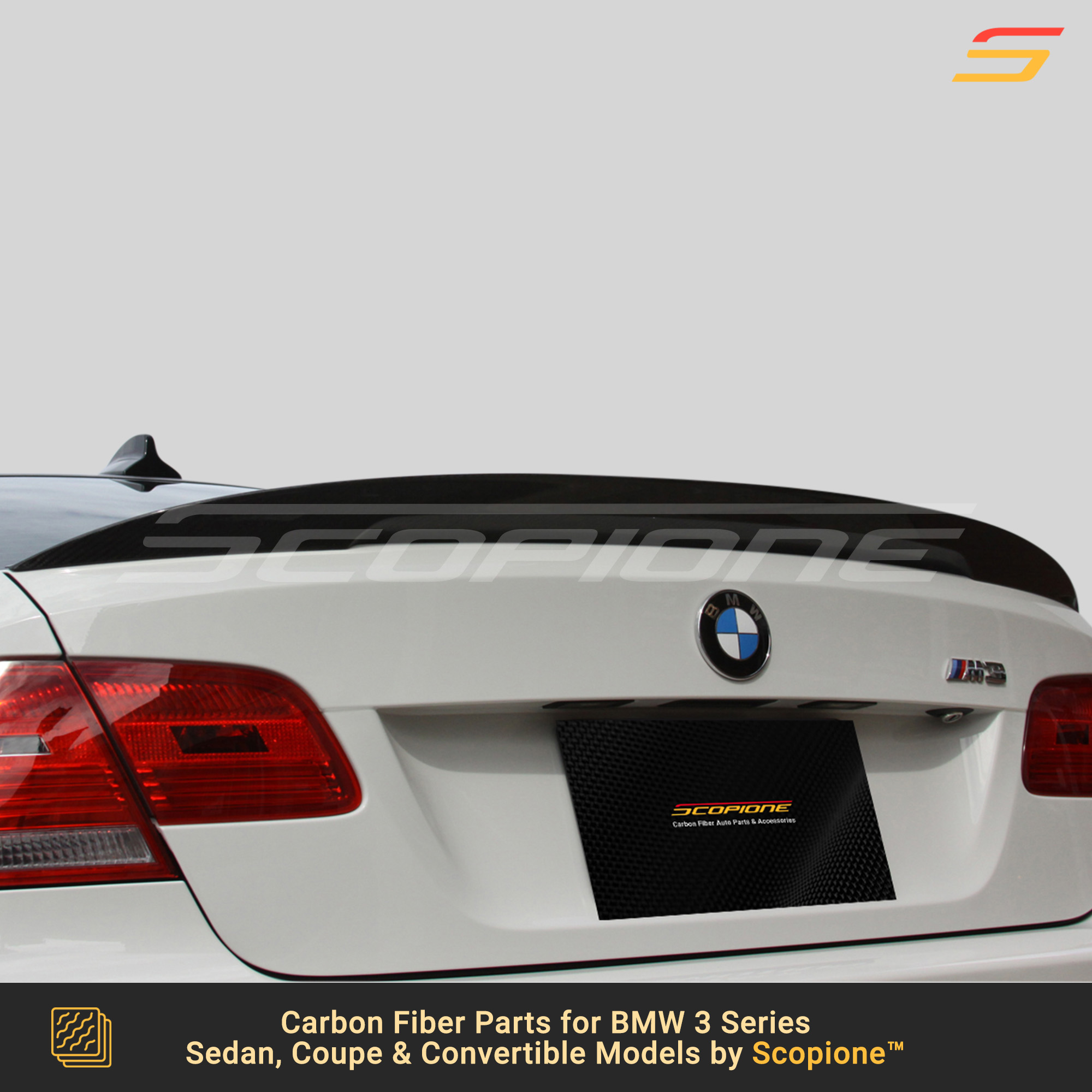
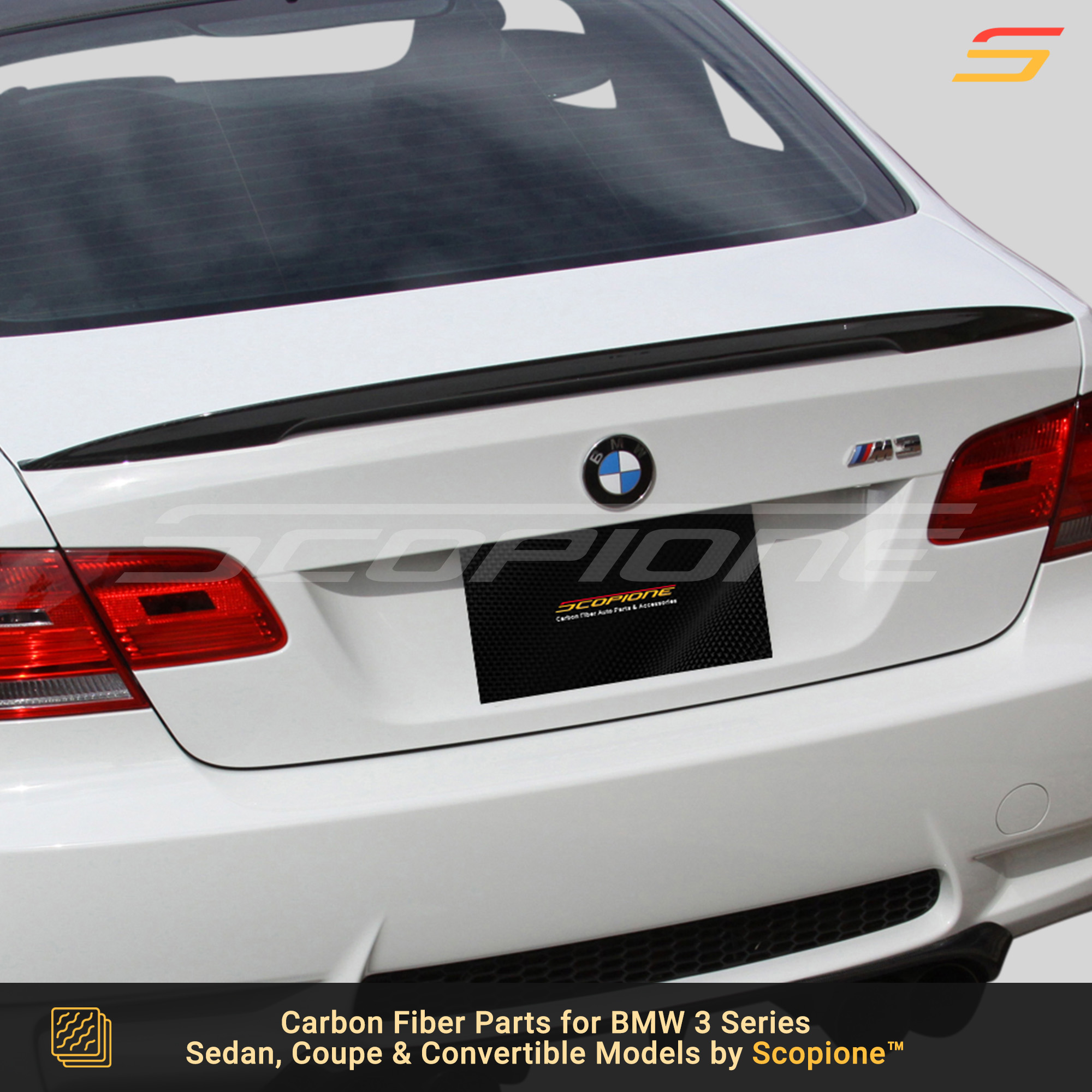
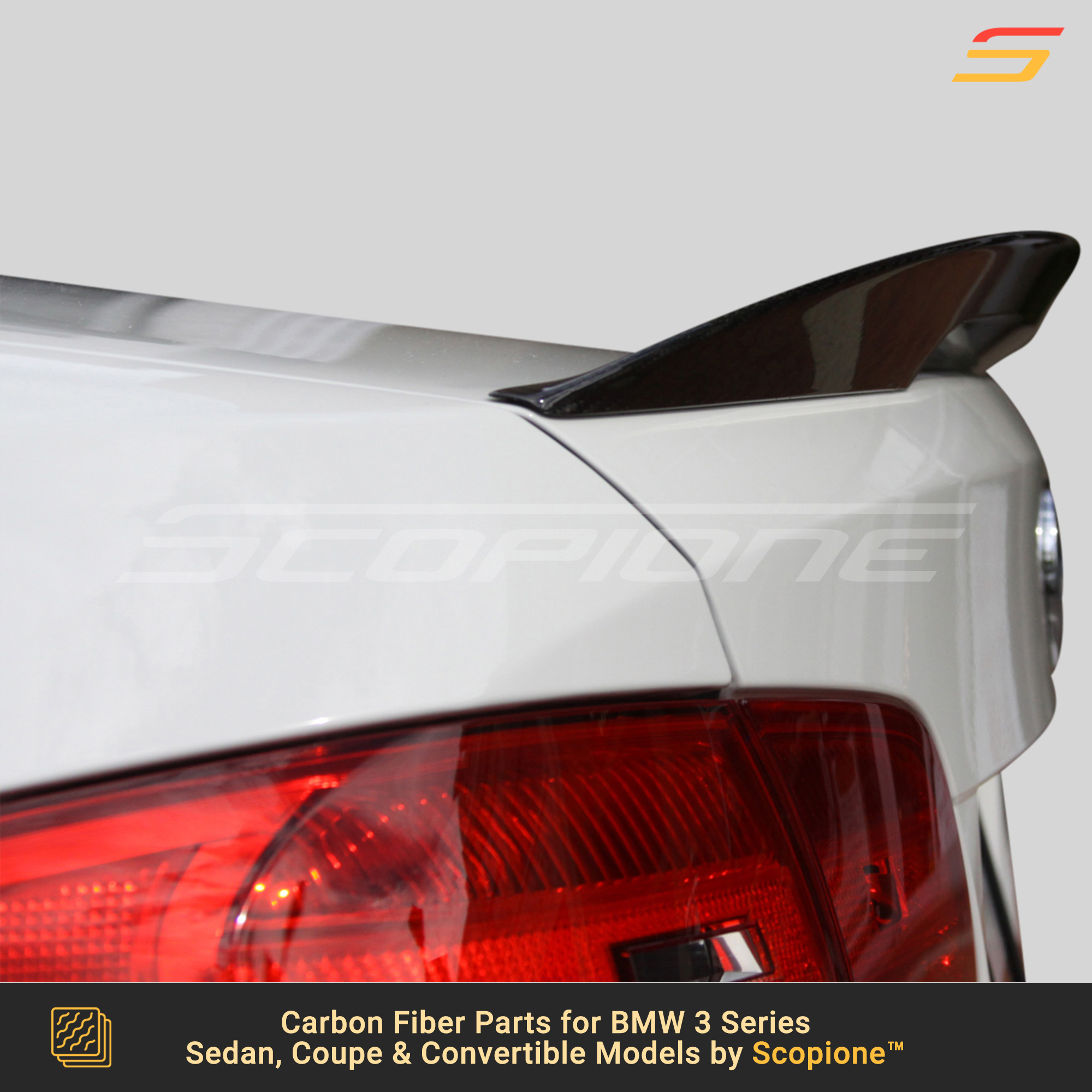
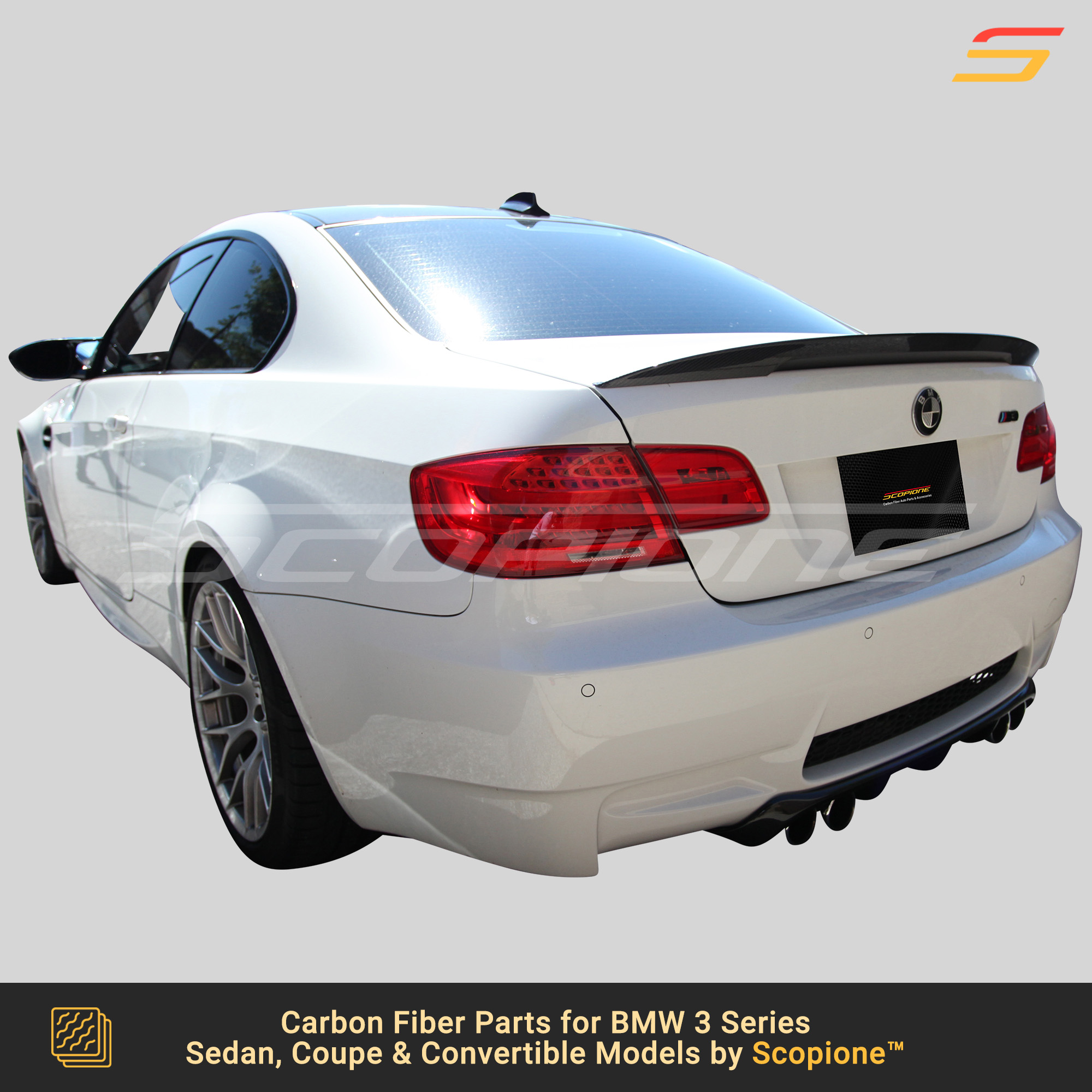
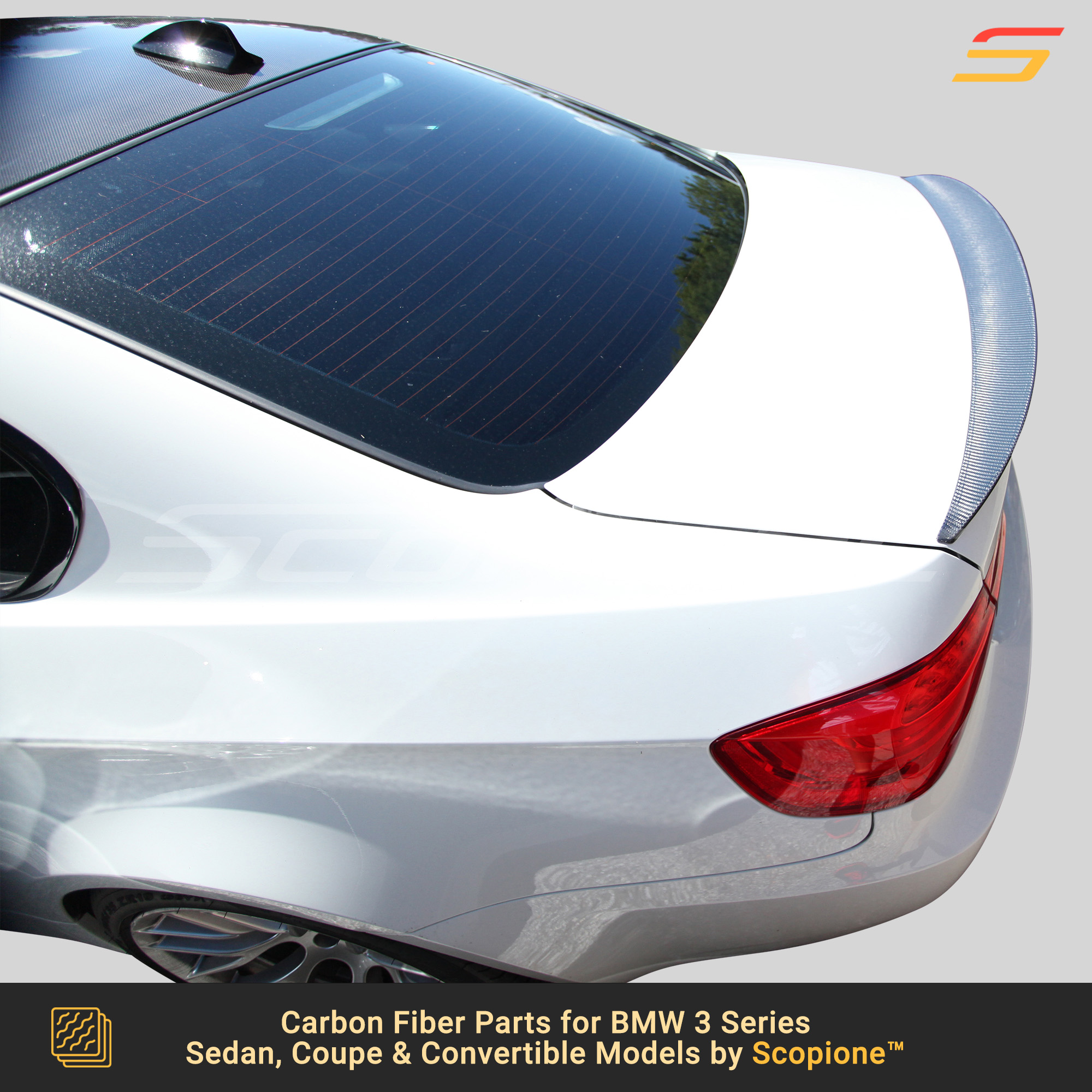

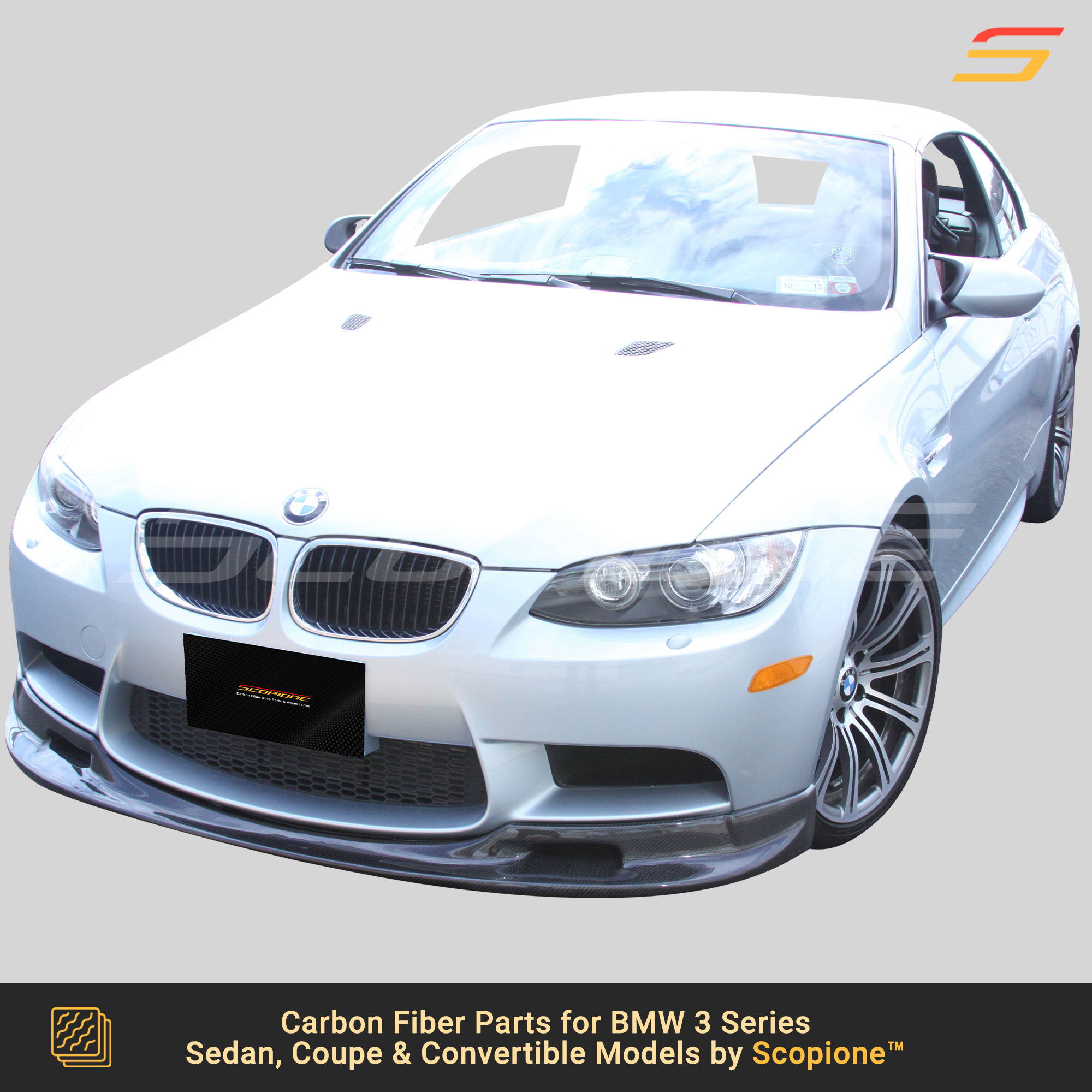
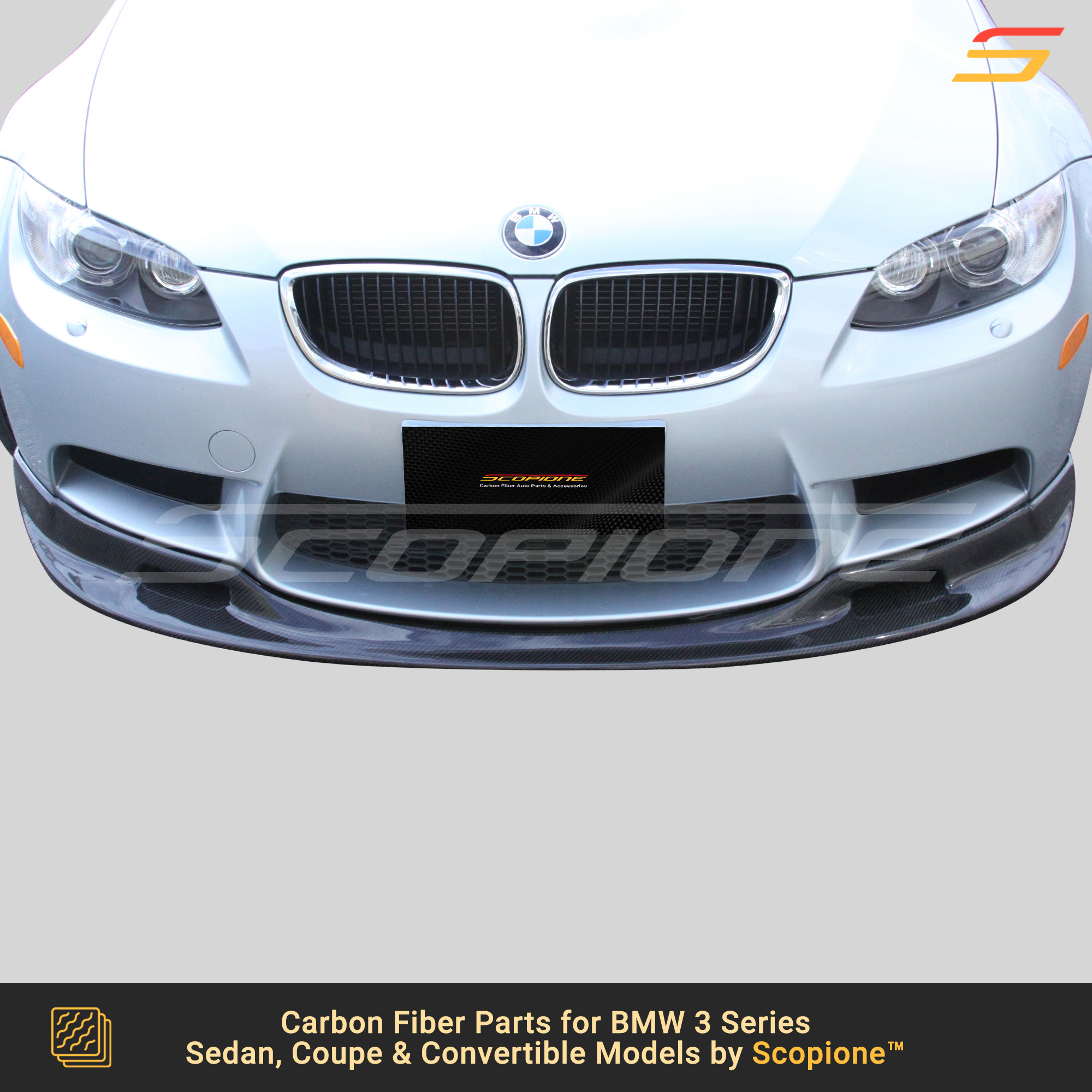
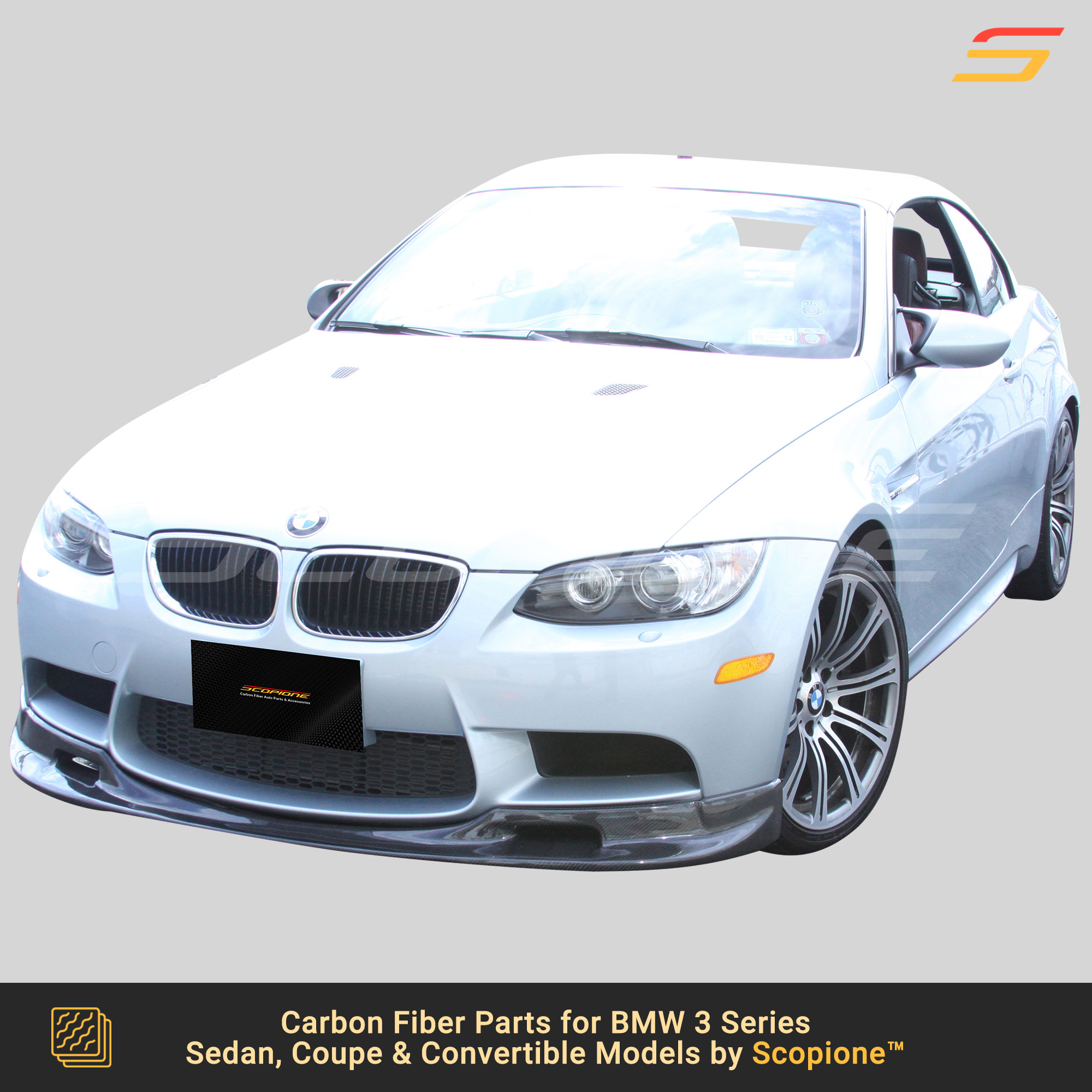
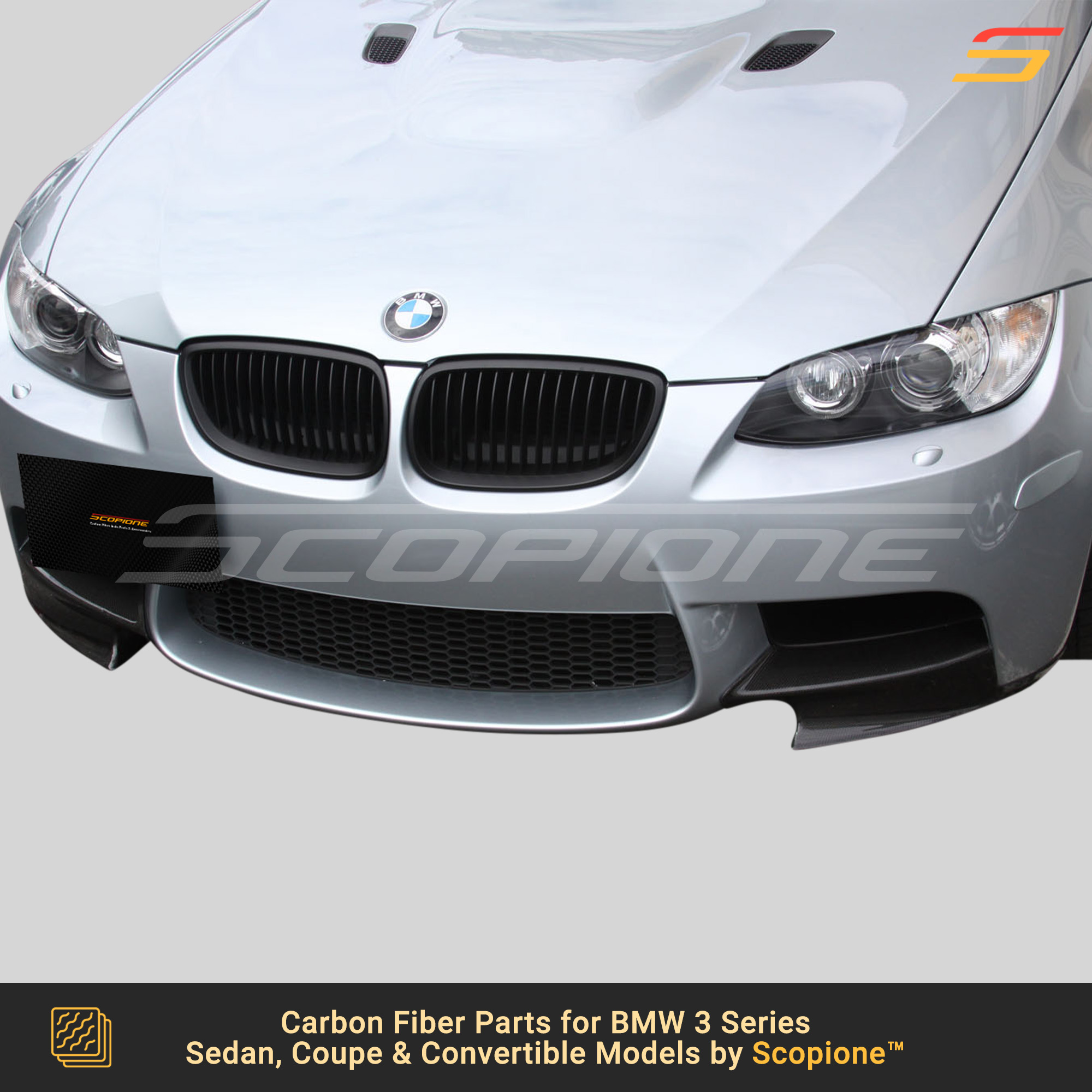

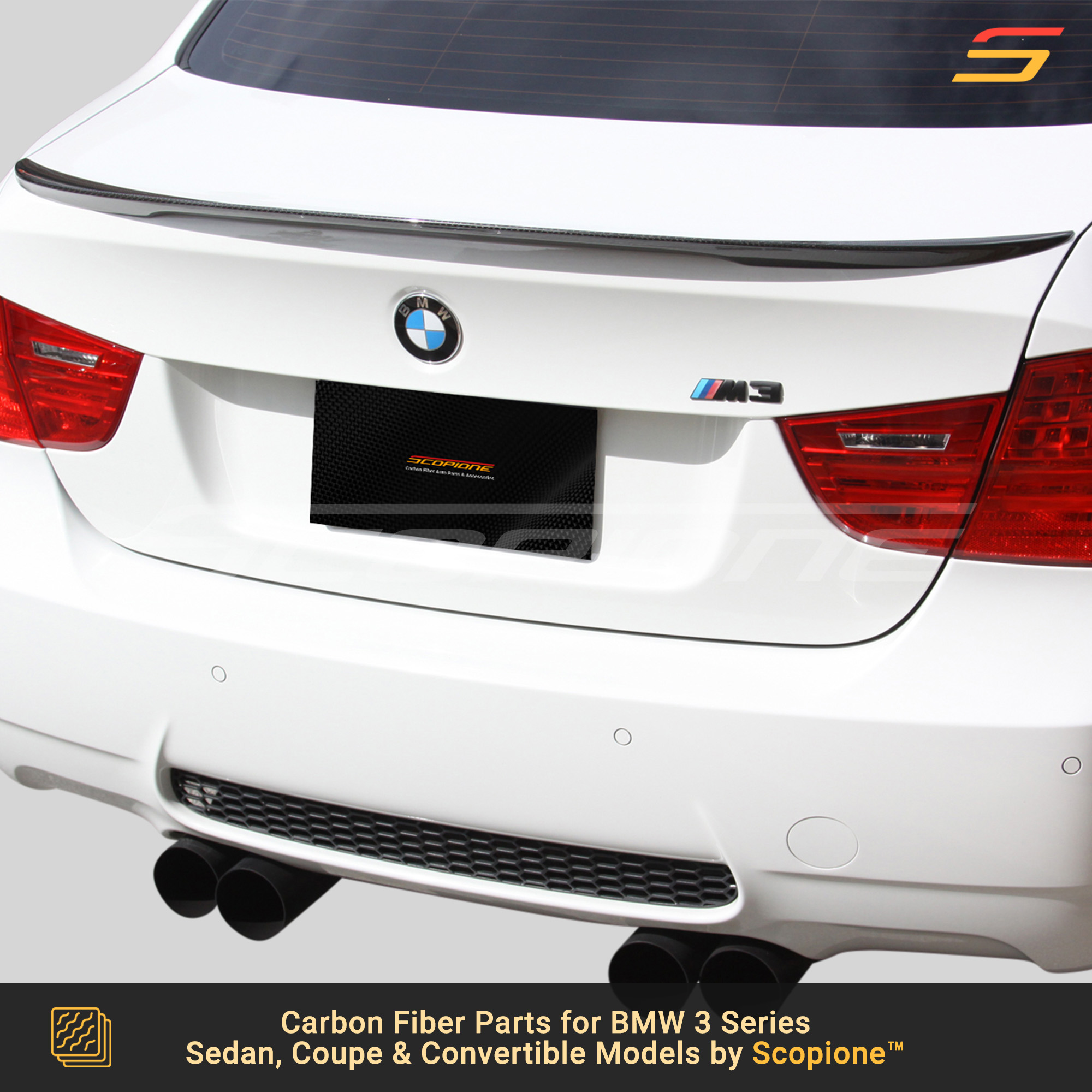
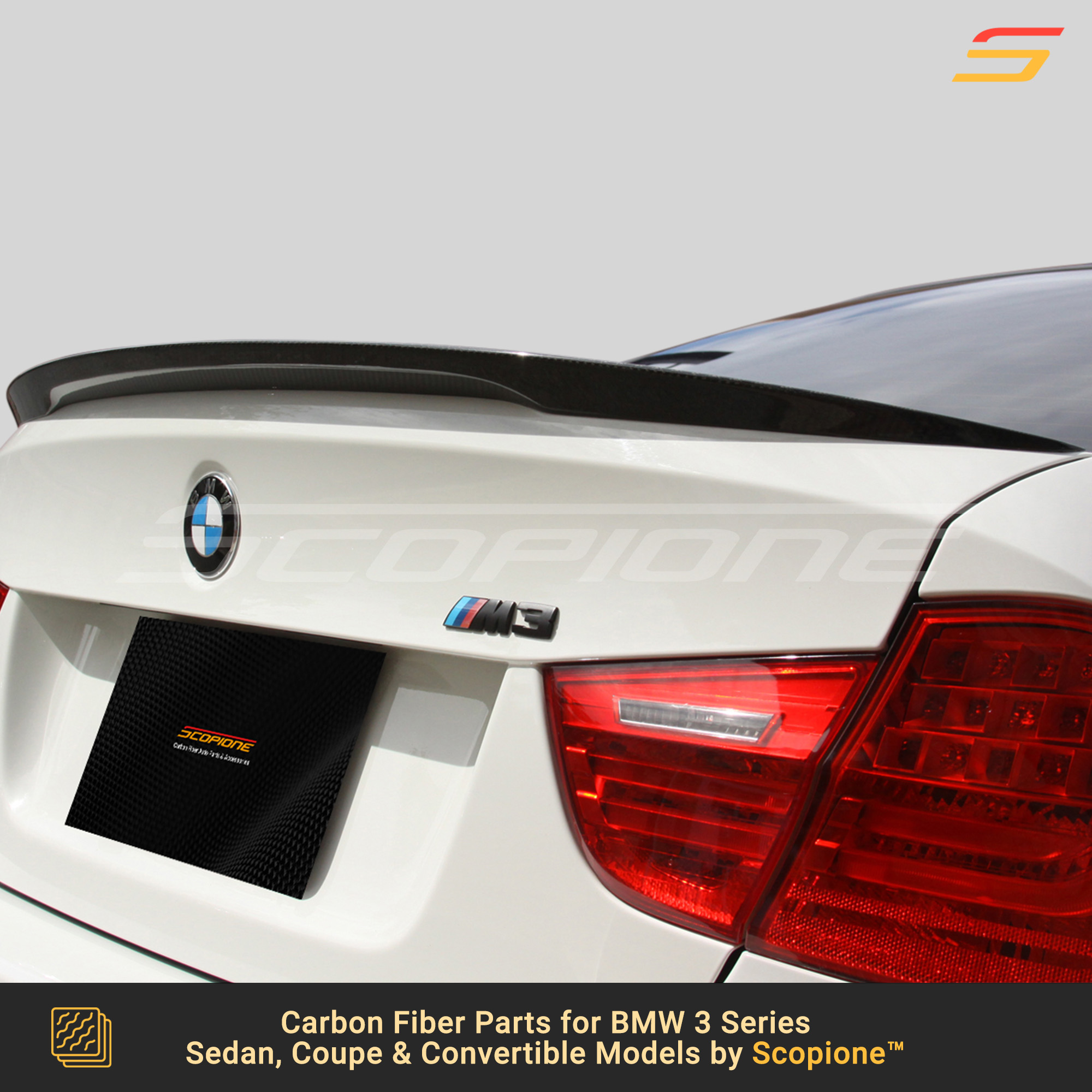
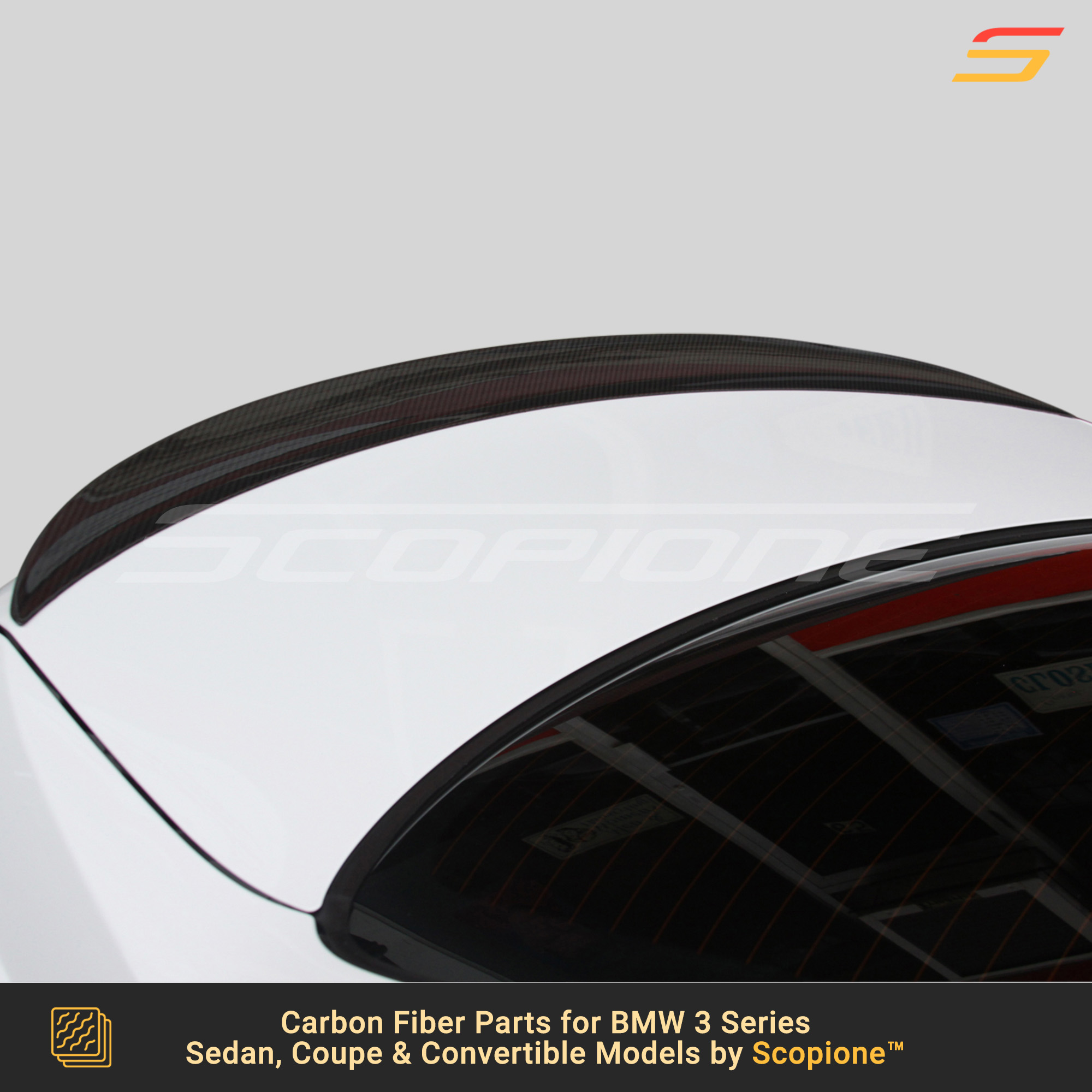


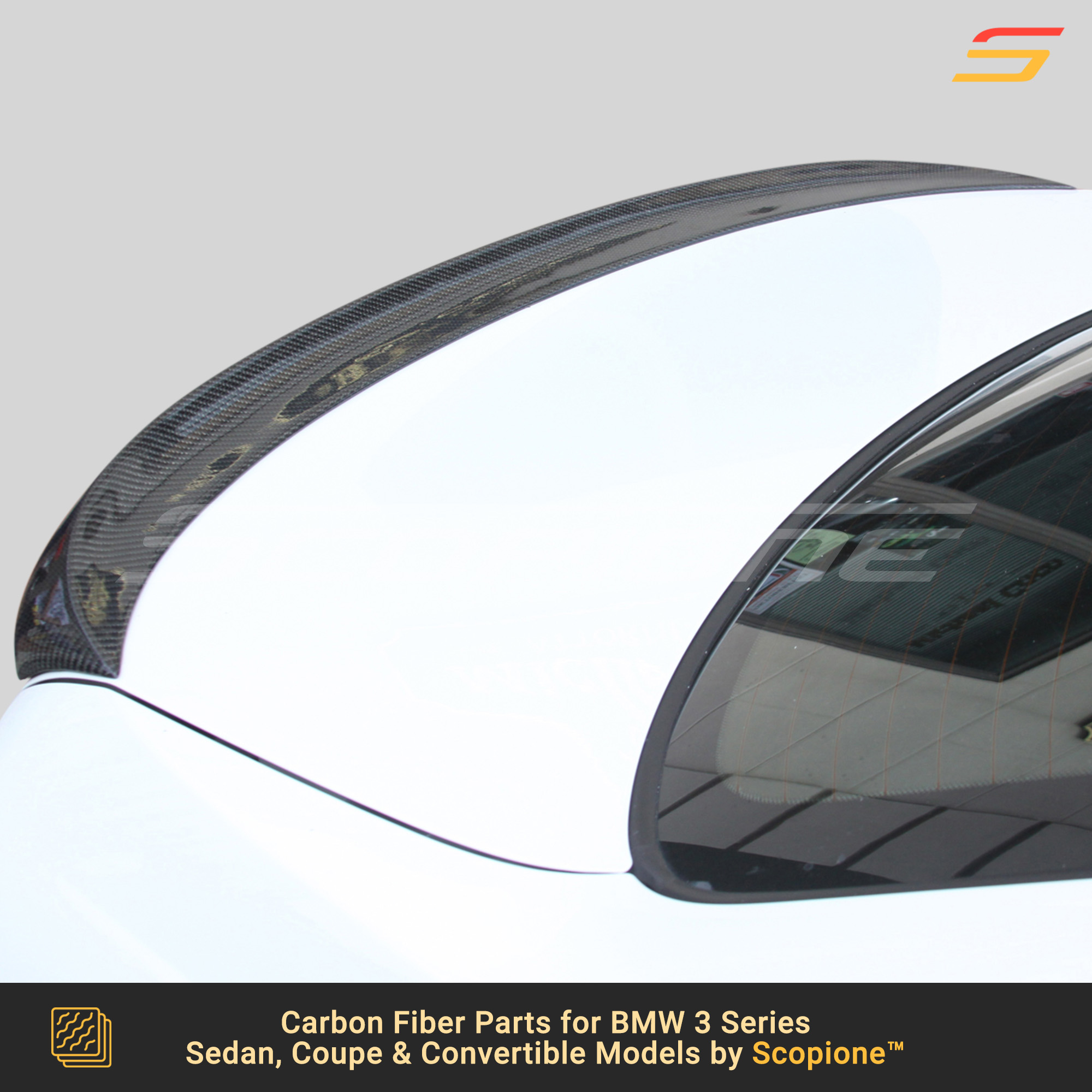
A critical fitment note for E90/E92 buyers: BMW updated the front bumper design mid-cycle (LCI, or Life Cycle Impulse). Pre-LCI models (2007–2010 for E92 coupes, 2006–2008 for E90 sedans) and LCI models (2011–2013 for E92, 2009–2011 for E90) use different front splitter profiles. Scopione lists separate products for each: pre-LCI bumper splitters, LCI bumper splitters, and M-Tech bumper splitters. Match the bumper variant before ordering.




F80 M3 & F82 M4 (2014–2020): Turbo Power, Carbon Construction
The split happened here. BMW divided the M3 name between sedan (F80) and the new M4 coupe (F82) and convertible (F83), all powered by the S55 3.0-liter twin-turbo inline-six. Output started at 425 hp, and a carbon-fiber driveshaft came standard. So did a CFRP roof on every M4 coupe – the first time BMW made structural carbon fiber a standard feature on a volume-production M car.
The M4 GTS (2016, 803 units built against an original 700-unit plan) pushed the S55 to 493 hp through water injection – a technology lifted from aircraft piston engines. It carried a CFRP hood, roof, diffuser, and adjustable rear wing, plus OLED taillights (another production first). The M4 CS (2018, 3,000 units) and M3 CS (2018, 1,200 units) offered a more accessible 454 hp tune (453 hp in the M3 CS) with extensive CFRP bodywork: hood, roof, trunk lid, and rear diffuser.
The Competition Package (2016–2020) raised output to 444 hp through revised ECU tuning, a larger rear anti-roll bar, and adaptive dampers recalibrated for sharper turn-in. By 2018, the Competition Package accounted for the majority of M3/M4 sales – non-Competition F80/F82 models are now harder to sell on the secondary market.
The Porsche 911 Carrera S occupied a higher price bracket, but on track the M4 GTS’s 7:27.88 Nurburgring time put it within striking distance of the 991 GT3.
Scopione’s F80 M3 and F82 M4 carbon-fiber catalog includes front upper splitters ($170), rear bumper valance splitters ($180), a rear bumper diffuser ($280), and the S55 engine cover ($380, also fits F87 M2).
G80 M3 & G82 M4 (2021–Present): The Polarizing Generation
The vertically elongated kidney grille drew immediate controversy when BMW unveiled the G80 M3 and G82 M4 in 2020. But the engineering underneath was the M division’s broadest offering yet. The S58 3.0-liter twin-turbo inline-six produces 473 hp in base form and 503 hp in Competition trim. For the first time, BMW offered the M3 and M4 with all-wheel drive (M xDrive) alongside a rear-wheel-drive manual option – and in 2023, the M3 Touring (G81) became the first-ever M3 wagon.
At the top: the M4 CSL (2023, 1,000 units). 543 hp. 240 lbs lighter than the M4 Competition. Titanium exhaust. CFRP roof, hood, trunk, and rear wing. It circled the Nurburgring Nordschleife in 7:20.207 – the fastest production BMW lap ever recorded.
The G81 M3 Touring answered a request BMW had refused for 35 years. 503 hp, Competition xDrive only, 500-liter cargo capacity. BMW never offered it in North America – but it is the first M3 that can carry a set of track wheels to the circuit and bring them home in the same car.
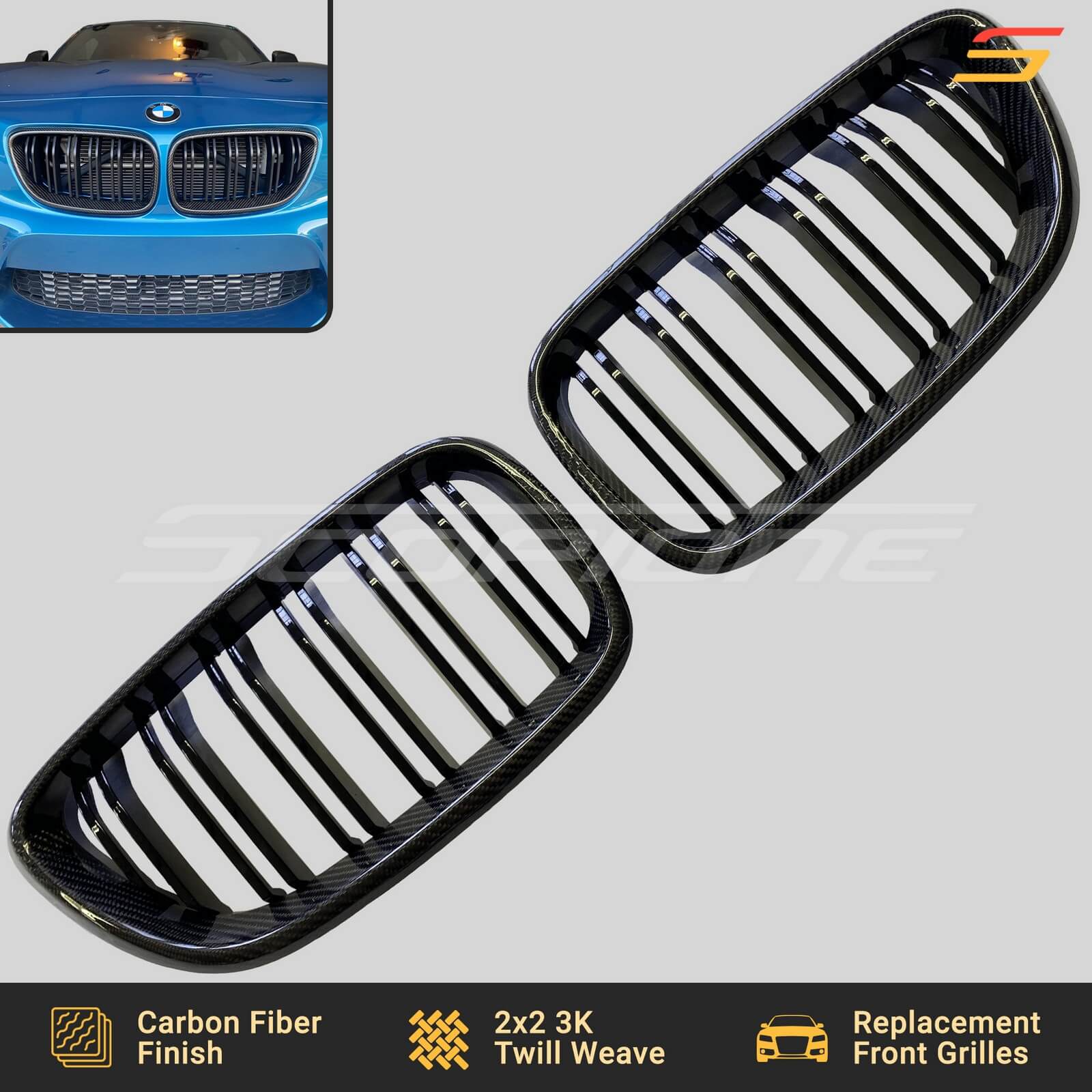
The grille controversy had an unexpected side effect: it drove record demand for aftermarket carbon-fiber kidney grille replacements. The oversized grille surface became the single highest-visibility location for a carbon fiber upgrade on any current BMW. On Bring a Trailer, a 2023 M4 CSL with 450 miles sold for $185,000 in 2024 – a $45,100 premium over sticker.
M2: The Driver’s M Car
Smaller, lighter, and less forgiving than the M3/M4. The M2 occupies the role that the original E30 M3 filled in 1986: a compact rear-wheel-drive coupe with enough power to challenge cars costing twice as much, and a chassis short enough to reward precise inputs.
F87 M2 (2016–2021)
The F87 M2 launched with the N55 3.0-liter single-turbo inline-six producing 365 hp – a strong starting point that BMW improved twice. The M2 Competition (2019) swapped in the S55 twin-turbo from the M3/M4 for 405 hp. And the M2 CS (2020, approximately 2,200 units) extracted 444 hp from the same S55, added a CFRP roof and center console, adaptive dampers, and a fixed rear wing.
The M2 CS is the closest modern BMW to the E46 M3 CSL in philosophy: strip weight, add power, sharpen everything. Manual and DCT transmissions were both available. The CS came standard with a CFRP roof, CFRP hood, and a carbon-fiber center console – factory carbon fiber that adds measurable value on the secondary market. Clean examples now trade between $85,000 and $120,000. One with 4,200 miles sold for $105,000 on Bring a Trailer in 2024 – $21,400 over the original $83,600 MSRP.
Scopione carries a dedicated F87 M2 catalog: carbon-fiber kidney grilles ($220), front bumper splitters in multiple designs ($240–$300), and upper splitters ($220–$270). The S55 engine cover ($380) cross-fits from the M3/M4 to the 2019–2021 M2 Competition and M2 CS.
G87 M2 (2023–Present)
The current M2 uses a detuned version of the S58 engine from the M3/M4: 453 hp, rear-wheel drive only, with a six-speed manual as standard equipment in the US market. A 2025 update raised output to 473 hp. At $62,200 base, the G87 occupies a price bracket well below the Audi R8 and Lamborghini Huracan but delivers a driving experience that magazine testers consistently describe as the purest in the current M lineup.
The G87 is projected to retain roughly 60% of MSRP at the five-year mark – the strongest depreciation resistance among current M cars. It may be the final purely combustion-powered M2, as BMW’s electrification roadmap extends into every model line by the end of the decade. That end-of-era positioning is likely to support long-term values, following the pattern set by the E46 M3 and E92 M3 when each was the last of its engine type.
M5: The Super Sedan
The M5 has always been about hiding extreme power in a four-door executive body. Four engine configurations in four generations tell the story: a naturally aspirated V8, a Formula 1-influenced V10, and two iterations of twin-turbo V8 producing up to 627 hp.
E39 M5 (1998–2003)
Many enthusiasts still call the E39 the definitive M5. The S62 4.9-liter V8 produced 394 hp through individual throttle bodies – one per cylinder, all eight visible under the hood. A six-speed manual was the only transmission offered. No SMG, no automatic, no all-wheel drive. The chassis delivered a balance between highway comfort and circuit capability that established the super sedan as a category, predating the Maserati GranTurismo and the Audi RS 6 by half a decade. A 2002 E39 M5 with 38,000 miles sold for $62,000 on Bring a Trailer in 2024 – nearly matching its original $69,400 MSRP in nominal dollars.
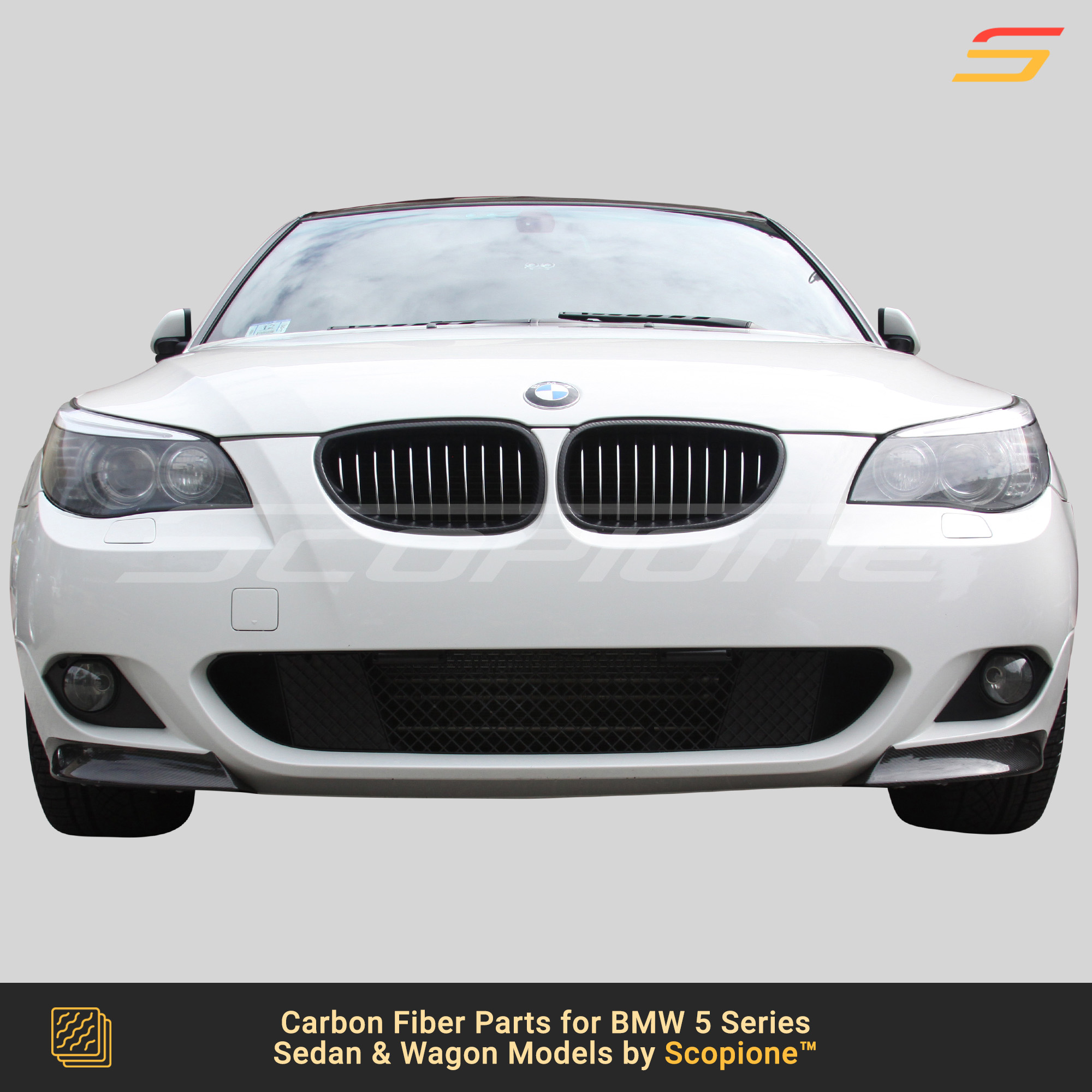
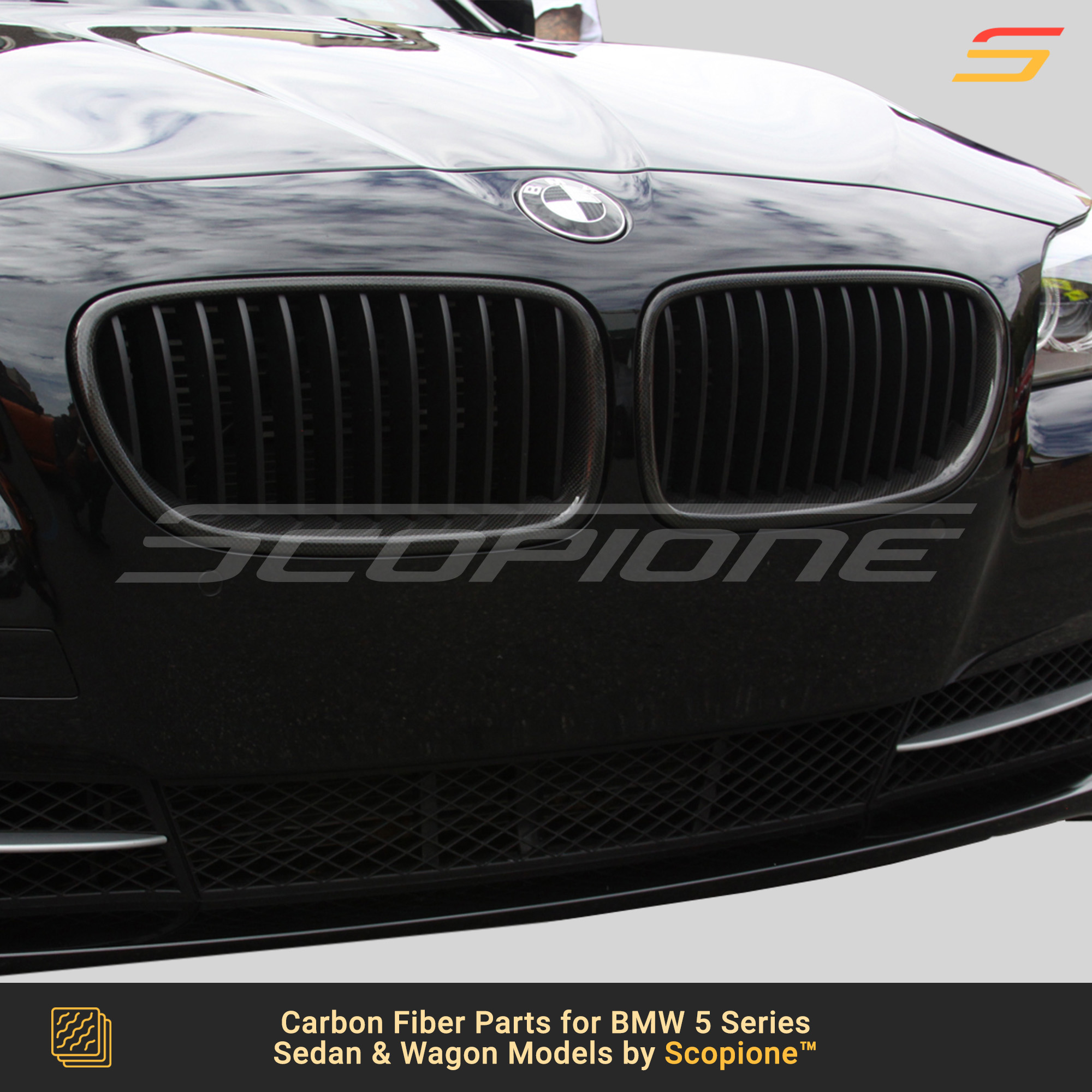
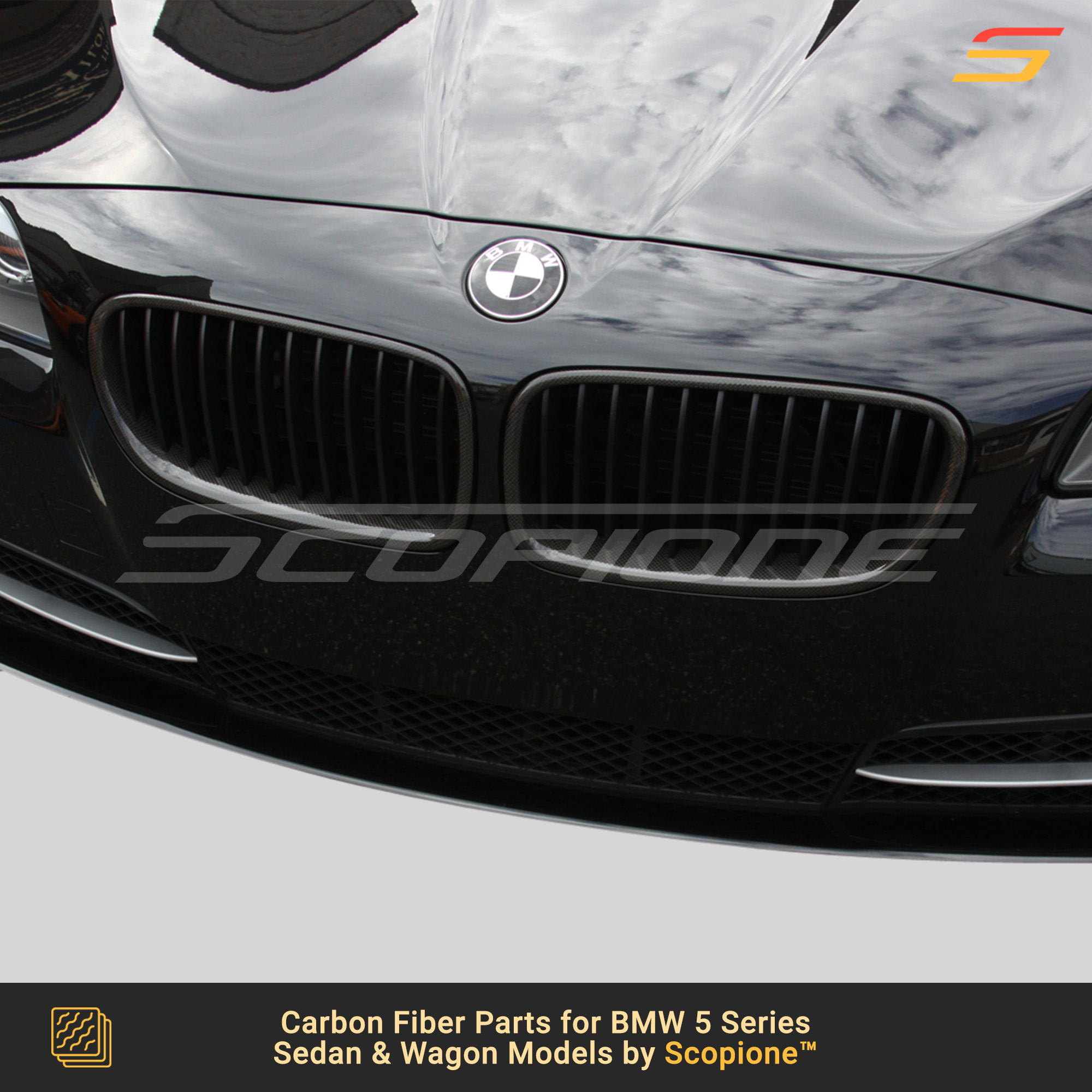
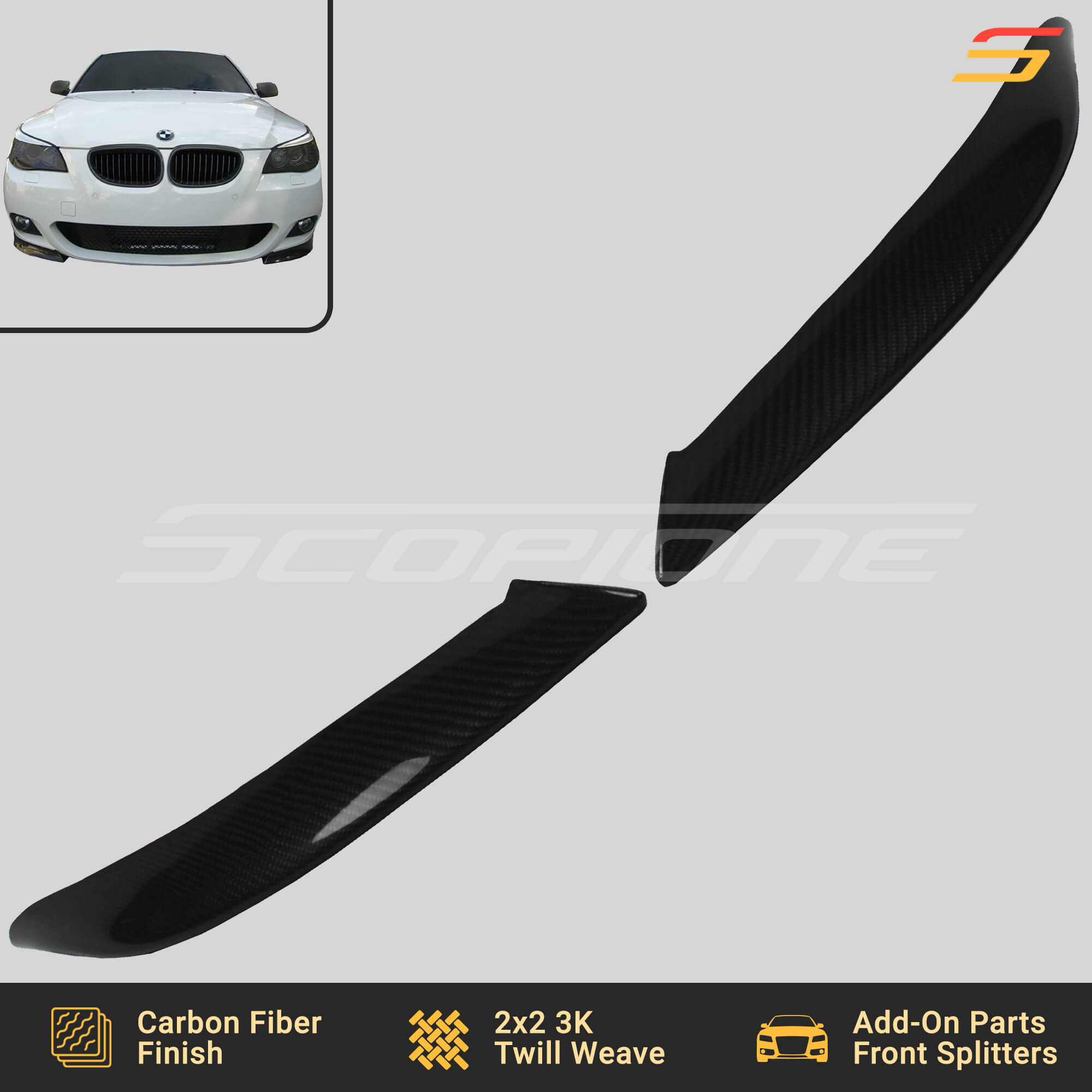
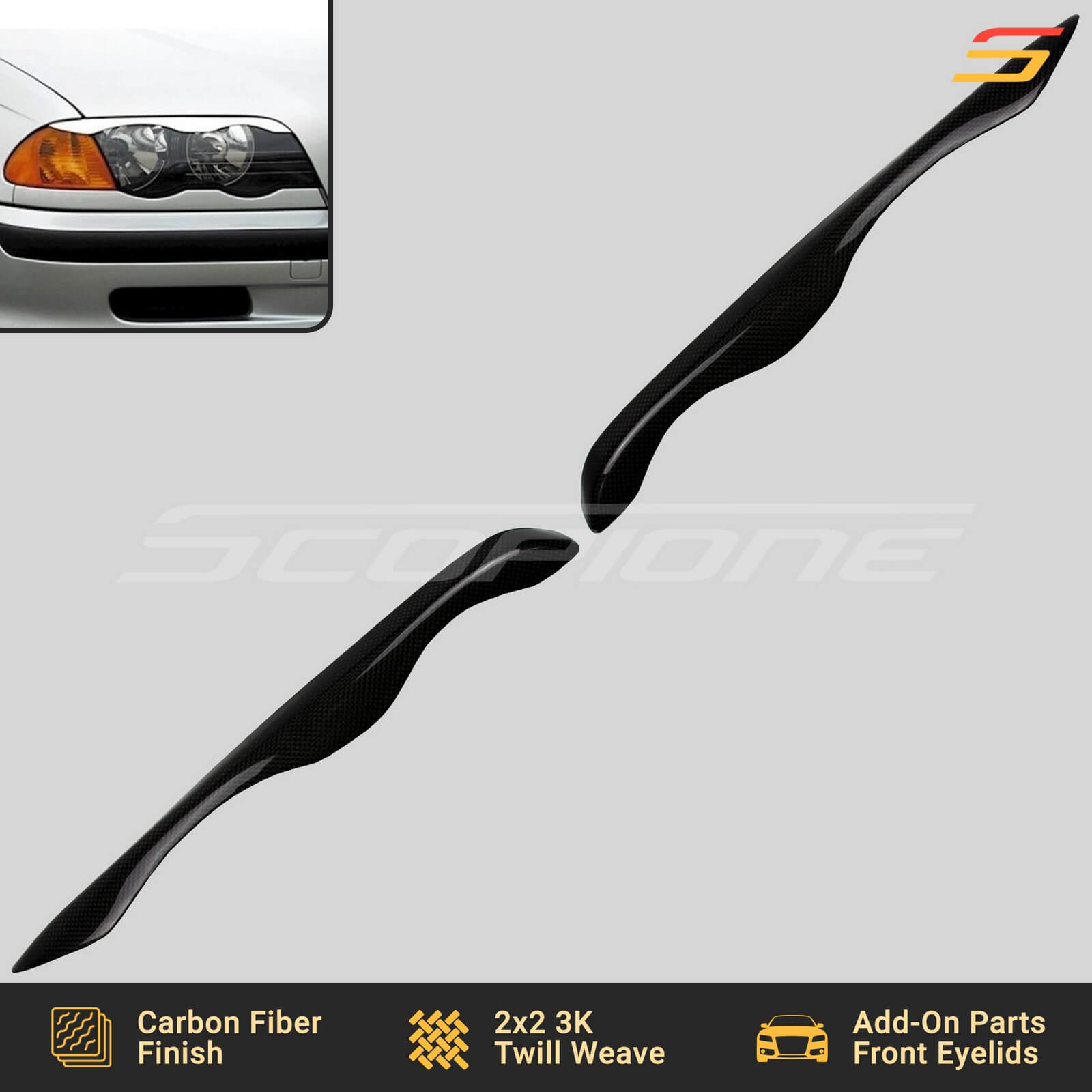
Scopione offers E39 5 Series and M5 carbon-fiber front splitters, headlight eyelids, kidney grilles, roof spoilers, and steering wheel covers – six distinct parts for a platform that remains one of the strongest-appreciating BMWs on the market. Clean E39 M5s now trade between $25,000 and $65,000.
E60 M5 (2005–2010): The V10
A 5.0-liter V10 producing 500 hp. 8,250 RPM redline. Developed during BMW’s Formula 1 partnership with Williams, with manufacturing techniques and high-rev design philosophy drawn from the P84 V10 program. The E60 M5 (19,523 units built) paired this engine with a seven-speed SMG III sequential gearbox – polarizing in operation but devastating in straight-line acceleration. The later 6-speed manual option (US market, 2007–2010) is now the more sought-after configuration.
The S85 V10 is an event every time it starts. But ownership carries known risks: rod bearing wear (similar to the S65 in the E92 M3), SMG hydraulic pump failures ($3,000–$5,000 to replace), and VANOS solenoid issues. A pre-purchase inspection from a BMW specialist is non-negotiable on any E60 M5. Cars with documented rod bearing replacement and a manual transmission swap command the strongest prices – $55,000 and up for clean examples.
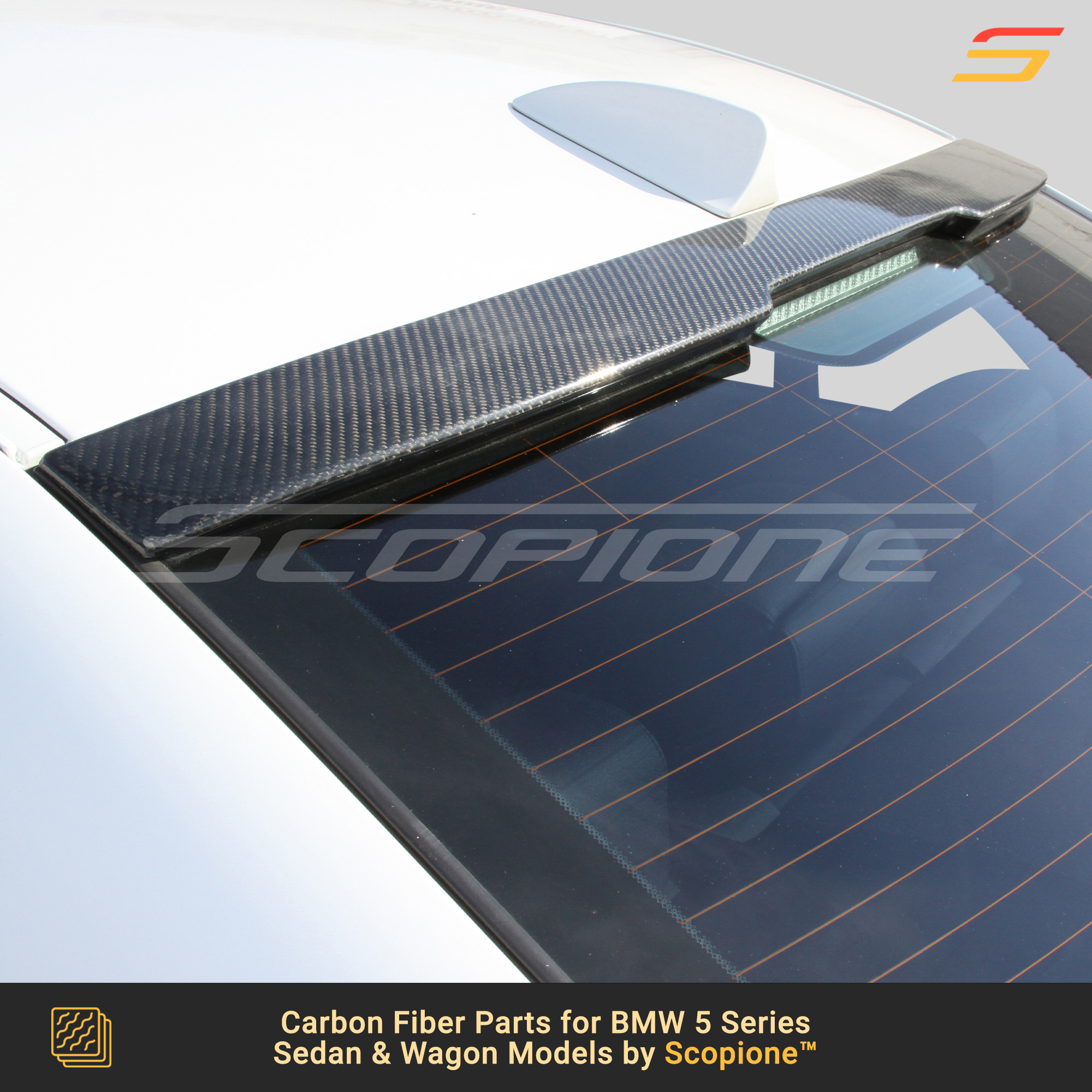
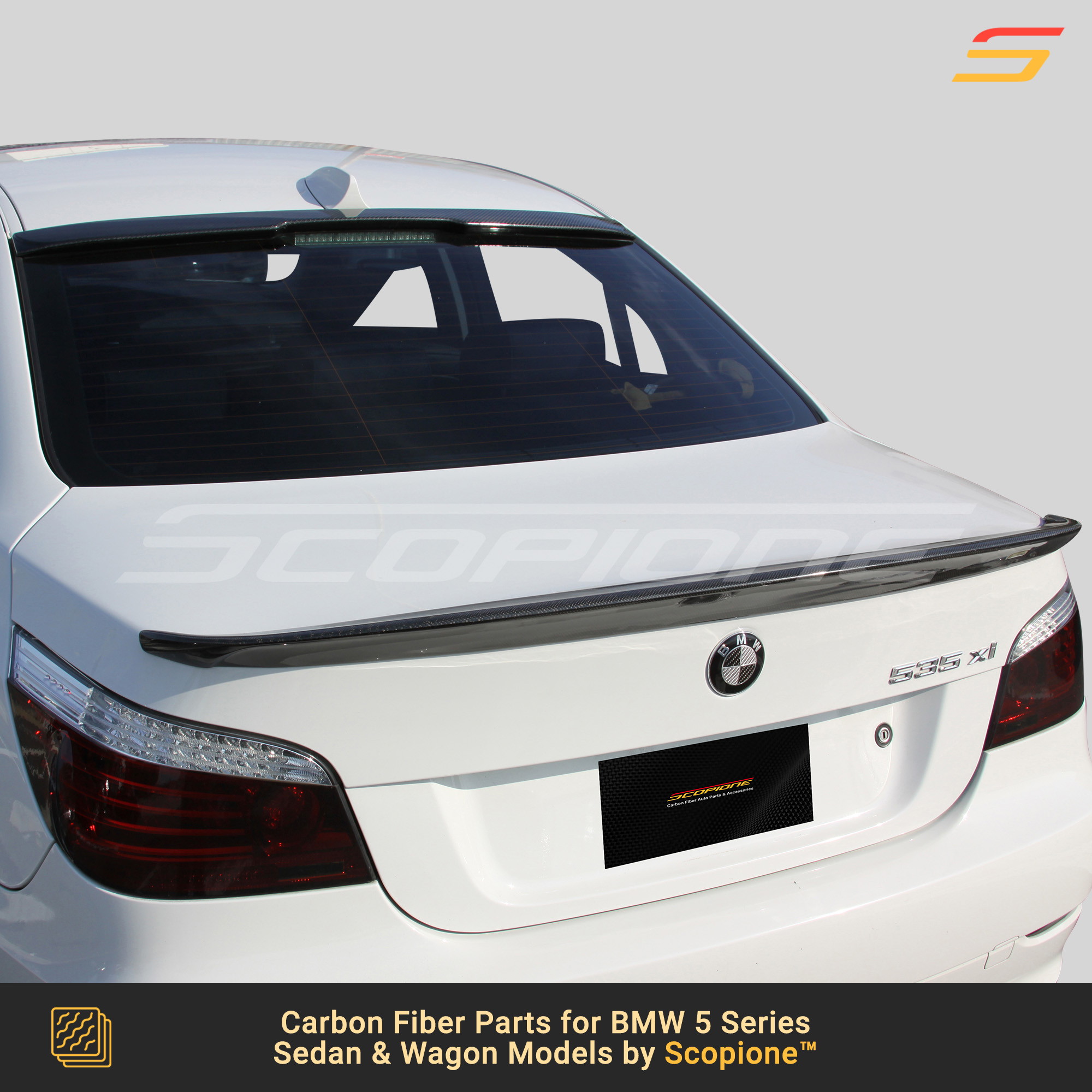
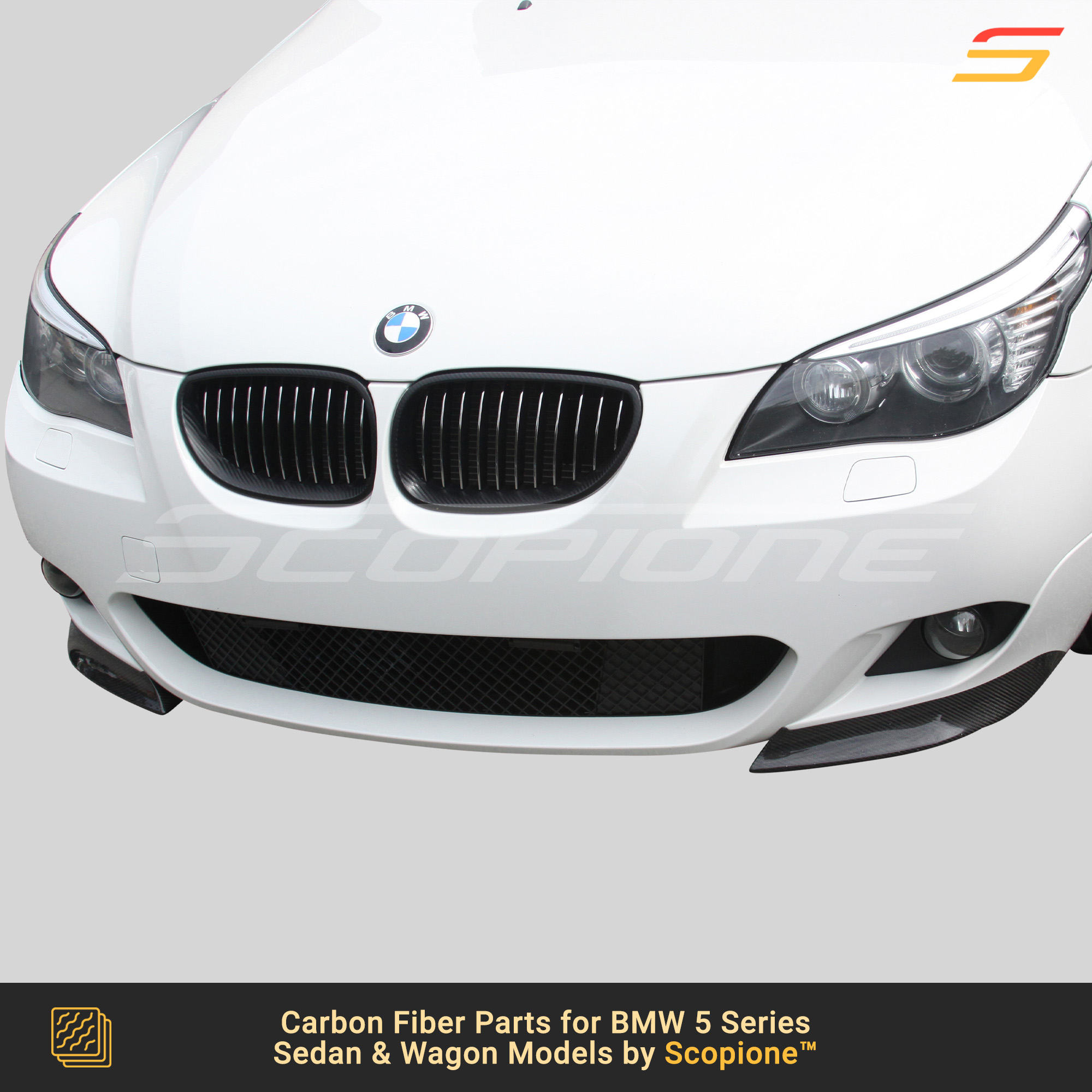
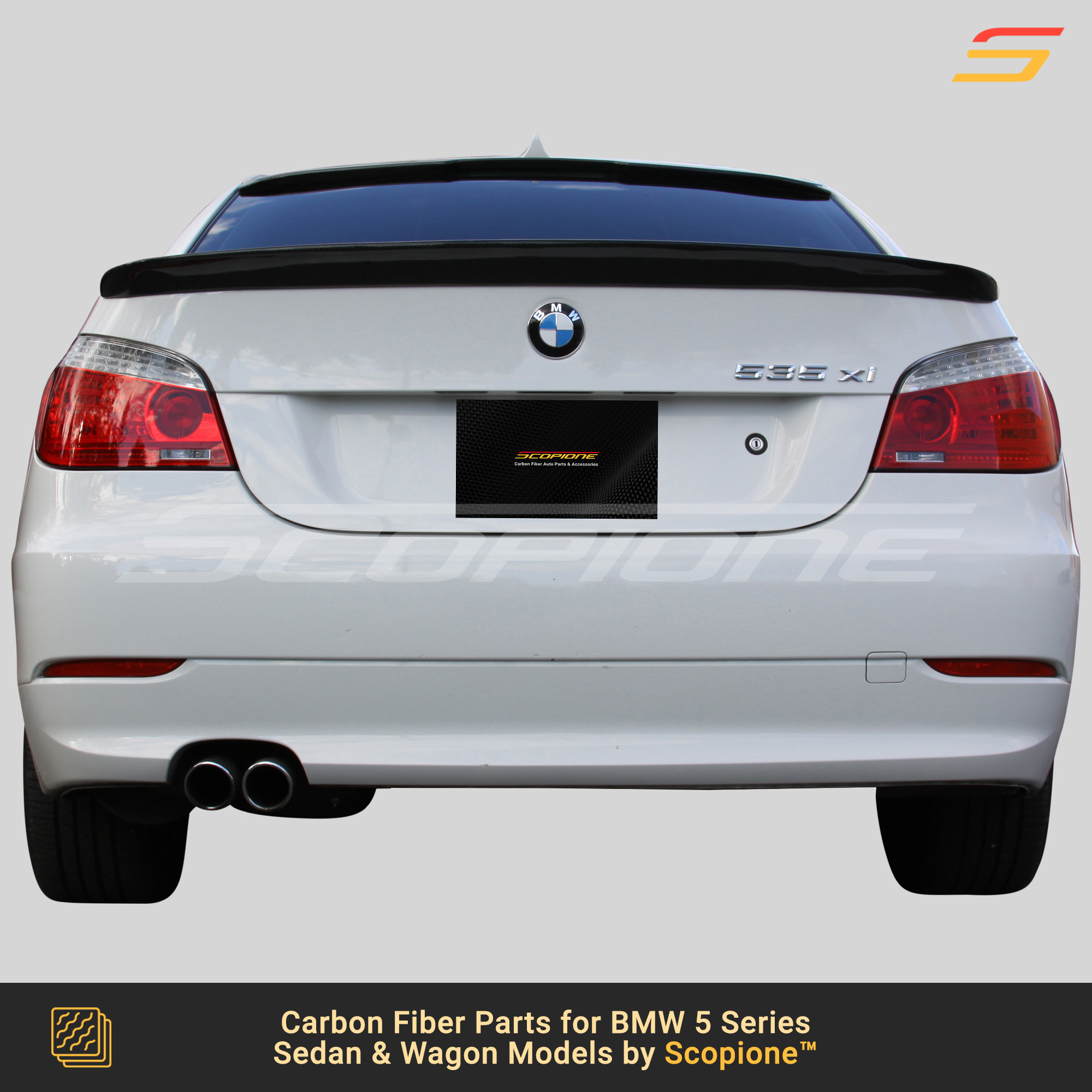
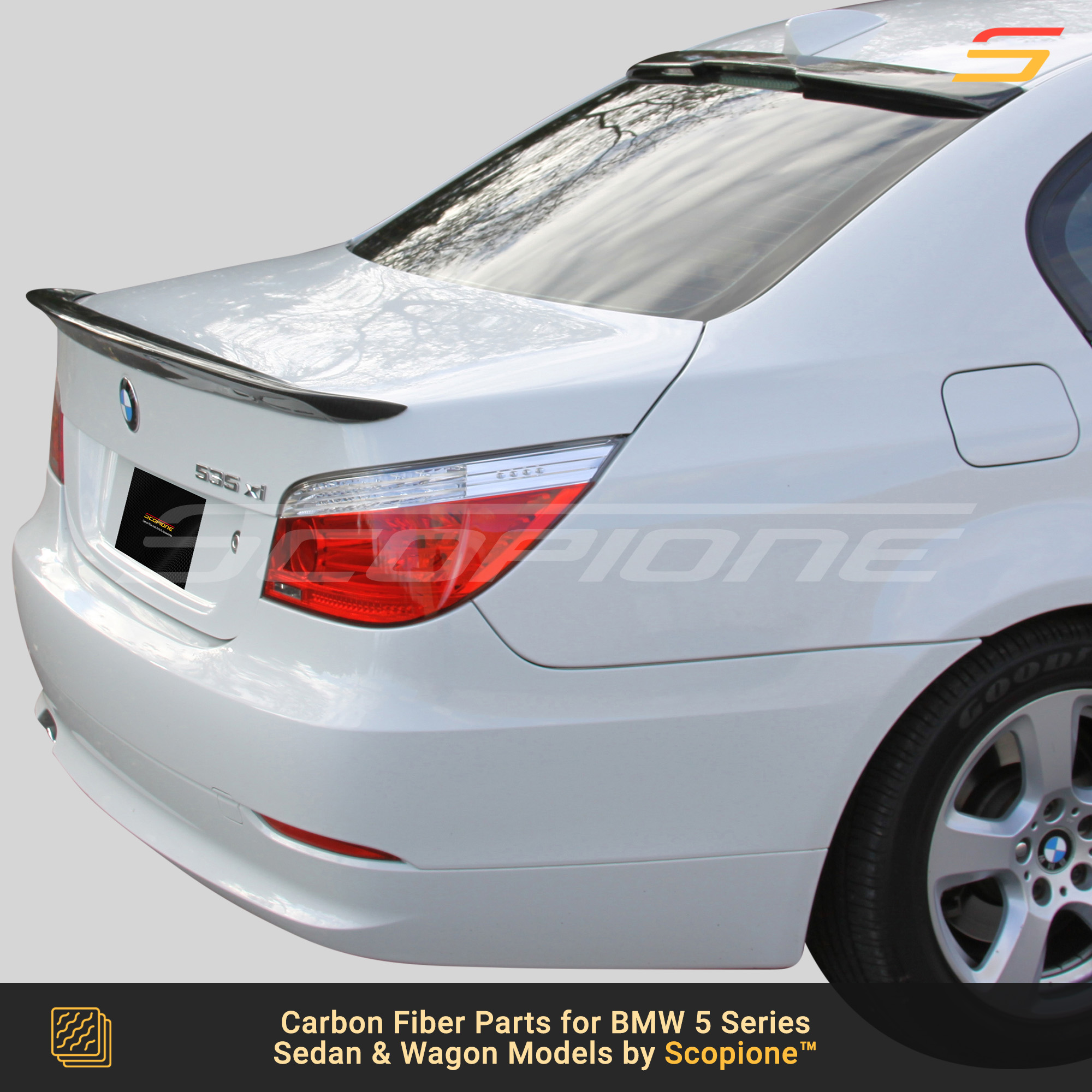
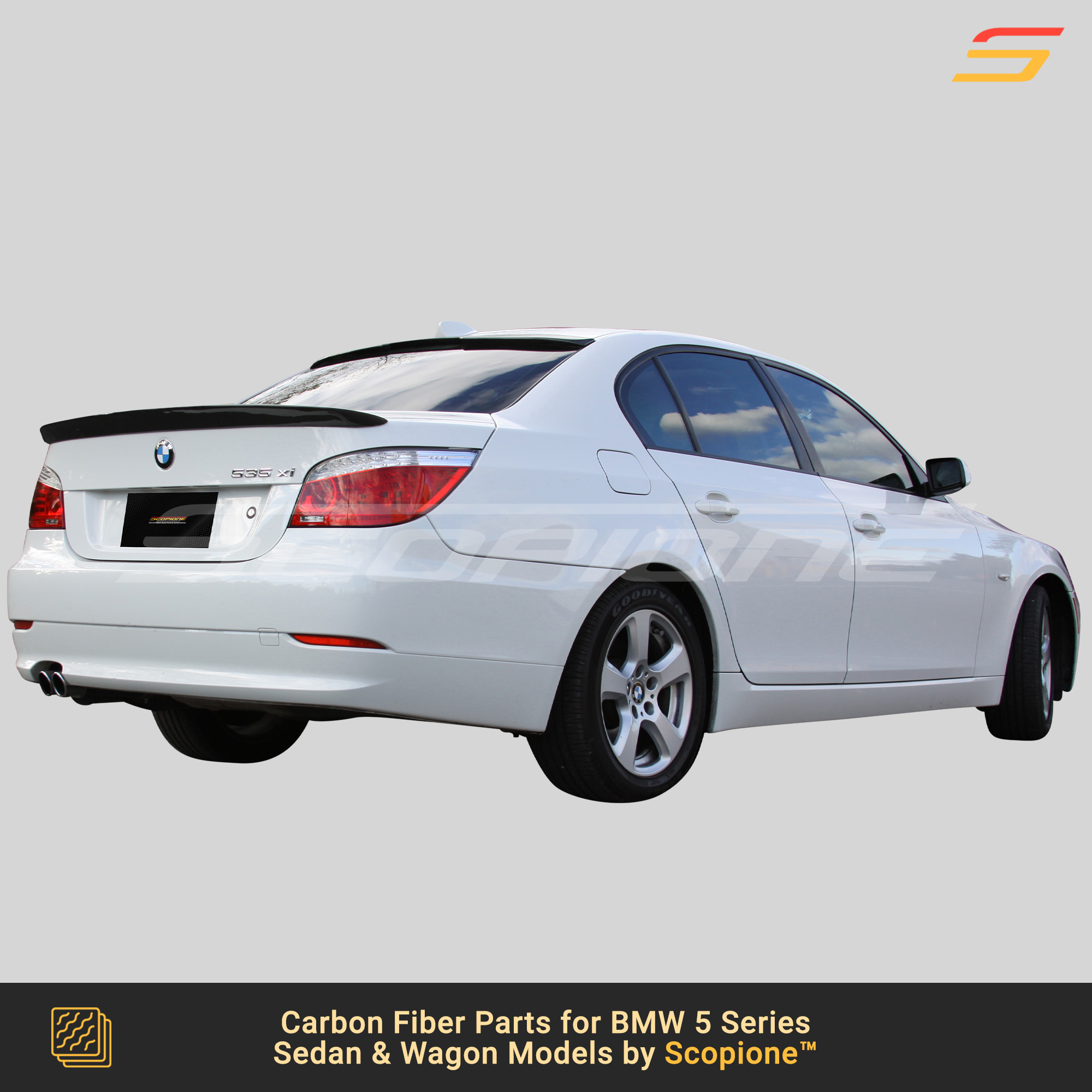
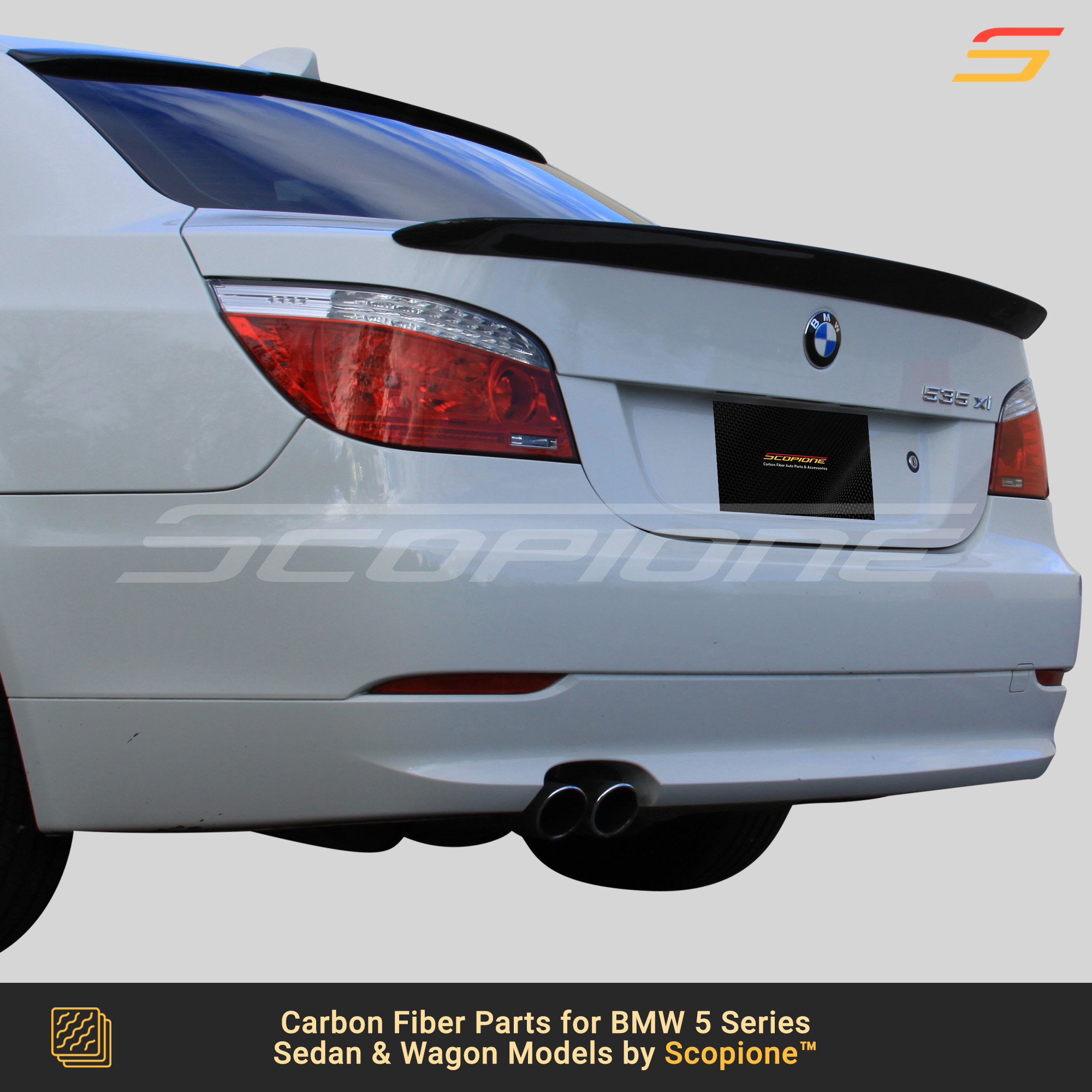
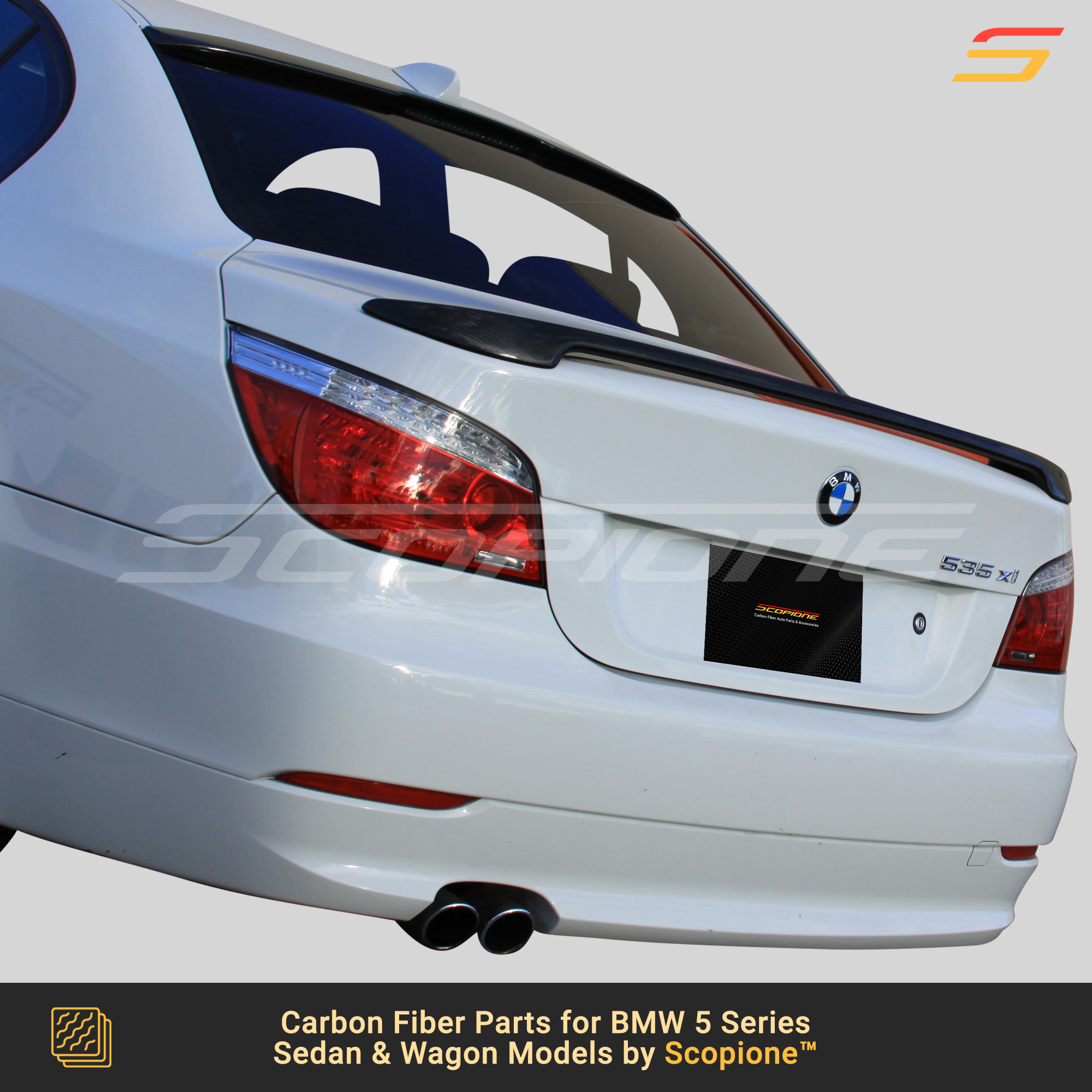
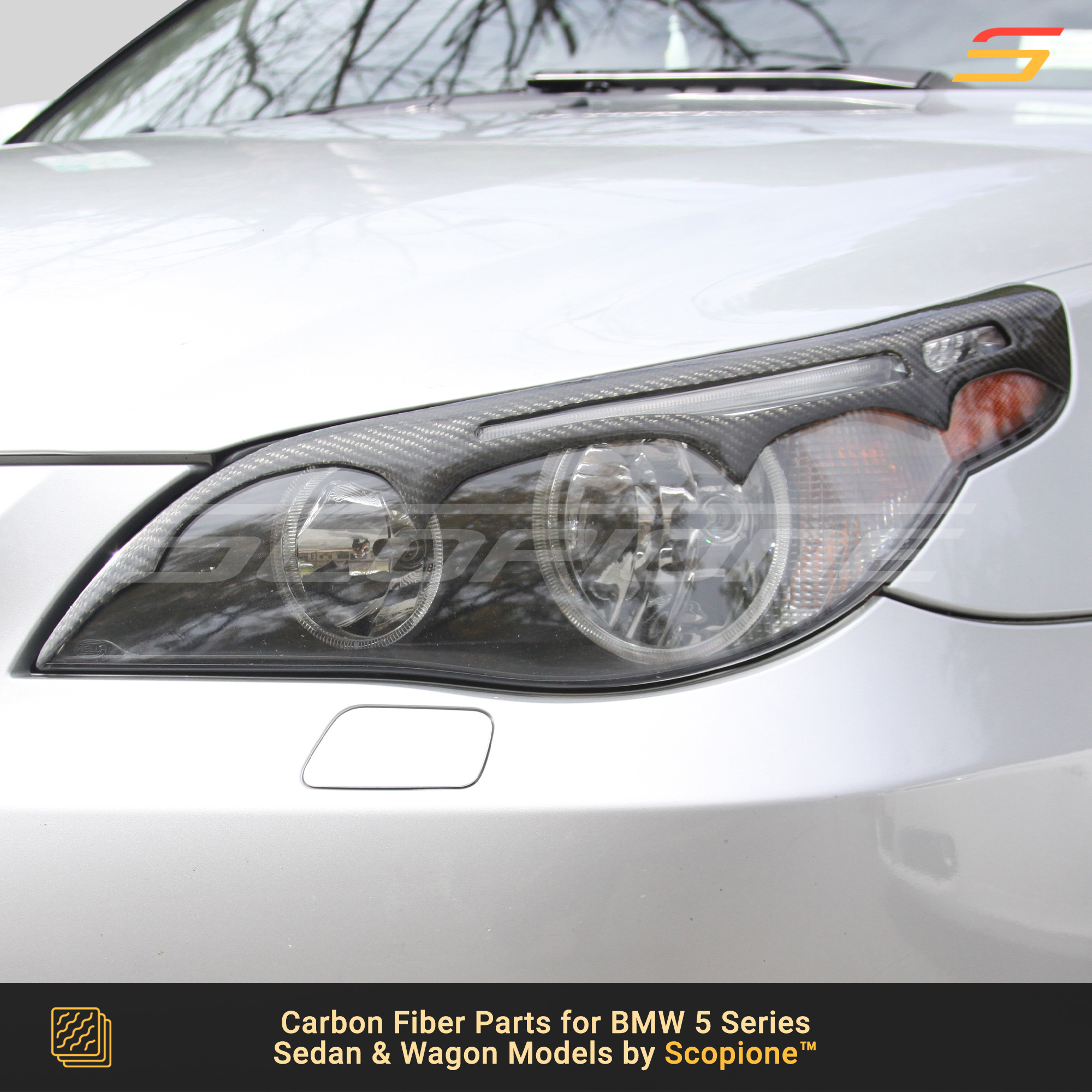
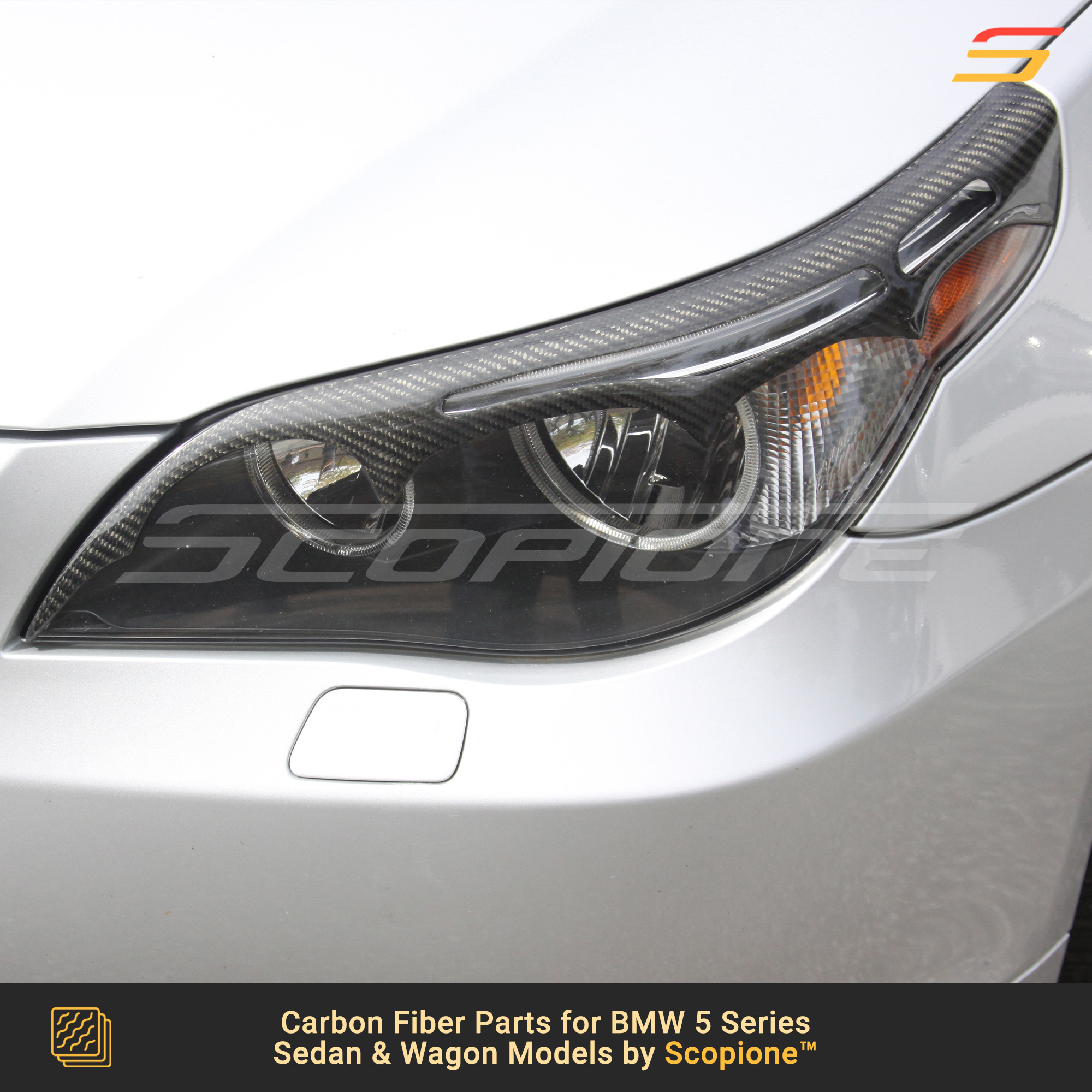
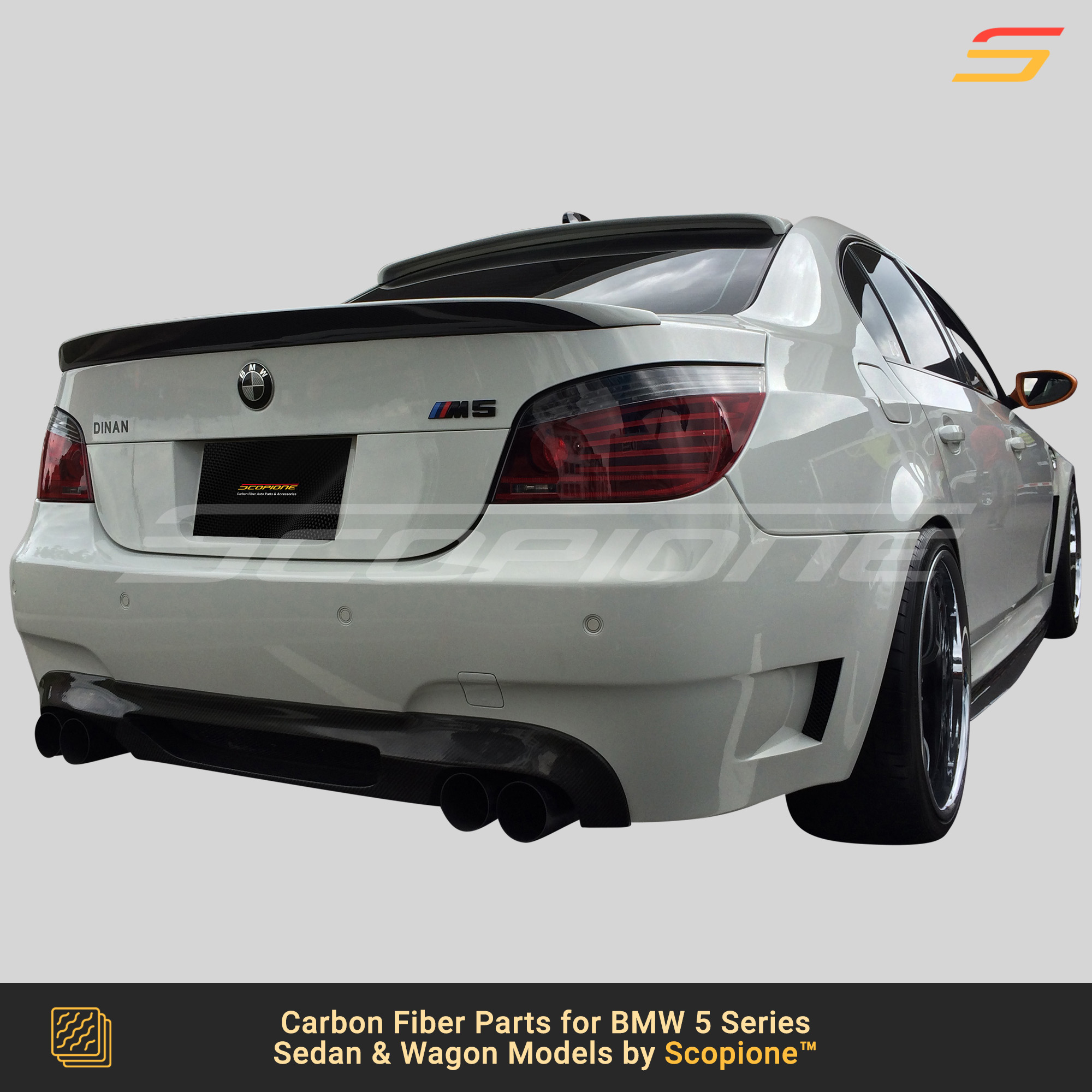
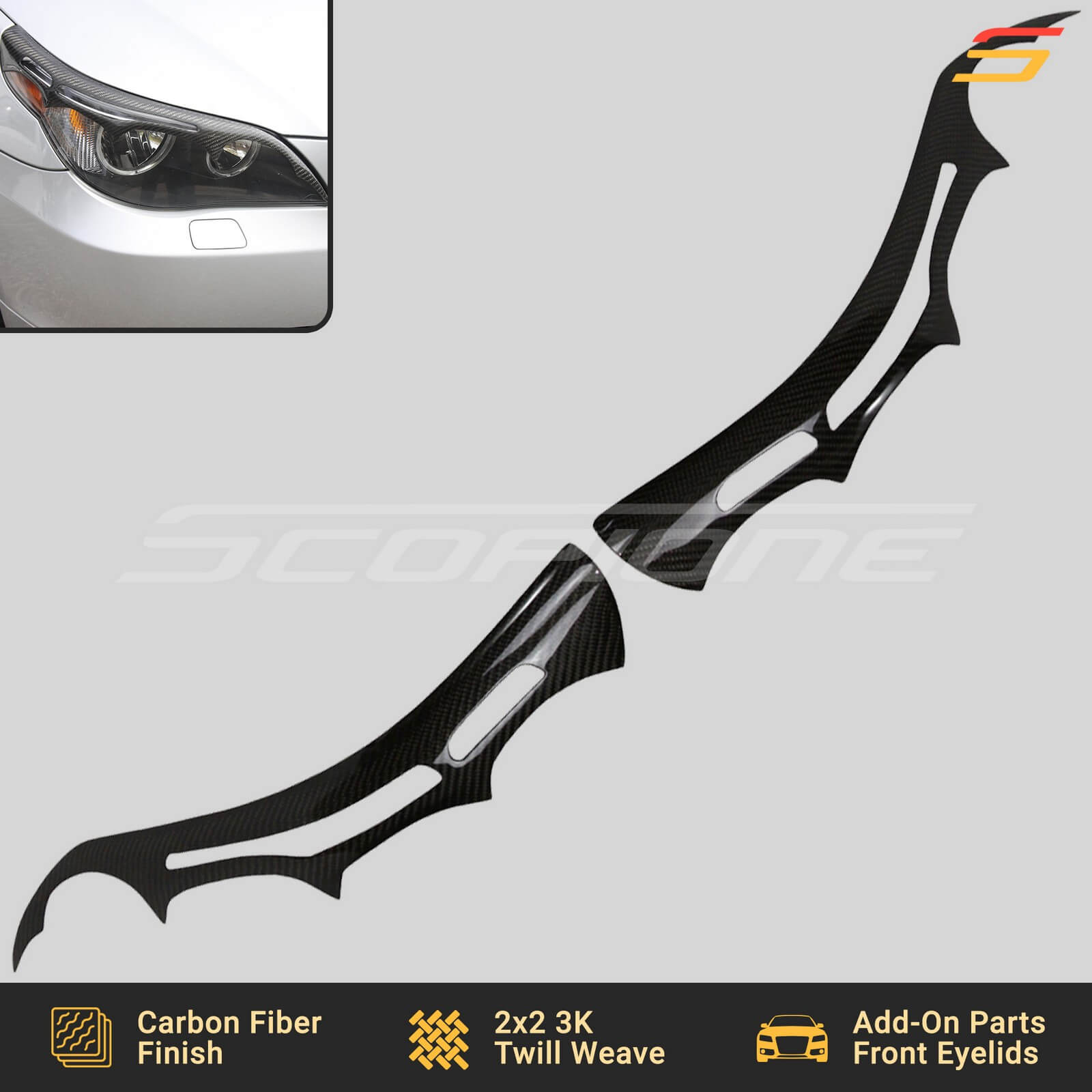
Scopione carries front M-Tech splitters, rear diffusers, roof spoilers, headlight eyelids ($140 glossy, $145 matte), and Angel Eyes LED bulbs for the E60 5 Series and M5, with both glossy and matte carbon fiber finishes available on select parts.






F10 & F90 M5 (2011–2023): Twin-Turbo V8
The F10 M5 (2012–2016) introduced the S63 4.4-liter twin-turbo V8 to the M5 formula: 553 hp through a hot-vee turbo layout where both turbochargers sit inside the V between the cylinder banks, shortening intake paths and reducing turbo lag. The 30 Jahre Edition (2014, 300 units) pushed output to 600 hp for the M5’s 30th anniversary.
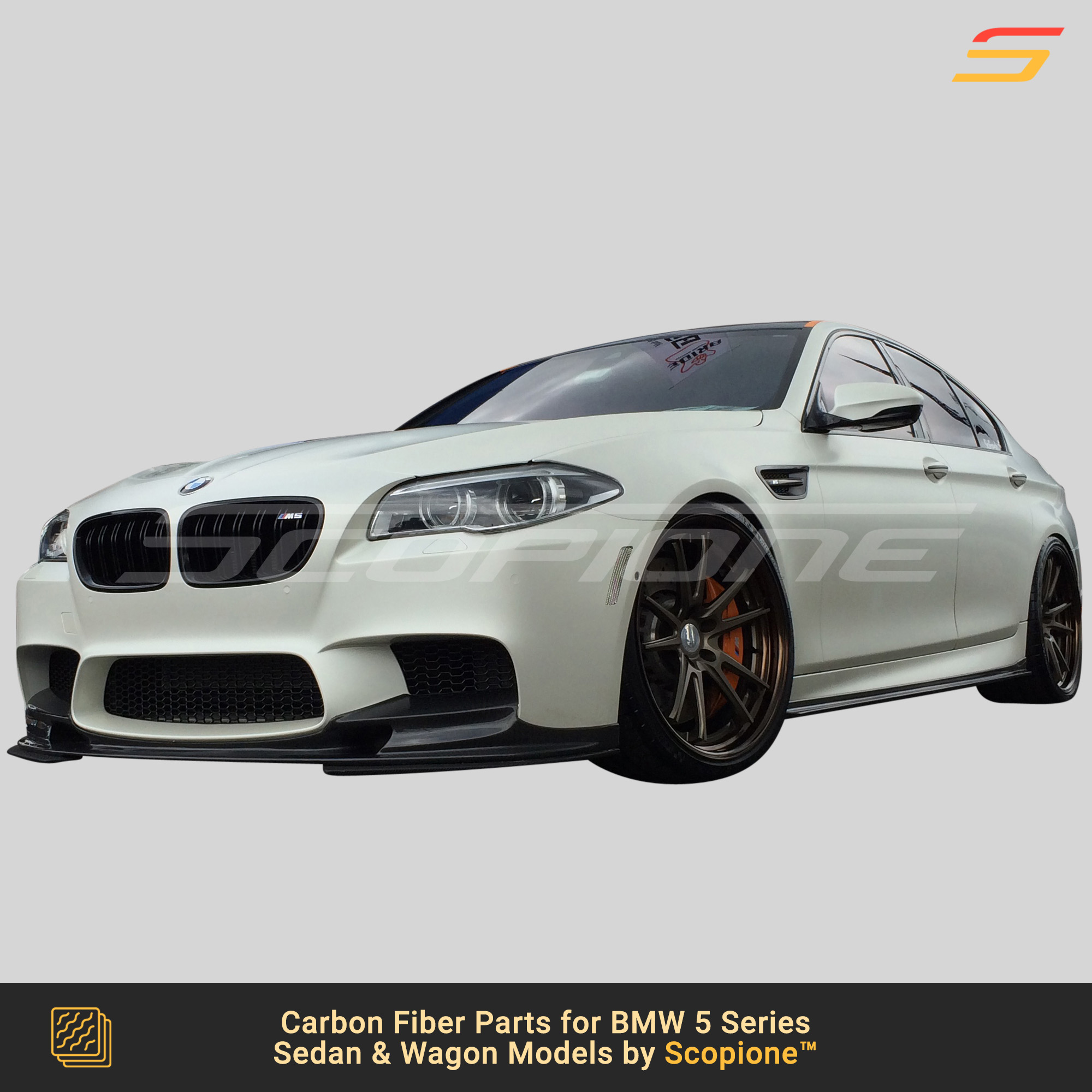
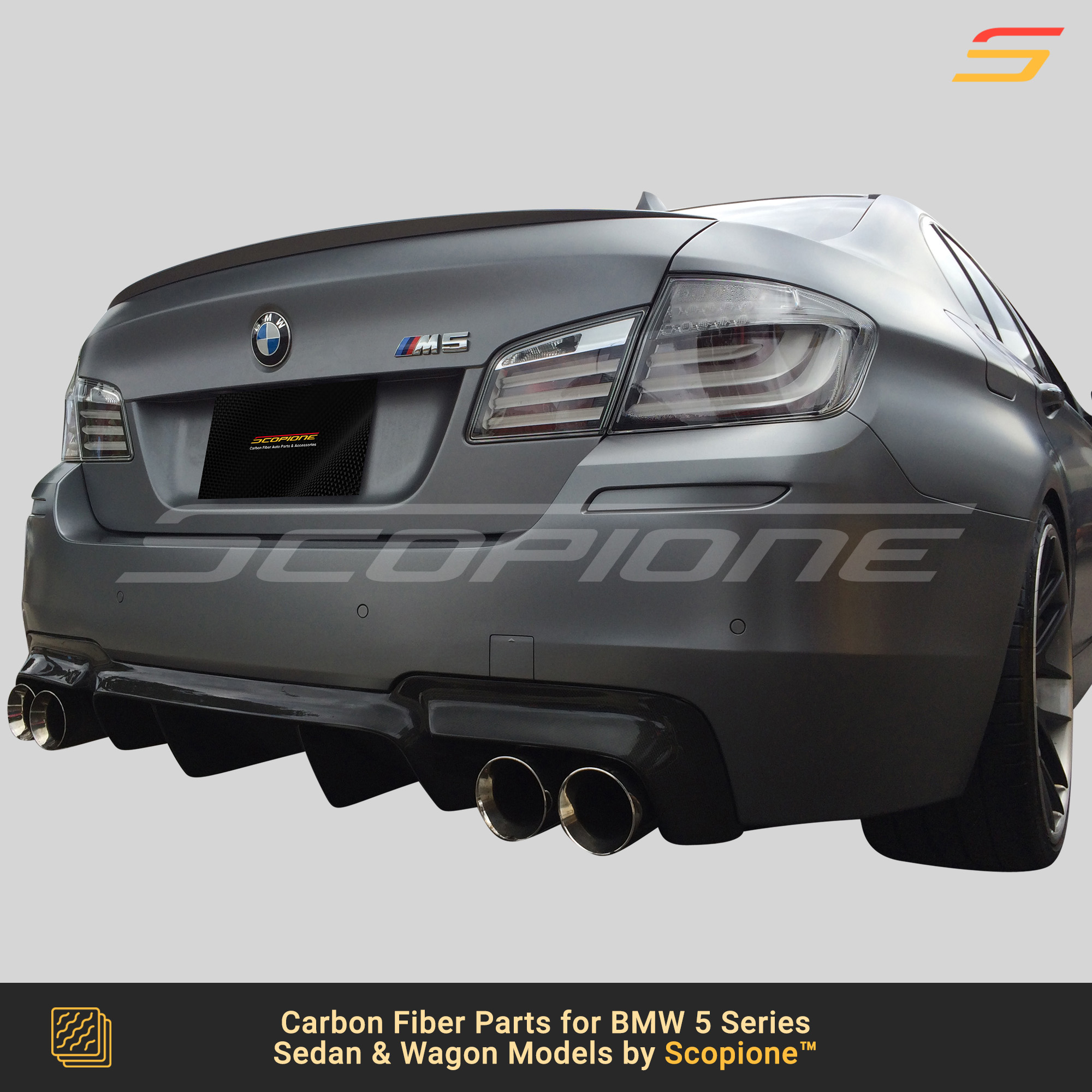
The F90 M5 (2018–2023) added all-wheel drive for the first time through BMW’s M xDrive system – switchable to rear-wheel drive through the center console. The M5 Competition delivered 617 hp. And the M5 CS (2022) reached 627 hp with extensive CFRP components: hood, front splitter, rear spoiler, mirror caps, and rear diffuser. At 230 lbs lighter than the M5 Competition, the CS hit 60 mph in 2.9 seconds – matching the Nissan GT-R R35 NISMO from a full-size luxury sedan weighing over 4,000 lbs.
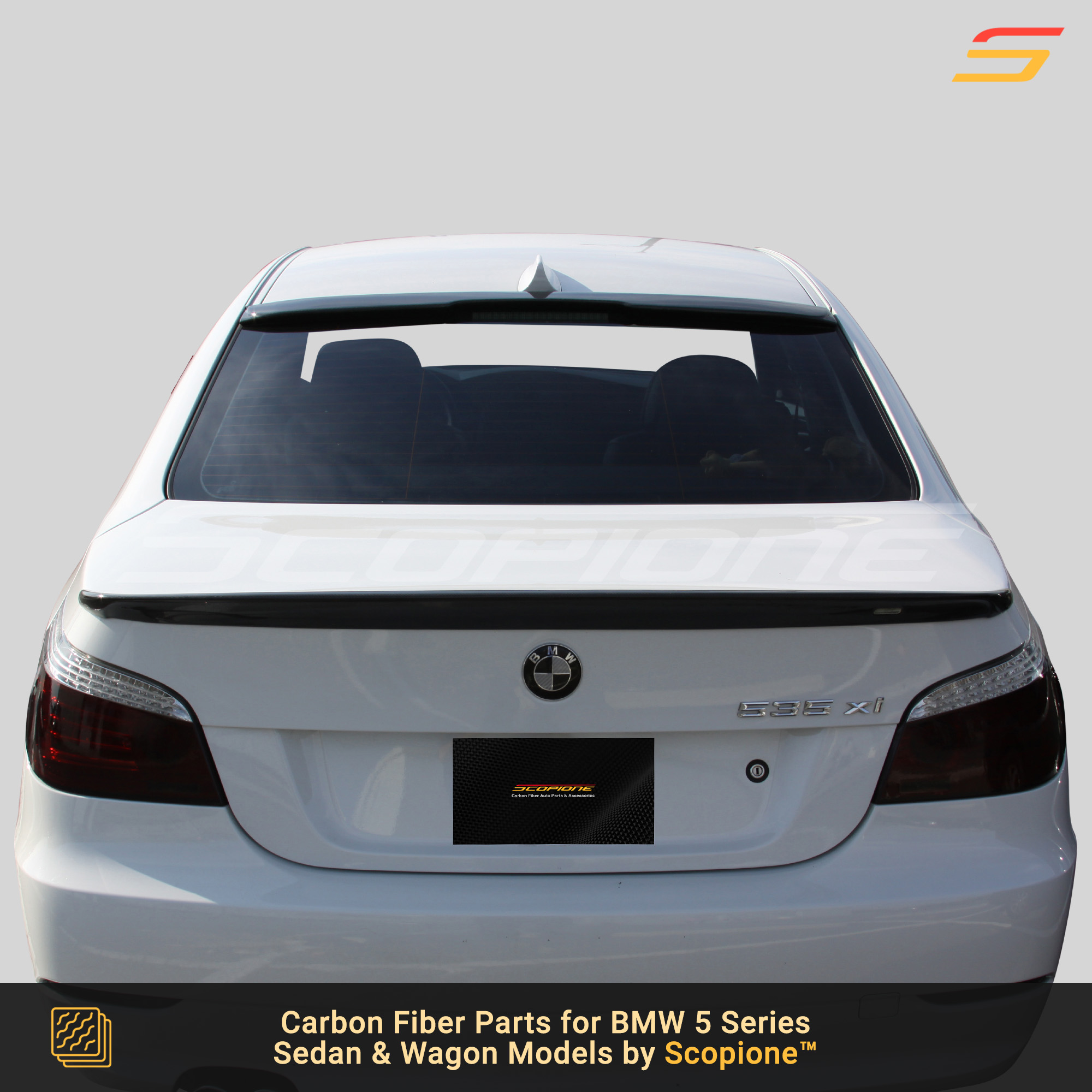
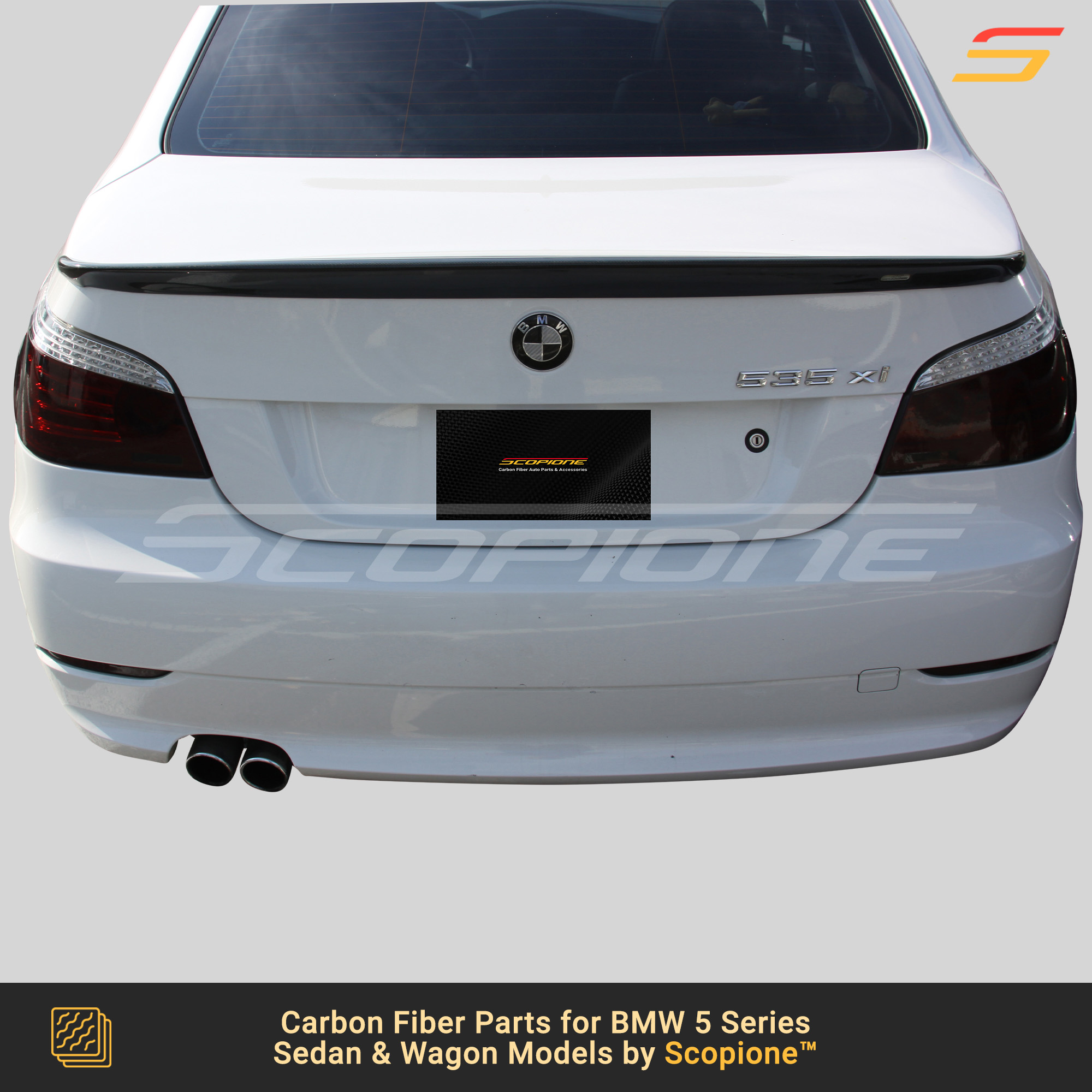
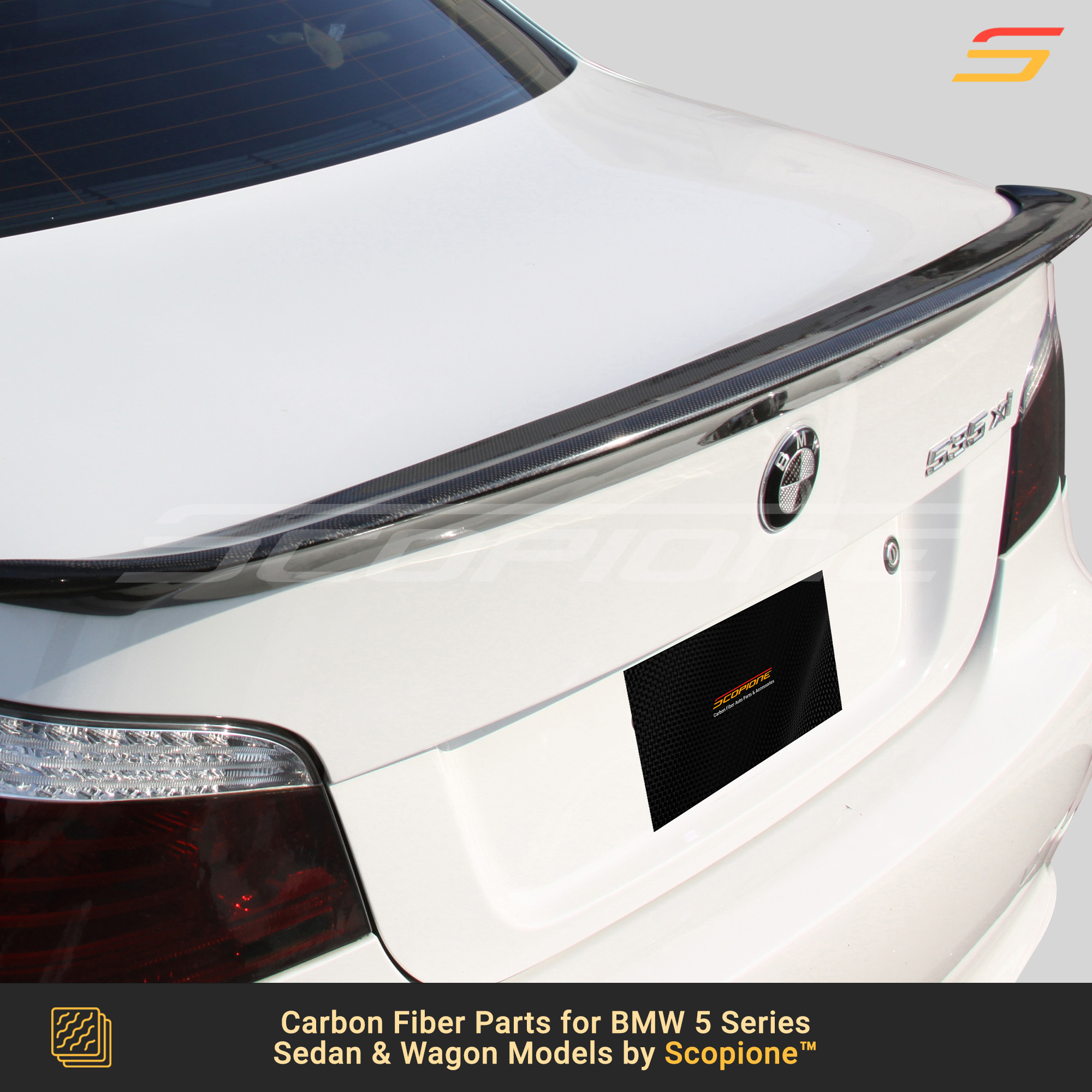
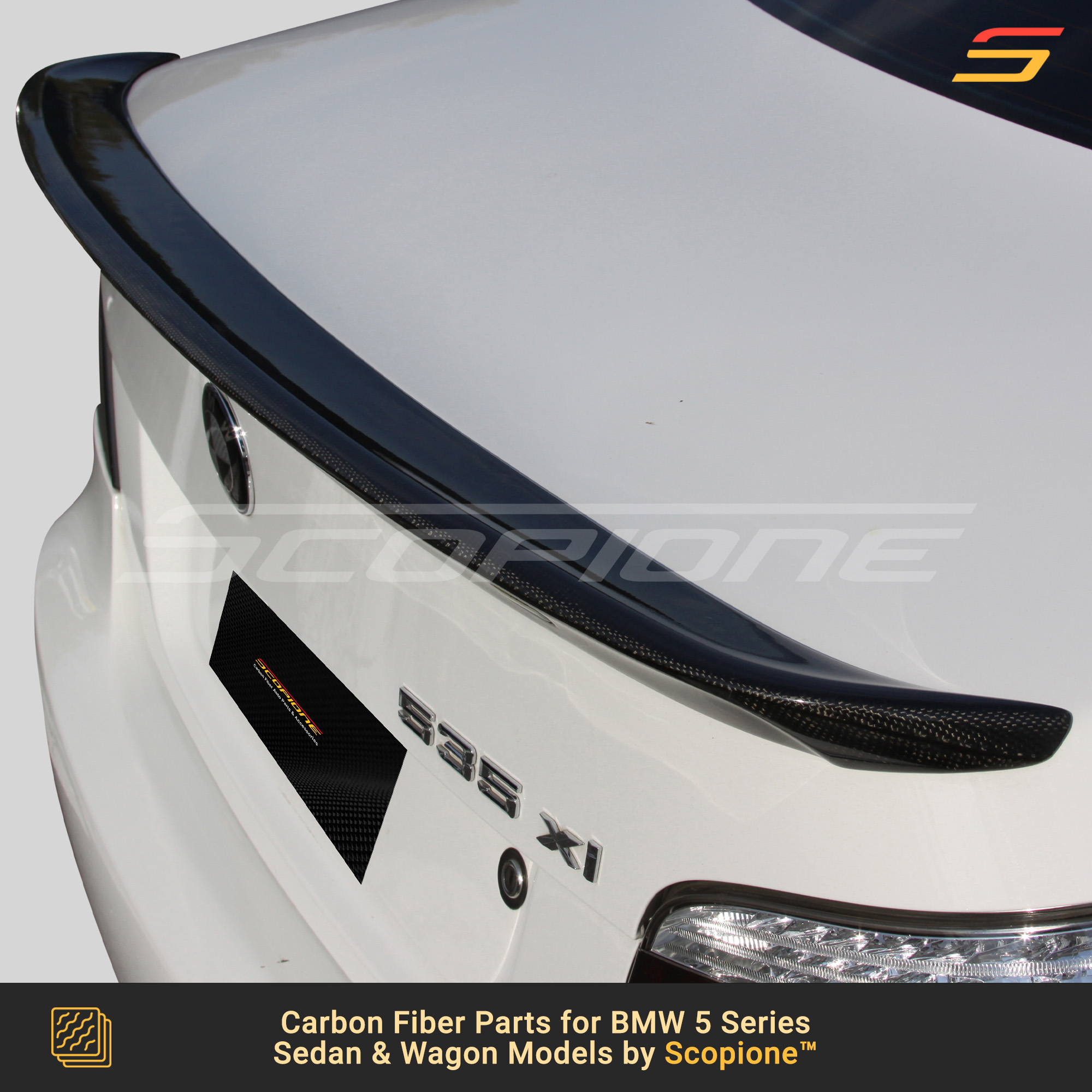
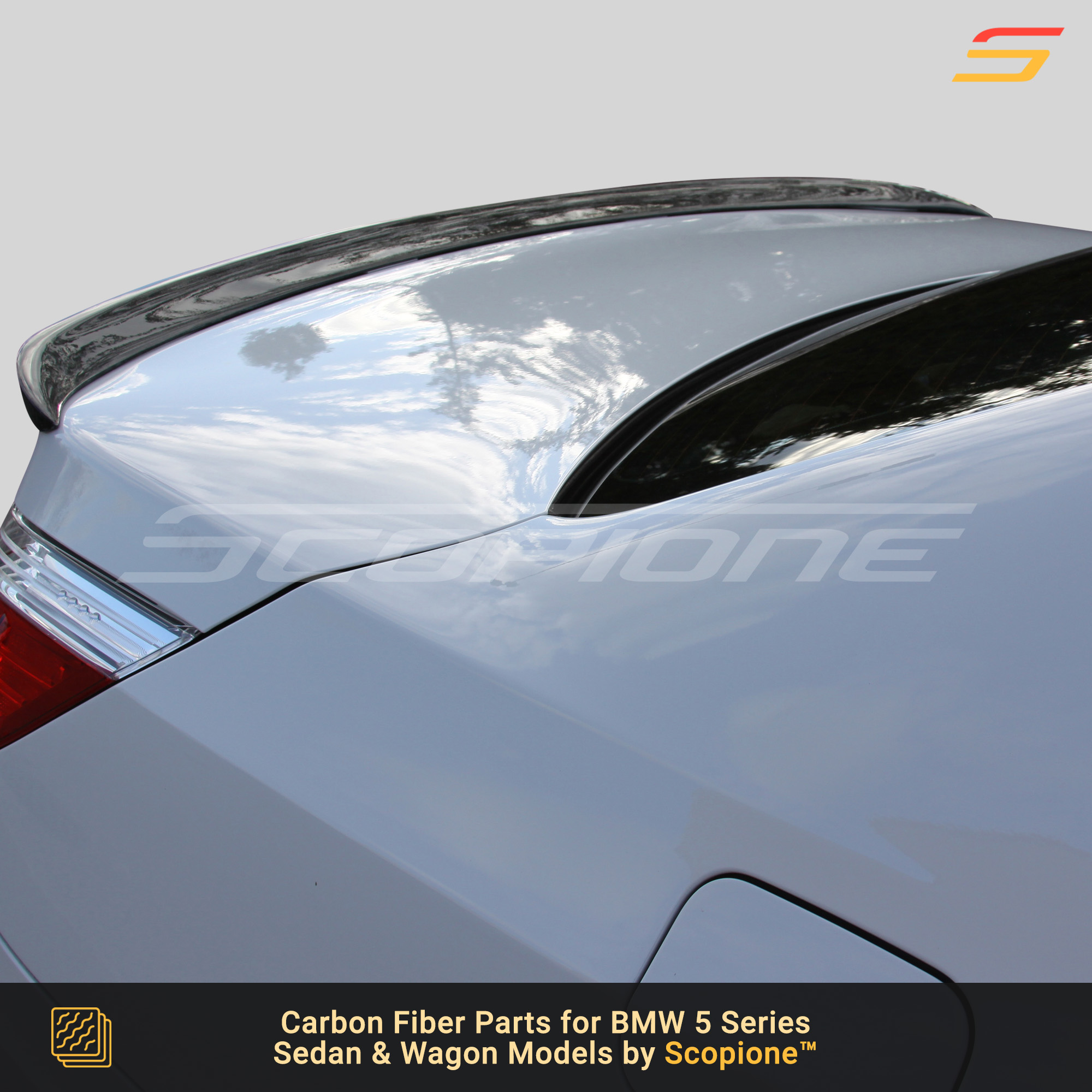
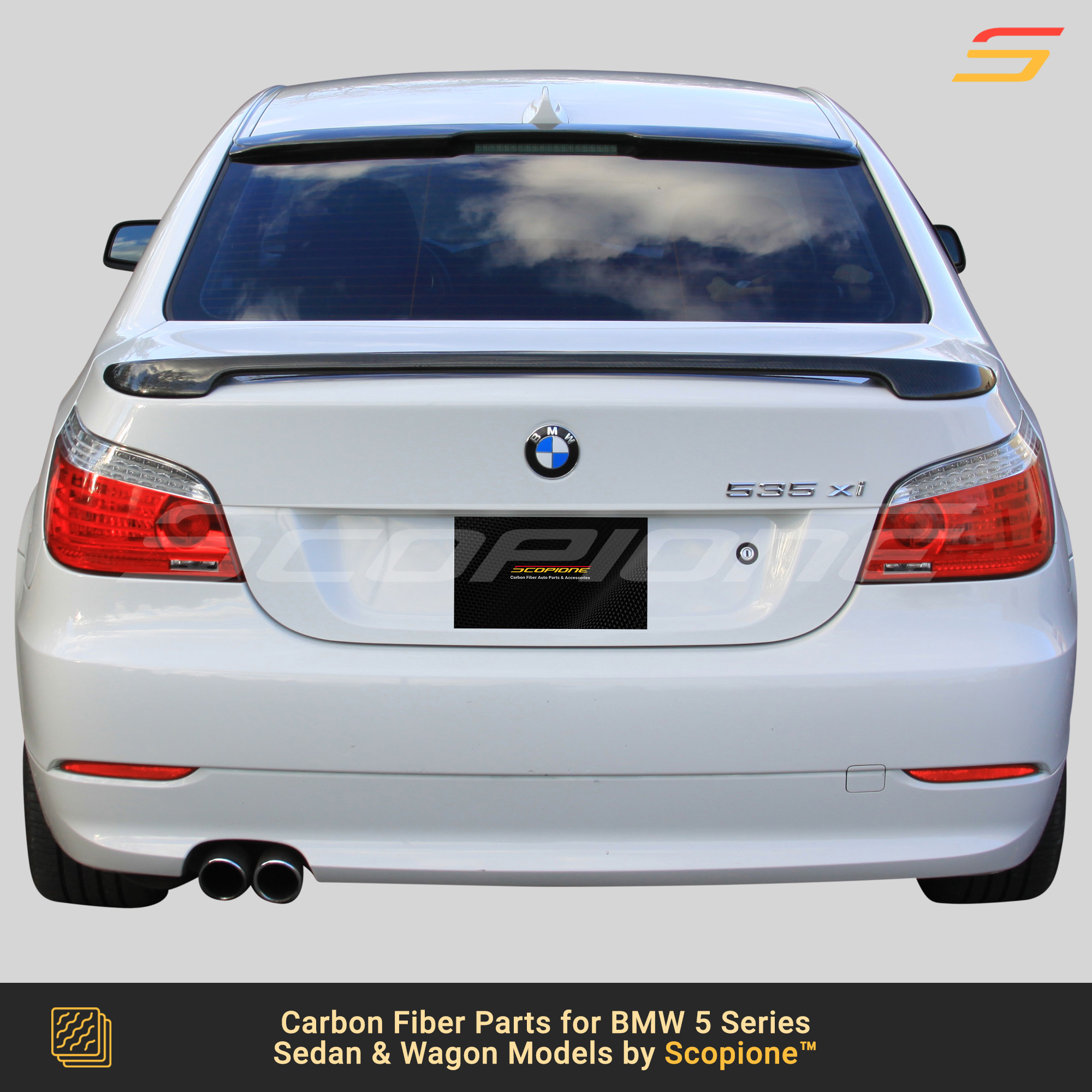
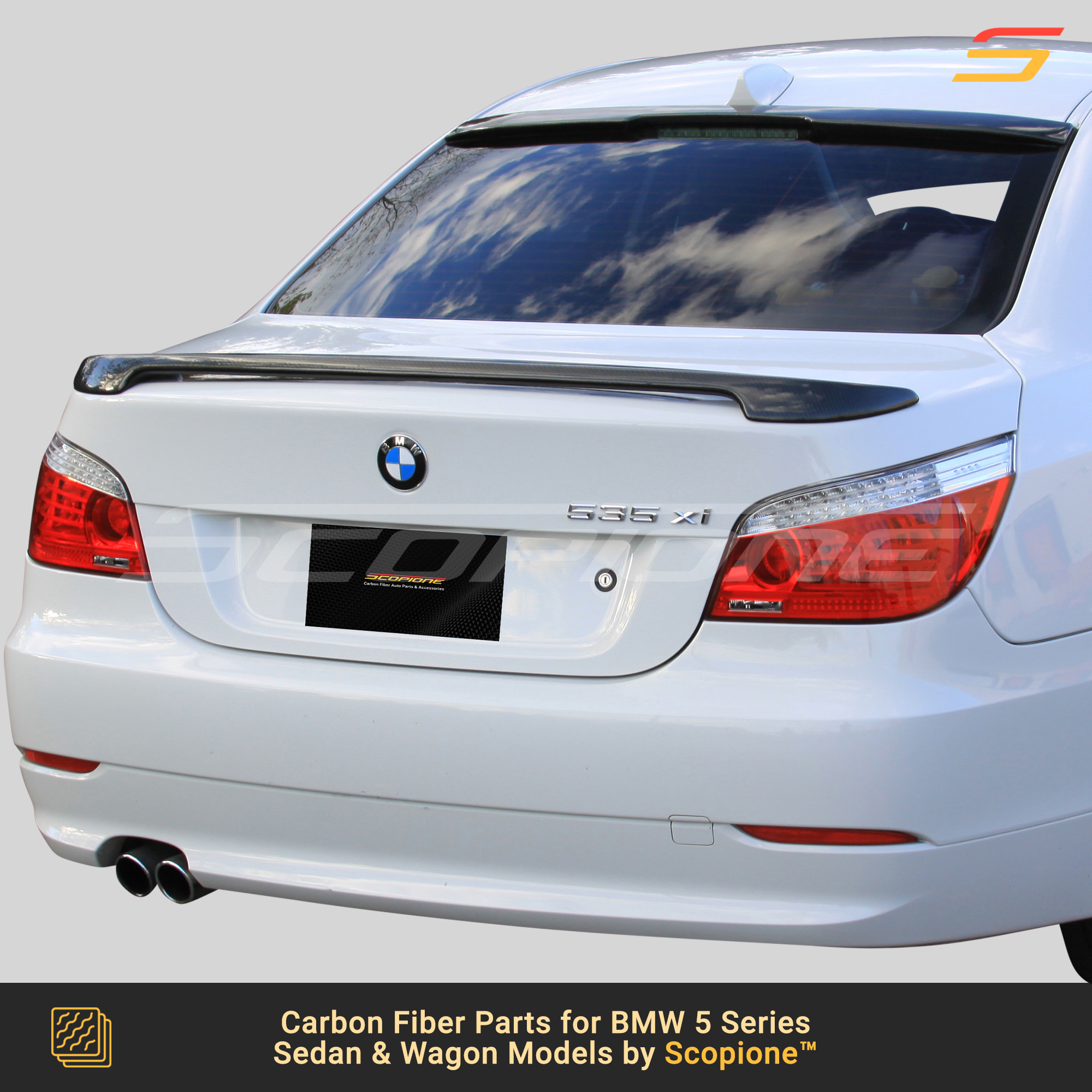
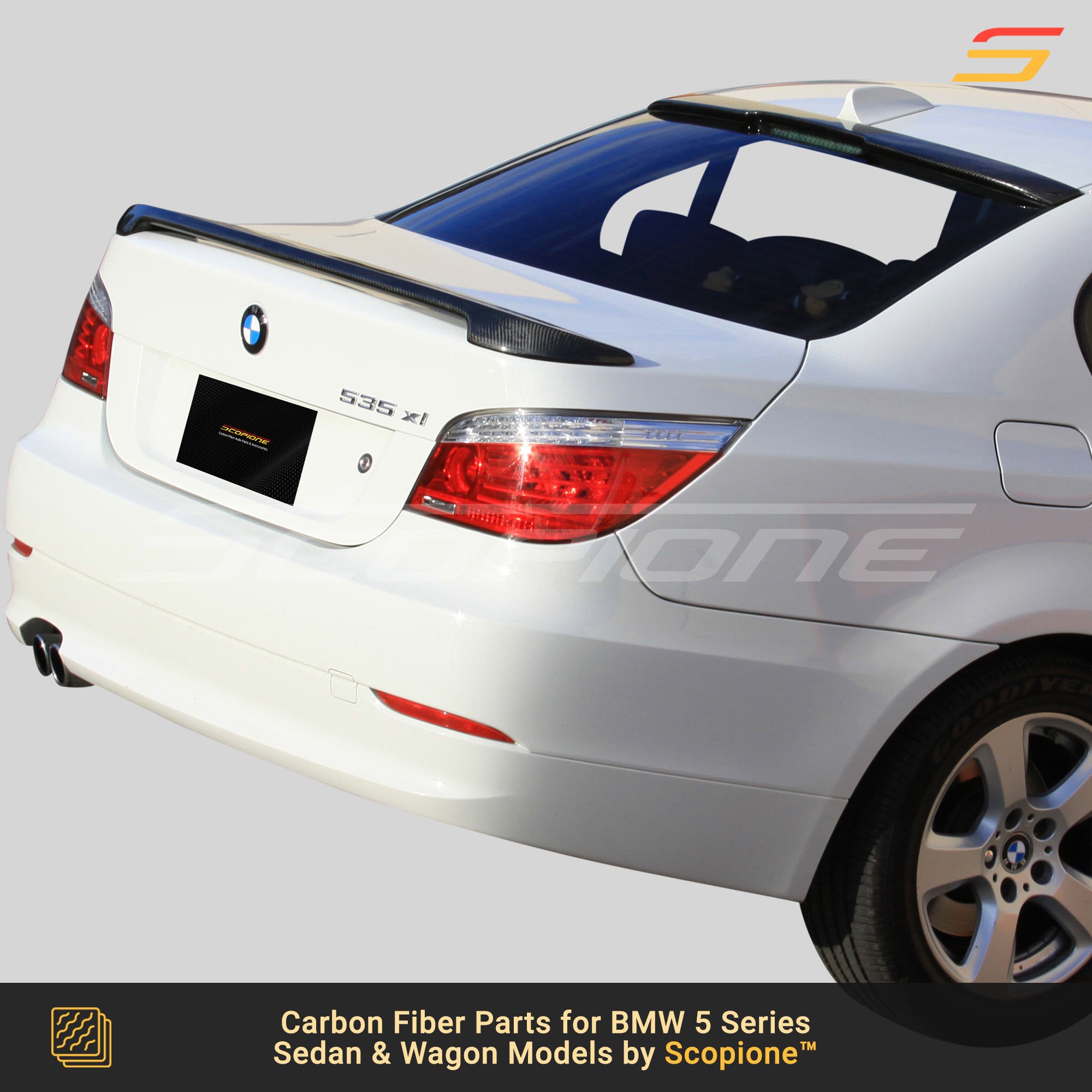
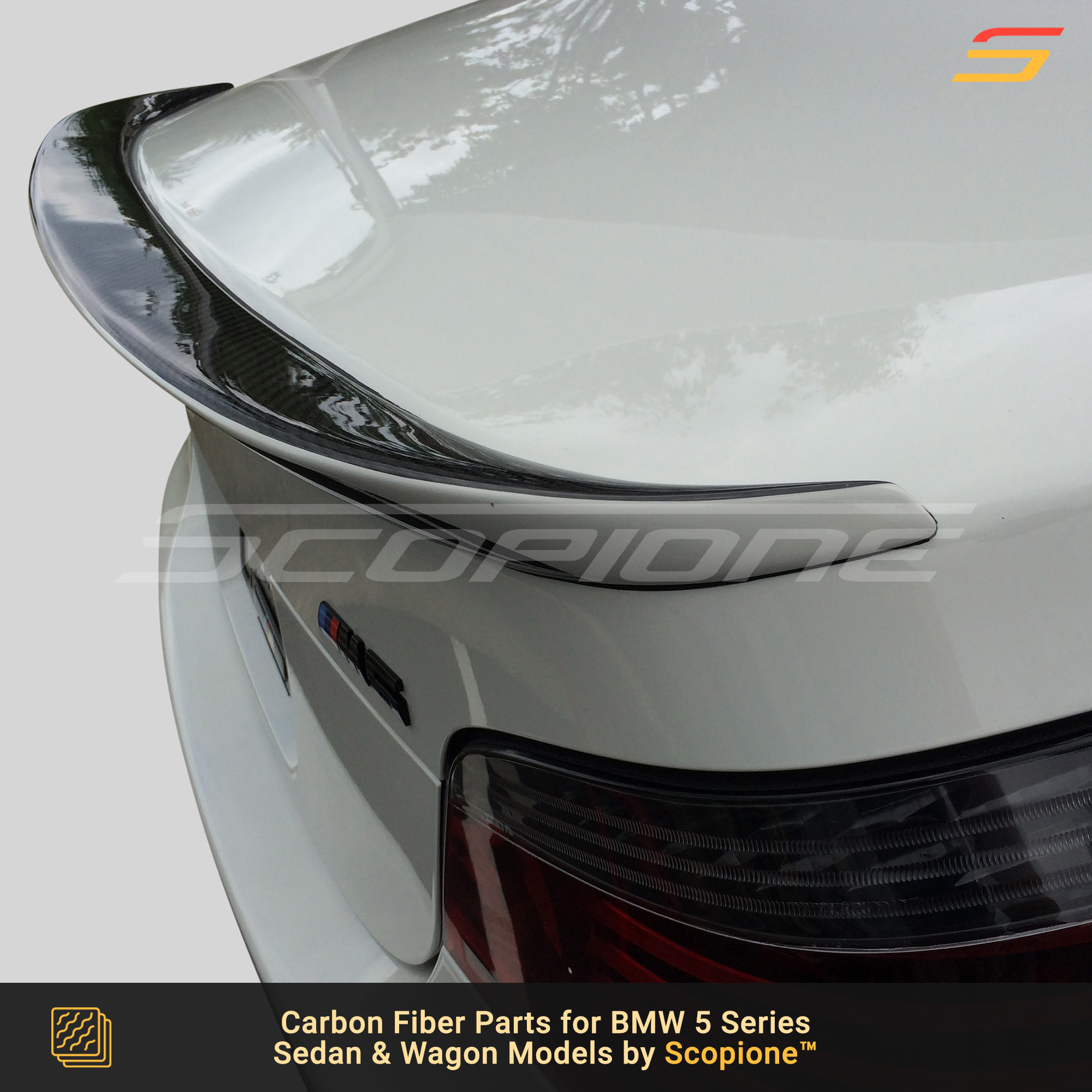
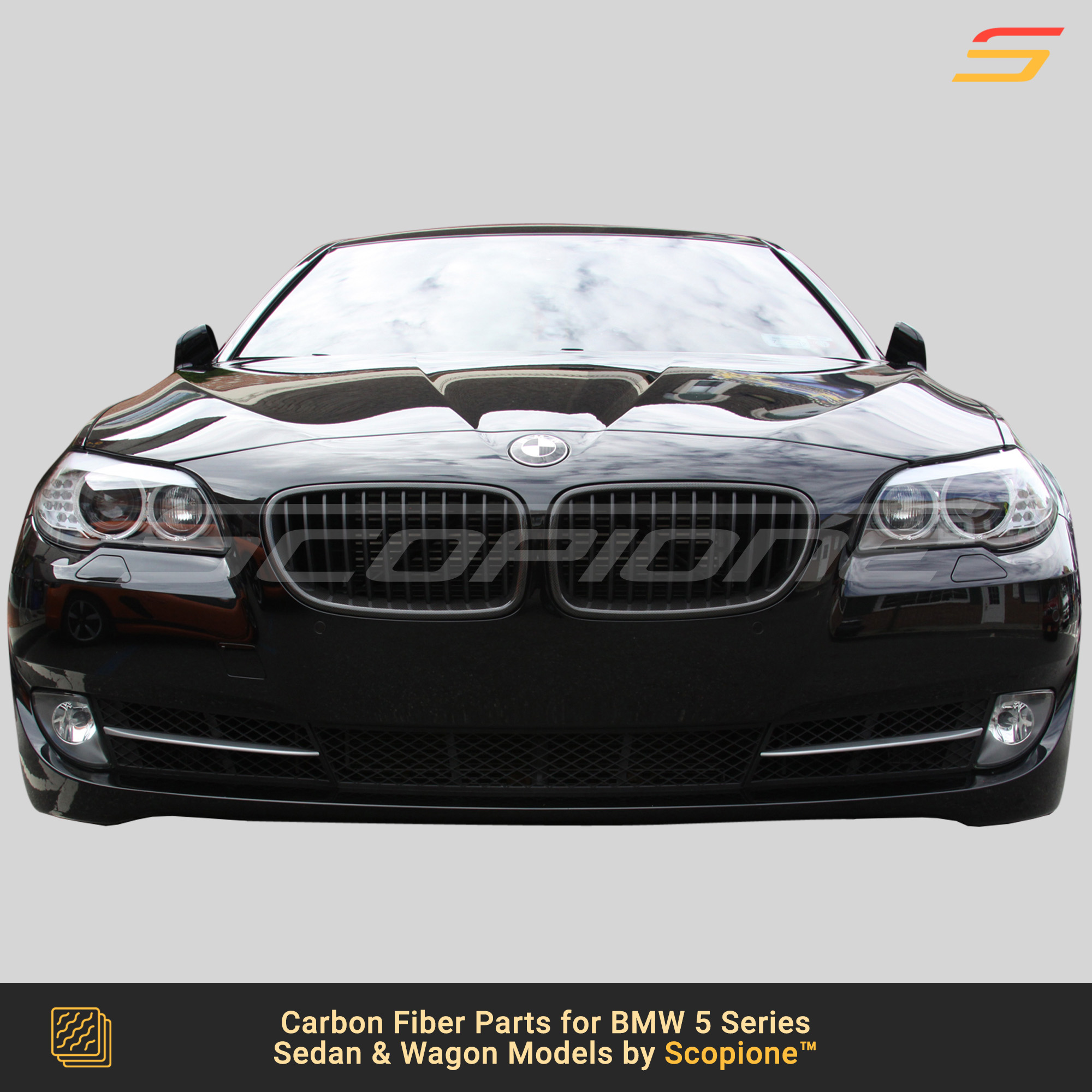
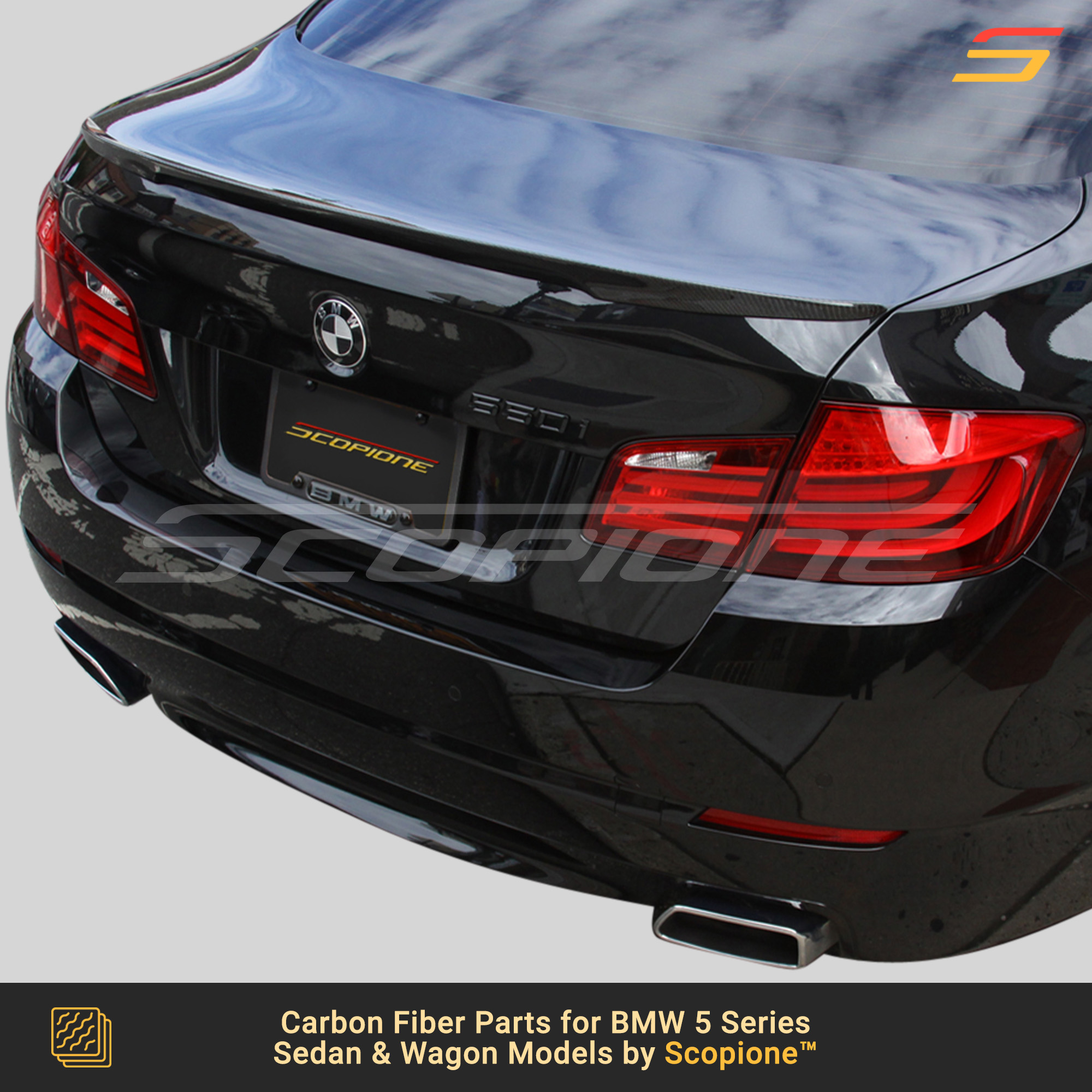
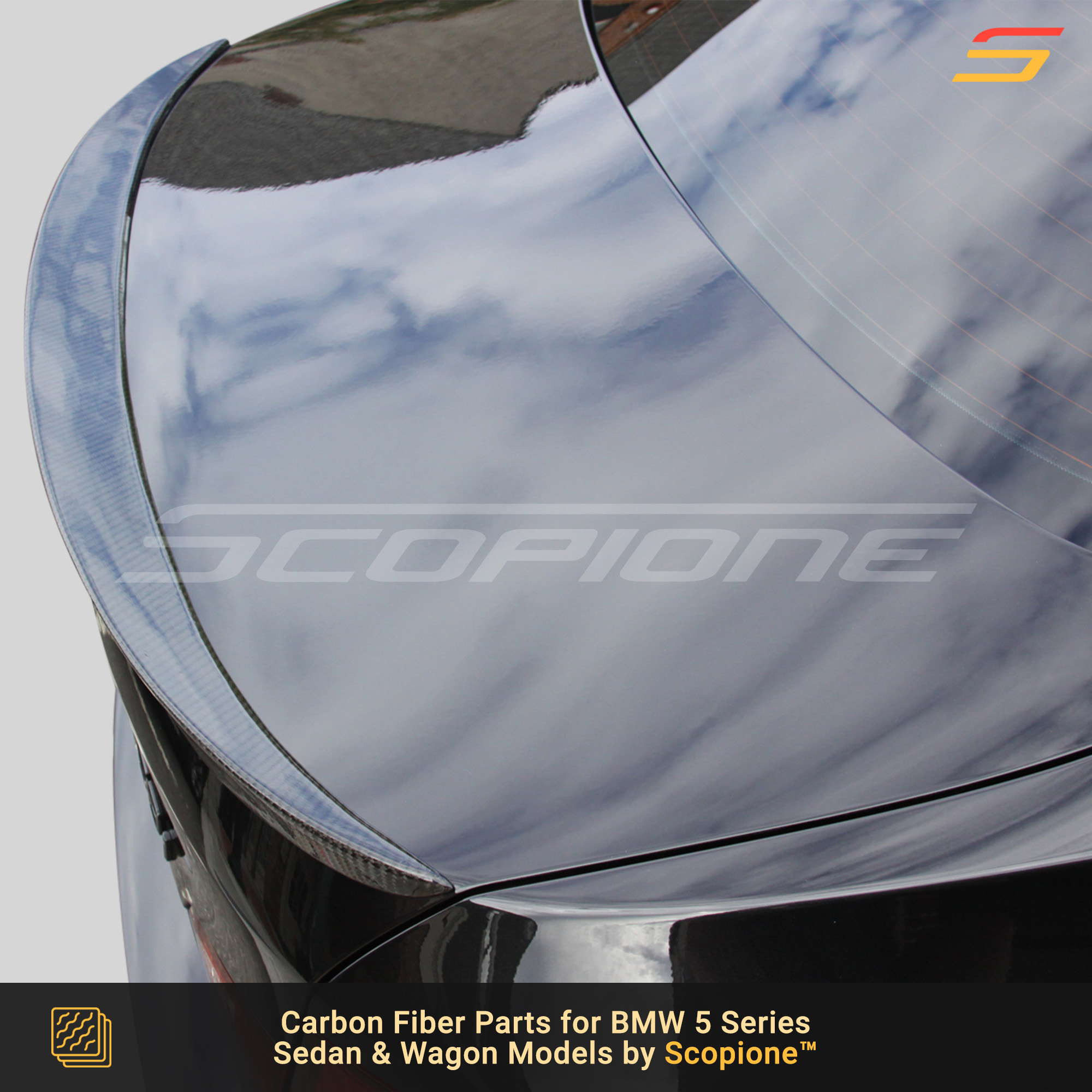
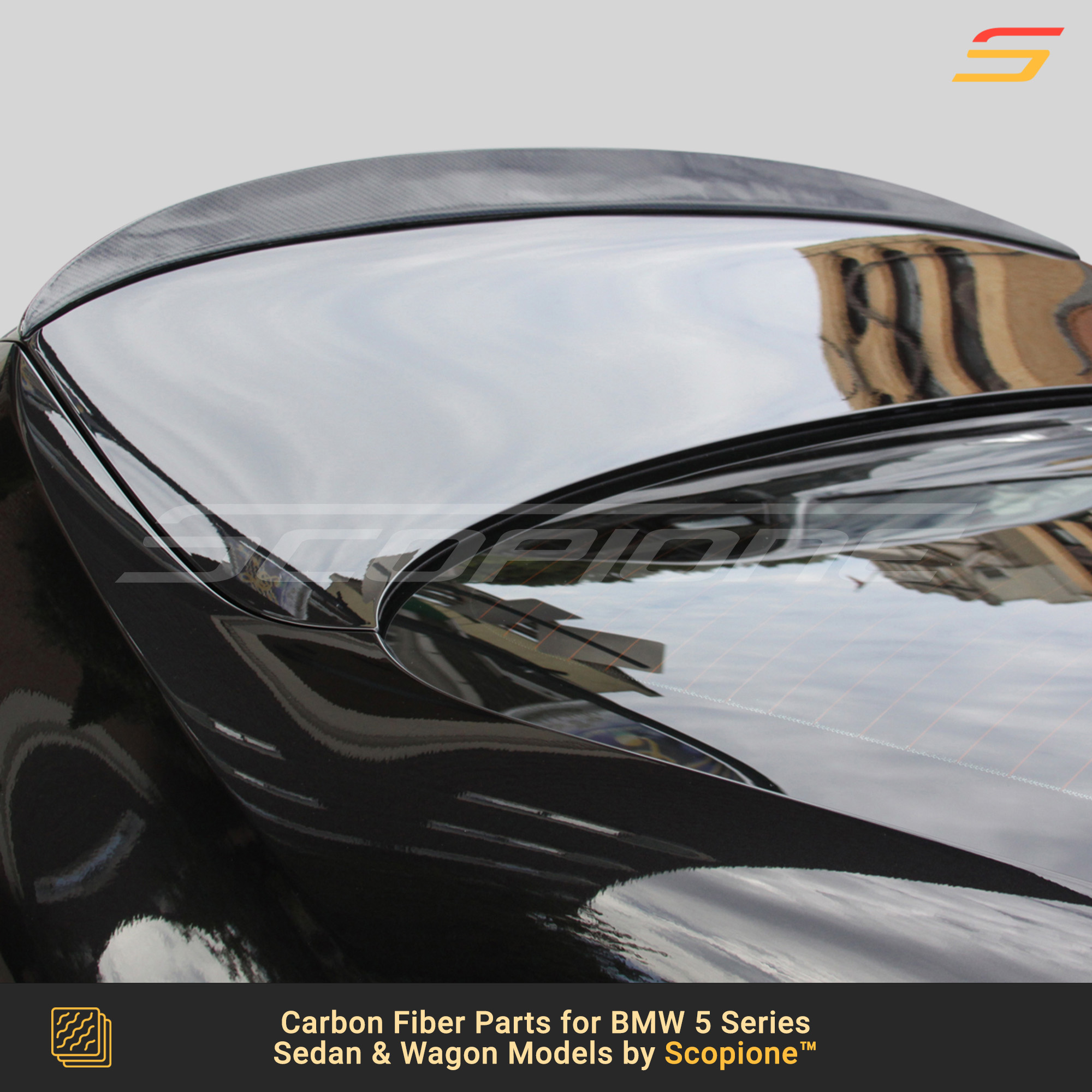
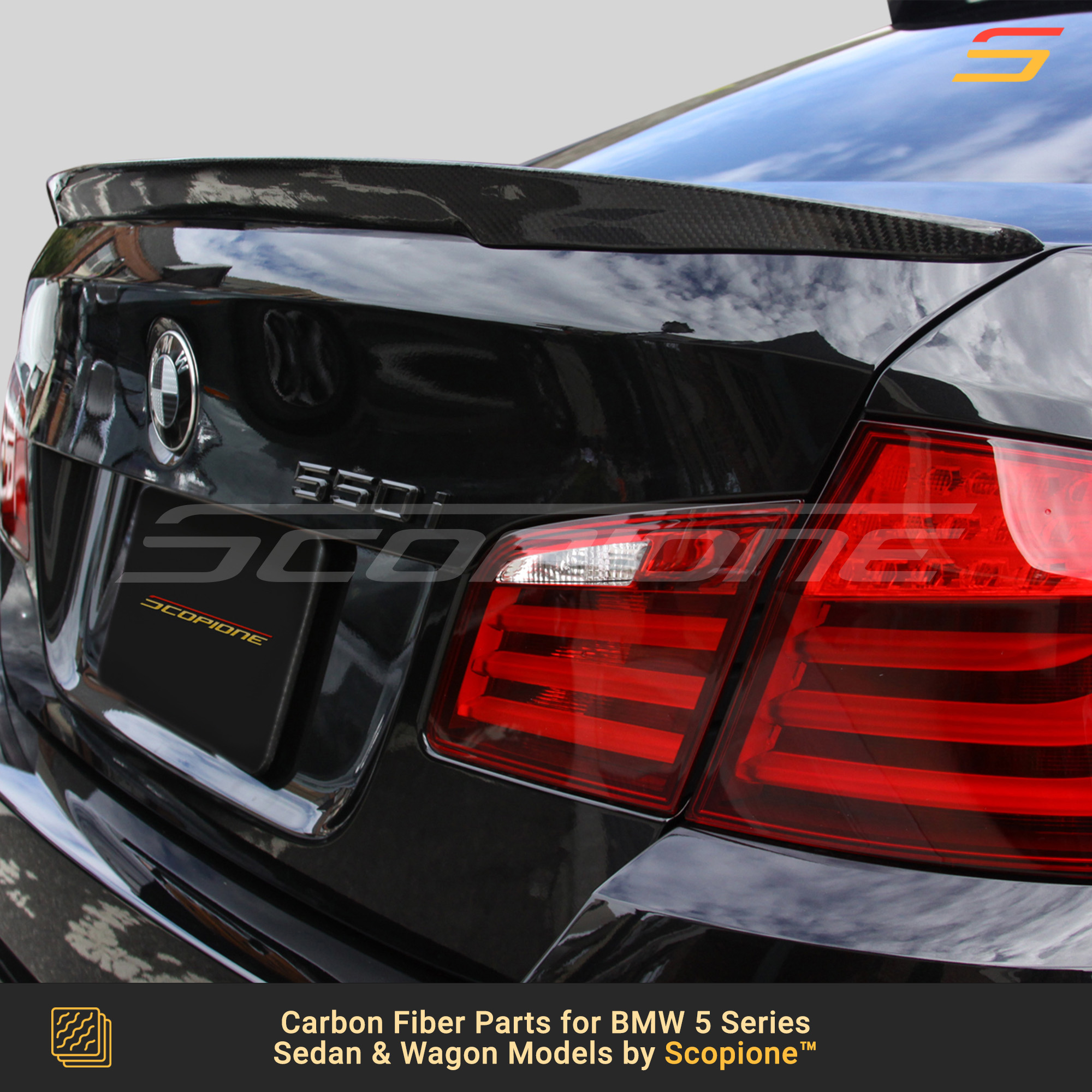
Scopione’s F90 M5 coverage includes carbon-fiber pre-LCI front bumper splitters ($300) for 2018–2020 models. For the F10 5 Series, trunk spoilers ($250) and roof spoilers ($260) cover both the standard 5 Series and M5 variants.
The new G90 M5 (2025) introduces a plug-in hybrid V8 drivetrain producing 717 hp total system output, but curb weight exceeds 5,300 lbs – over 1,000 lbs heavier than the F90 M5 CS. That weight penalty has already driven collector interest toward pre-hybrid M5 variants. A 2014 F10 M5 30 Jahre Edition (300 units worldwide) sold for $78,000 on Bring a Trailer in 2023 – well above comparable non-anniversary F10 M5s, which trade in the $25,000–$54,000 range.
X5 M, X6 M, M6 & the Extended BMW Lineup
BMW’s M division and M Performance catalog extends well beyond the M3, M4, and M5 core. Scopione carries carbon fiber parts for SUVs, grand tourers, compact sport coupes, and roadsters – platforms where a CF upgrade reshapes the visual character of the vehicle.
X5 M & X6 M (2010–Present)
BMW’s performance SUVs use the same S63 twin-turbo V8 family that powers the M5. The original E70 X5 M and E71 X6 M (2010–2014) produced 555 hp through a six-speed automatic. The current F95 X5 M Competition and F96 X6 M Competition extract 617 hp from the latest S63 evolution, reaching 60 mph in 3.7 seconds at a curb weight exceeding 5,300 lbs.
Scopione offers front bumper splitters ($360 on sale) and headlight eyelids ($140–$145 in glossy or matte) for the E70 X5 M and E71 X6 M, plus a rear bumper diffuser ($350) for the E71 X6. The oversized front fascia of the X5 M and X6 M provides substantial surface area for carbon-fiber splitter installations. Unlike the M3 and M4, where carbon fiber accents complement a sports car silhouette, carbon fiber on an X5 M or X6 M creates a contrast between the vehicle’s mass and the precision of the 2×2 twill weave – a visual tension that works particularly well on darker paint finishes.
6 Series & M6 (2004–2019)
The F-generation 6 Series and M6 (2012–2019) shared the M5’s S63 twin-turbo V8, producing 560–600 hp across Coupe (F13), Convertible (F12), and Gran Coupe (F06) body styles. The Gran Coupe’s four-door fastback silhouette competed with the Bentley Continental GT and Maserati GranTurismo in the luxury GT segment.
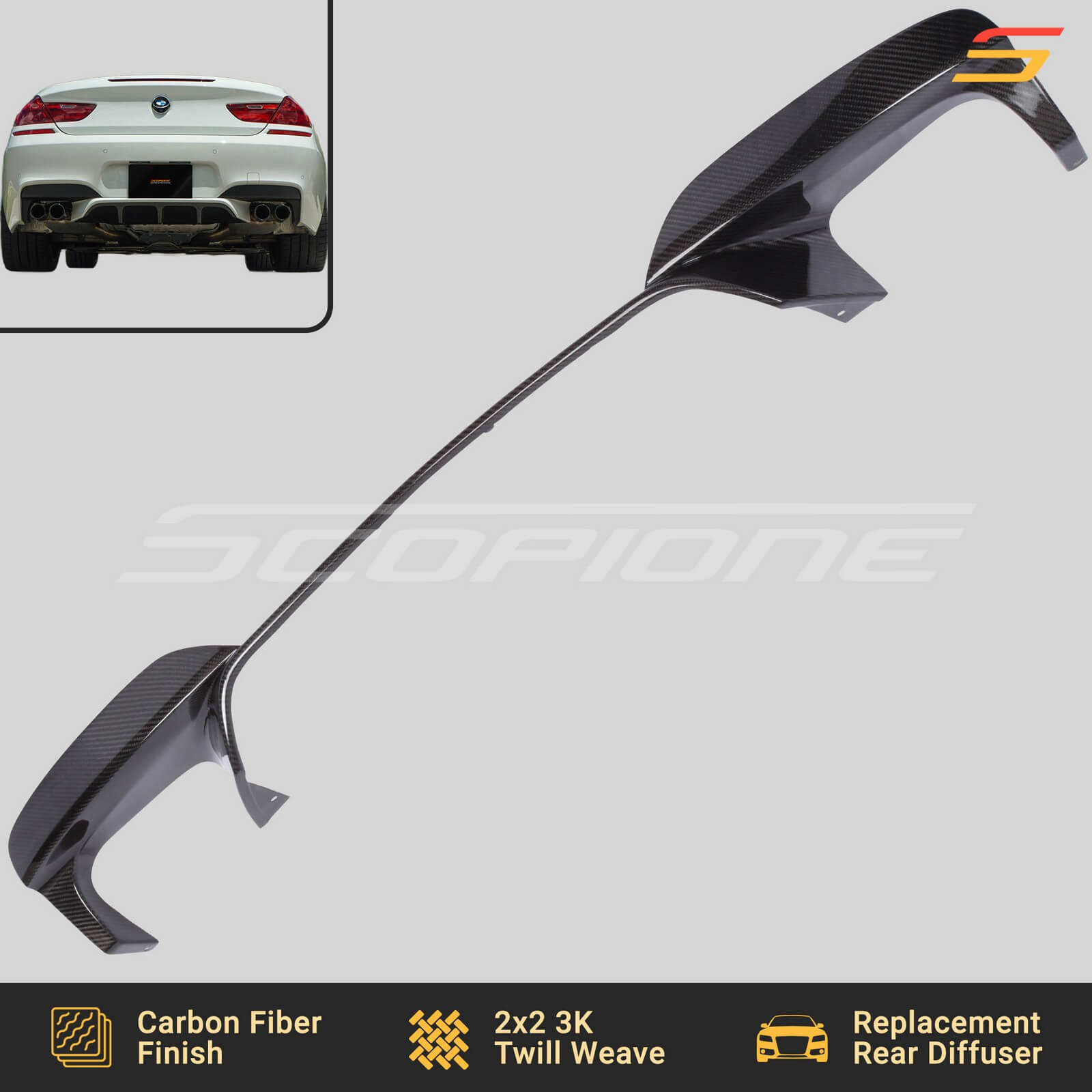
Scopione carries M-Tech front bumper splitters ($320) and three rear diffuser options for the F06/F12/F13 6 Series and M6, including a full-width bottom diffuser ($500), a bumper-integrated diffuser ($700), and a matte carbon-fiber variant ($750) – the highest-priced single part in the BMW catalog. The matte finish eliminates the glossy clear coat reflections, producing a raw-weave appearance that pairs well with the M6’s wide rear stance.
The E63/E64 6 Series and M6 (2004–2010) used the same S85 V10 as the E60 M5, producing 507 hp. Scopione carries Angel Eyes LED bulbs for the pre-LCI E63/E64 ($50–$85) and LCI models ($60–$90), though carbon fiber aero components for this generation are not currently in the catalog.
1 Series, Z4, 7 Series & Classic Platforms
Scopione’s BMW catalog reaches beyond M cars into the broader lineup:
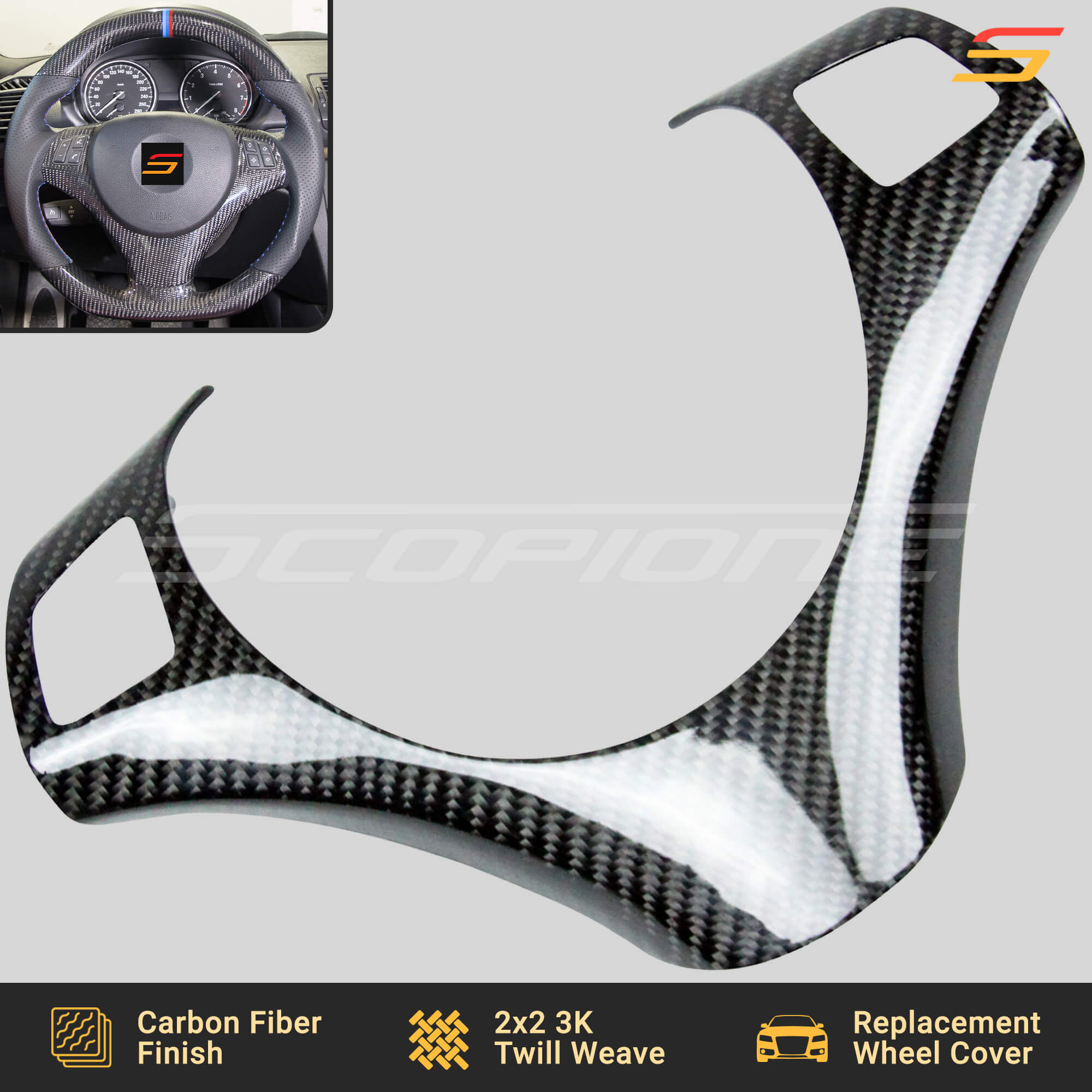
- E82/E87/E88 1 Series (2004–2013) – Front splitters, rear diffusers (glossy and matte), and steering wheel covers. The 135i used BMW’s first twin-turbo production engine (N54), and the E82 body also underpins the 1M Coupe.
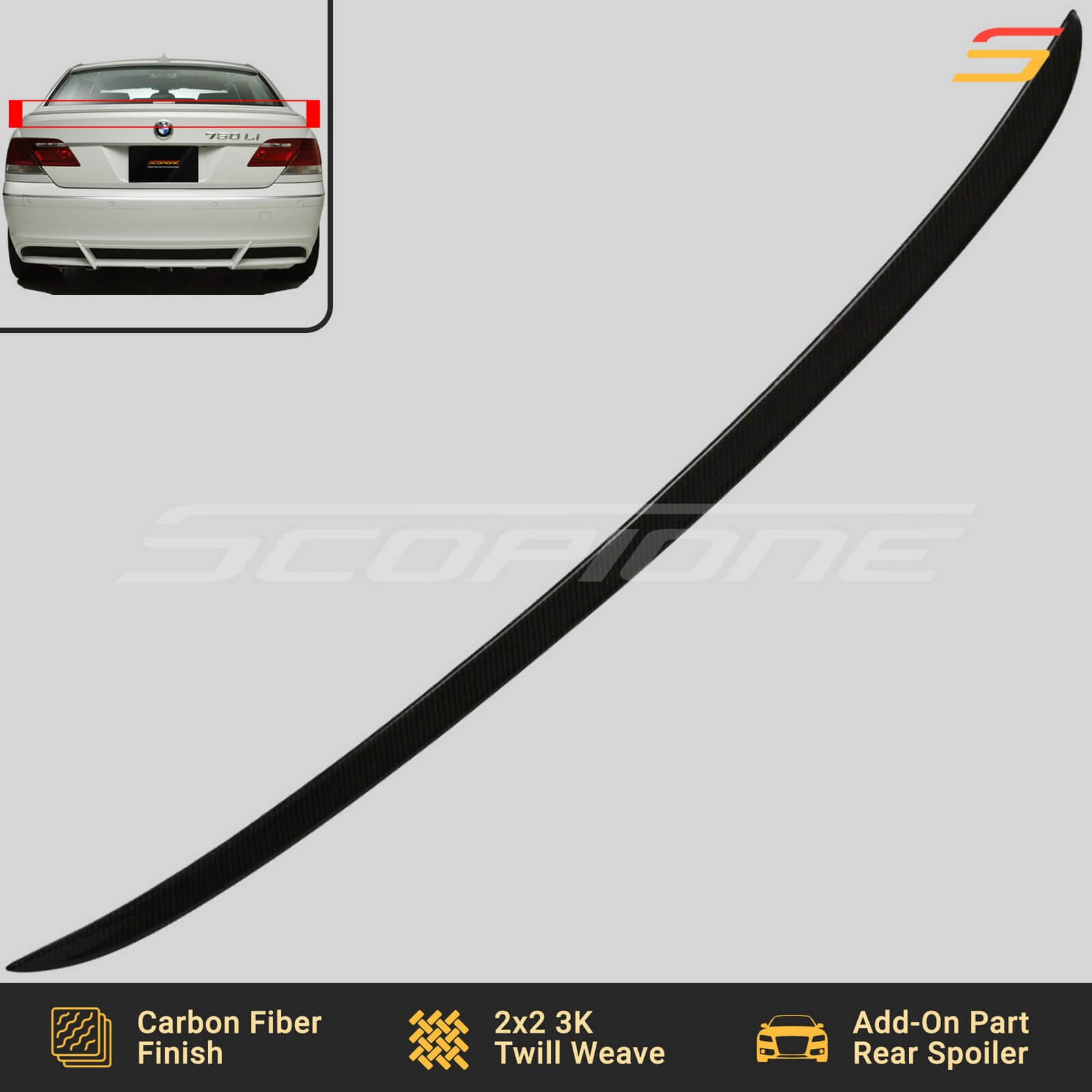
- E85/E86 Z4 and Z4 M (2003–2008) – Carbon-fiber kidney grilles ($200), trunk spoilers for the E86 coupe, and the S54 engine cover shared with the E46 M3.
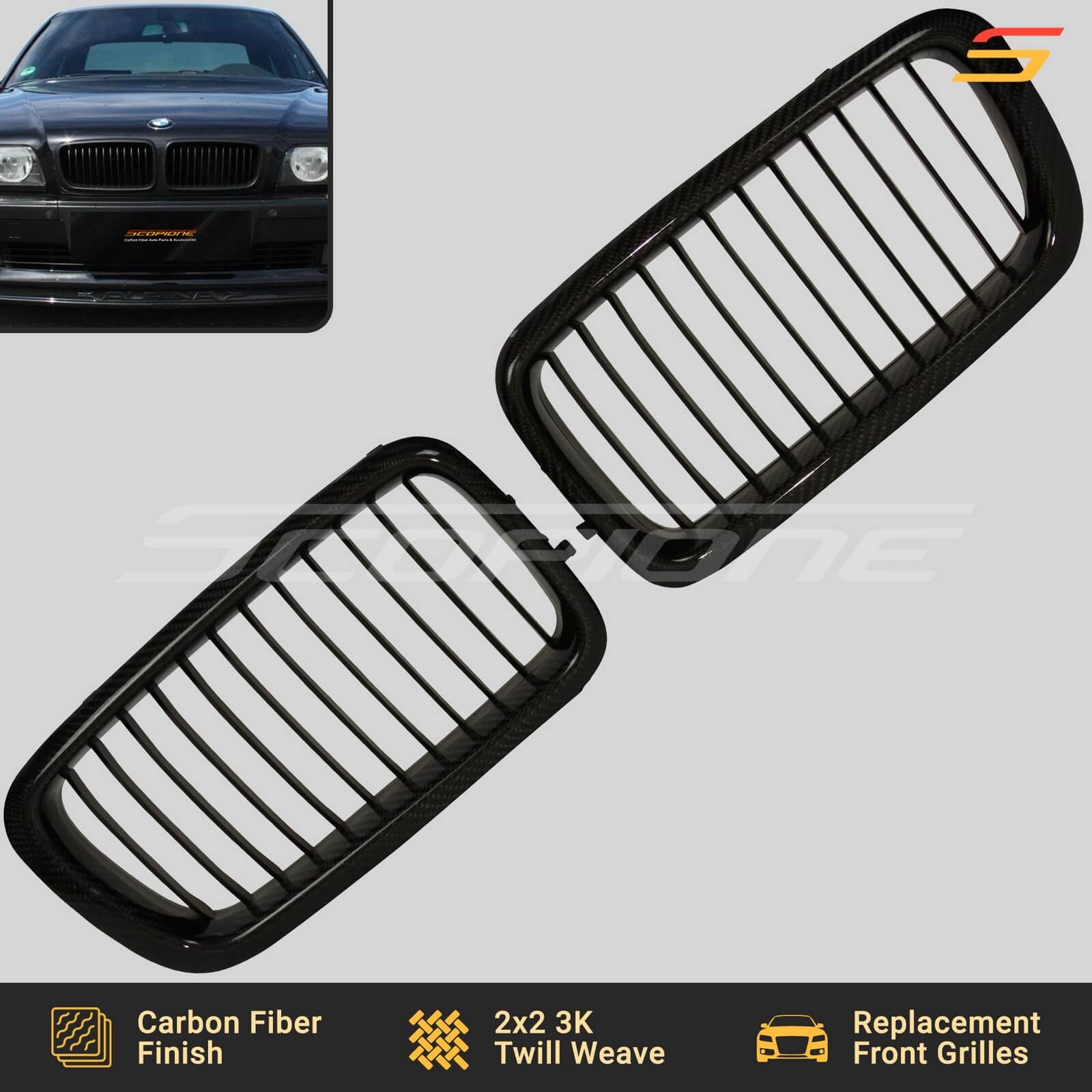
- E38 and E65/E66 7 Series (1995–2008) – Kidney grilles, rear trunk spoilers, and roof spoilers for BMW’s flagship sedan. The E65 introduced the controversial iDrive system and Chris Bangle’s polarizing design language.
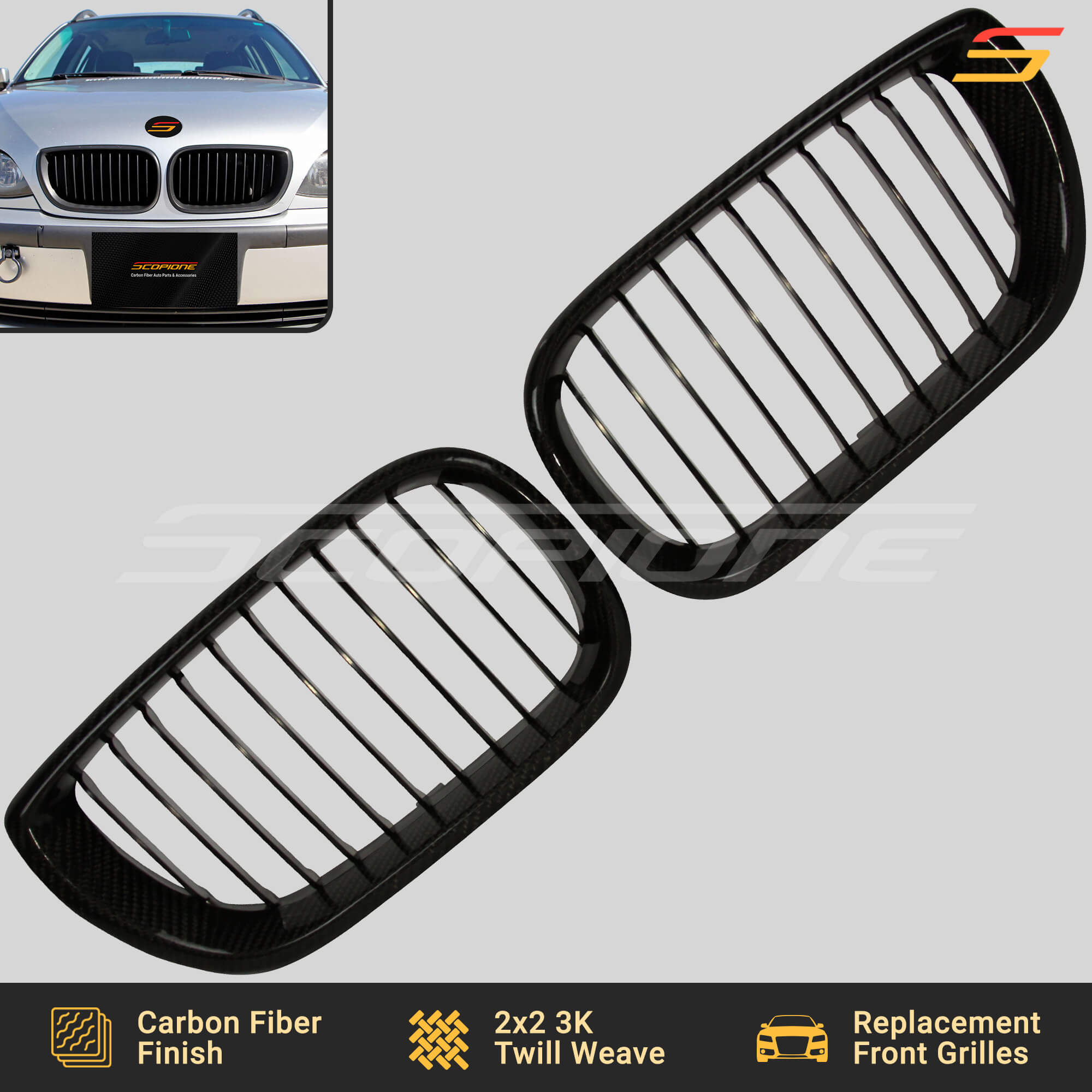
- Non-M E46 3 Series (1999–2006) – M-Tech II bumper splitters, rear diffusers, kidney grilles (pre-LCI and LCI), headlight eyelids, roof spoilers, and trunk spoilers. One of the deepest parts coverage in the catalog.
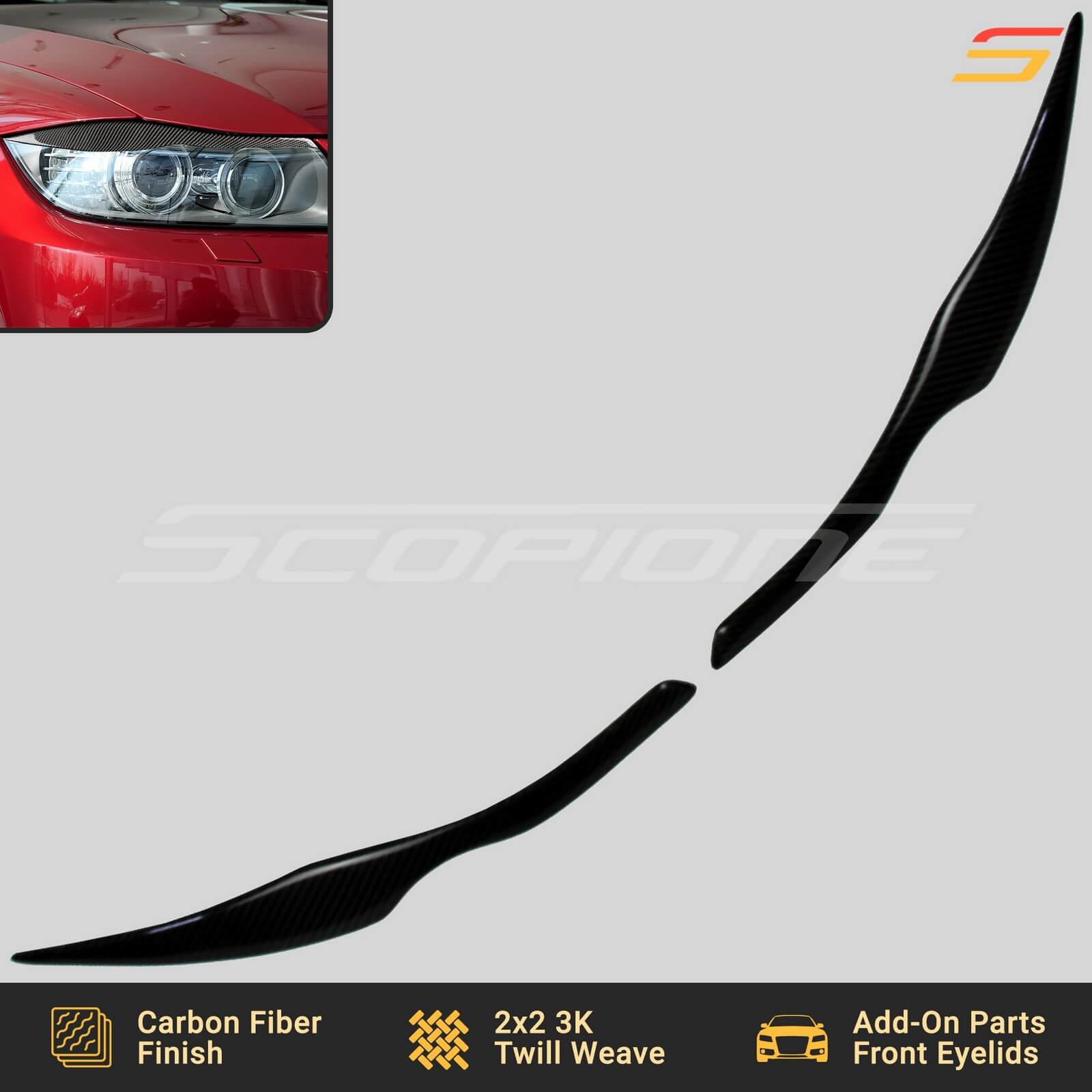
- Non-M E90/E91 3 Series (2006–2011) – Front lips, splitters for both pre-LCI and LCI bumpers, M-Tech diffusers, trunk spoilers in five distinct designs (SC1 through SC5), and headlight eyelids.
- E60/E61 5 Series (2004–2010) and F10 5 Series (2011–2016) – Rear M-Tech diffusers, trunk spoilers, roof spoilers, headlight eyelids, and front splitters.
- F22/F23 2 Series and F32/F33/F36 4 Series – M-Tech bumper splitters for non-M 2 and 4 Series models with M-Sport packages, plus the F34 3 Series GT, F15 X5, and G30 5 Series M-Tech bumpers.
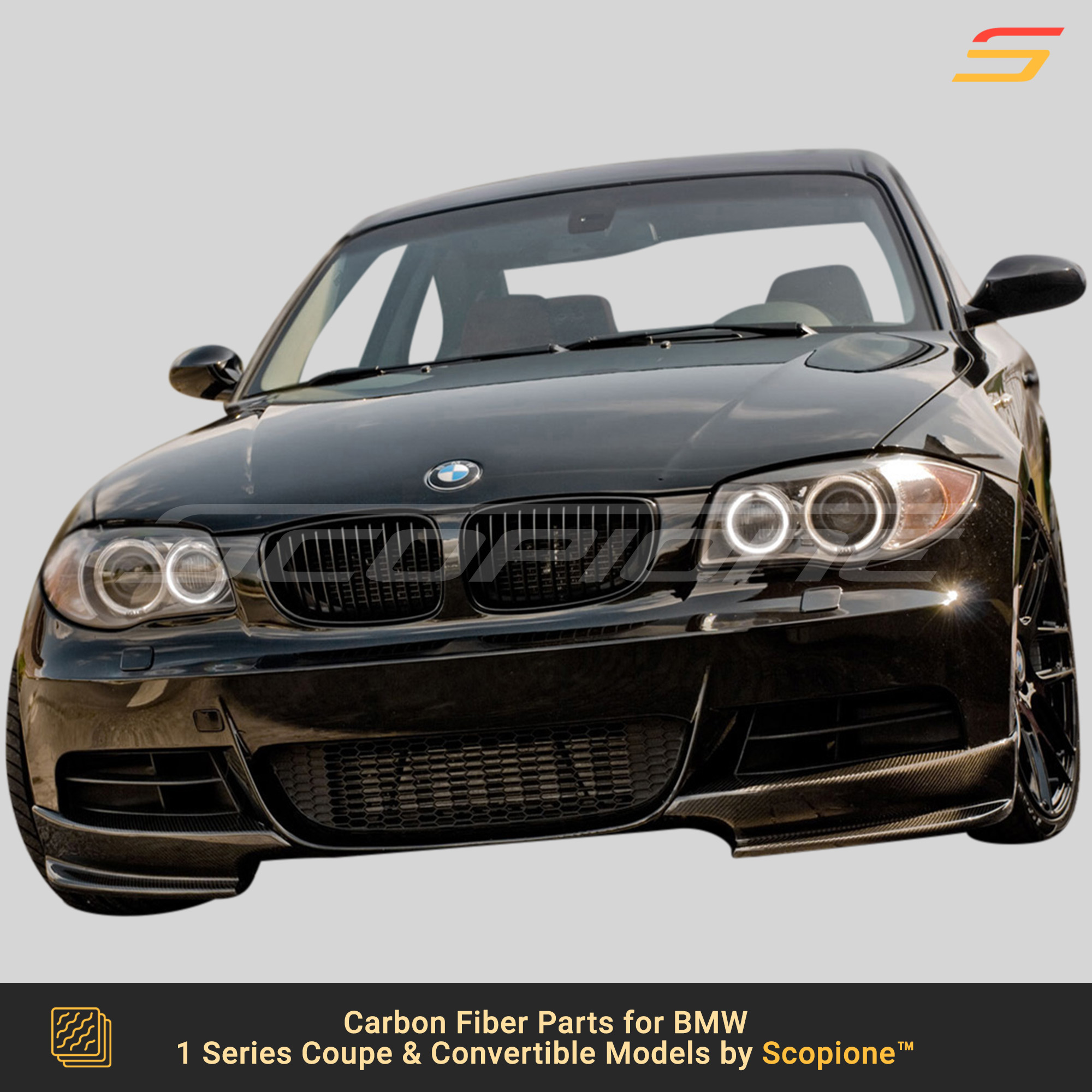
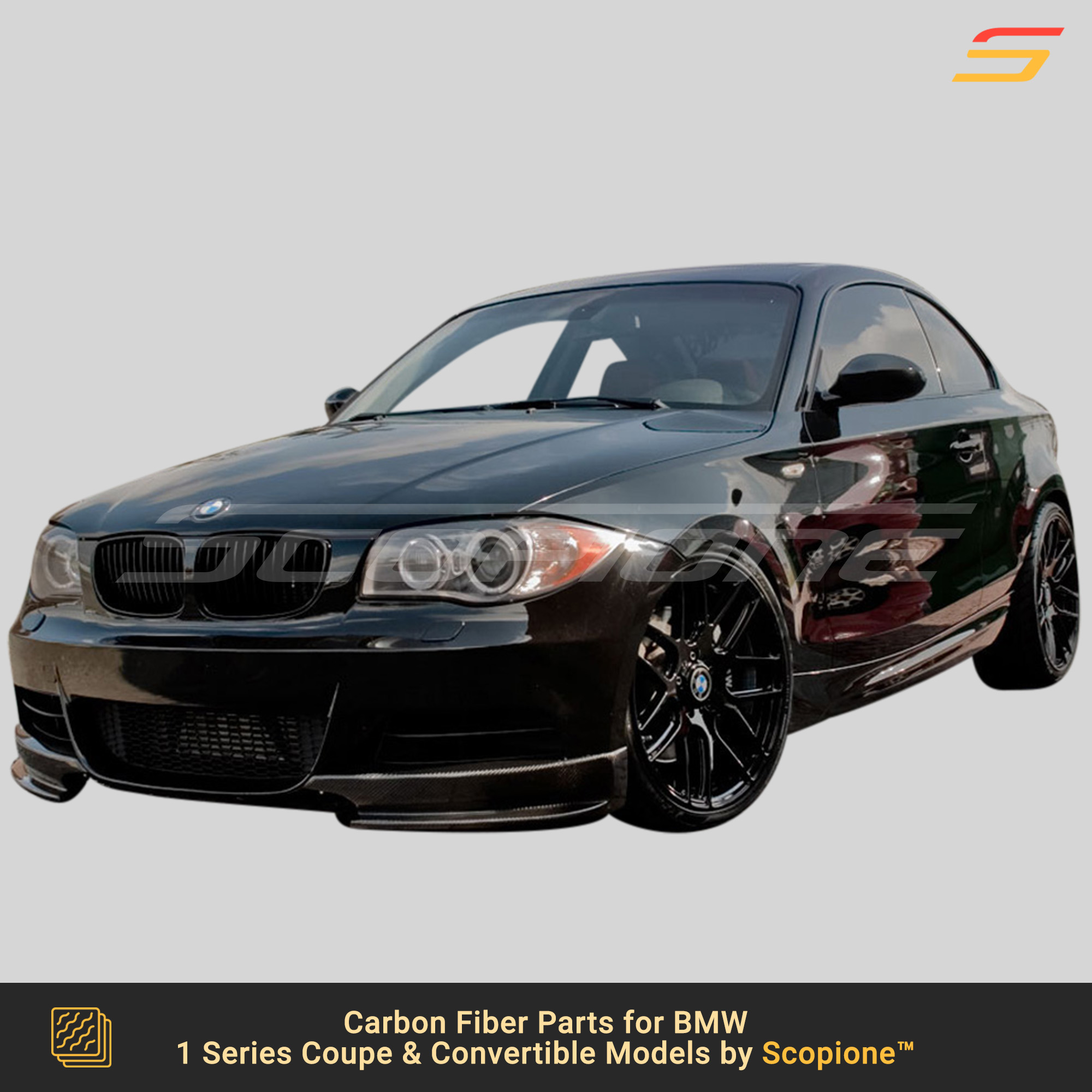
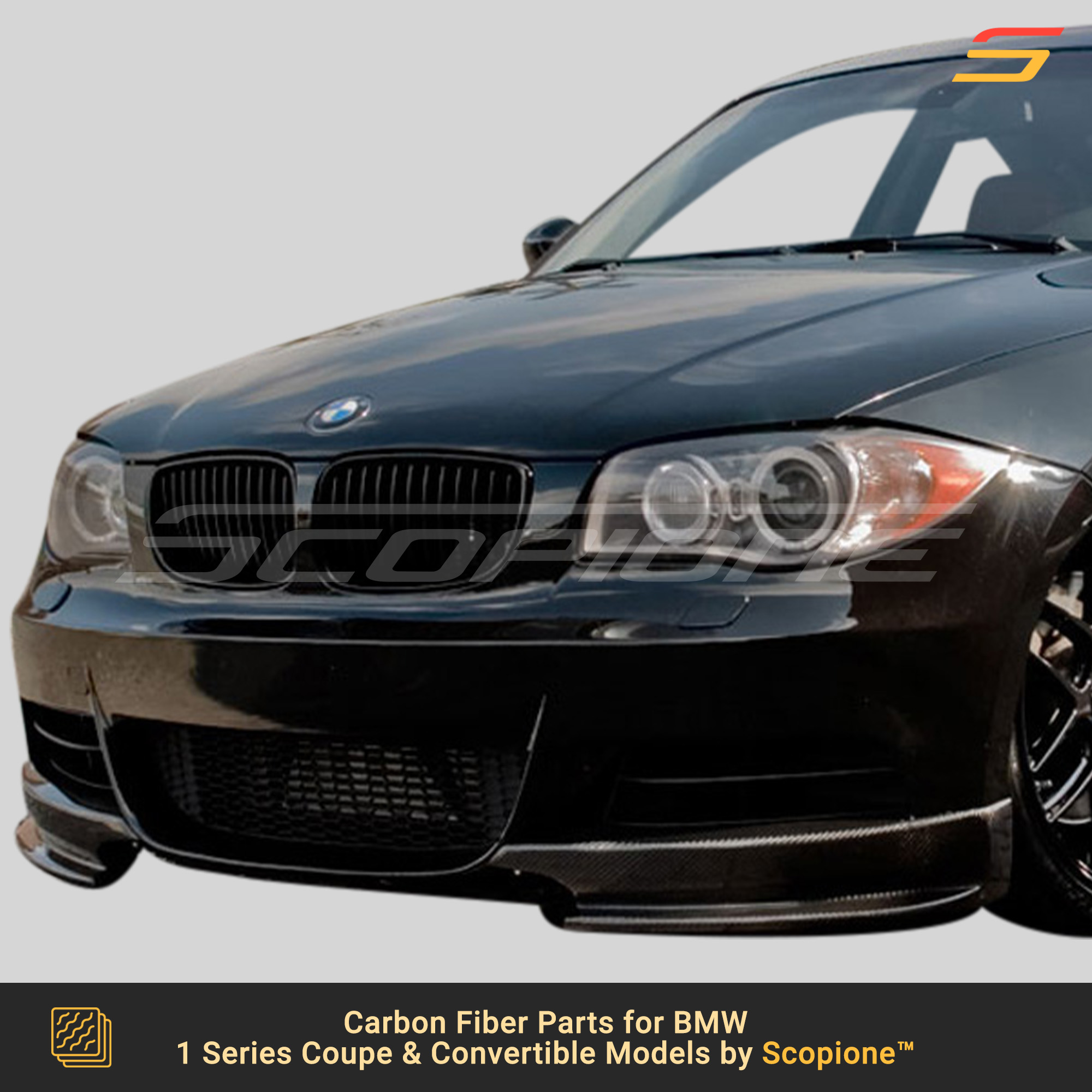
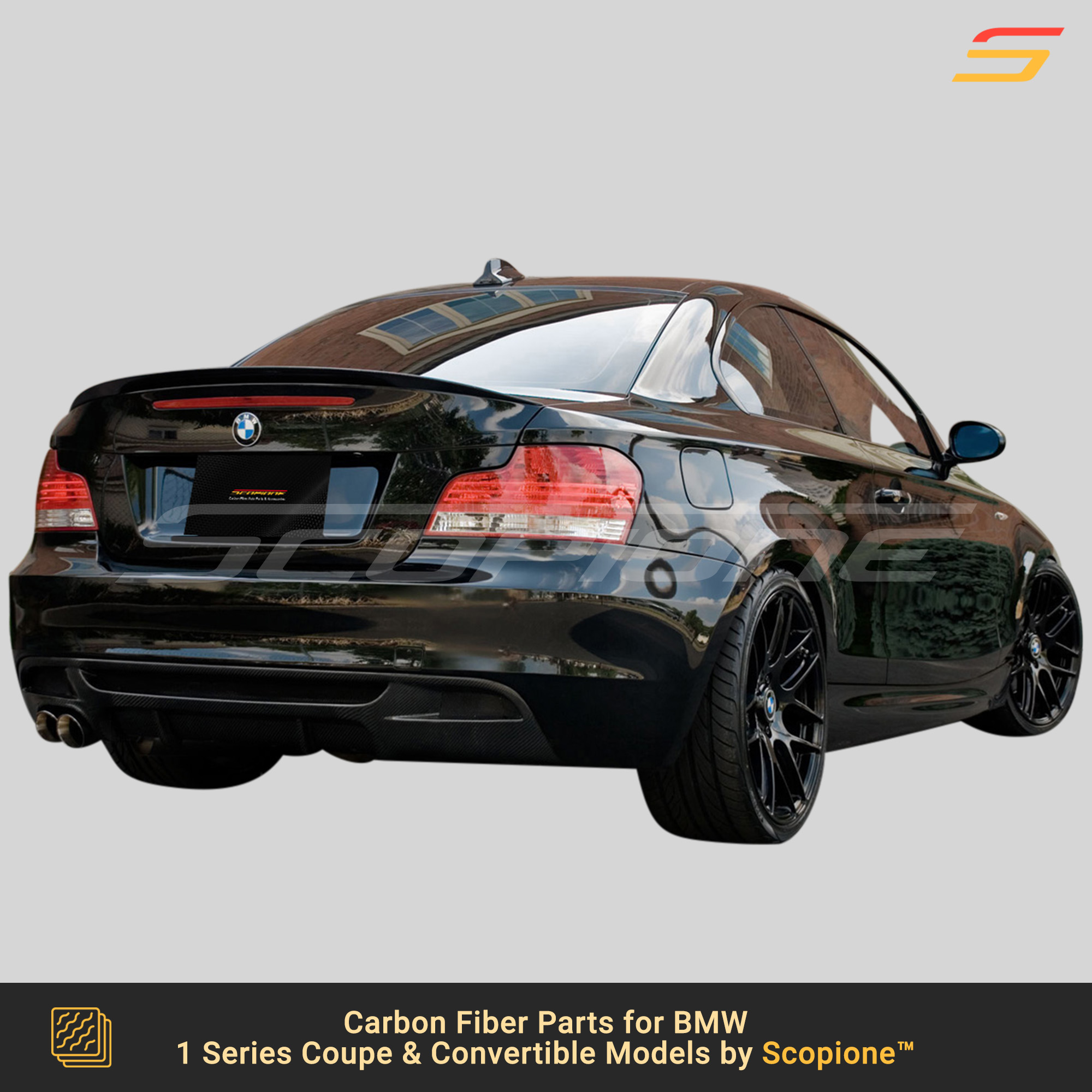
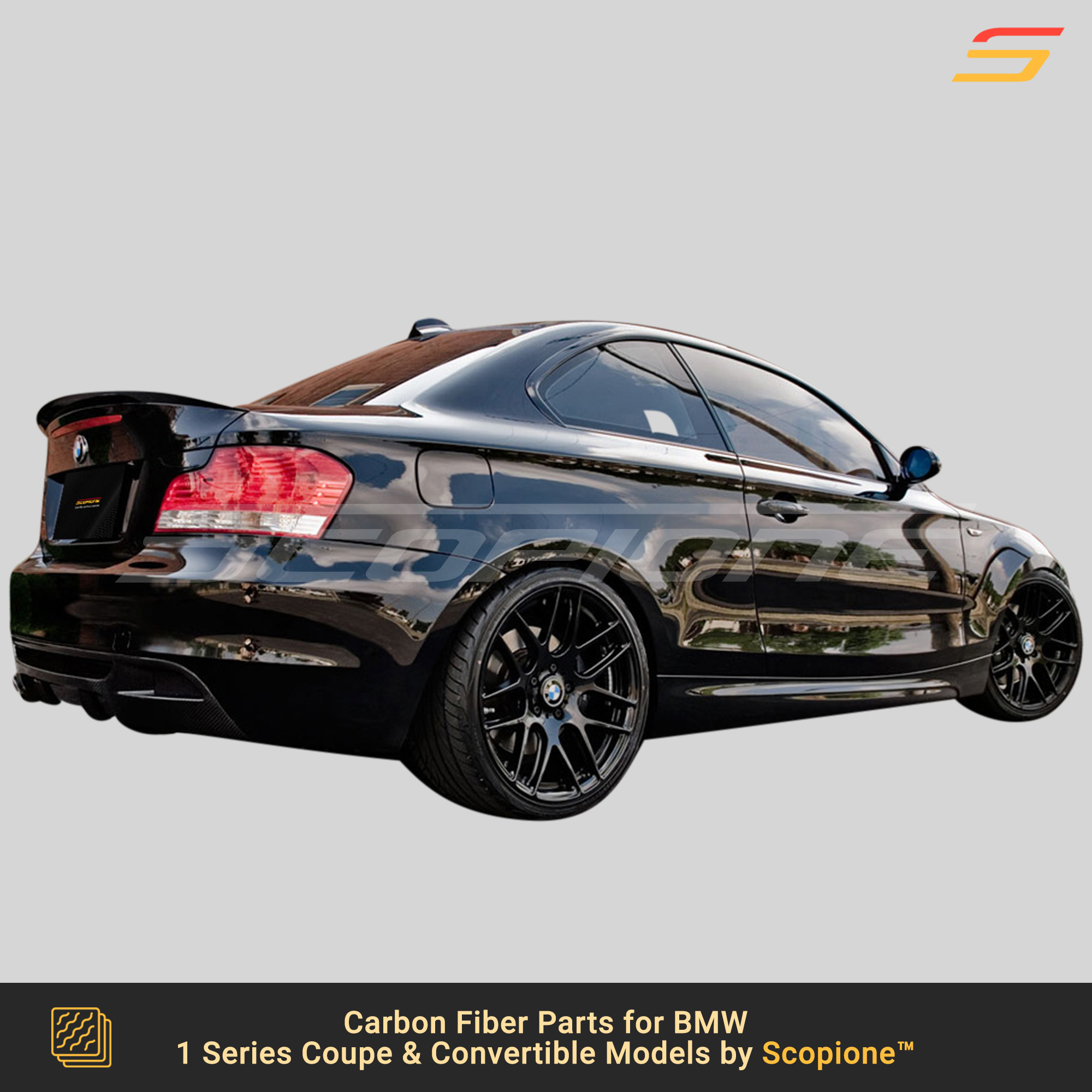
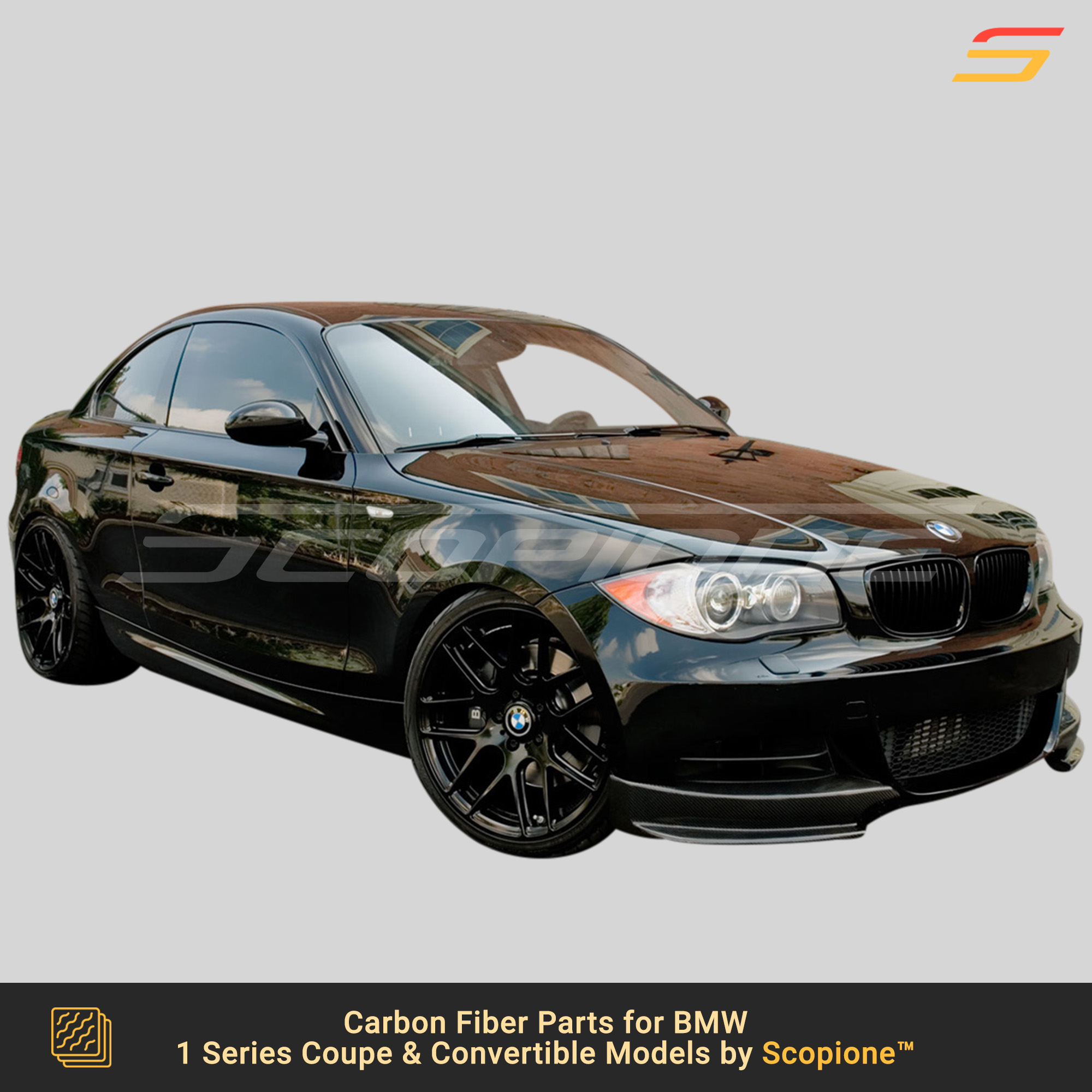
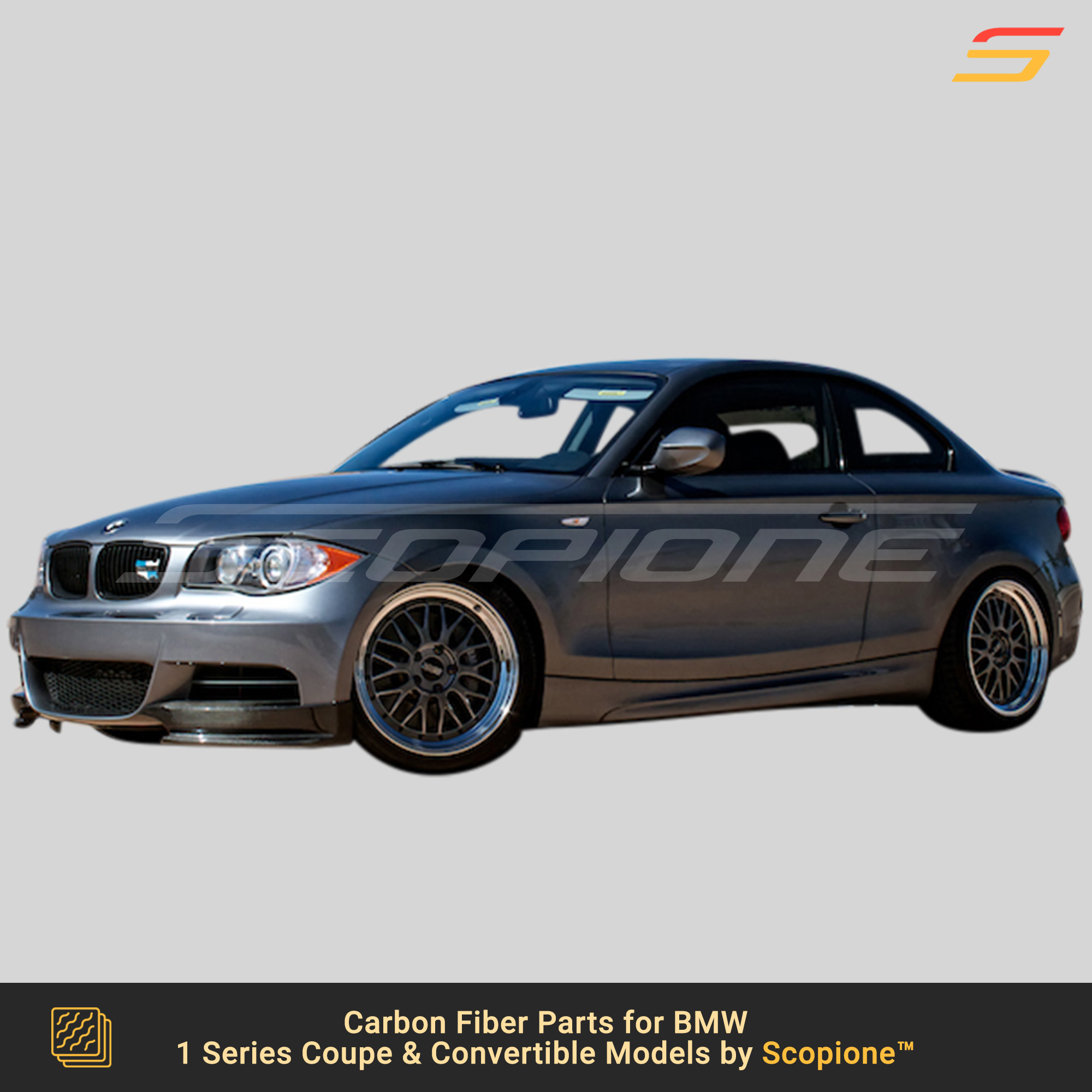

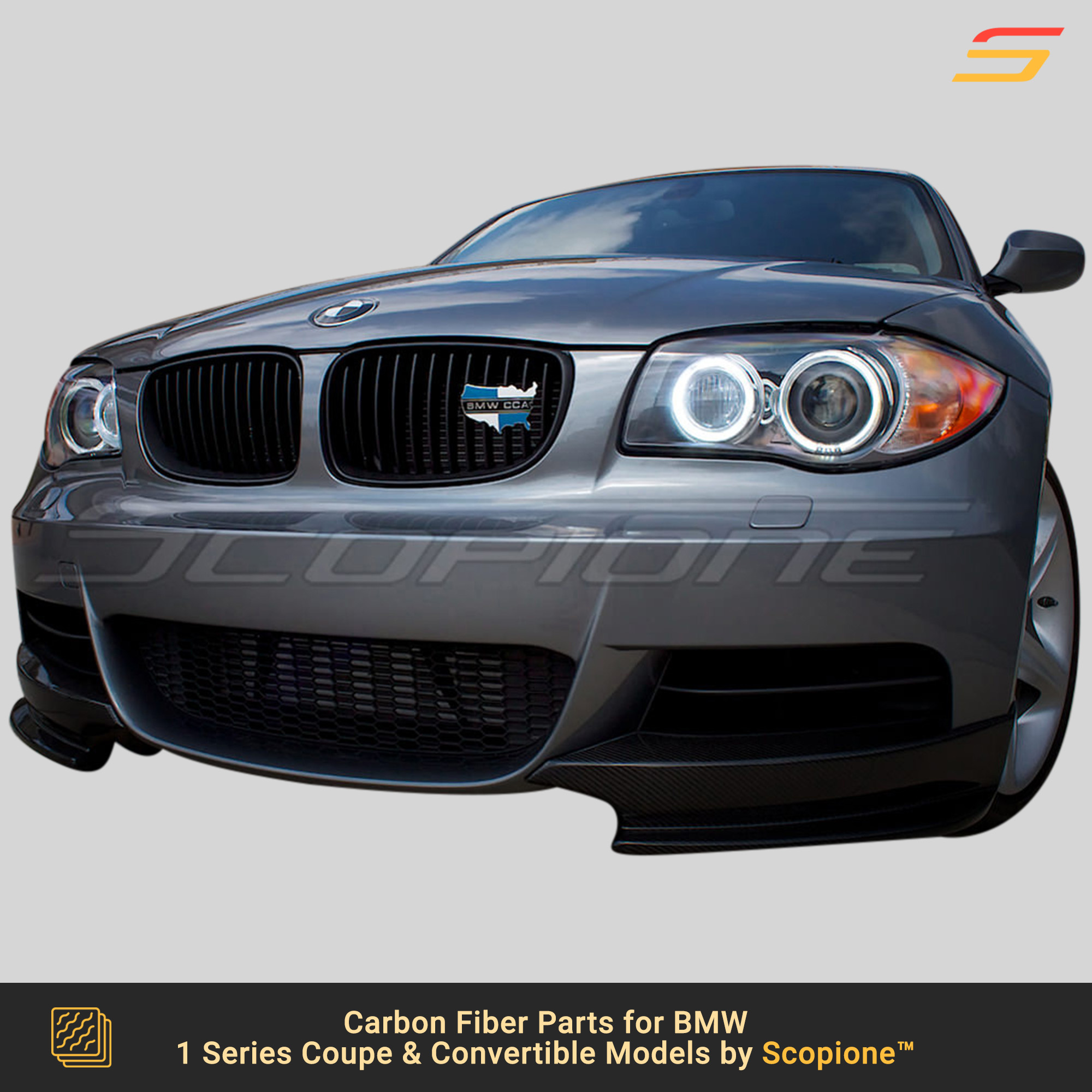
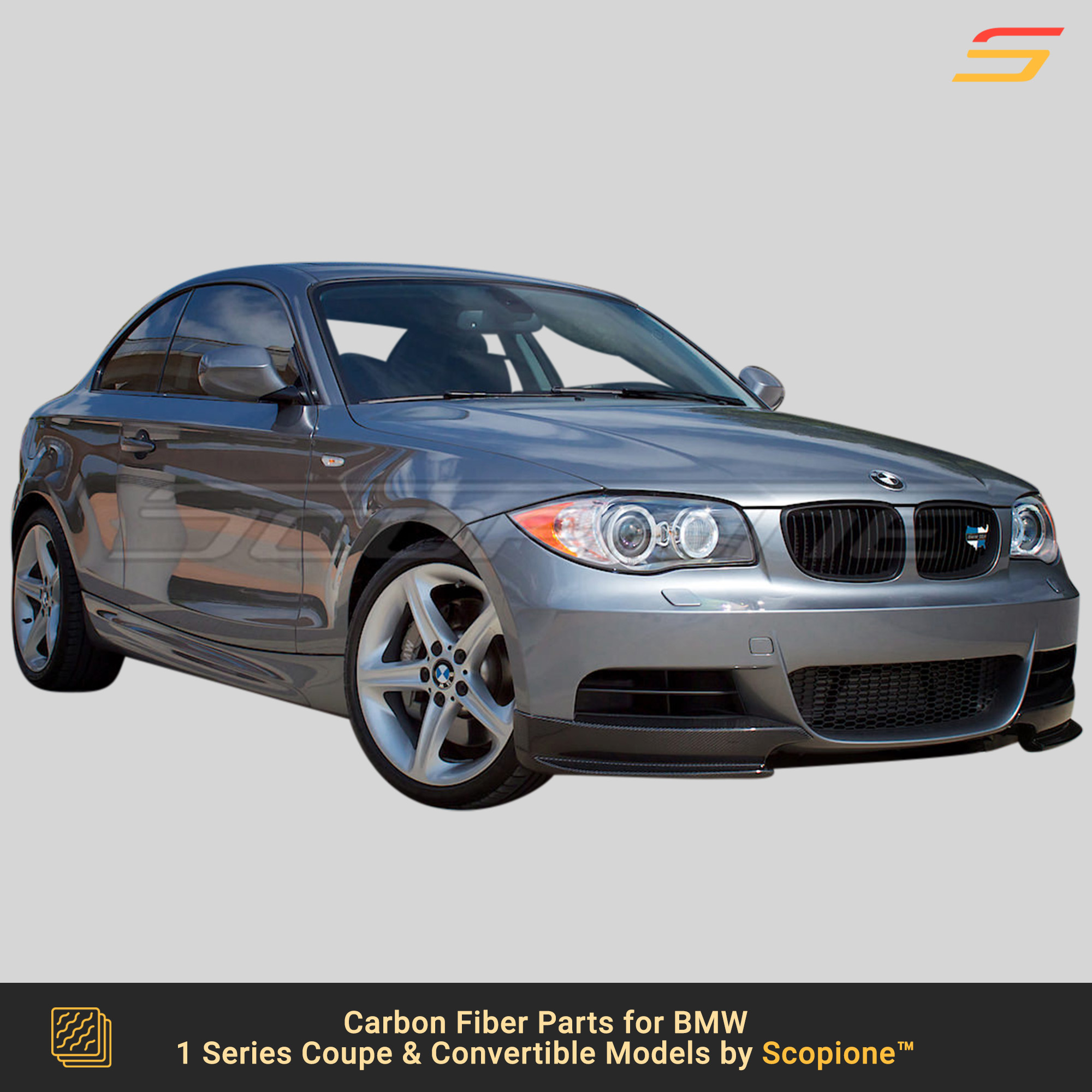

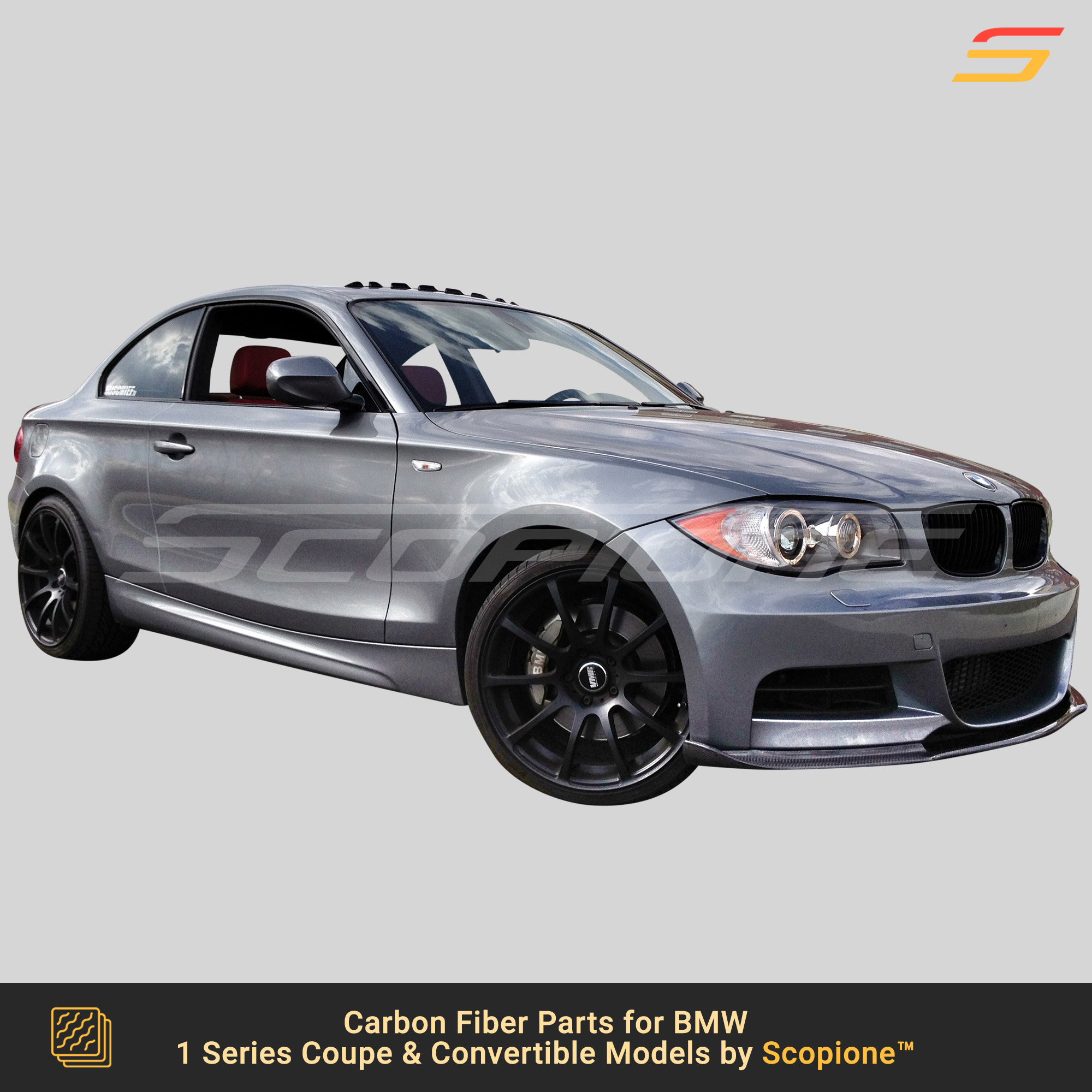
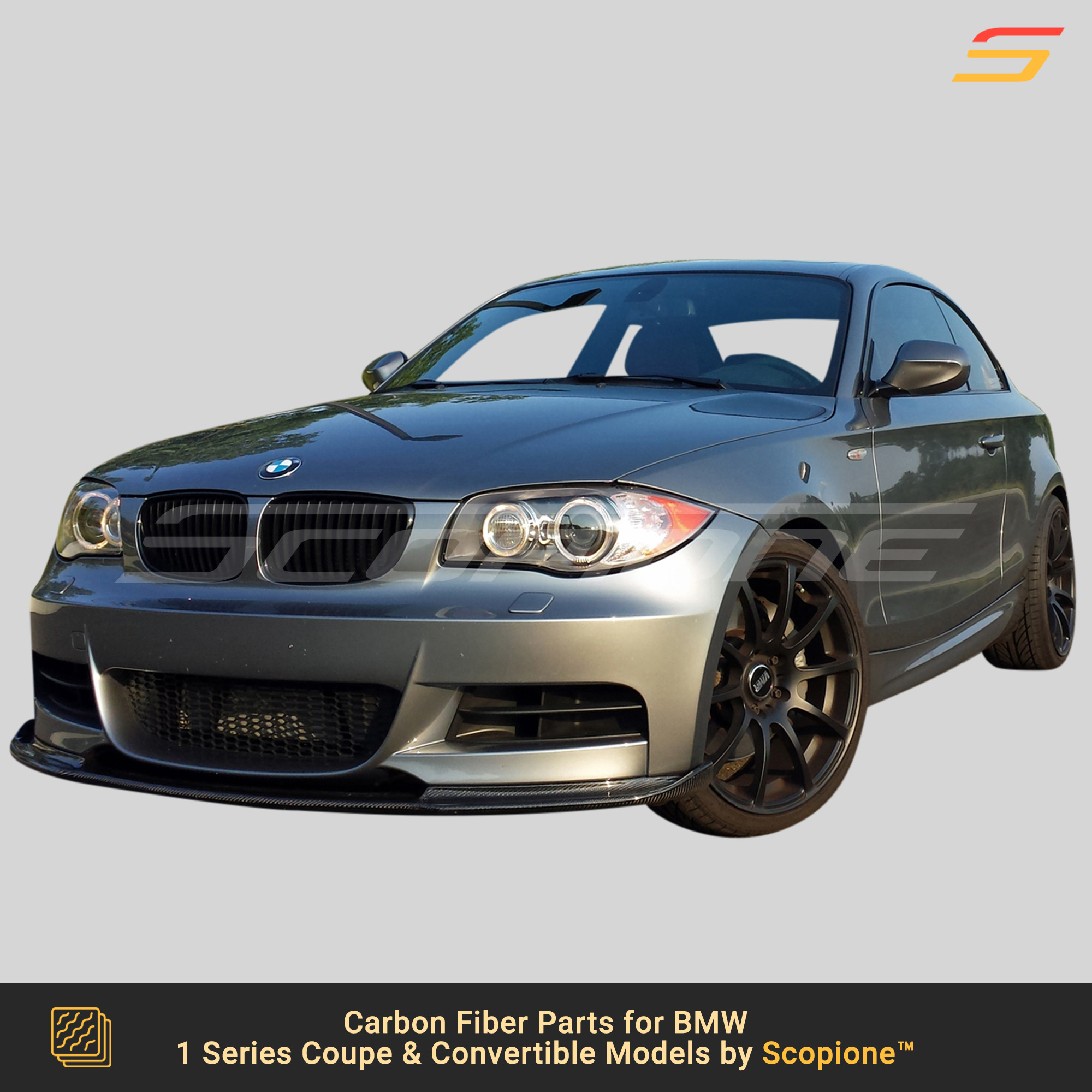
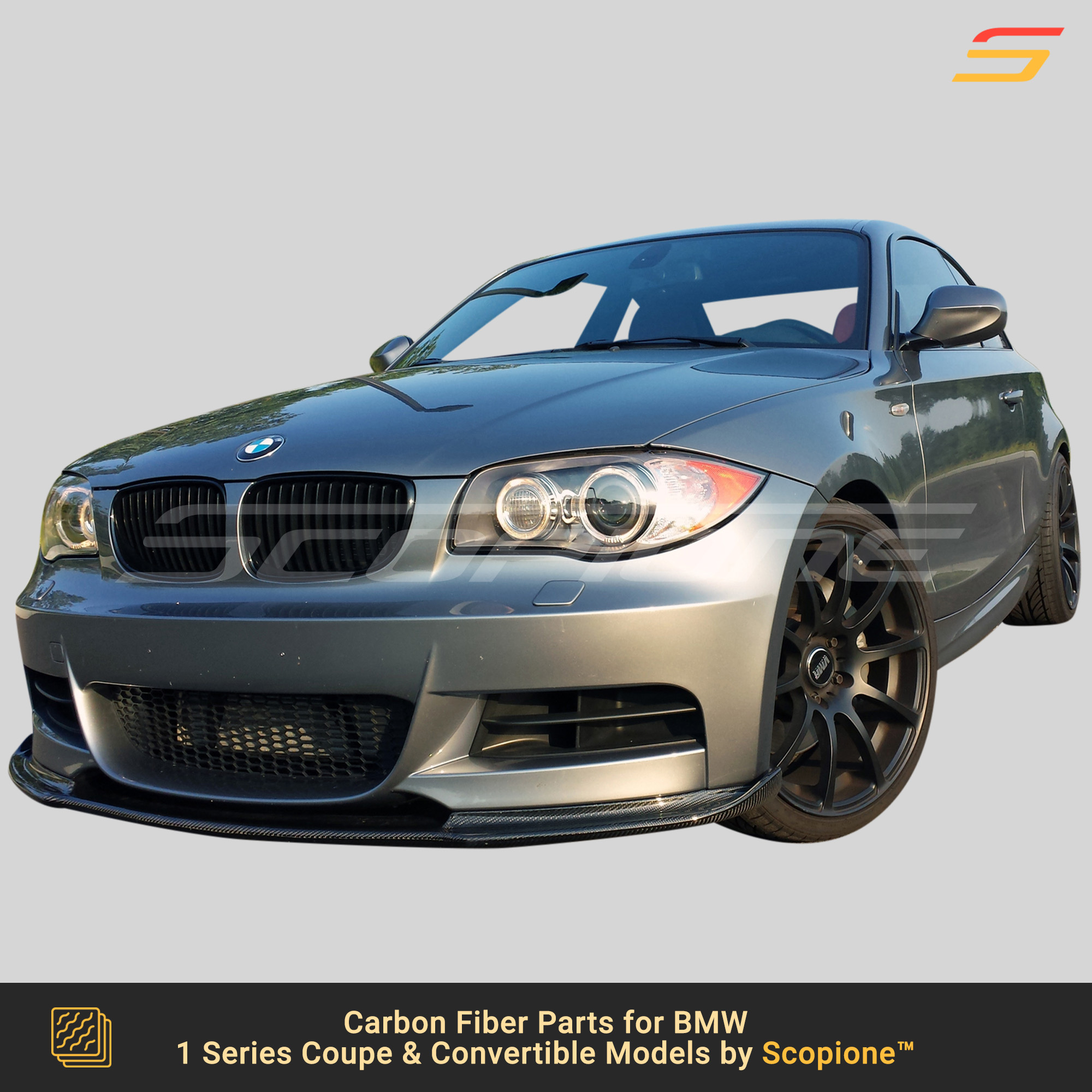
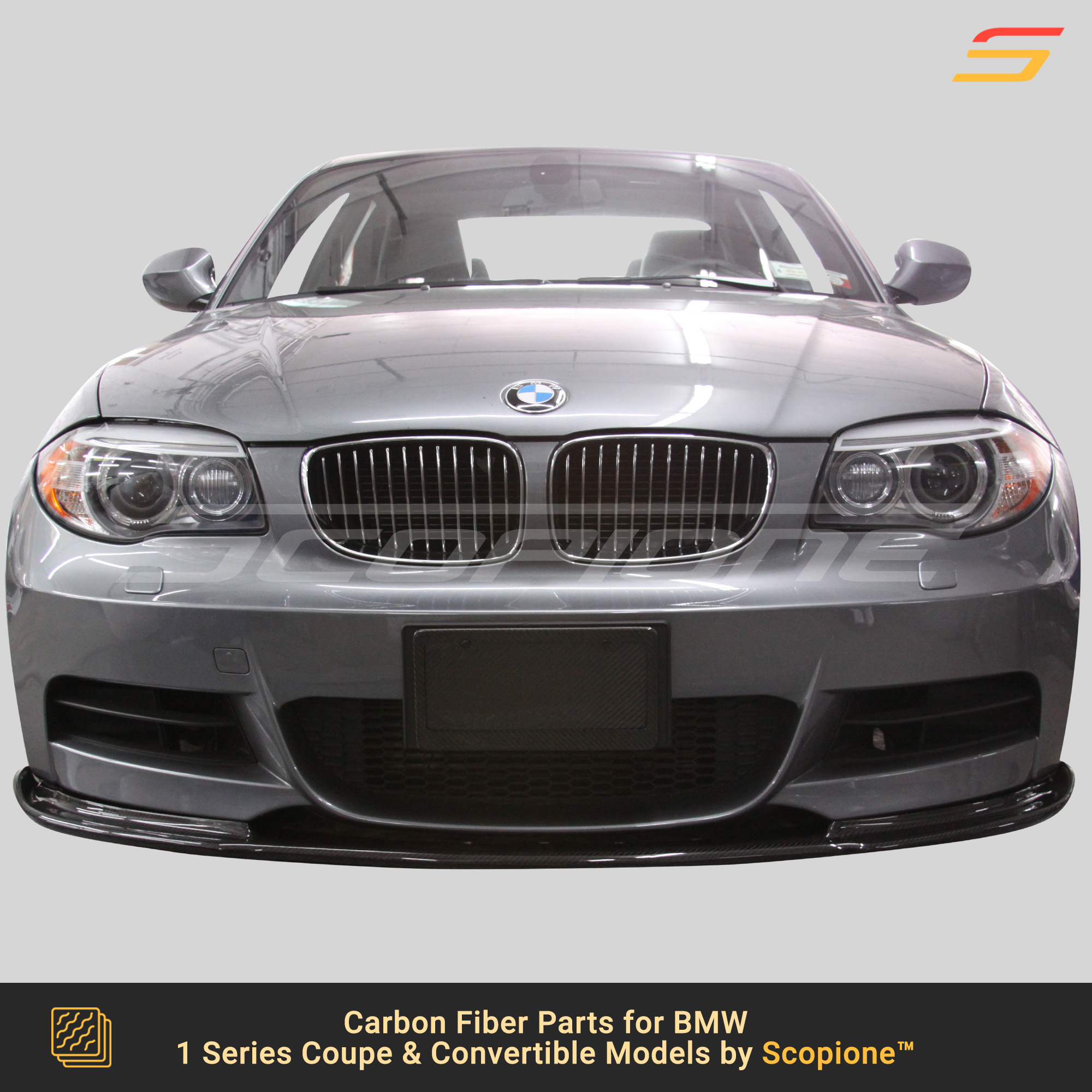
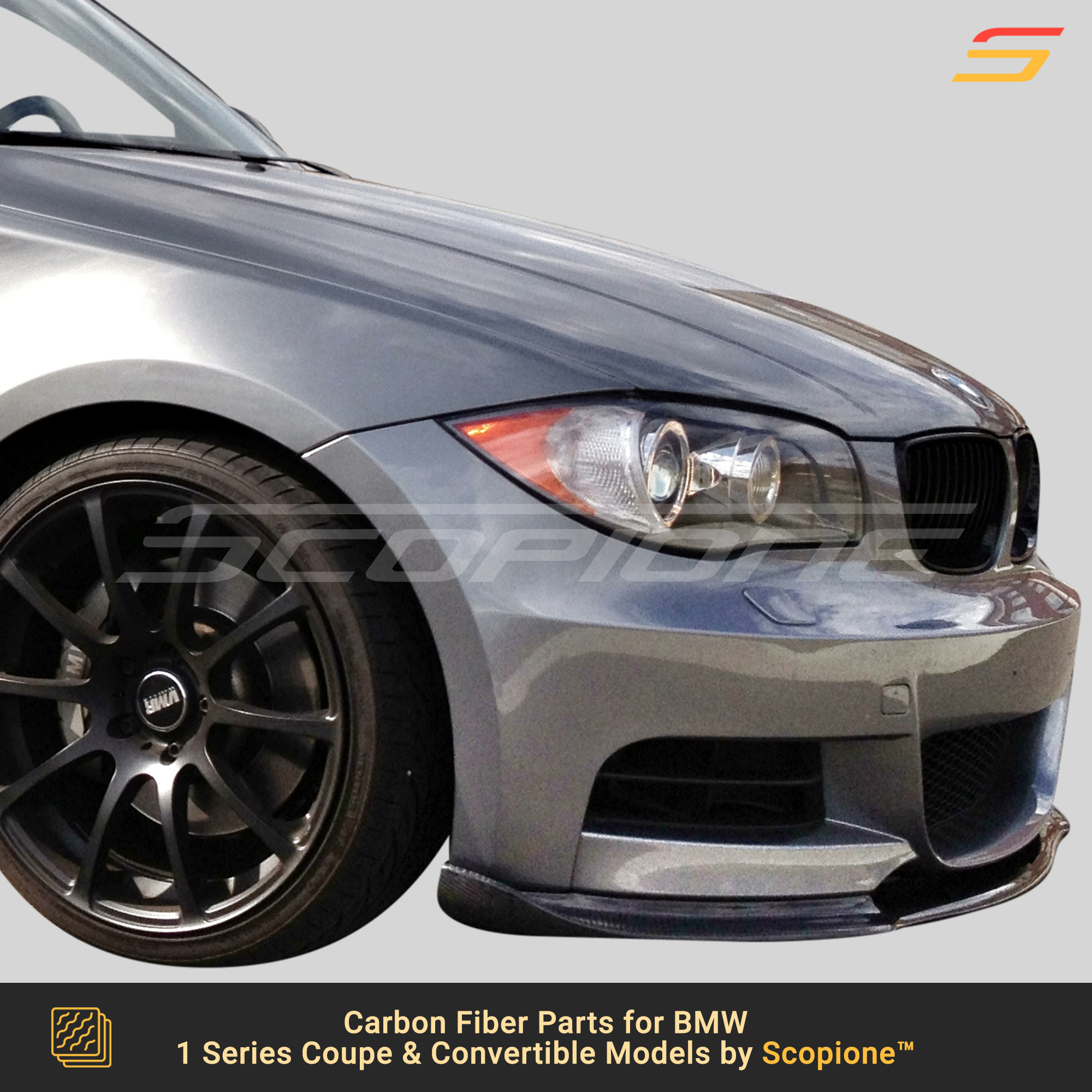
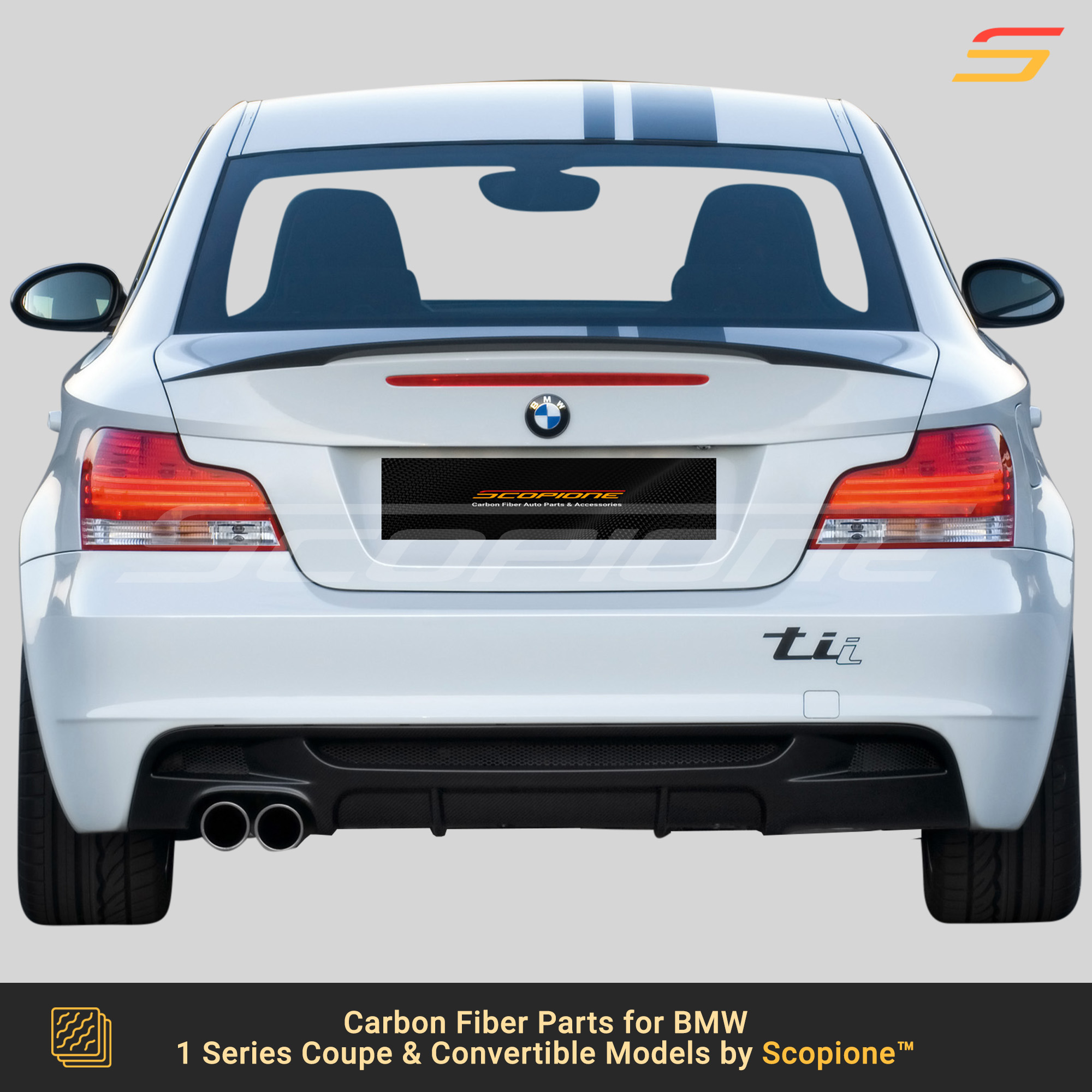
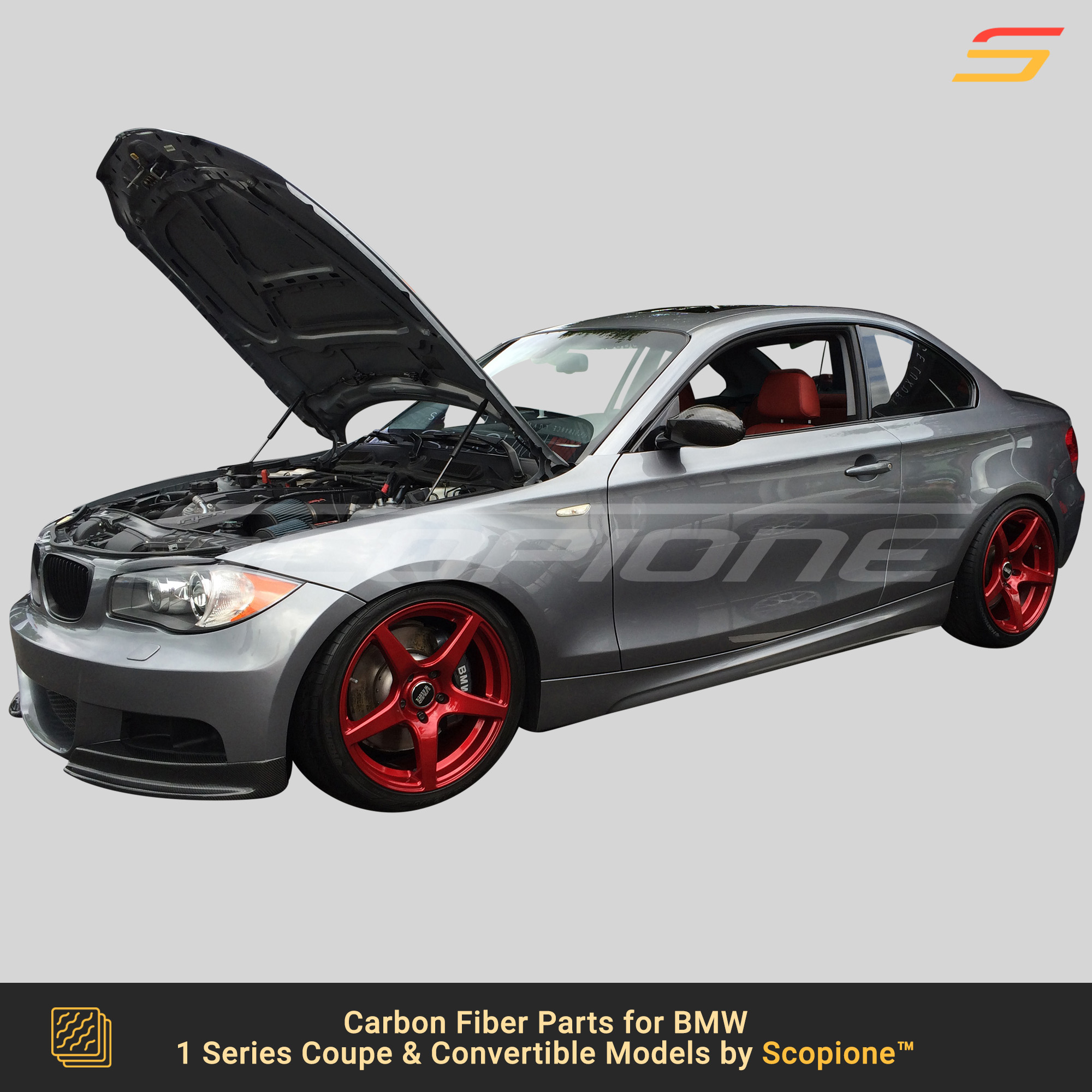
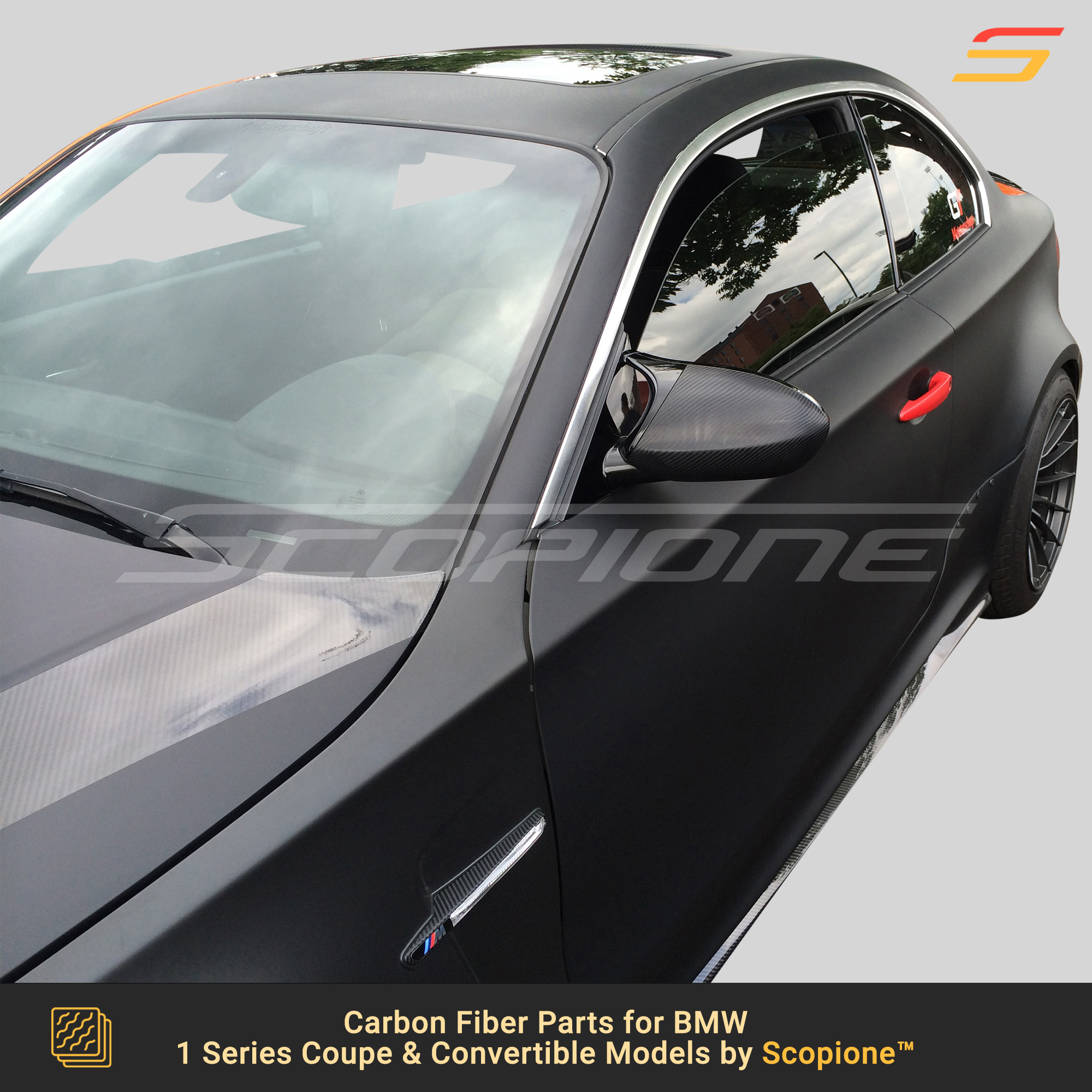
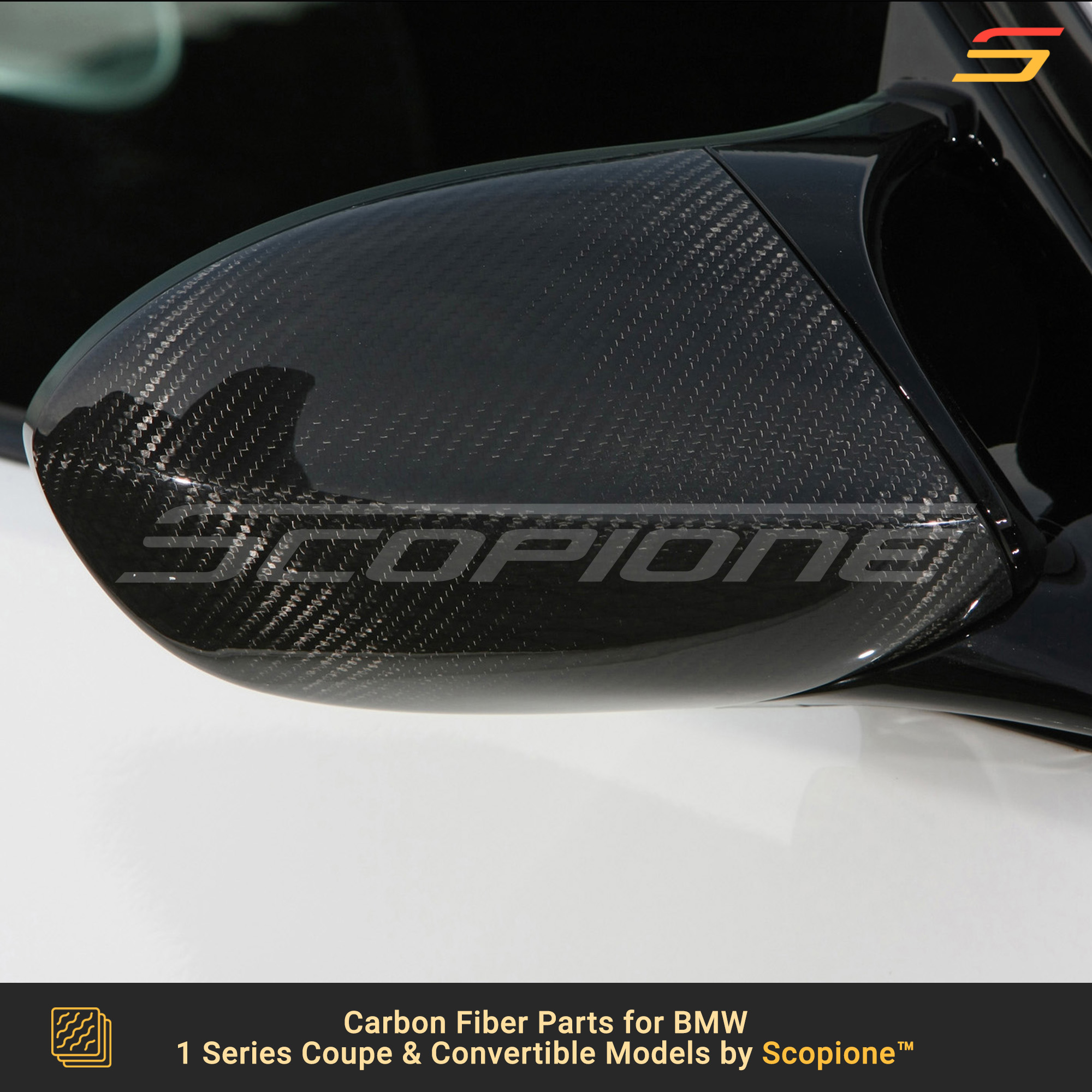
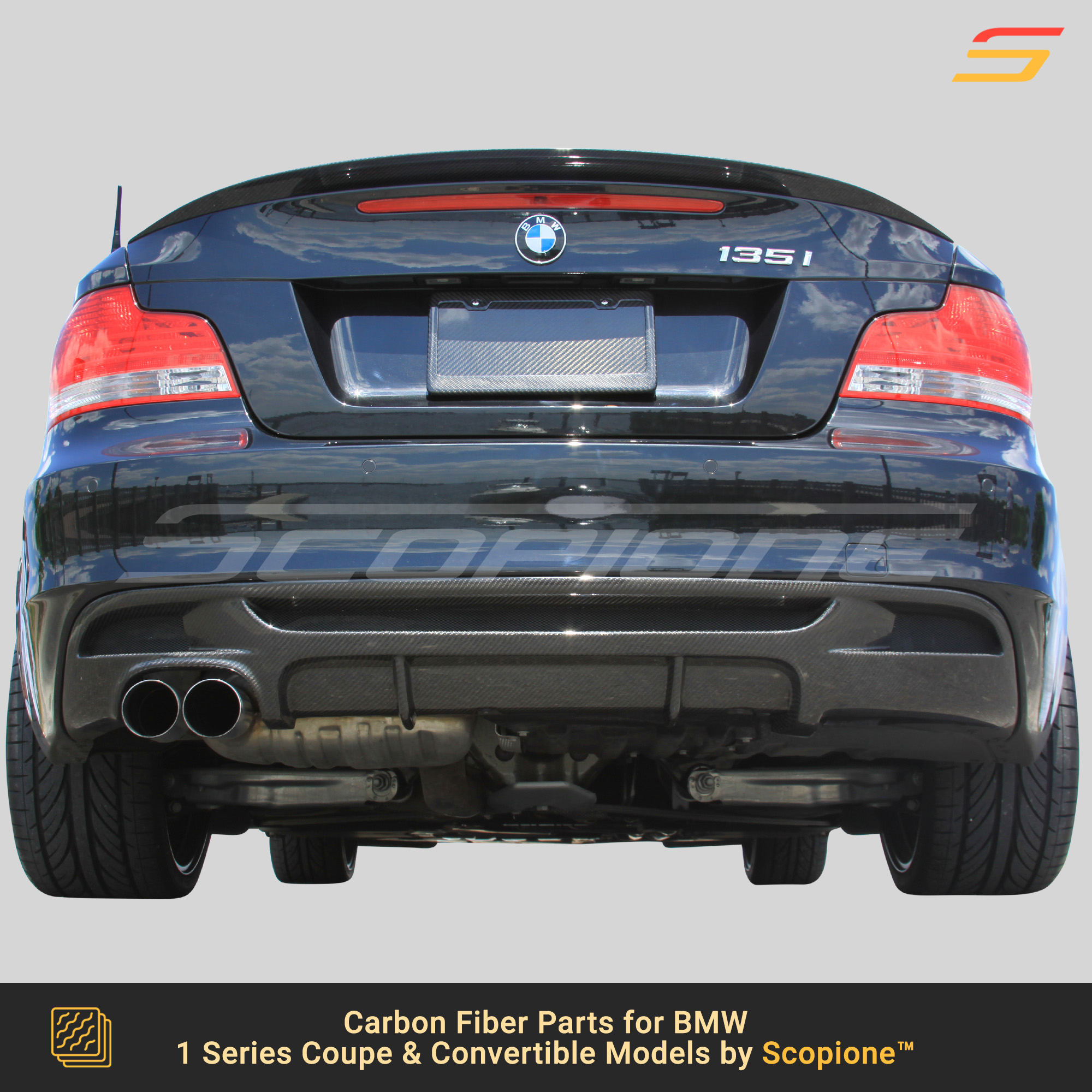
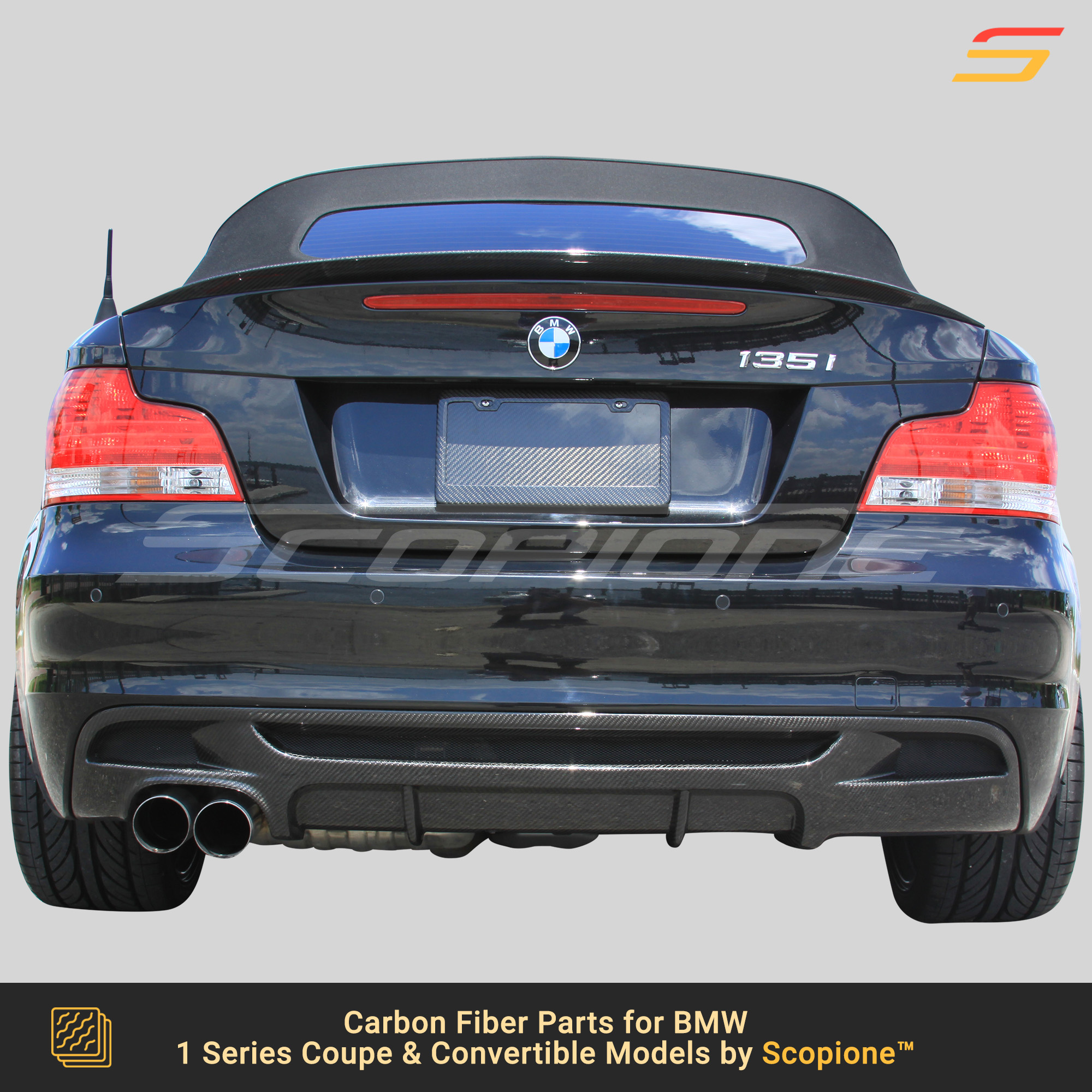

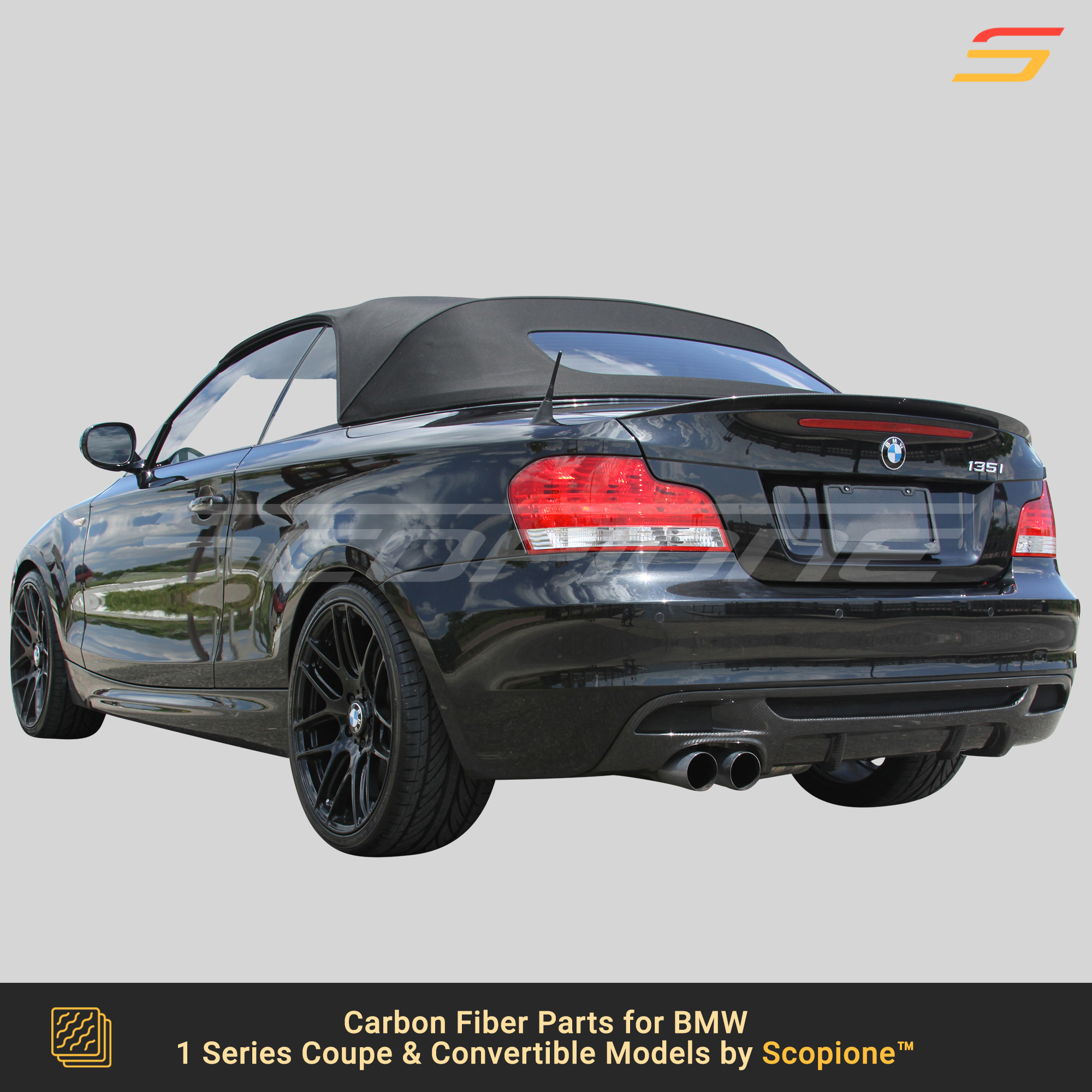

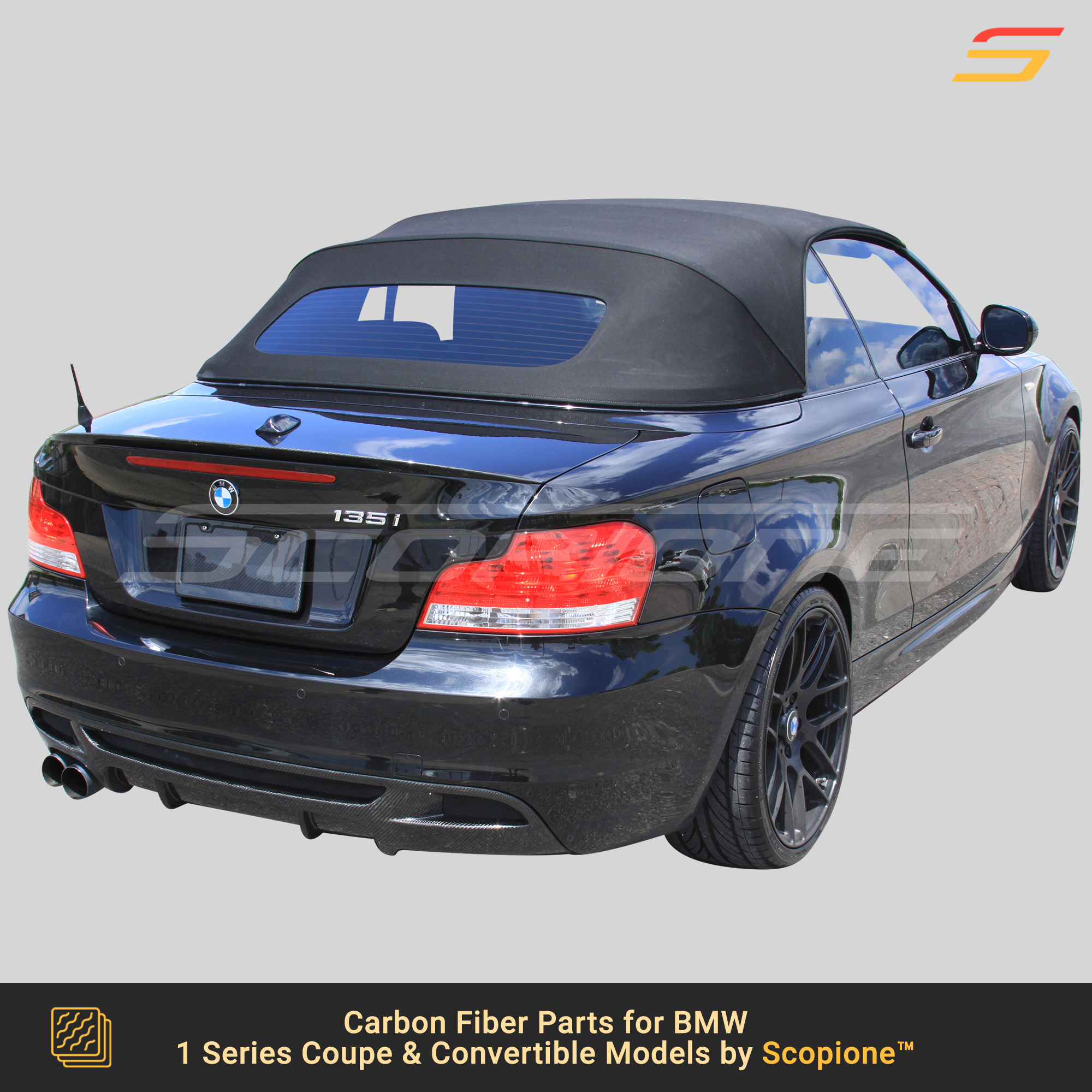
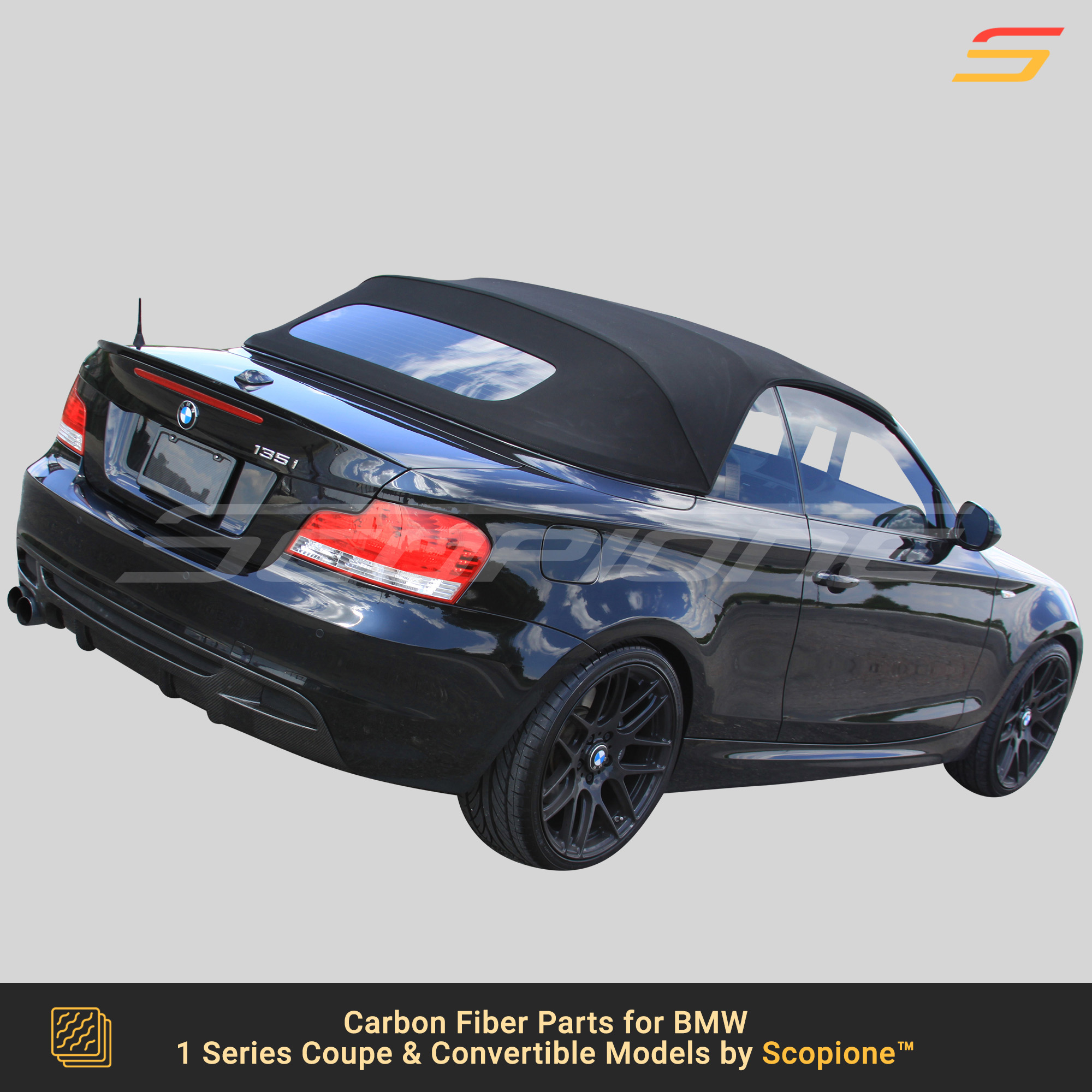
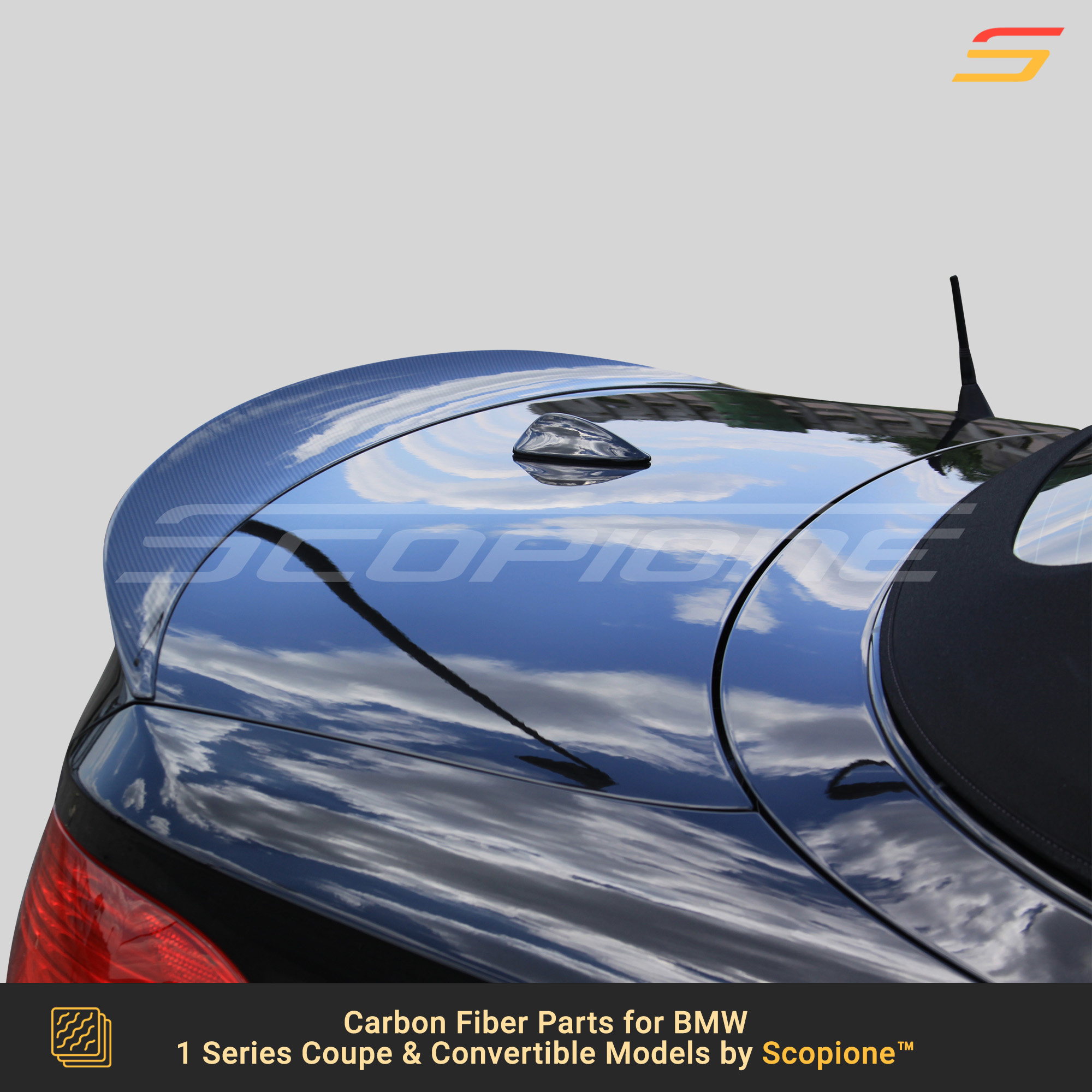
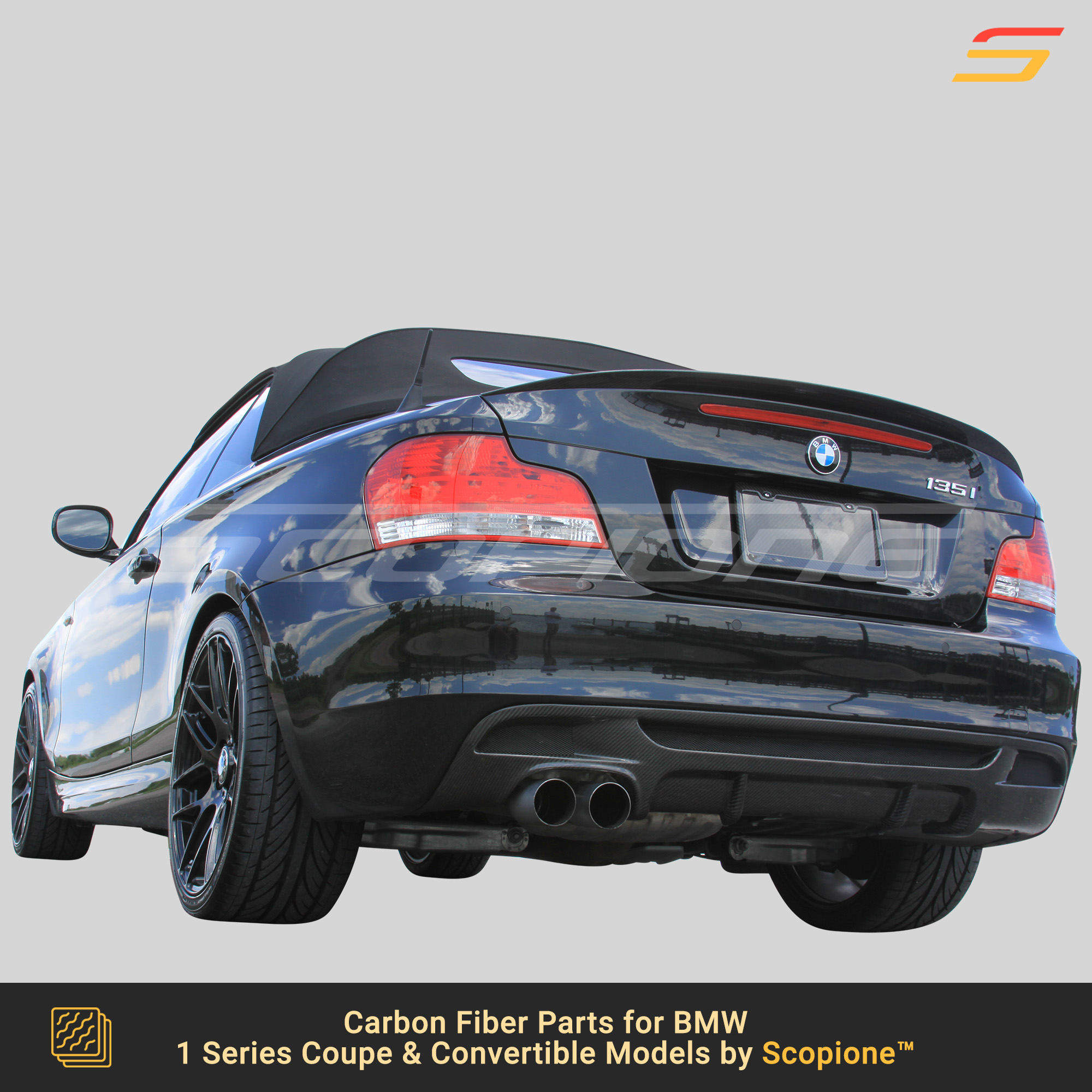
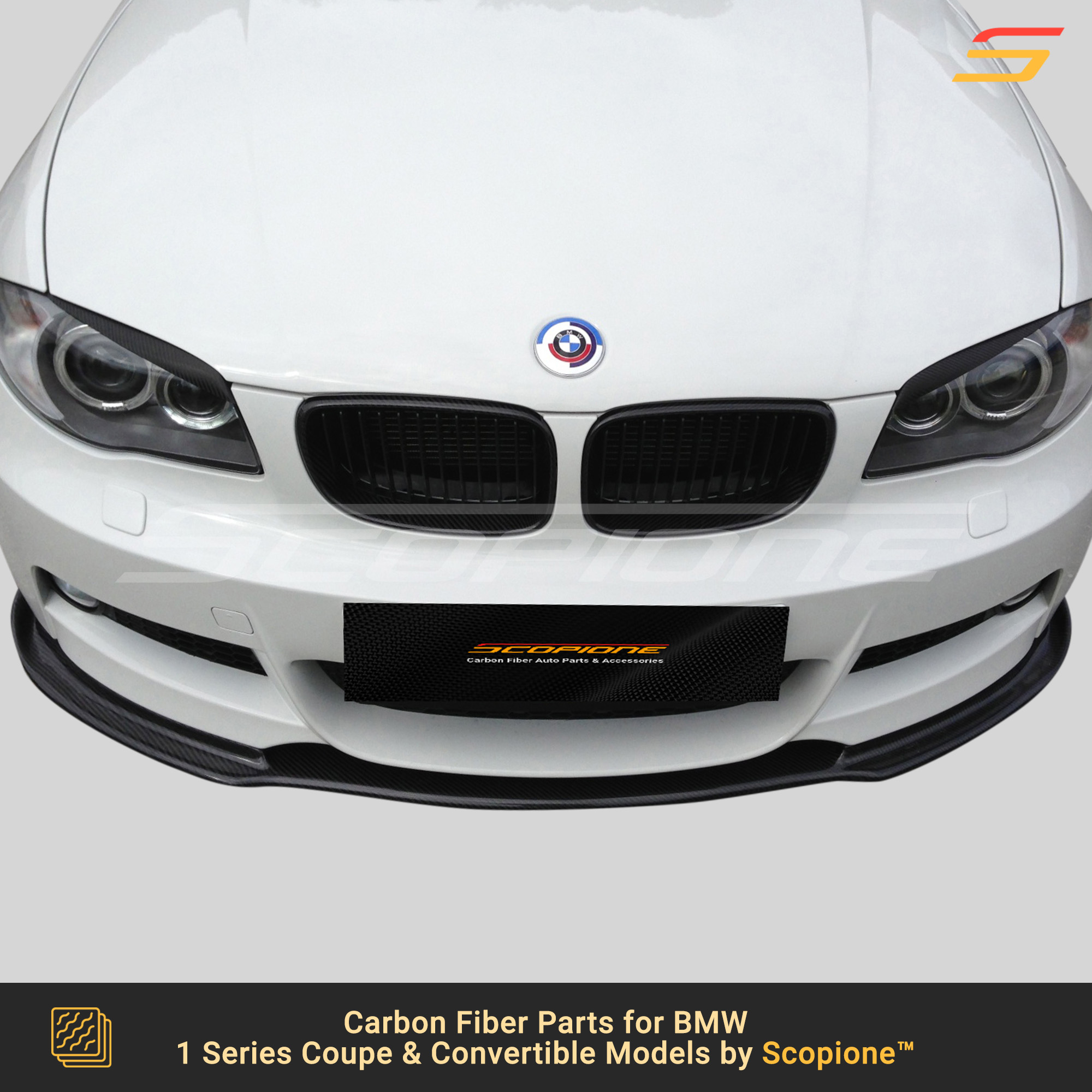
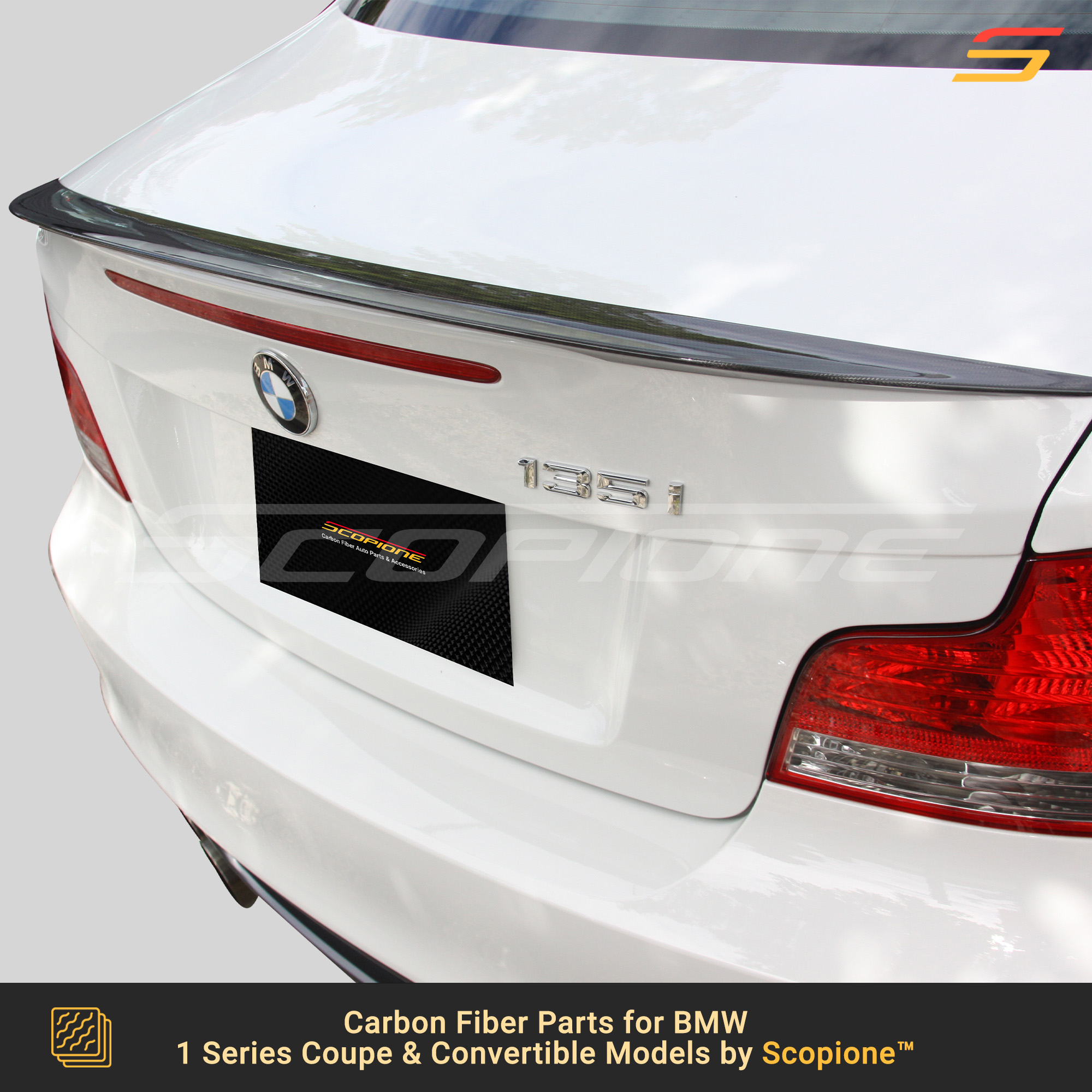

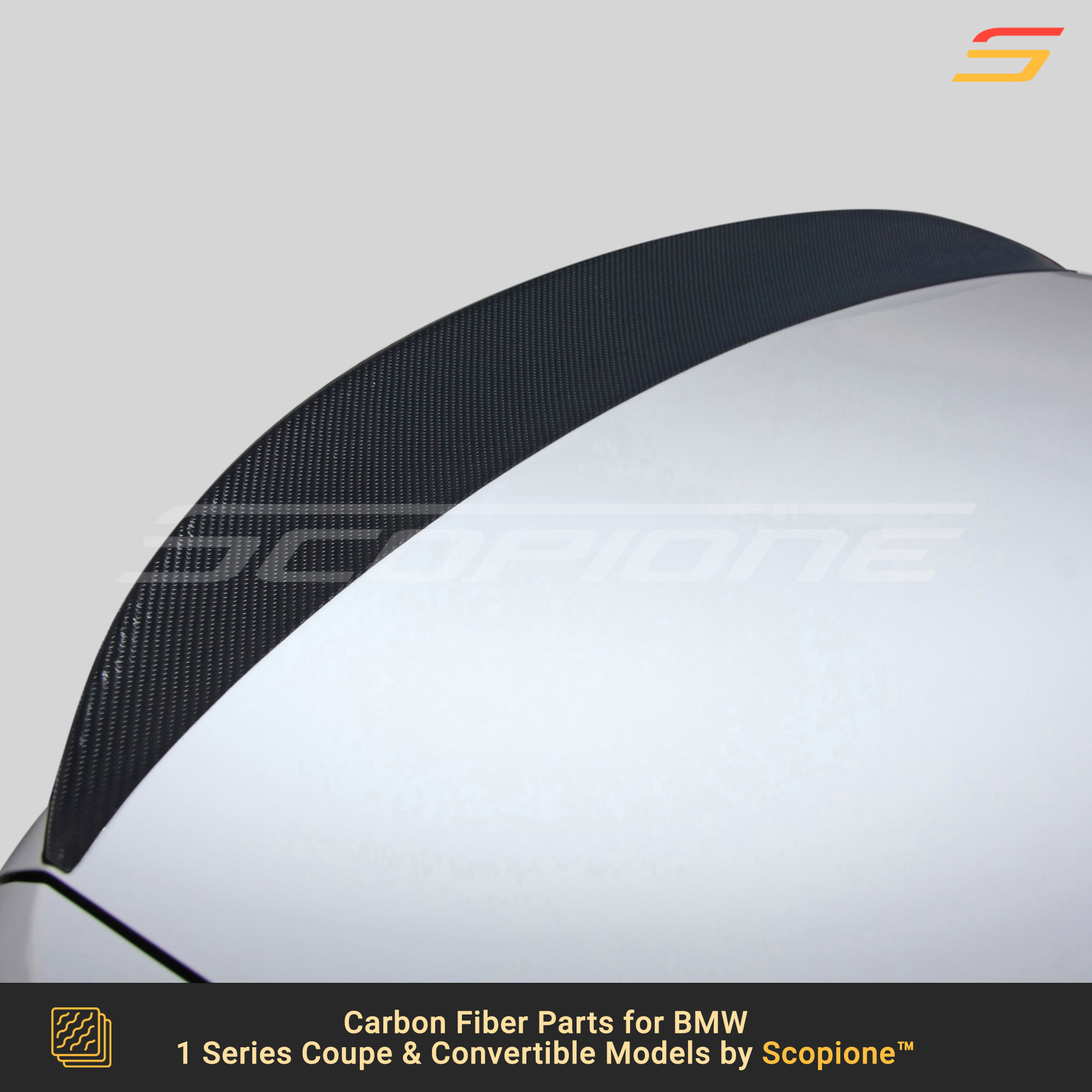
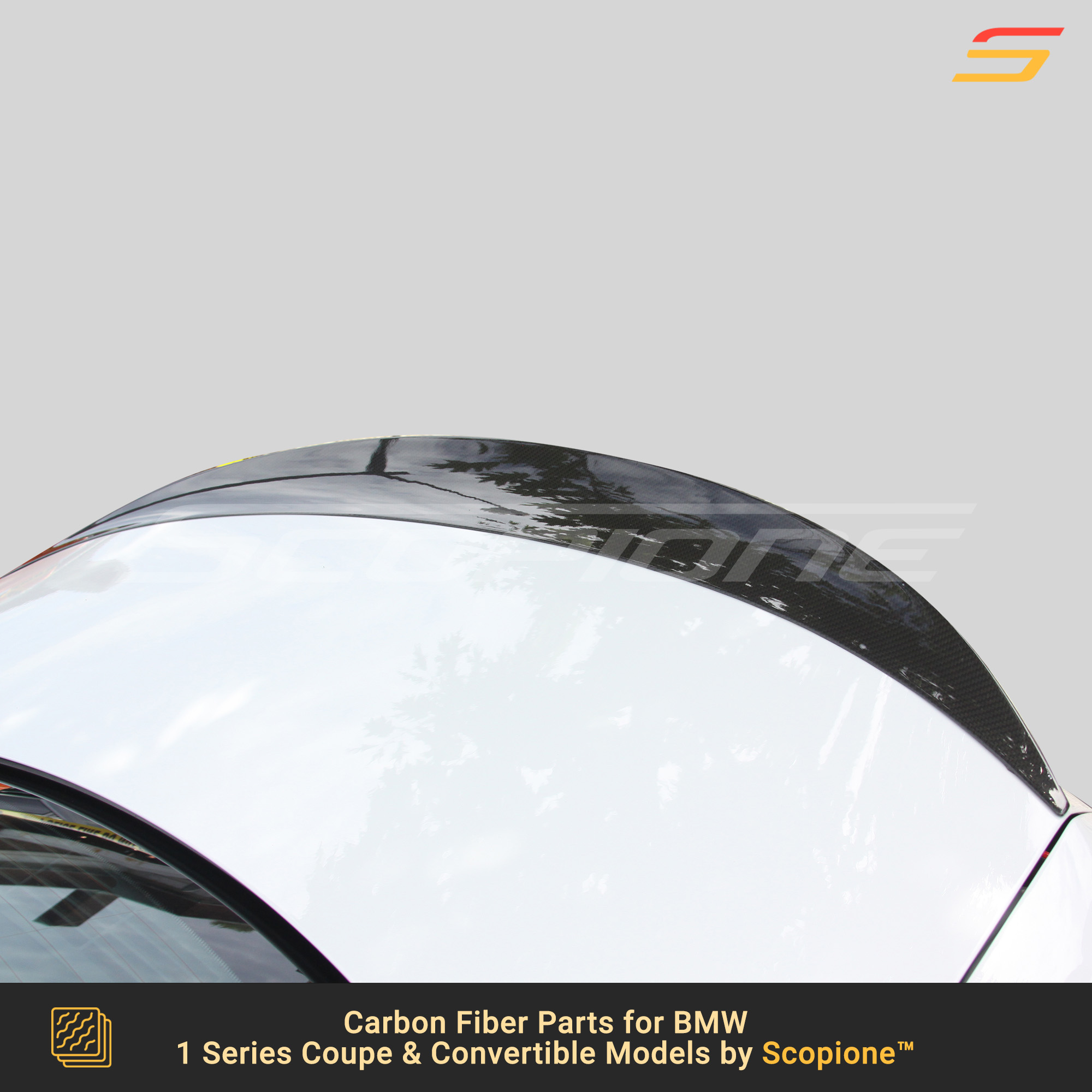
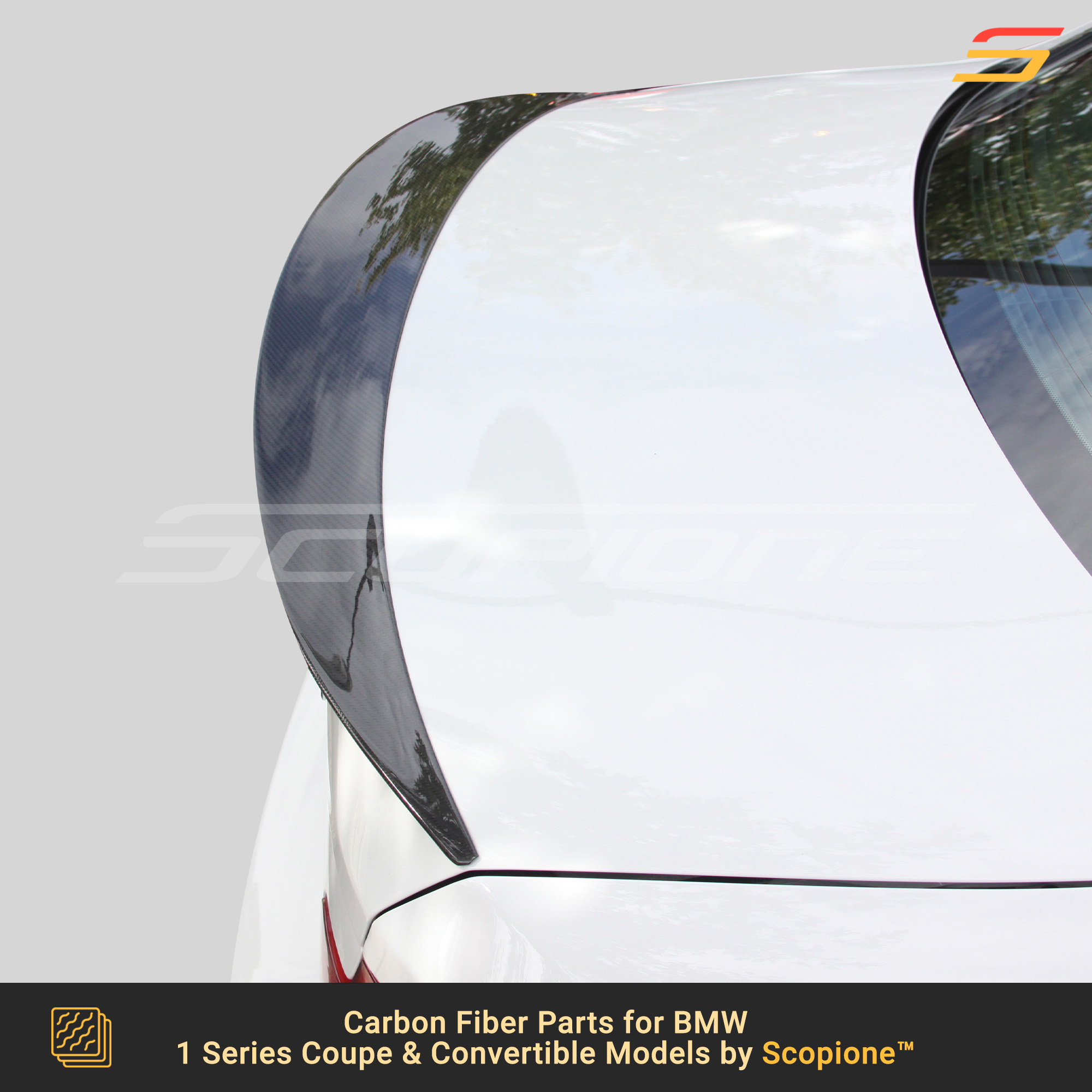
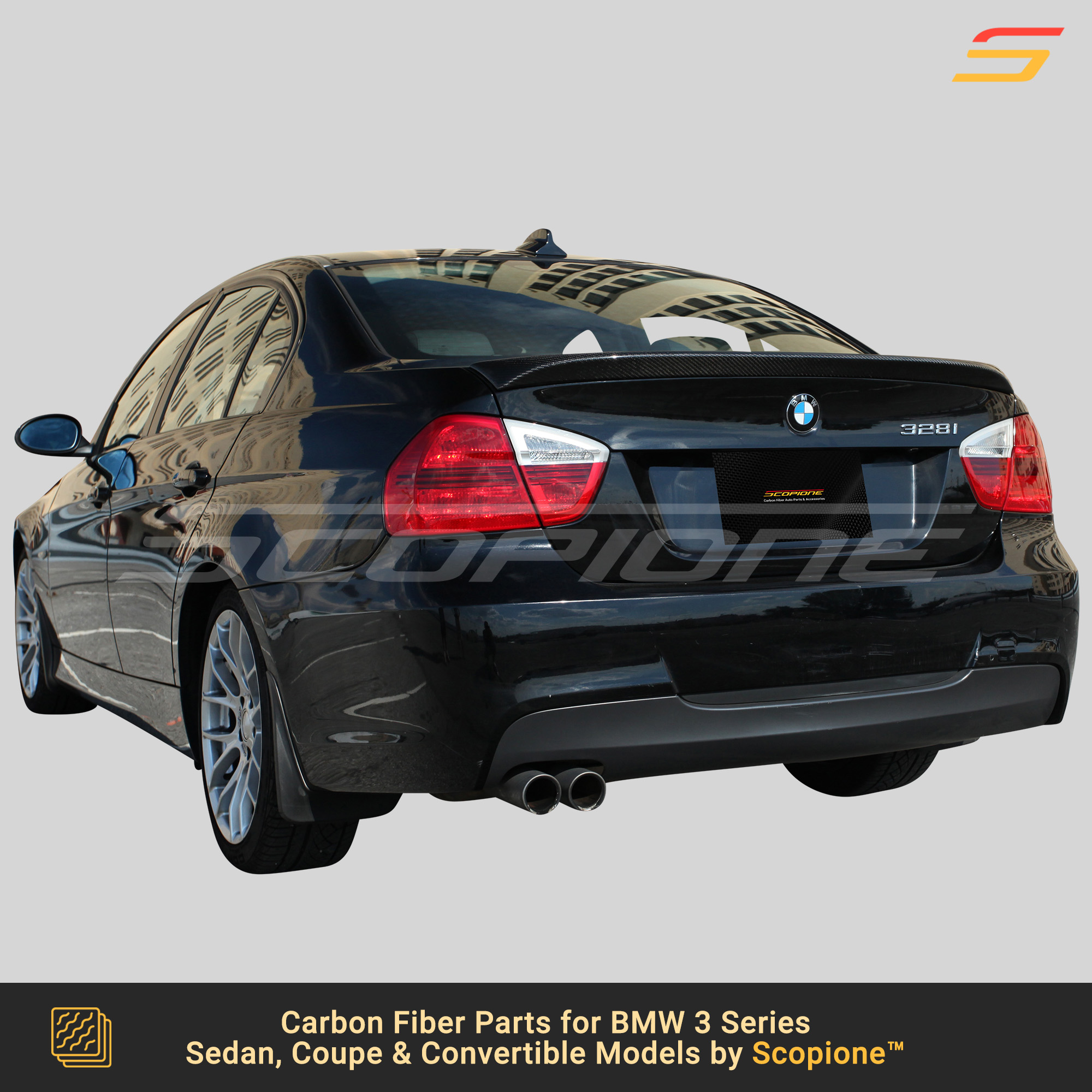
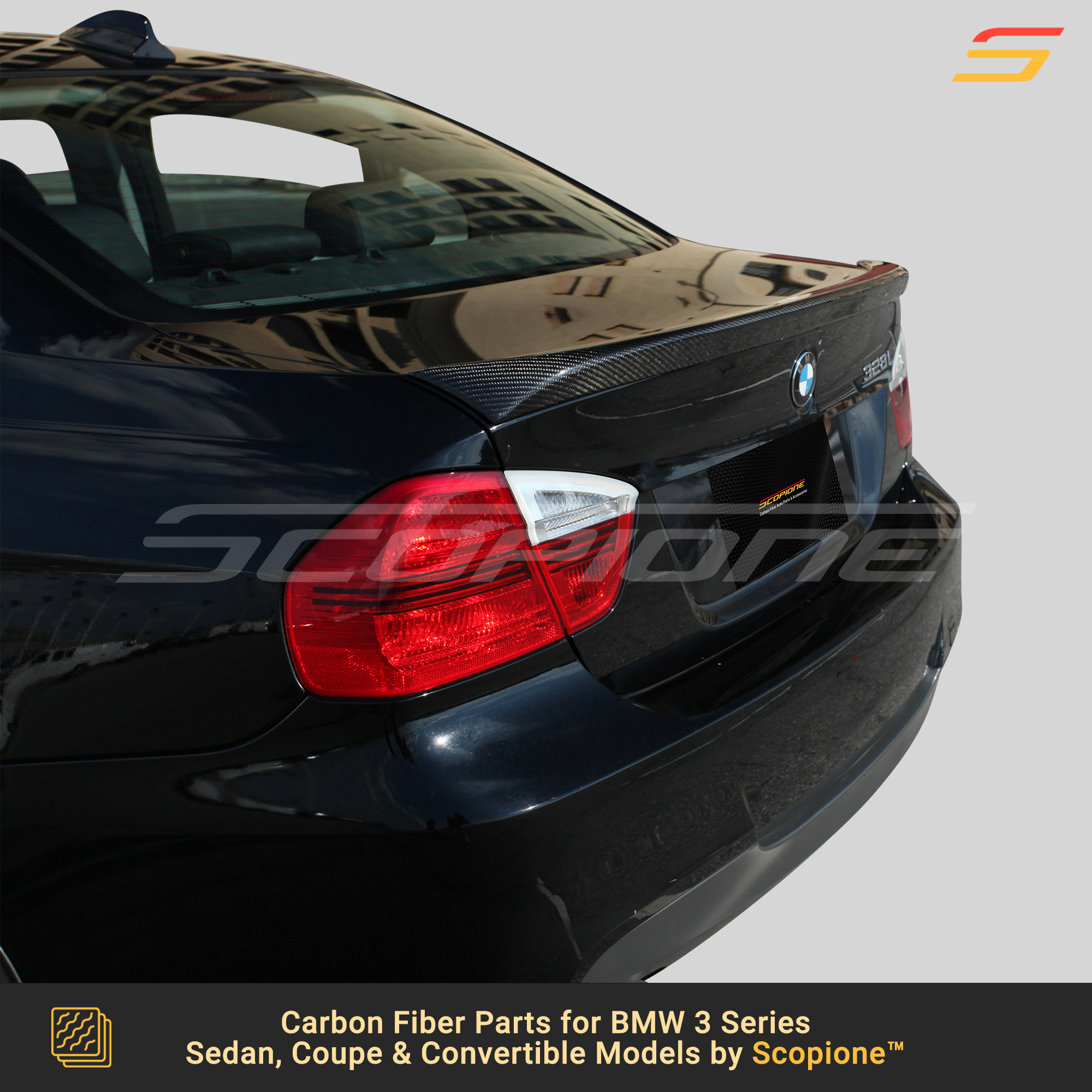
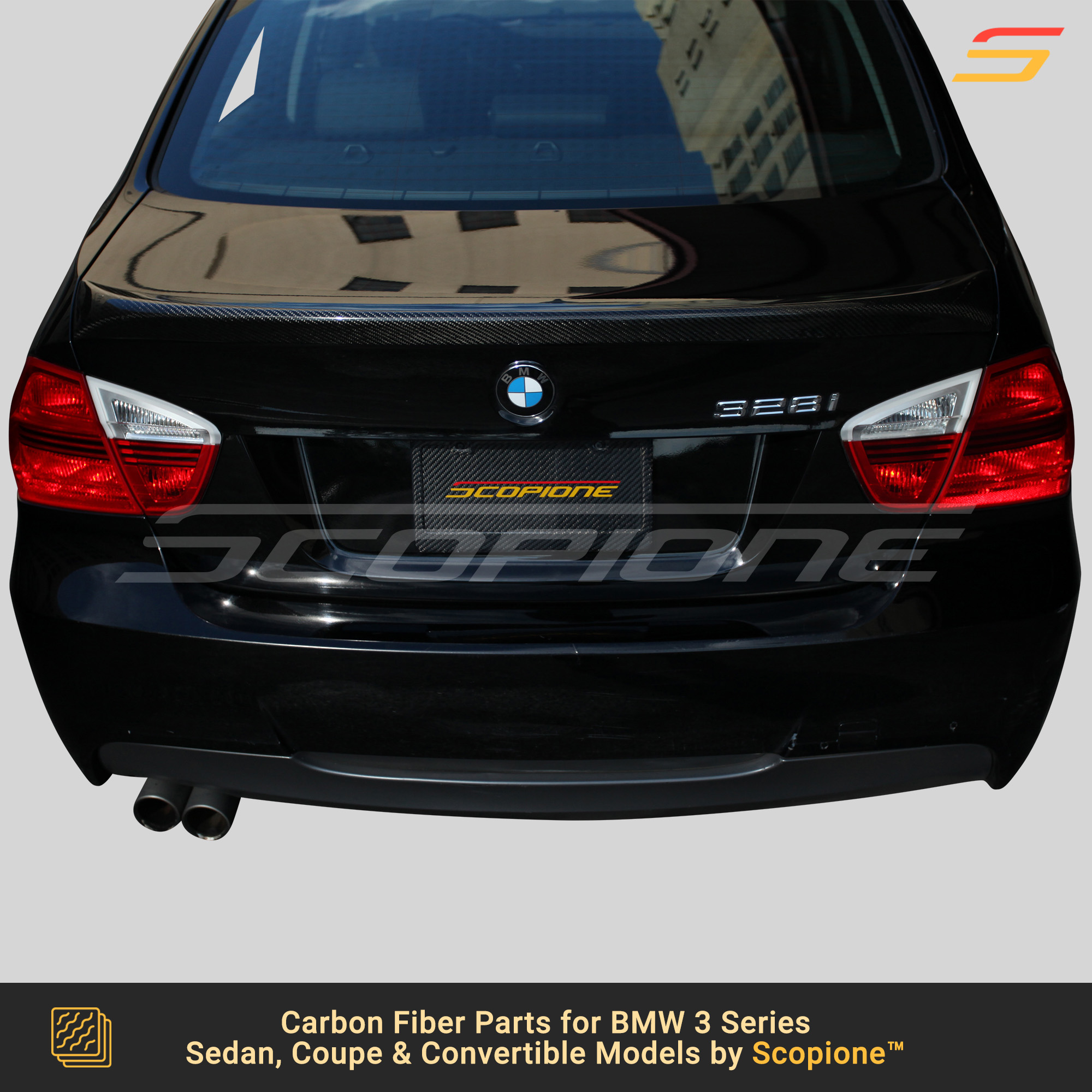
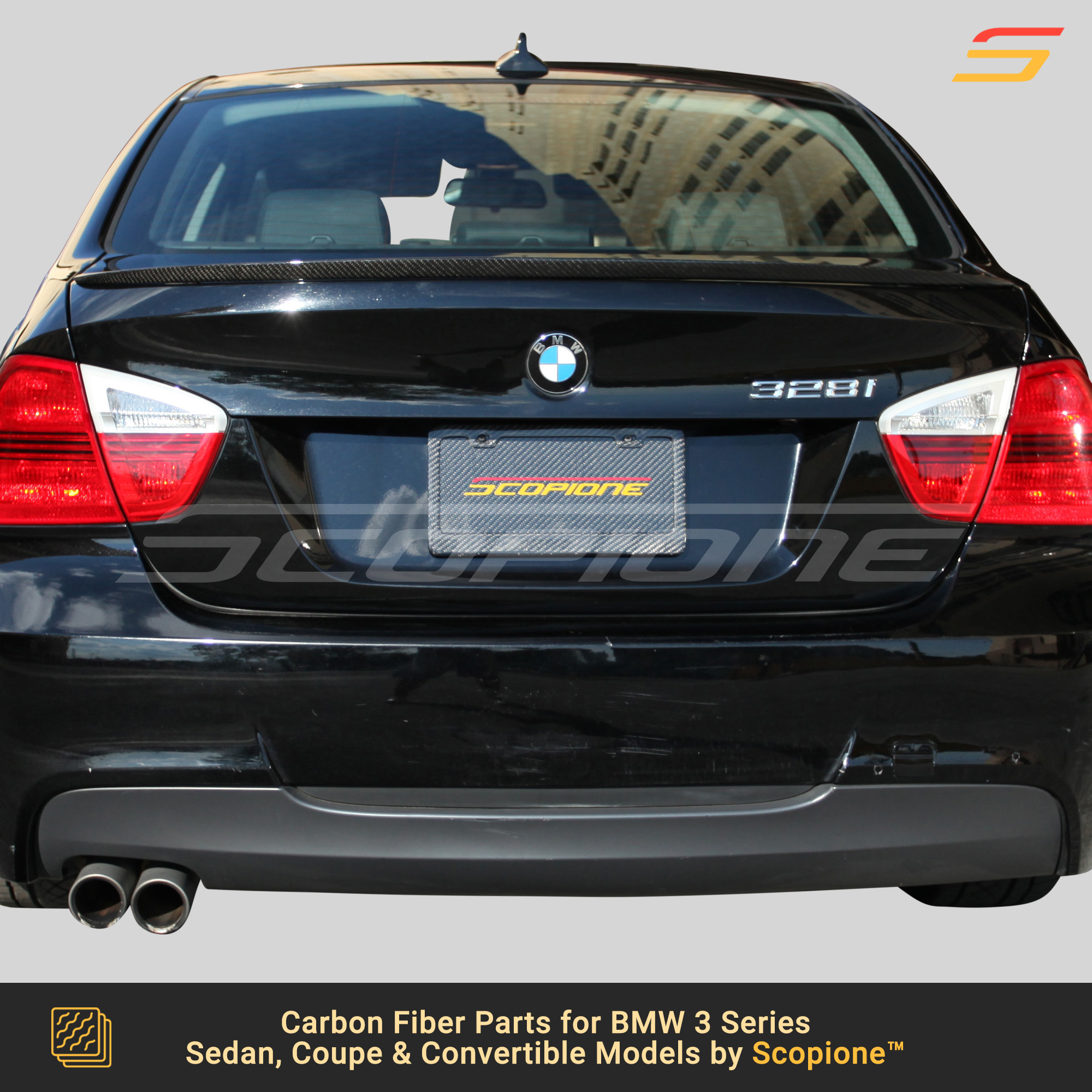
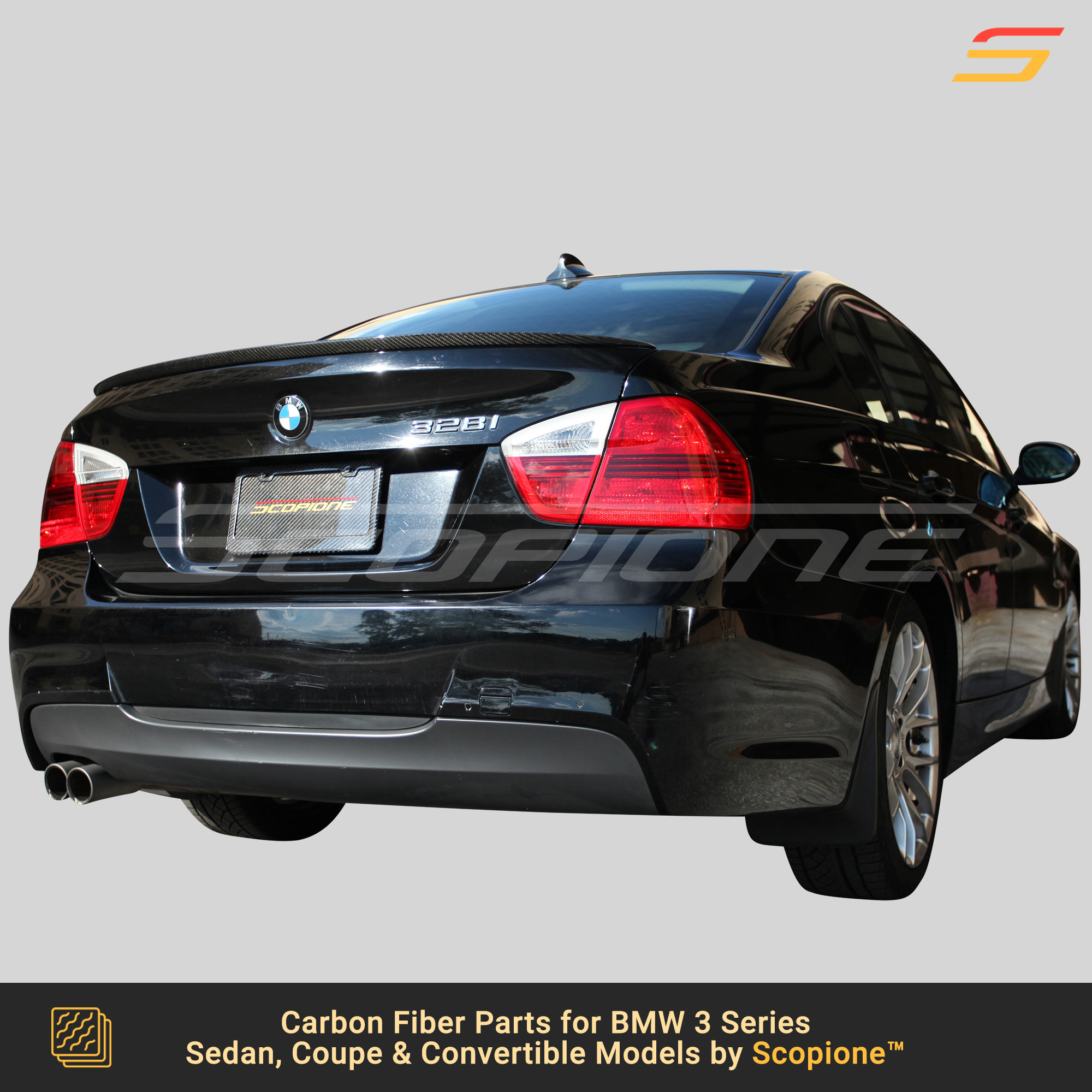
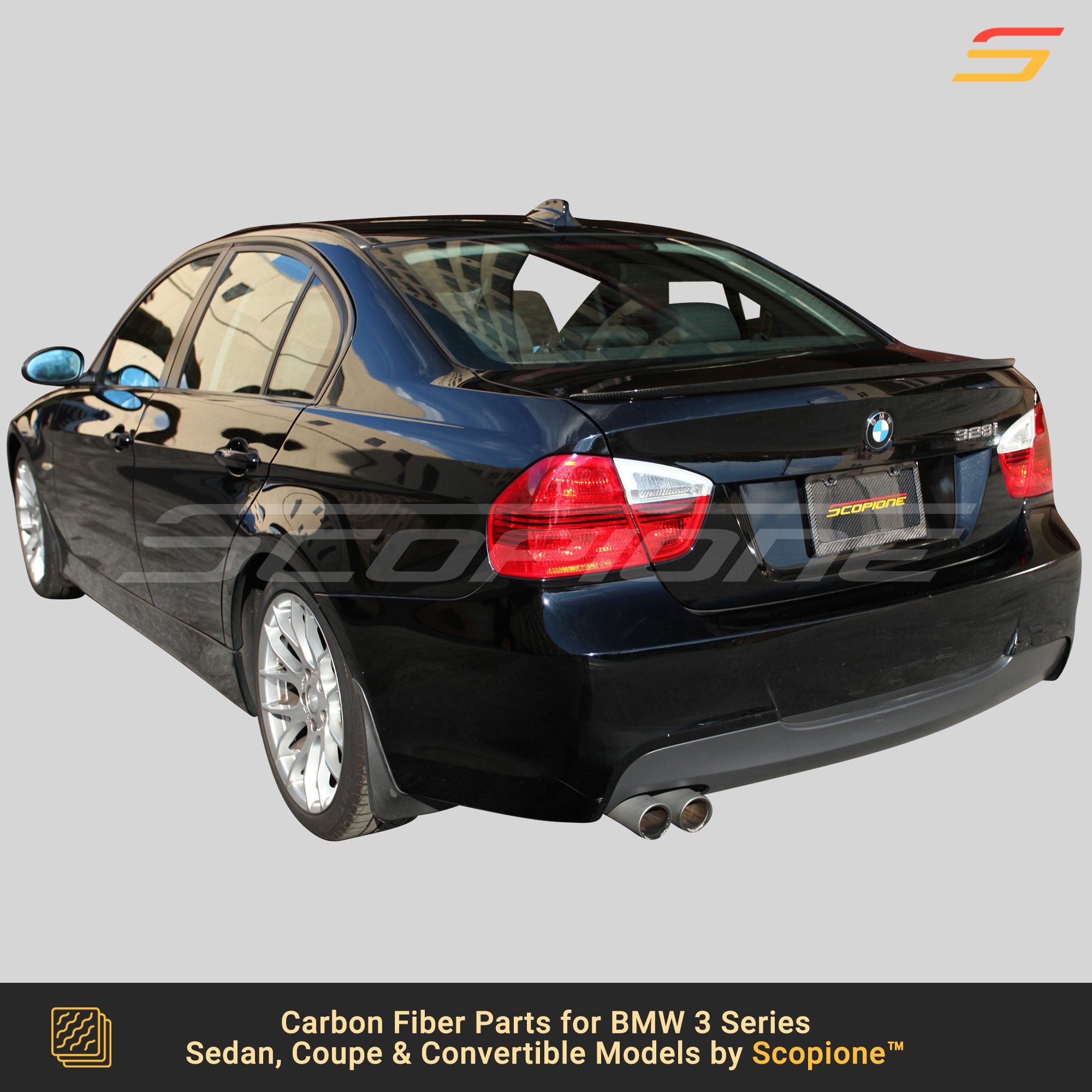
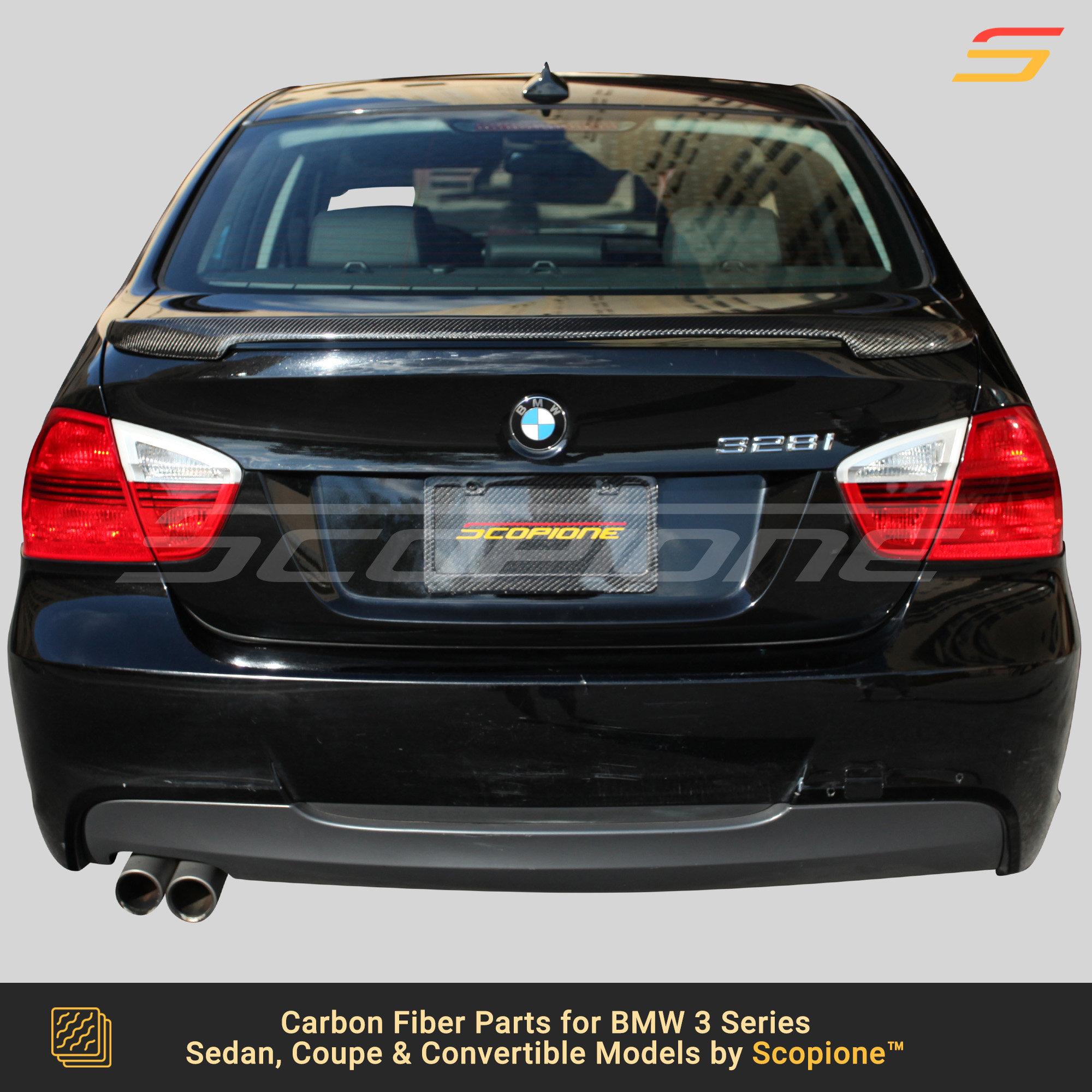

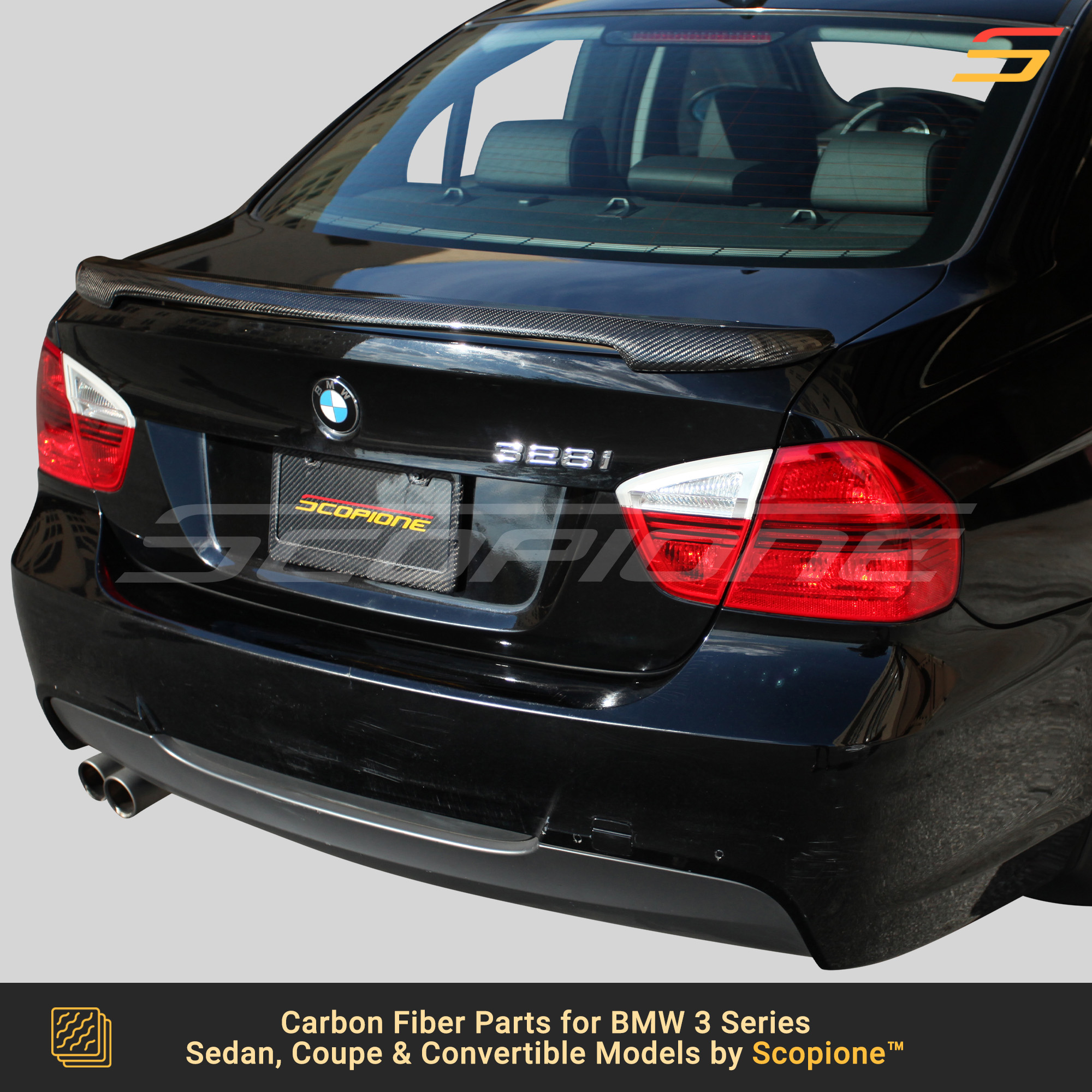
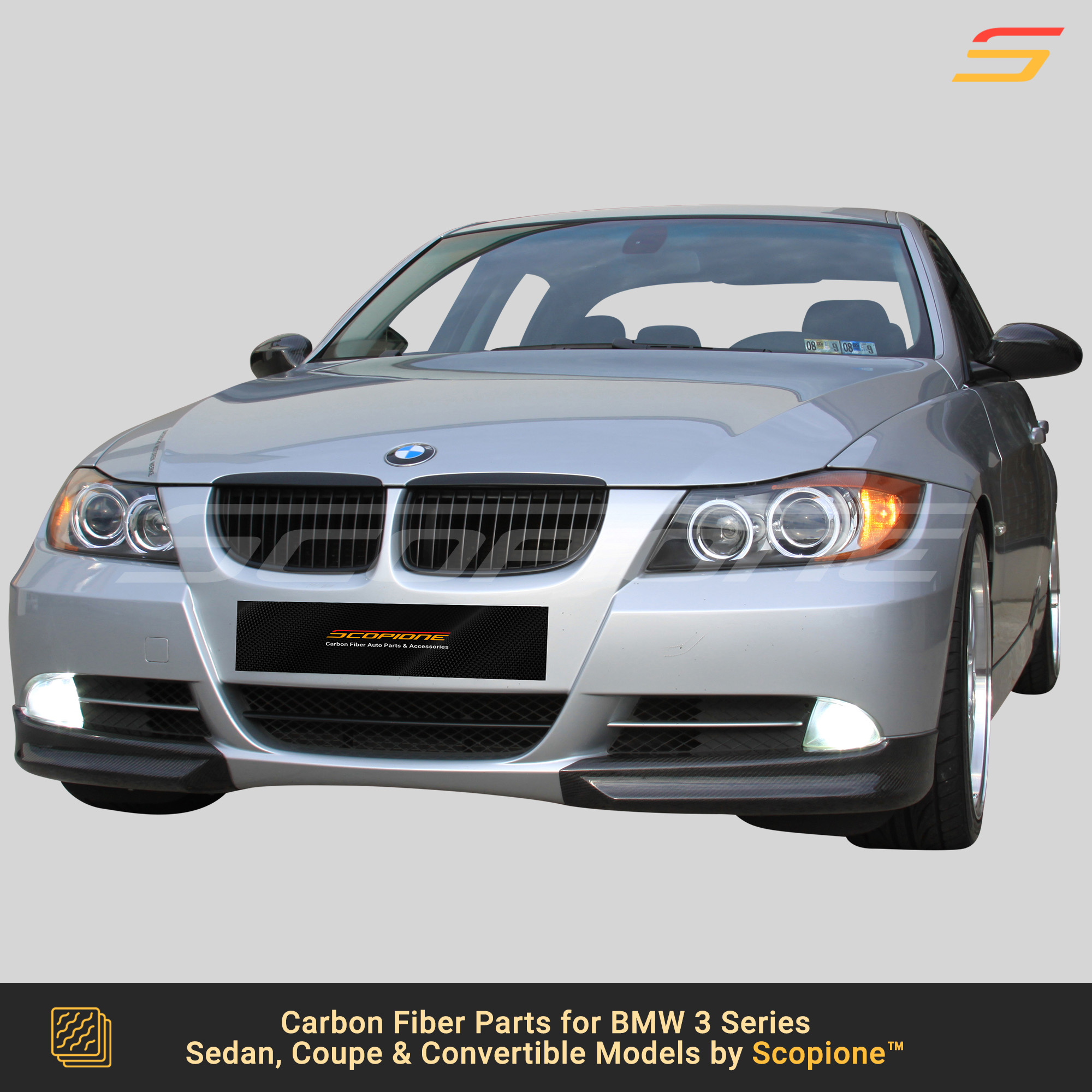
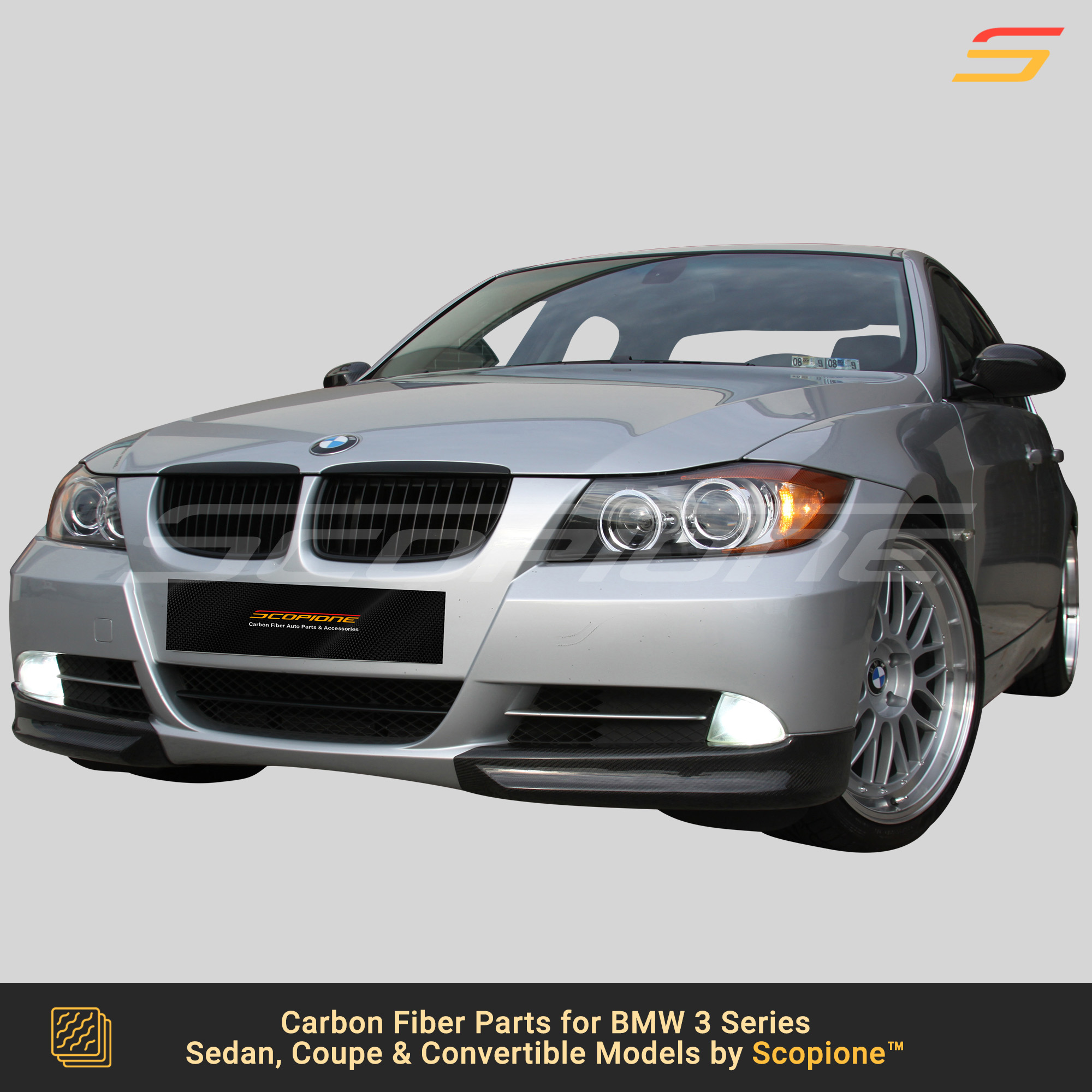
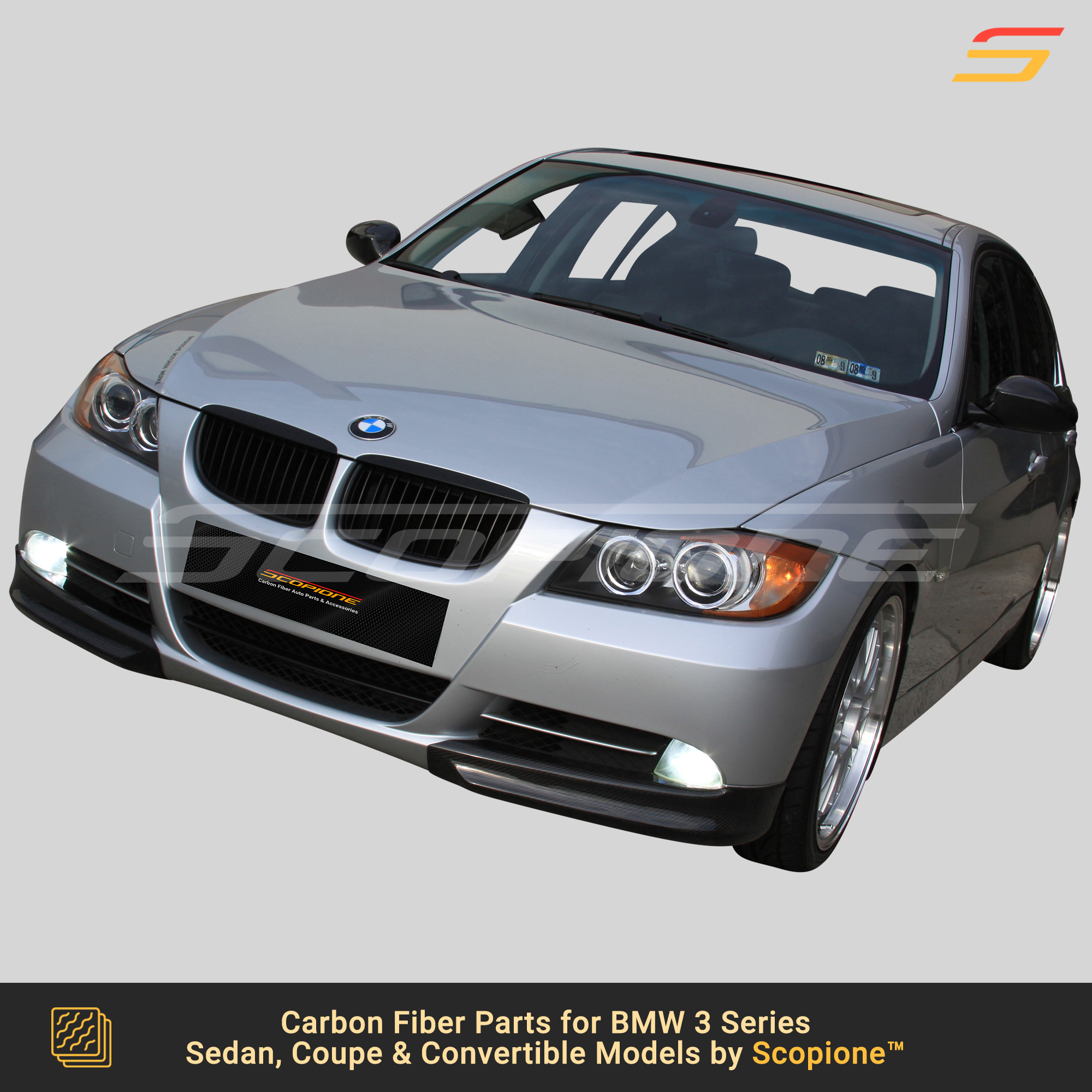

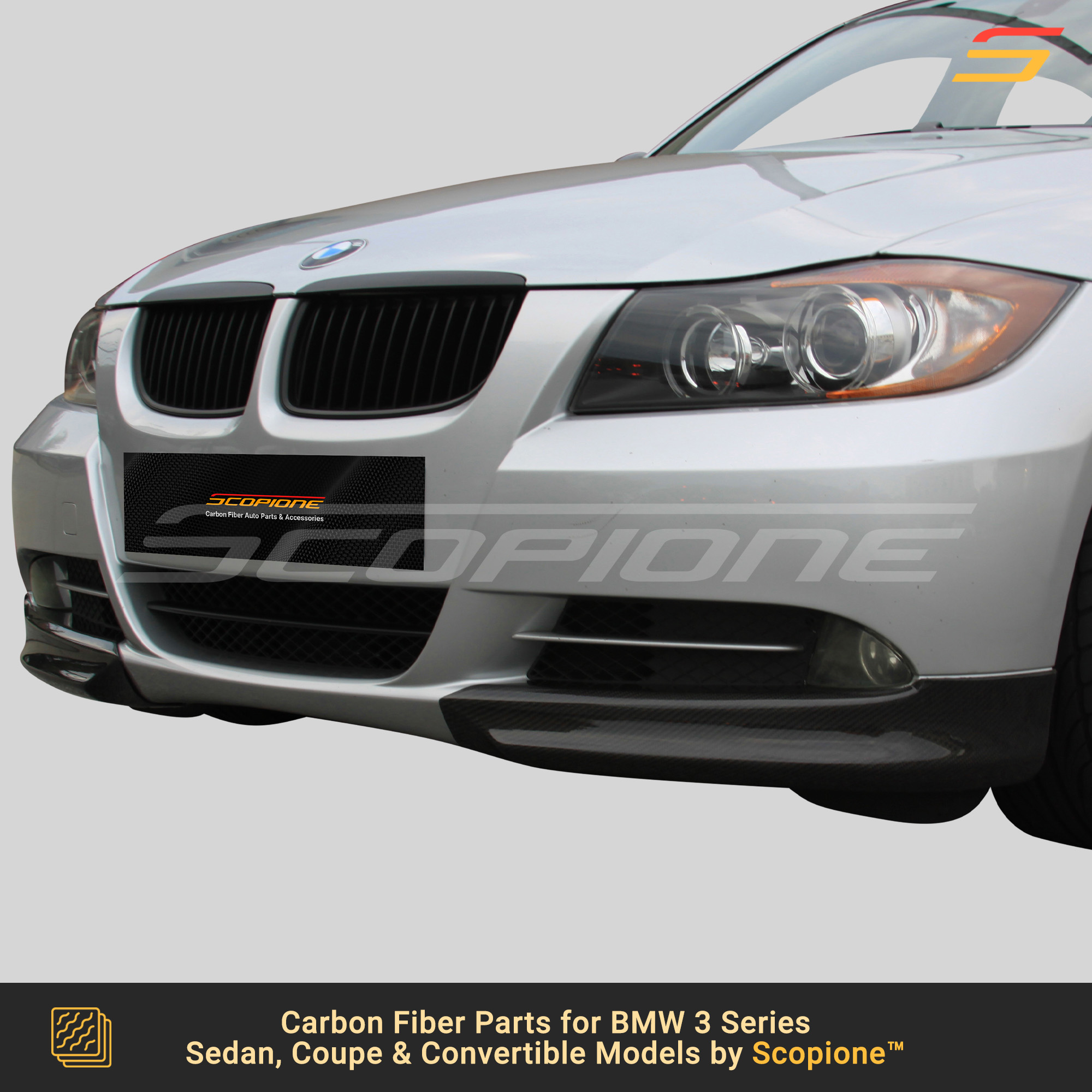
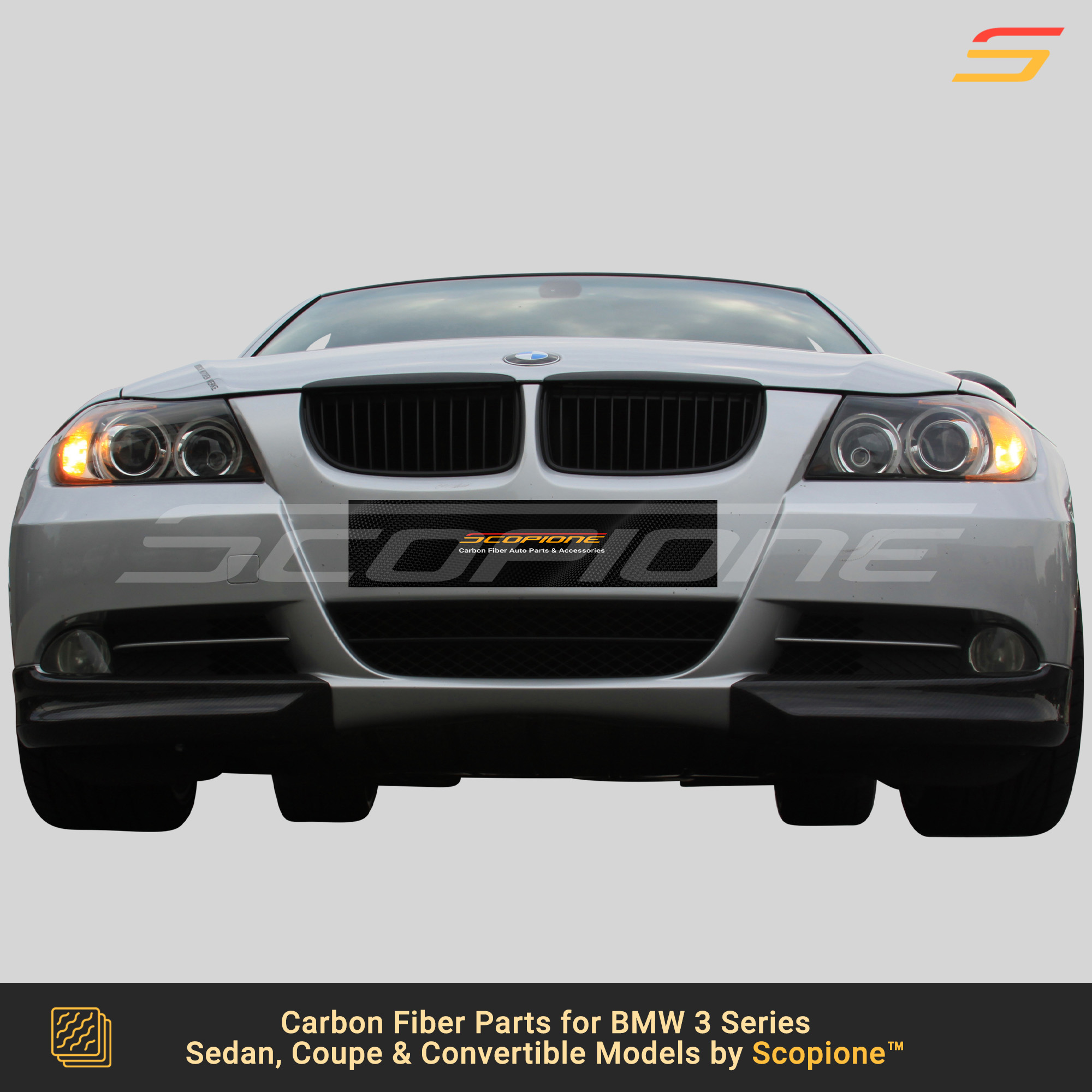
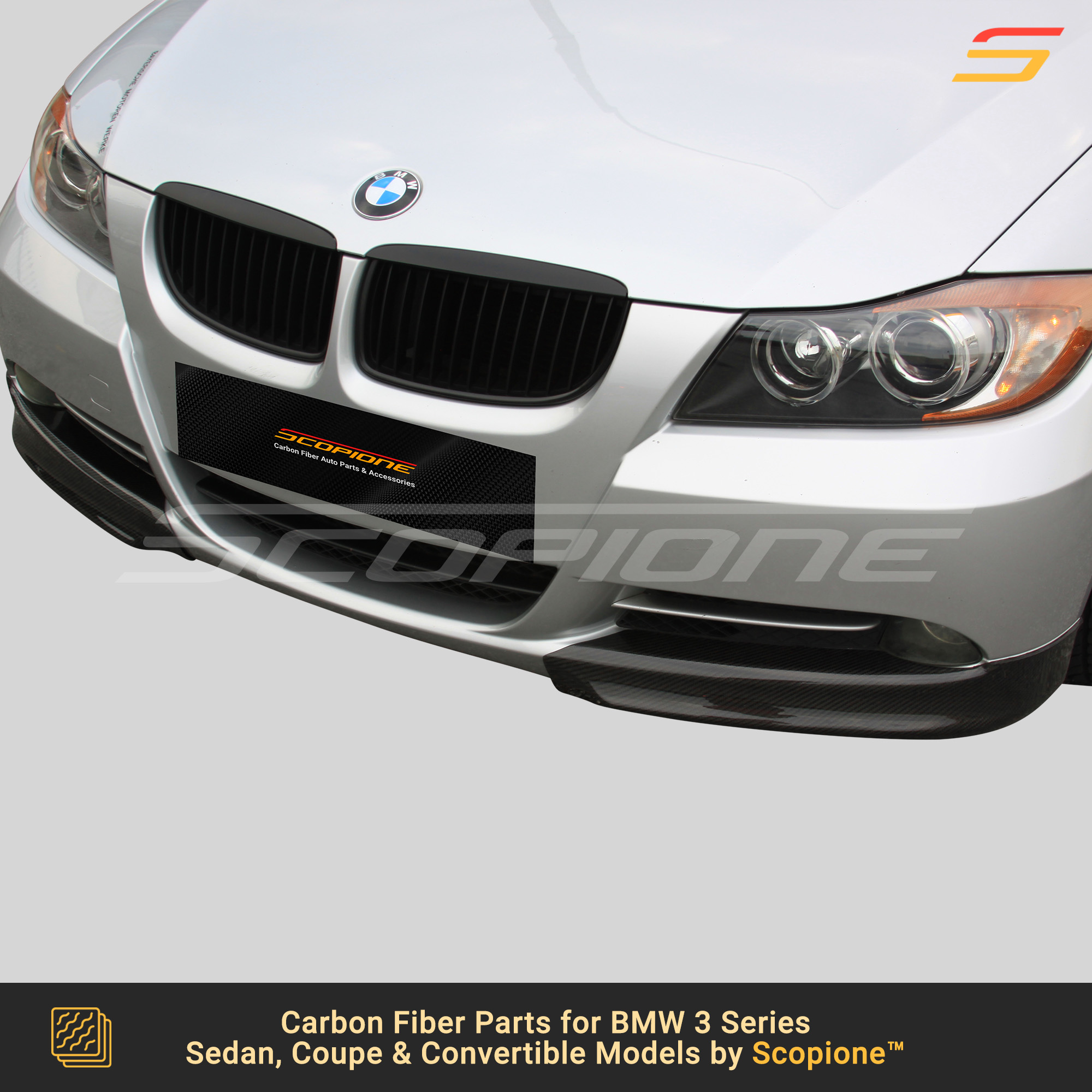

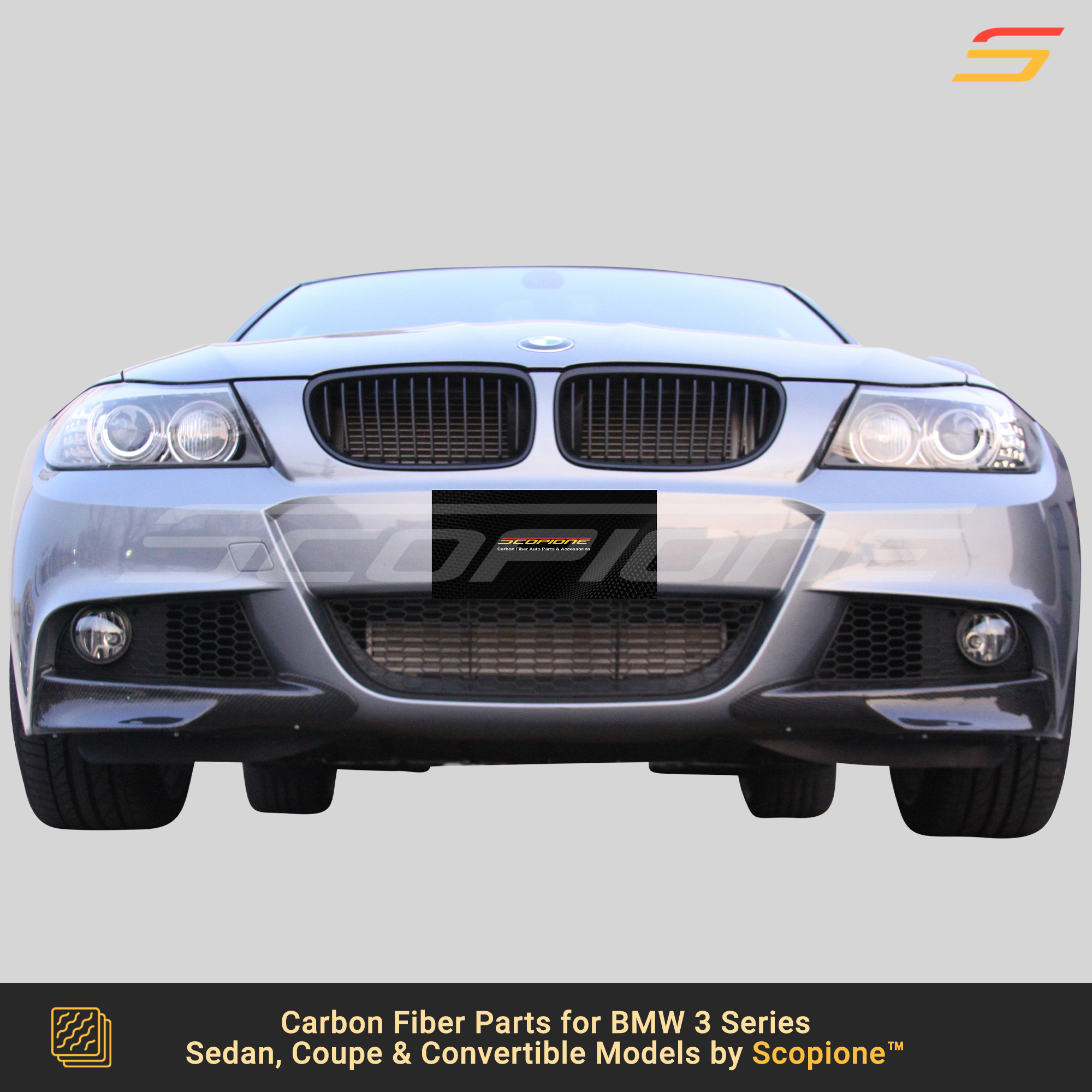
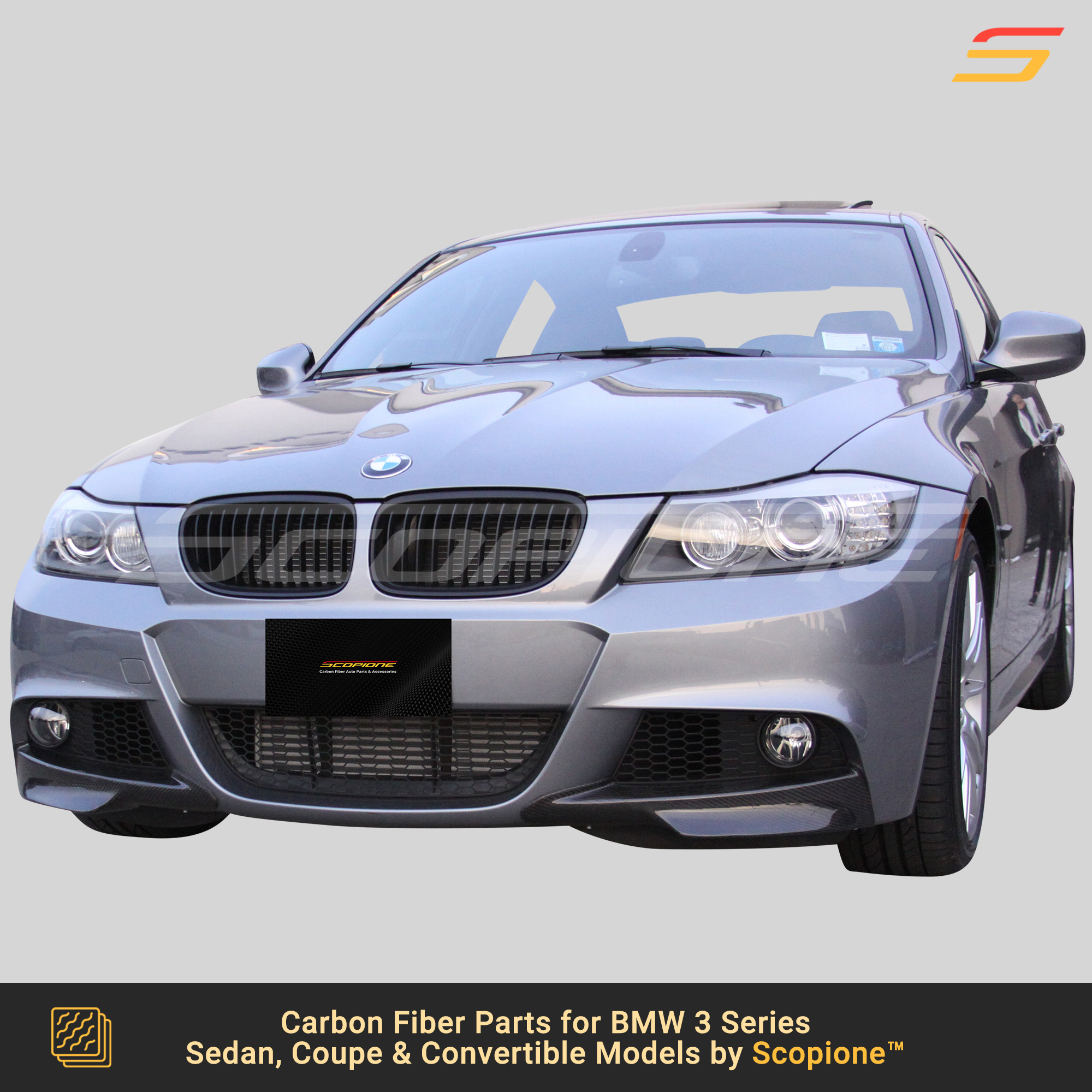
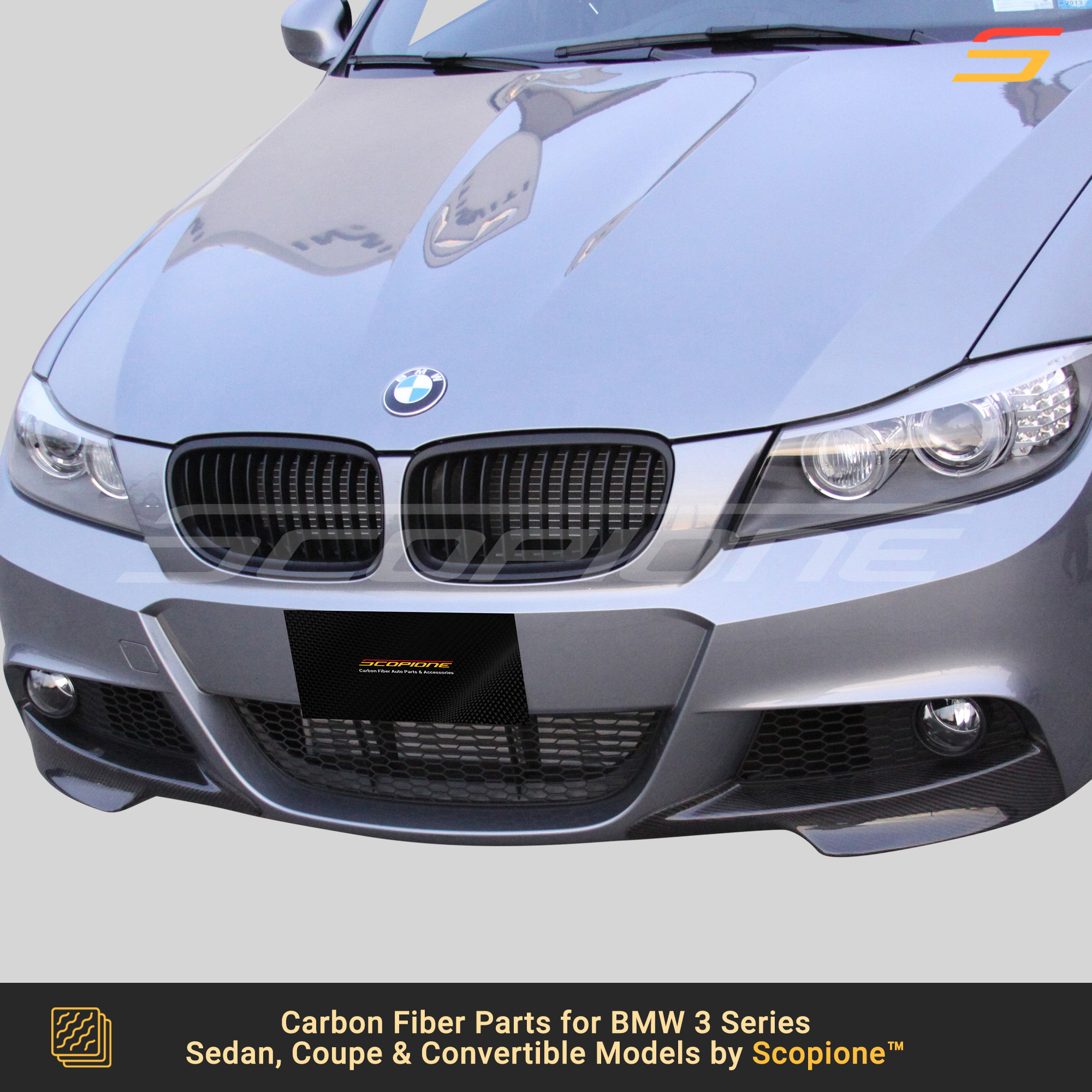
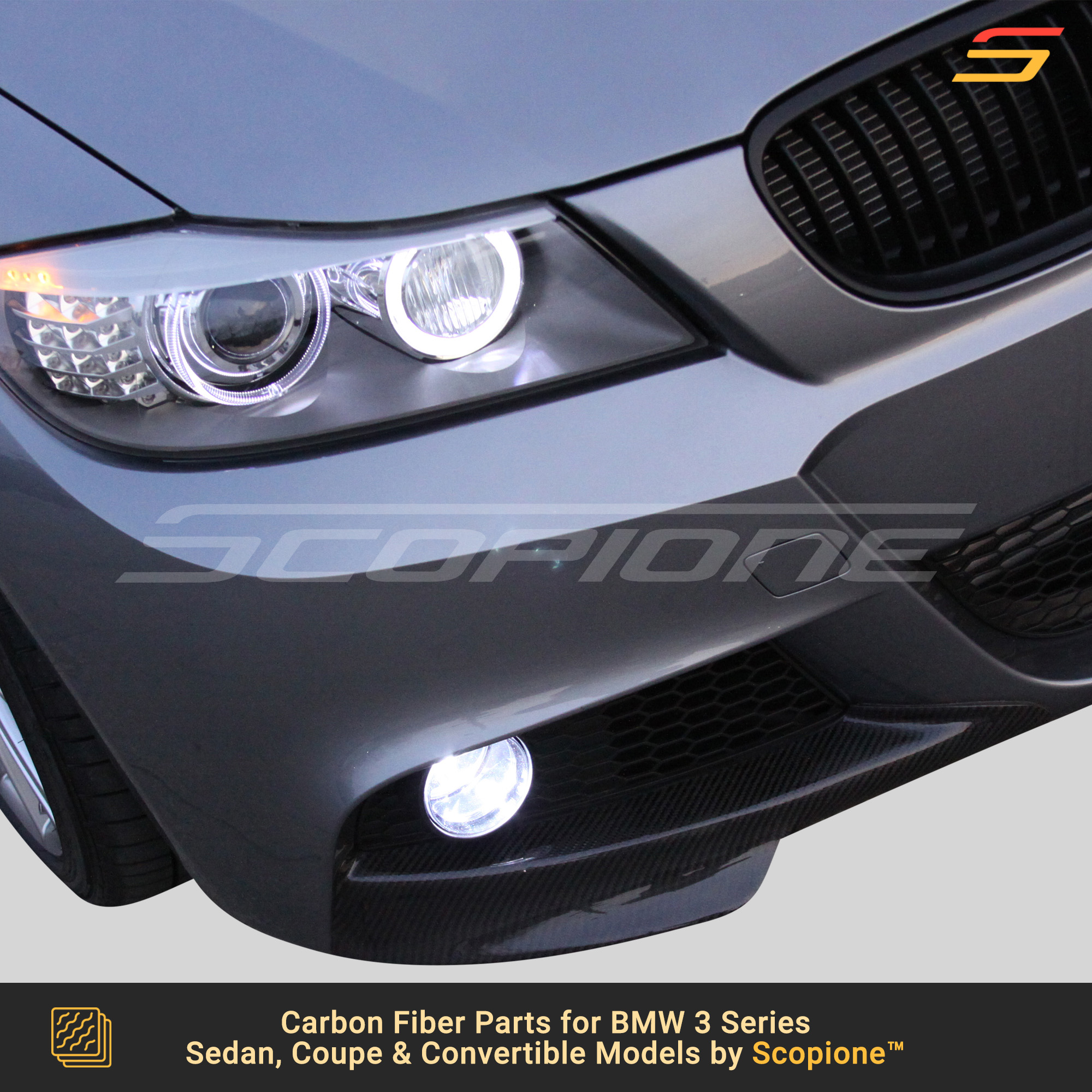
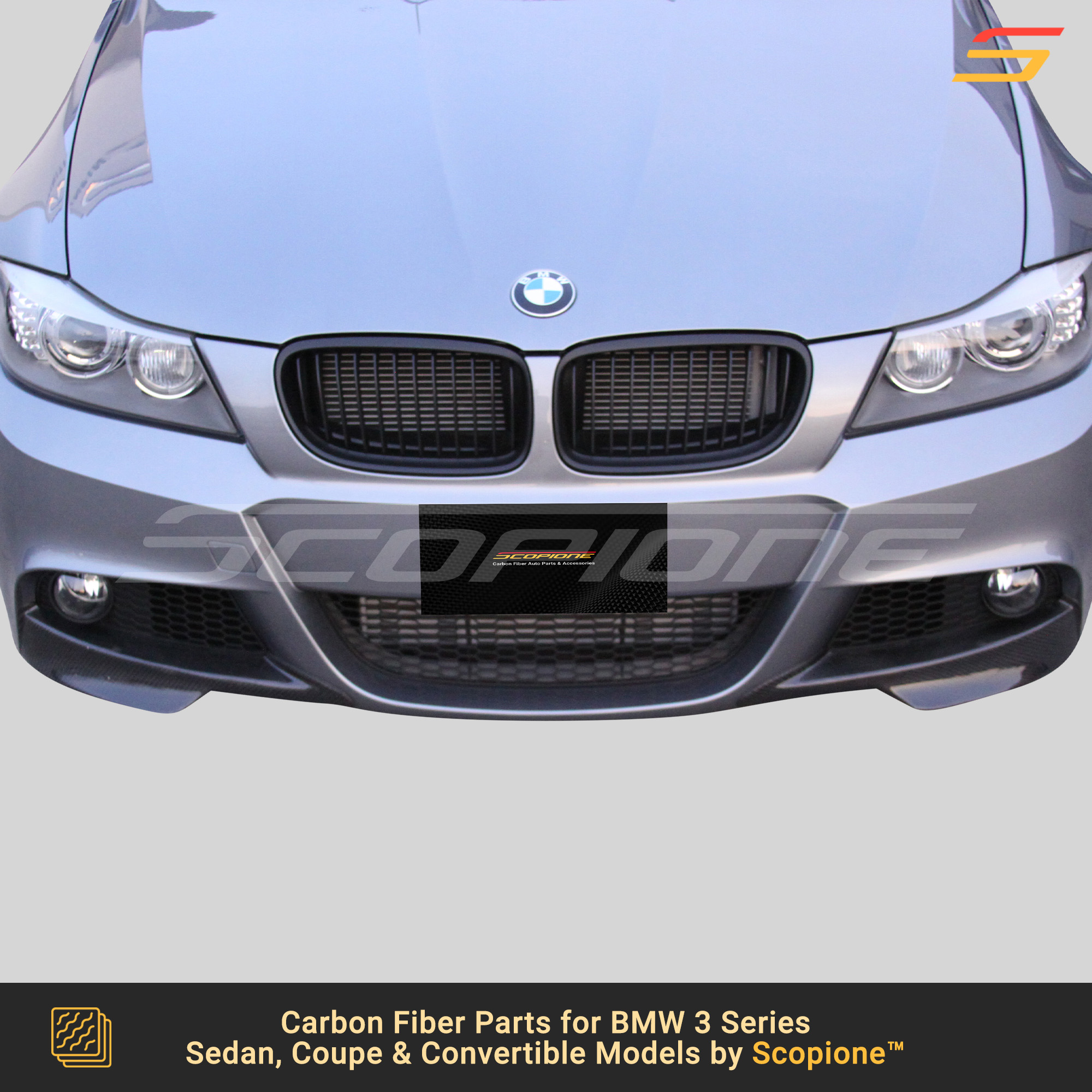
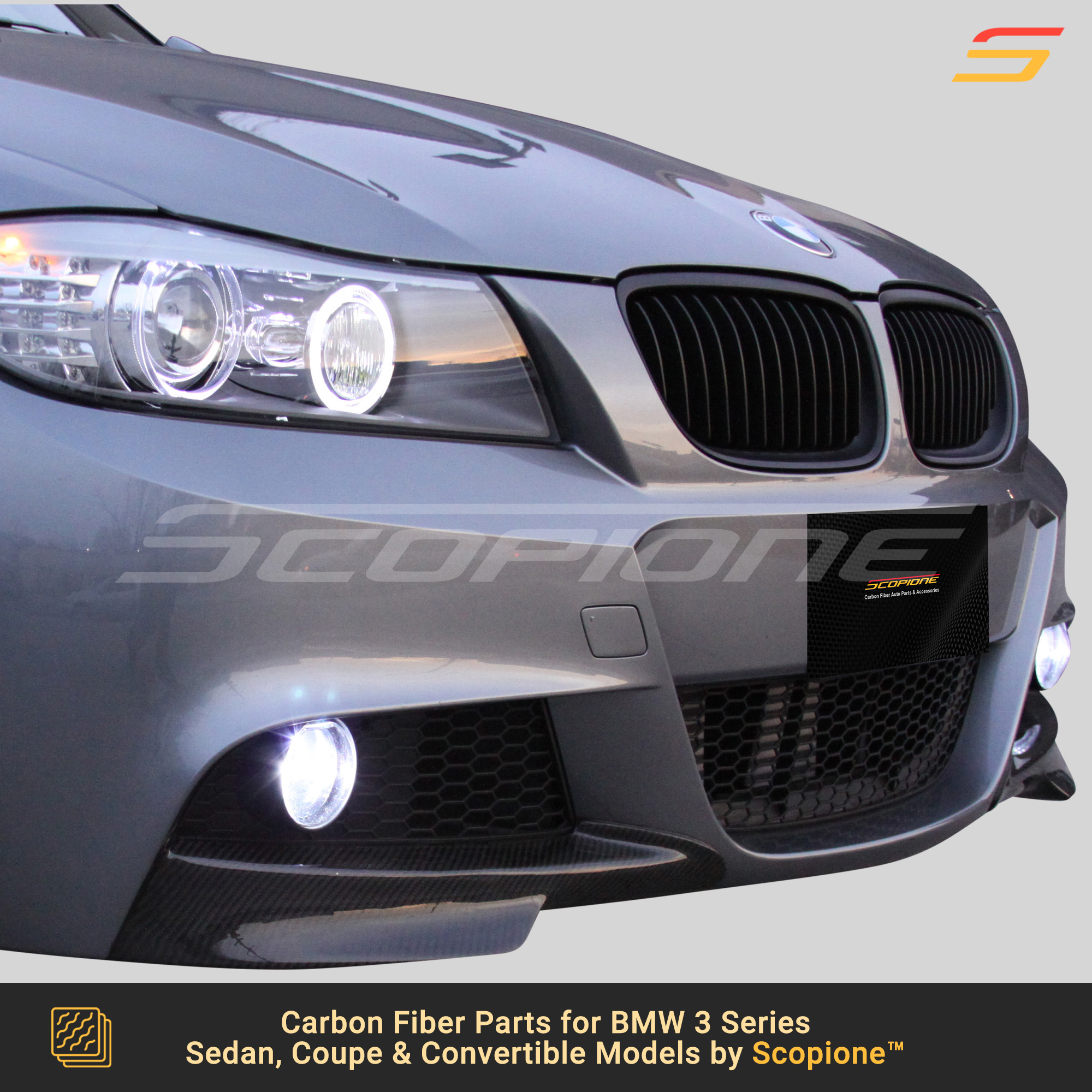
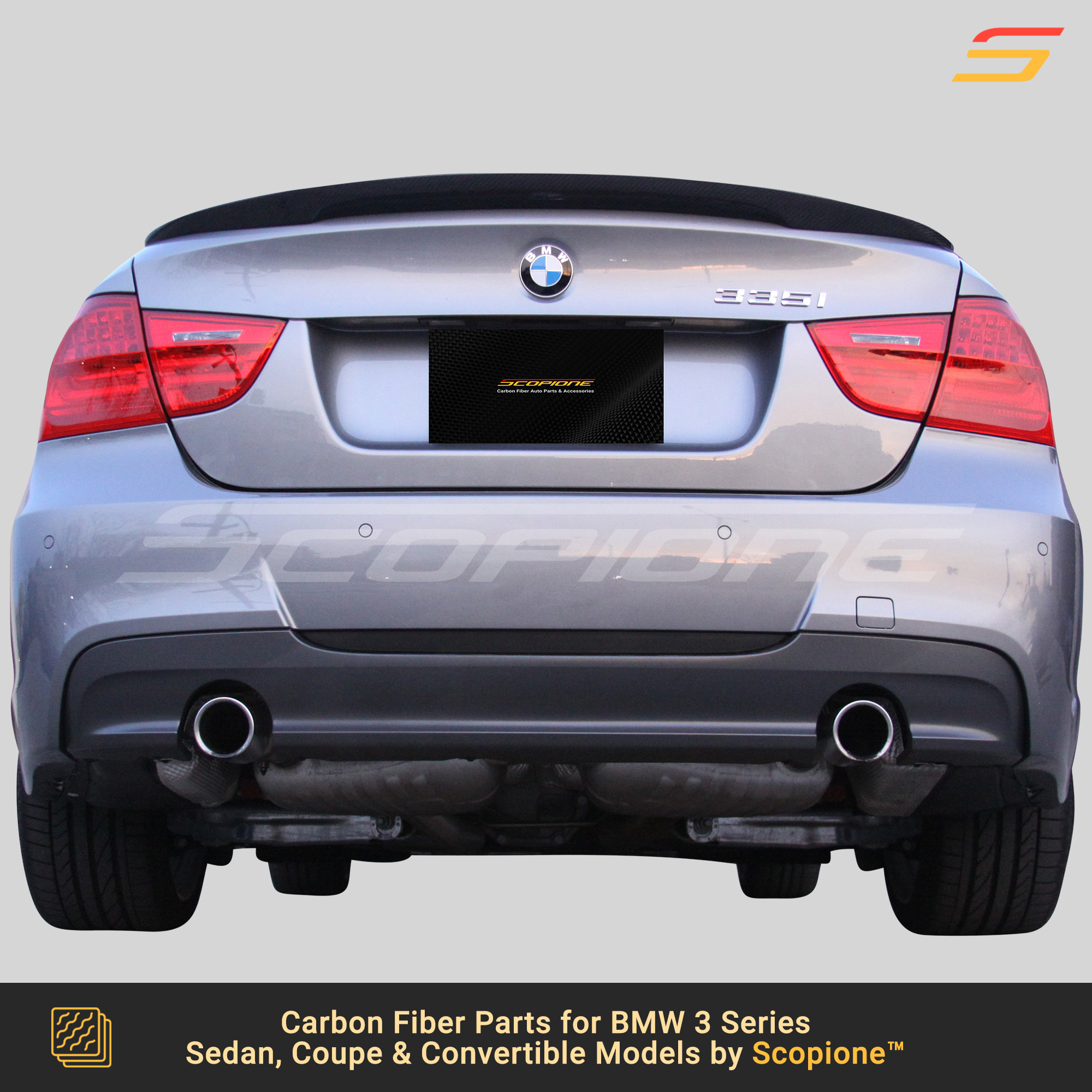
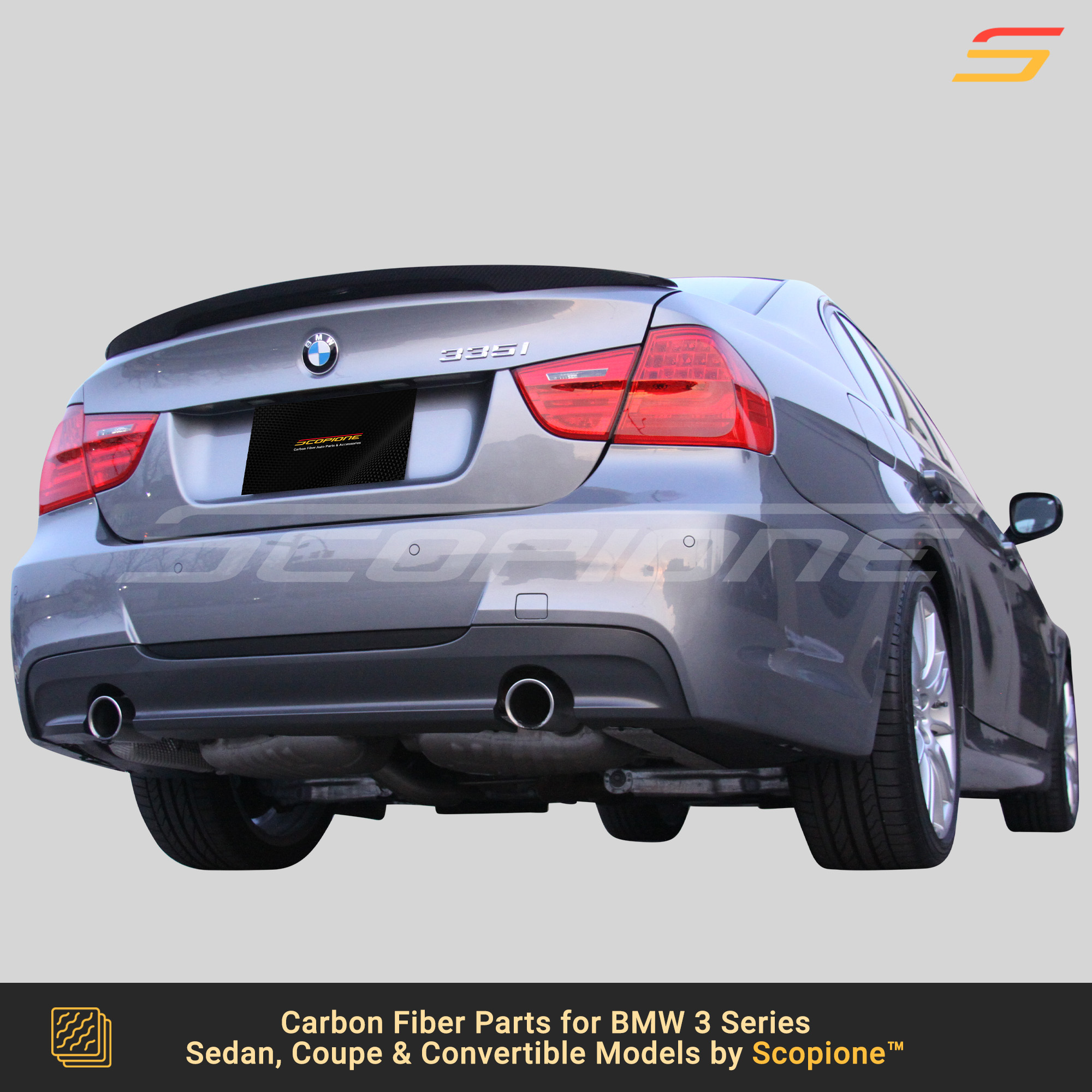

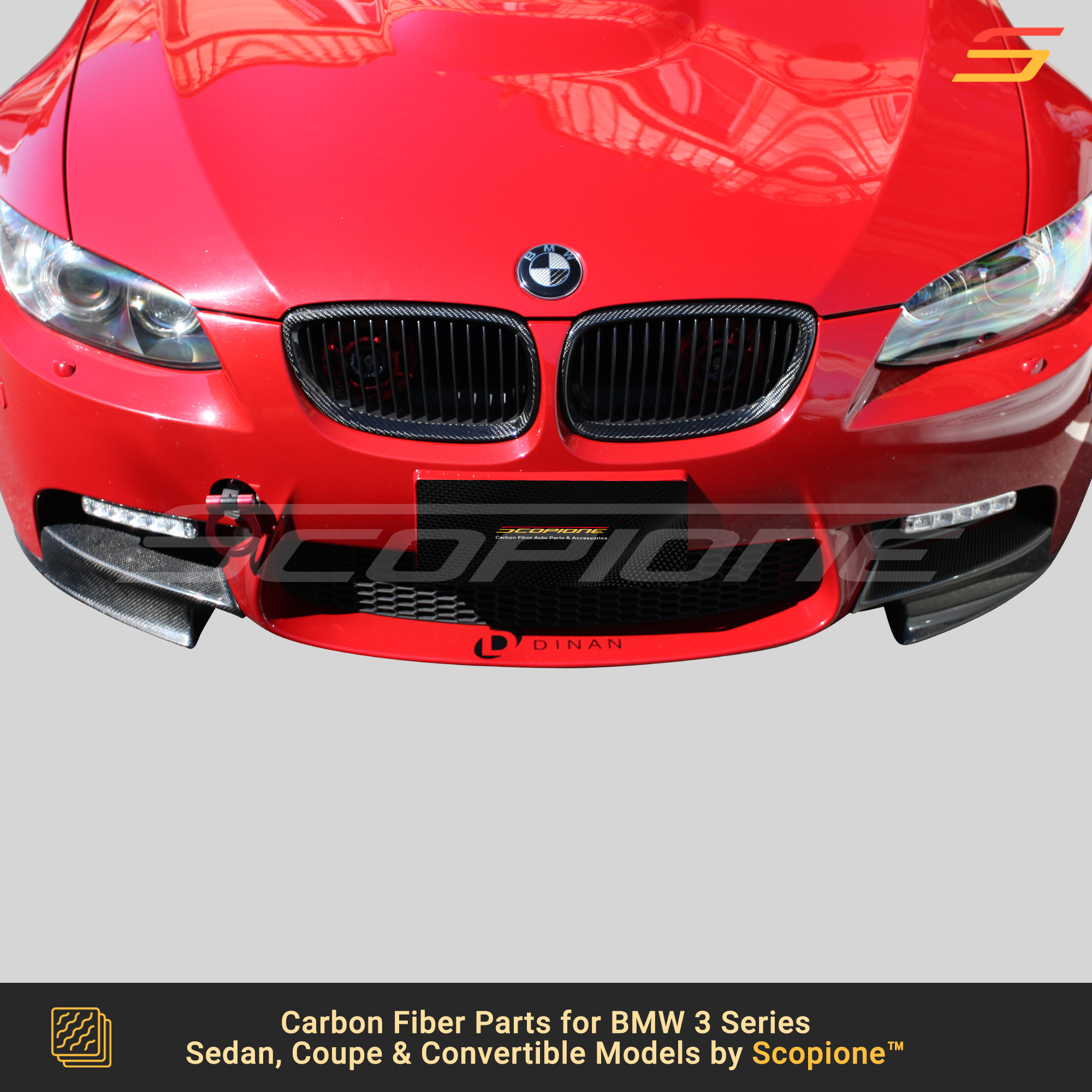
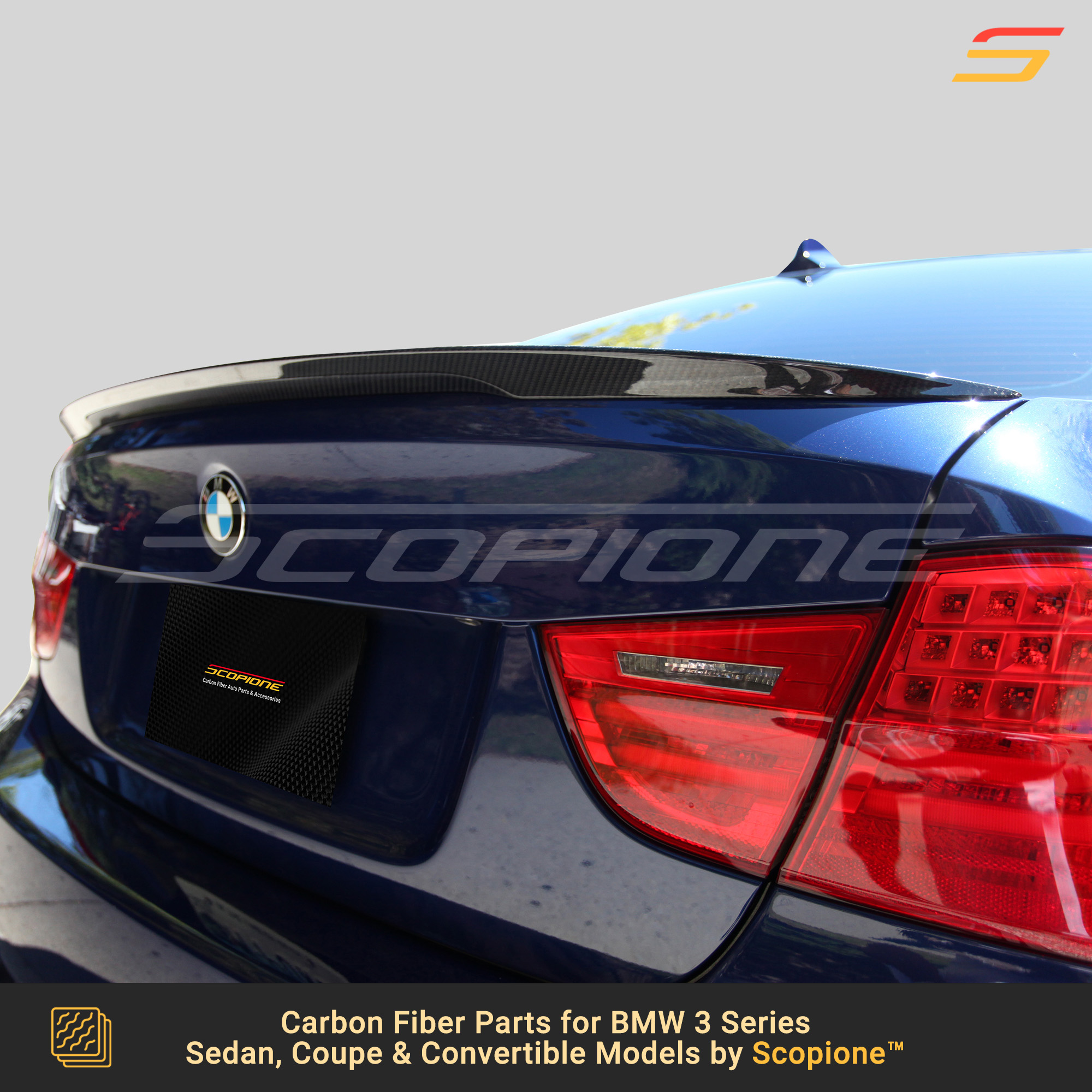
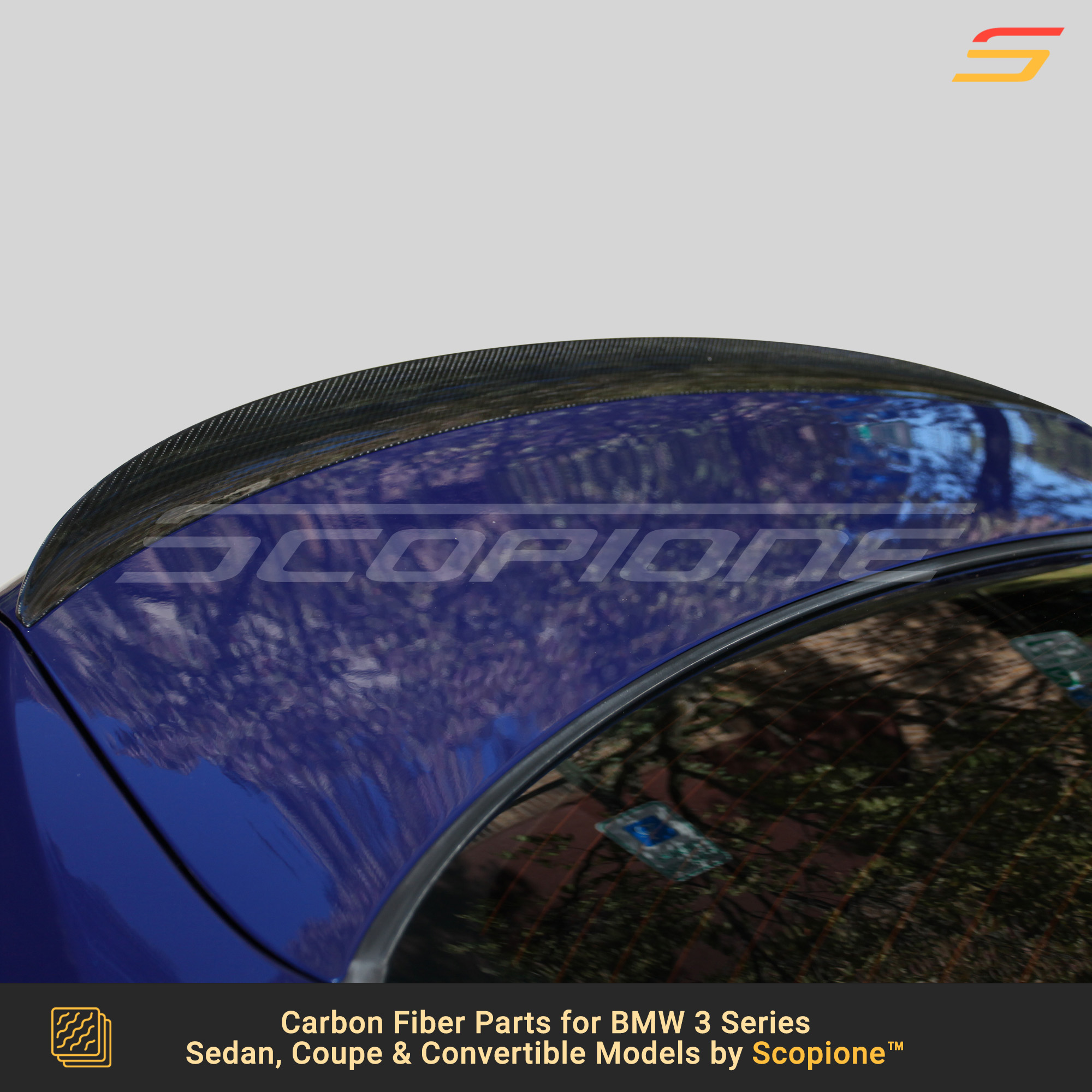
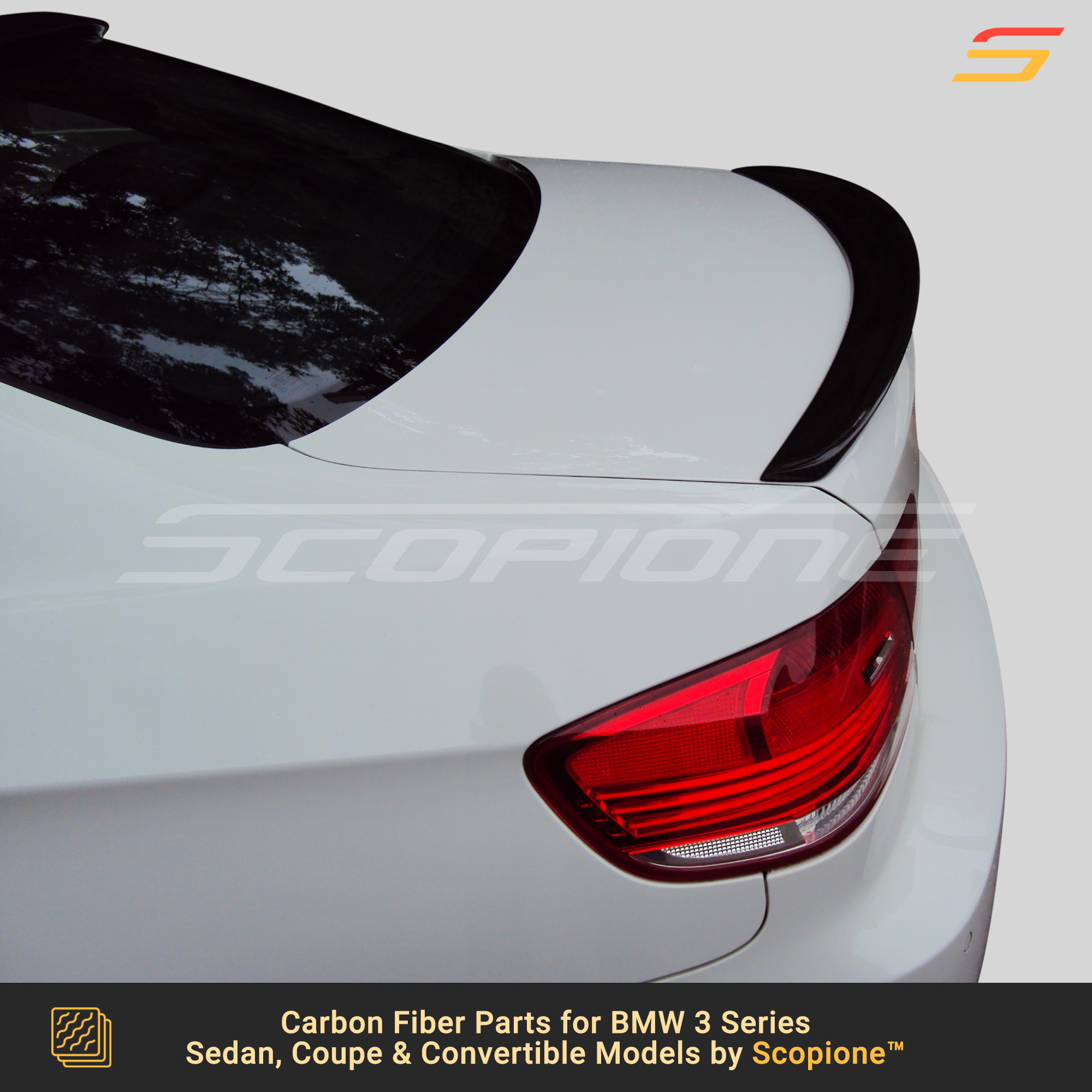

Every part listed above is available through the complete Scopione BMW parts catalog.
BMW and Carbon Fiber
No other major manufacturer has invested as heavily in structural carbon fiber as BMW. The trajectory starts with the E46 M3 CSL in 2003 – the first production BMW to use a CFRP roof panel, saving approximately 6 kg compared to the steel equivalent while lowering the center of gravity by several millimeters. That single part proved the concept: carbon fiber could reduce weight in visible, structurally significant locations without compromising crash safety.
BMW scaled the approach. The M3/M4 (F80/F82, 2014) made a CFRP roof standard on every coupe, along with a carbon-fiber driveshaft. The M4 GTS added a CFRP hood, rear diffuser, and rear wing. Each subsequent CS and CSL variant expanded the CFRP parts list: hood, trunk lid, mirror caps, interior trim, and aero components.
Then came the i3 in 2013 – the first mass-production car with a full carbon fiber passenger cell. BMW built a dedicated CFRP supply chain for this: carbon fiber tow production at a joint venture facility in Moses Lake, Washington (chosen for cheap hydroelectric power), with weaving and molding at BMW’s Landshut and Leipzig plants. The 7 Series (G11, 2016) adapted this technology into “Carbon Core” construction: 13 kg of CFRP reinforcements in the B-pillars, roof frame, rocker panels, and transmission tunnel, saving 40 kg of total body weight compared to the previous-generation steel structure.
For aftermarket carbon fiber – splitters, diffusers, grilles, spoilers – this factory commitment creates a natural visual language. A carbon-fiber front splitter on an M3 with a factory CFRP roof maintains material consistency from the roofline to the lower bumper edge. The 2×2 twill-weave pattern that Scopione uses matches the diagonal weave pattern visible on BMW’s own M Performance carbon fiber accessories. The overlap between factory and aftermarket is intentional: BMW’s M Performance Parts catalog prices carbon-fiber mirror caps at $600–$900 and front splitters at $800–$1,200. Aftermarket alternatives from manufacturers like Scopione deliver the same material specification at 40–60% lower cost, using the same hand-laid 2×2 3K twill-weave construction with UV-resistant clear coat protection.
Scopione: Carbon Fiber Parts for BMW
Scopione’s BMW catalog contains 117 products spanning from the 1991 E36 3 Series through the 2020 F90 M5 – the widest model coverage of any vehicle make in the Scopione lineup. Carbon fiber parts range from $130 headlight eyelids to a $750 matte carbon-fiber rear diffuser for the F06/F12/F13 6 Series M6. The full catalog is available at the Scopione BMW parts page.
What Scopione Offers for BMW
The BMW product catalog covers 12 distinct part categories across 20+ chassis codes:
| Part Category | Count | Price Range | Fitment Highlights |
|---|---|---|---|
| Front Splitters & Lips | ~32 | $170–$500 | E46, E90/E92, F80/F82, F87, E39, E60, F90, G30, E82, X5M/X6M |
| Rear Diffusers | ~22 | $280–$750 | E46 M3, E92 M3, F80/F82, E82, E60, F06/F12/F13 M6, E71 X6 |
| Trunk Spoilers | ~16 | $100–$280 | E46, E90, E92, E86 Z4, E65 7 Series, F10 |
| Roof/Visor Spoilers | ~10 | $110–$260 | E46, E92, E39, E60, E65 7 Series |
| Kidney Grilles | ~11 | $200–$240 | E36, E38, E39, E46, E53 X5, E85 Z4, F22/F87 |
| Headlight Eyelids | ~12 | $130–$145 | E39, E46, E60, E70 X5, E71 X6, E90 |
| Mirror Caps | 1 | $200 | E90/E92/E93 M3, E82 1M |
| Engine Covers | 2 | $260–$380 | S54 (E46 M3, Z4 M), S55 (F80, F82, F87) |
| Steering Wheel Covers | 5 | $190–$270 | E36/E39/E46, E90/E92, M3/1M, F-series, multi-model |
| Hood Vents | 1 | $210 | E90/E92/E93 M3 |
| Fog Light Covers | 2 | $200 | E46 M3, E46 M-Tech II |
| LED & HID Bulbs | 9 | $50–$110 | Angel Eyes for E39, E53, E60, E63, E70 |
Material and Finish Options
All Scopione carbon-fiber BMW parts use hand-laid 2×2 3K twill-weave carbon fiber with a UV-resistant clear coat – the same diagonal weave pattern visible on BMW’s own factory M Performance parts. Select parts are also available in matte carbon fiber finish at a modest premium ($5–$100 over glossy equivalents). For budget-conscious builds, fiberglass (FRP) alternatives are offered on select spoilers at $100–$130 – unpainted and ready for color-matching. Scopione backs all carbon fiber parts with a 12-month limited warranty against delamination.
Installation Notes
Installation complexity varies by part category. Kidney grilles and headlight eyelids are the simplest – clip-in or adhesive-bonded replacements taking 30–45 minutes. Engine covers are drop-in replacements on the S54 and S55, requiring 10–15 minutes and no tools beyond what is needed to remove the factory cover. Front splitters and lips mount to existing factory hardware on M and M-Tech bumpers, typically taking 1–2 hours. Rear diffusers are the most involved: 2–3 hours, with professional installation recommended for even alignment across the lower bumper edge. Scopione recommends a dry test-fit before final fastening on all aero components, particularly on cars where previous bodywork may have shifted mounting points.
BMW M Car Market Pricing & Carbon Fiber Investment
BMW M cars follow a clear appreciation pattern: naturally aspirated engines and limited-production variants climb while turbocharged volume models reach the bottom of their depreciation curves. Carbon-fiber upgrades serve both segments – preserving visual distinction on appreciating cars and adding differentiation to depreciating ones.
| Model | Original MSRP | Current Market Range | Top-Selling Part |
|---|---|---|---|
| E46 M3 Coupe | $46,600 | $22,000–$45,000 | Rear diffuser ($400–$600) |
| E46 M3 CSL | £58,455 (UK) | $130,000–$250,000 | CSL rear diffuser ($400) |
| E92 M3 Coupe | $56,500 | $25,000–$50,000 | Front splitters ($170) |
| E92 M3 GTS | £118,000 (UK) | $200,000–$380,000 | Front lip spoiler ($420–$480) |
| F82 M4 Coupe | $64,200 | $28,000–$55,000 | Rear bumper diffuser ($280) |
| F87 M2 CS | $83,600 | $85,000–$120,000 | Front splitters ($220–$300) |
| 1M Coupe | $47,010 | $55,000–$90,000 | Mirror caps ($200) |
| E39 M5 | $69,400 | $25,000–$65,000 | Kidney grilles ($210) |
| F90 M5 CS | $142,000 | $130,000–$170,000 | Front splitters ($300) |
Notable auction results underscore the trajectory. An E46 M3 CSL with 25,000 km sold for $225,000 on Bring a Trailer in 2024. An E92 M3 GTS with 4,800 miles reached $350,000. An F82 M4 GTS with 1,800 miles brought $170,000, and a 2023 G82 M4 CSL with just 450 miles sold for $185,000. The pattern is consistent across generations: low-mileage, limited-production M cars trade at substantial premiums when service history and originality are documented.
Pricing Factors That Affect BMW M Car Values
- Transmission type – Manual M3/M4/M2 models command 15–25% premiums over DCT and SMG equivalents. The manual take rate on the G80/G82 was under 20%, making those cars proportionally rarer.
- Rod bearing condition (S54/S65) – The E46 M3 and E90/E92 M3 engines have documented rod bearing wear patterns. Cars with service records showing bearing replacement ($3,000–$5,000 job) sell at measurable premiums.
- Factory carbon-fiber options – CFRP packages (roof, interior trim, aero kit) add $2,000–$8,000 to resale values depending on scope.
- Color specification – BMW Individual colors (Techno Violet, Phoenix Yellow, Dakar Yellow) add 10–20% over standard finishes. Individual interior packages compound the premium.
- CS/CSL/GTS production limits – Every limited-run M variant has appreciated. The E46 CSL has roughly doubled since 2020.
Ownership Costs
Annual maintenance for M cars runs $1,500–$4,000 depending on generation and mileage. Key service intervals: S54 VANOS rebuild ($1,500–$2,500 at 80,000–100,000 miles), S65 rod bearing replacement ($3,000–$5,000, preventive at 60,000–80,000 miles), S55/S58 crank hub inspection (typically under warranty). Brake service: $800–$2,500 for carbon-ceramic systems on GTS/CSL models. Insurance premiums for M3/M4: $2,400–$4,800 per year depending on age and location.
Frequently Asked Questions
What BMW models does Scopione make carbon fiber parts for?
Scopione offers 117 parts across the BMW range: M2 (F87), M3 (E46, E90/E92/E93, F80), M4 (F82/F83), M5 (E39, E60, F10, F90), M6 (F06/F12/F13), X5 M and X6 M (E70/E71), X5 (E53, F15), 1 Series (E81/E82/E87/E88), 2 Series (F22/F23), 3 Series (E36, E46, E90/E91/E92/E93), 3 Series GT (F34), 4 Series (F32/F33/F36), 5 Series (E39, E60/E61, F10, G30), 6 Series (F06/F12/F13), 7 Series (E38, E65/E66), and Z4 (E85/E86). All products are available at scopione.com/shop-by-make/bmw/.
Do Scopione carbon fiber parts fit both M and non-M BMW bumpers?
Scopione manufactures parts for both full M car bumpers and standard models with M-Sport or M-Tech bumper packages. Fitment depends on the bumper configuration – not the engine variant. An E92 with an M-Tech bumper uses the same front splitter as an E92 M3 with the factory M bumper, but a standard non-M-Tech E92 bumper requires a different part. Each product listing specifies the exact bumper type required.
Which BMW carbon fiber upgrade has the biggest visual impact?
Front splitters and rear diffusers create the largest change by extending the bumper lines and adding visible carbon-fiber surface area at ground level. Carbon-fiber kidney grilles are the single highest-visibility part due to BMW’s signature front-end design – particularly on the G80/G82 M3/M4 where the enlarged grille dominates the face of the car. Mirror caps provide a smaller but constantly visible accent from any angle.
How much does a full carbon fiber exterior package cost for a BMW M3 or M4?
A full Scopione exterior carbon-fiber package for an F80 M3 or F82 M4 – front upper splitters ($170), rear valance splitters ($180), rear bumper diffuser ($280), and the S55 engine cover ($380) – totals approximately $1,010 in parts. Compare that to BMW’s own M Performance carbon fiber accessories, which price individual splitters at $800–$1,200 each. Professional installation adds $400–$800 for a complete exterior package.
Are carbon fiber upgrades worth it for BMW resale value?
Factory CFRP options add $2,000–$8,000 to BMW M car resale values. Aftermarket carbon fiber from reputable manufacturers maintains visual distinction at lower cost than factory accessories, though only factory-optioned CFRP is reflected in official option pricing sheets used by dealers and auction houses. On limited-production variants (CSL, GTS, CS), tasteful carbon-fiber upgrades that match the factory weave pattern are generally well-received by collectors.
Carbon Fiber Parts for the BMW range
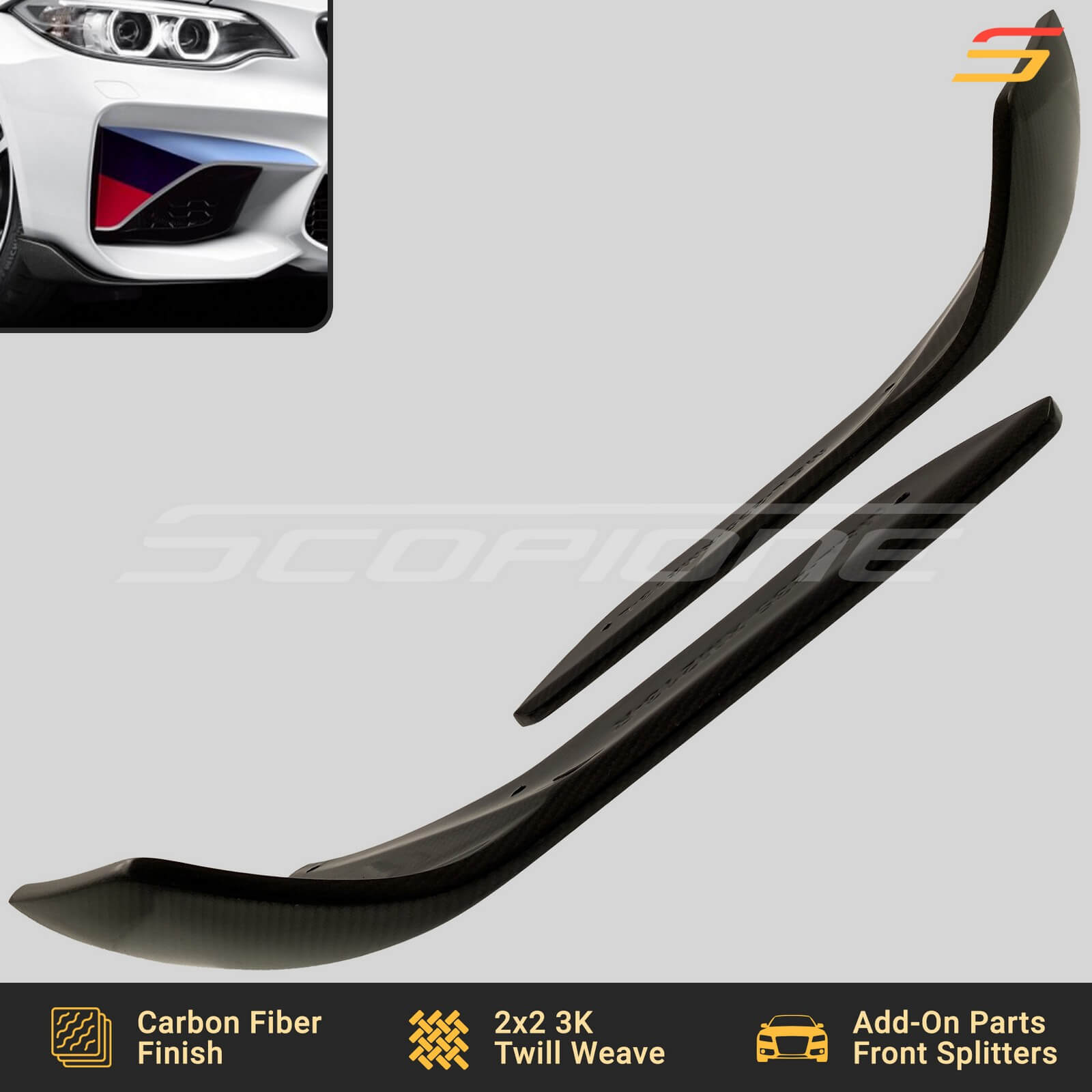
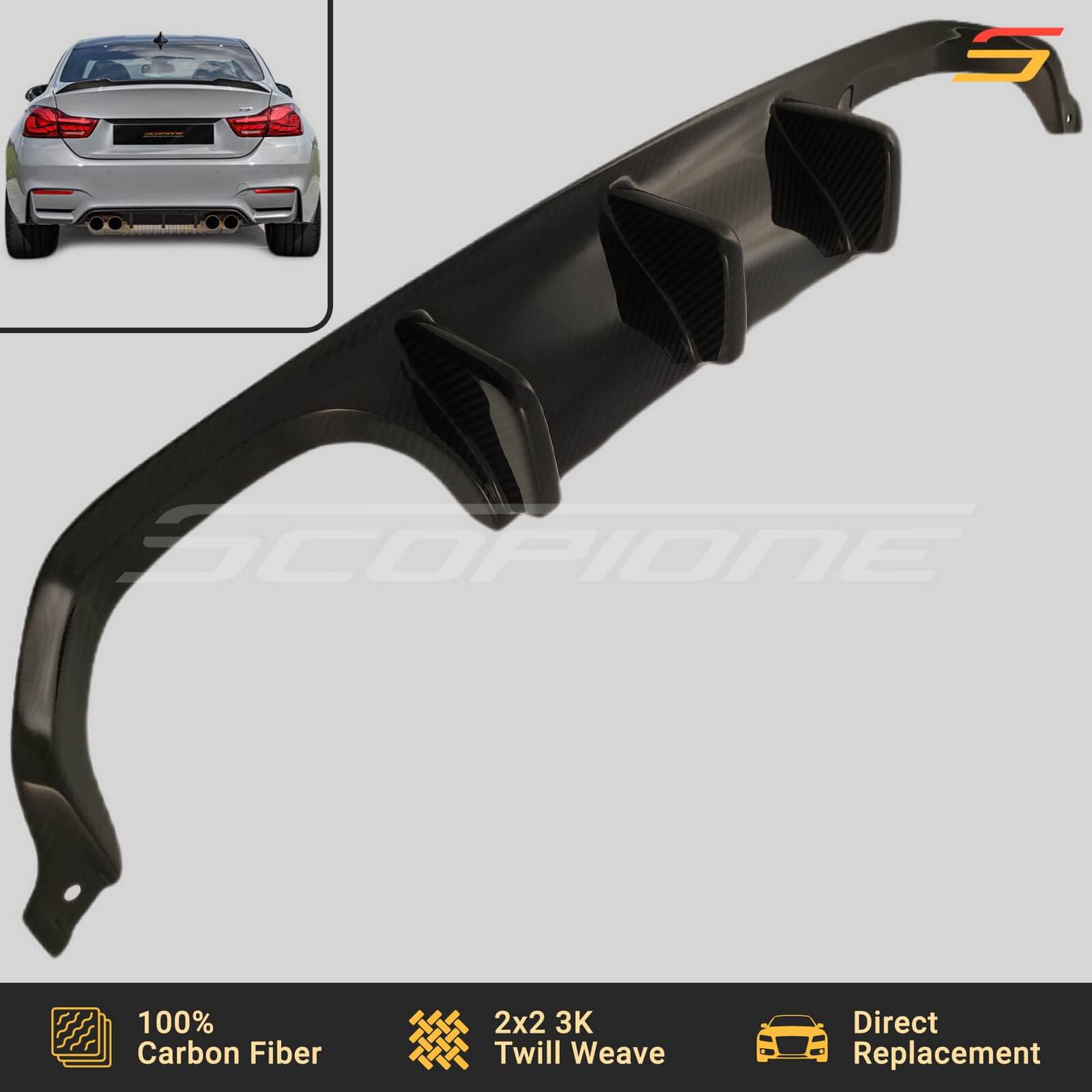
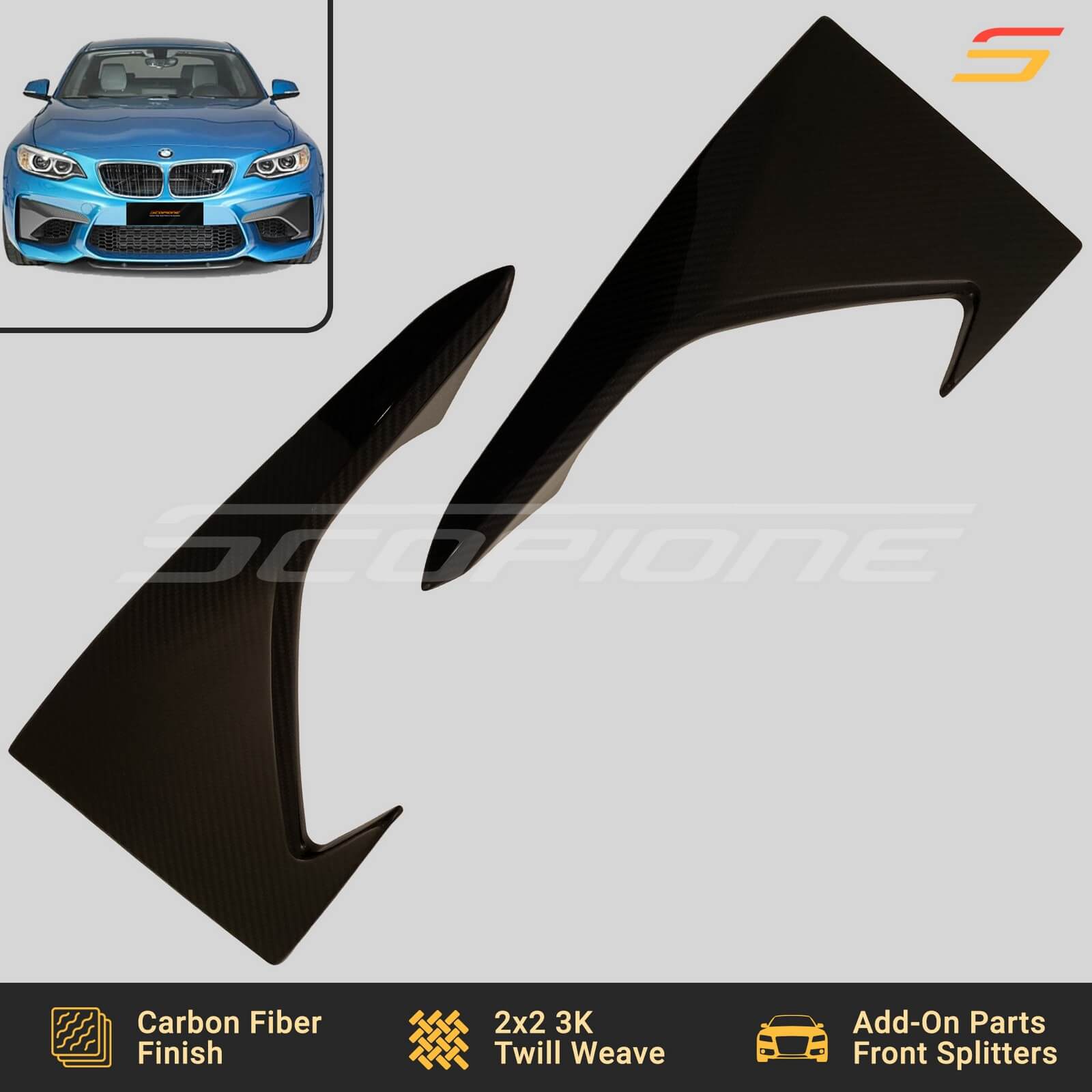
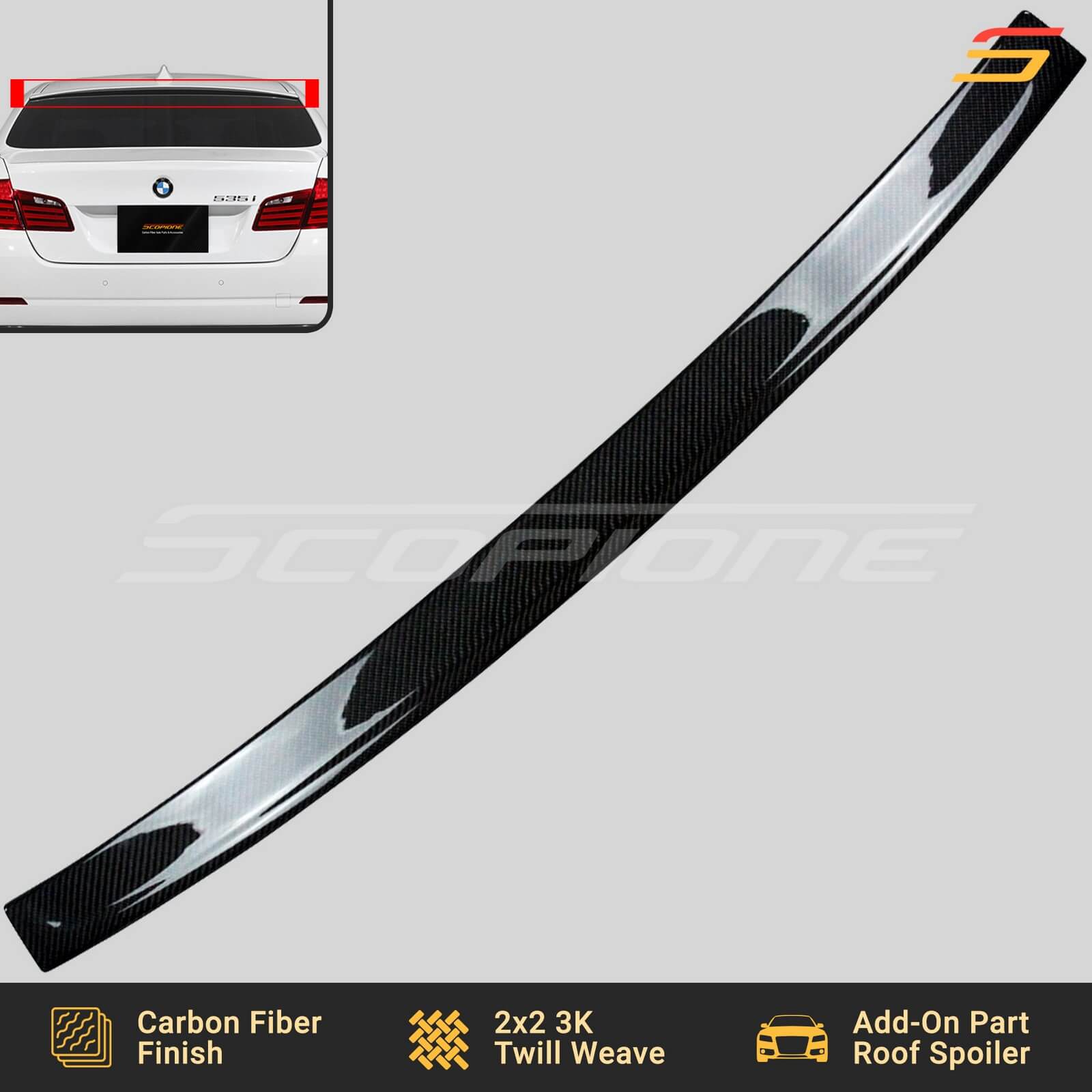
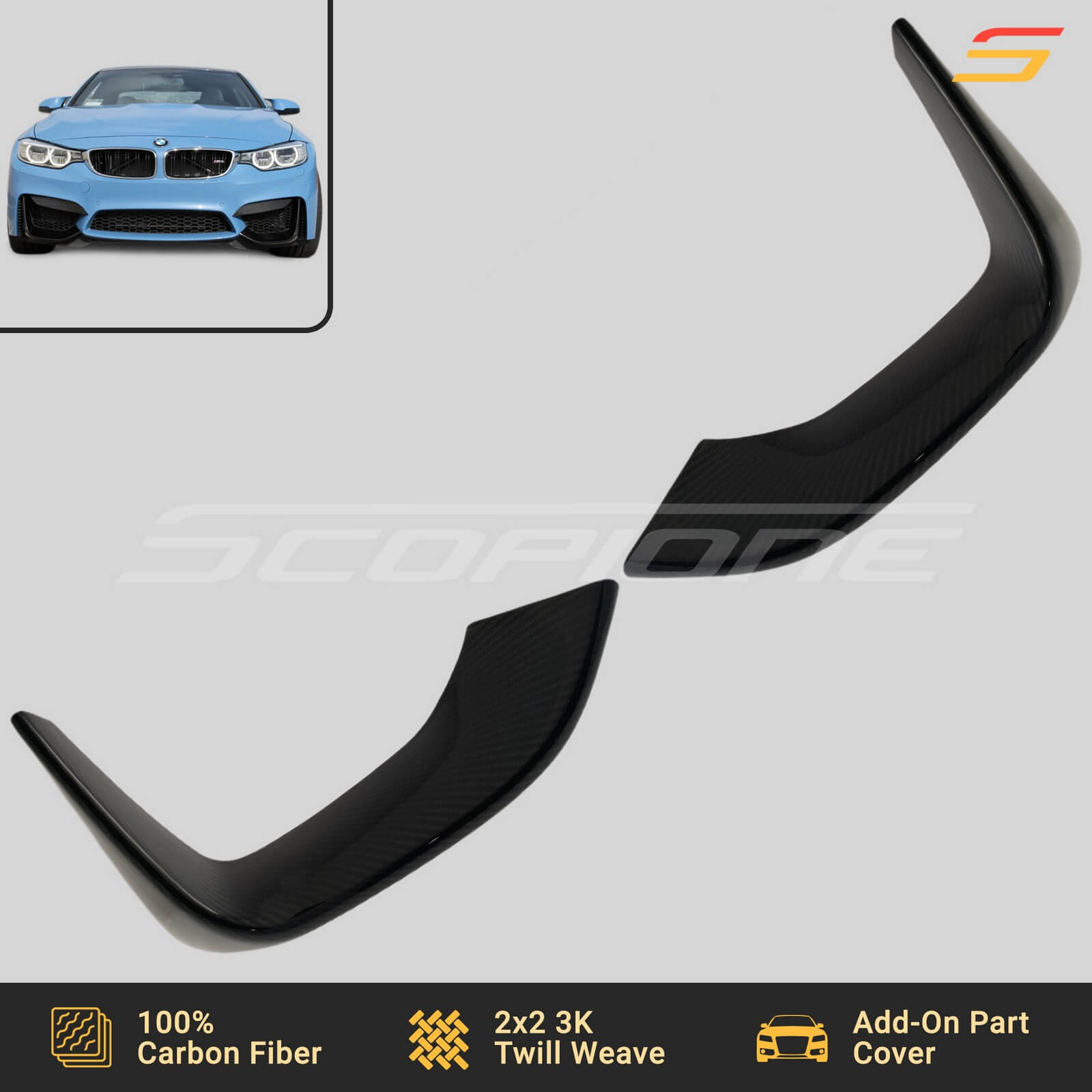
A selection of 24 of the 103 carbon fiber parts Scopione lists across the BMW range. Each image links to its product page.


More Scopione Picture Galleries
- Ferrari: 458 Italia & Spider • 488 GTB & Spider • F8 Tributo & Spider • F12 & 812 Superfast • SF90
- Lamborghini: Gallardo • Huracan • Aventador • Urus
- McLaren: MP4-12C & 650S • 720S & 765LT • Sports Series
- Porsche: 911, Boxster & Cayman
- Audi: R8
- Nissan: GT-R R35 • 350Z, 370Z & Z
- Aston Martin: Vantage, DB9 & DBS
- Bentley: Continental GT & GTC
- Maserati: GranTurismo & GranCabrio
- Toyota: Supra
- Subaru: WRX STI
- Mitsubishi: Lancer Evolution
- Chevrolet: Corvette • Camaro
- Dodge: Viper
Experience the elegance and performance of the BMW with Scopione. Browse our gallery and get inspired to elevate your supercar with our top-of-the-line carbon fiber upgrades.
Shop now for premium ScopioneCarbon carbon fiber upgrades and experience the ultimate in performance and aesthetics for your BMW!