

 Shop
ShopThe Ferrari 458 Italia arrived in 2009 as the last naturally aspirated mid-engine V8 Ferrari road car – a distinction that grows more significant with every turbocharged and electrified successor. Powered by a 4,497 cc flat-plane crank V8 producing 562 hp at a 9,000 rpm redline, the 458 pushed specific output to 127 PS per liter and beat the Enzo’s Fiorano lap time by 1.4 seconds in its Speciale variant. An estimated 15,000 units were produced across Italia coupe, Spider, Speciale, and Speciale A variants between 2009 and 2015. Scopione carries 30 carbon fiber parts for the Ferrari 458 Italia and Spider, covering exterior aero, interior trim, engine bay panels, and shift paddles in both glossy and matte 2×2 twill-weave finishes.
Introduction: The Ferrari 458 Italia & Spider
Ferrari previewed the 458 Italia online on July 28, 2009, then unveiled it at the 63rd Frankfurt Motor Show that September. The car replaced the F430 with an entirely new aluminum space frame – designated Type F142 – that shared nothing structural with its predecessor. Pininfarina penned the exterior under Ferrari design director Donato Coco, drawing from the Enzo and the Millechili concept car. Interior design came from Bertrand Rapatel, with ergonomic input from Michael Schumacher on the steering wheel layout and control placement.
The F136 FB engine delivered 562 hp from 4,497 cc of naturally aspirated V8 with gasoline direct injection – a first for a mid-engine Ferrari. Flat-plane crank architecture, a 12.5:1 compression ratio, and 80% of the 398 lb-ft torque available from 3,250 rpm made the powerband both broad and rewarding at high RPM. A Getrag 7-speed dual-clutch gearbox shifted in as little as 0.04 seconds. No manual transmission was offered.
The 458 Spider followed in 2011 with an aluminum retractable hardtop that opened in 14 seconds – the first folding hard top on a mid-engine Ferrari. It weighed approximately 50 kg more than the coupe at 1,535 kg, but matched the Italia’s 3.4-second 0-60 time. The Maserati GranTurismo, built under the same corporate umbrella, used variants of the same F136 V8 engine family – though in a front-engine, grand touring application rather than the 458’s mid-engine sports car layout.

The 458 Platform (2009–2015): Engine, Variants & Speciale
The 458 Italia established a new performance baseline for Ferrari’s mid-engine V8 lineage. At 1,485 kg (3,274 lb) with a 2,650 mm wheelbase – 50 mm longer than the F430 – it combined a lower center of gravity with improved weight distribution. Magnetorheological dampers (SCM-E), double-wishbone front suspension, and a multilink rear managed the chassis. Aerodynamic development produced 140 kg (309 lb) of downforce at 200 km/h through a flat underbody and aeroelastic front winglets that deformed at speed, balancing downforce and cooling airflow.
458 Italia Coupe: Core Specifications
| Specification | 458 Italia | 458 Spider |
|---|---|---|
| Engine | 4,497 cc V8, 562 hp at 9,000 rpm | 4,497 cc V8, 562 hp at 9,000 rpm |
| Torque | 398 lb-ft at 6,000 rpm | 398 lb-ft at 6,000 rpm |
| Transmission | 7-speed dual-clutch (Getrag) | 7-speed dual-clutch (Getrag) |
| 0-60 mph | 3.4 seconds | 3.4 seconds |
| Top Speed | 202 mph (325 km/h) | 199 mph (320 km/h) |
| Curb Weight | 1,485 kg (3,274 lb) | 1,535 kg (3,384 lb) |
| Drivetrain | Rear-wheel drive | Rear-wheel drive |
| Fiorano Lap | 1:25.0 | — |
The Lamborghini Huracan, launched in 2014, became the 458’s direct competitor during the final production years. Both naturally aspirated, both mid-engine, both targeting the same buyers.
458 Speciale (2013–2015): The Analog Peak
The 458 Speciale extracted 605 cv (597 hp) from the revised F136 FL engine by raising the compression ratio to 14:1 – a record for a naturally aspirated V8 road car at the time. Specific output reached 135 cv per liter, another record. Ferrari cut 90 kg from the standard Italia through lighter forged 20-inch wheels (12 kg alone), thinner glass, a Lexan polycarbonate rear window, carbon-fiber underbody panels, and a stripped interior.
Active aerodynamics set the Speciale apart from every prior Ferrari V8. Front and rear movable flaps adjusted continuously: above 170 km/h, front flaps opened to reduce radiator airflow and cut drag; above 220 km/h, a lower horizontal flap shifted overall downforce 20% rearward. Total downforce at 200 km/h reached 240 kg (529 lb), nearly double the standard Italia. Side Slip Control (SSC) integrated F1-Trac and E-Diff for electronic chassis management that allowed controlled oversteer without disabling stability systems entirely.
At Fiorano, the Speciale lapped in 1:23.5 – 1.4 seconds faster than the Enzo’s 1:24.9. Ferrari built 1,309 units. Against a $288,000 base MSRP, clean Speciales now trade between $400,000 and $808,500, a record set at Saratoga in September 2025.
458 Speciale A, Spider & Challenge Variants
- 458 Speciale A (Aperta, 2014–2015) – Open-top Speciale limited to 499 units (49 right-hand drive), confirmed by Ferrari. Same 605 cv engine. The highest-output street-legal NA Ferrari convertible until the LaFerrari Aperta. Current market: $950,000 to over $3 million.
- 458 Spider (2011–2015) – Aluminum retractable hardtop operating in 14 seconds. Ferrari claimed the aluminum roof was 25 kg lighter than the F430 Spider’s fabric top, with 12% better aerodynamic efficiency. Approximately 50 kg heavier than the coupe; top speed 199 mph versus 202 mph.
- 458 Challenge / Challenge Evo (2011–2014) – Purpose-built race cars for the Ferrari Challenge one-make series. 1,277 kg with empty fuel tank. CCM2 Brembo brakes sourced from the 599XX program, polycarbonate windows, center-lock wheels, air jacks, and plumbed fire suppression. Approximately 150 units built across both versions. Fiorano: 1:16.5.
458 MSRP When New
| Variant | Base MSRP | Inflation-Adjusted (2025) |
|---|---|---|
| 458 Italia | $225,325 (2010) | ~$329,000 |
| 458 Spider | ~$257,000 (2012) | ~$360,000 |
| 458 Speciale | $288,000 (2014) | ~$384,000 |
| 458 Speciale A | ~$320,000 (2014) | ~$425,000 |
The McLaren MP4-12C, launched in 2011 at a comparable price point, targeted the same performance envelope from a different engineering philosophy: McLaren’s MonoCell carbon tub versus Ferrari’s aluminum space frame.
Carbon Fiber on the Ferrari 458
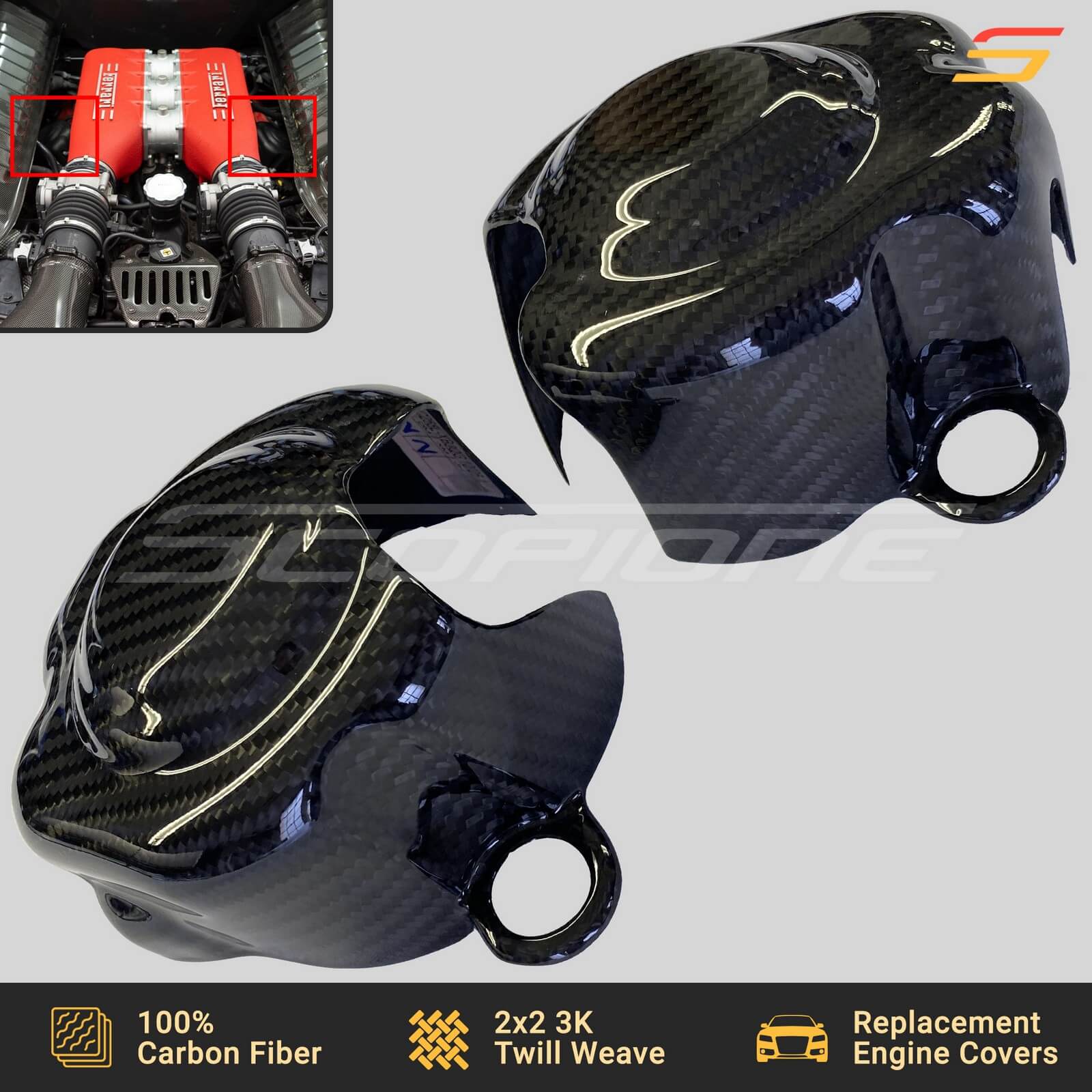
Ferrari offered an extensive carbon-fiber options catalog for the 458 through the factory configurator. A full carbon fiber interior package – dashboard trim, center console, door panels – cost upward of $20,000. Carbon fiber racing seats, a carbon-fiber steering wheel with LED shift indicator, engine covers, exterior mirrors, side air intakes, and a rear diffuser were all available as individual options. Ferrari used a 1×1 3K plain weave pattern for factory carbon components.
Exterior Carbon Fiber Applications
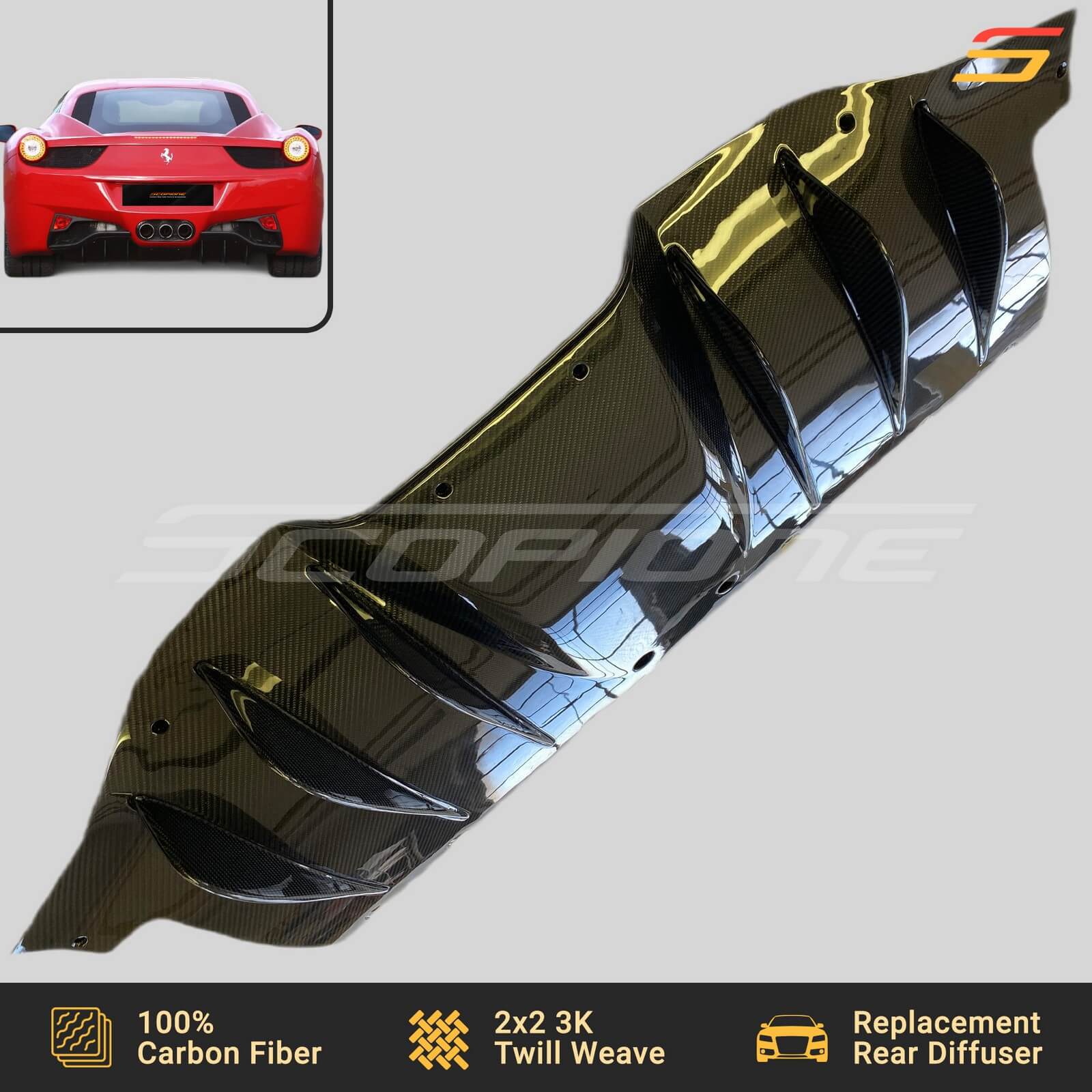
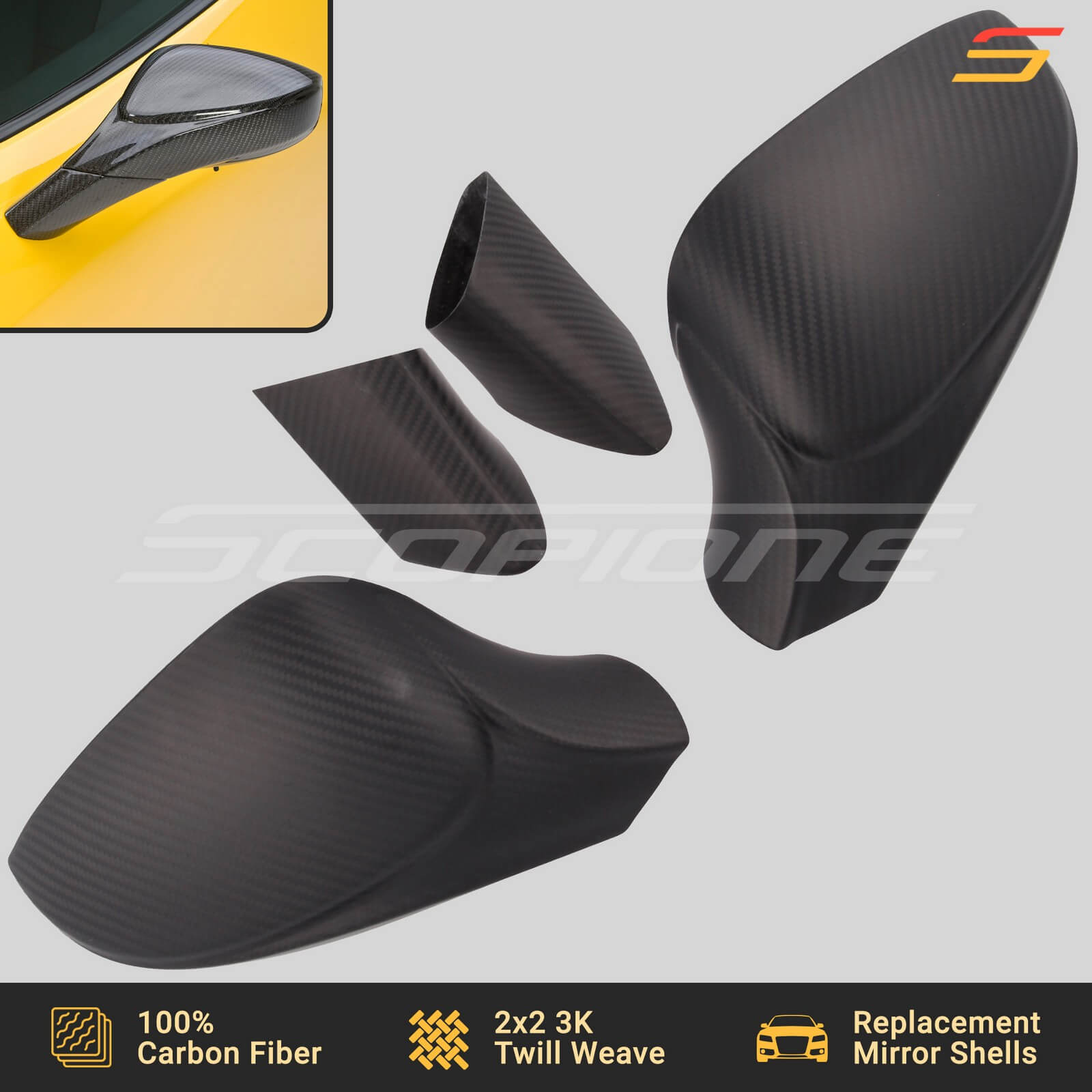
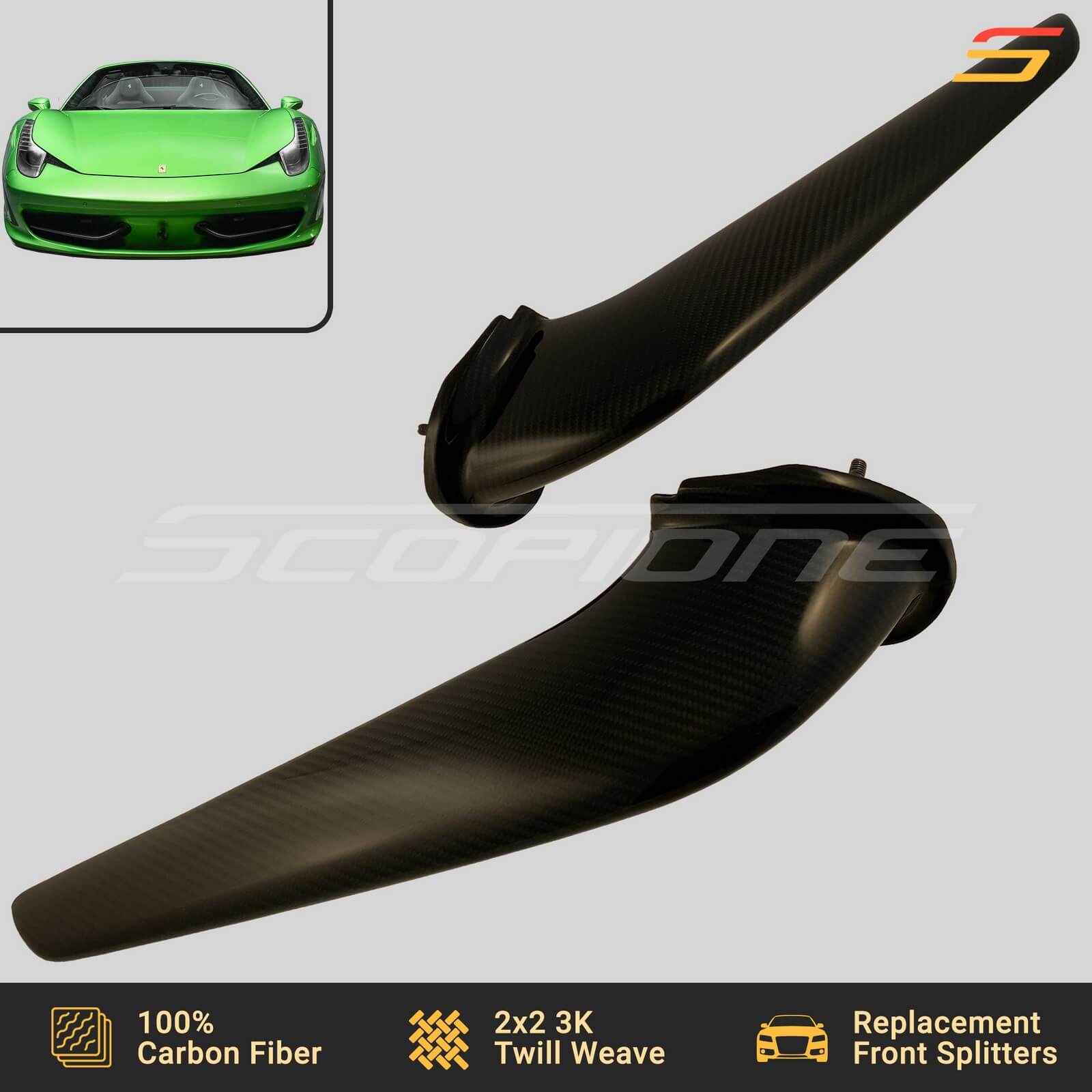
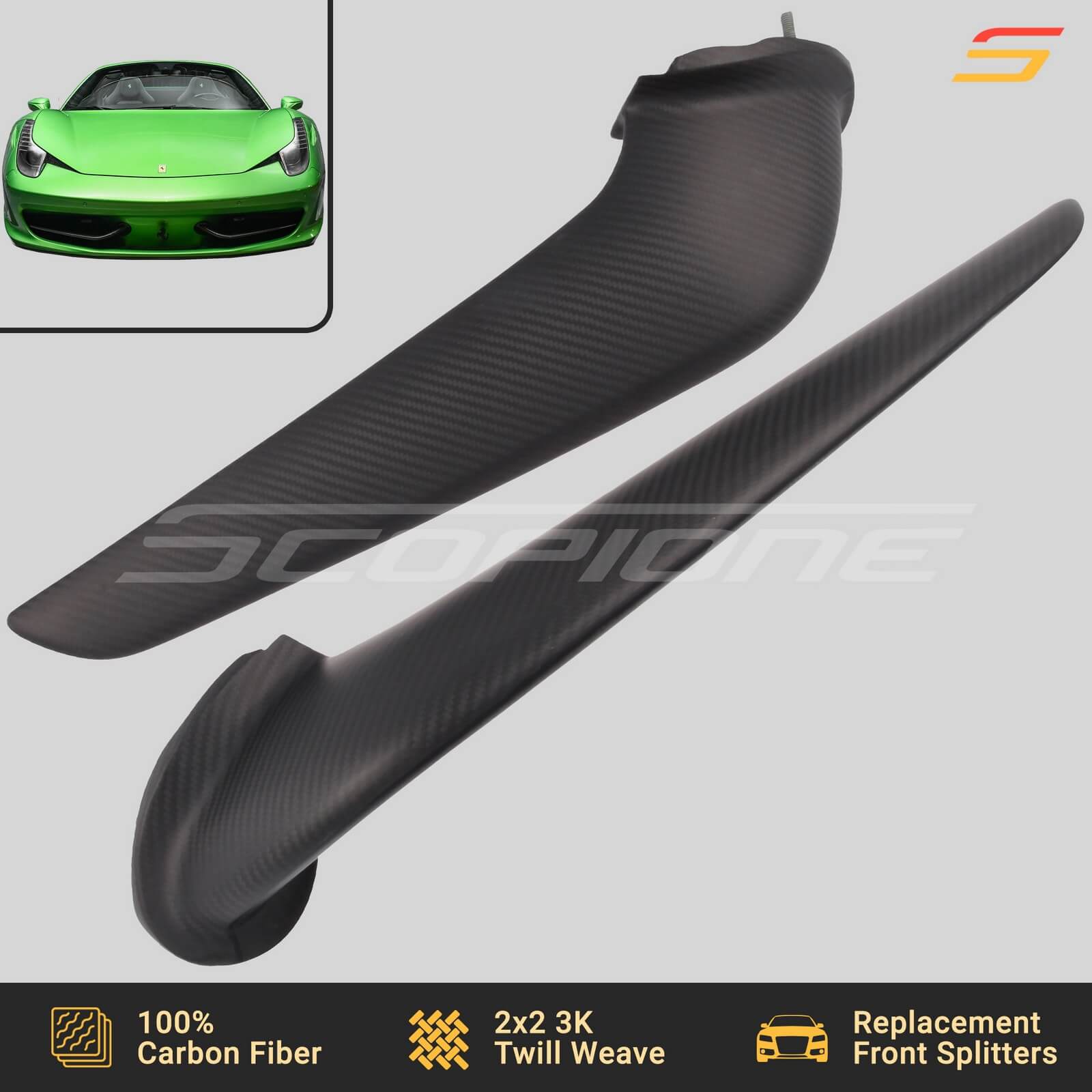
The 458’s exterior lends itself to carbon fiber in areas where the visual contrast against painted bodywork is immediately apparent. Front bumper splitters sit at the car’s lowest forward point and are among the first details visible at eye level in parking scenarios. Mirror shell replacements are high-visibility components that catch light from multiple angles. The rear diffuser – one of the largest single carbon-fiber pieces available for the 458 – transforms the rear view by replacing the factory-painted plastic insert with exposed twill weave.
- Front bumper splitters – extend the lower front profile and add visual depth to the front fascia
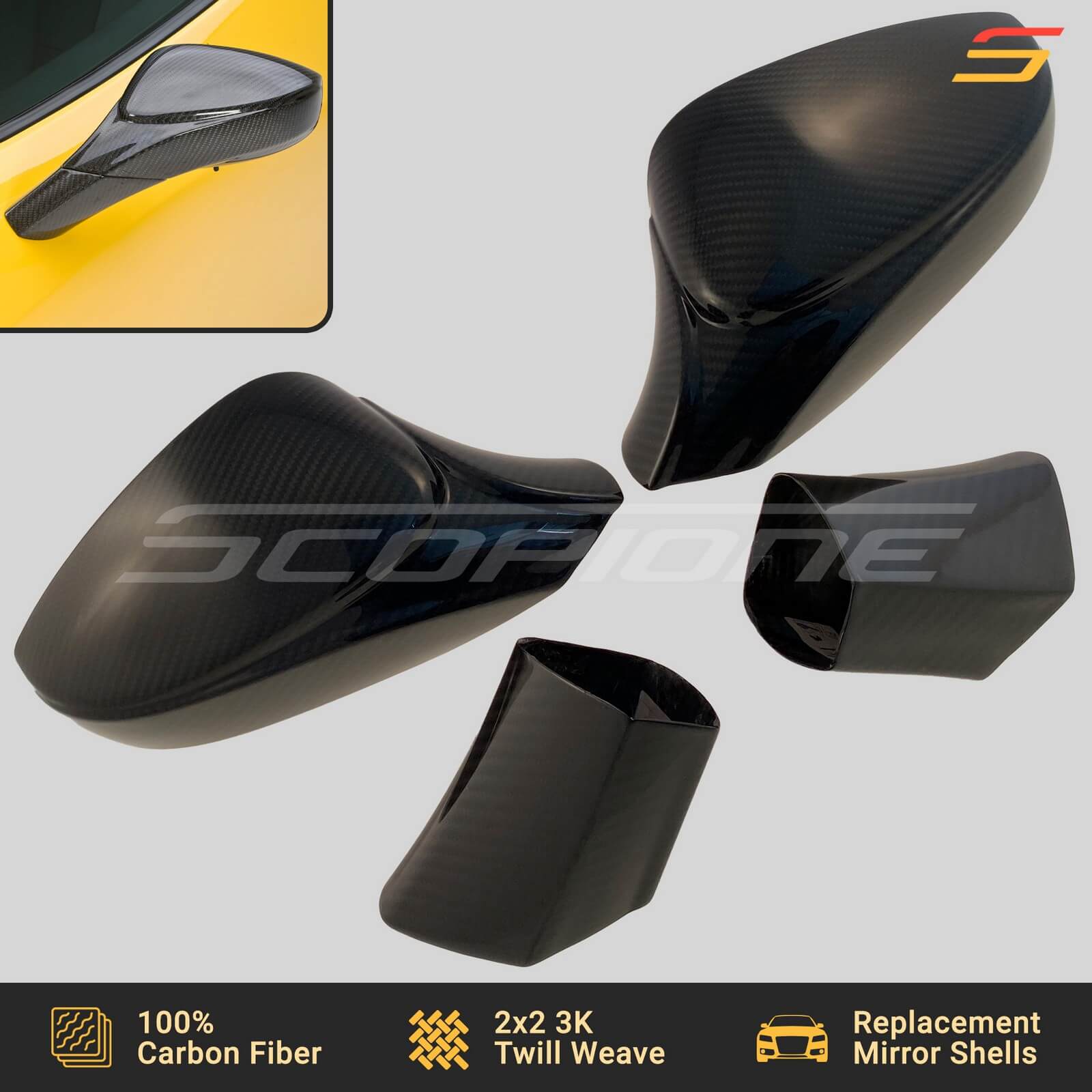
- Mirror shells in glossy or matte – visible from every angle of approach; available in both finishes to match interior trim preference
- Rear diffuser – the single highest-impact exterior CF piece, spanning the full width of the rear bumper
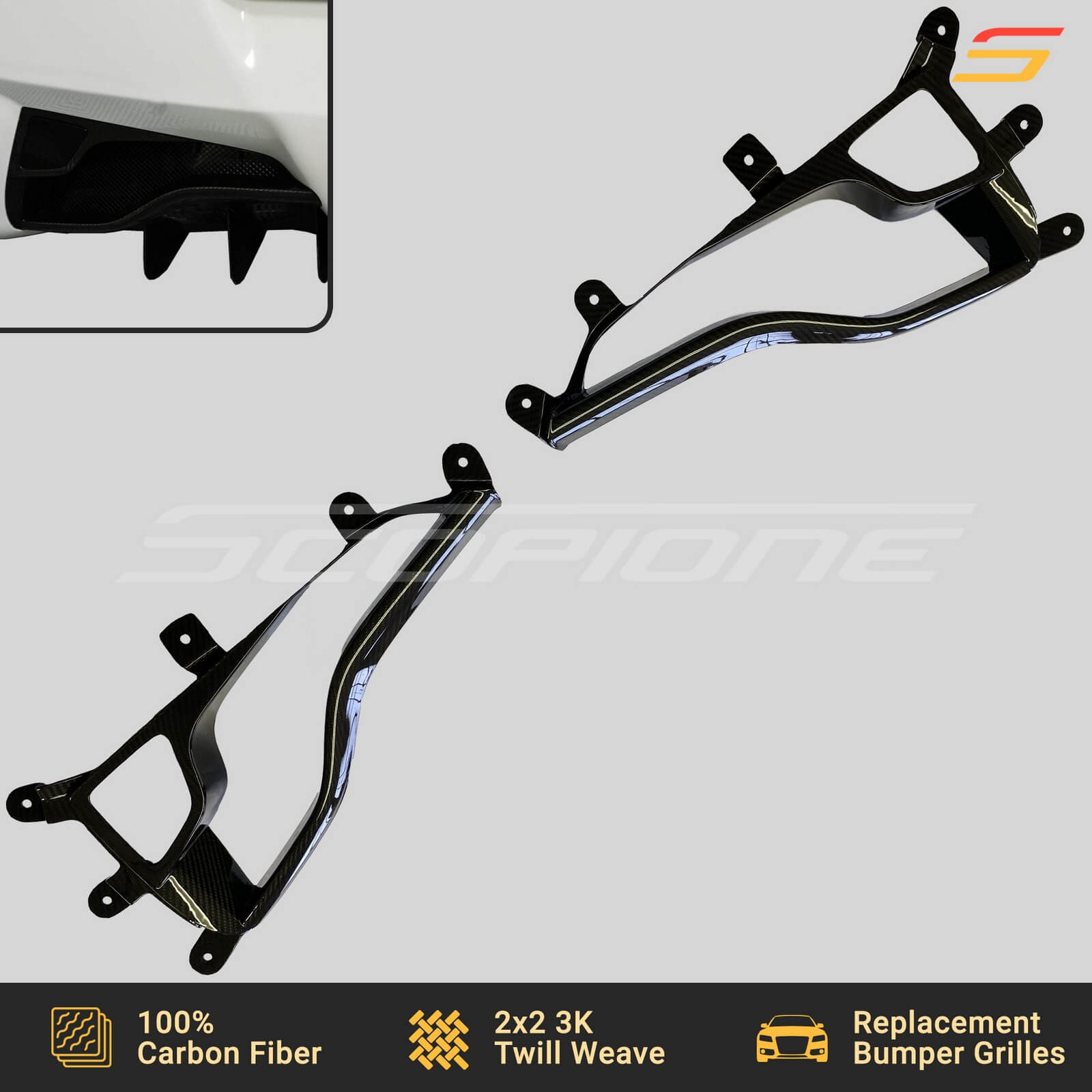
- Fog light grille vents – replace painted plastic inserts flanking the rear license plate
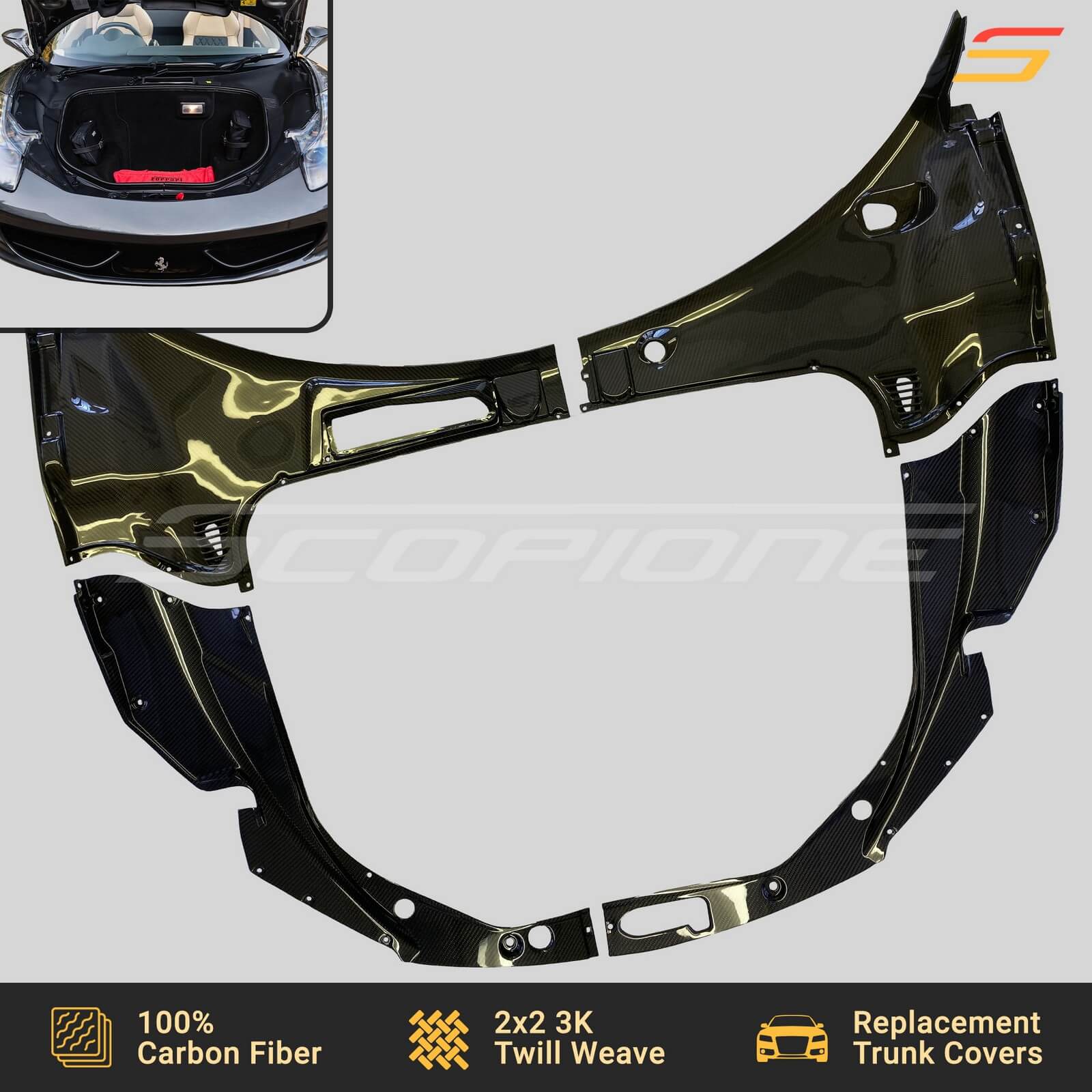
- Front trunk covers, side panels, and top bonnet – three separate kits covering the entire front luggage compartment in carbon fiber
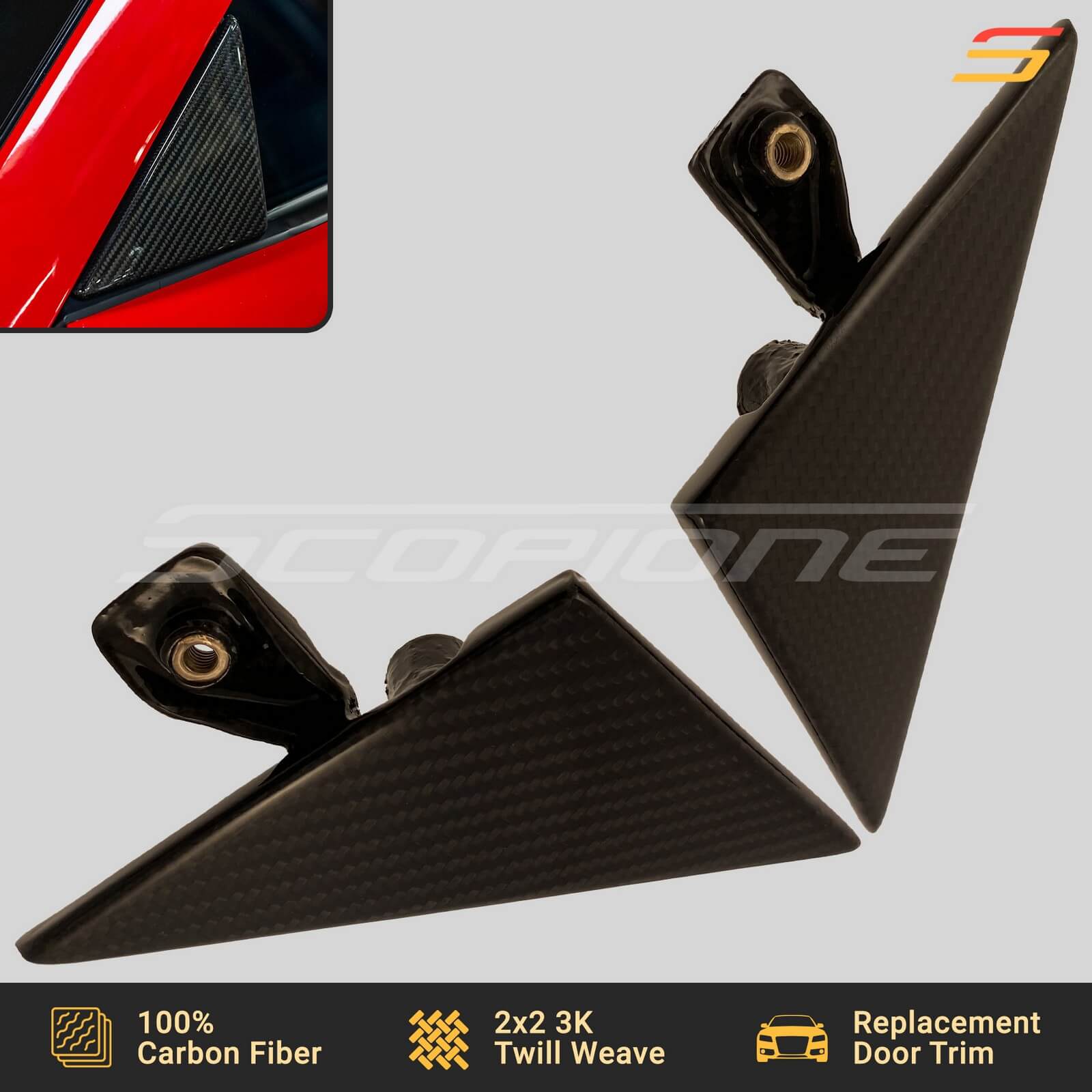
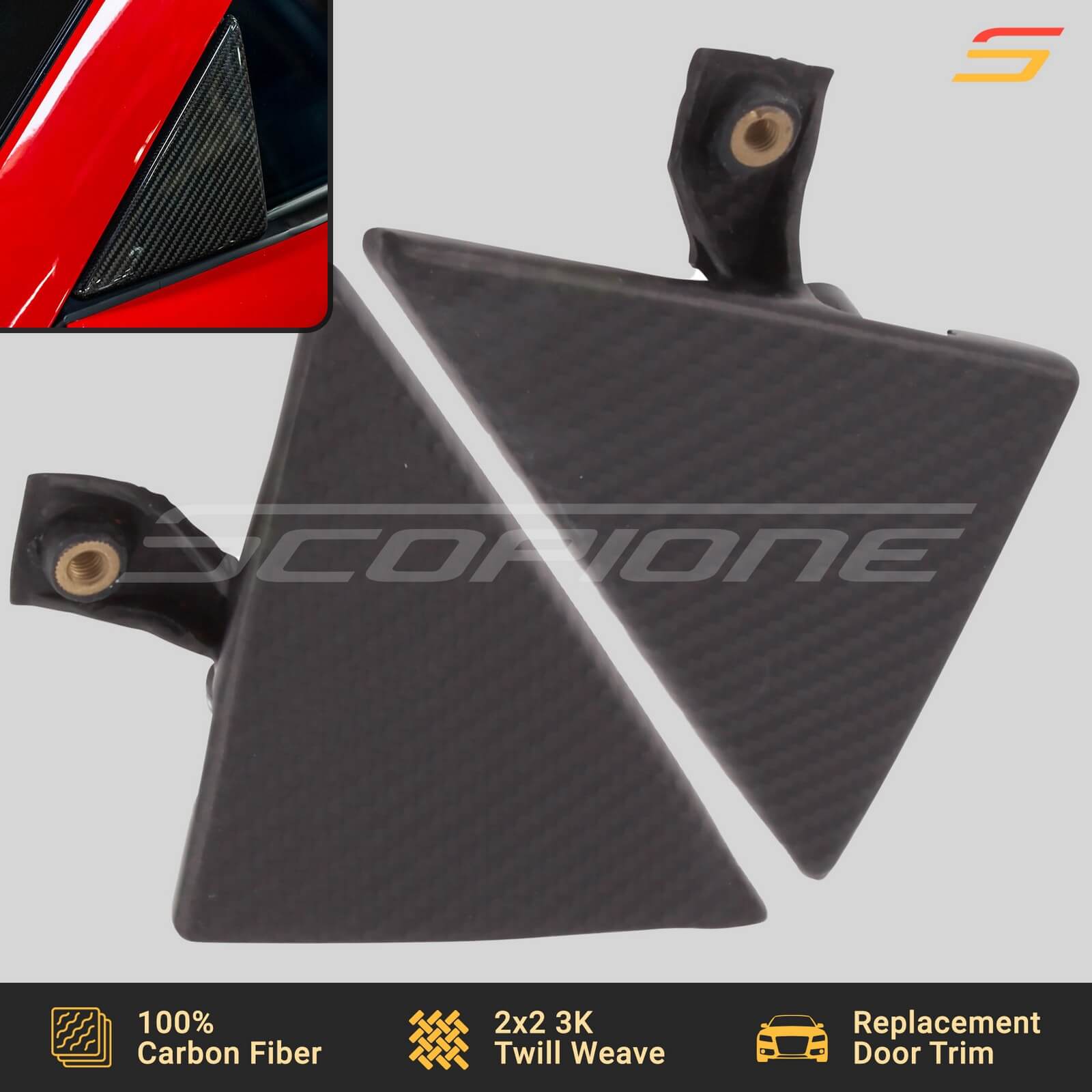
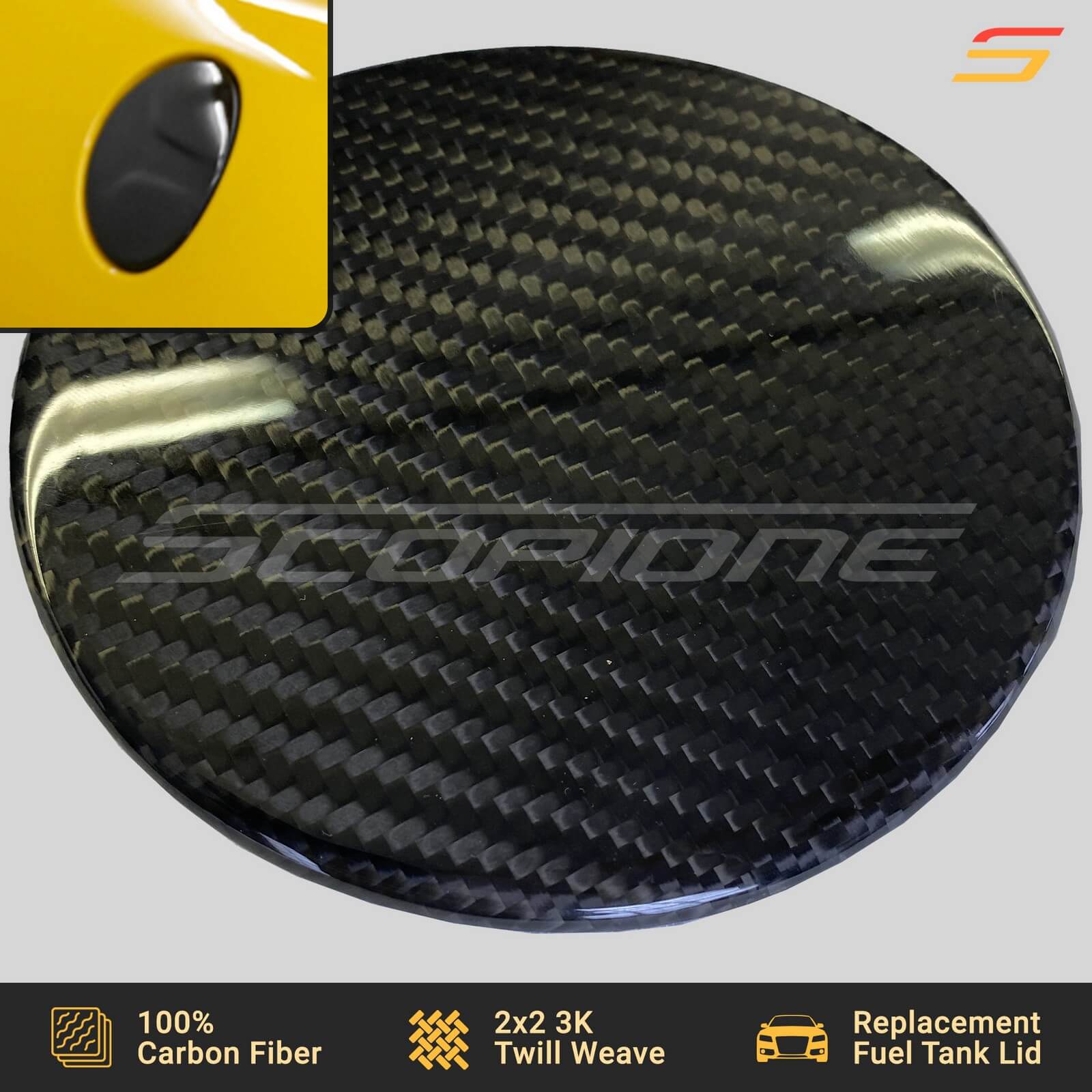
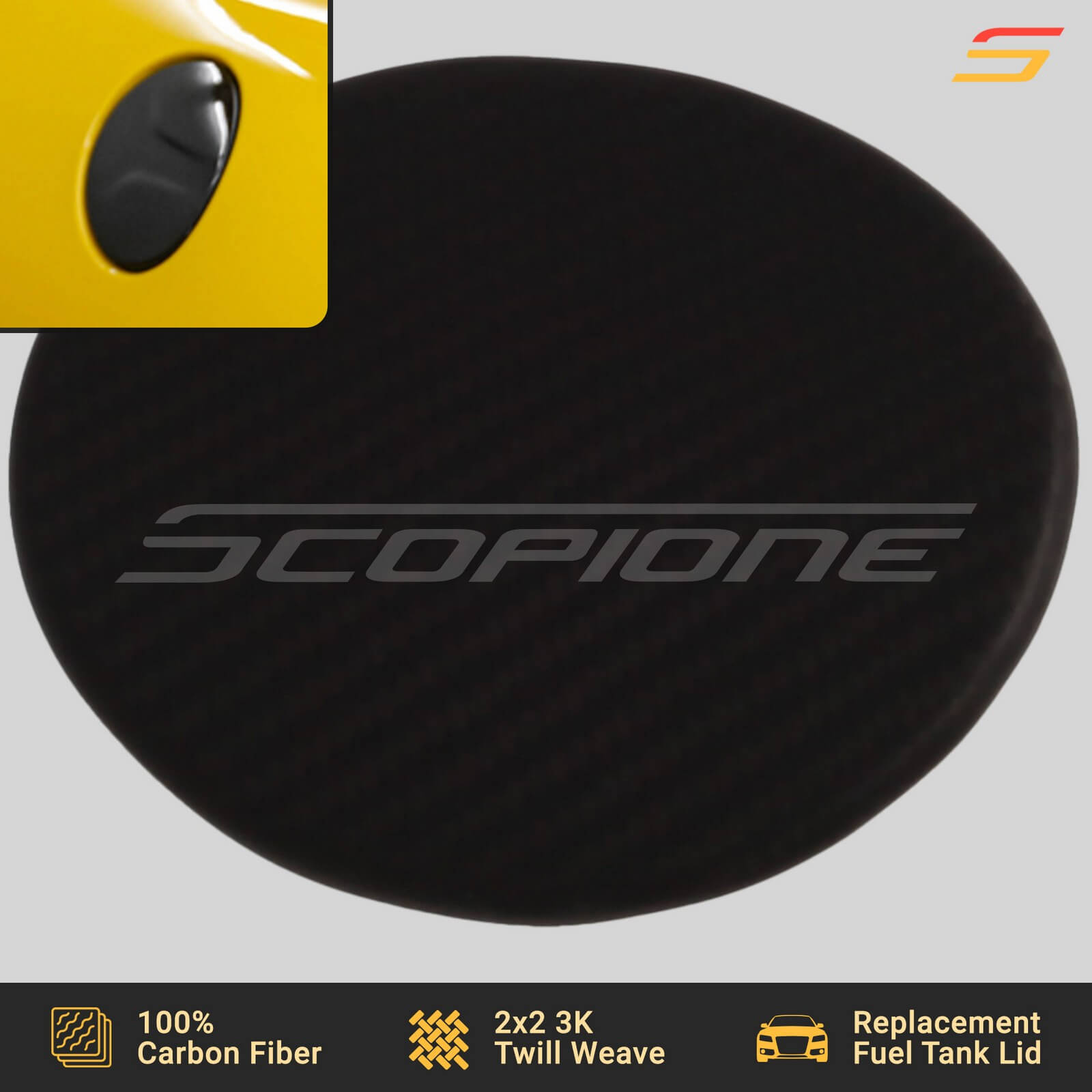
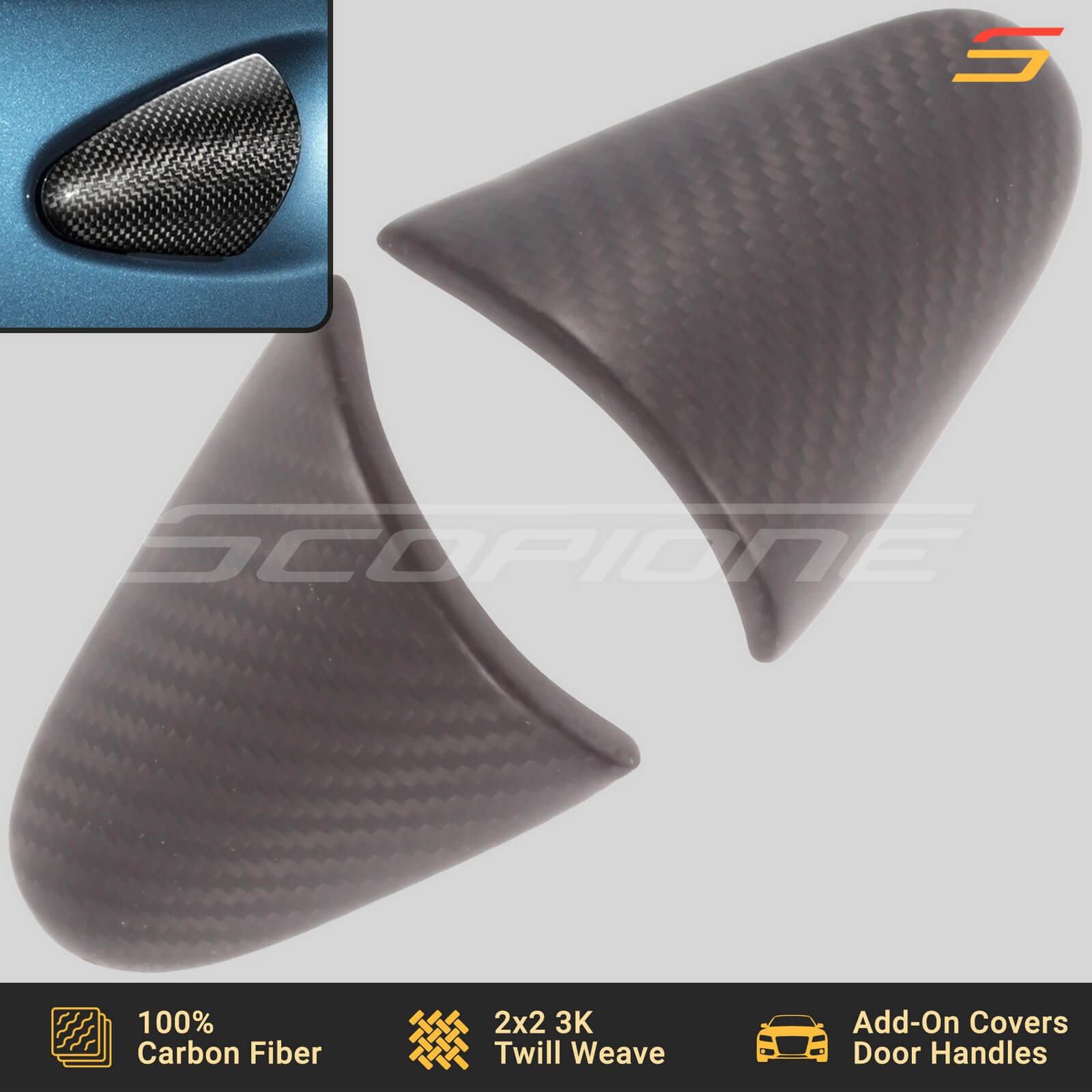
- Window door triangle trim, door handle covers, and fuel filler cap – smaller accent pieces available in both glossy and matte
Interior & Engine Bay
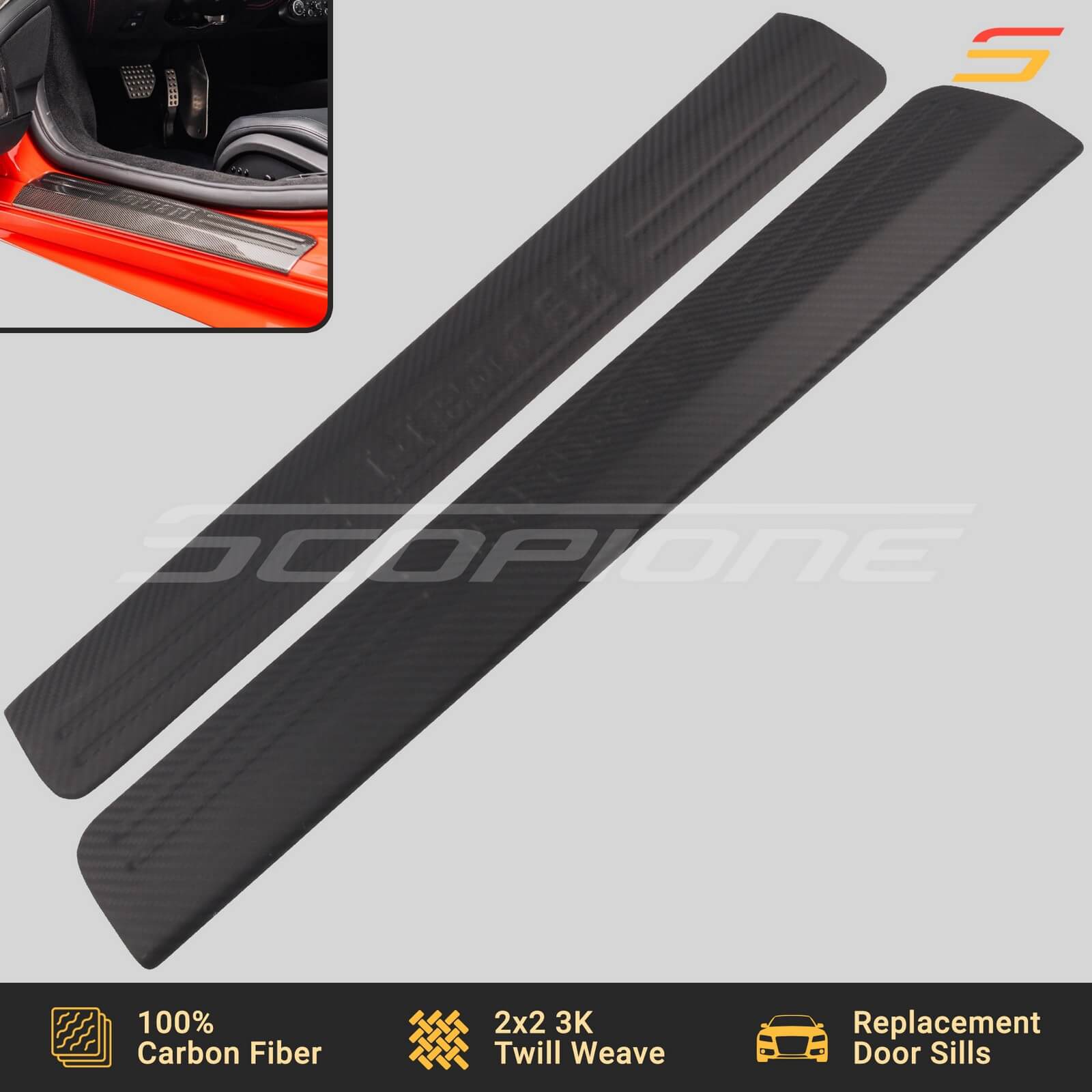
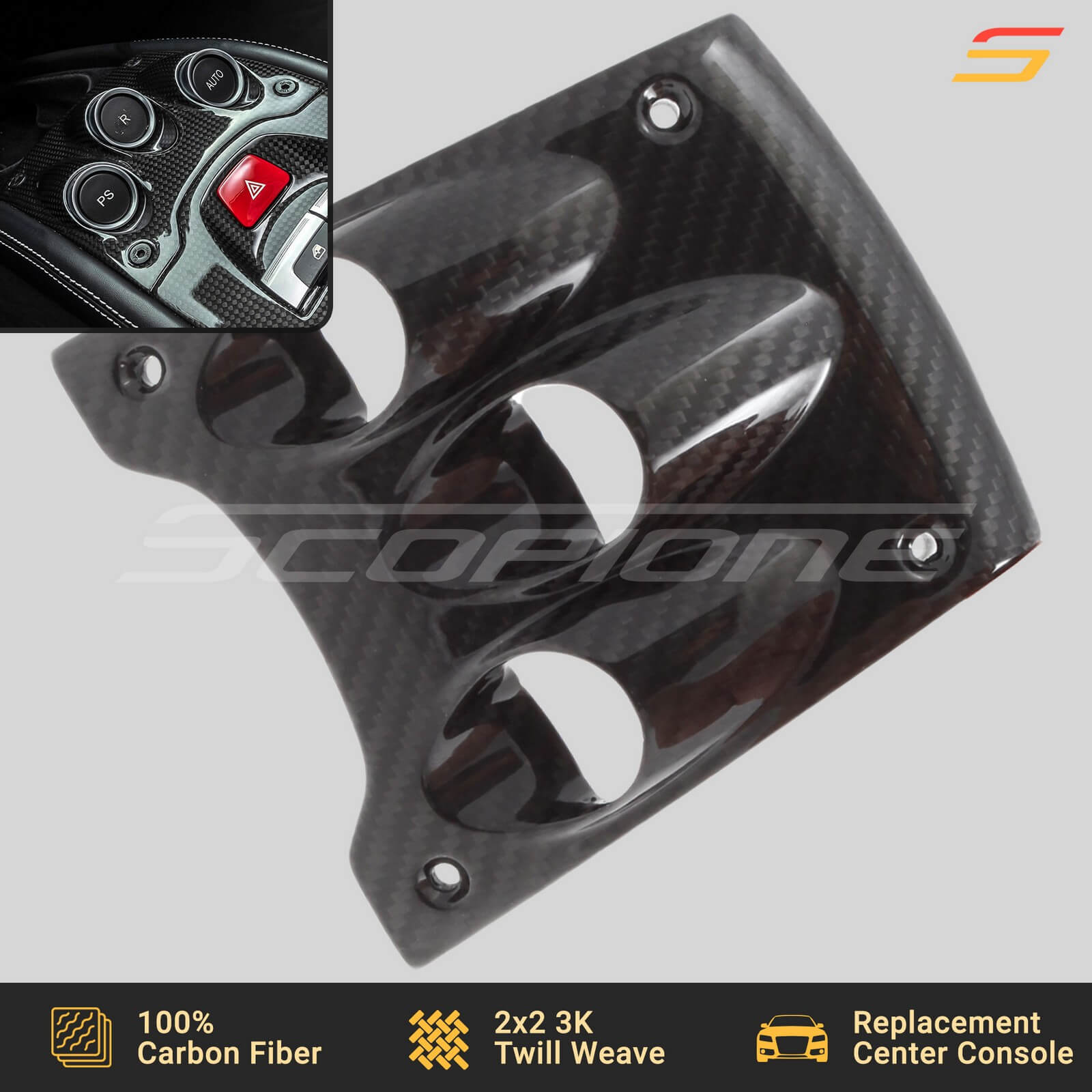
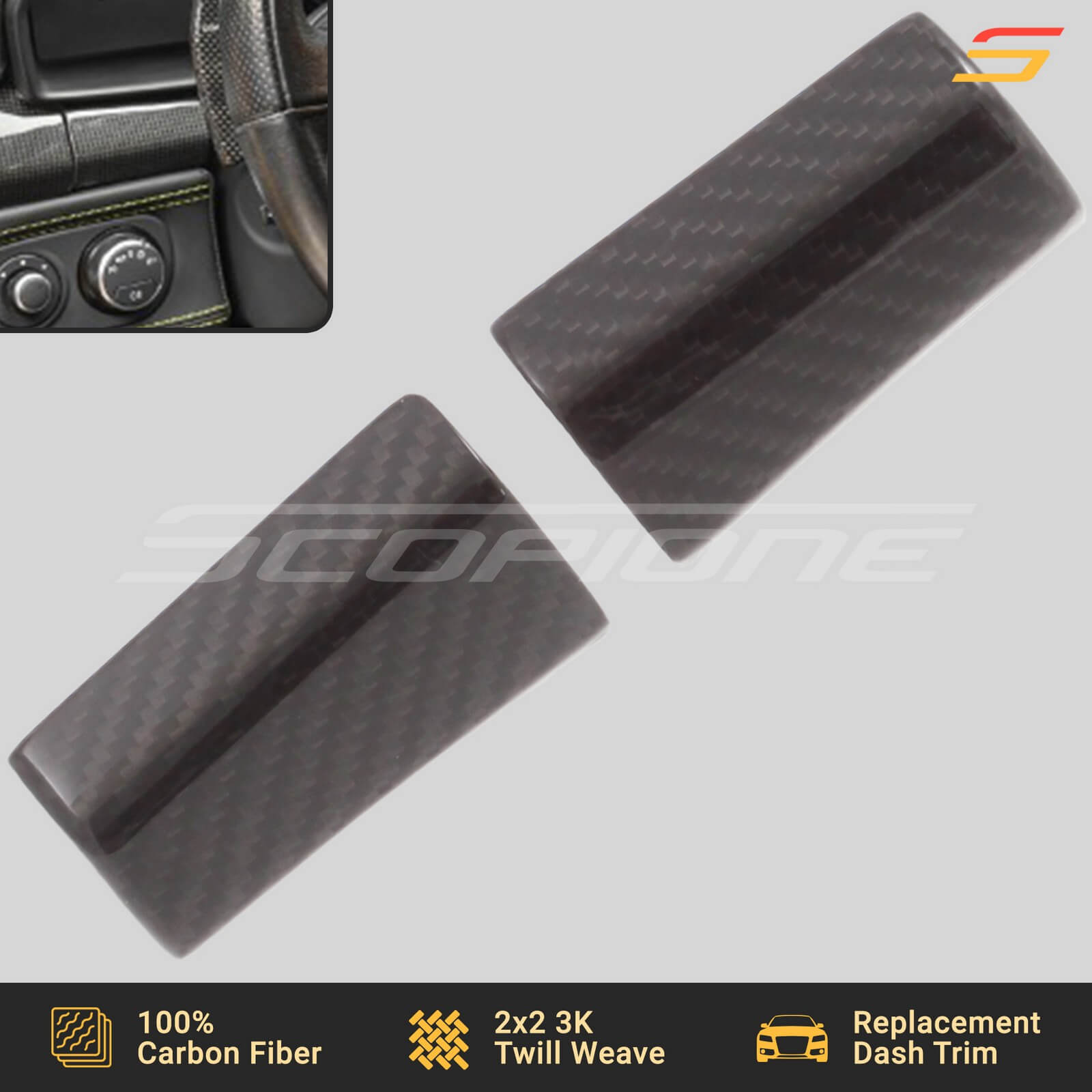
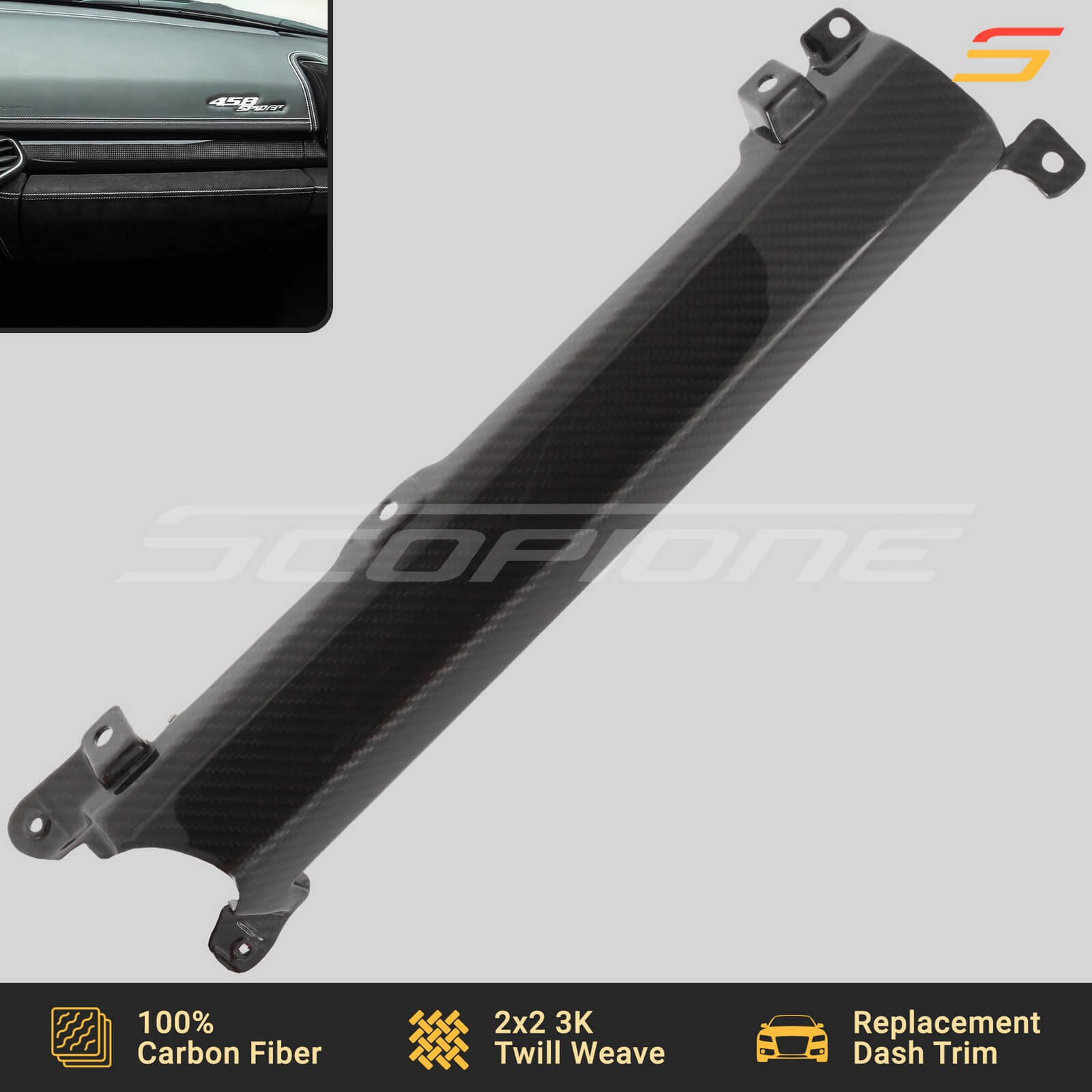
Inside the cockpit, carbon fiber trim pieces cover the surfaces drivers see and touch daily: dashboard air vent bezels, the F1 gearbox control surround, the center tunnel switch cluster, and the glove box panel. Carbon-fiber shift paddles – also compatible with the F12 Berlinetta and FF – replace the factory aluminum paddles with a lighter, more rigid alternative.
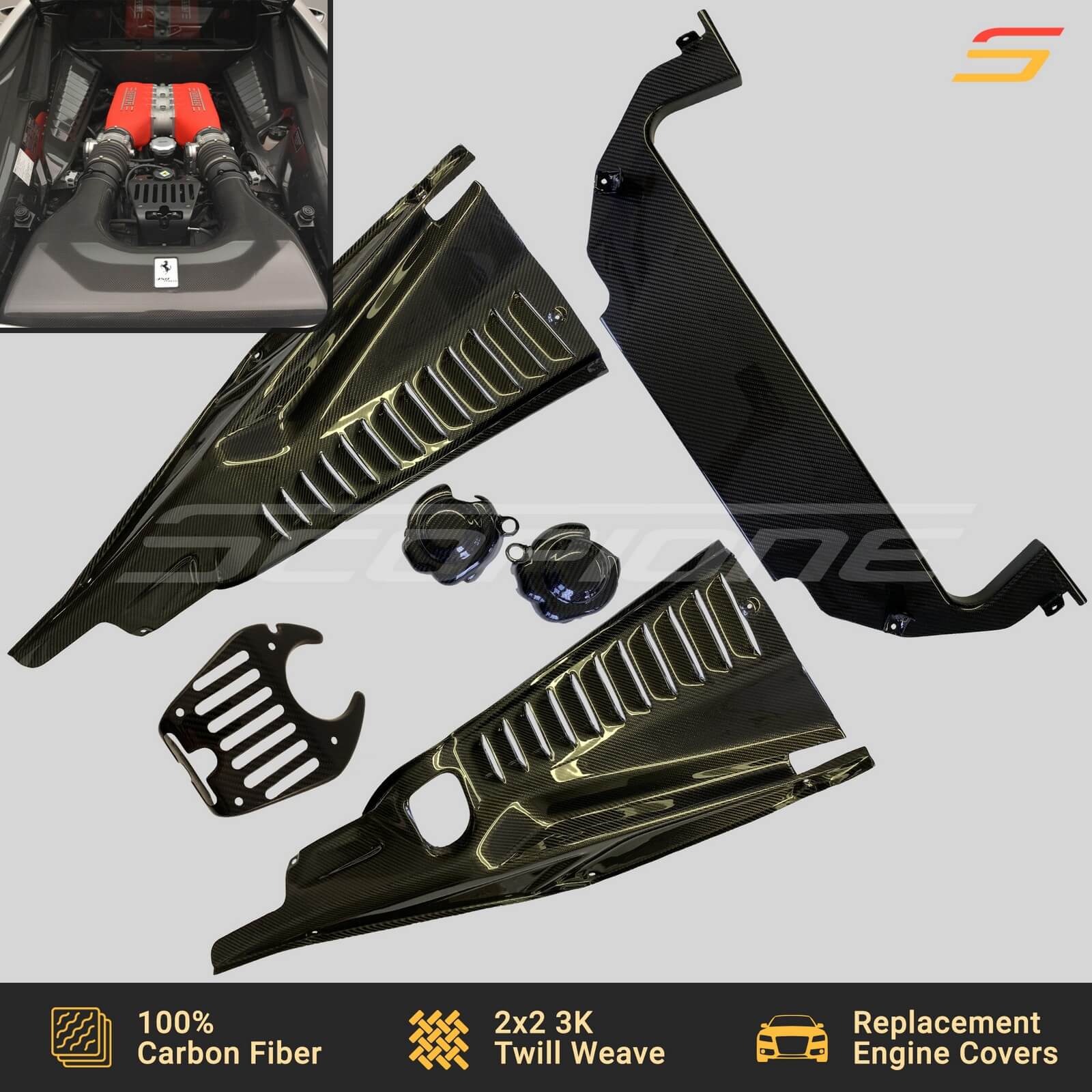
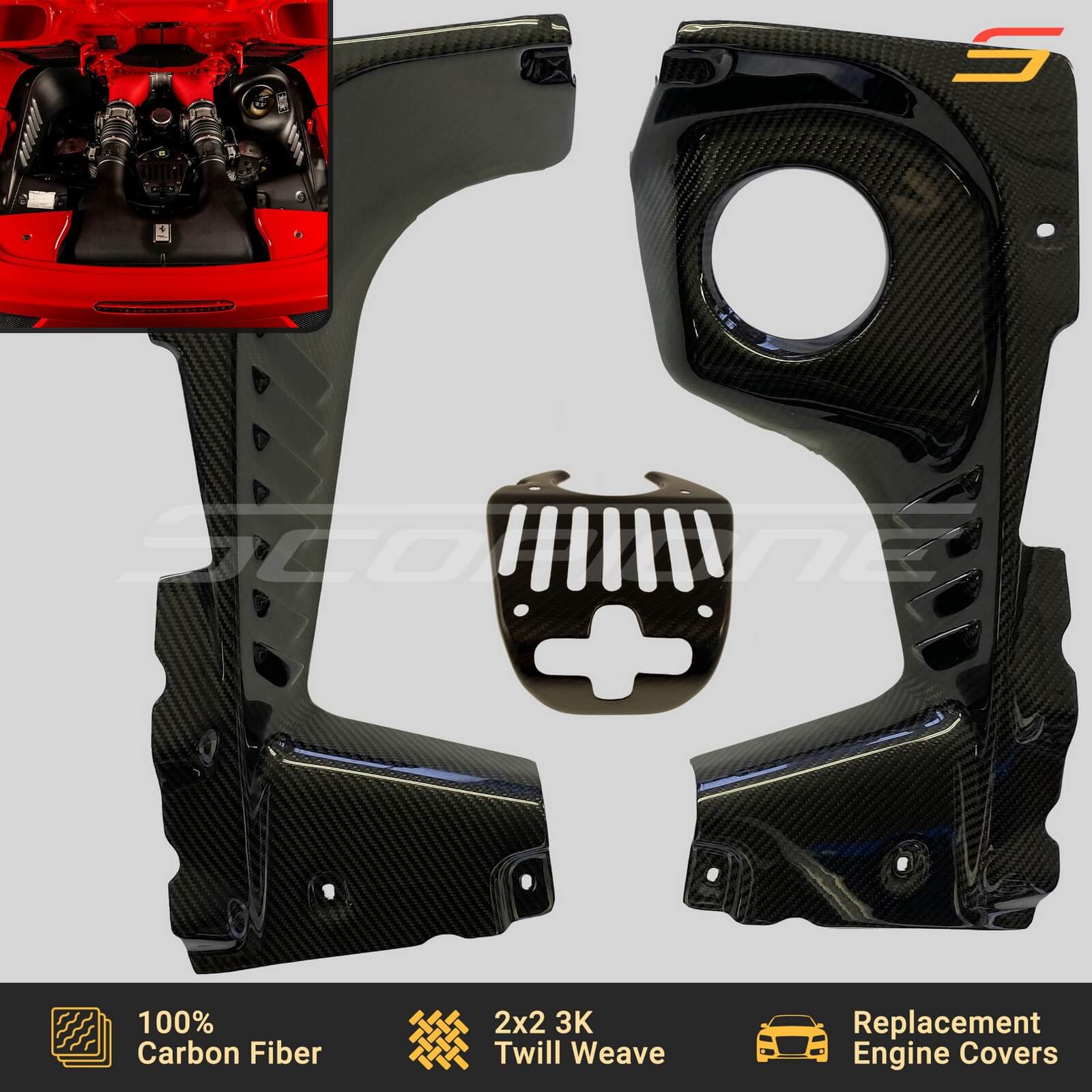
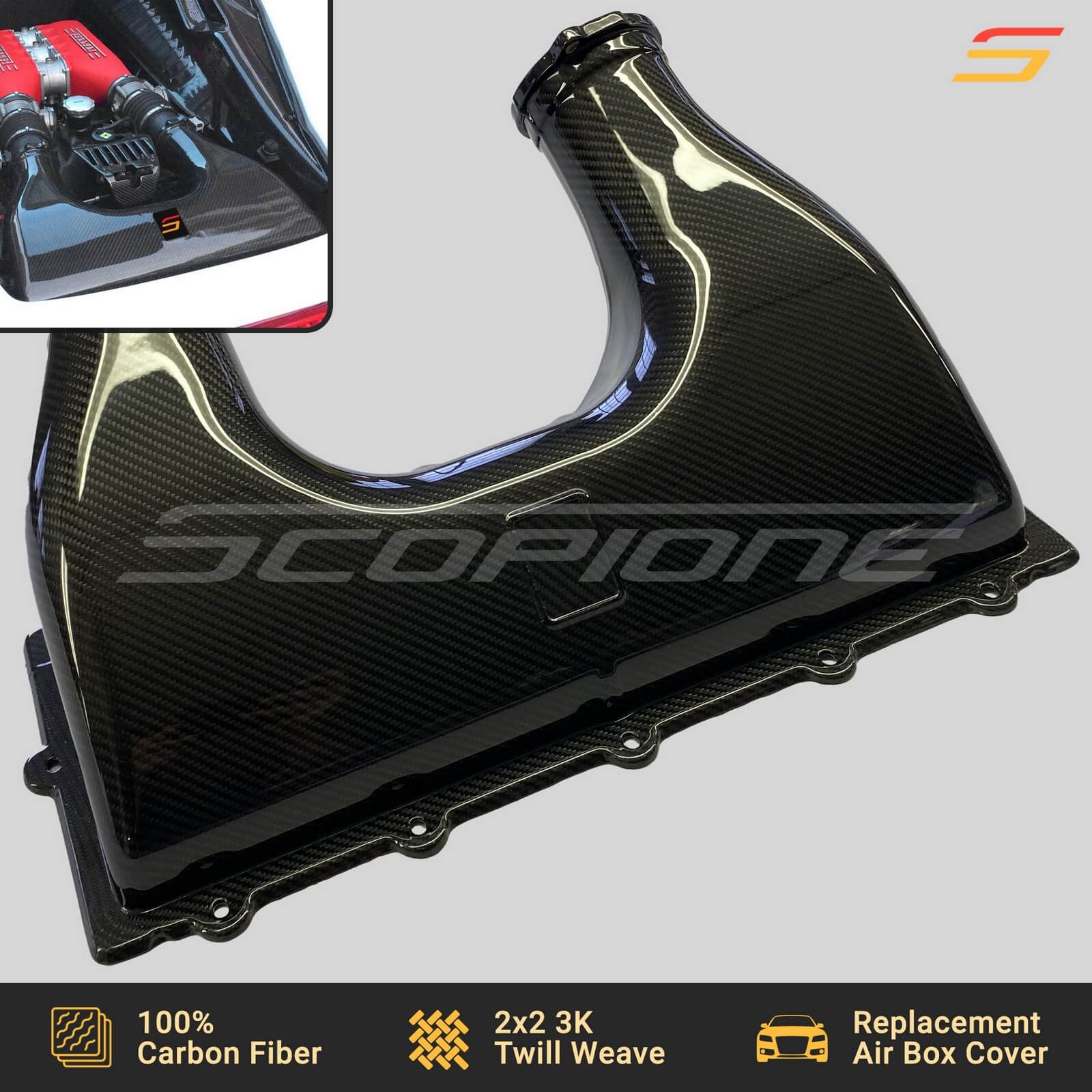
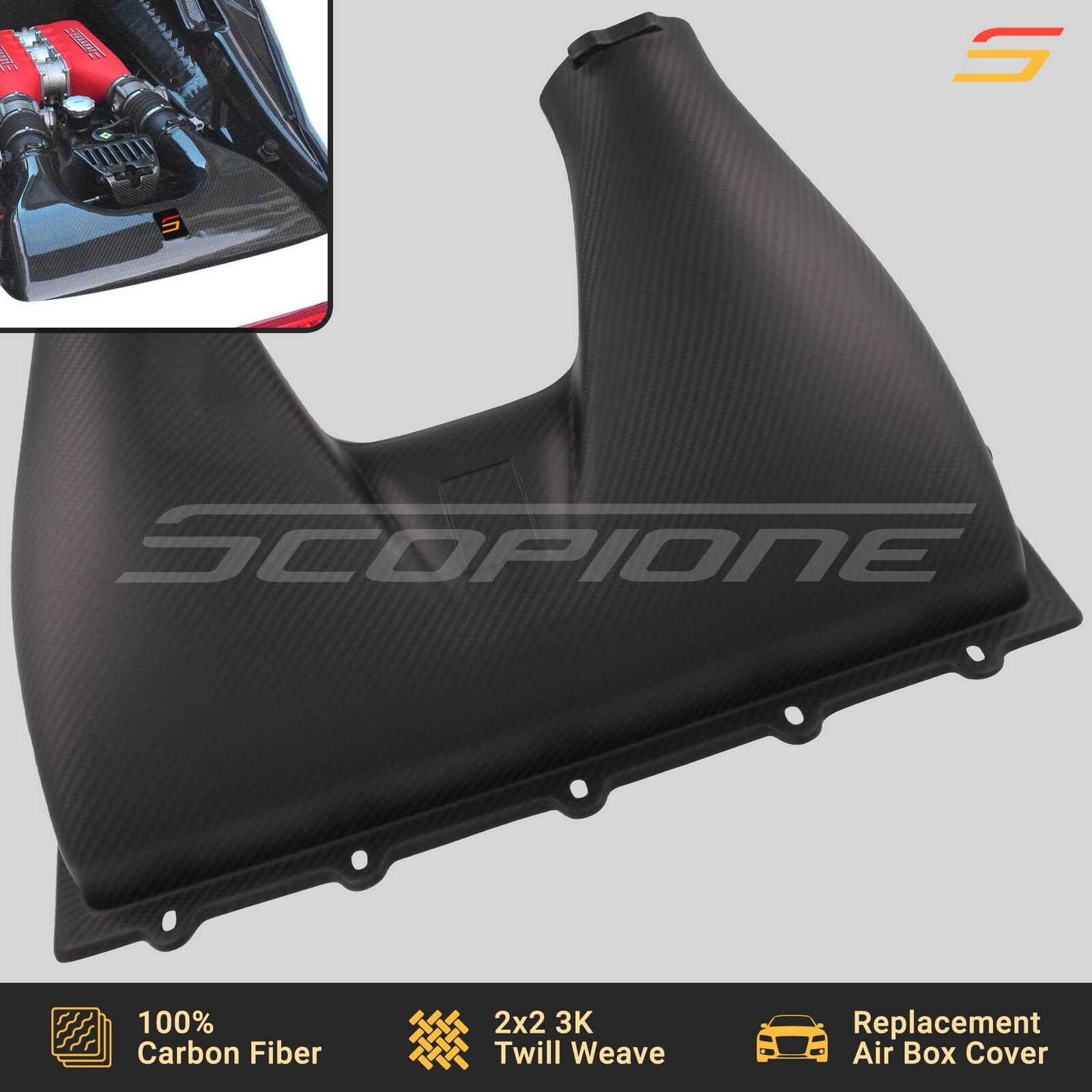
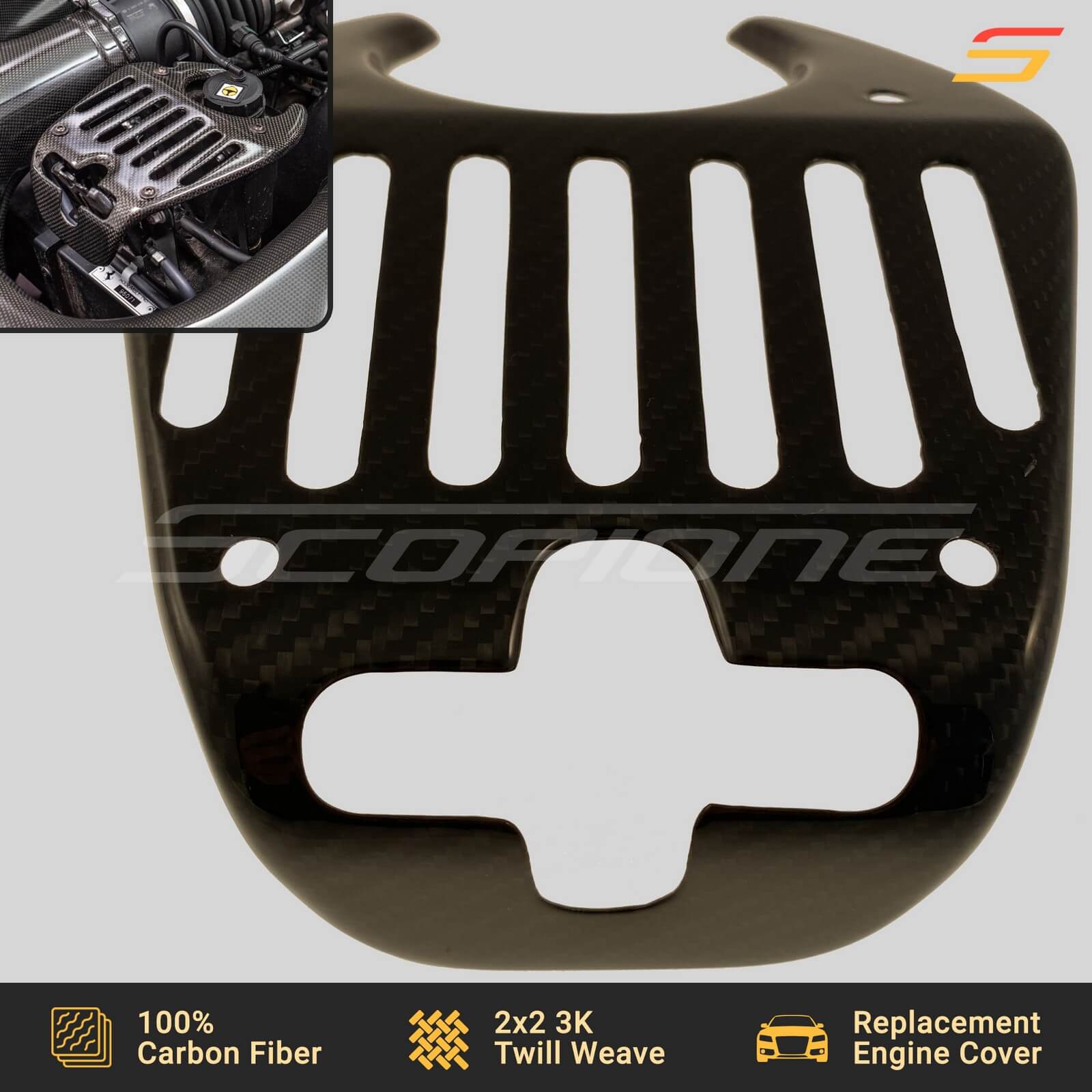
The engine bay is where carbon fiber has the highest visual density on a 458. Italia and Spider have different engine cover configurations due to the Spider’s exposed engine bay when the roof retracts. Scopione stocks separate engine cover kits for each body style: full panel sets for the Italia’s enclosed bay, and trim-focused sets for the Spider’s open presentation. Air filter box covers, fuel pump sound covers, firewall panels, latch covers, and side bay panels round out the engine bay catalog.
The 458 Spider’s engine bay receives particular attention because the retractable hardtop exposes it to direct view from above. CF engine covers on a Spider are visible to other drivers, passengers, and spectators in a way that the Italia’s enclosed bay is not – making the Spider’s engine bay one of the highest-impact locations for carbon-fiber upgrades on any mid-engine Ferrari.


Legacy of the 458 & Its Place in Ferrari History
The 458 sits at the end of a lineage stretching from the 1967 Dino 206 GT (a V6 predecessor) through the 308, 328, 348, 355, 360, and F430 – the last chapter of mid-engine V8 Ferraris powered exclusively by atmospheric induction. Its successor, the 488 GTB, introduced a 3.9-liter twin-turbo V8 producing 661 hp – more powerful, faster, and the first mid-engine turbo Ferrari since the F40. The F8 Tributo and 296 GTB continued the forced-induction and hybrid trajectory.
That transition has defined the 458’s collector narrative. The naturally aspirated 9,000 rpm V8 produces a mechanical sound and throttle response that turbocharged engines cannot replicate. Track driving in a 458 Speciale rewards high-RPM commitment in a way that modern turbocharged Ferraris, with their broader and flatter torque curves, do not require. For buyers who prioritize the sensory experience of driving over outright performance numbers, the 458 represents a threshold that Ferrari crossed in only one direction.
The Lamborghini Gallardo occupied a similar position in its own lineage – the last of a generation before the Huracan introduced a fundamentally different character. Both the 458 and the Gallardo are now appreciated as analog-era endpoints within their respective brands. And the Audi R8 V10, which competed directly with the 458 during production, shared the same fate – a naturally aspirated mid-engine car increasingly valued for the driving experience its successors abandoned.
Scopione: Carbon Fiber Upgrades for the Ferrari 458
Scopione’s Ferrari 458 catalog includes 30 carbon fiber parts covering exterior aerodynamic components, interior trim, and engine bay panels. All pieces are manufactured in 2×2 3K twill-weave carbon fiber with a UV-resistant clear coat in either glossy or matte finish. Each part is precision-fitted for 2010–2015 458 Italia and Spider models using factory mounting points. Scopione backs every component with a 12-month limited warranty against delamination.
The 458 aftermarket ecosystem is well-established. Ferrari’s factory carbon fiber options used a 1×1 3K plain weave – a different pattern from Scopione’s 2×2 twill weave. Buyers replacing or supplementing factory carbon should note this visual difference: 1×1 plain weave has a checkerboard appearance, while 2×2 twill weave shows a diagonal herringbone pattern. Both are legitimate carbon fiber constructions. Many owners deliberately choose the 2×2 twill for its visual distinctiveness.
Breakdown of Carbon Fiber Upgrade Costs for the Ferrari 458
| Carbon Fiber Part | Part Cost | Est. Installation | Total |
|---|---|---|---|
| Front Bumper Splitters | $1,200–$1,300 | $200–$400 | $1,400–$1,700 |
| Rear Bumper Diffuser | $2,300 | $300–$500 | $2,600–$2,800 |
| Side Mirror Shells | $1,600–$1,700 | $100–$200 | $1,700–$1,900 |
| Engine Covers Kit (Italia) | $2,600 | $200–$400 | $2,800–$3,000 |
| Engine Covers Set (Spider) | $1,700 | $200–$300 | $1,900–$2,000 |
| Air Filter Box Cover | $1,400–$1,500 | $100–$200 | $1,500–$1,700 |
| Interior Trim Set (AC vents, console, glove box) | $1,350–$1,900 | $200–$400 | $1,550–$2,300 |
| CF Shift Paddles | $700 | $100–$200 | $800–$900 |
| Fog Light Grille Vents | $1,800 | $200–$300 | $2,000–$2,100 |
| Full Front Hood Kit | $2,600 | $300–$500 | $2,900–$3,100 |
A comprehensive build – front splitters, rear diffuser, mirror shells, engine covers, and interior trim – runs approximately $10,000 to $12,000 installed, depending on finish selection and labor rates. Individual accent pieces (door handle covers at $220–$240, fuel filler cap at $180–$200, window triangle trim at $290–$320) allow incremental builds without large upfront commitments.
Browse Carbon Fiber Parts for the Ferrari 458 Italia & Spider
Ferrari 458 Used Market & Pricing (2025–2026)
- 458 Italia (coupe) – $180,000 to $300,000. Low-mileage, single-owner cars with full Ferrari dealer service history sit at the top. High-mileage examples with independent service records start below $200,000.
- 458 Spider – $200,000 to $380,000. The aluminum retractable hardtop commands a consistent premium over the coupe. Rosso Corsa over tan leather remains the easiest-to-sell color combination.
- 458 Speciale – $400,000 to $808,500. Average transaction prices exceed $470,000 – well above the original $288,000 MSRP. Sub-5,000-mile examples approach $800,000.
- 458 Speciale A (Aperta) – $950,000 to $3,080,000. Roughly triple the original allocation price. Rarity (499 units) and its status as the peak-output NA Ferrari convertible of its era drive the premium.
What Factors Affect Ferrari 458 Prices?
- Service history – Full Ferrari dealer records are non-negotiable for top-dollar sales. Gaps in service history can reduce value by 10–20% or more. Ferrari’s 7-year complimentary maintenance program covers cars serviced at authorized dealers.
- Mileage – Sub-10,000 mile cars trade at significant premiums. Above 30,000 miles, prices compress toward the bottom of each variant’s range.
- Color and specification – Rosso Corsa, Bianco Avus, and Grigio Silverstone sell fastest. Special-order colors (Blu Pozzi, Verde British Racing) can add or subtract value depending on the buyer pool. Factory carbon fiber interior adds $5,000–$15,000 to resale.
- Number of owners – Single-owner and two-owner cars command premiums. Five-plus owner histories are discounted regardless of condition.
- Title status – Rebuilt or salvage title 458s sell far below clean-title equivalents. Fire damage history – Ferrari recalled 1,248 units in 2010 after wheel-arch heat shield adhesive melted near the exhaust and caused fires in five cars – particularly depresses values.
- Modification quality – Reversible, documented upgrades from established manufacturers support value. Irreversible modifications or uncertified body work can reduce it.
Notable Auction Results for the Ferrari 458
| Model | Sale Price | Venue & Date |
|---|---|---|
| 2015 458 Speciale A | $3,080,000 | Mecum Kissimmee, January 2026 |
| 2015 458 Speciale | $808,500 | Saratoga Motorcar Auction, September 2025 |
| 2015 458 Speciale | $786,000 | RM Sotheby’s Arizona, January 2025 |
| 2013 458 Italia | $260,700 | Barrett-Jackson Scottsdale, January 2025 |
Is the Ferrari 458 a Good Investment?
The 458 market is appreciating. Spiders are gaining an estimated 5% year-over-year; coupes are also trending upward. The structural driver is straightforward: no future Ferrari will use a naturally aspirated mid-engine V8. The 488 GTB, F8 Tributo, and 296 GTB all moved to turbocharging or hybrid powertrains. Meanwhile, values on those newer models are softening – the 296 GTB has dropped approximately 16% from MSRP, and the SF90 is also declining. The analog, high-RPM character of the 458 is becoming rarer and more valued with each model year that passes.
For long-term holding, the Speciale is the clearest play: limited production (1,309 units), beating the Enzo’s Fiorano time, and already trading at roughly 40–180% above original MSRP. Standard Italias and Spiders have bottomed out on their depreciation curves and are in an early appreciation phase – and the dual-clutch-only specification, once held against the car, no longer discounts it now that every modern Ferrari shifts the same way.
What Are Common Ferrari 458 Maintenance Issues and Costs?
Annual maintenance runs $1,500 to $3,000 after Ferrari’s 7-year complimentary program expires. A standard dealer service – oil change, filter replacement, inspection – costs approximately $1,700. The 458 uses timing chains rather than belts, eliminating the F430’s expensive belt service interval (a significant ownership cost advantage).
Major cost items to budget for:
- Clutch replacement – $6,000 to $10,000 for the dual-clutch pack, depending on dealer versus independent shop labor
- Carbon-ceramic brake rotors – five-figure replacement cost for a full set; rotors can last 100,000+ miles with street use
- Sticky buttons syndrome – the rubberized coating on interior buttons and surfaces degrades over time, becoming tacky. Professional refinishing runs $500 to $1,000+ per component, or $5,000 to $10,000 for a full interior treatment. This issue affects the 458, F430, 599, California, and 488.
- Magnetorheological damper leaks – known issue, particularly on earlier production cars. Replacement is expensive and not always covered under extended warranty as it may be classified as an oil leak.
- Exhaust manifold cracking on early cars (less common on later production)
- Insurance – $5,000 to $12,000 per year depending on driver profile, location, and coverage level. Specialty collector car insurers typically offer lower premiums for agreed-value policies.
What Carbon Fiber Parts Does Scopione Offer for the Ferrari 458?
Scopione stocks 30 carbon-fiber parts for the 458 Italia and Spider, organized into three categories. Exterior: front bumper splitters, rear diffuser, mirror shells (glossy and matte), fog light grille vents, front hood cover kits, window triangle trim, door handle covers, and fuel filler cap covers. Interior: dashboard AC vent trim, F1 gearbox control surround, center console switch panel trim, glove box panel, and shift paddles (cross-compatible with F12 Berlinetta and FF). Engine bay: full engine cover kits (separate Italia and Spider configurations), air filter box covers, fuel pump sound covers, firewall cover, engine latch cover, and side bay panels.
All parts ship in 2×2 3K twill-weave carbon fiber with UV-resistant clear coat. Both glossy and matte finishes are available across most product lines. Installation uses factory mounting points – no drilling or cutting required.
Explore the Full Ferrari 458 Carbon Fiber Catalog
Gallery Description
The Ferrari 458 Italia and Spider picture gallery features owner-submitted photos, studio shots, and detail photography highlighting carbon-fiber upgrades on the 458 platform. Images cover both Italia coupes and Spider convertibles with various configurations of Scopione carbon fiber parts – from single accent pieces to full exterior and engine bay builds. Each photo demonstrates how 2×2 twill-weave CF components integrate with the 458’s Pininfarina body lines.
View All Ferrari 458 Carbon Fiber Upgrades on Scopione
Frequently Asked Questions
What Carbon Fiber Parts Does Scopione Offer for the Ferrari 458?
Scopione carries 30 carbon fiber parts for the Ferrari 458 Italia and Spider, including front bumper splitters, rear diffuser, mirror shells, engine covers, interior trim, shift paddles, and door handle covers. Both glossy and matte finishes are available.
Does Carbon Fiber Affect the Resale Value of a Ferrari 458?
Tasteful carbon fiber upgrades generally support or maintain resale value on the 458, particularly when they complement the factory carbon fiber options package. Reversible modifications with documented provenance are preferred by the collector market.
Is the Ferrari 458 a Good Investment?
The 458 is appreciating, especially the Speciale and Speciale A. As the last naturally aspirated mid-engine V8 Ferrari, it benefits from a structural value driver. Standard Italias and Spiders have bottomed out on depreciation and entered an early appreciation phase.
What Are Common Ferrari 458 Maintenance Issues and Costs?
Annual maintenance runs $1,500-$3,000. Known issues include sticky buttons syndrome (degrading interior coatings), leaking magnetorheological dampers, and exhaust manifold cracking on early cars. The 458 uses timing chains, eliminating the F430’s expensive belt service.
More Scopione Picture Galleries
Scopione’s carbon fiber catalog spans Italian, German, British, Japanese, and American performance vehicles. Each gallery page includes vehicle history, specifications, market data, and available CF upgrades:
- Ferrari: 488 GTB & Spider • F8 Tributo & Spider • F12 & 812 Superfast • SF90
- Lamborghini: Gallardo • Huracan • Aventador • Urus
- McLaren: MP4-12C & 650S • 720S & 765LT • Sports Series
- Porsche: 911, Boxster & Cayman
- BMW: M3, M4, M5 & More
- Audi: R8
- Nissan: GT-R R35 • 350Z, 370Z & Z
- Aston Martin: Vantage, DB9 & DBS
- Bentley: Continental GT & GTC
- Maserati: GranTurismo & GranCabrio
- Toyota: Supra
- Subaru: WRX STI
- Mitsubishi: Lancer Evolution
- Chevrolet: Corvette • Camaro
- Dodge: Viper
Experience the elegance and performance of the Ferrari 458 with Scopione. Browse our gallery and get inspired to elevate your supercar with our top-of-the-line carbon fiber upgrades.
Shop now for premium ScopioneCarbon carbon fiber upgrades and experience the ultimate in performance and aesthetics for your Ferrari 458!