

 Shop
ShopThe Chevrolet Camaro is the car that died and came back – discontinued in 2002 after a 35-year run, revived seven years later on the back of a movie and a concept car, and retired again in 2024. Scopione carries carbon fiber parts for the fifth- and sixth-generation Camaro, covering engine bay dress-up, exterior aero and interior trim – all in hand-laid 2×2 3K twill-weave carbon fiber with UV-resistant clear coat.
Introduction: The Pony Car That Came Back
Few nameplates have a history this discontinuous. The Camaro launched in 1967 as Chevrolet’s answer to the Mustang, ran through four generations, and then stopped: the last fourth-generation car was built on 27 August 2002. It stayed dead for seven model years. When it returned for 2010 it was a genuinely different proposition – heavier, far stiffer, and aimed as much at the corners as the quarter mile – and it ran two more generations before production ended in December 2023 for the 2024 model year.
That shape of history matters for anyone modifying one. The aftermarket, Scopione’s catalog included, is concentrated almost entirely on the fifth generation (2010–2015) and the sixth (2016–2024), because those are the cars still on the road in numbers and still being built up. The parts listed further down reflect exactly that.
Origins: 1967–1992
The Camaro exists because of the Mustang. Ford’s pony car had caught General Motors flat-footed, and Chevrolet’s answer debuted in September 1966 for the 1967 model year on the new rear-wheel-drive F-body platform – shared, as it would be for the next 35 years, with the Pontiac Firebird.
Even the name was a shot at Ford. Chevrolet managers found “camaro” in a French dictionary as slang for friend, pal or comrade. Asked publicly what a Camaro actually was, Chevrolet answered that it was a small, vicious animal that eats Mustangs.
First Generation (1967–1969)
The original ran just three model years and built 220,906 cars in 1967, 235,147 in 1968 and 243,085 in 1969 – roughly 699,000 in total. The Z/28 went on sale in December 1966 with a 302-cubic-inch V8 developed specifically to meet Trans-Am racing displacement rules, and it is the car the retro-styled fifth generation would deliberately echo four decades later.
Second Generation (1970–1981)
Introduced on 26 February 1970 and produced through the 1981 model year, the second generation is the longest-running of them all, updated cosmetically in 1974 and again in 1978. It was taken seriously at the time: Road & Track named the 1971 SS350 one of the ten best cars in the world.
Third Generation (1982–1992)
The third generation modernised the car. These were the first Camaros with modern fuel injection and the four-speed 700R4 automatic, the IROC-Z ran from 1985 to 1990, and the convertible returned in 1987 after an eighteen-year absence.
Two option codes worth knowing started here, because both still appear in parts listings today: the 1LE performance package debuted in 1988, and the B4C police package followed in 1991. The 1LE badge on Scopione’s rear diffuser is the direct descendant of that 1988 option code.
Fourth-Generation Camaro (1993–2002)
Built at Sainte-Thérèse, Quebec from November 1992, the fourth generation is the one that ended the original run. Early cars paired a 3.4-litre V6 with the 275 hp LT1 V8 in the Z28; from 1995 a 3.8-litre V6 rated 200–205 hp replaced the 3.4. The 1997 30th Anniversary cars are the collector pick – 979 were built, of which 108 received the 330 hp LT4 V8.
The LS1 Era
For 1998 the Camaro received the LS1, the same Gen III aluminium V8 architecture that had just transformed the Corvette. Chevrolet marketed it at 310 hp in the Camaro, a figure widely understood to be conservative – the engine produced closer to 350 hp at the flywheel. It is the reason clean 1998–2002 Z28 and SS cars still command attention.
The end came from economics rather than engineering: slow sales, a shrinking sports-coupé market and plant overcapacity. 42,098 cars were built for the final 2002 model year, closing with a 35th Anniversary edition.
The Hiatus (2002–2009)
For seven years there was no Camaro. The nameplate stayed dormant until a concept car and a starring role in a 2007 blockbuster rebuilt public appetite for it, and production of the fifth generation began in March 2009 for the 2010 model year.
This gap is the single most useful fact for anyone shopping parts. There is no 2003–2009 Camaro, so any listing claiming fitment in those years is describing a car that was never built. Scopione’s Camaro fitments start at 2010 for exactly this reason.
Fifth-Generation Camaro (2010–2015)
The returning Camaro was built from March 2009 to November 2015. The coupe launched first; convertible production began on 31 January 2011. This is the generation Scopione’s catalog covers most thoroughly.
Engine Lineup: LLT, LFX, LS3, L99, LSA, LS7
- V6 (LLT, 2010–2011) – 312 hp at 6,400 rpm and 273 lb-ft on the 2011 rating; 2010 cars were rated more conservatively at 304 hp.
- V6 (LFX, 2012–2015) – the 3.6-litre direct-injection replacement, 323 hp.
- SS (LS3 / L99) – 426 hp at 5,900 rpm and 420 lb-ft with the manual; automatics received the L99 at 400 hp and 410 lb-ft, the difference being cylinder deactivation.
- ZL1 (LSA, 2012–2015) – supercharged, 580 hp at 6,000 rpm and 556 lb-ft.
- Z/28 (LS7, 2014–2015) – the 7.0-litre naturally aspirated V8 lifted from the C6 Corvette Z06, in the most single-minded Camaro of the era.
Variants and the 1LE Package
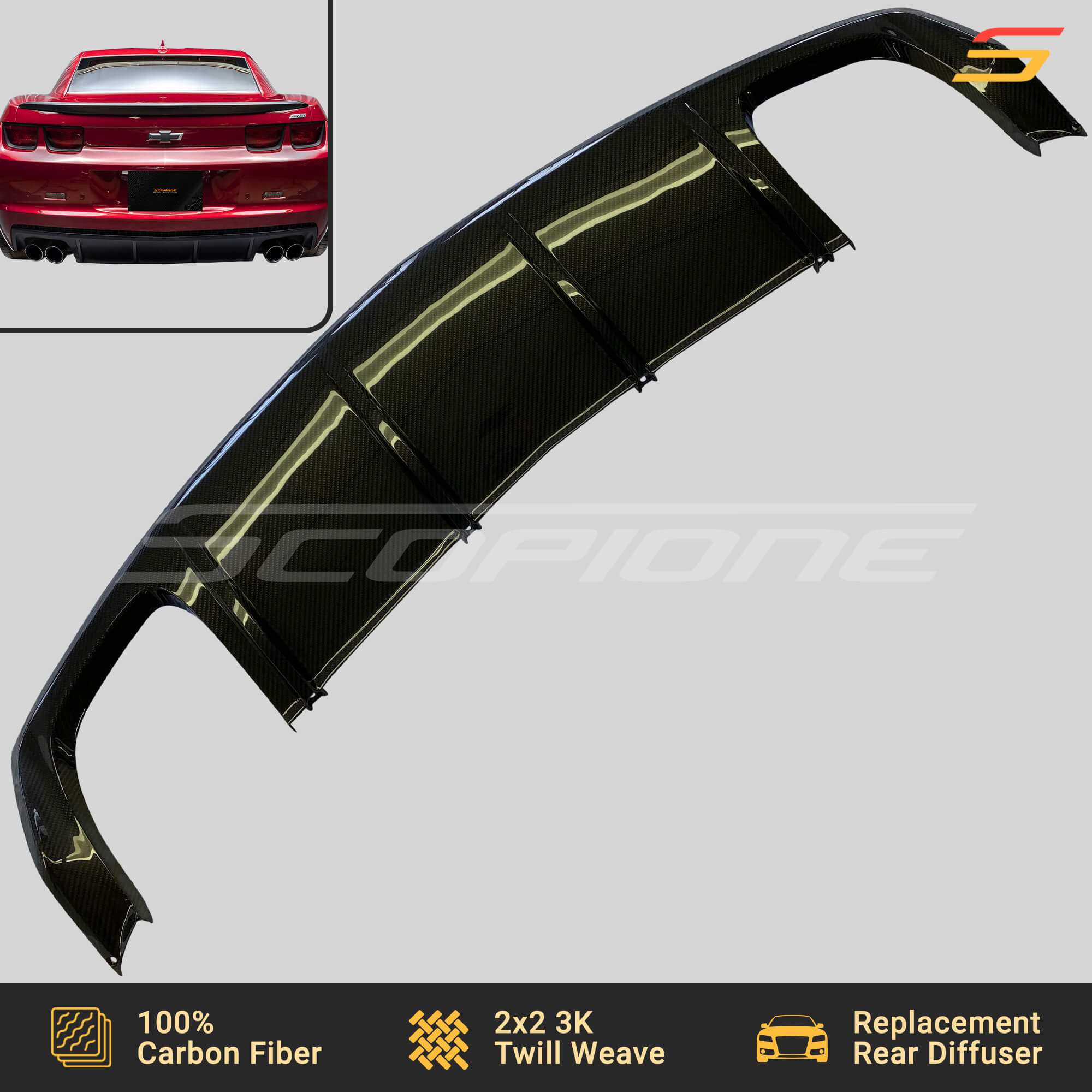
The SS arrived with the car in 2010. The ZL1 followed for 2012, the 1LE handling package returned for 2013 on 1SS and 2SS coupes, and the Z/28 was unveiled in 2013 for a 2014 launch. The 1LE badge matters here beyond trim level: it brought its own aero, and Scopione’s quad-tip 1LE rear diffuser is cut for that specific bumper.
Sixth-Generation Camaro (2016–2024)
Production ran from October 2015 to December 2023, covering model years 2016 through 2024. Moving to GM’s Alpha platform made the sixth-generation car more than 200 lb lighter than the fifth – the single biggest dynamic change between the two, and the reason a Gen 6 SS feels so different from a Gen 5 SS on the same road.
Engine Lineup: LTG, LGX, LT1, LT4
- 2.0L turbo four (LTG) – 275 hp at 5,600 rpm and 295 lb-ft at 3,000 rpm, on 1LS, 1LT and 2LT.
- 3.6L V6 (LGX) – 335 hp at 6,800 rpm and 284 lb-ft at 5,300 rpm.
- 6.2L V8 (LT1) – 455 hp at 6,000 rpm and 455 lb-ft at 4,400 rpm, in the SS. This is the engine Scopione’s LT1 cover is cut for.
- 6.2L supercharged V8 (LT4) – 650 hp at 6,400 rpm and 650 lb-ft at 3,600 rpm, ZL1 only.
The ZL1 arrived for 2017, and the ZL1 1LE that followed is the most carbon-intensive Camaro Chevrolet ever sold. The run closed with a Collector’s Edition for 2024.
Carbon Fiber and the Camaro
Factory carbon came late to the Camaro and arrived at the top of the range rather than across it. The fifth generation used none in volume. The sixth-generation ZL1 1LE changed that, fitting a carbon hood insert, a carbon fiber intake, carbon doors and front fascia, and a rear spoiler built to GT4 racing specification.
That top-down pattern is why the aftermarket matters more here than on a car like the Corvette, where carbon reached the mainstream trims earlier. On a Gen 5 SS or a Gen 6 SS, carbon fiber is something you add rather than something you specify – which is exactly the gap the parts below fill.
Scopione: Carbon Fiber Parts for the Camaro
What Scopione Offers for the Camaro
Seven parts fit the Camaro, weighted heavily toward the fifth generation and the engine bay. Two of them are shared with the Corvette, which is a consequence of the engines rather than the bodies – the same LS3 and LT1 V8s appear in both cars.
| Part | Fitment | Price | Notes |
|---|---|---|---|
| Quad Tip 1LE Rear Diffuser | 2010–2013 Camaro | $750 | Cut for the 1LE rear bumper |
| Engine Plenum Cover | 2010–2015 Camaro SS ZL1 | $700 | 6.2L V8 LS3 |
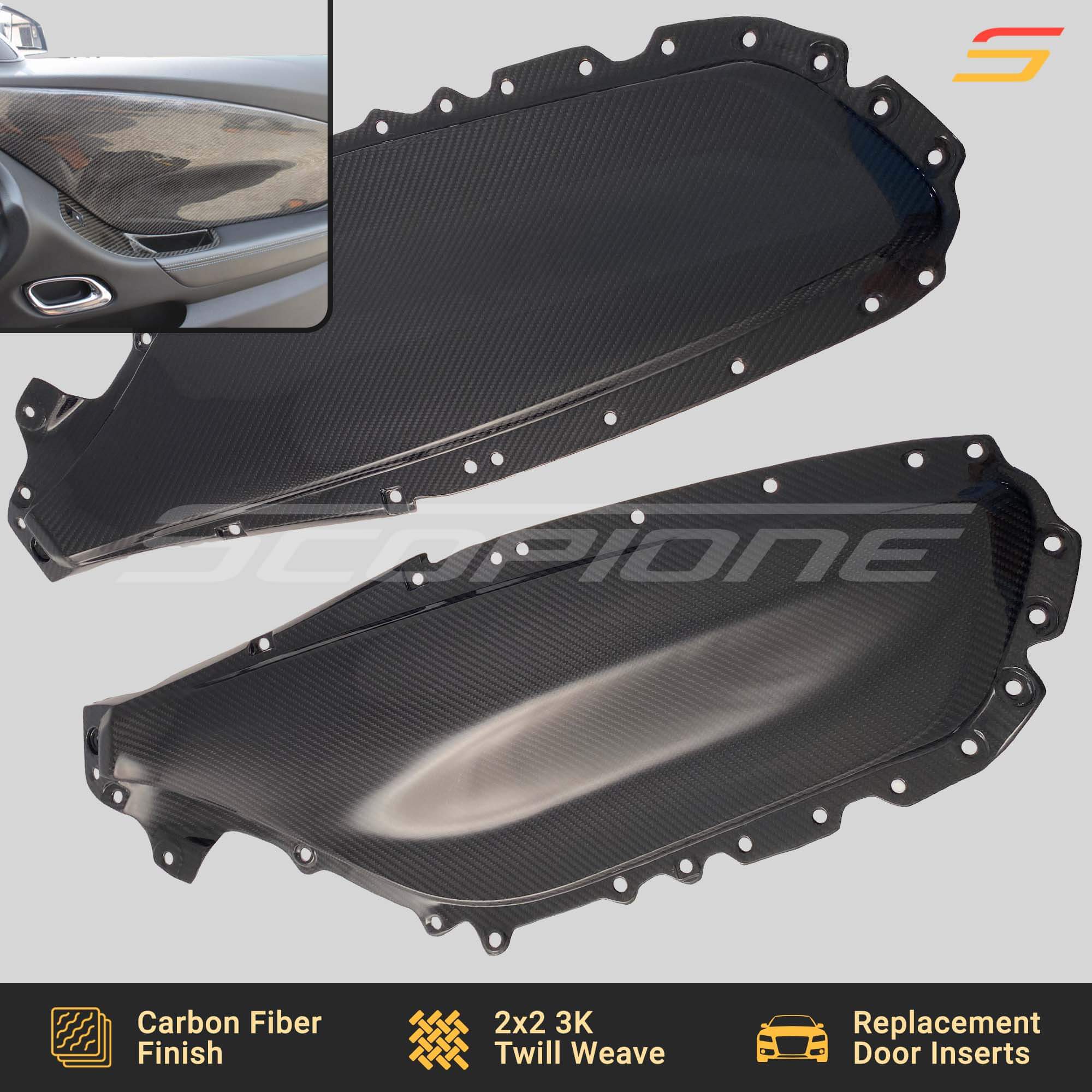
| Interior Door Trim Panels | 2010–2015 Camaro | $500 | Pair |
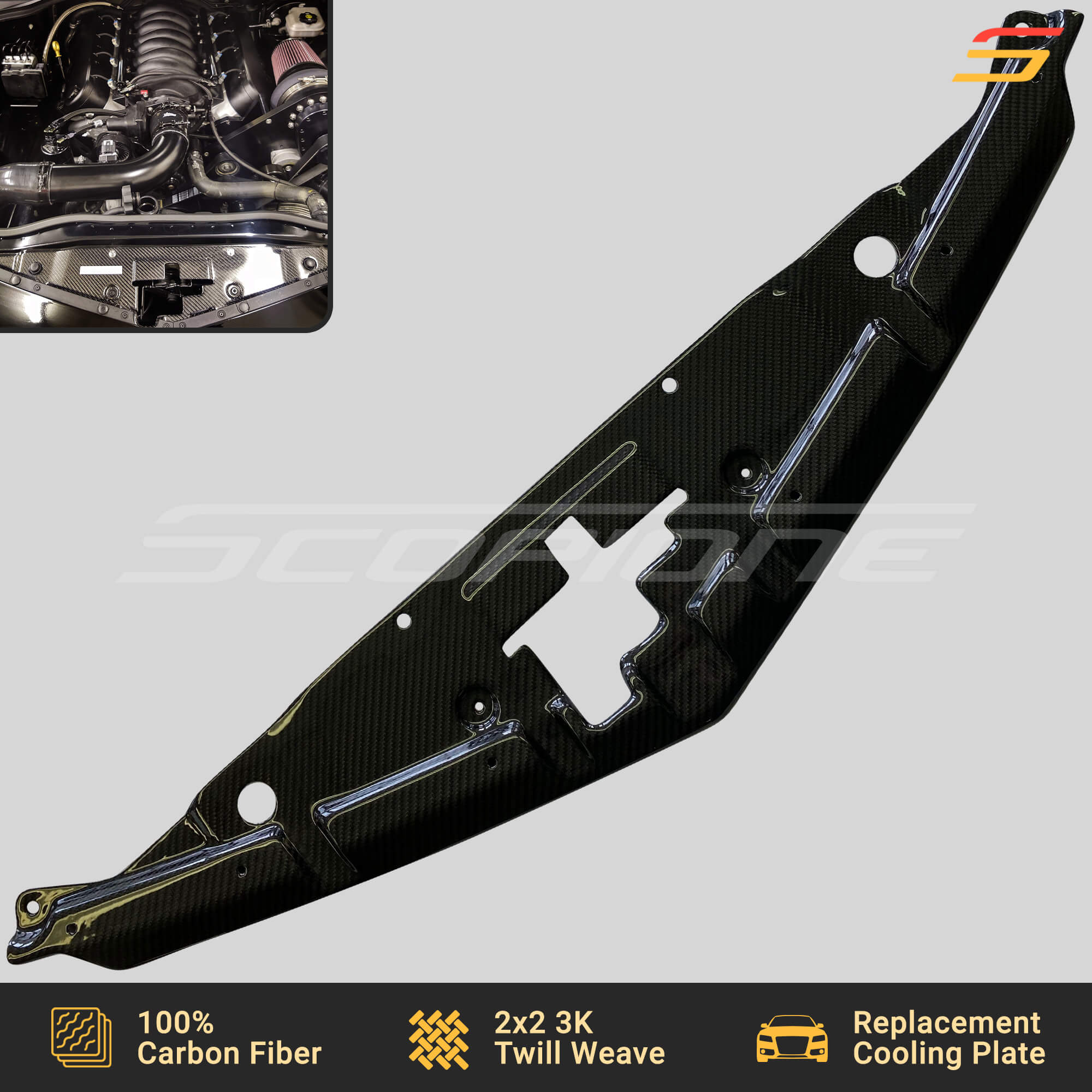
| Engine Radiator Cooling Plate | 2010–2015 Camaro | $450 | Engine bay dress-up |
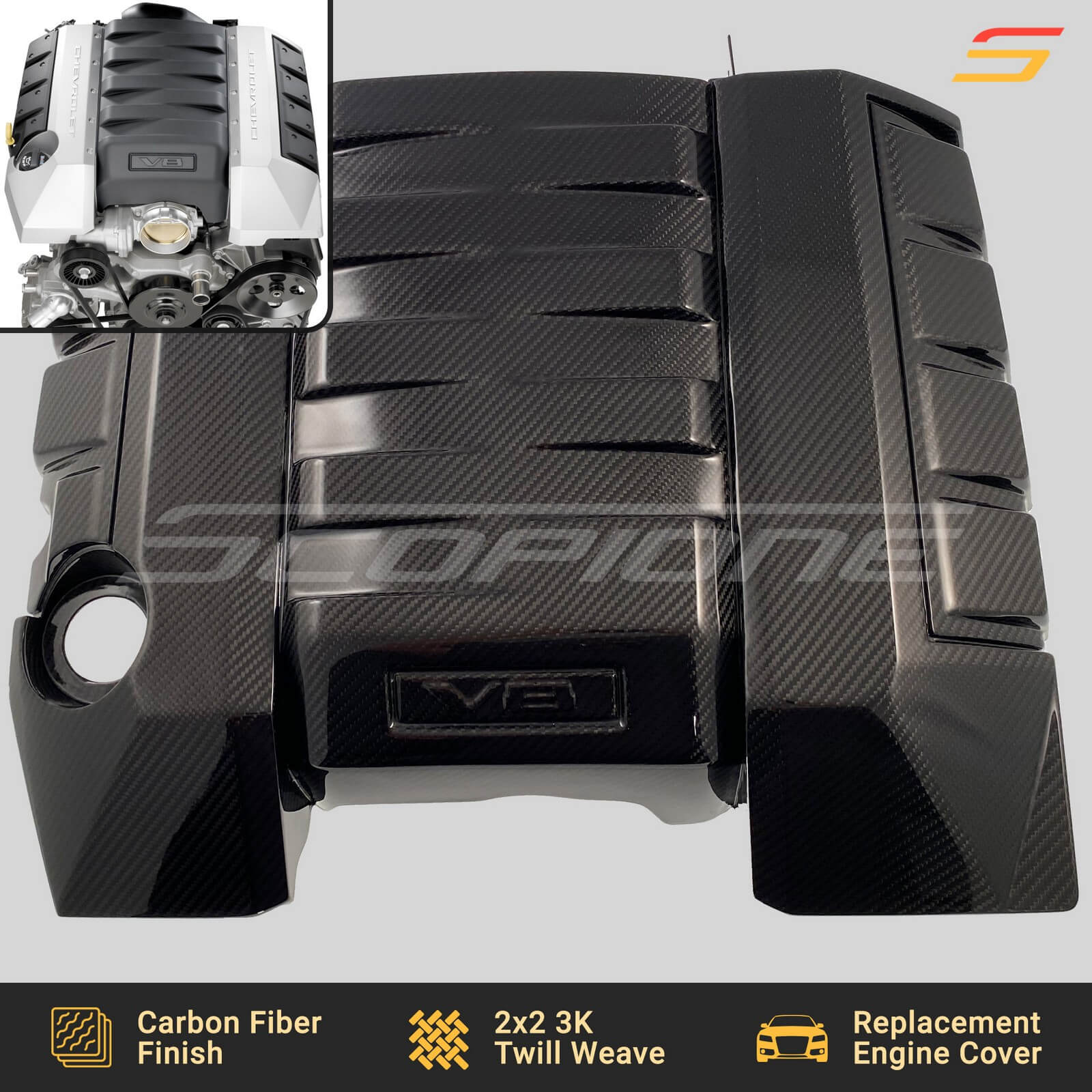
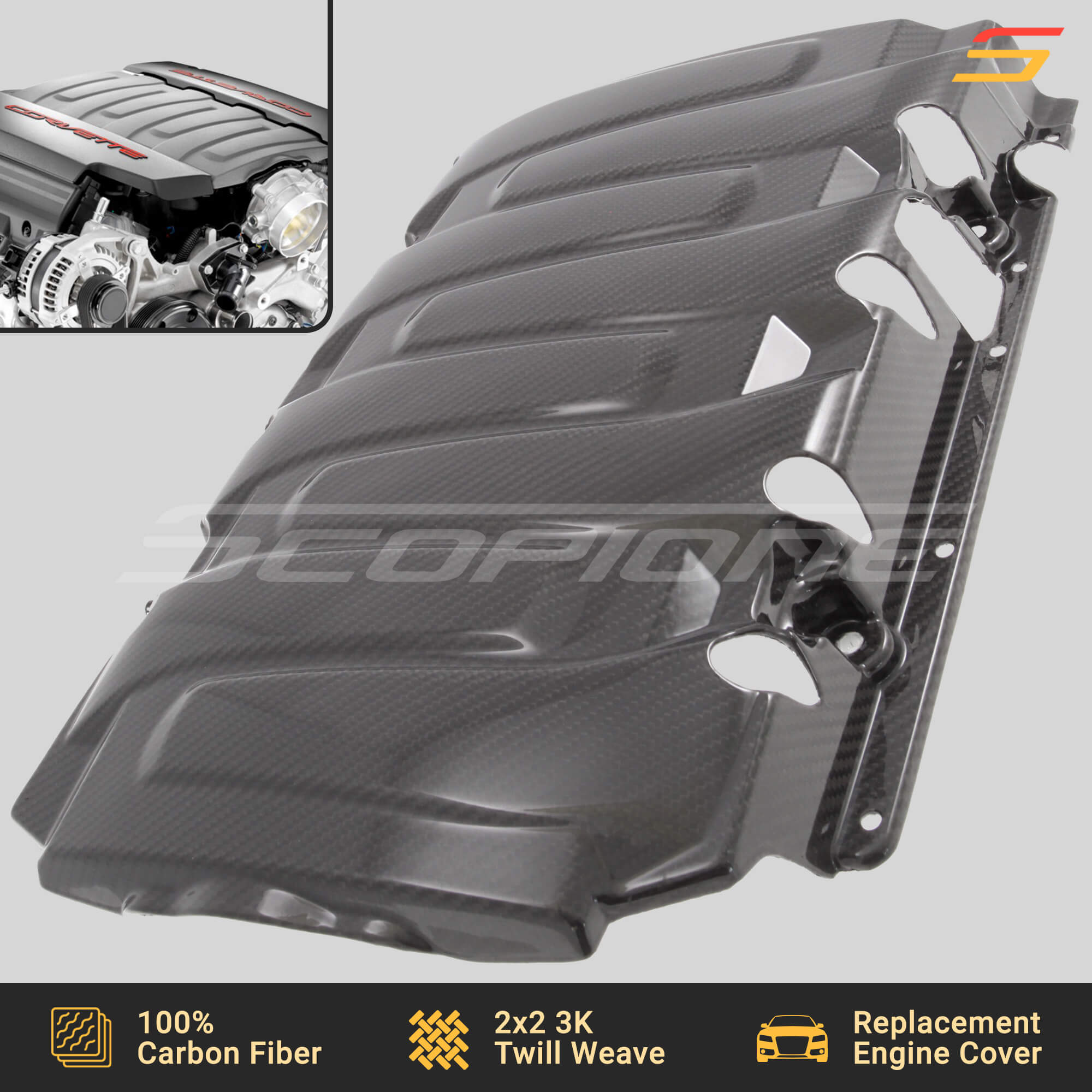
| LT1 Engine Cover | 2016–2024 Camaro SS | $450 | Also fits C7 Corvette; modifications required on Camaro SS |
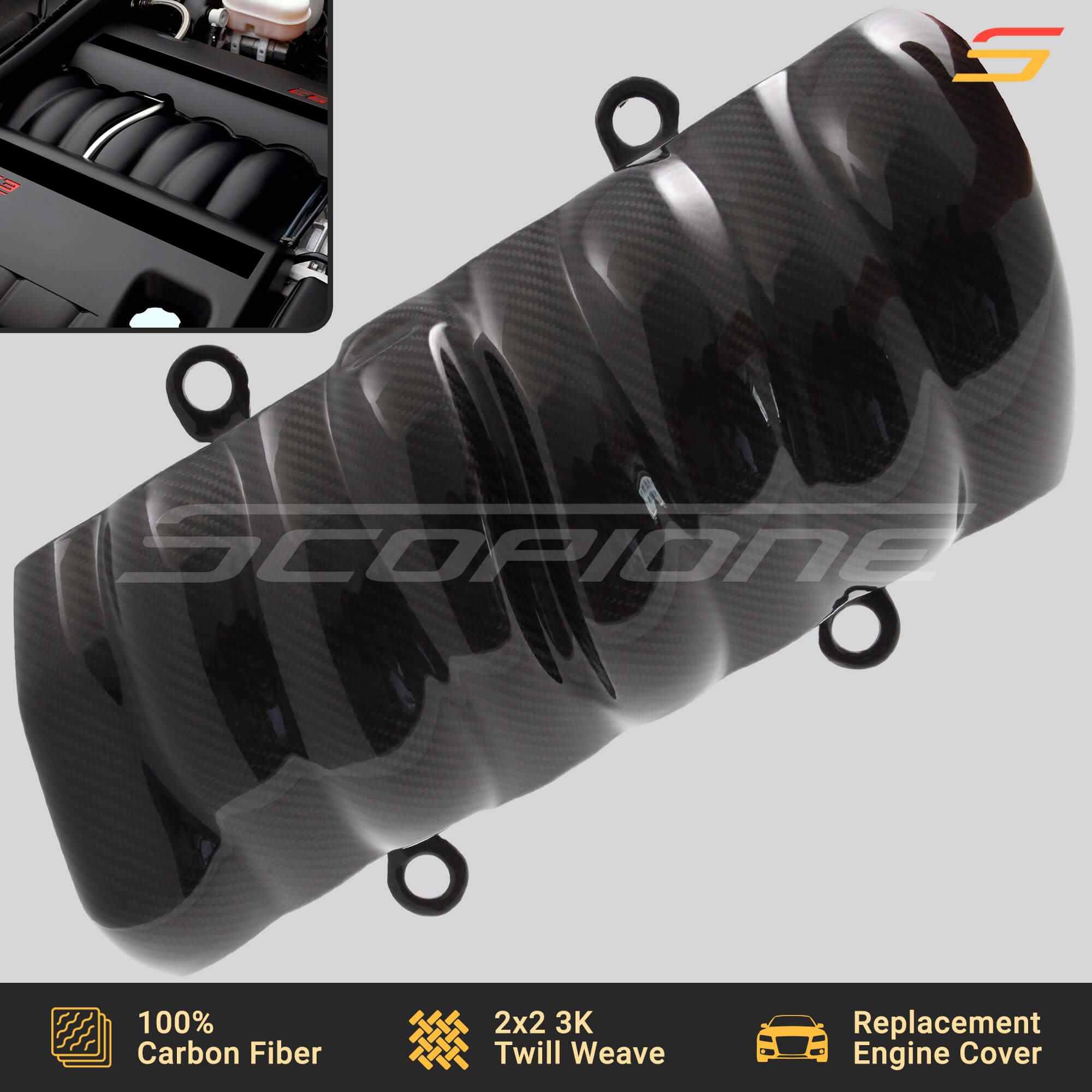
| LS3 Engine Cover | 2010–2015 Camaro SS | $370 | Also fits C6 Corvette & 2008–09 Pontiac G8 |
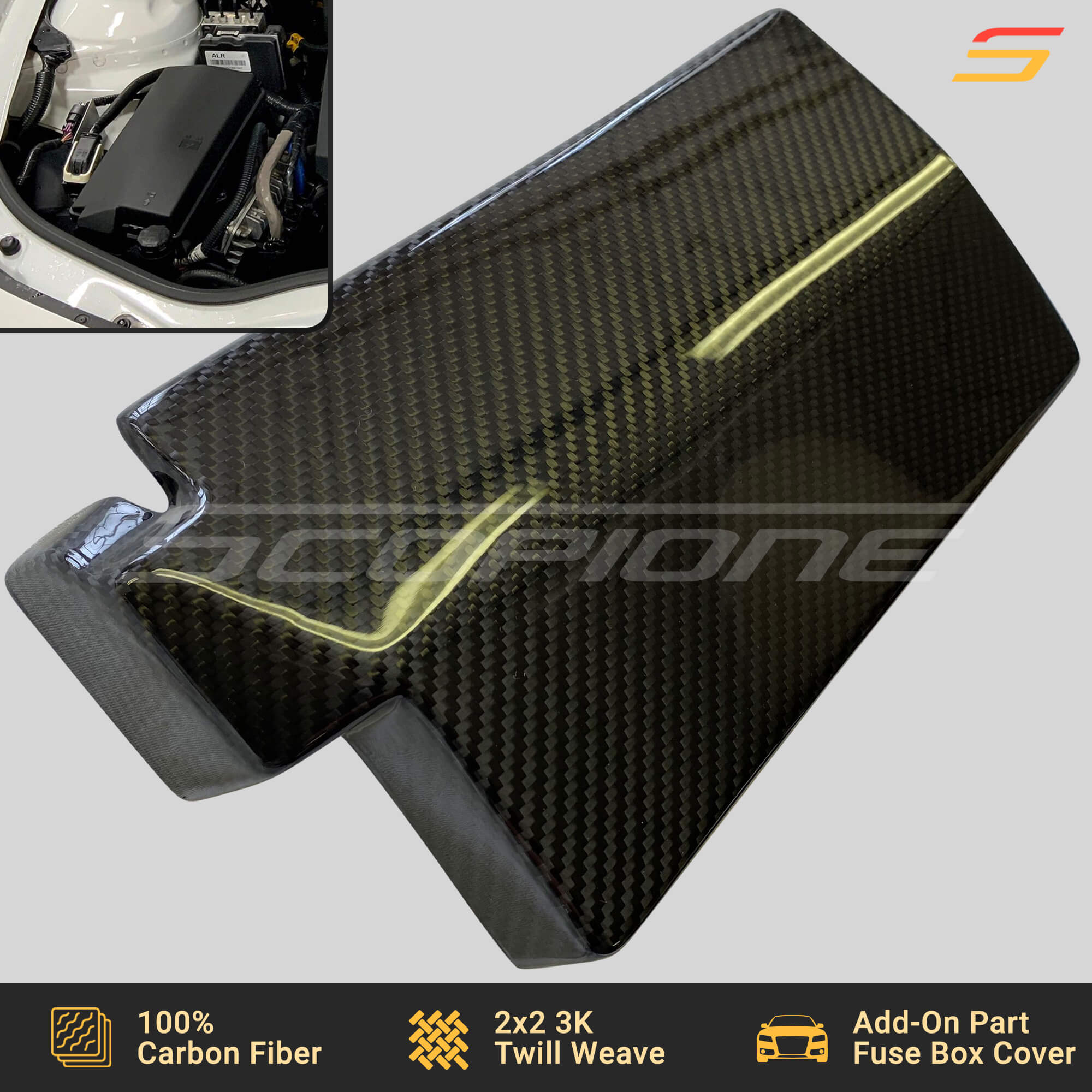
| Engine Bay Fuse Box Cover | 2010–2015 Camaro | $190 | Engine bay dress-up |
Cross-Compatibility with the Corvette
The two engine covers span several cars because GM shared the engines across platforms. The LS3 cover fits the 2010–2015 Camaro SS, the 2008–2013 Corvette C6 and the 2008–2009 Pontiac G8 – all with the LS3 or L76 6.2L – and needs no modification. The LT1 cover fits the 2014–2019 Corvette C7 directly; on the 2016–2024 Camaro SS it fits with modifications, which is worth knowing before you order. Full details for the Corvette side are on the Chevrolet Corvette picture gallery.
Fitment Notes
- The 1LE diffuser is generation- and bumper-specific – it is cut for the 2010–2013 1LE rear bumper and does not carry across to the 2014–2015 facelift.
- Engine covers follow the engine, not the year – check which V8 the car has (LS3 for Gen 5 SS, LT1 for Gen 6 SS) rather than the model year alone. The LT1 cover was designed around the C7 Corvette, so fitting it to a Camaro SS requires modification.
- The door trim panels are sold as a pair and fit the 2010–2015 interior.
Frequently Asked Questions
Answers to the questions we are asked most often about Camaro carbon fiber, fitment and the gap between generations.
What carbon fiber parts does Scopione offer for the Chevrolet Camaro?
Scopione carries 7 carbon fiber parts for the Camaro: LS3 and LT1 engine covers, an engine plenum cover, a fuse box cover, a radiator cooling plate, interior door trim panels, and a quad-tip 1LE-style rear diffuser. Coverage centers on the 2010-2015 fifth generation, with the LT1 engine cover extending to 2016-2024 SS models.
Do Scopione Camaro engine covers fit the Corvette too?
Yes – the LS3 engine cover fits the 2010-2015 Camaro SS, 2008-2013 Corvette C6, and 2008-2009 Pontiac G8; the LT1 cover fits the 2014-2019 Corvette C7 directly and the 2016-2024 Camaro SS with modifications. GM’s engine-sharing across platforms makes these parts cross-compatible.
Will the 1LE rear diffuser fit any fifth-generation Camaro?
No. The quad-tip 1LE rear diffuser is cut for the 2010-2013 1LE rear bumper specifically. It does not fit the 2014-2015 facelift, and it is not a universal fifth-generation part.
Which Camaro generations does Scopione make carbon fiber parts for?
The fifth generation (2010-2015) and the sixth generation (2016-2024). There are no parts for the first four generations, and no 2003-2009 Camaro exists – production stopped in August 2002 and did not resume until March 2009 for the 2010 model year.
Is the Chevrolet Camaro a good investment?
Halo variants are: the gen 5 Z/28 (1,801 built) trades at $50,000-$80,000, ZL1s hold value, and final-year 2024 Collector’s Edition cars sell above sticker – a 370-mile 2024 ZL1 brought $122,500. Volume SS coupes remain performance bargains rather than appreciating collectibles.
What are common Camaro maintenance issues and costs?
The LS3/LT1 V8s are inexpensive to maintain ($600-$1,500 annually). Known items include AFM/DoD lifter concerns on gen 6 LT1 automatics, 8-speed torque converter shudder (2016-2018), early gen 5 V6 timing chain wear, and supercharger service on ZL1s.
More Scopione Picture Galleries
- Ferrari: 458 Italia & Spider • 488 GTB & Spider • F8 Tributo & Spider • F12 & 812 Superfast • SF90
- Lamborghini: Gallardo • Huracan • Aventador • Urus
- McLaren: MP4-12C & 650S • 720S & 765LT • Sports Series
- Porsche: 911, Boxster & Cayman
- BMW: M3, M4, M5 & More
- Audi: R8
- Nissan: GT-R R35 • 350Z, 370Z & Z
- Aston Martin: Vantage, DB9 & DBS
- Bentley: Continental GT & GTC
- Maserati: GranTurismo & GranCabrio
- Toyota: Supra
- Subaru: WRX STI
- Mitsubishi: Lancer Evolution
- Chevrolet: Corvette
- Dodge: Viper
Experience the elegance and performance of the Chevrolet Camaro with Scopione. Browse our gallery and get inspired to elevate your supercar with our top-of-the-line carbon fiber upgrades.
Shop now for premium ScopioneCarbon carbon fiber upgrades and experience the ultimate in performance and aesthetics for your Chevrolet Camaro!