

 Shop
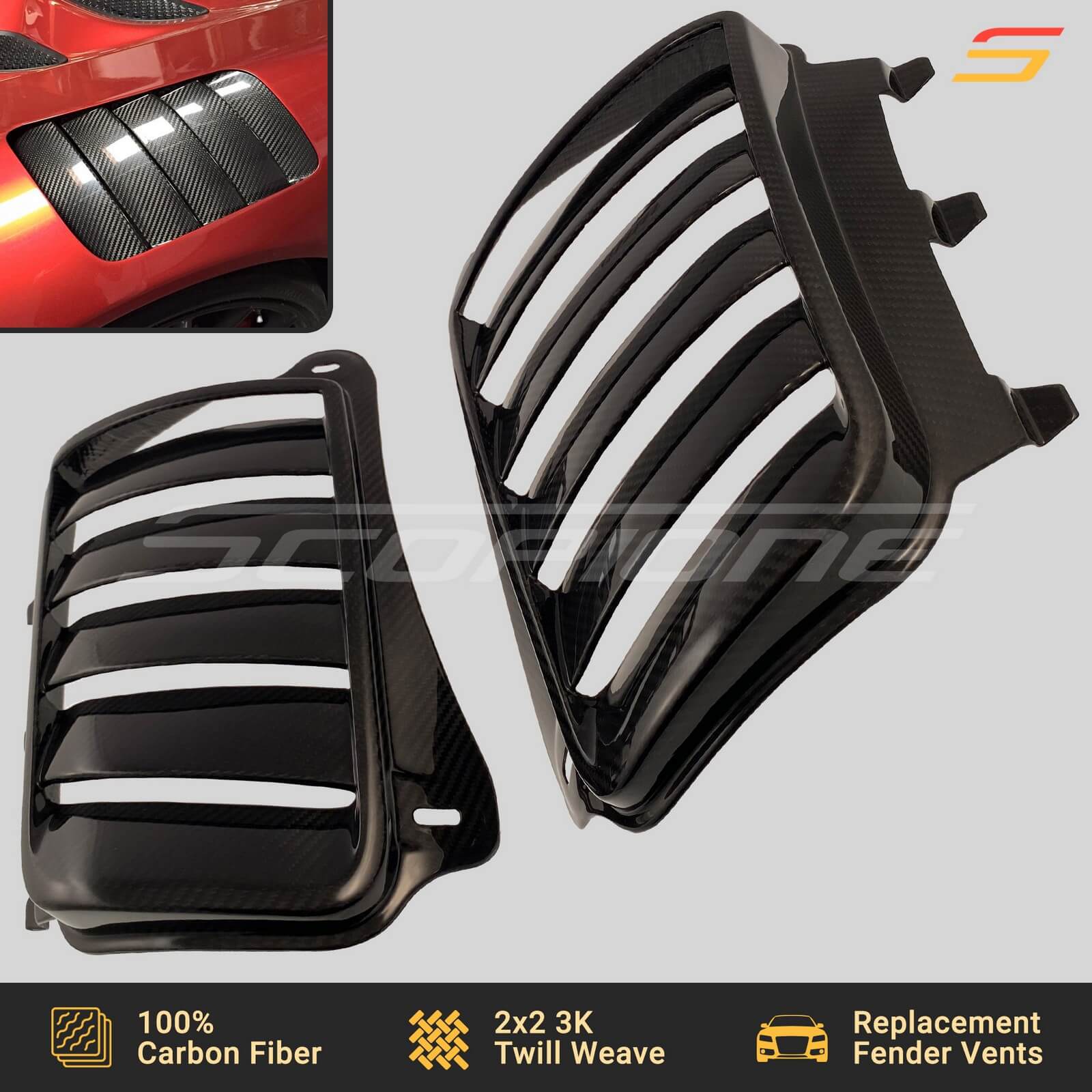
ShopThe Dodge Viper was America’s last analog supercar: an 8-liter-plus V10, a manual gearbox in every single car built across 25 years, and a final ACR whose Extreme Aero package still holds a place in production-car lap-record history. Scopione carries carbon fiber front fender hood vents for the 2016–2017 Viper ACR with the Extreme Aero package – direct replacement pieces for the record car’s bodywork, in hand-laid 2×2 3K twill-weave carbon fiber with UV-resistant clear coat.
Introduction: Ten Cylinders, No Apologies
The Viper began as a 1989 concept car built on a dare – a modern Shelby Cobra – and reached production in 1992 nearly unchanged: an 8.0L V10 whose aluminum block was engineered with Lamborghini (then Chrysler-owned), side-exit exhausts, and almost nothing else. No ABS. No traction control. Early cars had no exterior door handles. The formula was displacement and courage, and America bought it.
Five generations followed the same arc: more engine, more downforce, no automatic – ever. Every one of the roughly 31,000 Vipers built between 1992 and 2017 carried a manual gearbox, a claim no other modern supercar line can make. The GTS-R racing program brought class wins at Le Mans and FIA GT championships; the ACR versions turned each generation’s end into a track-record campaign; and the Gen V ACR’s Extreme Aero package – the configuration Scopione’s fender vents serve – closed the story with a stack of production-car lap records.
Production ended in August 2017 at Detroit’s Conner Avenue plant. No successor has ever been announced. The catalog is closed, and the market has been repricing it ever since.
Gen I–II: RT/10 & GTS (1992–2002)
The original RT/10 roadster made 400 hp from its 8.0L V10 through a Tremec 6-speed – the transmission family that would serve every Viper after it. Curb weight sat around 3,300 lbs, the side pipes cooked ankles, and period tests ran 0–60 in the mid-fours. It was exactly what the concept promised, minus weather protection – the canvas top and plastic windows were afterthoughts by design.
The 1996 GTS coupe civilized nothing and improved everything: 450 hp, the signature “double bubble” roof, and the shape that defines the classic Viper today. Its racing twin, the GTS-R, gave the program international credibility: three straight FIA GT class championships (1997–1999) and class wins at Le Mans in 1998, 1999, and 2000 – the 1998 victory was the first GT-class Le Mans win for an American car since the 1964 Shelby Daytona Coupe. The first ACR (1999) distilled the street car toward the track and set the template every later generation would follow.
| Model | Power | Original MSRP | Current Market |
|---|---|---|---|
| RT/10 (1992–1995) | 400 hp | ~$50,700 | $40,000–$65,000 |
| GTS (1996–2002) | 450 hp | ~$66,700 | $55,000–$95,000 |
Today the GTS coupe anchors the Viper’s classic tier – the shape collectors want, in the blue-with-white-stripes livery the racing program made famous – while clean RT/10s remain the accessible entry to V10 America.
Gen III–IV: SRT-10 (2003–2010)
The 2003 redesign sharpened the body, deleted the side-pipe silhouette’s excesses, enlarged the V10 to 8.3 liters and 500 hp, and moved the badge under Chrysler’s new SRT performance arm. Gen IV (2008–2010) answered escalation with escalation: 8.4 liters, variable valve timing on a pushrod V10, and 600 hp with 560 lb-ft – still without a turbocharger in sight.
The era also broadened the car. A convertible returned for 2003, the coupe followed in 2006, and the V10 found a second life in the Ram SRT-10 pickup – briefly the world’s fastest production truck. Chrysler’s bankruptcy-era turmoil nearly killed the program; a planned 2010 shutdown became a two-year pause instead.
The era’s high-water mark was the Gen IV ACR. Its adjustable wing and splitter turned the Viper into a downforce car, and the results made headlines: a 7:22.1 Nurburgring lap in 2008, improved to 7:12.13 in 2011 – production-car records in their day, set by a hand-built Detroit brute against Europe’s engineering establishment. The pattern that would define the Gen V ACR was now fully formed.
| Model | Power | Original MSRP | Current Market |
|---|---|---|---|
| SRT-10 (2003–2006) | 500 hp | ~$79,995 | $45,000–$80,000 |
| SRT-10 / ACR (2008–2010) | 600 hp | ~$98,000 (ACR) | $65,000–$100,000+ (specials far higher) |
Gen V: The Final Viper & the ACR (2013–2017)
The Gen V arrived in 2013 wearing an SRT badge (Dodge returned to the fender in 2015) with the V10 at 8.4 liters and 640–645 hp – the largest-displacement naturally aspirated engine in any production car of its era, breathing through a Tremec TR6060 and, at last, federally mandated stability control. Curb weight dropped below Gen IV levels, to roughly 3,400 lbs on an aluminum-and-carbon-skinned structure.
Then came the send-off. The 2016–2017 ACR with the Extreme Aero package wore the most extreme aerodynamics ever fitted to a street-legal American production car: a towering fixed wing, dive planes, an extended splitter, and vented carbon bodywork – including the fender-hood vents Scopione reproduces – generating roughly a ton of downforce at its 177 mph top speed. The configuration claimed 13 US production-car track records, and an unofficial 7:01.3 Nurburgring lap in 2017 – crowdfunded and privateer-run, the record campaign halted by a tire-failure crash moments after the flying lap – wrote the epitaph. The final editions sold out almost instantly: the 28-unit 1:28 Edition in forty minutes.
| Model | Power | Original MSRP | Current Market |
|---|---|---|---|
| SRT/Dodge Viper (2013–2017) | 640–645 hp | ~$97,395 | $85,000–$130,000 |
| Viper ACR w/ Extreme Aero (2016–2017) | 645 hp | ~$124,800 | $200,000–$400,000+ |
The ACR’s market verdict came fast: Extreme Aero cars have multiplied their sticker and lead every Viper value chart. The last analog American supercar turned out to be the one everyone wanted back.
Carbon Fiber and the Viper
The Viper’s relationship with carbon fiber peaked exactly where it mattered. Gen V bodywork already mixed aluminum and composites, but the ACR’s Extreme Aero package made carbon structural to the car’s purpose – the wing, splitter extensions, dive planes, and vented panels exist because composite construction survives aerodynamic loads that would fold stamped metal. The fender-hood vents are part of that system, bleeding wheel-well pressure out of the bodywork at speed.
Viper owners treat carbon accordingly. On ACRs, CF replacement parts maintain the record car’s configuration with correct-weight, correct-finish pieces; on standard Gen Vs and earlier cars, carbon hoods, splitters, and trim carry the ACR’s visual language down the range. The aftermarket’s work is preservation and homage in equal measure – these cars stopped being built in 2017, but their bodywork keeps needing parts, and track-driven ACRs consume theirs.
Scopione’s vents follow the factory logic: hand-laid 2×2 3K twill-weave CF with UV-resistant clear coat, shaped as direct replacements for the ACR’s vented fender-hood pieces. On a car whose value now runs deep into six figures – and whose factory parts supply ended with the Conner Avenue line – correct replacement bodywork is cheaper than correcting damaged originals.
Legacy: The Analog Endpoint
The Viper’s 25 years bracket an era that will not repeat. It launched when a bare V10 roadster could reach production on personality, and it died when regulation, electrification, and market math closed the category. Manual-only to the last car, naturally aspirated to the last car, and progressively more extreme instead of more comfortable – the Viper never once softened, which is precisely why its market hardened.
The rivalry with the Chevrolet Corvette defined American performance one-upmanship for a quarter century, and the Nurburgring campaigns against cars like the Nissan GT-R gave Detroit lap-record credibility no marketing budget could buy. Since 2017 the collector market has sorted the catalog the usual way: ACRs first, GTS coupes as the classics, everything else appreciating behind them – the same pattern playing out across retired nameplates like the Camaro, at Viper-scale prices.
Roughly 31,000 cars. No successor. The math does itself.
Scopione: Carbon Fiber for the Viper ACR
Scopione’s Viper catalog is one part, chosen well: direct replacement carbon fiber front fender hood vents for the 2016–2017 ACR with the Extreme Aero package – the exact bodywork configuration behind the lap-record campaign. Hand-laid 2×2 3K twill-weave CF with UV-resistant clear coat, backed by Scopione’s 12-month limited warranty against delamination. Find it on the Scopione Dodge Viper page.
What Scopione Offers for the Viper
| Part | Fitment | Type | Price |
|---|---|---|---|
| Front Fender Hood Vents | 2016–2017 Viper ACR w/ Extreme Aero | Direct replacement | $900 (sale) / $1,600 |
Browse Carbon Fiber Parts for the Dodge Viper
Fitment Notes
- Extreme Aero configuration only – the vents fit the 2016–2017 ACR’s vented fender-hood bodywork and will not fit Vipers without factory fender-hood vents.
- Standard Gen V cars, TA editions without vents, and Gen I–IV Vipers use different fenders entirely.
- Listed specifications are 20 x 14 x 8 inches at 3 lbs, per the product page.
- Owners restoring track-driven ACRs can verify vent condition against product photos before ordering; the design duplicates the pressure-relief geometry of the originals.
Viper Market Pricing & Carbon Fiber Investment
The Viper market runs on scarcity mathematics. The ACR Extreme Aero cars are the blue chips – the all-Viper auction record stands at $593,500 for a VoooDoo II ACR Extreme (March 2026) – GTS coupes carry the classic tier, and the generations behind them are appreciating as the closed catalog sorts itself – Gen V standard cars fastest. Replacement carbon serves the top of that pyramid directly – ACR owners maintaining record-configuration bodywork on cars that keep gaining value.
| Variant | Original MSRP | Current Market Range | Scopione Part |
|---|---|---|---|
| Gen I RT/10 | ~$50,700 | $40,000–$65,000 | – |
| Gen II GTS | ~$66,700 | $55,000–$95,000 | – |
| Gen III SRT-10 | ~$79,995 | $45,000–$80,000 | – |
| Gen IV SRT-10 / ACR | ~$98,000 (ACR) | $65,000–$100,000+ | – |
| Gen V (non-ACR; TA editions higher) | ~$97,395 | $85,000–$130,000 (TA to $200,000) | – |
| Gen V ACR Extreme Aero | ~$124,800 | $200,000–$400,000+ | Fender vents ($900) |
Pricing Factors That Affect Viper Values
- ACR Extreme Aero status – low production, record provenance, and demand that has multiplied the original sticker.
- Originality, mileage, and provenance – the record-setters at every generation are low-mileage, unmodified, special-edition or provenance cars: Lee Iacocca’s own VIN 001 RT/10 brought $285,000.
- GTS coupe premium – the double-bubble shape is the definitive classic Viper and outprices contemporary roadsters.
- Final-edition scarcity – the 2017 sendoff cars trade on end-of-production provenance.
- Permanent scarcity – roughly 31,000 cars across 25 years, no successor announced, no more coming.
Ownership Costs
The pushrod V10 is fundamentally robust – no turbos, no exotic valvetrain, and parts kinship with Chrysler’s truck-engine ecosystem. Budget $800–$2,000 annually for a healthy example. The recurring cost is rubber: the Viper’s extreme rear widths put tire sets at $2,000–$3,500 every 8,000–15,000 street miles, and clutches on driven cars run $2,000–$3,500. Early cars need age-related attention to cooling and rubber components; ACRs add aero-hardware inspection and track consumables to the schedule. Simple machinery, honestly priced.
Frequently Asked Questions
What carbon fiber parts does Scopione offer for the Dodge Viper?
One part, matched to the halo car: direct replacement carbon fiber front fender hood vents ($900 sale / $1,600 original) for the 2016–2017 Viper ACR with the Extreme Aero package, in hand-laid 2×2 3K twill-weave CF. They reproduce the vented fender-hood pieces of the lap-record bodywork and are listed on the Scopione Viper page.
Which Vipers do the Scopione fender hood vents fit?
Only the 2016–2017 Gen V ACR equipped with the Extreme Aero package – the vented-fender bodywork is specific to that configuration. Standard Gen V Vipers, TA editions without fender vents, and all earlier generations use different front bodywork and cannot take these pieces.
Is the Dodge Viper a good investment?
The generation-by-generation answer is already visible. Gen V ACR Extreme Aero cars trade at $200,000–$400,000+ against a ~$125,000 sticker and keep climbing as the final manual-only V10 America built. GTS coupes anchor the classic tier at $55,000–$95,000, Gen V standard cars trade at $85,000–$130,000, and even early RT/10s have stopped depreciating. Roughly 31,000 cars ever, manual-only, no successor – the scarcity story is structural, not speculative.
What are common Dodge Viper maintenance issues and costs?
The V10 itself is stout: budget $800–$2,000 annually, with wide rear tires ($2,000–$3,500 per set) as the recurring expense and clutch replacement at $2,000–$3,500 on driven cars. Watch age-related cooling and rubber components on Gen I–II cars, and inspect aero hardware on ACRs. There is no timing belt drama, no turbo plumbing, and no dual-clutch mechatronics – the Viper’s simplicity is its ownership advantage.
More Scopione Picture Galleries
- Ferrari: 458 Italia & Spider • 488 GTB & Spider • F8 Tributo & Spider • F12 & 812 Superfast • SF90
- Lamborghini: Gallardo • Huracan • Aventador • Urus
- McLaren: MP4-12C & 650S • 720S & 765LT • Sports Series
- Porsche: 911, Boxster & Cayman
- BMW: M3, M4, M5 & More
- Audi: R8
- Nissan: GT-R R35 • 350Z, 370Z & Z
- Aston Martin: Vantage, DB9 & DBS
- Bentley: Continental GT & GTC
- Maserati: GranTurismo & GranCabrio
- Toyota: Supra
- Subaru: WRX STI
- Mitsubishi: Lancer Evolution
- Chevrolet: Corvette • Camaro
Experience the elegance and performance of the Dodge Viper with Scopione. Browse our gallery and get inspired to elevate your supercar with our top-of-the-line carbon fiber upgrades.
Shop now for premium ScopioneCarbon carbon fiber upgrades and experience the ultimate in performance and aesthetics for your Dodge Viper!