

 Shop
ShopThe Ferrari 488 GTB brought turbocharging back to Ferrari’s mid-engine V8 lineup for the first time since the F40 ended production in 1992. Its 3,902 cc twin-turbo V8 – designated F154 CB – produced 670 PS (661 hp) at 8,000 rpm with a specific output of 172 PS per liter, a record for a road-going Ferrari at the time of its 2015 launch. Alongside the retractable-hardtop 488 Spider and the track-focused 488 Pista, the 488 platform ran from 2015 to 2019 before being succeeded by the F8 Tributo. Scopione carries 24 carbon fiber parts for the Ferrari 488 GTB and Spider, covering exterior aero, interior trim, and engine bay panels in both glossy and matte 2×2 twill-weave finishes.
Introduction: The Ferrari 488 GTB & Spider
Ferrari unveiled the 488 GTB at the 85th Geneva Motor Show in March 2015. The car replaced the 458 Italia – the last naturally aspirated mid-engine V8 Ferrari – with a forced-induction successor that Ferrari insisted would preserve the high-revving character of its predecessor. The name “488” referred to the individual cylinder displacement (488 cc × 8 cylinders = 3,902 cc), a naming convention Ferrari last used with the 348 and 355.
Development centered on the F154 CB engine: a 90-degree flat-plane crank V8 with twin IHI twin-scroll turbochargers. Equal-length exhaust manifolds were engineered specifically to minimize turbo lag and preserve exhaust character. Ferrari reported the engine reached peak torque of 760 Nm (561 lb-ft) at just 3,000 rpm while still pulling to an 8,000 rpm redline – an unusual breadth for a forced-induction unit. Ferrari’s Variable Torque Management (VTM) system progressively increased allowable torque through the gears, delivering full output only in higher ratios to manage traction and drivability.
The 488 Spider followed six months later at the Frankfurt Motor Show in September 2015. Like the 458 Spider before it, it used an aluminum retractable hardtop that opened in 14 seconds and could be operated at speeds up to 40 km/h. The Spider weighed approximately 50 kg more than the GTB due to the roof mechanism, but Ferrari maintained matching 0-100 km/h acceleration at 3.0 seconds for both body styles.



The 488 Platform (2015–2019): Engine, Variants & Pista
The 488 GTB built on the 458’s Type F142 aluminum space frame – now designated F142M – with the same 2,650 mm wheelbase but a fundamentally different powertrain philosophy. Where the 458’s 4.5-liter V8 relied on displacement and high compression for its output, the 488’s 3.9-liter unit used twin turbochargers to produce 670 PS (661 hp) from a smaller package. Kerb weight sat at 1,475 kg (3,252 lb) for the GTB, with a dry weight of 1,370 kg. SSC2 (Side Slip Control 2) replaced the 458’s original system, integrating E-Diff3 and F1-Trac with magnetorheological SCM3 dampers for faster electronic chassis response.
488 GTB & Spider: Core Specifications
| Specification | 488 GTB | 488 Spider |
|---|---|---|
| Engine | 3,902 cc twin-turbo V8, 661 hp at 8,000 rpm | 3,902 cc twin-turbo V8, 661 hp at 8,000 rpm |
| Torque | 561 lb-ft at 3,000 rpm | 561 lb-ft at 3,000 rpm |
| Transmission | 7-speed dual-clutch (Getrag) | 7-speed dual-clutch (Getrag) |
| 0-60 mph | 3.0 seconds | 3.0 seconds |
| Top Speed | 205 mph (330 km/h) | 202 mph (325 km/h) |
| Kerb Weight | 1,475 kg (3,252 lb) | 1,525 kg (3,362 lb) |
| Drivetrain | Rear-wheel drive | Rear-wheel drive |
| Fiorano Lap | 1:23.0 | — |
The Lamborghini Huracan was the 488’s primary Italian rival – naturally aspirated V10 versus turbocharged V8, two fundamentally different approaches to mid-engine performance at overlapping price points.
488 Pista (2018–2019): The Track Weapon
The 488 Pista – “pista” meaning “track” in Italian – pushed the F154 engine to 720 PS (710 hp) with 770 Nm of torque. Ferrari stripped 90 kg from the standard GTB to reach a 1,280 kg dry weight, using carbon-fiber bumpers, engine cover, rear spoiler, and a stripped interior with carbon racing seats. An S-Duct adapted from Formula 1 channeled air from below the front bumper through and over the hood. Combined with revised vortex generators, front diffusers, and rear spoiler, the Pista’s aerodynamic package generated 20% more total downforce than the 488 GTB.
Ferrari Dynamic Enhancer (FDE) debuted on the Pista, applying brake-based torque vectoring to individual rear wheels for sharper corner entry and rotation. At Fiorano, the result was a 1:21.5 lap – 2.0 seconds quicker than the 458 Speciale and a new benchmark for Ferrari’s mid-engine V8 track cars.
488 Pista Spider, Challenge & Racing Variants
- 488 Pista Spider (2018–2019) – Open-top Pista with the same 720 PS engine. Dry weight of 1,380 kg: 100 kg heavier than the Pista coupe but lighter than the standard Spider. A carbon-fiber tonneau cover replaced the rear deck when the roof retracted. Approximately 1,100 units estimated.
- 488 Challenge / Challenge Evo (2017–2020) – Purpose-built race car for Ferrari’s one-make Challenge series. 670 hp (same F154 CB engine as the road car, tuned for track use). Fixed rear wing, center-lock wheels, polycarbonate windows, plumbed fire suppression, and air jacks. The Challenge Evo (2020) incorporated aerodynamic refinements from the 488 GTE race program.
- 488 GTE / GT3 (introduced 2016) – FIA-homologated factory race cars. Four FIA WEC GTE-Pro manufacturer titles (2016, 2017, 2021, 2022) and the 2019 Le Mans GTE-Pro class win came in the 488 GTE. The GT3 variant served customer racing teams worldwide.
488 MSRP When New
| Variant | Base MSRP | Inflation-Adjusted (2025) |
|---|---|---|
| 488 GTB | $245,400 (2016) | ~$325,000 |
| 488 Spider | $272,700 (2016) | ~$362,000 |
| 488 Pista | $330,000 (2019) | ~$407,000 |
| 488 Pista Spider | $350,000 (2019) | ~$432,000 |
The McLaren 720S, launched in 2017, arrived as a direct competitor that pushed the mid-engine performance benchmark higher – its 720 PS (710 hp) twin-turbo V8 and MonoCage II carbon tub targeting the same buyers who were cross-shopping the 488 GTB and Pista.

Carbon Fiber on the Ferrari 488
Ferrari offered an extensive carbon-fiber options package for the 488 through the factory configurator. The full carbon exterior package covered mirrors, side air intakes, rear diffuser, engine covers, and front splitter elements. Inside, carbon-fiber dashboard inserts, door sills, center console trim, racing seats, and an LED-equipped carbon steering wheel were available as individual options. A heavily optioned 488 GTB could exceed $350,000 when configured with the full carbon fiber racing package, Scuderia shields, and sport exhaust.
Exterior Carbon Fiber Applications
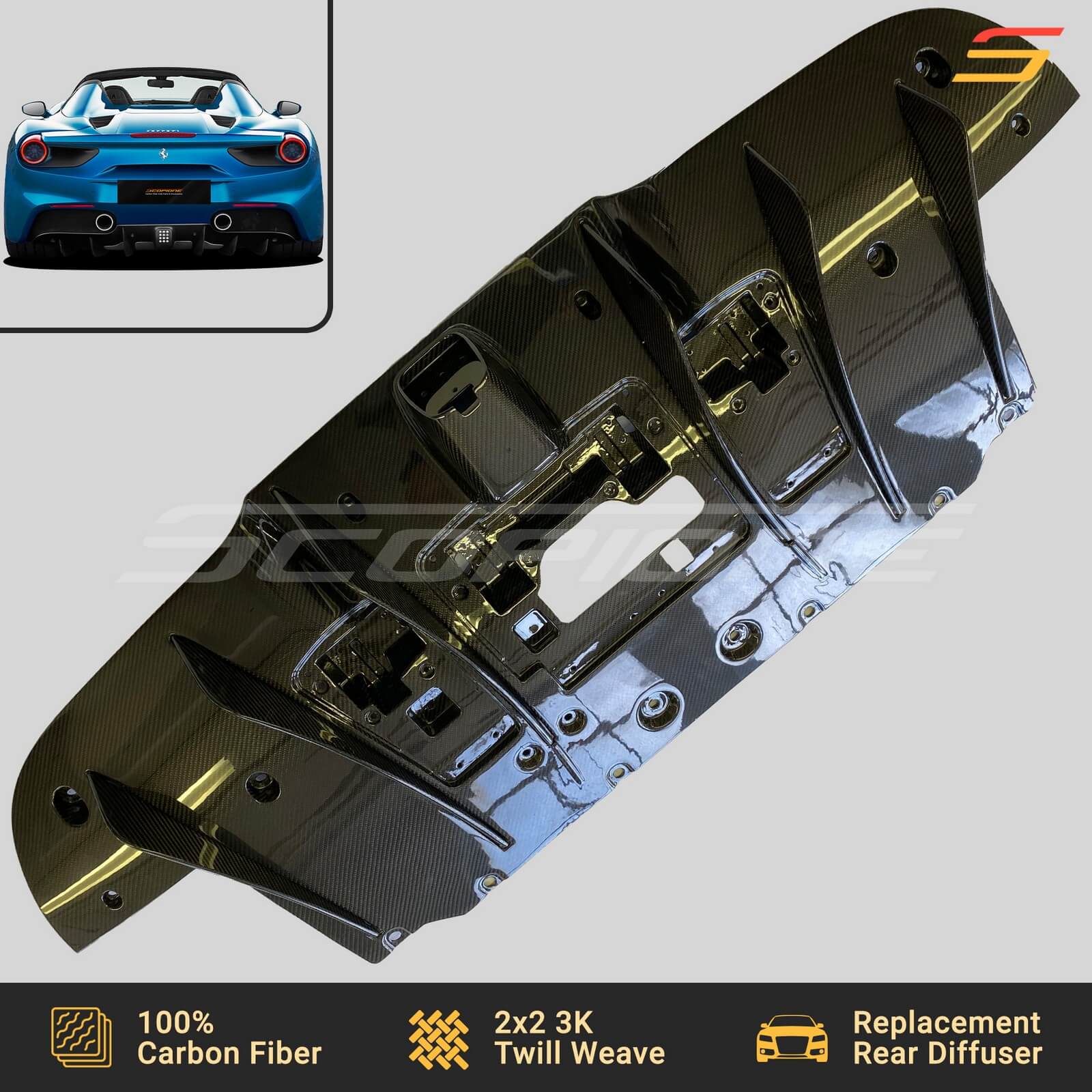
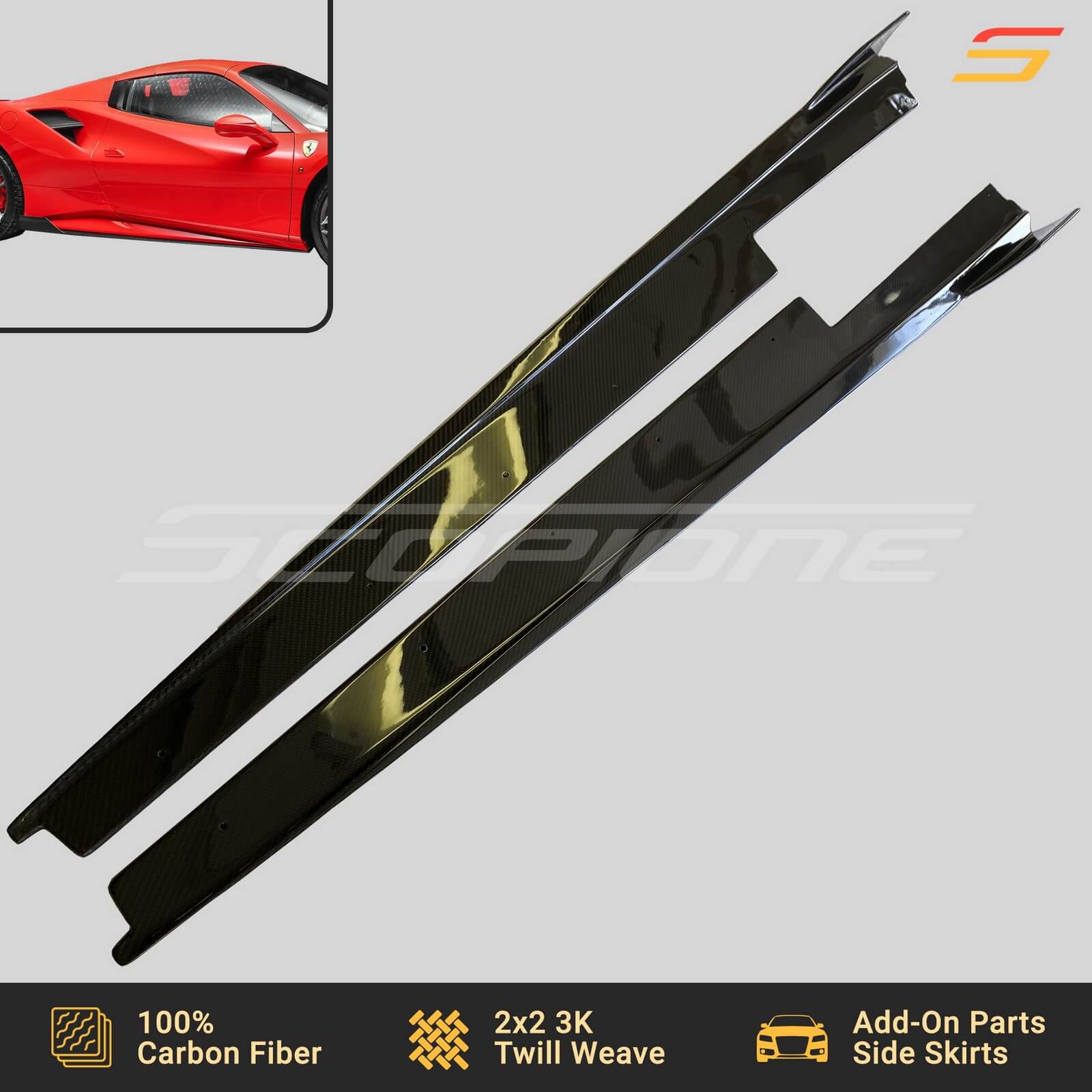
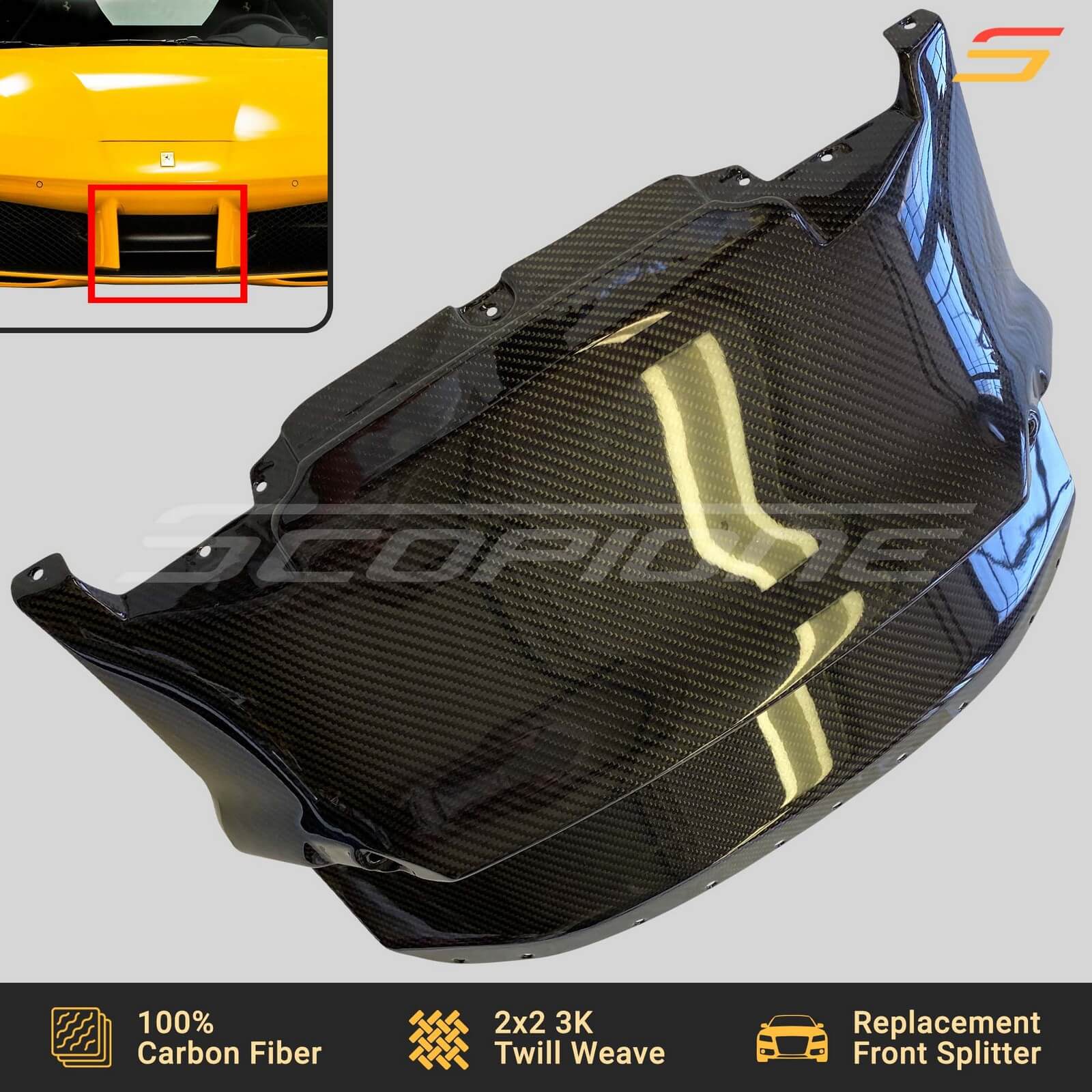
The 488’s aerodynamic bodywork was shaped around functional airflow – side air intakes that feed the turbochargers while echoing the 308 GTB’s sculpted form, and a Ferrari-patented blown rear spoiler. Carbon fiber parts for the exterior work with these aero surfaces rather than against them. The rear diffuser spans the full width of the rear bumper and is the single largest visual-impact CF piece available. Widened side skirts fill the gap between the rocker panel and the body side, lowering the visual stance. The front center air intake splitter sits at the lowest forward point of the car and is one of the first details visible at approach.
- Rear diffuser – full-width carbon fiber replacement spanning the entire rear bumper opening
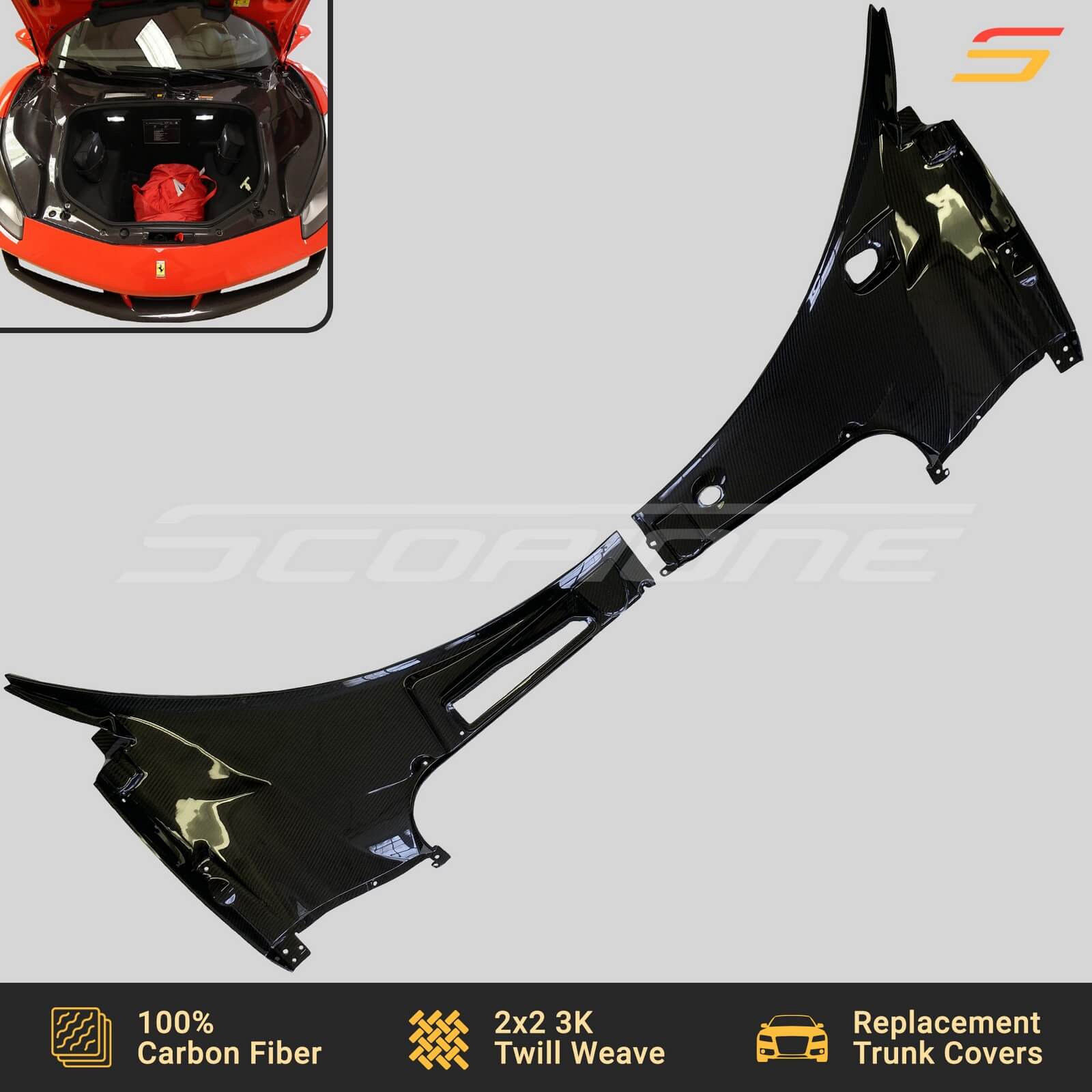
- Front bonnet covers – three-piece kit (top, sides, and full kit) covering the front trunk lid in exposed twill weave
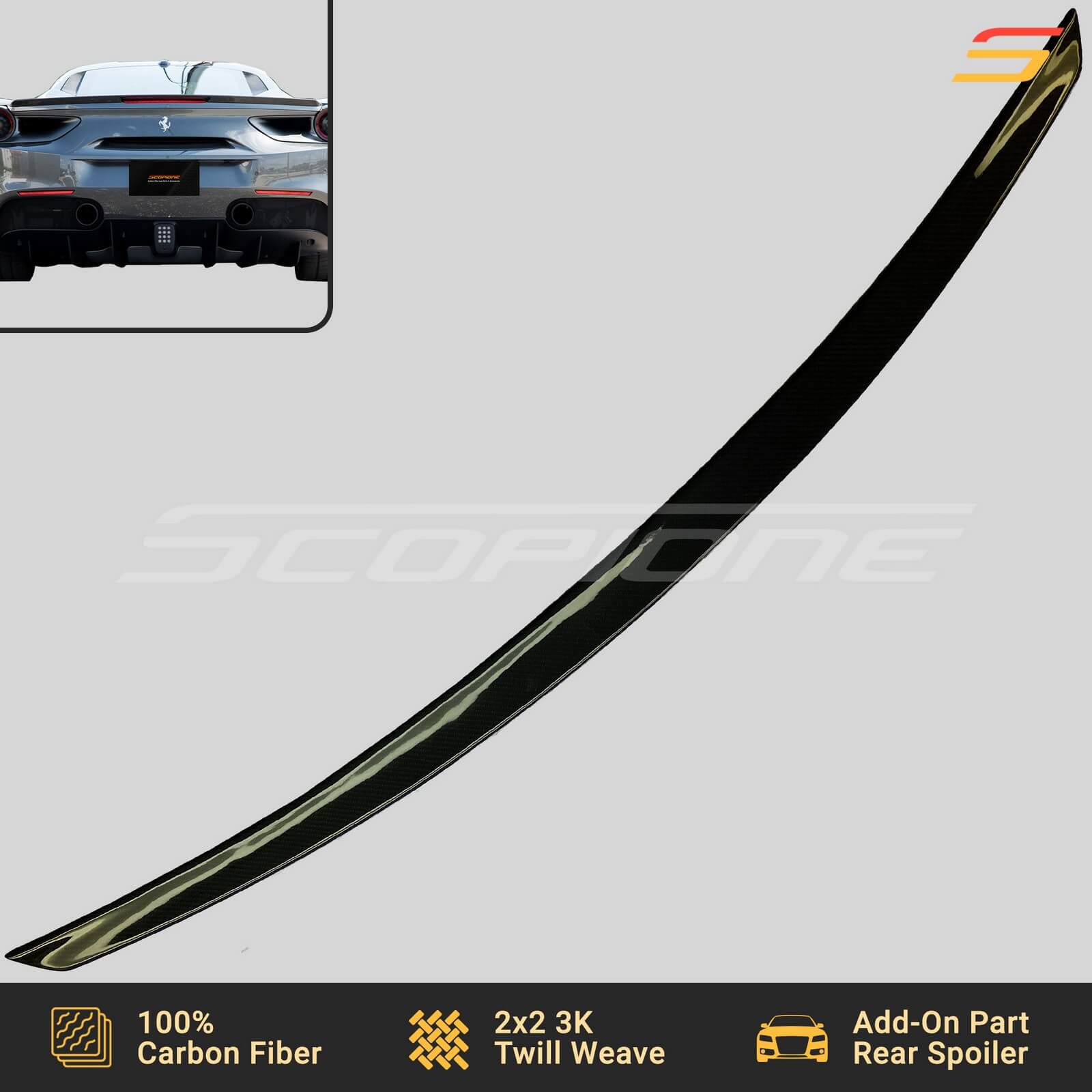
- Rear trunk spoiler, side skirts, and front center splitter – three functional aero components that define the car’s profile from every angle
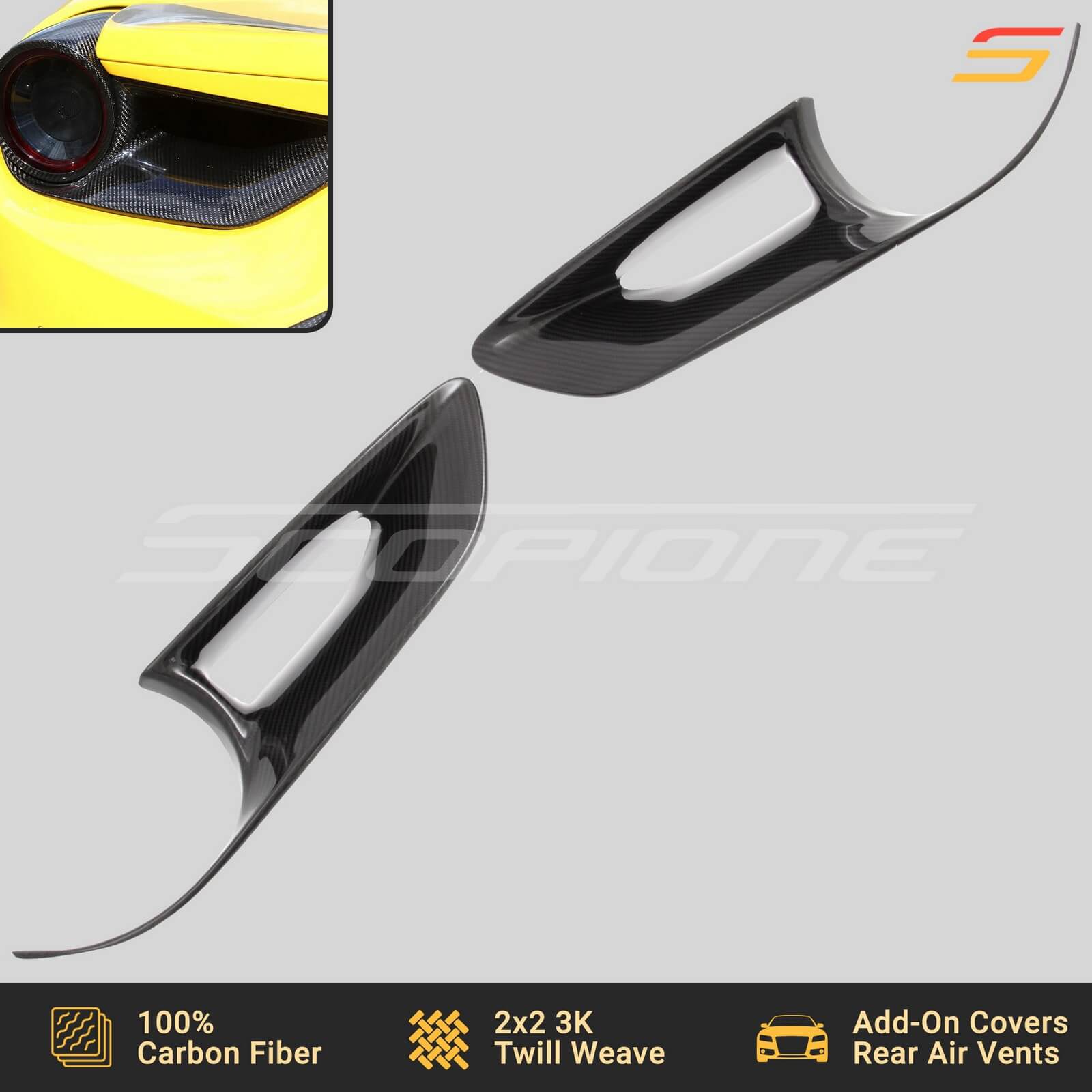
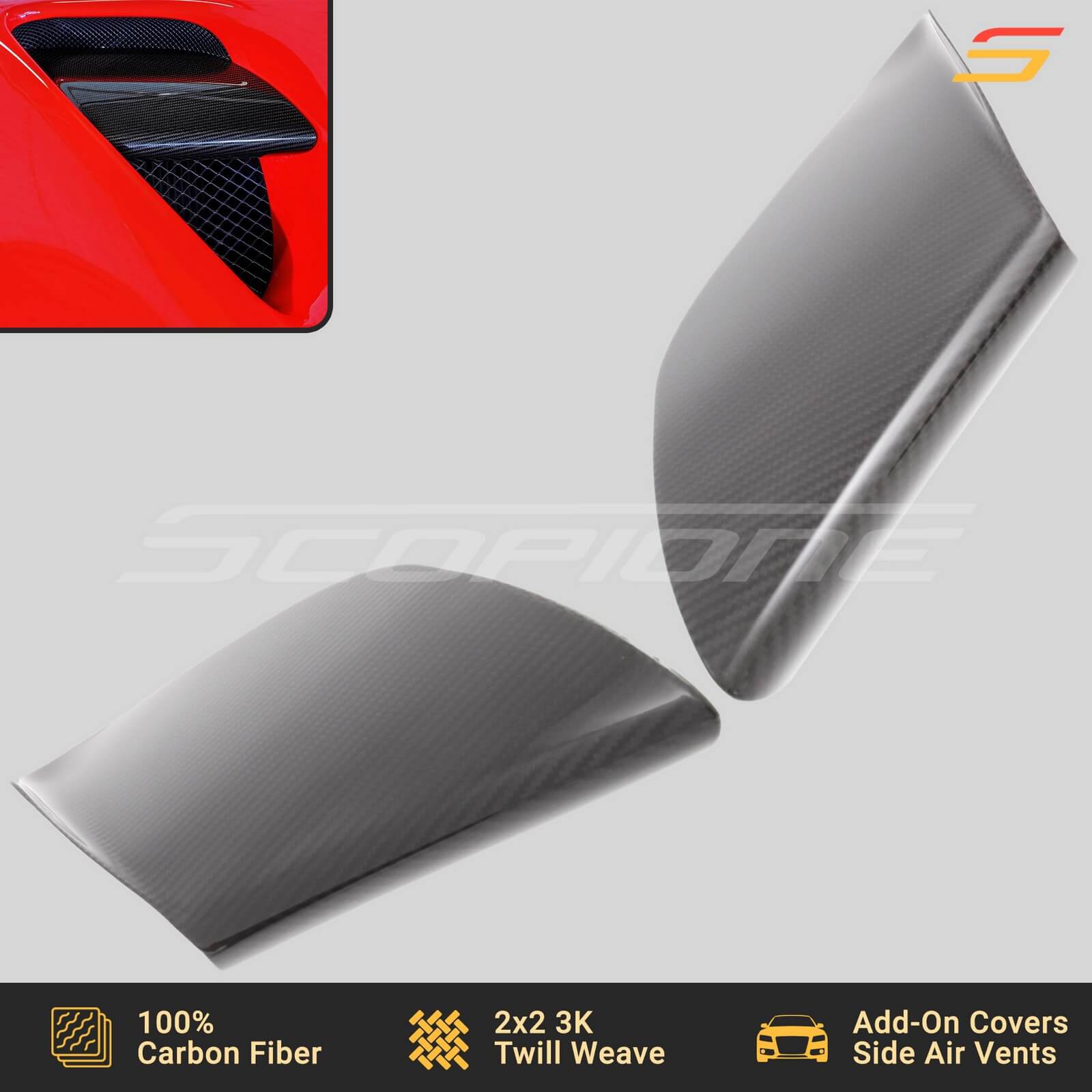
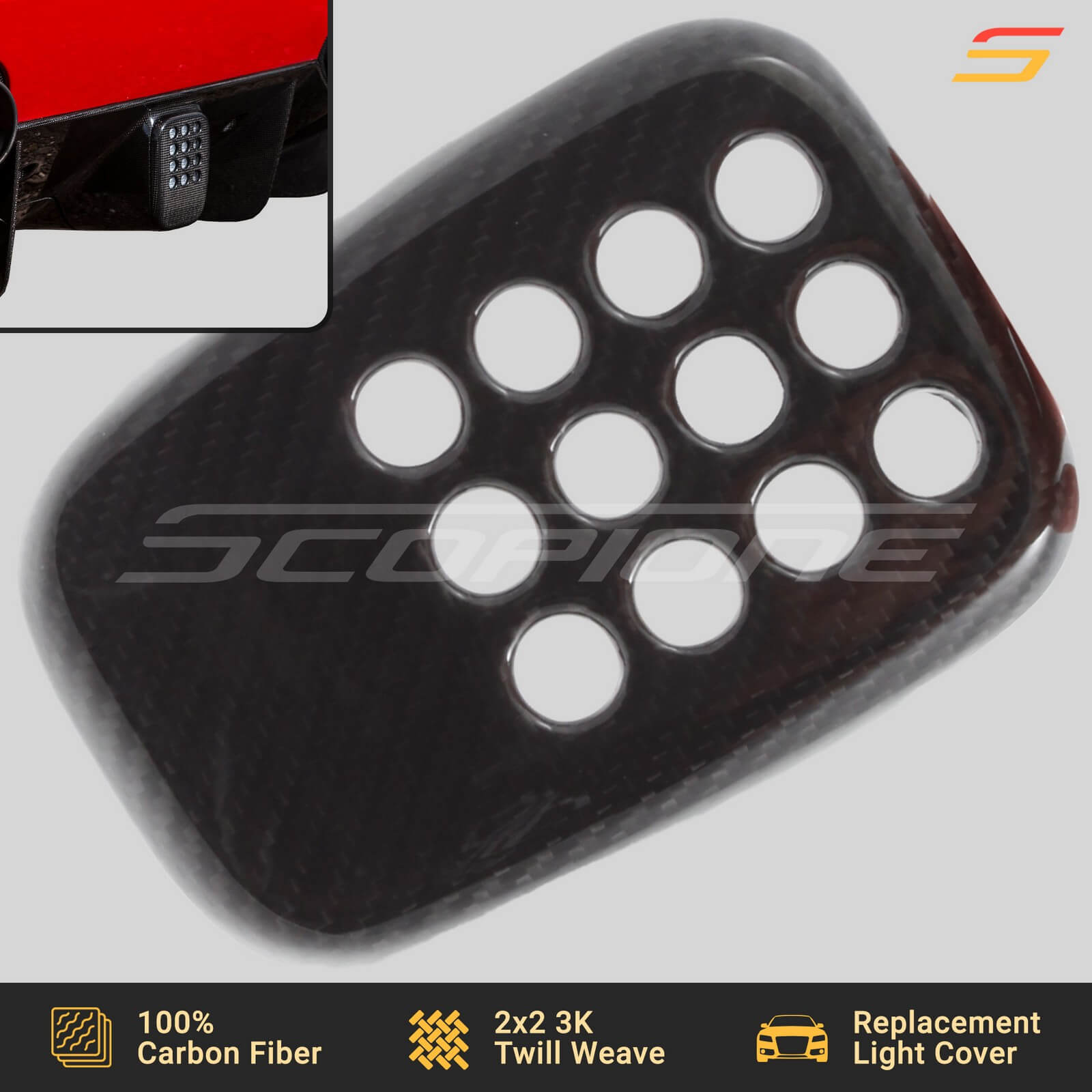
- Accent pieces in glossy or matte: door handle covers, fuel filler cap, side air intake vents, rear fog light cover, and tail light surrounds
Interior & Engine Bay
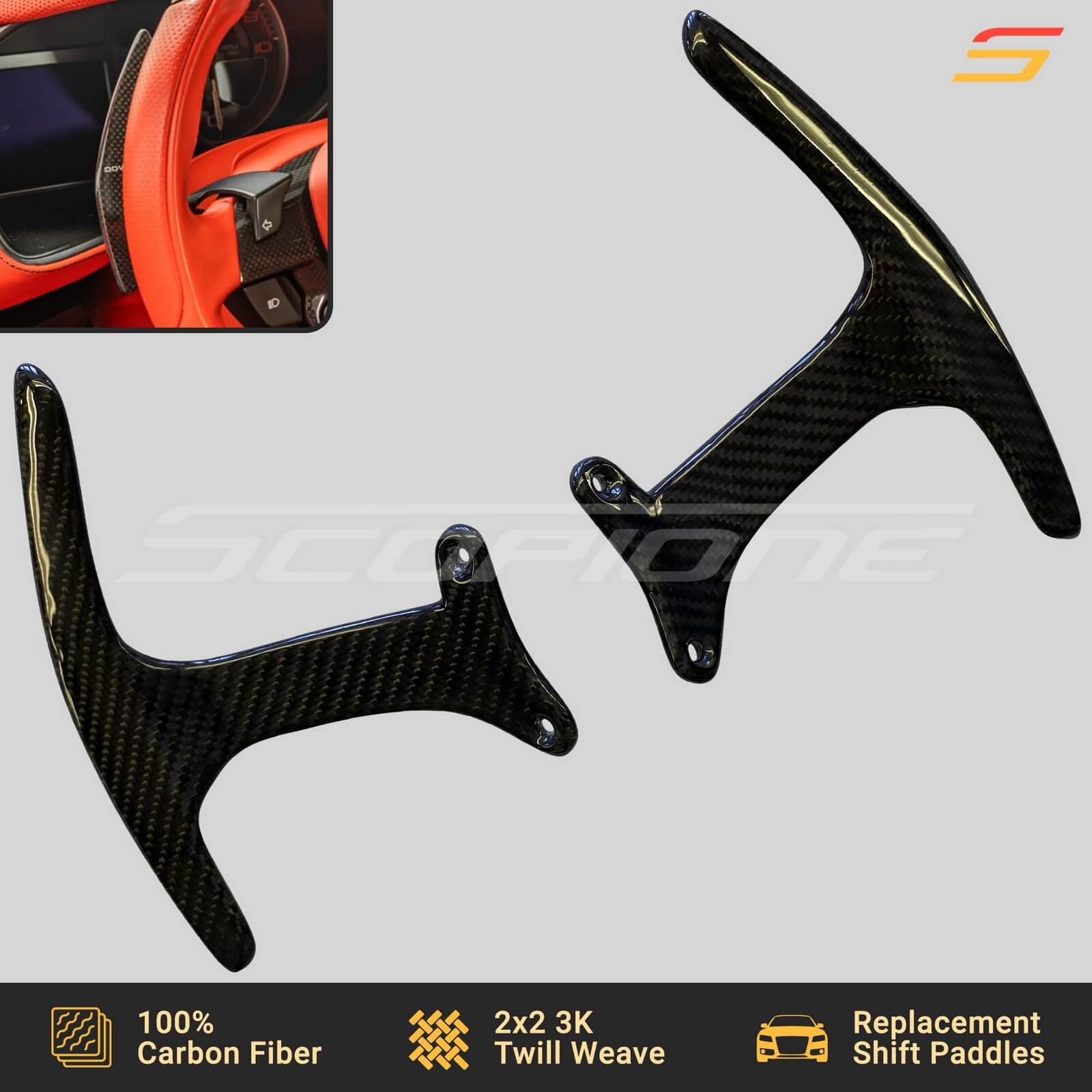
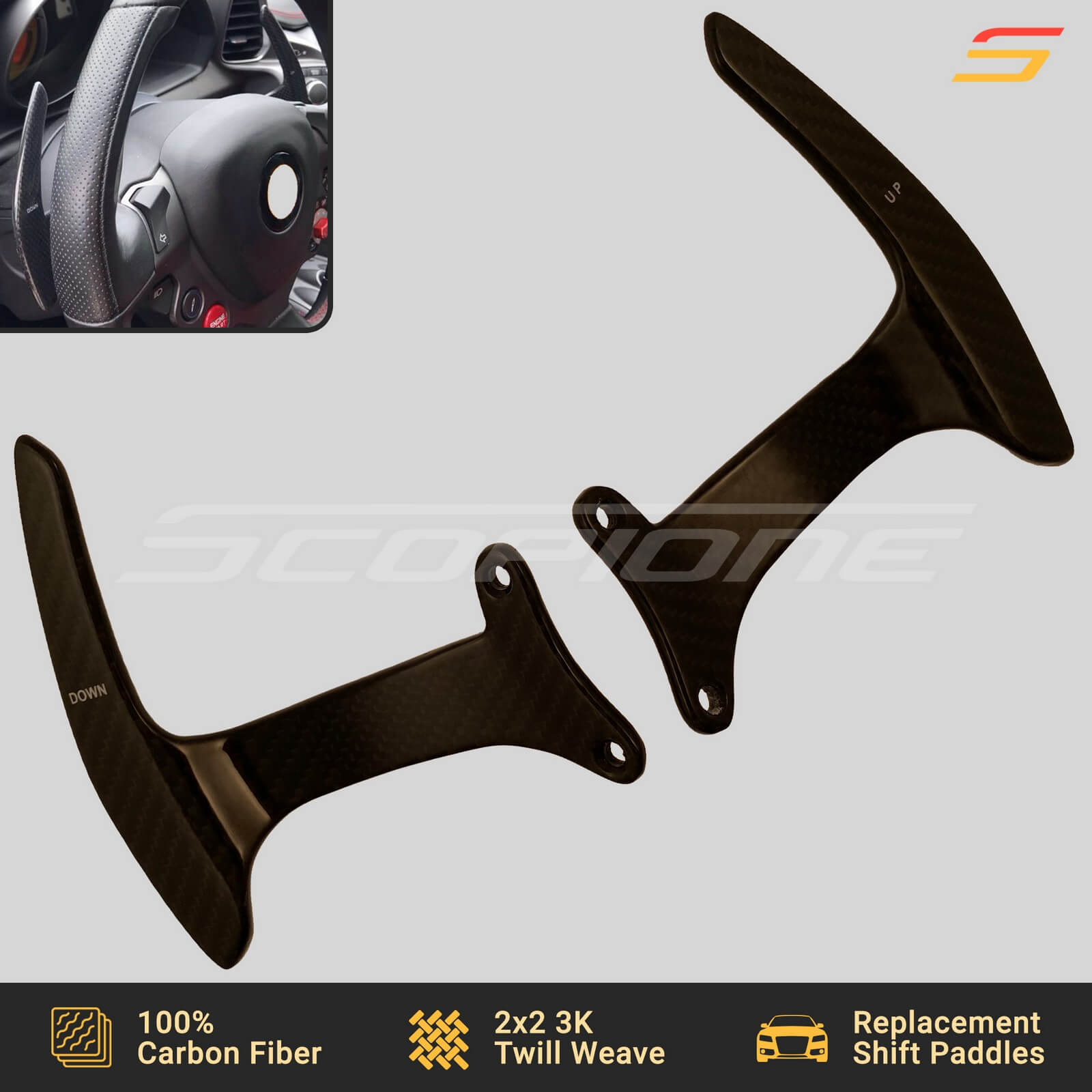
Interior carbon fiber on the 488 focuses on touch points and high-visibility surfaces. Extended shift paddles – longer than factory units for easier reach during aggressive driving – are a frequent first interior upgrade. Replacement shift paddles offer a direct swap for the factory aluminum paddles. Interior door handle covers add a third point of carbon-fiber contact inside the cockpit.
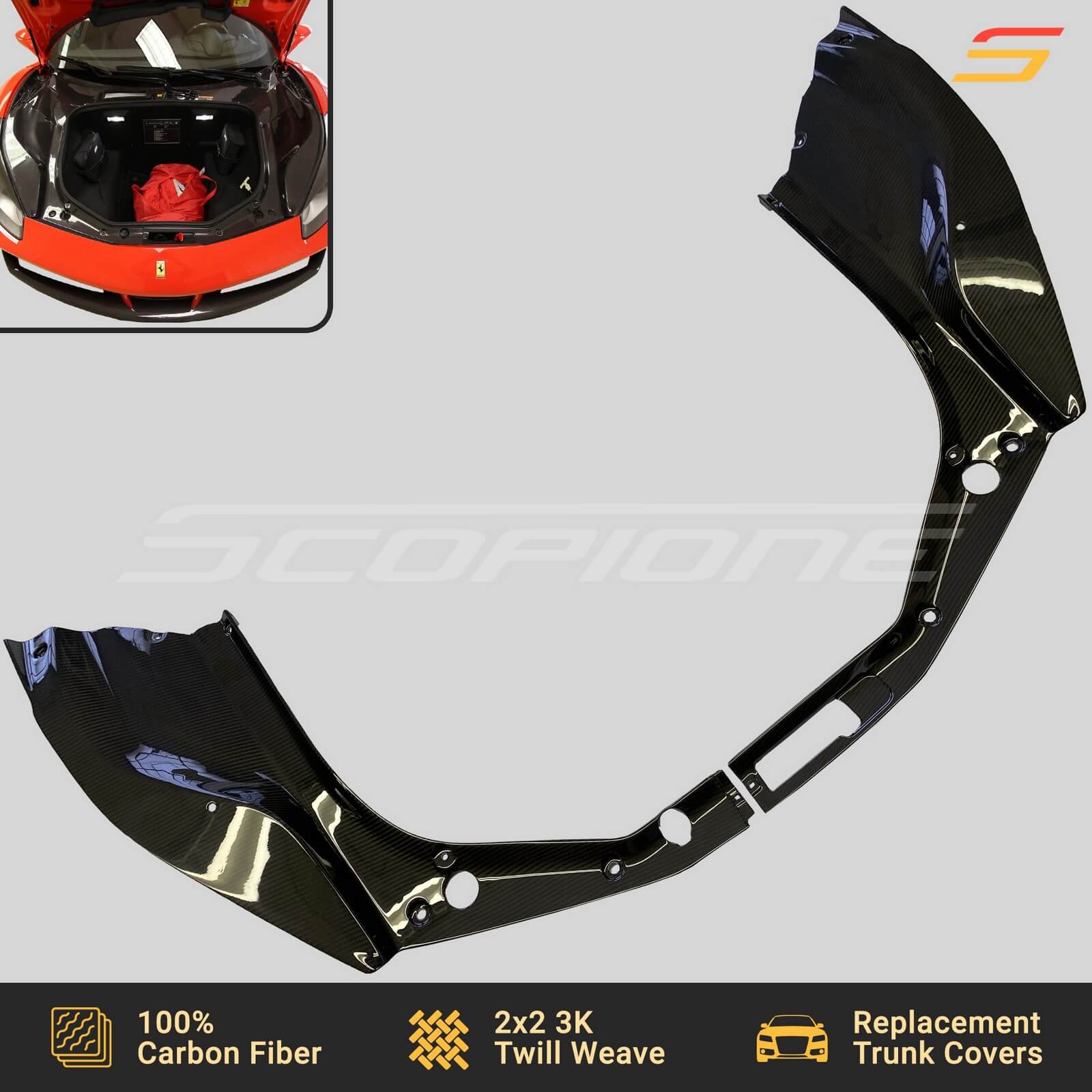
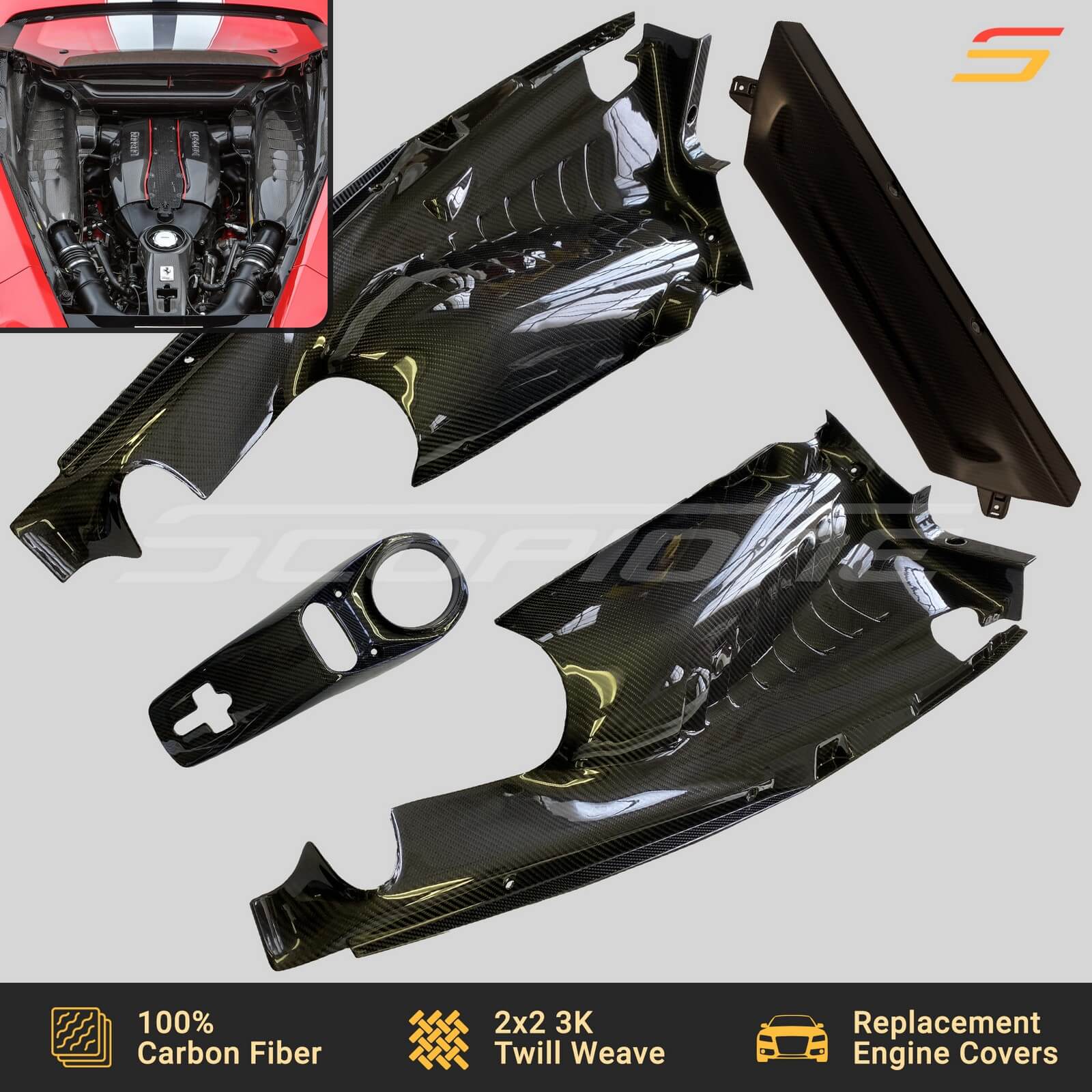
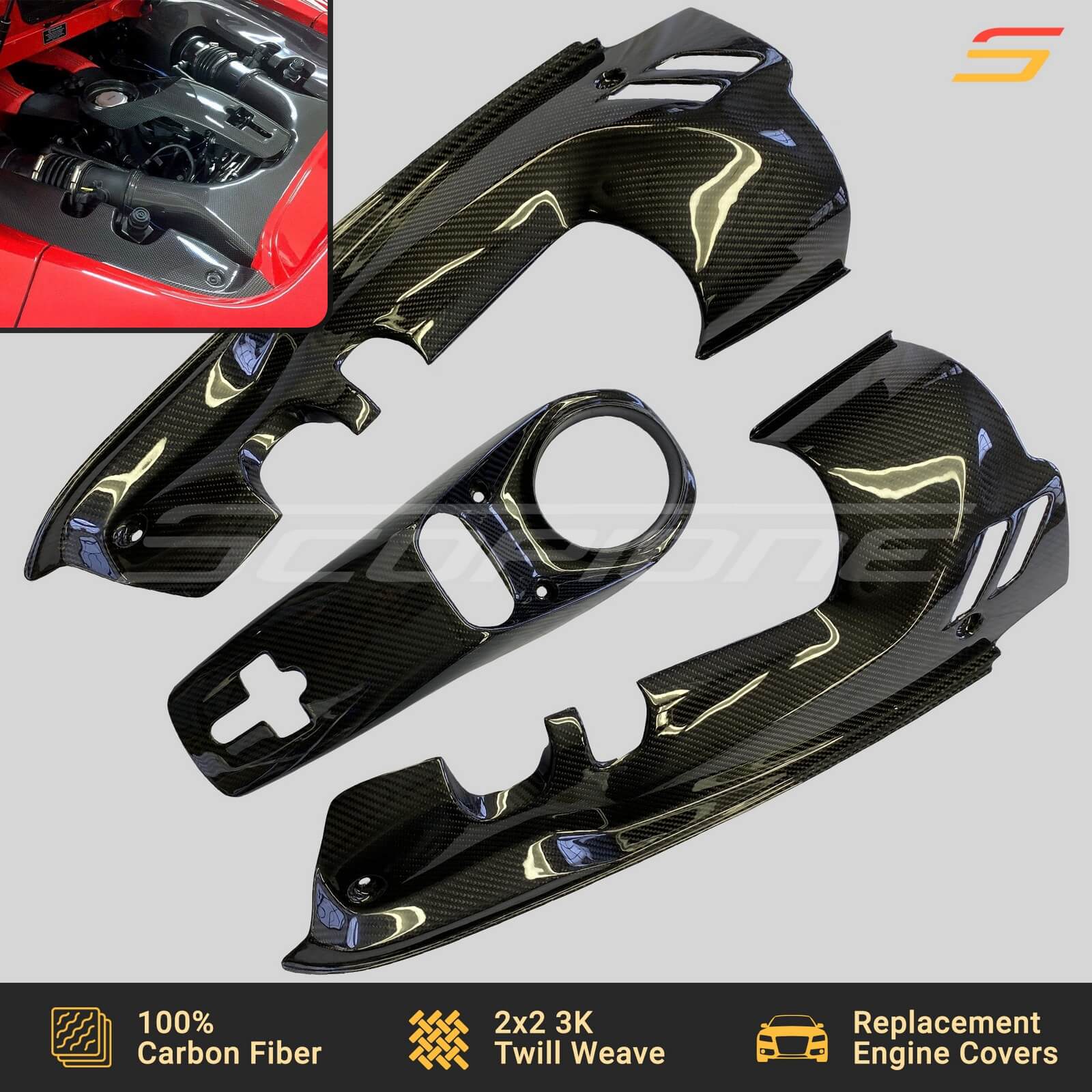
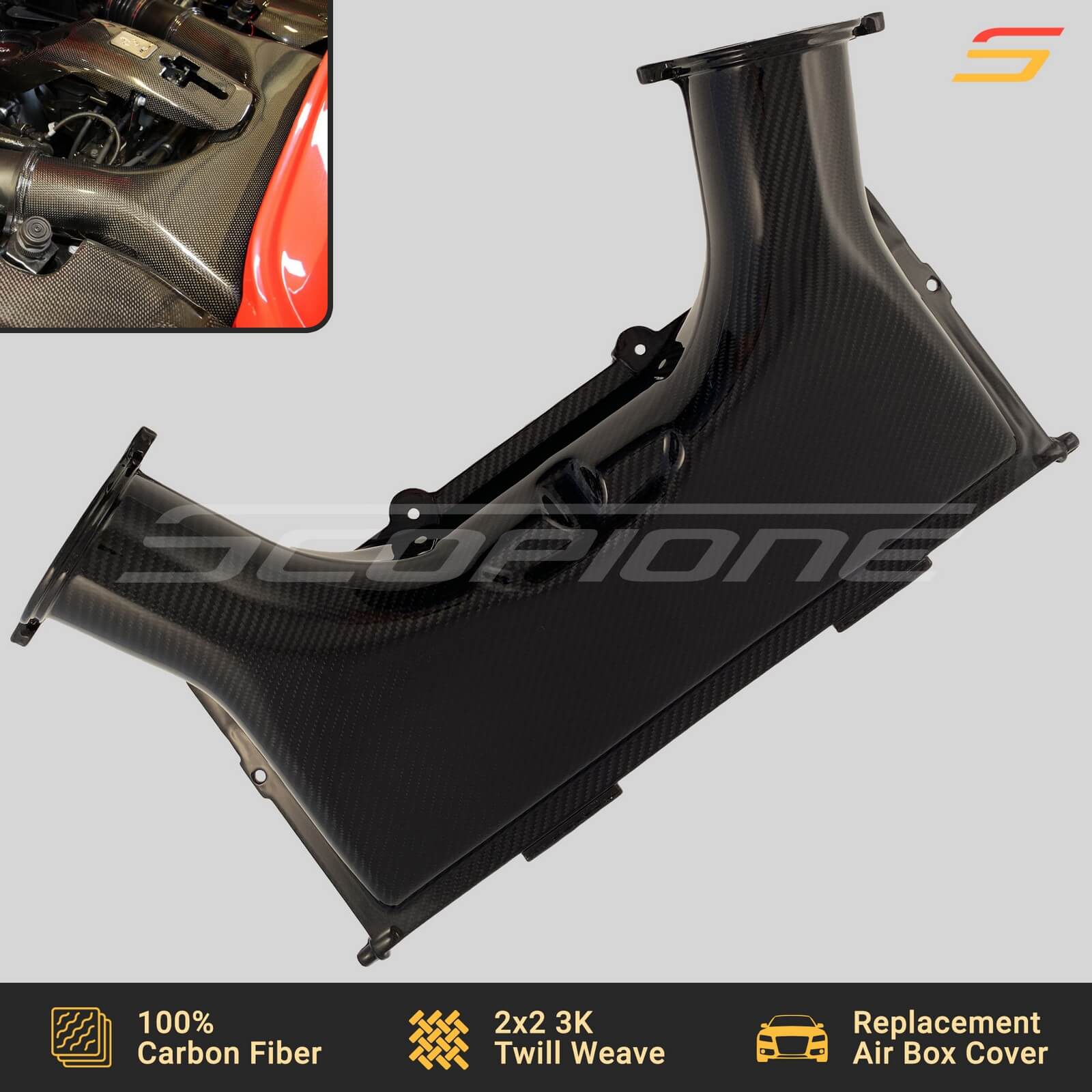
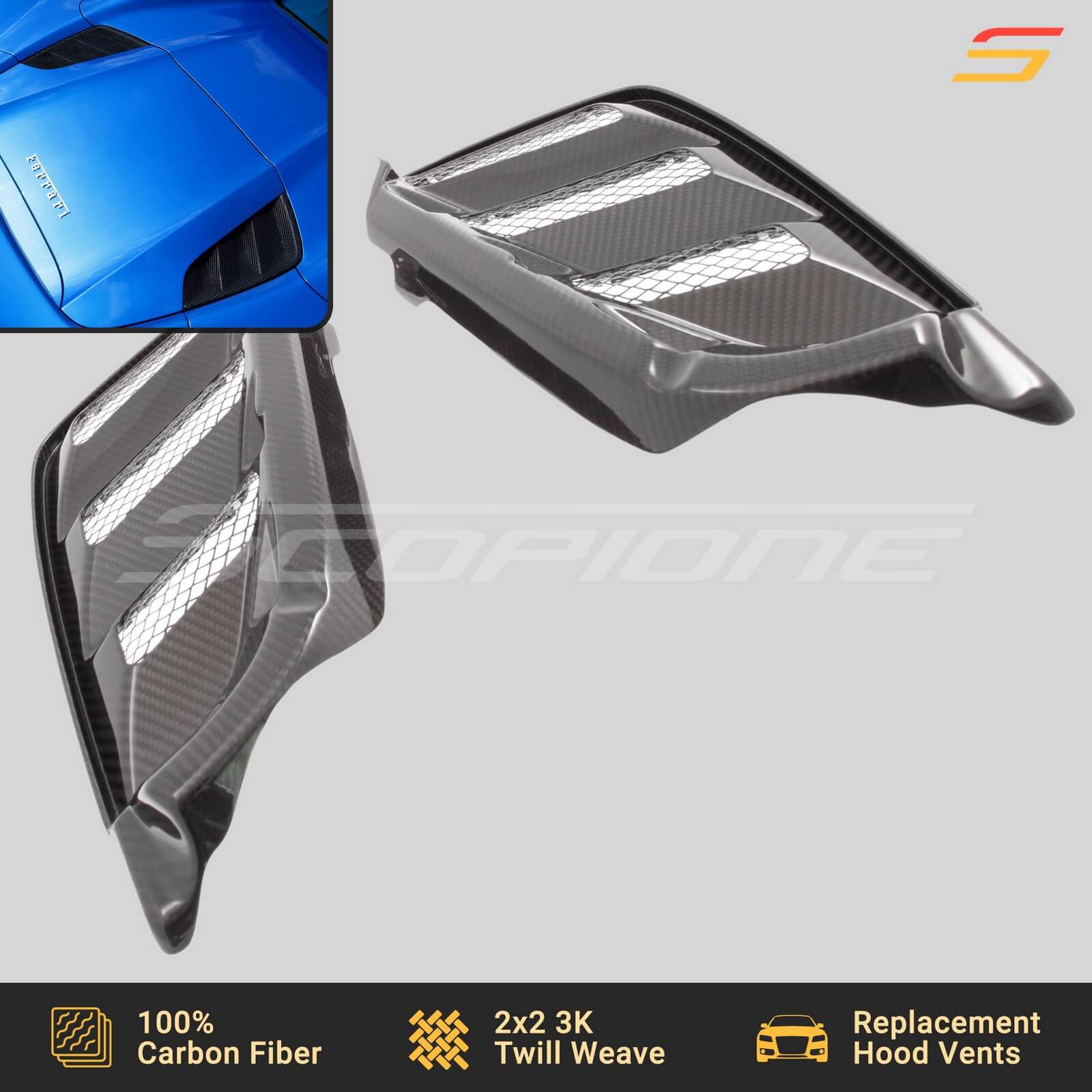
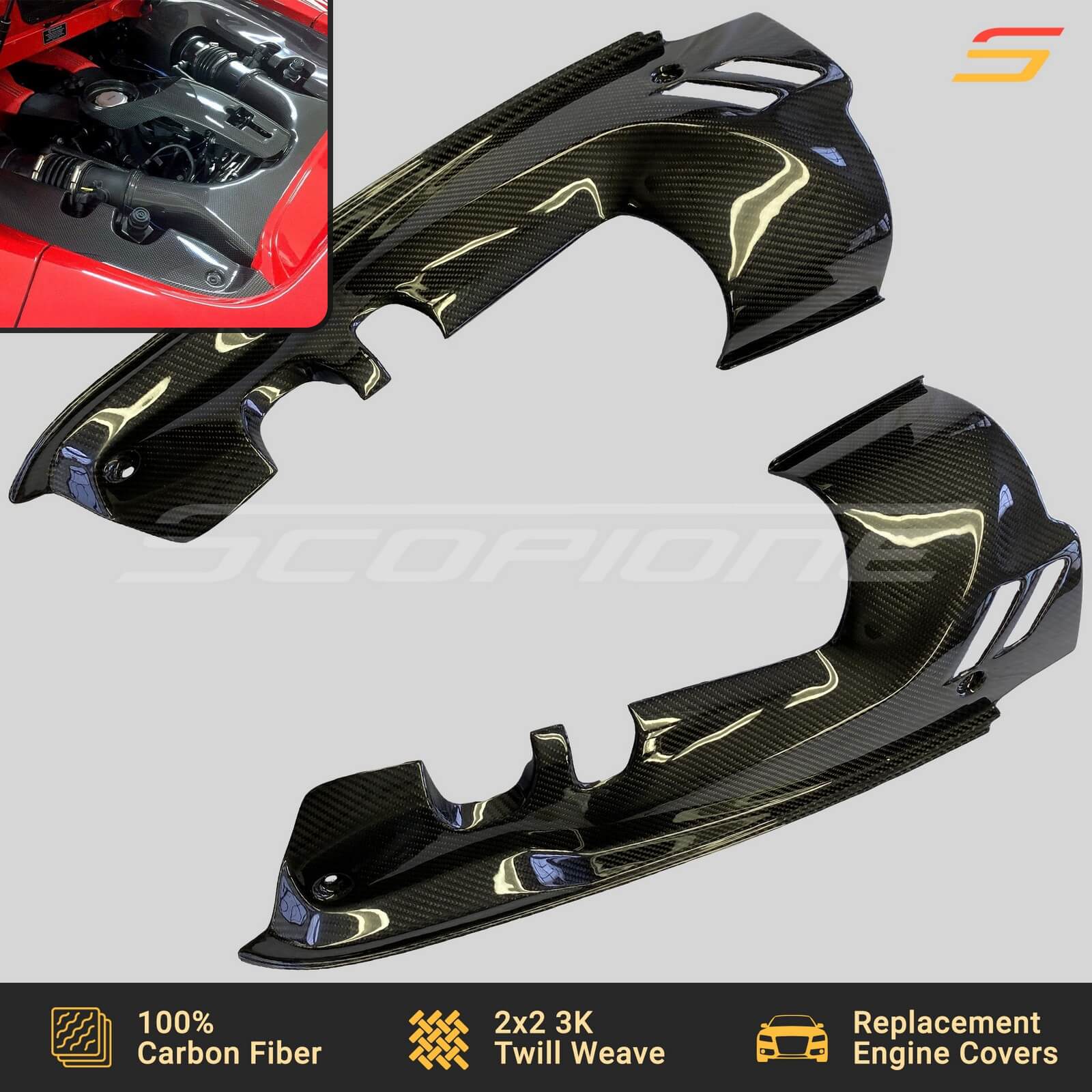
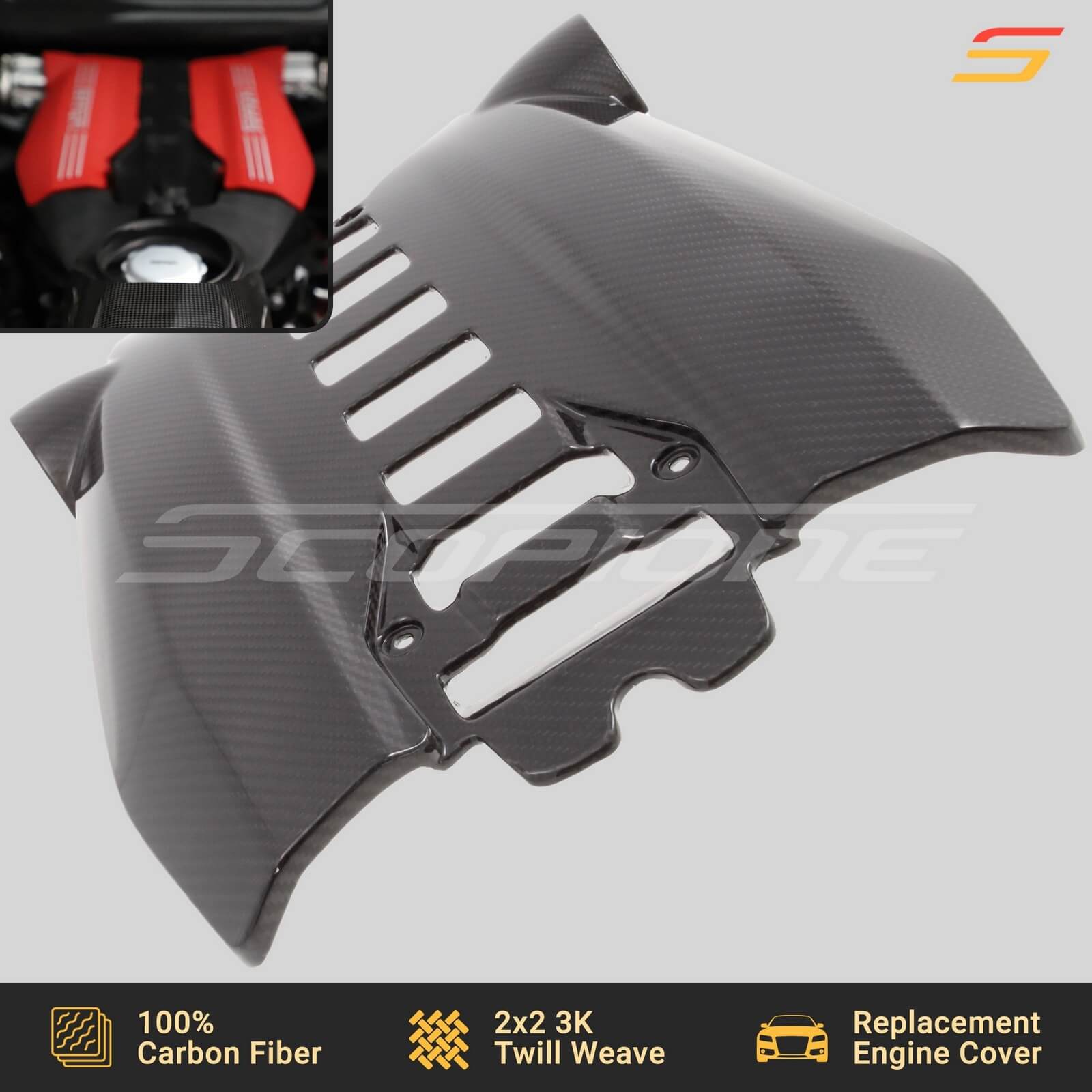
The engine bay is where the 488’s carbon fiber catalog is deepest. Scopione stocks separate engine cover configurations for the GTB and Spider due to the different bay layouts: the GTB’s enclosed bay uses full panel cover sets, while the Spider’s exposed bay (visible when the hardtop retracts) uses trim-focused sets. Center engine covers, side engine covers, air filter box covers, firewall covers, rear engine hood vents (Spider-specific), and air intake trims fill out the engine bay selection.
The Spider’s engine bay deserves particular attention. When the retractable hardtop folds away, the engine bay becomes visible from above – to passengers, trailing drivers, and spectators. CF engine covers on a 488 Spider function as exterior presentation pieces in a way that the GTB’s enclosed bay does not. This makes the Spider’s engine bay one of the highest-impact locations for carbon-fiber upgrades on the 488 platform.
Legacy of the 488 & Its Place in Ferrari History
The 488 GTB addressed a question that had lingered since the F40: whether a turbocharged mid-engine V8 could match the throttle response and top-end character of a naturally aspirated unit. The F154 engine came close enough to satisfy the overwhelming majority of drivers. Reviews at launch consistently noted the near-absence of turbo lag and the willingness to rev past 8,000 rpm – behaviors that previous turbo engines in this class did not exhibit. On track, the 488’s broader torque curve made it faster than the 458 Italia on every benchmark despite giving up 600 cc of displacement.
In racing, the 488 was dominant. The 488 GTE won the 2019 24 Hours of Le Mans GTE-Pro class and secured four FIA WEC GTE-Pro manufacturer titles across 2016, 2017, 2021, and 2022. That racing pedigree fed back into the road car’s reputation. The Pista, named after the Italian word for “track,” carried the closest racing lineage of any 488 variant – its S-Duct, aerodynamic package, and brake-based torque vectoring system all traced to lessons from the GTE program.
The F8 Tributo replaced the 488 in 2019 with 720 PS from an evolved F154 engine – 50 PS more than the 488 GTB and matching the Pista’s output in a standard road car. But the 488 occupies a specific historical position: it was the first turbocharged mid-engine V8 Ferrari to enter volume production since the F40, and the last before hybridization arrived with the SF90 Stradale. The McLaren Sports Series competed at a lower price point during the same period, offering a carbon-tub alternative to Ferrari’s aluminum architecture.
Scopione: Carbon Fiber Upgrades for the Ferrari 488
Scopione’s Ferrari 488 catalog includes 24 carbon fiber parts covering exterior aerodynamic components, interior trim, and engine bay panels. All pieces are manufactured in 2×2 3K twill-weave carbon fiber with a UV-resistant clear coat, available in glossy or matte finish. Each part is precision-fitted for 2015–2019 488 GTB and Spider models using factory mounting points. A 12-month limited warranty against delamination stands behind every component.
Ferrari’s factory carbon fiber options used a 1×1 3K plain weave pattern – a visual difference from Scopione’s 2×2 twill weave worth noting for buyers mixing aftermarket and factory carbon. Plain 1×1 weave reads as a checkerboard up close; 2×2 twill runs a diagonal herringbone. Neither is more genuine than the other – the twill simply announces itself more clearly. Some Scopione engine covers also cross-fit the 488 Pista and F8 Tributo.
Breakdown of Carbon Fiber Upgrade Costs for the Ferrari 488
| Carbon Fiber Part | Part Cost | Est. Installation | Total |
|---|---|---|---|
| Rear Bumper Diffuser | $2,800 | $300–$500 | $3,100–$3,300 |
| Widened Side Skirts | $2,100 | $300–$500 | $2,400–$2,600 |
| Front Bonnet Covers Kit | $2,250 | $300–$500 | $2,550–$2,750 |
| Engine Covers Trim Set (GTB) | $3,200 | $200–$400 | $3,400–$3,600 |
| Engine Covers Set (Spider) | $1,700 | $200–$300 | $1,900–$2,000 |
| Air Filter Box Cover | $1,600 | $100–$200 | $1,700–$1,800 |
| Top Bonnet Covers | $1,500 | $200–$300 | $1,700–$1,800 |
| Rear Trunk Spoiler | $1,500 | $200–$400 | $1,700–$1,900 |
| Extended Shift Paddles | $730 | $50–$100 | $780–$830 |
| Front Center Air Intake Splitter | $1,100 | $200–$400 | $1,300–$1,500 |
A comprehensive exterior build – diffuser, side skirts, front bonnet kit, splitter, and rear spoiler – runs approximately $10,500 to $12,000 installed, depending on finish selection and labor rates. Accent pieces (door handles at $270–$450, fuel filler cap at $300, rear fog light cover at $400) allow incremental builds at lower entry points.
Browse Carbon Fiber Parts for the Ferrari 488 GTB & Spider
Ferrari 488 Used Market & Pricing (2025–2026)
- 488 GTB (coupe) – $200,000 to $300,000. Standard-specification cars with higher mileage start around $200,000. Low-mile, single-owner examples with full Ferrari dealer service history and desirable options (carbon racing package, sport exhaust, front lift system) reach $280,000–$300,000.
- 488 Spider – $230,000 to $350,000. The retractable hardtop commands a consistent premium over the GTB. Rosso Corsa and Bianco Avus remain the quickest-selling color choices.
- 488 Pista – $500,000 to $750,000. Dealer asking prices start around $675,000 for higher-mileage examples, with sub-3,000-mile cars reaching $750,000 or more. Historical transaction averages sit near $487,000, but the market has moved sharply upward since 2024.
- 488 Pista Spider – $750,000 to $1,200,000. Current dealer asking prices start above $1,000,000 for most examples. Historical average transaction prices near $629,000 reflect earlier sales – the approximately 1,100 units produced and growing collector demand have pushed current values significantly higher.
What Factors Affect Ferrari 488 Prices?
- Service history – Full Ferrari dealer records are essential for top-dollar resale. Ferrari’s 7-year complimentary maintenance program covers cars serviced exclusively at authorized service centers. Gaps or independent-only service reduce values substantially.
- Mileage – Sub-5,000-mile Pistas command the steepest premiums. On standard GTBs, values compress once mileage exceeds 20,000.
- Color and options – Rosso Corsa remains the most liquid color. Tailor Made and Atelier specifications can add value when tasteful, or subtract it when divisive. Carbon fiber racing package, LED steering wheel, front lift system, parking cameras, and sport exhaust all support higher resale.
- Variant hierarchy – The price ladder runs GTB → Spider → Pista → Pista Spider, with significant gaps between each tier. A loaded GTB can overlap with entry-level Spiders.
- Title and accident history – Rebuilt or salvage title cars sell 30–40% below clean-title equivalents. Track damage, even when properly repaired, depresses values more than street incidents.
Ferrari 488 Market Transaction Data
| Variant | Avg. Transaction Price | Source / Period |
|---|---|---|
| 488 GTB | $224,000–$265,000 | CLASSIC.COM & Edmunds, 2024–2025 |
| 488 Spider | $285,000–$310,000 | CLASSIC.COM & Edmunds, 2024–2025 |
| 488 Pista | $487,000 (historical avg.) | CLASSIC.COM, through Q1 2026 |
| 488 Pista Spider | $629,000 (historical avg.) | CLASSIC.COM, through Q1 2026 |
Note: Pista and Pista Spider asking prices have risen sharply since late 2024. Current dealer inventory starts well above the historical transaction averages shown here. The 488 GTB holds the record BaT sale at $390,500 (September 2025), demonstrating the premium that low-mileage, well-optioned examples can command.
Is the Ferrari 488 GTB a Good Investment?
The 488 GTB and Spider are in a late depreciation phase. Standard GTBs typically trade near or below their original $245,400 MSRP, though top low-mile cars reach $280,000–$300,000, and Spiders have settled into a relatively stable range. The Pista variants tell a different story – Pista coupes now command well above their $330,000 MSRP, with asking prices starting around $675,000 and climbing. Pista Spiders have appreciated even more dramatically, with current market values exceeding $1,000,000 for most examples. As Ferrari’s last pure internal combustion turbo V8 before hybridization (the SF90 Stradale introduced a plug-in hybrid V8 in 2019), the 488 may benefit from collector interest similar to what the 458 Italia currently enjoys. But for standard variants, appreciation is likely 3 to 5 years away.
What Are Common Ferrari 488 Maintenance Issues and Costs?
Annual maintenance runs $1,500 to $3,000 after Ferrari’s 7-year complimentary maintenance program expires. A standard dealer service – oil change, filter replacement, inspection – costs approximately $1,700 to $2,000. The 488 uses timing chains rather than belts, carrying forward the same advantage the F430 and 458 established over the belt-driven 360 Modena and earlier V8 Ferraris.
Major cost items to budget for:
- Dual-clutch pack replacement – $6,000 to $10,000 depending on dealer versus independent shop labor rates
- Carbon-ceramic brake rotors – $8,000 to $15,000 per axle for replacement, though rotors can last 60,000 to 100,000+ miles under street driving conditions
- Sticky buttons syndrome – inherited from the 458. The rubberized coating on interior buttons and surfaces degrades into a tacky residue. Budget $500 to $1,000+ per component, or $5,000 to $10,000 for a full interior refinishing.
- Rear tires – $350 to $600 per tire (305/30R20 Pirelli P Zero). Regular driving may require annual rear replacement.
- Turbocharger replacement – the IHI twin-scroll units are generally reliable, but turbo failures are a documented concern in the 488 community. Replacement runs approximately $25,000 per turbo at a dealer.
- Insurance – $2,500 to $6,500 per year for typical full-coverage policies, varying by driver profile and location. Agreed-value policies from specialty collector insurers often provide lower premiums than standard carriers.
What Carbon Fiber Parts Are Available for the Ferrari 488?
Scopione stocks 24 carbon-fiber parts for the 488 GTB and Spider across three categories. Exterior: rear bumper diffuser, rear trunk spoiler, widened side skirts, front center splitter, front bonnet covers (top, side, and full kit), side air intake vents, rear fog light cover, tail light covers, door handle covers, and fuel filler cap. Interior: extended shift paddles, replacement shift paddles, and interior door handle covers. Engine bay: full engine cover trim sets (separate GTB and Spider configurations), center engine cover, side engine covers, air filter box cover, firewall cover, rear engine hood vents (Spider), and air intake engine cover trim.
Each part is produced in 2×2 3K twill-weave carbon fiber and sealed with UV-resistant clear coat. Glossy and matte finishes are available across most product lines. Every piece mounts to factory points, with no drilling or cutting involved. Some engine cover components cross-fit the 488 Pista and F8 Tributo.
Ferrari 488 owners considering modifications can explore Scopione’s catalog
Gallery Description
The Ferrari 488 GTB and Spider picture gallery features owner-submitted photos, studio shots, and detail photography highlighting carbon-fiber upgrades on the 488 platform. Images cover both GTB coupes and Spider convertibles with various configurations of Scopione carbon fiber parts – from individual accent pieces to full exterior and engine bay builds. Each photo demonstrates how 2×2 twill-weave CF components integrate with the 488’s aerodynamic body lines shaped by Ferrari’s Centro Stile.
View all available carbon fiber parts for the Ferrari 488
Frequently Asked Questions
What Carbon Fiber Parts Are Available for the Ferrari 488?
Scopione carries 24 carbon fiber parts for the Ferrari 488 GTB and Spider, including rear diffuser, rear spoiler, side skirts, engine covers, shift paddles, and bonnet covers. Both glossy and matte finishes are available.
Which 488 parts do not fit the GTB?
Three: the Engine Covers Panels Set, the Rear Engine Hood Vents and the Side Engine Covers Trim. All three are engine-bay pieces that fit the Spider and Pista only, because the folding hardtop changes how the deck above the engine is packaged. GTB owners should use the Engine Covers Trim Set instead.
Do any 488 parts fit the F8 Tributo?
Yes – eight of them. The F8 Tributo kept the 488’s 3.9-litre twin-turbo architecture and much of the surrounding geometry, so the Engine Covers Trim Set, Engine Filter Air Box Cover, Center Engine Cover, both sets of shift paddles, exterior door handles, door handle covers and fuel tank lid all carry across.
Does Carbon Fiber Affect the Resale Value of a Ferrari 488?
Carbon fiber upgrades generally support resale value on the 488, especially when they complement the factory carbon fiber racing package. Reversible modifications with documented provenance are preferred by buyers.
Is the Ferrari 488 GTB a Good Investment?
Standard 488 GTBs are still in a late depreciation phase, though the curve is flattening. Pista variants already trade above MSRP. As Ferrari’s last pure ICE turbo V8, the 488 may appreciate in 3-5 years as the market shifts.
What Are Common Ferrari 488 Maintenance Issues and Costs?
Annual maintenance runs $1,500-$3,000. Known issues include sticky buttons syndrome (inherited from the 458), documented turbo failures (~$25K per turbo), and rear tire wear. The 488 uses timing chains. Carbon-ceramic brakes last 60,000-100,000+ miles under street use.
More Scopione Picture Galleries
Scopione’s carbon fiber catalog spans Italian, German, British, Japanese, and American performance vehicles. Each gallery page includes vehicle history, specifications, market data, and available CF upgrades:
- Ferrari: 458 Italia & Spider • F8 Tributo & Spider • F12 & 812 Superfast • SF90
- Lamborghini: Gallardo • Huracan • Aventador • Urus
- McLaren: MP4-12C & 650S • 720S & 765LT • Sports Series
- Porsche: 911, Boxster & Cayman
- BMW: M3, M4, M5 & More
- Audi: R8
- Nissan: GT-R R35 • 350Z, 370Z & Z
- Aston Martin: Vantage, DB9 & DBS
- Bentley: Continental GT & GTC
- Maserati: GranTurismo & GranCabrio
- Toyota: Supra
- Subaru: WRX STI
- Mitsubishi: Lancer Evolution
- Chevrolet: Corvette • Camaro
- Dodge: Viper
Experience the elegance and performance of the Ferrari 488 with Scopione. Browse our gallery and get inspired to elevate your supercar with our top-of-the-line carbon fiber upgrades.
Shop now for premium ScopioneCarbon carbon fiber upgrades and experience the ultimate in performance and aesthetics for your Ferrari 488!