

 Shop
ShopThe Maserati GranTurismo & GranCabrio carried a Ferrari-derived naturally aspirated V8 through 12 years of production (2007–2019), followed by a second generation powered by Maserati’s own Nettuno twin-turbo V6 and a fully electric Folgore drivetrain. Scopione stocks a catalog of carbon fiber exterior and interior components for the Maserati GranTurismo and GranCabrio – front splitters, rear diffusers, mirror covers, fender vents, shift paddles, and a complete dash trim kit – precision-fitted for 2008–2019 first-generation models.
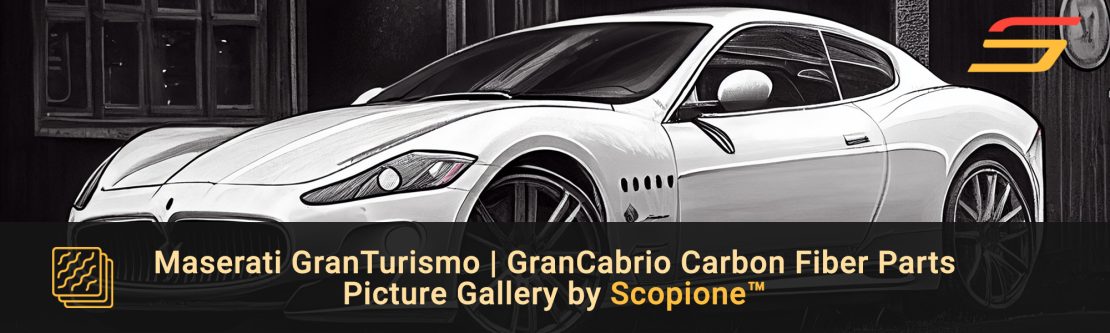
Introduction: The Maserati GranTurismo & GranCabrio
The GranTurismo debuted at the 2007 Geneva Motor Show as Maserati’s return to the two-door grand tourer segment – a car built around a Ferrari-derived V8, a Pininfarina-drawn body, and a shortened Quattroporte platform. It replaced the 4200-series Coupé and GranSport, pairing four genuinely usable seats with high-speed touring capability. The GranCabrio convertible followed two years later at the 2009 Frankfurt Motor Show, adding a hydraulic fabric soft top on the same mechanical foundation.
Maserati built the GranTurismo at the Viale Ciro Menotti plant in Modena — the same factory that produced the MC12 and Quattroporte. Estimated total production across all first-generation GranTurismo and GranCabrio variants reached approximately 40,000 units over the 12-year run, making it one of Maserati’s highest-volume models in the brand’s history.
Pininfarina’s exterior aged remarkably well. The GranTurismo stayed in production for 12 years (2007–2019) with only minor cosmetic revisions – one of the longest continuous production runs for any Italian sports car design of the modern era. The proportions were classical: long hood, trident grille, 2+2 cabin, short rear deck. Underneath sat a modified Maserati Quattroporte M139 platform with a 2,942 mm wheelbase and rear-wheel drive through a limited-slip differential.
Ferrari supplied the engine – a naturally aspirated F136 V8 in 4.2-liter (405 hp) and later 4.7-liter (433–454 hp) configurations. The same engine family powered the Ferrari F430 and California, calibrated differently for each application. When Ferrari stopped supplying engines to Maserati, the GranTurismo’s V8 became the final naturally aspirated Ferrari-built V8 in any road car. That distinction gives every first-generation GranTurismo a specific place in Italian automotive lineage.
In 2022, Maserati revealed the second-generation GranTurismo – a ground-up redesign powered by the in-house Nettuno V6 twin-turbo (shared with the MC20 supercar) and an all-electric Folgore variant. The Bentley Continental GT represents the British/German approach to the same grand touring brief, while the Maserati defines the Italian philosophy: lighter, more driver-focused, and built around engine character rather than outright refinement.
Scopione’s Maserati GranTurismo carbon fiber catalog covers front splitters, rear diffusers, mirror covers, fender vents, shift paddles, gauge cluster bezels, and a complete interior dash trim kit for 2008–2019 models.



First Generation (2007–2019): The Ferrari V8 Era
The original GranTurismo launched with a 4.2-liter Ferrari F136 V8 – producing 405 hp at 7,100 rpm and 339 lb-ft at 4,750 rpm. It shared its basic architecture with the Ferrari F430’s flat-plane-crank V8, but the Maserati version used a cross-plane crankshaft – a deeper, rumbling exhaust note in place of Ferrari’s scream – and was calibrated for torque delivery suited to a 1,880 kg grand tourer rather than a mid-engine sports car. A ZF 6-speed automatic was the standard transmission. Skyhook adaptive damping smoothed the ride across the GranTurismo’s 2,942 mm wheelbase.
In 2008, the GranTurismo S introduced the 4.7-liter version of the F136 – 433 hp, stronger mid-range torque, and Maserati’s MC Shift transmission: a Magneti Marelli electro-actuated single-clutch gearbox derived from Ferrari’s F1 road car technology. MC Shift delivered sharp upshifts but coarse low-speed behavior that divided owners. The ZF automatic remained available on non-S models and eventually became the preferred choice for daily driving.
Maserati launched the GranTurismo MC Trofeo World Series in 2010 — a one-make racing championship using stripped-down, roll-caged GranTurismos with the 4.7L V8 and sequential gearbox. The series ran across Europe, Asia, and the Middle East through 2017, giving Maserati a visible motorsport platform for the first time since the MC12 GT1 program. Engineering lessons from Trofeo cars — particularly suspension geometry, brake cooling, and aerodynamic balance — fed directly into the MC Stradale road car.
Three key variants defined the first generation:
- GranTurismo MC Stradale (2011–2017) – Track-focused variant. 444 hp initially, rising to 454 hp with the 2013 facelift. Factory carbon-fiber front splitter, rear diffuser, and engine cover. Originally a 2-seater (rear seat delete for weight reduction), with an optional 2+2 configuration from 2013. Approximately 110 kg lighter than the base car. Brembo carbon-ceramic brakes available. MC Shift only.
- GranTurismo Sport (2012–2019) – Final evolution carrying 454 hp and a revised front bumper. Available with either ZF automatic or MC Shift. Updated 8.4-inch infotainment. Carried the model through its last seven production years with minimal exterior changes.
- GranCabrio Sport / MC (2012–2019) – 444–454 hp convertible variants with hydraulic fabric top. The GranCabrio MC added factory carbon-fiber mirror caps, a sport exhaust, and Alcantara interior accents. Approximately 100 kg heavier than the coupe. Open/close cycle: 28 seconds at up to 32 km/h.
Maserati GranTurismo (2007–2019) MSRP
| Model | Base MSRP (USD) | Inflation-Adjusted (2024) |
|---|---|---|
| GranTurismo 4.2 (2008) | $118,000 | ~$169,000 |
| GranTurismo S (2009) | $130,000 | ~$186,000 |
| MC Stradale (2012) | $143,000 | ~$192,000 |
| GranTurismo Sport (2018) | $132,000 | ~$157,000 |
| GranCabrio (2010) | $140,000 | ~$198,000 |
| GranCabrio Sport (2018) | $150,000 | ~$179,000 |
First-gen GranTurismo and GranCabrio owners can find CF exterior and interior upgrades on the Scopione Maserati page.
Second Generation (2023–Present): Nettuno and Folgore
The second-generation GranTurismo broke from Maserati’s Ferrari dependency entirely. The Nettuno 3.0-liter V6 twin-turbo – shared with the MC20 supercar – uses a pre-chamber combustion system with passive and active ignition chambers, a design derived from Formula 1 technology. In Modena trim: 483 hp, rear-wheel drive, ZF 8-speed automatic. In Trofeo specification: 542 hp with revised turbo calibration, sport exhaust with butterfly valves, and factory carbon-fiber exterior elements.
The fully electric Folgore variant pushed the GranTurismo’s performance ceiling substantially higher. Three permanent-magnet motors (one front, two rear) deliver 751 hp and 995 lb-ft through an 800V electrical architecture. A 92.5 kWh battery sits in a T-bone layout under the floor, keeping the center of gravity low despite 2,260 kg of total weight. 0–60 in 2.7 seconds.
Klaus Busse’s Centro Stile design replaced Pininfarina’s flowing curves with sharper angles, wider haunches, and a full LED lighting signature. Inside, a 12.2-inch digital instrument cluster, 12.3-inch central infotainment screen, and 8.8-inch climate display replaced the first generation’s analog-heavy dashboard. The GranCabrio returned in 2024 with the same Modena, Trofeo, and Folgore options – its soft top opens in 14 seconds at up to 50 km/h.
A PrimaSerie 75th Anniversary edition (limited to 75 units) launched alongside the second generation in exclusive Rame Folgore copper paint with a numbered interior plaque. The shift from Ferrari V8 to Nettuno V6 mirrors the broader industry pivot away from naturally aspirated engines – a transition also visible in the Lamborghini Aventador-to-Revuelto generation change.
Maserati GranTurismo (2023–Present) MSRP
| Model | Base MSRP (USD) |
|---|---|
| GranTurismo Modena (2024) | $174,000 |
| GranTurismo Trofeo (2024) | $205,000 |
| GranTurismo Folgore (2024) | ~$215,000 |
| GranCabrio Trofeo (2025) | ~$220,000 |
Scopione’s current Maserati catalog focuses on first-generation (2008–2019) models. Browse available carbon-fiber components by fitment year.
Carbon Fiber on the GranTurismo & GranCabrio
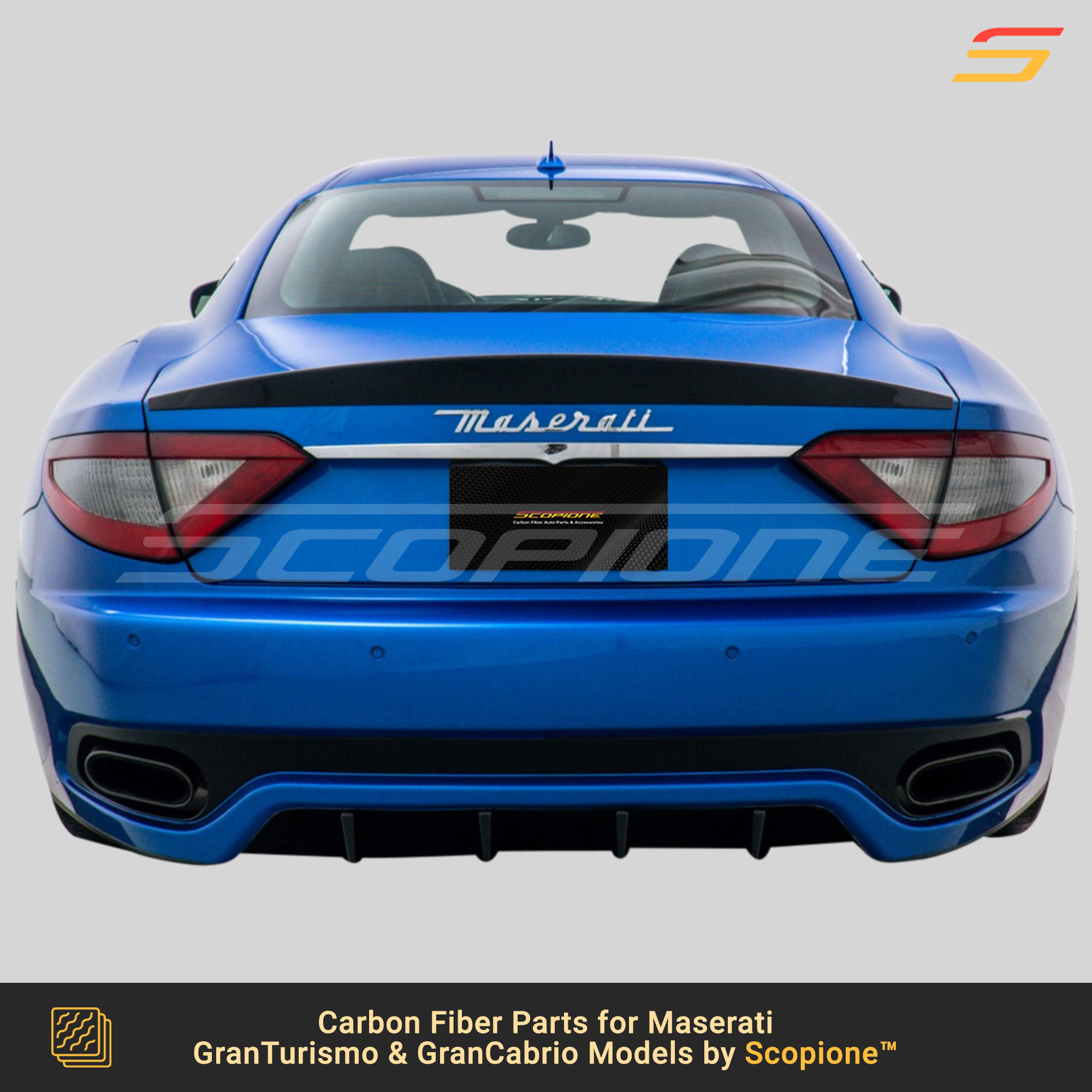
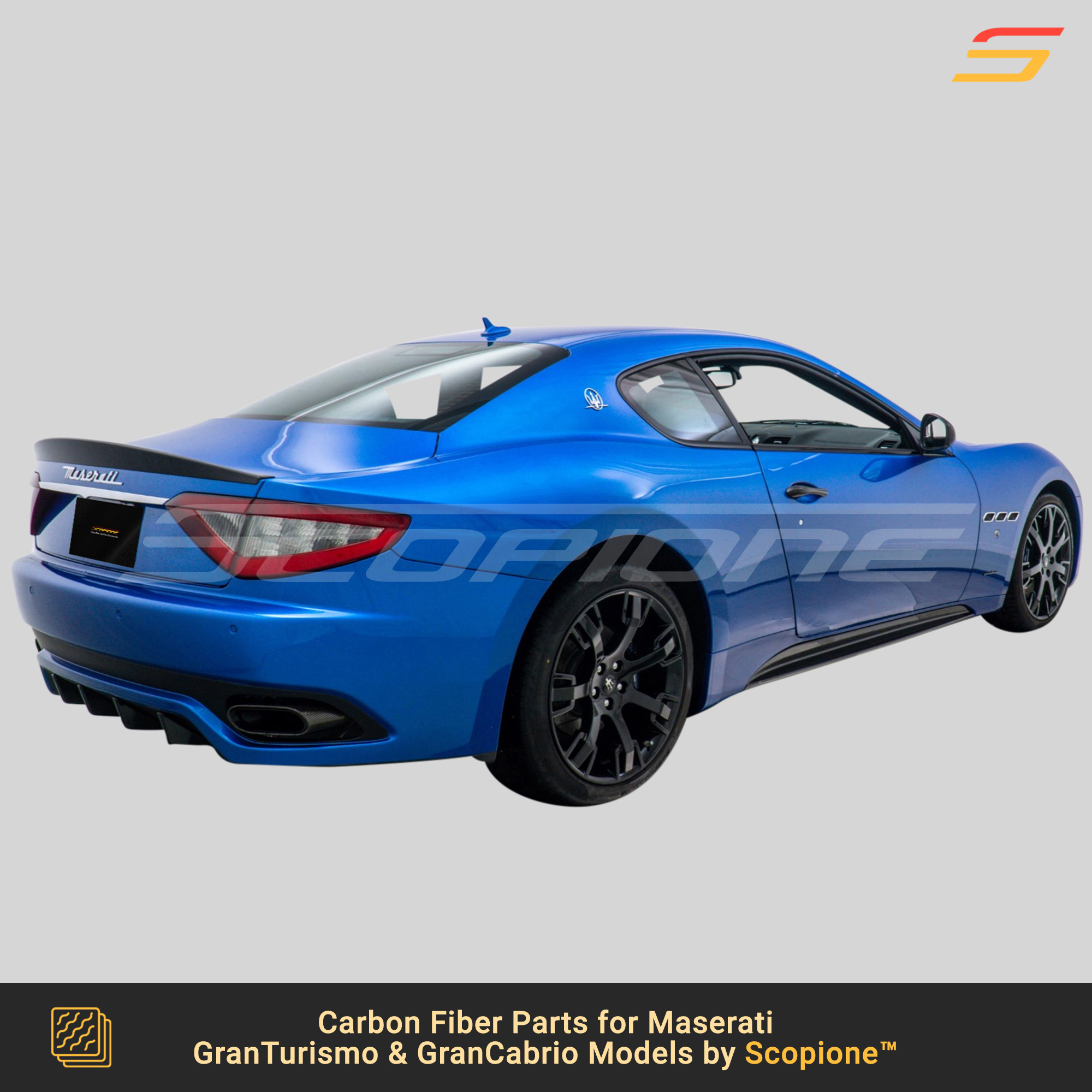
Maserati’s factory use of carbon fiber on the GranTurismo began with the MC Stradale in 2011. The track-focused variant received a CF front splitter, rear diffuser, and engine cover as standard equipment – functional aero components that also contributed to the car’s 110 kg weight reduction over the base model. The GranCabrio MC followed with CF mirror caps and select aerodynamic elements. On the second-generation Trofeo, factory carbon-fiber exterior elements (splitter, side skirts, diffuser) come standard, extending the material’s presence from the motorsport-derived variants into the core lineup.
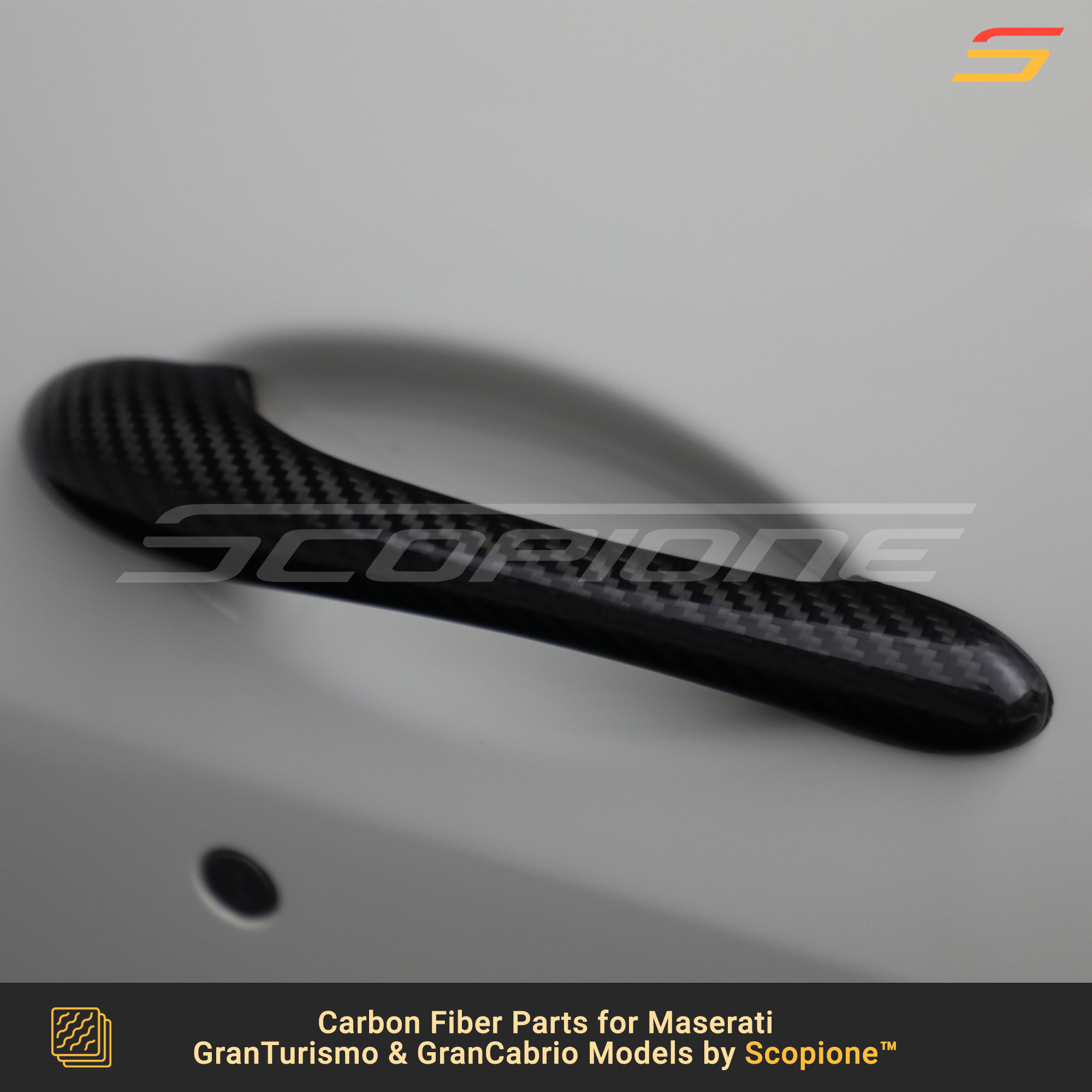
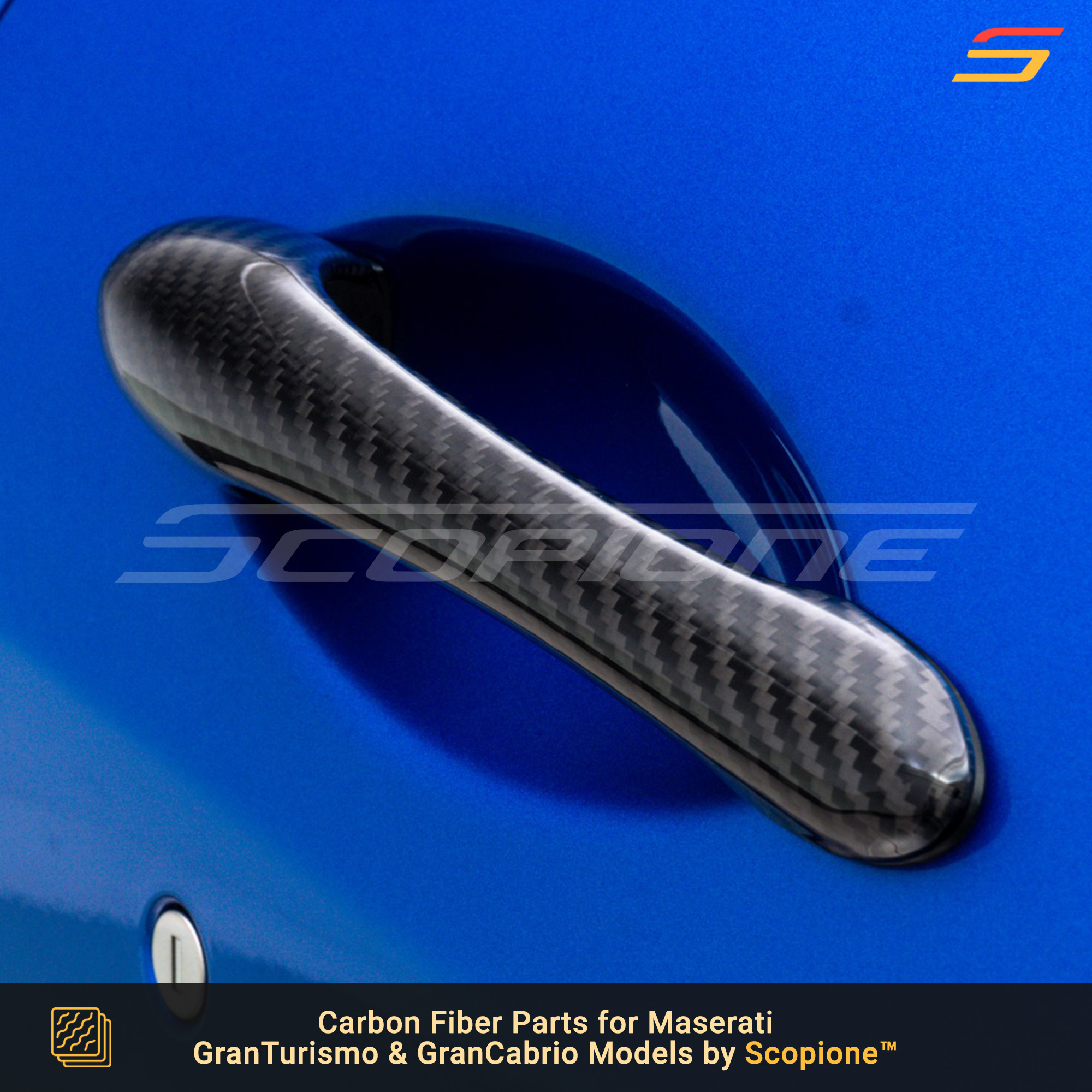
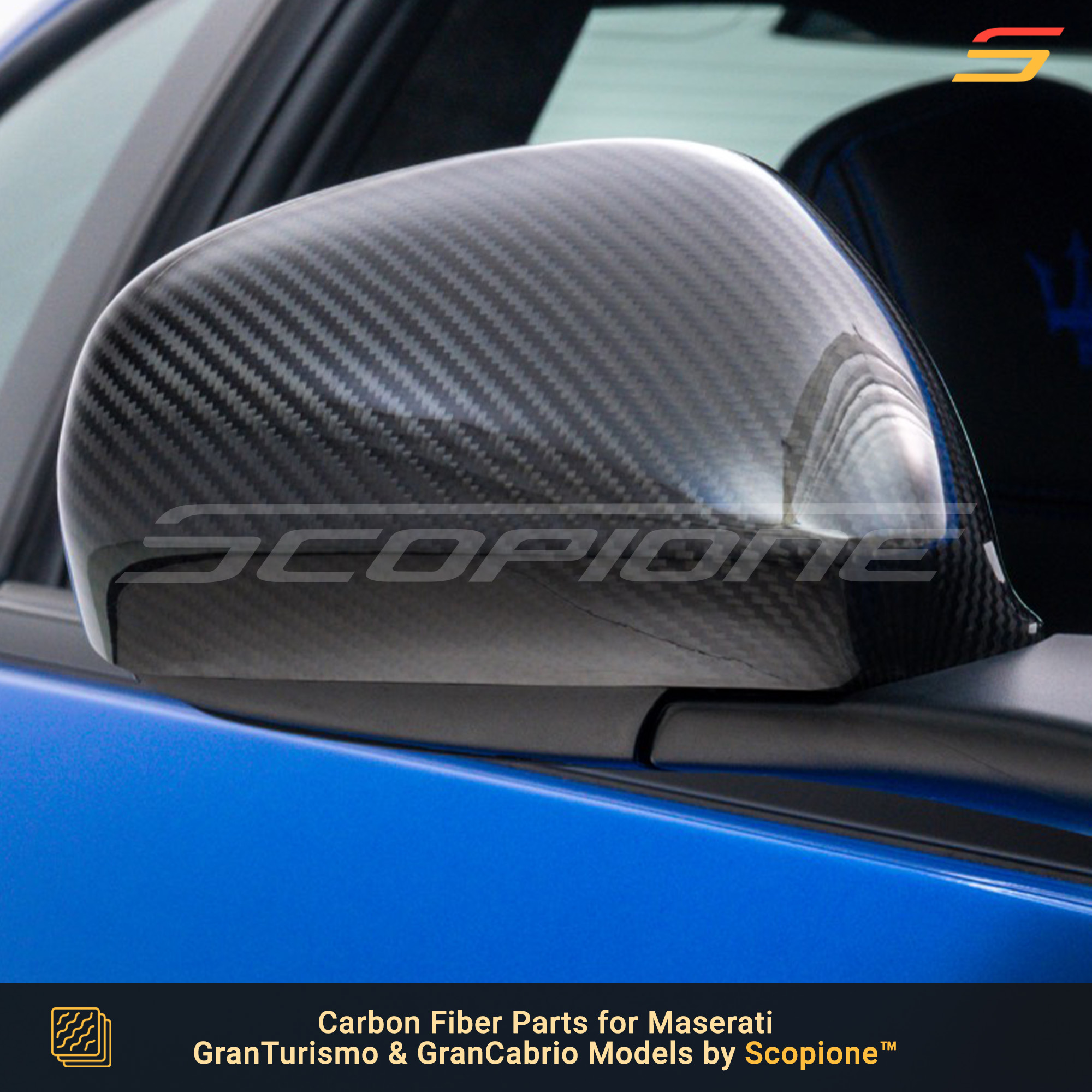
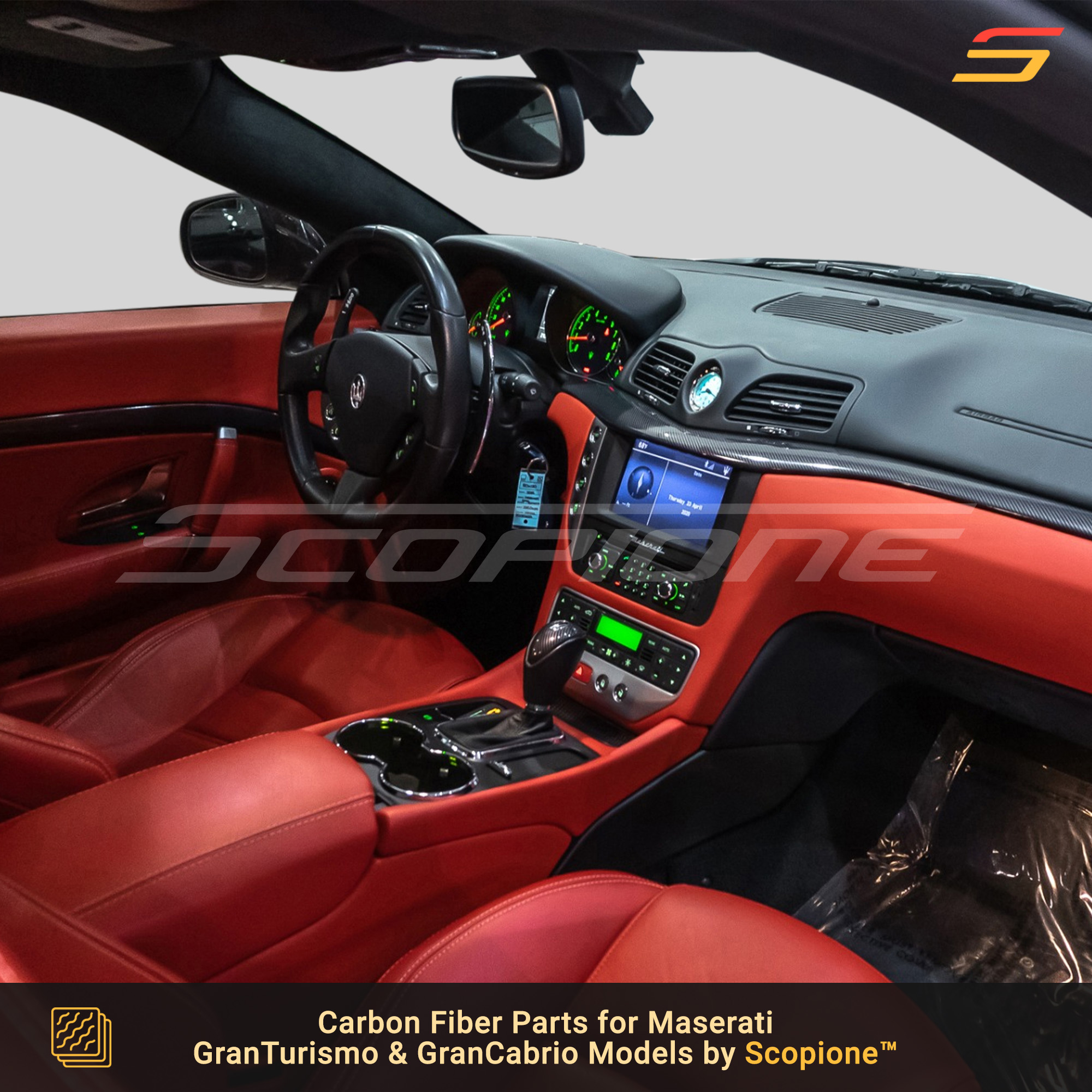
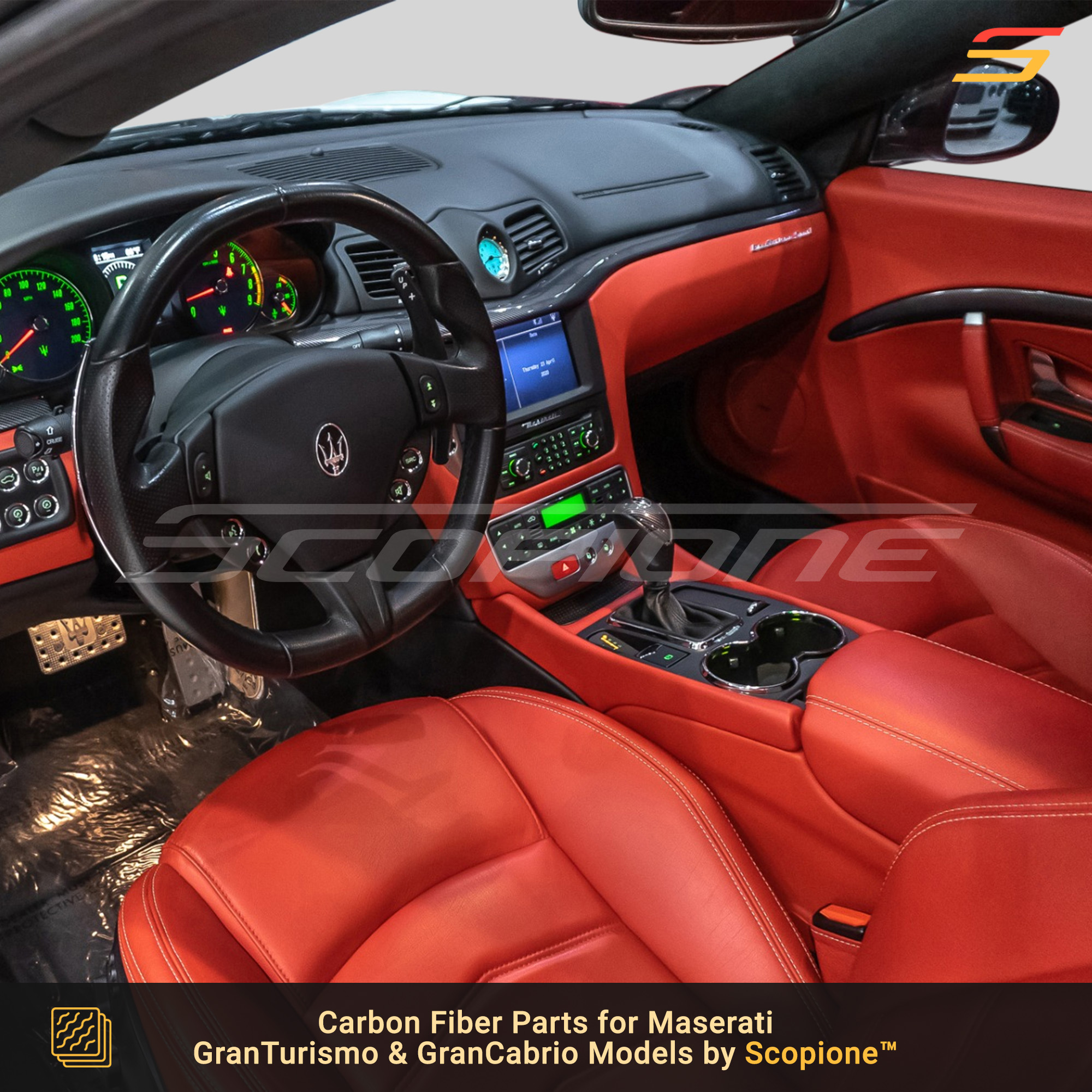
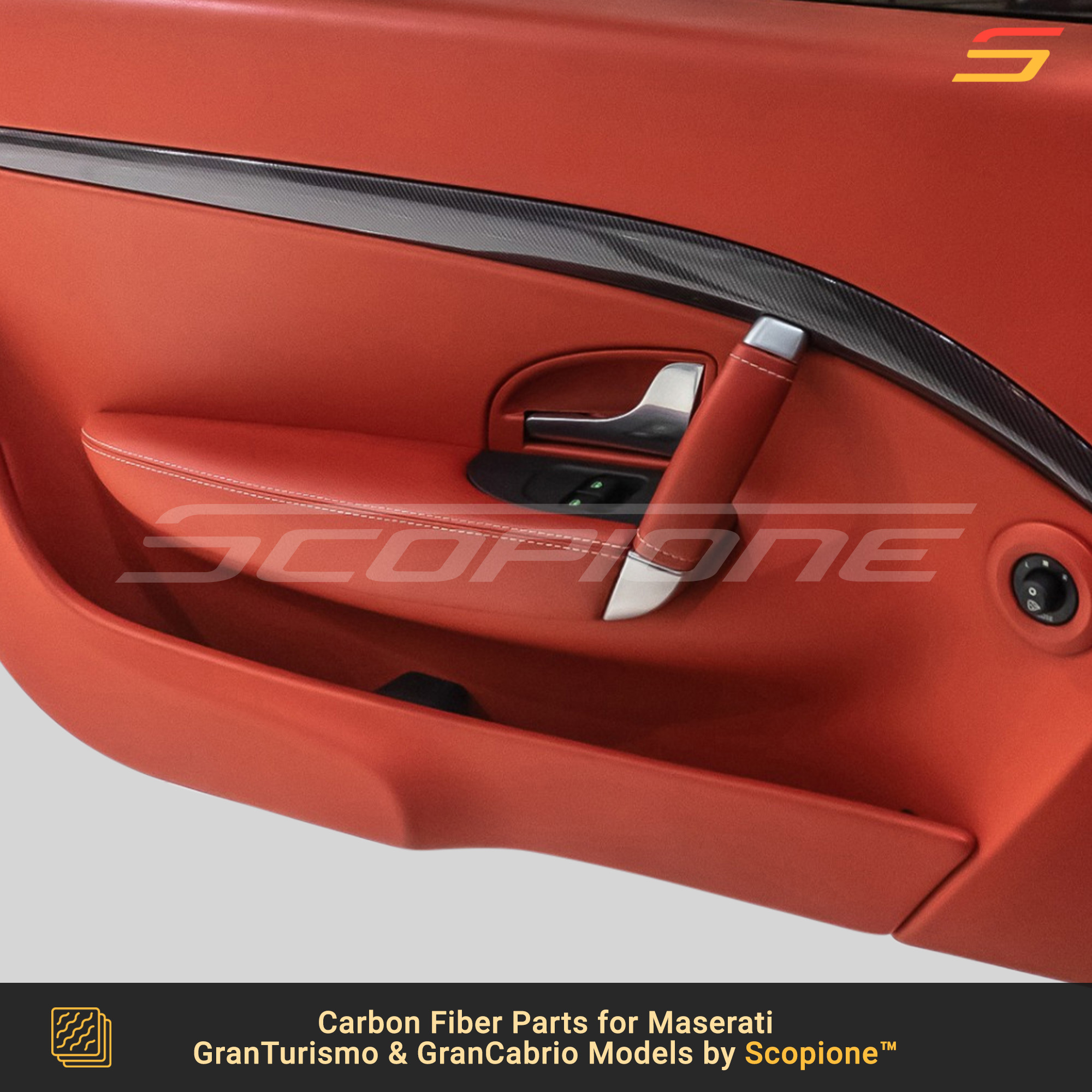
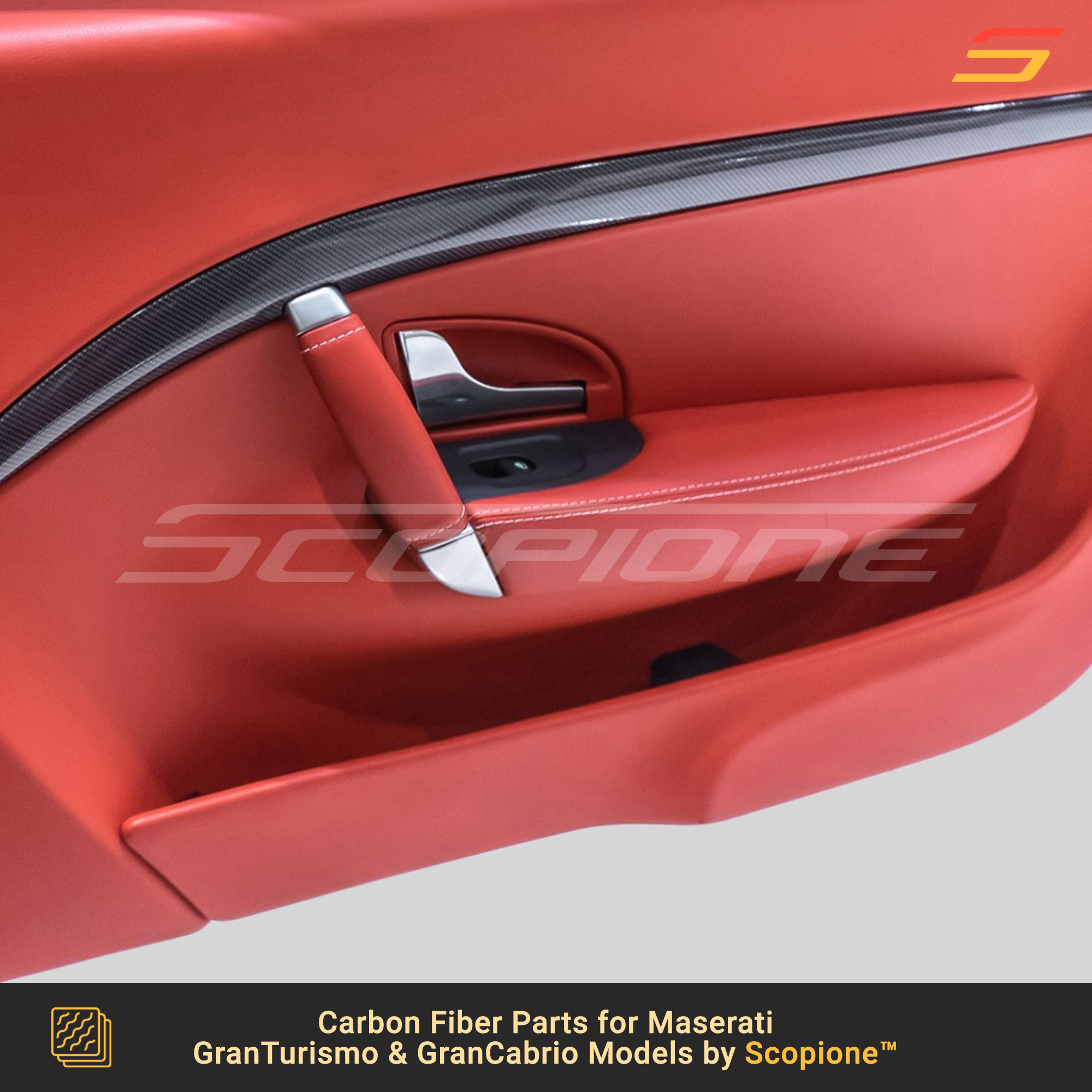
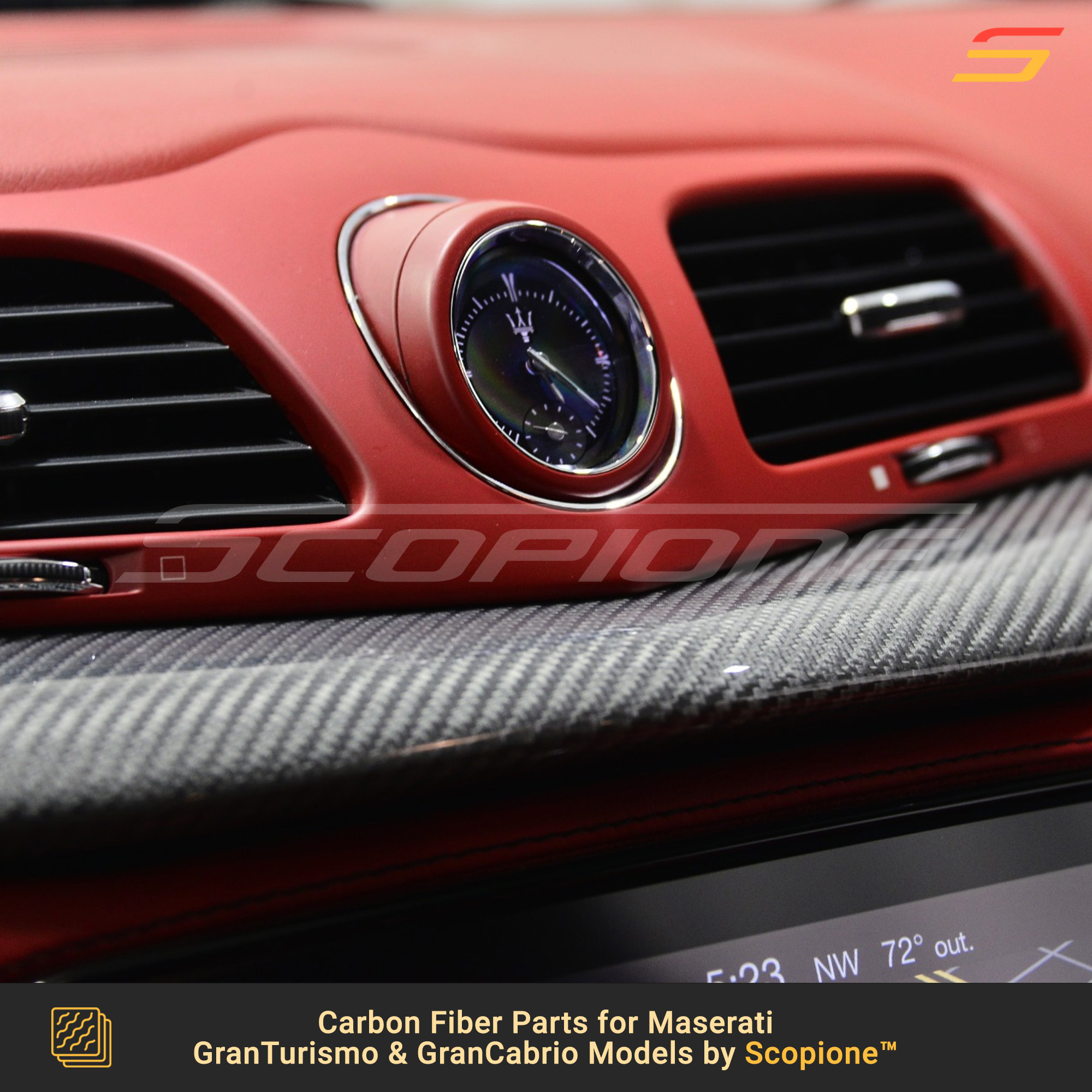
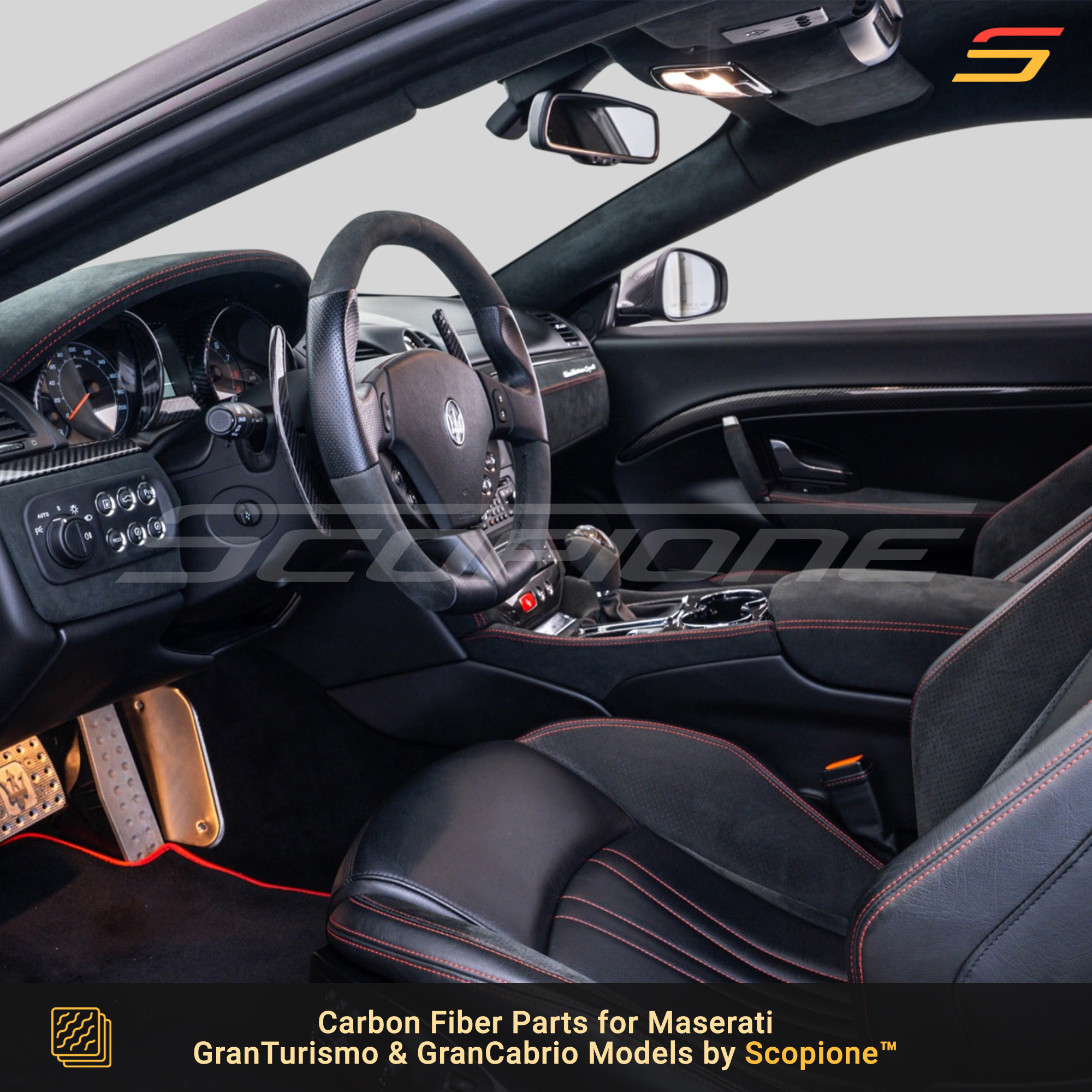
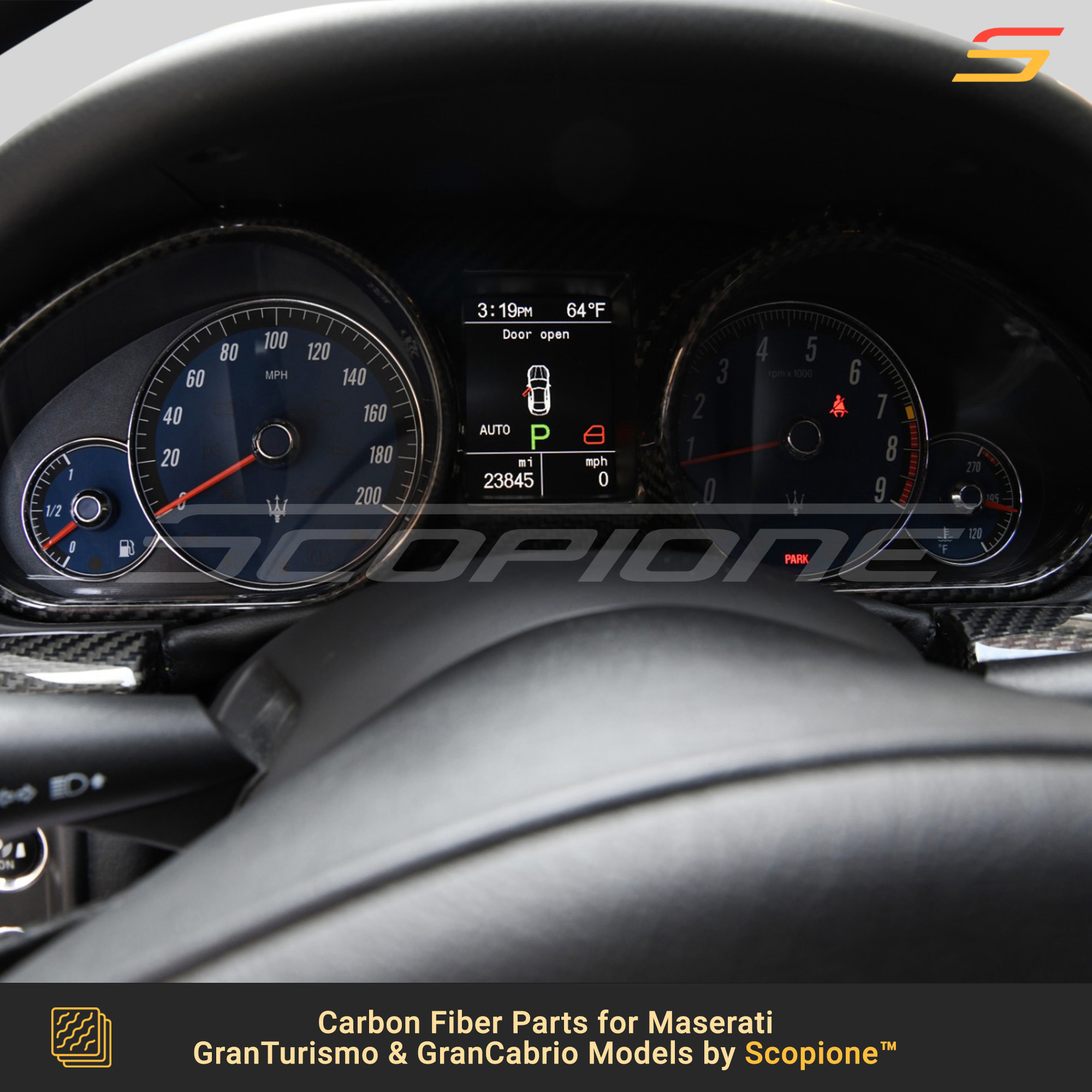
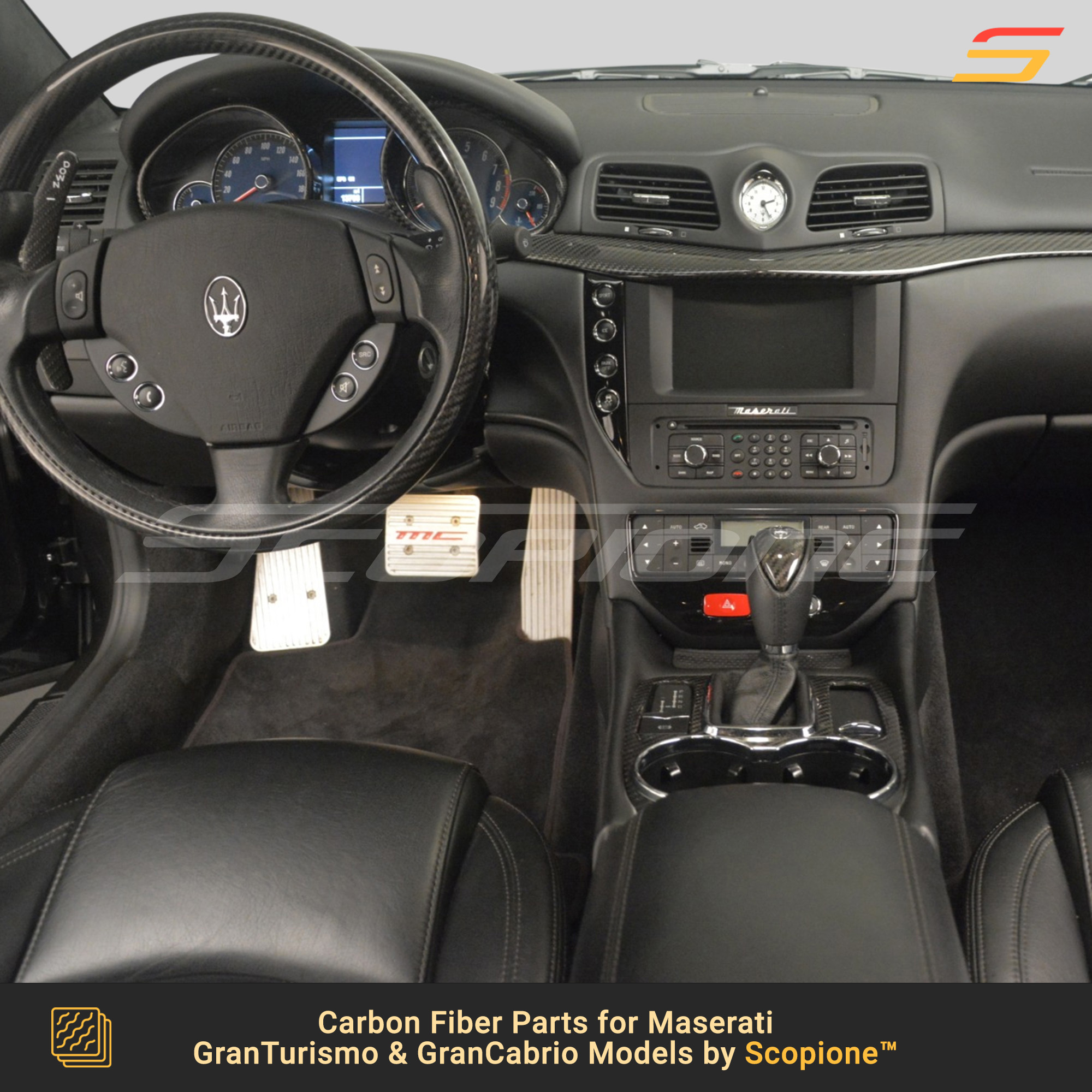
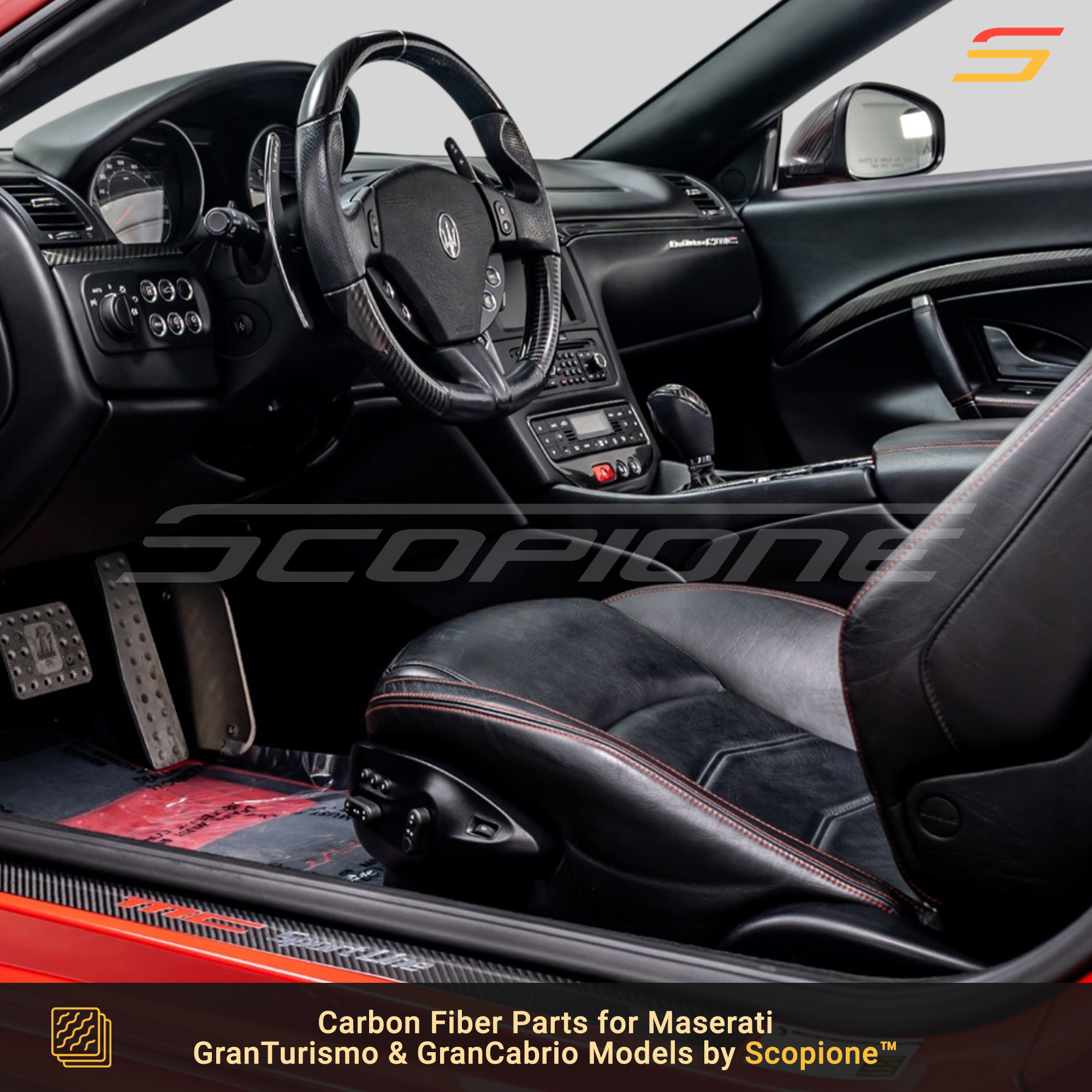
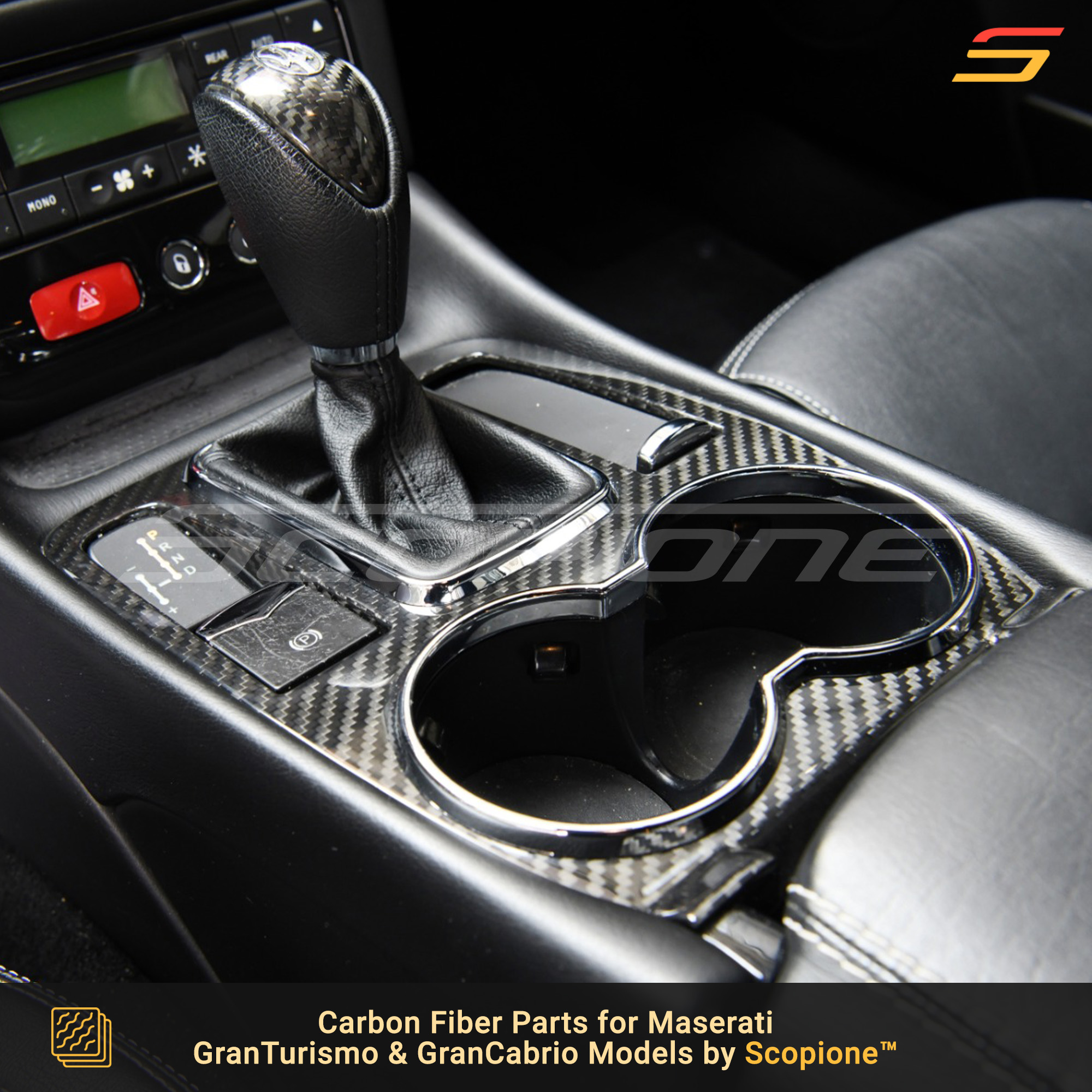
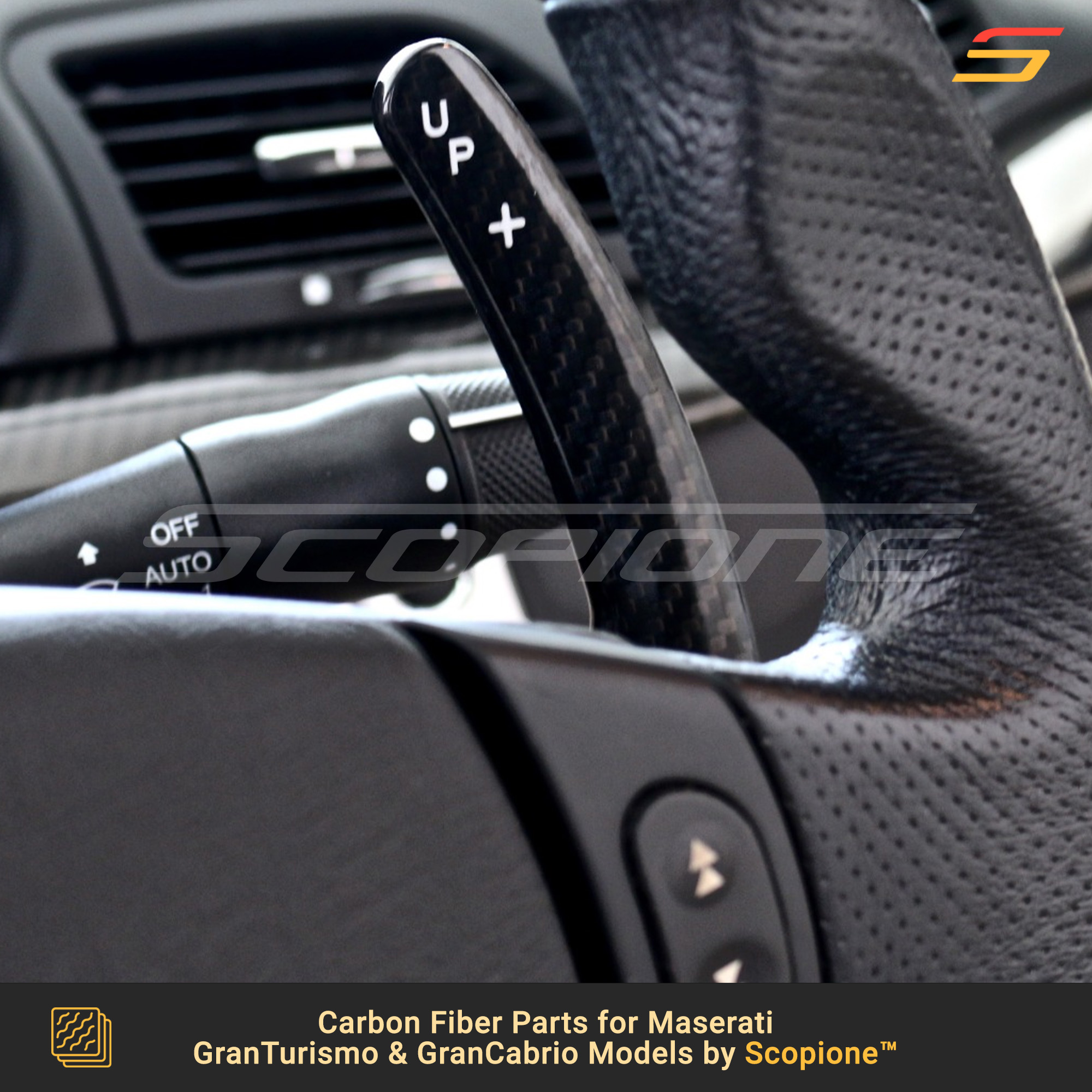
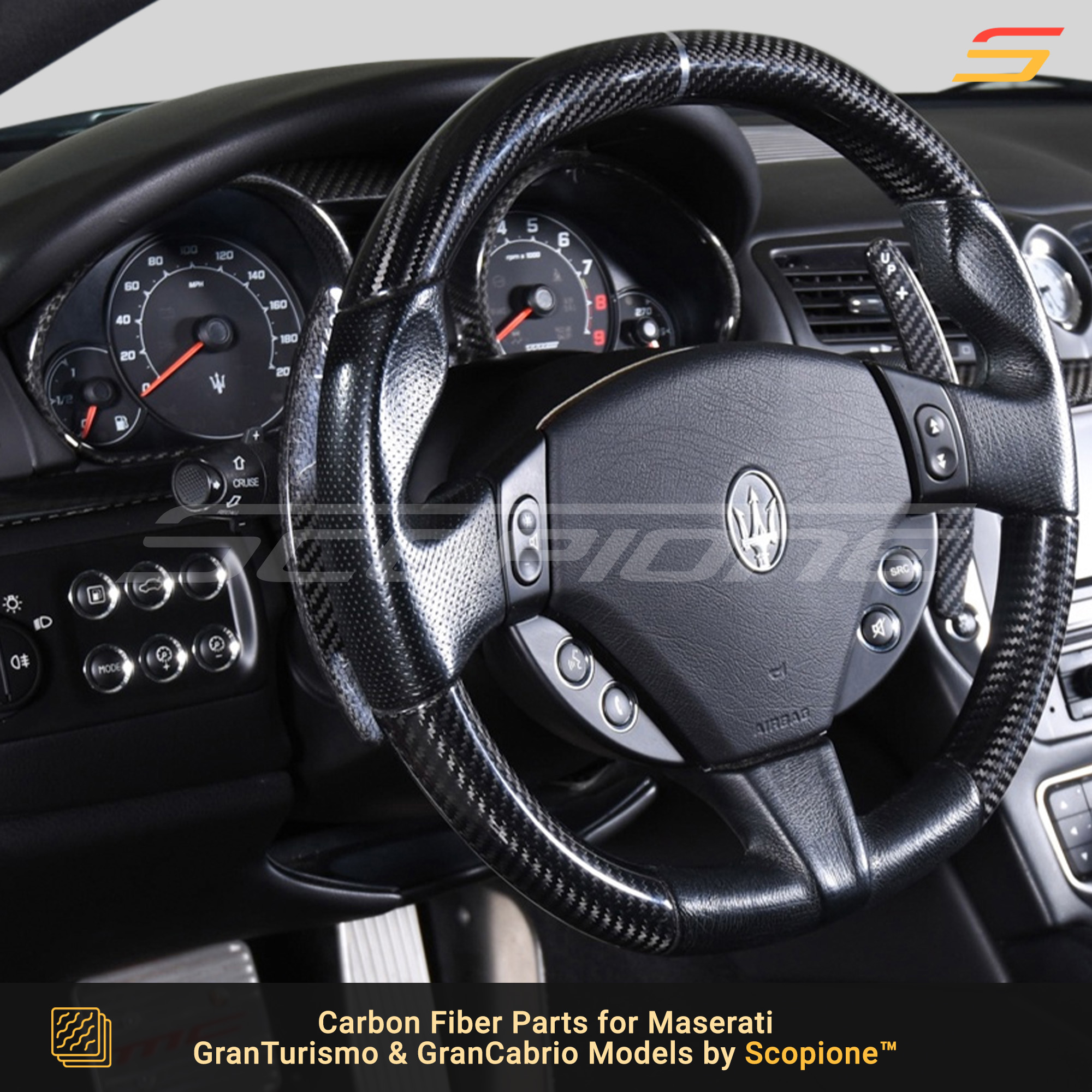
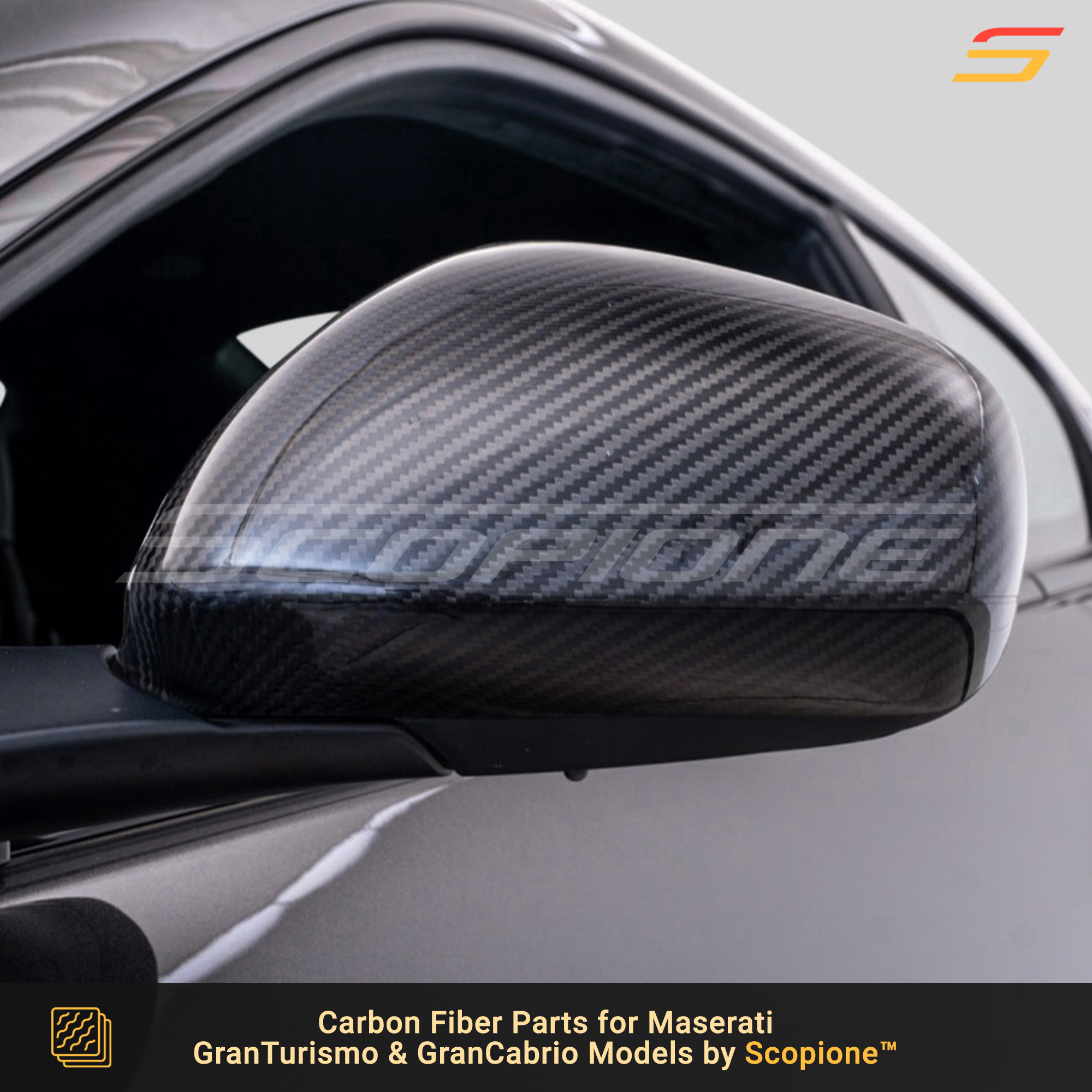
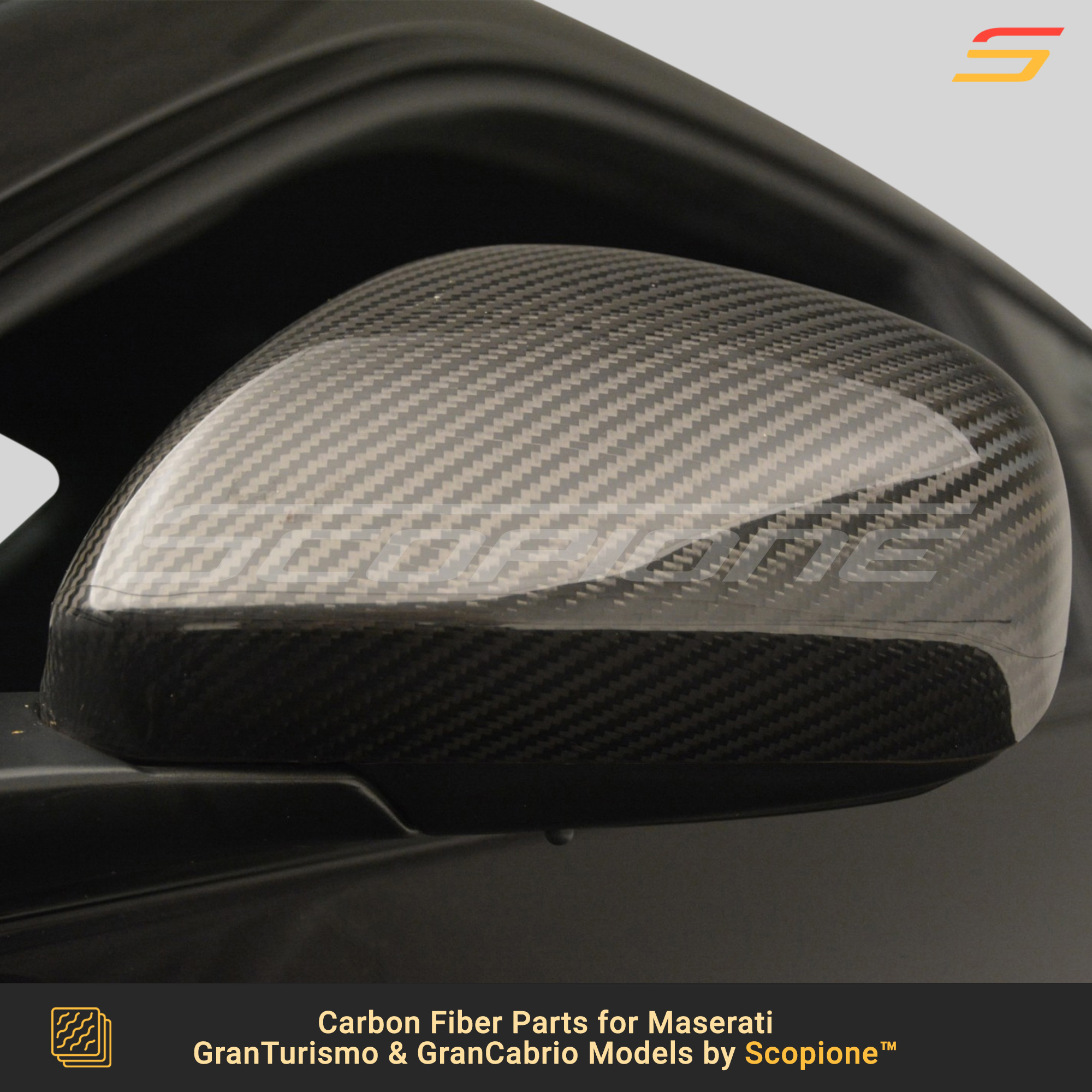
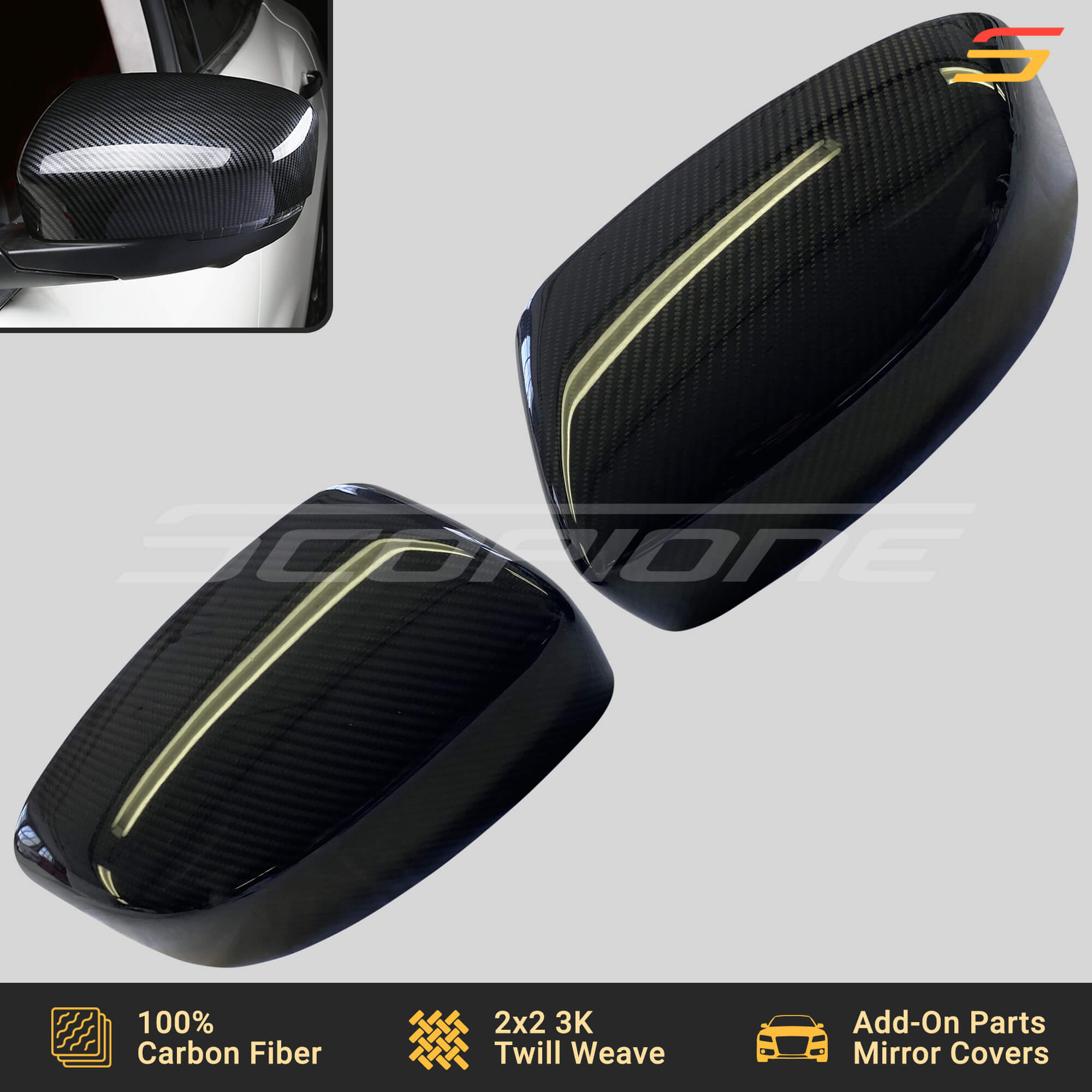
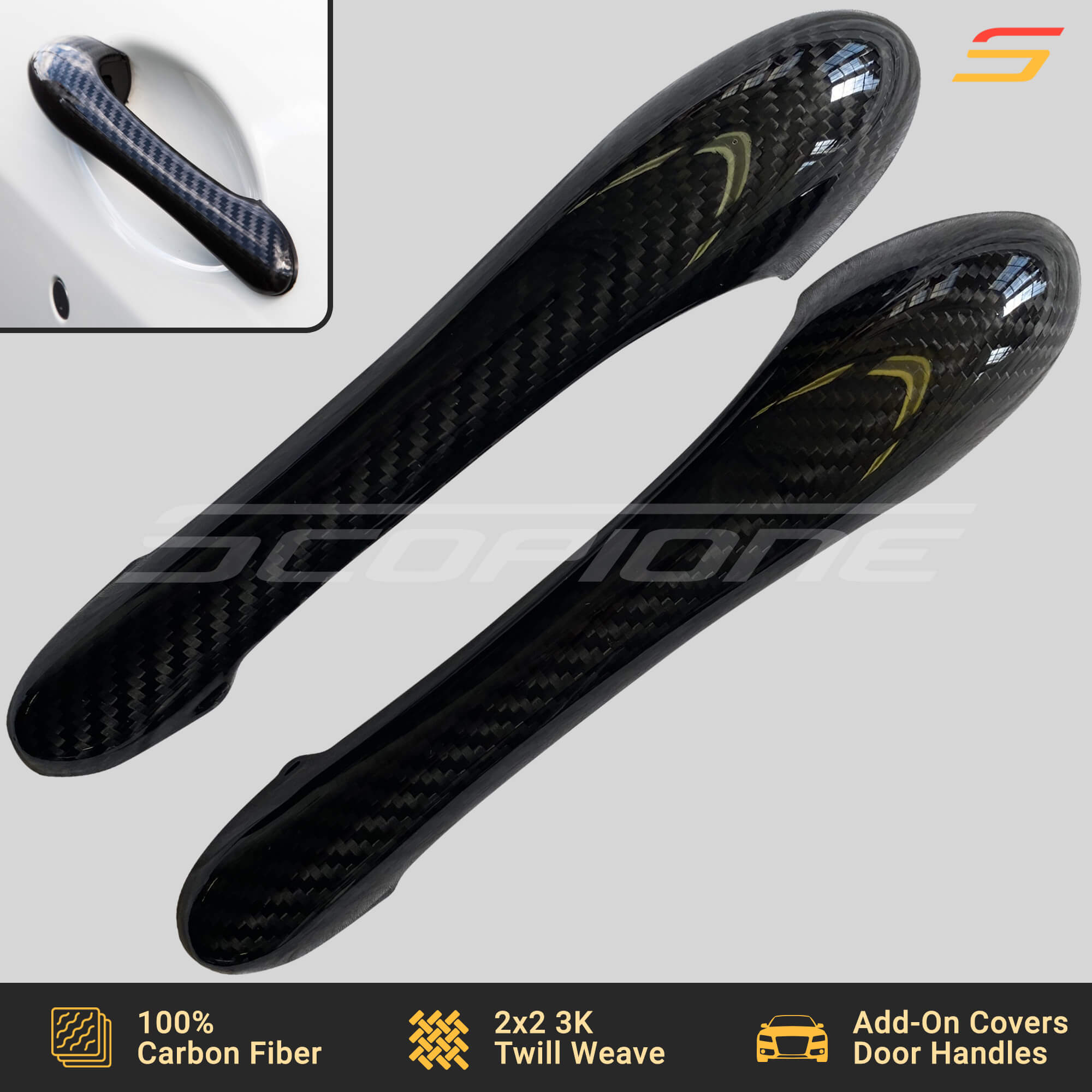
The GranTurismo’s aftermarket carbon fiber application falls into two categories: exterior aero and interior trim. Exterior components – front bumper splitters, rear diffusers, fender vent covers, mirror caps, and door handle overlays – serve both visual and aerodynamic functions on a car that sits low, travels fast, and has enough frontal area for meaningful airflow management. Interior pieces – shift paddles, gauge cluster bezels, gear shift surrounds, and the full dash trim kit – replace factory wood, aluminum, or plastic surfaces with exposed twill-weave CF.
The Aston Martin Vantage and DB9/DBS serve the same market segment – front-engine, rear-drive grand tourers where carbon-fiber components address both visual refinement and weight distribution. On these platforms, the exposed weave pattern reads as a motorsport reference rather than a cosmetic afterthought.
Installation on the first-generation GranTurismo follows a straightforward pattern. Mirror covers, fender vents, and door handle covers are adhesive-backed or clip-on – 1–2 hours total for all three. The front splitter and rear diffuser mount to factory bumper points, requiring 2–4 hours of professional labor. Interior trim pieces need careful removal of factory panels – the dash and door trim kit is the most involved installation in the Scopione Maserati catalog, running 4–6 hours at a shop familiar with the M139 interior architecture. But the visual payoff is significant: exposed CF across the entire dashboard and door card surfaces shifts the cabin character from factory grand tourer toward cockpit.
Carbon-fiber exterior and interior parts for the first-gen GranTurismo and GranCabrio are available on Scopione’s Maserati catalog.


Scopione: Carbon Fiber Upgrades for the Maserati GranTurismo & GranCabrio
Scopione’s Maserati catalog covers nine carbon-fiber components for the first-generation GranTurismo and GranCabrio (2008–2019) – five exterior pieces and four interior upgrades. All parts are hand-laid from 2×2 twill-weave carbon fiber with a UV-resistant clear coat finish. Exterior bumper components (front splitter, rear diffuser) fit 2008–2017 pre-facelift models. Interior and accessory pieces (shift paddles, gauge cluster, mirror covers, fender vents, door handles, dash trim kit) cover the full 2008–2019 production range.
Exterior Carbon Fiber Costs: GranTurismo & GranCabrio
Exterior CF components for the first-generation GranTurismo and GranCabrio:
| Carbon Fiber Part | Part Cost (USD) | Installation Est. (USD) | Total Est. (USD) |
|---|---|---|---|
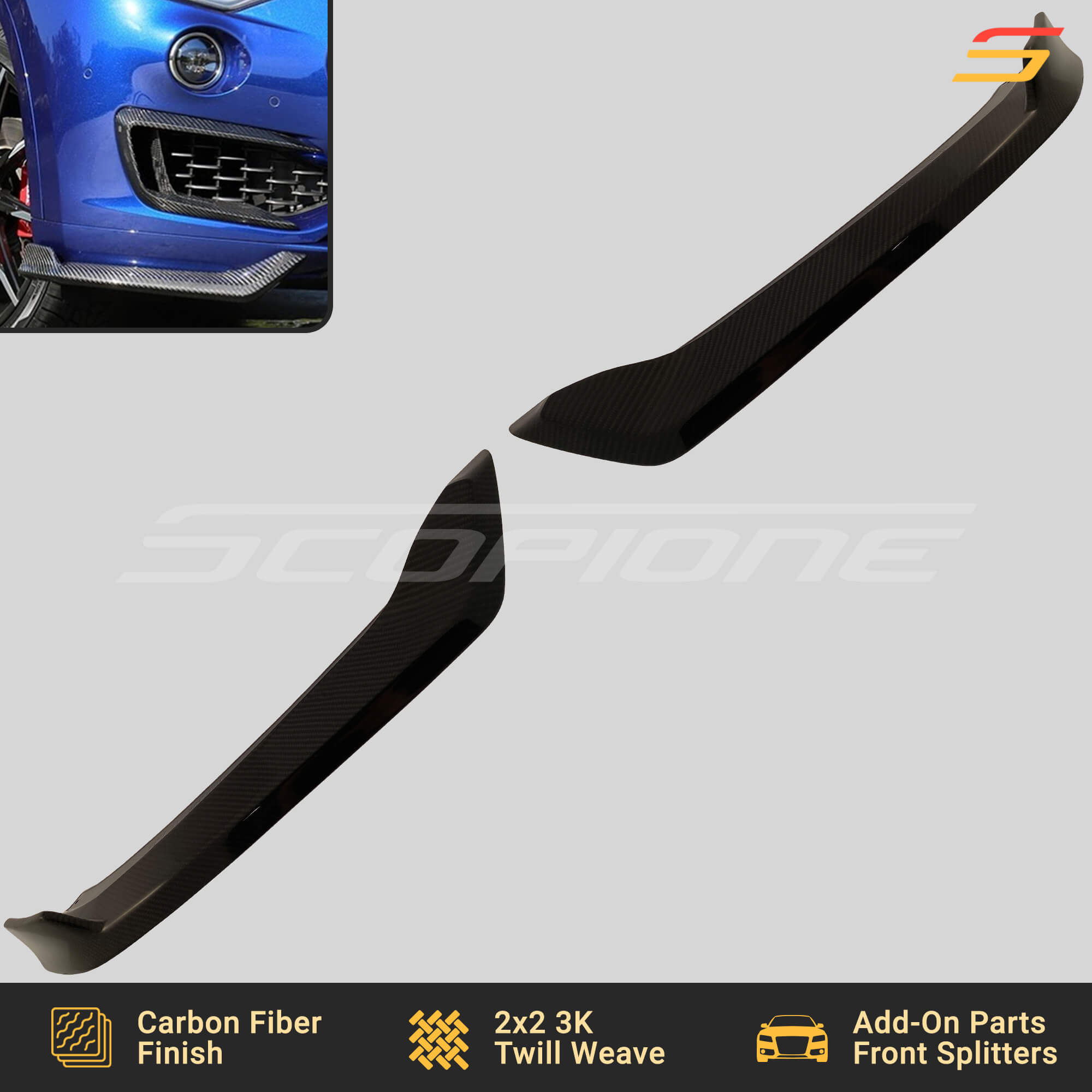
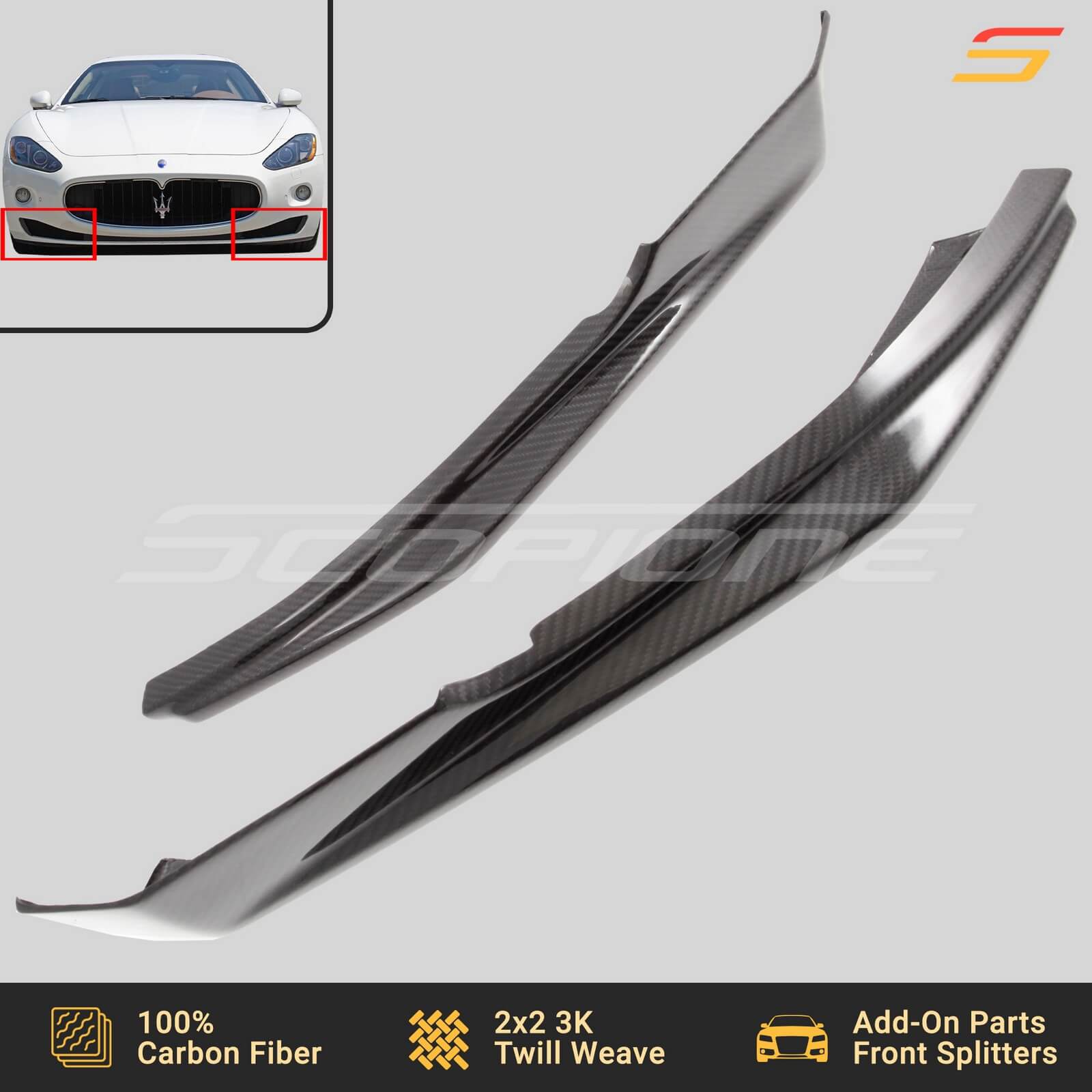
| Front Bumper Splitters Lip (08–17) | $470 | $200 – $400 | $670 – $870 |
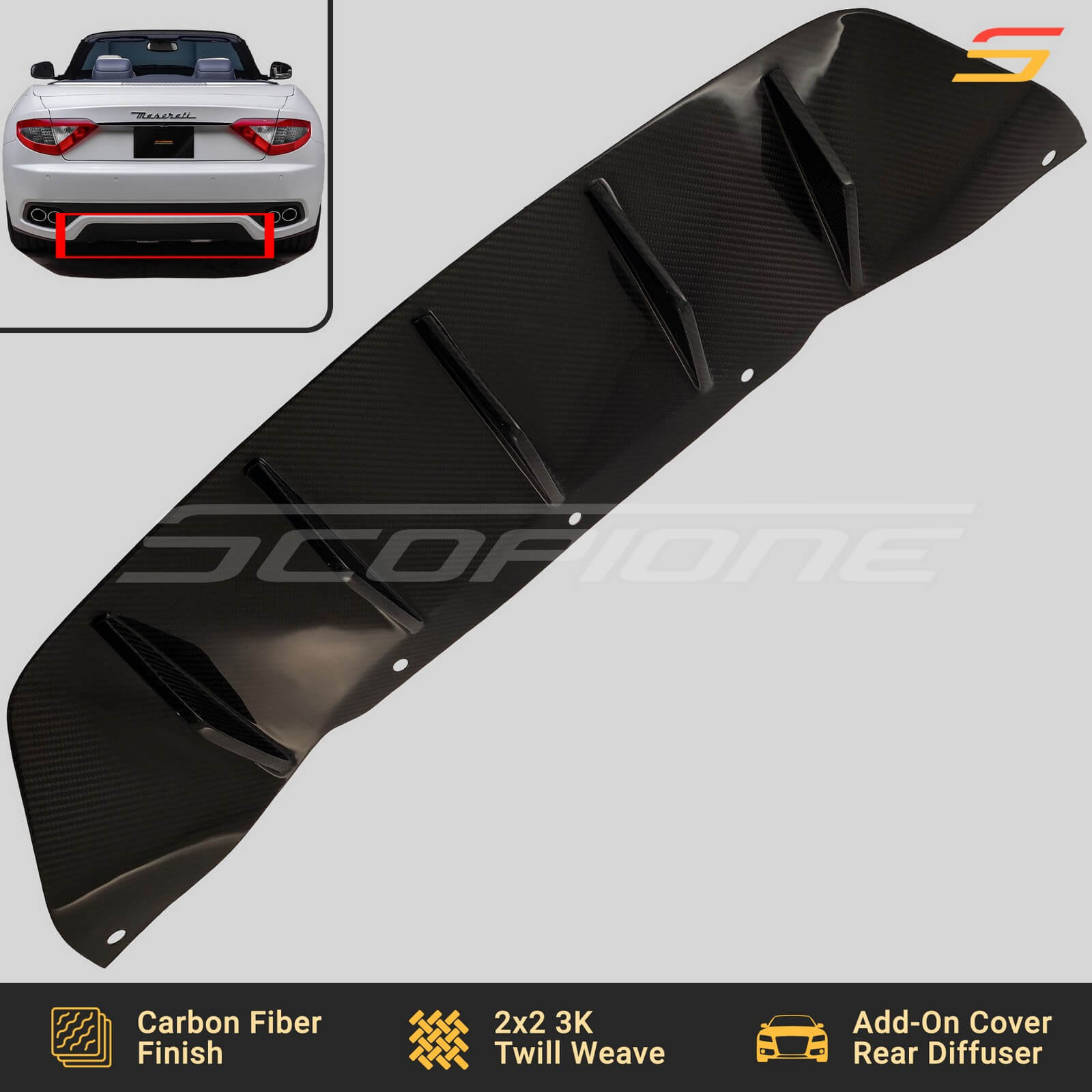
| Rear Bumper Diffuser (08–17) | $1,100 | $300 – $500 | $1,400 – $1,600 |
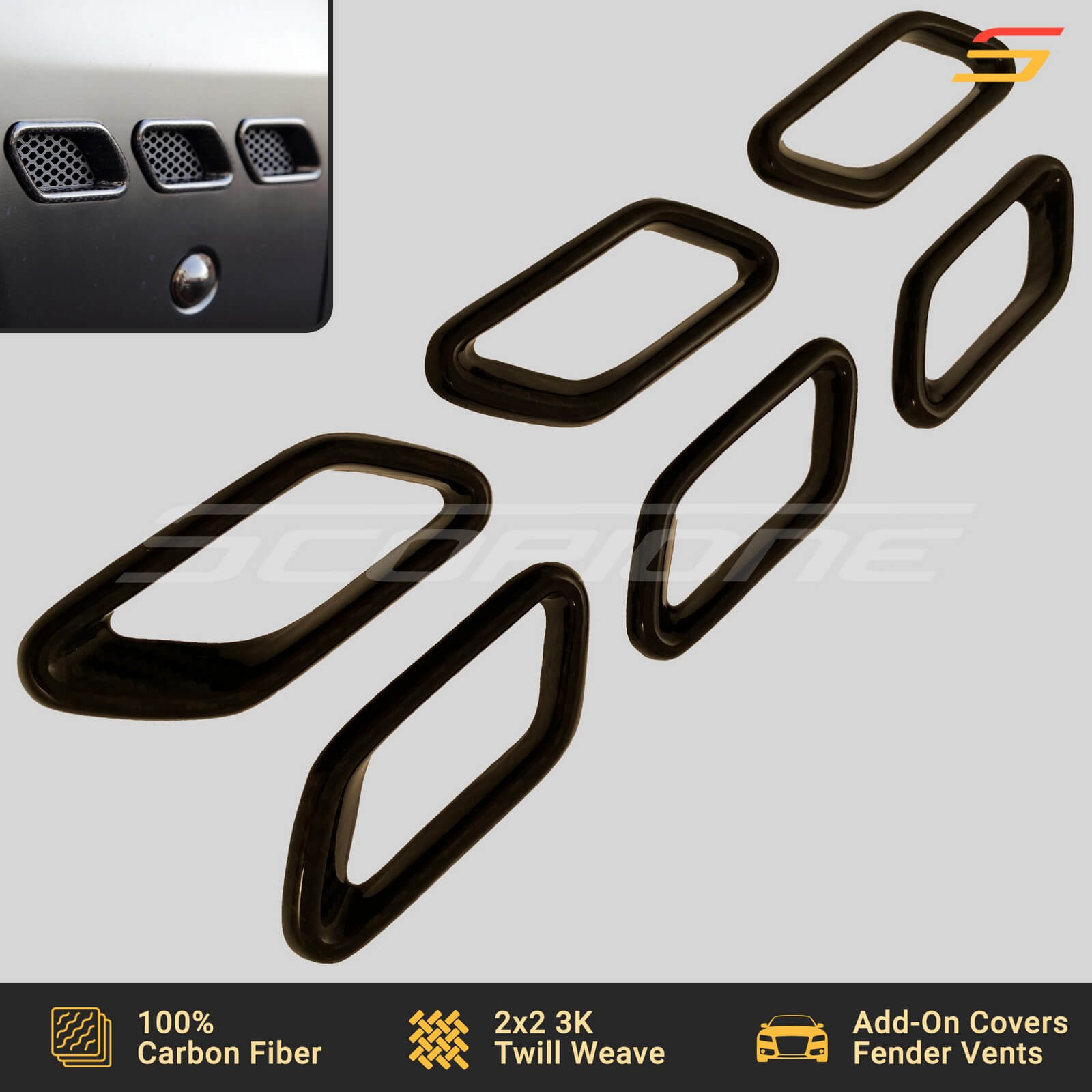
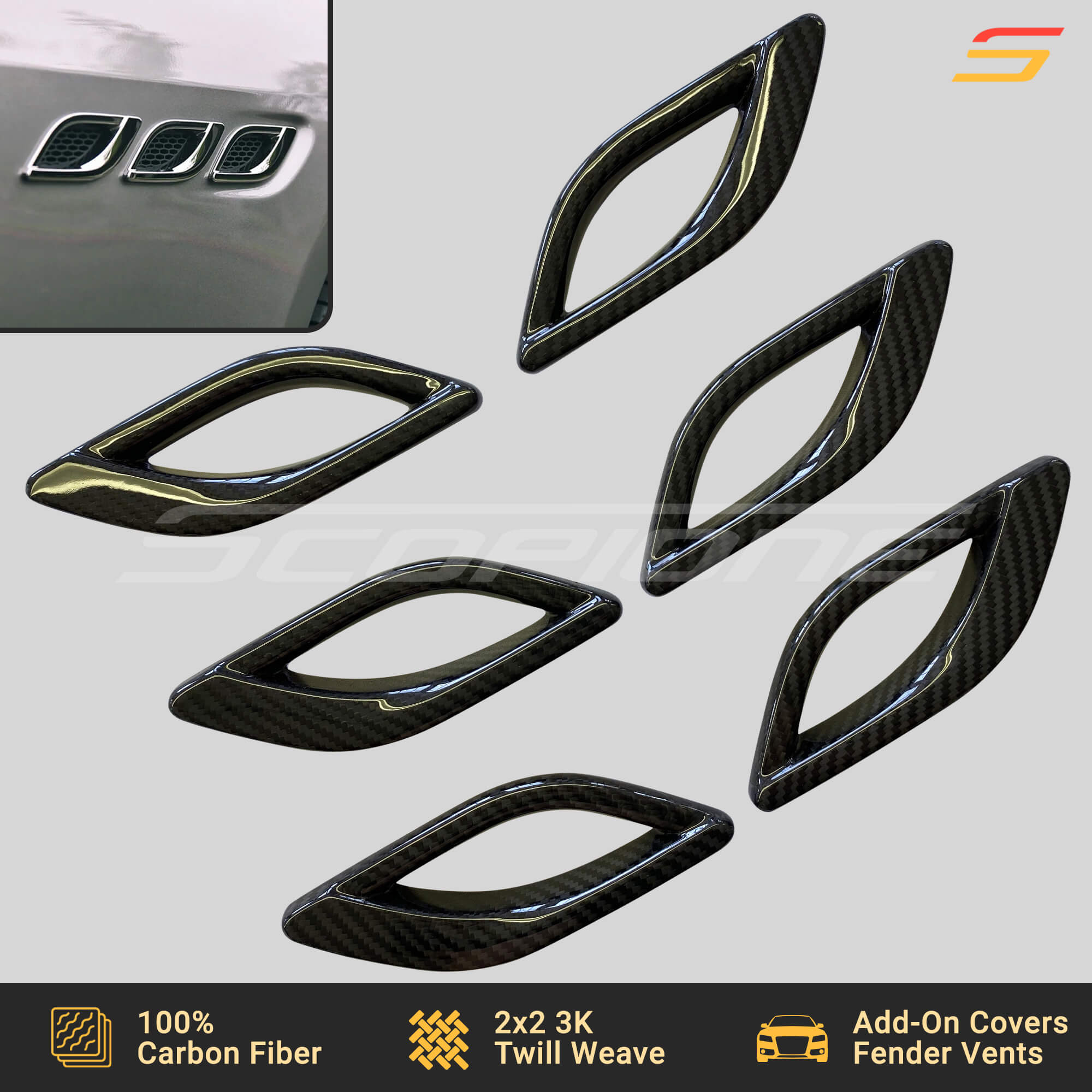
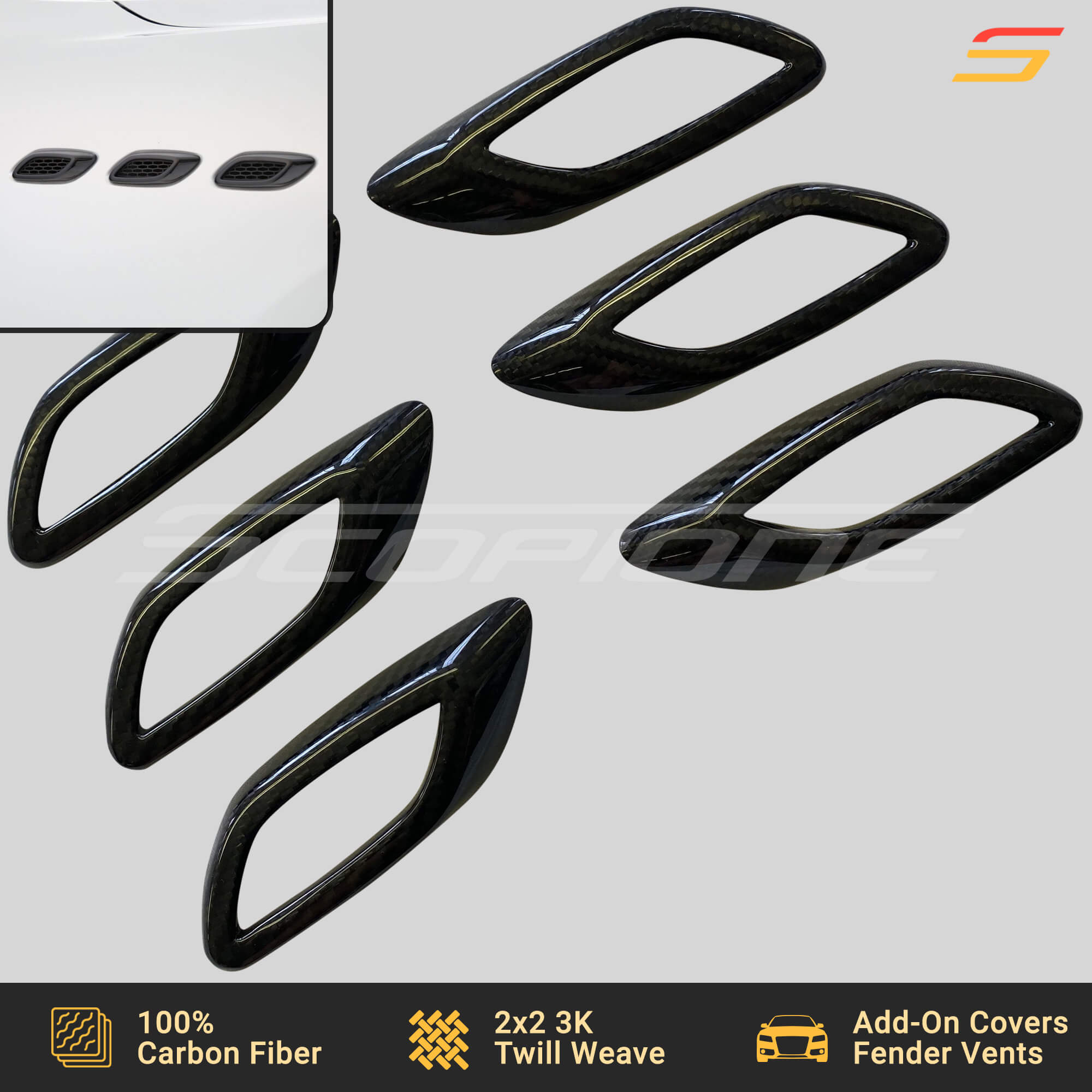
| Fender Vents Covers (08–19) | $300 | $100 – $200 | $400 – $500 |
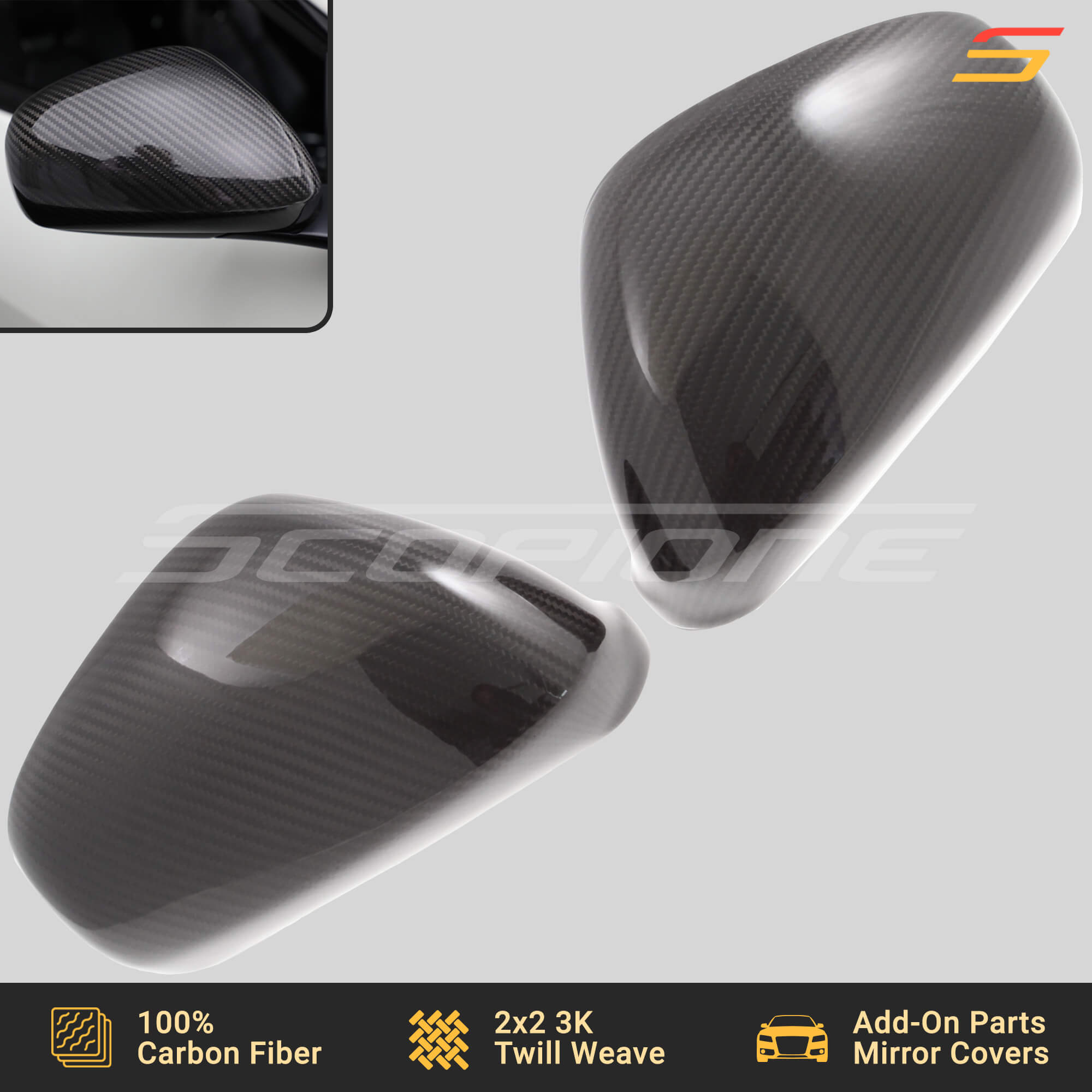
| Side Mirror Covers (08–19) | $290 | $50 – $100 | $340 – $390 |
| Door Handle Covers (08–19) | $190 | $50 – $100 | $240 – $290 |
Full exterior package: Front splitter, rear diffuser, fender vents, mirror covers, and door handles installed on a first-gen GranTurismo runs approximately $3,050–$3,650 – roughly 5–8% of the car’s current used market value on a GranTurismo Sport.
Interior Carbon Fiber Costs: GranTurismo & GranCabrio
Interior CF upgrades for 2008–2019 GranTurismo and GranCabrio models:
| Carbon Fiber Part | Part Cost (USD) | Installation Est. (USD) | Total Est. (USD) |
|---|---|---|---|
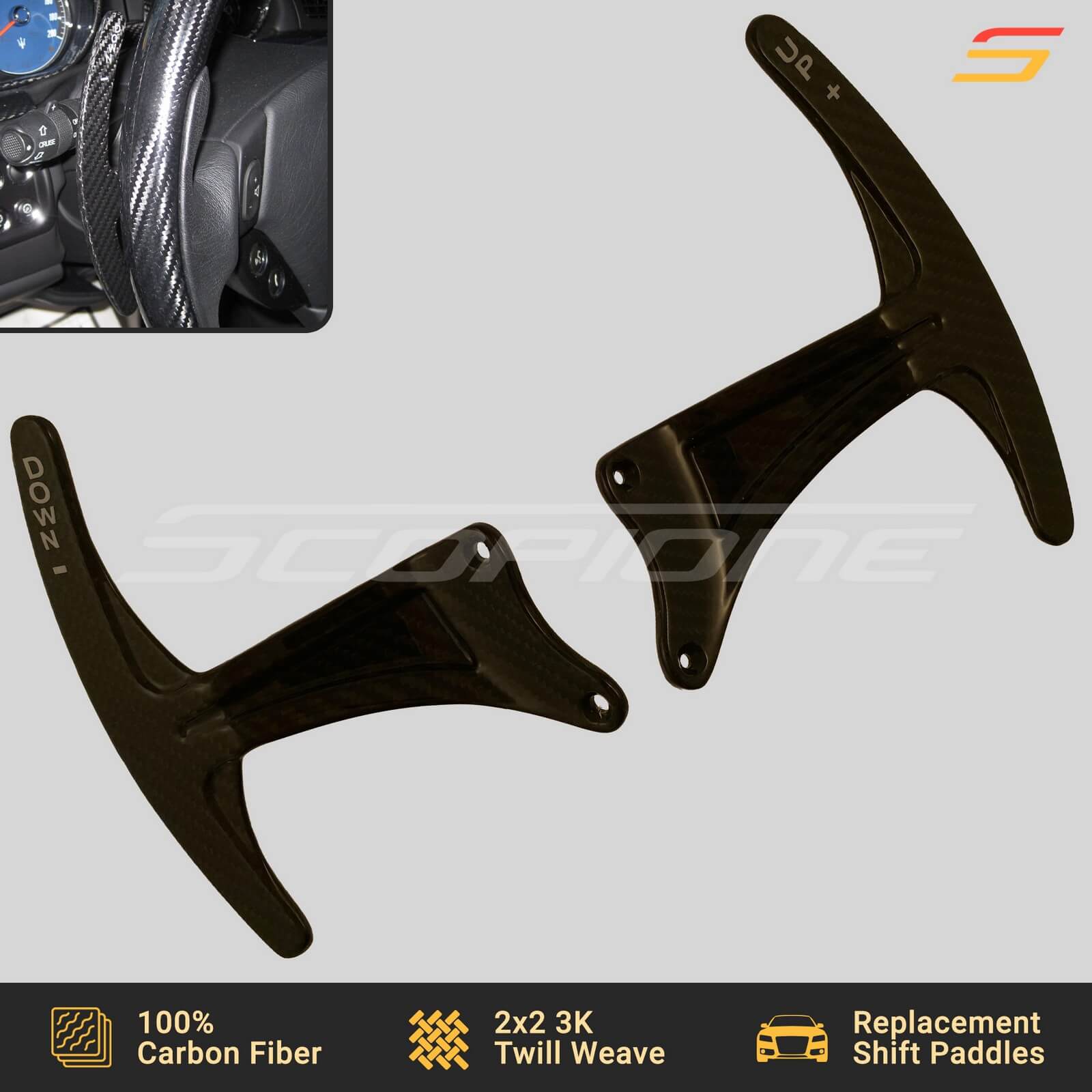
| Shift Paddles | $500 | $50 – $100 | $550 – $600 |
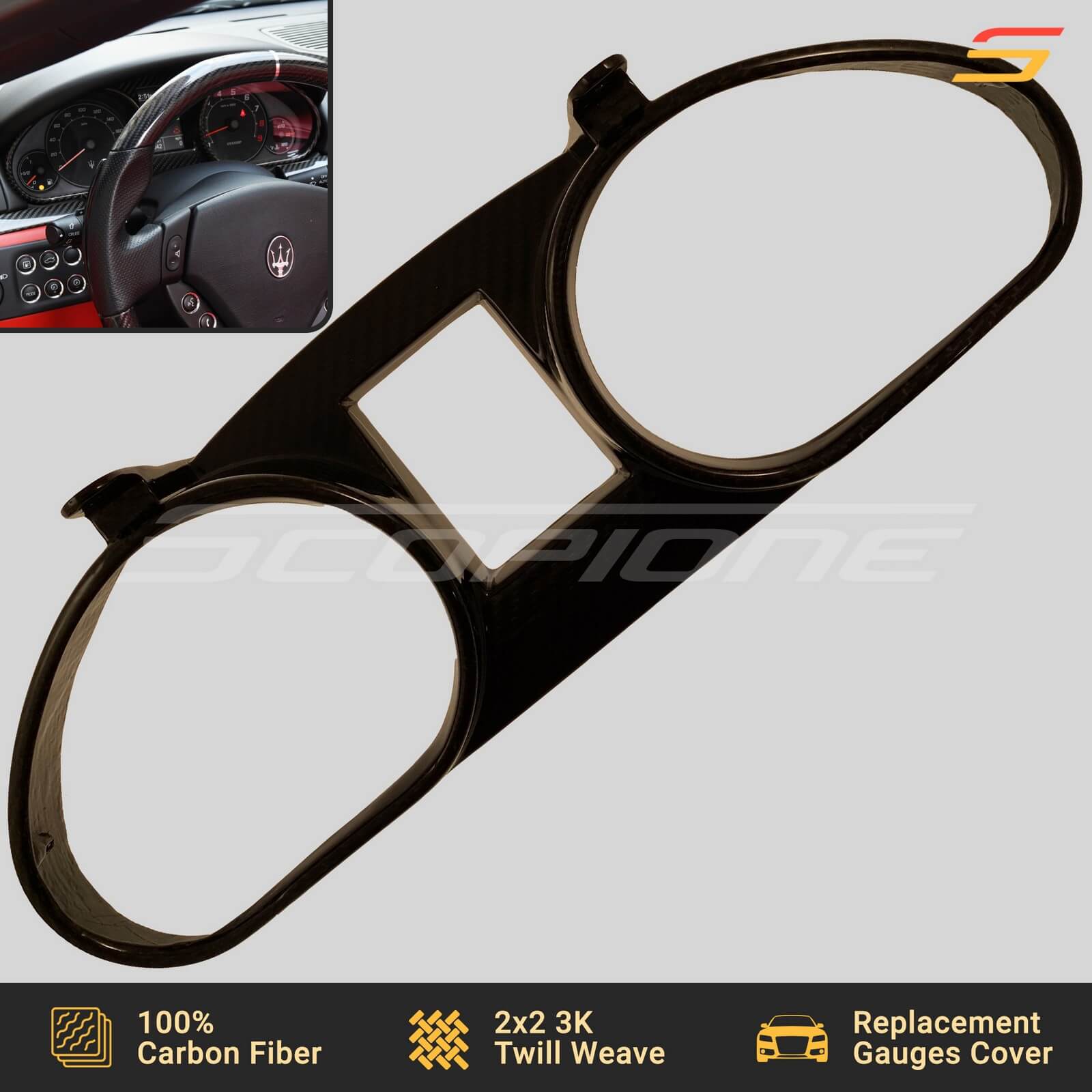
| Gauge Cluster Console Trim | $750 | $200 – $400 | $950 – $1,150 |
| Gear Shift Dash Trim Cover | $450 | $100 – $200 | $550 – $650 |
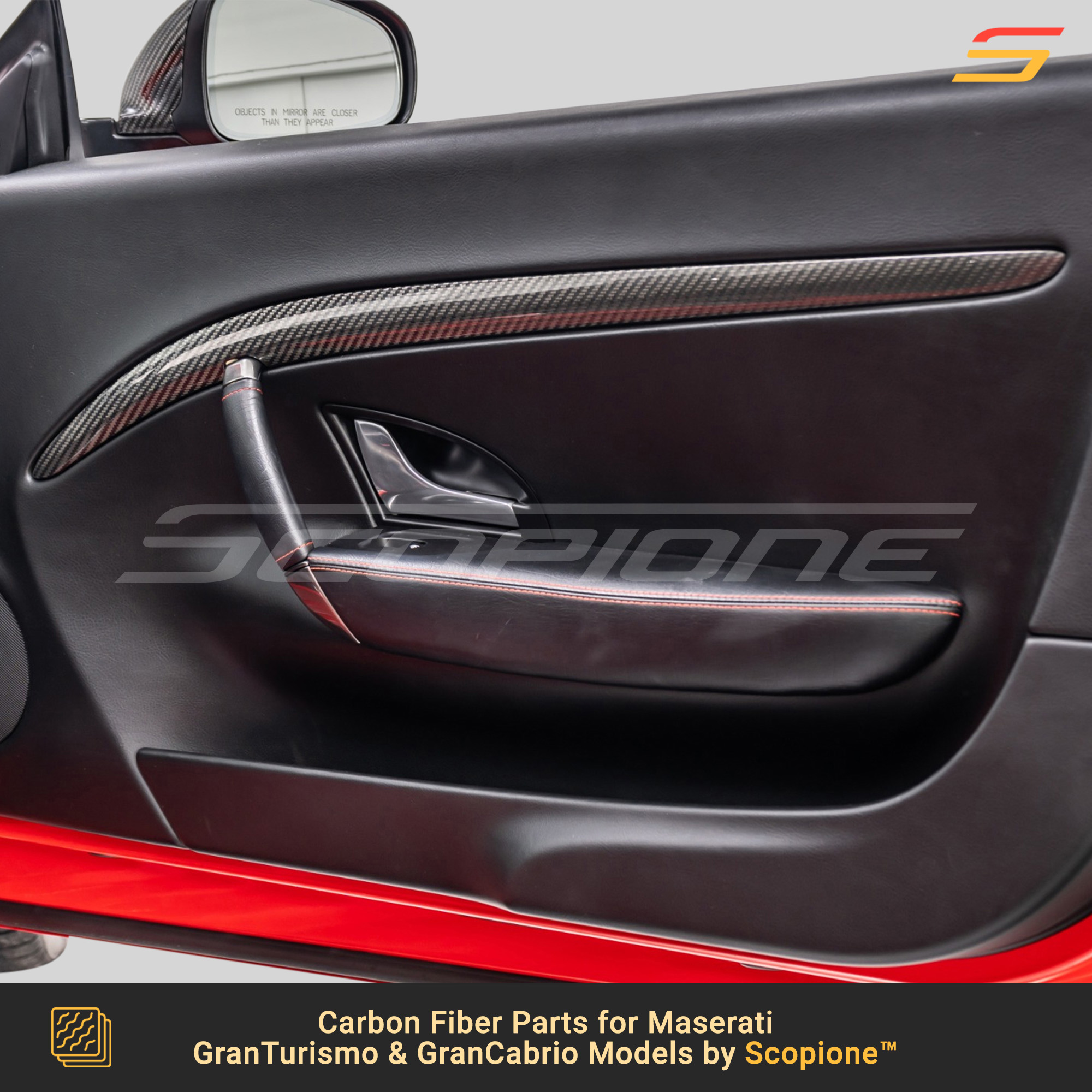
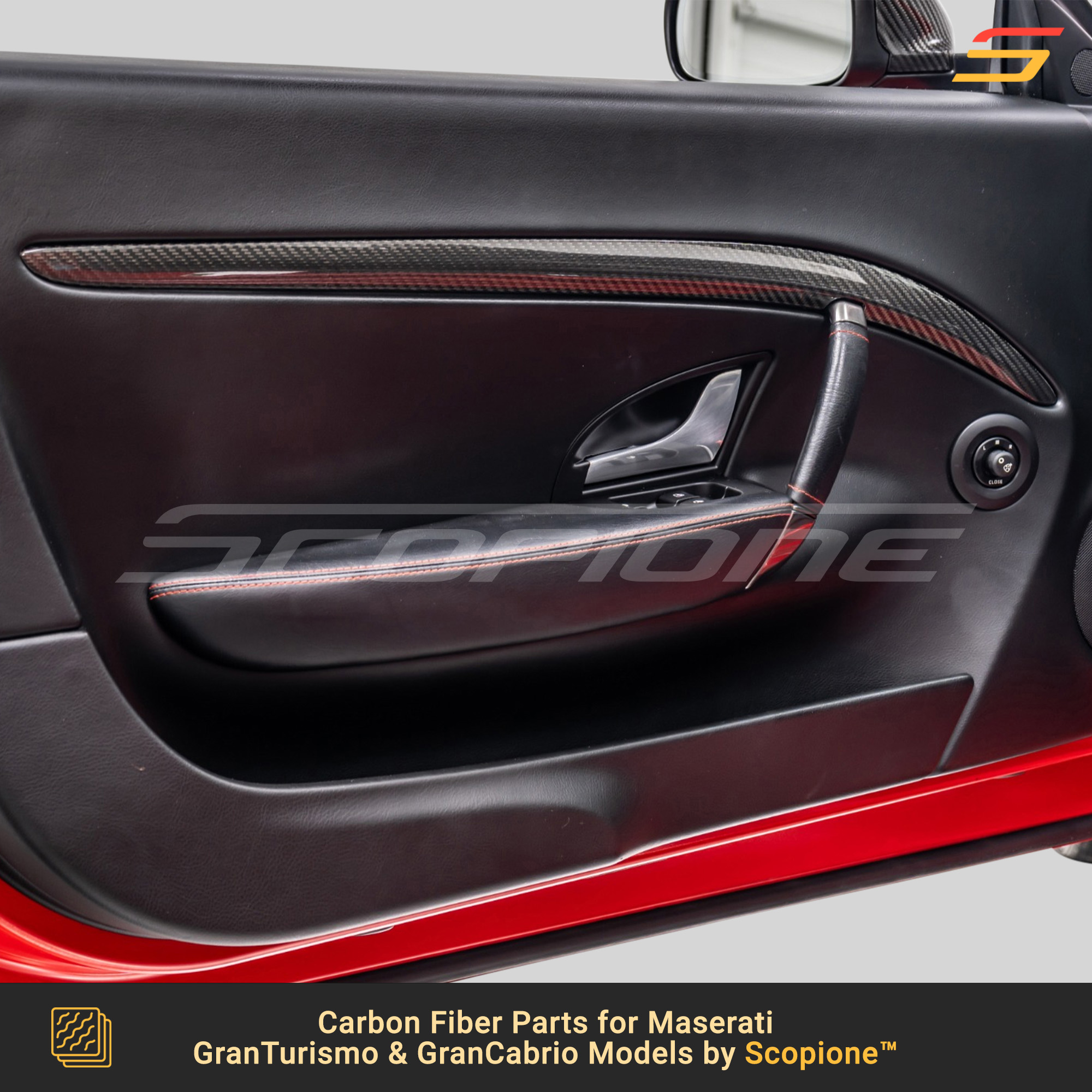
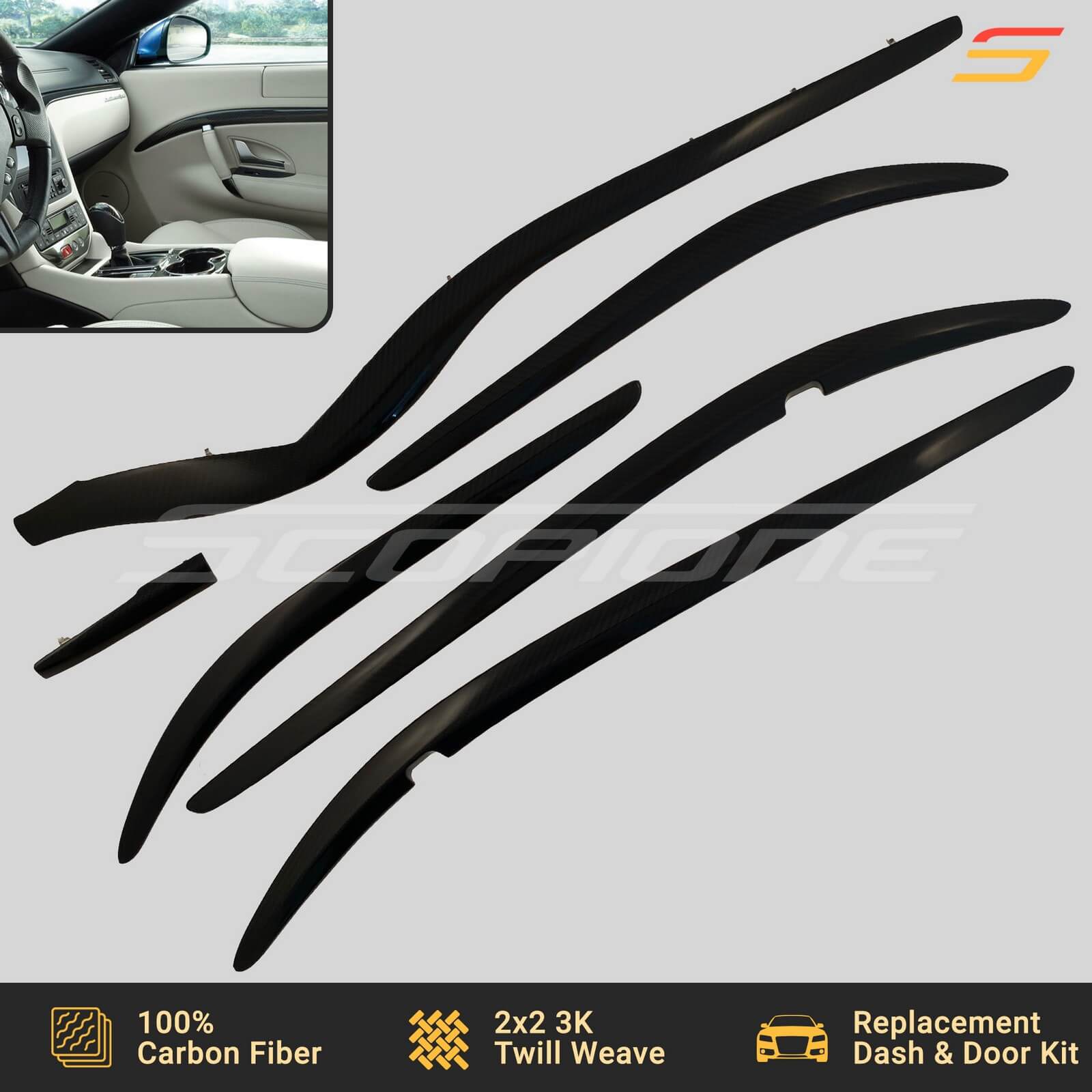
| Interior Dash & Door Panel Trim Kit | $2,500 | $500 – $1,000 | $3,000 – $3,500 |
Full interior conversion: Shift paddles, gauge cluster, gear shift surround, and the complete dash and door trim kit installed runs $5,050–$5,900. The dash trim kit is the single highest-value item in the Scopione Maserati catalog – a complete swap of every major interior surface from factory wood or aluminum to exposed twill-weave CF.
Browse Carbon Fiber Parts for the Maserati GranTurismo & GranCabrio
Used Maserati GranTurismo & GranCabrio Market (2024–2025)
GranTurismo and GranCabrio resale values vary by engine size, transmission choice, variant specification, and interior condition. Current approximate market ranges:
- 2007–2012 GranTurismo 4.2L: $22,000 – $40,000
- 2008–2012 GranTurismo S (4.7L, MC Shift): $28,000 – $50,000
- 2012–2019 GranTurismo Sport (4.7L): $40,000 – $75,000
- 2011–2017 MC Stradale (factory CF aero): $75,000 – $150,000
- 2010–2012 GranCabrio base (4.7L): $30,000 – $55,000
- 2012–2019 GranCabrio Sport / MC: $45,000 – $85,000
- 2023+ GranTurismo Modena (Nettuno V6): $140,000 – $175,000
- 2023+ GranTurismo Trofeo: $175,000 – $220,000

Explore Scopione Carbon Fiber for the GranTurismo & GranCabrio
Does Carbon Fiber Affect the Resale Value of a Maserati GranTurismo?
Quality carbon-fiber components from documented sources can maintain or strengthen a GranTurismo’s resale position – particularly on MC Stradale variants that already carry factory CF elements. A front splitter and mirror covers in exposed twill weave complement the MC Stradale’s factory aero rather than conflicting with it. On GranTurismo Sport models, the addition of CF interior trim (shift paddles, gauge cluster, dash kit) adds a cockpit character that the factory wood or aluminum trim does not deliver.
When CF adds value:
• Professionally installed components with receipts from the installing shop.
• Parts that complement existing factory carbon-fiber elements (MC Stradale splitter, GranCabrio MC mirror caps).
• Interior trim upgrades that address the first generation’s known weak point – aging factory surface materials.
When it does not:
• Generic or poorly fitted parts that produce visible gaps against Maserati’s body panels.
• Aggressive exterior modifications on base-spec GranTurismos where the aesthetic conflicts with the car’s grand touring character.
• Modifications installed without documentation on a car where service history drives resale value.
Practical advice: Retain all original OEM trim pieces in storage, use carbon fiber from documented sources like Scopione, and keep installation receipts with the vehicle’s service file. On GranTurismos with the sticky-button issue already remediated, fresh interior surfaces paired with CF trim upgrades add tangible appeal at resale.
Is the Maserati GranTurismo MC Stradale a Good Investment?
- MC Stradale collector status: Factory carbon-fiber aero (front splitter, rear diffuser, engine cover), 110 kg weight reduction, and its identity as the final Ferrari-engined Maserati GT position the MC Stradale as the collector pick in the lineup. Early 2-seat versions with low mileage have crossed $100K at auction.
- Base GranTurismo depreciation floor: 4.2L models from 2007–2012 have settled at $22K–$40K – a depreciation floor that appears stable. Pininfarina’s 12-year design continuity means a 2008 car looks nearly identical to a 2019 from across a parking lot.
- Last Ferrari V8 effect: When Ferrari stopped supplying engines to Maserati, every first-gen GranTurismo gained a specific provenance. The naturally aspirated F136 V8 exhaust note – a cross-plane rumble that no turbocharged successor replicates – is the primary emotional argument for first-gen ownership.
- PrimaSerie scarcity: The 75-unit PrimaSerie 75th Anniversary second-gen model could carry long-term premiums based on production numbers alone. But second-gen cars are too new for reliable investment analysis.
Notable Auction Results for the Maserati GranTurismo (2024–2025)
| Model | Sale Price |
|---|---|
| 2013 GranTurismo MC Stradale (2-seat) | $97,000 (Nov 2024) |
| 2019 GranTurismo Sport (final year) | $68,000 (Jan 2025) |
| 2015 GranCabrio MC | $62,000 (Sep 2024) |
| 2008 GranTurismo S (MC Shift) | $35,000 (Oct 2024) |
| 2009 GranTurismo 4.2 (ZF auto) | $26,000 (Feb 2025) |
What Are Common Maserati GranTurismo Maintenance Issues and Costs?
GranTurismo ownership costs are moderate by Italian GT car standards but higher than mass-market alternatives. Annual routine maintenance (oil, filters, inspection) runs $2,000–$5,000 depending on service interval and whether a Maserati dealer or independent specialist performs the work. Independent Maserati/Ferrari specialists can reduce labor rates by 30–50% versus authorized dealer pricing.
Key cost items by component:
- MC Shift clutch replacement: $5,000 – $8,000. The single highest-cost maintenance item on S, MC Stradale, and GranCabrio MC variants. Clutch life varies with driving style – aggressive city driving can wear the single-clutch unit in 30,000–40,000 miles, while highway-focused use extends life to 60,000+ miles.
- Cam variator / timing chain tensioner (4.2L): $3,000 – $5,000. Common on higher-mileage 4.2L engines. A ticking or rattling noise on cold start is the typical first symptom. The 4.7L engine has an improved variator design and is less prone to this failure mode.
- Skyhook adaptive suspension struts: $2,000 – $4,000 per corner when struts fail. The adaptive dampers are specific to the GranTurismo platform and do not share parts with the Quattroporte.
- Sticky interior buttons: First-generation interior switches develop a degraded, tacky coating over time – a well-documented issue across all variants. Professional remediation: $500–$2,000 depending on scope. Affects resale value more than functionality.
The GranTurismo Sport with the ZF 6-speed automatic carries the lowest running costs in the lineup – no MC Shift clutch to replace, the reliable 4.7L engine, and a broad independent specialist network. For buyers who plan to drive regularly, the ZF-equipped Sport is the pragmatic choice.
Which Maserati GranTurismo Should I Buy?
- Entry point: 2007–2012 GranTurismo 4.2 with ZF auto ($22K – $40K) – the lowest entry to Maserati grand touring. Pininfarina design, Ferrari V8 sound, four usable seats. Budget an additional $3K–$6K annually for maintenance. Avoid 4.2L examples with undocumented cam variator history.
- Value pick: 2012–2019 GranTurismo Sport with ZF auto ($40K – $75K) – the 4.7L engine’s stronger output, updated infotainment, and the ZF transmission’s lower maintenance costs make this the sweet spot. Final production years (2017–2019) offer the most refined calibration.
- Driver’s choice: MC Stradale ($75K – $150K) – factory CF aero, 110 kg weight reduction, the sharpest chassis tuning in the lineup. Accept the MC Shift’s daily-driving compromises in exchange for the closest analog to a road-legal Trofeo race car Maserati built during the Ferrari V8 era.
- Open-air: GranCabrio Sport or MC ($45K – $85K) – the same 460 hp 4.7L engine with a hydraulic fabric roof. The GranCabrio MC adds factory CF mirrors and a sport exhaust for buyers who want performance convertible character without the MC Stradale’s 2-seat limitation.
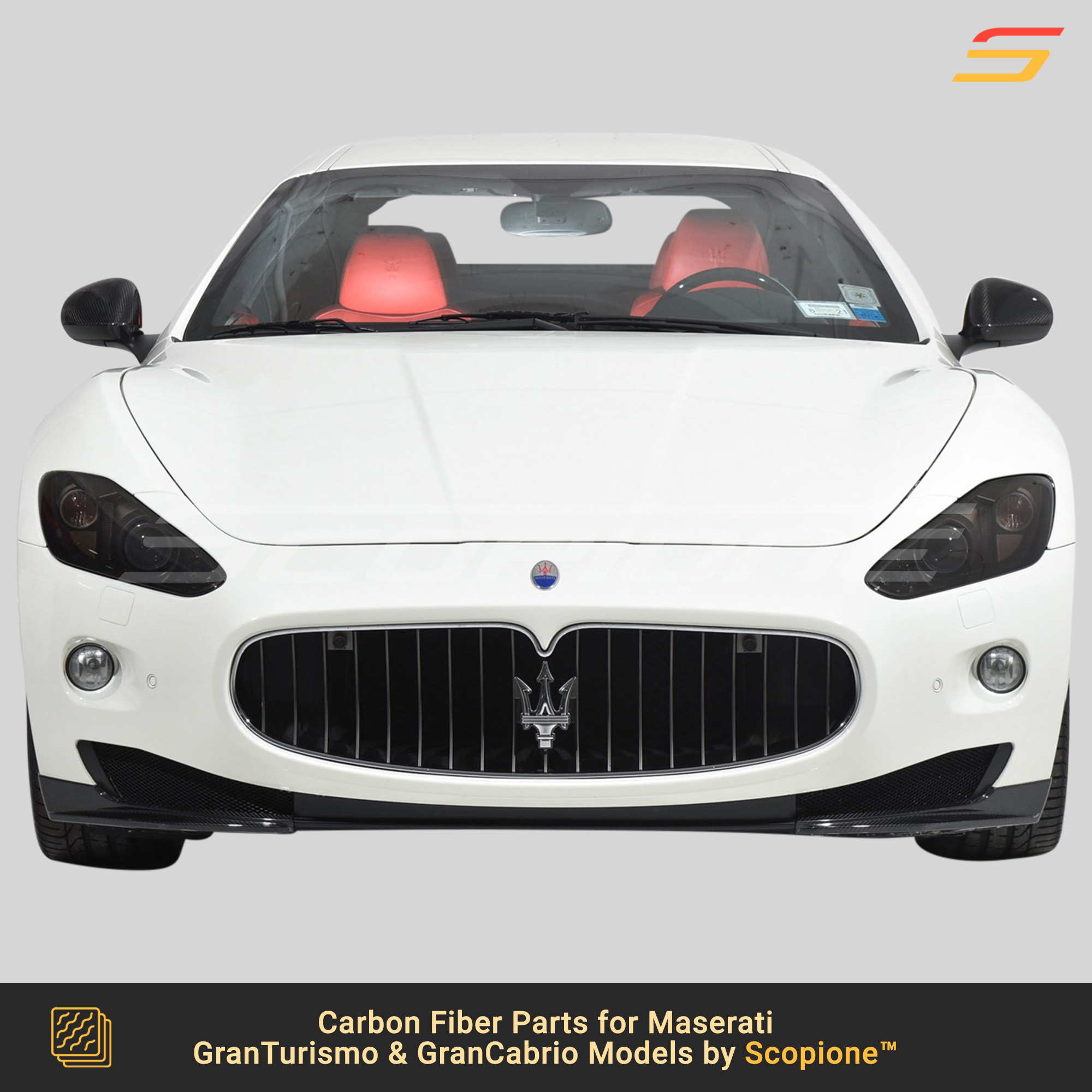
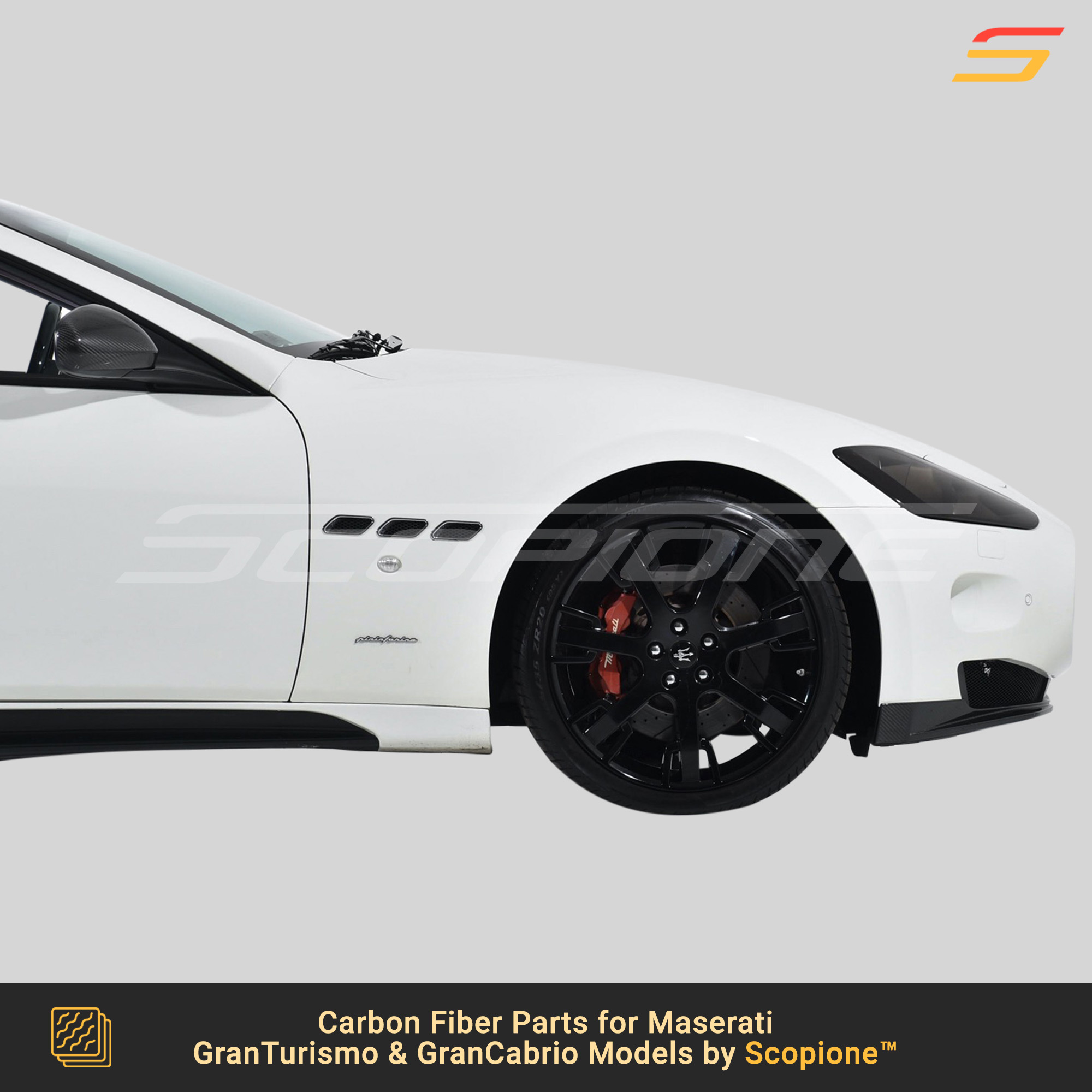
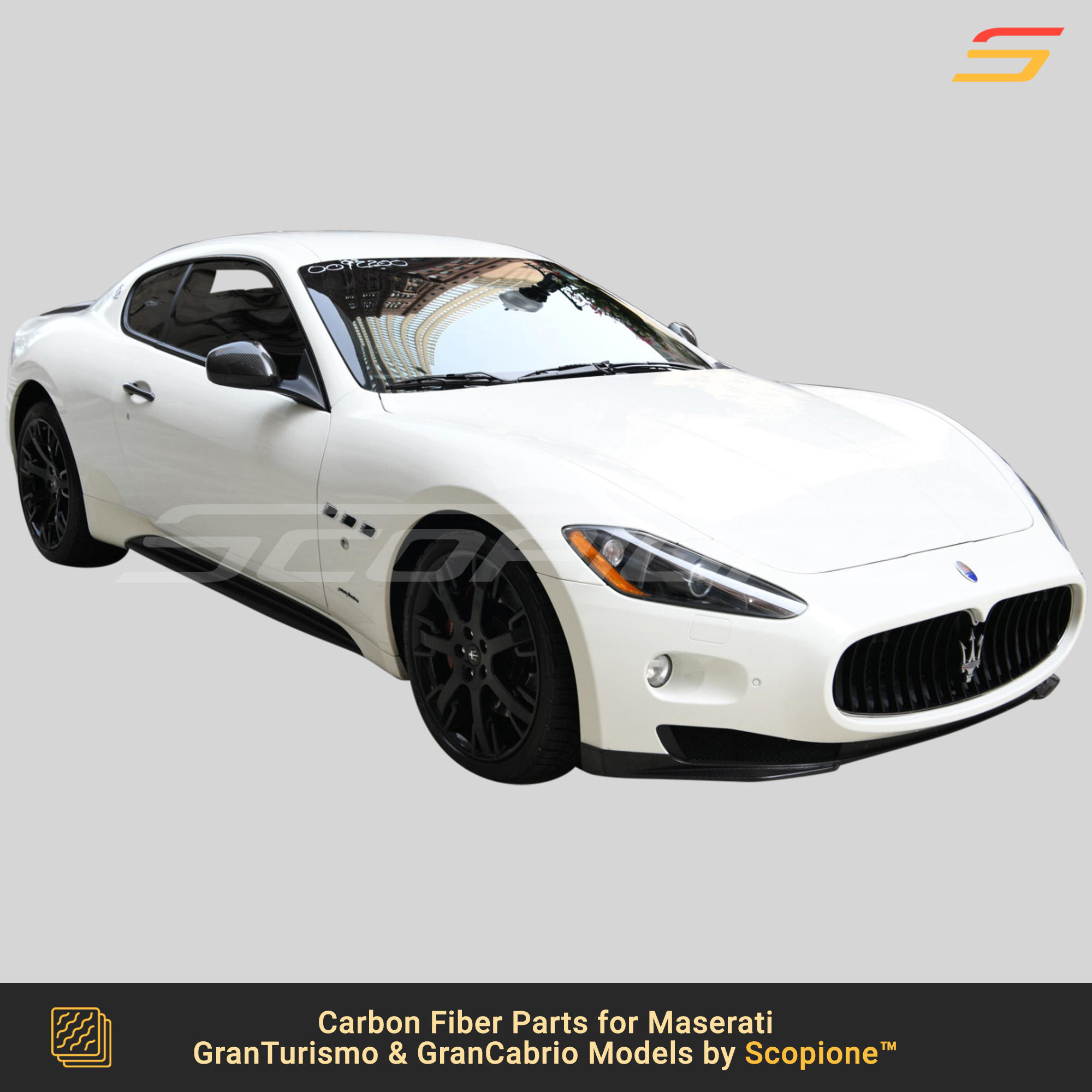
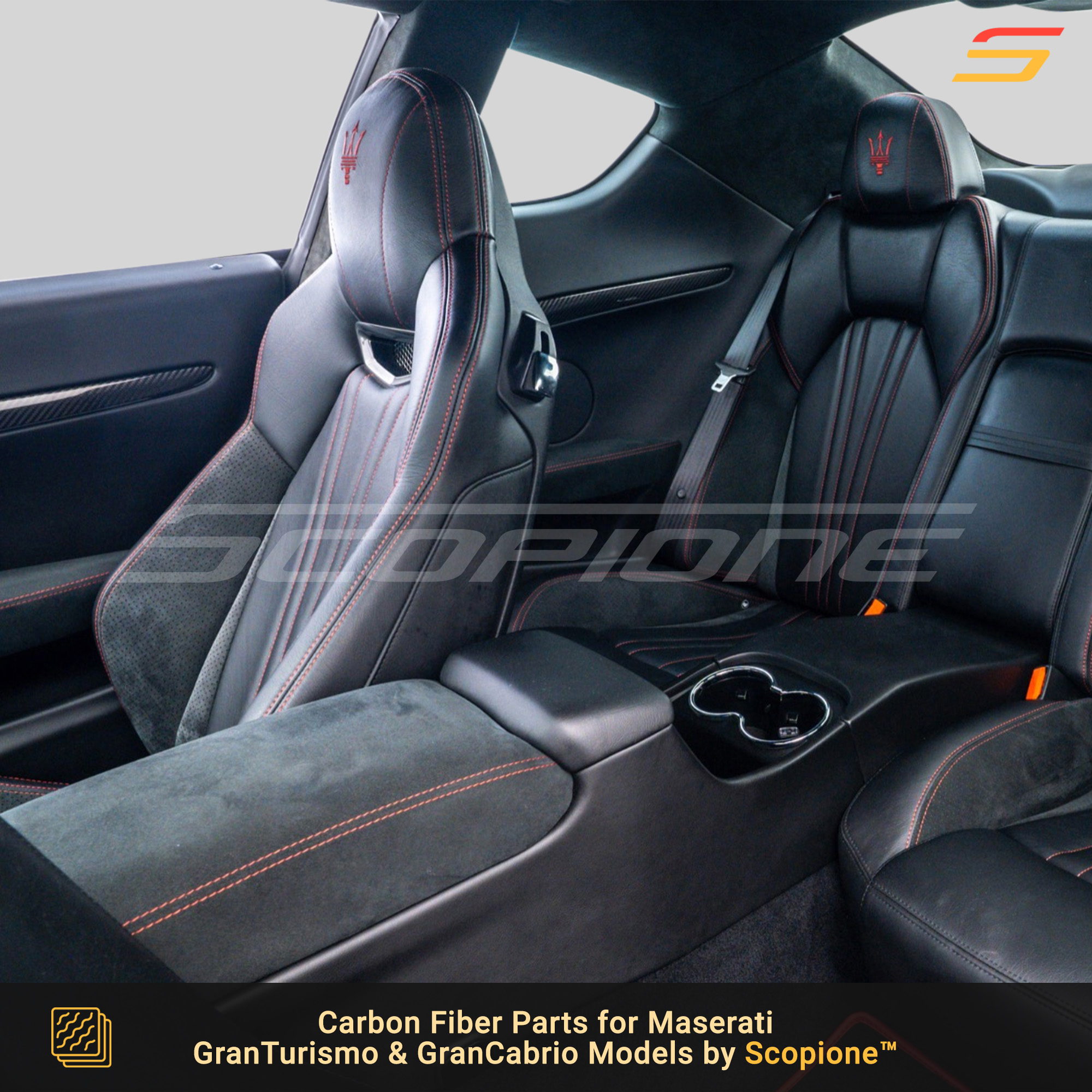
The Scopione Maserati GranTurismo & GranCabrio Picture Gallery features photographs of first-generation GranTurismos fitted with Scopione carbon-fiber components – front splitters, rear diffusers, mirror covers, fender vents, shift paddles, and complete interior trim kits. The gallery captures how the exposed CF twill-weave pattern integrates with the GranTurismo’s Pininfarina body lines and factory interior surfaces across models and color combinations.
Every Scopione component is hand-laid from 2×2 3K twill-weave carbon fiber with a UV-resistant clear coat – the same material quality across all nine catalog items.
Browse the Scopione Maserati GranTurismo & GranCabrio catalog for specific part fitment, pricing, and installation details.
Carbon Fiber Parts for the Maserati GranTurismo and GranCabrio
The 13 carbon fiber parts Scopione currently lists for the Maserati GranTurismo and GranCabrio. Each image links to its product page.

More Scopione Picture Galleries
Scopione’s carbon fiber catalog covers a wide range of performance and luxury vehicles. Browse galleries for related makes and models:
- Ferrari: 458 Italia & Spider • 488 GTB & Spider • F8 Tributo & Spider • F12 & 812 Superfast • SF90
- Lamborghini: Gallardo • Huracan • Aventador • Urus
- McLaren: MP4-12C & 650S • 720S & 765LT • Sports Series
- Porsche: 911, Boxster & Cayman
- BMW: M3, M4, M5 & More
- Audi: R8
- Nissan: GT-R R35 • 350Z, 370Z & Z
- Aston Martin: Vantage, DB9 & DBS
- Bentley: Continental GT & GTC
- Toyota: Supra
- Subaru: WRX STI
- Mitsubishi: Lancer Evolution
- Chevrolet: Corvette • Camaro
- Dodge: Viper
Experience the elegance and performance of the Maserati GranTurismo & GranCabrio with Scopione. Browse our gallery and get inspired to elevate your supercar with our top-of-the-line carbon fiber upgrades.
Shop now for premium ScopioneCarbon carbon fiber upgrades and experience the ultimate in performance and aesthetics for your Maserati GranTurismo & GranCabrio!