

 Shop
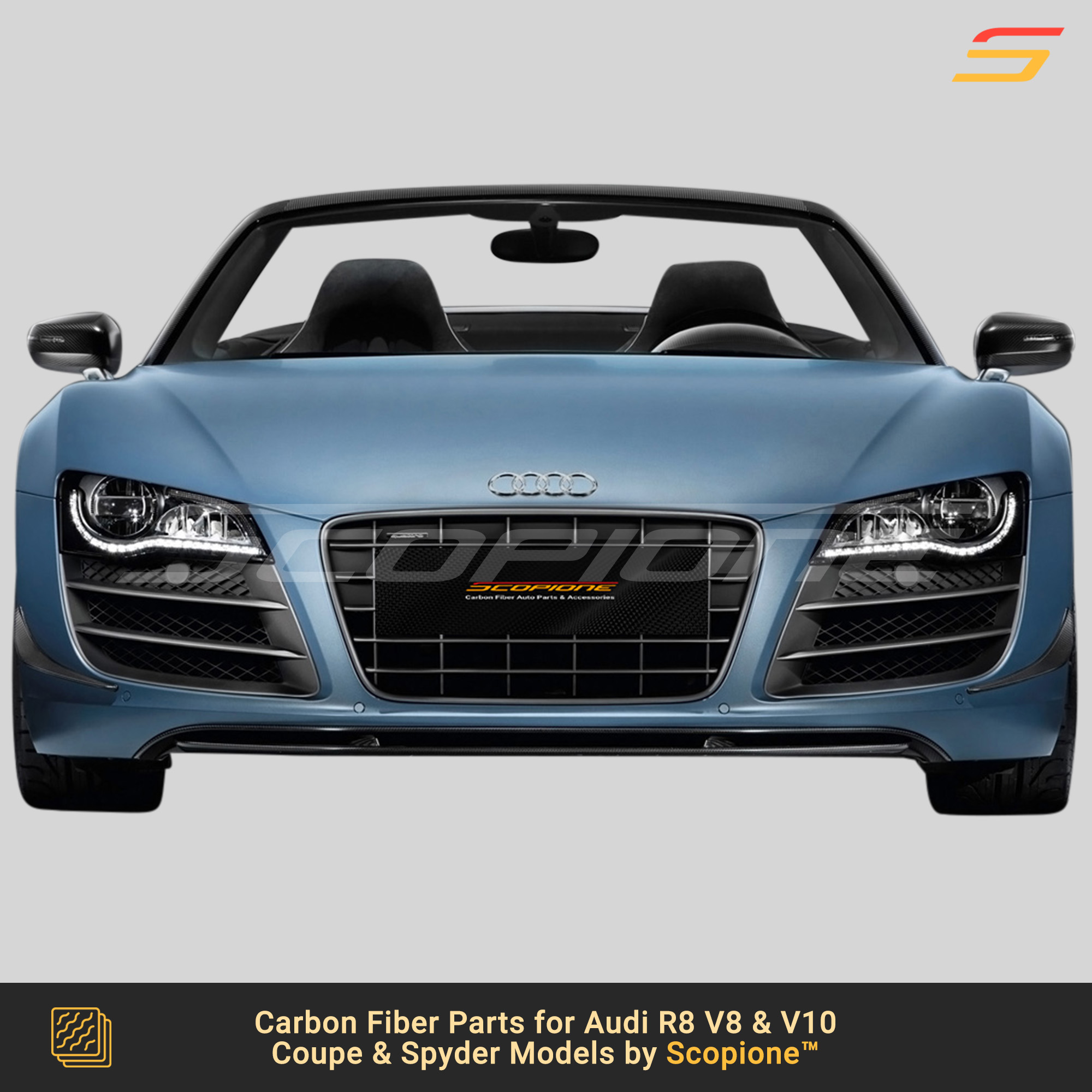
ShopThe Audi R8 was the first mid-engine supercar in Audi’s history – a naturally aspirated V8 or V10, hand-built at the Bollinger Hofe plant near Neckarsulm, Germany, across an 18-year production run (2007–2024). Total output: 45,949 units, each assembled by 70 workers fitting 5,000 individual parts. From the gated-manual V8 that started it all to the 612 hp R8 GT that ended production, the R8 was built to challenge Ferrari and Lamborghini while remaining genuinely daily-drivable – and it defined Audi’s performance identity in a way no other model had. Scopione carries a full line of carbon fiber parts for the Audi R8 – engine bay covers, side engine panels, diffusers, front lip spoilers, intake covers, and door sills – precision-fitted across both the Type 42 and Type 4S generations.

Introduction: Audi’s First Mid-Engine Supercar
The idea began with the Le Mans quattro concept at the 2003 Geneva Motor Show – a twin-turbocharged V10 wrapped in a carbon fiber skin, named after the R8 LMP prototype that had won Le Mans five times between 2000 and 2005. Three years later, the production R8 premiered at the 2006 Paris Motor Show. It was the first production car with full-LED headlamps, and it carried Audi’s racing heritage directly into its model name. Customer deliveries started in early 2007.
The first generation (Type 42) rode on a stretched version of the Lamborghini Gallardo’s aluminum spaceframe – wheelbase extended 90mm to 2,650mm, engine mounted in a carbon fiber cradle. Two powertrains: a 4.2-liter V8 FSI producing 414–430 hp, and a 5.2-liter V10 FSI shared with the Gallardo LP560-4, producing 518–570 hp depending on variant. Every R8 left Bollinger Hofe with quattro permanent all-wheel drive.
The second generation (Type 4S, 2016–2024) moved to the Modular Sports System (MSS) platform shared with the Lamborghini Huracan. The V8 was dropped entirely. The V10 was now the only engine, and the body shell – a multimaterial construction of 79.6% aluminum and 13% CFRP – weighed just 200 kg. That is 10 kg less than the predecessor, with 40% greater torsional rigidity.
At the 2008 World Car Awards, the R8 took both World Performance Car of the Year and World Design Car of the Year. It then became Tony Stark’s car in the Iron Man films, cementing its place in both automotive and pop culture.
Scopione’s R8 carbon fiber catalog covers engine bay kits, side engine covers, diffusers, front lips, intake covers, and door sills – precision-fitted for both Type 42 and Type 4S models.
Evolution of Audi R8 Models
Type 42 (2007–2015): The Original R8
The launch R8 paired the 4.2-liter V8 FSI (414 hp, later 430 hp after the 2012 facelift) with a 6-speed gated manual or R tronic automated single-clutch. Dry weight sat at 1,635 kg (3,605 lb) for the V8 coupe. A year later, the 5.2-liter V10 FSI arrived – 525 hp, shared with the Gallardo LP560-4, pushing the car to 196 mph and a 3.7-second 0–60. The V10 quickly became the definitive R8 powertrain.
The R8 Spyder convertible joined the lineup in 2010. Then at the 2012 facelift, the aging R tronic single-clutch was replaced by a proper 7-speed S tronic dual-clutch. The V8 also gained 16 hp (to 430), and the V10 Plus variant appeared for the first time: 550 hp, 50 kg lighter than the standard V10 through carbon-ceramic brakes, bucket seats, and CFRP exterior panels.
But it was the limited-production variants that shaped the Type 42’s collectible status:
- R8 GT Coupe (2011–2012) – 333 units worldwide (90 for US). 560 hp. 100 kg lighter than the standard V10 via CFRP front splitter, side blades, diffuser, rear wing, and carbon fiber seats that alone saved 70 lbs. The R tronic was the only transmission option. Production number engraved on the gear shift knob.
- R8 GT Spyder (2012) – 333 units. Same 560 hp powertrain. 85 kg lighter than the standard V10 Spyder. Unveiled at the 2011 24 Hours of Le Mans. CFRP soft top cover, front spoiler, fixed rear spoiler, large rear side panels. Electrohydraulic soft top operated in 19 seconds.
- R8 LMX (2014–2015) – 99 units, Europe only. The first production car with laser high-beam headlights – four diodes per module, 300-micrometer diameter, illumination range doubled to 600 meters. 570 hp. Exclusive Ara Blue crystal-effect paint.
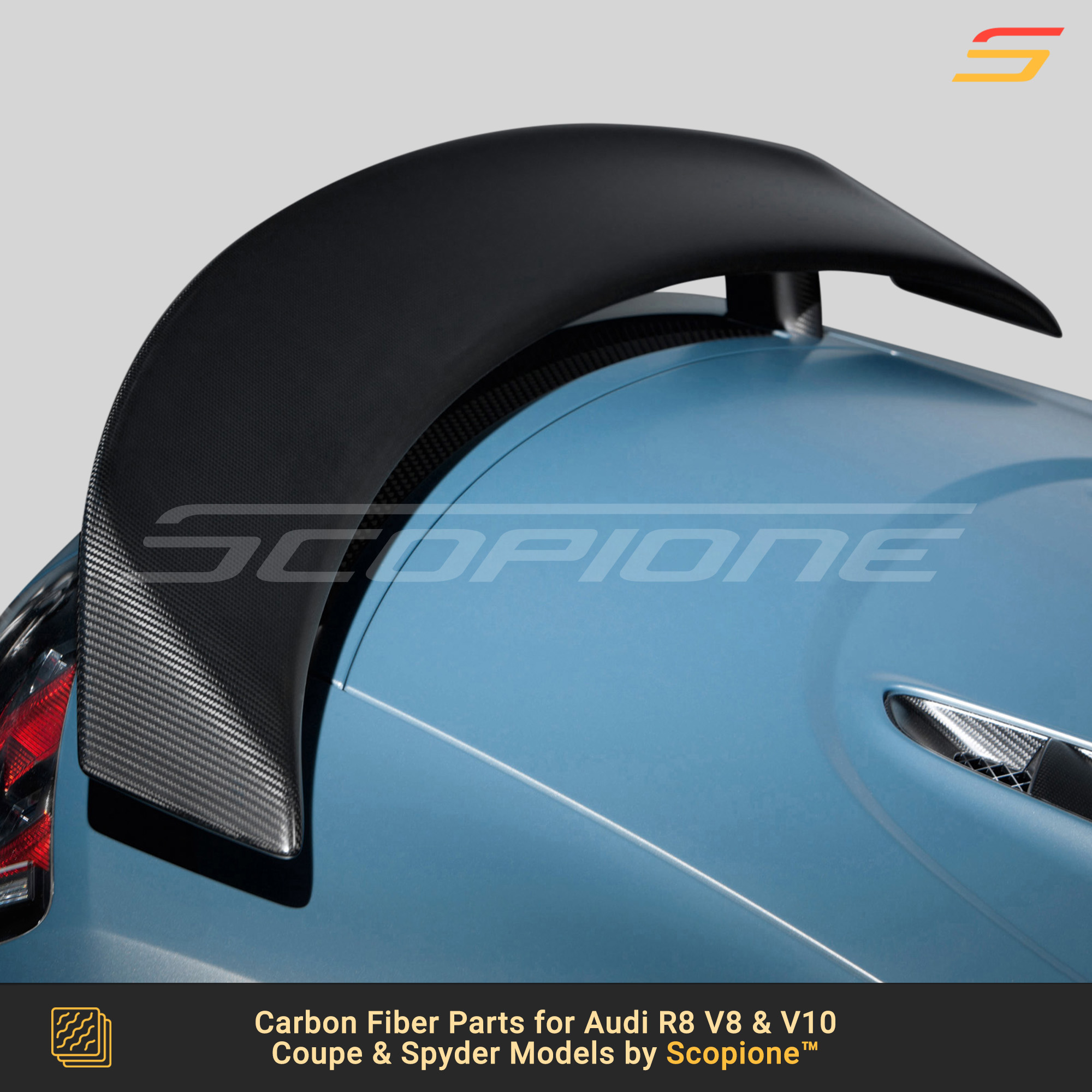
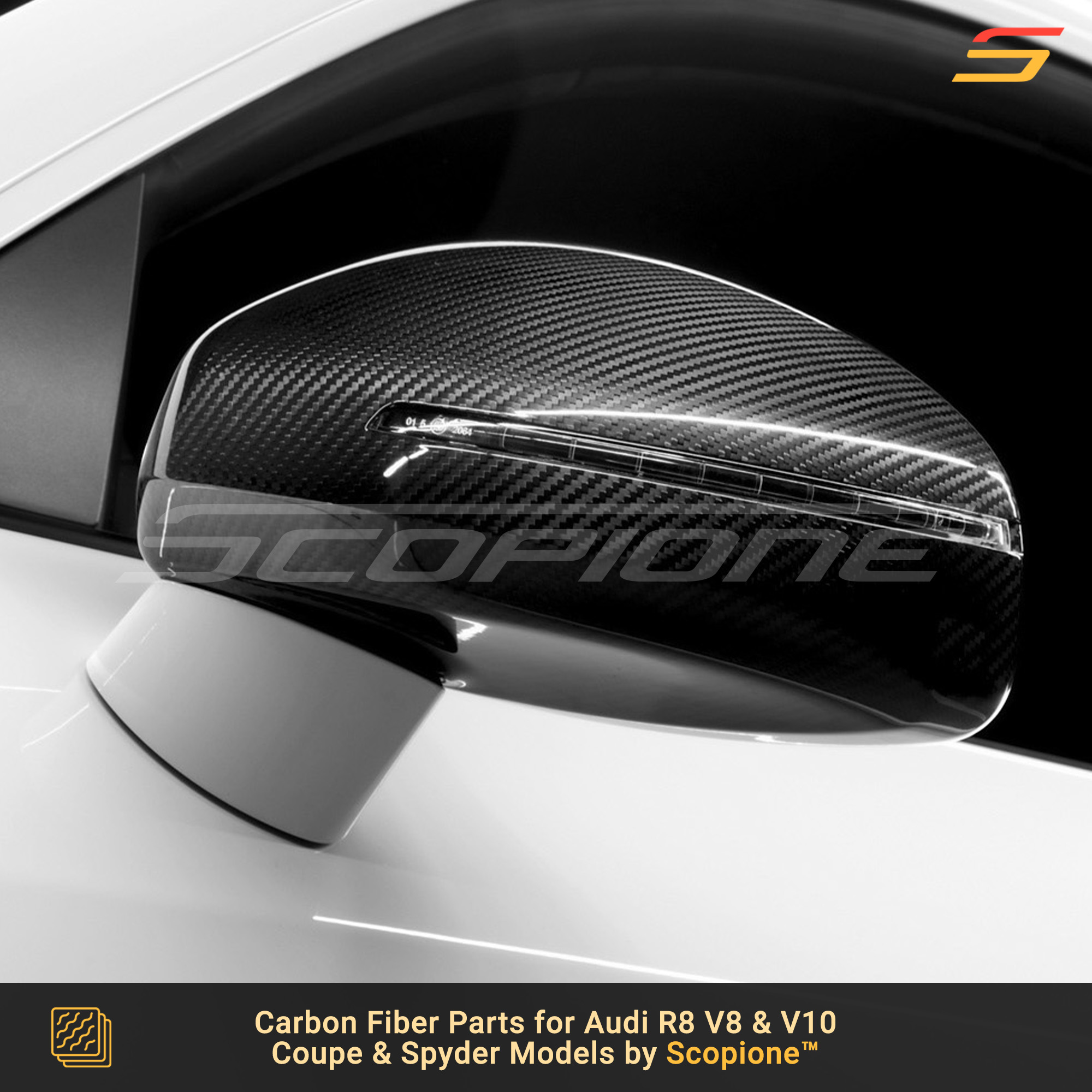
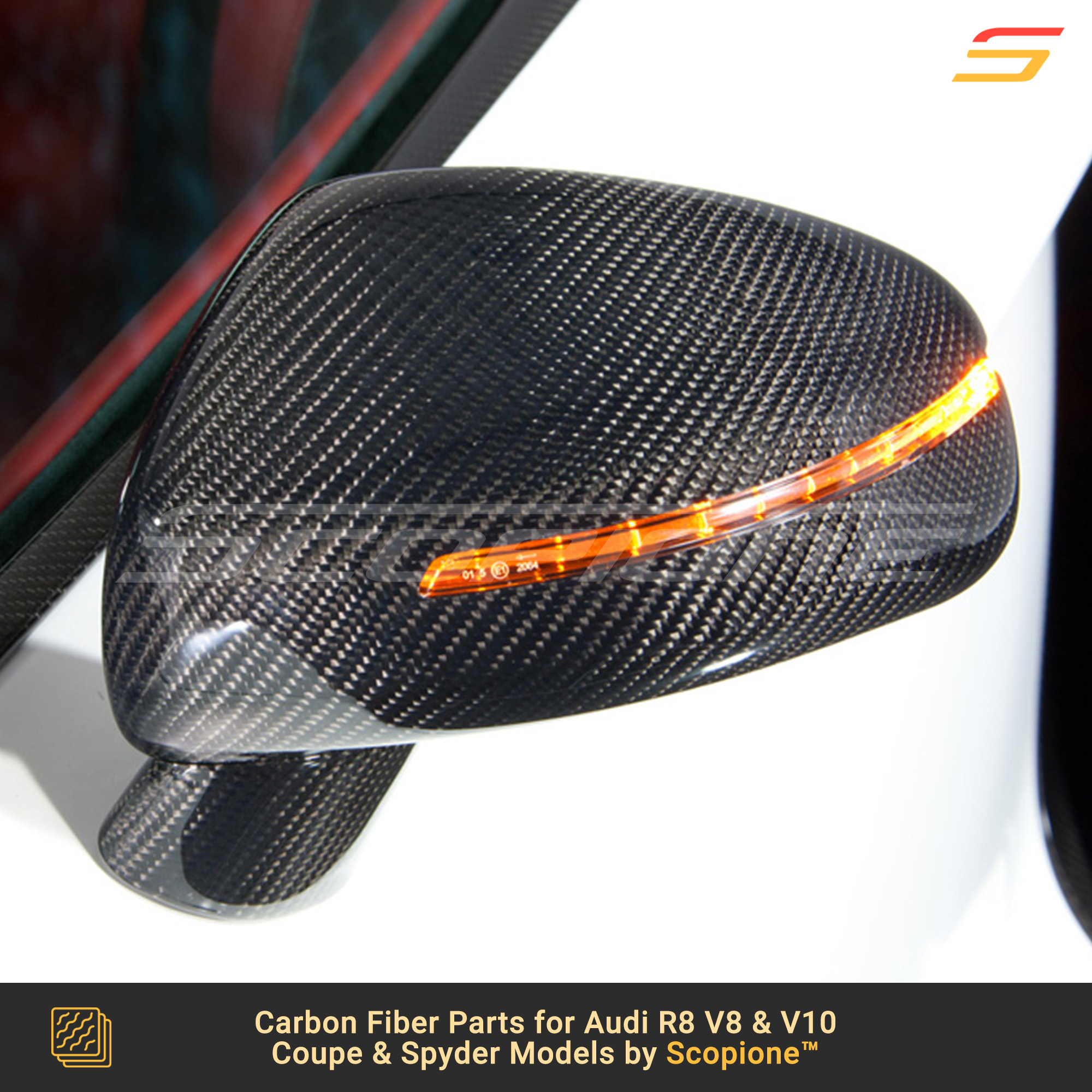
- R8 Competition (2015) – 60 units, US exclusive. 570 hp with all-matte carbon fiber: front splitter, mirror housings, sideblades, engine cover, fixed rear spoiler, diffuser. Carbon-ceramic brakes with red anodized calipers. 0–60 in 3.2 seconds.
Models & Key Specifications:
- V8 4.2 FSI Coupe (2007–2015)
- Engine: 4.2L V8 FSI (414–430 HP)
- Transmission: 6-speed gated manual / R tronic / S tronic (2012+)
- Drivetrain: quattro AWD
- 0–60 mph: 4.0 seconds (manual)
- V10 5.2 FSI Coupe (2009–2015)
- Engine: 5.2L V10 FSI (518–525 HP)
- 0–60 mph: 3.7 seconds (tested)
- Top speed: 196 mph (316 km/h)
- V10 Plus (2013–2015)
- Engine: 5.2L V10 FSI (550 HP)
- Dry weight: 1,570 kg (3,461 lb) – 50 kg lighter than standard
- 0–60 mph: 3.3 seconds
- R8 GT Coupe (2011–2012)
- Engine: 5.2L V10 FSI (560 HP)
- Dry weight: 1,525 kg (3,362 lb) – 100 kg lighter than standard
- Production: 333 units
Audi R8 Type 42 (2007–2015) MSRP Price Ranges
| Model | Base MSRP (USD) | Price Adjusted for Inflation (2024) |
|---|---|---|
| V8 Coupe (2008–2012) | $109,000 | ~$153,000 |
| V10 Coupe (2010–2015) | $150,200 | ~$203,000 |
| V10 Plus Coupe (2013–2015) | $175,000 | ~$225,000 |
| R8 GT Coupe (2012) | $196,800 | ~$256,000 |
| R8 Competition (2015) | $200,000 | ~$250,000 |
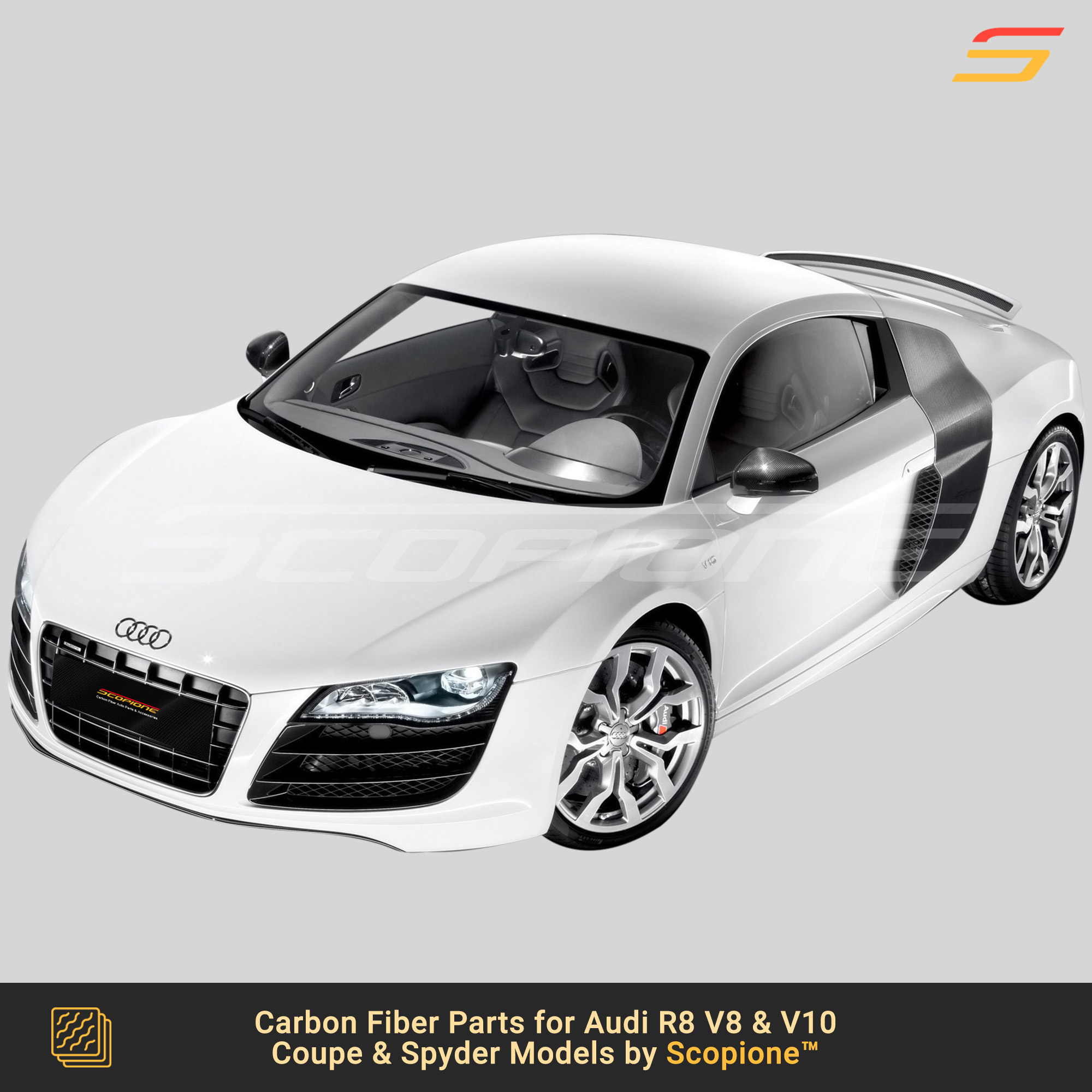
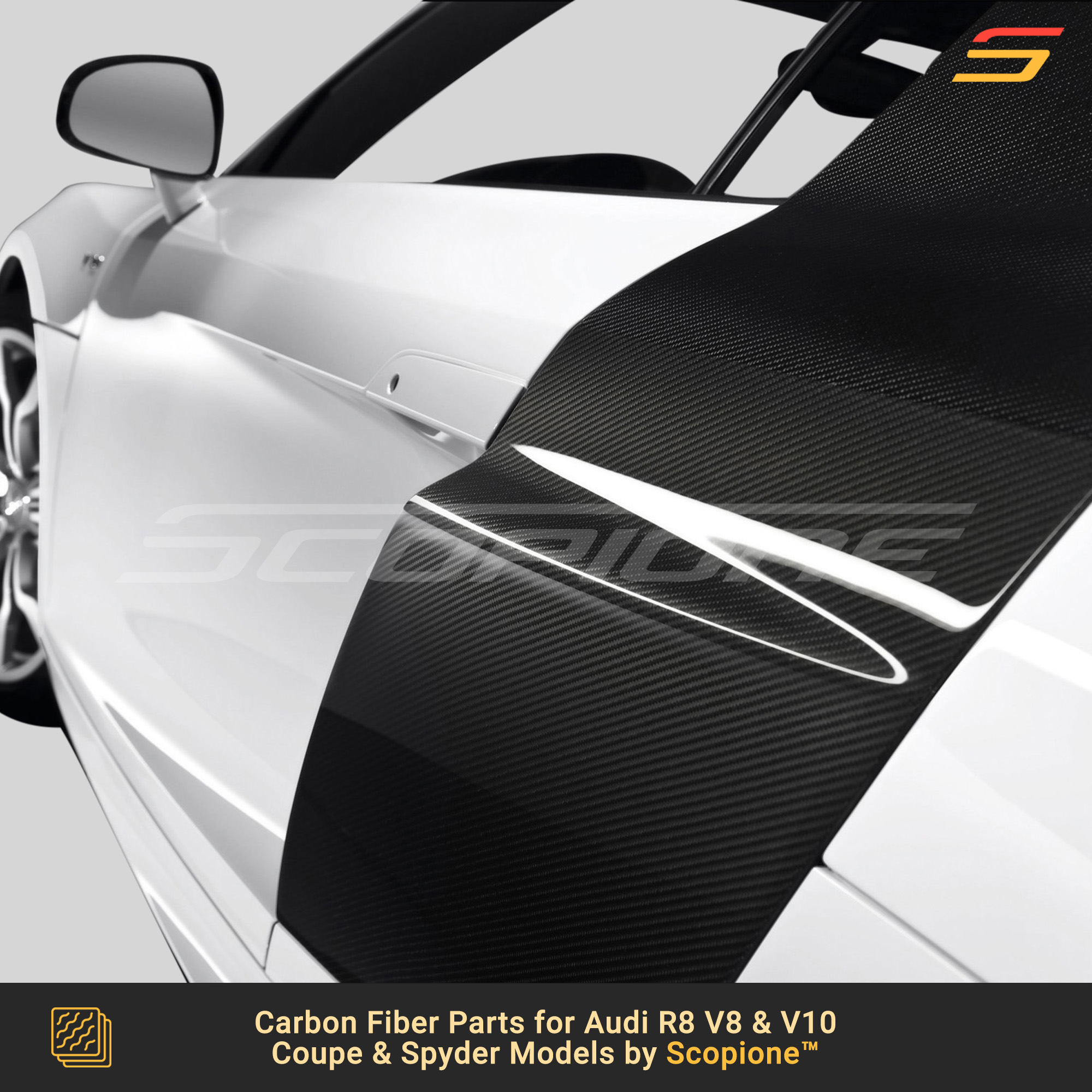
Scopione stocks carbon fiber components for every Type 42 R8 variant – browse by model year.
Type 4S (2016–2024): The MSS Platform
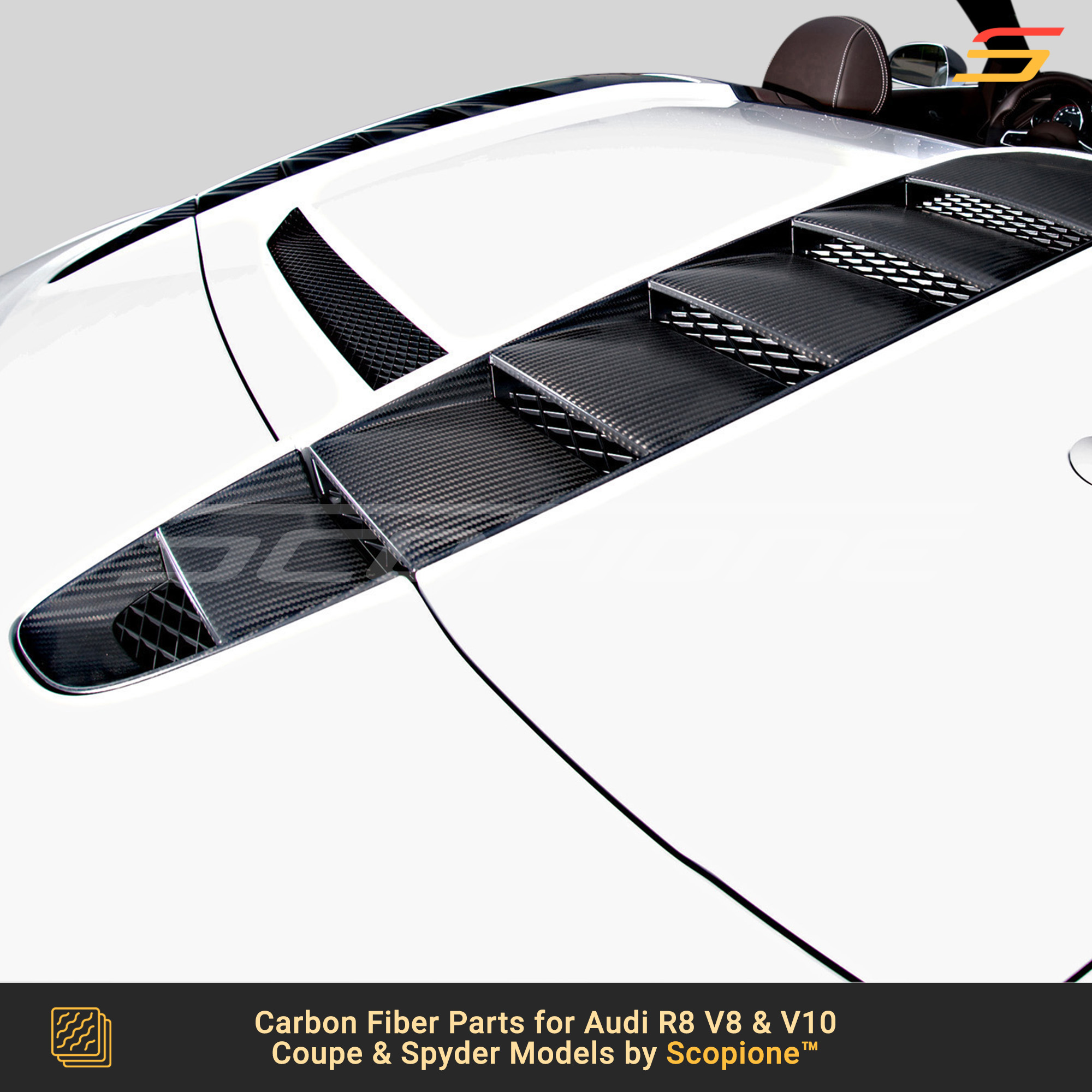
The second-generation R8, unveiled at the 2015 Geneva Motor Show, dropped the V8 entirely and became a V10-only car. The Audi Space Frame (ASF) used Resin Transfer Moulding for its CFRP B-pillars, center tunnel, and rear bulkhead – 79.6% aluminum, 13% carbon fiber by weight. Body shell assembly required 215 semi-hollow punch rivets, 184 blind rivets, 244 metric screws, and 51 meters of engineered adhesive. The result weighed 200 kg – lighter and 40% stiffer than the car it replaced.
At launch, two power levels: the V10 quattro (540 hp) and the V10 Plus (610 hp). The 2019 facelift renamed these as V10 quattro (562 hp) and V10 Performance quattro (612 hp), added dual injection (port + direct), and introduced rear-wheel steering to the lineup. The same facelift also brought RWD models – the first rear-drive Audis had arrived with the 2018 RWS, but now RWD became a permanent catalog option.
The manual transmission did not return. Every Type 4S used the 7-speed S tronic dual-clutch. Enthusiasts mourned the gated shifter. But the dual-clutch delivered faster lap times, and the V10’s 8,700 rpm redline remained intact.
- R8 V10 RWS – Rear Wheel Series (2018) – 999 units (320 for US). The first rear-wheel-drive Audi since the VW acquisition in the 1960s. 540 hp, 50 kg lighter than the equivalent quattro model. Dashboard badge reads “1 of 999.” Optional red racing stripe from roof to rear, mirroring the R8 LMS GT4 race car. At $138,700, it was the least expensive R8 available – roughly $26,000 below the quattro.
- R8 V10 Decennium (2019) – 222 units (50 for US). Celebrating 10 years of V10 R8. 612 hp. Exclusive Daytona Gray matte paint, matte bronze 20-inch milled wheels, gloss carbon fiber side blades and mirror housings, sequential build number on each car.
- V10 Performance RWD (2022–2024) – Performance-level power (612 hp) available in rear-wheel drive for the first time. Coupe and Spyder.
- R8 GT RWD (2023) – The final R8. 333 units (150 for US: 50 each in Tango Red, Daytona Gray, Mythos Black). 602 hp with a unique Torque Rear mode offering 7 levels of traction adjustability. Carbon fiber front splitter, dual dive planes, intake scoops, diffuser, larger rear wing, and carbon-fiber front sway bar. Michelin Pilot Sport Cup 2 tires. Carbon-ceramic brakes standard. MSRP: $249,900.
Audi R8 Type 4S (2016–2024) MSRP Price Ranges
| Model | Base MSRP (USD) | Price Adjusted for Inflation (2024) |
|---|---|---|
| V10 Coupe (2017–2019) | $162,900 | ~$195,000 |
| V10 Plus Coupe (2017–2018) | $189,900 | ~$228,000 |
| V10 RWS (2018) | $138,700 | ~$166,000 |
| V10 Performance Coupe (2020–2023) | $196,700 | ~$226,000 |
| Decennium (2019) | $214,995 | ~$258,000 |
| R8 GT (2023) | $249,900 | ~$258,000 |
Type 4S R8 owners can find model-specific carbon fiber parts on the Scopione R8 page.
Carbon Fiber Integration in the Audi R8 Over the Years
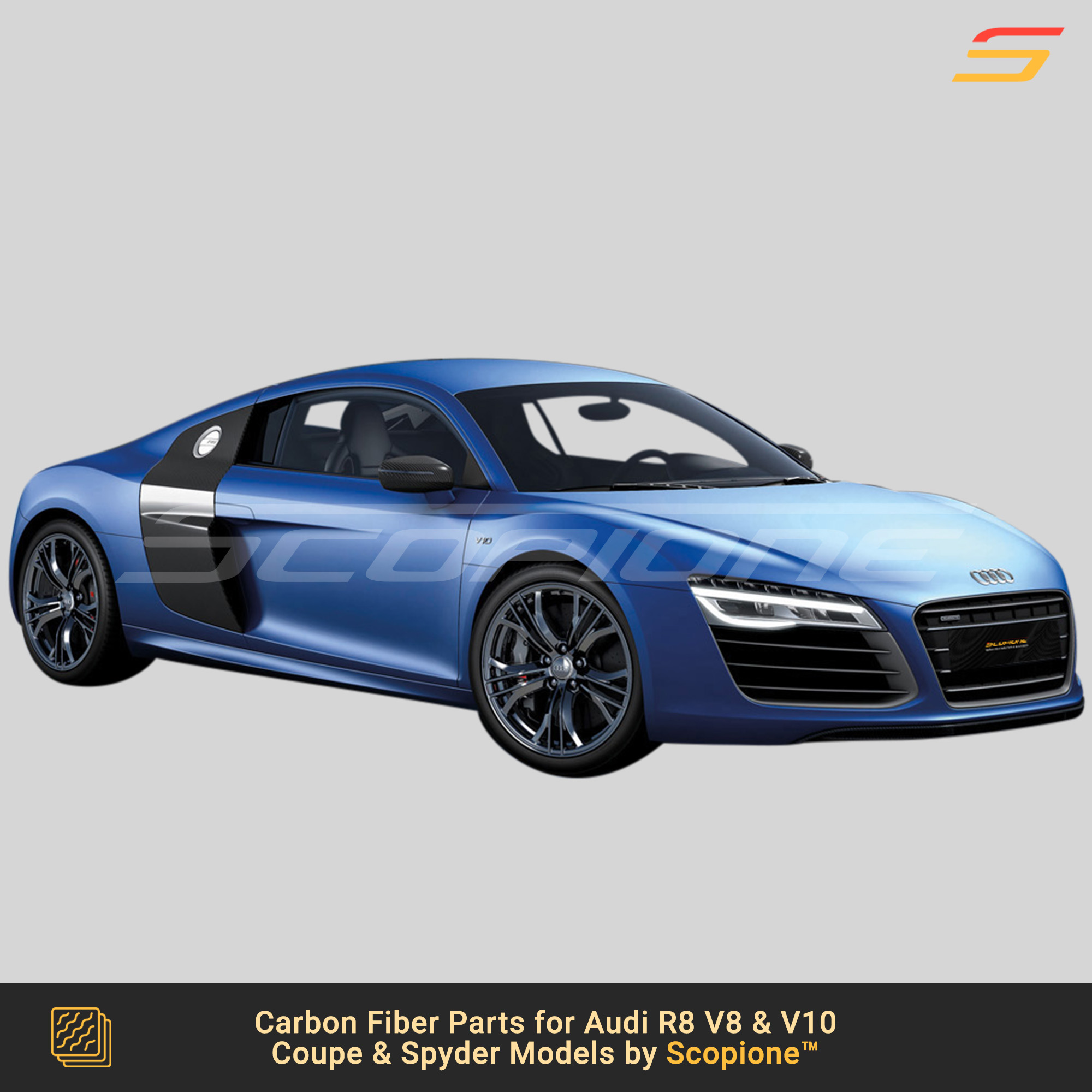
Carbon fiber entered the R8’s DNA from the beginning. The Type 42 mounted its engine in a carbon fiber cradle. The R8 GT used CFRP for its front splitter, side blades, diffuser, rear wing, and even the seats – saving 100 kg over the standard car. And the Type 4S went further: 13% of the entire body shell was CFRP, manufactured using Resin Transfer Moulding – a technique that allowed structural carbon fiber components (B-pillars, center tunnel, rear bulkhead) to be integrated directly into the Audi Space Frame.
1. Exterior Enhancements
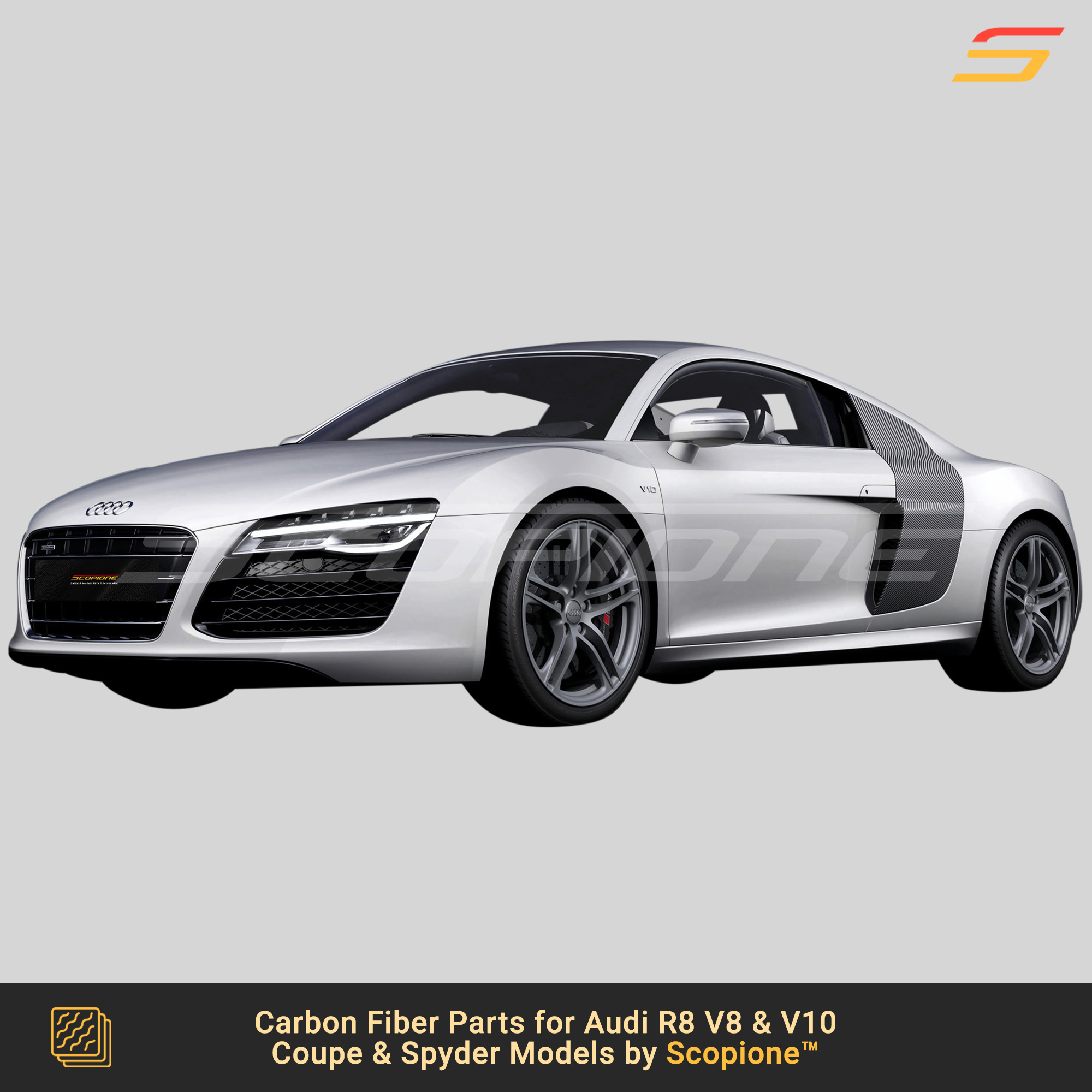
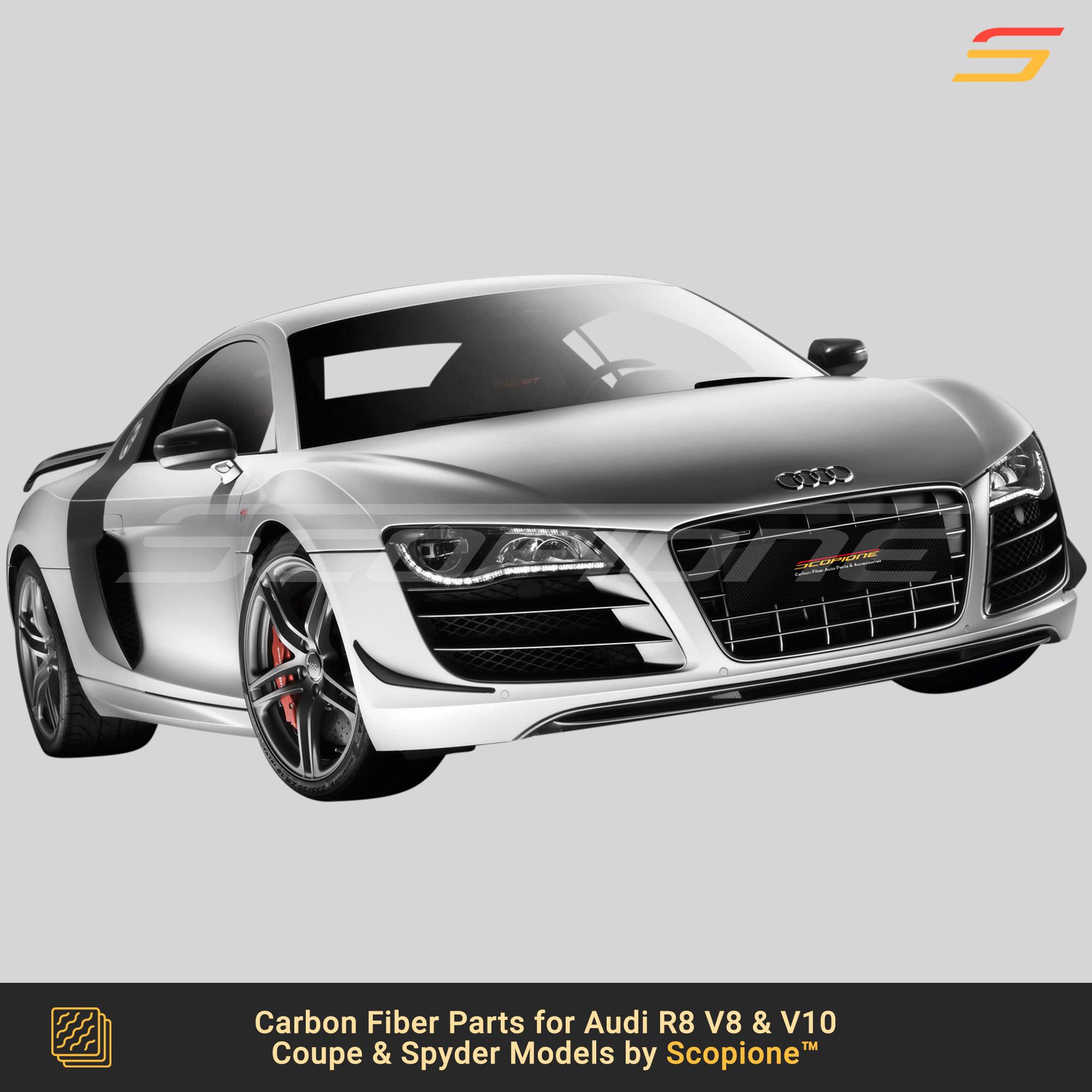
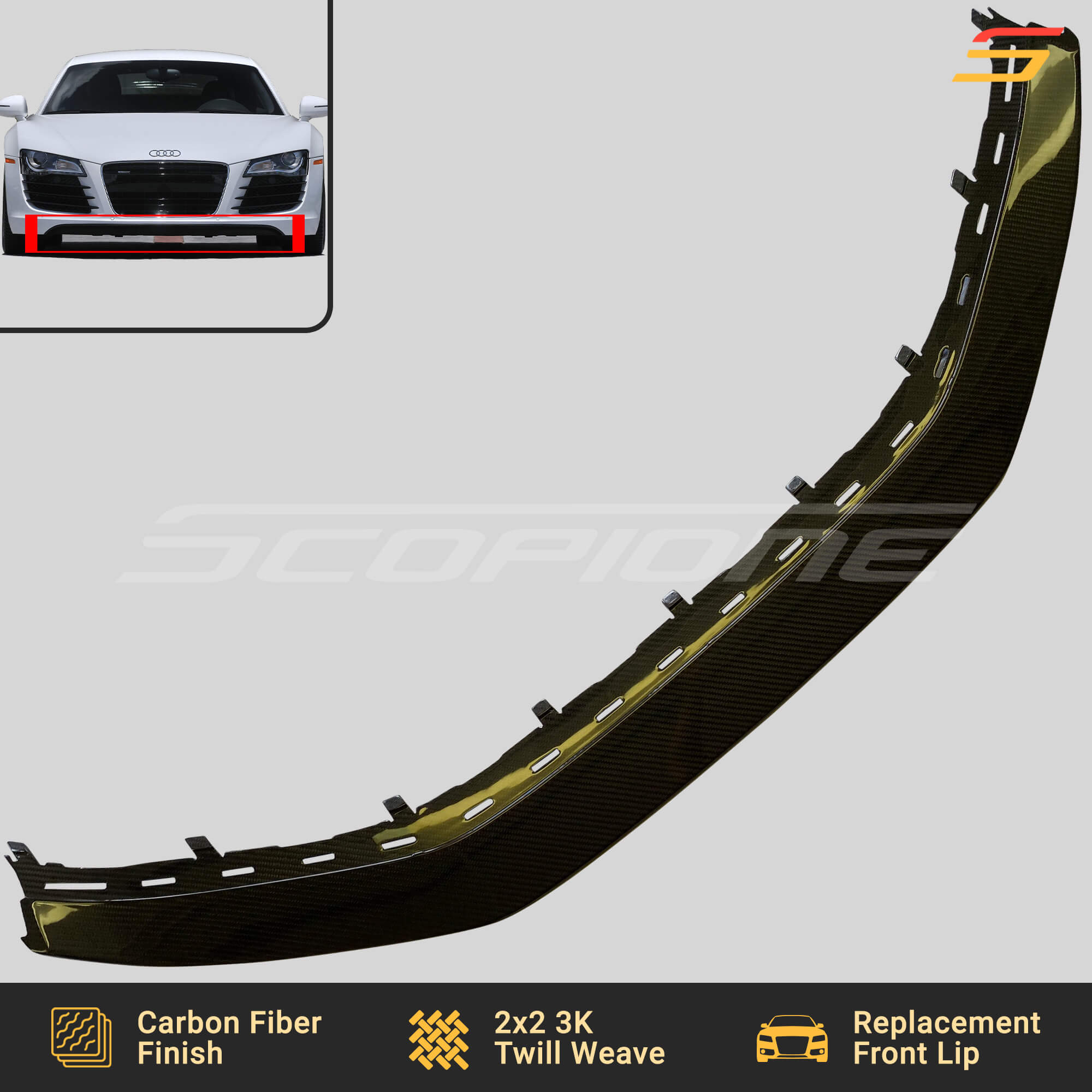
- Front Lip Spoiler – Carbon-fiber front lip for 2008–2015 V8 and V10 models (Coupe and Spyder). Extends the lower bumper line.
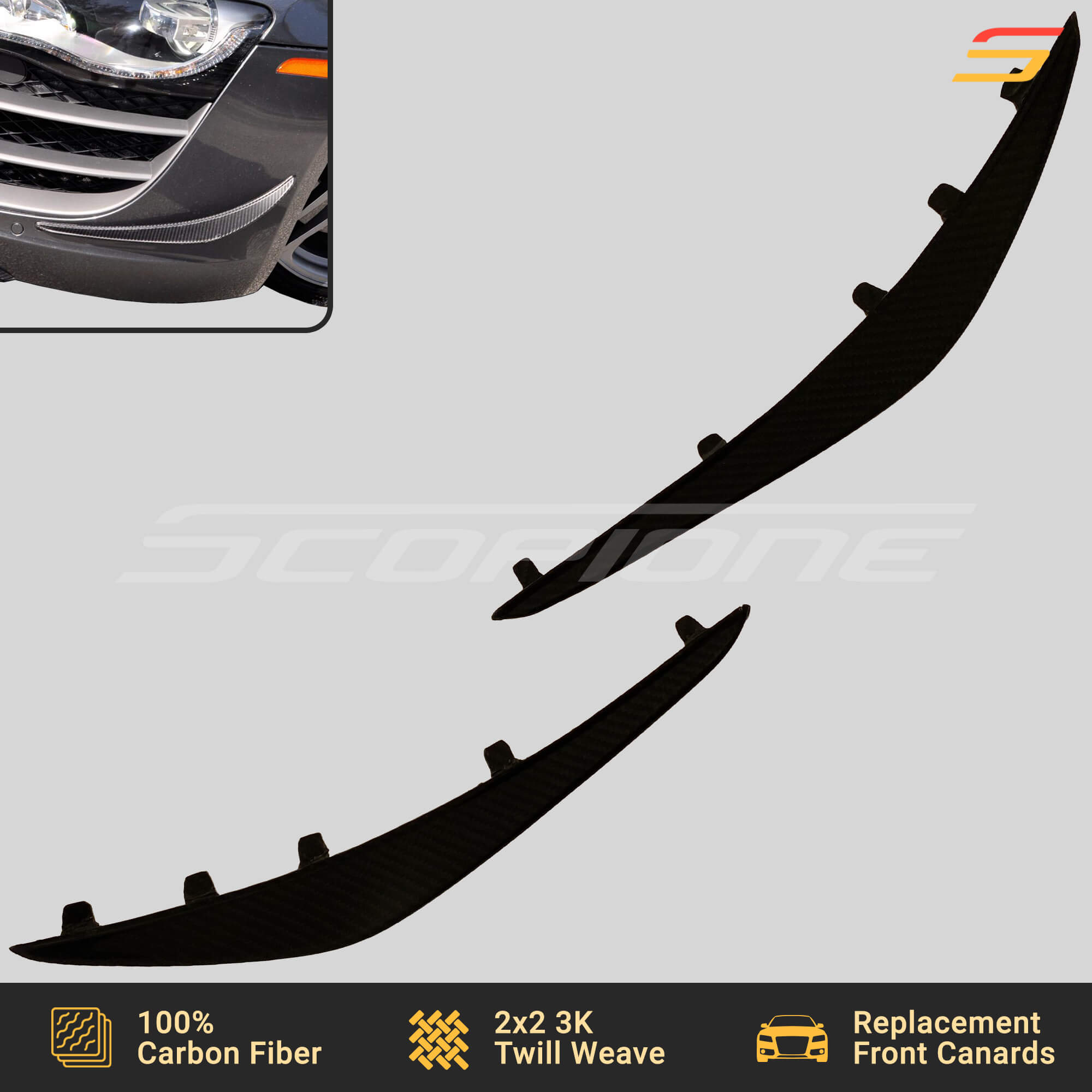
- Front Splitters / Canards – Directional aero elements on the front corners with visible 2×2 twill weave under clear coat.
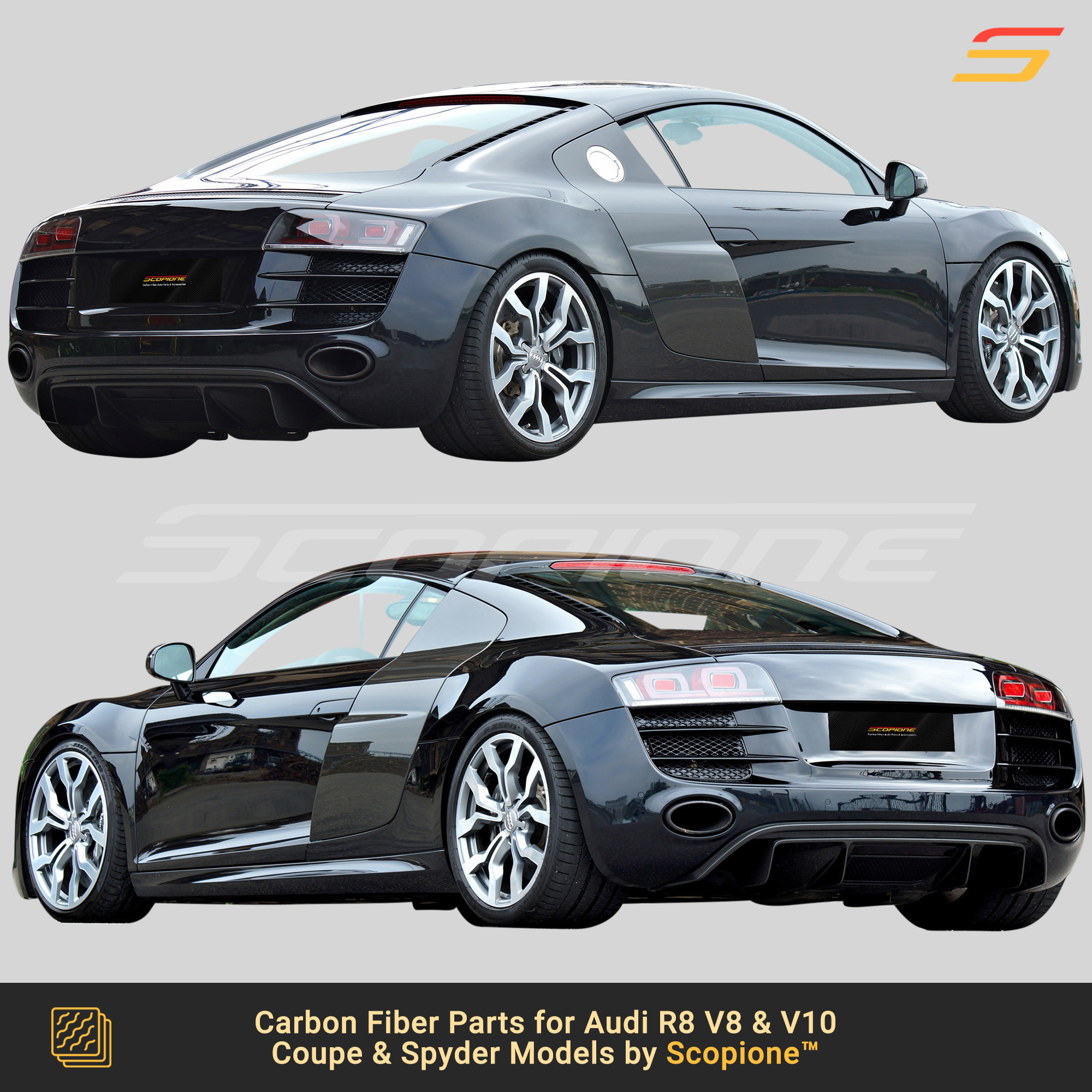
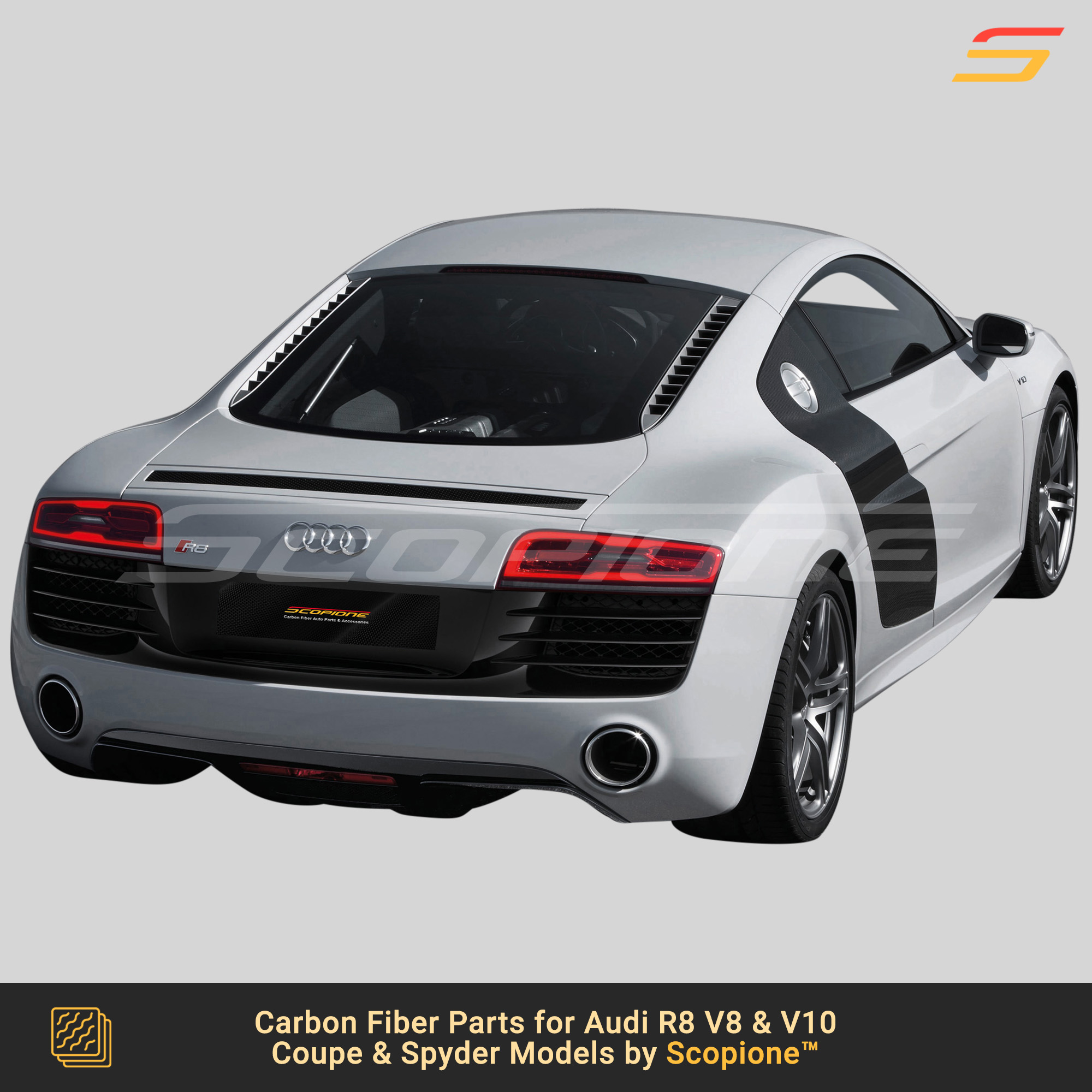
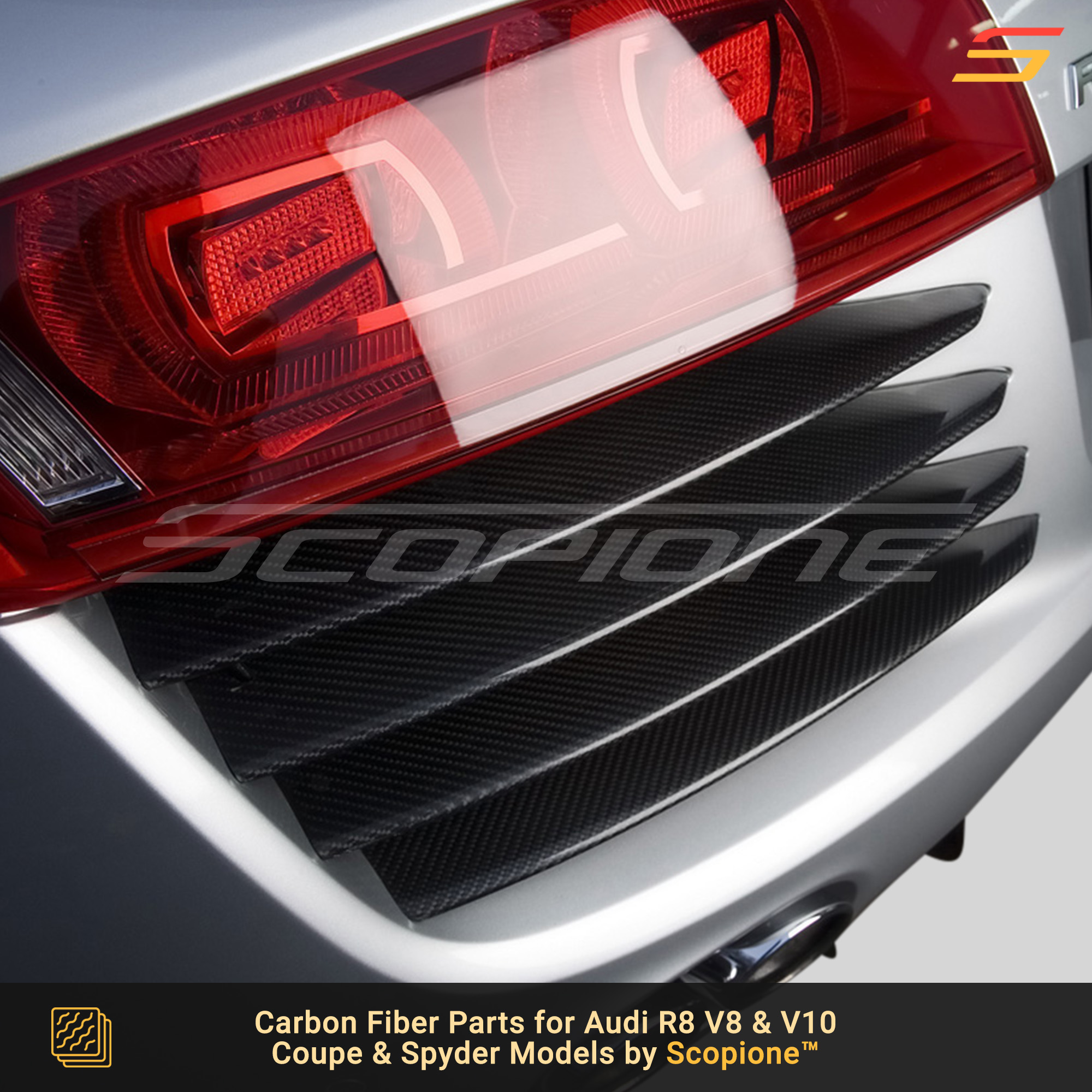
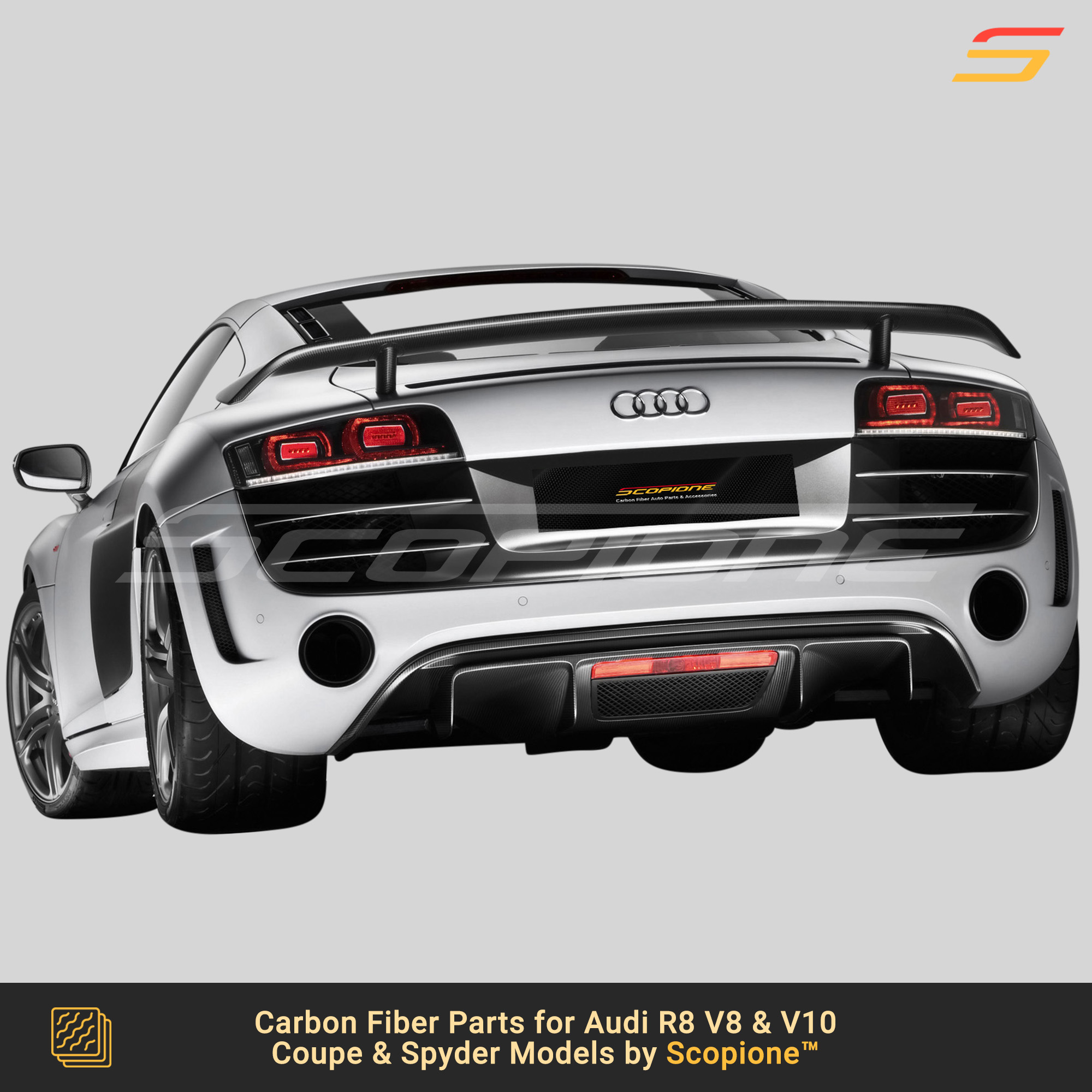
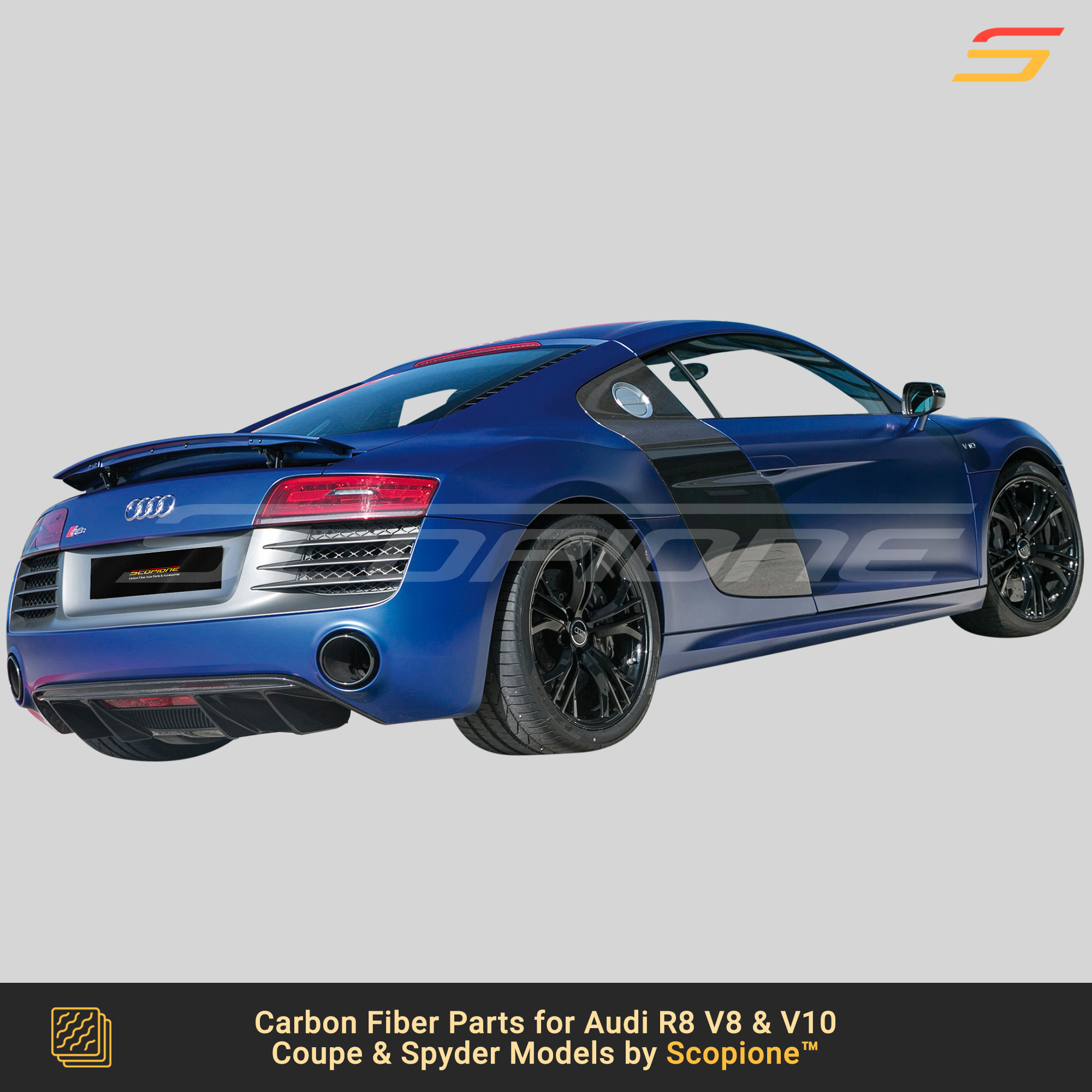
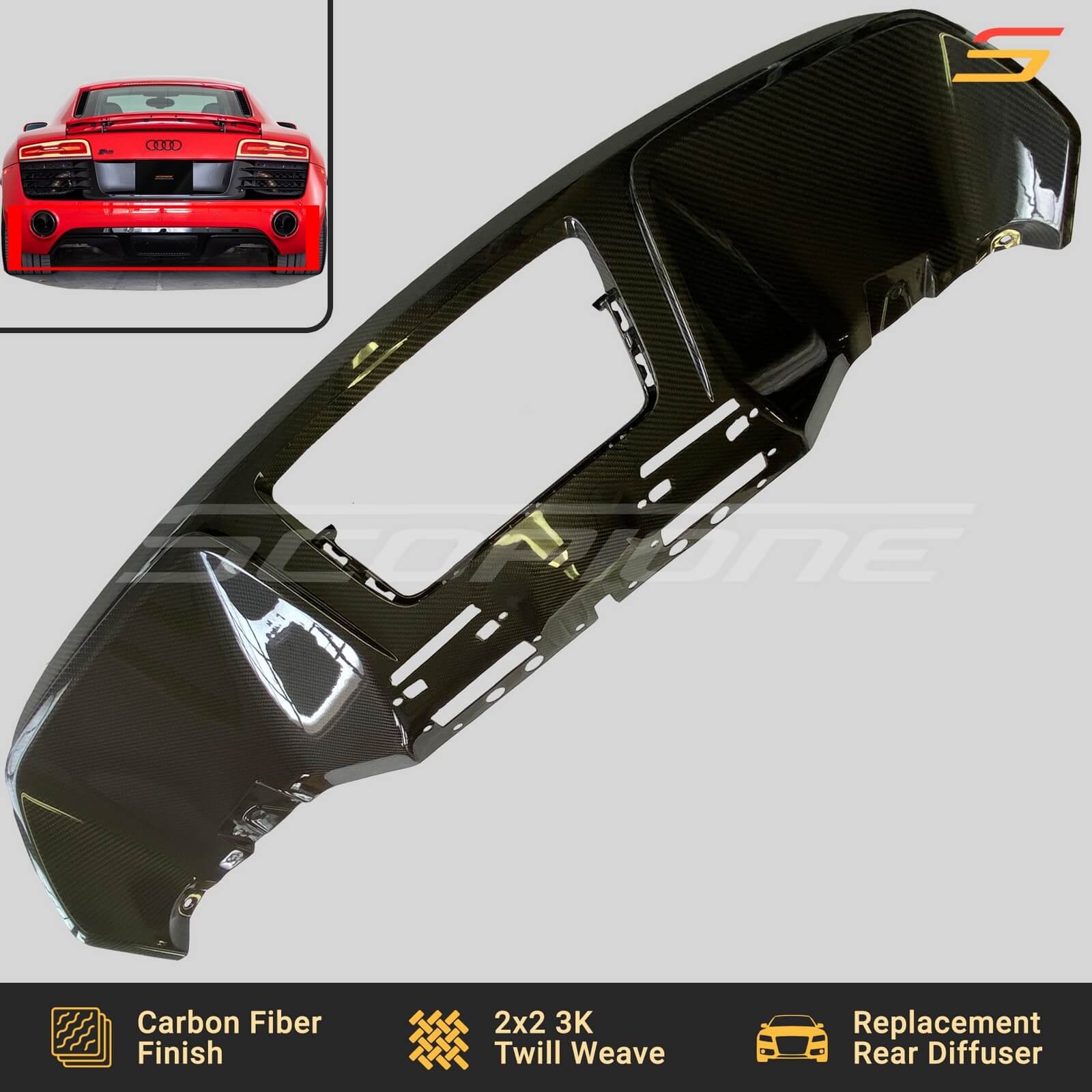
- Rear bumper diffuser in carbon fiber – three fitments: V10 GT 5.2L, V8 4.2L, and 2014–2015 facelift. Each replaces the factory panel.
- Door Sill Steps (Type 4S) – Carbon-fiber sill covers for 2016–2023 R8. Visible weave texture at every entry and exit.
All exterior carbon fiber components are listed on the Scopione Audi R8 shop page with fitment data per model year.
2. Engine Bay & Performance Components
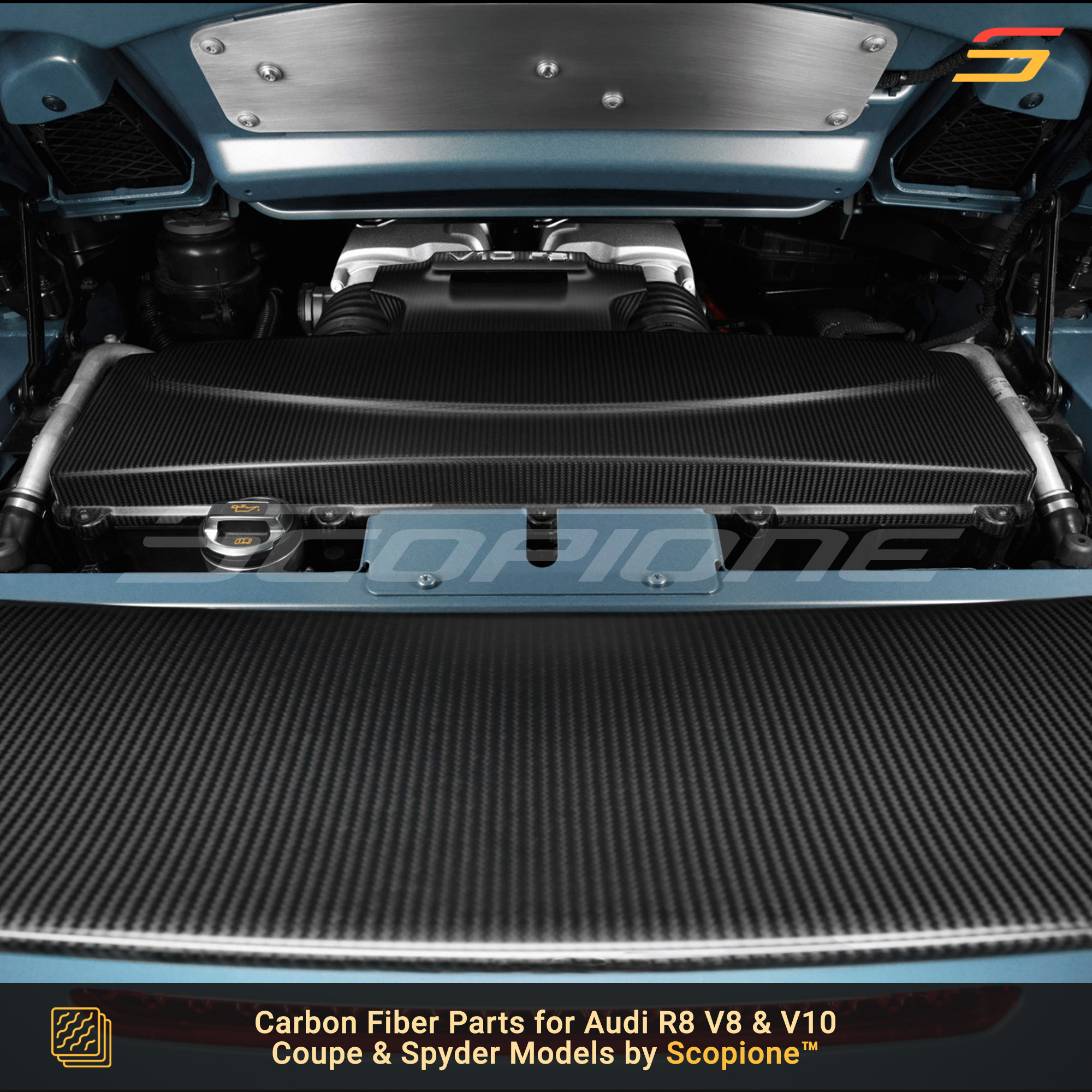
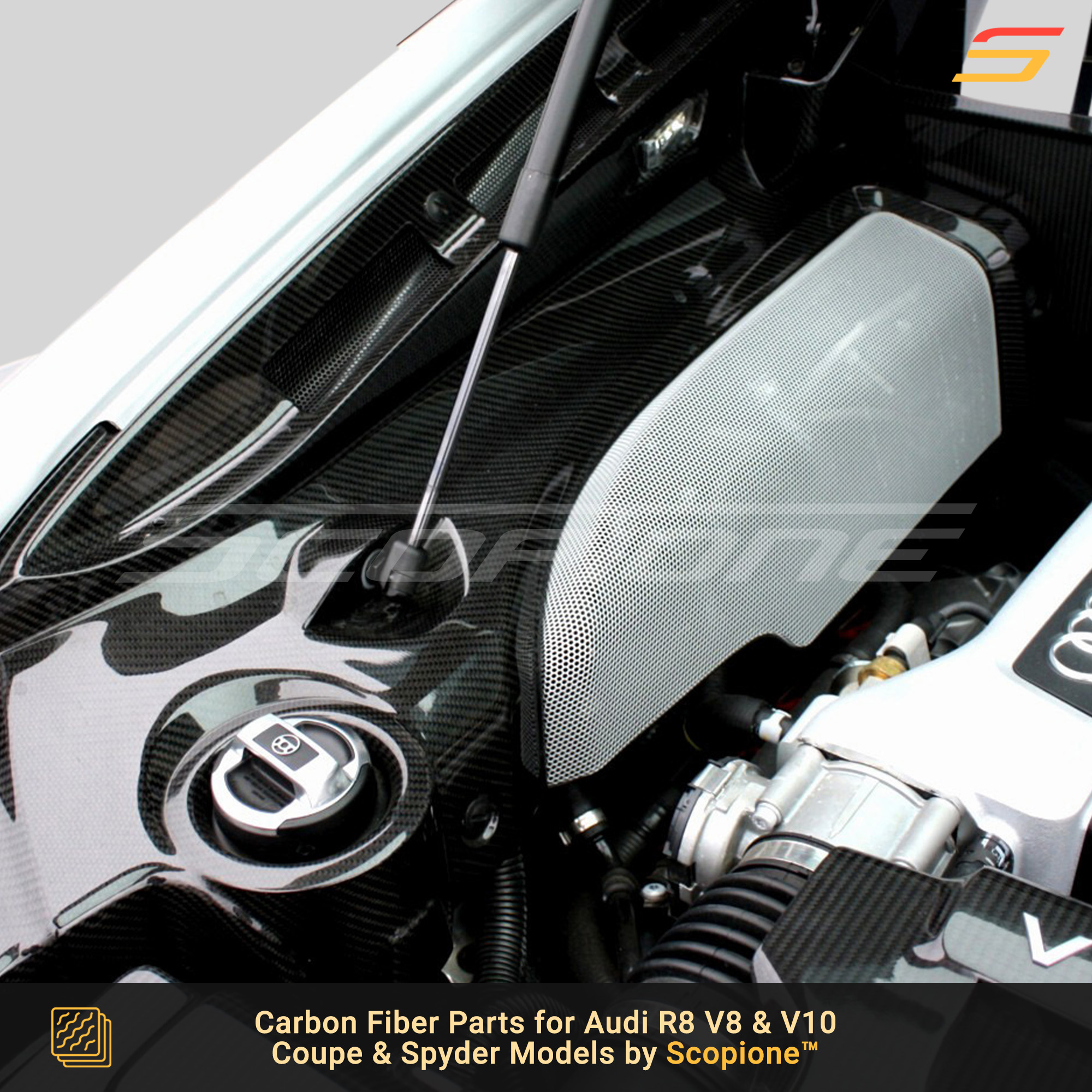
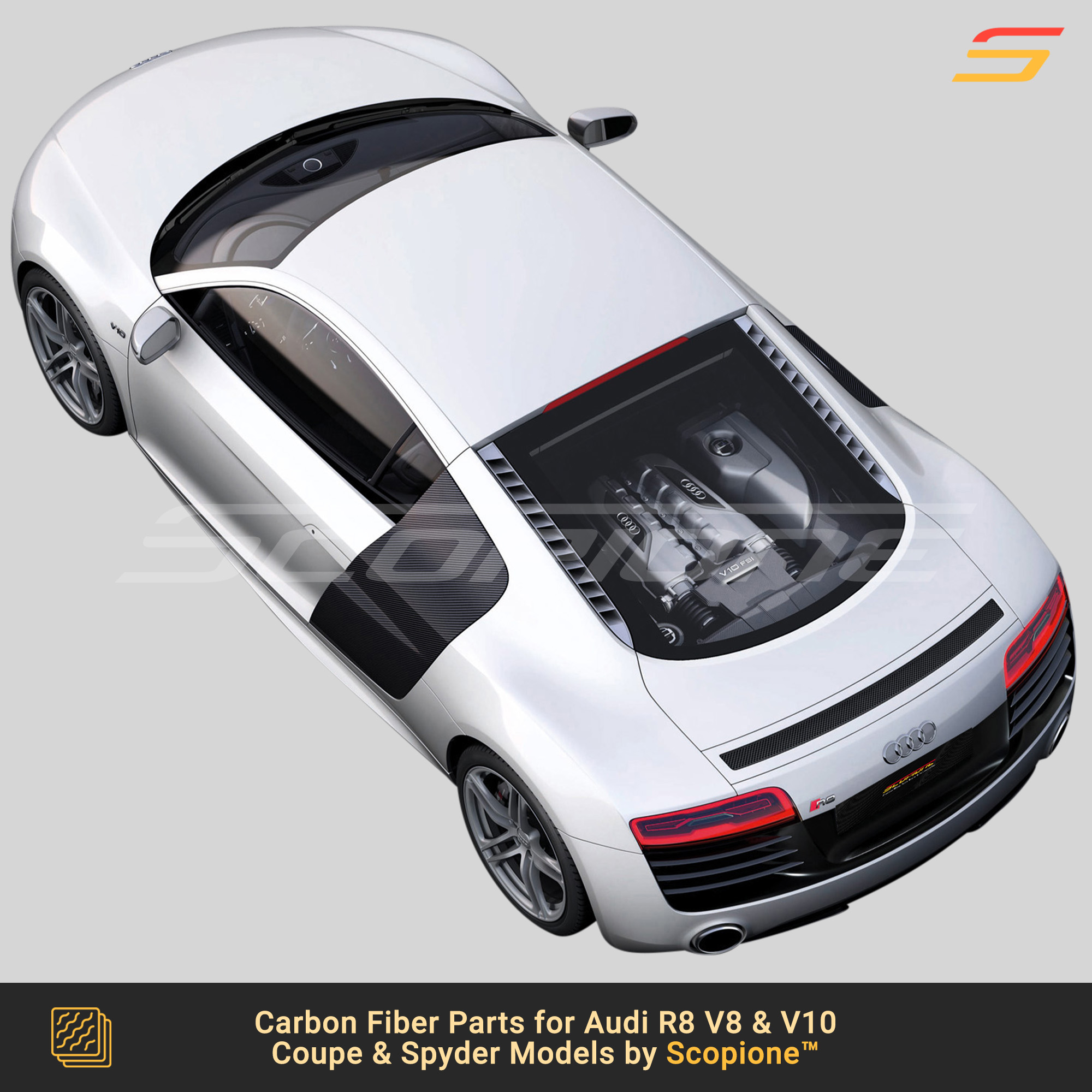
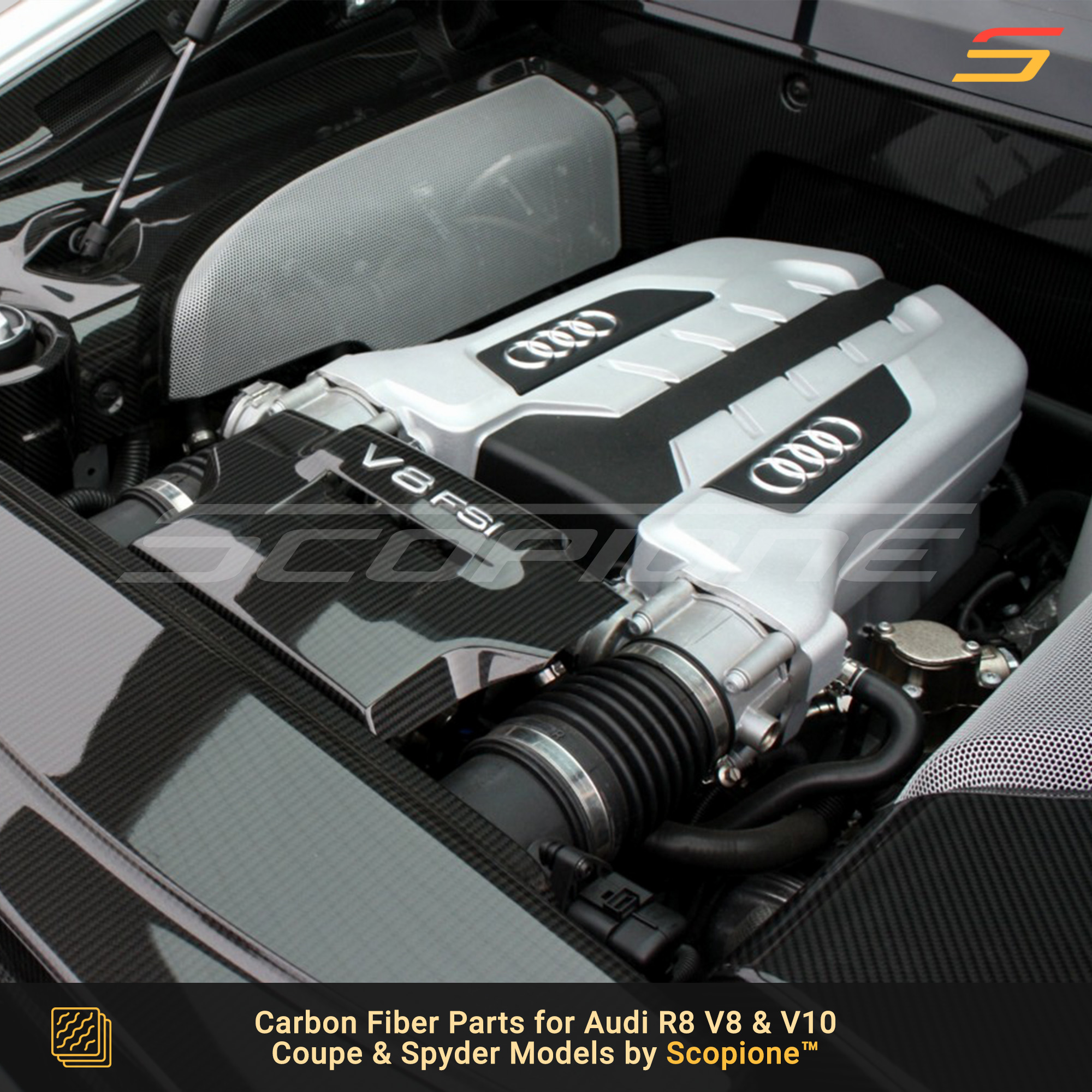
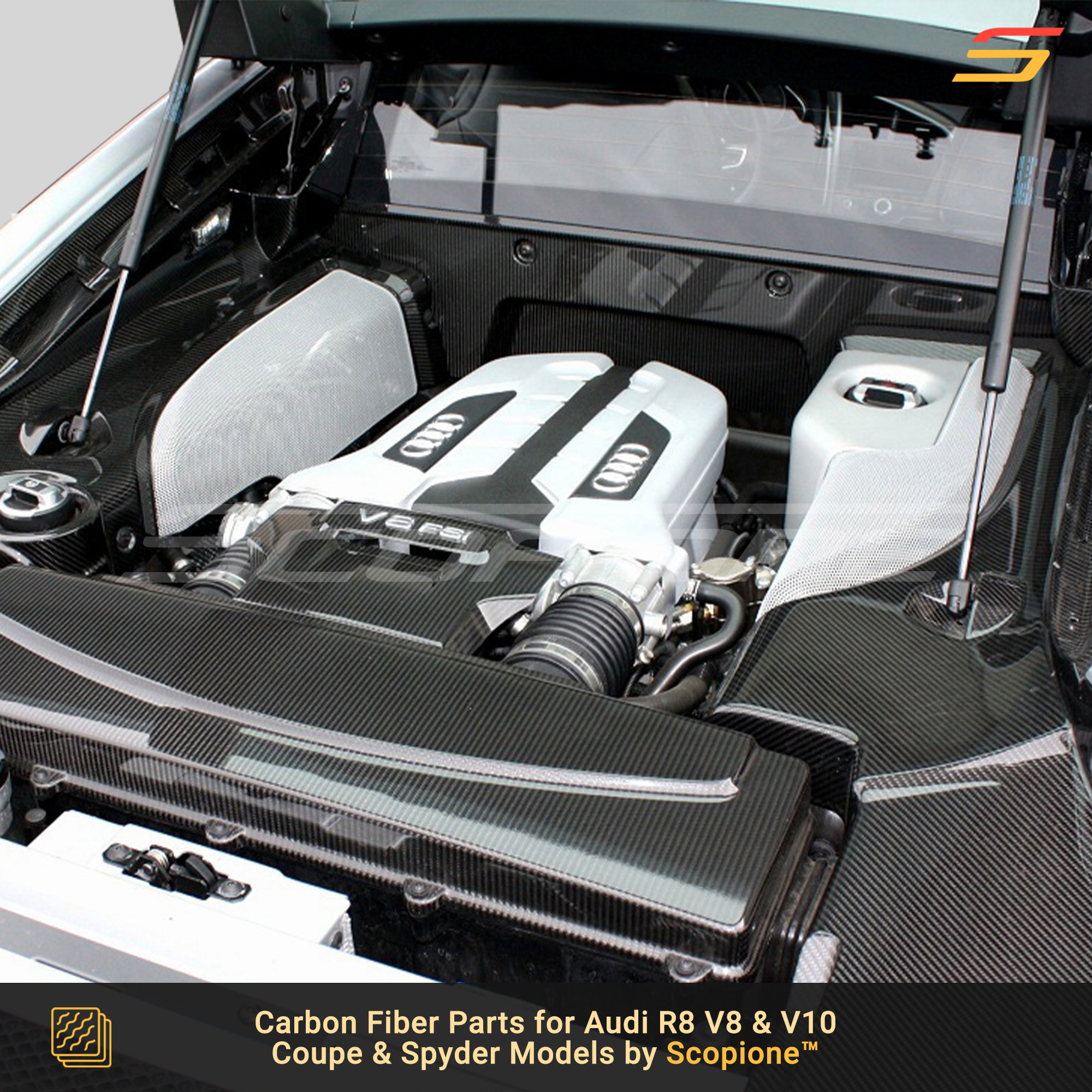
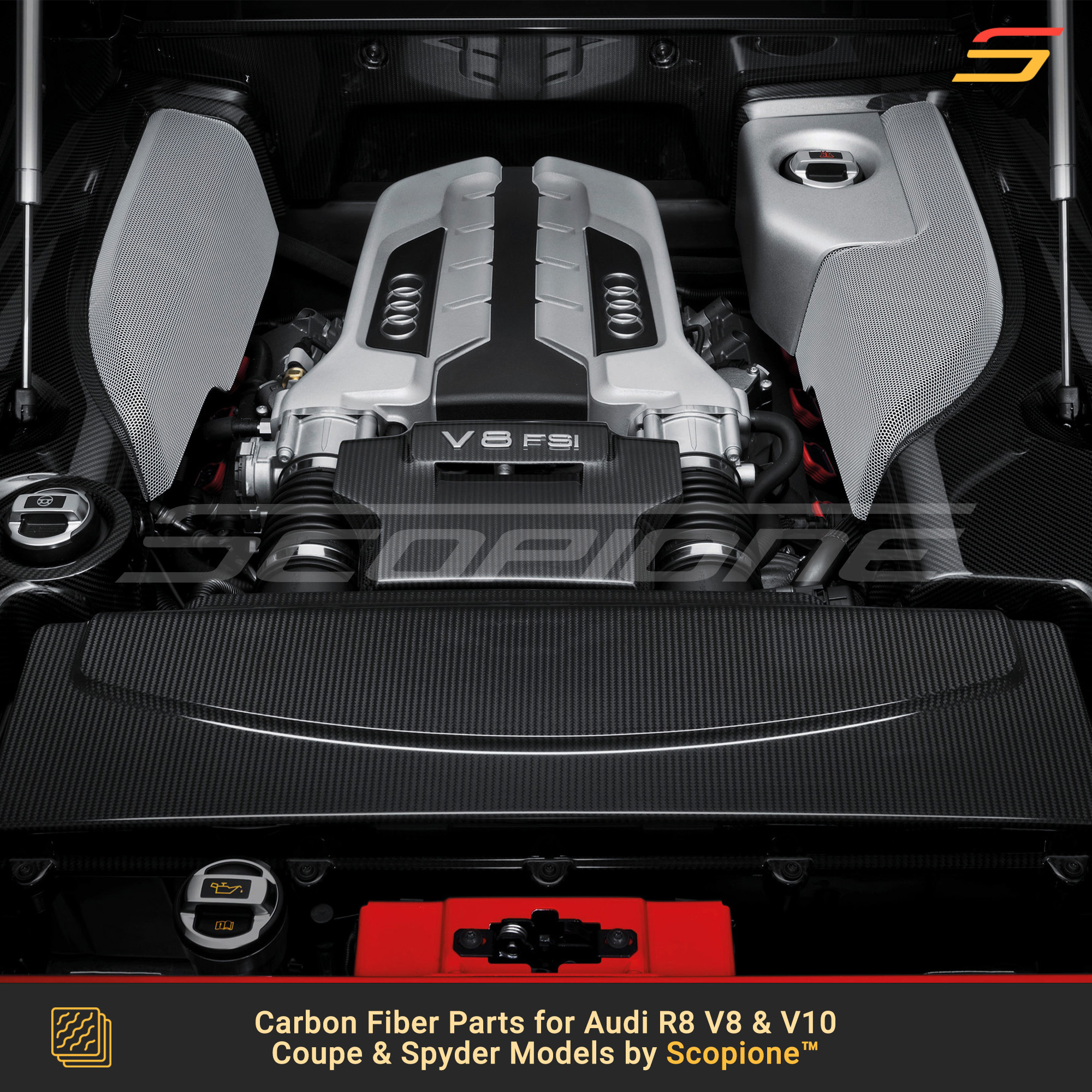
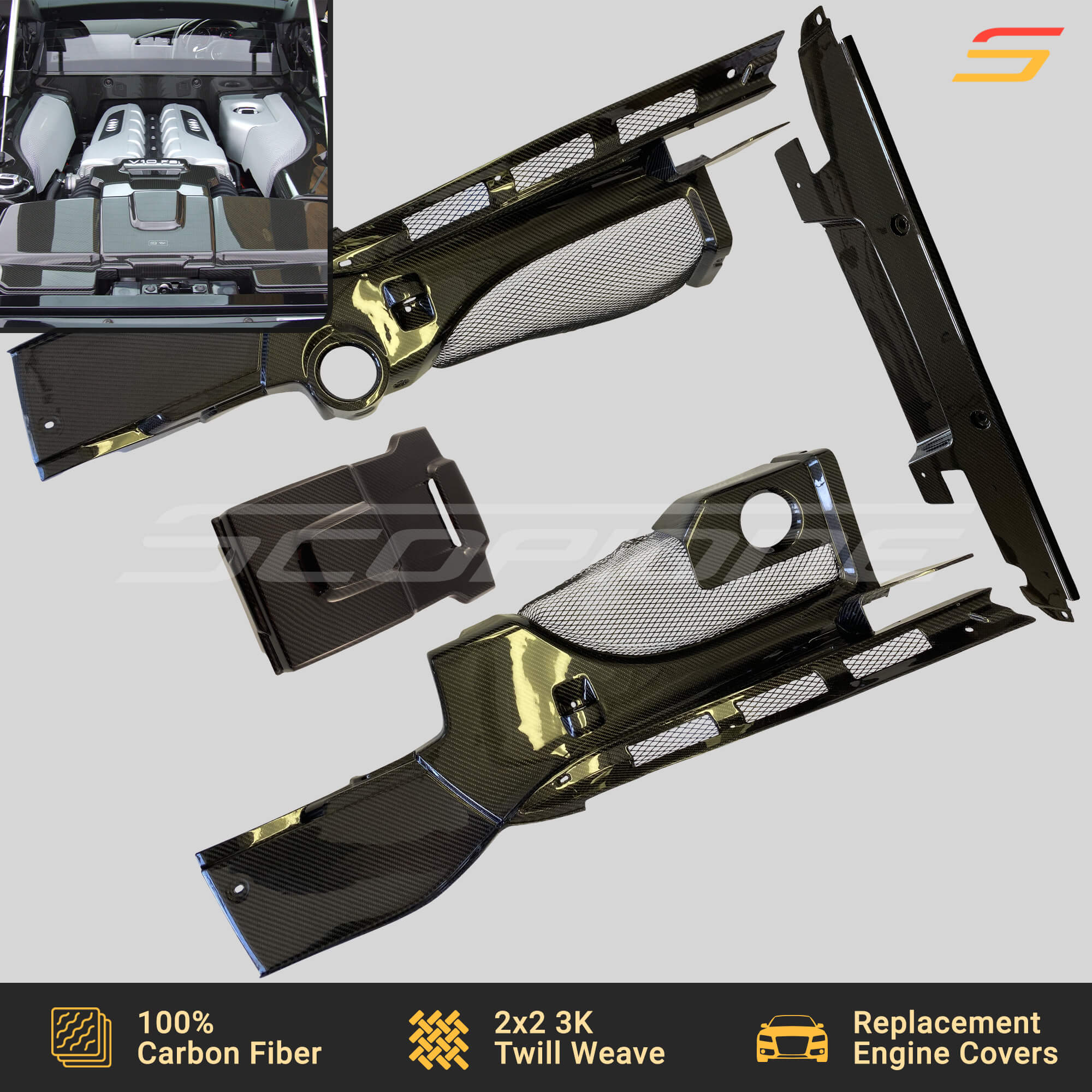
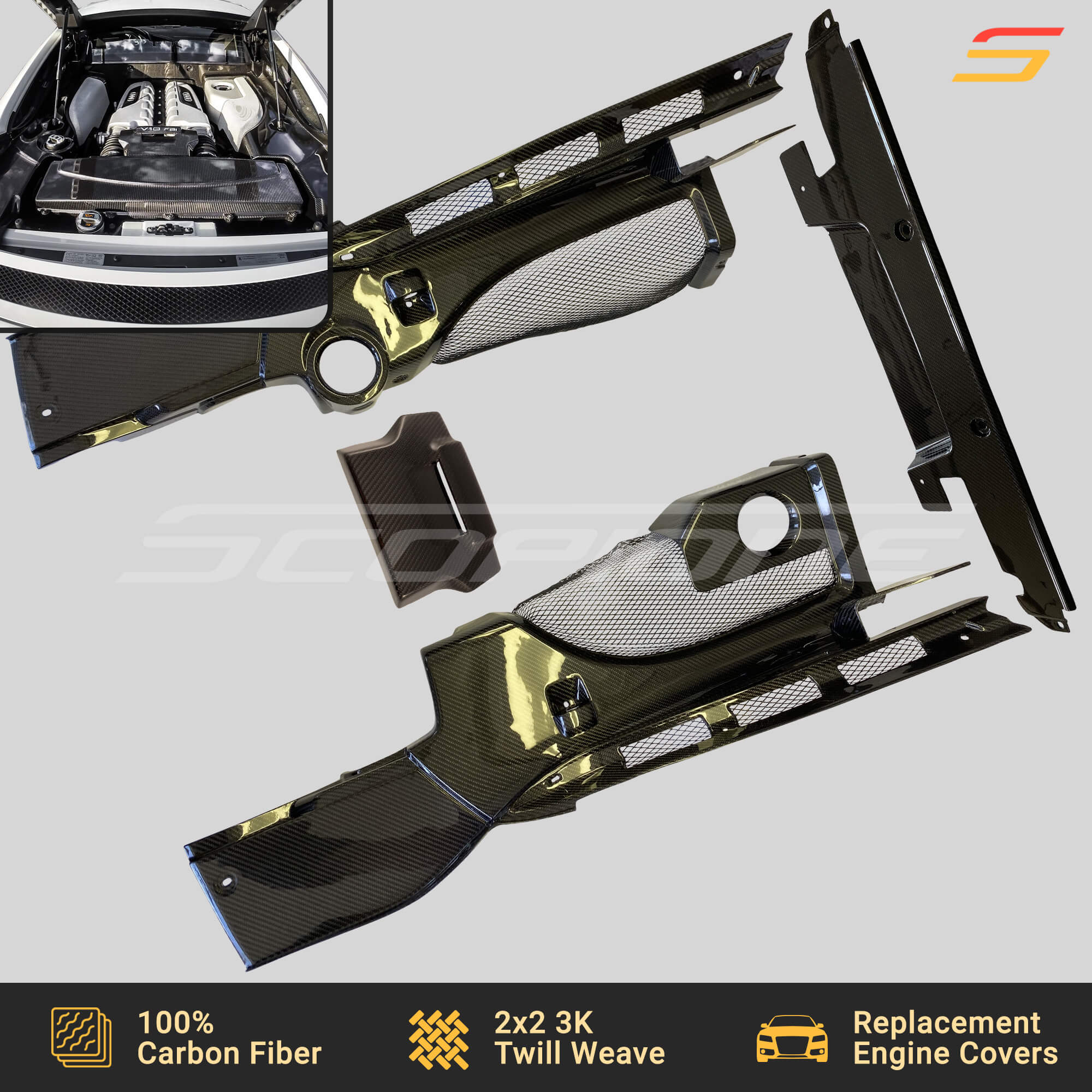
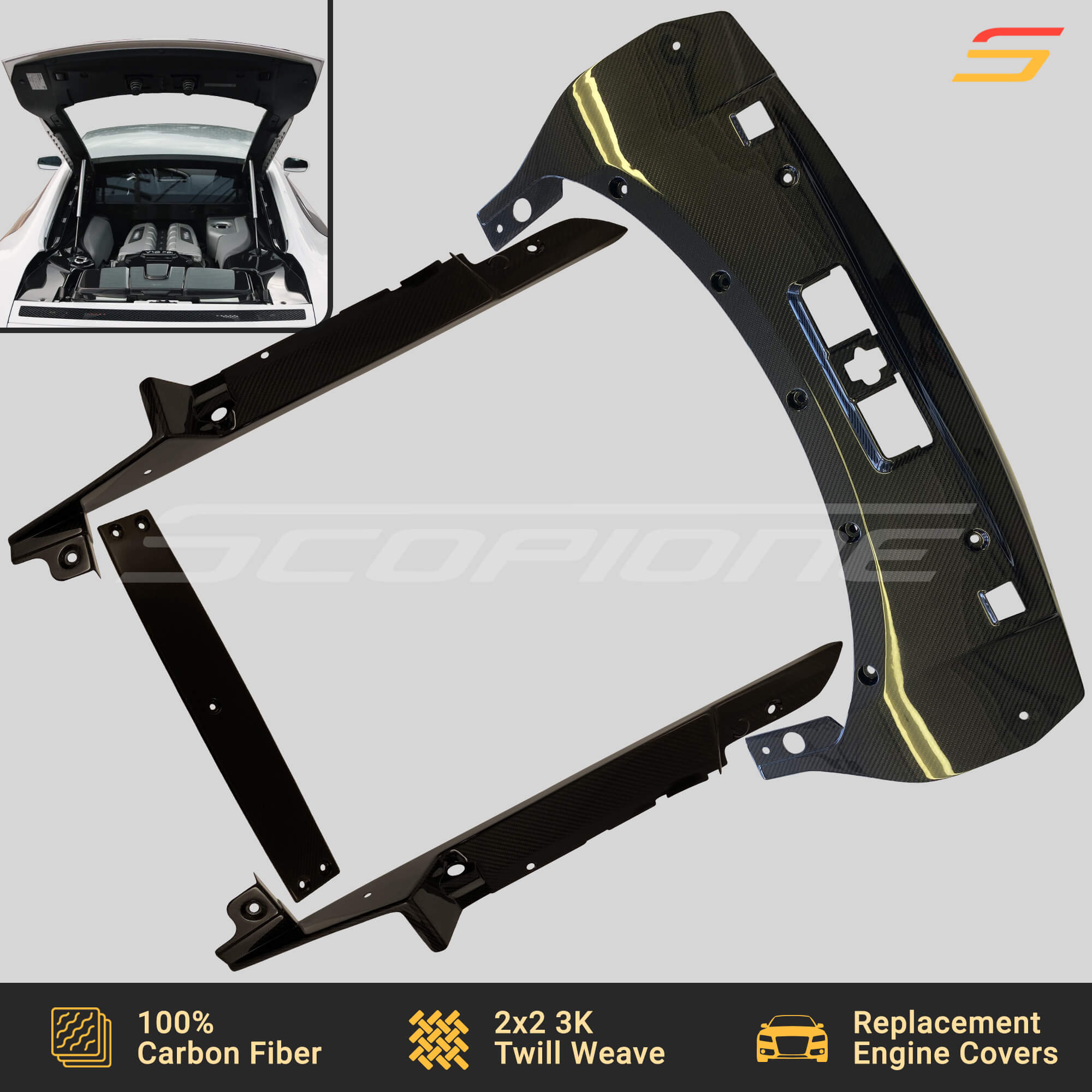
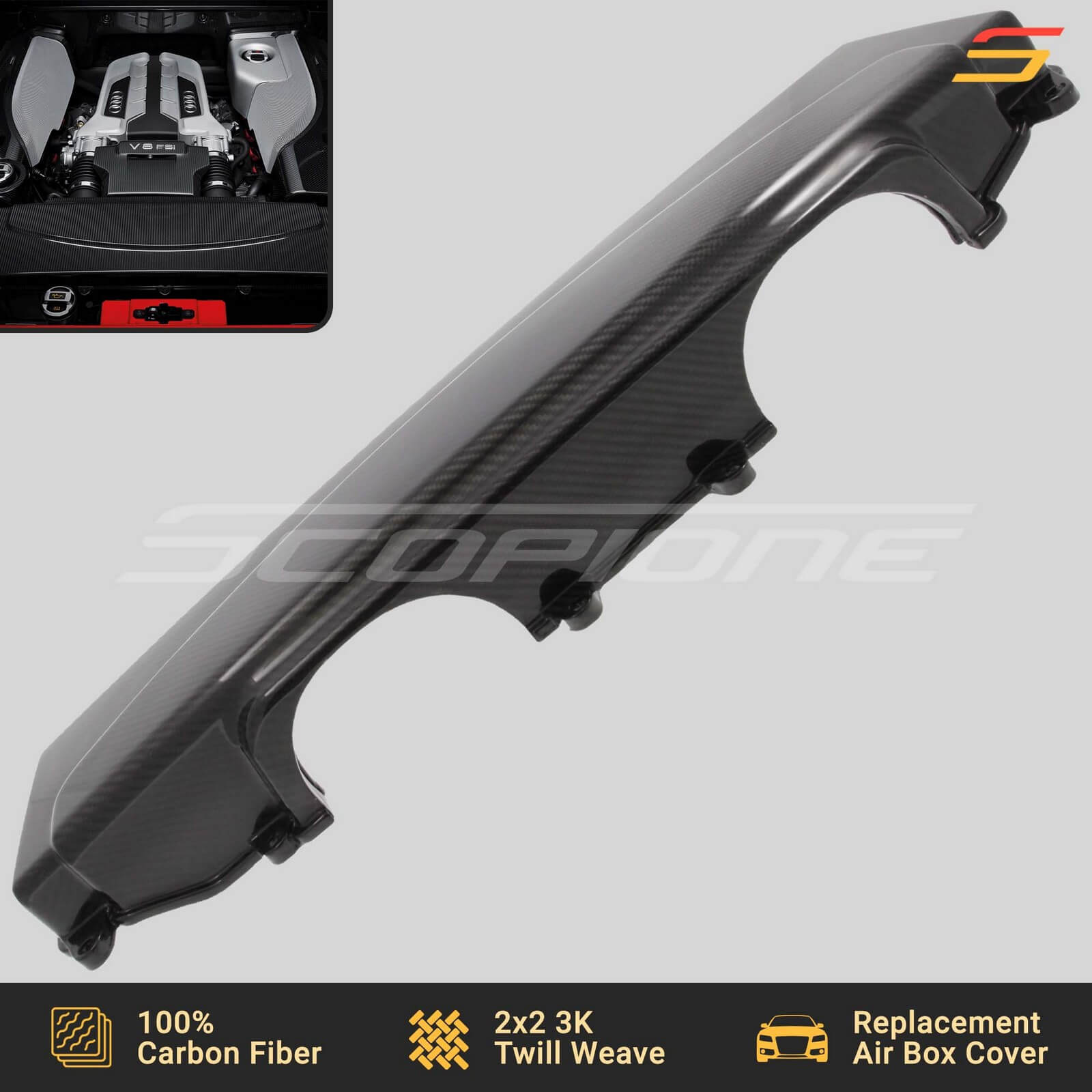
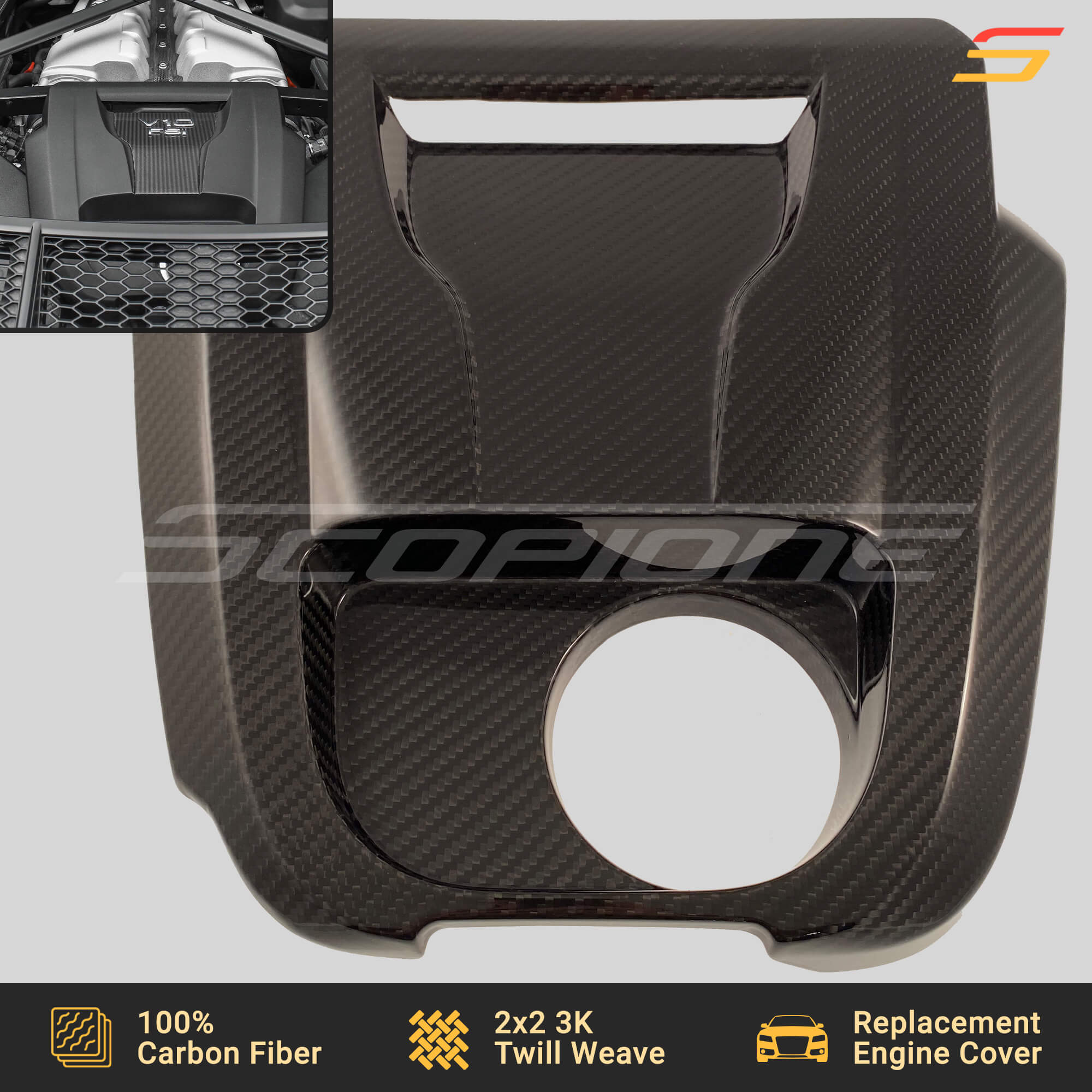
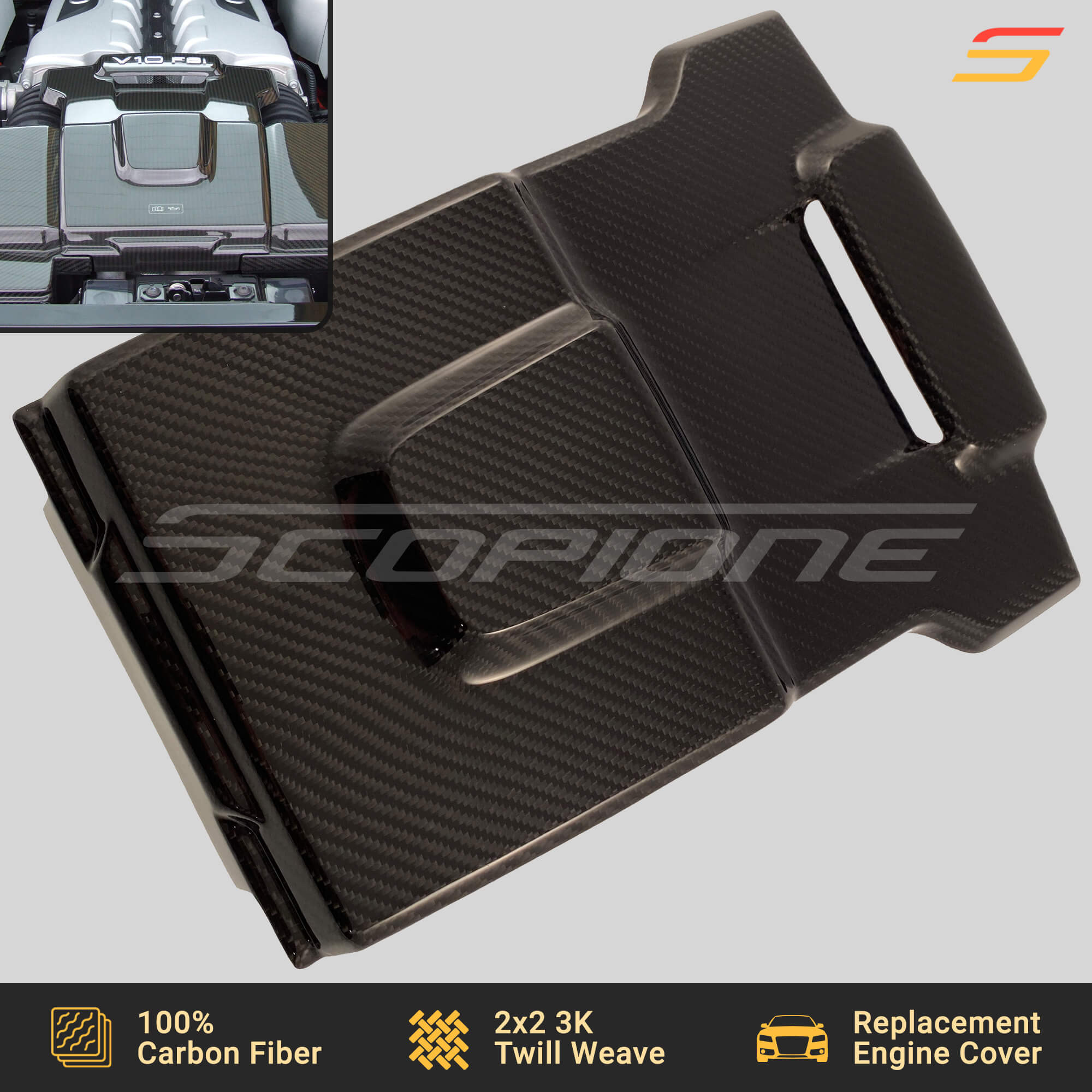
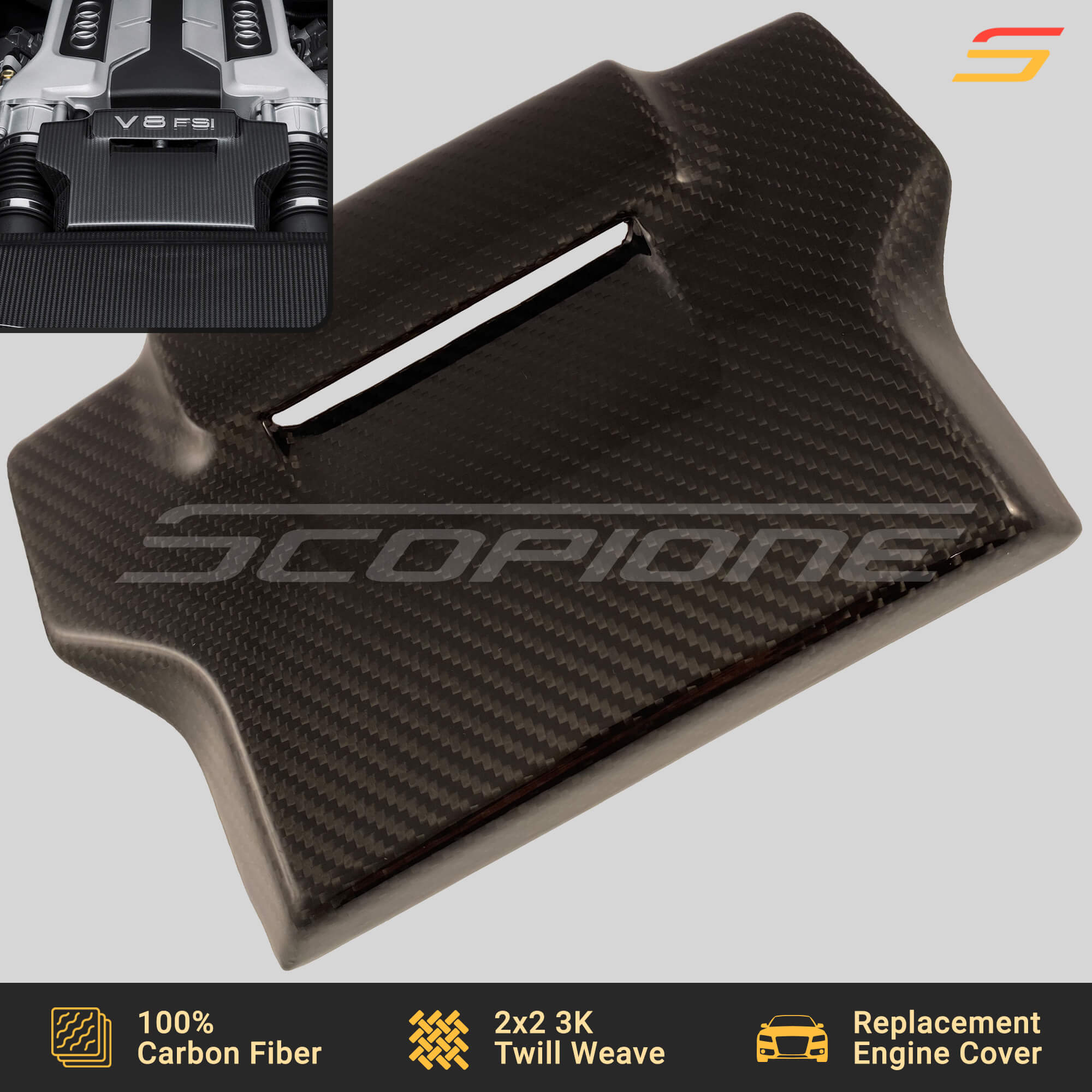
- Engine Bay Covers Kit – The first R8 carbon fiber upgrade other drivers notice. Full multi-piece kit replaces factory engine bay covers in clear-coated 2×2 twill weave. Separate kits for Type 42 pre-facelift (2008–2012), Type 42 facelift (2014–2015), and Type 4S (2016–2023).
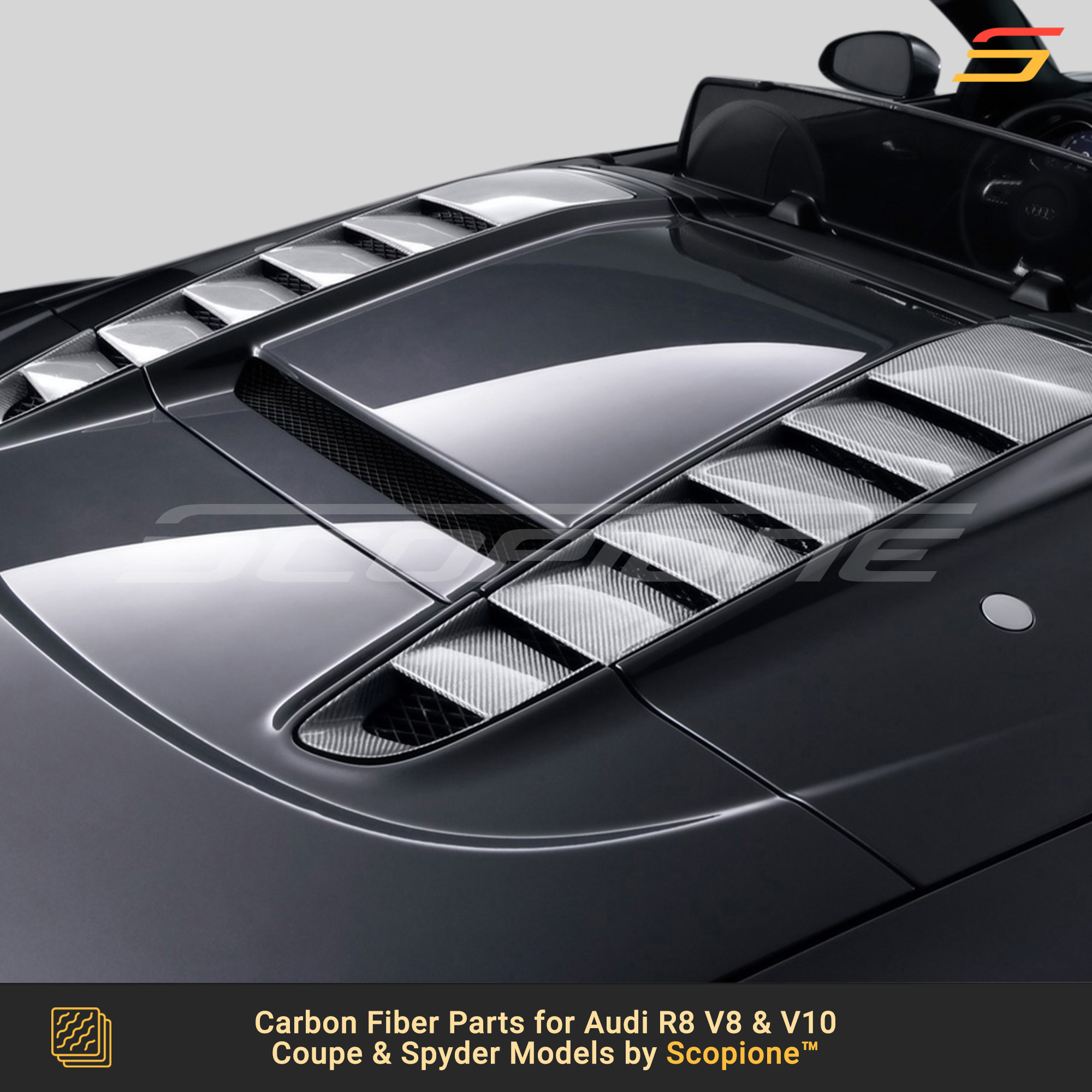
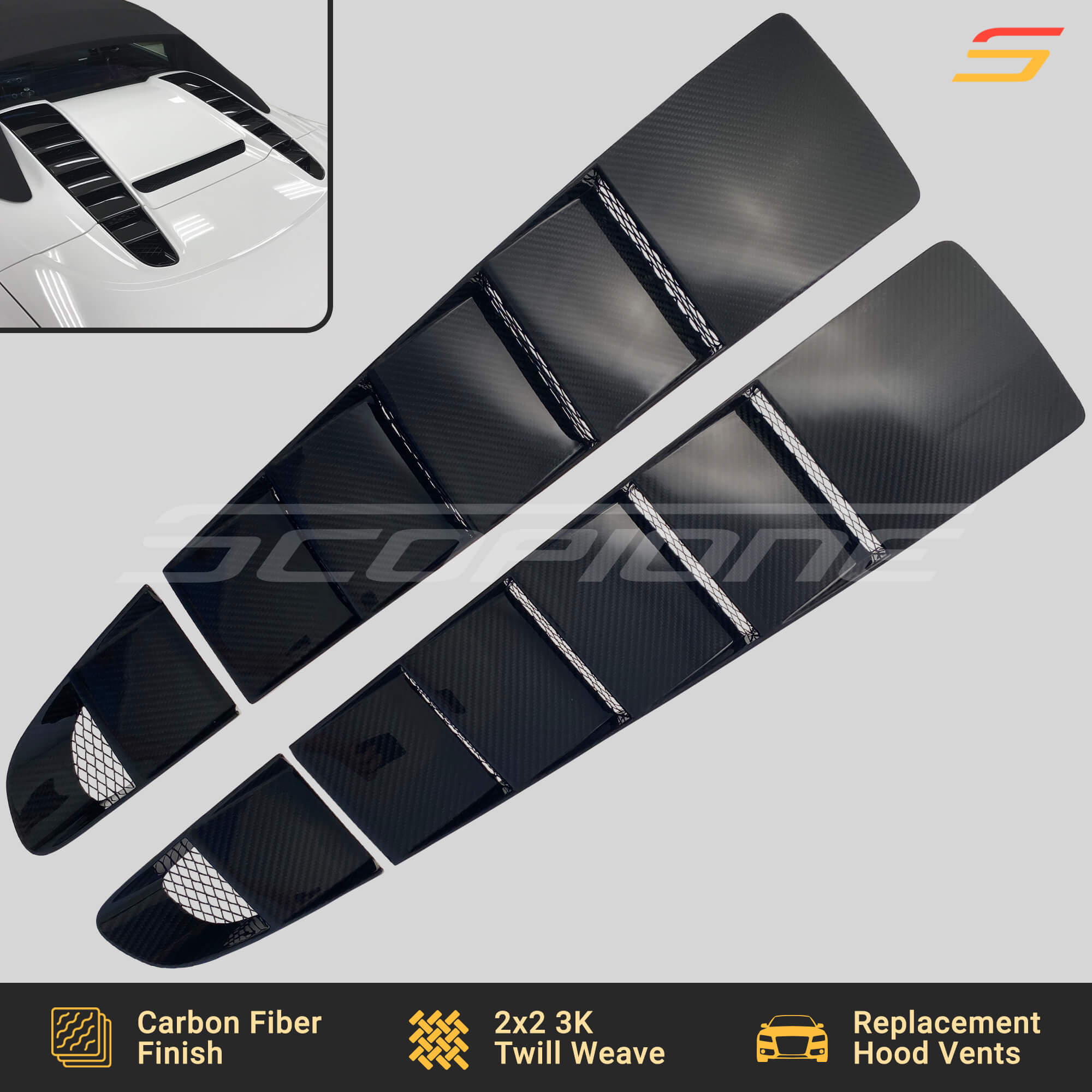
- Engine hatch hood lid covers – carbon fiber overlays for the rear engine lid. Available as a complete kit or individual center and side pieces for the Type 42.
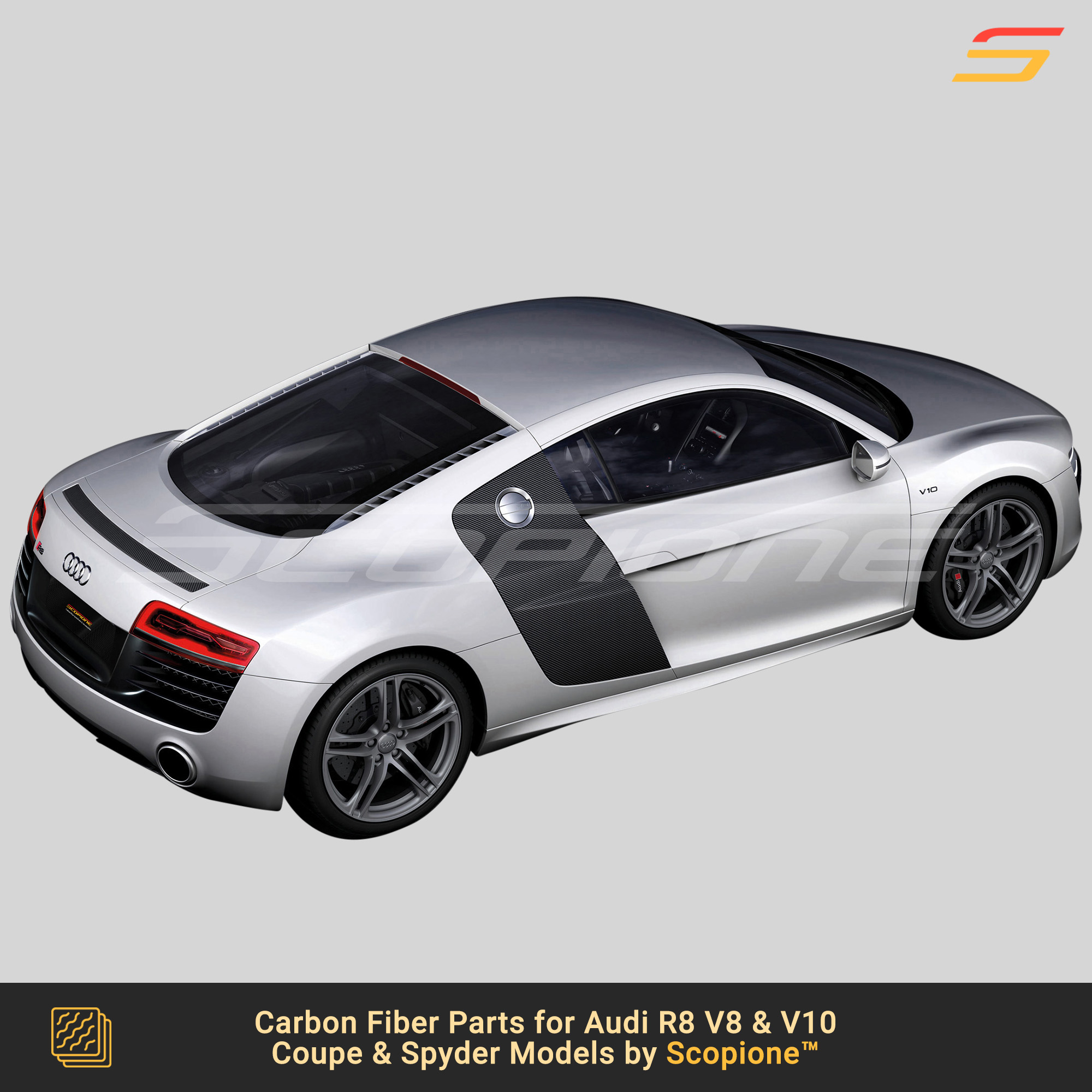
- Side Engine Covers – Flanking panels that frame the V10 in visible carbon fiber. Available for both Type 42 and Type 4S.
- Firewall engine cover – the rear-most panel in the engine bay, completing the full CF engine bay treatment. Both generations covered.
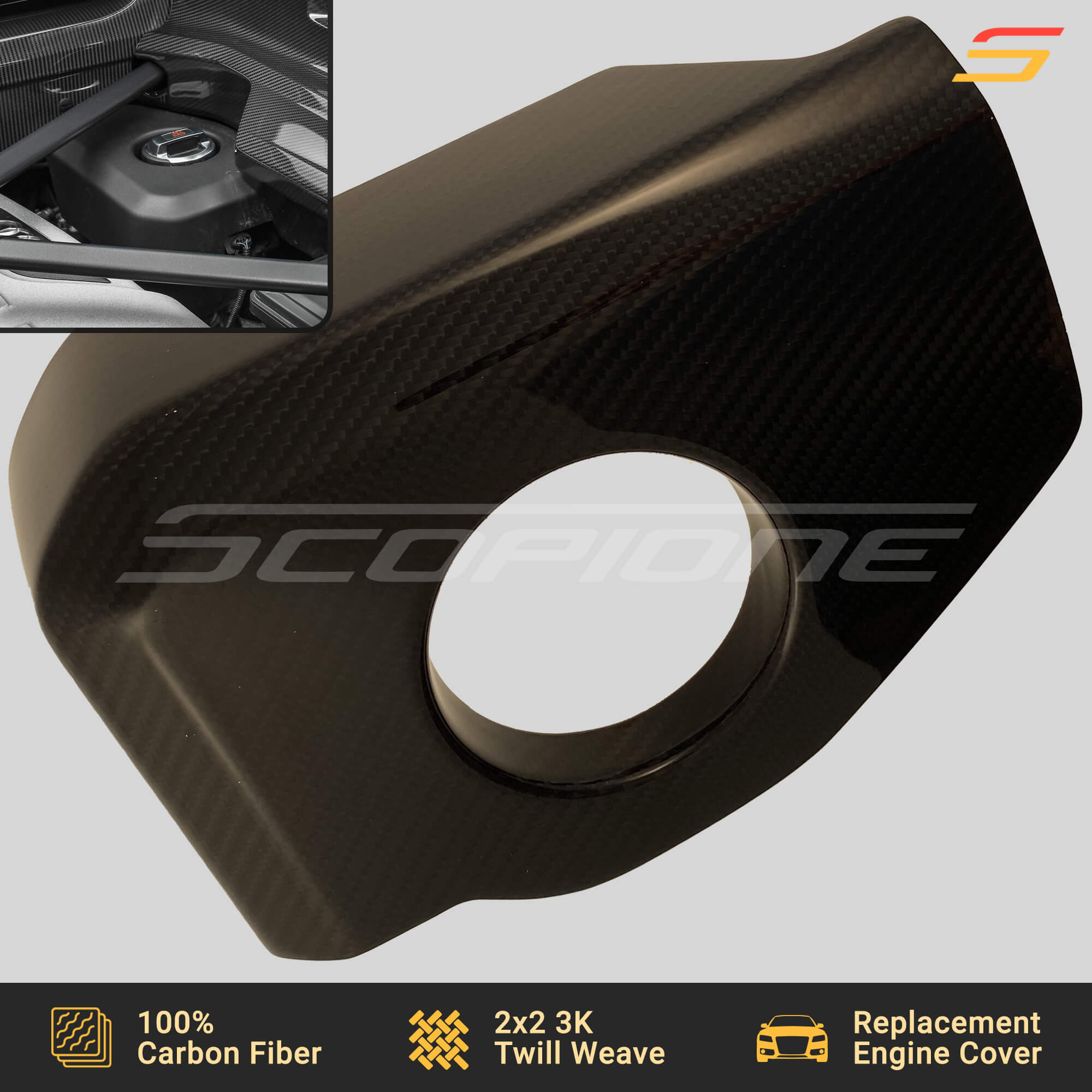
- Intake Covers, Oil Cap Cover, Coolant Cap Cover – Bolt-on and clip-on CF detail pieces for the Type 4S engine bay.
- Rear engine vent louvers for the R8 Spyder (2011–2015) – carbon-fiber vent lids replacing the factory units on the Spyder rear deck.
Engine bay CF kits and individual covers are available through the Scopione R8 engine bay section.
3. Interior & Factory Carbon
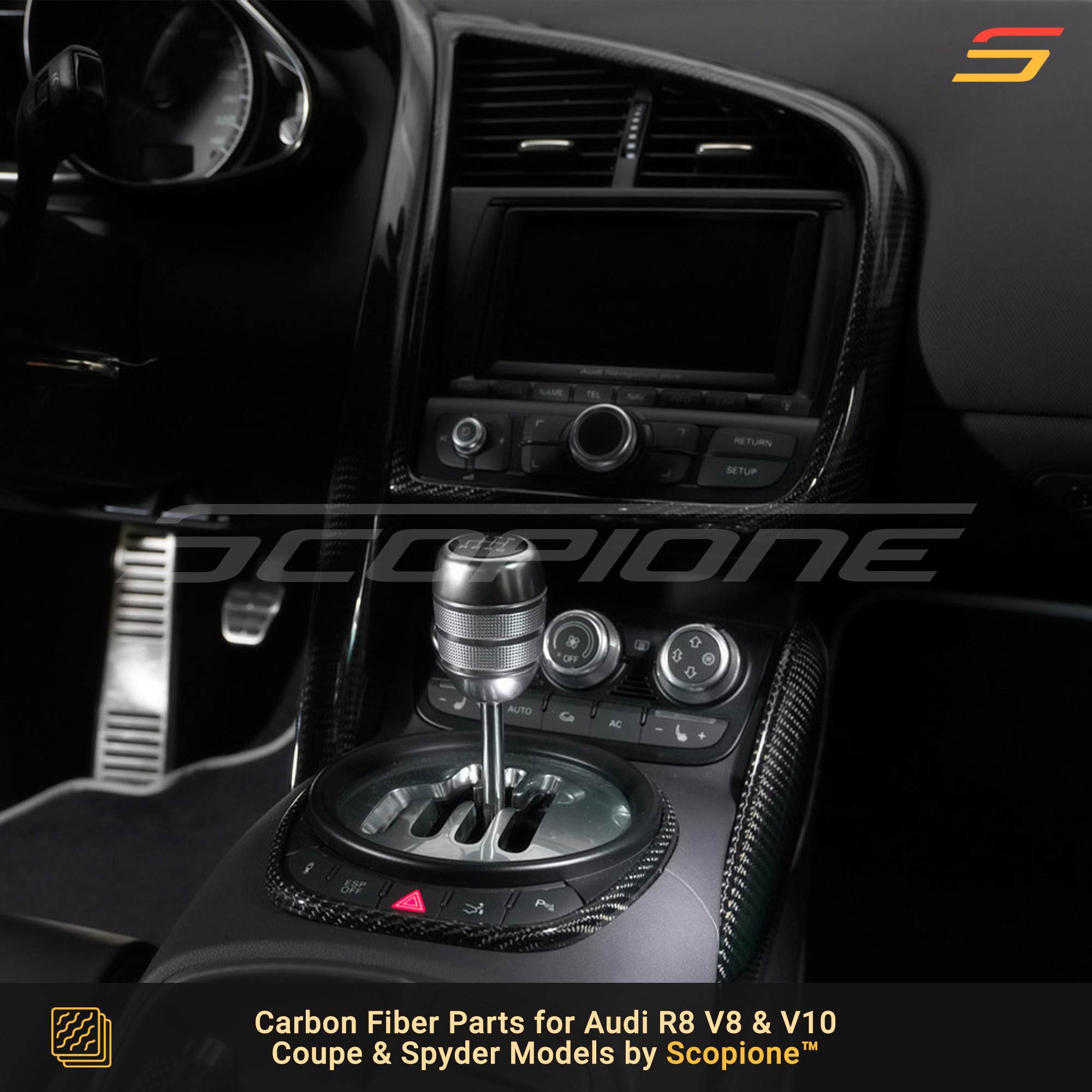
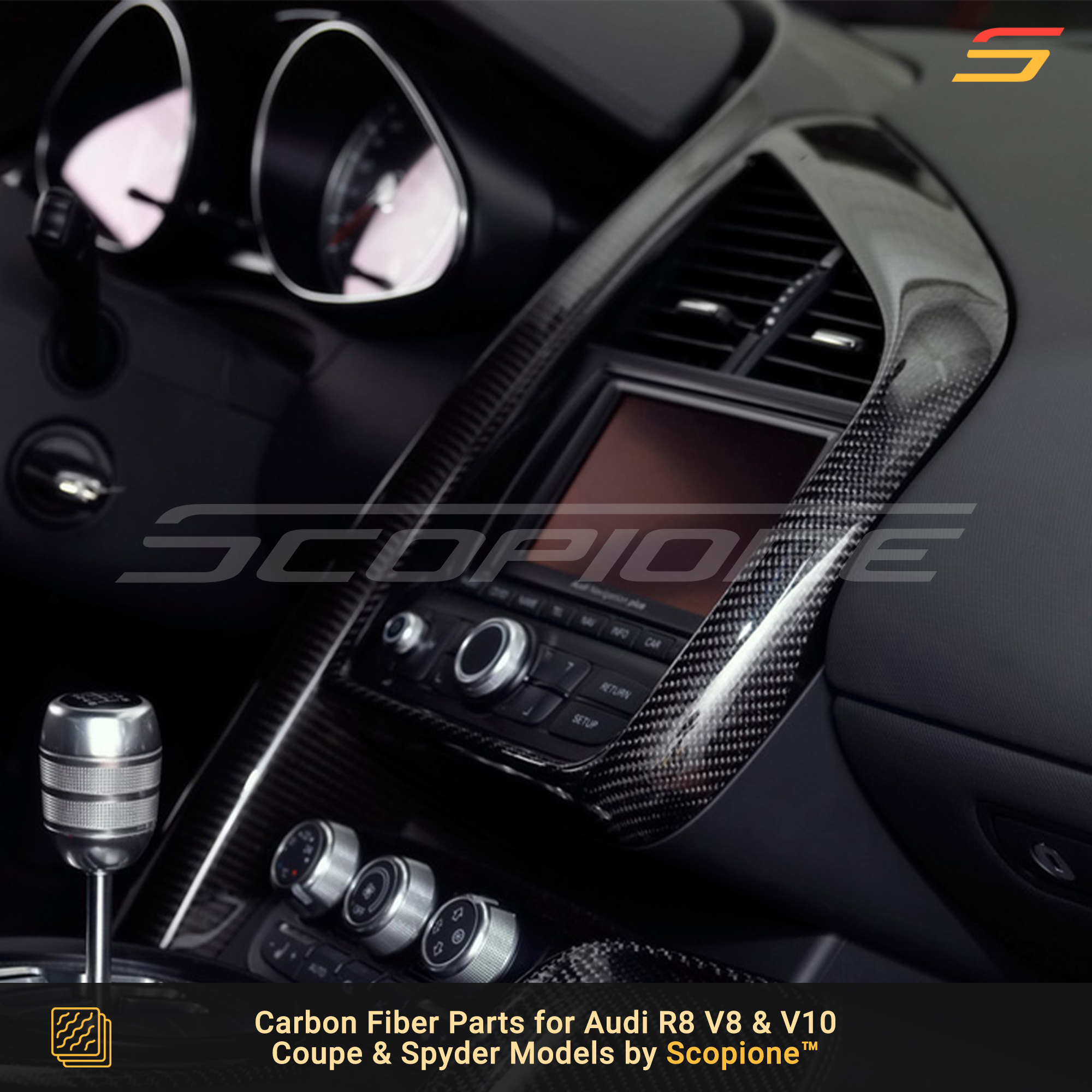
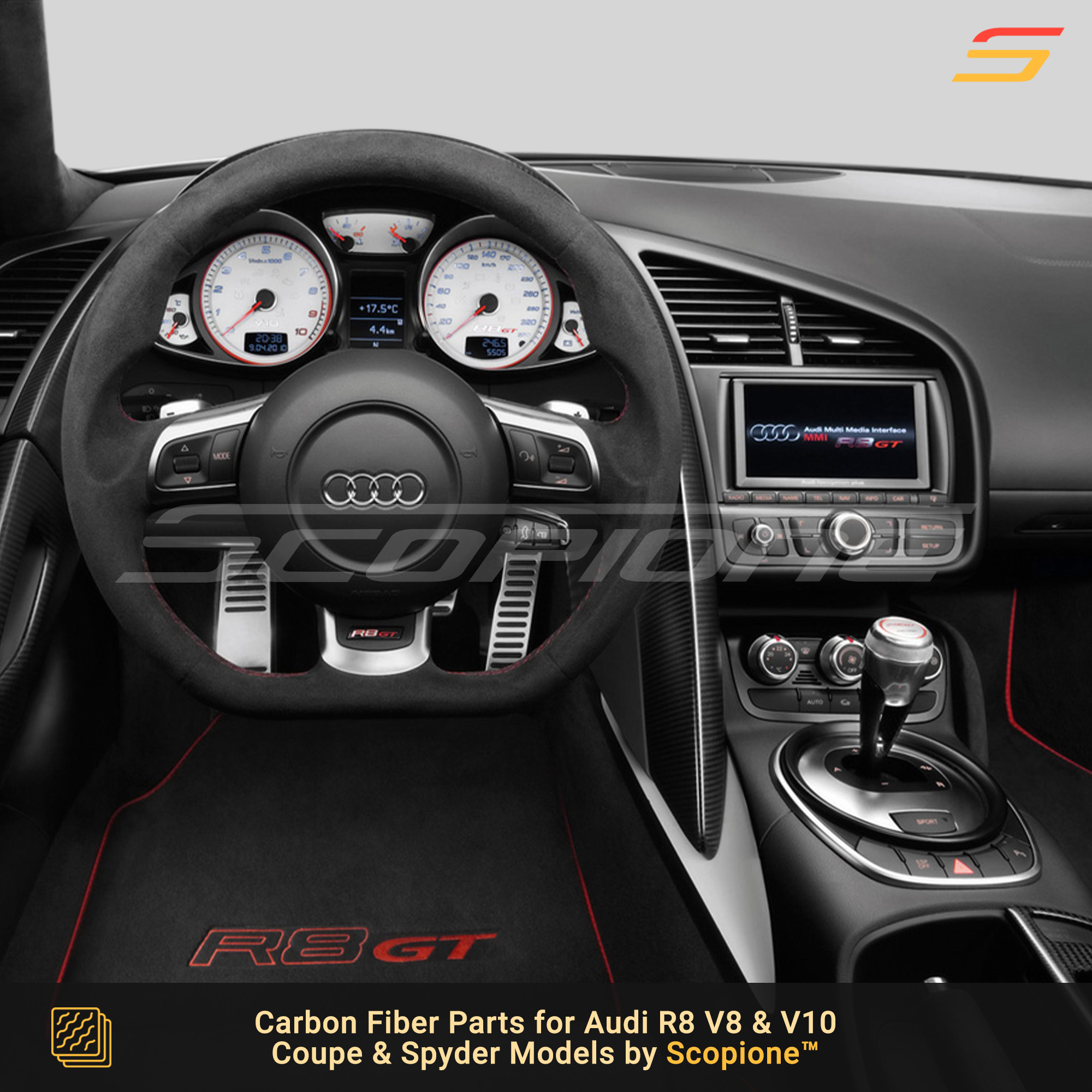
Audi used carbon fiber inside the R8 as deliberately as outside. The R8 GT’s carbon fiber bucket seats alone saved 70 lbs. The Type 4S integrated structural CFRP directly into the cabin architecture – B-pillars, center tunnel, and rear bulkhead – and factory options added CF inlays across the cockpit. From the Scopione catalog, carbon fiber door sill steps for the 2016–2023 Type 4S put a visible weave at every entry and exit – the interior-facing complement to an engine bay and exterior package.
Why Carbon Fiber Matters on the R8 Platform
✓ Weight Reduction – Carbon fiber weighs roughly 60% less than equivalent FRP components. The R8 GT proved it at scale: CFRP body panels and carbon fiber seats contributed to a 100 kg weight reduction over the standard V10.
✓ Factory Precedent – Audi used carbon fiber structurally from Gen 1 (engine cradle) through Gen 2 (13% CFRP body shell). The R8 GT, Competition, and R8 GT RWD all shipped with extensive factory CF packages. Aftermarket carbon fiber follows the same trajectory.
✓ Structural Integrity – High tensile strength with heat resistance. The R8’s engine bay operates at sustained temperatures that make carbon fiber’s thermal stability a functional advantage, not just an aesthetic one.
✓ Collector Relevance – Well-documented CF modifications from recognized brands increase desirability on the used market. The gated-manual V10 and limited-production GT models are actively appreciating – documented upgrades add buyer confidence at auction.
Legacy of the R8 & Its Place in Audi History
Production ended on March 22, 2024. The very last R8 was not delivered to a customer – it was sent to Audi’s museum in Ingolstadt. By then, 45,949 cars had rolled off the Bollinger Hofe line. Audi Sport also built 454 customer racing cars: R8 LMS GT3 and GT4 variants that competed across endurance series worldwide.
The R8 accumulated firsts across its lifespan. First mid-engine Audi. First production car with full-LED headlamps (2006). First production car with laser high-beam headlights (R8 LMX, 2014). First rear-wheel-drive Audi since the VW acquisition (R8 RWS, 2018). The GT badge appeared exactly three times – 333 coupes (2011), 333 spyders (2012), and 333 final editions (2023) – 999 cars that bookended the entire production run.
Platform sharing ran deep. The Gen 1 stretched the Gallardo’s spaceframe. The Gen 2 shared the Huracan’s MSS architecture. The 5.2-liter V10 – built in Gyor, Hungary – powered all three cars, tuned differently for each. Together with the Lamborghini Aventador, the R8 and Huracan represent the final chapter of naturally aspirated VW Group supercars.
There is no direct successor. An electric R8 replacement has been discussed for 2029 or later, potentially on the Porsche SSP6 platform. The Audi e-tron GT fills the performance flagship role, but it is a sedan. The mid-engine, naturally aspirated V10 format that defined the R8 has no planned continuation.
Scopione: Carbon Fiber Upgrades for the Audi R8
The R8’s engine bay – visible through the rear glass on coupe models and fully exposed on the Spyder – is the centerpiece of every carbon fiber upgrade on this platform. Scopione’s R8 catalog focuses heavily on this area: complete engine bay cover kits, individual side covers, firewall panels, hatch lid overlays, intake covers, and detail pieces like oil and coolant cap covers. Exterior components include front lip spoilers, front splitter canards, rear diffusers (three variant-specific fitments), and door sill covers.
All carbon fiber components are hand-laid from 2×2 twill-weave carbon fiber with a UV-resistant clear coat. Parts mount to factory points – no drilling required on most installations. Separate fitments cover the full 2007–2024 production range.
Breakdown of Carbon Fiber Upgrade Costs for Audi R8
Carbon fiber upgrade costs on the R8 vary by component and generation. Below is a breakdown of average pricing for aftermarket carbon fiber parts with professional installation:
| Carbon Fiber Part | Estimated Cost (USD) | Installation Cost (USD) | Total Cost (USD) |
|---|---|---|---|
| Engine Bay Covers Kit (Type 4S) | $3,800 – $5,400 | $400 – $800 | $4,200 – $6,200 |
| Engine Bay Covers Kit (Type 42) | $2,800 – $4,300 | $400 – $800 | $3,200 – $5,100 |
| Engine Hatch Hood Lid Covers Kit | $3,000 – $4,400 | $300 – $600 | $3,300 – $5,000 |
| Side Engine Covers (Either Gen) | $2,200 – $2,250 | $200 – $400 | $2,400 – $2,650 |
| Firewall Engine Cover | $1,400 | $200 – $400 | $1,600 – $1,800 |
| Rear Bumper Diffuser | $2,000 – $3,700 | $300 – $800 | $2,300 – $4,500 |
| Front Bumper Lip Spoiler | $1,400 – $2,100 | $200 – $500 | $1,600 – $2,600 |
| Front Splitters / Canards | $950 – $1,500 | $200 – $400 | $1,150 – $1,900 |
| Door Sills Steps (Type 4S) | $1,000 – $1,500 | $100 – $200 | $1,100 – $1,700 |
| Intake / Cap Covers (Type 4S) | $550 – $900 | $50 – $200 | $600 – $1,100 |
OEM vs. Aftermarket: Audi offered extensive factory carbon fiber on the R8 GT (CFRP body panels, CF seats), Competition (all-matte CF exterior), and R8 GT RWD (CF splitter, dive planes, wing, sway bar). OEM replacements carry significant price premiums. Scopione’s CF components use 2×2 twill-weave layup and clear coat finishing with fitment engineered to match factory body lines.
Used Audi R8 Market (2024–2025)
R8 resale values vary significantly by generation, transmission type, variant, and mileage. Current approximate market ranges:
- Type 42 V8 Coupe (2008–2012): $45,000 – $85,000
- Type 42 V10 Coupe (2010–2015): $75,000 – $150,000
- Type 42 V10 Plus (2013–2015): $90,000 – $160,000
- Type 42 GT Coupe (2012): $110,000 – $128,000
- Type 42 GT Spyder (2012): $83,000 – $158,000
- Type 42 Competition (2015): $111,000 – $150,000
- Type 4S V10 Coupe (2017–2019): $55,000 – $104,000
- Type 4S V10 Performance (2020–2024): $95,000 – $210,000
- Type 4S RWS (2018): $125,000 – $140,000
- Type 4S R8 GT (2023): $250,000 – $291,500
Browse Carbon Fiber Parts for the Audi R8
Factors Affecting Audi R8 Prices
- Model & Trim: Higher trims (V10 Plus, Performance, GT, special editions) command more.
- Condition & Mileage: Low-mileage, well-documented cars bring premium prices.
- Market Demand: Production ended in March 2024 – discontinuation has lifted demand across the range.
- Upgrades & Modifications: Documented carbon fiber upgrades and quality tuning can raise value; unbranded work can lower it.
Does Carbon Fiber Increase the Resale Value of an Audi R8?
Carbon fiber modifications can influence an R8’s resale value, but the effect depends on execution, documentation, and the variant being modified.
When carbon fiber adds value:
• Professionally installed, well-documented parts from recognized brands increase buyer confidence at resale.
• On V10 and GT variants, a documented carbon-fiber engine bay or exterior package adds measurable desirability.
• Gated-manual V10 buyers – the strongest collector segment – often pay a premium for quality modifications with receipts and installation records.
When it does not:
• Unbranded or poorly fitted aftermarket parts raise red flags for serious buyers.
• The V8 R tronic market is already the least desirable R8 segment – modifications add less incremental value here.
• Carbon fiber alone does not guarantee a price increase. Brand recognition and documentation are the deciding factors.
Practical approach: Use carbon fiber parts from documented sources like Scopione, retain all receipts and installation records, keep original OEM parts if removed.
Is the Audi R8 a Good Investment?
- Gated-manual V10 (Gen 1): Already appreciating significantly. Hagerty named the 2008–2015 R8 a 2023 Bull Market Pick. The V10 segment specifically has grown 47.4% in value since 2018. Only 26 manual V10 Plus cars were built (2014–2015) – these are extreme outliers in valuation.
- R8 GT (all generations): Production limited to 333 units per variant (999 total across GT Coupe, GT Spyder, and R8 GT RWD). Trading at strong premiums. The 2023 R8 GT RWD has already reached $291,500 at auction.
- R8 Competition (2015): 60 units, US exclusive. Stable at $111,000–$150,000.
- Gen 2 V10 Performance: Still depreciating, but production ended Q1 2024. As the last naturally aspirated V10 Audi, the depreciation curve should flatten. Year-over-year, the overall R8 market is up 3.9%.
- V8 / R tronic: The lowest R8 entry point at $45,000–$85,000. Continuing slow depreciation. The V8 generates less collector interest, and the R tronic single-clutch is the least desirable transmission on any R8.
Notable Auction Results for Audi R8 (2022–2025)
| Model | Sale Price |
|---|---|
| 2023 R8 GT RWD (#264/333, 41 miles) | $291,500 (Jan 2024) |
| 2023 R8 GT RWD (Barrett-Jackson Scottsdale) | $265,000 (Jan 2024) |
| 2011 R8 V10 6-Speed (9K miles, Bring a Trailer) | $177,000 (2023) |
| 2012 R8 GT Spyder | $158,000 (Jan 2023) |
| 2012 R8 GT Coupe (18K miles) | $128,000 (Jun 2024) |
| 2020 R8 V10 Performance Spyder | $196,000 (Apr 2025) |
What Is the Best Audi R8 Variant to Buy?
- Entry point: Type 42 V8 Coupe ($45K – $85K) – the most accessible R8 on the used market. Gated manual examples command higher prices than R tronic automatics.
- Driver engagement: Gen 1 V10 with gated 6-speed manual ($75K – $150K) – the open-gate shifter, 8,700 rpm redline, and analog driving experience define this car. The facelifted 2014–2015 V10 manual is the rarest Gen 1 variant.
- Performance value: Type 4S V10 Performance quattro ($130K – $210K) – 612 hp, S tronic dual-clutch, MSS platform with 13% CFRP construction. The most capable R8 for daily use and track days.
- Long-term collector hold: R8 GT (any generation, $110K – $291K) – 333 units per variant. The GT badge appeared exactly three times in the R8’s 18-year production run.
What Are Common Audi R8 Maintenance Issues and Costs?
Annual maintenance on an R8 typically runs $425–$600 for minor service (oil change, visual inspection). Major service every 20,000 miles: $960–$1,200. Spark plugs every 60,000 miles: $400–$600. Dual-clutch transmission fluid every 40,000 miles: $300–$500. Tires run $1,300–$1,600 per set of Pirelli P Zeros with typical tread life of 8,000–15,000 miles. Carbon ceramic rotor replacement: $8,000–$12,000 per set.
Common issues to budget for: timing chain tensioner wear on V8 4.2L engines (inspect every 40,000 miles, $2,000–$4,000 to replace – failure can cause engine damage). R tronic actuator failures on Gen 1 automatics ($3,000–$6,000). Magnetic ride shock failure ($1,500–$2,500 per corner). Carbon sigma blade delamination on pre-2012 cars in hot climates. The R8 is widely considered one of the more affordable supercars to maintain – considerably cheaper than Ferrari or Lamborghini for equivalent services, roughly comparable to a Porsche 911 Turbo.
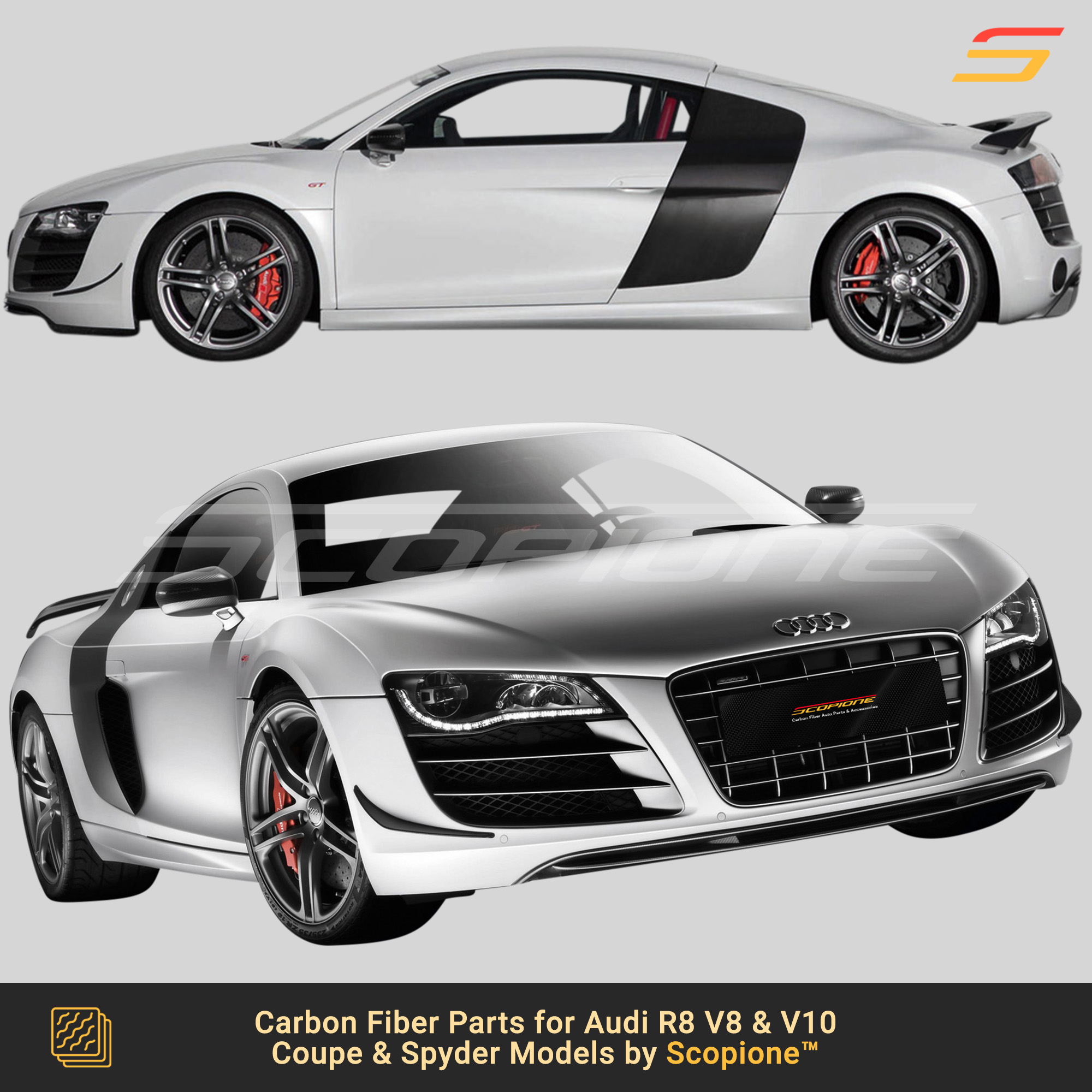
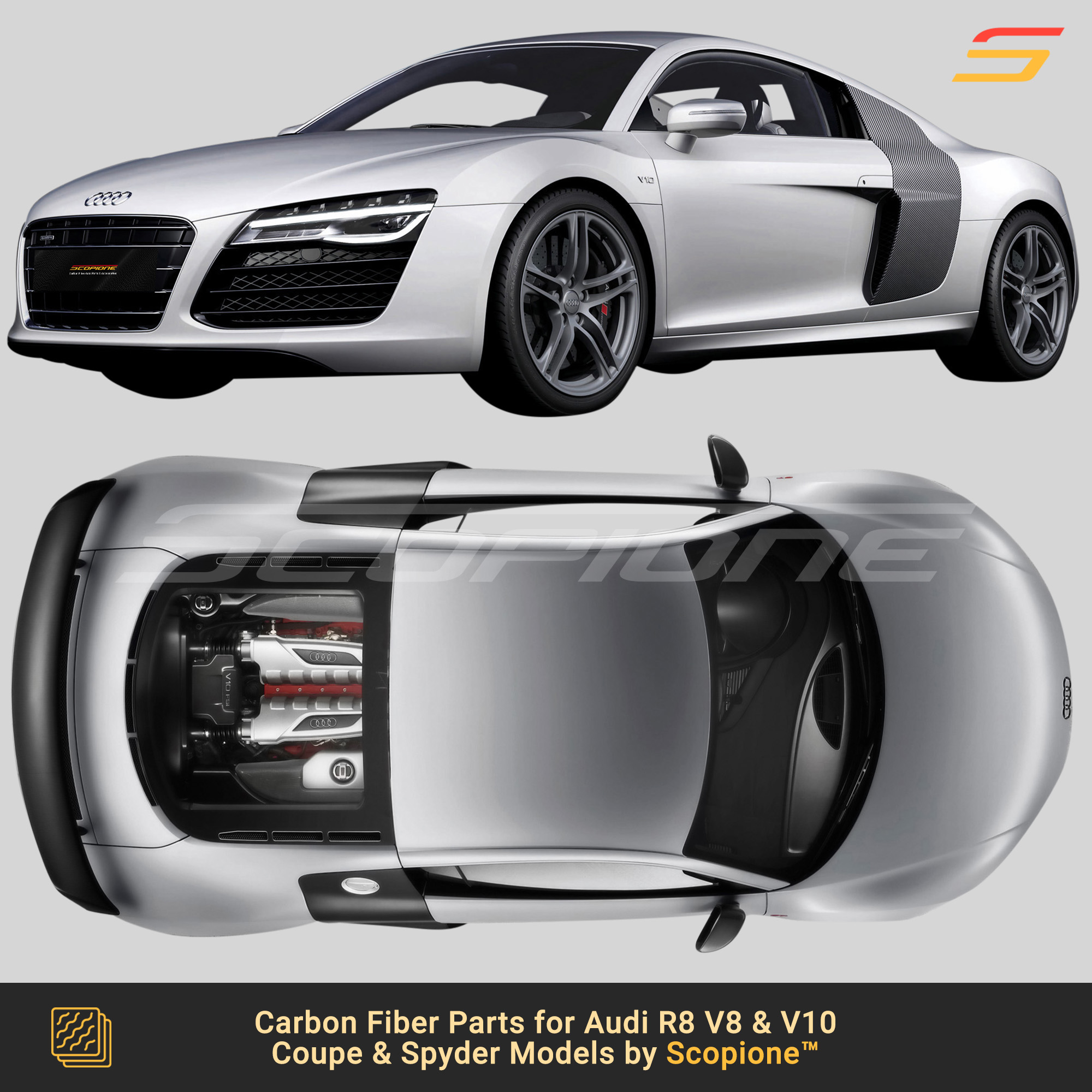
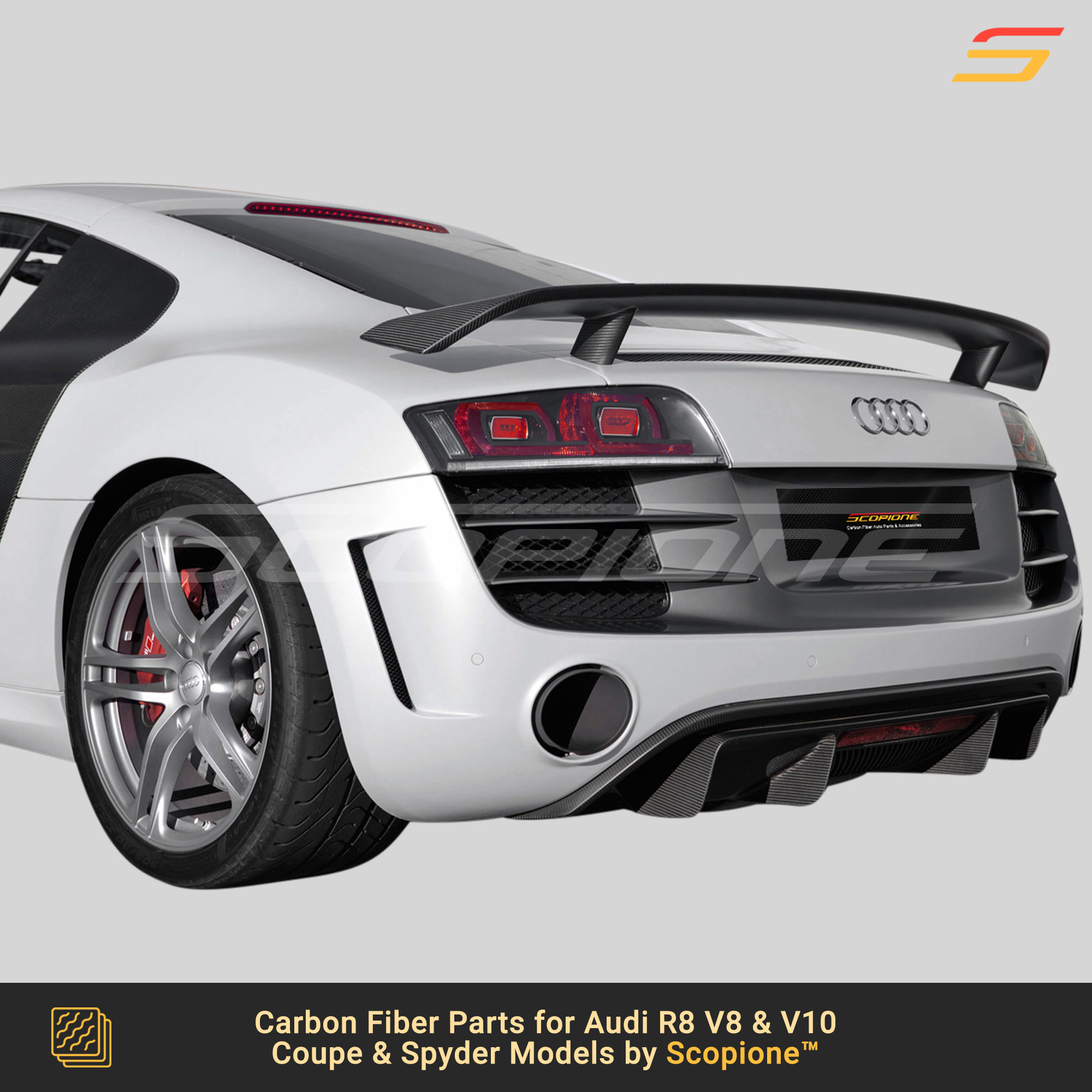
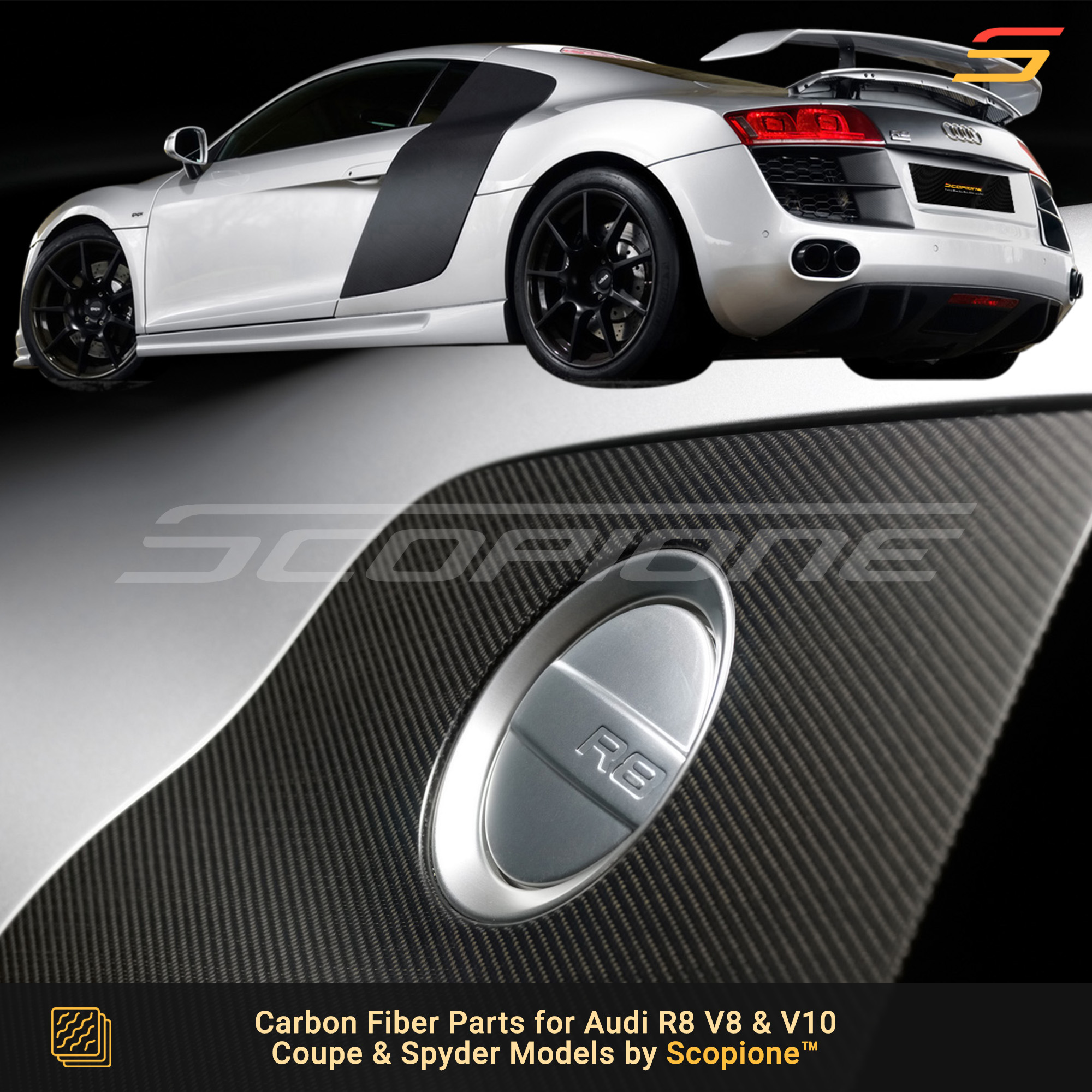
The Scopione R8 Picture Gallery features photographs of Audi R8s fitted with Scopione carbon fiber components – engine bay cover kits, side engine covers, front lip spoilers, diffusers, door sills. Each image shows how the carbon fiber weave pattern and gloss finish integrate with the R8’s factory body lines and engine bay surfaces.
R8 owners considering modifications can browse these real-world installations as reference. The gallery captures the car’s side blade profile, mid-mounted engine bay, and low-slung nose – with and without carbon fiber upgrades.
Every Scopione component for the R8 is built to match factory mounting geometry. The carbon fiber layup and clear coat process is consistent across the full catalog – the same material quality whether the part goes on a 2008 V8 or a 2023 R8 GT.
R8 owners considering modifications can explore Scopione’s catalog for specific part fitment, pricing, and installation details.
Carbon Fiber Parts for the Audi R8
The 16 carbon fiber parts Scopione currently lists for the Audi R8. Each image links to its product page.




More Scopione Picture Galleries
Scopione’s carbon fiber catalog covers a wide range of performance and luxury vehicles. Browse galleries for related makes and models:
- Ferrari: 458 Italia & Spider • 488 GTB & Spider • F8 Tributo & Spider • F12 & 812 Superfast • SF90
- Lamborghini: Gallardo • Huracan • Aventador • Urus
- McLaren: MP4-12C & 650S • 720S & 765LT • Sports Series
- Porsche: 911, Boxster & Cayman
- BMW: M3, M4, M5 & More
- Nissan: GT-R R35 • 350Z, 370Z & Z
- Aston Martin: Vantage, DB9 & DBS
- Bentley: Continental GT & GTC
- Maserati: GranTurismo & GranCabrio
- Toyota: Supra
- Subaru: WRX STI
- Mitsubishi: Lancer Evolution
- Chevrolet: Corvette • Camaro
- Dodge: Viper
Experience the elegance and performance of the Audi R8 with Scopione. Browse our gallery and get inspired to elevate your supercar with our top-of-the-line carbon fiber upgrades.
Shop now for premium ScopioneCarbon carbon fiber upgrades and experience the ultimate in performance and aesthetics for your Audi R8!