

 Shop
ShopThe Bentley Continental GT & GTC defined the modern luxury grand tourer across three generations and two decades of production – a W12 twin-turbo flagship joined by a V8 twin-turbo option, permanent all-wheel drive, and a convertible variant that shares every mechanical component beneath a multi-layer folding roof. From the 552 hp first-generation W12 to the 700 hp second-generation Supersports, Bentley pushed power and refinement in parallel. Scopione carries a line of carbon fiber aero components for the Bentley Continental GT and GTC – front bumper lips, rear diffusers, side skirts, rear spoilers, and complete body kits – precision-fitted across 2003–2024 model years.

Introduction: The Bentley Continental GT & GTC
The Continental GT debuted at the 2003 Geneva Motor Show as the first Bentley developed entirely under Volkswagen Group ownership – and the car that pulled the Crewe factory back from the edge of irrelevance. Before the Continental GT, Bentley produced roughly 1,000 cars per year. Within five years of launch, annual output exceeded 10,000. The Continental GT became the highest-volume Bentley in the brand’s history, with cumulative production estimated at over 80,000 units across three generations.
Dirk van Braeckel penned the original design around a “power line” running from the front fender crest to the rear haunch – a proportion that has survived through two major redesigns. The engineering drew from VW Group resources: a D1 platform shared with the VW Phaeton, a W12 6.0-liter twin-turbo engine producing 552 hp, permanent all-wheel drive with a 40:60 rear-biased Torsen differential, and a ZF 6-speed automatic. Three years later, the Continental GTC added a four-layer insulated soft top on the same mechanical platform – approximately 145 kg heavier, structurally reinforced, and otherwise identical.
Under the same VW Group umbrella that invested in Bentley, the Audi R8 emerged as a mid-engine sports car from the same corporate engineering resources. The Continental GT occupied the opposite end of that spectrum: front-engine, four-seat, 2,350 kg, built for crossing continents rather than attacking circuits.
Scopione’s Bentley Continental carbon fiber catalog covers front lips, rear diffusers, side skirts, spoilers, and complete aero kits for both second and third-generation models.


First Generation (2003–2011): The Rebirth of Bentley
Building the Continental GT required Volkswagen Group to invest over £500 million in retooling the Crewe factory – a facility that had been assembling hand-built cars in volumes of roughly 1,000 per year since 1946. The production line combined German-precision robotics for body construction with traditional hand-finishing in the wood and leather workshops. Each interior alone required 130 hours of hand craftsmanship. The investment paid off: Bentley hit 10,000 annual sales within five years, a volume the brand had never approached in its 85-year history.
The original Continental GT carried a 6.0-liter W12 twin-turbo producing 552 hp and 479 lb-ft through a ZF 6-speed automatic. Permanent AWD with a Torsen center differential split torque 40:60 front-to-rear. At 2,350 kg (5,181 lb), it was among the heaviest GT cars in production – but the W12’s 479 lb-ft of torque from 1,600 rpm made the weight disappear on highway pulls. Top speed: 198 mph.
The Continental GTC arrived in 2006 with a four-layer insulated soft top that opened or closed in 25 seconds at speeds up to 30 km/h. Structural reinforcement added approximately 145 kg. The same W12 powertrain, the same interior, the same AWD system. Bentley sold the GTC as a year-round convertible rather than a fair-weather companion.
Two performance variants pushed the first-gen Continental beyond its grand touring brief:
- Continental GT Speed (2007–2011) – 602 hp from revised turbo boost mapping. Lowered suspension by 10 mm, 20-inch dark-tint alloy wheels, Alcantara headliner. 0–60 in 4.3 seconds, 202 mph top speed.
- Continental GT Supersports (2009–2011) – 621 hp, 73 kg lighter than the base GT through carbon-ceramic brakes, CF splitter and diffuser from factory, and reduced sound insulation. Quickshift transmission programming. Approximately 1,000 units produced. The fastest first-gen Continental at 204 mph.
- Continental GT Diamond Series (2010) – Limited-production run commemorating the 60,000th Bentley built at the Crewe factory. Unique diamond-quilted interior, Mulliner driving specification, exclusive two-tone paint options, and a numbered plaque on the center console.
Bentley Continental GT (2003–2011) MSRP
| Model | Base MSRP (USD) | Inflation-Adjusted (2024) |
|---|---|---|
| Continental GT W12 (2003) | $150,000 | ~$250,000 |
| Continental GTC W12 (2006) | $195,000 | ~$298,000 |
| GT Speed (2008) | $195,000 | ~$279,000 |
| GT Supersports (2010) | $267,000 | ~$377,000 |
First-gen Continental GT owners can find the universal-fitment CF rear spoiler blade on the Scopione Bentley page.
Second Generation (2011–2018): The V8 Era & 700 HP
The second-generation Continental GT brought two foundational changes: a restyled exterior with sharper headlights and a more sculpted hood, and – for the first time – a V8 engine option. The 4.0-liter twin-turbo V8, co-developed with Audi, produced 500 hp (507 hp from 2015) with cylinder deactivation for improved fuel economy. A hot-V configuration placed the turbochargers between the cylinder banks. You could identify a V8 Continental by its figure-eight exhaust tips versus the oval outlets on the W12.
The W12 received a parallel upgrade: 567 hp at launch, rising to 582 hp by 2015. A new ZF 8-speed automatic replaced the previous 6-speed across the range. The GT Speed pushed to 616 hp initially, then 626–633 hp with revised turbo calibration – hitting 206 mph on later models.
Bentley’s entry into GT3 racing with the Continental GT3 program (2013 debut season) fed directly back into the road car range. The race car stripped 1,100 kg from the road car, replaced the W12 with the twin-turbo V8, and ran rear-wheel drive. It won the Silverstone round of the Blancpain Endurance Series in its first season. Everything Bentley learned about the V8’s rear-drive behavior and weight reduction informed the GT3-R – a road-legal homage limited to 300 units.
Two limited-production variants stand out from this generation:
- Continental GT3-R (2014) – 572 hp V8, rear-wheel drive only. The single RWD Continental GT Bentley has ever produced. 100 kg lighter than the GT V8 S through rear seat deletion, a carbon-fiber hood, titanium exhaust, and a fixed rear wing. Limited to 300 units worldwide. Inspired directly by the Continental GT3 racing program.
- Continental Supersports (2017–2018) – 700 hp (710 PS) from the W12 – the highest output from any Bentley road car at the time. Carbon fiber splitter, diffuser, and rear spoiler from factory. Torque vectoring AWD. 3.5 seconds to 60 mph. 209 mph top speed. Approximately 710 units produced.
The V8 S added 521 hp, a sport exhaust, and firmer suspension for buyers who wanted sharper responses than the base V8 without the W12’s complexity. And the GTC continued in both V8 and W12 configurations, gaining the same powertrain and chassis upgrades as the coupe throughout the generation.
Bentley Continental GT (2011–2018) MSRP
| Model | Base MSRP (USD) | Inflation-Adjusted (2024) |
|---|---|---|
| Continental GT V8 (2012) | $175,000 | ~$234,000 |
| Continental GT W12 (2012) | $200,000 | ~$268,000 |
| GT Speed (2014) | $220,000 | ~$285,000 |
| GT3-R (2014) | $337,000 | ~$437,000 |
| Supersports (2017) | $293,000 | ~$363,000 |
Second-gen Continental GT owners can explore Scopione’s carbon-fiber body kit and aero catalog for 2016–2018 facelift models.
Third Generation (2018–2024): The MSB Platform
The third-generation Continental GT moved to an entirely new foundation: the Porsche MSB platform, shared with the Porsche Panamera. Despite growing in exterior dimensions, the car shed 80 kg from the previous generation through aluminum and composite body construction. A ZF 8-speed dual-clutch automatic replaced the torque-converter unit. Active AWD with an electronic rear differential replaced the mechanical Torsen center diff.
The W12 continued as the flagship engine at 626 hp (467 kW), paired with 48V active anti-roll bars that adjust stiffness in real time. The V8 twin-turbo produced 542 hp with cylinder deactivation at cruise. Inside, a rotating display panel offered three modes: touchscreen, analog dials, or a clean veneer surface with no screens visible.
Current and special-edition variants:
- Continental GT Speed (2021–2024) – 650 hp (659 PS) W12 with electronic rear differential for torque vectoring. Carbon-ceramic brakes optional. 208 mph top speed. Dark-tint exterior accents.
- Continental GT Mulliner (2020–2024) – Coachbuilt luxury specification with diamond-in-diamond quilted seats, exclusive paint options, chrome accents, and Mulliner-specific wheel designs.
- Continental GTC (3rd Gen) – Convertible with a Z-fold soft top that opens in 19 seconds at up to 50 km/h. Available in V8, W12, Speed, and Mulliner configurations.
The third-gen chassis introduced 48V active anti-roll bars that can vary stiffness from full-comfort to near-rigid in under half a second – a system that genuinely transforms the car’s character between Comfort and Sport modes. The air suspension gained three-chamber struts with a wider spread between softest and firmest settings than the previous generation. Combined with the electronic rear diff, the third-gen Continental GT can switch from luxury motorway cruiser to backroad corner-carver in a way neither previous generation could match.
Bentley has confirmed the current W12 as the final twelve-cylinder in the Continental lineup. The brand’s Beyond100 strategy commits to hybrid-only offerings by 2026 and full electrification by 2030.
Bentley Continental GT (2018–2024) MSRP
| Model | Base MSRP (USD) | Inflation-Adjusted (2024) |
|---|---|---|
| Continental GT V8 (2024) | $225,000 | $225,000 |
| Continental GTC V8 (2024) | $247,000 | $247,000 |
| GT Speed (2024) | $275,000 | $275,000 |
| GT Mulliner (2024) | $300,000+ | $300,000+ |
Third-gen Continental GT and GTC owners can browse the Scopione Bentley aero catalog by model year.
Carbon Fiber on the Continental GT & GTC
Bentley’s factory use of carbon fiber on the Continental GT escalated through each generation. The first-gen Supersports introduced a CF front splitter and rear diffuser as standard – functional aero components that also saved weight on a car where every kilogram mattered. The second-gen GT3-R went further: a full carbon-fiber hood, fixed rear wing, and aerodynamic undertray. The 700 hp Supersports added a CF splitter, diffuser, and rear spoiler as factory fitment. On the interior side, Bentley’s Mulliner division has offered carbon-fiber dashboard trim, center console fascias, and door inserts as factory options since the second generation.
Bentley’s Mulliner division expanded its carbon-fiber offerings significantly with the third generation. Current Mulliner options include a full CF body styling kit (front splitter, side skirts, rear diffuser), CF mirror caps, CF door sills with illuminated treadplates, and interior CF fascia panels. On a typical Mulliner-specified Continental GT, the factory carbon fiber options alone can exceed £20,000 – establishing CF as part of the car’s factory identity rather than a purely aftermarket addition.
For Continental GT and GTC owners extending that factory direction with aftermarket components, the application sits firmly in the exterior aero category. The Continental’s 2,200+ kg curb weight and grand touring character mean that CF aero components serve two parallel functions: reducing visual mass on a large-bodied car, and managing airflow at sustained high speeds where the Continental routinely operates. A front lip, side skirts, rear diffuser, and rear spoiler in carbon fiber sharpen the Continental’s profile without altering its fundamental proportions.
The Maserati GranTurismo occupies a similar segment – a luxury grand tourer where carbon-fiber aero components serve both aesthetic and functional roles. On both platforms, the visual contrast between exposed twill weave and factory body paint is a signature of considered modification rather than aftermarket excess.
Installation on the Continental GT demands particular attention to panel alignment. Bentley’s factory panel gaps are among the tightest in the luxury GT segment – typically 3–4 mm with consistent tolerance across the entire body. Any aftermarket component that disrupts those gaps reads immediately as non-factory. Professional installation by a shop experienced with Bentley bodywork is worth the labor cost – the difference between a 2 mm gap variance and a 5 mm one is the difference between a factory-quality fit and something that catches the eye for the wrong reason. Expect 4–8 hours for a full aero kit, with the front lip and rear diffuser requiring careful alignment before final fastening.
Exterior CF aero components for the Continental GT and GTC are available on the Scopione Bentley catalog page.

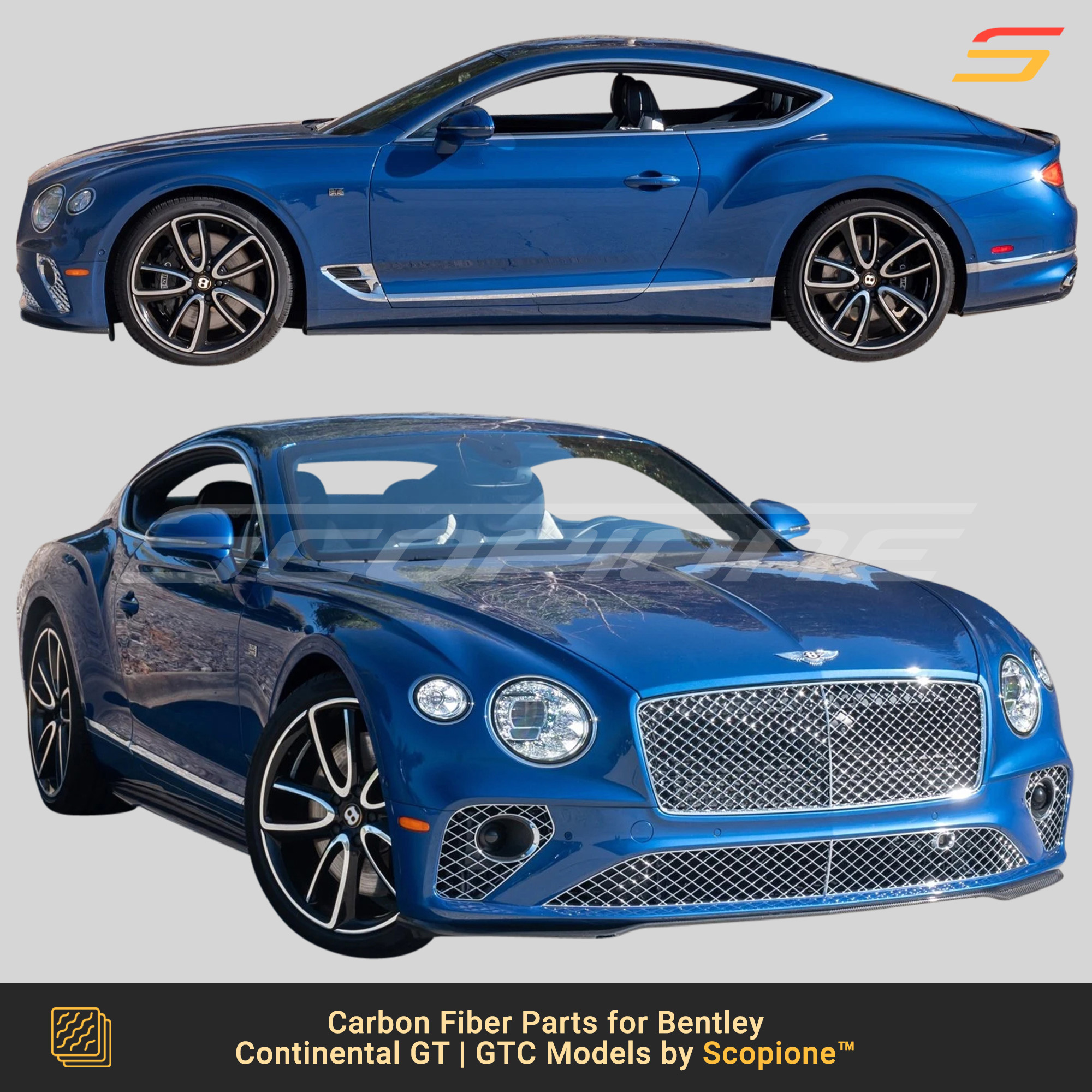

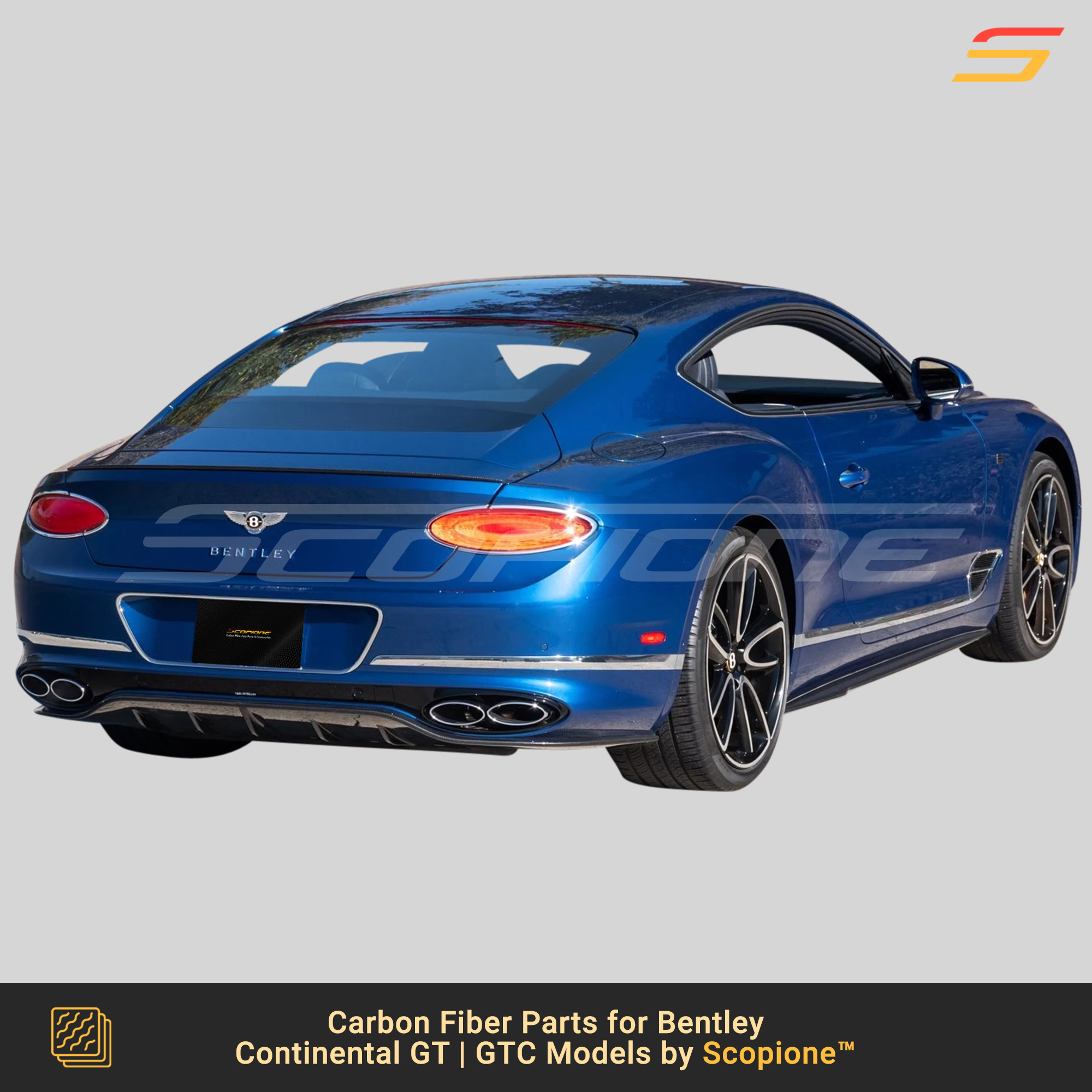
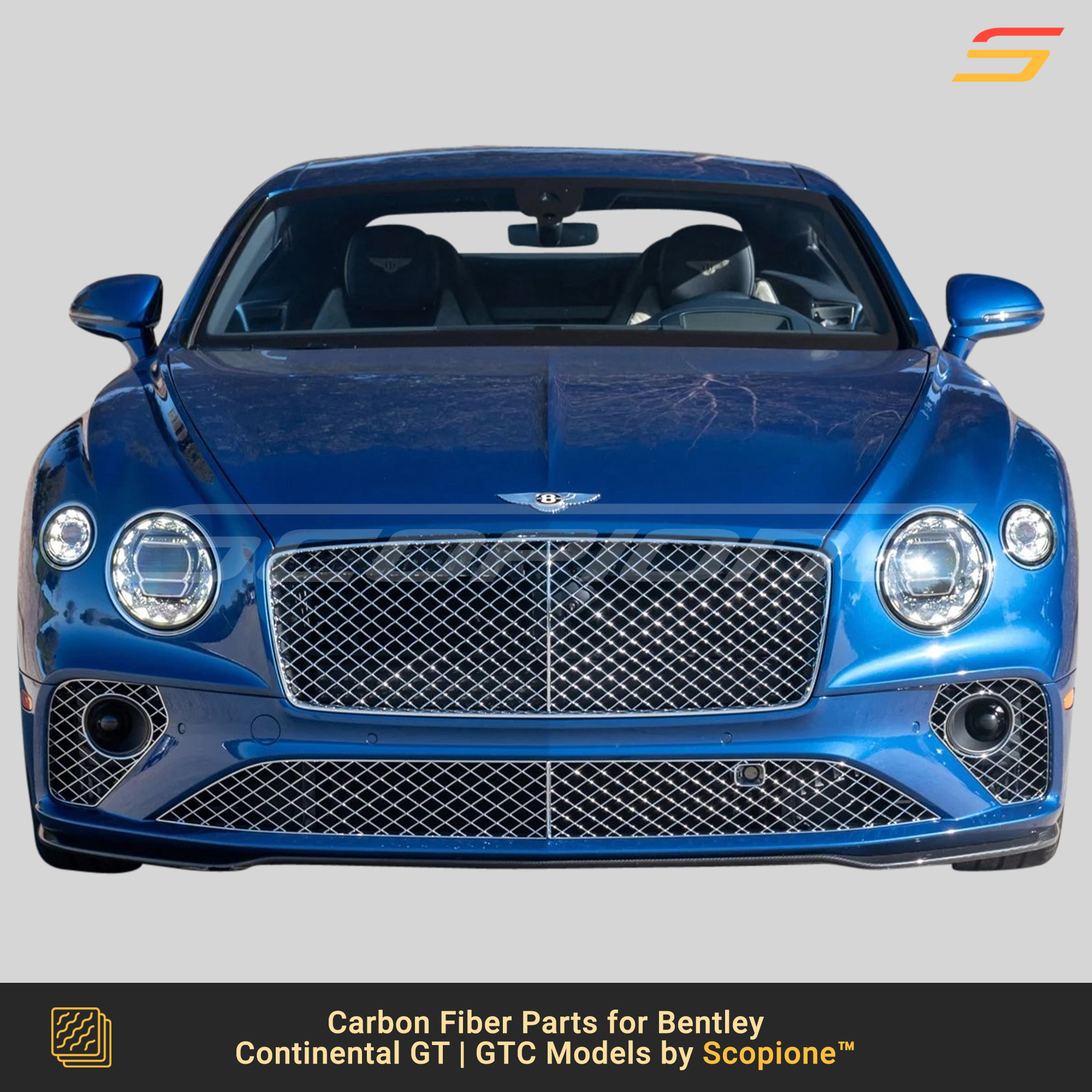
Scopione: Carbon Fiber Upgrades for the Bentley Continental GT & GTC
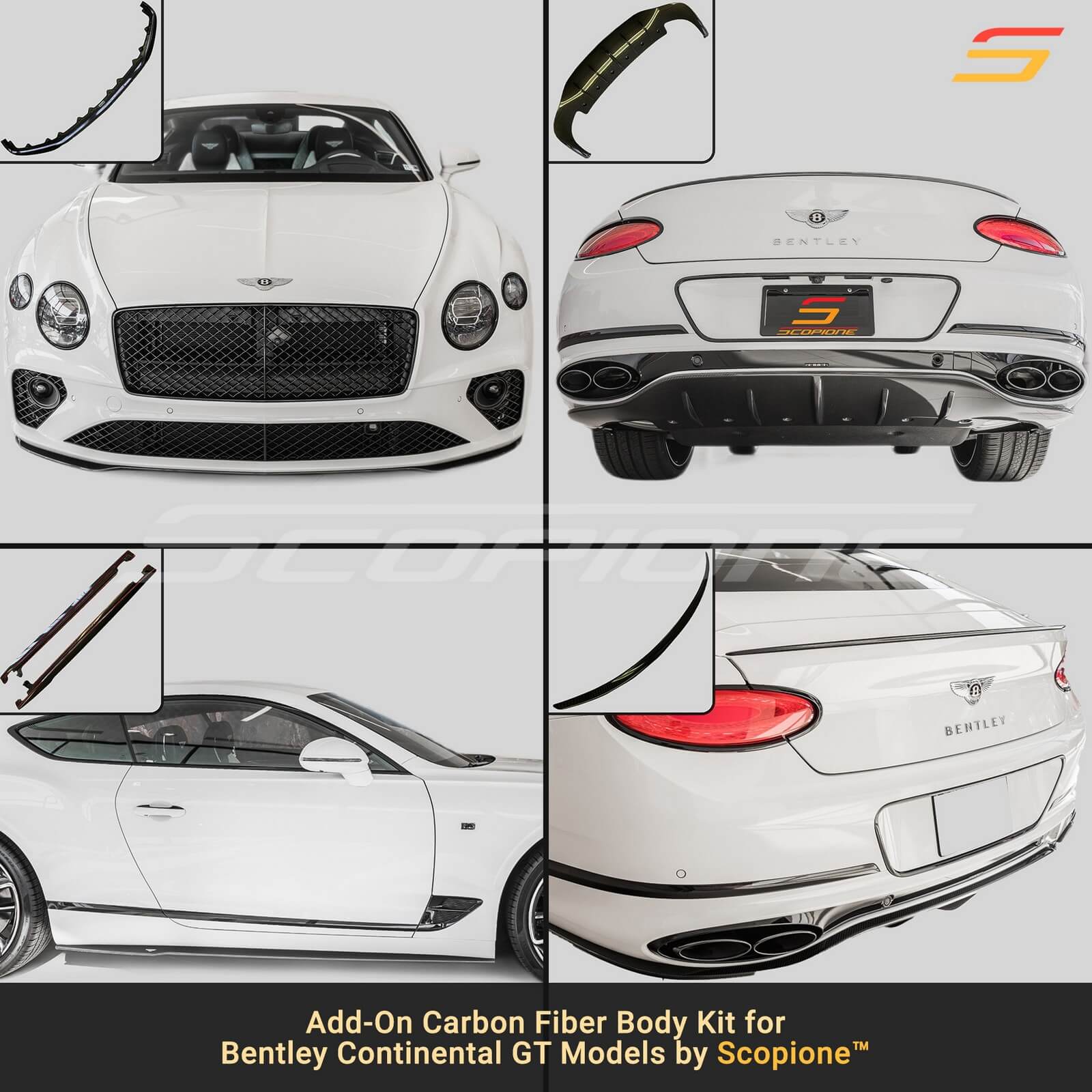
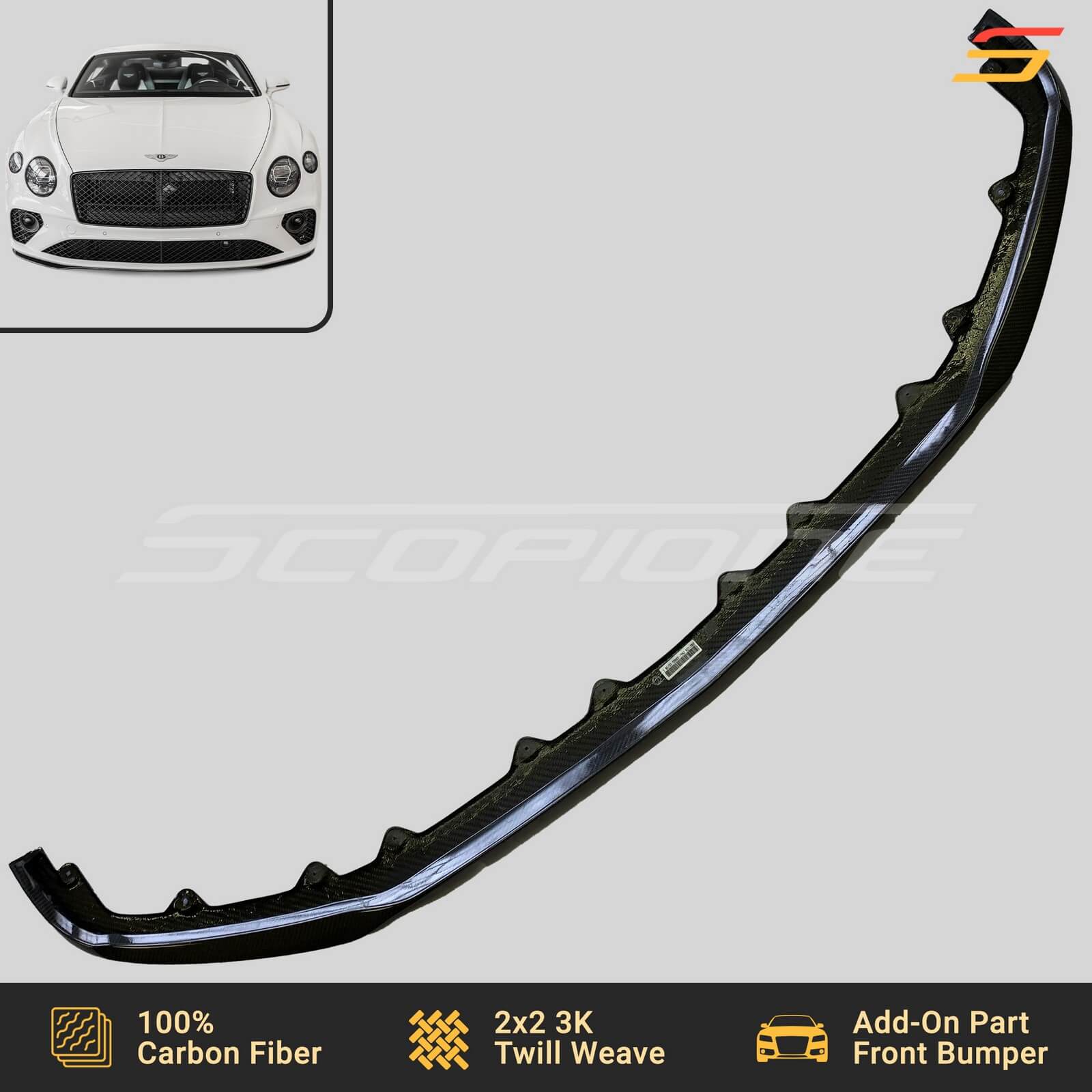
Scopione’s Bentley catalog focuses on exterior aerodynamic components – front bumper lips, rear bumper diffusers, side skirts, rear spoilers, and complete body kits – across the second-generation facelift (2016–2018) and third-generation (2019–2024) Continental GT and GTC. A universal rear spoiler blade also covers first and second-generation GT coupes (2003–2018). All parts are hand-laid from 2×2 twill-weave carbon fiber with a UV-resistant clear coat finish, mounting to factory body points with no drilling required.
Carbon Fiber Upgrade Costs: 2019–2024 Continental GT & GTC
Carbon-fiber aero components for the third-generation Continental GT and GTC. Individual pieces or a complete body kit:
| Carbon Fiber Part | Part Cost (USD) | Installation Est. (USD) | Total Est. (USD) |
|---|---|---|---|
| Full Add-On Body Kit | $7,500 | $2,000 – $4,000 | $9,500 – $11,500 |
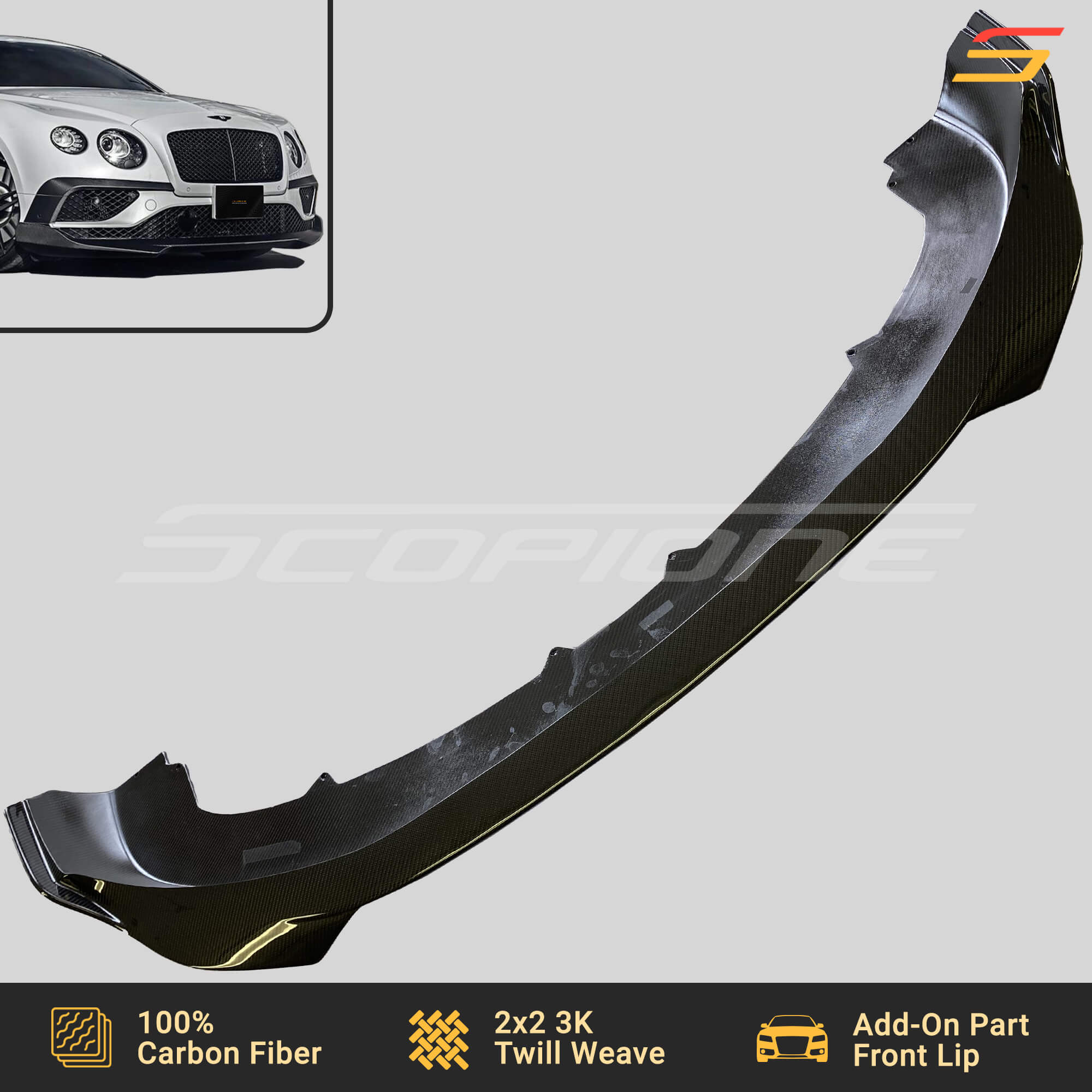
| Front Bumper Lip Spoiler | $2,300 | $400 – $800 | $2,700 – $3,100 |
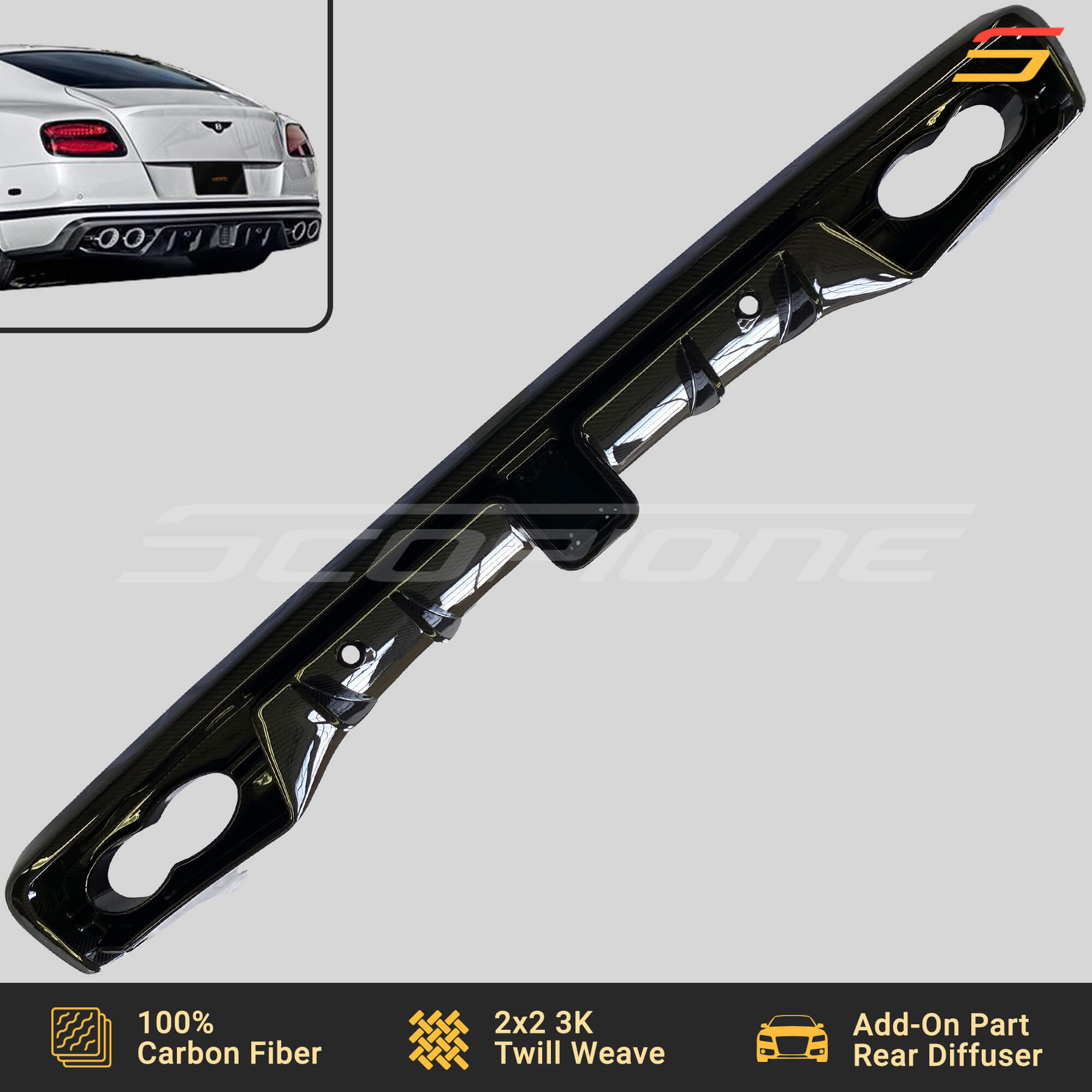
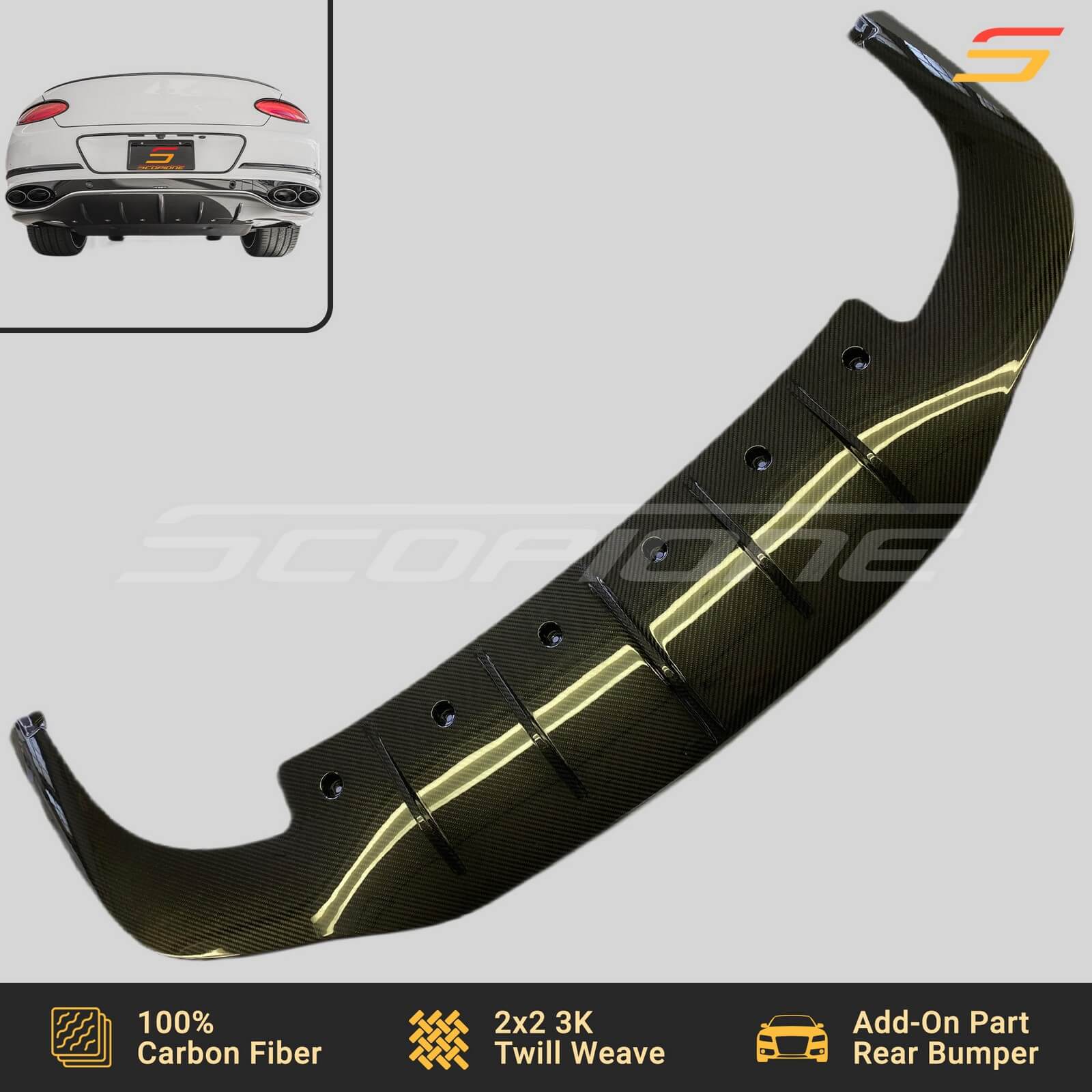
| Rear Bumper Diffuser | $2,500 | $400 – $800 | $2,900 – $3,300 |
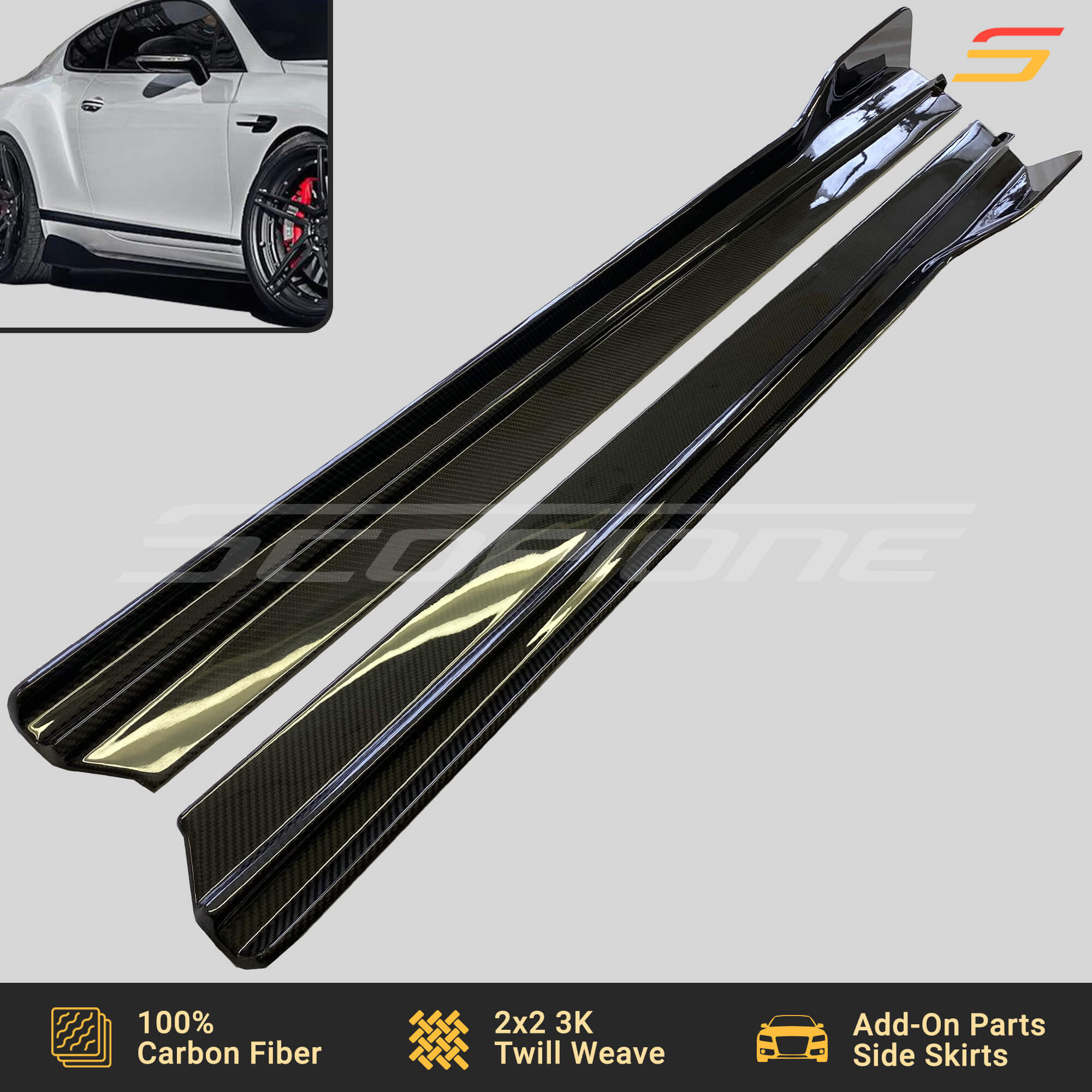
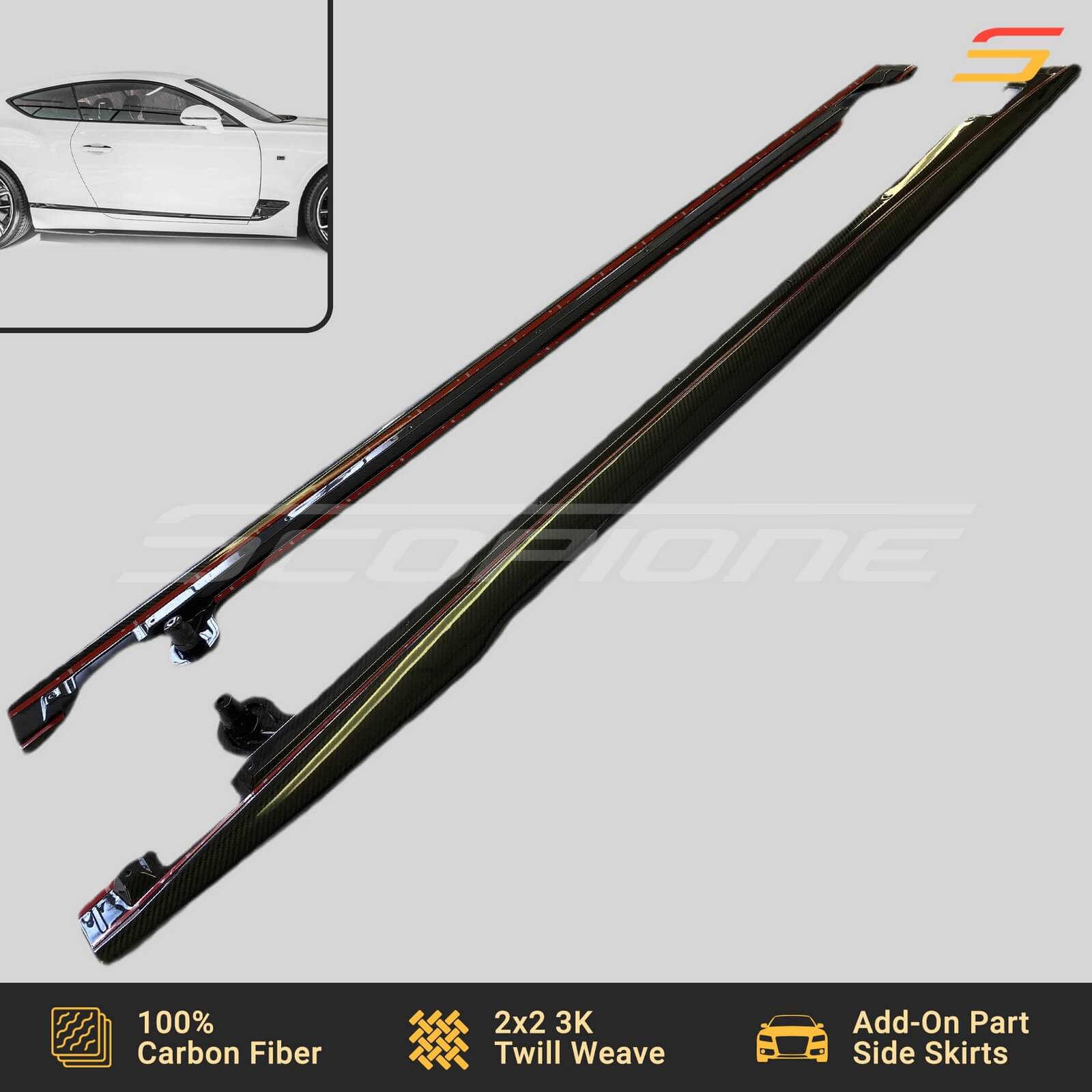
| Add-On Side Skirts | $2,400 | $300 – $600 | $2,700 – $3,000 |
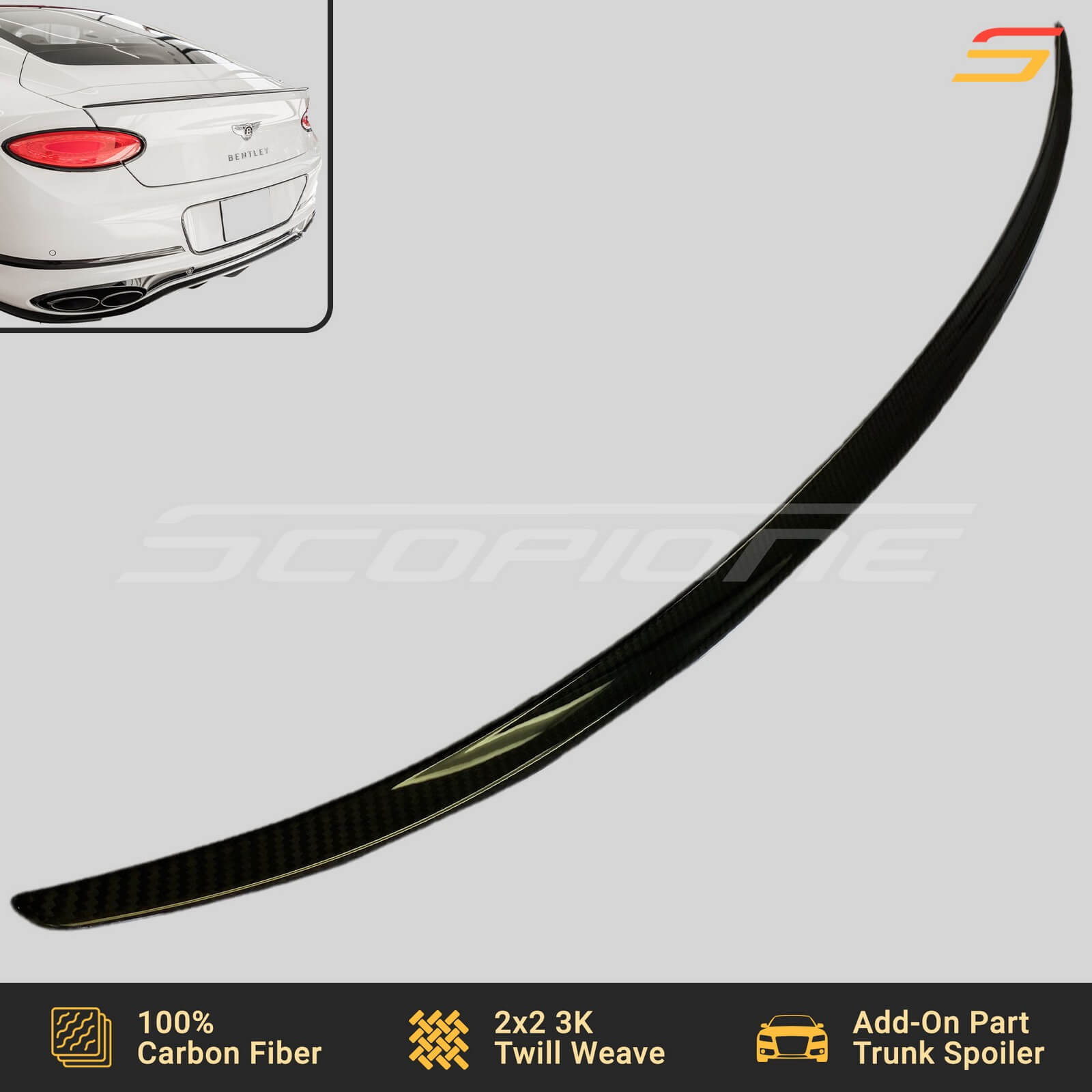
| Rear Trunk Spoiler | $600 | $150 – $300 | $750 – $900 |
Full exterior aero package (individual pieces): Front lip, rear diffuser, side skirts, and rear trunk spoiler installed on a 2019+ Continental GT runs approximately $9,050–$10,300. The Full Add-On Body Kit is the single-package alternative at $7,500 plus installation.
Carbon Fiber Upgrade Costs: 2016–2018 Continental GT & GTC
Aero components for the second-generation facelift Continental (GT V8 S, GTC, GT Speed):
| Carbon Fiber Part | Part Cost (USD) | Installation Est. (USD) | Total Est. (USD) |
|---|---|---|---|
| Full Add-On Body Kit | $8,500 | $2,000 – $4,000 | $10,500 – $12,500 |
| Front Bumper Lip Spoiler | $2,300 | $400 – $800 | $2,700 – $3,100 |
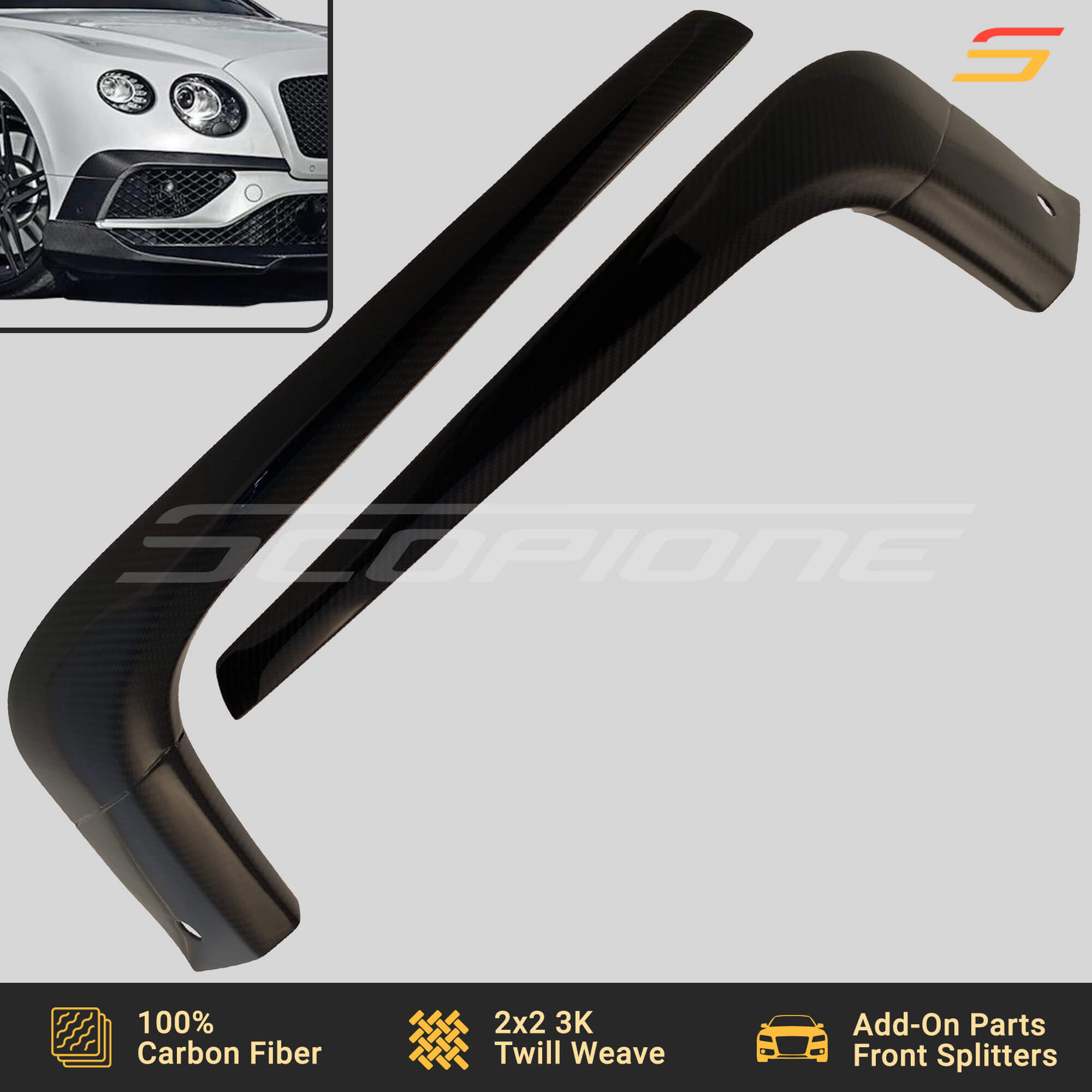
| Front Bumper Upper Splitters | $1,450 | $200 – $400 | $1,650 – $1,850 |
| Rear Bumper Diffuser | $3,000 | $400 – $800 | $3,400 – $3,800 |
| Add-On Widened Side Skirts | $2,500 | $300 – $600 | $2,800 – $3,100 |
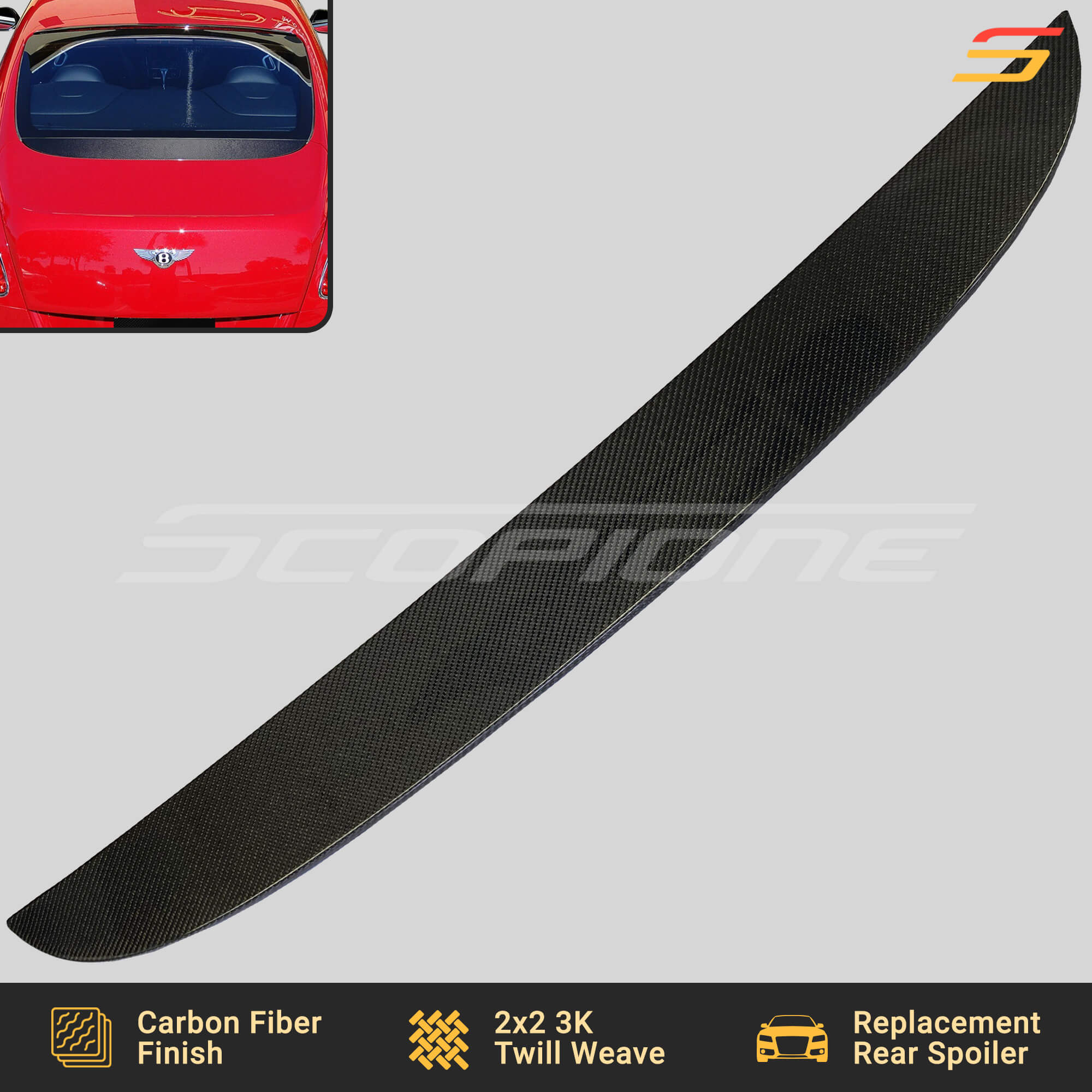
An additional Rear Spoiler Blade ($800) fits all first and second-generation Continental GT coupes (2003–2018) – the broadest fitment range in the Scopione Bentley catalog. Installation runs approximately $150–$300.
Browse Carbon Fiber Aero Parts for the Bentley Continental GT & GTC
Used Bentley Continental GT & GTC Market (2024–2025)
Continental GT resale values vary dramatically by generation, engine choice, specification level, and service history. Current approximate market ranges:
- 2004–2010 Continental GT W12: $25,000 – $55,000
- 2006–2011 Continental GTC W12: $35,000 – $65,000
- 2009–2011 GT Supersports (621 hp): $80,000 – $140,000
- 2012–2017 Continental GT V8 / V8 S: $50,000 – $95,000
- 2012–2018 Continental GT W12 / Speed: $65,000 – $135,000
- 2014 GT3-R (300 units, RWD): $250,000 – $400,000+
- 2017–2018 Supersports (700 hp): $200,000 – $300,000
- 2019+ Continental GT V8 (3rd Gen): $150,000 – $200,000
- 2019+ Continental GT W12 / Speed (3rd Gen): $200,000 – $300,000+

Explore Scopione Carbon Fiber for the Continental GT & GTC
Does Carbon Fiber Affect the Resale Value of a Bentley Continental GT?
Quality carbon-fiber aero modifications from documented sources can maintain or strengthen a Continental GT’s resale position – particularly on cars that already carry factory Mulliner CF interior options or factory aero elements from Speed and Supersports variants. A front lip and rear diffuser in exposed twill weave that match the factory body lines read as intentional enhancement rather than aftermarket addition.
When CF adds value:
• Professionally installed components with receipts from the installing shop.
• Parts that complement existing factory carbon-fiber elements (Supersports splitter, Mulliner interior trim).
• Clean bolt-on aero that does not alter the Continental’s proportions or require bodywork modification.
When it does not:
• Generic or unbranded parts that do not match Bentley’s body lines or panel gaps.
• Aggressive aero kits on Mulliner-spec cars where the aesthetic conflict narrows the buyer pool.
• Modifications installed without documentation or professional fitment verification.
Practical advice: Retain all original OEM components in storage, use carbon fiber from documented sources like Scopione, and keep installation receipts with the vehicle’s service file.
Is the Bentley Continental GT a Good Investment?
- First-gen depreciation floor: W12 Continental GTs from 2004–2010 have settled at $25K–$55K after losing 70–80% of their original MSRP. These cars appear to have found a price floor – further depreciation is unlikely on well-maintained, service-documented examples.
- GT3-R and Supersports appreciation: The GT3-R (300 units, only RWD Continental) trades at $250K–$400K+ – well above its original $337K MSRP. The 700 hp Supersports (approximately 710 units) holds similarly strong. These are the collector picks.
- W12 phase-out effect: Bentley’s commitment to full electrification by 2030 means the current W12 is the last twin-turbocharged twelve-cylinder Continental GT engine. When production ends, the final W12 Speed and Mulliner models may follow the pattern of other “last of” combustion engines.
- Color and specification: Understated colors (silver, dark sapphire, glacier white) with factory Mulliner options hold the broadest resale appeal. Paint-to-sample Mulliner colors can add significant value to the right buyer or narrow the pool substantially – a polarizing variable on a car where bespoke options are effectively unlimited.
Notable Auction Results for the Bentley Continental GT (2024–2025)
| Model | Sale Price |
|---|---|
| 2014 Continental GT3-R (300 units) | $370,000 (Oct 2024) |
| 2017 Supersports Convertible (700 hp) | $265,000 (Jan 2025) |
| 2010 Continental GT Supersports | $118,000 (Aug 2024) |
| 2016 Continental GT Speed | $115,000 (Nov 2024) |
| 2005 Continental GT W12 | $38,000 (Mar 2025) |
What Are Common Bentley Continental GT Maintenance Issues and Costs?
Bentley Continental GT ownership costs are substantially higher than other vehicles in the Scopione catalog. Annual routine maintenance (oil, filters, inspection) runs $3,000–$8,000 depending on service interval and whether a Bentley dealer or independent specialist performs the work. Independent Bentley specialists can reduce labor rates by 30–50% versus authorized dealer pricing without compromising service quality.
Key cost items by component:
- W12 major service: $5,000 – $10,000 at Bentley dealer intervals. The W12’s twin-bank configuration means double the ignition components, double the coil packs, and a cooling system with significant complexity.
- Air suspension: $3,000 – $6,000 per corner when struts fail. The most common mechanical issue on Continental GTs over 8 years old. Budget for at least two corner replacements over a 10-year ownership period.
- Brake rotors: $2,000 – $4,000 per axle (standard iron). Carbon-ceramic brake replacement on Supersports/Speed variants: $15,000–$25,000 for a full set.
- First-gen specific: Infotainment system failures (head unit replacement $2,000–$4,000), coolant pipe leaks on W12 (particularly the rear crossover pipes), and window regulator failures.
The second-gen V8 carries lower running costs than any W12 variant – fewer cylinders, simpler cooling, and shared-platform components that are available from independent suppliers. For buyers who plan to drive their Continental GT regularly, the V8 is the pragmatic choice.
Which Bentley Continental GT Generation Should I Buy?
- Entry point: 2004–2010 Continental GT W12 ($25K – $55K) – the lowest entry to Bentley ownership. W12 character, four-seat grand touring, and a depreciation curve that has largely flattened. Budget an additional $5K–$15K annually for maintenance and repairs on a car of this age and complexity.
- Value pick: 2012–2017 Continental GT V8 / V8 S ($50K – $95K) – the second-gen V8 offers the best balance of performance, running costs, and modern amenities. Lower maintenance than the W12, a sportier character, and cylinder deactivation for highway cruising.
- Current-generation: 2019+ Continental GT V8 or W12 ($150K+) – the MSB-platform car with Porsche-derived engineering, modern infotainment, and active chassis systems. The current benchmark for Continental GT refinement.
- Collector territory: GT3-R or Supersports – factory carbon fiber, limited production numbers, motorsport-derived engineering. These are the Continental GTs that auction houses compete for.
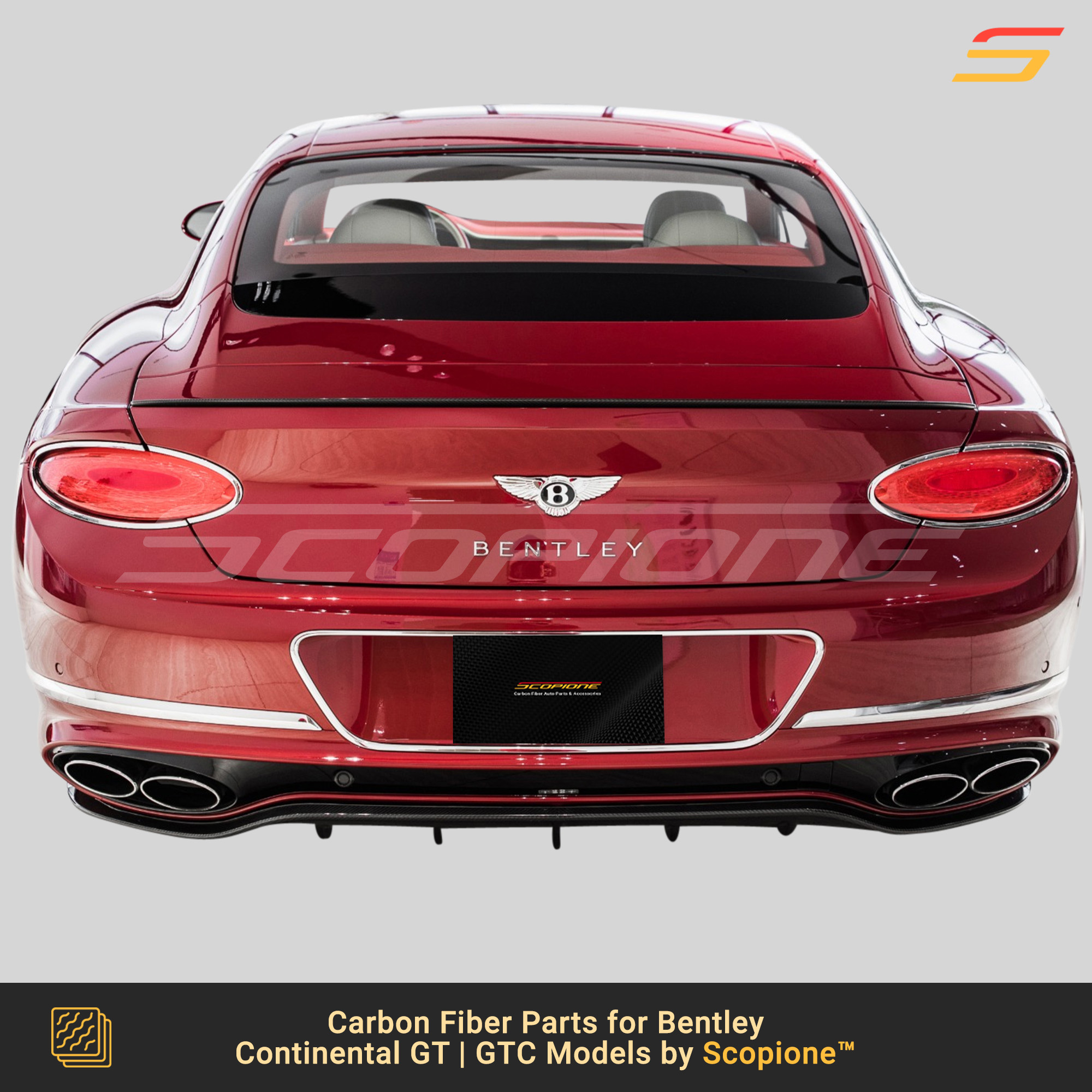
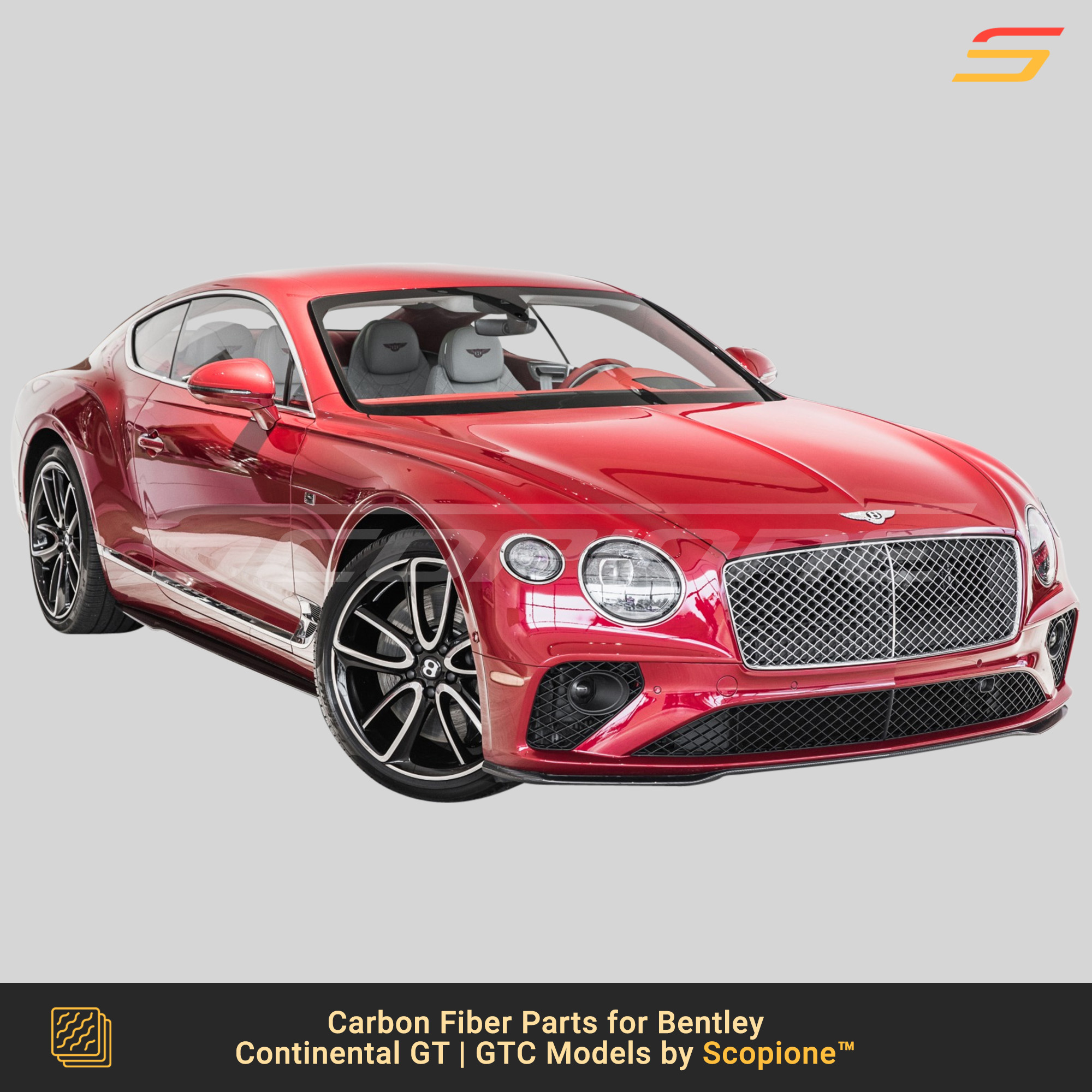
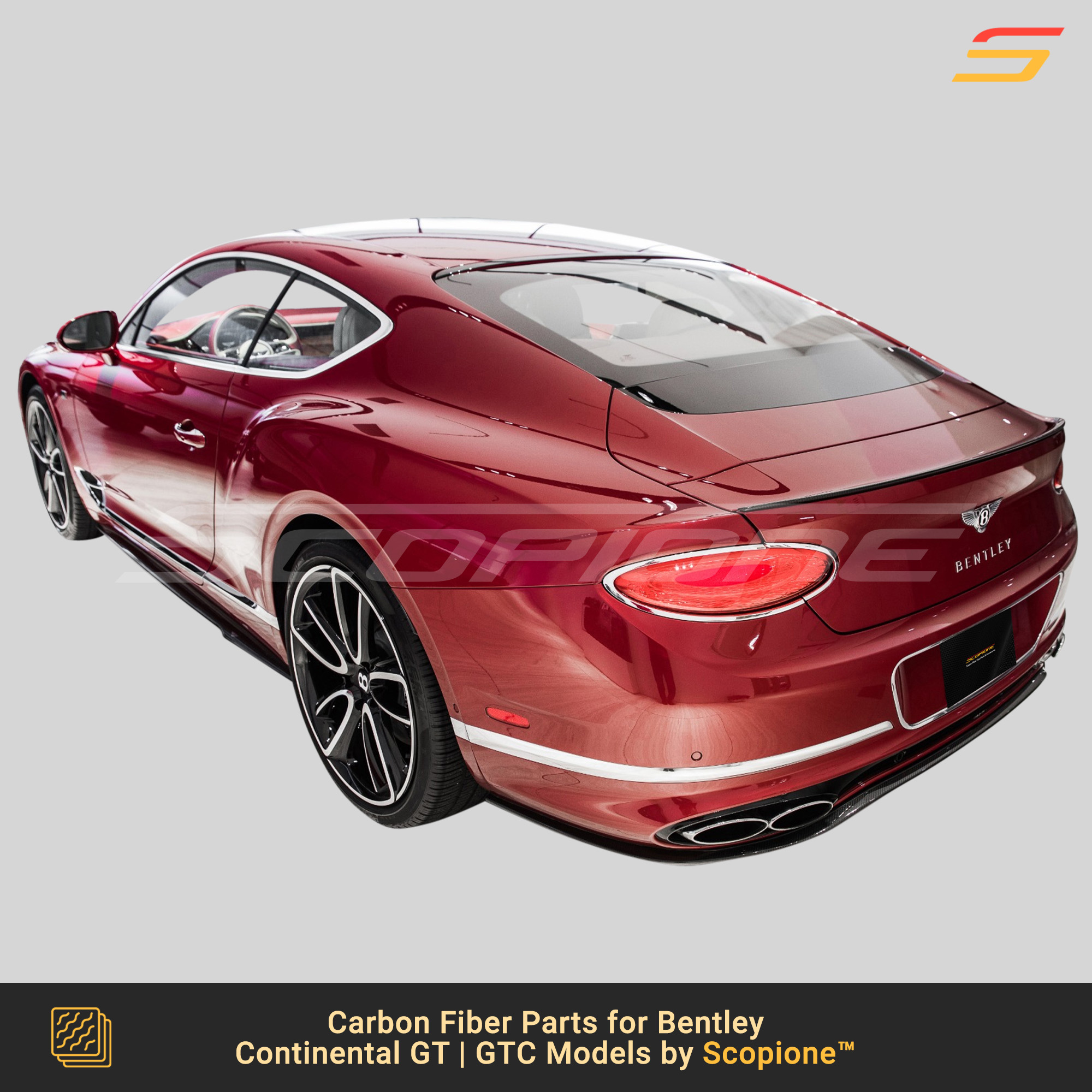
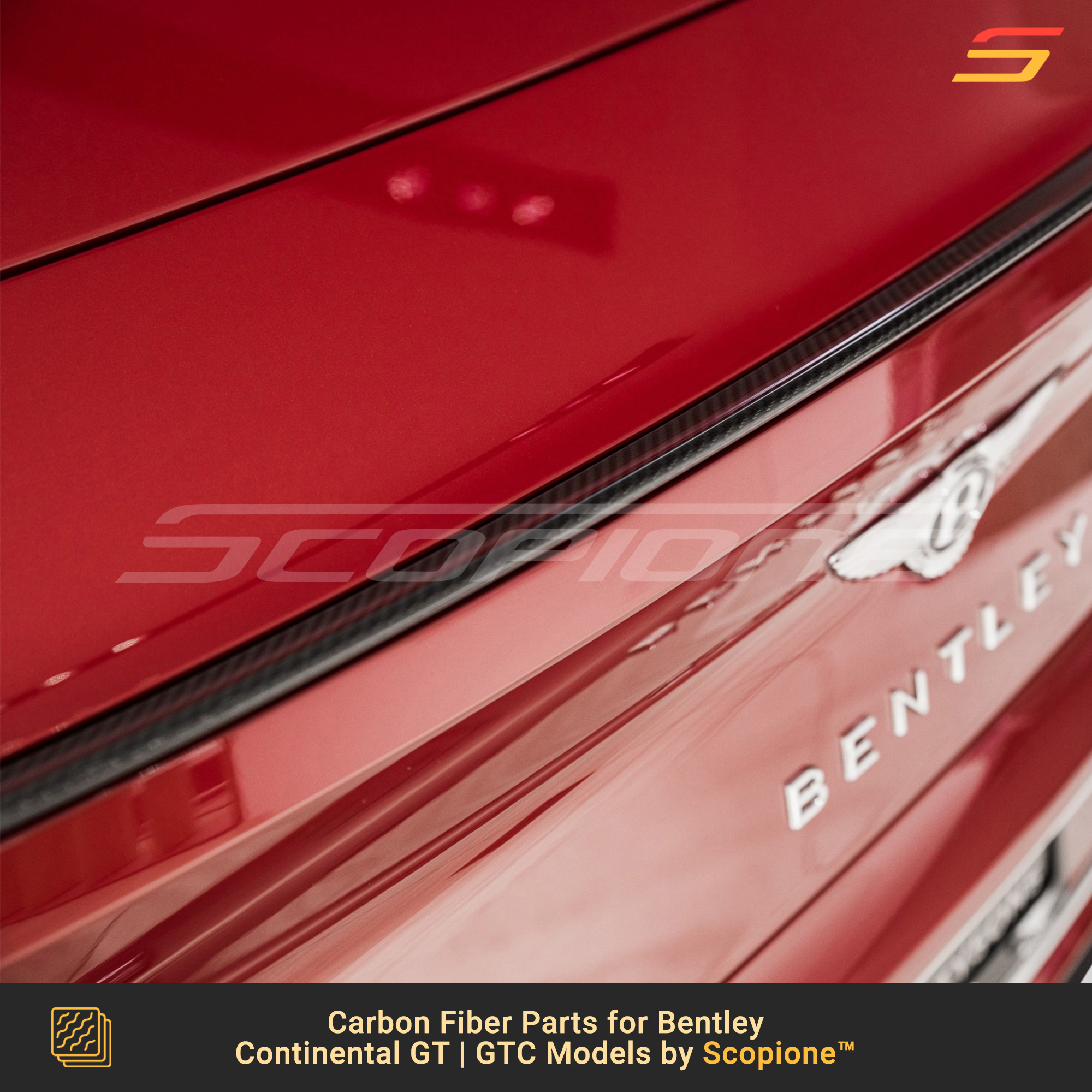
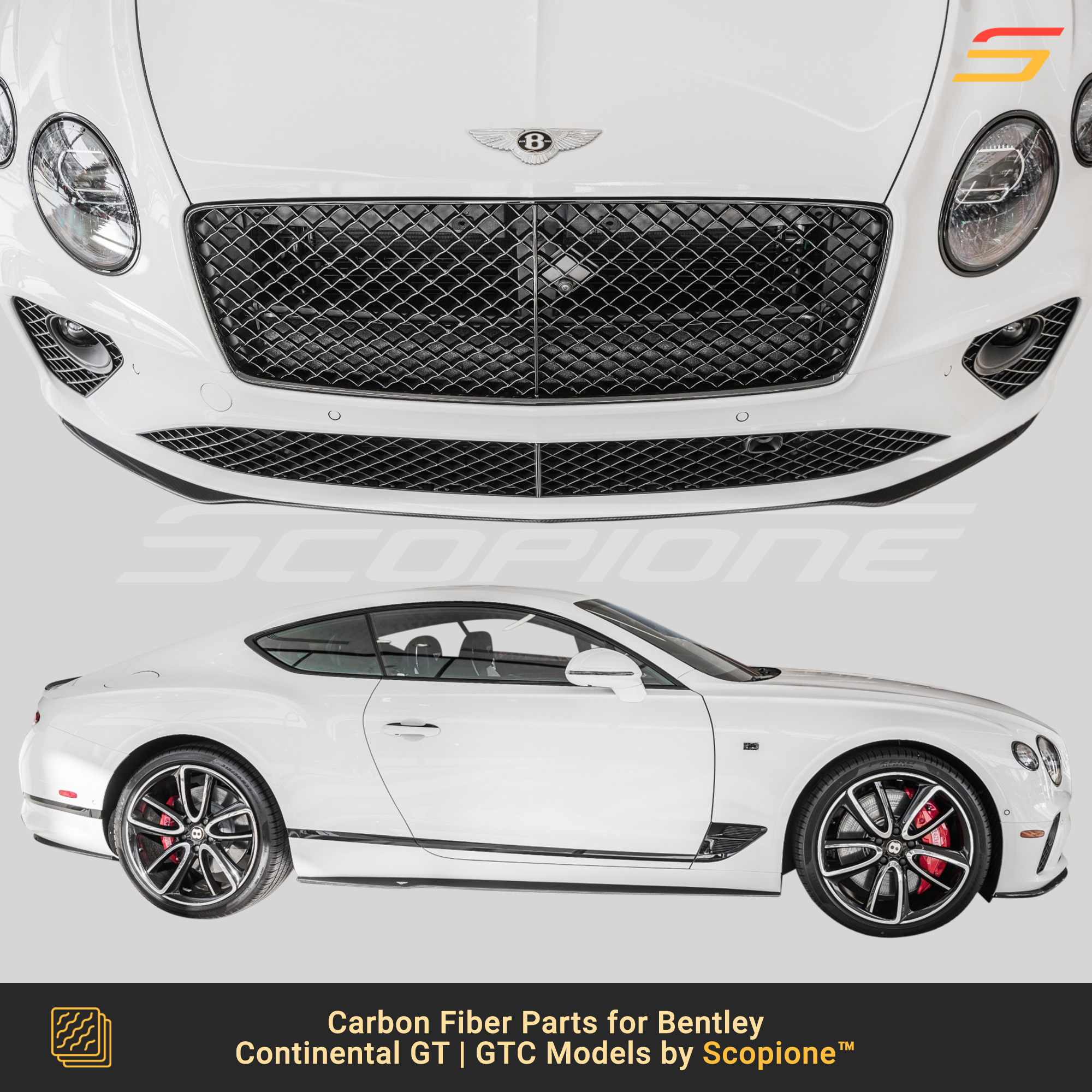
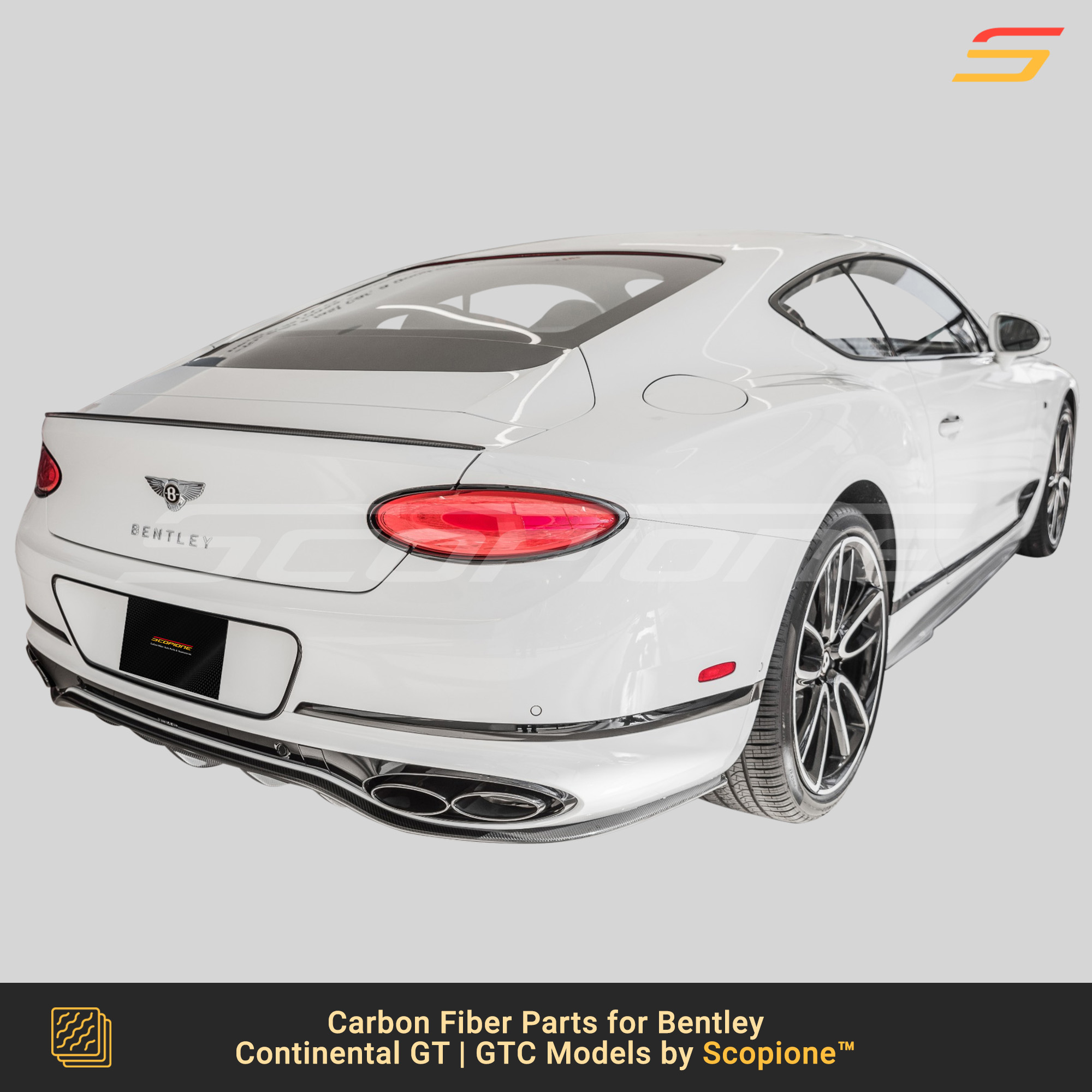
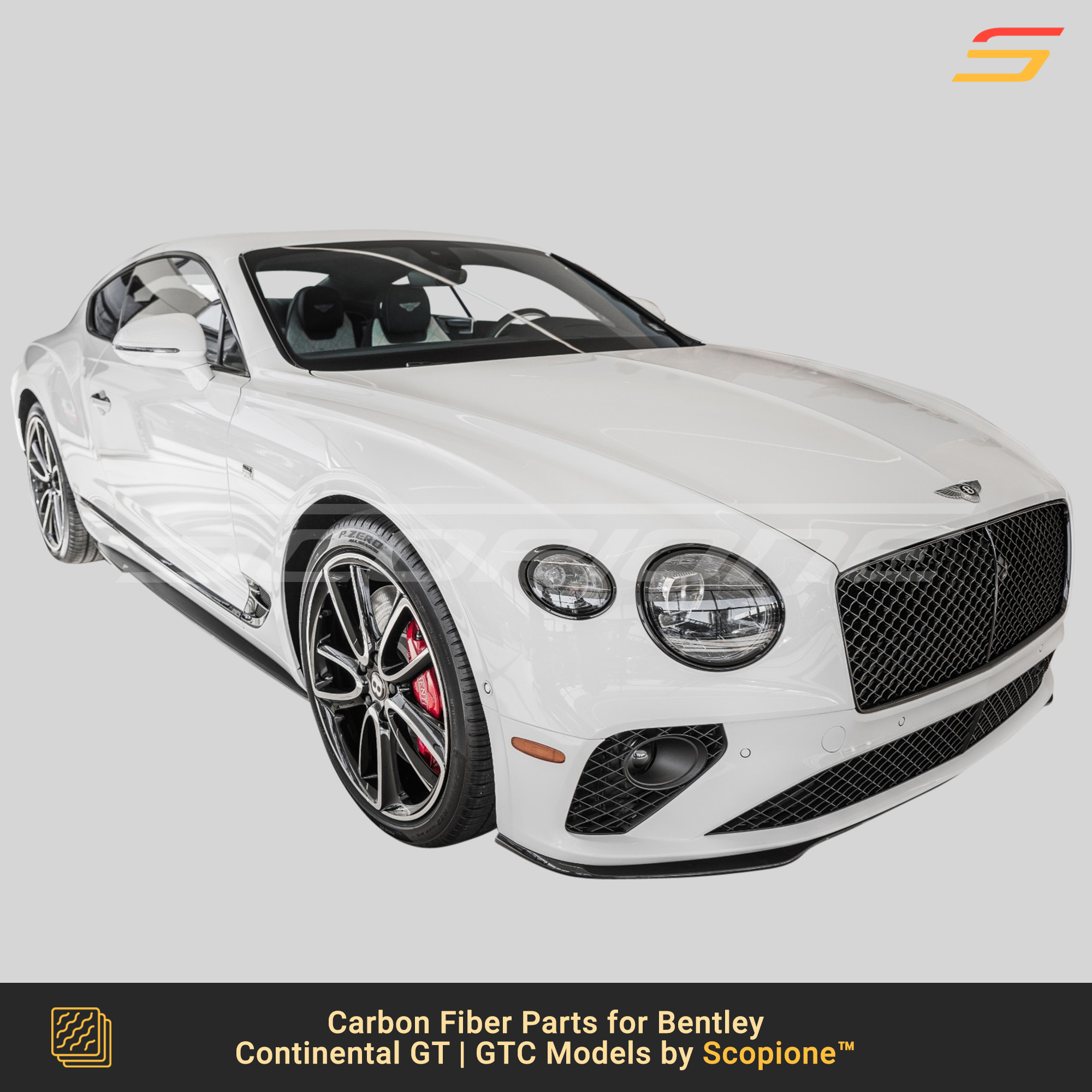
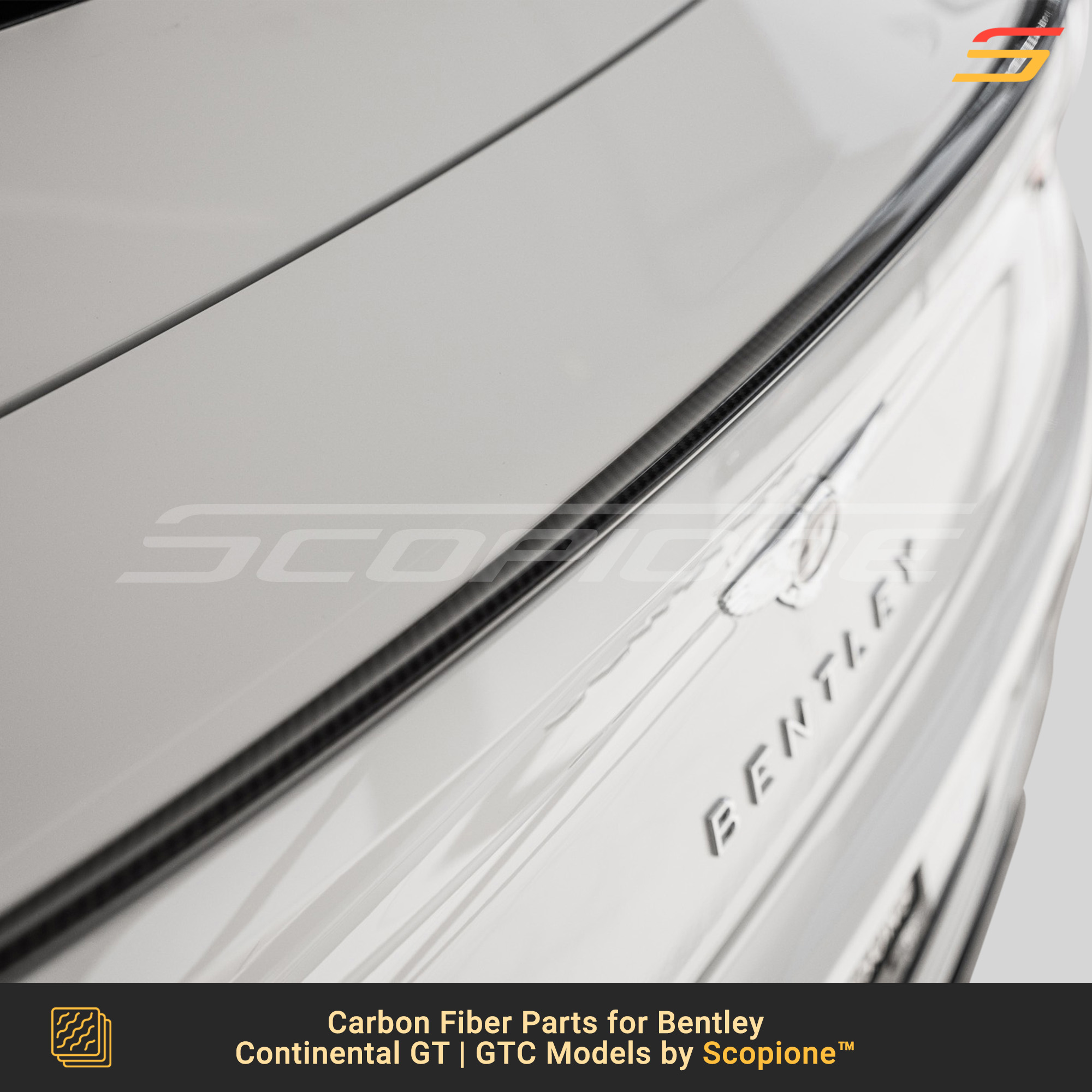
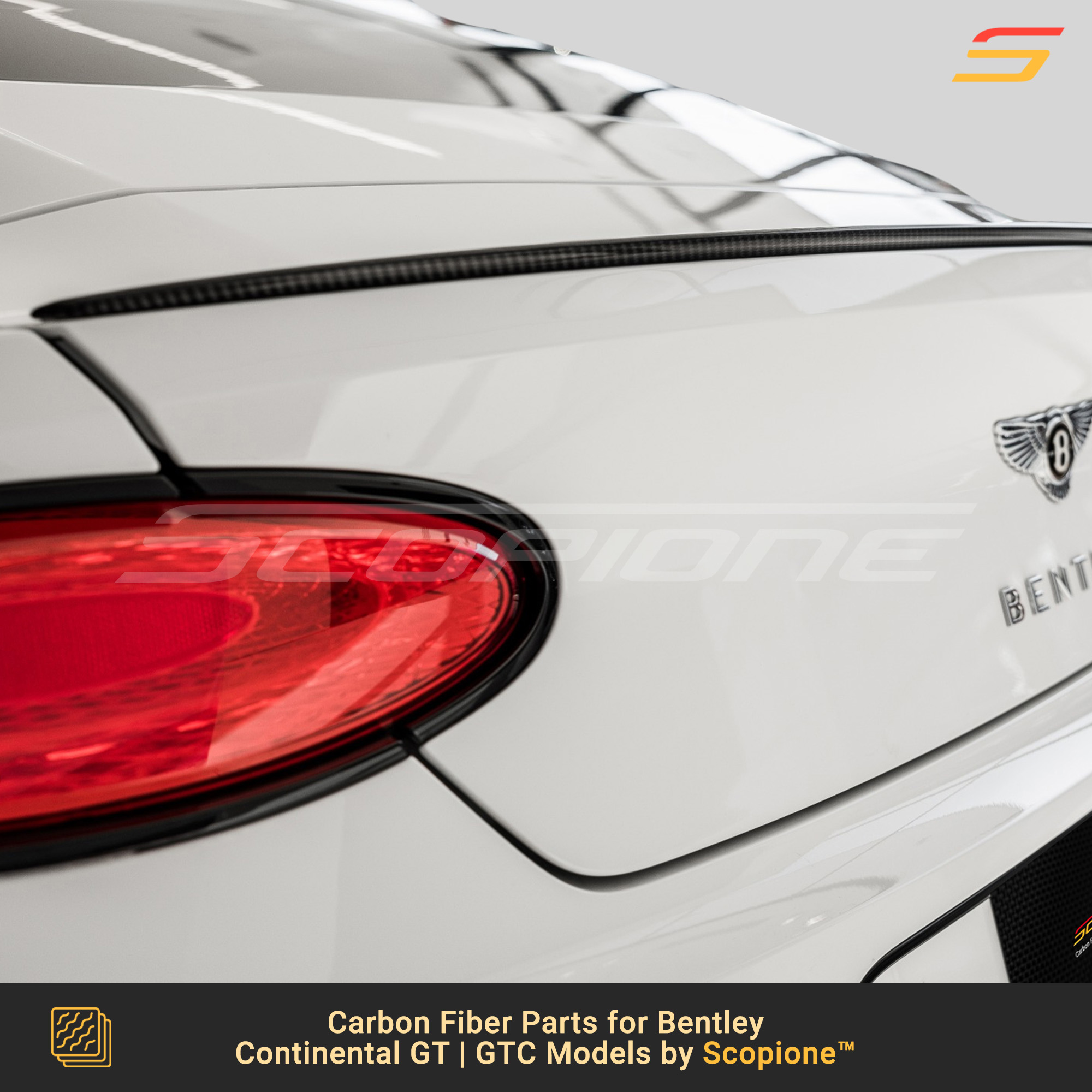
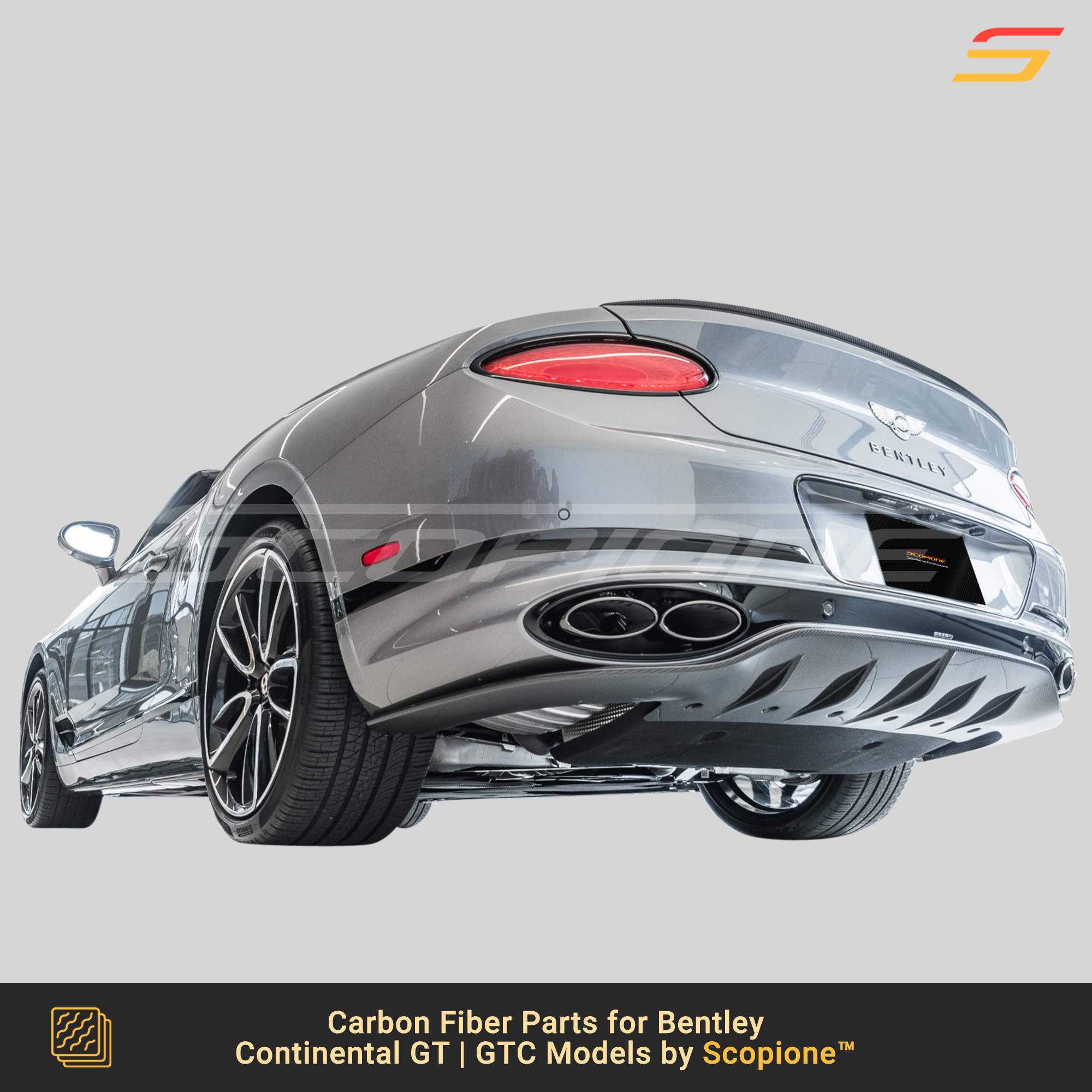
The Scopione Bentley Continental GT & GTC Picture Gallery features photographs of Continental GTs fitted with Scopione carbon-fiber aero components – front lips, rear diffusers, side skirts, and rear spoilers. Each image shows how the exposed CF twill-weave pattern integrates with the Continental’s factory body lines and paint finish.
Continental GT and GTC owners evaluating exterior modifications can browse these real-world installations as reference. The gallery captures the car’s grand touring proportions and aerodynamic profile with and without carbon-fiber upgrades.
Every Scopione component for the Continental GT and GTC is engineered to match factory body mounting geometry. The 2×2 3K twill-weave carbon fiber layup and UV-resistant clear coat finish is consistent across the full catalog – the same material quality on a 2016 GT V8 S and a 2024 GT Speed.
Browse the Scopione Bentley Continental GT & GTC catalog for specific part fitment, pricing, and installation details.
Customer Continental GT & GTC Photo Gallery
More customer Continentals wearing Scopione carbon fiber aero – browse the collection:

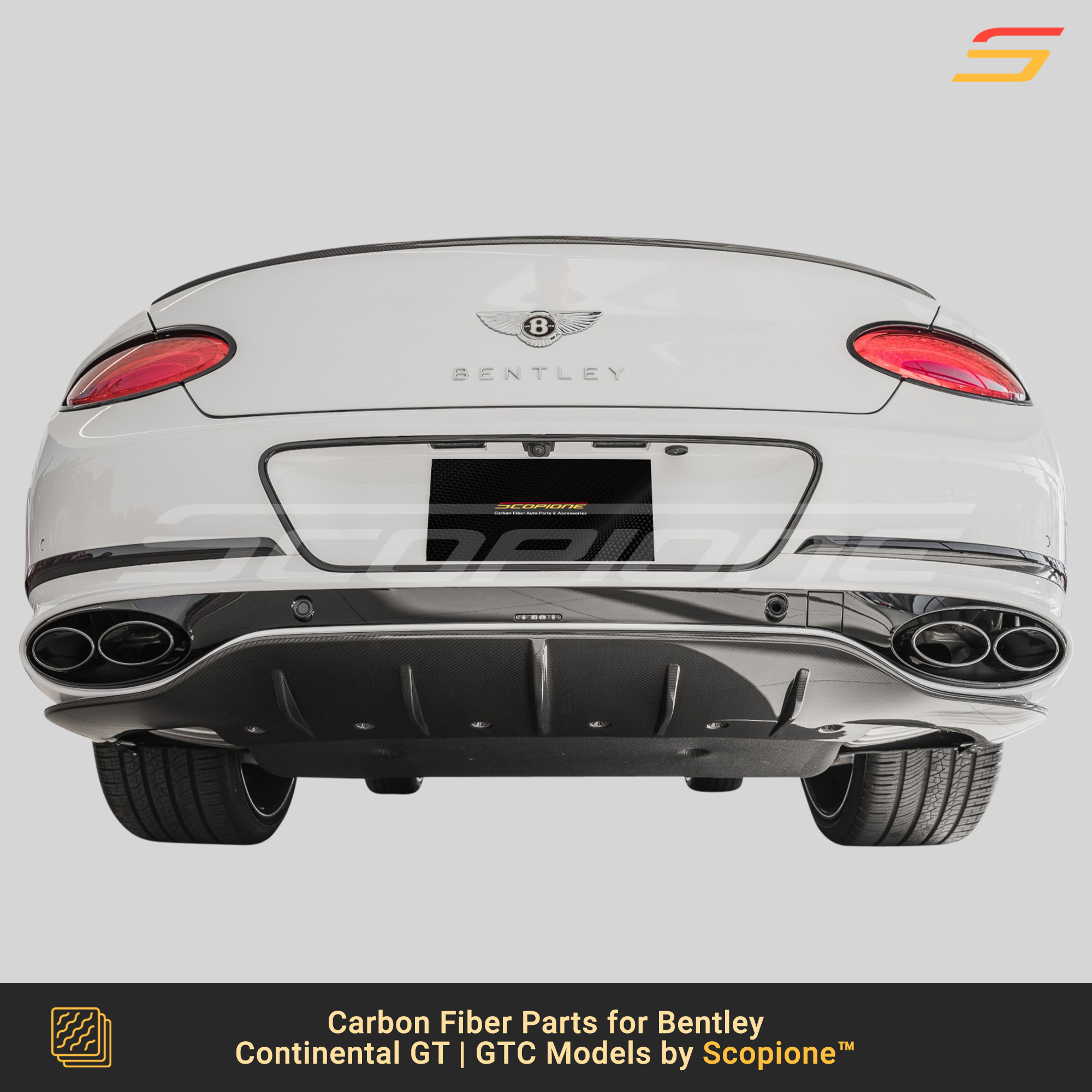







Carbon Fiber Parts for the Bentley Continental GT and GTC
The 11 carbon fiber parts Scopione currently lists for the Bentley Continental GT and GTC. Each image links to its product page.

More Scopione Picture Galleries
Scopione’s carbon fiber catalog covers a wide range of performance and luxury vehicles. Browse galleries for related makes and models:
- Ferrari: 458 Italia & Spider • 488 GTB & Spider • F8 Tributo & Spider • F12 & 812 Superfast • SF90
- Lamborghini: Gallardo • Huracan • Aventador • Urus
- McLaren: MP4-12C & 650S • 720S & 765LT • Sports Series
- Porsche: 911, Boxster & Cayman
- BMW: M3, M4, M5 & More
- Audi: R8
- Nissan: GT-R R35 • 350Z, 370Z & Z
- Aston Martin: Vantage, DB9 & DBS
- Maserati: GranTurismo & GranCabrio
- Toyota: Supra
- Subaru: WRX STI
- Mitsubishi: Lancer Evolution
- Chevrolet: Corvette • Camaro
- Dodge: Viper
Experience the elegance and performance of the Bentley Continental GT or GTC with Scopione. Browse our gallery and get inspired to elevate your supercar with our top-of-the-line carbon fiber upgrades.
Shop now for premium ScopioneCarbon carbon fiber upgrades and experience the ultimate in performance and aesthetics for your Bentley Continental GT or GTC!