

 Shop
ShopThe Lamborghini Huracan became the most-produced Lamborghini in history across its 10-year run (2014–2024) – a naturally aspirated 5.2-liter V10 paired with a 7-speed dual-clutch gearbox, totaling approximately 24,000 units. From the 602 hp LP 610-4 to the carbon-fiber-intensive STO and the final 10-unit STJ, the Huracan pushed Lamborghini’s lightweight engineering further with each variant. Scopione carries a full line of carbon fiber parts for the Lamborghini Huracan – engine bay covers, mirror shells, diffusers, side skirts, interior trim – precision-fitted to factory mounting points across all model years.

Introduction: The Birth of the Lamborghini Huracan
The Lamborghini Huracan was revealed online in December 2013 and made its worldwide public debut at the 2014 Geneva Motor Show. It replaced the Lamborghini Gallardo – the car that had saved the company’s finances – and did so with an entirely new platform, a new transmission architecture, and a mandate to double the predecessor’s production numbers. Named after a Spanish fighting bull from 1879, the Huracan was designed by Filippo Perini during his tenure as Director of Centro Stile (2006–2015). He had already shaped the Aventador. The Huracan was his second act.
Underneath, the Huracan rides on the Modular Sports System (MSS) platform – a hybrid aluminum and carbon fiber monocoque shared with the Audi R8 Type 4S. Chassis assembly takes place at Audi’s Neckarsulm facility in Germany before final assembly at Sant’Agata Bolognese. The 5.2-liter V10 was the first engine in the segment to combine both direct fuel injection (DFI) and multi-point injection (MPI) – a dual system that improved throttle response at low rpm while maintaining peak power at 8,250 rpm. And the transmission was a clean break from the Gallardo’s aging E-gear: a 7-speed LDF (Lamborghini Doppia Frizione) dual-clutch, the first DCT in a Lamborghini.
Scopione’s Huracan carbon fiber catalog covers engine bay covers, mirror shells, diffusers, side skirts, air vents, and interior trim – precision-fitted across all model years from 2014 to 2024.
LP 610-4 / LP 580-2 (2014–2019): The Foundation
The launch Huracan – the LP 610-4 – produced 610 PS (602 hp) from a 5.2-liter naturally aspirated V10, paired with AWD and the new 7-speed dual-clutch. Dry weight sat at 1,422 kg (3,135 lb). Factory-claimed 0–60 came in at 3.2 seconds. Independent tests consistently beat that figure, recording 2.8–3.0 seconds. Top speed: 325 km/h (202 mph).
Lamborghini received over 700 orders within the first month – before a single car had reached a customer. The Spyder convertible followed at the 2015 Frankfurt Motor Show, adding roughly 100 kg of chassis reinforcement. Then in 2016, the LP 580-2 introduced the first rear-wheel-drive Huracan: 580 PS (572 hp), 33 kg lighter than the AWD car, with a 40/60 front-rear weight distribution and ANIMA driving modes tuned specifically for oversteer characteristics.
But the variant that redefined the Huracan’s reputation arrived in 2017:
- Performante LP 640-4 (2017–2019) – 631 hp with 40 kg stripped through Forged Composite (chopped carbon fiber in resin) body panels. The patented ALA (Aerodinamica Lamborghini Attiva) active aero system used motorized flaps inside a hollow Forged Composite rear wing – 750% more downforce than the standard car. On October 5, 2016, Marco Mapelli drove it around the Nurburgring Nordschleife in 6:52.01, beating the Porsche 918 Spyder’s previous record. Approximately 1,800 units produced (coupe and Spyder combined).
- LP 610-4 Avio (2016) – 250 units dedicated to the Italian Air Force. Five exclusive color options with military-inspired interior logos. The first limited-edition Huracan.
- Performante Spyder (2018–2019) – Open-top Performante with identical ALA active aero and 631 hp powertrain. A 2018 Performante Spyder holds the highest recorded Huracan auction result at $493,500 (July 2024).
Models & Key Specifications:
- LP 610-4 Coupe (2014–2019)
- Engine: 5.2L V10 (602 HP)
- Transmission: 7-speed LDF dual-clutch
- Drivetrain: AWD
- 0–60 mph: 3.2 seconds (factory) / 2.8–3.0 seconds (tested)
- LP 580-2 Coupe (2016–2019)
- Engine: 5.2L V10 (572 HP)
- Drivetrain: RWD
- Dry weight: 1,389 kg (3,062 lb) – 33 kg lighter than AWD
- Performante LP 640-4 (2017–2019)
- Engine: 5.2L V10 (631 HP)
- Dry weight: 1,382 kg (3,047 lb) – 40 kg lighter than standard
- Production: ~1,800 units (coupe + Spyder)
Lamborghini Huracan (2014–2019) MSRP Price Ranges
| Model | Base MSRP (USD) | Price Adjusted for Inflation (2024) |
|---|---|---|
| LP 610-4 Coupe (2015–2019) | $237,250 | ~$305,000 |
| LP 610-4 Spyder (2016–2019) | $262,350 | ~$330,000 |
| LP 580-2 Coupe (2016–2019) | $201,100 | ~$253,000 |
| LP 580-2 Spyder (2017–2019) | $222,000 | ~$275,000 |
| Performante Coupe (2018–2019) | $274,390 | ~$330,000 |
| Performante Spyder (2018–2019) | $308,859 | ~$365,000 |
Scopione stocks carbon fiber components for every first-generation Huracan variant – browse by model year.
EVO / EVO RWD (2019–2022): The LDVI Era
The 2019 EVO was not a facelift. Lamborghini replaced the central nervous system. The LDVI (Lamborghini Dinamica Veicolo Integrata) brain now controlled every dynamic system simultaneously – AWD torque split, rear-wheel steering (new to the Huracan), torque vectoring, traction control, and magneto-rheological damping. Instead of reacting to driver inputs, the LDVI used “feed forward logic” to predict and pre-adjust. Titanium intake valves, borrowed from the Aventador SVJ, allowed the V10 to breathe more efficiently at peak rpm.
The result: 640 PS (631 hp) for the EVO AWD – matching the Performante’s output but in a car with rear-wheel steering and 5x more front downforce than the outgoing LP 610-4. The physical interface changed too. An 8.4-inch capacitive touchscreen replaced the previous button-heavy center console. Apple CarPlay integration arrived for the first time.
The EVO RWD followed in 2020 with 610 PS (602 hp) and a new P-TCS (Performance Traction Control System) calibrated to deliver 73% more downforce than the LP 580-2 and 30% more precise oversteer control. At 1,389 kg dry, it was 73 lb lighter than the EVO AWD.
- EVO GT Celebration (2019) – 36 units commemorating consecutive victories at the 24 Hours of Daytona (2018–2019) and 12 Hours of Sebring (2018–2019). One unit for each combined racing hour.
Lamborghini Huracan EVO (2019–2022) MSRP Price Ranges
| Model | Base MSRP (USD) | Price Adjusted for Inflation (2024) |
|---|---|---|
| EVO AWD Coupe (2020–2022) | $261,274 | ~$305,000 |
| EVO AWD Spyder (2020–2022) | $287,400 | ~$336,000 |
| EVO RWD Coupe (2020–2022) | $208,571 | ~$244,000 |
| EVO RWD Spyder (2020–2022) | $230,000 | ~$269,000 |
EVO-generation Huracan owners can find model-specific carbon fiber parts on the Scopione Huracan page.
Final Variants (2021–2024): The Last V10
The Huracan’s final chapter produced the sharpest driver’s cars Lamborghini had ever built. Each variant took the 5.2-liter V10 in a different direction – track, road, and terrain.
- STO (Super Trofeo Omologata, 2021–2024) – 631 hp with 75% of body panels in carbon fiber. Dry weight dropped to 1,339 kg – 43 kg lighter than the Performante. The “cofango” – a single-piece carbon fiber front component merging hood, fenders, and bumper – came directly from the Super Trofeo race car. Brembo co-developed the CCMR (Carbon Ceramic Matrix Reinforced) brakes, derived from Formula 1 technology and appearing on a production car for the first time. Downforce increased 53% over the Performante. Base MSRP climbed from $327,838 at launch to $417,000 by 2024.
- Tecnica (2022–2024) – 631 hp, RWD, positioned between EVO RWD and STO. Carbon-fiber front hood and rear engine cover came standard. Rear-wheel steering with 3 degrees maximum deflection. 35% more downforce than EVO, 20% less drag. The Tecnica bridged daily driving and track work in a way the STO intentionally did not.
- Sterrato (2023–2024) – 602 hp, AWD, with 44 mm more ground clearance than the EVO. Bridgestone Dueler all-terrain tires. LED off-road lights. A Rally driving mode. Digital inclinometer and compass – firsts for any Lamborghini. All 1,499 units sold immediately. The Sterrato was the last non-hybrid Lamborghini launched.
- STJ (Super Trofeo Jota, 2024) – The last Huracan. Ten units total, one per cylinder. Improved aero from the STO with four-way adjustable racing shocks replacing standard active dampers. Over one second faster than the STO on Nardo’s handling track. “Jota” references FIA Appendix J – a Lamborghini racing tradition dating back to the Miura SVJ.
- 60th Anniversary Editions (2023) – 60 units each of the STO, Tecnica, and EVO Spyder (180 total). Carbon fiber “1 of 60” identification plaque and anniversary liveries.
Lamborghini Huracan Final Variants (2021–2024) MSRP Price Ranges
| Model | Base MSRP (USD) | Price Adjusted for Inflation (2024) |
|---|---|---|
| STO (2021 launch) | $327,838 | ~$370,000 |
| STO (2024) | $417,000 | $417,000 |
| Tecnica (2023–2024) | $280,000 – $300,000 | ~$290,000 |
| Sterrato (2023) | $278,972 | ~$290,000 |
| Sterrato (2024) | $296,000 | $296,000 |
Huracan owners across all generations can view all available parts on the Scopione Huracan page.
Carbon Fiber Integration in Lamborghini Huracan Over the Years
Carbon fiber defined the Huracan’s performance hierarchy even more sharply than it had on the Gallardo. The base LP 610-4 used it sparingly – optional Ad Personam interior trim in Forged Composite. The Performante made it structural, with ALA active aero housed inside a hollow carbon fiber wing. And the STO went further than any road-going Lamborghini before it: 75% of external body panels in carbon fiber, built using an aerospace-derived sandwich construction technique that used 25% less material while maintaining full structural rigidity.
1. Exterior Enhancements
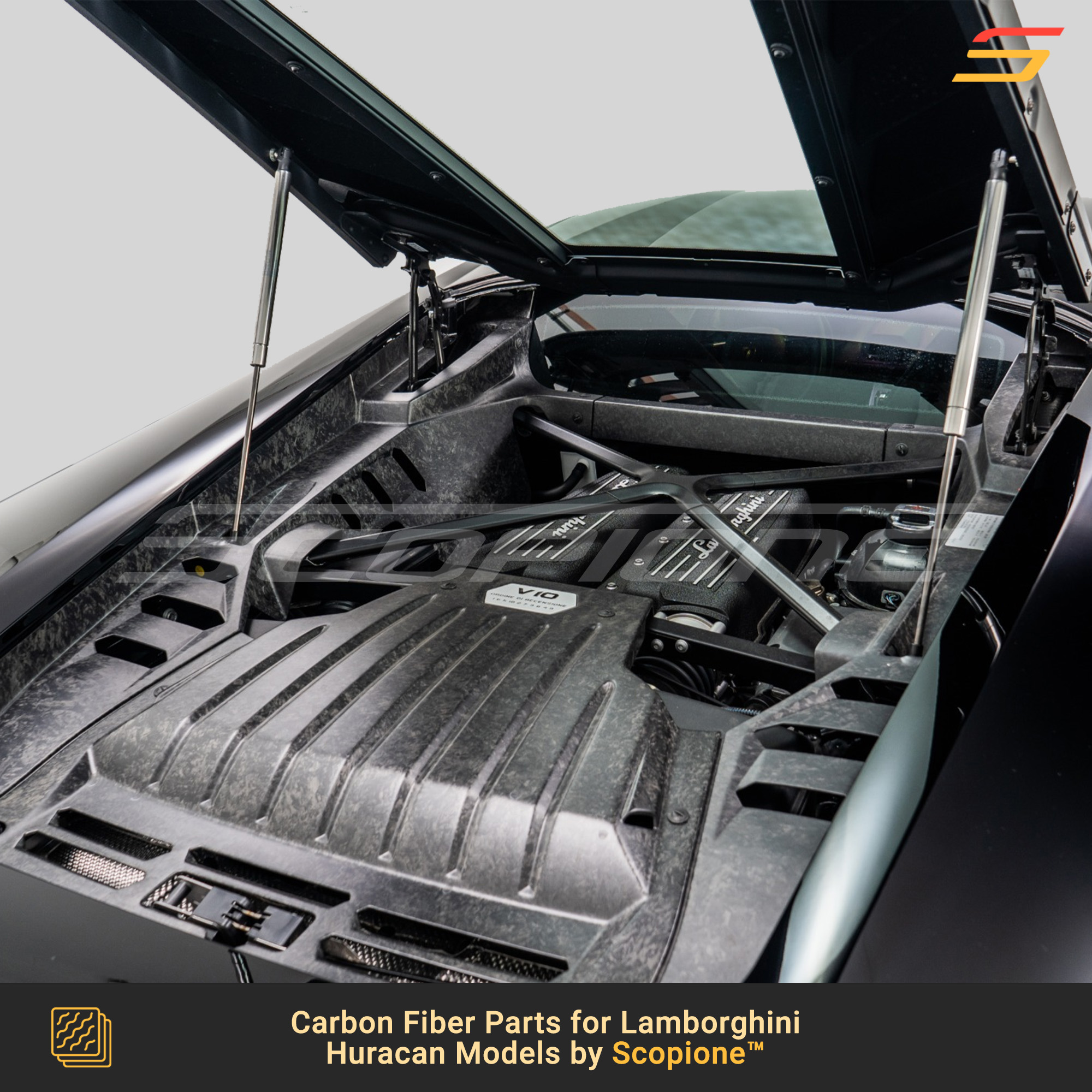
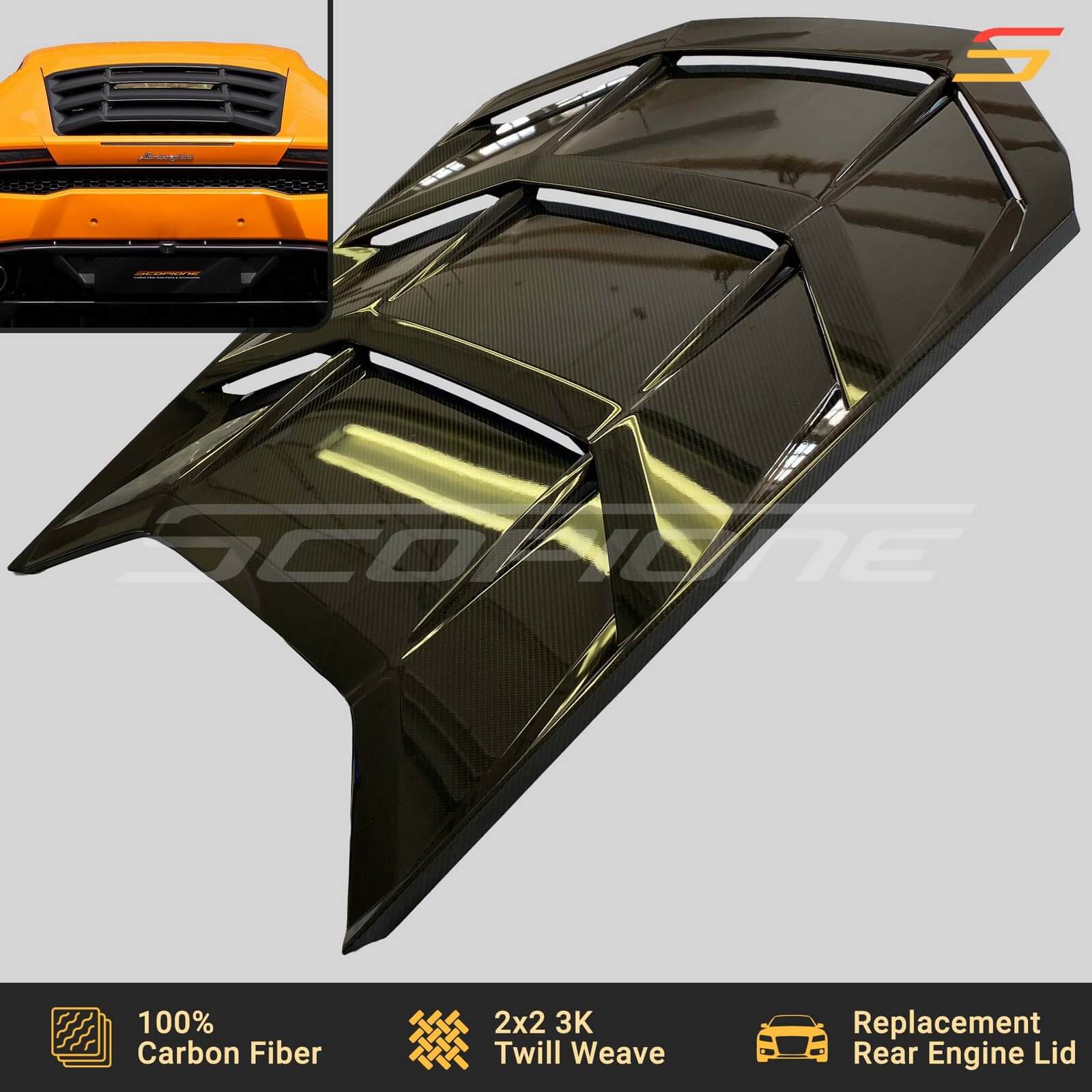
- Engine Bay Covers – Carbon-fiber construction reduces weight over the rear axle while exposing the 2×2 twill-weave pattern through a clear-coated finish. Scopione’s replacement engine bay covers kit is the first Huracan upgrade other drivers notice.
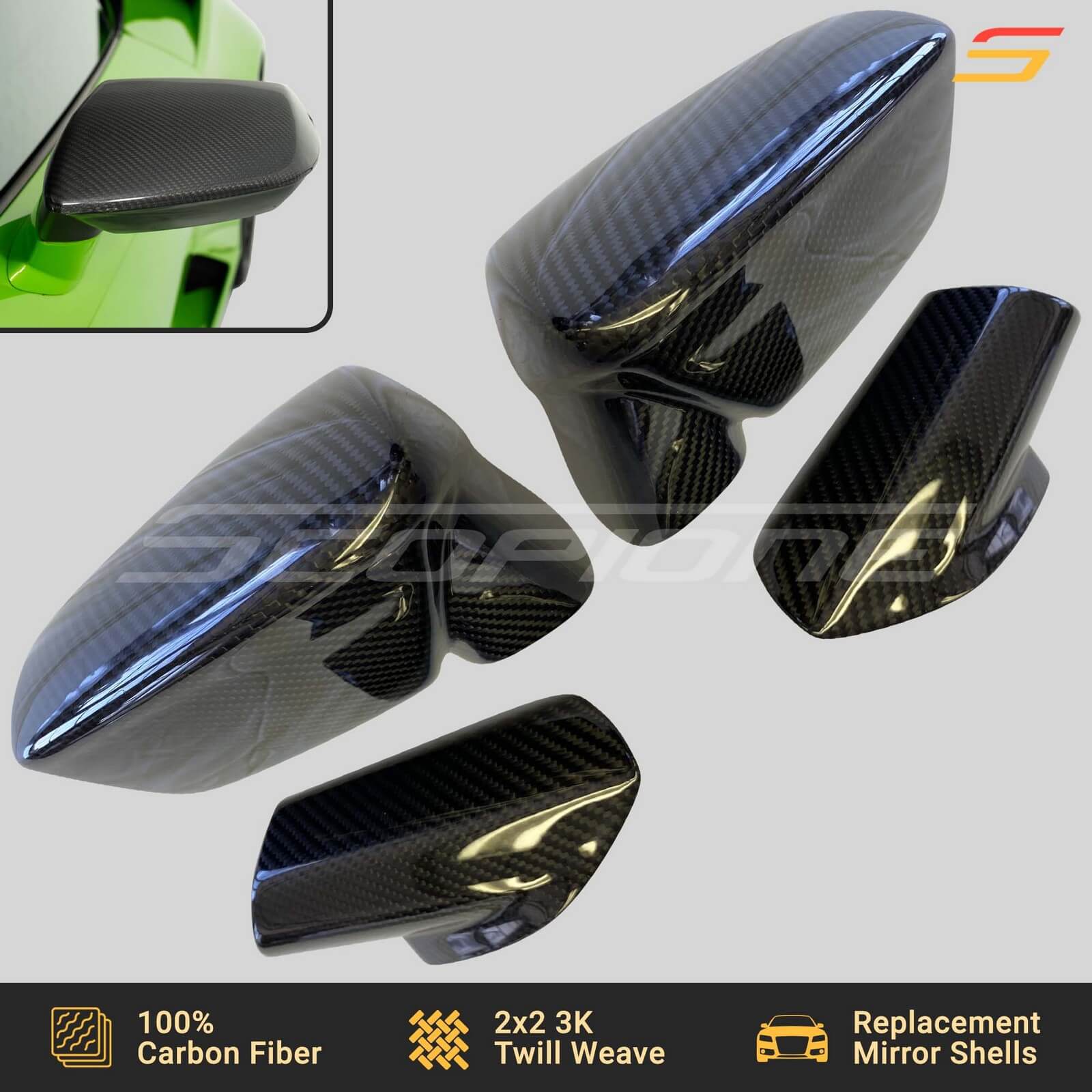
- Mirror Shells – Direct-replacement side mirror covers in carbon fiber. A bolt-on change that alters the car’s profile from any angle.
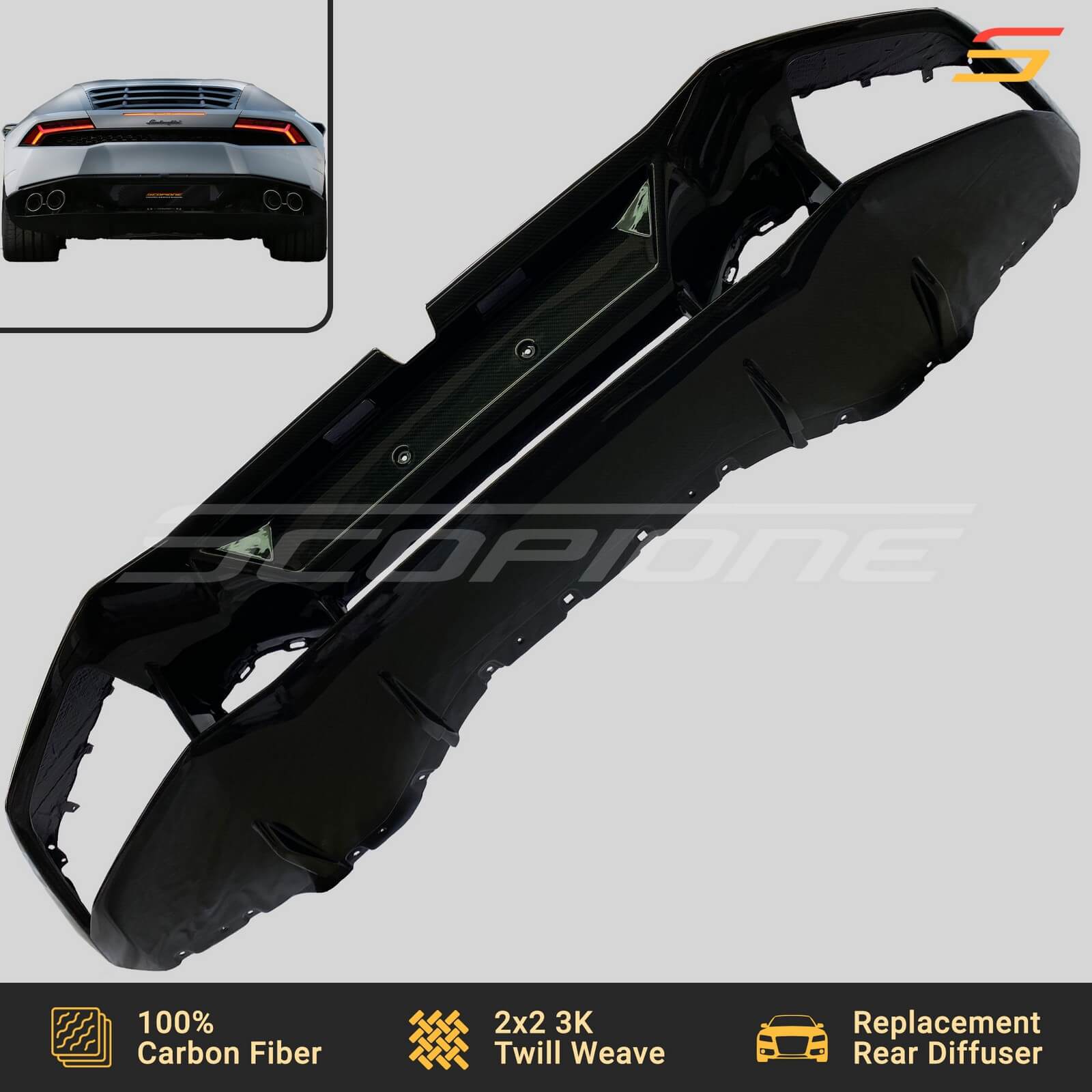
- Rear diffuser in carbon fiber improves rear aerodynamic profile and replaces the factory unit on LP610 models.
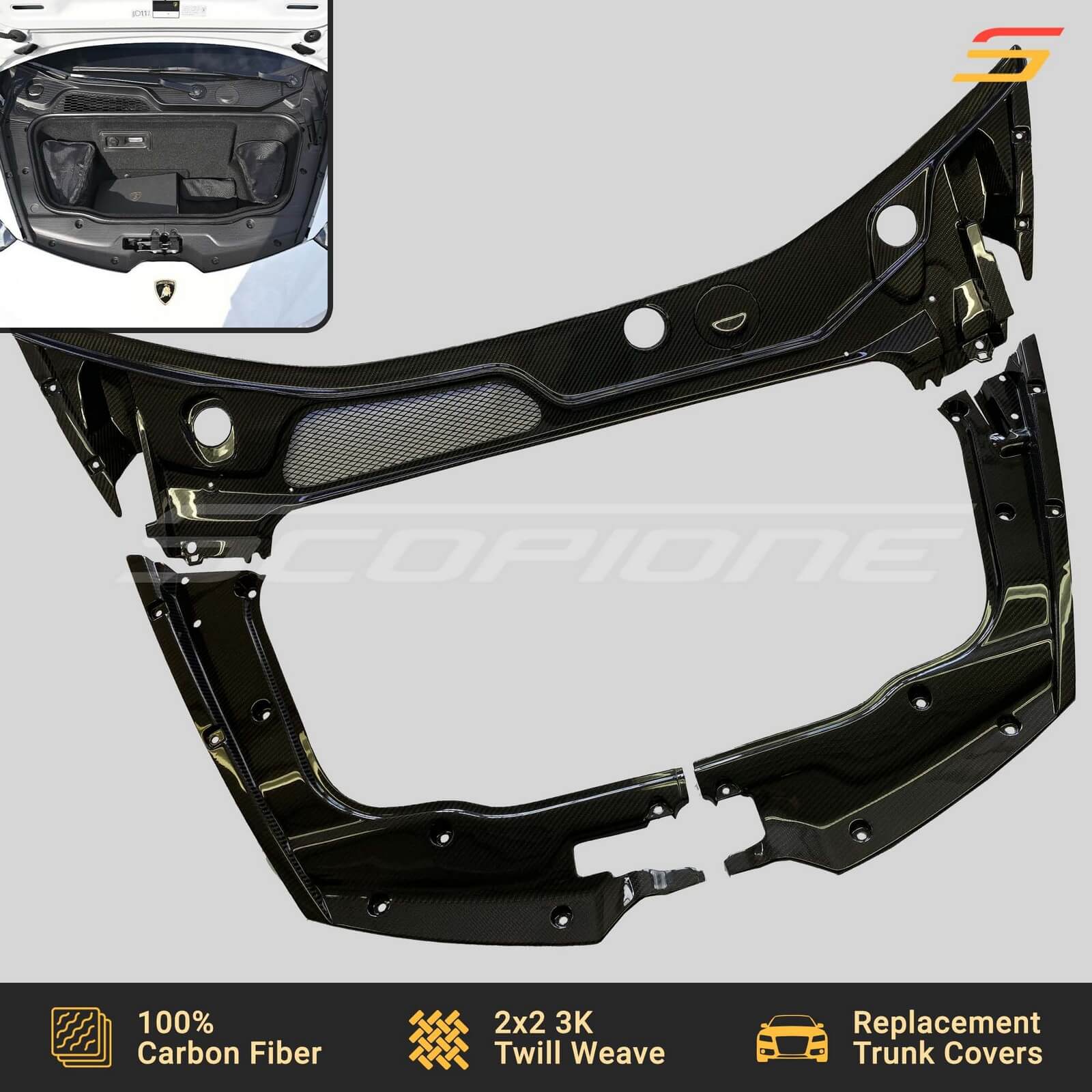
- Front hood and trunk cover kits extend the carbon-fiber treatment forward, matching the STO and Tecnica’s factory approach on earlier variants.
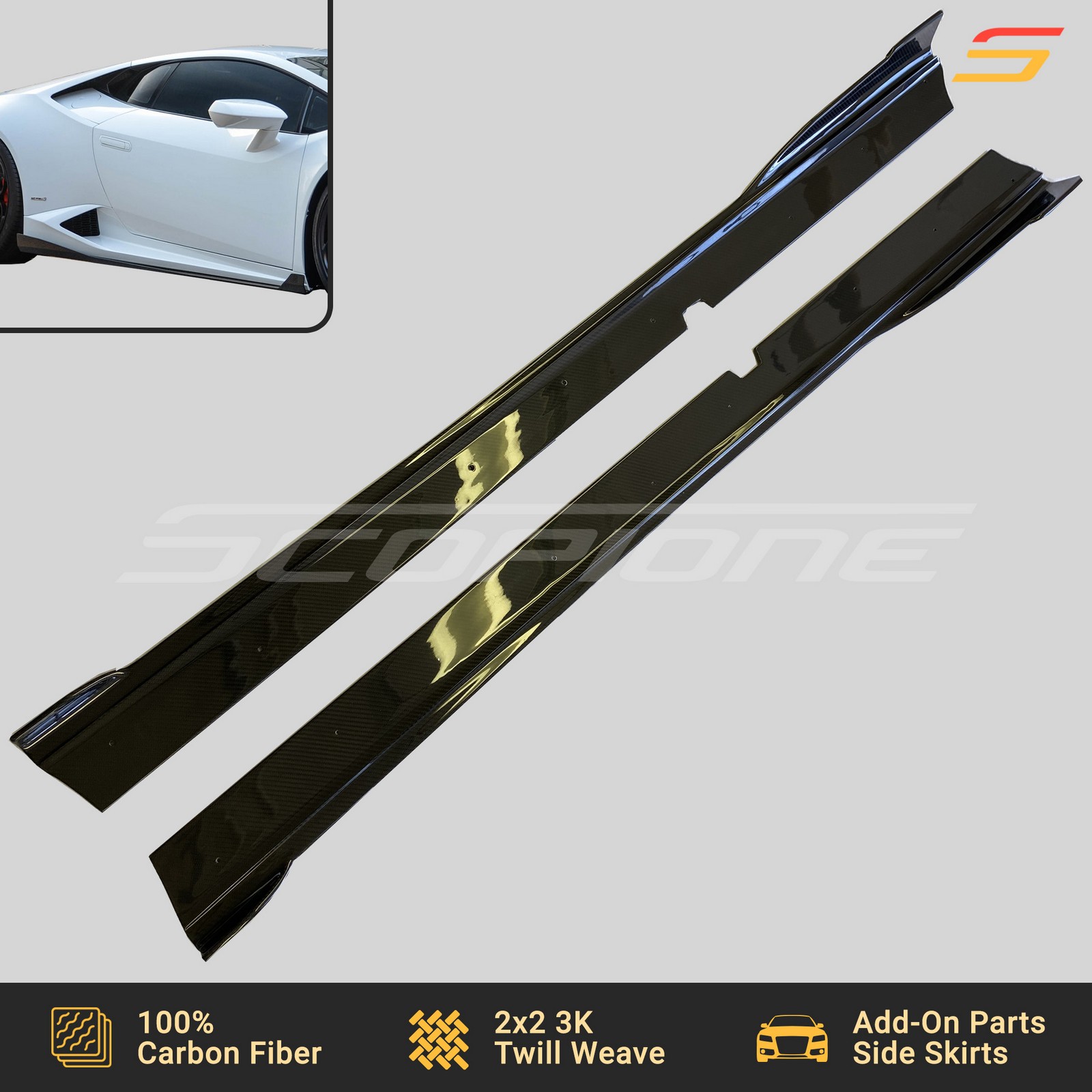
- Side Skirts – Widened carbon fiber side skirts (compatible with LP 580 and LP 610) direct airflow along the body sides, adding both visual width and functional aerodynamic benefit at speed.
All exterior carbon fiber components are available through Scopione’s Huracan page, with fitment data listed per model year.
2. Interior Upgrades
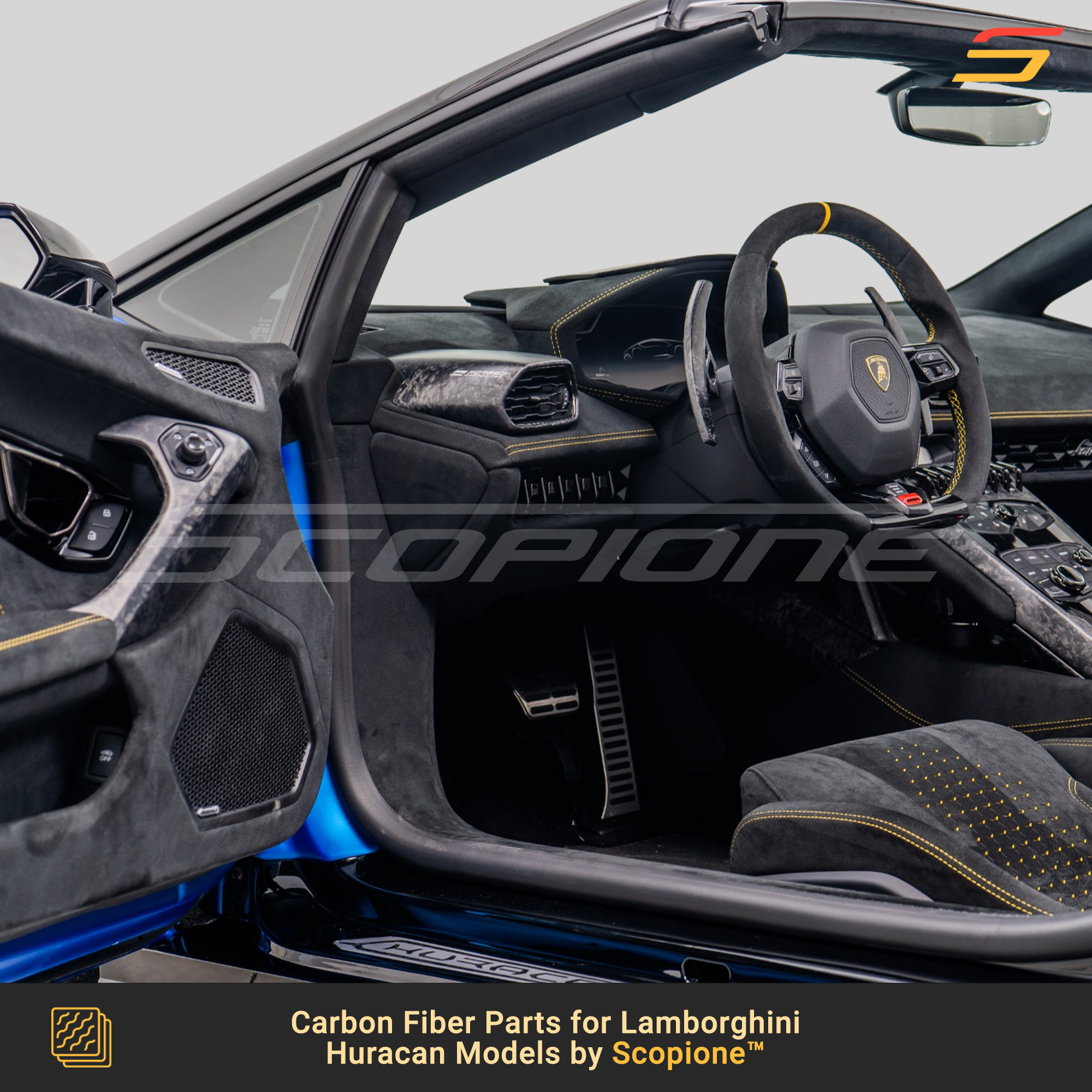
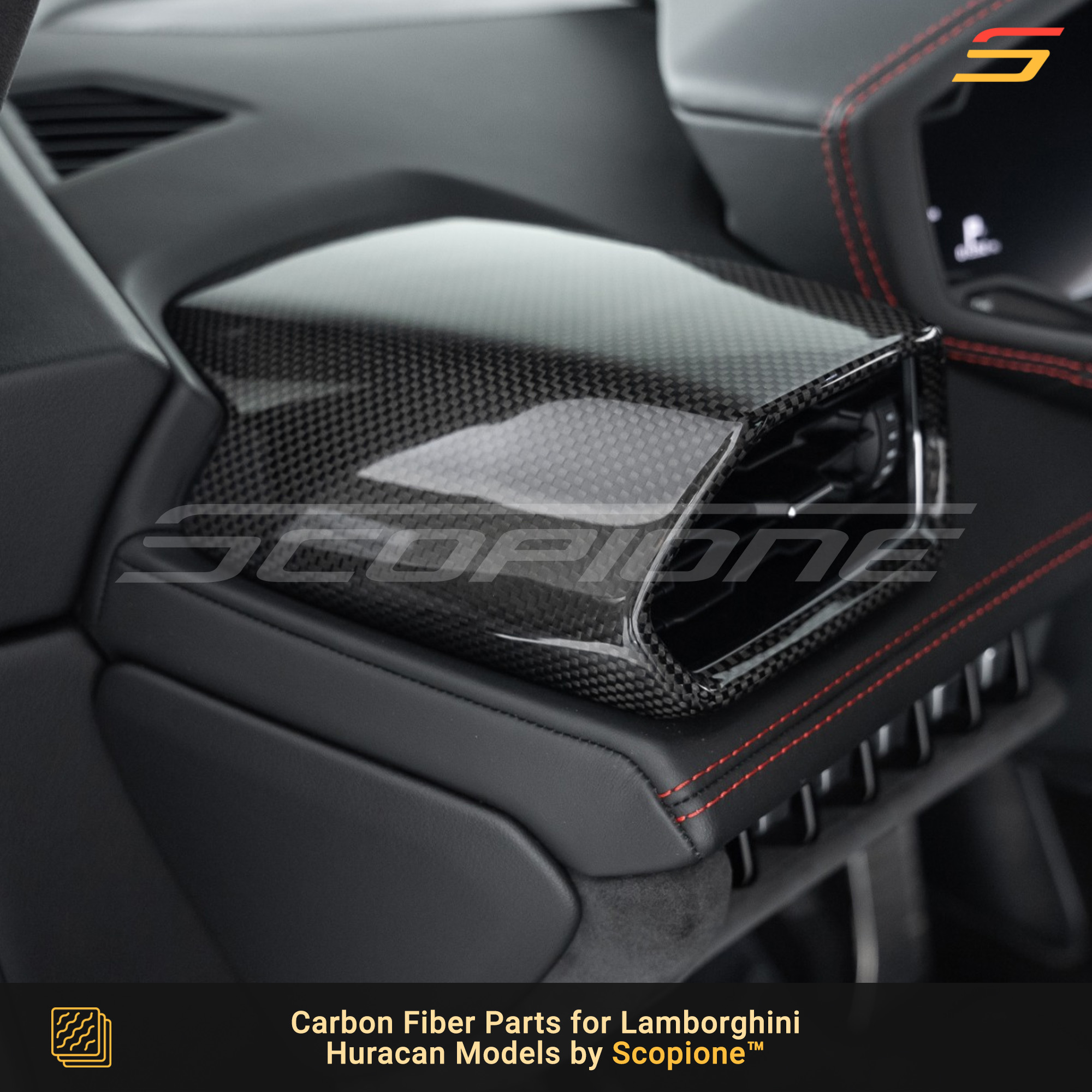
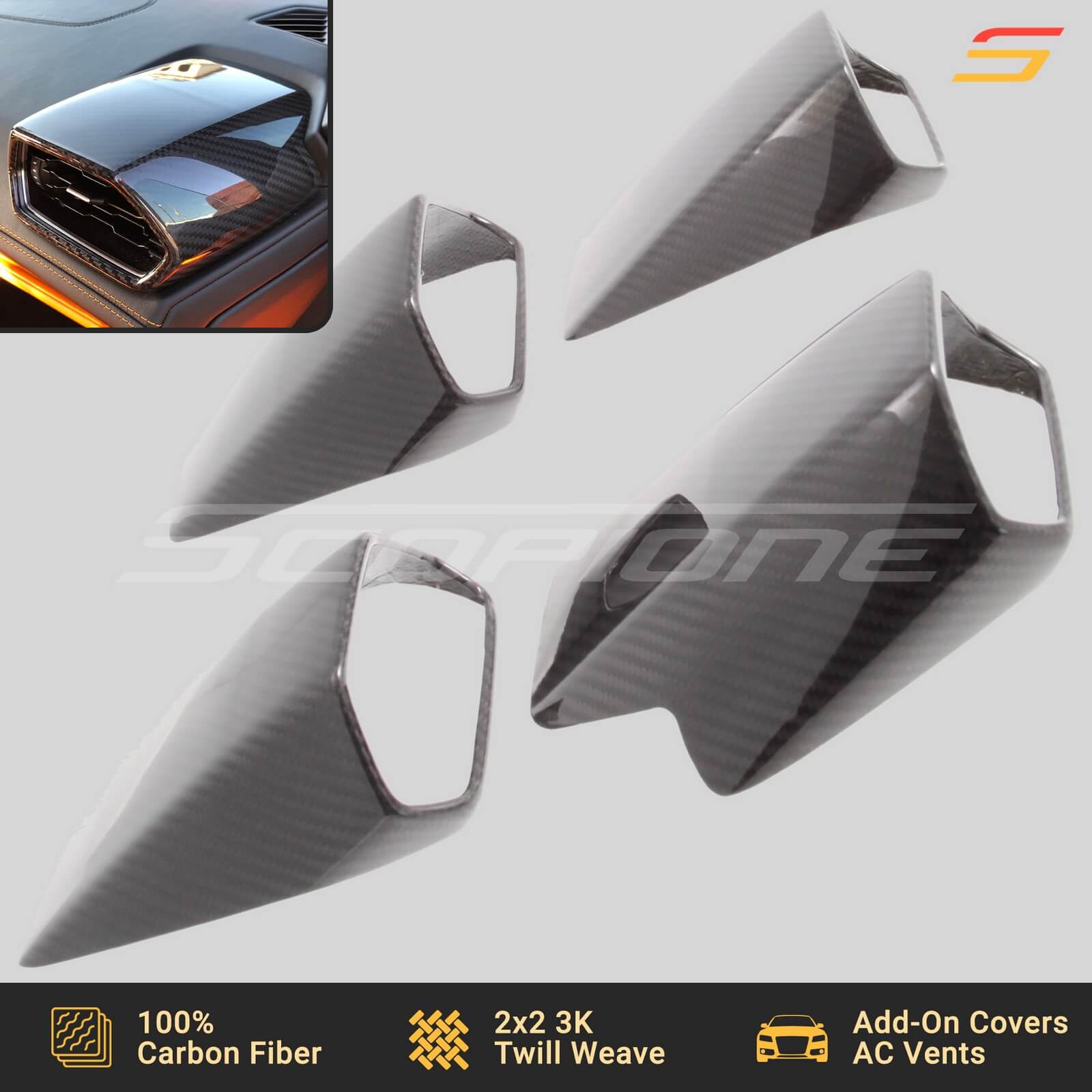
- AC Vent Covers – Carbon fiber overlays on the dashboard air vents, adding visible weave texture to the cockpit without modifying the HVAC system.
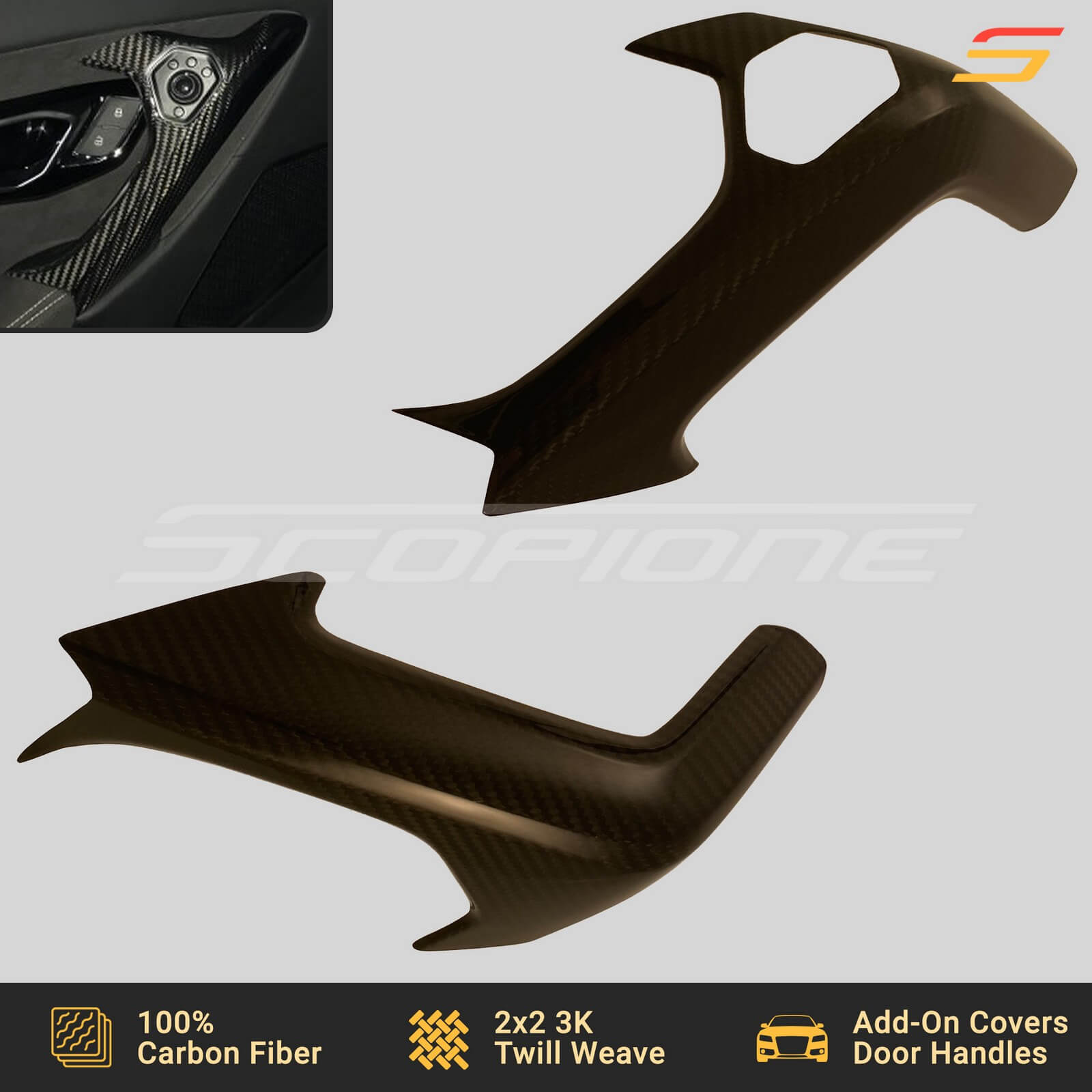
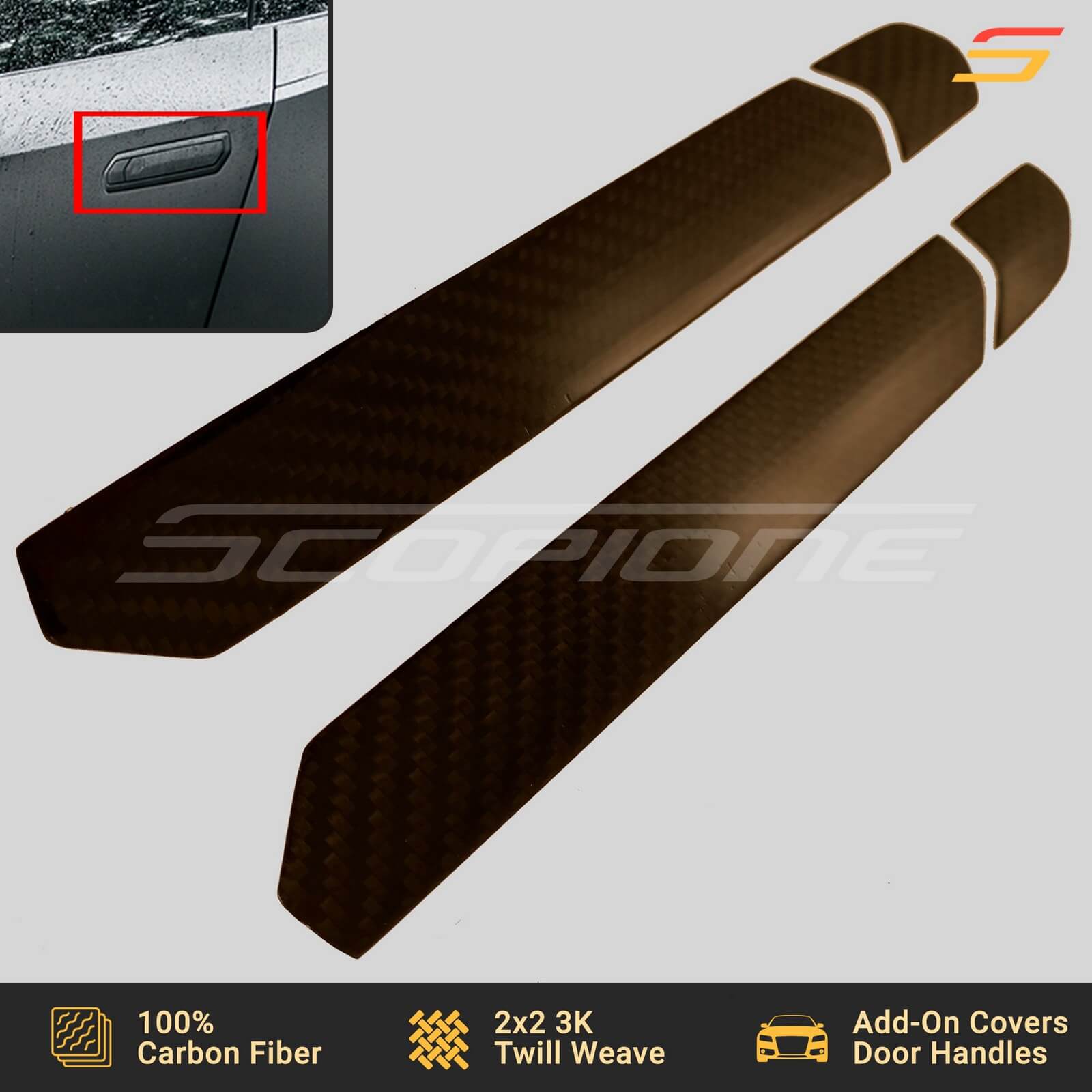
- Interior door handle covers in carbon fiber – a tactile change that puts the material directly under the driver’s fingertips every time the door opens.
Interior CF trim for the Huracan – vent covers, door handles – is available on the Scopione Huracan shop page.
3. Performance & Structural Components
- Engine Bay Covers Kit – The centerpiece of the engine bay: a complete multi-piece replacement kit that surrounds the V10 in clear-coated 2×2 twill-weave carbon fiber.
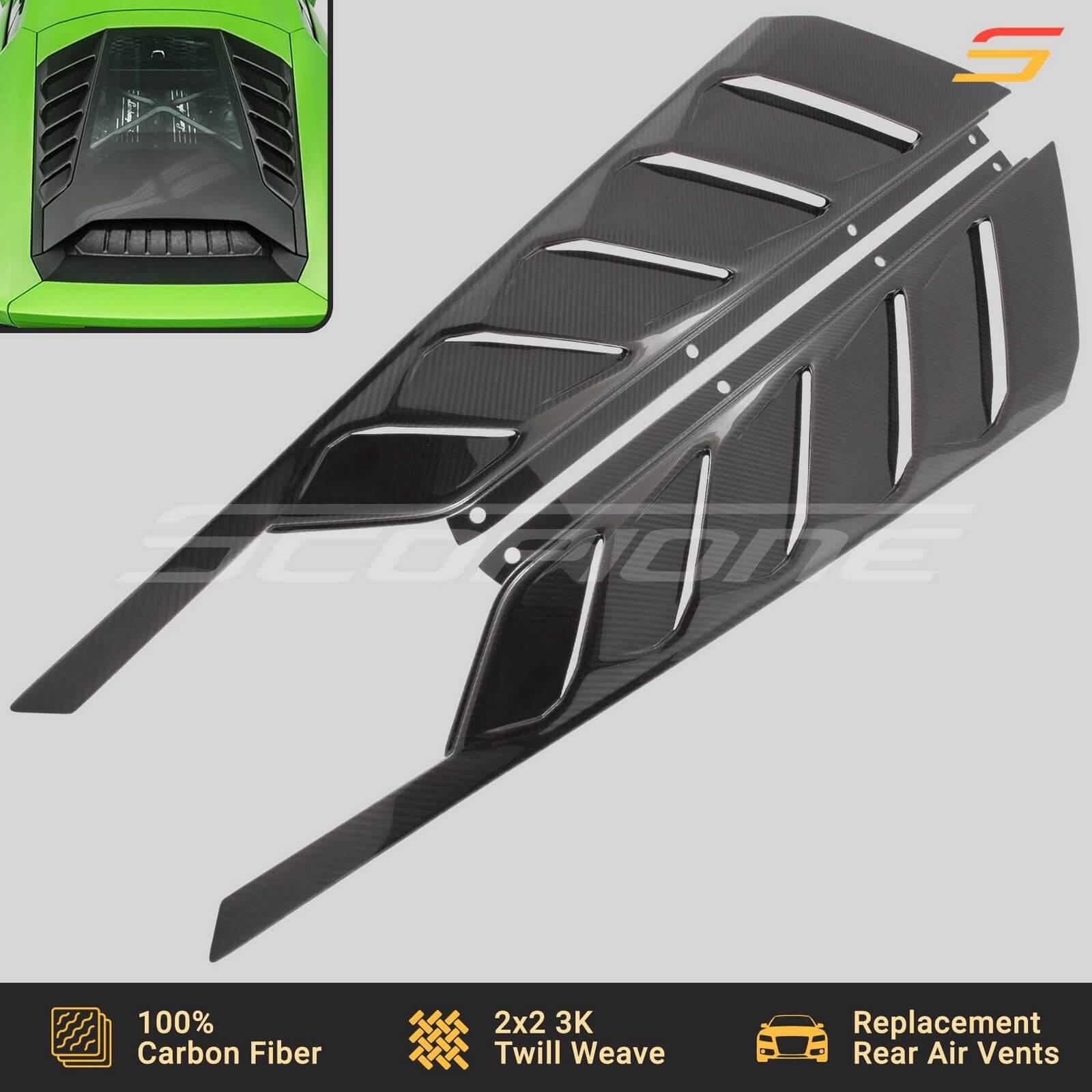
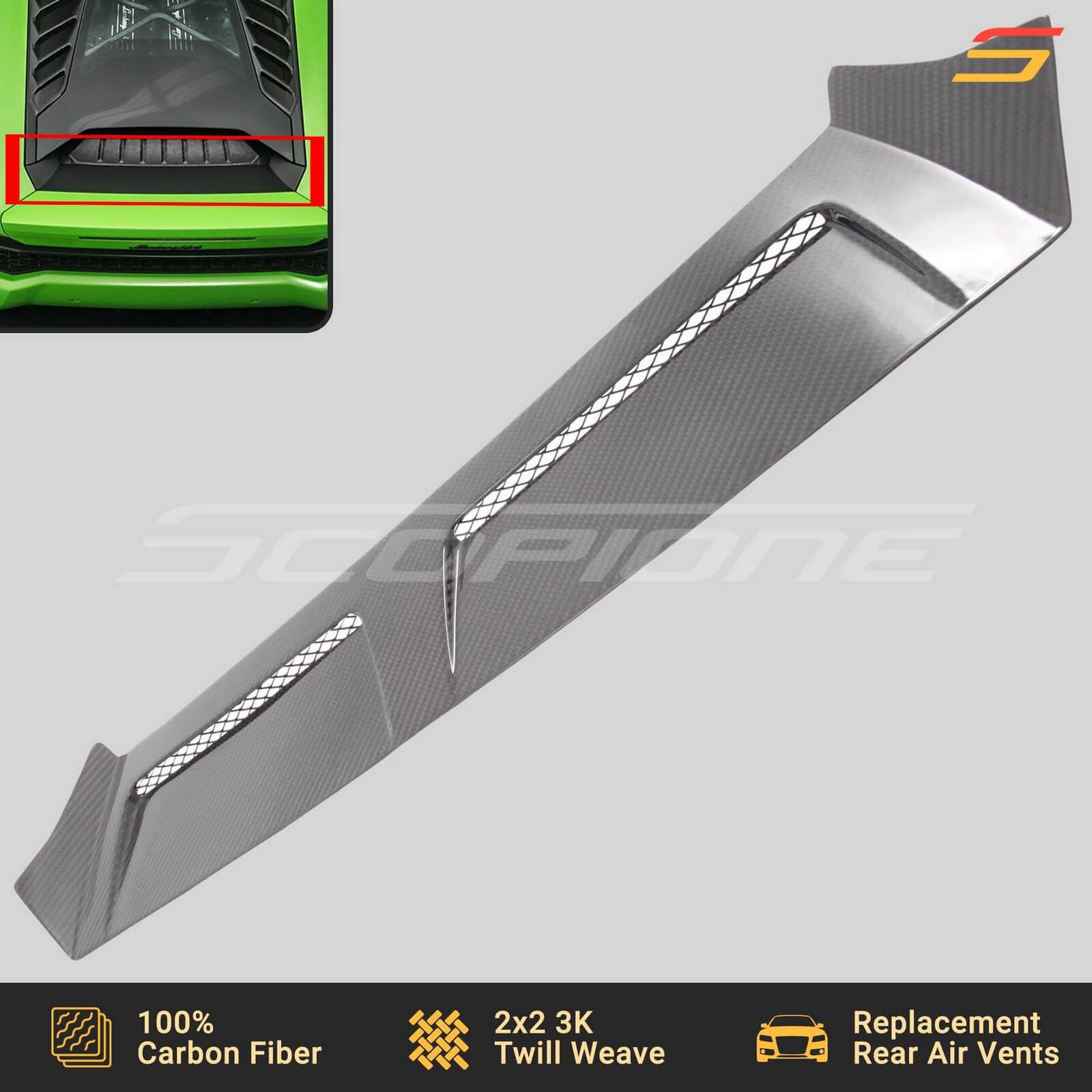
- Replacement rear hood engine air vents keep cooling airflow while extending the carbon treatment across the rear deck.
- Rear Trunk Air Vents – Carbon-fiber vent lids and trim improve engine cooling airflow while maintaining the rear deck’s visual cohesion.
Why Carbon Fiber Matters on the Huracan Platform
✓ Weight Reduction – Carbon fiber weighs roughly 60% less than equivalent FRP components. Lamborghini proved this at scale: the STO’s carbon-fiber body panels contributed to a 43 kg weight reduction over the Performante.
✓ Factory Precedent – The Performante used Forged Composite for its ALA wing and body panels. The STO used 75% carbon-fiber body coverage. The Tecnica added a CF front hood and engine cover as standard. Aftermarket carbon fiber follows the same trajectory the factory established.
✓ Structural Integrity – High tensile strength with heat resistance. Carbon-fiber panels hold up under track conditions – the STO’s cofango proved it across thousands of track-day hours.
✓ Collector Relevance – Well-documented CF modifications from recognized brands increase desirability among Huracan buyers, particularly on track-focused variants.
Scopione’s Huracan carbon fiber line covers exterior, interior, and engine bay components – explore the full catalog.
Legacy of the Huracan & Its Place in Lamborghini History
Production ended in December 2024. The very last Huracan was an STJ – one of 10, one per cylinder. By then, approximately 24,000 units had rolled off the line at Sant’Agata Bolognese, making the Huracan the most-produced Lamborghini ever. It reached the Gallardo’s 14,022-unit milestone in roughly half the time.
The Huracan also became the foundation of Lamborghini’s return to serious motorsport. The Super Trofeo one-make series, developed in collaboration with Dallara Engineering, expanded to three continental championships across Europe, Asia, and North America. The GT3 variant won on its competitive debut at Monza in 2015 (Grasser Racing Team). Three consecutive 24 Hours of Daytona GTD class victories followed in 2018–2020. And at the 2025 24 Hours of Spa, a Huracan GT3 Evo2 delivered Lamborghini’s first overall victory at the event.
The successor – the Lamborghini Temerario – replaces the naturally aspirated V10 with a twin-turbocharged 4.0-liter V8 hybrid. No more atmospheric V10. No more exhaust note that revs to 8,250 rpm without electronic assistance. The Huracan, alongside the Lamborghini Aventador, represents the final chapter of naturally aspirated Lamborghini production. Variants like the Performante, STO, and Sterrato will hold positions that newer, hybridized cars cannot replicate.
Scopione: Carbon Fiber Upgrades for the Lamborghini Huracan
From the LP 610-4 launch car to the final STO deliveries, the Huracan’s relationship with carbon fiber deepened with every generation. The early cars offered it as an option. The Performante made it structural. The STO built 75% of its body from it. For Huracan owners continuing that trajectory with aftermarket components, Scopione provides precision-fitted carbon fiber parts across the full 2014–2024 model range.
Scopione’s Huracan catalog includes engine bay covers, mirror shells, rear diffusers, side skirts, front hood cover kits, air vent trim, and interior components – all hand-laid from 2×2 twill-weave carbon fiber with a UV-resistant clear coat finish. Parts mount to factory points. No drilling required on most installations.
Breakdown of Carbon Fiber Upgrade Costs for Lamborghini Huracan
Carbon fiber upgrade costs on the Huracan vary by component. Below is a breakdown of average pricing for aftermarket carbon fiber parts with professional installation:
| Carbon Fiber Part | Estimated Cost (USD) | Installation Cost (USD) | Total Cost (USD) |
|---|---|---|---|
| Engine Bay Covers Kit (Coupe) | $3,400 – $5,300 | $300 – $800 | $3,700 – $6,100 |
| Rear Bumper Diffuser (LP610) | $3,700 – $5,500 | $400 – $1,200 | $4,100 – $6,700 |
| Side Mirror Shells (Replacement) | $2,500 – $3,700 | $100 – $250 | $2,600 – $3,950 |
| Front Hood Bonnet Covers Kit | $2,400 – $3,700 | $300 – $600 | $2,700 – $4,300 |
| Widened Side Skirts (LP580/LP610) | $2,000 – $3,200 | $300 – $800 | $2,300 – $4,000 |
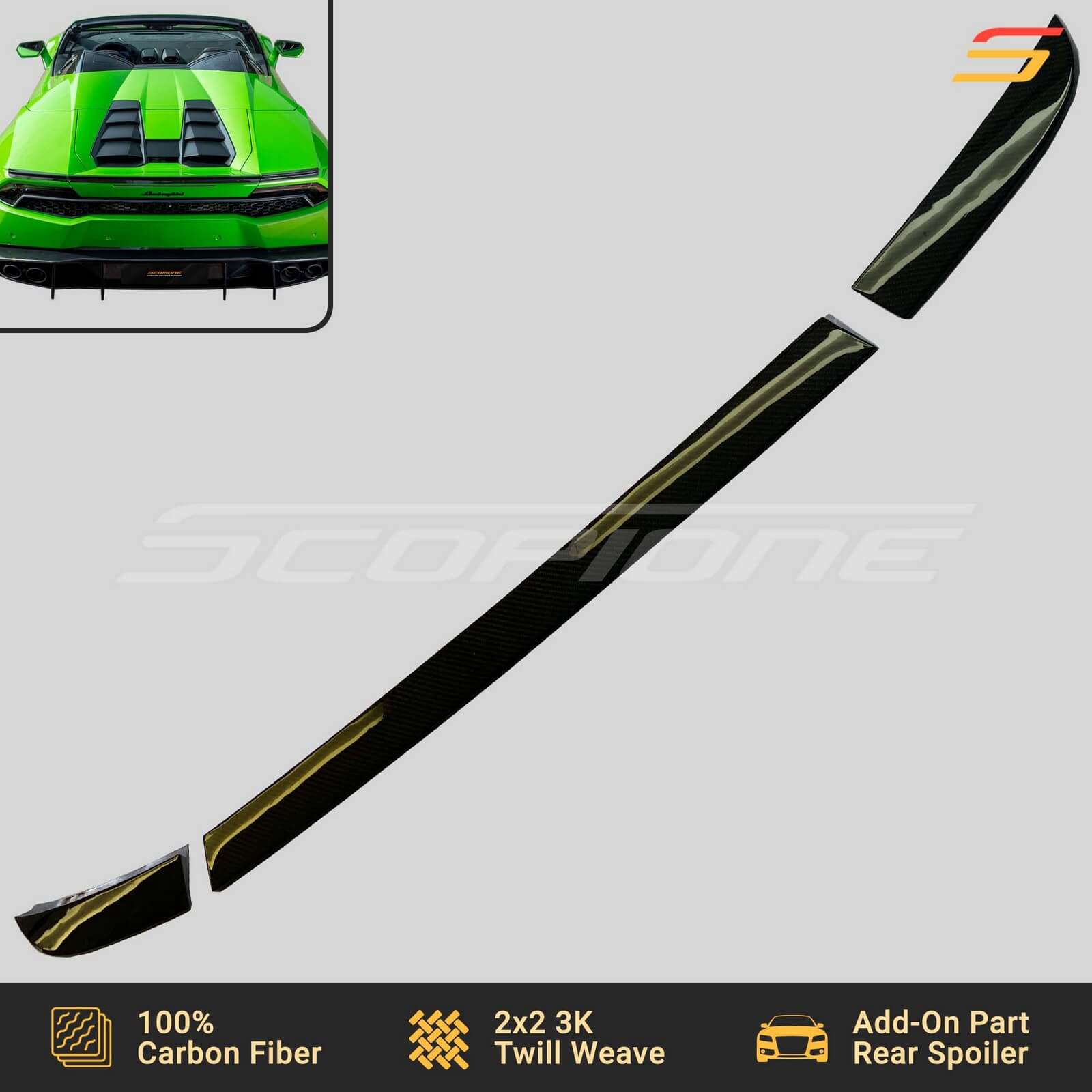
| Rear Trunk Spoiler (Add-On) | $1,300 – $2,100 | $200 – $400 | $1,500 – $2,500 |
| Rear Hood Air Vents Lid | $3,000 – $5,300 | $200 – $500 | $3,200 – $5,800 |
| Interior Trim (Vents + Door Handles) | $1,400 – $1,850 | $200 – $400 | $1,600 – $2,250 |
OEM vs. Aftermarket: Lamborghini offered extensive factory carbon fiber on the Performante (Forged Composite), STO (75% CF body), and Tecnica (CF hood and engine cover). OEM replacement parts carry significant price premiums. Scopione’s CF components use 2×2 twill-weave layup and clear coat finishing with fitment engineered to match factory body lines – at a fraction of OEM pricing.
Used Lamborghini Huracan Market (2024–2025)
Huracan resale values vary significantly by variant, mileage, specification, and color. Current approximate market ranges:
- LP 610-4 Coupe (2015–2019): $160,000 – $220,000
- LP 610-4 Spyder (2016–2019): $190,000 – $250,000
- LP 580-2 (2016–2019): $170,000 – $230,000
- Performante Coupe (2018–2019): $250,000 – $320,000
- EVO / EVO RWD (2020–2024): $210,000 – $310,000
- STO (2021–2024): $330,000 – $580,000
- Tecnica (2023–2024): $280,000 – $350,000
- Sterrato (2023–2024): $280,000 – $450,000

Browse Carbon Fiber Parts for the Lamborghini Huracan
Does Carbon Fiber Increase the Resale Value of a Lamborghini Huracan?
Carbon fiber modifications can influence a Huracan’s resale value – but the effect depends on execution, documentation, and the variant being modified.
When carbon fiber adds value:
• Professionally installed, well-documented parts from recognized brands increase buyer confidence at resale.
• On track-focused variants (Performante, STO), a documented carbon-fiber package can add measurable desirability at auction.
• Buyers shopping for an enhanced Huracan often pay a premium for quality weight reduction with installation records.
When it does not:
• Unbranded or poorly fitted aftermarket parts raise red flags for serious buyers.
• Extreme widebody conversions narrow the buyer pool – collectors generally favor OEM-specification cars at auction.
• Carbon fiber alone does not guarantee a price increase. Documentation and brand recognition are the deciding factors.
Practical approach: Use carbon fiber parts from documented sources like Scopione, retain all receipts and installation records, and keep original OEM parts if removed.
Is the Lamborghini Huracan a Good Investment?
- Performante: The strongest Huracan investment. Depreciation of 13–15% over 5–7 years – significantly better than the exotic sports car average of ~30%. Low-mileage Performante Spyders show the highest appreciation potential.
- STO: Long-term collector potential as one of the last NA V10 supercars with 75% carbon-fiber body coverage. Short-term oversupply from speculative buyers has softened prices. Strong hold for 5+ year ownership.
- Base LP 610-4: Will follow a U-shaped depreciation curve – further decline before stabilizing. Some examples already trading below $160,000. Long road to appreciation, but the naturally aspirated V10 is a meaningful tailwind.
- Last V10 Premium: As the successor Temerario adopts a hybrid twin-turbo V8, the Huracan’s status as the last naturally aspirated V10 Lamborghini supports long-term values across all variants. Production volume (~24,000 units) tempers dramatic appreciation compared to the Gallardo’s 14,022.
Notable Auction Results for Lamborghini Huracan (2022–2025)
| Model | Sale Price |
|---|---|
| 2018 Performante Spyder | $493,500 (Jul 2024) |
| 2018 Performante Coupe | $415,000 (May 2022) |
| 2024 Sterrato (55 miles) | $302,000 (Apr 2025) |
| 2020 EVO AWD (Barrett-Jackson) | $286,000 (2023) |
| 2014 LP 610-4 | $108,001 (May 2024) |
Which Lamborghini Huracan Variant Is the Best Value?
- Entry point: 2015–2019 LP 610-4 Coupe ($160K – $220K) – the most accessible naturally aspirated V10 Lamborghini on the used market. Full 602 hp, AWD, dual-clutch.
- Performance value: 2020–2022 EVO RWD ($210K – $260K) – LDVI system, P-TCS traction control, 602 hp with rear-wheel drive and rear-wheel steering. More capable than the LP 580-2 in every measurable dimension.
- Long-term hold: Performante Coupe ($250K – $320K) – ALA active aero, Nurburgring record pedigree, Forged Composite construction. The Huracan that auction houses compete for.
What Are Common Lamborghini Huracan Maintenance Issues and Costs?
Annual maintenance on a Huracan typically runs $850–$1,500 for minor service (oil, filters, visual inspection). Intermediate service every 2 years or 18,000 miles – including brake fluid flush and coolant change – costs $1,500–$2,500. Major service at the 5-year or 46,000-mile mark (spark plugs, transmission fluid, clutch inspection) ranges from $3,500–$6,000. Tires run $3,000–$5,000 per set of Pirelli P Zeros. Carbon ceramic brake replacement exceeds $10,000.
Common issues to budget for: DCT clutch wear typically appears around 30,000 km depending on driving style (stop-and-go traffic and Auto mode accelerate wear). Timing chain cover oil leaks require an expensive engine-out procedure. Early models experienced hydraulic system quirks that were largely resolved through software updates. The Huracan is widely considered one of the most reliable Lamborghinis ever built – a significant improvement over the Gallardo’s E-gear-related failure points.
The Scopione Huracan Picture Gallery features photographs of Huracans fitted with Scopione carbon fiber components – engine bay covers, mirror shells, side skirts, diffusers, air vent trim. Each image shows how the carbon fiber weave pattern and gloss finish integrate with the Huracan’s factory body lines and interior surfaces.
Huracan owners considering modifications can browse these real-world installations as reference. The gallery captures the car’s angular exterior, driver-focused cockpit, and mid-mounted V10 engine bay – with and without carbon fiber upgrades.
Every Scopione component for the Huracan is built to match factory mounting geometry. The carbon fiber layup and clear coat finishing process is consistent across the full catalog – the same material quality whether the part goes on a 2015 LP 610-4 or a 2024 STO.
Browse the Scopione Huracan catalog for specific part fitment, pricing, and installation details.
Carbon Fiber Parts for the Lamborghini Huracan
The 13 carbon fiber parts Scopione currently lists for the Lamborghini Huracan. Each image links to its product page.

More Scopione Picture Galleries
Scopione’s carbon fiber catalog covers a wide range of performance and luxury vehicles. Browse galleries for related makes and models:
- Ferrari: 458 Italia & Spider • 488 GTB & Spider • F8 Tributo & Spider • F12 & 812 Superfast • SF90
- Lamborghini: Gallardo • Aventador • Urus
- McLaren: MP4-12C & 650S • 720S & 765LT • Sports Series
- Porsche: 911, Boxster & Cayman
- BMW: M3, M4, M5 & More
- Audi: R8
- Nissan: GT-R R35 • 350Z, 370Z & Z
- Aston Martin: Vantage, DB9 & DBS
- Bentley: Continental GT & GTC
- Maserati: GranTurismo & GranCabrio
- Toyota: Supra
- Subaru: WRX STI
- Mitsubishi: Lancer Evolution
- Chevrolet: Corvette • Camaro
- Dodge: Viper
Experience the elegance and performance of the Lamborghini Huracan with Scopione. Browse our gallery and get inspired to elevate your supercar with our top-of-the-line carbon fiber upgrades.
Shop now for premium ScopioneCarbon carbon fiber upgrades and experience the ultimate in performance and aesthetics for your Lamborghini Huracan!