

 Shop
ShopThe Lamborghini Gallardo carved its place as one of the defining mid-engine supercars of the 2000s – a naturally aspirated V10 with available gated manual, produced over a 10-year run totaling 14,022 units. From the original 493 hp 5.0-liter coupe to the 562 hp LP 570-4 Squadra Corse, carbon fiber played an expanding role in the Gallardo’s performance story. Scopione carries a full line of carbon fiber parts for the Lamborghini Gallardo – engine covers, mirror shells, diffusers, interior trim – precision-fitted to factory mounting points across all model years.
Introduction: The Birth of the Lamborghini Gallardo
The Lamborghini Gallardo debuted at the 2003 Geneva Motor Show as the brand’s first production V10 supercar – and the first “entry-level” Lamborghini since the Jalpa left production in 1988. Positioned below the flagship Murcielago (predecessor to the Lamborghini Aventador), the Gallardo was developed under Audi’s engineering oversight following Volkswagen Group’s 1998 acquisition of Lamborghini. Its exterior was penned by Luc Donckerwolke – the Belgian-Peruvian designer who had already shaped the Murcielago – during his tenure as Lamborghini’s Head of Design. Italian styling. German structural discipline. A combination that had never been attempted at Sant’Agata Bolognese before.
The formula worked. Over its 10-year production run (2003–2013), the Gallardo became the most-produced Lamborghini in history, with 14,022 units built – accounting for nearly half of all Lamborghinis ever manufactured at the time of its retirement. Its compact mid-engine layout, naturally aspirated V10, and permanent all-wheel drive transformed Lamborghini from a financially fragile niche builder into a profitable volume manufacturer.
Scopione’s Gallardo carbon fiber catalog covers engine bay covers, mirror shells, splitters, diffusers, and interior trim – precision-fitted across all model years from 2003 to 2013.
First Phase (2003–2008): The Foundation
The original Gallardo launched with a 5.0-liter V10 producing 493 horsepower, paired with either a gated 6-speed manual or the electro-hydraulic E-gear automated manual. An aluminum space frame kept curb weight to 1,520 kg (3,351 lb). The result: 0–60 mph in approximately 4.0 seconds and a top speed of 309 km/h (192 mph).
Power climbed to 520 hp across the range in 2006, the same year Lamborghini introduced the Gallardo Spyder convertible. And several performance-focused variants followed:
- Gallardo SE (2005–2006) – 250 units with a two-tone exterior, Callisto wheels, and 520 hp. All 250 sold before the first car left the factory.
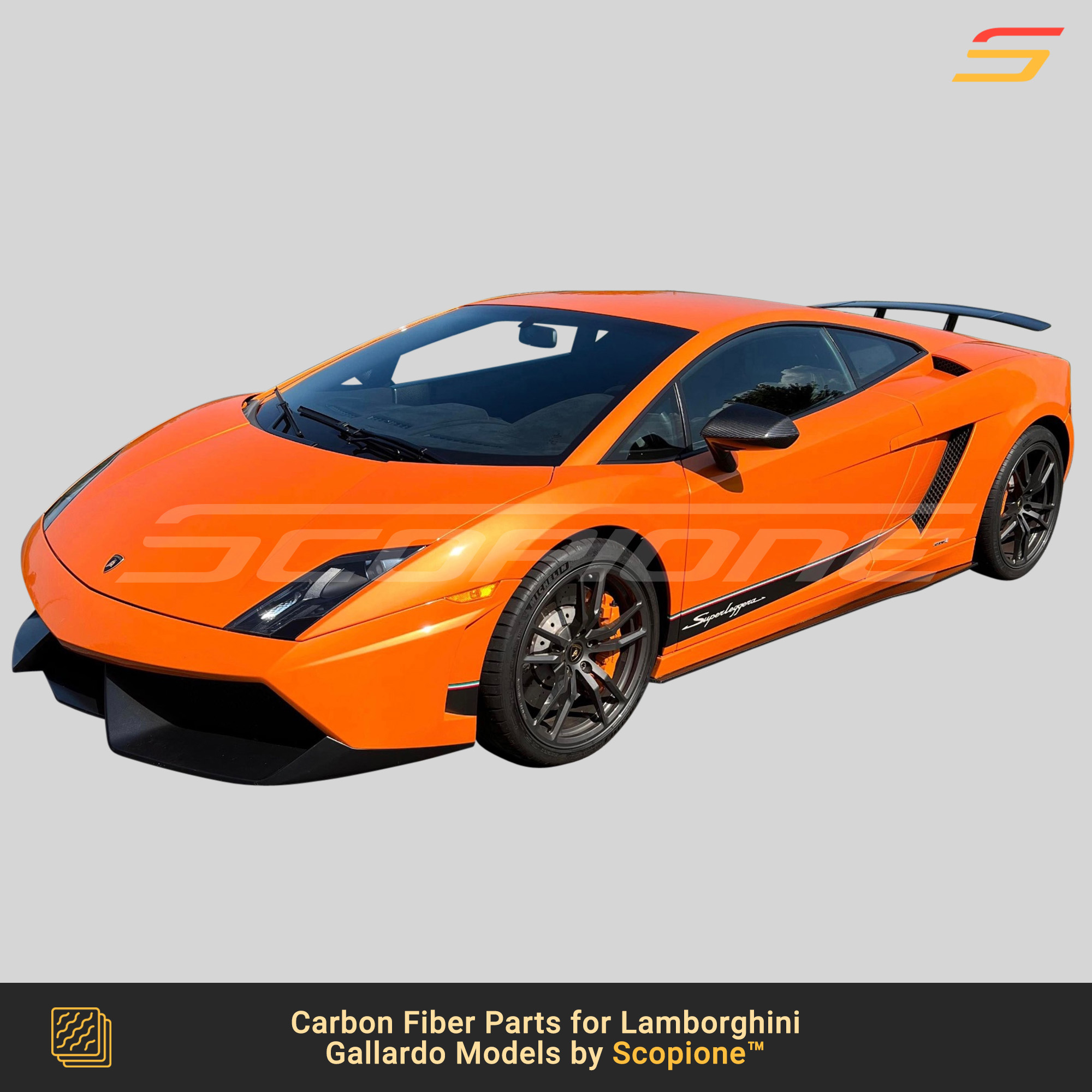
- Gallardo Superleggera (2007–2008) – The car that proved carbon fiber’s value on the Gallardo platform. 523 hp, 100 kg of weight stripped through carbon-fiber body panels, polycarbonate windows, and Alcantara interior. Roughly 618 units produced – 172 allocated to the US market.
- Gallardo Nera (2007) – A 185-unit run showcasing the Ad Personam customization program. Matte black accents and darkened tail lights throughout.
Models & Approximate Production Numbers:
- Gallardo 5.0 Coupe (2003–2008)
- Engine: 5.0L V10 (493–520 HP)
- Transmission: 6-speed manual or E-gear
- Drivetrain: Permanent AWD
- Production: ~5,942 coupes (special editions included)
- Gallardo Spyder (2006–2008)
- Engine: 5.0L V10 (520 HP)
- Transmission: 6-speed manual or E-gear
- Production: ~2,646 spyders
- Gallardo Superleggera (2007–2008)
- Engine: 5.0L V10 (523 HP)
- Weight: 1,330 kg (2,932 lb) – 100 kg lighter than standard
- Production: ~618 units (172 for the US)
- Gallardo SE & Nera (2005–2007) (Limited Editions)
- SE: 250 units
- Nera: 185 units
Lamborghini Gallardo (2003–2008) MSRP Price Ranges
| Model | Base MSRP (USD) | Price Adjusted for Inflation (2024) |
|---|---|---|
| Gallardo 5.0 Coupe (2003–2008) | $165,000 – $175,000 | ~$265,000 – $280,000 |
| Gallardo Spyder (2006–2008) | $195,000 – $201,000 | ~$290,000 – $300,000 |
| Gallardo Superleggera (2007–2008) | $220,000+ | ~$320,000+ |
| Gallardo SE (2005–2006) | $185,000+ | ~$285,000+ |
| Gallardo Nera (2007) | $175,000+ | ~$260,000+ |
Scopione stocks carbon fiber components for every first-phase Gallardo variant – browse by model year.
Second Phase (2008–2013): The LP Series
The 2008 LP 560-4 – “Longitudinale Posteriore,” referencing the engine’s rear longitudinal mounting – brought a substantially reworked 5.2-liter V10 producing 552 hp with direct fuel injection. The new engine replaced the 5.0’s split-crankpin design with shared crankpins, shifting from even 72-degree firing intervals to alternating 54/90-degree intervals. The result: a deeper, more muscular exhaust character distinct from the 5.0’s higher-pitched scream. New driving modes included E-gear’s Corsa setting with 40% quicker shifts and Thrust Mode launch control.
This phase produced the Gallardo variants with the strongest collector following:
- Gallardo LP 550-2 Valentino Balboni (2009–2010) – The first rear-wheel-drive Lamborghini in over a decade, named for the company’s chief test driver. Limited to ~250 units. A white and gold racing stripe ran the length of the car.
- LP 570-4 Superleggera (2010–2013) – 562 hp with 70 kg stripped through carbon-fiber body panels, a fixed rear wing, and deleted sound deadening. Power-to-weight ratio: 2.5 kg/hp.
- LP 570-4 Spyder Performante (2011–2013) – Open-top Superleggera with 65 kg of weight savings. The very last Gallardo ever built was a Spyder Performante finished in Rosso Mars.
- LP 570-4 Super Trofeo Stradale (2012–2013) – 150 numbered units. A road-legal version of the Super Trofeo race car with a removable carbon fiber engine cover and adjustable rear wing.
- LP 570-4 Squadra Corse (2013) – The final factory Gallardo. Roughly 50 units built, each with full carbon-fiber door panels, a quick-release engine cover, and a high-mounted rear wing with vertical fins carried over from the race program.
The LP series also anchored Lamborghini’s return to organized motorsport. The Lamborghini Blancpain Super Trofeo one-make series launched in 2009 with the Gallardo LP 560-4 Super Trofeo – a 570 hp, 1,300 kg race-prepared car. From an inaugural European grid of 11 cars, the series expanded to three continental championships across Europe, Asia, and North America, with 30+ entries per region. It remains active today using the Huracan platform.
Models & Production Numbers:
- Gallardo LP 560-4 Coupe & Spyder (2008–2013)
- Engine: 5.2L V10 (552 HP)
- Transmission: 6-speed manual or 6-speed E-gear
- 0–60 mph: 3.6 seconds
- Top Speed: 325 km/h (202 mph)
- Production: ~5,404 units (Phase 2 total)
- LP 550-2 Valentino Balboni (2009–2010)
- Engine: 5.2L V10 (542 HP)
- Drivetrain: Rear-wheel drive only
- Production: ~250 units
- LP 570-4 Superleggera (2010–2013)
- Engine: 5.2L V10 (562 HP)
- Weight: 1,340 kg (2,954 lb)
- 0–60 mph: ~3.0 seconds
- LP 570-4 Squadra Corse (2013)
- Engine: 5.2L V10 (562 HP)
- Full carbon-fiber door panels & engine cover
- Production: ~50 units
- LP 570-4 Super Trofeo Stradale (2012–2013)
- Race-derived road car
- Production: 150 numbered units
Lamborghini Gallardo LP Series (2008–2013) MSRP Price Ranges
| Model | Base MSRP (USD) | Price Adjusted for Inflation (2024) |
|---|---|---|
| Gallardo LP 560-4 Coupe (2008–2013) | $181,900 – $210,000 | ~$250,000 – $280,000 |
| Gallardo LP 560-4 Spyder (2009–2013) | $209,500 – $221,000 | ~$280,000 – $300,000 |
| LP 550-2 Valentino Balboni (2009–2010) | $219,800 | ~$310,000 |
| LP 570-4 Superleggera (2010–2013) | $237,600 | ~$320,000 |
| LP 570-4 Spyder Performante (2011–2013) | $248,000 | ~$330,000 |
| LP 570-4 Super Trofeo Stradale (2012–2013) | $189,000+ | ~$245,000+ |
| LP 570-4 Squadra Corse (2013) | $259,100 | ~$330,000+ |
LP-series Gallardo owners can find model-specific carbon fiber parts on the Scopione Gallardo page.
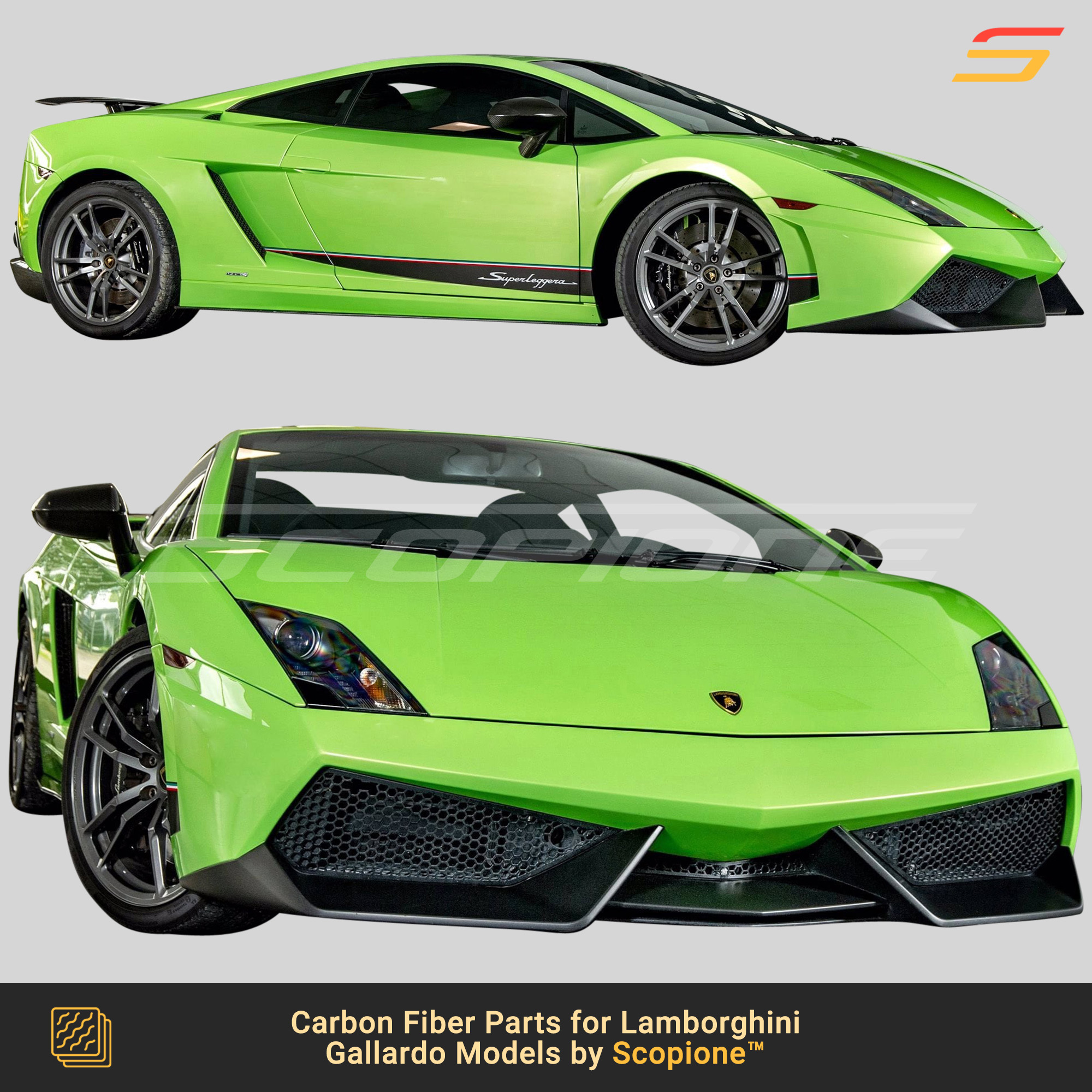
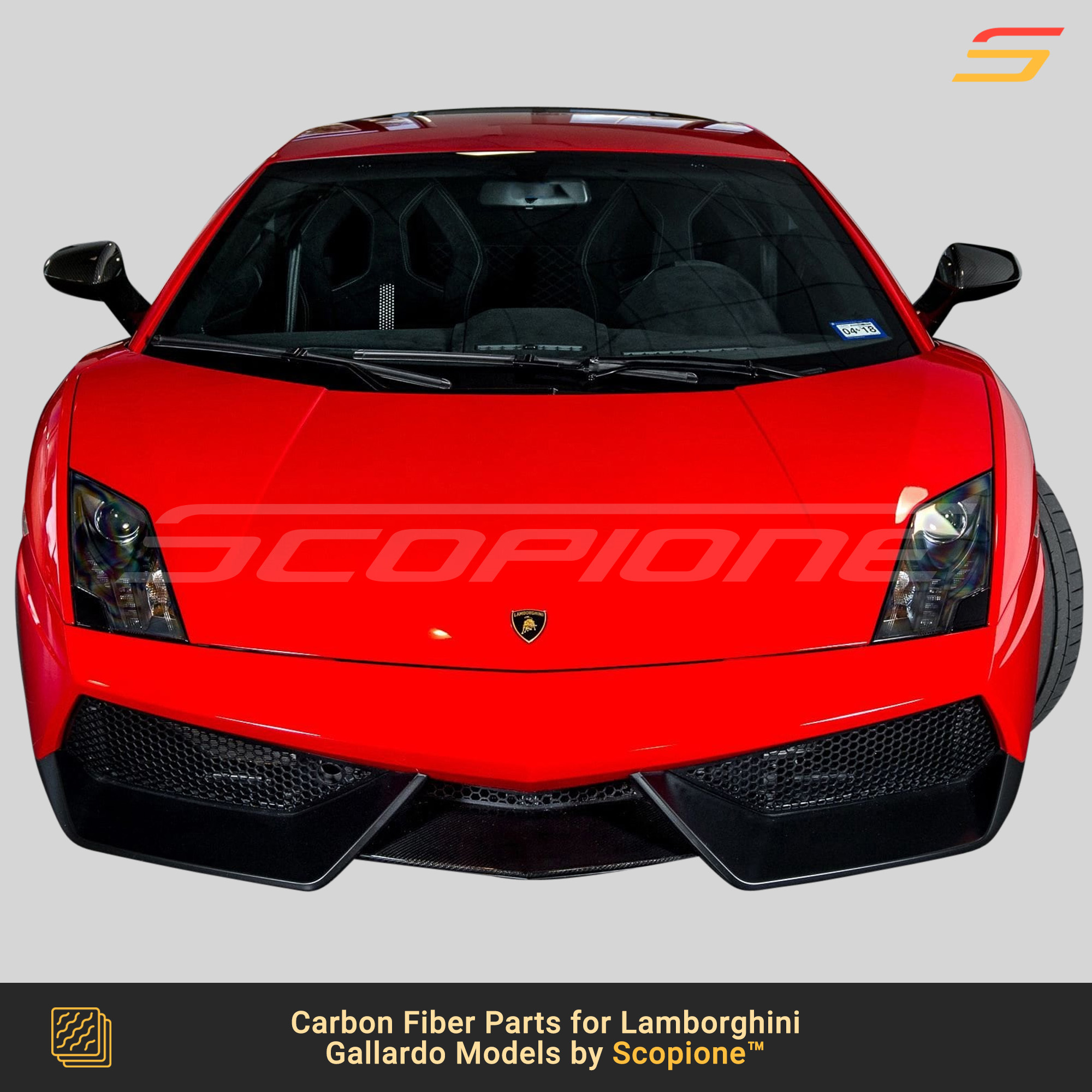
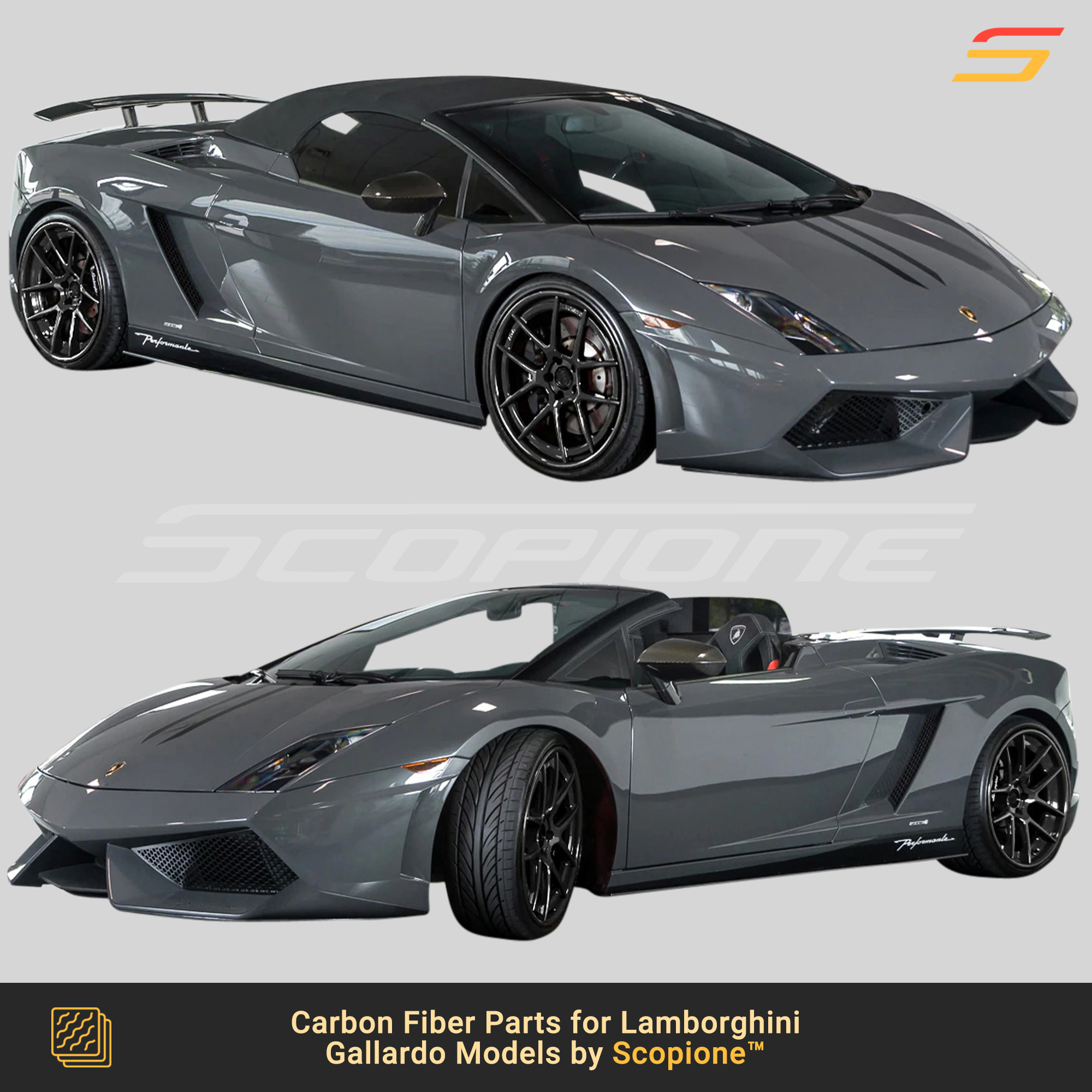
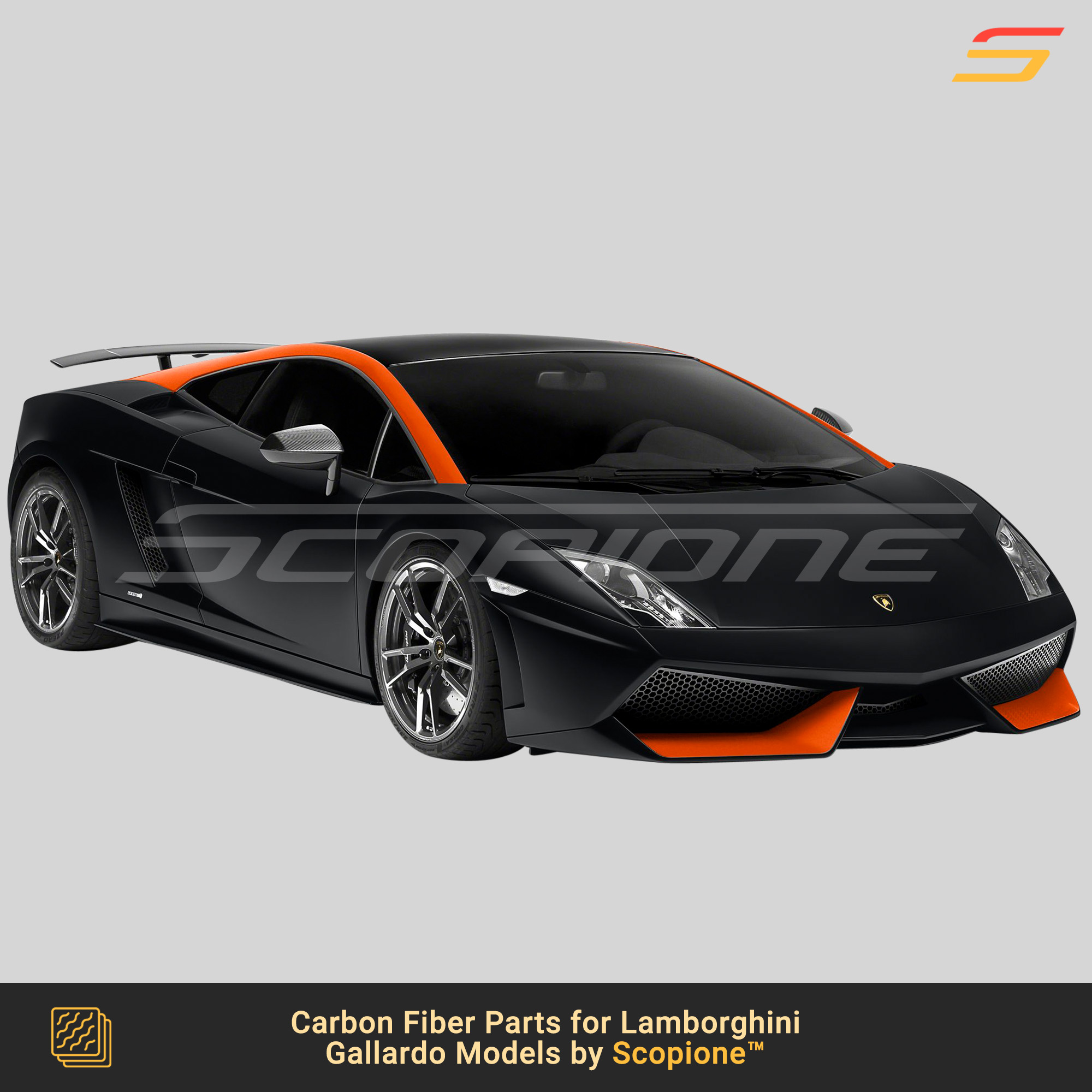
Carbon Fiber Integration in Lamborghini Gallardo Over the Years
Carbon fiber defined the Gallardo’s performance hierarchy. The base models used it sparingly – engine covers, interior accents. But with each special edition, from the original Superleggera to the Squadra Corse, Lamborghini pushed carbon fiber deeper into the car’s structure. The Superleggera shed 100 kg. The Squadra Corse replaced its entire door panels with carbon fiber – a first for any Gallardo variant.
1. Exterior Components
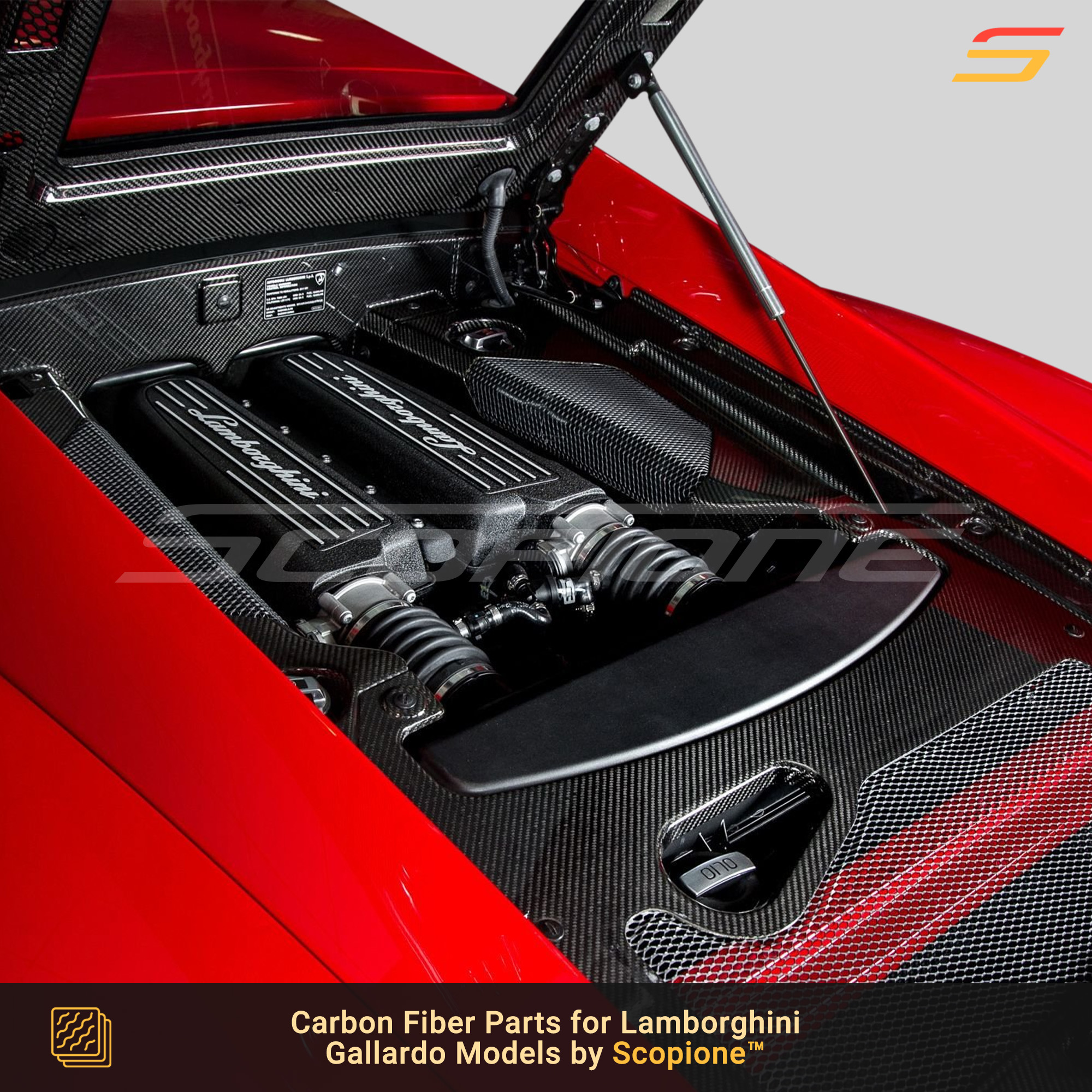
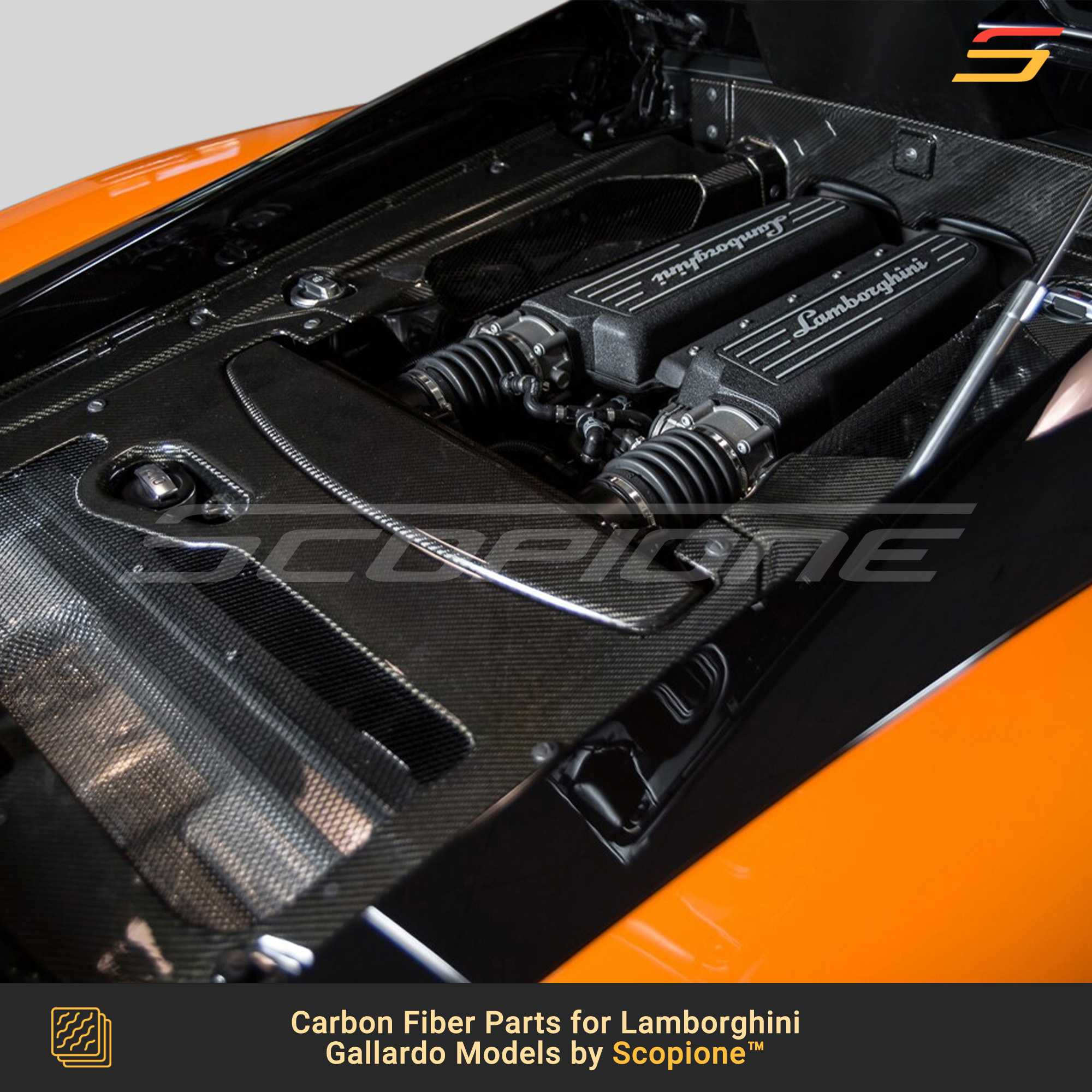
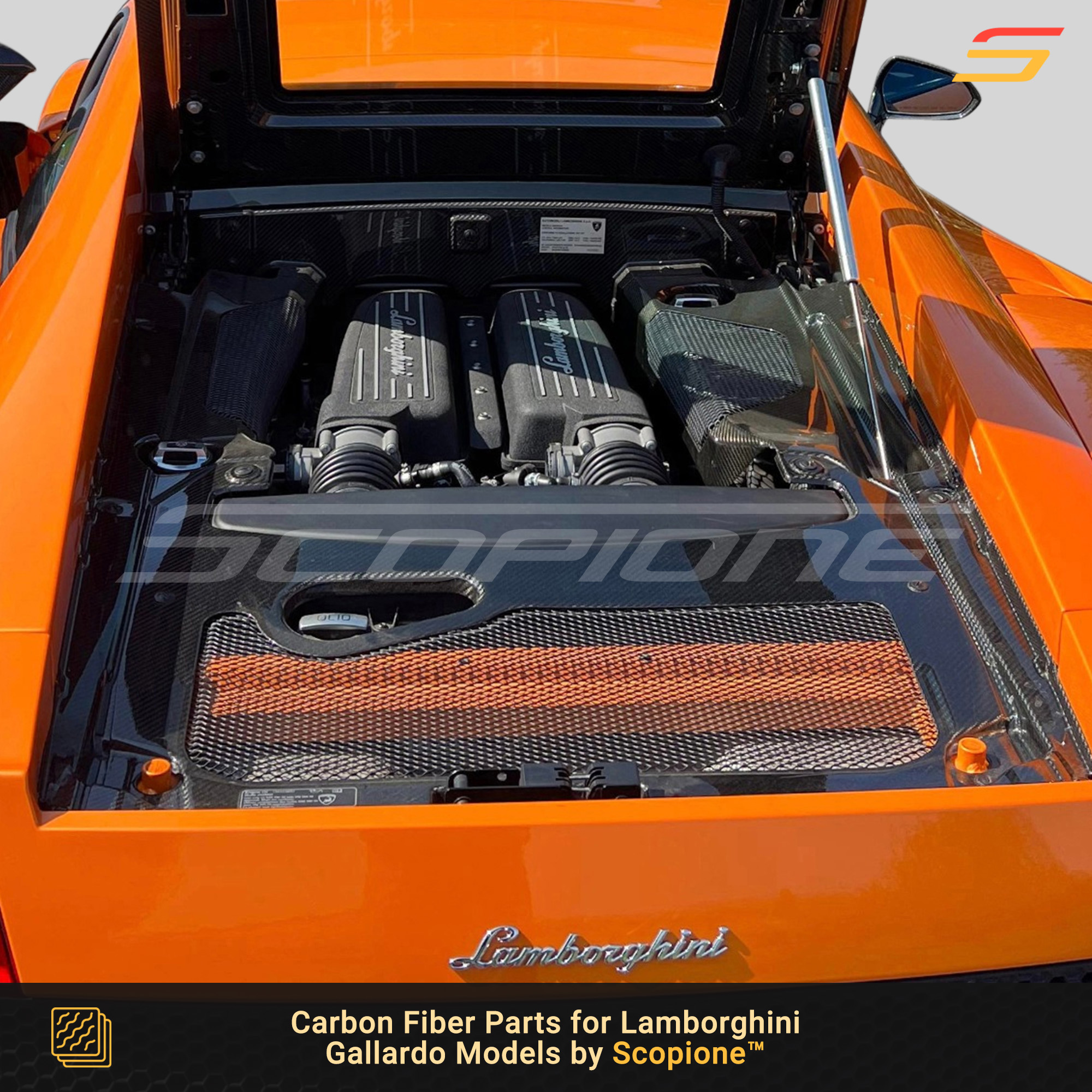
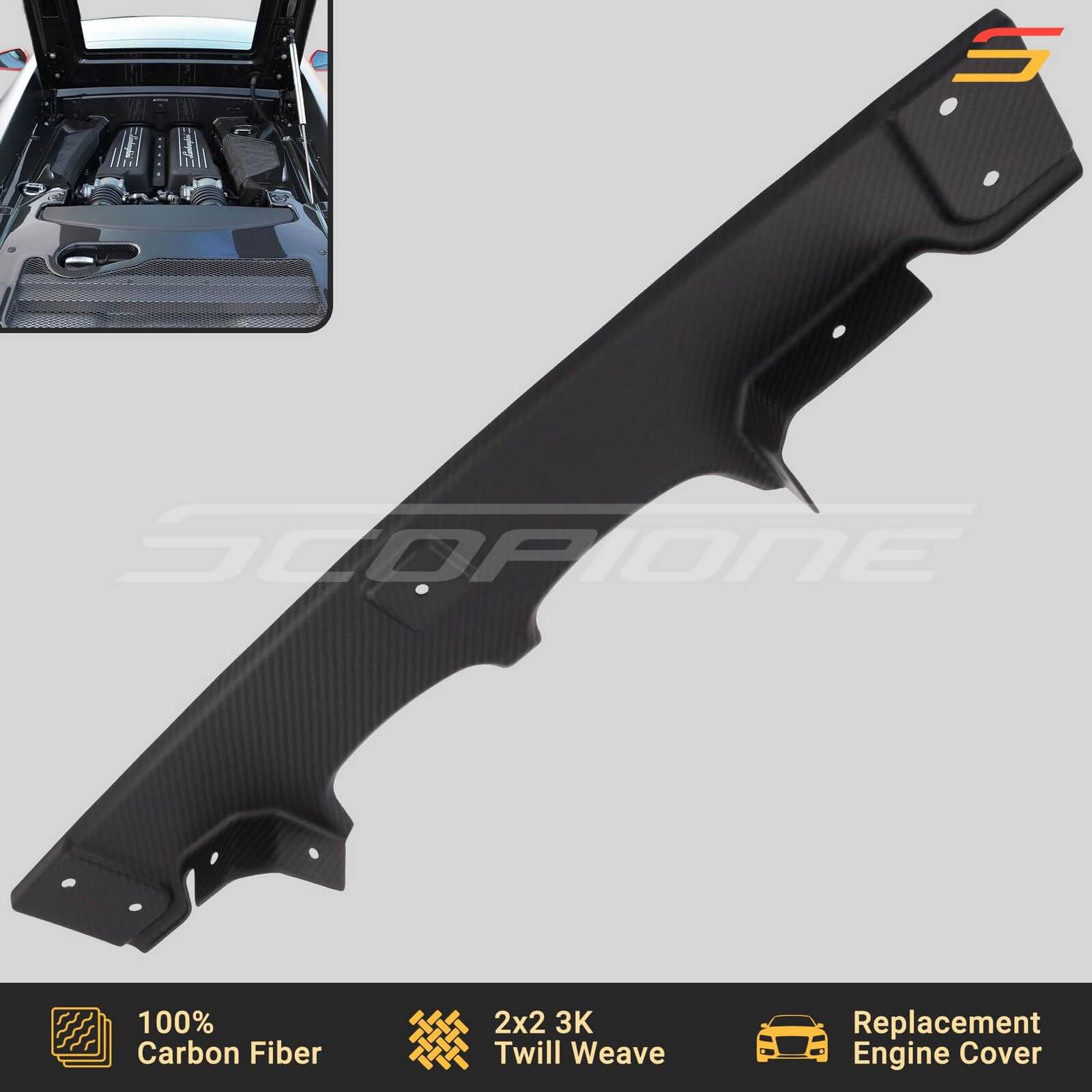
- Engine Cover – Carbon-fiber construction reduces weight over the rear axle while exposing the twill-weave pattern through a clear-coated finish. The Superleggera and Squadra Corse used quick-release mechanisms for pit-stop engine access.
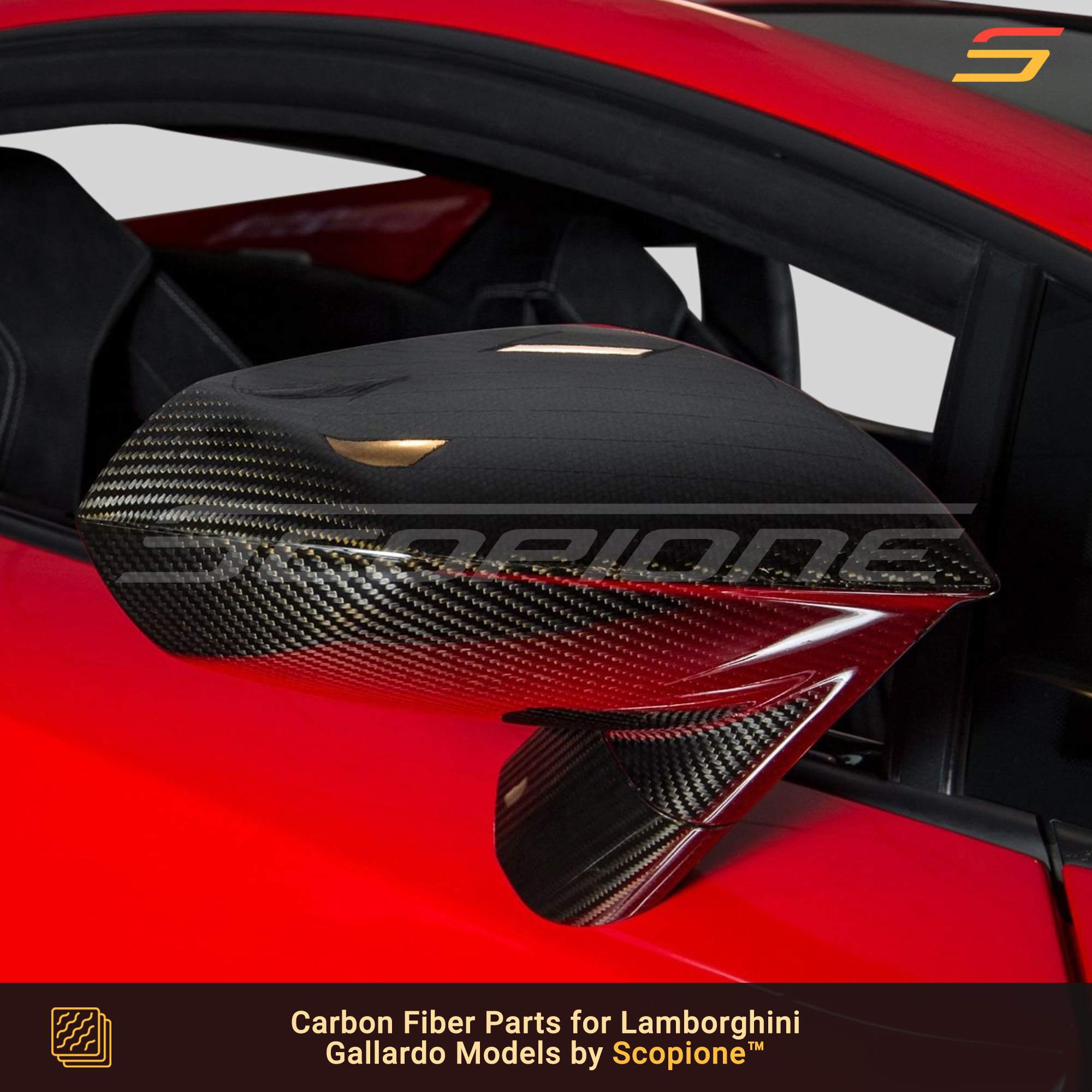
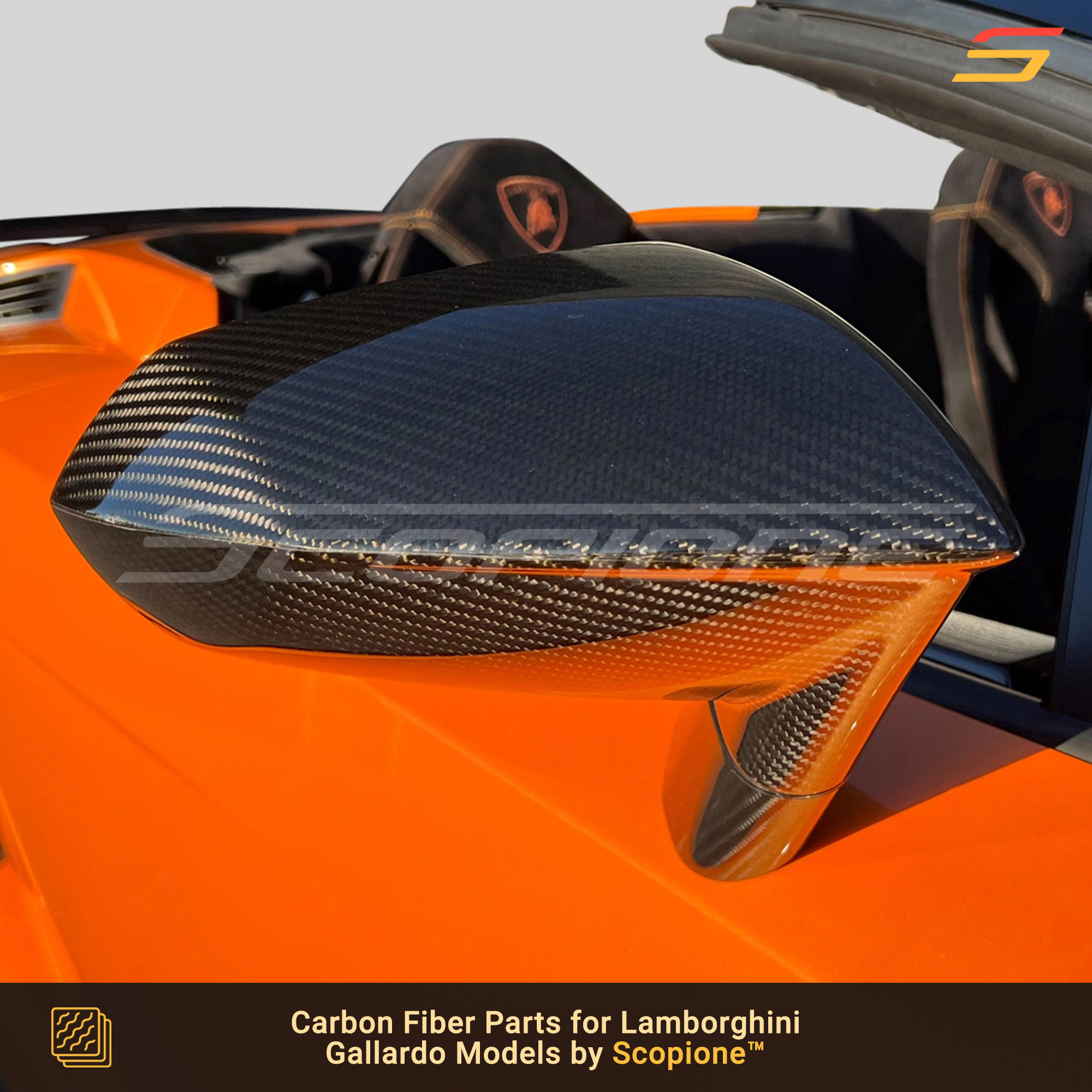
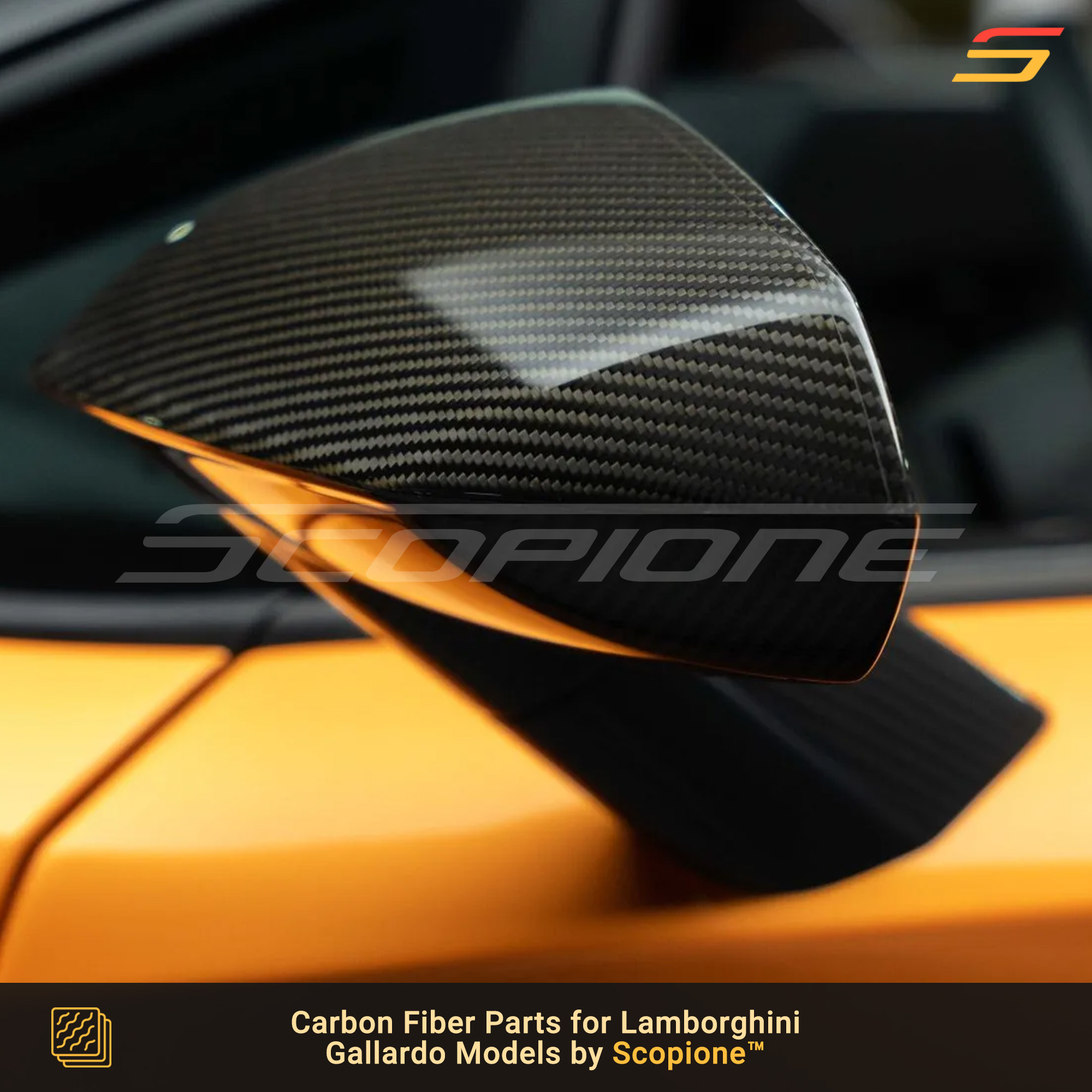
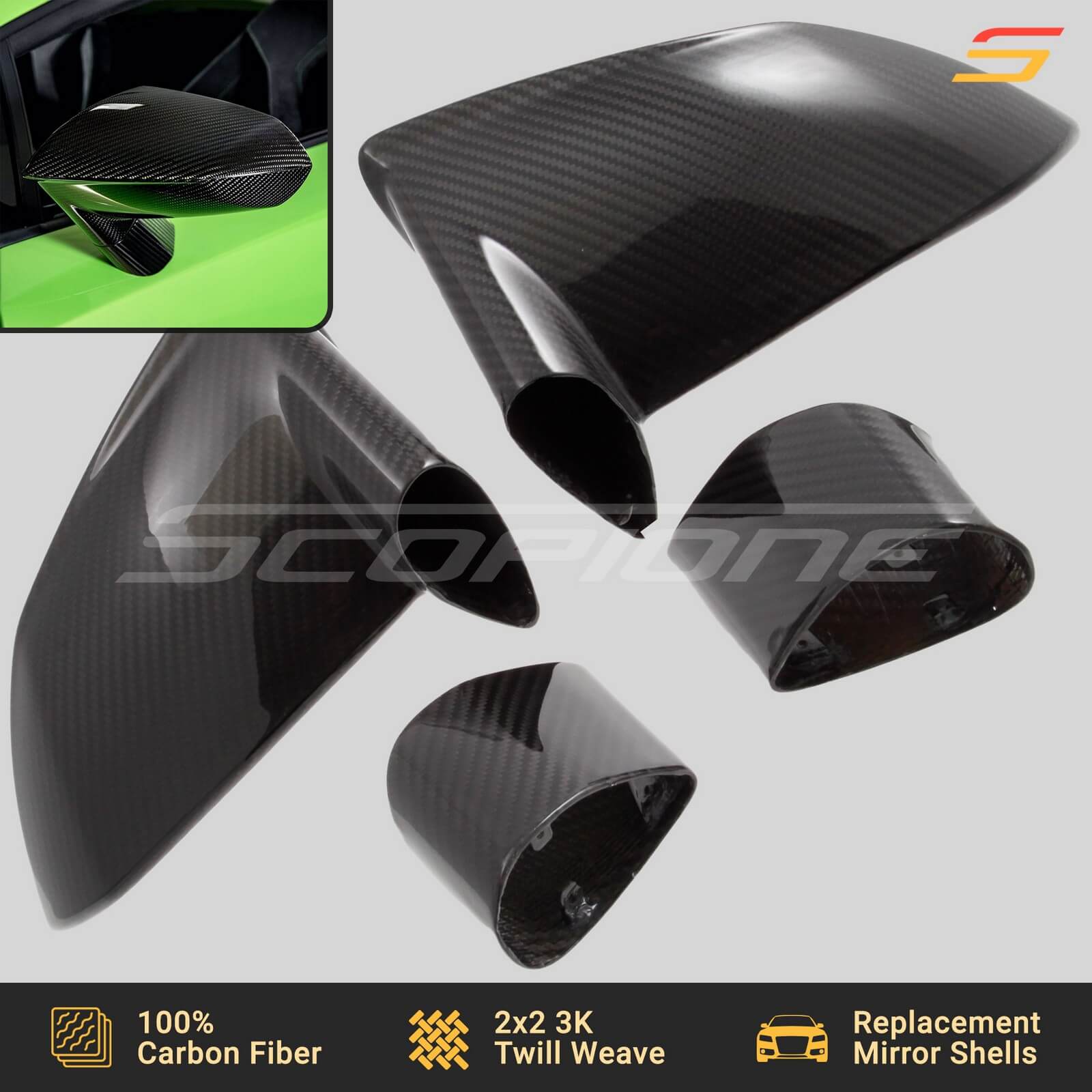
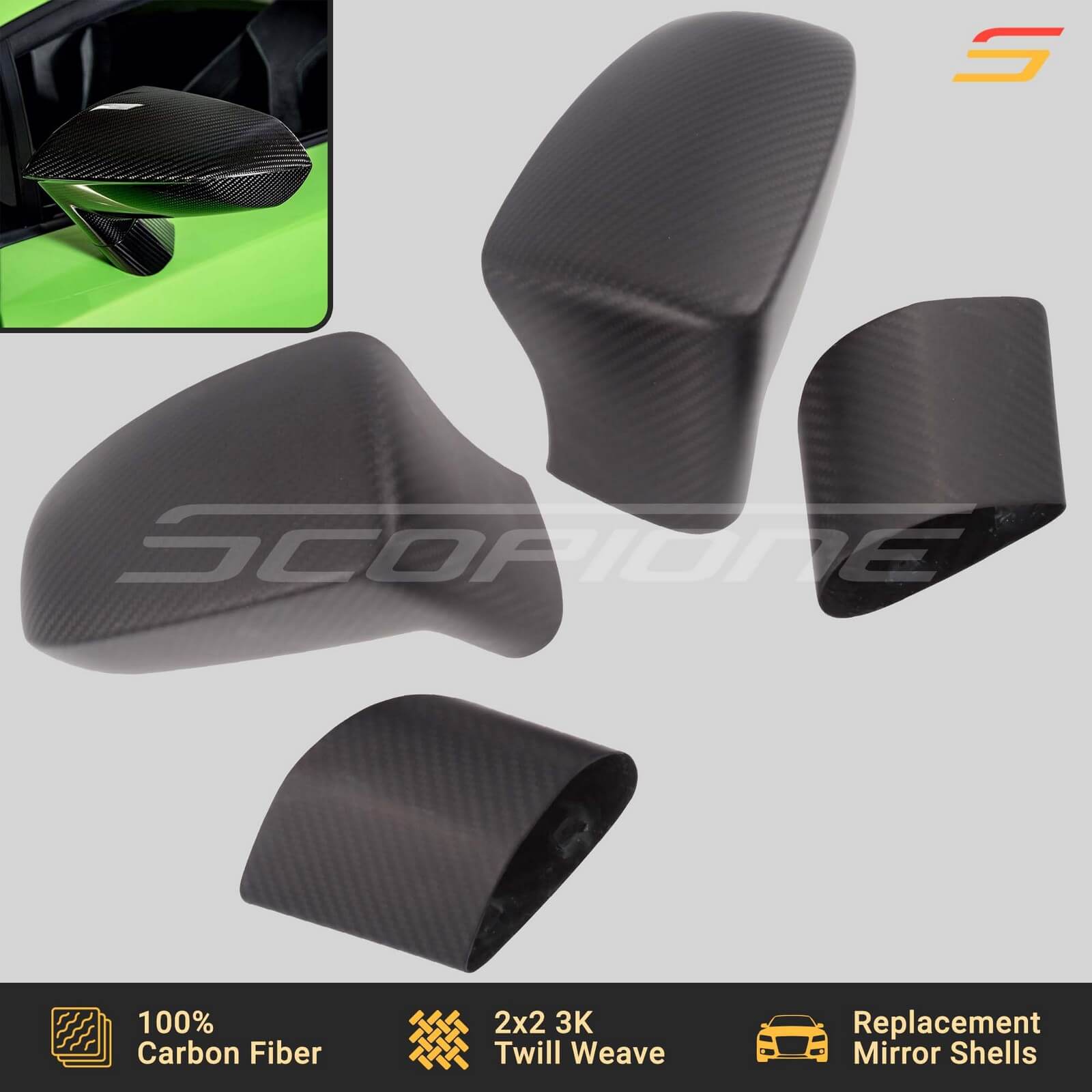
- Mirror Shells – Full replacement side mirror shells in gloss or matte carbon fiber. The first upgrade other drivers notice on a Gallardo, and available for all model years, 2003–2013.
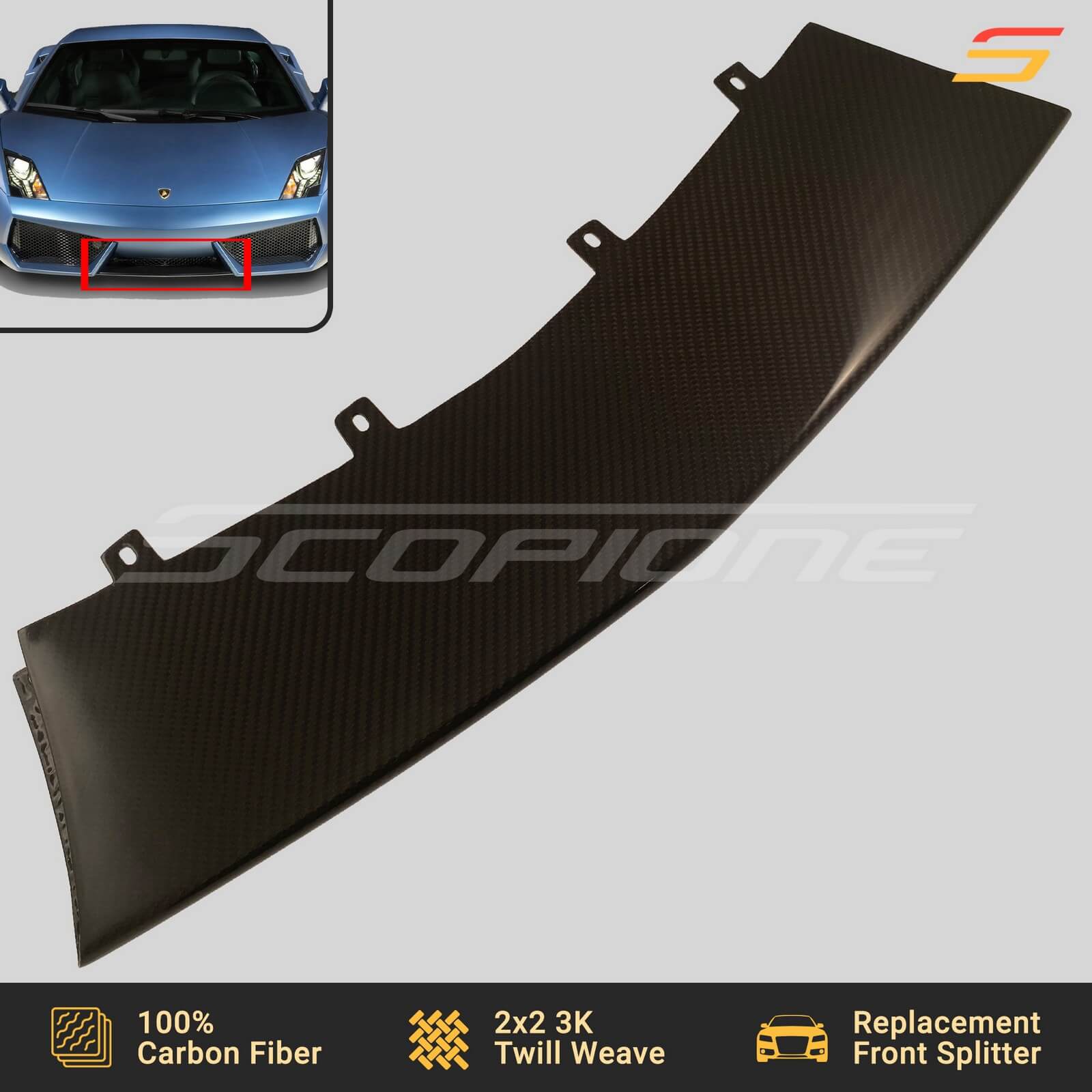
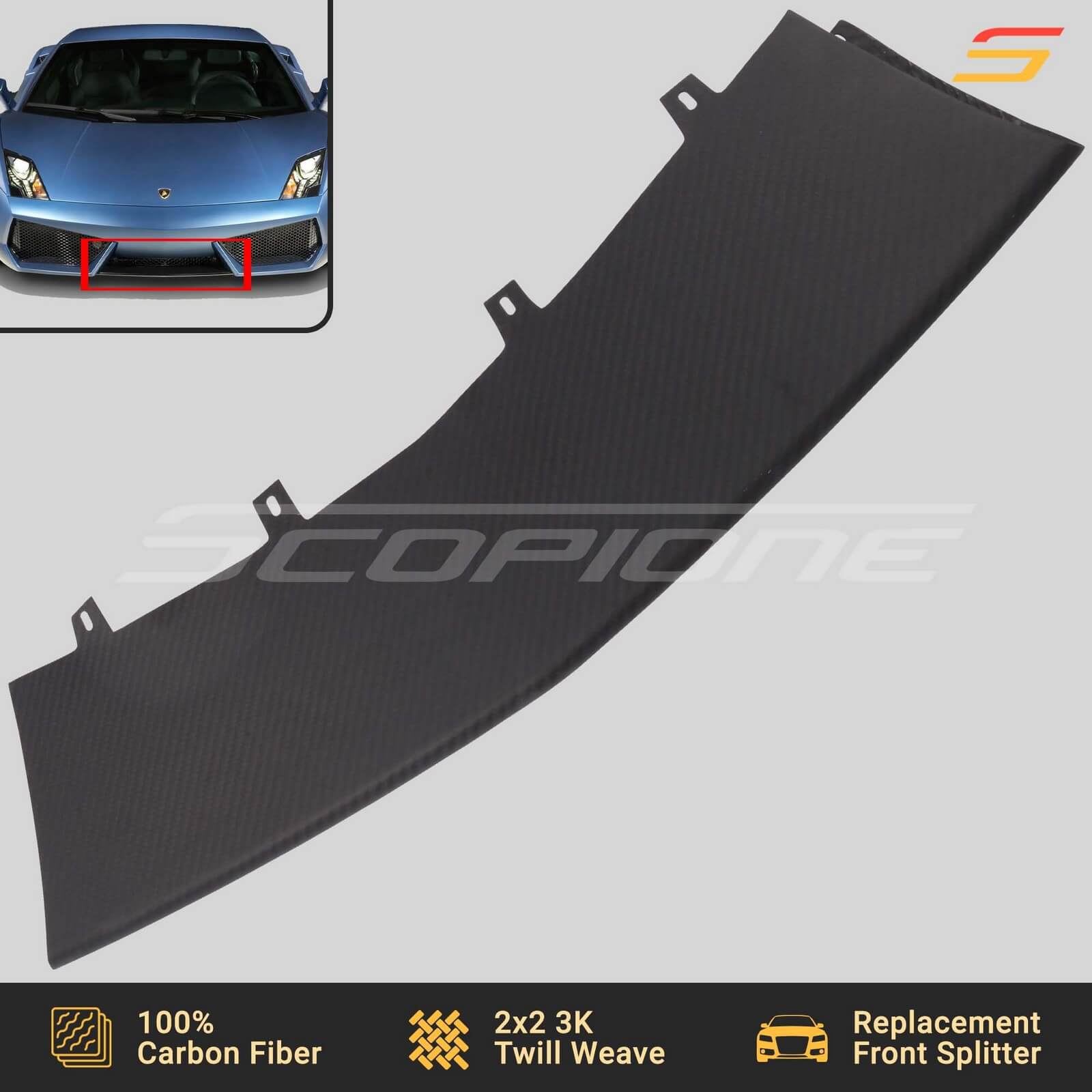
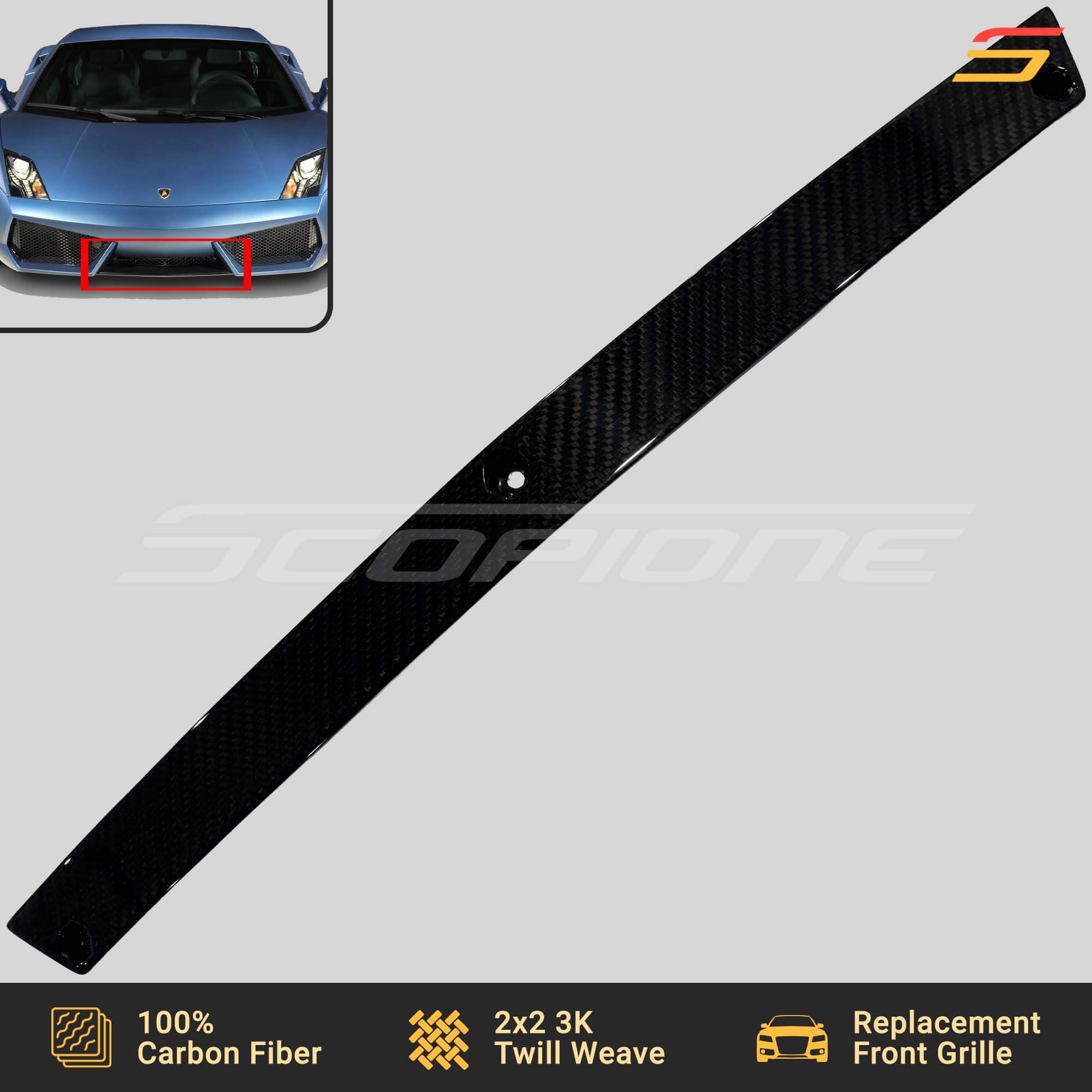
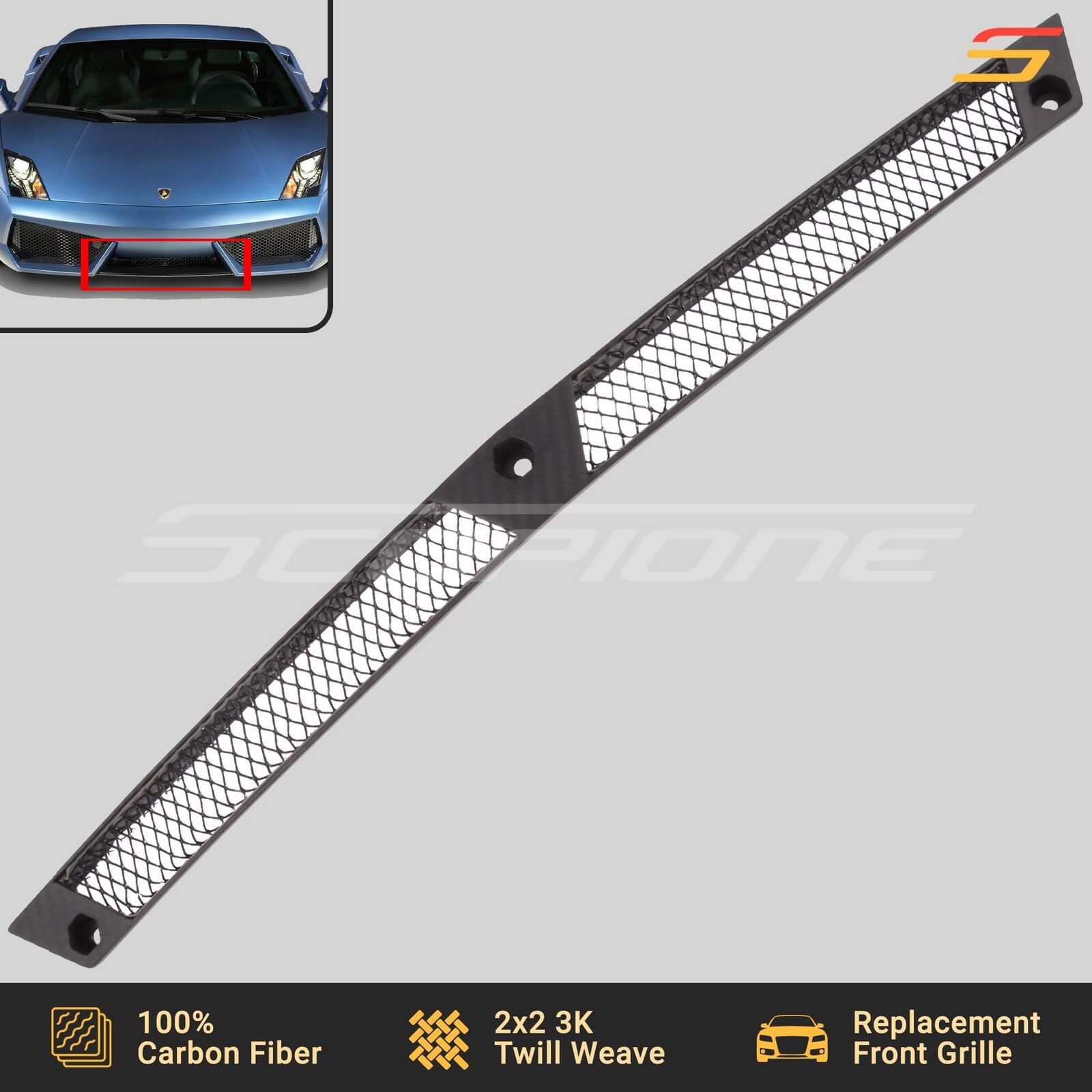
- Front bumper splitter lips and center lip grilles – LP 550/LP 560 and LP 570 fitments, in gloss or matte – sharpen the nose and increase front-end downforce at speed.
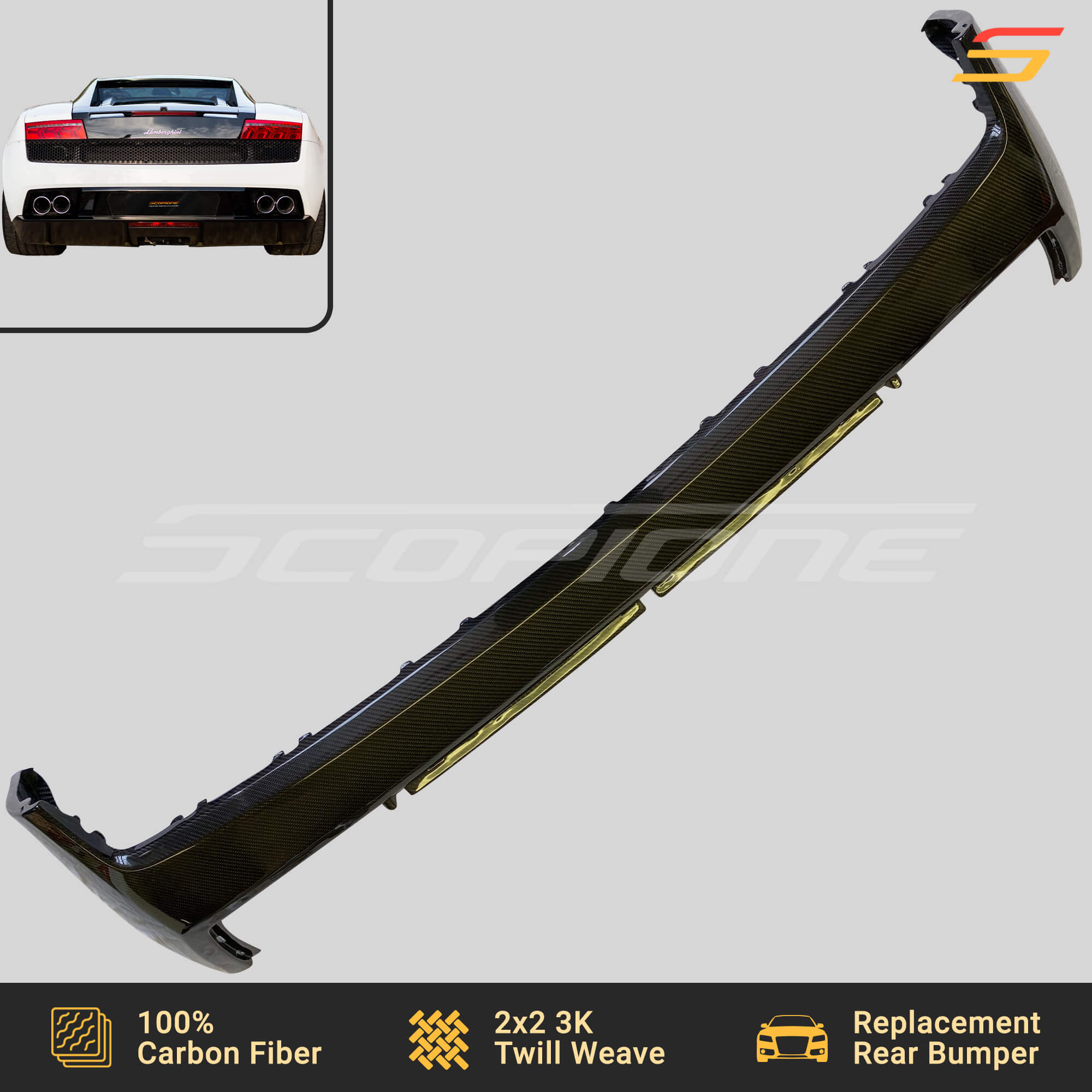
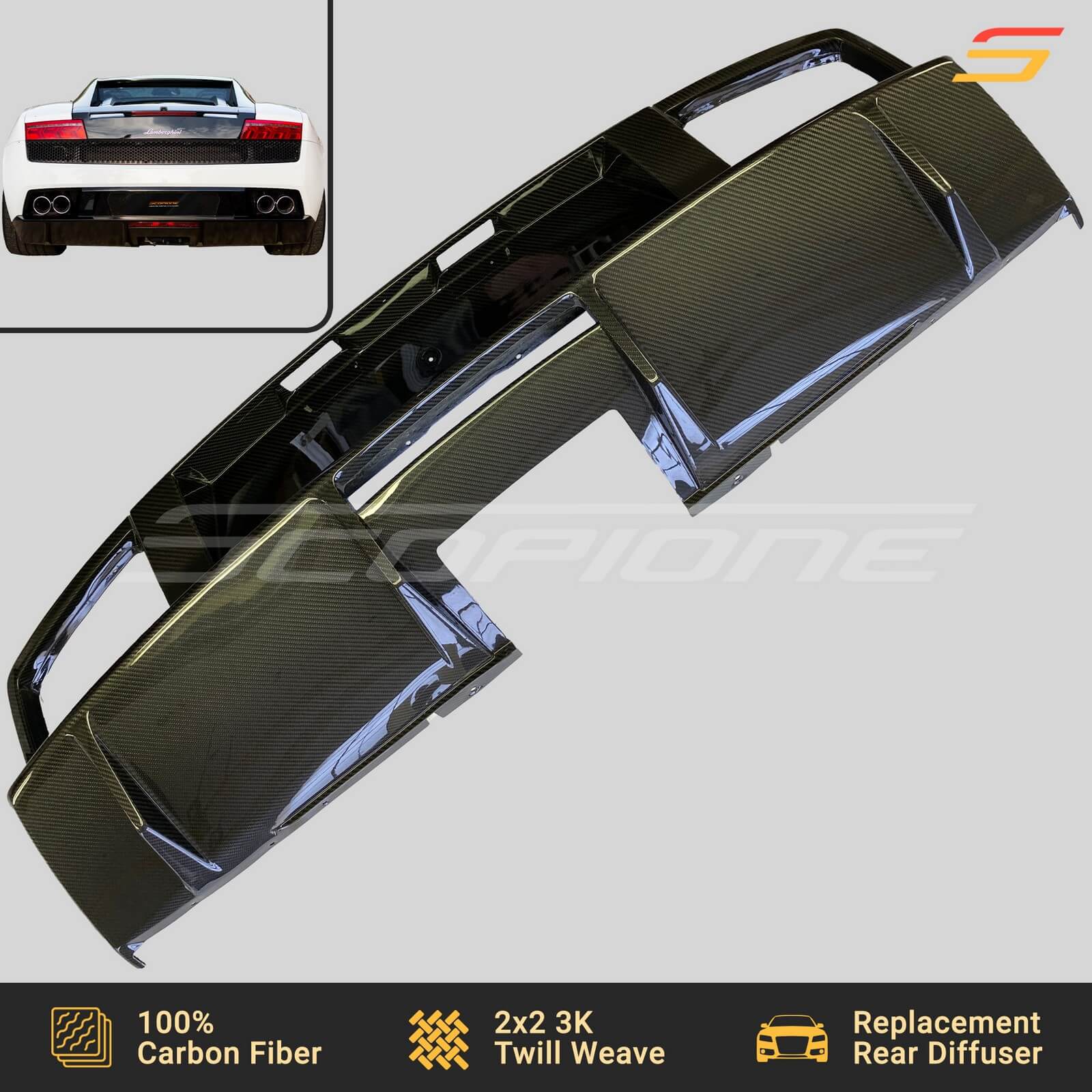
- The rear bumper diffuser (LP 550/LP 560) and the full carbon fiber rear bumper assembly (LP 550–LP 570) handle the back half of the aero equation. From the factory, the Super Trofeo Stradale’s adjustable rear wing produced 3x the aerodynamic load of the standard LP 560-4.
All of these exterior components are available through Scopione’s Gallardo page, with fitment data listed per model year.
2. Interior Upgrades
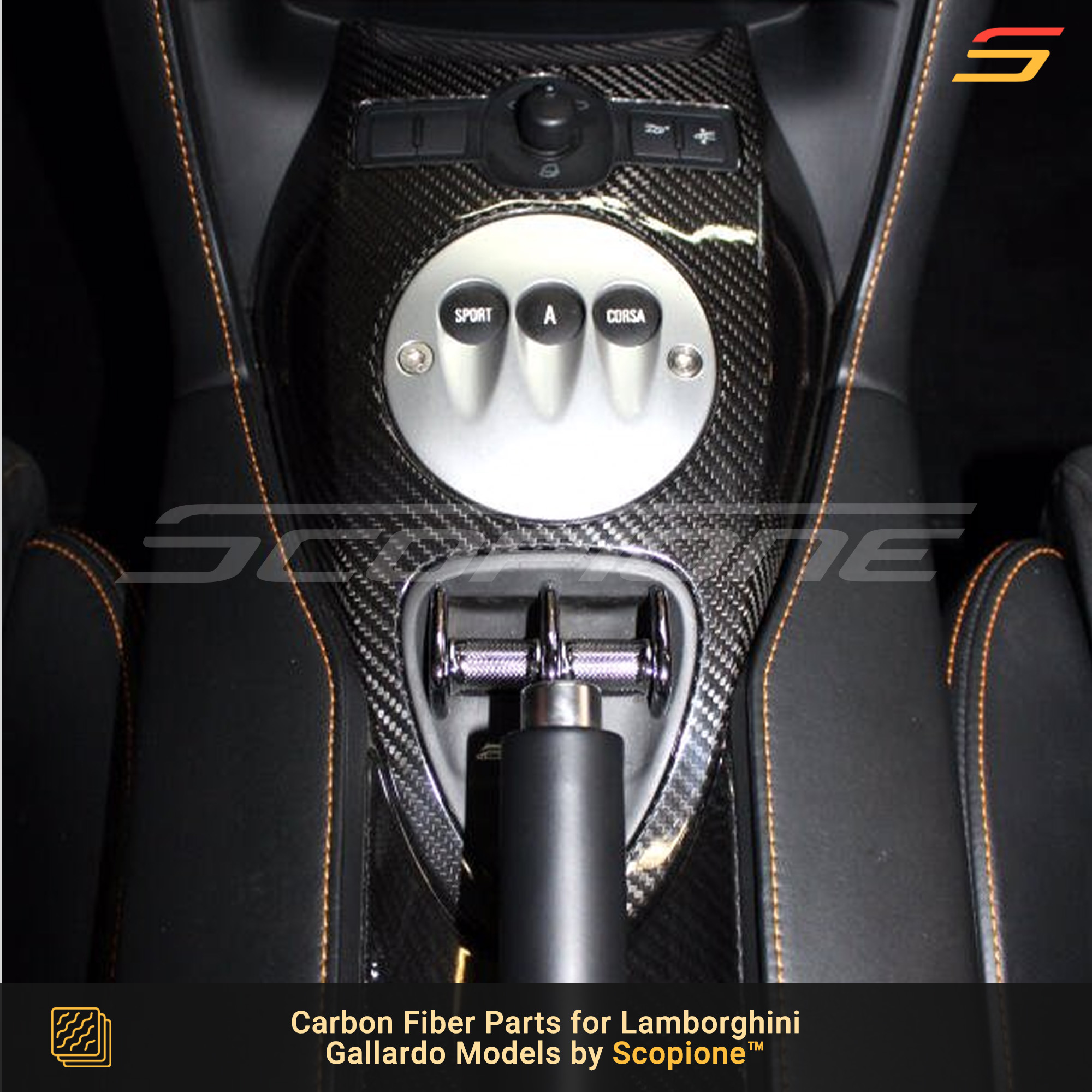
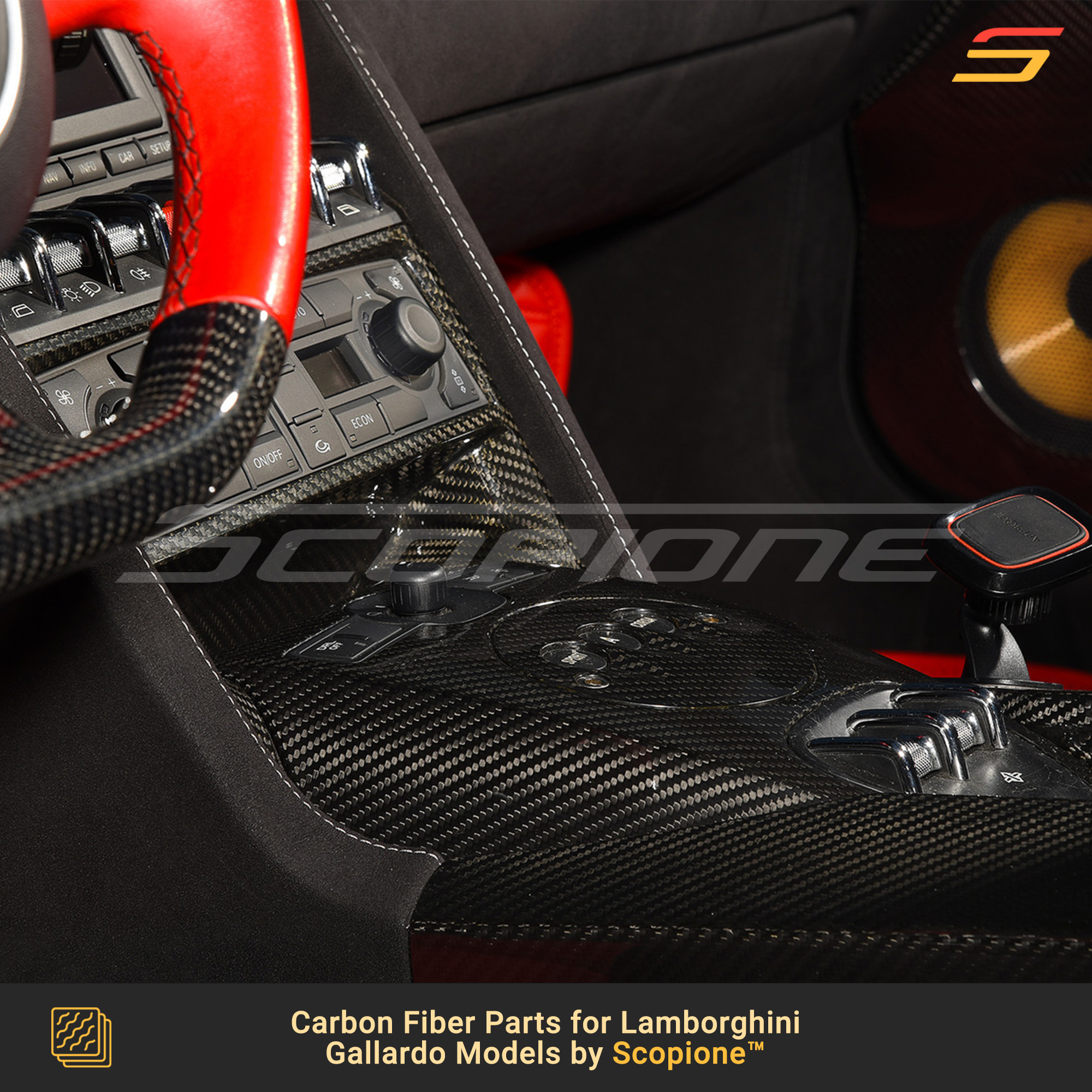
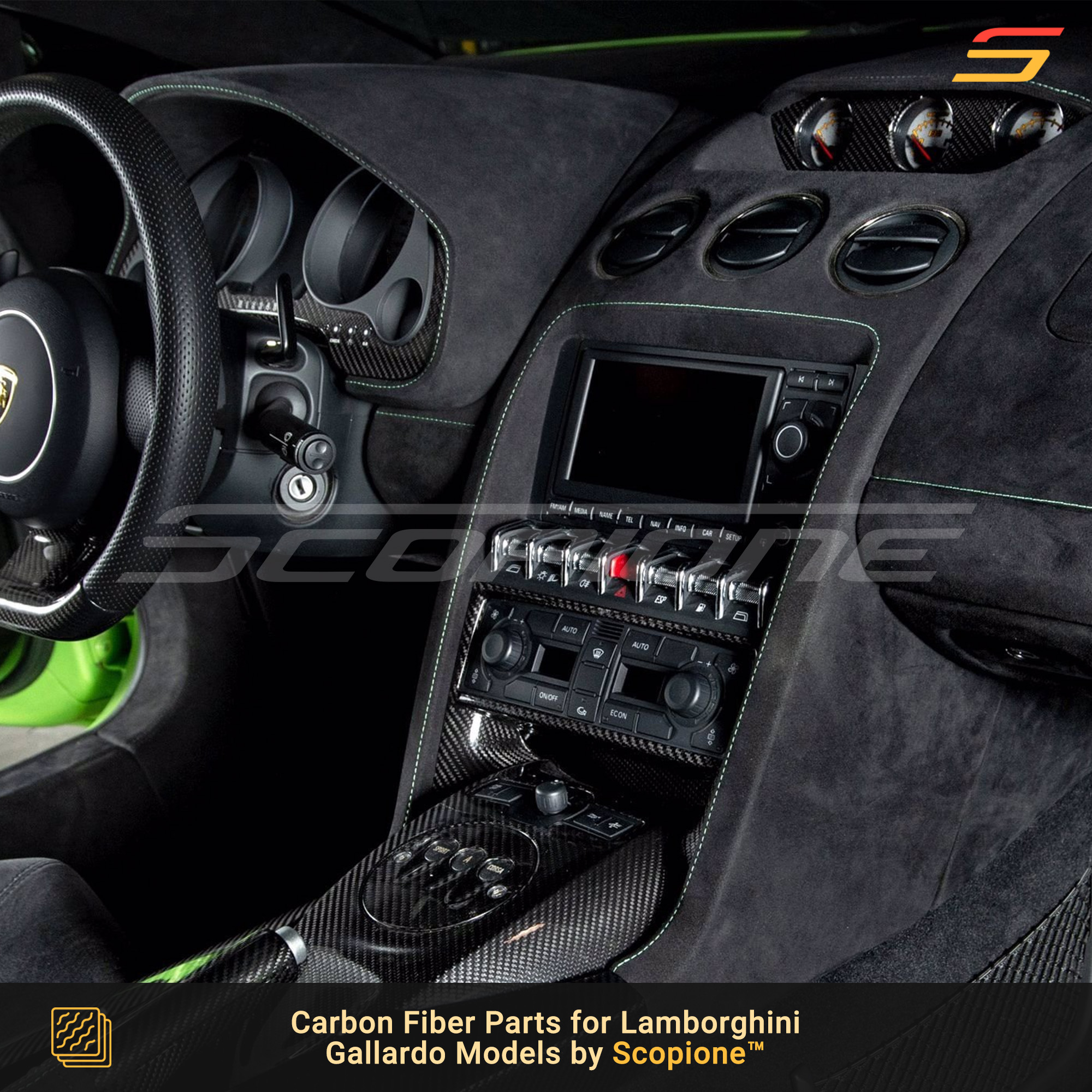
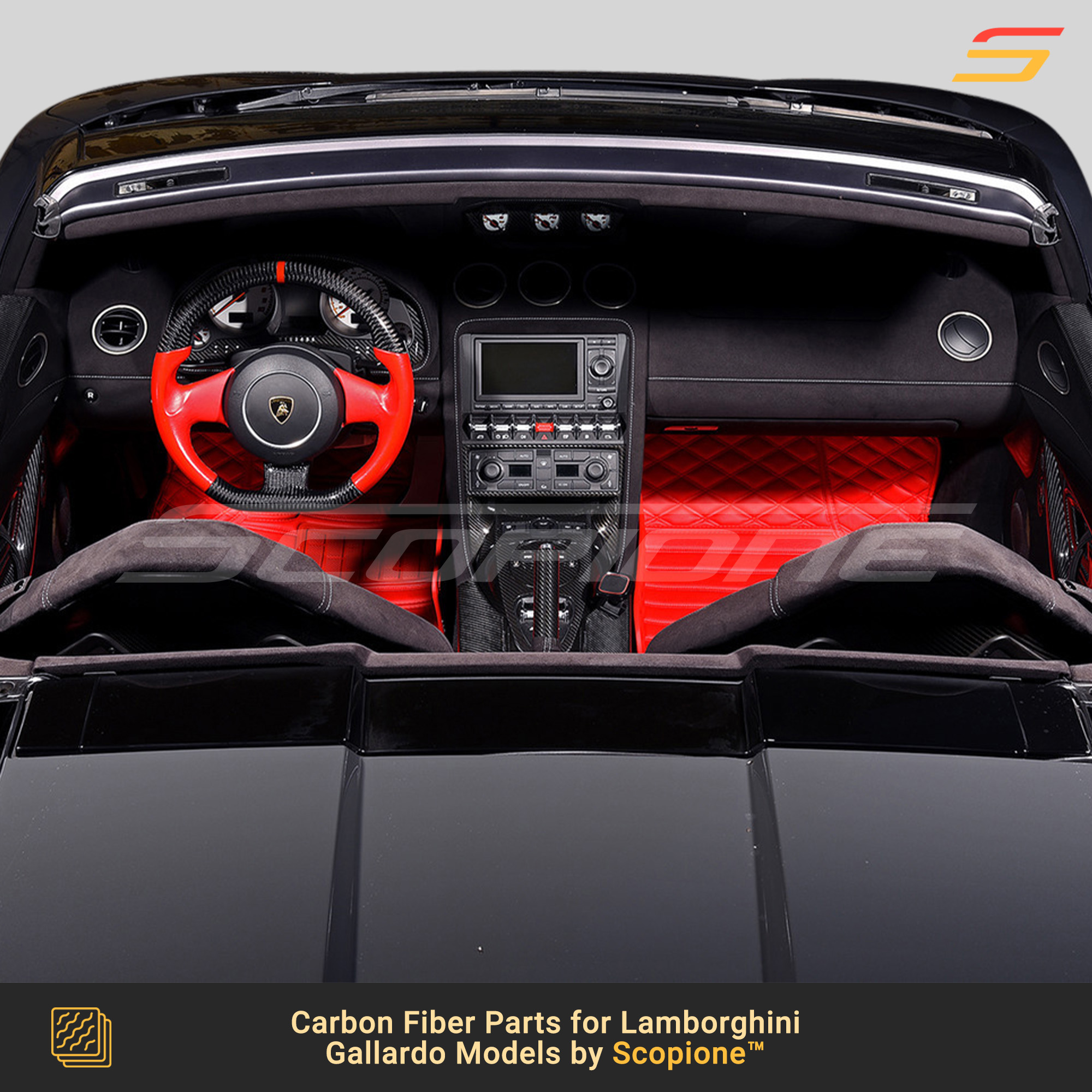
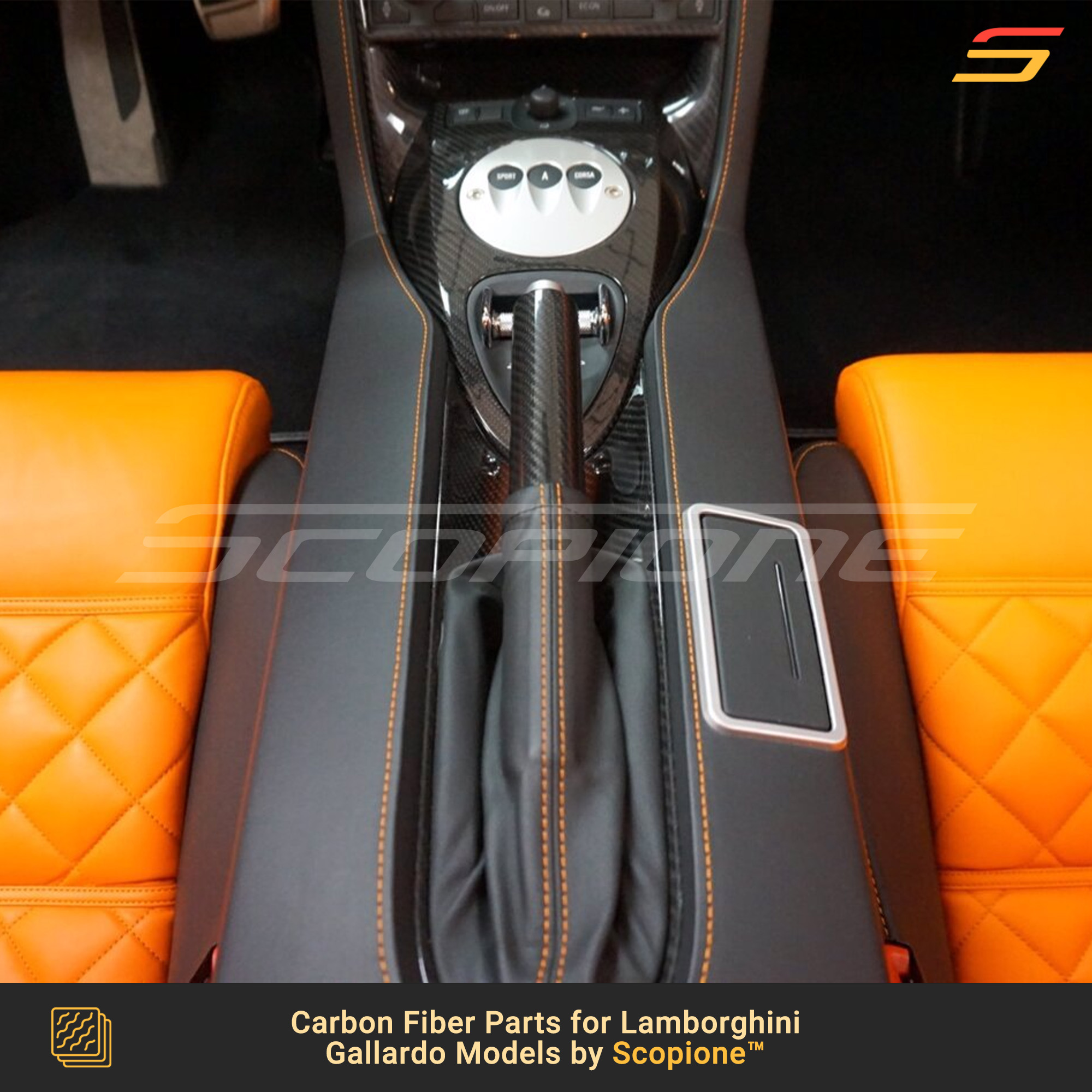
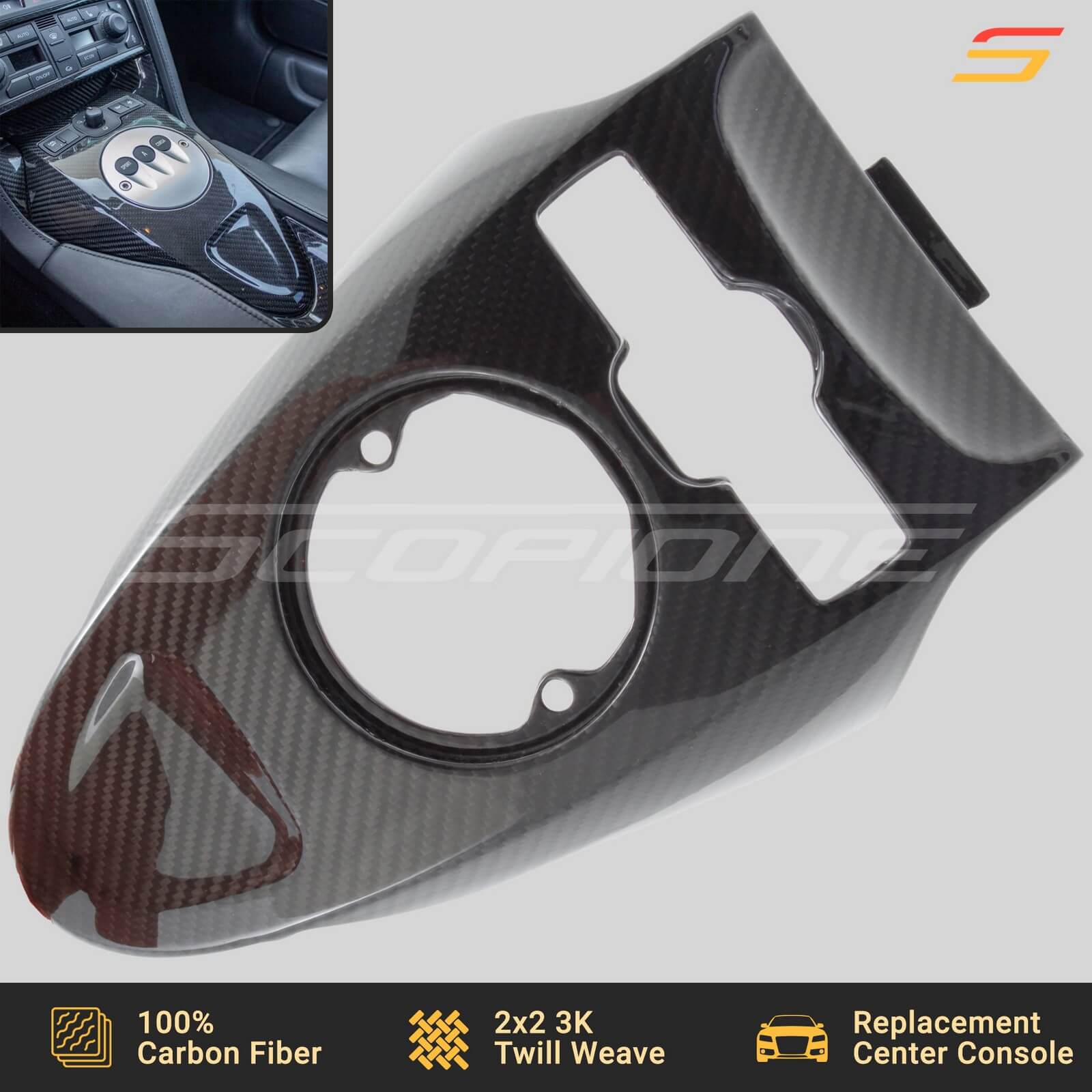
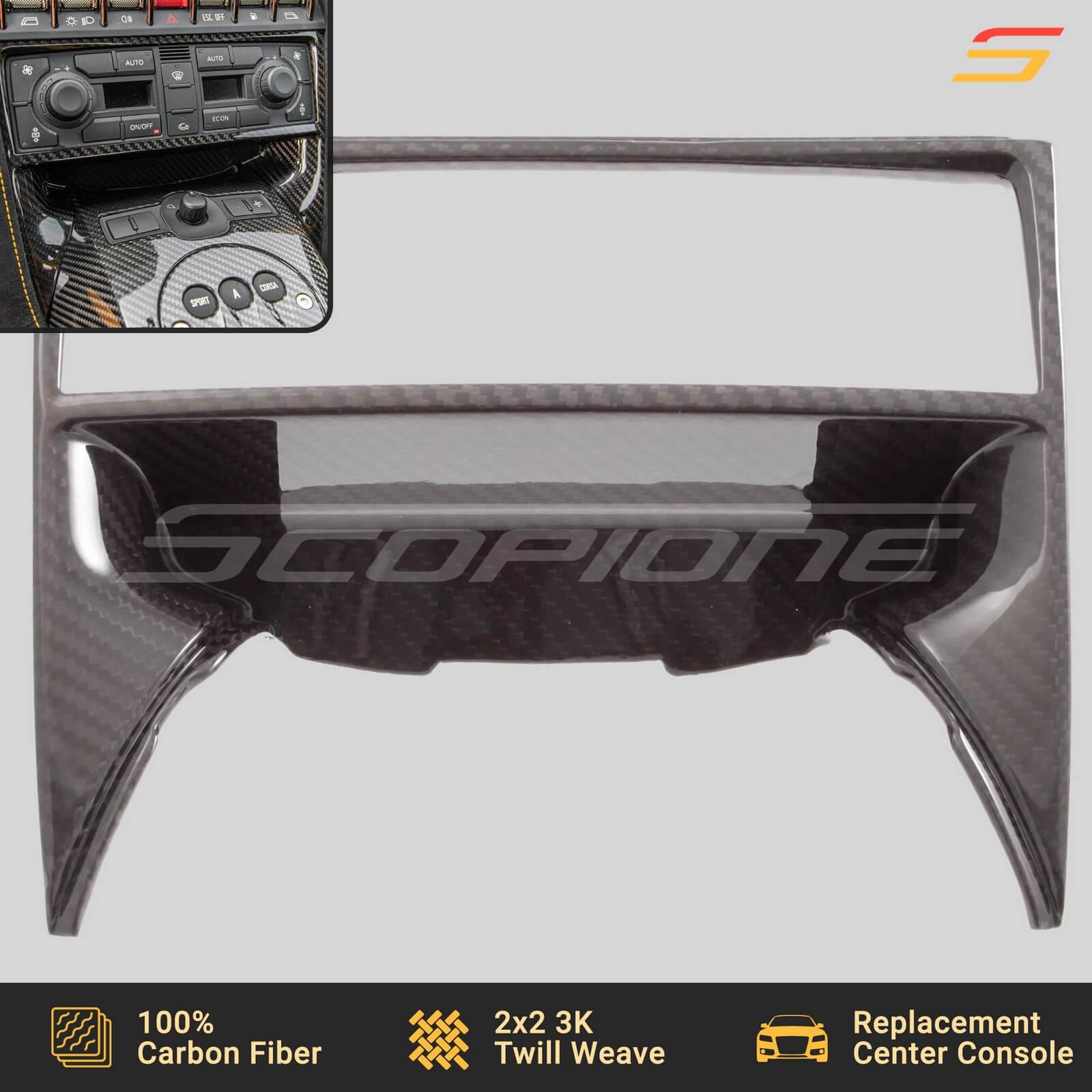
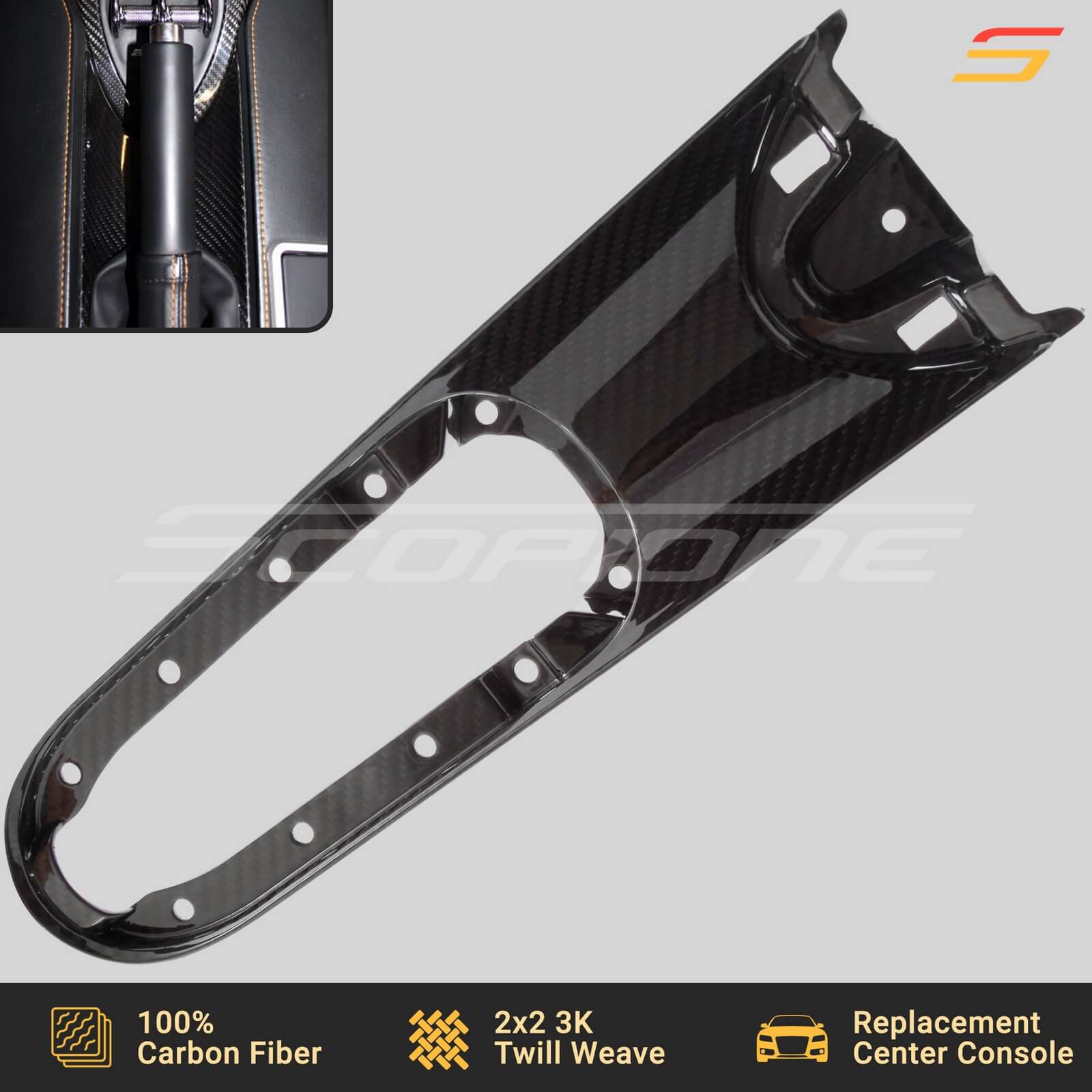
- Console & Dash Trim – Carbon fiber AC-switch dash trim plus switch-control and hand-brake console trims replace the factory plastic surrounds, adding visible weave texture through the center of the cockpit.
- Full carbon-fiber door panels debuted on the Squadra Corse – a factory-level modification that shaved kilograms from each door while maintaining crash structure integrity.
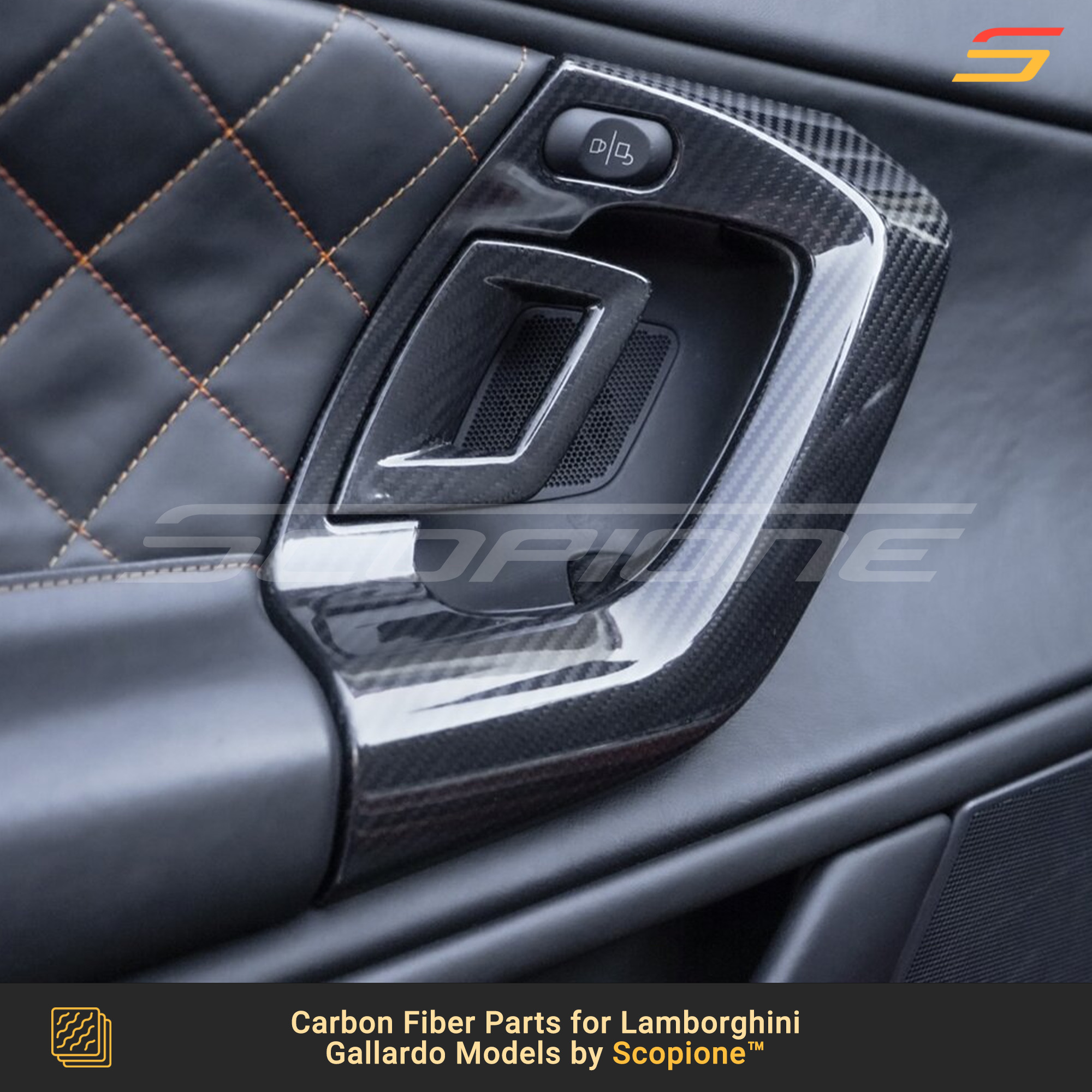
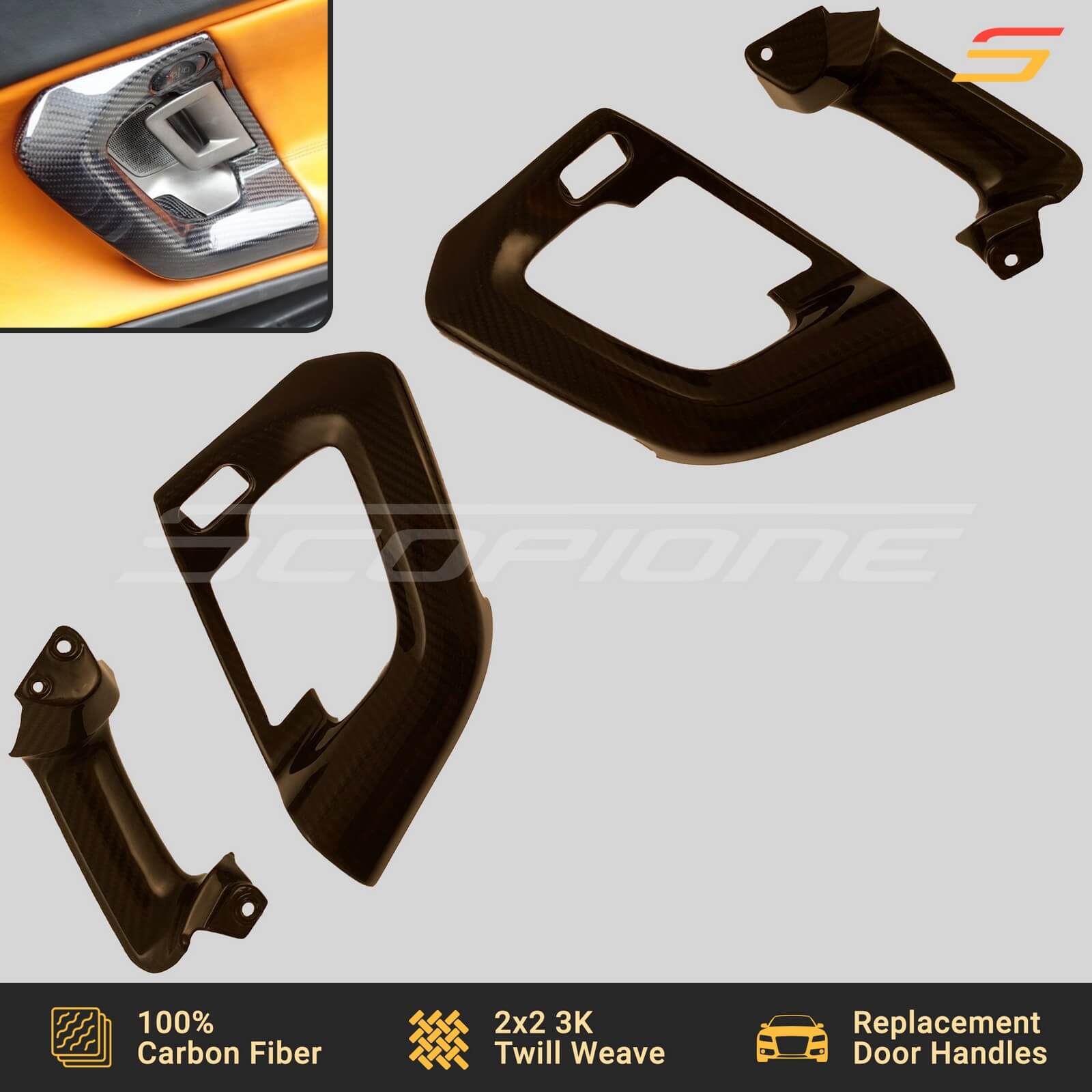
- Interior Door Handles – Full replacement carbon fiber door handles put the material directly under your fingertips every time the door opens.
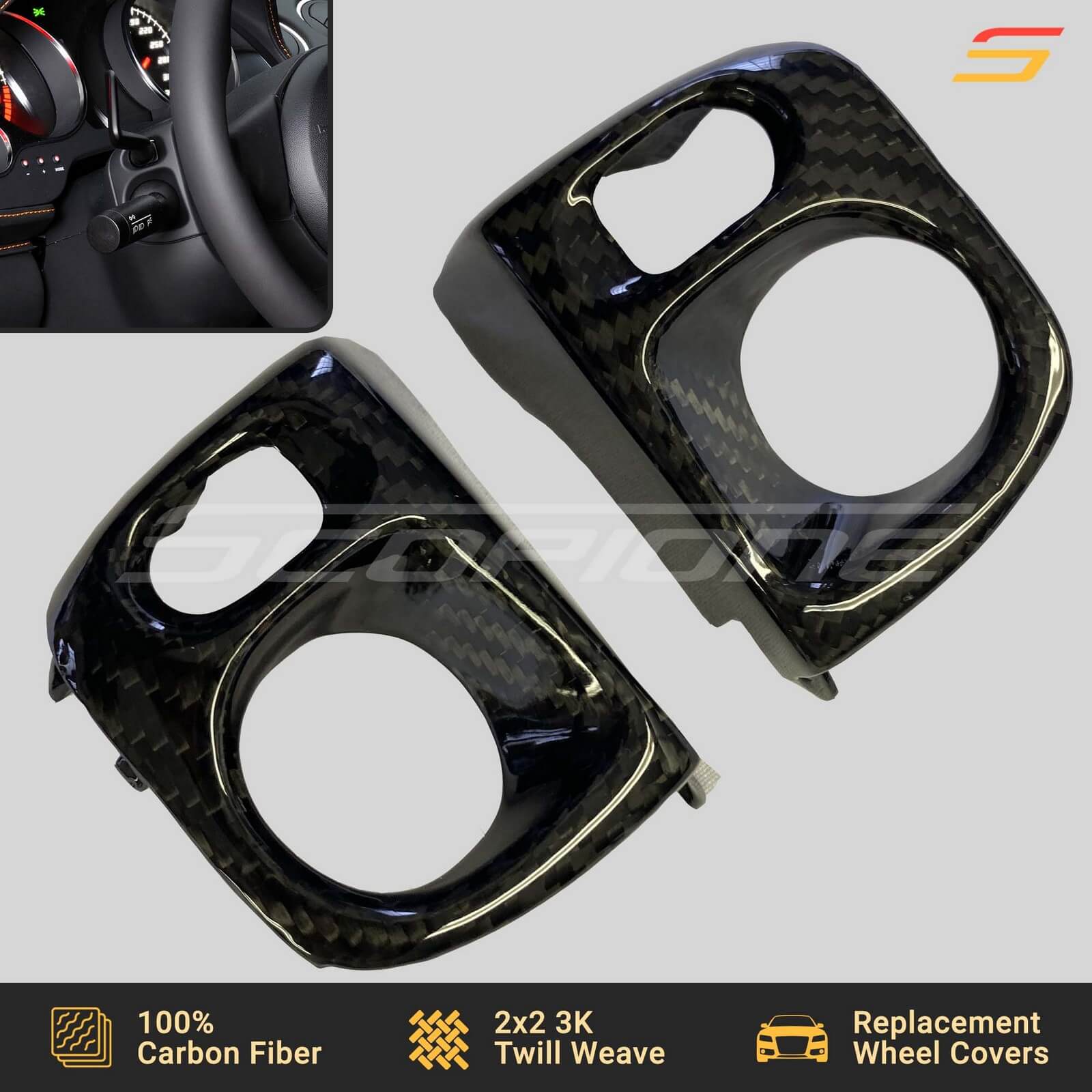
- Steering wheel gearbox covers – E-gear and manual-specific carbon fiber covers – frame the wheel hub in exposed weave. A tactile upgrade with functional weight savings.
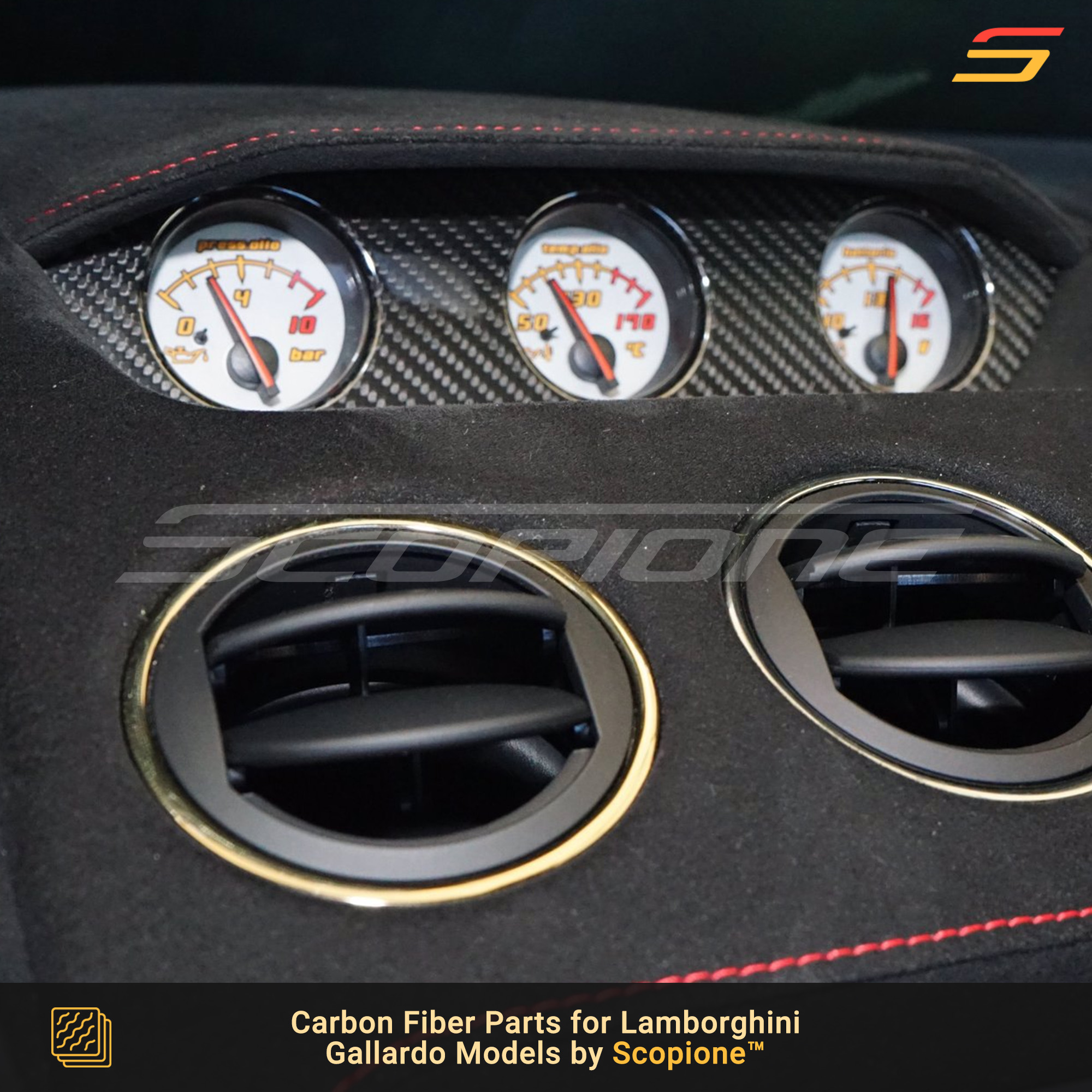
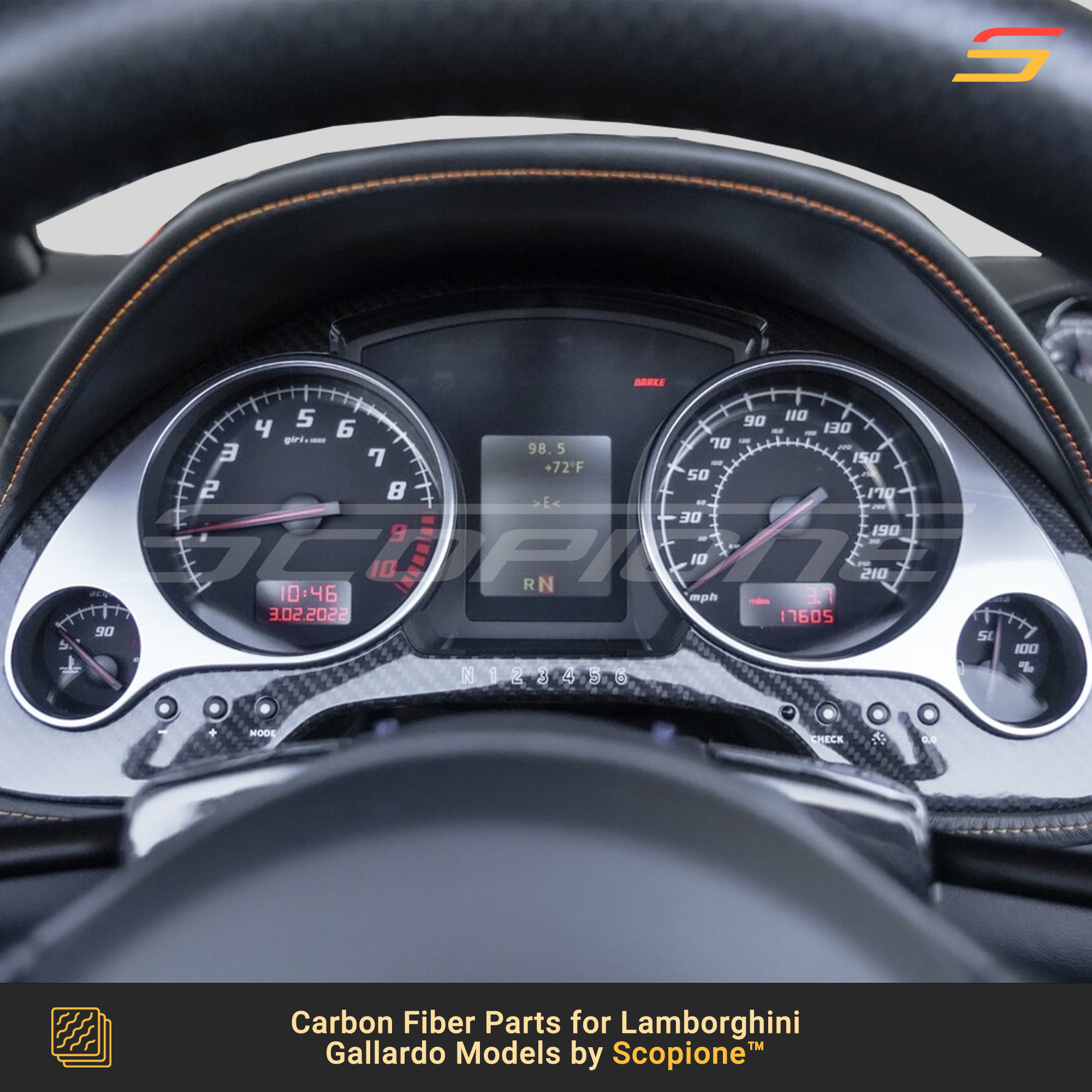
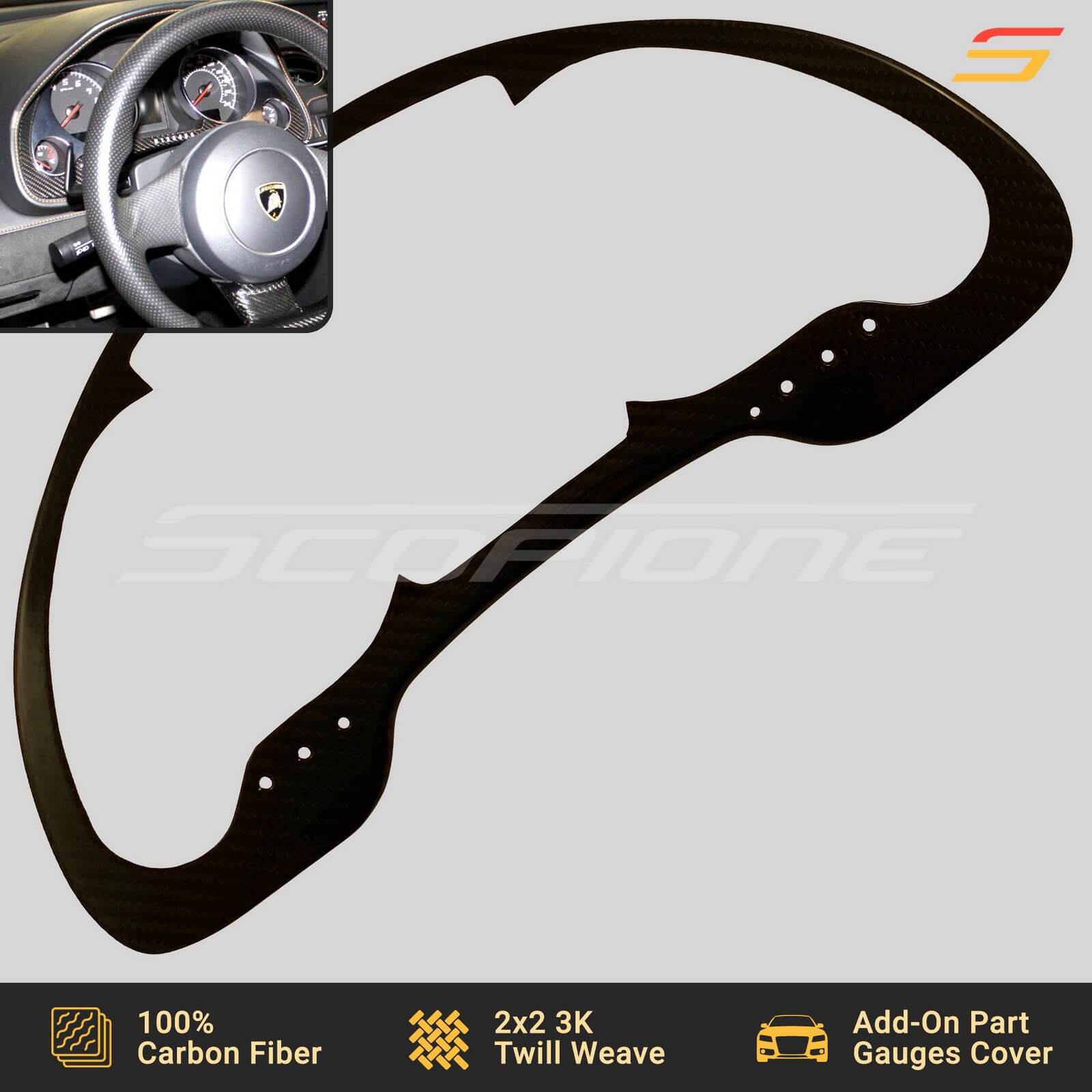
- Gauge Cluster & 3-Gauge Console Covers – Frame the instrument panel and center gauges in exposed carbon fiber weave.
Interior carbon fiber for the Gallardo – dash trim, console, steering wheel accents – is available on the Scopione Gallardo shop page.
3. Performance & Structural Components
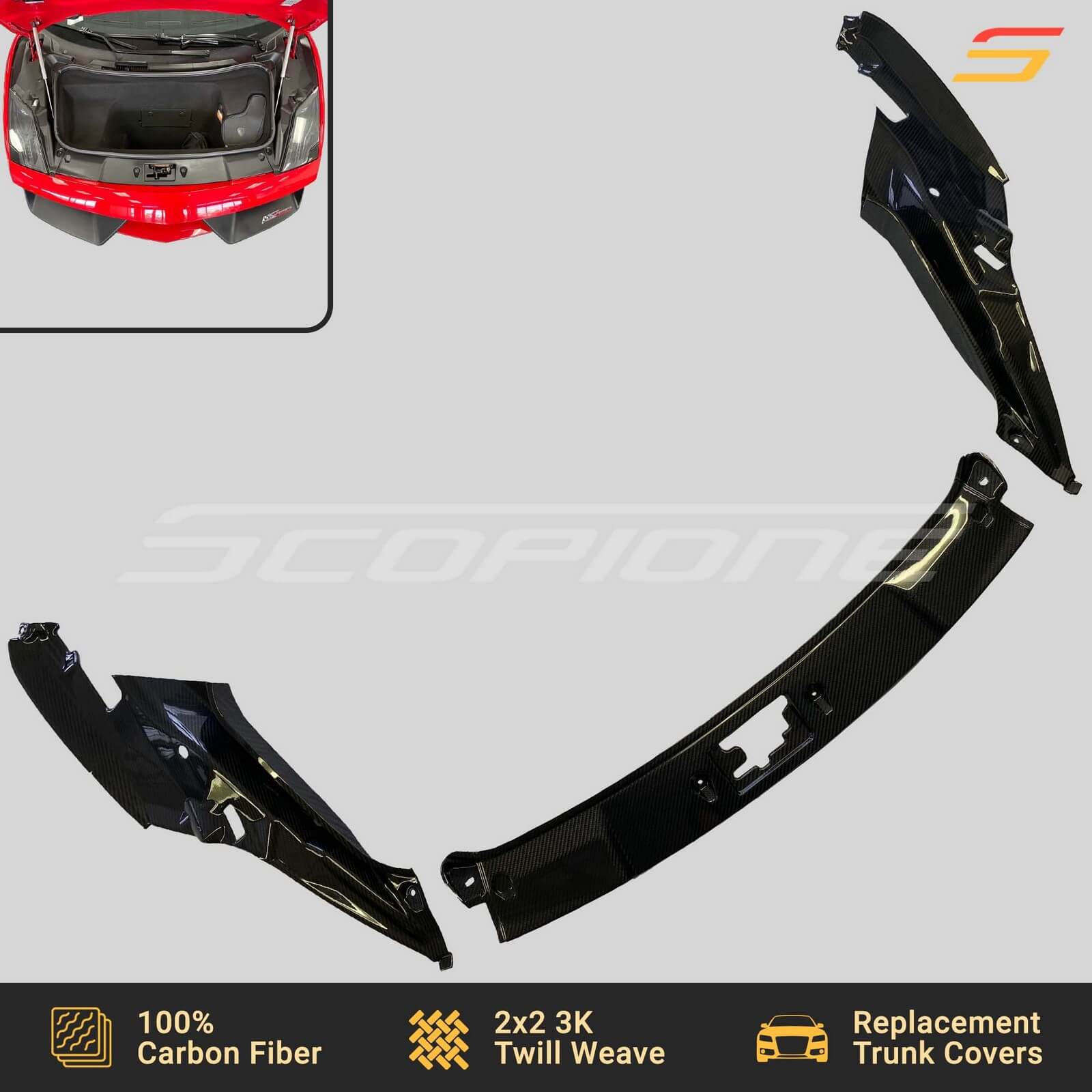
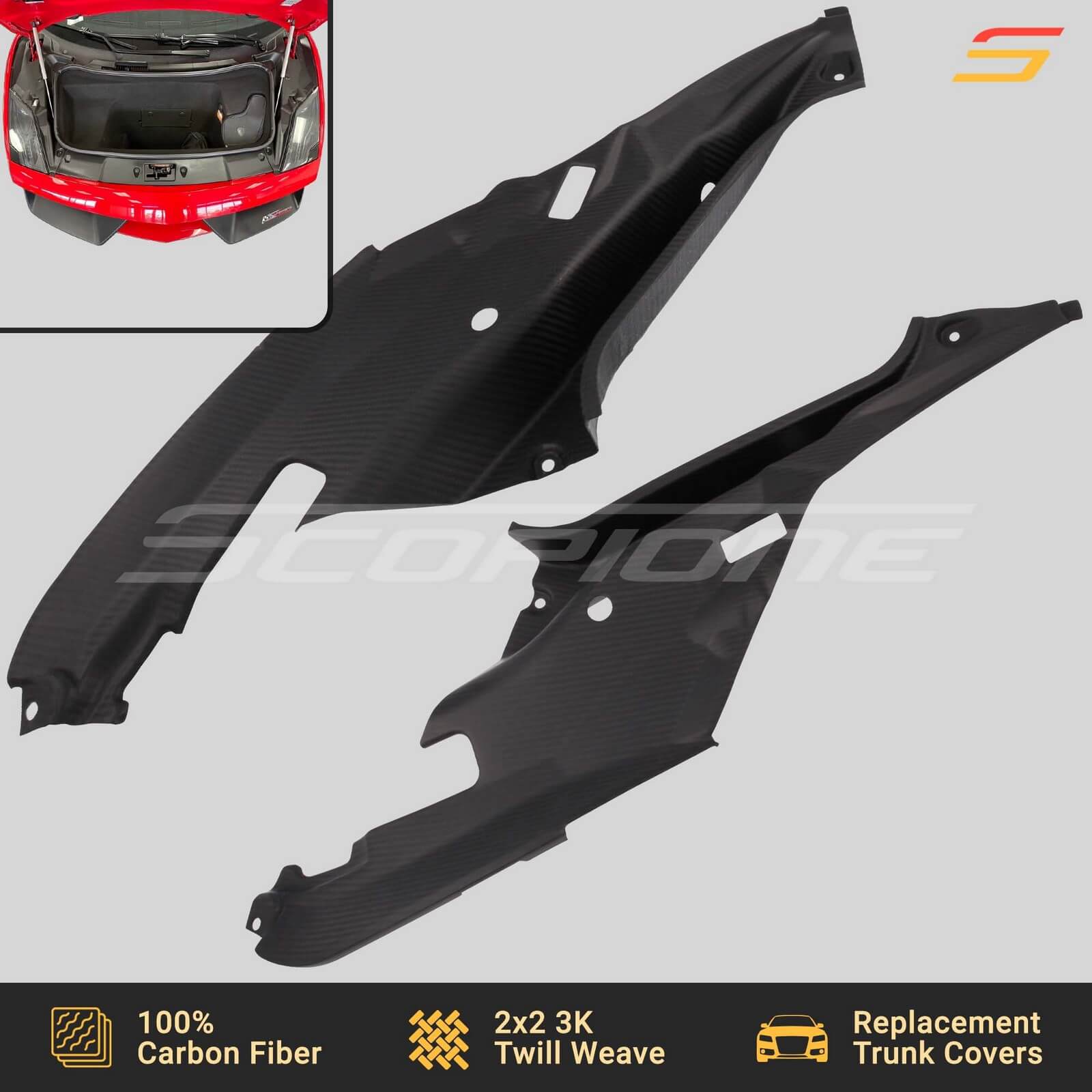
- Engine Bay Covers Kit – A complete heat-resistant carbon fiber replacement kit that reduces weight over the rear axle, plus a matte-finish replacement firewall cover.
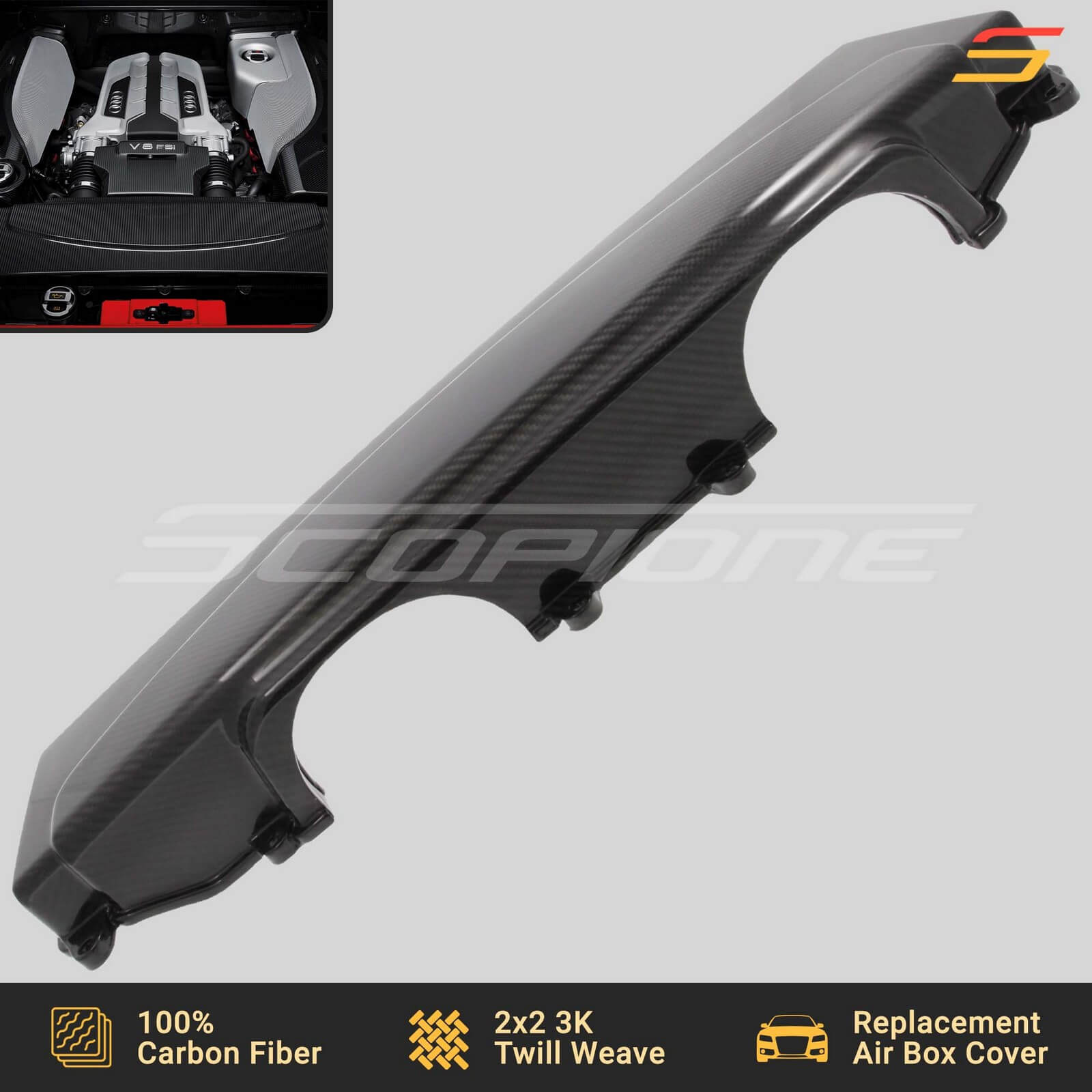
- Engine air filter box cover – a carbon fiber lid for the V10’s airbox, with a shared fitment that also serves the Audi R8.
- Factory Underbody Aero – From the factory, the Superleggera and Squadra Corse ran extensive carbon fiber underbody trays to cut drag and stabilize the car at speed – part of why those editions remain the platform’s benchmark.
Carbon Fiber Benefits on the Gallardo Platform
✓ Weight Reduction – Carbon fiber weighs roughly 60% less than equivalent FRP components. On a car that already tips the scales at 1,520 kg, every kilogram matters for acceleration, braking, and cornering.
✓ Visual Impact – The 2×2 twill-weave pattern under a glossy clear coat creates a distinct texture that complements the Gallardo’s angular body lines.
✓ Structural Strength – High tensile strength with heat resistance – carbon-fiber panels hold up under track conditions without warping or fading.
✓ Collector Appeal – Well-documented CF modifications from recognized brands can increase desirability among Gallardo collectors and enthusiasts.
Scopione’s Gallardo carbon fiber line covers exterior, interior, and engine bay components – view all available parts.

Legacy of the Gallardo & Its Impact on Lamborghini
On November 25, 2013, the very last Gallardo – an LP 570-4 Spyder Performante in Rosso Mars – rolled off the line at Sant’Agata Bolognese. It closed a chapter that fundamentally changed the company.
Before the Gallardo, Lamborghini was financially unstable. The Gallardo fixed that. Under Audi’s ownership, it shared powertrain and AWD components with what would become the Audi R8, improving reliability while reducing development costs. By 2004, the model had ushered in an era of consistent profitability – enabling Lamborghini to fund future platforms and expand its dealer network globally.
The Gallardo’s successor, the Huracan, debuted in 2014 and hit the same 14,022-unit mark in roughly half the time. But as naturally aspirated V10 supercars become extinct under emissions regulations and electrification, the Gallardo holds a position that newer cars cannot replicate. Manual-transmission examples and limited editions – the Superleggera, Valentino Balboni, Squadra Corse – are firmly established as modern classics with strong appreciation trajectories.
The Gallardo also served a role no other supercar had filled. Starting in 2004, Lamborghini donated multiple Gallardos to the Italian Polizia Stradale for highway patrol on the Salerno–Reggio Calabria motorway. The cars carried medical equipment – defibrillators, blood pressure monitors – and completed over 200 organ transport missions. One LP 560-4 Polizia was destroyed in 2009 when a motorist pulled out of a fuel station without looking. Minor injuries only. The partnership between Lamborghini and the Italian state police has continued for over 20 years, with Huracan-based cars replacing the original Gallardos.
Over 25 special editions. Sales across 45 countries. And a production run that accounted for nearly half of all Lamborghinis ever built at the time. The Gallardo’s significance in supercar history is not a matter of opinion.
Scopione: Carbon Fiber Upgrades for the Lamborghini Gallardo
From its 2003 debut to the final special editions in 2013, the Gallardo evolved alongside carbon fiber technology. The early cars used it as decoration. The Superleggera used it to cut 100 kg. The Squadra Corse built entire door panels from it. For Gallardo owners looking to continue that trajectory with aftermarket components, Scopione provides precision-fitted carbon fiber parts across the full model range.
Scopione’s Gallardo catalog includes engine bay covers, mirror shells, rear diffusers, splitter lips, and interior console trim – all hand-laid from 2×2 twill-weave carbon fiber with a UV-resistant clear coat finish. Parts mount to factory points. No drilling required on most installations.
Breakdown of Carbon Fiber Upgrade Costs for Lamborghini Gallardo
Carbon fiber upgrade costs on the Gallardo vary by component. Below is a breakdown of average pricing for aftermarket carbon fiber parts with professional installation:
| Carbon Fiber Part | Estimated Cost (USD) | Installation Cost (USD) | Total Cost (USD) |
|---|---|---|---|
| Rear Bumper Assembly (LP 550–LP 570) | $4,200 – $4,600 | $500 – $1,200 | $4,700 – $5,800 |
| Rear Bumper Diffuser (LP 550/LP 560) | $4,100 – $4,500 | $400 – $1,200 | $4,500 – $5,700 |
| Engine Bay Covers Kit (Coupe) | $3,900 – $4,300 | $300 – $800 | $4,200 – $5,100 |
| Side Mirror Shells (Gloss or Matte) | $2,900 – $3,200 | $100 – $250 | $3,000 – $3,450 |
| Front Hood Bonnet Covers Kit | $2,800 – $3,000 | $300 – $600 | $3,100 – $3,600 |
| Interior Door Handles (Replacement) | $2,300 – $2,500 | $200 – $400 | $2,500 – $2,900 |
| Front Bumper Splitter Lip (LP 550–LP 570) | $1,200 – $1,400 | $200 – $500 | $1,400 – $1,900 |
| Console & Gauge Trim (per piece) | $700 – $1,500 | $100 – $300 | $800 – $1,800 |
| Steering Wheel Gearbox Covers | $650 – $700 | $100 – $200 | $750 – $900 |
OEM vs. Aftermarket: Lamborghini offered factory carbon fiber packages on the Superleggera and Squadra Corse, but OEM replacement parts carry a significant price premium. Scopione’s CF components use the same 2×2 twill-weave layup and clear coat finishing, with fitment engineered to match factory body lines – at a fraction of OEM pricing.
Used Lamborghini Gallardo Market (2024–2025)
Gallardo resale values vary significantly by variant, transmission type, mileage, and modification quality. Current approximate market ranges:
- Early Gallardo 5.0 (2004–2008): $80,000 – $130,000
- LP 560-4 Coupe (2008–2013): $97,000 – $170,000
- Superleggera (any generation): $137,000 – $250,000
- LP 550-2 Valentino Balboni: $140,000 – $425,000+
- LP 570-4 Spyder Performante: $130,000 – $578,000+ (record auction result)
- LP 570-4 Squadra Corse / Super Trofeo Stradale: $200,000 – $320,000+

Browse Carbon Fiber Parts for the Lamborghini Gallardo
Does Carbon Fiber Affect the Resale Value of a Lamborghini Gallardo?
Carbon fiber modifications can influence a Gallardo’s resale value – but the effect depends entirely on execution and documentation.
When carbon fiber adds value:
• Professionally installed, well-documented parts from recognized brands increase buyer confidence.
• A complete carbon fiber package on rare variants (Superleggera, Squadra Corse) can add measurable desirability at auction.
• Buyers shopping for a track-prepared Gallardo often pay a premium for documented weight reduction.
When it does not:
• Unbranded or poorly fitted aftermarket parts raise red flags for serious buyers.
• Extreme widebody conversions narrow the buyer pool.
• Carbon fiber alone does not guarantee a price increase – stock or OEM-specification cars often bring the strongest auction results.
Practical advice: To protect resale value, use carbon fiber parts from documented sources like Scopione, retain all receipts and installation records, and keep the original OEM parts if removed.
What Factors Affect Lamborghini Gallardo Prices?
- Model & Variant: Special editions (Superleggera, Valentino Balboni, Squadra Corse) command significant premiums over standard production models.
- Transmission: Manual (gated 6-speed) Gallardos can sell for 2–3x the price of equivalent E-gear cars. This gap continues to widen.
- Condition & Mileage: Low-mileage examples with documented service histories bring the highest prices.
- Market Positioning: As naturally aspirated V10 supercars with available manual transmissions disappear from new-car showrooms, demand for analog Gallardos has increased steadily.
- Modification Quality: Carbon fiber upgrades, performance exhaust systems, and suspension work from recognized brands can raise value – but cheap or poorly installed modifications have the opposite effect.
- Color & Specification: Certain factory colors command premiums – Verde Ithaca, Giallo Midas, and Arancio Borealis are consistently sought after. Cars optioned with the E-gear’s Corsa mode, carbon-ceramic brakes, or the Lightweight package also attract stronger bids.
Notable Auction Results for Lamborghini Gallardo (2024–2025)
| Model | Sale Price |
|---|---|
| 2013 LP 570-4 Spyder Performante (6-Speed Manual) | $578,000 (Oct 2024) |
| 2011 LP 550-2 Valentino Balboni | $425,000 (Aug 2024) |
| 2008 Superleggera | $246,000 (Apr 2025) |
| 2005 Gallardo Coupe | $121,000 (Apr 2024) |
| 2006 Gallardo Spyder | $99,000 (Oct 2025) |
Is the Lamborghini Gallardo a Good Investment?
- Depreciation: Early Gallardo 5.0 models (2004–2008) have largely bottomed out, stabilizing in the $80K–$130K range. E-gear cars sit at the lower end; manual cars at the upper.
- Collectibility: Limited editions hold or appreciate. Manual-transmission Superleggeras, Valentino Balbonis, and Squadra Corses have shown consistent upward movement at auction.
- Analog Premium: Naturally aspirated, non-turbocharged V10 supercars with manual transmissions are no longer being produced. This scarcity supports estimated long-term appreciation of 4–6% annually for high-demand variants.
Gallardo Buying Guide (2025)
- Entry point: 2004–2008 Gallardo 5.0 with E-gear ($80K – $100K) – the most accessible V10 Lamborghini on the used market.
- Performance value: 2009–2013 LP 560-4 Coupe ($100K – $140K) – the 5.2L direct-injection V10 with improved driving modes and faster E-gear calibration.
- Long-term hold: Any manual-transmission Gallardo, plus special editions (Superleggera, Valentino Balboni, Squadra Corse) – these are the cars auction houses compete for.
What Are Common Lamborghini Gallardo Maintenance Issues and Costs?
Annual maintenance on a Gallardo typically runs $2,000–$4,000 for routine service (oil, filters, brake fluid). The major service interval – timing belt replacement – comes every 5 years or ~15,000 miles and costs $3,000–$5,000 at an independent specialist. E-gear hydraulic pumps and clutch actuators are the most common failure point on automated-manual cars, with replacement costs of $3,000–$6,000. Budget accordingly.
Why Are Manual Lamborghini Gallardos Worth More Than E-Gear Cars?
The Gallardo’s E-gear is an electro-hydraulically actuated single-clutch automated manual – a computer-controlled system that manages a conventional gearbox’s clutch engagement and gear selection via hydraulic pressure. It is not a dual-clutch transmission. The system’s hydraulic pump (Magneti Marelli unit), accumulator, and actuator are documented failure points, with repair costs ranging from $3,000 for a pump replacement at an independent shop to $19,000+ for a full actuator rebuild at a dealer. Clutch replacement on E-gear cars runs $3,000–$7,000 at independent specialists.
Manual-gated Gallardos avoid these costs entirely – and the exposed metal gate remains a defining Lamborghini tactile signature. Manual cars routinely sell for 2–3x the price of equivalent E-gear examples. A 2006 manual Gallardo might bring $130,000 while an identical E-gear car trades at $80,000. This gap has widened steadily since 2018 as the analog driving premium accelerates across the collector market.
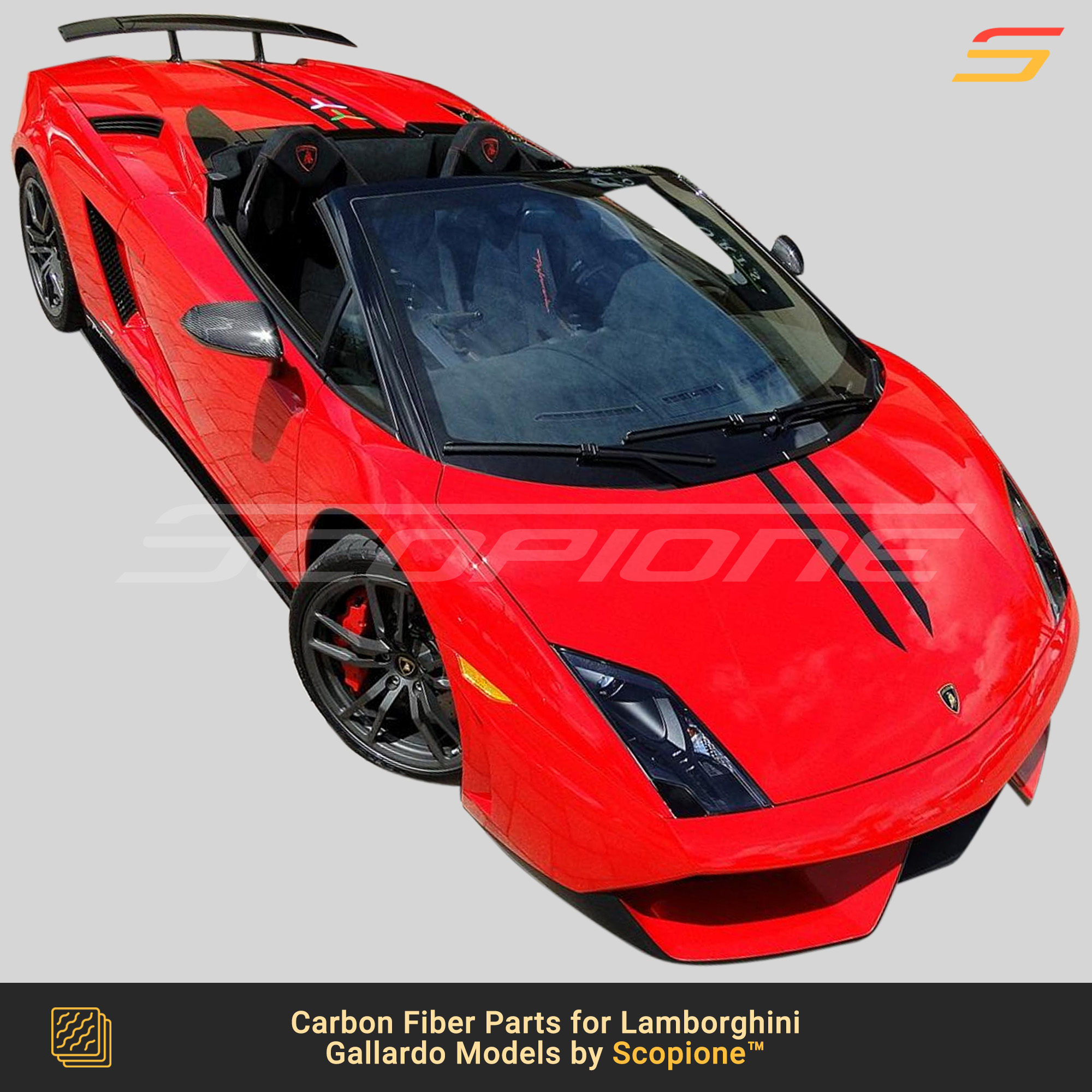
The Scopione Gallardo Picture Gallery features photographs of Gallardos fitted with Scopione carbon fiber components – engine bay covers, mirror shells, console trim, gauge cluster covers. Each image shows how the carbon fiber weave pattern and gloss finish integrate with the Gallardo’s factory body lines and interior surfaces.
Gallardo owners considering modifications can browse these real-world installations as reference. The gallery captures the car’s angular exterior, driver-focused cockpit, and mid-mounted V10 engine bay – with and without carbon fiber upgrades.
Every Scopione component for the Gallardo is built to match factory mounting geometry. The carbon fiber layup and clear coat finishing process is consistent across the full catalog – the same material quality whether the part goes on a 2004 5.0 or a 2013 LP 560-4.
Browse the Scopione Gallardo catalog for specific part fitment, pricing, and installation details.
Carbon Fiber Parts for the Lamborghini Gallardo
The 23 carbon fiber parts Scopione currently lists for the Lamborghini Gallardo. Each image links to its product page.





More Scopione Picture Galleries
Scopione’s carbon fiber catalog covers a wide range of performance and luxury vehicles. Browse galleries for related makes and models:
- Ferrari: 458 Italia & Spider • 488 GTB & Spider • F8 Tributo & Spider • F12 & 812 Superfast • SF90
- Lamborghini: Huracan • Aventador • Urus
- McLaren: MP4-12C & 650S • 720S & 765LT • Sports Series
- Porsche: 911, Boxster & Cayman
- BMW: M3, M4, M5 & More
- Audi: R8
- Nissan: GT-R R35 • 350Z, 370Z & Z
- Aston Martin: Vantage, DB9 & DBS
- Bentley: Continental GT & GTC
- Maserati: GranTurismo & GranCabrio
- Toyota: Supra
- Subaru: WRX STI
- Mitsubishi: Lancer Evolution
- Chevrolet: Corvette • Camaro
- Dodge: Viper
Experience the elegance and performance of the Lamborghini Gallardo with Scopione. Browse our gallery and get inspired to elevate your supercar with our top-of-the-line carbon fiber upgrades.
Shop now for premium ScopioneCarbon carbon fiber upgrades and experience the ultimate in performance and aesthetics for your Lamborghini Gallardo!