

 Shop
ShopThe Ferrari SF90 Stradale rewired what a series-production Ferrari could be: 986 horsepower from a twin-turbo V8 and three electric motors, all-wheel drive, and a 0–60 sprint measured at two seconds flat. Named for Scuderia Ferrari’s 90th anniversary, it opened the electrified era the 849 Testarossa now carries forward. Scopione does not currently list SF90-specific parts – the Scopione Ferrari carbon fiber catalog covers the 458, 488, F8, F12, and 812 families – and this gallery covers the SF90’s history, specifications, and market position.
Introduction: Ferrari’s Hybrid Flagship
Ferrari revealed the SF90 Stradale in May 2019 as three firsts in one body: the company’s first series-production plug-in hybrid, its first all-wheel-drive sports car, and – at 986 hp – the most powerful road car it had ever sold. The name honored Scuderia Ferrari’s 90th season; the specification honored nothing that came before it.
The architecture mattered as much as the number. A 769 hp twin-turbo V8 drives the rear wheels through a new 8-speed dual-clutch; two independent electric motors drive the front axle, vectoring torque and providing reverse – the gearbox itself has no reverse gear. A third motor sits between engine and transmission. The result runs silently on electrons, corners on all four driven wheels, and reaches 60 mph in the low twos while costing a fraction of the hypercars it out-accelerated.
Production wound down in 2024 alongside the 812’s naturally aspirated finale – two eras closing at once, one pointing backward, one forward. The SF90’s template now continues in the 849 Testarossa.
SF90 Stradale, Spider & XX (2019–2024)
Every SF90 pairs the F154-family 4.0L twin-turbo V8 with a 7.9 kWh battery and roughly 15 miles of electric-only range, managed through the eManettino’s four modes – eDrive, Hybrid, Performance, and Qualify, the last releasing all 986 horses at once. Above 130 mph (210 km/h) the front motors decouple and the car runs pure rear-drive.
Stradale & Assetto Fiorano
The coupe launched with an optional track package that defined the collector hierarchy: Assetto Fiorano brought Multimatic dampers, titanium springs and exhaust, carbon fiber door panels and underbody strakes, and a high-downforce rear spoiler while cutting roughly 66 lbs. Cars so equipped are the sought-after specification – though their higher original stickers mean the depreciation math varies by car.
Spider & XX
- SF90 Spider (2020–2024) – The retractable-hardtop version. At debut, no production convertible anywhere made more power.
- SF90 XX Stradale / XX Spider (2023–2024) – The first road-legal XX programme cars: 1,016 hp, a fixed rear wing (Ferrari’s first since the F50), 799 coupes and 599 spiders, sold out before public announcement.
| Model | Power | Original MSRP | Current Market |
|---|---|---|---|
| SF90 Stradale | 986 hp | $507,000 (launch)–$524,815 | $410,000–$600,000 |
| SF90 Spider | 986 hp | ~$570,000 | $500,000–$715,000 |
| SF90 XX (799 + 599 units) | 1,016 hp | ~$844,000 (US) | $1,600,000–$2,300,000 |
Car and Driver’s instrumented test recorded 0–60 in 2.0 seconds – at the time, among the quickest numbers the magazine had ever published for a series-production car. The as-optioned reality: most SF90s left dealers with $100,000–$200,000 in options, a fact that shapes today’s used pricing.
Carbon Fiber and the SF90
Few series Ferraris have leaned harder on carbon fiber than the SF90. The options list offered CF wheels, exterior packages spanning splitter to diffuser, and full carbon interior trim; Assetto Fiorano made carbon fiber door panels and underbody components standard equipment; and the XX versions wear composite aero as identity – that fixed wing exists because carbon construction makes its loads manageable. And the weave is everywhere the eye lands: sills, diffuser, cockpit.
Factory precedent runs ahead of the aftermarket here. Because the SF90’s panels, aero, and interior could be specified in carbon from Maranello – and because as-optioned stickers routinely crossed $700,000 – the aftermarket CF market for the SF90 remains thin and largely bespoke. That contrasts with the 458/488/F8 lineage, where a decade of ownership depth built a broad replacement and add-on catalog of the kind Scopione carries for the F8.
For SF90 owners, the practical carbon conversation is preservation rather than addition: factory CF is clear-coated like Scopione’s own 2×2 3K twill-weave parts, and the same UV-protection logic applies. The rule is simple. Keep the clear coat healthy and the weave outlasts the car; let it chalk and refinishing costs multiply.
Legacy: The First of the Breed
Every electrified Ferrari that follows will trace its argument to the SF90 – the car that proved batteries could serve Maranello’s identity instead of diluting it. It normalized four-figure-adjacent horsepower in series production, made AWD a Ferrari word, and gave the XX programme its first license plate.
The 849 Testarossa – unveiled in September 2025 with 1,036 hp – is the direct evolution, which settles the SF90’s historical position: first of the breed, no longer the newest. Series cars trade below their as-optioned stickers, the depreciation curve now stabilizing in the pattern familiar from every first-generation hybrid supercar. Collectors who remember what happened to those earlier firsts once depreciation bottomed tend to watch this phase closely. The Aventador closed Lamborghini’s pure-V12 chapter the same year the SF90 opened Ferrari’s hybrid one – the two bookends of the transition.
The XX cars stand apart. First road-legal XX, fixed production numbers, sold out before announcement – their tier was never subject to the depreciation question.
Scopione and the SF90: Ferrari Carbon Fiber Coverage
Plainly stated: Scopione does not currently list SF90-specific carbon fiber parts. The catalog’s Ferrari coverage centers on the model families with the deepest aftermarket demand – the 458, 488, F8, F12, and 812 – and new fitments are added as the catalog grows. The Scopione Ferrari shop page always reflects current availability.
What Scopione Covers Across Ferrari
| Ferrari Family | Coverage Focus | Gallery Page |
|---|---|---|
| 458 Italia & Spider (2010–2015) | Exterior trim, door handles, paddles | 458 gallery |
| 488 GTB & Spider (2016–2021) | Engine bay, exterior, paddles | 488 gallery |
| F8 Tributo & Spider (2020–2023) | Engine bay, paddles, door handles, fuel lid | F8 gallery |
| F12 & 812 Superfast (2013–2024) | Splitters, mirror shells, spoiler, paddles | F12 & 812 gallery |
The parts below are the current Ferrari fitments – one from each family Scopione covers. None of them fits the SF90; they are here to show what the catalog’s Ferrari coverage looks like today.
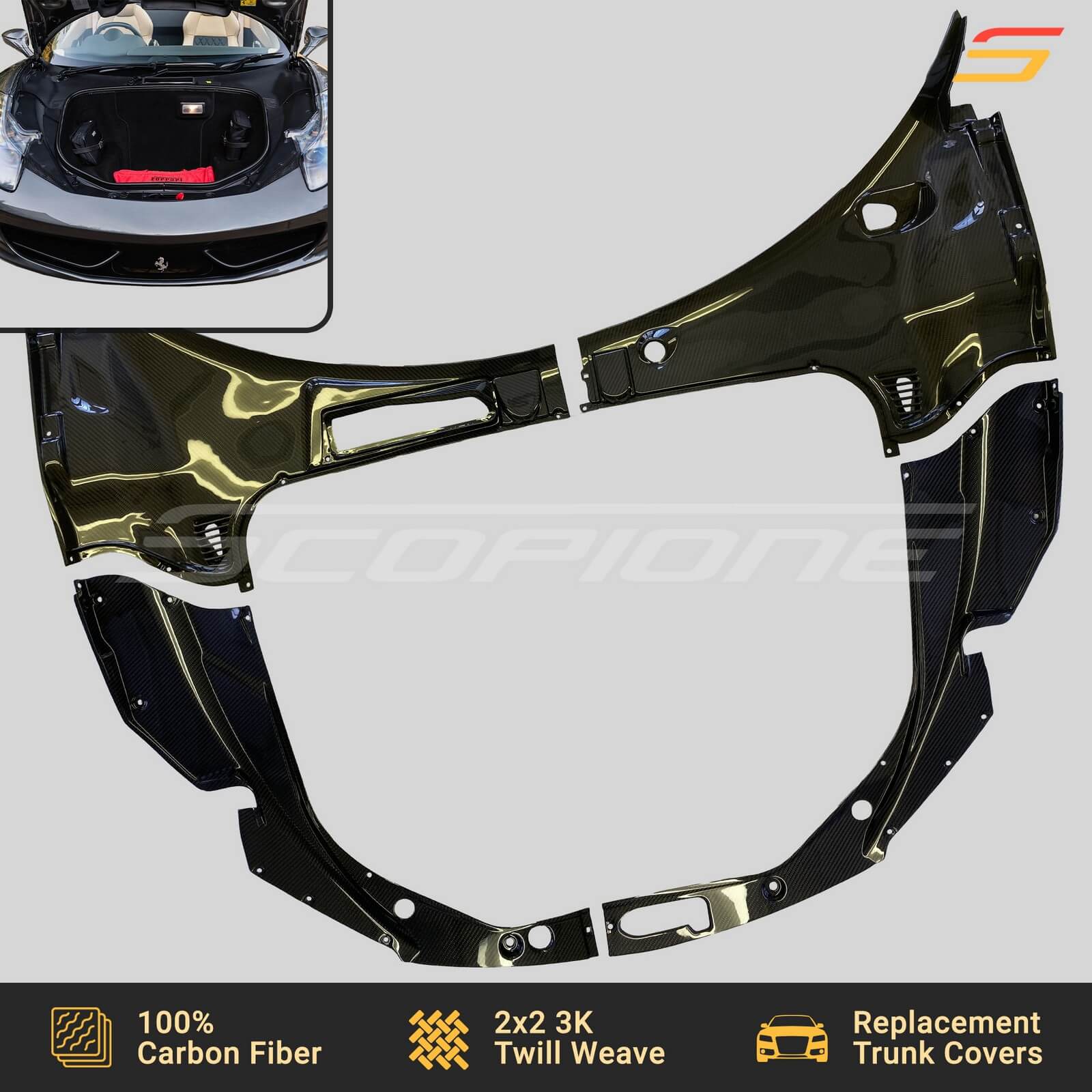
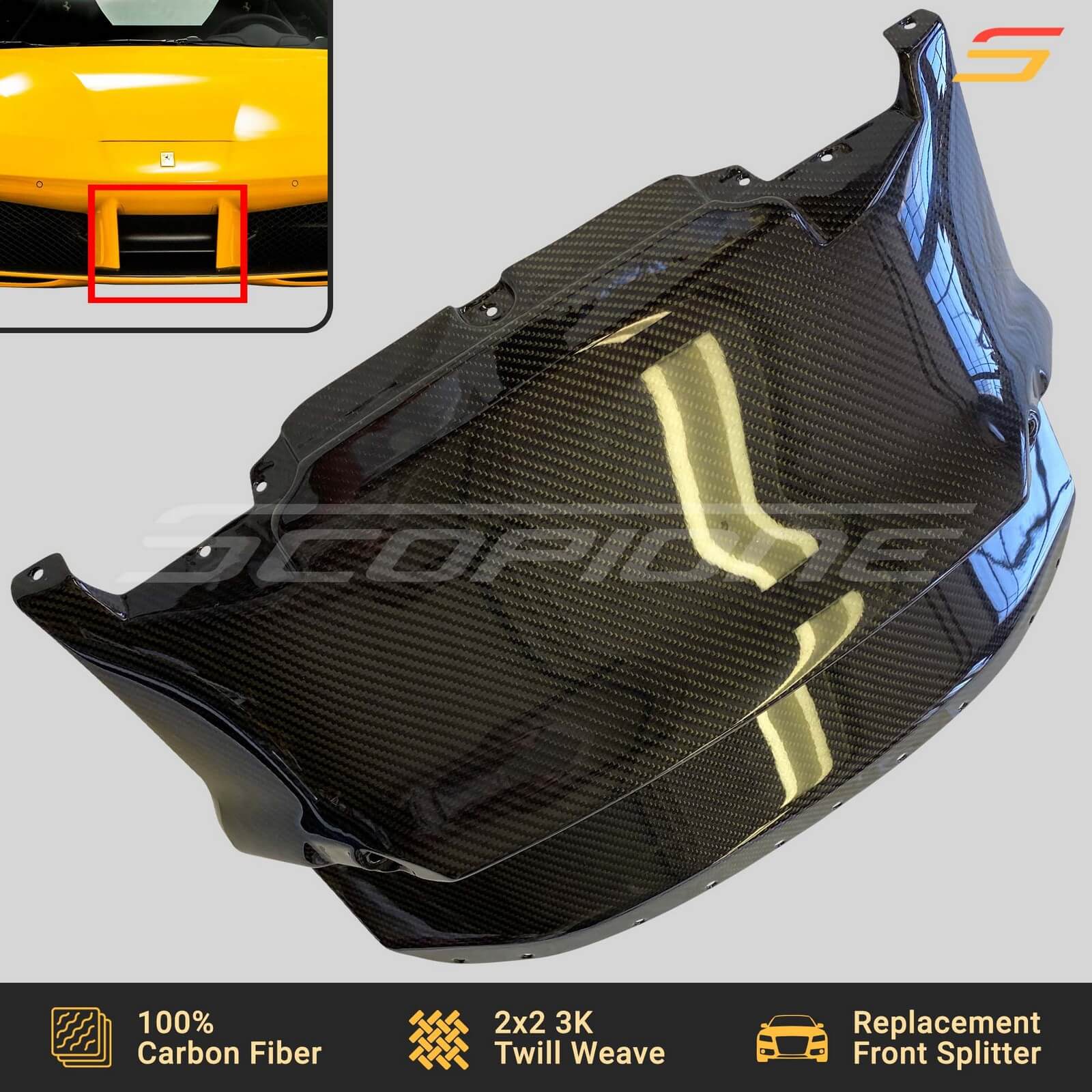
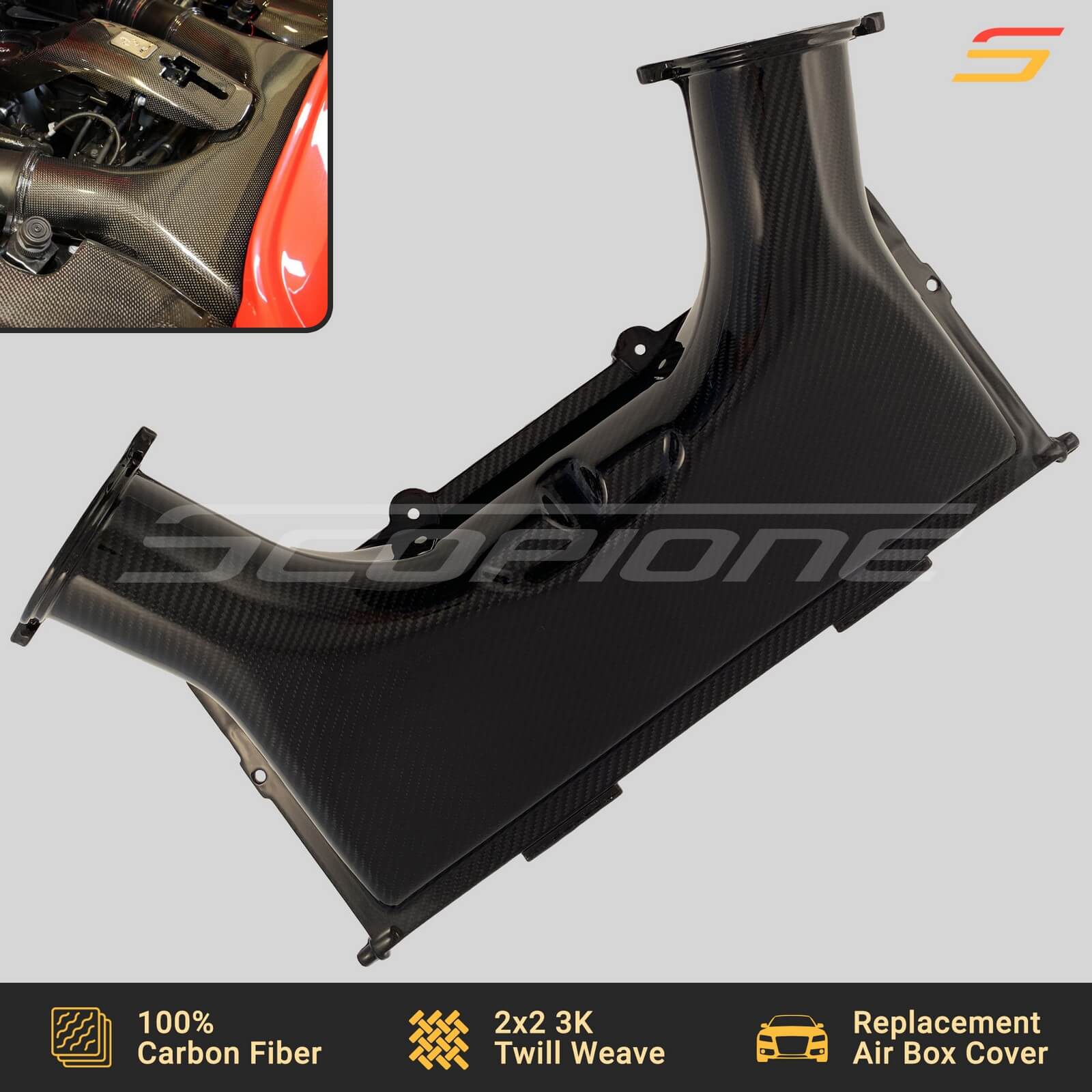
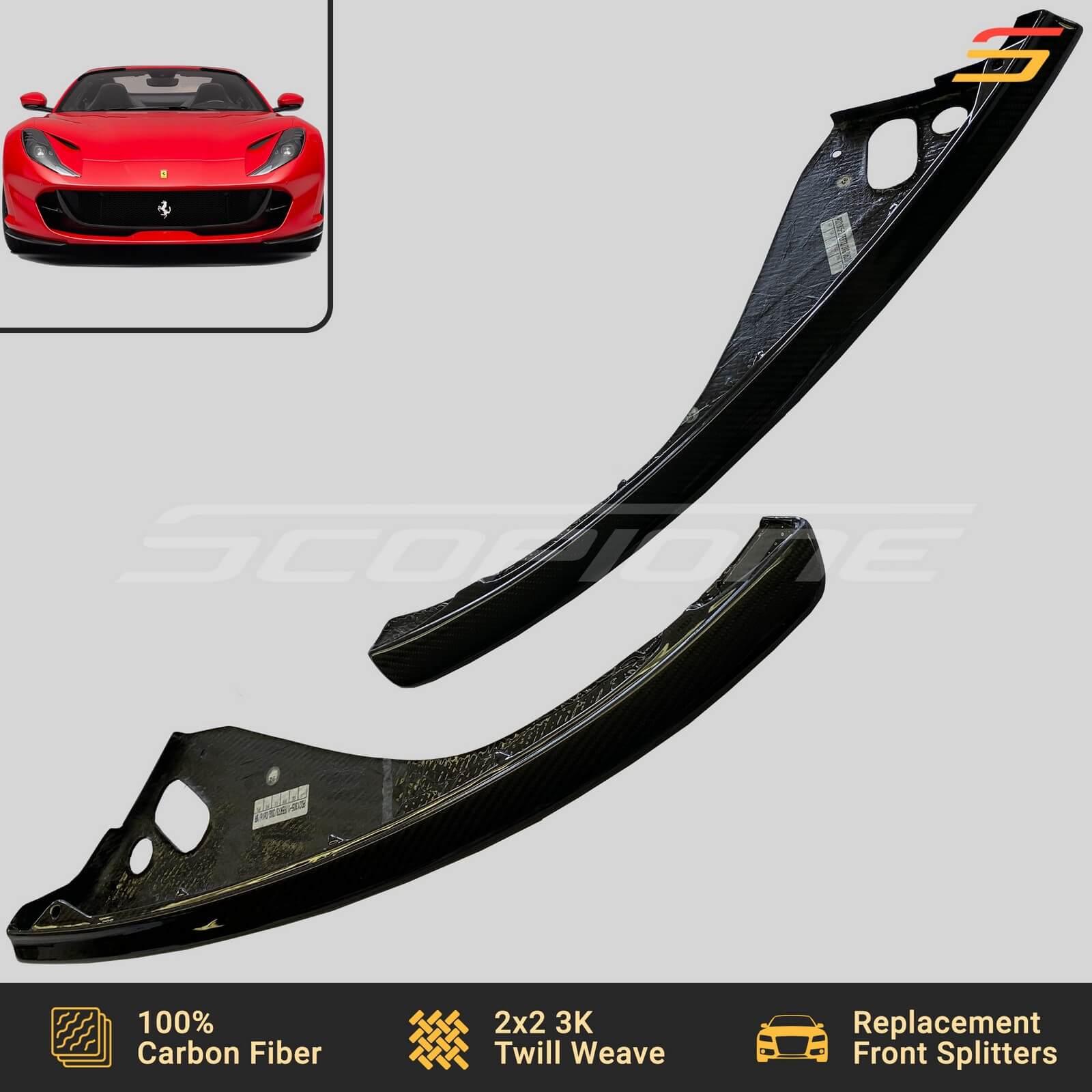
SF90 owners cross-shopping the range will find the closest kinship on the F8 side – same mid-engine V8 layout, same F154 engine family, and a catalog of engine bay and exterior pieces whose fitment logic the SF90 would follow if fitments arrive. Browse specific parts, pricing, and fitment windows on the Ferrari 812 / F8 / F12 category page.
SF90 Market Pricing
The SF90 market splits cleanly. Series cars are depreciation buys – mostly sub-sticker Ferraris with factory maintenance still running – while the XX cars occupy a fixed-number collector tier that never depreciated at all.
| Variant | Original MSRP | Current Market Range | Direction |
|---|---|---|---|
| SF90 Stradale | $507,000–$524,815 | $410,000–$600,000 | Below base sticker, stabilizing |
| SF90 Spider | ~$570,000 | $500,000–$715,000 | Near sticker, stabilizing |
| SF90 XX Stradale / Spider | ~$844,000 (US) | $1,600,000–$2,300,000 | Roughly double sticker |
Pricing Factors That Affect SF90 Values
- Assetto Fiorano – The sought-after specification, though its higher original sticker means absolute depreciation can run larger than on standard cars.
- As-optioned sticker recovery – Cars optioned $100,000–$200,000 over base recover only part of it; well-chosen specs recover more.
- Battery and hybrid service status – documented high-voltage health checks and remaining warranty materially move buyer confidence.
- Mileage bands – like every modern flagship Ferrari, sub-5,000-mile cars set the prices.
- XX allocation history – the 799+599 XX cars trade on provenance and spec within their own tier.
Ownership Costs
Most SF90s remain inside Ferrari’s 7-year Genuine Maintenance program, which covers scheduled servicing from first registration and transfers with the car. Beyond it, routine annual service runs $3,000–$6,000 – more in years with wear items or hybrid-system work – with battery health checks added to the conventional regimen. Regenerative braking shoulders part of the everyday braking load ahead of the carbon-ceramics. The long-horizon item is the high-voltage battery: Ferrari’s own hybrid warranty extension, which replaces the pack at year eight, prices out near $60,000 over its term – the best published proxy for replacement cost, and the reason documented battery health commands real money at resale.
Frequently Asked Questions
Does Scopione offer carbon fiber parts for the Ferrari SF90?
Not currently – no SF90-specific fitments exist in the catalog. Scopione’s Ferrari line covers the 458, 488, F8, F12, and 812 families with exterior, engine bay, and cockpit carbon fiber, and new fitments are added over time. The Ferrari catalog page reflects what is available today.
What makes the Ferrari SF90 Stradale historically significant?
Three firsts: Ferrari’s first series-production plug-in hybrid, its first all-wheel-drive sports car, and – at 986 hp – the highest-output road car the company had sold to that point. Its architecture (twin-turbo V8 plus three electric motors, electric front axle, no mechanical reverse) became the template the 849 Testarossa evolved. The XX versions added the first road-legal XX programme cars.
Is the Ferrari SF90 a good investment?
Series cars trade below their as-optioned stickers – Stradales at $410,000–$600,000 against a base sticker of $507,000–$524,815 that options routinely pushed past $700,000 – with the curve stabilizing rather than falling. The XX cars (799 coupes, 599 spiders) run $1.6–$2.3 million, roughly double their sticker, in a collector tier that never depreciated at all. History favors first-of-breed cars once depreciation bottoms, but today the series SF90 buys as a car, not a certificate.
What does it cost to maintain a Ferrari SF90?
Inside the 7-year Genuine Maintenance window, scheduled service is covered. Beyond it, expect $3,000–$6,000 annually for routine service – more in hybrid-system years – plus battery health checks. Ferrari’s hybrid warranty extension, which replaces the high-voltage pack at year eight, prices near $60,000 over its term, making documented battery condition one of the strongest value signals on the used market.
More Scopione Picture Galleries
- Ferrari: 458 Italia & Spider • 488 GTB & Spider • F8 Tributo & Spider • F12 & 812 Superfast
- Lamborghini: Gallardo • Huracan • Aventador • Urus
- McLaren: MP4-12C & 650S • 720S & 765LT • Sports Series
- Porsche: 911, Boxster & Cayman
- BMW: M3, M4, M5 & More
- Audi: R8
- Nissan: GT-R R35 • 350Z, 370Z & Z
- Aston Martin: Vantage, DB9 & DBS
- Bentley: Continental GT & GTC
- Maserati: GranTurismo & GranCabrio
- Toyota: Supra
- Subaru: WRX STI
- Mitsubishi: Lancer Evolution
- Chevrolet: Corvette • Camaro
- Dodge: Viper
Experience the elegance and performance of the Ferrari SF90 with Scopione. Browse our gallery and get inspired to elevate your supercar with our top-of-the-line carbon fiber upgrades.
Shop now for premium ScopioneCarbon carbon fiber upgrades and experience the ultimate in performance and aesthetics for your Ferrari SF90!