

 Shop
ShopMercedes-Benz has shaped automotive engineering for longer than any other manufacturer — from Karl Benz’s 1886 Patent-Motorwagen through the Silver Arrows’ dominance of pre-war Grand Prix racing to the AMG One’s Formula 1 power unit wrapped in a carbon-fiber monocoque. The brand’s CFRP trajectory follows a motorsport pipeline: the CLK GTR proved carbon fiber in FIA GT racing (1997), the McLaren-built SLR brought a CF front crash structure to a production grand tourer (2003), the AMG GT Black Series wrapped an entire body in carbon-fiber panels (2020), and the AMG One transplanted an F1-grade CFRP safety cell into a street-legal hypercar (2022). Each step moved carbon fiber from accent to structure, from partnership to proprietary capability. That progression defines Mercedes-Benz carbon fiber evolution. Scopione stocks precision-fitted 2×2 3K twill-weave carbon-fiber components for Mercedes-Benz models – explore the full Mercedes-Benz catalog.
Mercedes-Benz Carbon Fiber Timeline
| Year | Model / Milestone | Carbon Fiber Significance |
|---|---|---|
| 1886 | Benz Patent-Motorwagen | First automobile — established the engineering rigor that underpins every material decision since |
| 1901 | Mercedes 35 HP | First pressed steel frame — new structural material replacing wood, a paradigm shift that CF would later repeat |
| 1934 | W25 Silver Arrow | Paint stripped to meet 750 kg limit — weight reduction as a core performance strategy |
| 1954 | 300 SL “Gullwing” | Tubular space frame so rigid it required gullwing doors — structural logic that CFRP tubs inherit |
| 1969 | C111 | First Mercedes composite body (fiberglass/GFRP) — experimental proof of concept for composites |
| 1984 | 190E 2.3-16 Cosworth | Motorsport-to-road pipeline established — race homologation process later used for CLK GTR |
| 1997 | CLK GTR | First Mercedes CFRP monocoque — 30 road cars with racing carbon-fiber chassis |
| 2003 | SLR McLaren | McLaren-built CFRP monocoque + CF front crash structure — first safety-rated CF in a Mercedes GT |
| 2010 | SLS AMG | Aluminum space frame + optional CF panels — Black Series variant covered in CFRP |
| 2014 | AMG GT / GT R | CF hood, roof, wing standard on performance variants — CF enters the AMG option catalog |
| 2020 | AMG GT Black Series | Full CFRP exterior body — 720 hp flat-plane V8, Nürburgring 6:43.616 |
| 2022 | AMG One | F1-grade CFRP monocoque — 1,049 hp, Nürburgring 6:35.183 |
1886–1945: Invention, Speed, and the Silver Arrows
The automobile began with Mercedes-Benz — or, more precisely, with the two men whose companies would merge to form it. Karl Benz filed Patent DRP 37435 on January 29, 1886, for a vehicle powered by an internal combustion engine. Fifteen years later, Wilhelm Maybach designed the Mercedes 35 HP and established the modern automobile’s fundamental architecture. By the 1930s, the combined Mercedes-Benz was building Silver Arrows — racing machines that pursued speed through a ruthless combination of aerodynamics, forced induction, and weight reduction. Carbon fiber was decades away. But the engineering philosophy that would eventually demand it — performance through material optimization, not brute force alone — was already embedded in the company’s DNA.
Benz Patent-Motorwagen (1886)
Karl Benz did not attach an engine to a horse carriage. He built a three-wheeled vehicle from the ground up as an integrated machine: engine, chassis, and drivetrain conceived as a single system. The 954 cc single-cylinder four-stroke produced 0.75 hp and propelled the Motorwagen at a walking pace of roughly 10 mph. Its significance lies not in speed but in method. Every component justified its presence through function rather than convention.
Bertha Benz validated the concept in August 1888 by driving 106 km from Mannheim to Pforzheim — the first long-distance automobile journey. She solved problems en route that Karl had not anticipated: brake pads wore out (she had a cobbler install leather ones), fuel was unavailable (she bought ligroin at a pharmacy), a clogged fuel line required a hatpin to clear. The trip proved that the automobile could operate beyond its inventor’s workshop. Patent DRP 37435 is recognized as the birth certificate of the entire industry.
- Engine: 954 cc single-cylinder four-stroke, 0.75 hp
- Top speed: 10 mph (16 km/h)
- Designer: Karl Benz
No composite materials existed. Steel tube framing and wooden wheels were the structural vocabulary. But Benz’s insistence on purpose-built engineering — questioning every gram, every joint, every structural choice — established a design rigor that runs through every Mercedes lightweight innovation that followed. The Patent-Motorwagen was not a conversion. It was the first clean-sheet automobile, and that distinction matters: starting from zero meant every structural decision was deliberate, not inherited from a horse-drawn predecessor. The same clean-sheet philosophy would reappear when Mercedes-AMG designed the AMG One’s CFRP monocoque — a chassis conceived from the outset as a carbon-fiber structure rather than a metal design adapted to composites.
Mercedes 35 HP (1901)
Emil Jellinek was a wealthy businessman and amateur racer based in Nice, France. He competed under the pseudonym “Mercedes” — his eleven-year-old daughter’s name — because gentlemen of his social standing did not advertise their participation in motor racing under their own names. Dissatisfied with the era’s high-center-of-gravity vehicles, he commissioned Daimler-Motoren-Gesellschaft to build something faster and more stable. He ordered thirty-six cars sight unseen, backing his conviction with substantial personal capital. Wilhelm Maybach delivered.
The 35 HP was the first automobile with a pressed steel frame, replacing the reinforced wooden chassis that every manufacturer used. It introduced the honeycomb radiator for efficient engine cooling. Mechanically operated inlet valves replaced the atmospheric intake systems of earlier engines. The 5.9-liter inline-four produced 35 hp — modest by modern standards, but the car won the Nice-La Turbie hill climb in March 1901 and rendered the majority of existing automobiles obsolete overnight.
- Engine: 5.9L inline-four, 35 hp
- Top speed: 53 mph (85 km/h)
- Designer: Wilhelm Maybach
The pressed steel frame was to 1901 what a CFRP monocoque is to the 2020s — a fundamental structural rethinking. Maybach proved that adopting a new material for the car’s skeleton could simultaneously reduce weight and increase rigidity. That lesson would repeat, with different materials, across every generation of Mercedes-Benz engineering: tubular steel in the 300 SL, aluminum in the SLS AMG, carbon fiber in the AMG One.
Mercedes-Benz W25 Silver Arrow (1934–1939)
The Silver Arrows origin story is about one kilogram. At the 1934 Eifelrennen on the Nürburgring, the new Mercedes-Benz W25 weighed 751 kg — one kilogram over the 750 kg Grand Prix weight limit. Racing manager Alfred Neubauer ordered the white paint stripped from the aluminum bodywork overnight. The bare-metal car came in under the limit, won the race the next day, and “Silver Arrows” entered the motorsport vocabulary.
The W25 evolved through the W125 (1937) and W154 (1938–1939). The W125 produced 592 hp from a 5.6-liter supercharged straight-eight — power that Grand Prix cars would not match for over two decades. Rudolf Caracciola, Manfred von Brauchitsch, and Hermann Lang dominated European championship racing through the late 1930s. Four European Championship titles — Caracciola in 1935, 1937, and 1938, Lang in 1939 — validated the program before World War II suspended all motorsport.
- Engine: 3.4L–5.6L supercharged inline-eight, 354–592 hp (W25 through W125)
- Top speed: Over 200 mph (estimated, W125 at Avus 1937)
- Key figures: Hans Nibel, Max Wagner, Rudolf Uhlenhaut (engineering); Alfred Neubauer (team management)
The Silver Arrows codified two principles central to Mercedes-Benz’s future CF adoption. First, weight reduction is a legitimate performance strategy worth any fabrication complexity. Second, material selection directly determines competitive advantage. Stripping paint to save a single kilogram is the philosophical ancestor of replacing steel body panels with CFRP equivalents. The engineering logic is identical; only the material has changed. Mercedes returned to Grand Prix racing in 1954 with the W196, and Juan Manuel Fangio won consecutive World Championships in 1954 and 1955. The Silver Arrows name survived the war, the hiatus, and the decades since — Mercedes’ current Formula 1 program still races in silver livery, a direct visual link to the aluminum bodywork of 1934.
Scopione Perspective: Invention and Silver Arrows
Mercedes-Benz’s founding era established engineering principles — structural optimization, weight-conscious design, material innovation — that modern carbon-fiber components continue to serve. Scopione’s Mercedes-Benz carbon fiber catalog carries that lightweight philosophy into the present, offering 2×2 3K twill-weave components that reduce weight while adding visual precision to AMG and standard models alike.
1952–1999: From the Gullwing to Carbon Fiber Racing
Mercedes-Benz returned to motorsport in 1952, and the technology from its W194 race car produced one of the great production cars of the twentieth century: the 300 SL Gullwing. The following decades brought experimental prototypes — the C111’s fiberglass body represented the brand’s first systematic use of composite materials — and competition-bred road cars like the 190E 2.3-16 Cosworth. The era concluded with a pivotal moment in the Mercedes-Benz carbon fiber evolution: the CLK GTR, whose CFRP monocoque made it the first road-going Mercedes built around a carbon-fiber chassis.
Mercedes-Benz 300 SL “Gullwing” (1954–1963)
The 300 SL started as the W194 racing car that won Le Mans in 1952. American importer Max Hoffman convinced Mercedes-Benz to build a production version. Friedrich Geiger and Karl Wilfert faced a fundamental constraint: the tubular space frame chassis was so deep-sided for torsional rigidity that conventional doors could not open wide enough for a driver to enter. Geiger solved the problem by hinging the doors at the roof — creating the gullwing configuration that became the car’s defining visual signature.
The 300 SL was also the first production car with mechanical direct fuel injection, a Bosch system that produced 215 hp from three liters. At 161 mph, it ranked among the fastest road cars in the world. Mercedes built 1,400 Gullwing coupes (1954–1957) and 1,858 Roadsters (1957–1963) — 3,258 units total.
- Engine: 3.0L M198 inline-six, Bosch mechanical direct fuel injection, 215 hp
- 0–60 mph: 8.8 seconds
- Top speed: 161 mph (260 km/h)
- Production: 3,258 units (1,400 Gullwing + 1,858 Roadster)
- Designers: Friedrich Geiger / Karl Wilfert
The 300 SL’s chassis architecture directly parallels modern CFRP monocoque design. A rigid central structure dictates the car’s proportions, entry points, and crash behavior. The gullwing doors exist because the space frame demanded structural depth exactly where a conventional door would cut through — the sills were too high for conventional hinged doors. Modern carbon-fiber tubs face identical packaging constraints. The McLaren F1, the Porsche Carrera GT, the AMG One — all use high sills and unconventional door mechanisms because their composite tubs demand it. When Mercedes-AMG revived the gullwing for the SLS AMG in 2010, the 300 SL’s structural logic was the explicit reference.
The 300 SL also matters for its commercial context. Max Hoffman did not ask Mercedes to build a race car for showrooms. He recognized that Americans would pay a premium for a vehicle whose engineering derived directly from Le Mans technology. That insight — that racing-derived engineering commands a price premium in the road car market — would prove prophetic when Mercedes later sold CLK GTRs for $1.5 million and AMG Ones for €2.75 million. The 300 SL established the commercial model for every subsequent Mercedes supercar: racing technology, repackaged for the road, at a price that reflects the engineering investment.
Mercedes-Benz C111 (1969–1979)
The C111 was never intended for production. It was a rolling laboratory, and it spent a decade testing technologies that would not reach Mercedes showrooms for years afterward.
The C111-I (1969) housed a three-rotor Wankel engine producing 280 hp. The C111-II (1970) added a fourth rotor for 350 hp, reaching 60 mph in 4.8 seconds. Both cars wore fiberglass-reinforced plastic (GFRP) bodies — the first composite bodywork in Mercedes-Benz history. But the record-breaking variants proved more consequential: the C111-III (1978) set nine international speed records with a turbocharged five-cylinder diesel, and the C111-IV (1979) used a twin-turbo V8 to reach 403 km/h at the Nardò Ring — a closed-circuit speed record.
- Engine variants: 3-rotor Wankel (280 hp), 4-rotor Wankel (350 hp), turbo diesel, twin-turbo V8 (500 hp)
- Top speed: 250 mph (403 km/h, C111-IV at Nardò, 1979)
- Body: Fiberglass-reinforced plastic (GFRP) — first Mercedes composite body
- Project lead: Erich Waxenberger; exterior styling by Bruno Sacco
The GFRP body was the significant detail. Mercedes engineers discovered that composite materials could deliver the low tooling costs, high strength-to-weight ratios, and aerodynamic freedom that metal panels could not match. The C111’s composite body gave the company its first institutional knowledge of advanced materials — not just the manufacturing process but the failure modes, the repair techniques, the surface finishing requirements. That institutional knowledge proved essential when carbon fiber entered Mercedes’ vocabulary through motorsport in the 1990s.
The C111 never became a production car, but its technology diffused throughout the Mercedes range. Aerodynamic lessons from the record-breaking variants informed the W126 S-Class. Turbodiesel research shaped the brand’s compression-ignition lineup for decades. And the composite fabrication data provided a technical foundation for the CFRP structures that would follow. The C111-IV’s 403 km/h Nardò record stood as proof that Mercedes engineers could operate at the extreme edge of automotive performance — the same environment where carbon fiber’s properties would later prove indispensable.
Mercedes-Benz 190E 2.3-16 Cosworth (1984–1988)
The 190E was Mercedes-Benz’s compact sedan — the brand’s first entry below the mid-size E-Class. It was not, on its face, an obvious candidate for a motorsport variant. But Mercedes saw an opportunity. Cosworth Engineering designed a dual-overhead-cam 16-valve cylinder head for the W201’s M102 engine block, turning a modest four-cylinder into a 185 hp sports sedan powerplant. The conversion was clinical rather than crude: Cosworth’s head design increased valve area and improved breathing without enlarging the engine’s displacement, adding power through efficiency rather than additional capacity. The car proved that Mercedes-Benz could compete in motorsport-adjacent performance segments without compromising its engineering standards.
The 190E 2.3-16 gained international fame at a single event. On May 12, 1984, the new Nürburgring Grand Prix circuit held its opening race — a spec series featuring twenty identical 190E 2.3-16s driven by Formula 1 and rally champions. A twenty-four-year-old Ayrton Senna won, beating Niki Lauda, Carlos Reutemann, and a field of established stars on a rain-soaked circuit. The race has been replayed on highlight reels for four decades and counting.
- Engine: 2.3L M102 inline-four, Cosworth DOHC 16-valve head, 185 hp
- 0–60 mph: 7.5 seconds
- Top speed: 143 mph (230 km/h)
- Production: ~18,500 units (2.3-16), plus ~4,000 (2.5-16) and 502 each of Evolution and Evolution II
No carbon fiber in the 190E. Standard steel monocoque construction. But the car’s significance for Mercedes’ CF story is the pipeline it established. The 190E 2.5-16 Evolution II (1990, 502 units) was a homologation special for DTM touring car racing, wearing a factory aerodynamic package more aggressive than anything Mercedes had previously fitted to a road car — a rear wing, extended fender flares, and a deep front splitter that looked entirely out of place on a compact sedan. The DTM Evolution cars taught Mercedes to translate racing technology into limited-production road cars: identify a competition requirement, build the minimum number of road cars to satisfy homologation, and price them to reflect the engineering content. Seven years later, the CLK GTR followed the identical process — but with a carbon-fiber monocoque instead of a steel body kit.
Mercedes-Benz CLK GTR (1997–1999)
The CLK GTR was built for one purpose: win the FIA GT Championship. FIA regulations required a minimum of 25 road cars for GT1 homologation. Mercedes-AMG built exactly 25 coupes and 5 Super Sport roadsters — thirty cars total, each priced above $1.5 million.
The road car retained the racing car’s CFRP monocoque tub — the first time a Mercedes-Benz customer could purchase a vehicle built around a carbon-fiber chassis. A 6.9-liter M297 V12 delivered 604 hp through the structure, which weighed approximately 1,440 kg complete. The CLK GTR Super Sport roadster variant used a 7.3-liter version producing 655 hp, shaving the roof from the coupe’s body while retaining the CFRP tub’s structural integrity — a proof of concept for open-top carbon-fiber construction that the later SLR Stirling Moss speedster would echo. The CLK GTR won the 1997 and 1998 FIA GT Championships, validating the carbon-fiber approach at the highest level of international GT racing.
- Engine: 6.9L M297 V12, 604 hp
- 0–60 mph: 3.8 seconds
- Top speed: 214 mph (344 km/h)
- Production: 30 units (25 coupes + 5 Super Sport roadsters)
- Weight: ~1,440 kg
The CLK GTR established a precedent that held for every subsequent Mercedes supercar. When the engineering requirement demanded a structural material that could deliver racing-level stiffness at minimal weight, carbon fiber was the answer. Not aluminum. Not high-strength steel. CFRP. The decision was not aesthetic. Carbon fiber cost more to manufacture, required specialized tooling, and demanded new quality control processes. But the weight savings — and the torsional rigidity gains — made the investment non-negotiable for a vehicle competing at the highest level of GT racing.
The CLK GTR also raced against the era’s other carbon-fiber GT1 machines: McLaren’s F1 GTR and Porsche’s 911 GT1 — cars that represented the era’s highest level of CFRP competition. Winning the championship against those rivals validated not just the CLK GTR’s design but Mercedes’ ability to compete on carbon fiber’s terms. The SLR McLaren, the AMG GT Black Series, and the AMG One all follow the template the CLK GTR laid down: racing-derived carbon fiber construction, manufactured in limited numbers, at prices that reflect the engineering investment.
Scopione Perspective: From Gullwing to GT Racing
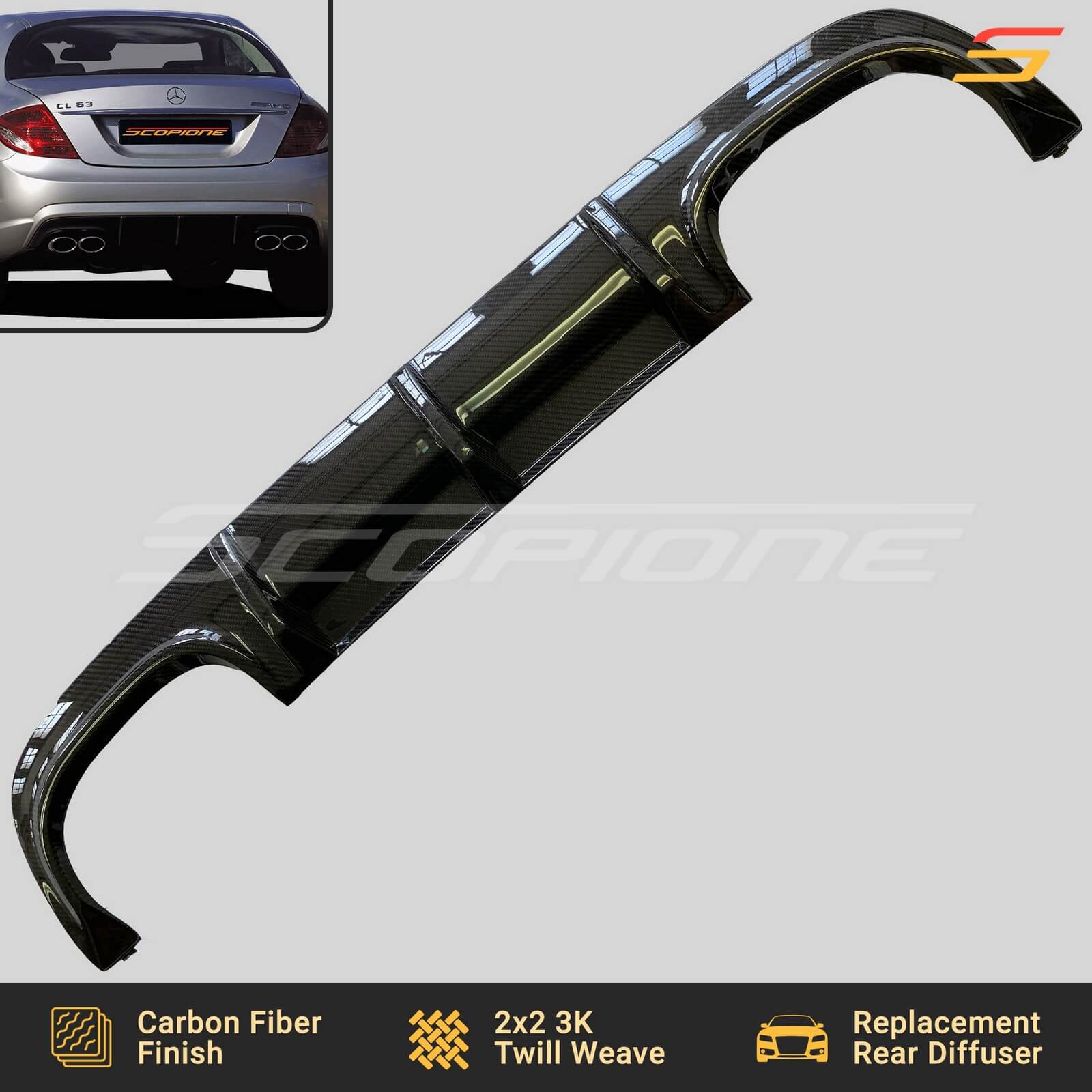
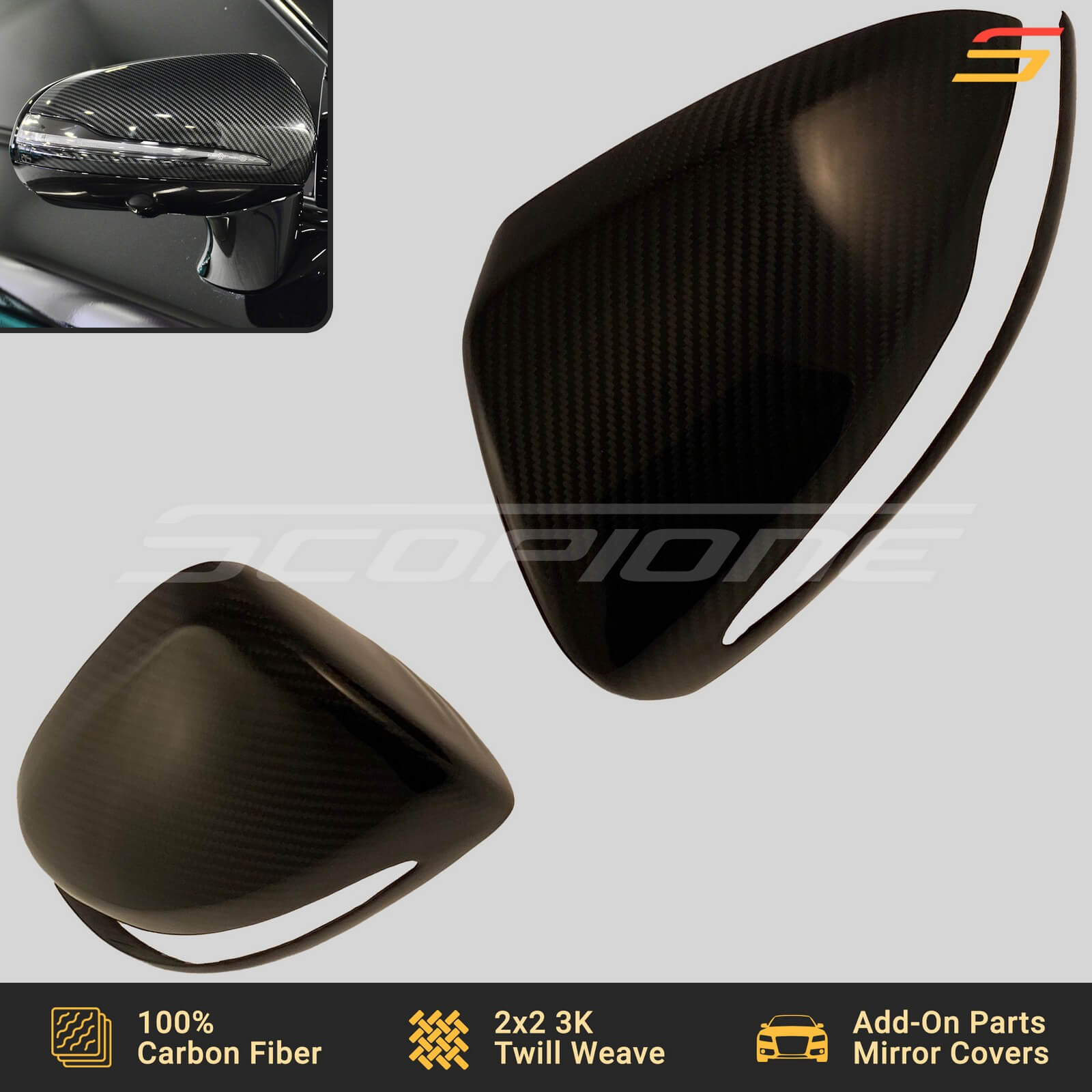
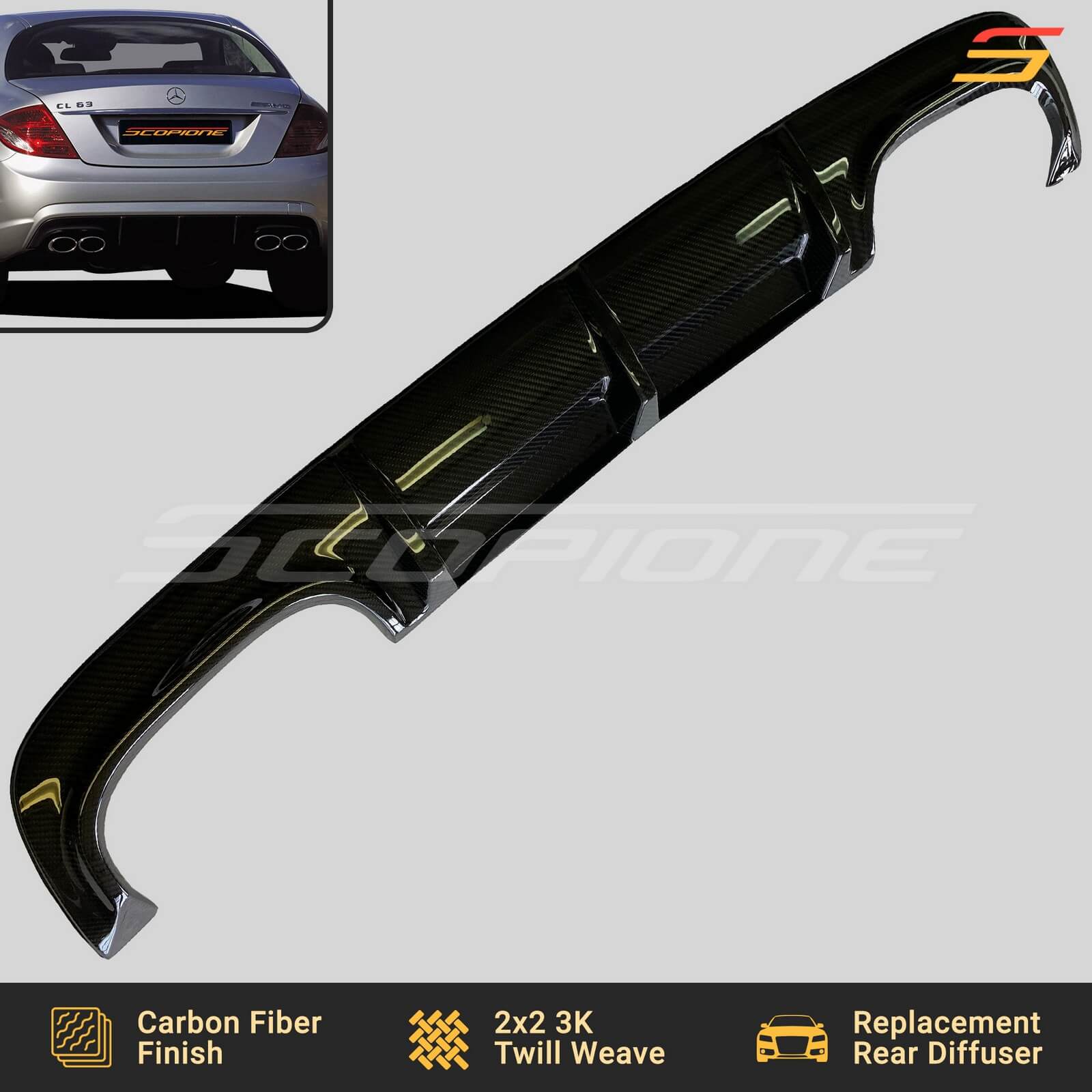
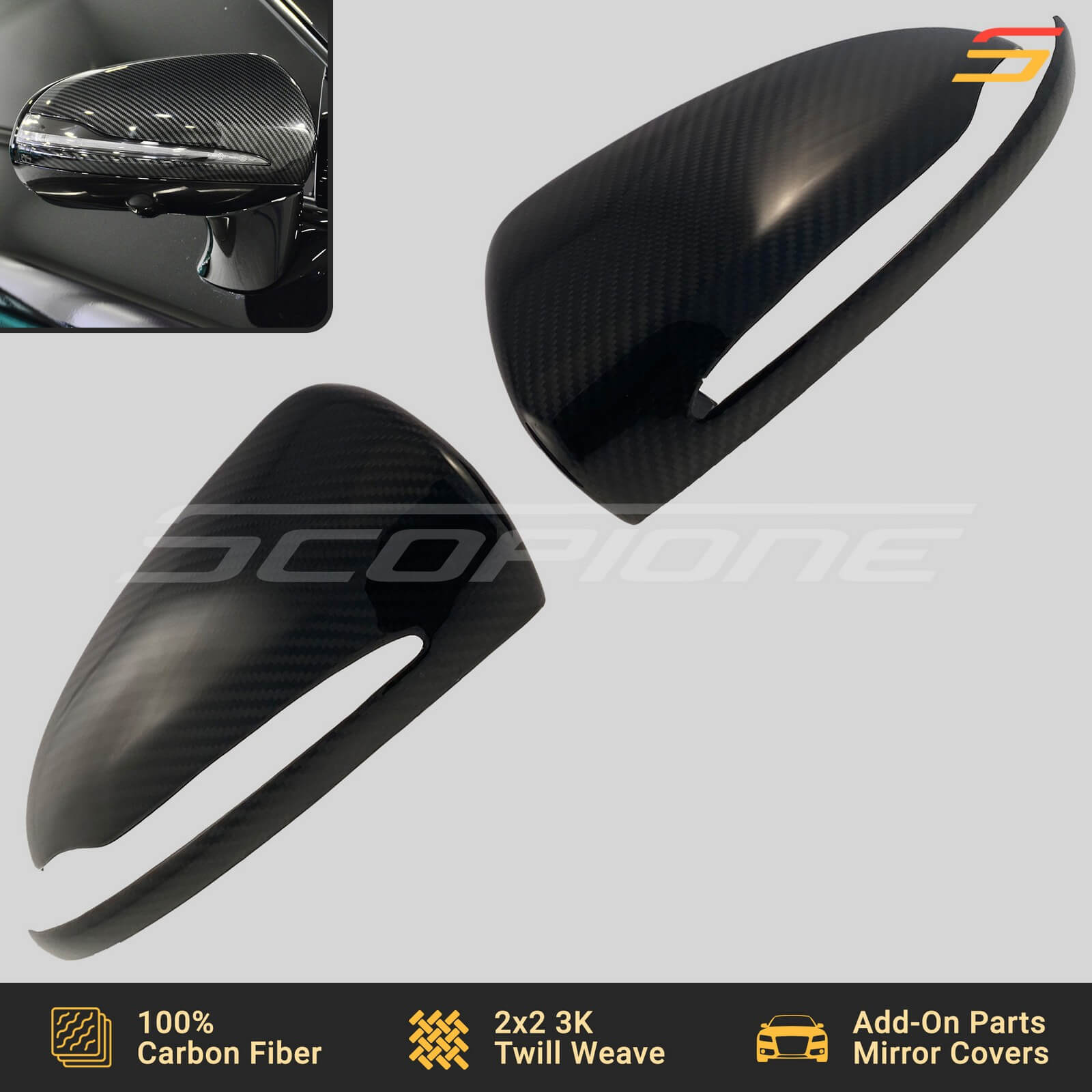
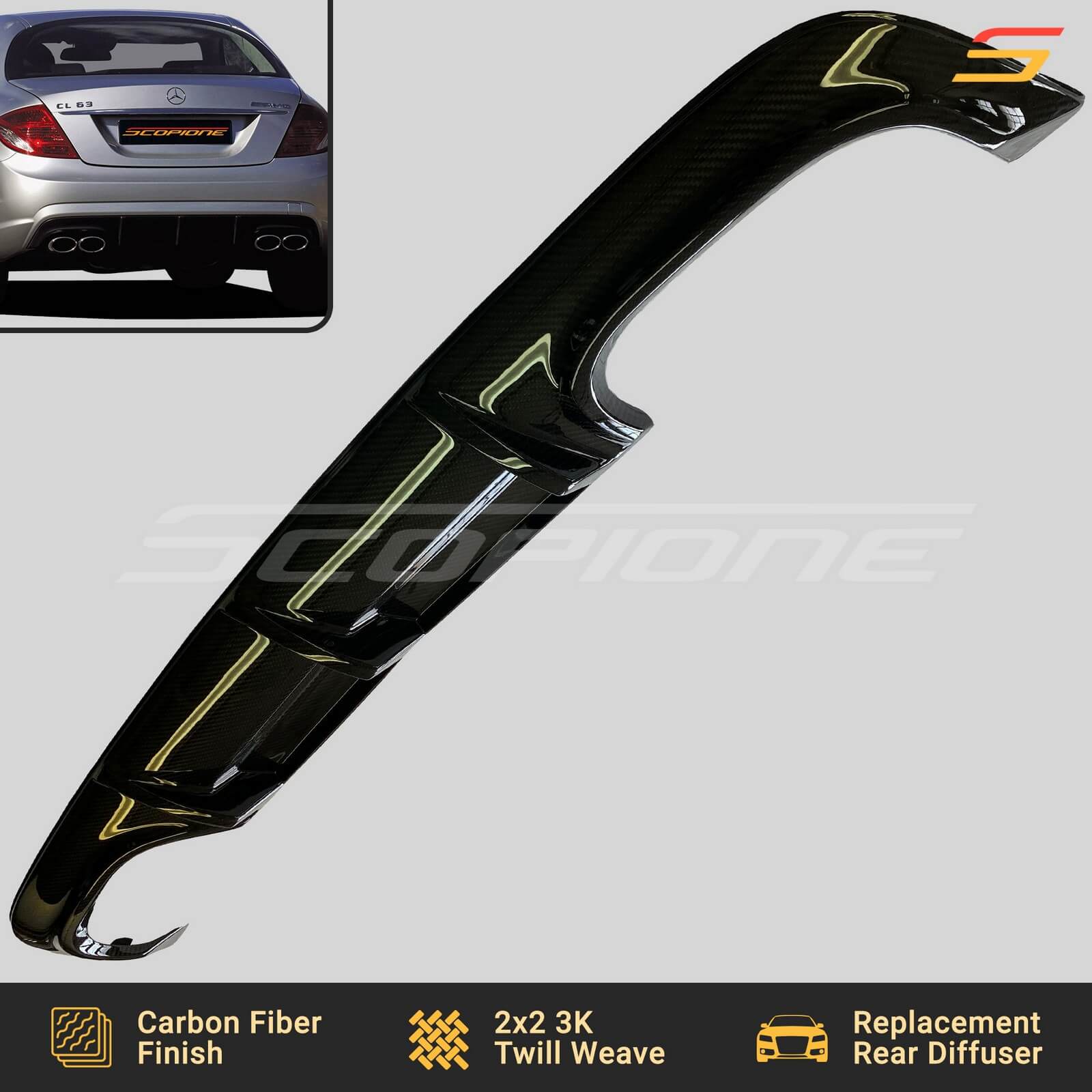
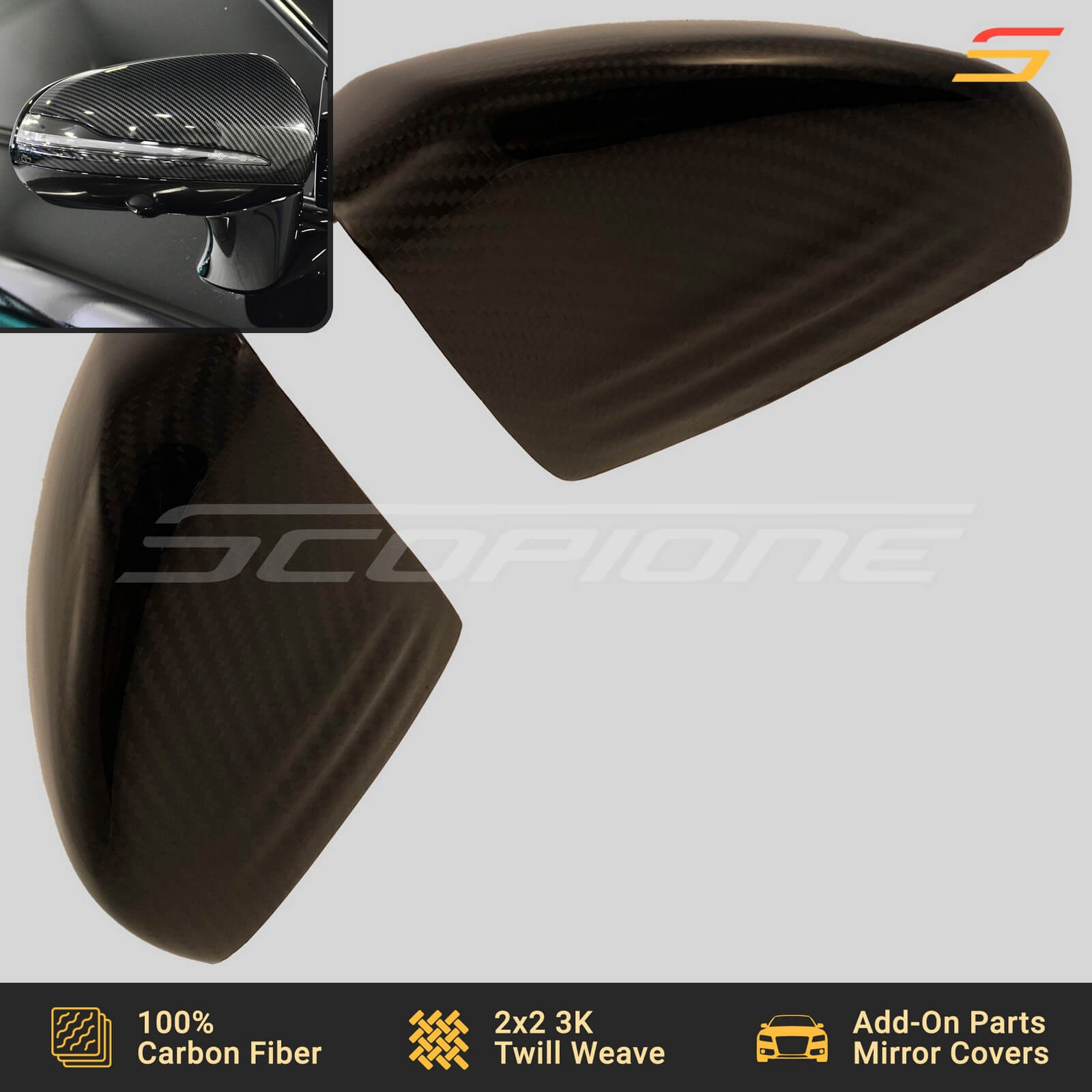
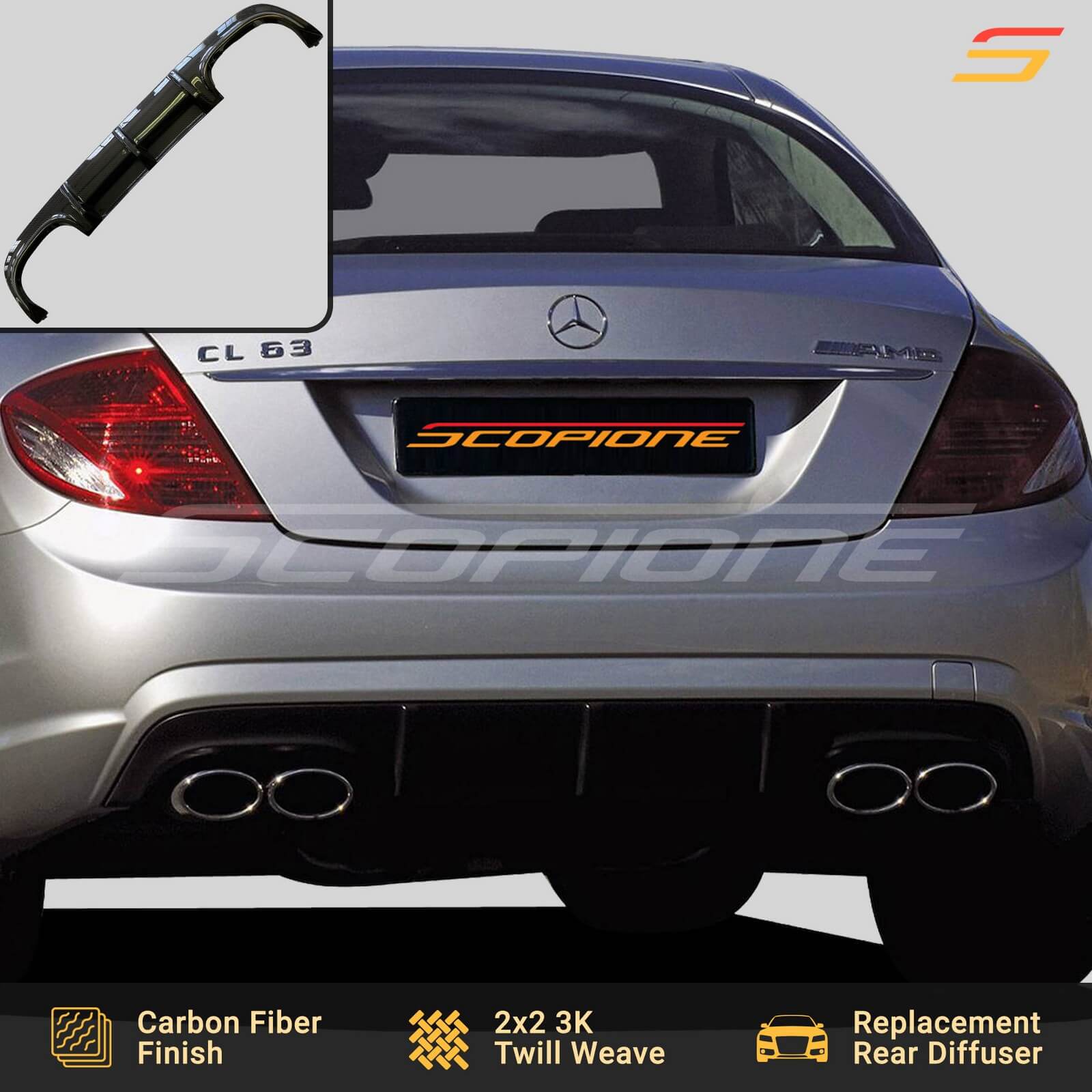
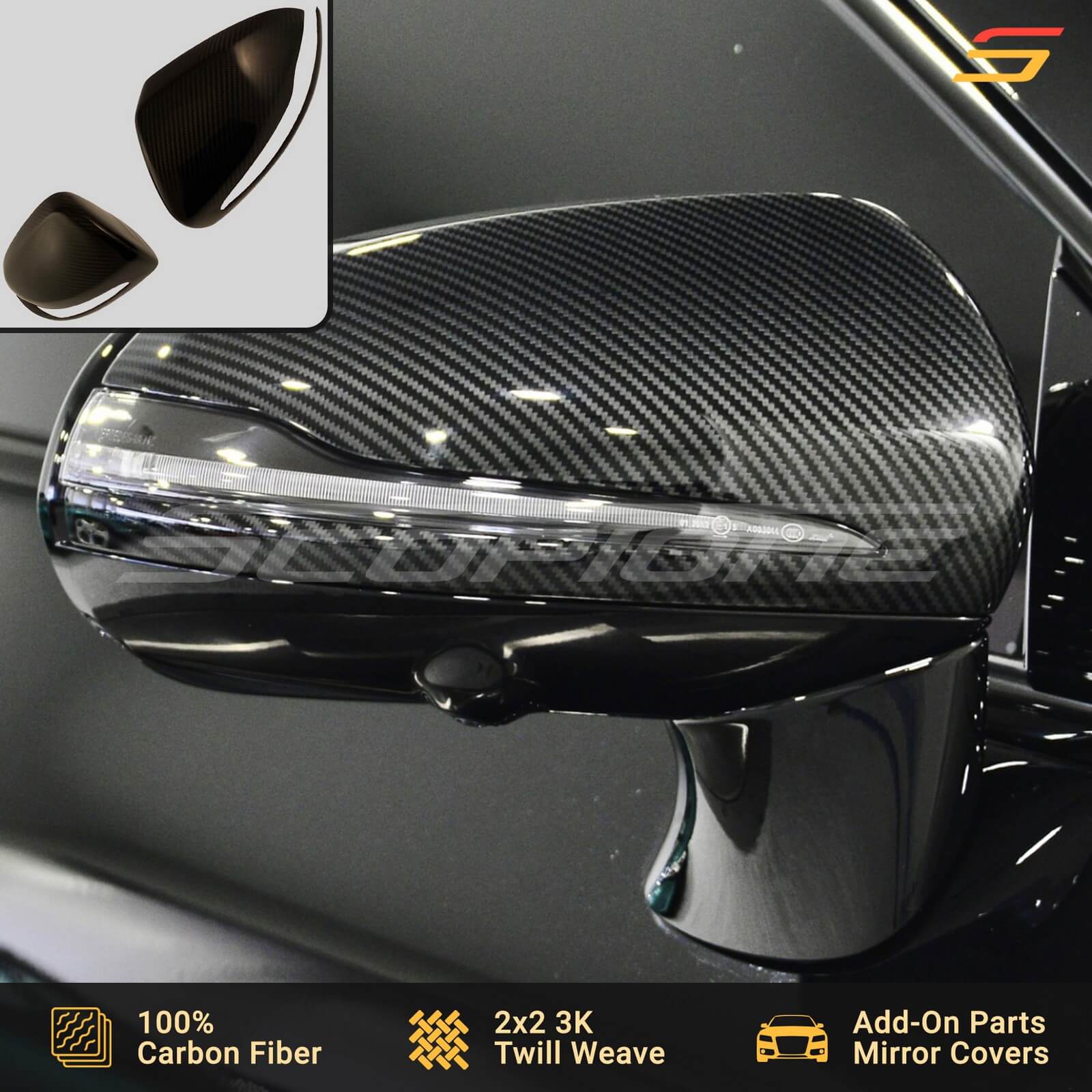
The 300 SL’s tubular space frame and the CLK GTR’s CFRP monocoque represent two solutions to the same problem: building a chassis rigid enough for high-speed performance without excess weight. Scopione’s Mercedes-Benz CF parts continue that engineering thread on a deliberately small scale: a 2×2 3K twill-weave replacement rear diffuser for the CL63 and CL65 AMG, and add-on side mirror covers for the S, C, E, CLS, GLC and AMG GT four-door.
2003–2019: The McLaren Partnership and AMG Performance
The early 2000s brought a partnership that defined Mercedes’ next chapter in carbon fiber. Mercedes-Benz and McLaren joined forces to create the SLR — a grand tourer built around a carbon-fiber monocoque at McLaren’s Technology Centre in Woking. When that collaboration ended, Mercedes-AMG stepped forward with the SLS AMG, followed by the AMG GT platform. Carbon fiber shifted from a structural necessity reserved for thirty-unit homologation specials into a performance-option catalog item available across multiple AMG variants. The material’s role changed: still functional, but increasingly accessible.
Mercedes-Benz SLR McLaren (2003–2010)
The SLR McLaren was a collaboration unlike anything either company had attempted. Mercedes-Benz designed the exterior and interior. McLaren engineered and assembled the car at its Woking facility, applying composite manufacturing techniques refined through two decades of Formula 1 chassis production. The arrangement leveraged McLaren’s CFRP expertise to build a grand tourer that neither company could have executed independently.
The 5.4-liter supercharged M155 V8 produced 617 hp in standard form, rising to 641 hp in both the 722 Edition (2006) and the SLR Stirling Moss (2009, 75 units) — a windshield-less speedster. Approximately 2,157 SLRs were built across all variants over seven production years.
- Engine: 5.4L M155 supercharged V8, 617–641 hp
- 0–60 mph: 3.4 seconds
- Top speed: 207 mph (334 km/h)
- Production: ~2,157 units (all variants: coupe, roadster, 722 Edition, Stirling Moss)
- Weight: 1,768 kg (coupe)
The SLR’s CFRP monocoque was assembled using McLaren’s F1 autoclave processes. But the car’s more significant contribution was its carbon-fiber front crash structure — an energy-absorbing element designed to progressively delaminate and fragment on impact, dissipating crash energy in a controlled sequence. This was the first time a production GT used carbon fiber not merely for lightweight structure but as an engineered safety component. Unlike metal crash structures that deform plastically (absorbing energy by bending), the CF front section was tuned to break apart in a controlled pattern — each layer of the composite laminate absorbing energy as it fractured. Carbon-ceramic brakes complemented the carbon-fiber body, making the SLR one of the first road cars where carbon-based materials handled both the structure and the stopping. The same Woking facility would later produce the McLaren MP4-12C’s MonoCell, carrying the SLR’s composite lessons forward into McLaren’s own production car line.
Mercedes-AMG SLS AMG (2010–2014)
The SLS AMG was the first car designed and built entirely by Mercedes-AMG. No McLaren. No external partner. The gullwing doors were an explicit homage to the 300 SL, and like the 1954 original, they existed because of structural necessity: the aluminum space frame’s high side sills required top-hinged doors for practical entry.
The hand-built M159 V8 displaced 6.2 liters and produced 563 hp in standard form — each engine assembled by a single technician who signed the intake manifold upon completion. AMG marketed this as “One Man, One Engine,” and it was not merely a slogan. The practice established individual accountability for each power unit, linking the builder’s name to the engine’s performance for its entire service life. The SLS AMG Black Series (2013) pushed output to 622 hp with wider bodywork, stiffer suspension, and extensive carbon-fiber body panels. Meanwhile, the SLS AMG Electric Drive (2013) delivered 740 hp from four electric motors — a powertrain that foreshadowed the AMG One’s multi-motor hybrid architecture by nearly a decade.
- Engine: 6.2L M159 hand-built naturally aspirated V8, 563–622 hp
- 0–60 mph: 3.7 seconds
- Top speed: 197 mph (317 km/h)
- Production: ~11,500 units (all variants)
- Structure: Aluminum space frame (~241 kg), optional CF components
The SLS used an aluminum space frame weighing approximately 241 kg — not a CFRP monocoque. But carbon fiber’s role expanded across the model range. Optional CF components included the hood, engine cover, rear diffuser, mirror caps, and interior trim. The Black Series went further: carbon-fiber hood, fenders, rear wing, diffuser, and engine cover arrived as standard equipment, reducing weight by roughly 70 kg versus the base SLS. The approach was transitional — aluminum for primary structure, CFRP for weight-critical panels — and it established the template the AMG GT would refine.
Mercedes-AMG GT / AMG GT R (2014–2022)
The AMG GT replaced both the SLS AMG and SLR McLaren in Mercedes’ sports car lineup, bringing AMG’s twin-turbo V8 philosophy to a broader audience. The front-mid-mounted 4.0-liter M178 engine sat behind the front axle, with a rear transaxle for weight distribution. The range expanded from the base GT (456 hp) through GT S, GT C, GT R (577 hp), and the track-honed GT R PRO.
The AMG GT R earned its reputation through lap times rather than specifications. Rear-axle steering, active aerodynamics, and a manually adjustable traction control system delivered Nürburgring performance competitive with cars costing twice as much. BMW’s M division and Aston Martin brought aluminum-intensive alternatives to the same segment, but AMG’s combination of accessible pricing and carbon-fiber content set a different competitive standard.
- Engine: 4.0L M178 twin-turbo V8, 456–577 hp
- 0–60 mph: 3.5 seconds (GT R)
- Top speed: 198 mph (318 km/h, GT R)
- CF content: Hood, trunk lid, rear wing, underbody (standard on GT R); roof, mirrors, skirts (optional)
Carbon fiber normalized across the AMG GT range. The GT R carried a CF hood, trunk lid, rear wing, and underbody panels as standard equipment. Optional packages added a carbon-fiber roof, mirror caps, side skirts, and interior trim. Carbon fiber was no longer reserved for thirty-unit specials or McLaren-built exotica. It was available across multiple trim levels of a car AMG sold in meaningful volume — thousands of units annually. That commercial scale demonstrated CFRP manufacturing capability far beyond the SLR’s hand-built production.
Scopione Perspective: Partnership and AMG Performance
The SLR McLaren brought carbon fiber into Mercedes’ DNA through partnership. The SLS and AMG GT kept it there through AMG’s own engineering. Scopione carries two carbon-fiber parts for these cars: add-on mirror covers that fit the AMG GT four-door, C-Class, E-Class, S-Class, CLS and GLC, and a replacement rear diffuser for the CL63 and CL65 AMG — both finished in the same 2×2 3K twill weave used in AMG’s factory CF packages.
2020–Present: Hypercar Engineering and Carbon Fiber Mastery
Mercedes-AMG entered the hypercar era with two vehicles that pushed CFRP to its structural and performance limits. The AMG GT Black Series wrapped a full exterior body in carbon-fiber panels around a race-derived flat-plane V8. The AMG One went further — a Formula 1 power unit mounted inside a carbon-fiber monocoque that is, for practical purposes, a detuned Grand Prix car with license plates. Together, they demonstrate that Mercedes-AMG’s carbon fiber capability has evolved from borrowed technology (McLaren partnership) to fully internalized engineering. The new-generation AMG GT (2024) extends CF availability across the range, completing a three-tier carbon-fiber strategy: CFRP monocoques for hypercars, extensive CFRP body panels for limited specials, and CF option packages for volume sports cars.
Mercedes-AMG GT Black Series (2020–2022)
The Black Series arrived as the most extreme road car AMG had produced to that point. Its flat-plane crank V8 — unique in the AMG lineup, where cross-plane engines define the brand’s exhaust note — produced 720 hp with a sharper, higher-revving character. Maro Engel lapped the Nürburgring Nordschleife in 6:43.616 in November 2020. Fastest production Mercedes ever around the circuit.
But the carbon-fiber story is where the Black Series stands apart from every AMG before it. CFRP components include the hood, front fenders, front splitter, roof panel, rear wing with carbon-fiber endplates, rear diffuser, side skirts, engine cover, and portions of the front crash structure. The list is not decorative. Each panel was replaced because its CFRP equivalent offered a measurable weight reduction over the aluminum or steel original, and that reduction translated directly into improved lap times through lower inertia in acceleration, braking, and directional changes. The dry weight of approximately 1,400 kg — roughly 150 kg lighter than the AMG GT R — came primarily from this wholesale material substitution.
- Engine: 4.0L M178 LS2 flat-plane crank twin-turbo V8, 720 hp
- 0–60 mph: 3.1 seconds
- Top speed: 202 mph (325 km/h)
- Production: ~1,700 units
- Dry weight: ~1,400 kg
- Nürburgring: 6:43.616 (Maro Engel, November 2020)
The manually adjustable two-stage rear wing deserves specific attention. Its carbon-fiber construction allowed a large aerodynamic surface to remain rigid under downforce loads exceeding several hundred kilograms at top speed while contributing minimal weight. A metal wing of equivalent size and stiffness would have added measurably to the rear axle load at rest — counterproductive for a car built around weight distribution. Approximately 1,700 Black Series units were produced, demonstrating that AMG could design, engineer, and manufacture extensive CFRP bodywork in-house. McLaren was no longer needed.
Mercedes-AMG One (2022–Present)
The AMG One is the most literal Formula 1 technology transfer ever attempted in a road car. Its 1.6-liter turbo V6 is derived from the Mercedes-AMG F1 W07 — the engine that powered Lewis Hamilton’s 2016 World Championship campaign. The power unit retains the F1 car’s MGU-K (kinetic energy recovery), MGU-H (heat energy recovery from the turbocharger), and adds four electric motors for a combined output of 1,049 hp. The engine revs to 11,000 rpm on the road. Only 275 units were built, each pre-sold at approximately €2.75 million before the first car left the assembly facility in Coventry.
Every major system was adapted from the F1 car rather than designed from scratch. The electrified turbocharger, the four-motor hybrid architecture, the battery management — all carry F1 lineage. This is not a marketing claim. The power unit’s architecture is verifiably derived from the W07. Adapting an F1 engine for road use required years of development — the AMG One was announced in 2017 but did not reach customers until 2022. The challenge was durability: an F1 power unit is designed for approximately 7,000 km of racing before rebuild, while a road car must survive tens of thousands of kilometers of daily driving, cold starts, and idle time. Mercedes-AMG engineers had to re-engineer the power unit’s lubrication, cooling, and emissions systems without fundamentally altering the architecture that made it an F1 engine in the first place.
- Power unit: 1.6L turbo V6 + MGU-K + MGU-H + 4 electric motors, 1,049 hp combined
- 0–60 mph: 2.9 seconds
- Top speed: 219 mph (352 km/h)
- Production: 275 units (all pre-sold)
- Weight: 1,695 kg (wet)
- Nürburgring: 6:35.183 (Maro Engel, October 2022 — production car record at the time)
The AMG One’s CFRP monocoque is constructed to Formula 1 safety cell standards. The occupant cell must withstand impact loads that would crush a conventional steel or aluminum structure, and it must do so at a weight penalty low enough to avoid negating the hybrid powertrain’s performance advantage. Carbon fiber is the only material that satisfies both constraints simultaneously. The monocoque provides the torsional rigidity required for the hybrid powertrain’s extreme torque delivery and the crash protection mandated for street homologation. Active aerodynamic elements — a deployable roof scoop, multi-element rear wing — are carbon fiber, combining lightweight construction with stiffness sufficient to resist aero loads exceeding 1,000 kg at speed. The AMG One represents the culmination of Mercedes-Benz’s CFRP trajectory: from borrowed CF in racing homologation (CLK GTR) through partnership-built monocoques (SLR McLaren) to a fully in-house hypercar with an F1-grade carbon-fiber safety cell. The Maserati MC20 followed a parallel path — developing a proprietary CFRP monocoque with Dallara — but the AMG One’s F1-derived architecture occupies a structural class of its own.
Mercedes-AMG GT 63 (R232, 2024–Present)
The second-generation AMG GT arrived in 2024 as a more refined successor to the original, sharing less with the SLS-era platform than it does with the AMG One’s development program. The AMG GT 63 S E Performance variant combines the 4.0-liter twin-turbo V8 with a rear-axle electric motor for 805 hp — the highest output of any series-production AMG. Active aerodynamics and rear-axle steering, both technologies validated in the AMG One program, migrated down to the volume sports car. The aluminum-intensive structure reflects lessons learned from a decade of AMG GT development — where to place material for rigidity, where to remove it for weight savings, and where carbon fiber offers a measurable advantage over aluminum.
- Engine: 4.0L M178 twin-turbo V8; E Performance: V8 + rear electric motor, 805 hp combined
- 0–60 mph: 3.2 seconds (GT 63 S E Performance)
- Top speed: 196 mph (315 km/h)
- CF options: Roof panel, mirror caps, front splitter inserts, rear diffuser, fixed rear wing, interior trim
The R232 AMG GT continues the carbon-fiber integration established by its predecessor but within a broader product strategy. An optional CF exterior package includes the roof panel, mirror caps, front splitter inserts, rear diffuser, and fixed rear wing. Interior carbon-fiber trim packages are available across all variants. The E Performance plug-in hybrid variant adds another dimension: the rear-axle electric motor contributes 204 hp of instant torque, and the battery’s weight (concentrated low and rearward) demanded carbon-fiber weight savings elsewhere in the structure to maintain the car’s center of gravity within AMG’s target range.
The R232 represents where carbon fiber sits in Mercedes-AMG’s current lineup: structural CFRP for hypercars (AMG One), extensive CFRP body panels for limited specials (Black Series), and configured CF options for volume sports cars (AMG GT 63). The Lamborghini approach — CFRP monocoques across multiple model lines — differs in strategy but not in outcome. Both manufacturers have reached a point where carbon fiber is an expected component of their performance identity. The material choice, and the level of integration, scales to price and volume.
Scopione Perspective: The Hypercar Era
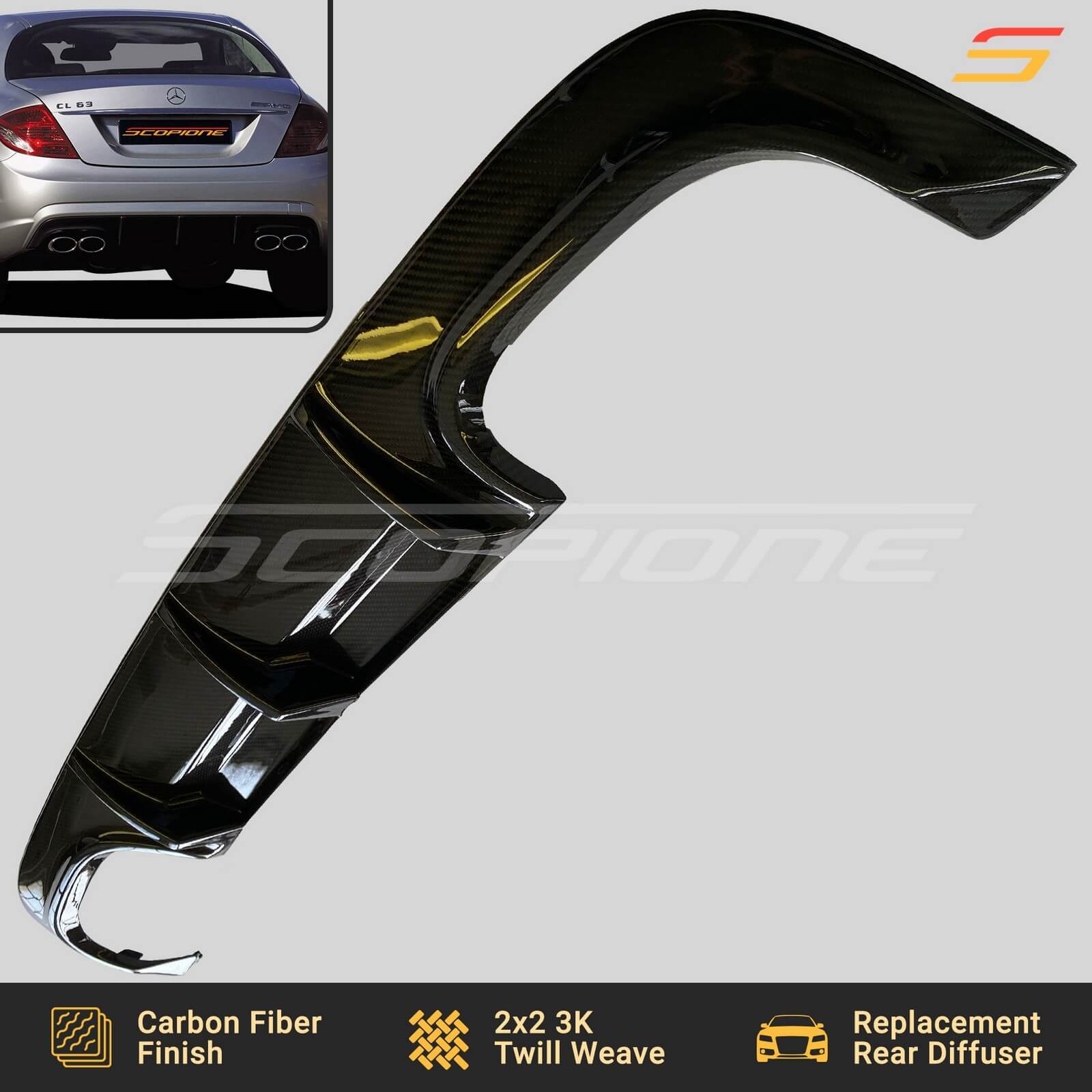
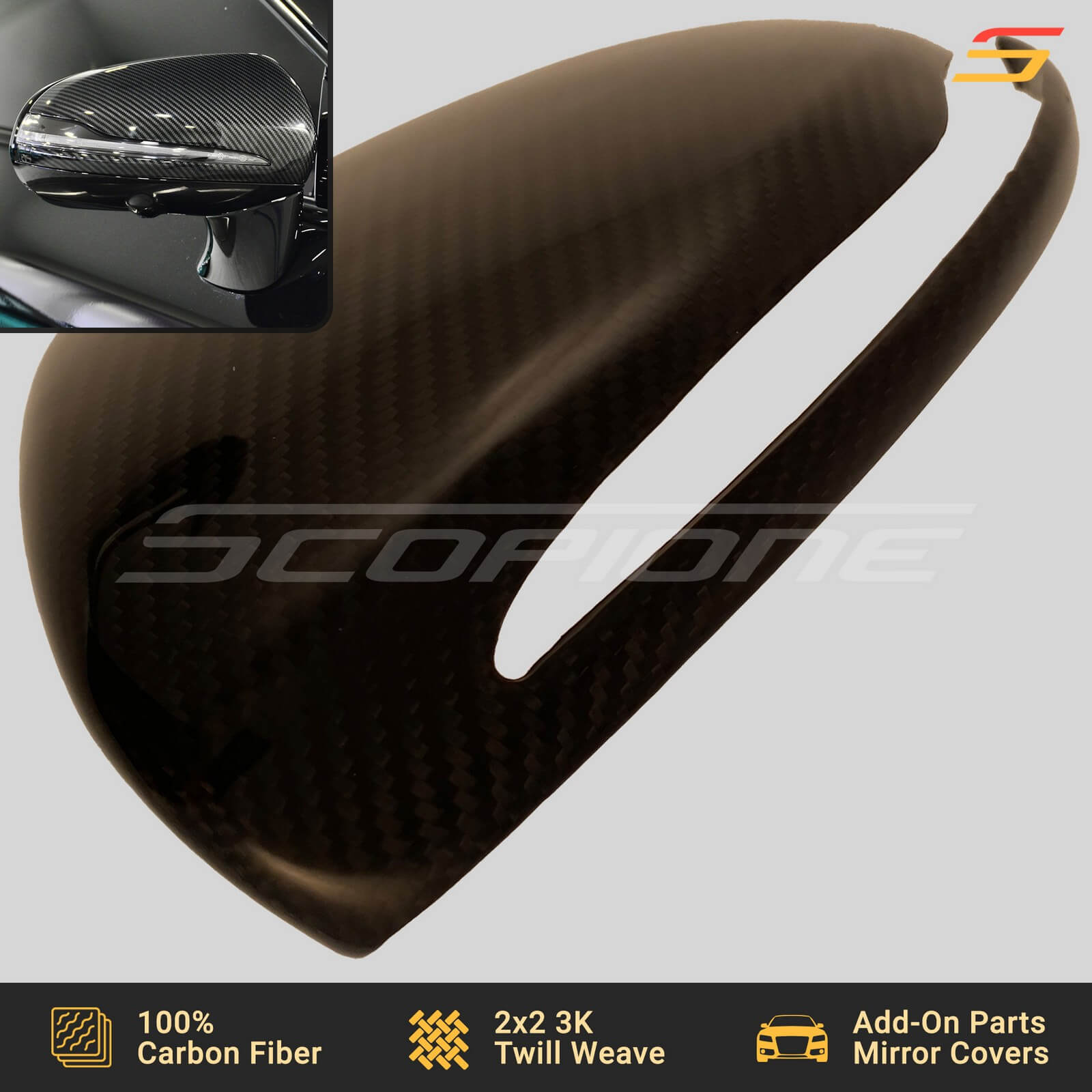
The AMG One’s F1-grade CFRP monocoque and the Black Series’ full carbon-fiber body represent the engineering ceiling. For Mercedes-Benz owners whose vehicles sit closer to the production floor, Scopione delivers the same visual and weight-reduction benefits through precision-fitted CF components. Mirror covers and a rear diffuser — both finished in UV-resistant clear-coated 2×2 3K twill weave — bring the carbon-fiber aesthetic from the AMG hypercar program to daily-driven AMG and standard Mercedes-Benz models.
Frequently Asked Questions
Mercedes-Benz and Carbon Fiber: Common Questions
When Did Mercedes-Benz First Use Carbon Fiber?
Mercedes-Benz first deployed carbon fiber in a road car with the CLK GTR in 1997. The CLK GTR used a CFRP monocoque chassis derived directly from its FIA GT1 racing car. Only 30 road cars were built (25 coupes and 5 Super Sport roadsters). Earlier experimentation with composite materials occurred in the C111 prototypes (1969–1979), which used fiberglass (GFRP) bodywork.
Which Mercedes-AMG Models Feature Carbon Fiber Construction?
The key carbon-fiber Mercedes-AMG models span three decades. The CLK GTR (1997) and SLR McLaren (2003) used full CFRP monocoques. The SLS AMG Black Series (2013) featured extensive CF body panels. The AMG GT R and GT R PRO (2017–2021) carried standard carbon-fiber hoods, wings, and underbody panels. The AMG GT Black Series (2020) wrapped nearly its entire exterior in CFRP. And the AMG One (2022) uses an F1-grade CFRP monocoque producing 1,049 hp from a hybrid power unit. Current AMG GT models (2024) offer optional carbon-fiber exterior and interior packages.
What Is the AMG One’s Carbon Fiber Monocoque?
The AMG One’s CFRP monocoque is built to Formula 1 safety cell standards. It houses the F1-derived 1.6-liter turbo V6 hybrid power unit (1,049 hp combined) and provides both the torsional rigidity required for the system’s extreme torque delivery and the crash protection required for road homologation. The monocoque structure, combined with CFRP body panels and carbon-fiber active aerodynamic elements, keeps the car’s wet weight at 1,695 kg despite carrying a complex hybrid powertrain with multiple electric motors and a battery pack.
How Does the Silver Arrows Heritage Connect to Modern Carbon Fiber?
The Silver Arrows program codified weight reduction as a core Mercedes-Benz performance strategy. Stripping paint from the W25 in 1934 to save one kilogram and meet the 750 kg weight limit embodies the same engineering logic that drives modern CFRP adoption: every gram removed from the chassis directly improves acceleration, braking, and cornering. The 300 SL’s tubular space frame (1954) continued the theme, and the CLK GTR’s CFRP monocoque (1997) applied it with a new material. The philosophy has been consistent for ninety years — only the material science has changed.
What Carbon Fiber Parts Does Scopione Offer for Mercedes-Benz?
Scopione’s Mercedes-Benz catalog is small and specific: two 2×2 3K twill-weave carbon-fiber parts. A replacement rear bumper diffuser for the 2008–2010 CL63 and CL65 AMG (W216) — AMG trim only, and it will not fit the CL550 or CL600. And add-on side mirror covers for the S-Class (2014–2020), C-Class (2015–2021), GLC (2016–2022), E-Class (2017–2022), CLS (2019–2022) and AMG GT four-door (2019–2022); these fit over the factory mirror shells rather than replacing them, and will not fit aftermarket shells. Both are precision-fitted to OE specifications, finished with a UV-resistant clear coat, and carry the listings’ 1-year limited warranty. Visit scopione.com/shop-by-make/mercedes-benz/ for current availability and fitment details.
Experience the elegance and performance of the Mercedes-Benz with Scopione. Browse our gallery and get inspired to elevate your supercar with our top-of-the-line carbon fiber upgrades.
Shop now for premium ScopioneCarbon carbon fiber upgrades and experience the ultimate in performance and aesthetics for your Mercedes-Benz!
Back to Top ↑Disclaimer: Technical specifications, production figures, and historical details presented in this article are editorial in nature and may differ from official manufacturer data. Photographs show the two Scopione carbon fiber parts for Mercedes-Benz — the CL63/CL65 AMG rear diffuser and the add-on side mirror covers.