

 Shop
Shop
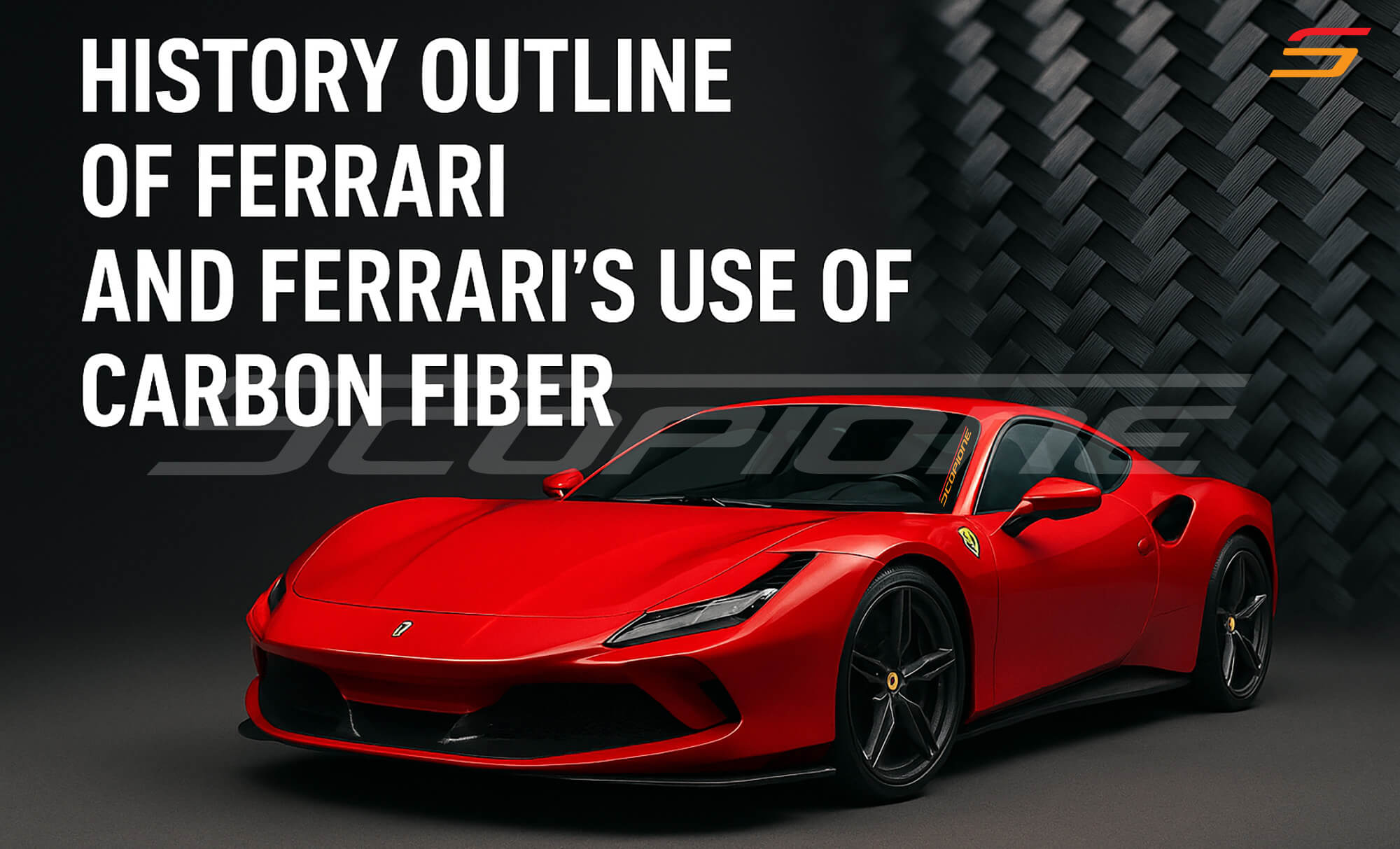
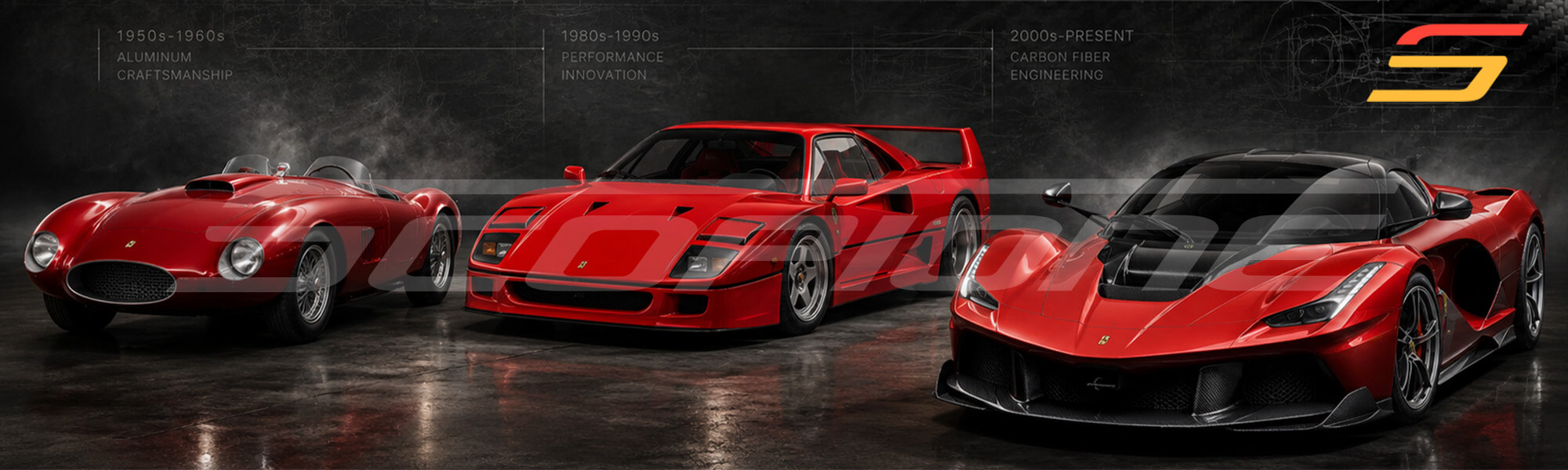
Ferrari did not develop carbon fiber for its road cars. The technology came down from the pit lane. For four decades, Maranello maintained two parallel engineering tracks: Formula 1 teams pushing composite materials to structural limits at racing speed, and road car engineers building aluminum-bodied sports cars for customers who expected refinement alongside performance. The bridge between those two worlds was never automatic – it required specific people, specific cars, and specific commercial calculations. John Barnard designed the first Ferrari F1 car with a full carbon fiber monocoque in 1989. Six years later, the F50 carried that same structural philosophy onto public roads. But Ferrari’s volume sports cars – the 355, 360, 430, 458, 488 – remained on aluminum platforms for another quarter-century. That was not a failure to adopt. It was a deliberate strategy: reserve full CF monocoques for limited-production hypercars where cost constraints loosen, and offer CF as an optional upgrade on volume models where margins matter. The result is a company with deeper CF structural expertise than almost any automaker, deployed across fewer production units than competitors who standardized the material earlier. Scopione stocks carbon fiber components for multiple Ferrari platforms – browse the full Ferrari catalog.
Carbon Fiber Milestones at a Glance
| Year | Milestone | Model / Program |
|---|---|---|
| 1983 | First CF composite elements in an F1 chassis | Ferrari 126C3 |
| 1987 | First Ferrari road car with carbon fiber body panels | F40 |
| 1989 | First Ferrari F1 car with full CF monocoque (John Barnard) | Ferrari 640 |
| 1995 | First Ferrari road car with full CF monocoque chassis | F50 |
| 2002 | Second-generation CF monocoque with F1 technology transfer | Enzo |
| 2013 | CF monocoque 20% lighter and 27% stiffer than Enzo’s | LaFerrari |
| 2019 | Hybrid flagship with CF structural reinforcements at volume | SF90 Stradale |
| 2025 | New-generation CF chassis with battery integration | F80 |
1947–1970s: Racing DNA and the Pursuit of Lightness
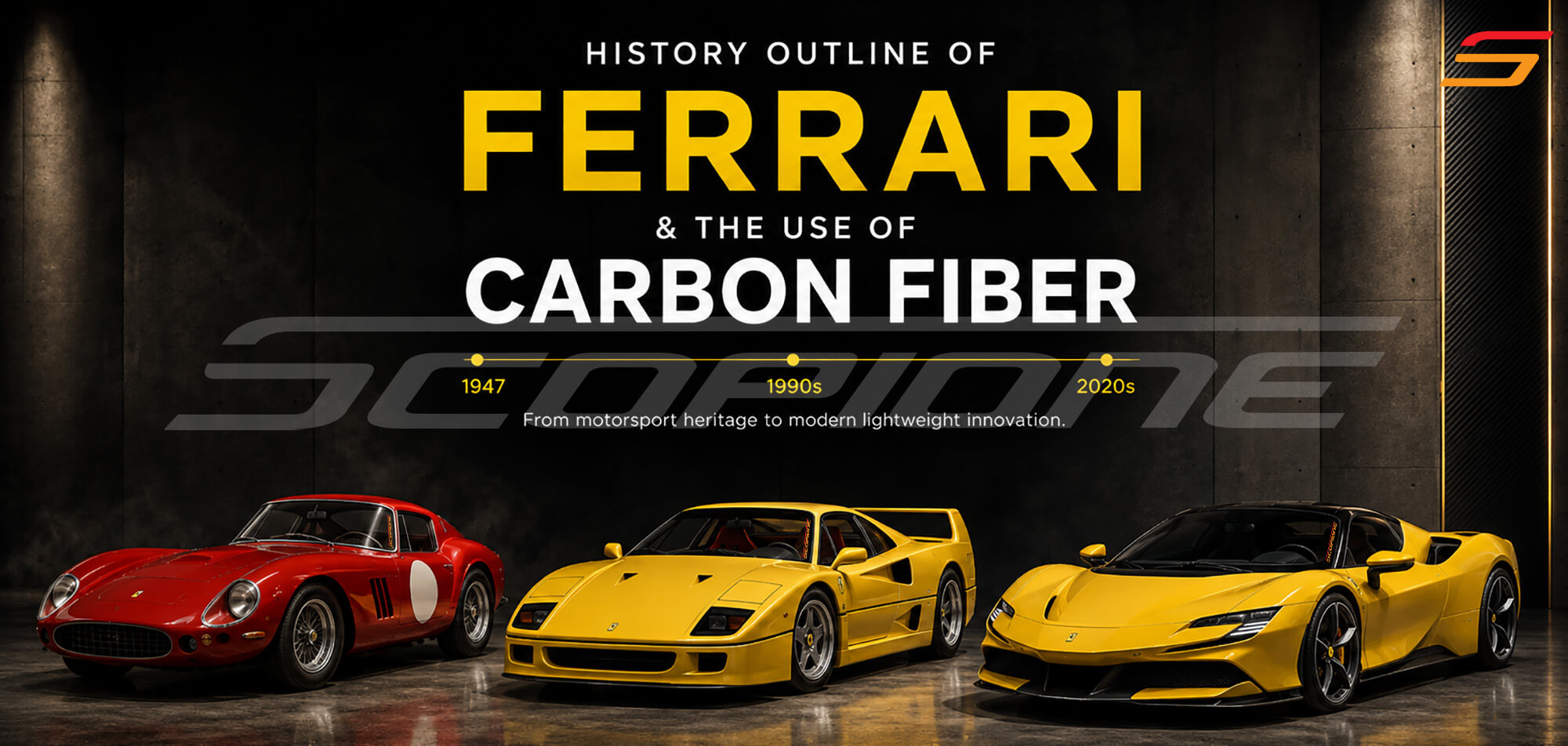
Ferrari existed as a racing operation before it was a road car company. Enzo Ferrari founded Scuderia Ferrari in 1929 as Alfa Romeo’s works team, and for nearly two decades his identity was that of a team principal, not a manufacturer. The road cars that followed from 1947 onward were, in Enzo’s own framing, a means to fund racing. That priority shaped everything: weight was the enemy, and the coachbuilders who clothed Ferrari’s tubular steel chassis – Touring, Vignale, Pinin Farina – were chosen partly for their ability to keep body panels thin and light. Carbon fiber was decades away from commercial viability. But the engineering culture that would later embrace it – an obsession with power-to-weight ratio forged in the crucible of Grand Prix and endurance racing – was present from the first car that carried the prancing horse emblem.
Ferrari 125 S (1947): The Beginning
Gioacchino Colombo designed the 1.5-liter V12 that powered Ferrari’s first car. Touring Superleggera built the body using the same method they applied to Lamborghini’s 350 GT two decades later: thin aluminum panels over a tubular steel skeleton. Only two 125 S chassis were completed. The car debuted at the Piacenza circuit on May 11, 1947 – retired from its first race with a fuel pump failure, then won its second outing at the Terme di Caracalla circuit in Rome two weeks later. That pattern – racing setback followed by immediate competitive success – would define Ferrari’s character for the next eight decades.
- Engine: 1.5L Colombo V12, 118 hp
- Production: 2 units
- Top speed: ~130 mph
- Construction: Tubular steel chassis, aluminum Superleggera body
The Colombo V12 architecture – compact, high-revving, designed for racing first – would power Ferraris in various displacements through the 1960s. Colombo’s emphasis on specific output over displacement established an engineering philosophy that persists: Ferrari engines have consistently produced more horsepower per liter than their competitors, a characteristic that demands lightweight construction in the surrounding vehicle to exploit fully. The 125 S also established a relationship between Ferrari and its coachbuilders that would endure for decades – Touring, Vignale, and eventually Pininfarina each contributed body designs that prioritized aerodynamic efficiency and low mass, building an institutional expectation that composite materials would later fulfill at a higher level of structural performance.
Ferrari 250 GTO (1962–1964): Lightness as Competitive Weapon
The 250 GTO was a racing car wearing road-legal bodywork – built to satisfy FIA homologation requirements for GT racing, not to serve as a grand tourer. Giotto Bizzarrini (the same engineer who later designed Lamborghini’s first V12) tuned the Colombo V12 to 296 hp. Sergio Scaglietti shaped the aluminum body panels by hand, hammering them thin enough that mechanics could press dents out with their thumbs after racing incidents. At approximately 880 kg, the 250 GTO achieved a power-to-weight ratio that many modern supercars with carbon-fiber construction still have not matched.
- Engine: 3.0L Colombo V12, 296 hp
- 0–60 mph: 5.8 seconds
- Top speed: 174 mph
- Production: 36 units
- Curb weight: ~880 kg
Only 36 GTOs left the factory. Each one was effectively hand-built – no two are dimensionally identical. That extreme low-volume, hand-fabricated approach to weight savings worked for 36 cars but could never scale. The history of Ferrari’s CF adoption is partly the history of finding industrial processes that deliver GTO-level weight consciousness at 15,000-unit production volumes. Auction records for the 250 GTO have exceeded $48 million, establishing a collector market that Ferrari would later serve deliberately with limited-edition hypercars.
Ferrari Dino 246 GT and the 308 GTB: Mid-Engine Volume and the First Composite Experiment
Before the 308, the Dino 246 GT (1969–1974, 3,569 units) proved that Ferrari could build mid-engine sports cars at genuine volume. Named after Enzo’s son Alfredino – who contributed to the V6 engine concept before his death from muscular dystrophy in 1956 at age 24 – the Dino carried emotional weight beyond its engineering significance. Aldo Brovarone at Pininfarina designed a body that became an instant icon. The mid-engine V6 layout established the template that every “entry-level” Ferrari would follow for the next five decades, leading directly to the 308, 328, 348, 355, 360, 430, 458, 488, F8, and ultimately the 296 GTB that revived the V6 cylinder count 50 years later.
The 308 GTB is usually discussed as the car that defined the “affordable Ferrari” formula: mid-engine V8, Pininfarina styling, a price point within reach of successful professionals rather than only the aristocracy. But the early 308 GTB hides a detail that matters for the CF story. The first approximately 712 units used fiberglass body panels – not steel, not aluminum. Fiberglass. Ferrari switched to steel bodies from 1977 onward for durability and cost reasons, but those early fiberglass 308s were roughly 150 kg lighter than their steel-bodied successors.
- Engine: 2.9L V8, 237–255 hp
- 0–60 mph: 6.7 seconds
- Top speed: 158 mph
- Production: 12,004 units (all variants)
- Fiberglass production: ~712 units (1975–1977)
Those fiberglass 308s represent Ferrari’s first production use of composite body panels – predating carbon fiber adoption by over a decade. The experiment was abandoned because fiberglass lacked the structural properties and surface finish quality that Ferrari’s customers expected. But it demonstrated a willingness to explore non-metal materials when weight targets demanded it. A decade later, when CF composites offered the structural integrity that fiberglass could not, Ferrari’s engineers already understood the manufacturing challenges of composite body panels from firsthand experience.
The 308 also anchored the mid-engine V8 lineage that continues through eight generations to the current 296 GTB. Every model in that chain – 328, 348, 355, 360, 430, 458, 488, F8 – progressively incorporated more carbon fiber, making the 308 the origin point of a 50-year arc from fiberglass experiment to standard CF specification. The progression was not linear. The 328 and 348 returned to all-steel construction. The 355 offered optional CF interior trim. The 360 introduced aluminum space frames. Only with the 430 Scuderia in 2007 did CF become a defining characteristic of the V8 sports car lineup – 32 years after the fiberglass 308 first demonstrated what non-metal body panels could achieve.
Scopione Perspective: The Founding Era
The engineering culture that produced the 250 GTO’s 880 kg curb weight, the Dino’s mid-engine template, and the 308 GTB’s fiberglass body panels was the same culture that later embraced carbon fiber without hesitation. Every founding-era decision – Colombo’s high-revving V12s that demanded light chassis, Scaglietti’s hand-hammered aluminum, the Dino’s volume production capability, the fiberglass experiments on the 308 – reflected a consistent priority: extract performance through reduced mass. Scopione’s carbon fiber components for modern Ferrari models carry that principle forward. Each part is precision-fitted to factory mounting points, maintaining the design geometry and structural alignment that Maranello’s engineers specified for each platform.
1980s–1990s: From Formula 1 to the Road
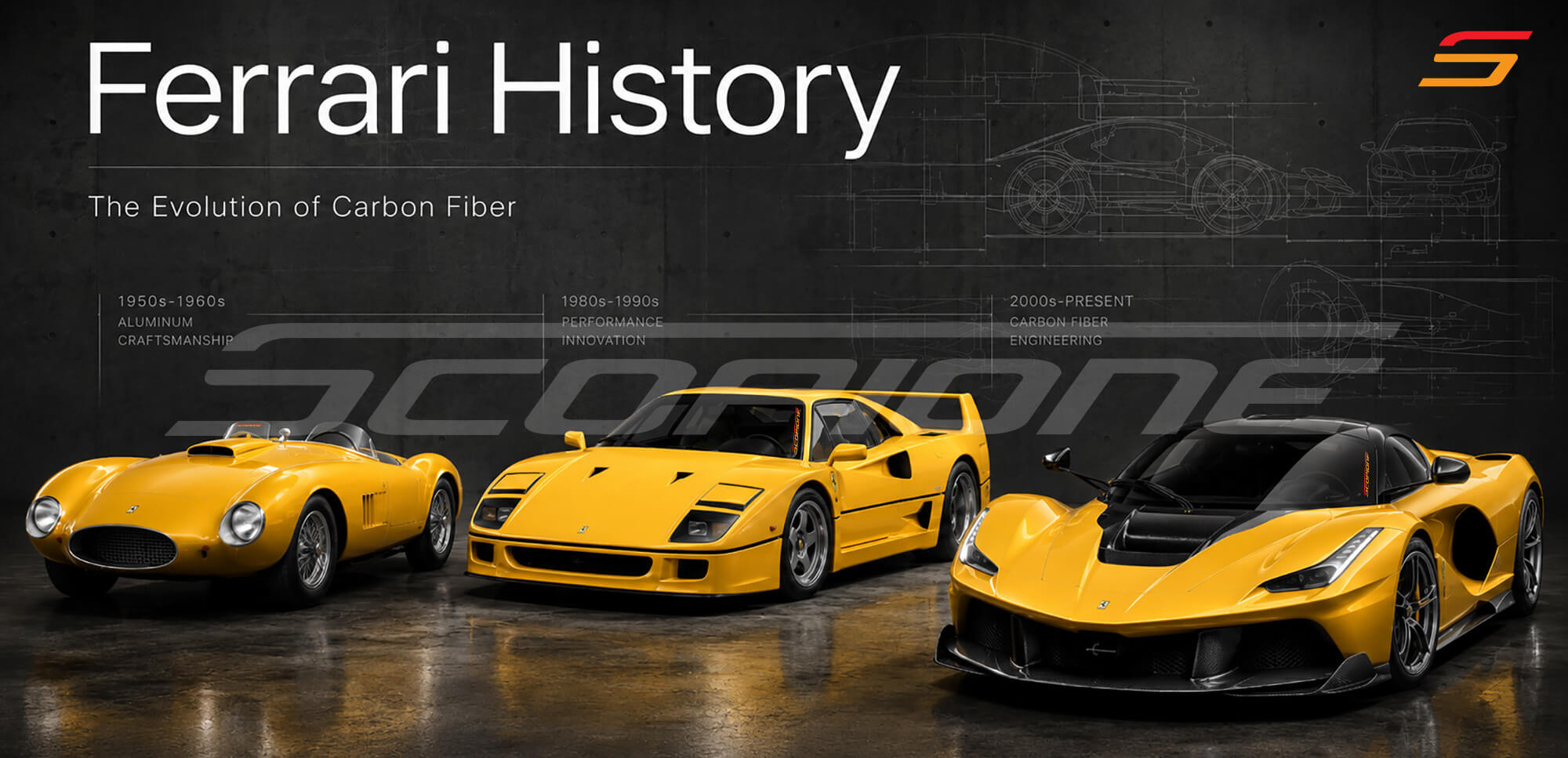
The bridge between Ferrari’s racing composites and its road car composites has a name: John Barnard. The British engineer had already designed the first-ever carbon fiber monocoque F1 car – the McLaren MP4/1 in 1981 – before moving to Ferrari in 1986. Barnard’s Ferrari 640 (1989) carried a full CF monocoque, and his insistence on semi-automatic gearbox technology produced the paddle-shift system that every modern Ferrari now uses. Barnard operated from the Guildford Technical Office in Surrey, England – over 1,200 km from Maranello – because he refused to relocate. That arrangement infuriated Italian engineers at the factory but produced results: the 640 won its debut race at the 1989 Brazilian Grand Prix with Nigel Mansell at the wheel. The knowledge Barnard’s team developed at GTO – how to design, stress-analyze, and manufacture CF tubs for racing loads – migrated to Maranello’s road car division within a decade. The F40 arrived first, with CF body panels. The F50 followed with a full CF monocoque derived directly from F1 practice. But the volume models – the 355, the 360 – stayed on aluminum. Ferrari was transferring F1 technology to its road cars, but only to the ones where cost was secondary to engineering ambition.
Ferrari F40 (1987–1992): Enzo’s Final Statement
Enzo Ferrari was 89 years old, nearly blind, and managing the company from his Fiorano apartment when the F40 project took shape. He overruled his own commercial team, who wanted another refined GT to compete with Porsche’s 959. The old man demanded a raw racing car for the road – the kind of machine he had built his reputation on before leather interiors and air conditioning became expected. The cabin had no carpeting, no door handles on the inside (pull-cable releases instead), and sliding Lexan windows where electric glass would have added weight. The twin-turbocharged 2.9-liter V8 produced 478 hp, enough to breach the 200 mph barrier for the first time in a production car.
- Engine: 2.9L twin-turbo V8, 478 hp
- 0–60 mph: 3.8 seconds
- Top speed: 201 mph
- Production: 1,315 units
- Curb weight: ~1,100 kg
The body was a mix of carbon fiber, Kevlar, and aluminum – not a full CF monocoque, but a significant departure from the all-metal construction of every previous road Ferrari. The composite panels saved enough weight to bring the curb weight below 1,100 kg despite the intercoolers, plumbing, and reinforced drivetrain components that the twin-turbo V8 required. For context, Ferrari’s contemporary volume V8 – the 328 GTB – weighed approximately 1,263 kg with less than half the F40’s power output.
The F40’s CF usage was functional, not decorative. Body panels were left unpainted in some areas to save the weight of primer and paint layers. The weave pattern was visible under the thin red lacquer – each strand of carbon catching light differently depending on the viewing angle. This was carbon fiber as structural honesty: a material chosen for its properties, displayed without apology. That approach contrasted sharply with the polished, concealed composite work that would characterize later Ferraris, where CF surfaces were either painted over or finished to jewelry-grade standards with multi-layer clear coats.
While Ferrari was building 1,315 F40s with CF body panels, other manufacturers were pushing composites further. Across the Atlantic, Peter Stevens and Gordon Murray were designing the McLaren F1 (1992) around a full carbon fiber monocoque – a complete structural CF chassis that made the F40’s bolt-on panels look conservative. The McLaren F1 demonstrated that CF could serve as a road car’s primary structure at series production scale (106 units). Ferrari took note. The next hypercar would not settle for composite body panels.
Ferrari F50 (1995–1997): Formula 1 on the Street
The F50 was not Ferrari’s answer to the McLaren F1 in power or top speed. It was an answer in structural philosophy. Its 4.7-liter V12 was derived directly from the Ferrari 641 F1 engine that Alain Prost and Nigel Mansell raced in the 1990 season. The engine bolted rigidly to the carbon fiber monocoque with no rubber mounts and no subframe – a stressed-member arrangement identical to an F1 car, where the engine forms part of the chassis structure. The driver felt every combustion pulse through the seat, the pedals, the steering column. This was not refinement. It was transparency.
- Engine: 4.7L naturally aspirated V12 (F1-derived), 513 hp
- 0–60 mph: 3.7 seconds
- Top speed: 202 mph
- Production: 349 units
- Monocoque weight: ~102 kg
Engineering First – First Ferrari Road Car CF Monocoque: The F50’s carbon fiber tub weighed approximately 102 kg and formed the structural core of the entire vehicle. The engine hung off its rear bulkhead. The front and rear suspensions mounted directly to it. The fuel cell sat within it. Every load path – cornering forces, braking loads, powertrain torque reaction – traveled through carbon fiber. The manufacturing techniques came directly from Ferrari’s F1 monocoque production: hand-laid prepreg sheets, autoclave curing, precision machining of metal inserts for suspension pickup points.
The F50 proved that F1 composite technology could function in a road car environment – surviving potholes, speed bumps, parking lot scrapes, temperature cycling from desert heat to mountain cold, and the accumulated wear of daily use that no F1 car endures. The 349-unit production run was small enough to manage quality through hand inspection but large enough to expose manufacturing issues that would need solving before CF monocoques could scale.
Lamborghini, by comparison, would not build a full CF monocoque road car until the Aventador in 2011 – 16 years after the F50. Pagani achieved it with the Zonda C12 in 1999, four years after Ferrari. McLaren put every road car on a CF MonoCell from 2011 onward. The F50’s head start in CF monocoque road car production gave Maranello a technological lead that lasted over a decade, though the company chose to exploit it only in limited-edition flagships rather than extending it to volume models. That choice was not a failure of capability – it was a commercial decision that preserved the exclusivity premium Ferrari’s hypercar customers expected. A full CF monocoque on a $200,000 sports car would have commoditized the technology that justified $500,000+ hypercar pricing.
Ferrari 360 Modena (1999–2005): Aluminum Takes the Volume Path
While the F50 demonstrated what CF could do, the 360 Modena demonstrated what Ferrari chose instead for its volume models. Pininfarina designed the exterior. Alcoa engineered the all-aluminum space frame – a first for Ferrari at this production scale. The aluminum structure was roughly 28% lighter and 40% stiffer than the 355’s steel equivalent while keeping per-unit costs compatible with a 16,365-unit production run.
- Engine: 3.6L V8, 400 hp
- 0–60 mph: 4.5 seconds
- Top speed: 183 mph
- Production: 16,365 units
- Chassis: All-aluminum space frame (Alcoa)
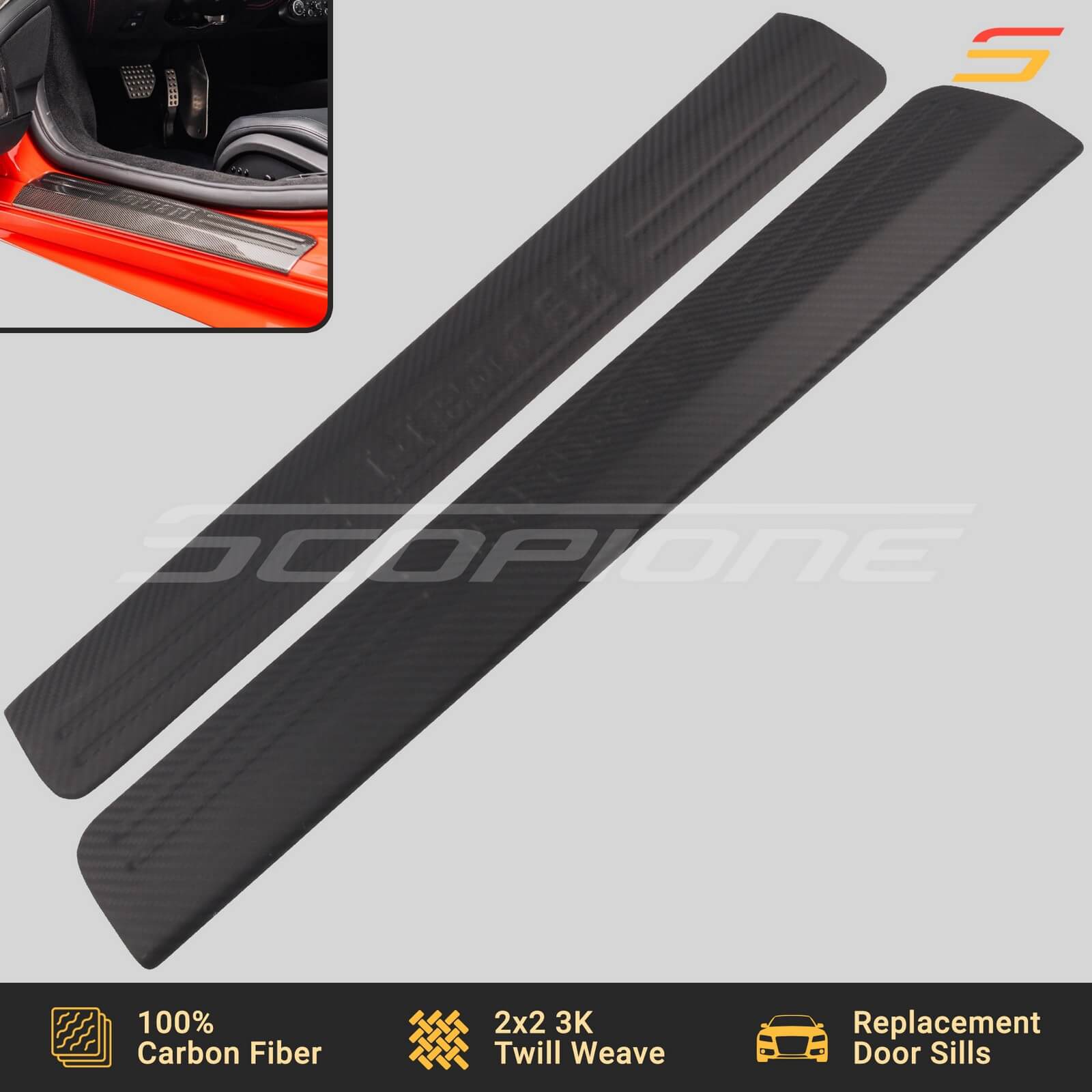
Carbon fiber appeared on the 360 only as optional trim – seats, door sills, interior panels. The strategic logic was clear: CF monocoques cost too much for a car priced under $200,000, but aluminum space frames could deliver significant weight savings at volume pricing. This bifurcated approach – CF monocoques for hypercars, aluminum for volume – would define Ferrari’s material strategy for the next two decades. Other manufacturers made different choices. McLaren, when it entered road car production in 2011, put every model on a CF MonoCell chassis regardless of price point. Lamborghini standardized CF monocoques on the Aventador at over 11,000 units. Ferrari’s strategy was more conservative – and more commercially calculated.
Scopione Perspective: The F1 Transfer Era
The technology pipeline from Ferrari’s F1 program to its road cars created a distinctive CF heritage – one rooted in racing-grade structural engineering rather than aesthetic trim. That heritage informs the aftermarket CF components available for Ferrari models from this era and beyond. Scopione’s catalog for Ferrari platforms uses 2×2 3K twill-weave carbon fiber with UV-resistant clear coat – the same material specification that appeared on factory optional CF packages from the 360 onward. The twill pattern and clear coat finish maintain visual continuity with Ferrari’s factory-installed carbon options, ensuring aftermarket pieces integrate without visual mismatch.
2000s–2010s: The Enzo, LaFerrari, and CF Industrialization
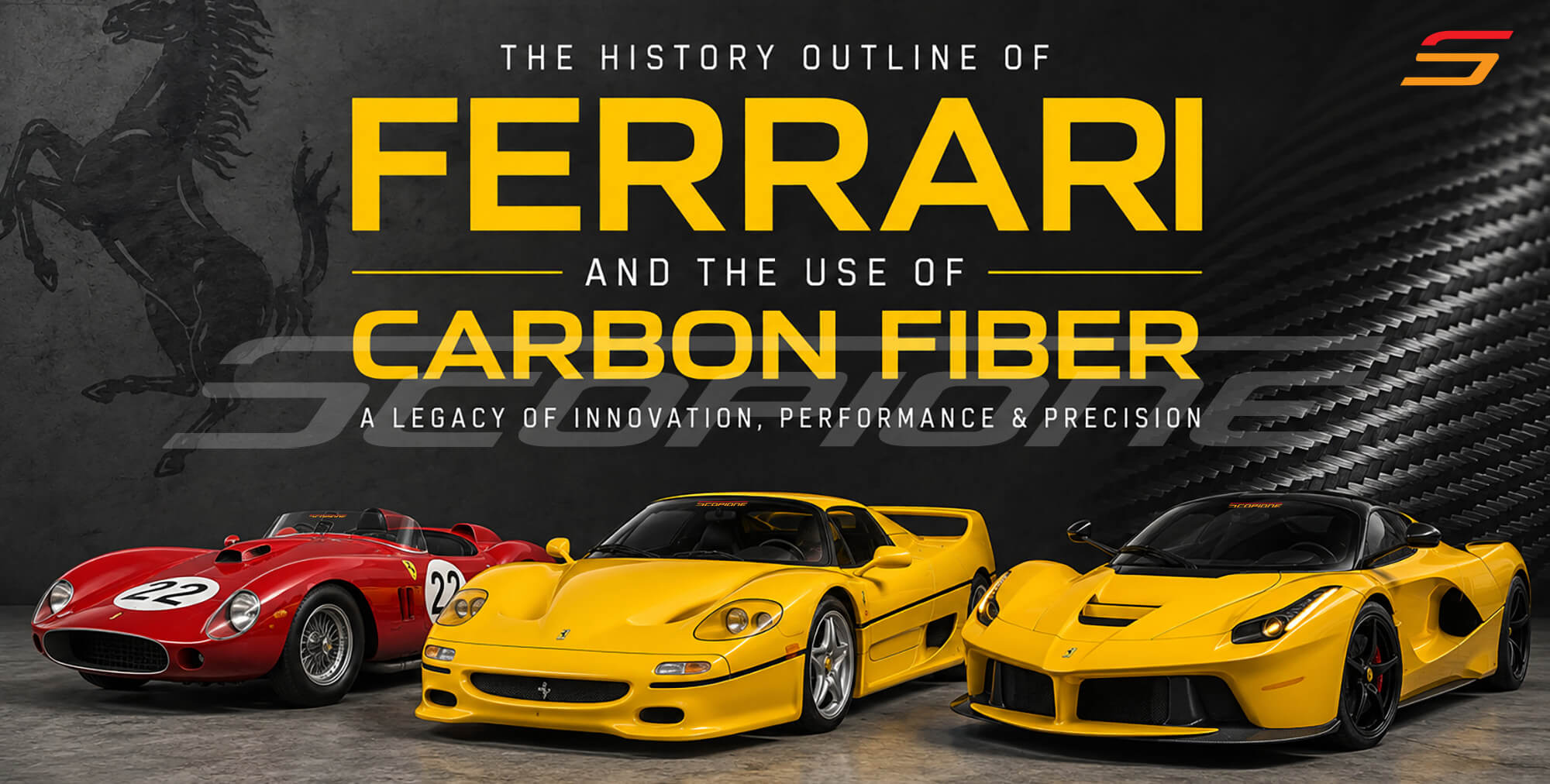
This was the era of extremes. At the summit, Ferrari built two hypercars – the Enzo and the LaFerrari – with full CF monocoques that represented generational leaps in composite technology. Below them, the volume V8 and V12 sports cars stayed on aluminum platforms but adopted progressively more CF through optional packages, factory aero kits, and weight-saving special editions. The track-only FXX program used paying customers as development partners for technologies that would eventually reach production. And by the end of the decade, the SF90 Stradale was beginning to blur the line between Ferrari’s hypercar and volume CF strategies.
Ferrari Enzo (2002–2004): The Founder’s Name on Carbon Fiber
Named after the founder seven years after his death, the Enzo represented a larger technical undertaking than any Ferrari road car before it. Ken Okuyama led the design at Pininfarina. Michael Schumacher contributed to chassis development during the five-time champion’s tenure at Scuderia Ferrari. The car combined F1-derived active aerodynamics, a robotized sequential gearbox, and carbon-ceramic brakes – technologies the road car division cherry-picked from the racing program.
- Engine: 6.0L V12, 660 hp
- 0–60 mph: 3.1 seconds
- Top speed: 217 mph
- Production: 400 units (the last built for Pope John Paul II and auctioned for charity)
- Curb weight: 1,365 kg
The Enzo’s CF monocoque was the second in a Ferrari road car and represented a full generation of improvement over the F50’s tub. Higher-modulus fibers, improved resin systems, and more sophisticated layup techniques yielded a structure that was both lighter and stiffer per unit area. Extensive CF appeared throughout the exterior – not just as structural elements but as visible surfaces with a clear-coated weave finish that became a visual signature of the car.
The FXX program (2005–2007, 30 units) took the Enzo platform further. Each FXX was a track-only development car sold to selected clients for approximately $1.8 million, with the understanding that the cars would remain Ferrari property for data collection. The FXX program generated engineering data on CF durability under extreme track loads – information that fed directly into the LaFerrari’s monocoque development. The FXX-K (2015, 40 units) extended this model with a 1,035 hp hybrid powertrain, proving that Ferrari’s CF tubs could accommodate electrified drivetrains before the LaFerrari Aperta reached customers.
Ferrari 458 Italia (2009–2015): The Volume CF Expansion
The 458 Italia represented the peak of Ferrari’s naturally aspirated V8 program. The flat-plane crank 4.5-liter V8 reached 9,000 rpm and produced 127 hp per liter – specific output figures that reflected F1 engine philosophy applied to a production powerplant. The car abandoned the manual gearbox entirely, committing to the dual-clutch automated transmission that Barnard’s paddle-shift innovation had made inevitable.
- Engine: 4.5L naturally aspirated V8, 562 hp
- 0–60 mph: 3.3 seconds
- Top speed: 202 mph
- Production: ~15,000 units
- Chassis: Aluminum space frame
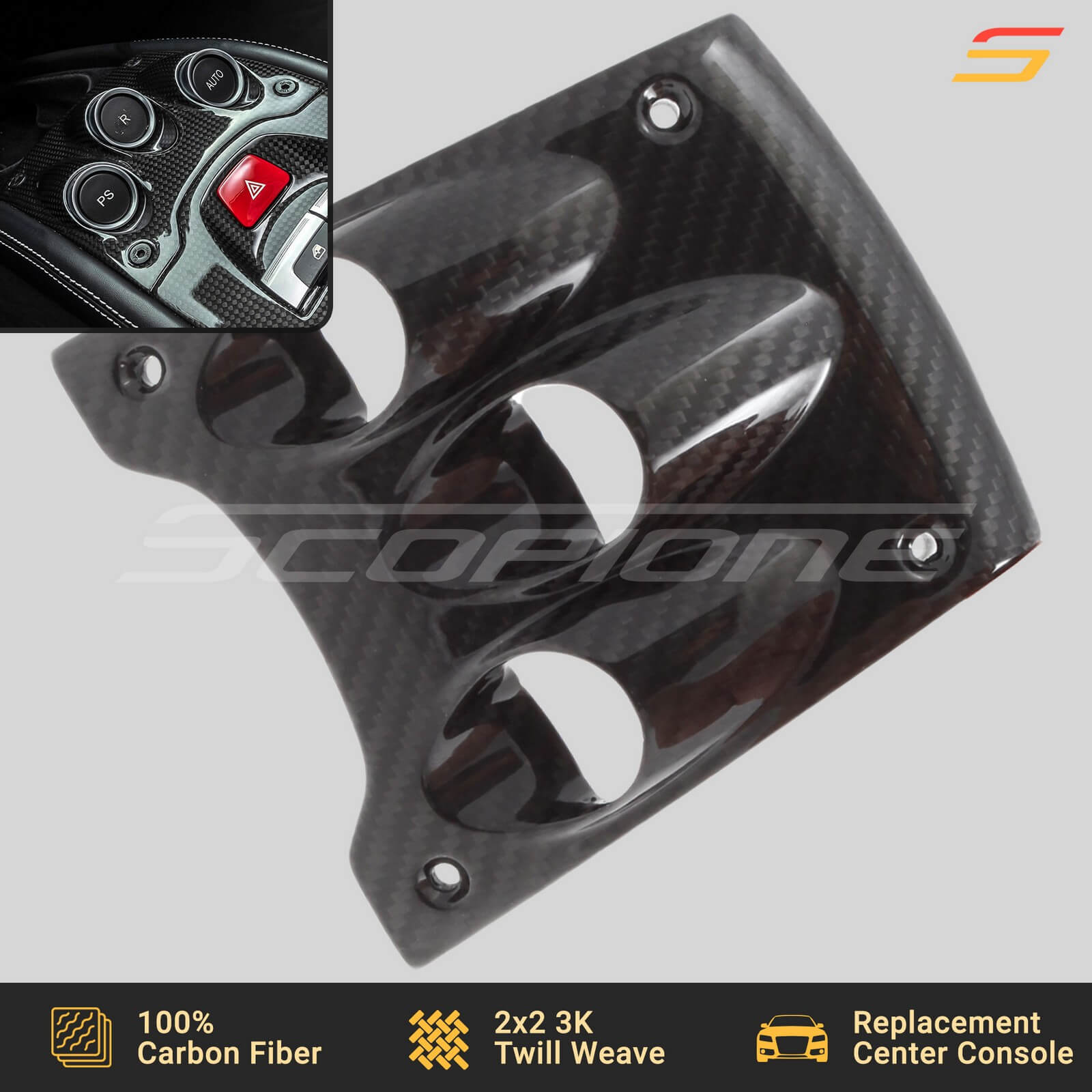
The 458’s aluminum chassis remained the structural foundation, but CF options expanded significantly over previous generations. The optional CF racing seats saved approximately 9 kg per pair versus the standard seats. Dashboard trim, center console panels, door cards, and steering wheel accents could all be specified in exposed carbon fiber through Ferrari’s personalization program. The exterior offered a CF front spoiler, rear diffuser, and side skirts through the optional Aero Package.
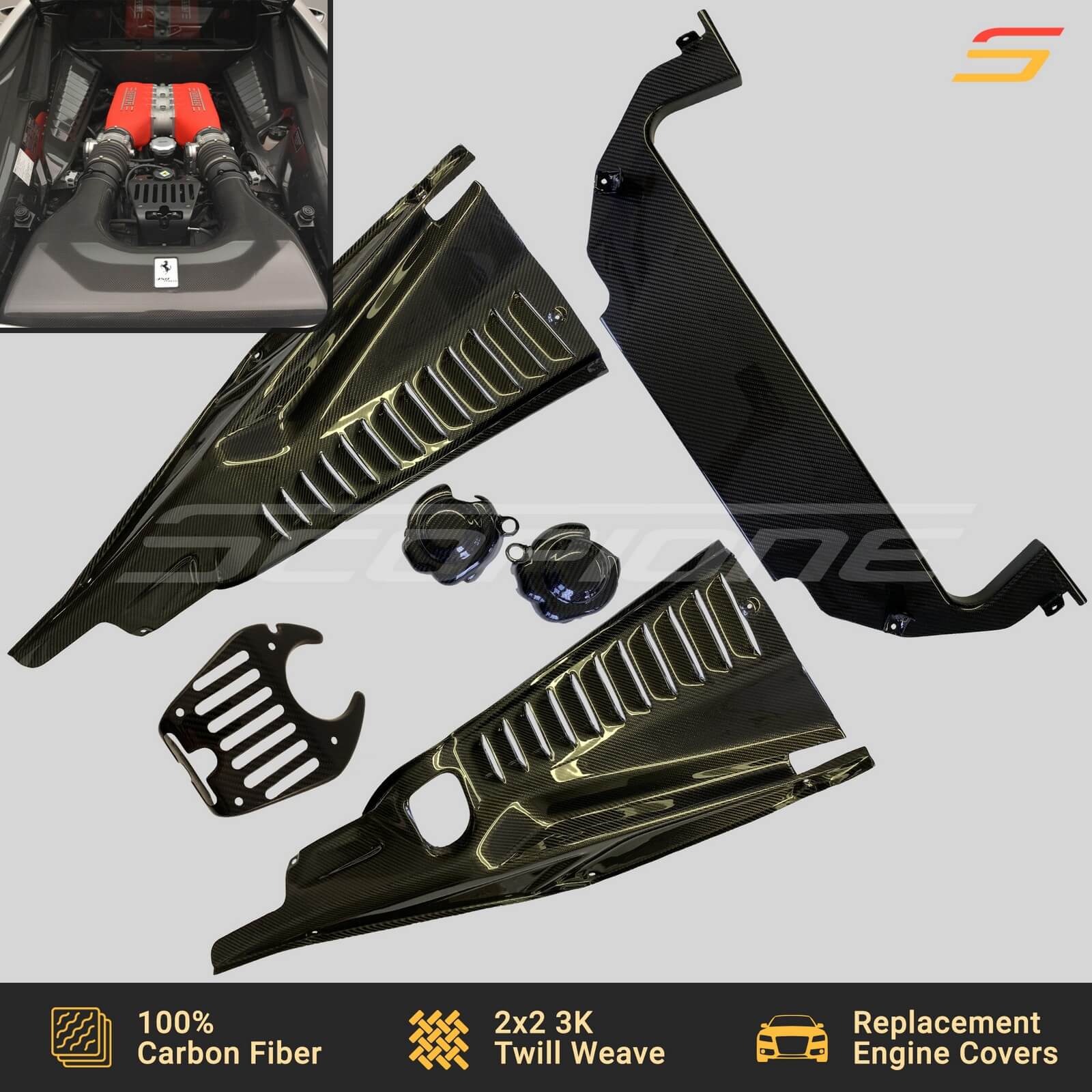
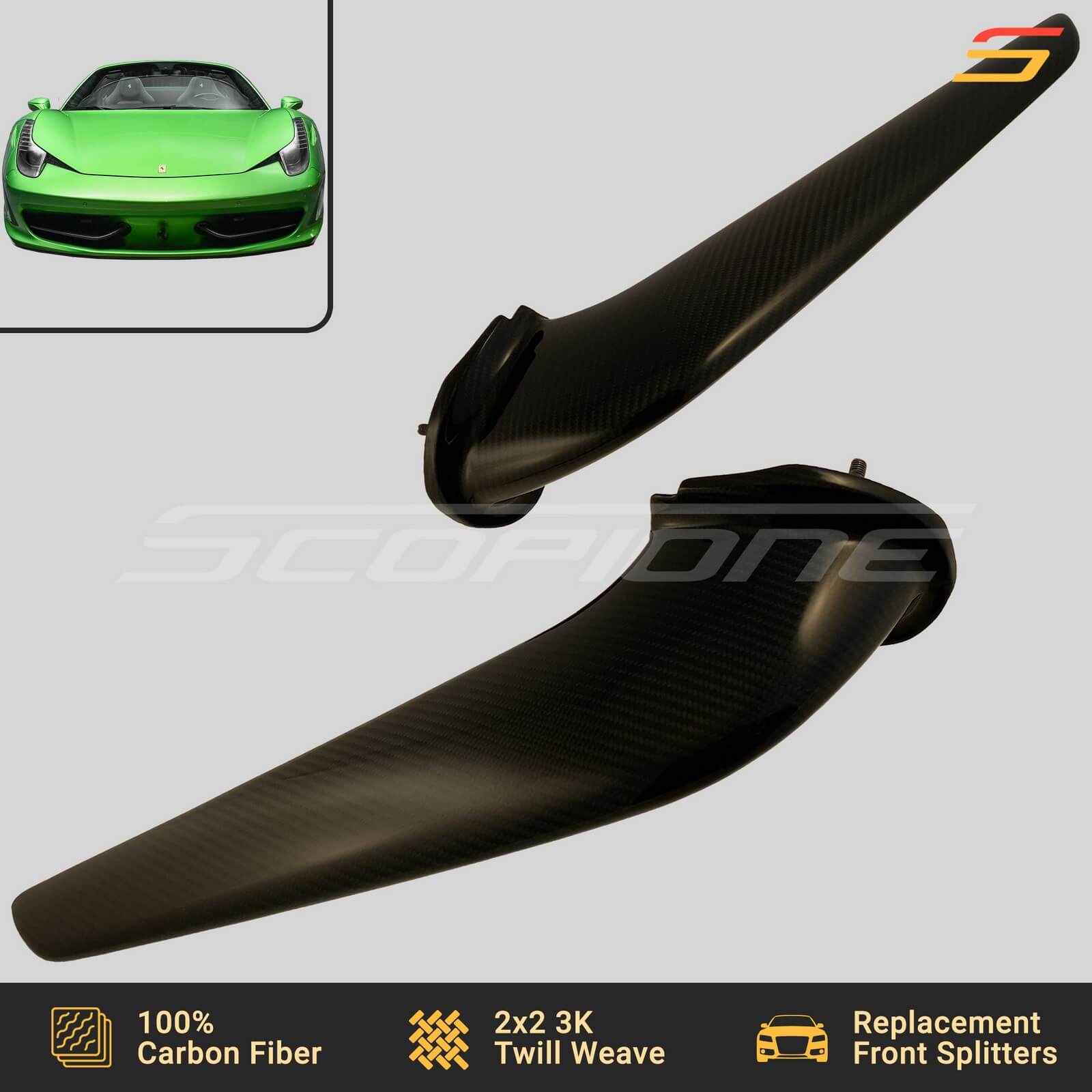
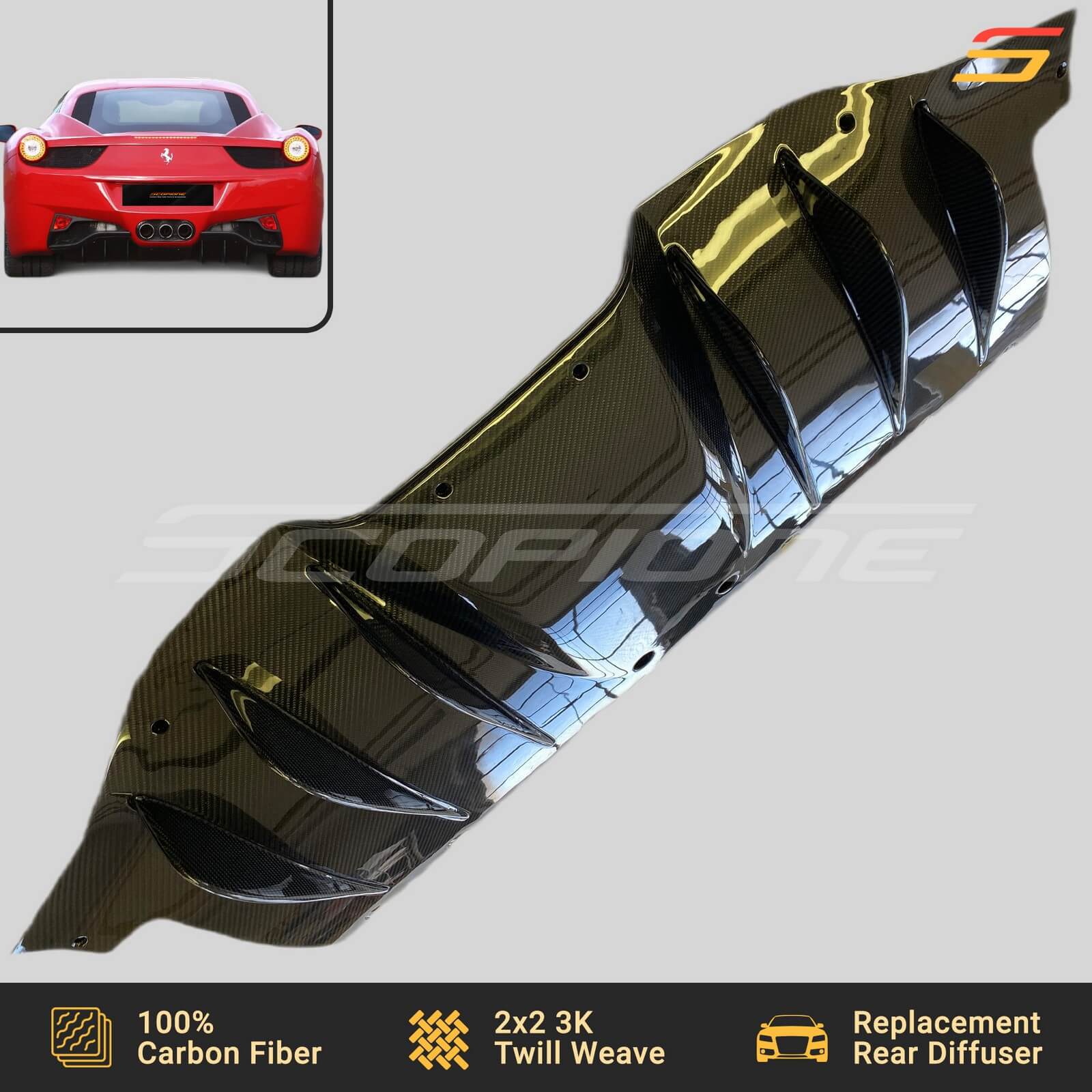
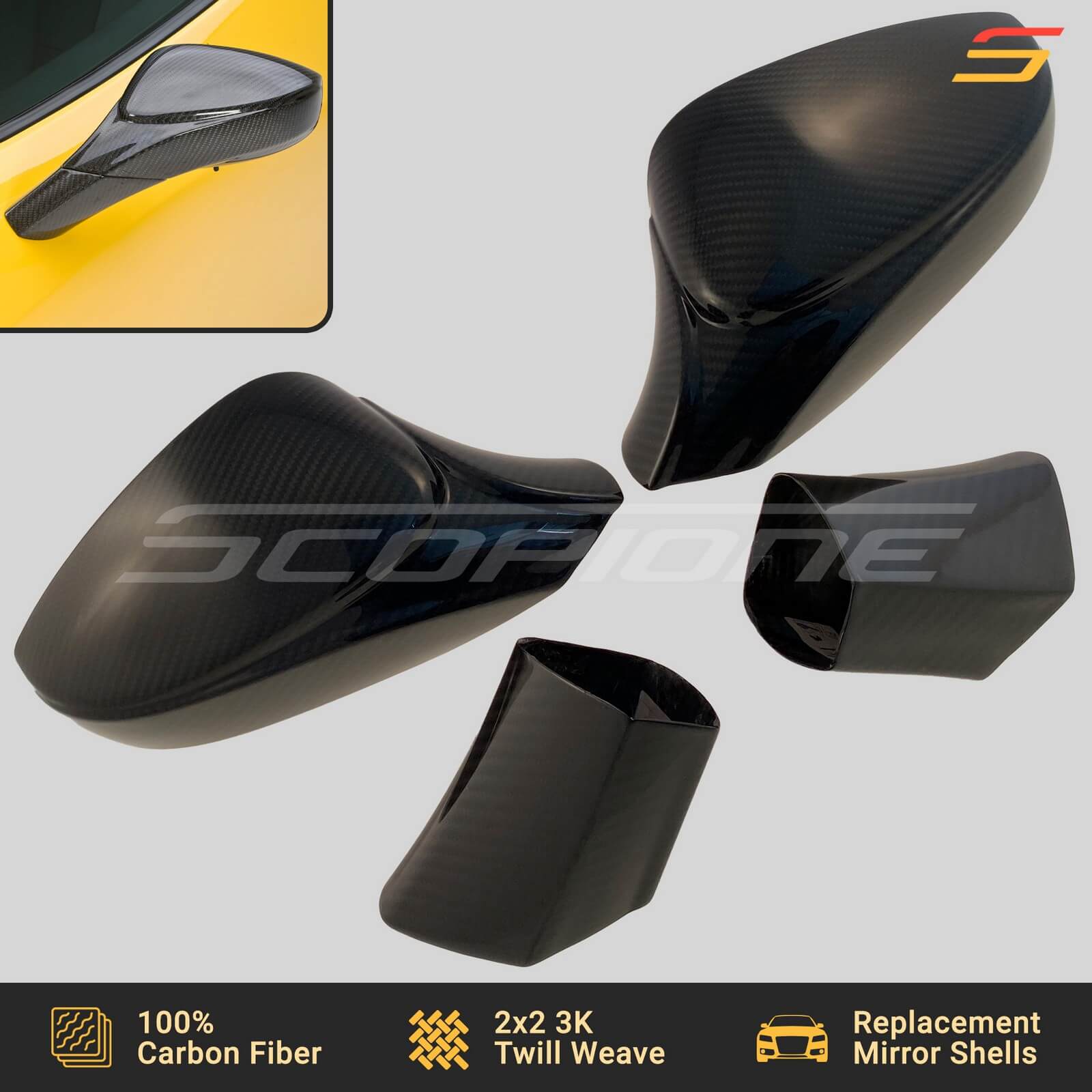
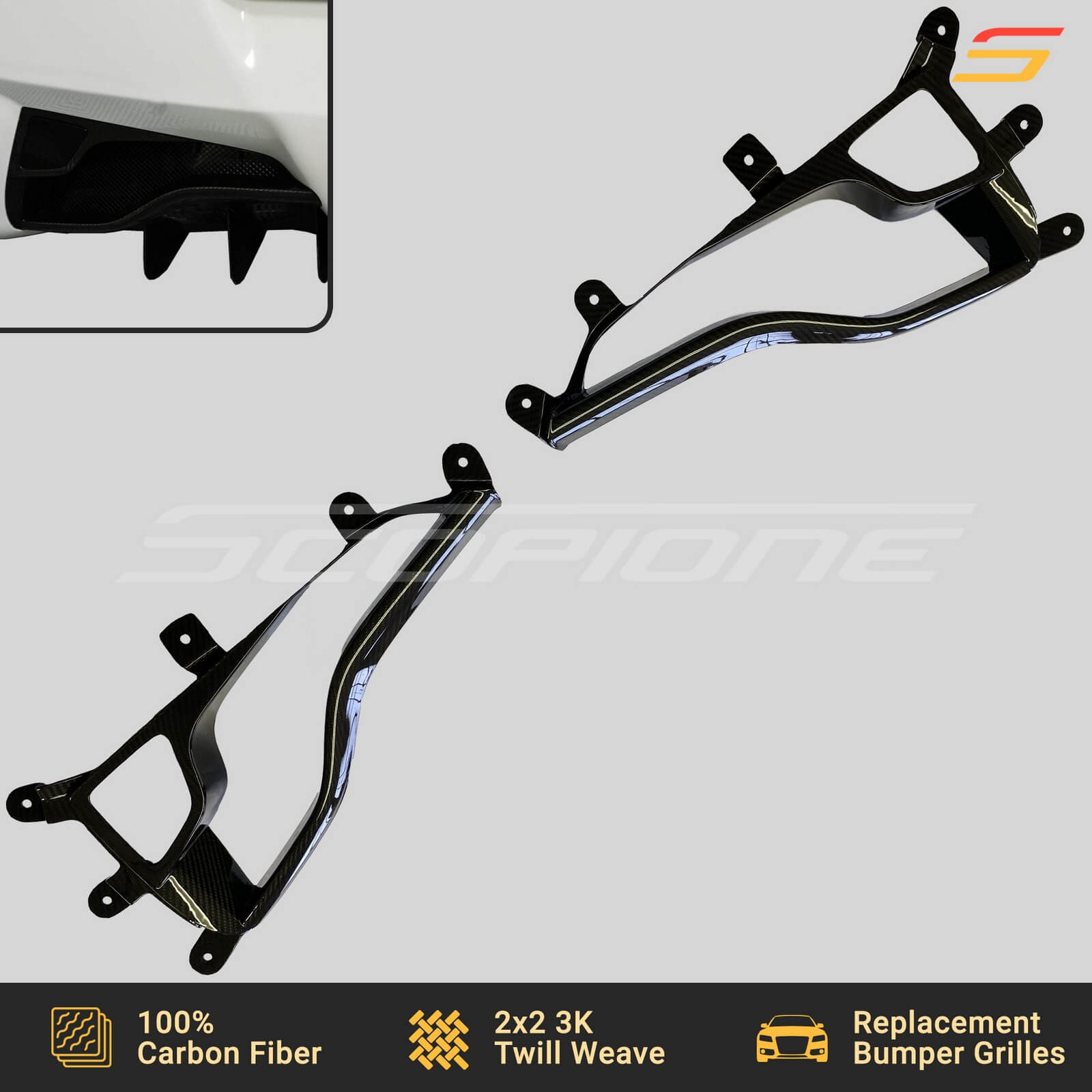
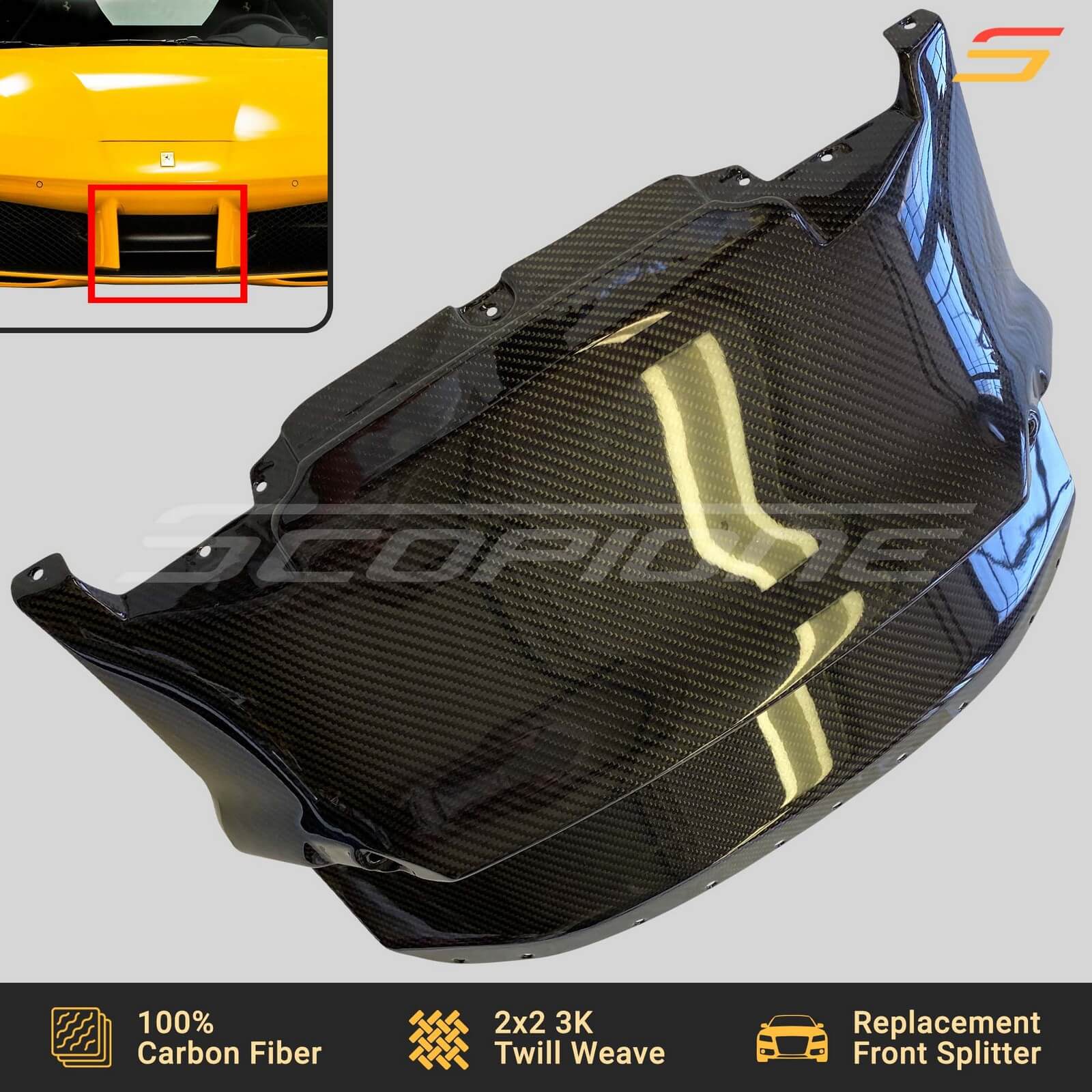
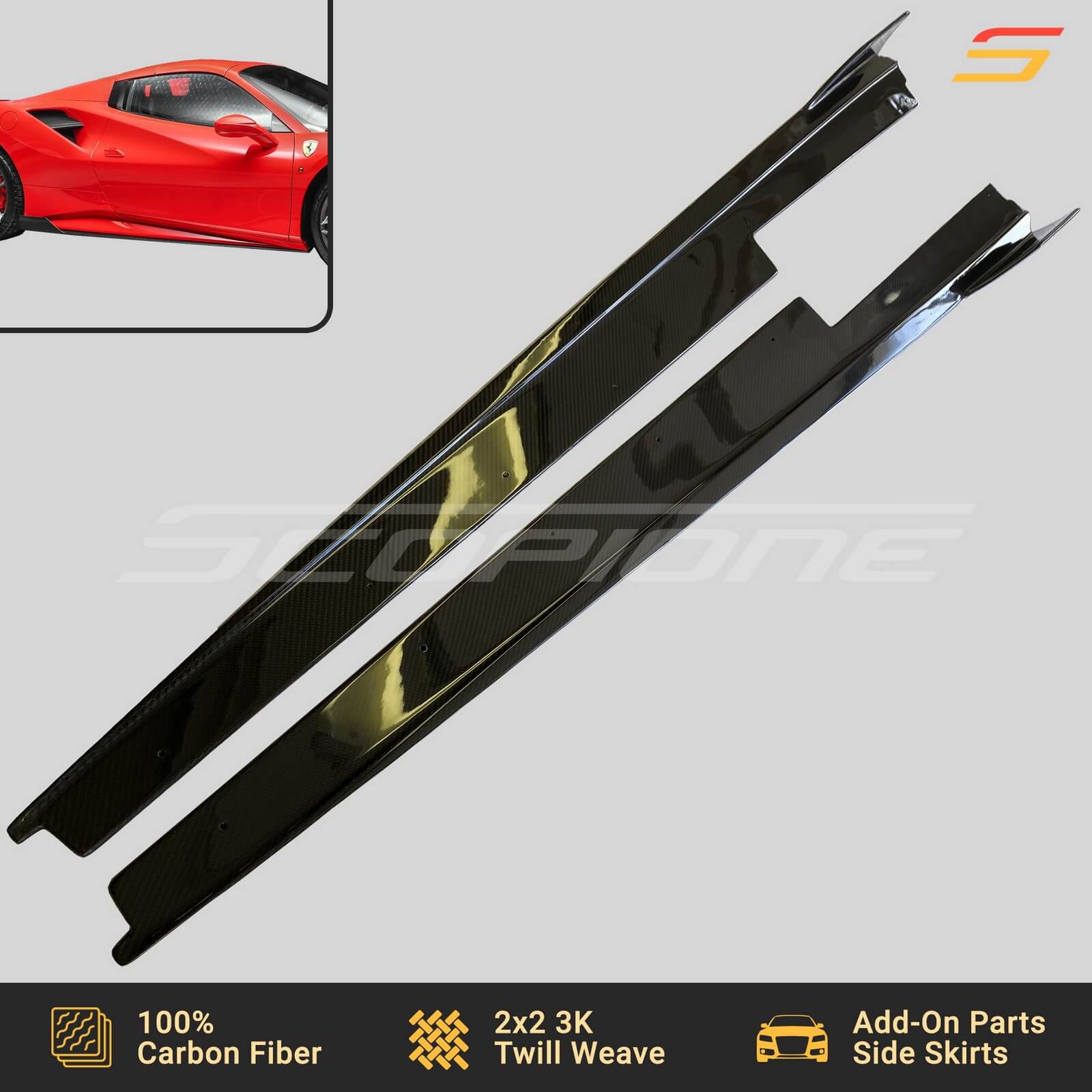
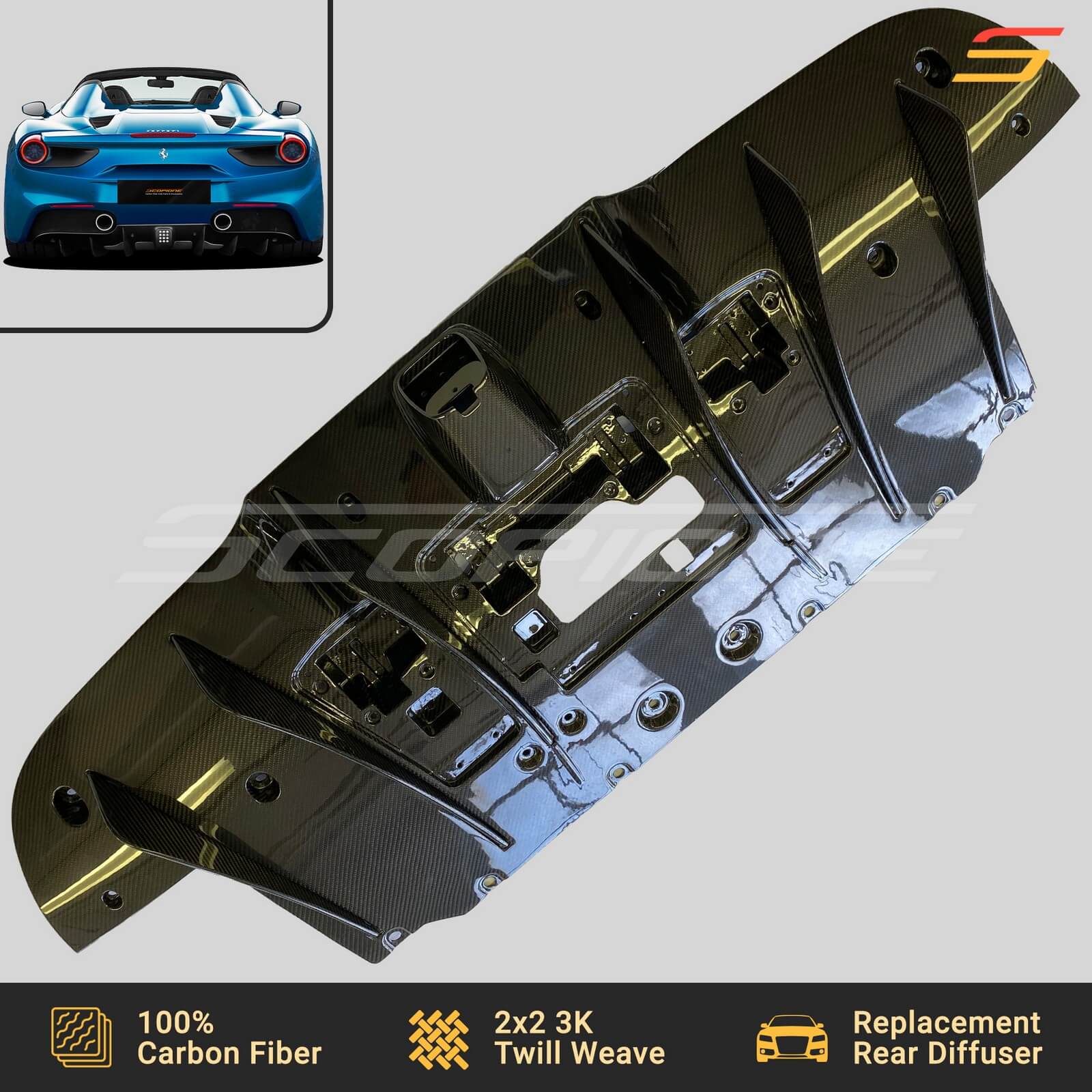
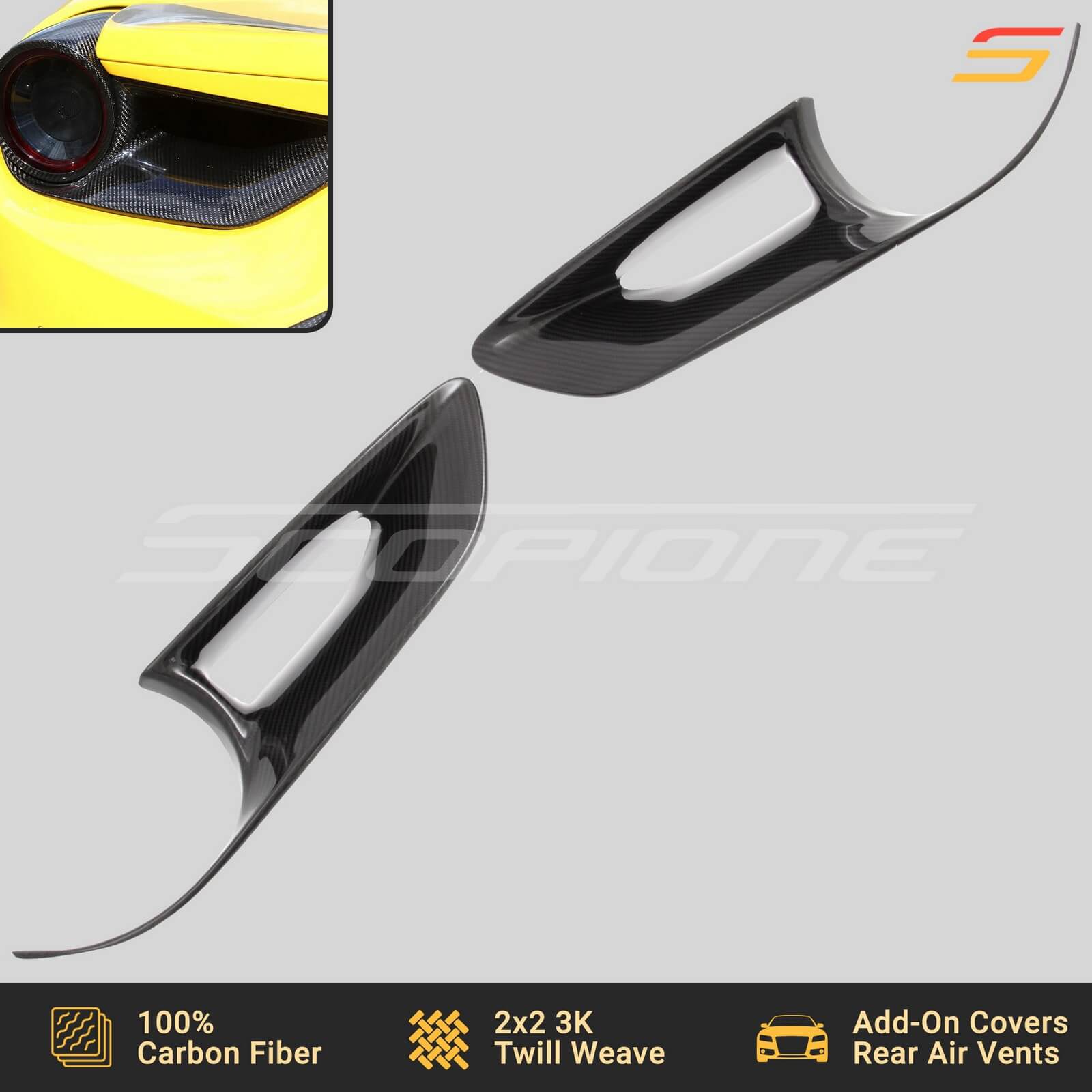
The 458 Speciale (2013, approximately 3,000 units) pushed the CF content further: roughly 200 lbs of weight savings through CF components, revised aerodynamic surfaces, and deleted sound insulation. The Speciale beat the Enzo’s Fiorano test track lap time despite giving away more than 60 horsepower – a demonstration that weight reduction through CF and aerodynamic optimization could substitute for raw power. Scopione’s 25-part 458 carbon-fiber catalog – hood and engine cover kits, splitters, diffuser, mirror shells, and interior trim – is on the Ferrari parts page.
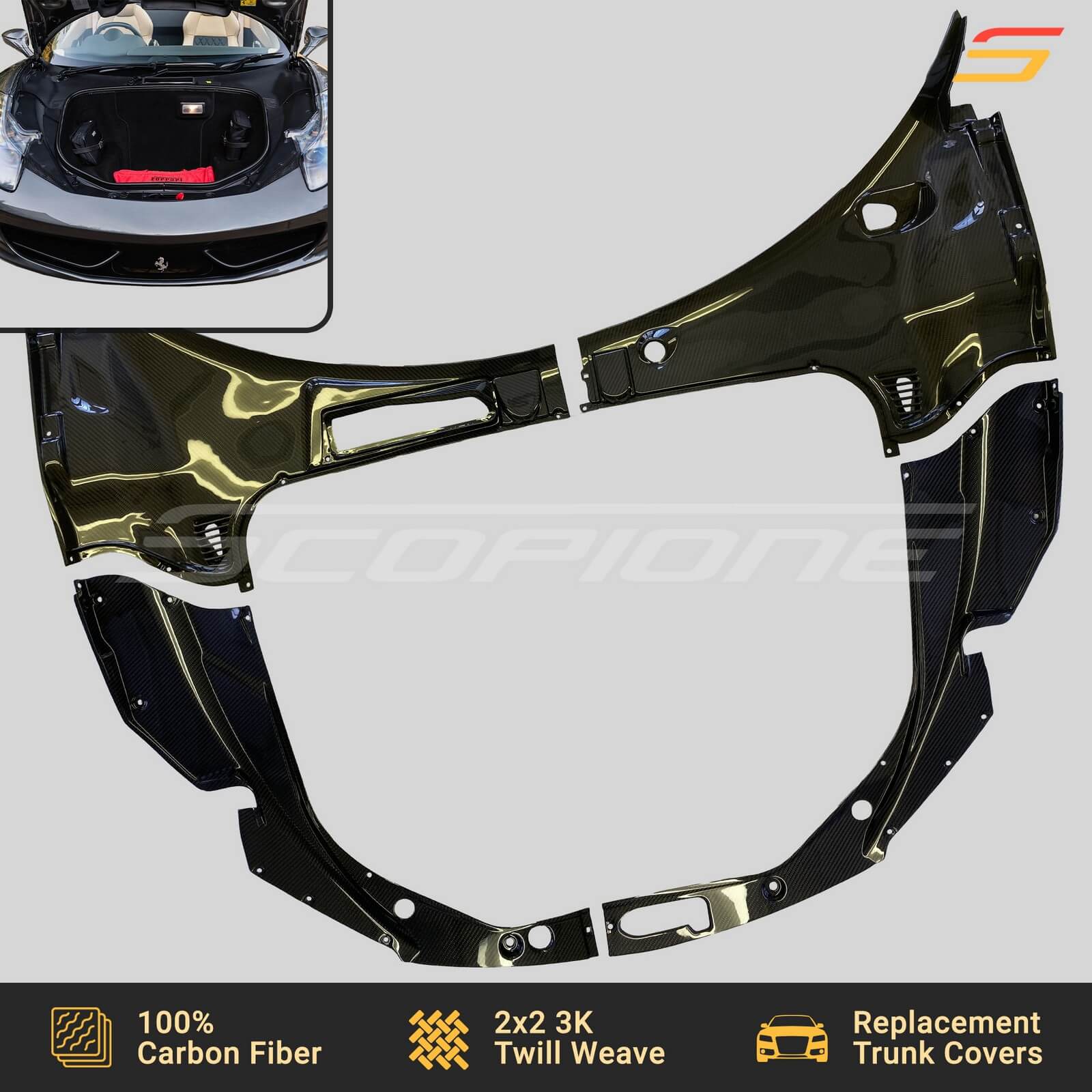
Ferrari LaFerrari (2013–2018): Carbon Fiber Meets Hybrid Power
The LaFerrari was Ferrari’s first hybrid production car and its furthest advance in CF structural engineering. The HY-KERS system paired a 789 hp 6.3-liter V12 – the same engine family that powered the Enzo – with a 161 hp electric motor derived from Ferrari’s F1 KERS system. Combined output reached 950 hp. Active aerodynamics managed downforce automatically through deployable front and rear surfaces, eliminating the fixed wing that the Enzo had used.
- Engine: 6.3L V12 + electric motor, 950 hp combined
- 0–60 mph: 2.6 seconds
- Top speed: 217 mph
- Production: 500 coupes + 210 Aperta roadsters
CF Milestone – A Generation Beyond the Enzo: The LaFerrari’s CF monocoque was 20% lighter and 27% stiffer than the Enzo’s. Those improvements came from higher-modulus carbon fibers, advanced resin formulations, and manufacturing techniques refined over a decade of F1 and FXX program development. Every exterior panel was carbon fiber. The battery pack for the hybrid system was mounted low in the chassis to optimize the center of gravity, housed in a separate enclosure within the CF structure.
The LaFerrari demonstrated that hybridization and CF construction could coexist – the electric motor and battery added weight, but the lighter, stiffer CF monocoque offset much of the penalty. At 1,255 kg dry, the LaFerrari weighed less than its competitors despite the hybrid hardware: the McLaren P1 (1,395 kg) and the Porsche 918 Spyder (1,634 kg) were both heavier. That weight advantage was attributable primarily to the CF monocoque’s structural efficiency.
The 500-coupe, 210-Aperta production run was large enough to generate genuine engineering data on hybrid-CF integration – thermal cycling behavior of batteries near CF structures, long-term durability of adhesive bonds between CF and aluminum suspension mounting points, and the vibration characteristics of electric motor housings attached to a CF tub. That data informed the SF90 Stradale’s architecture five years later.
Ferrari 488 GTB and Pista (2015–2019): Turbo Returns
The 488 GTB marked Ferrari’s return to forced induction after the F40 – a 27-year gap. The 3.9-liter twin-turbo V8 produced 661 hp and won International Engine of the Year four consecutive times. The challenge was matching the 458’s driving experience despite the turbocharging: lag, heat management, and the muffling effect of turbines on exhaust sound all needed solving.
- Engine: 3.9L twin-turbo V8, 661 hp
- 0–60 mph: 3.0 seconds
- Top speed: 205 mph
- Production: ~15,000 units
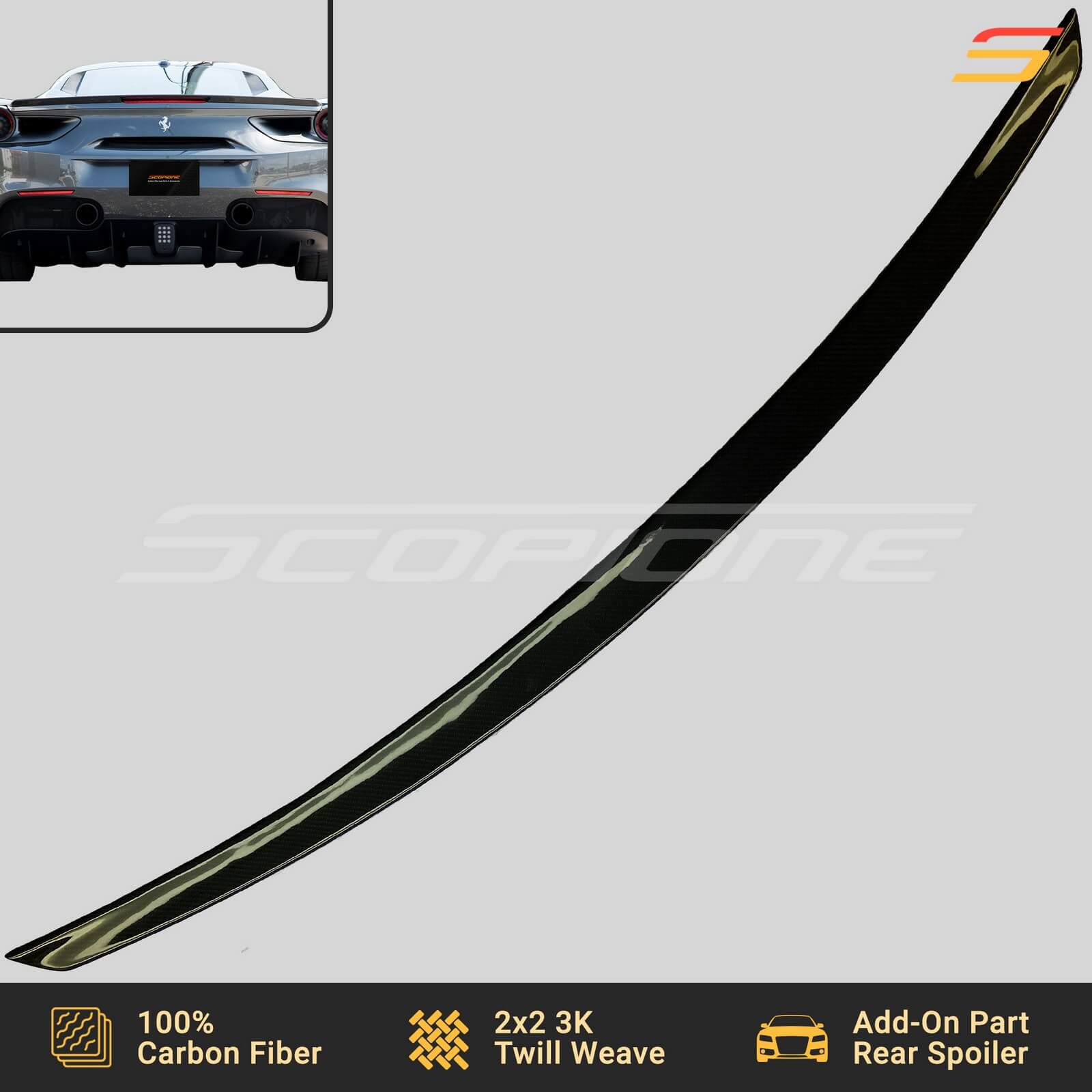
The 488 Pista (2018, approximately 3,500 units) was the track-focused variant that pushed CF content to new levels for a volume Ferrari. The Pista shed 90 kg versus the standard GTB through carbon-fiber front and rear bumpers, hood, rear spoiler, and the option of CF wheels. The engine received the Speciale treatment – 710 hp, faster-spooling turbos, shorter gear ratios. At Fiorano, the Pista lapped in 1:21.5 – faster than the Enzo by a significant margin, despite using a V8 instead of a V12. For perspective, the Lamborghini Huracan Performante (2017, 631 hp) used forged composite and ALA active aerodynamics to set Nurburgring records during the same period. The competitive pressure from Sant’Agata pushed Maranello’s lightweight special editions to extract every possible gram from their CF budgets.
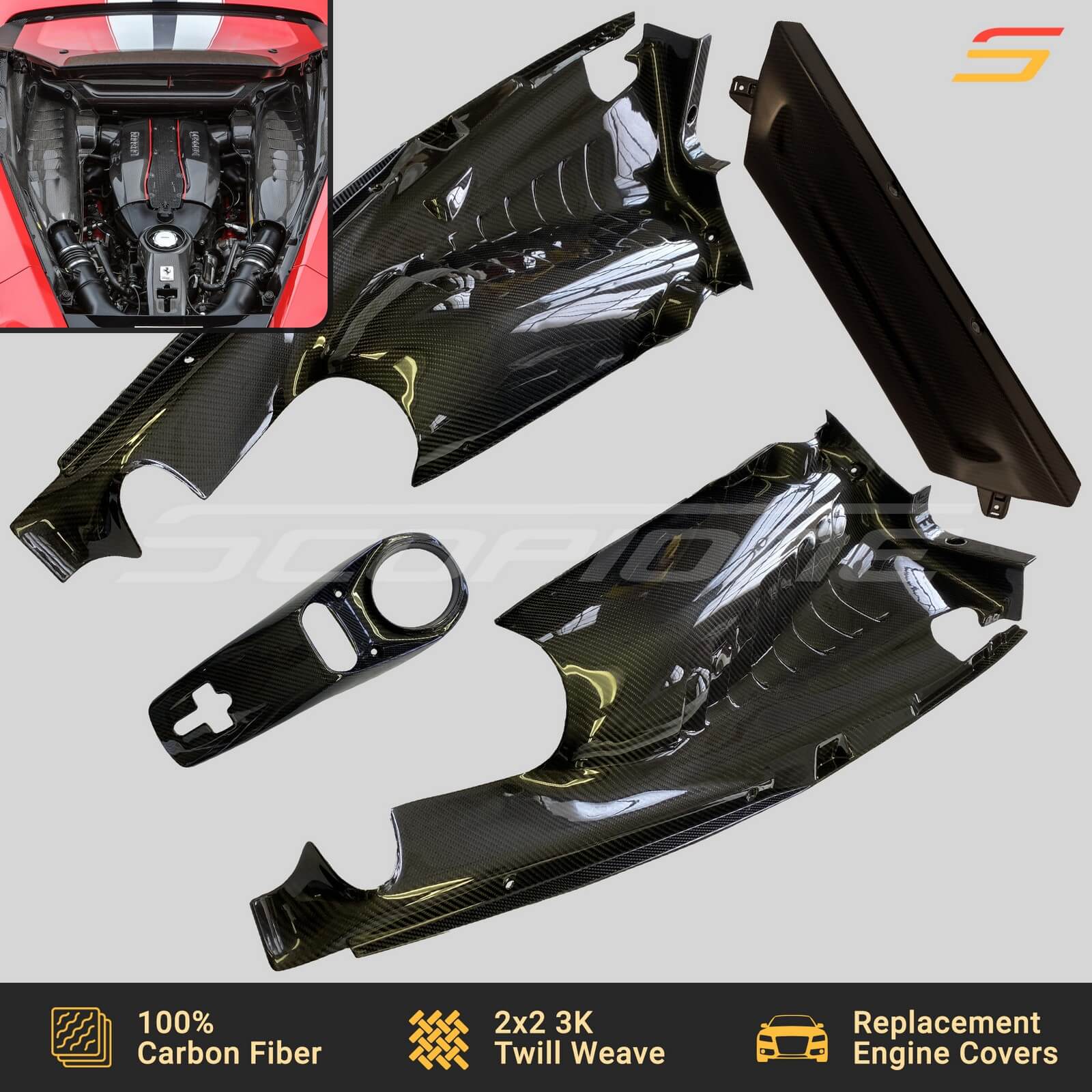
The Pista’s commercial success – approximately 3,500 units at a substantial premium over the GTB – validated the business model: take a volume model, strip weight through CF and engineering optimization, retune the powertrain, and sell at a higher margin. That formula has repeated across every Ferrari V8 generation since the 430 Scuderia. The 488’s carbon-fiber components – many shared with the F8 Tributo – are on the Scopione Ferrari page.


Ferrari SF90 Stradale (2019–2025): Blurring the Line
The SF90 was the car that began dissolving Ferrari’s bifurcated CF strategy. Named after the Scuderia Ferrari 90th anniversary, the SF90 Stradale was Ferrari’s first plug-in hybrid series-production car – not a limited-edition hypercar, but a model built in significant numbers. Three electric motors (one between engine and gearbox, two on the front axle) provided all-wheel drive and 986 hp combined output.
- Powertrain: 4.0L twin-turbo V8 + 3 electric motors, 986 hp combined
- 0–60 mph: 2.5 seconds
- Top speed: 211 mph
- Chassis: Aluminum with CF structural reinforcements
The SF90 used an aluminum chassis with more CF structural reinforcements than any previous volume Ferrari – not a full monocoque, but an intermediate architecture that used CF where it delivered the highest stiffness-to-weight return. The battery pack sat in a separate enclosure beneath the floor, bolted to the aluminum structure. The Assetto Fiorano package added CF door panels, underbody panels, and a titanium exhaust for additional weight reduction. Compared to Lamborghini’s approach – a full CF monocoque on the Aventador at over 11,000 units – Ferrari’s use of aluminum-plus-CF was more conservative but also more cost-effective at the SF90’s production volume.
The SF90 proved that hybrid technology enhanced rather than diminished the Ferrari brand. Its commercial success – sold in far greater numbers than any previous Ferrari flagship – demonstrated that customers who could afford a $500,000+ Ferrari were willing to accept electrification when the performance justified it.


Scopione Perspective: The Enzo and LaFerrari Era
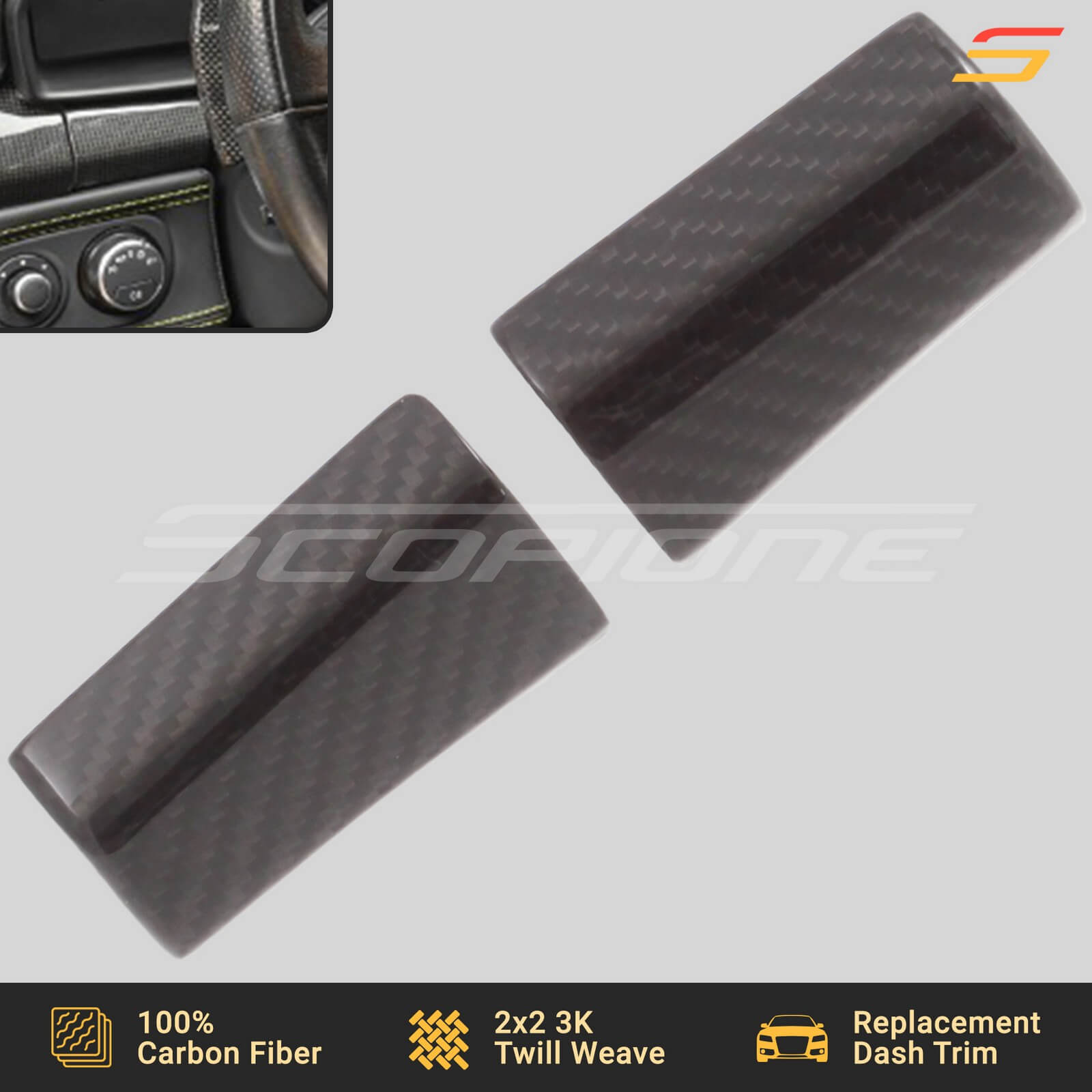
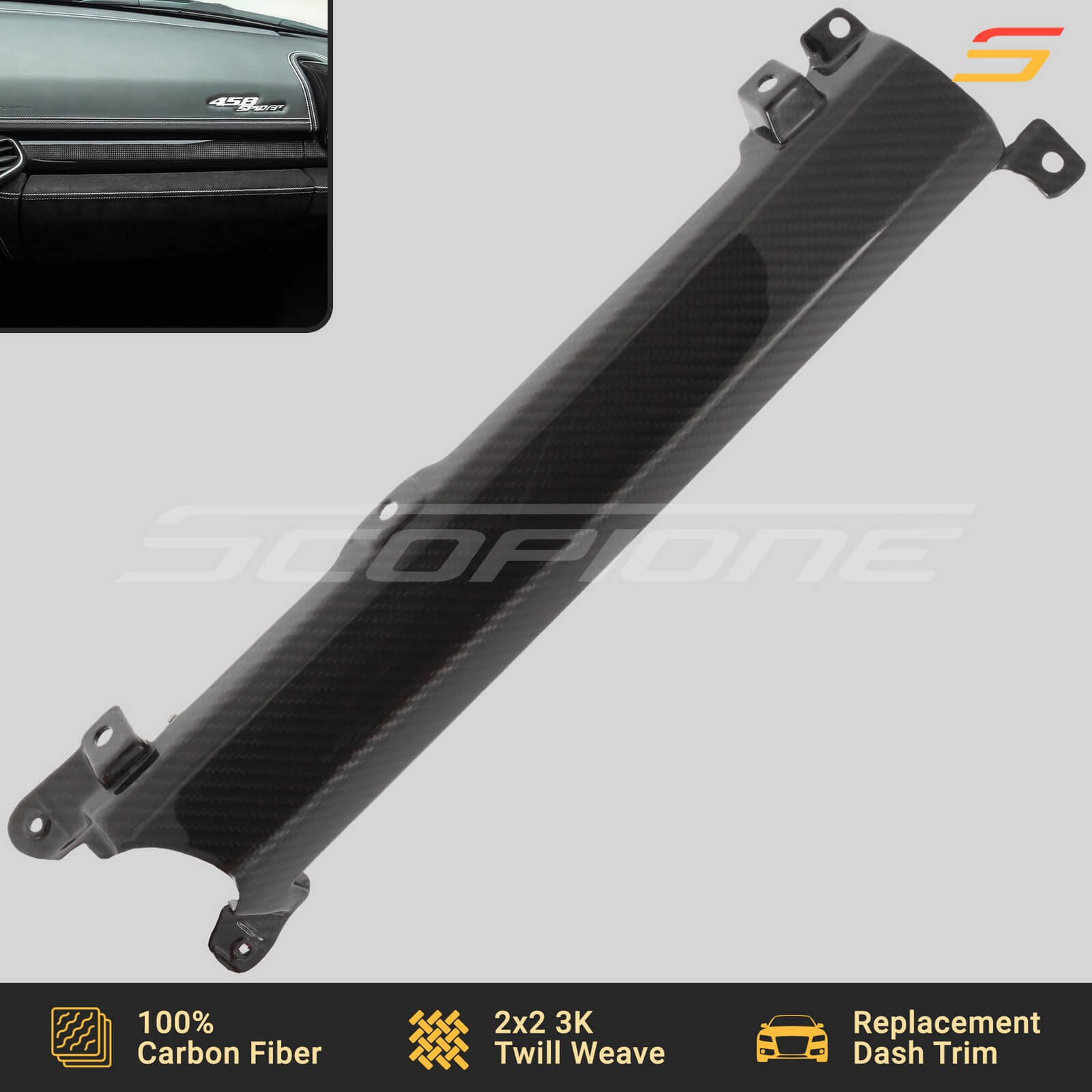
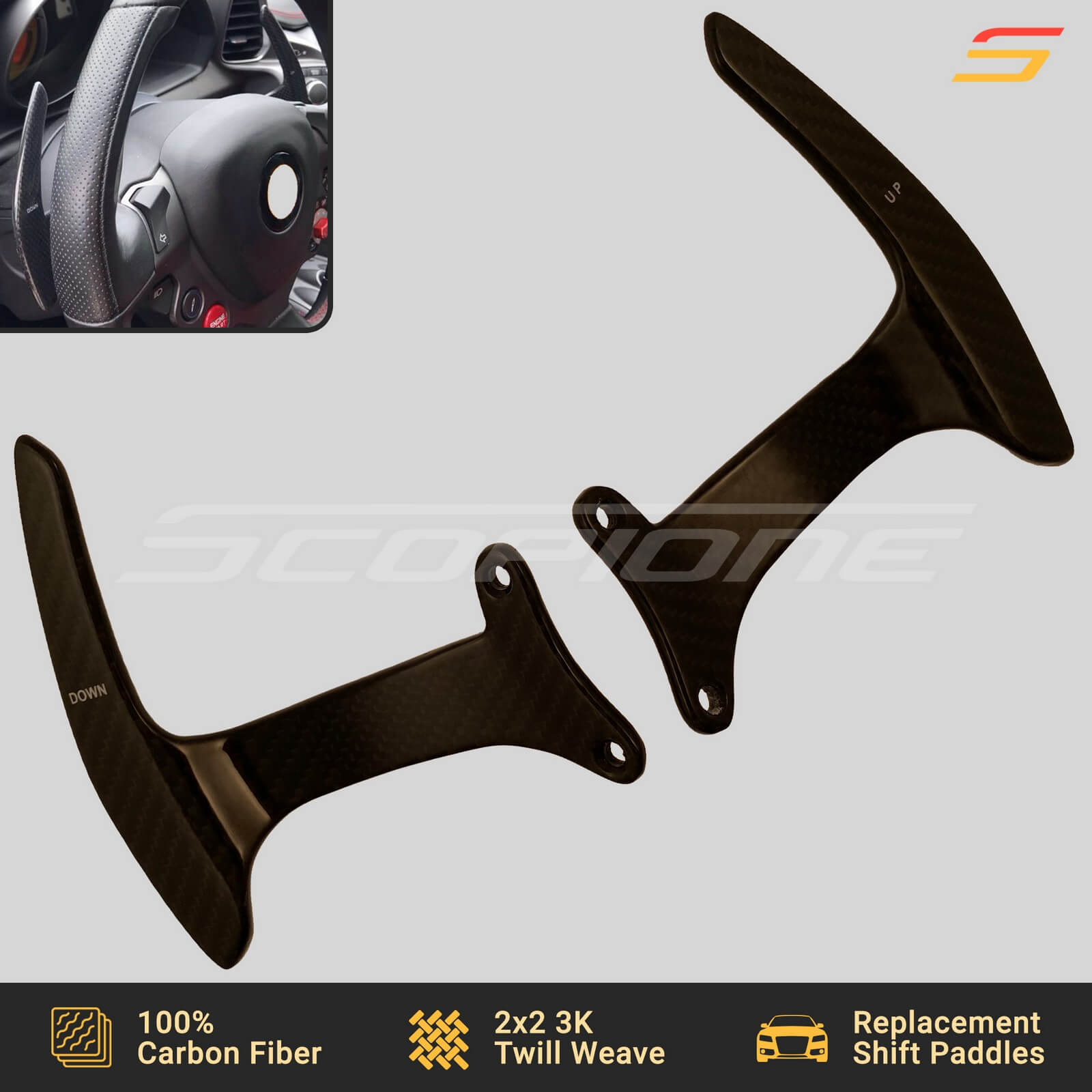
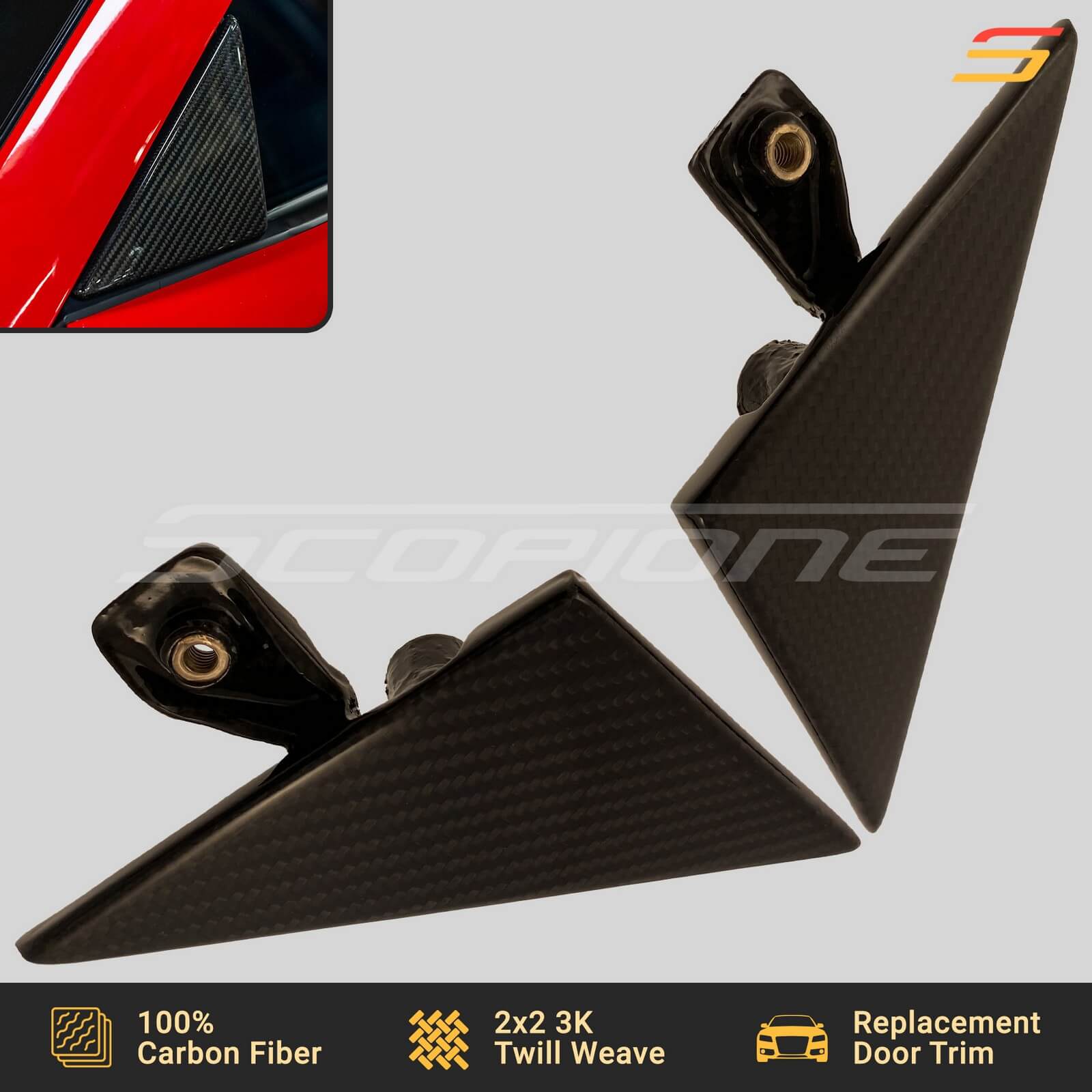
The 458, 488, and F8 form the core of Scopione’s Ferrari catalog. These three platforms span 2009 through 2023 and represent Ferrari’s complete modern mid-engine V8 lineage – the last naturally aspirated generation, the turbocharged transition, and the final evolution before hybridization. Scopione offers 2×2 twill-weave CF front splitters, rear diffusers, hood and engine cover kits, mirror shells, shift paddles, and interior trim across the three platforms – deepest on the 458 (25 parts) and the 488/F8 family (22).
For the 458 Italia, aftermarket CF components can bring Speciale-level visual impact to standard models – a front lip, rear diffuser, and mirror caps can close much of the visual gap without the Speciale’s deleted sound insulation and firmer suspension. The 488 GTB and F8 Tributo catalogs cover a comparable range of exterior and interior CF components, matched to the twill pattern and finish quality of Ferrari’s factory options.
For Owners – CF Care on Ferrari Platforms: Carbon fiber components on mid-engine Ferraris face specific environmental challenges. The engine bay generates significant heat – CF engine covers and intake trims should be inspected periodically for clear coat clouding caused by thermal cycling. Front lip spoilers on lowered cars are vulnerable to parking lot scrapes; unlike aluminum, CF does not bend before breaking, so stone chip damage should be addressed with clear coat touch-up before moisture reaches the fiber layers. Interior CF trim maintains its finish with pH-neutral cleaners rather than solvent-based products that can cloud the clear coat. UV-resistant clear coat on all Scopione parts protects against the yellowing and surface degradation that uncoated CF develops over time.
2020s–Present: Hybridization, Electrification, and CF at Scale
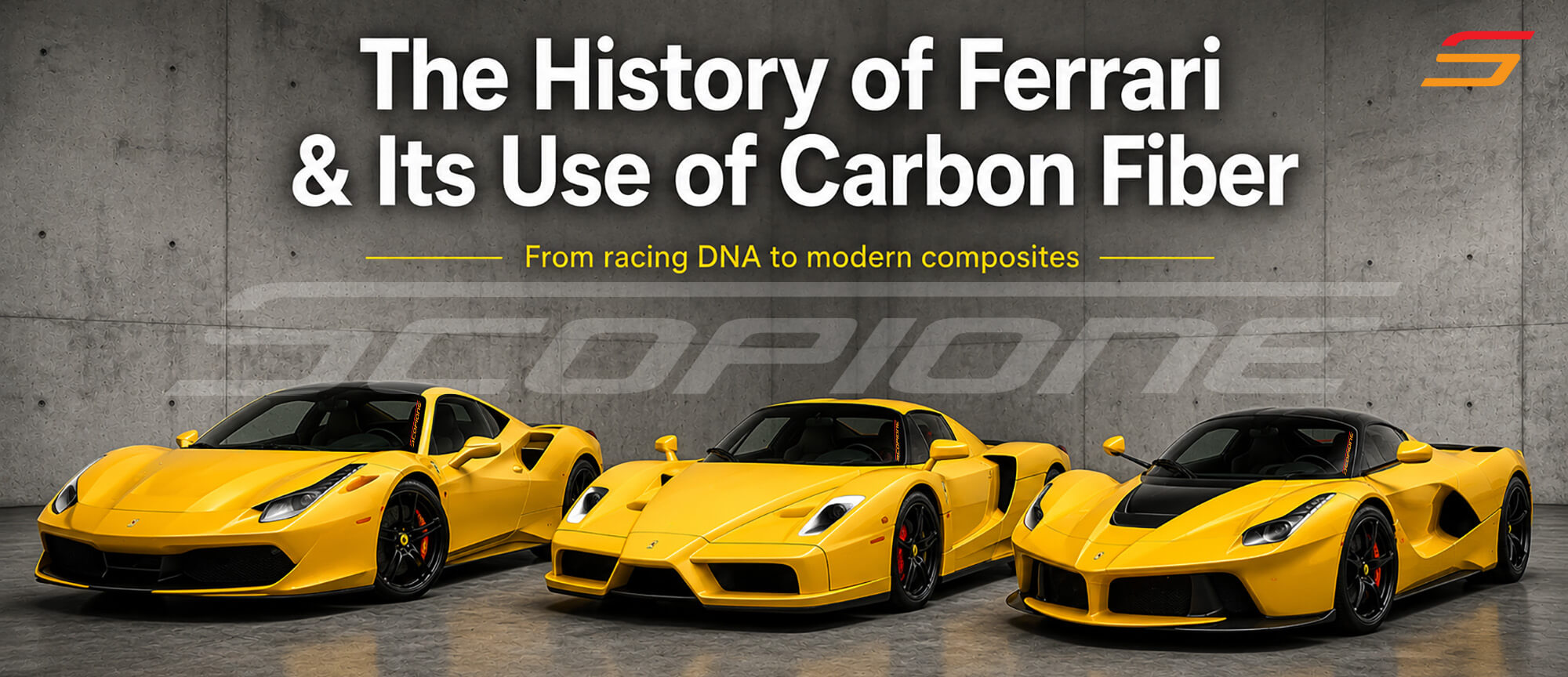
Ferrari’s three-decade bifurcation – CF monocoques for hypercars, aluminum for everything else – is finally narrowing. The 296 GTB introduced a hybrid mid-engine sports car with more integrated CF than any previous volume Ferrari. The Daytona SP3 proved that CF monocoque technology could flex across body styles from a common platform. And the F80 – Ferrari’s latest hypercar – pushes CF integration further than any previous Maranello product, with battery housing beginning to merge into the composite structure. The same challenge that drove Lamborghini’s Revuelto monofuselage – offsetting hybrid battery weight through advanced CF construction – is reshaping Ferrari’s approach, though from a different starting point and with a different commercial calculus.
Ferrari 296 GTB (2022–Present): The V6 Revival
The 296 GTB revived the V6 engine layout that Alfredino Ferrari’s namesake Dino 246 had pioneered 50 years earlier – though the resemblance ends at cylinder count. The new 3.0-liter V6 uses a 120-degree bank angle with twin turbochargers mounted in the hot-V configuration, paired with an electric motor between the engine and 8-speed dual-clutch gearbox. Combined output: 819 hp from a package considerably more compact than the 488’s twin-turbo V8.
- Powertrain: 3.0L twin-turbo V6 + electric motor, 819 hp combined
- 0–60 mph: 2.9 seconds
- Top speed: 205 mph
- Chassis: Aluminum with CF structural reinforcements
The 296 uses an aluminum chassis with CF structural reinforcements – more CF integration than the F8 Tributo that preceded it. The Assetto Fiorano specification adds a CF front bumper, rear diffuser, and underbody panels alongside Multimatic adaptive dampers and a fixed rear wing. The 296 represents Ferrari’s highest-CF-content volume mid-engine car to date, signaling a gradual shift from CF-as-option toward CF-as-standard specification.
The Dino connection is more than nostalgic. The original Dino proved Ferrari could build mid-engine sports cars at meaningful volume (3,569 units). The 296 proves Ferrari can build hybrid mid-engine sports cars with integrated CF at even greater volume. The V6 architecture is also significantly more compact than the V8 it replaces, freeing chassis volume for electric motor assemblies and battery modules – the same packaging advantage that makes CF’s weight savings increasingly critical as hybrid hardware adds mass. The reduction in engine displacement and cylinder count across Ferrari’s lineup – from V12 flagships to V8 sports cars to the current V6 – has been consistently offset by electrification, and each step increases reliance on CF to keep total vehicle weight within the dynamic envelope that Ferrari’s chassis engineers target.
Ferrari Daytona SP3 (2022–Present): CF Monocoque Flexibility
Part of Ferrari’s Icona series, the Daytona SP3 references the 1960s endurance racing prototypes that defined Ferrari’s dominant Le Mans era of six victories between 1960 and 1965. The naturally aspirated 6.5-liter V12 produces 829 hp – more than any previous atmospheric Ferrari engine. Production is limited to 599 units.
- Engine: 6.5L naturally aspirated V12, 829 hp
- 0–60 mph: 2.85 seconds
- Top speed: 211 mph
- Production: 599 units
The Daytona SP3 uses a full CF monocoque derived from the LaFerrari’s architecture but adapted for its targa body style. This adaptability demonstrates an important manufacturing maturity: Ferrari’s CF monocoque capability is now flexible enough to support bespoke, low-volume variants without requiring a ground-up structural redesign. The same fundamental tub geometry serves different body configurations, reducing per-unit development cost and enabling more limited-edition models from a common platform.
The Daytona SP3 also represents a deliberate choice against hybridization. Its naturally aspirated V12 produces no electric assistance – an increasingly rare proposition as Ferrari and its competitors electrify. The CF monocoque enables this: by keeping structural weight low, the Daytona SP3 achieves its performance targets without the mass penalty of battery packs and electric motors. At 829 hp from a naturally aspirated engine in a CF-monocoque chassis, the power-to-weight ratio reaches territory where electric assistance becomes an engineering choice rather than a performance necessity. Carbon fiber makes the pure combustion engine viable at this performance level for longer than aluminum alone could support.
Ferrari F80 (2025–Present): The Convergence Point
The F80 is Ferrari’s latest hypercar and the successor to the LaFerrari. It makes a decisive break with tradition: the first Ferrari hypercar to use a V6 instead of a V12. The compact 3.0-liter twin-turbo V6, paired with three electric motors, produces 1,200 PS (1,184 hp) combined – roughly 235 hp more than the LaFerrari managed with a 6.3-liter V12 hybrid. Active aerodynamics generate over 1,000 kg of downforce at 250 km/h. Production is limited to 799 units.
- Powertrain: 3.0L twin-turbo V6 + 3 electric motors, 1,200 PS (1,184 hp) combined
- 0–62 mph: 2.15 seconds
- Top speed: 217 mph
- Production: 799 units
The F80’s CF monocoque represents the most advanced composite structure in any Ferrari road car. High-modulus carbon fiber with new resin systems yields higher stiffness-to-weight ratios than the LaFerrari’s tub. The battery integration is more advanced than the SF90’s approach – mounted as a structural element within the CF architecture rather than bolted to it in a separate enclosure. Active aerodynamic surfaces – including a hydraulically actuated rear wing and front flaps – are CF throughout.
The F80 represents a convergence point. Ferrari’s hypercar CF expertise, developed across four generations from the F50 through the Daytona SP3, now meets its electrification strategy head-on. The result is an architecture where CF is no longer just the car’s skeleton – it is increasingly becoming the structural housing for the powertrain’s energy storage. Lamborghini’s Revuelto monofuselage pursues the same integration from the opposite direction – a company that standardized CF on volume models now applying it to battery integration, versus Ferrari’s hypercar-first approach trickling integration downward. The Lamborghini Carbon Fiber Evolution article traces that contrasting trajectory in detail.
| Spec | Enzo (2002) | LaFerrari (2013) | F80 (2025) |
|---|---|---|---|
| Engine | 6.0L V12, 660 hp | 6.3L V12 + motor, 950 hp | 3.0L V6 + 3 motors, 1,184 hp |
| 0–60 mph | 3.1 sec | 2.6 sec | 2.15 sec |
| CF monocoque | 2nd gen (post-F50) | 20% lighter, 27% stiffer | Battery-integrated structure |
| Production | 400 units | 710 units | 799 units |
| Electrification | None | Single motor (HY-KERS) | 3 motors, plug-in hybrid |
Scopione Perspective: The Hybrid Era
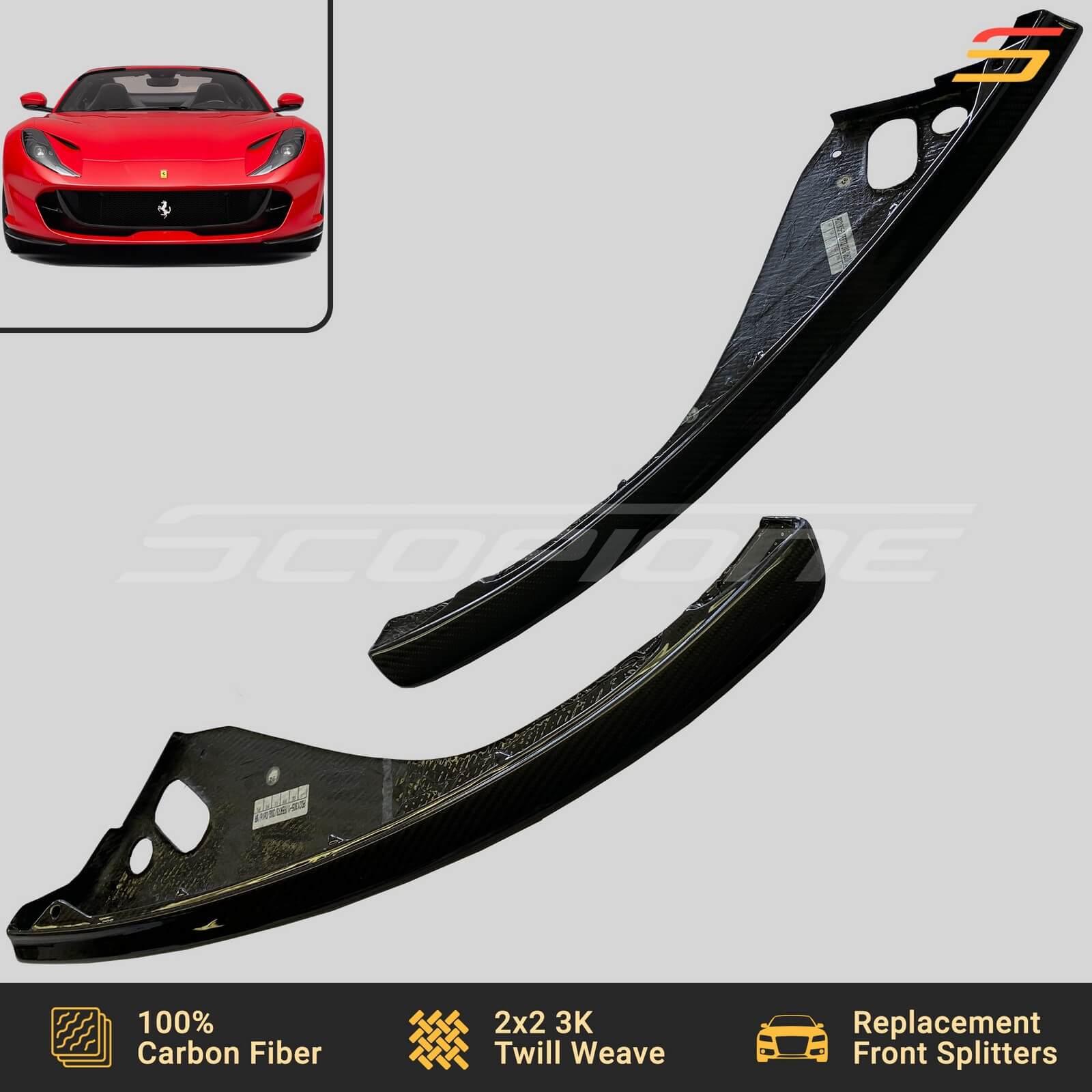
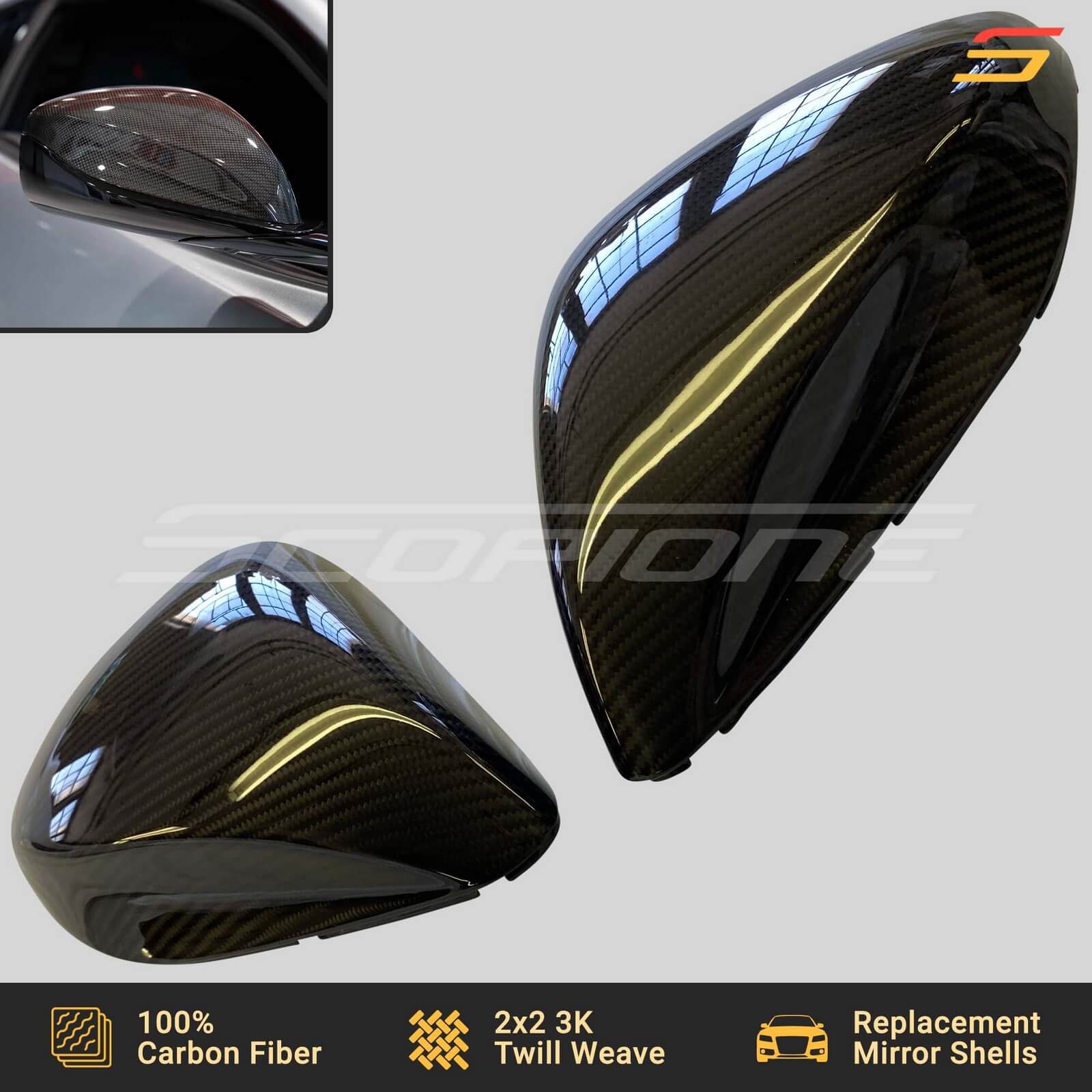
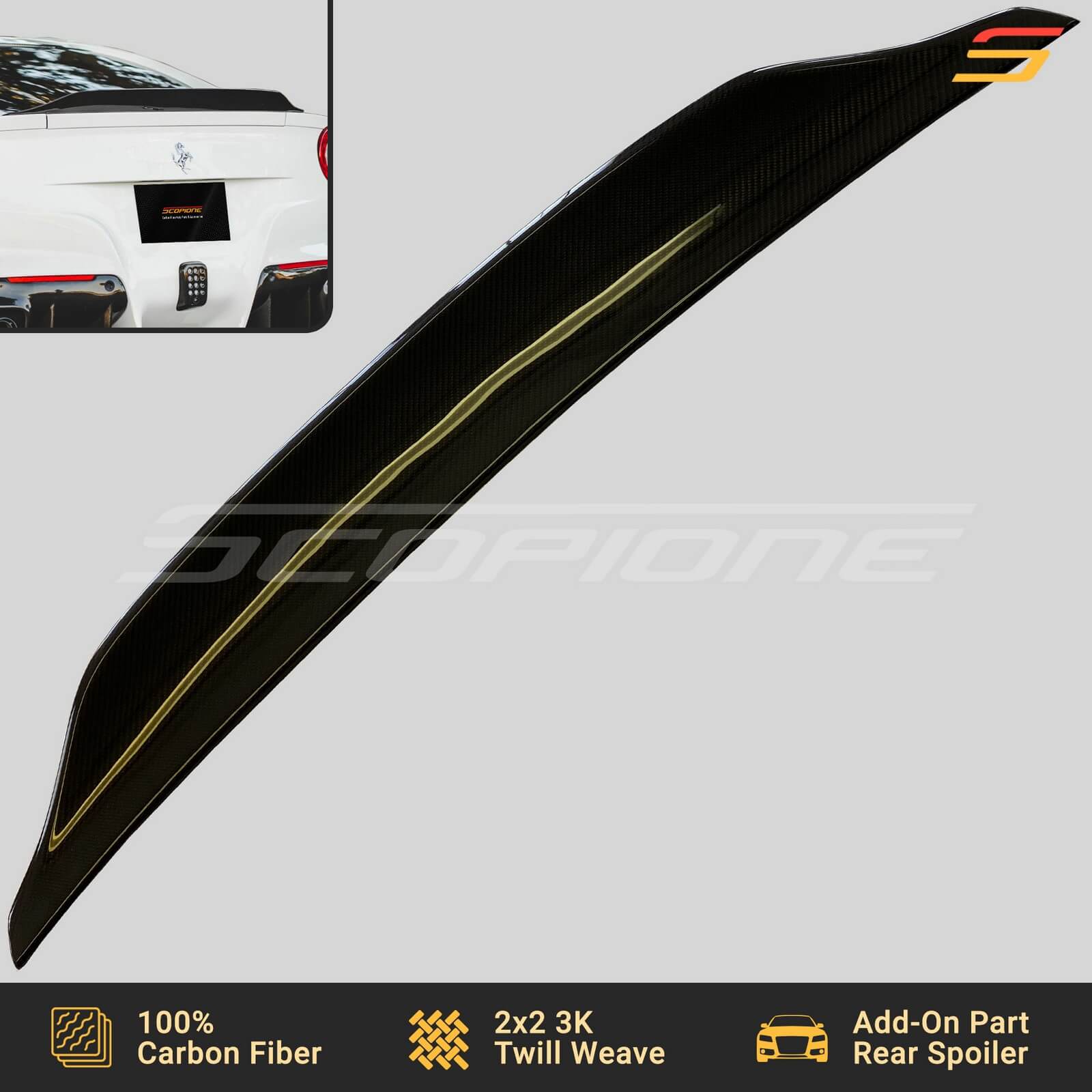
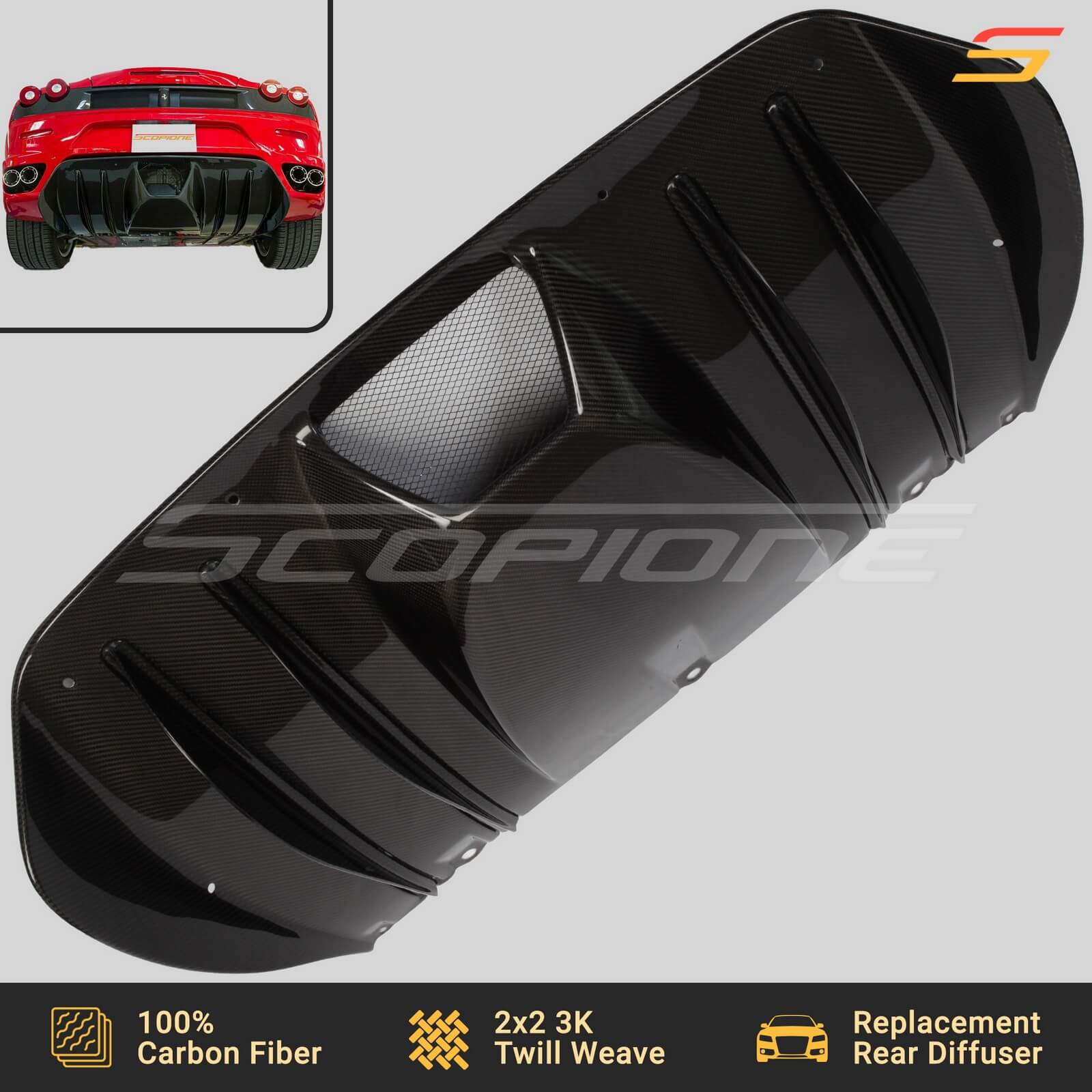
As Ferrari’s lineup hybridizes, the role of aftermarket carbon fiber evolves alongside the factory offerings. Scopione’s Ferrari catalog currently covers the 458, 488, and F8 platforms – three generations of mid-engine V8s spanning 2009 to 2023 – plus parts for the F430, F12berlinetta, and 812 Superfast/GTS. Each successive generation increased factory CF content, and the aftermarket followed: components that were exotic options on the 458 became standard expectations on the F8. The catalog continues to expand as newer platforms reach the aftermarket development stage.
For existing owners, carbon-fiber upgrades serve both functional and resale purposes. A well-chosen set of CF components – front lip, mirror caps, rear diffuser, engine cover – signals careful, enthusiast-grade ownership that appeals to pre-owned buyers. The 2×2 3K twill weave pattern on Scopione parts matches the factory specification, maintaining the visual consistency that Ferrari’s design language demands across OEM and aftermarket installations.
Frequently Asked Questions
Ferrari and Carbon Fiber: Common Questions
When did Ferrari first use carbon fiber in a road car?
The Ferrari F40 (1987) was the first Ferrari road car to incorporate carbon fiber, using CF and Kevlar composite body panels alongside aluminum. The F50 (1995) was the first Ferrari road car with a full carbon fiber monocoque chassis – a structural approach derived directly from Ferrari’s Formula 1 program. John Barnard’s Ferrari 640 F1 car (1989) had pioneered the full CF monocoque in racing, and the F50 transferred that technology to the road six years later.
How did Formula 1 influence Ferrari’s carbon fiber road cars?
The connection is direct and documented. The Ferrari 126C3 (1983) introduced CF composite elements in an F1 chassis. John Barnard’s Ferrari 640 (1989) was the first Ferrari F1 car with a full CF monocoque. That structural engineering – layup techniques, resin systems, metal insert bonding, stress analysis methods – transferred to the F50 road car within six years. The LaFerrari’s HY-KERS hybrid system was derived from F1’s kinetic energy recovery system. Ferrari’s FXX track programs served as intermediate development platforms, testing road-car-relevant CF technologies under racing loads with paying customers as test drivers.
Which Ferrari models have full carbon fiber monocoque chassis?
Five Ferrari road cars have used full CF monocoques: the F50 (1995, 349 units), Enzo (2002, 400 units), LaFerrari (2013, 710 units), Daytona SP3 (2022, 599 units), and F80 (2025, 799 units). Ferrari’s volume sports cars – the 360, 430, 458, 488, F8, 296 GTB – use aluminum space frames with optional or integrated CF components. This dual-track approach reflects a deliberate strategy: full CF monocoques for cost-unconstrained hypercars, aluminum-plus-CF for volume models.
Does Scopione make carbon fiber parts for Ferrari?
Scopione offers 2×2 3K twill-weave carbon fiber parts for three core Ferrari platforms – the 458 Italia/Spider (2009–2015), 488 GTB/Spider (2015–2019), and F8 Tributo/Spider (2019–2023) – plus parts for the F430, F12berlinetta, and 812 Superfast/GTS. The catalog covers exterior aero components (front splitters, side skirts, rear diffusers, mirror shells), engine bay parts (air box covers, engine cover kits), and interior trim (center console panels, dashboard caps, door sills, shift paddles). All parts feature UV-resistant clear coat and precision fitment to factory mounting points. Browse the full selection at scopione.com.
Why does Ferrari use aluminum instead of carbon fiber for most models?
Cost and production volume. A CF monocoque suitable for a Ferrari hypercar requires extensive hand layup, autoclave curing, and precision machining – processes that add significant per-unit cost. For a 400-unit Enzo or 799-unit F80, that cost is absorbed into a seven-figure price tag. For a 15,000-unit 488 or 296 GTB priced under $350,000, the economics do not support full CF construction. Aluminum space frames, which Alcoa helped Ferrari develop starting with the 360 Modena, deliver significant weight savings over steel at a fraction of CF monocoque cost. Ferrari offers optional CF components and trim packages for volume models, allowing customers to add carbon fiber where they value it – a commercially rational approach that also generates substantial revenue from the personalization program.
Explore More Scopione Content
Ferrari Carbon Fiber Parts
- Browse all Ferrari carbon fiber parts – 458 Italia/Spider, 488 GTB/Spider, F8 Tributo, plus the F430, F12berlinetta, and 812 Superfast/GTS
More Carbon Fiber Evolution Articles
- Lamborghini Carbon Fiber Evolution – From Pagani’s composite experiments to the Revuelto’s battery-integrated monofuselage, tracing a contrasting approach to CF adoption
- McLaren’s Carbon Fiber Evolution
- Carbon Fiber in the Automotive Industry
- The Pioneers of Carbon Fiber Innovation
- The Evolution and Impact of Carbon Fiber: A Comprehensive Guide
- Aston Martin’s Carbon Fiber Evolution – The V12 Vanquish’s CF tunnel to the Valkyrie’s F1-derived monocoque
- Audi’s Carbon Fiber Evolution – Thirteen Le Mans wins on CFRP monocoques, and the R8’s structural carbon
- Bentley’s Carbon Fiber Evolution – The Supersports’ 110 kg weight cut to Mulliner’s coachbuilt Batur
- Cadillac’s Carbon Fiber Evolution – V-Series aero packages and the hand-built CELESTIQ
- Honda & Acura’s Carbon Fiber Evolution – The aluminium NSX, and a different answer to the lightweight question
- Land Rover’s Carbon Fiber Evolution – Seventy-five years of aluminium, and where carbon finally arrived
- Lotus’s Carbon Fiber Evolution – Add lightness — the first fiberglass monocoque in 1957 to the Evija’s CFRP tub
- Maserati’s Carbon Fiber Evolution – The Birdcage’s tube frame to the MC20’s own CFRP monocoque
- Mercedes-Benz’s Carbon Fiber Evolution – Silver Arrows to the AMG One’s F1-derived monocoque
- MINI’s Carbon Fiber Evolution – 640 kg in 1959, and recycled CFRP arches on the JCW GP3
- Volkswagen’s Carbon Fiber Evolution – The Beetle’s people’s-car logic to the XL1’s 230 kg CFRP monocoque
Experience the elegance and performance of the Ferrari with Scopione. Browse our gallery and get inspired to elevate your supercar with our top-of-the-line carbon fiber upgrades.
Shop now for premium ScopioneCarbon carbon fiber upgrades and experience the ultimate in performance and aesthetics for your Ferrari!
Disclaimer: Technical specifications, production figures, and historical details presented in this article are editorial in nature and may differ from official manufacturer data. Photographs show Scopione carbon fiber parts for the Ferrari 458, 488, F8, F12, FF, 812, GTC4Lusso and F430, and promotional imagery.