

 Shop
Shop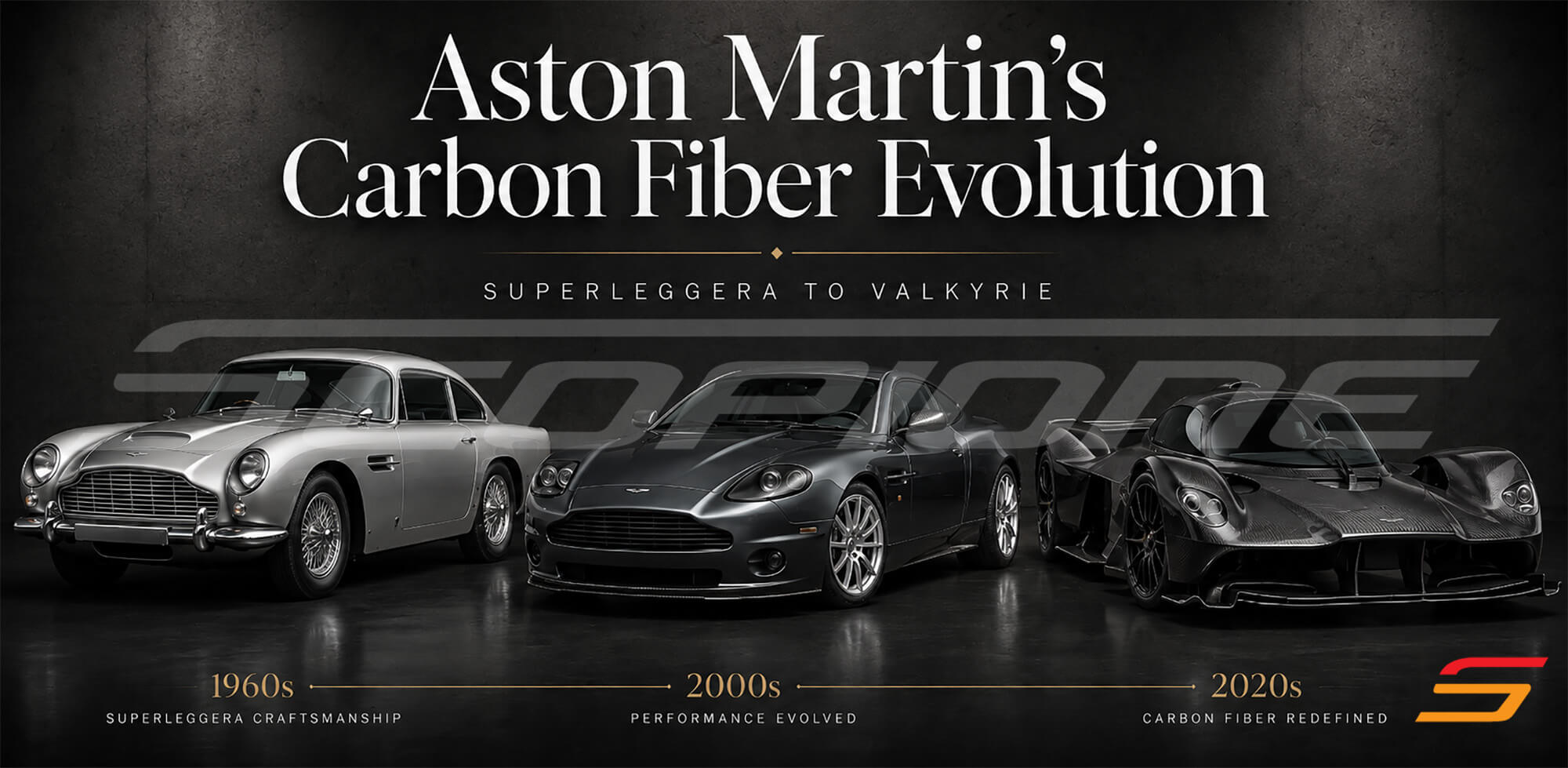
Aston Martin has never followed a predictable path – not in its finances, not in its ownership, and not in its adoption of carbon fiber. The company survived seven bankruptcies and multiple ownership changes before its first CF component appeared in a production car. That car was the V12 Vanquish in 2001, which carried a nine-layer carbon fiber transmission tunnel and CF windscreen pillars – a hybrid aluminum-and-composite approach developed with Ford Research Laboratories. Eight years later, the One-77 carried a full CF monocoque built by Multimatic of Canada, with each tub requiring six workers and three weeks to complete. Multimatic built the Vulcan’s track-only CF chassis next, and then the Valkyrie’s F1-derived monocoque with Adrian Newey and Red Bull Advanced Technologies. That partnership runs through every Aston Martin CF milestone. The Valhalla, which entered production in 2025 with a bespoke CF tub, marks the point where Aston Martin began producing its own carbon fiber structures in-house. Scopione stocks carbon-fiber components for Aston Martin’s Vantage, DB9, DBS, Virage and Rapide – browse the full Aston Martin catalog.
Aston Martin Carbon Fiber Timeline
| Year | Milestone | Model |
|---|---|---|
| 2001 | First CF structural elements (CF tunnel, A-pillars) | V12 Vanquish |
| 2009 | First full CF monocoque (Multimatic) | One-77 |
| 2012 | First full CF body panels on a production GT | Vanquish (2nd gen) |
| 2015 | Track-only CF monocoque | Vulcan |
| 2018 | CF body panels save 72 kg vs aluminum | DBS Superleggera |
| 2021 | F1-derived CF monocoque (Red Bull AT / Multimatic) | Valkyrie |
| 2025 | In-house CF tub production (RTM + autoclave) | Valhalla |
1913–1970s: British GT Heritage and Lightweight Construction
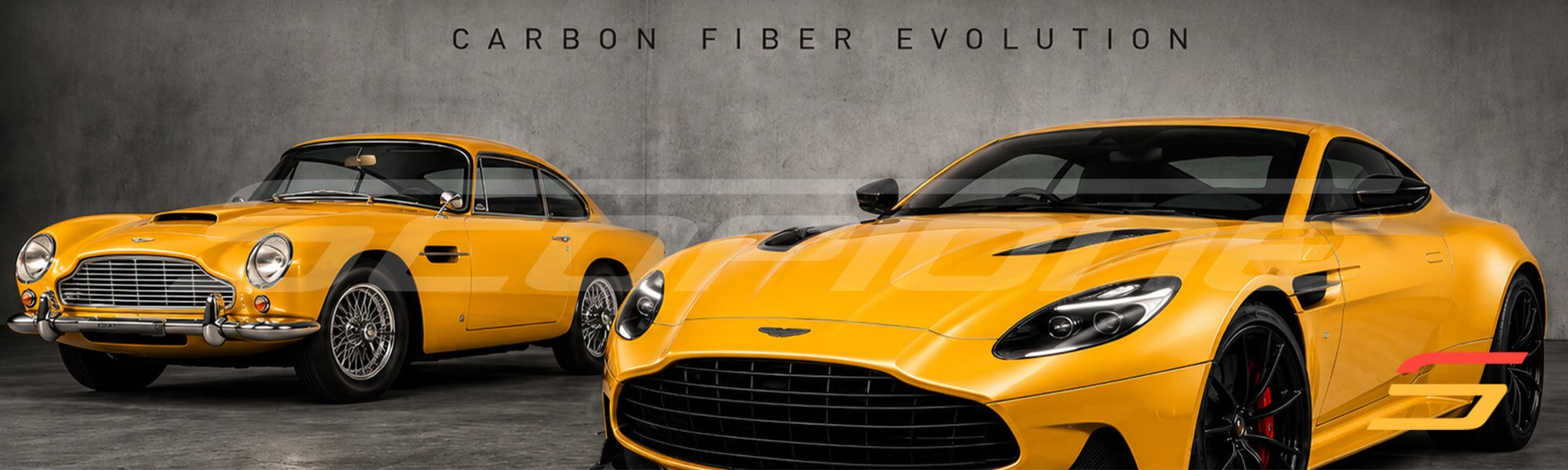
Lionel Martin and Robert Bamford started selling modified Singer cars from a small workshop at Henniker Mews in London in 1913. Martin raced these cars at the Aston Clinton hill climb in Buckinghamshire – combining “Aston” from the hill and “Martin” from his own name gave the company its identity. The early years were defined by financial instability: the original company went bankrupt in 1924, was reformed, and went bankrupt again in 1932. A pattern was established that would repeat for the next century.
David Brown changed everything. In 1947, the Yorkshire industrialist purchased Aston Martin for £20,500 after seeing a classified advertisement in The Times. He bought Lagonda shortly after, acquiring the rights to W.O. Bentley’s 2.6-liter straight-six engine. Brown’s initials gave the “DB” prefix to every Aston Martin that followed. Under his ownership, the company moved from London to Feltham and then to the Newport Pagnell works in Buckinghamshire, where it would remain for over fifty years.
Newport Pagnell’s cramped workshops became the crucible for Aston Martin’s handbuilt character. Each car was assembled in small batches by technicians who remained with the company for decades. The workforce rarely exceeded 400 people. Engine blocks were hand-finished, body panels shaped on English wheels, and final assembly involved substantial manual adjustment. This small-batch ethos would later define how Aston Martin approached carbon fiber: not through volume manufacturing but through limited production runs requiring intensive skilled labor. When the One-77’s CF monocoque demanded six workers per tub, the culture was already in place.
Aston Martin DBR1 (1956-1959): Le Mans and Racing Credibility
Ted Cutting designed the DBR1 as a purpose-built sports racing car – five were built, each with a tubular spaceframe chassis and aluminum bodywork. On June 21, 1959, Carroll Shelby and Roy Salvadori drove chassis DBR1/2 to victory at the 24 Hours of Le Mans – Aston Martin’s only outright win at La Sarthe. The victory came at enormous cost. David Brown spent over £1 million on the racing program (approximately £25 million in today’s currency), and the company withdrew from factory racing the following year. A sister car, DBR1/1, sold at RM Sotheby’s in 2017 for $22.55 million – the highest price ever paid for a British car at the time.
- Construction: Tubular spaceframe, aluminum bodywork
- Engine: 3.0L straight-six, ~250 hp
- Production: 5 units
- Le Mans: 1959 outright winner (Shelby / Salvadori)
Aston Martin DB4 (1958-1963): Superleggera and Italian Engineering
The DB4 introduced Aston Martin to Superleggera construction – a lightweight building technique patented by Carrozzeria Touring of Milan. Thin aluminum body panels were hand-formed over a cage of small-diameter steel tubes that conformed to the body shape. “Superleggera” translates directly as “super light” in Italian, and the philosophy was straightforward: reduce weight through material efficiency, not material substitution.
Harold Beach, Aston Martin’s chief engineer, traveled to Milan to work alongside Touring. In six weeks, Beach designed a new platform chassis after the existing multi-tubular spaceframe proved incompatible with Touring’s body construction. Federico Formenti at Touring penned the body shape that debuted at the 1958 Paris Motor Show. The DB4 was the first Aston Martin built at Newport Pagnell and reportedly the first production car to achieve 0-100-0 mph in under 30 seconds.
- Engine: 3.7L Tadek Marek straight-six, 240 hp
- Production: 1,110 units across five series
- Construction: Superleggera (aluminum over tubular steel frame)
- Designer: Carrozzeria Touring (body), Harold Beach (platform)
The DB4 GT Zagato variant – 19 units, bodied by Zagato in Milan rather than Touring – became one of the rarest and highest-valued Aston Martins ever produced. The Superleggera technique served Aston Martin through the DB5 (1,021 units, 1963-1965) and into the DB6, establishing a construction identity that the company would not abandon until the VH platform arrived four decades later. The same impulse – lightness through material innovation – would eventually express itself through carbon fiber rather than aluminum and steel tubing.
Aston Martin DB5 (1963-1965): The Bond Effect
The DB5 refined the DB4’s formula with a 4.0-liter Tadek Marek straight-six producing 282 hp, a ZF 5-speed gearbox, and improved Girling disc brakes. Mechanically, it was an evolution. Culturally, it was a transformation. The DB5’s appearance in Goldfinger (1964) as James Bond’s car created the most famous automotive product placement in cinema history. Aston Martin gained global brand recognition that far exceeded its production capacity – a dynamic the company has leveraged ever since.
Only 1,021 DB5s were built, each using Superleggera construction produced in-house at Newport Pagnell under license from Touring. Original examples now sell for over $6 million at auction. One of the three surviving Goldfinger cars, complete with its gadget modifications (rotating number plates, oil slick dispenser, bullet-proof rear screen), sold at RM Sotheby’s in 2019 for $6.4 million. The Bond association endured through 25 films and counting, and Aston Martin has continued to supply hero cars for the franchise – including the DBS, Vantage, and DB10 (built specifically for Spectre). The DB10 is particularly relevant to the CF story: only 10 were built for the film, using a bespoke body structure that incorporated carbon-fiber panels – a one-off application that foreshadowed the DBS Superleggera’s mass-production CF body three years later.
- Engine: 4.0L Tadek Marek straight-six, 282 hp
- Production: 1,021 units
- Top speed: 148 mph
- Cultural impact: Goldfinger (1964) – James Bond’s car
Scopione Perspective: Aston Martin’s Lightweight Heritage
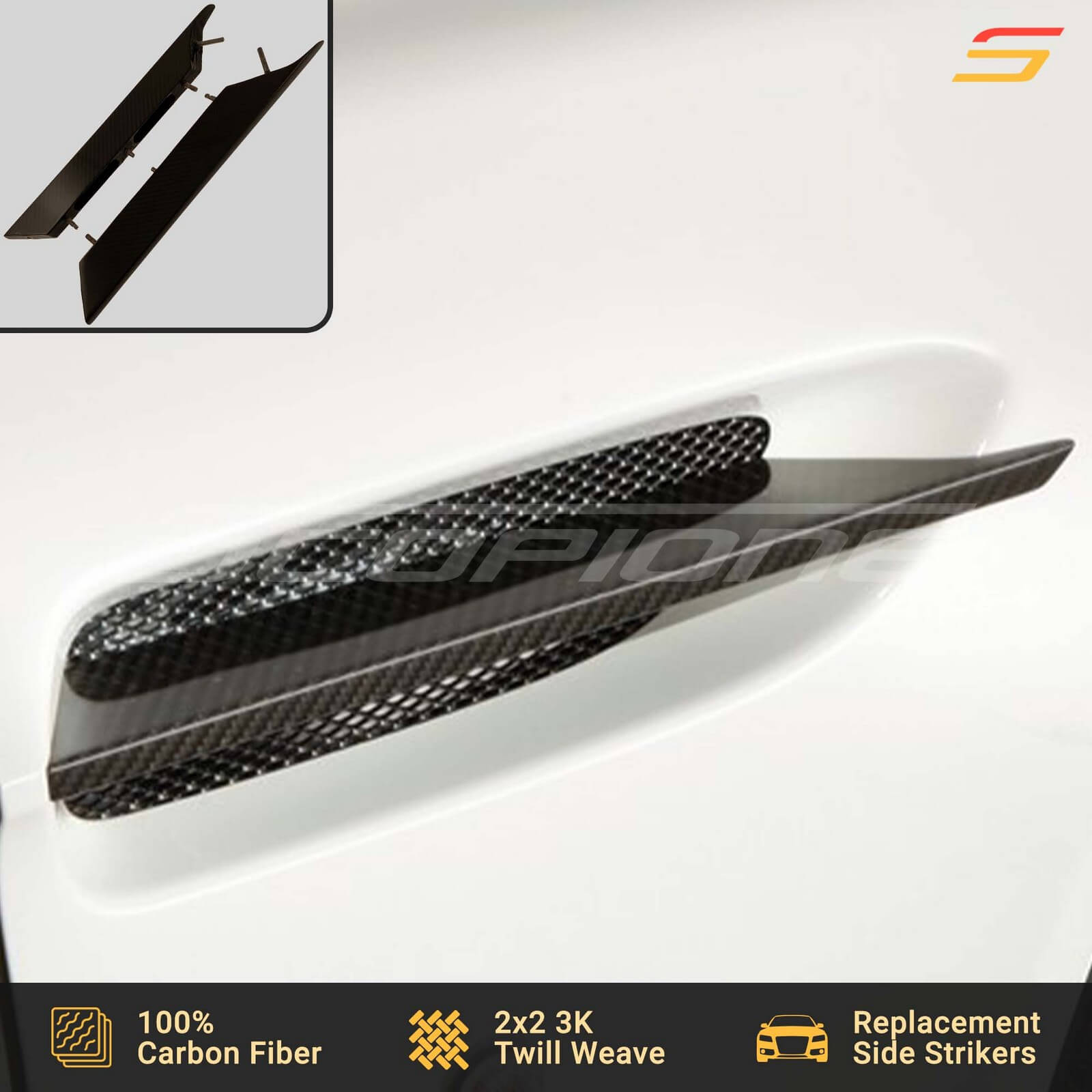
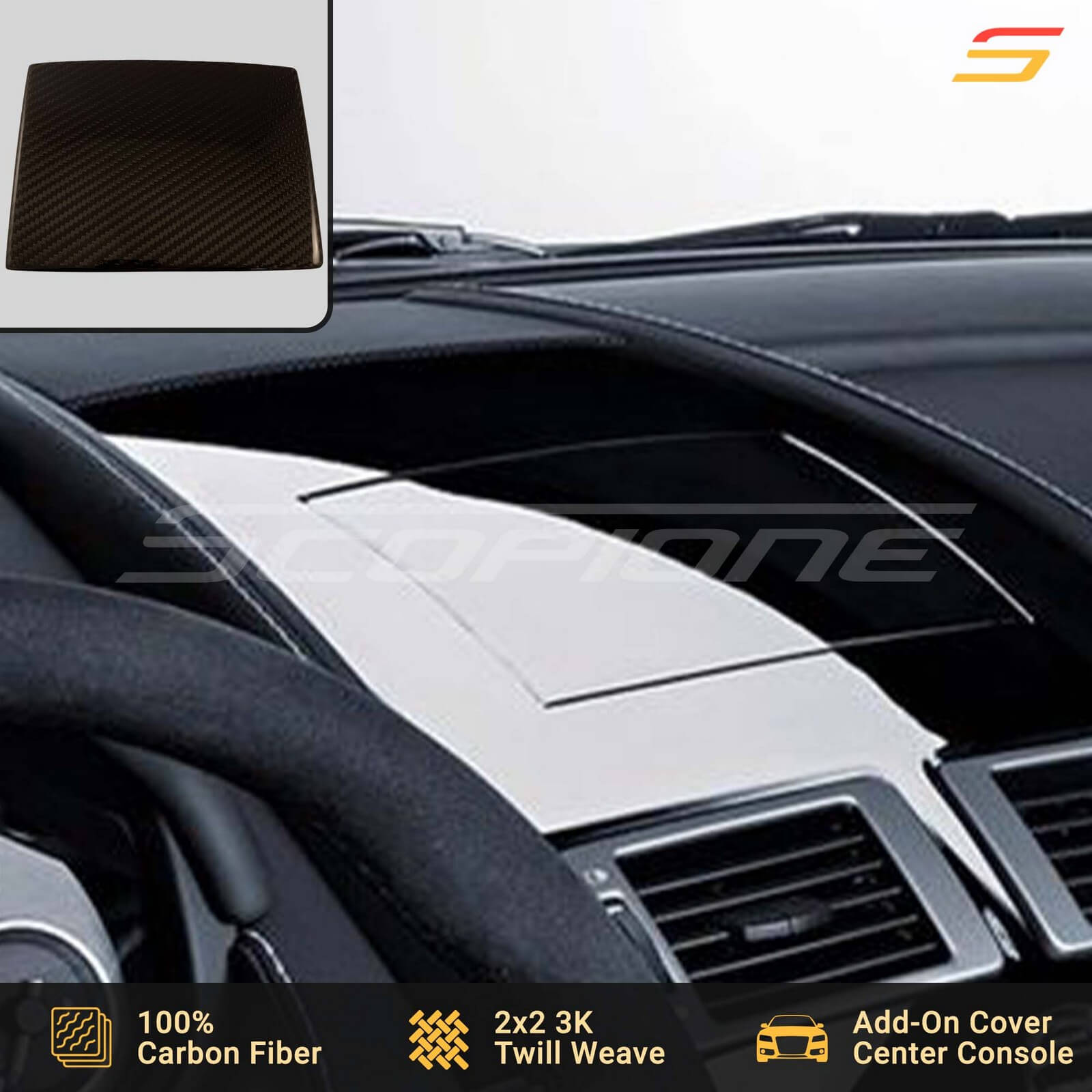
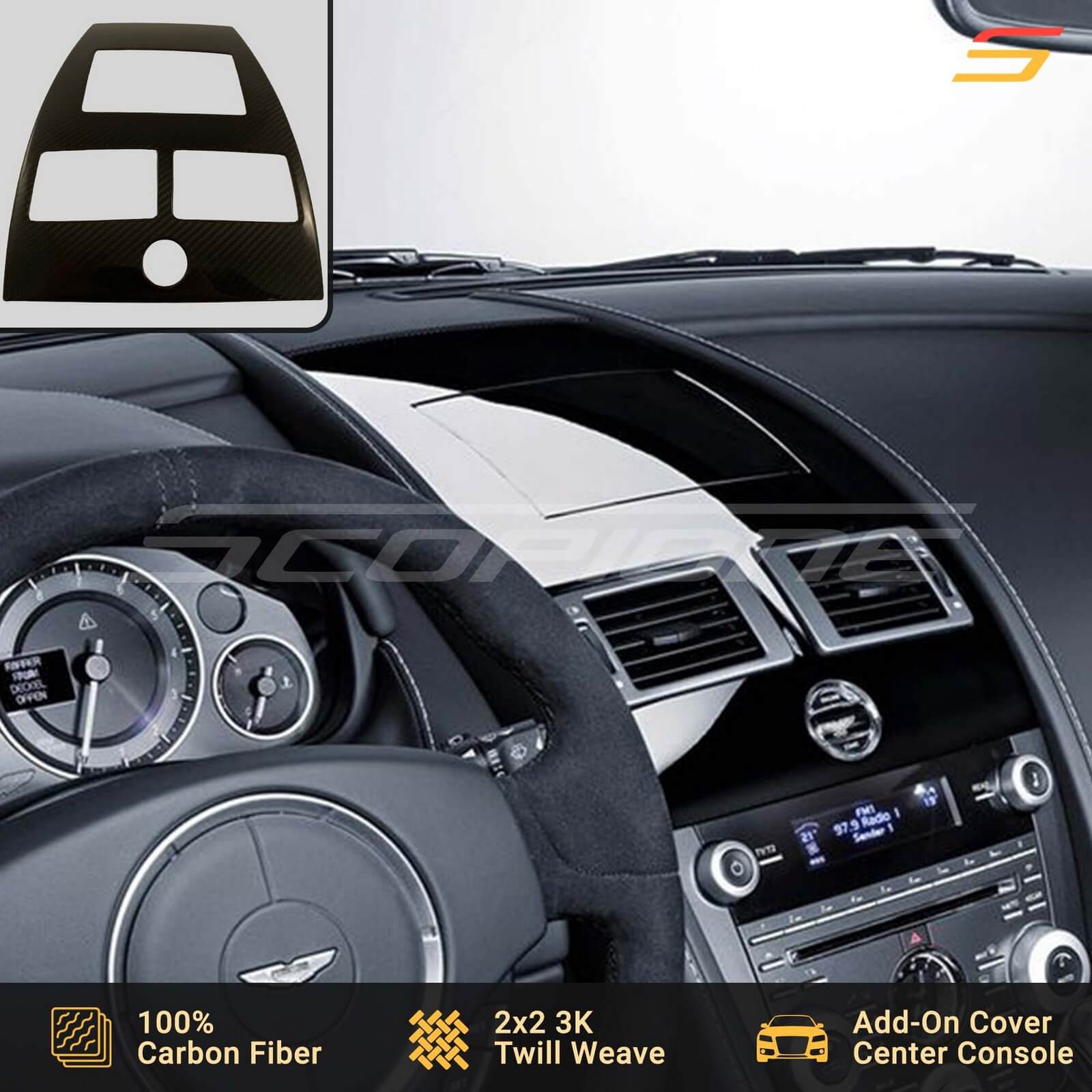
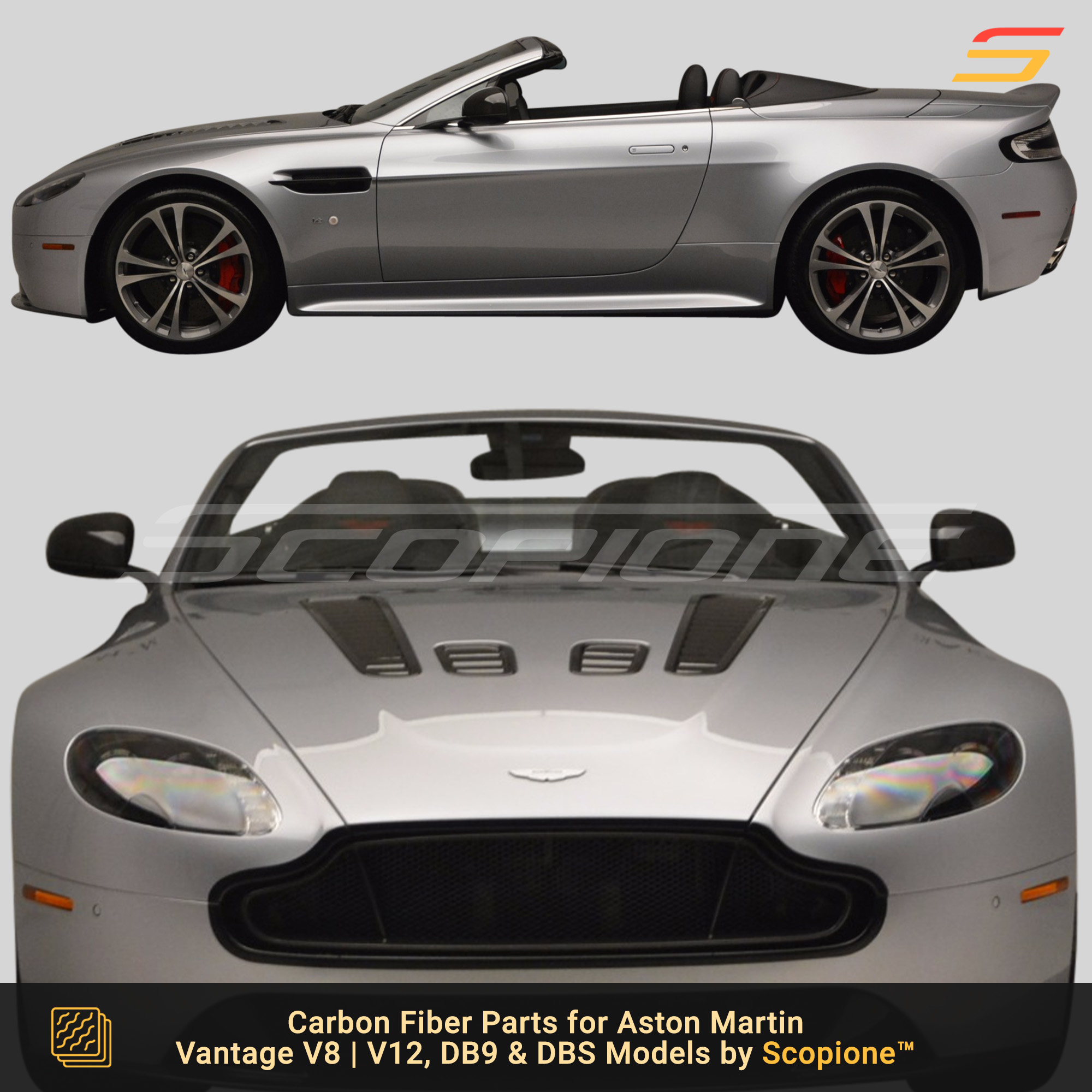
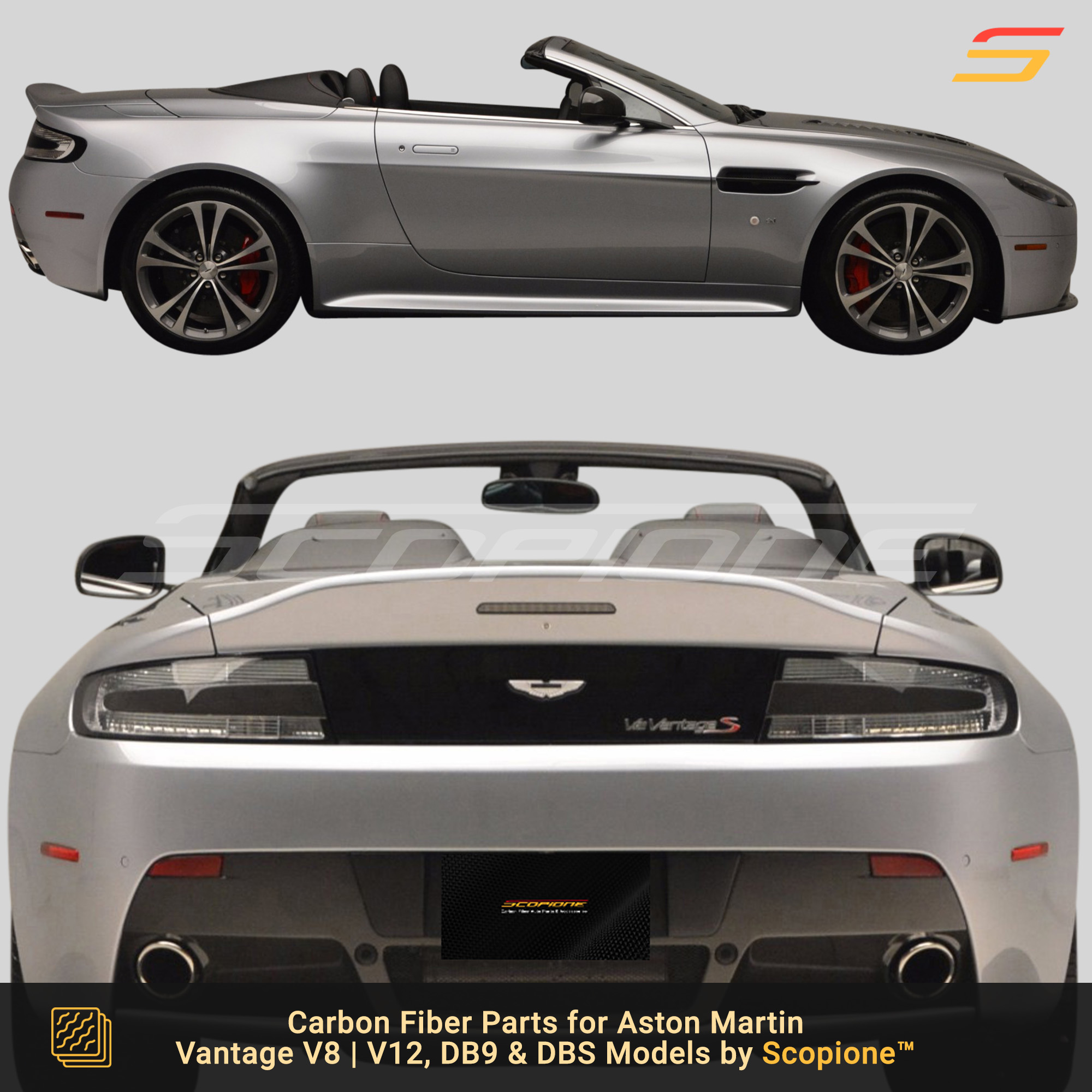
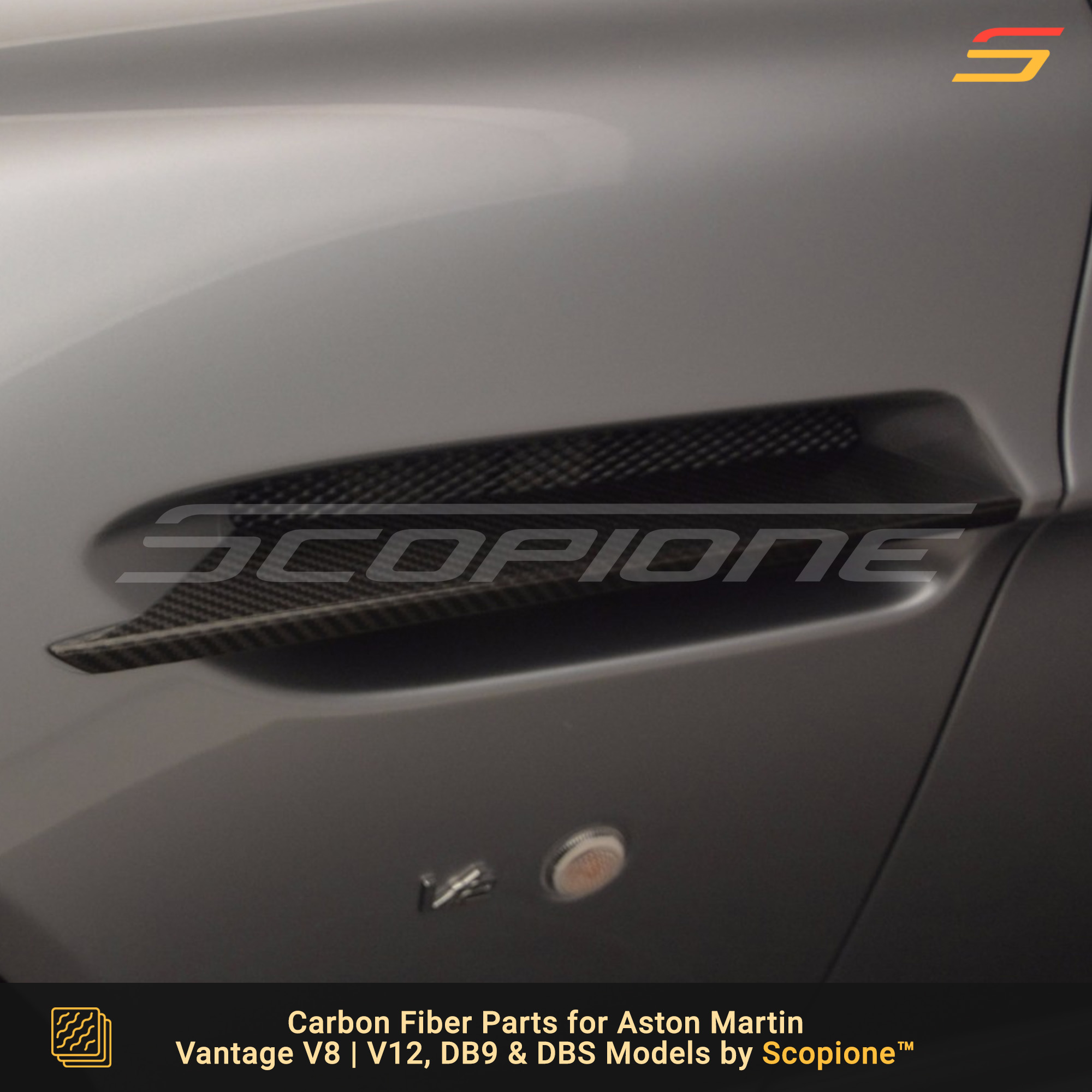
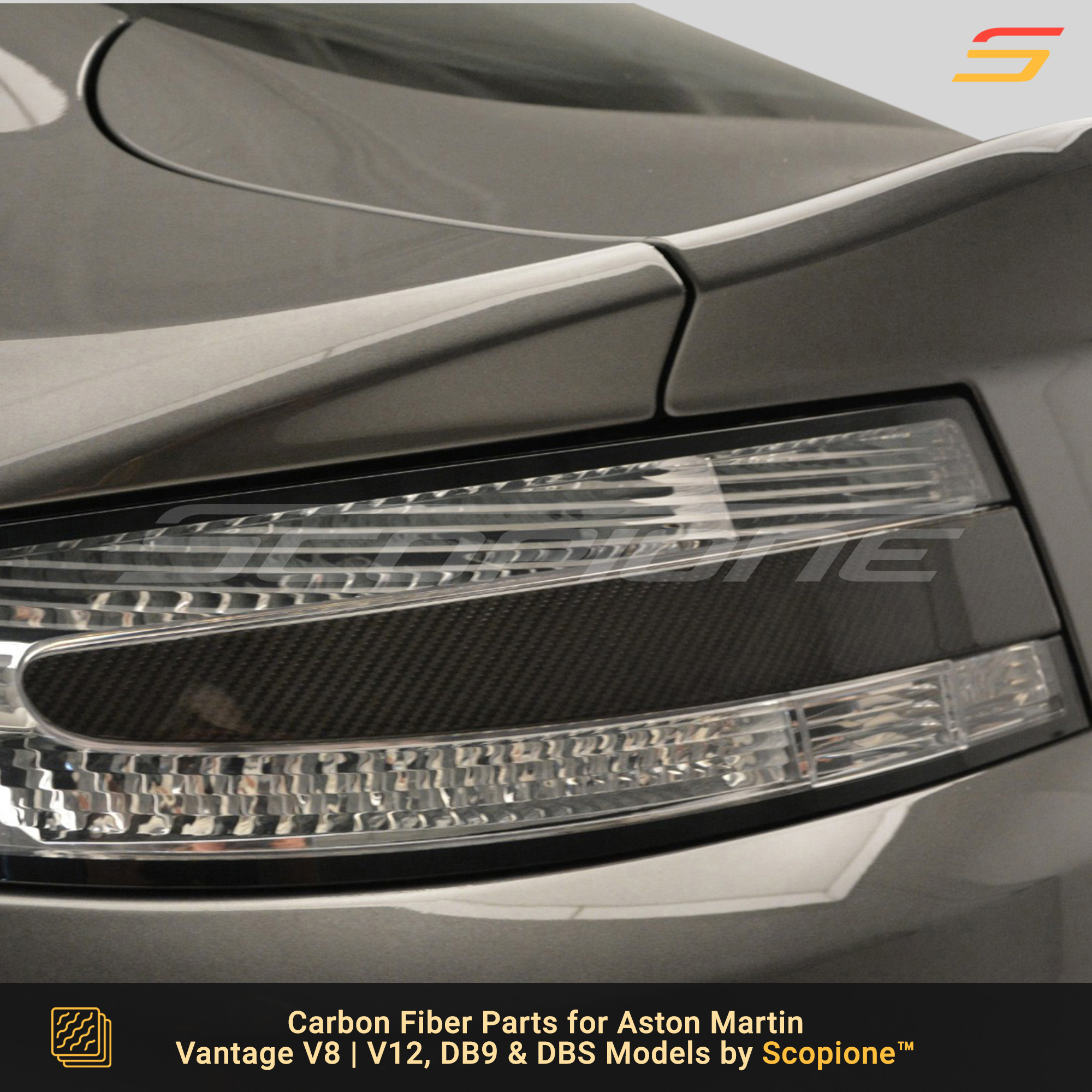
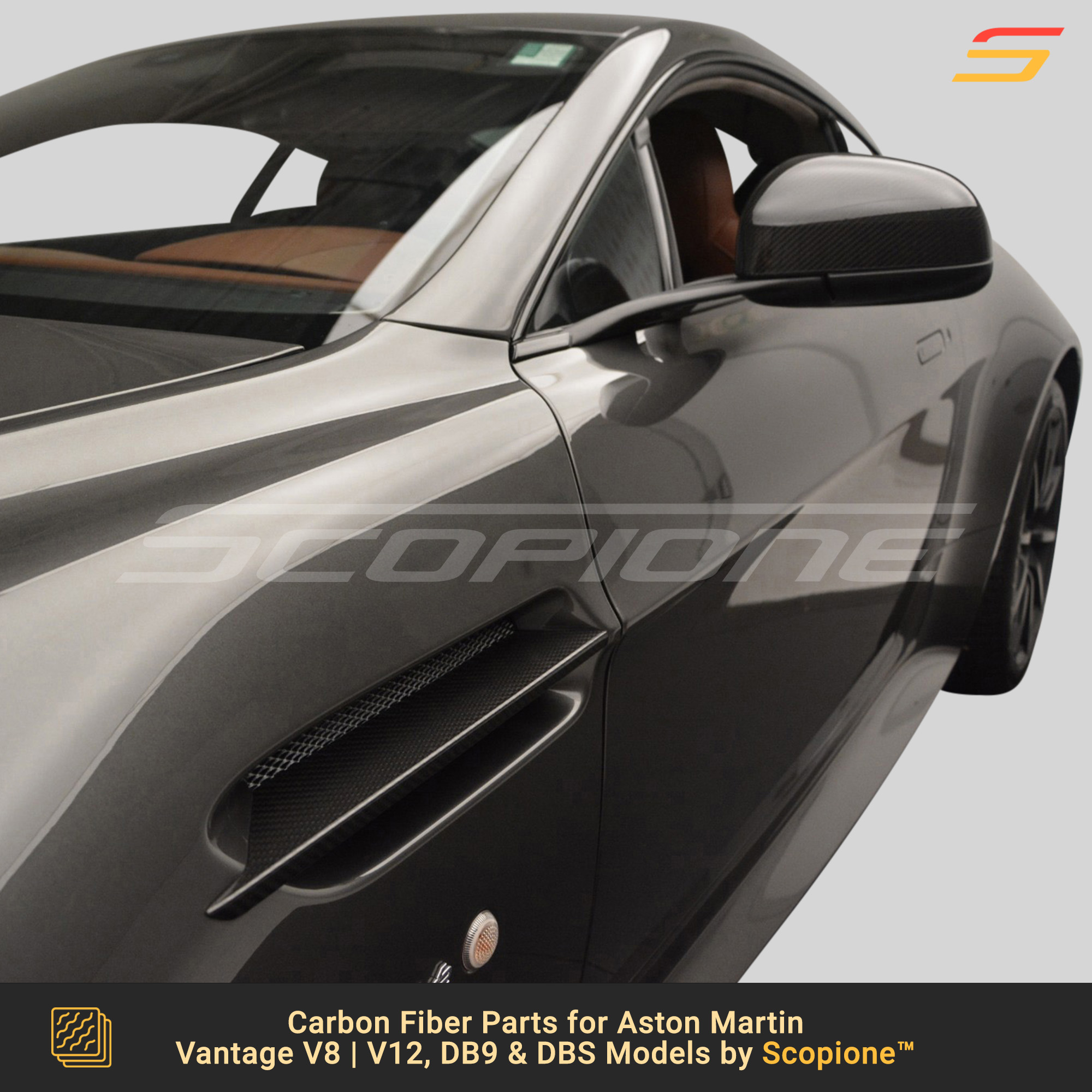
Touring of Milan’s Superleggera technique gave Aston Martin its first lightweight construction identity in the 1950s – thin aluminum over tubular steel, handbuilt at Newport Pagnell. That same principle drives today’s carbon-fiber aftermarket. Scopione carries 2×2 3K twill-weave CF components for the Vantage, DB9, DBS, Virage and Rapide – finished with UV-resistant clear coat for long-term durability. A Scopione carbon-fiber mirror cap or side vent surround integrates with the factory finish without visual mismatch, continuing the lightweight-material philosophy that Touring introduced seventy years ago.



1987–2007: The Ford Era and Carbon Fiber Introduction
By the mid-1980s, Aston Martin was in trouble again. Production had dropped to fewer than 200 cars per year. Victor Gauntlett, the company’s chairman, brokered the deal that brought Ford Motor Company in as a majority shareholder in 1987. Ford eventually acquired full ownership and poured resources into modernizing Aston Martin’s engineering, manufacturing, and product range. The result was two decades of relative stability – a rarity in Aston Martin’s history.
Ian Callum’s DB7 design in 1994 revitalized the brand commercially, selling approximately 7,000 units – more than any previous Aston Martin. But the engineering landmark of the Ford era was the V12 Vanquish in 2001, which introduced carbon fiber to Aston Martin’s construction for the first time. The VH (Vertical/Horizontal) bonded aluminum platform followed, underpinning every Aston Martin from the DB9 (2004) through the DBS Superleggera (2023).
Aston Martin DB7 (1994-2004): The Car That Saved the Brand
Ian Callum designed the DB7 at Tom Walkinshaw Racing (TWR), which developed the car on a platform derived from the Jaguar XJS. The relationship was pragmatic: Ford owned both Jaguar and Aston Martin, and sharing platforms reduced development costs. The initial 3.2-liter supercharged inline-six produced 335 hp. The V12 Vantage variant (1999) introduced Aston Martin’s first V12 engine, producing 420 hp.
Approximately 7,000 DB7s were produced across a decade – a volume that justified the investment in engineering capability that followed. The DB7 proved Aston Martin could sustain volume production without losing its handbuilt character. The Bloxham factory in Oxfordshire, separate from the Newport Pagnell works, was set up specifically for DB7 production. Without the DB7’s commercial success, the engineering programs that led to the V12 Vanquish and eventually the One-77 would not have been financially viable.
Callum’s design vocabulary – the sweeping fender line, compressed greenhouse, and elongated bonnet proportions – established the visual language that Aston Martin would carry forward through the DB9 and beyond. The DB7 also introduced a broader customer base to the brand. Many DB7 buyers had never owned an Aston Martin before – they came from Porsche, Jaguar, and Mercedes-Benz ownership, attracted by Callum’s styling and a price point significantly below the V8 Vantage of the preceding era. This expanding ownership community created the sustained aftermarket demand that companies like Scopione would eventually serve with carbon-fiber upgrades for subsequent VH-platform models.

- Engine: 3.2L supercharged I6 (335 hp) / 6.0L V12 (420 hp, Vantage)
- Production: ~7,000 units
- Top speed: 186 mph (V12 Vantage)
- Designer: Ian Callum (TWR)
Aston Martin V12 Vanquish (2001-2007): Carbon Fiber Arrives
The V12 Vanquish was the first Aston Martin to incorporate carbon fiber into its construction – and the approach was characteristically unconventional. Rather than a full CF monocoque (McLaren’s route with the F1 in 1993), or CF body panels (Ferrari’s approach with the F40 in 1987), Aston Martin used carbon fiber as a structural backbone. A nine-layer CF transmission tunnel ran the length of the car, providing torsional rigidity to the bonded aluminum tub structure. CF windscreen pillars, CF A-pillars, and CF front and rear crash structures completed the composite elements. The exterior body panels, however, were aluminum – shaped using the Superform process and hand-finished at Newport Pagnell.
The engineering was developed in partnership with Ford Research Laboratories and Nottingham University. Computer-controlled manufacturing processes, familiar in aerospace but rarely applied to automotive construction at the time, were used for the composite sections. Ford’s access to cross-industry research was critical: the V12 Vanquish benefited from composite engineering knowledge developed for the aerospace sector, filtered through Ford’s global research network. The result was a chassis with the torsional rigidity of a CF monocoque at a fraction of the production cost – each Vanquish could be assembled in days rather than the weeks required for the One-77’s full CF tub.
The V12 Vanquish was built at Newport Pagnell using a combination of traditional hand-assembly and new composite lay-up techniques. Workers who had previously assembled aluminum-bodied DB7 Vantages transitioned to handling pre-impregnated carbon fiber sheets for the transmission tunnel sections. Each tunnel layup used nine plies of CF material oriented at specific angles to maximize torsional stiffness. The A-pillar sections were particularly complex: they needed to carry crash loads while meeting rollover strength requirements, all within tight packaging constraints dictated by the windscreen rake angle. Quality control involved ultrasonic testing of each composite section before assembly – a technique borrowed directly from aerospace.
- Engine: 5.9L V12, 460 hp
- Top speed: 190 mph
- Production: ~2,600 units (including Vanquish S)
- CF elements: 9-layer CF tunnel, CF A-pillars, CF crash structures
The V12 Vanquish also appeared as James Bond’s car in Die Another Day (2002) – maintaining the franchise connection. The V12 Vanquish’s hybrid aluminum-and-CF construction was a pragmatic compromise: it delivered CF stiffness benefits where they mattered structurally, without requiring the full CF monocoque manufacturing capability that Aston Martin would not develop until the One-77 program. For a closer look at the Vantage, DB9, and DBS models from this era, see the Aston Martin Vantage, DB9 & DBS Picture Gallery.
Aston Martin DB9 and V8 Vantage: The VH Platform
The DB9 (2004), designed under Henrik Fisker’s direction with styling roots in Ian Callum’s earlier work, introduced the VH (Vertical/Horizontal) bonded aluminum platform – a significant engineering advance for Aston Martin, though not a carbon fiber one. The VH architecture used extruded aluminum sections bonded and riveted together, creating a strong, relatively lightweight structure that could be scaled across multiple models. The DB9 replaced the DB7 as Aston Martin’s grand tourer. The V8 Vantage (2005) brought the same platform to a smaller, more accessible package competing against the Porsche 911 and Jaguar F-Type.
The VH platform proved remarkably durable, underpinning the DB9, V8 Vantage, V12 Vantage, DBS, Rapide, and second-generation Vanquish across nearly two decades. Its bonded aluminum construction introduced Aston Martin to advanced adhesive and composite assembly techniques – manufacturing processes that would later translate to CF construction. The bonding adhesives used in VH construction are structurally similar to those used to bond CF panels to aluminum substructures: the factory tooling and quality-control procedures developed for VH carried over when Aston Martin began integrating carbon-fiber body panels on the second-generation Vanquish.
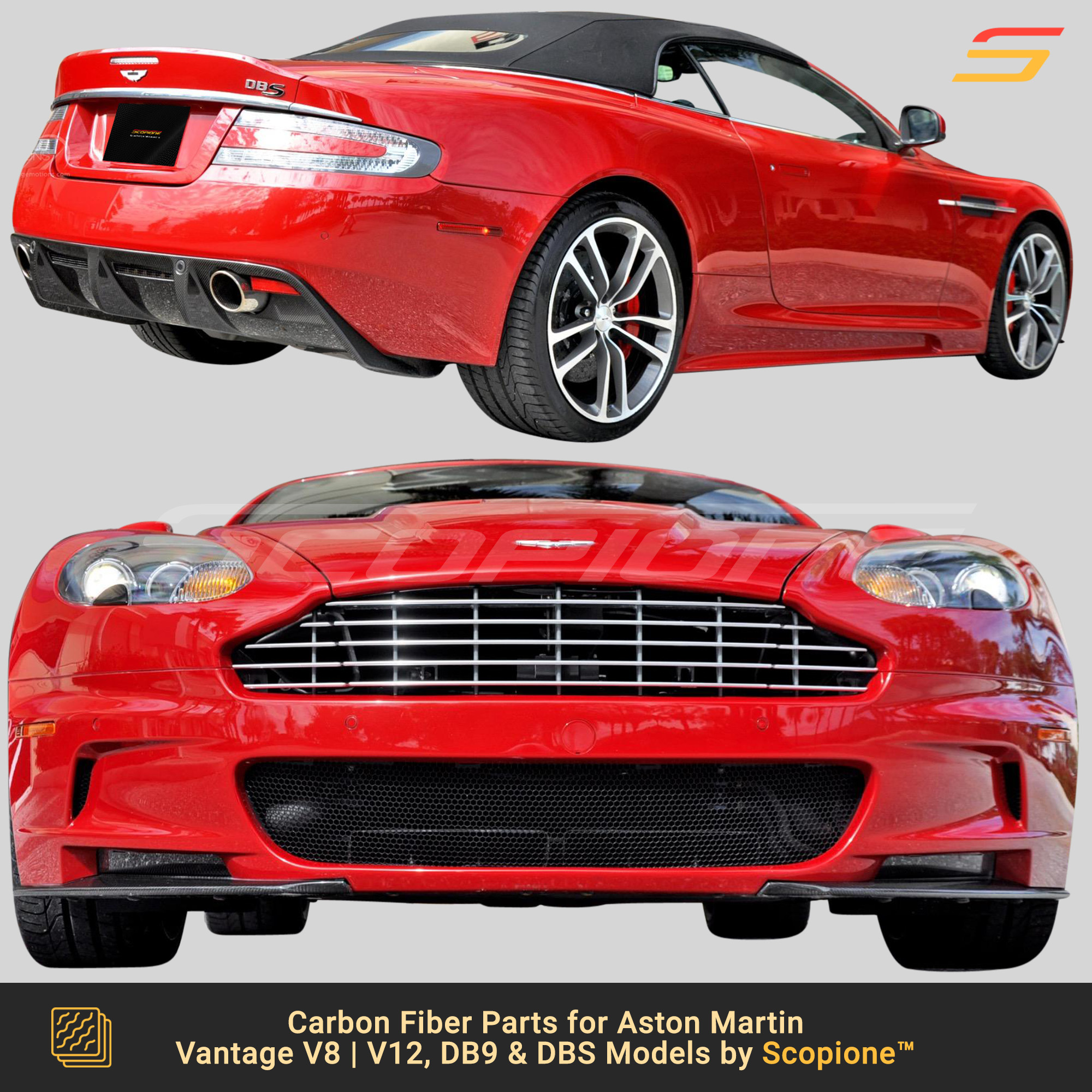
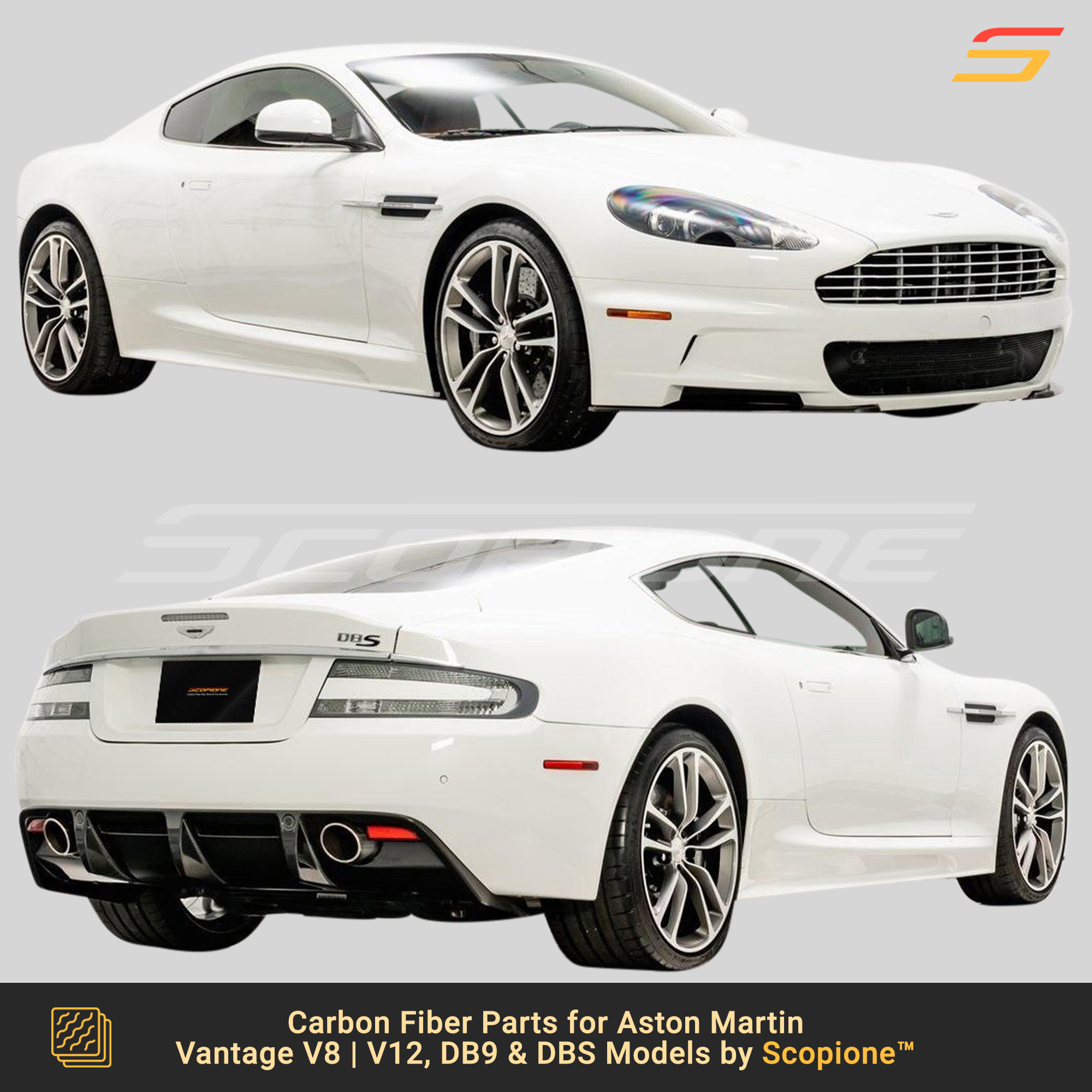
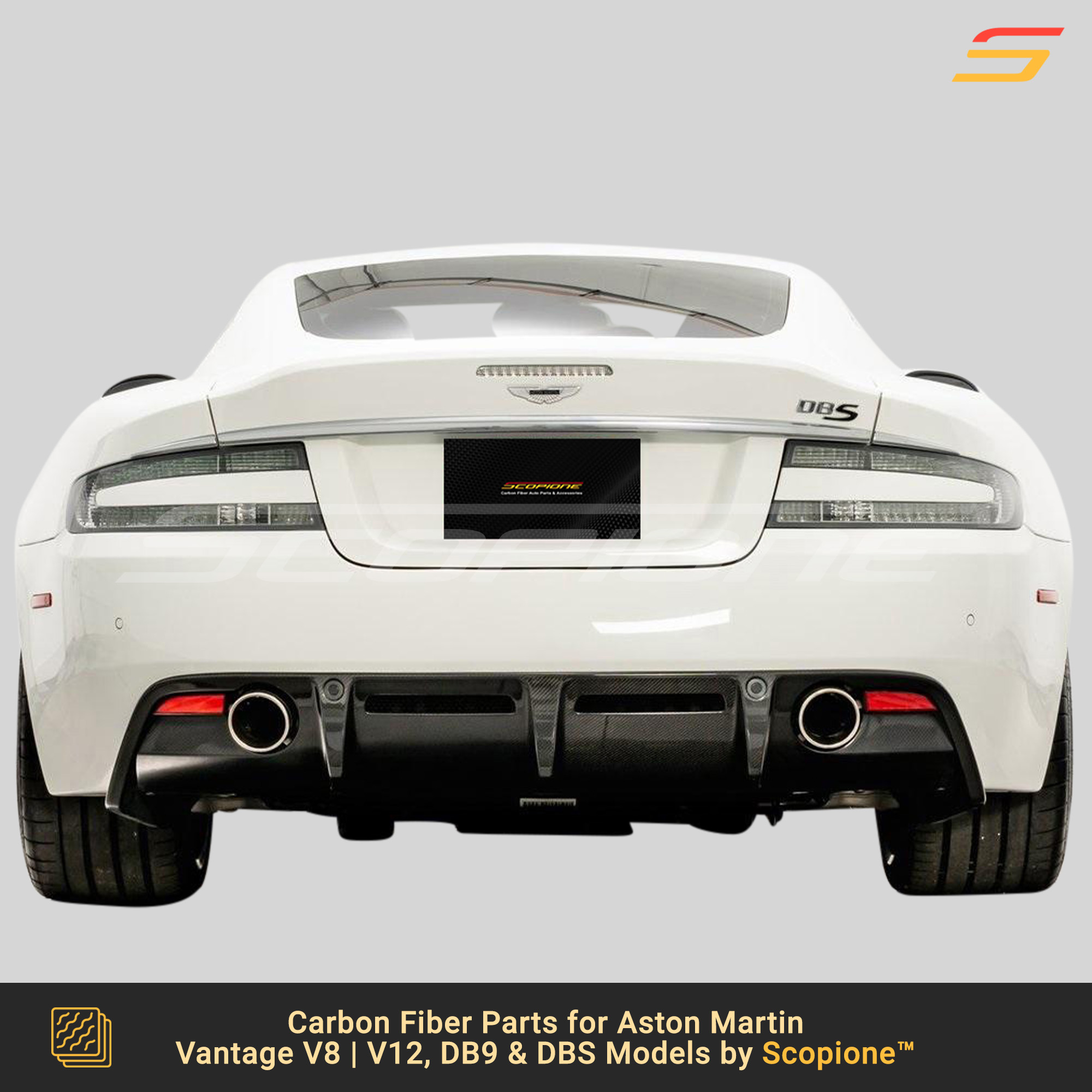
The V8 Vantage deserves particular mention as the volume model that brought Aston Martin ownership to a wider audience. Starting below £80,000 when launched, it competed directly with the Porsche 911 Carrera S. The 4.3-liter (later 4.7-liter) V8 was sourced from Ford’s Cologne engine plant and hand-assembled at Aston Martin’s facility. The V12 Vantage (2009) stuffed the DB9’s 5.9-liter V12 into the smaller Vantage body – a packaging exercise that required CF components for the bonnet (to save weight over the nose) and repositioned the battery to the trunk to improve weight distribution. The V12 Vantage was arguably the first standard-production Aston Martin where CF was used not for structural reasons but for engineering necessity: the aluminum bonnet could not be made light enough to meet the front-axle weight targets. The Vantage, DB9, and DBS remain the Aston Martin models with the deepest Scopione parts coverage – view the full Picture Gallery for fitment reference.
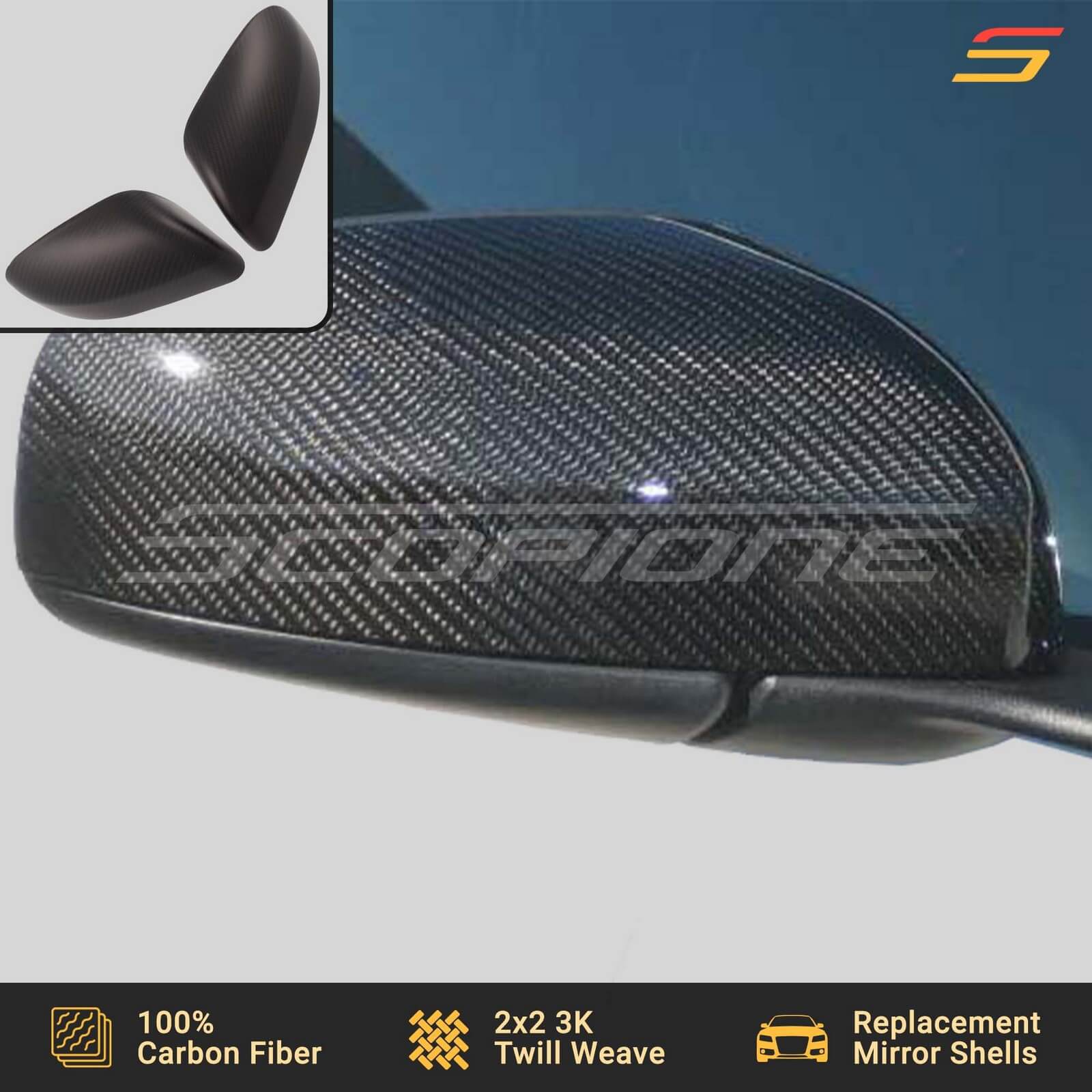
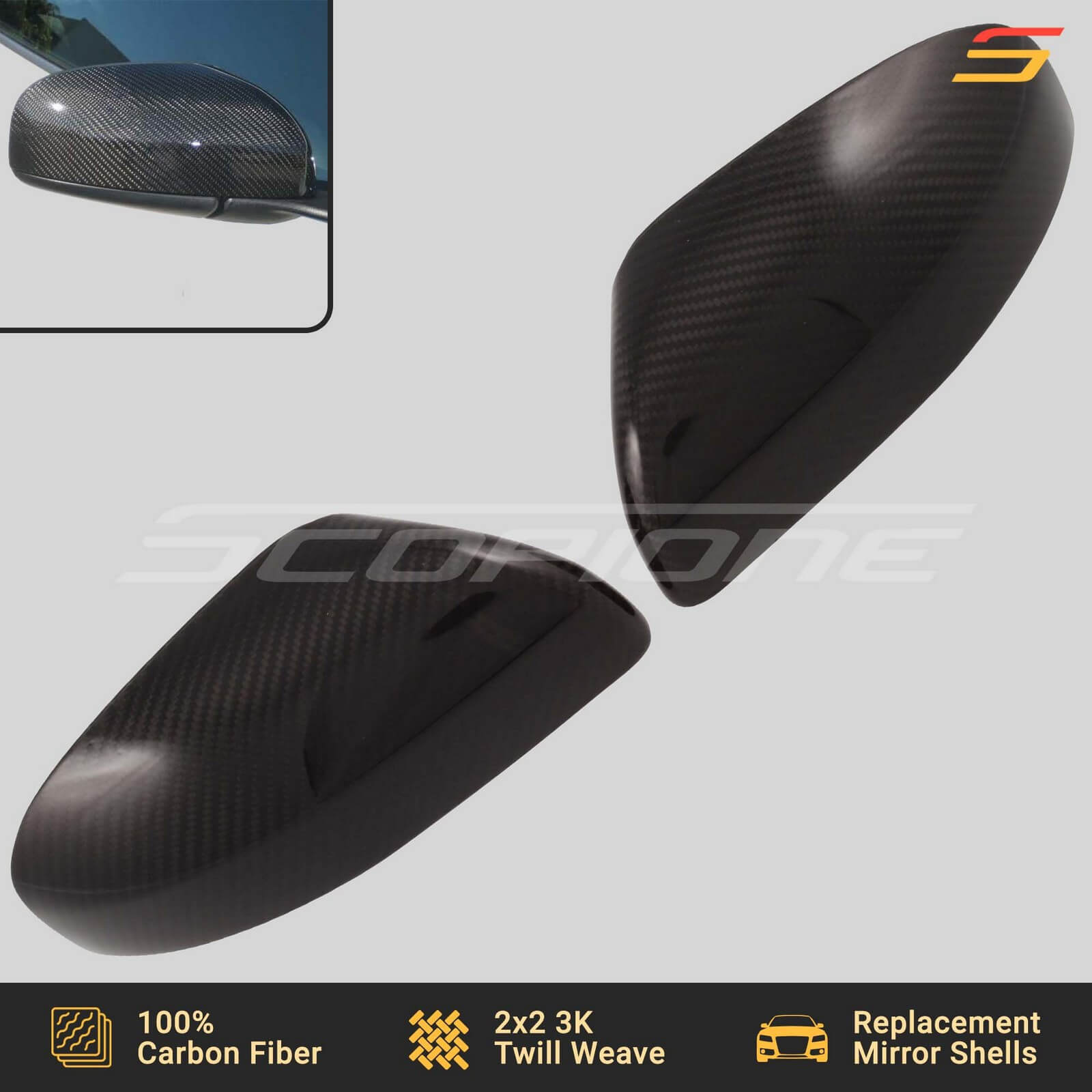
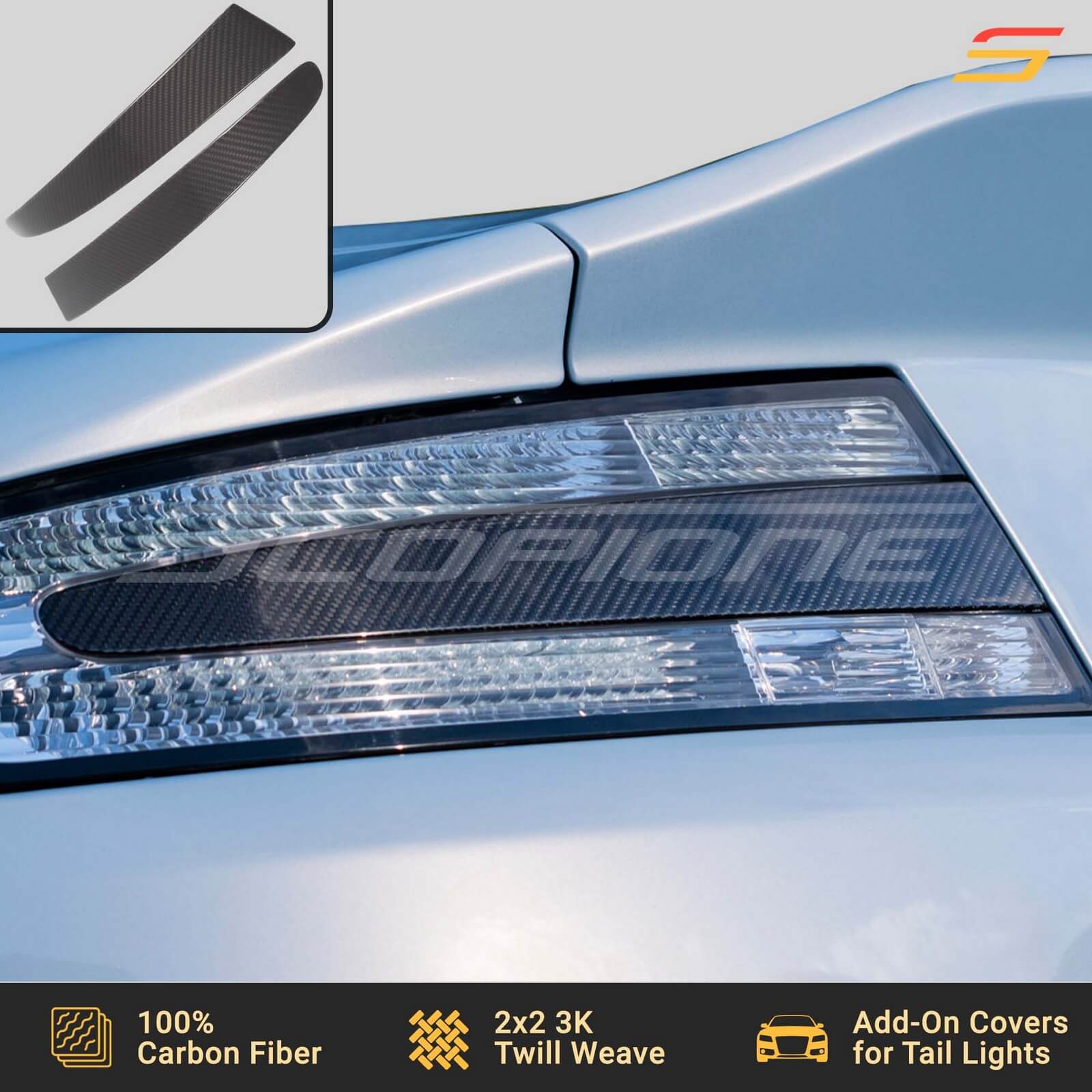
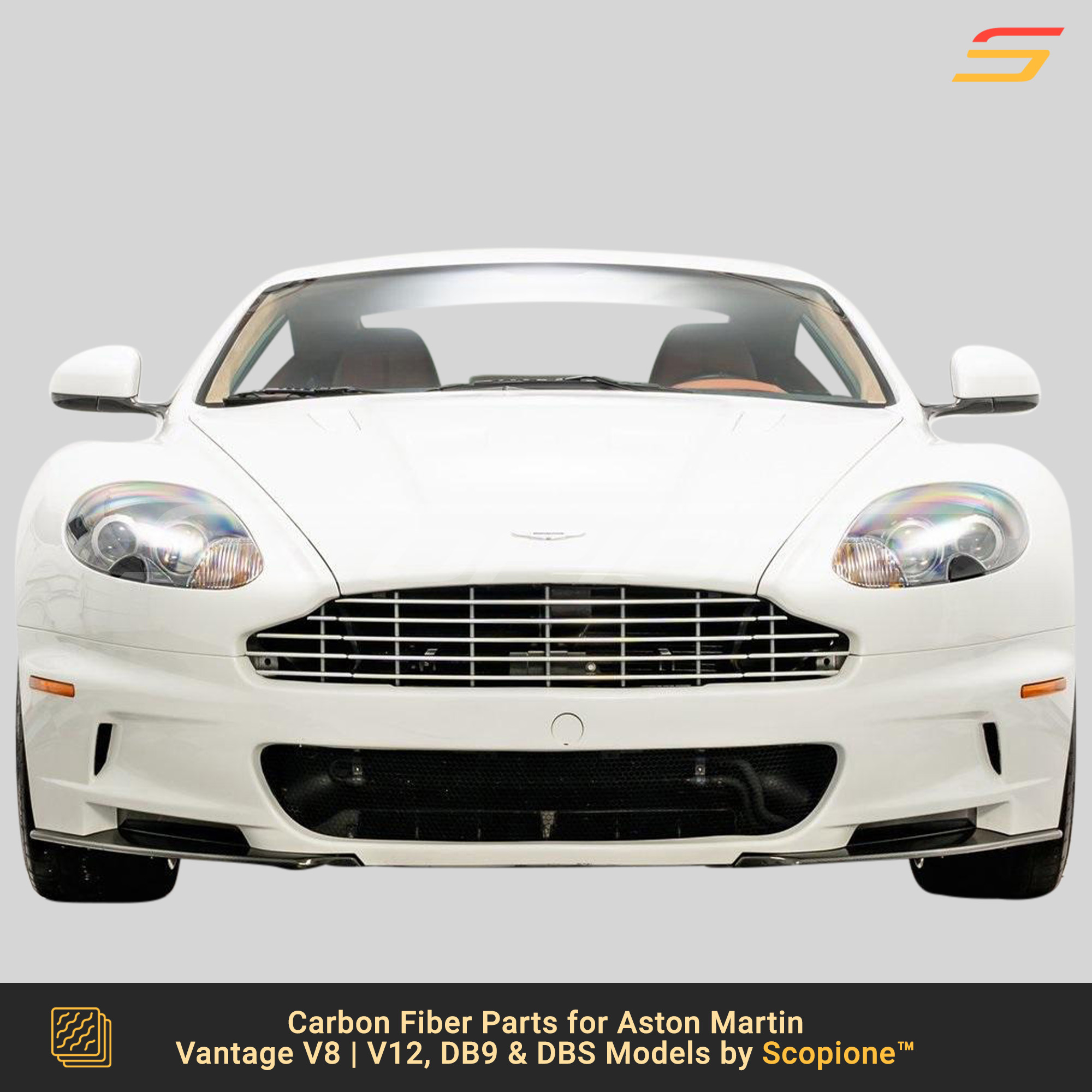
- DB9: 5.9L/6.0L V12, 450-510 hp, 2004-2016
- V8 Vantage: 4.3L/4.7L V8, 380-430 hp, 2005-2018
- Platform: VH bonded aluminum (shared across all models)
Scopione Perspective: The VH Platform Era
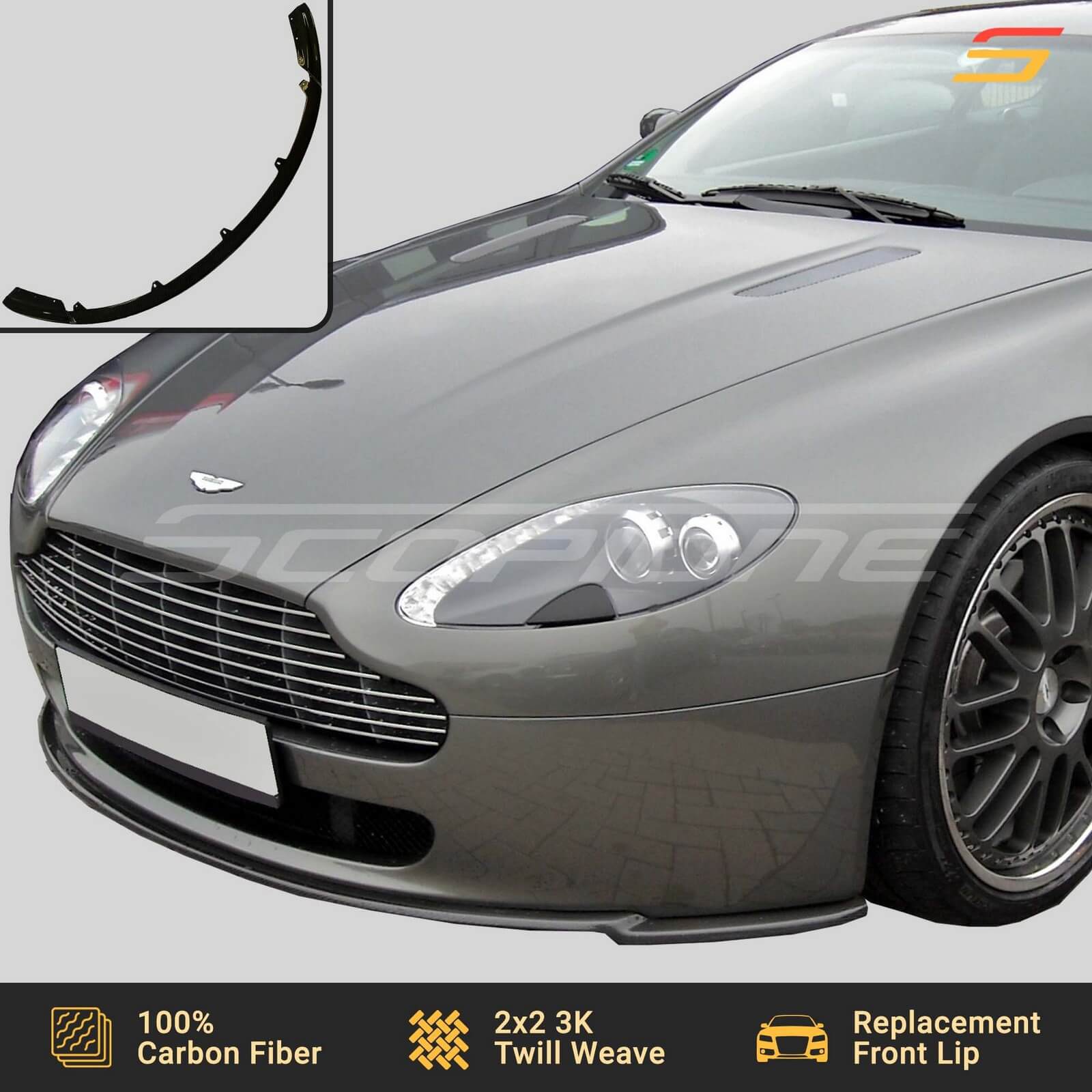
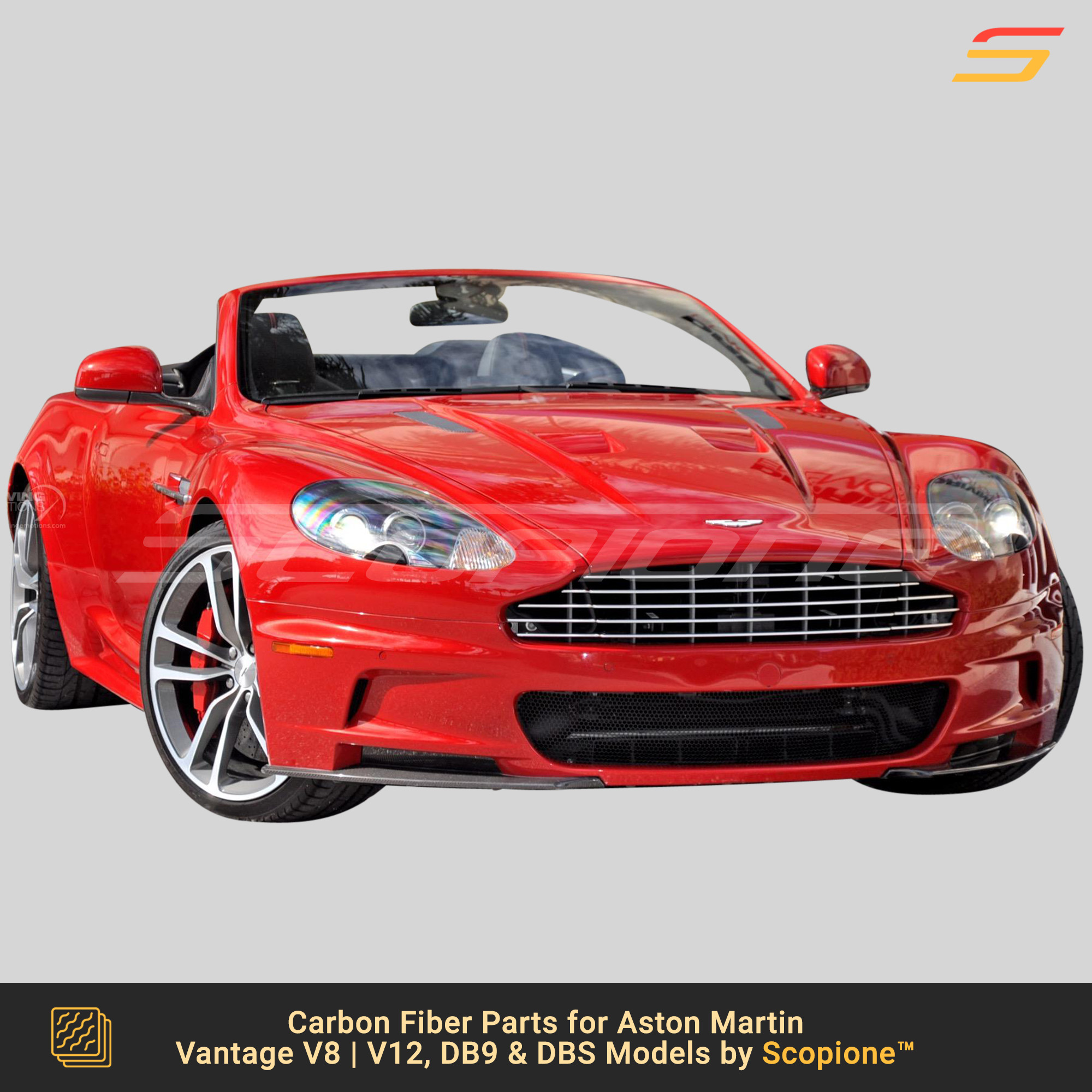
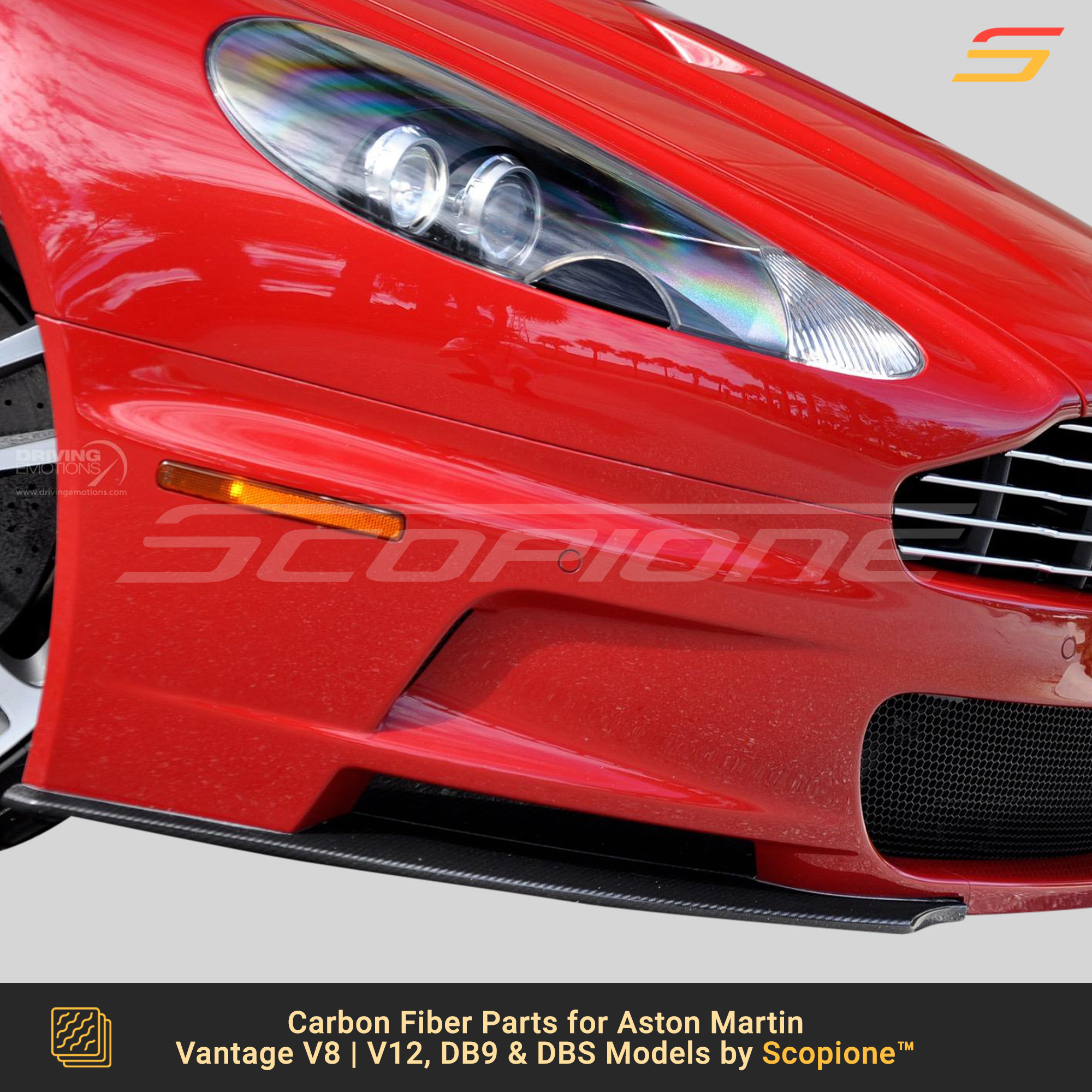
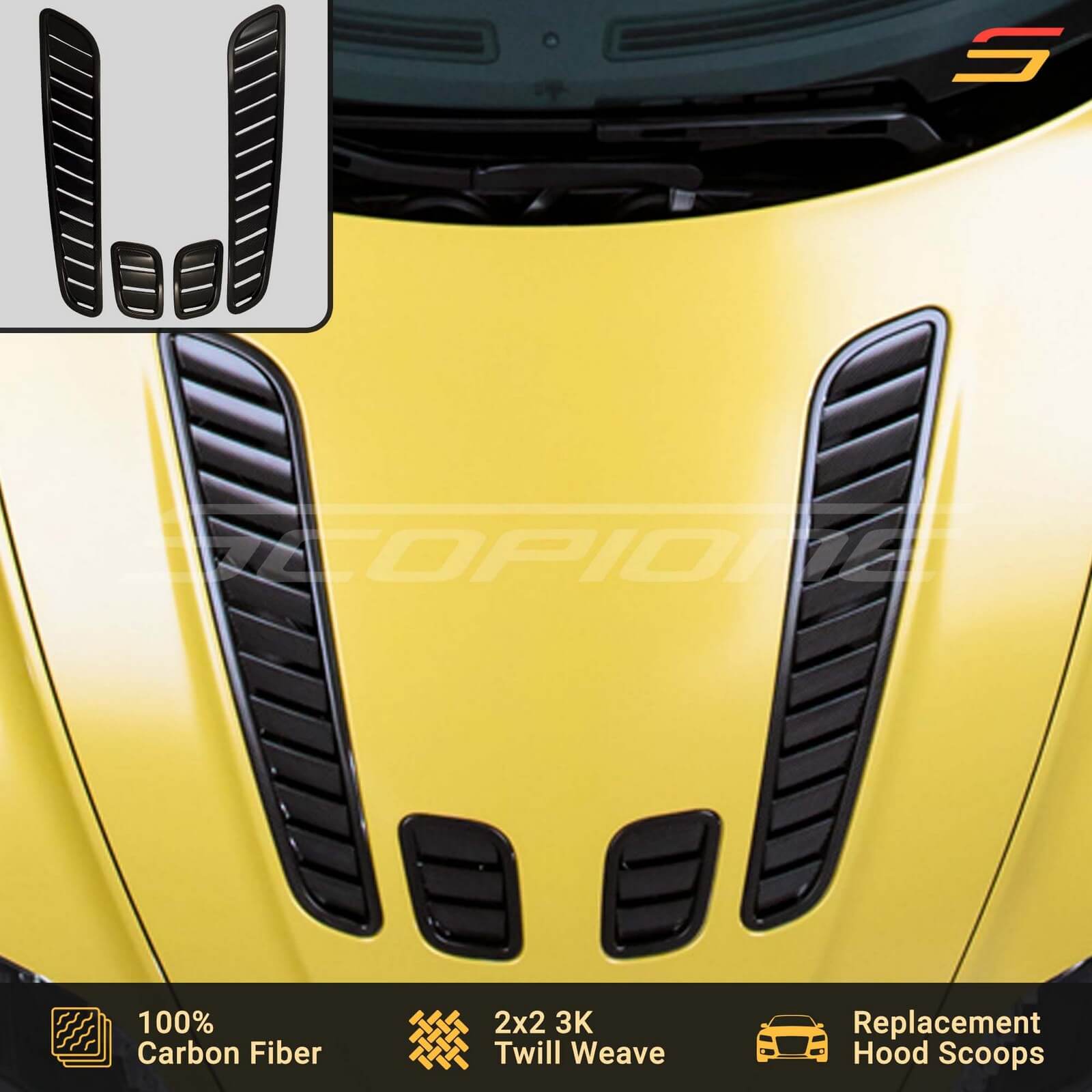
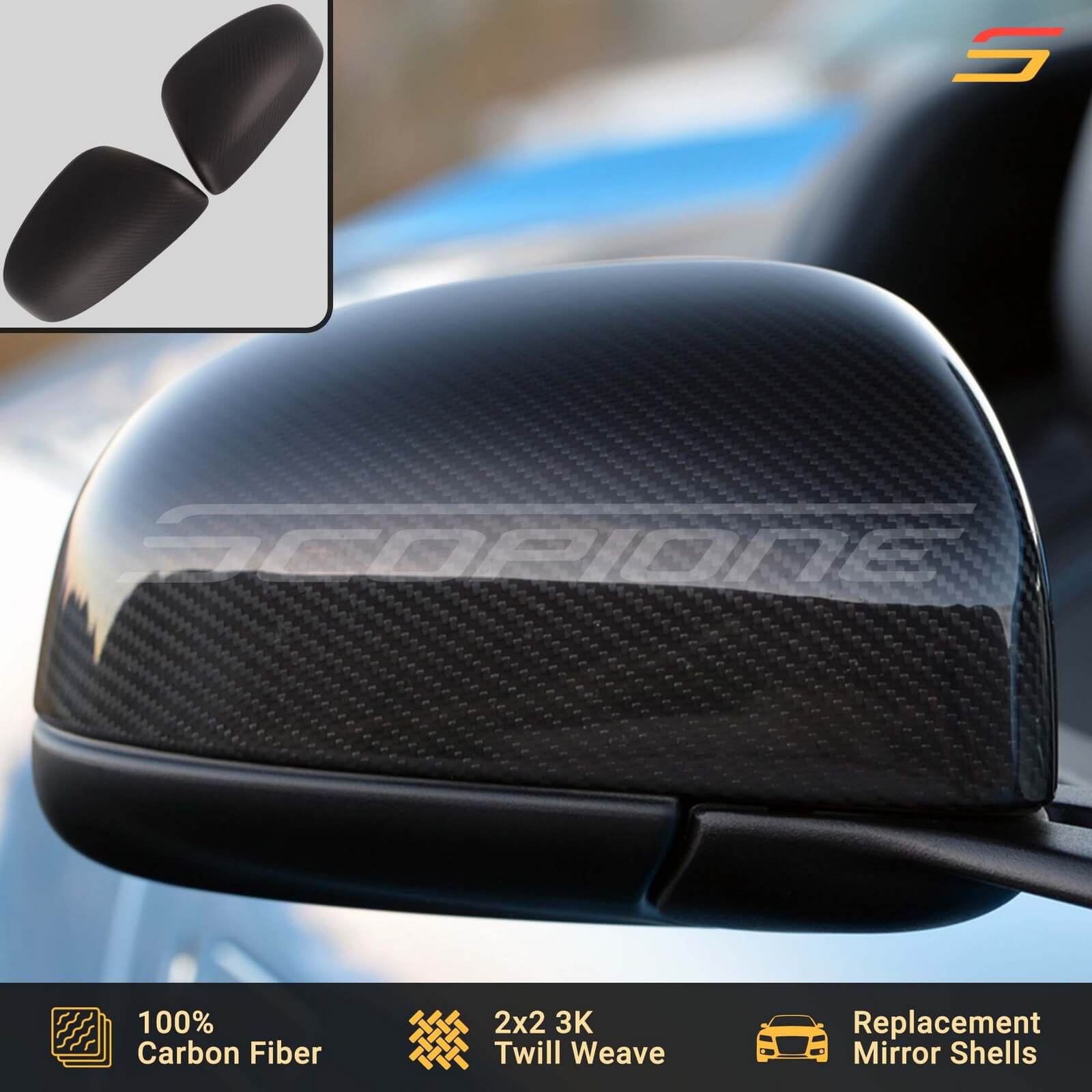
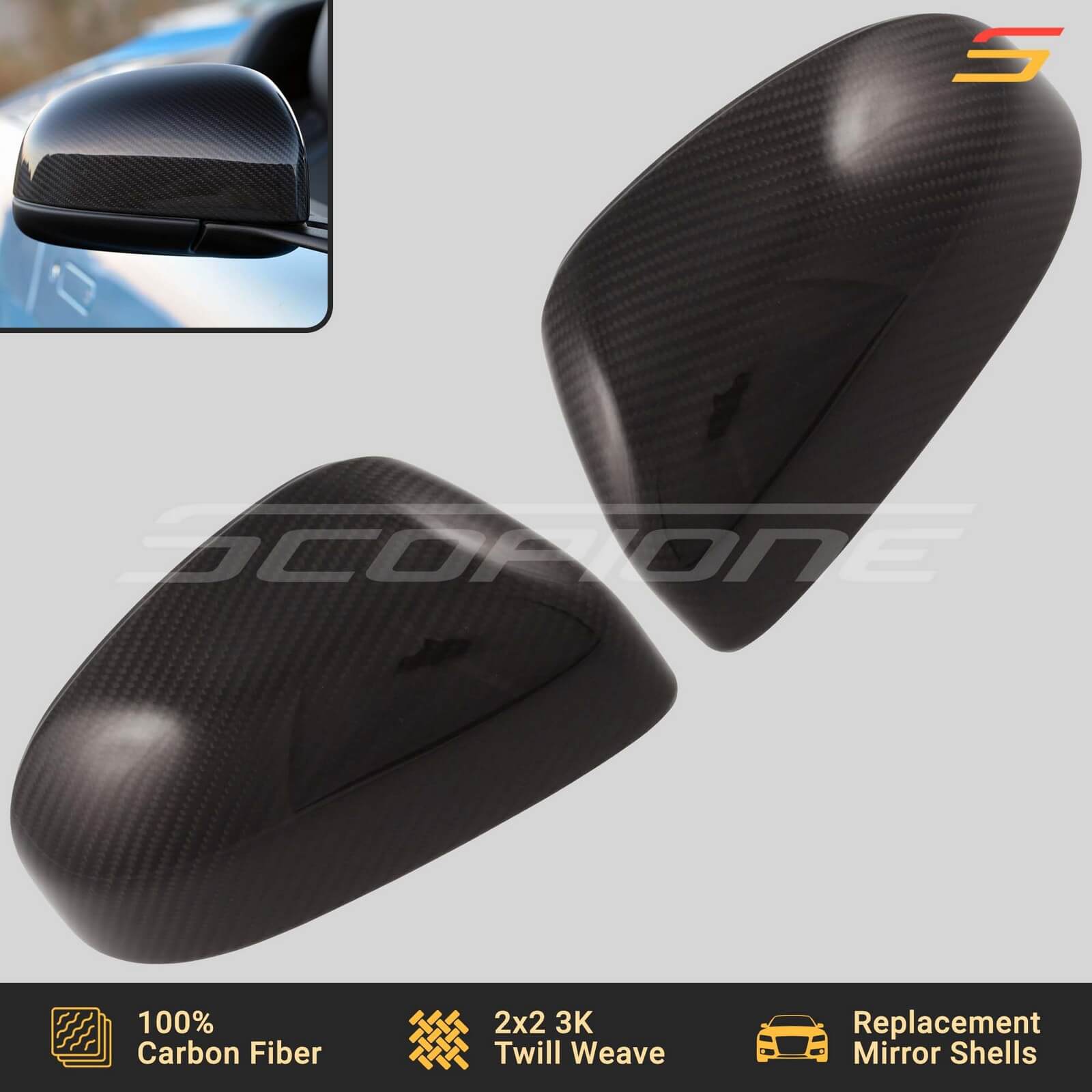
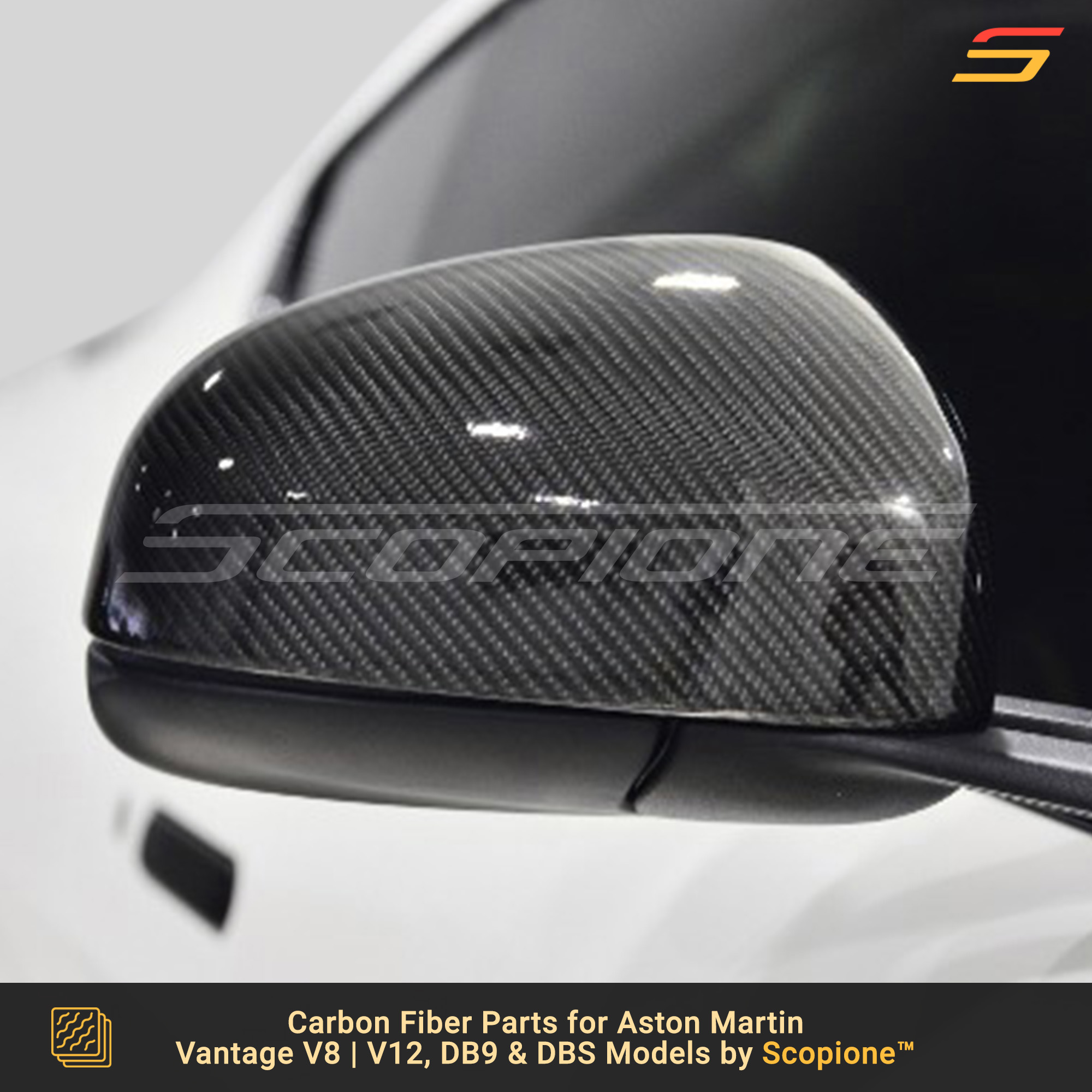
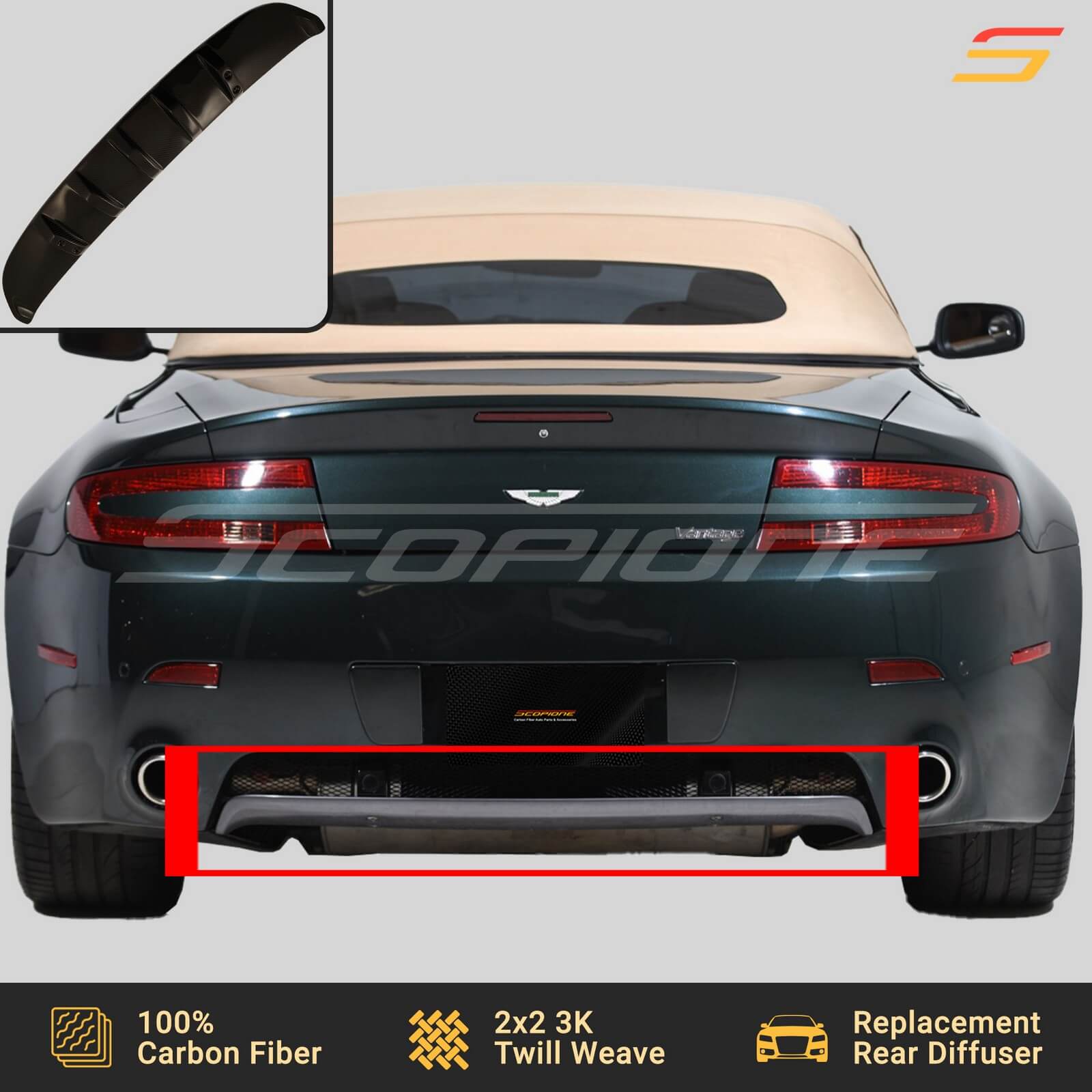
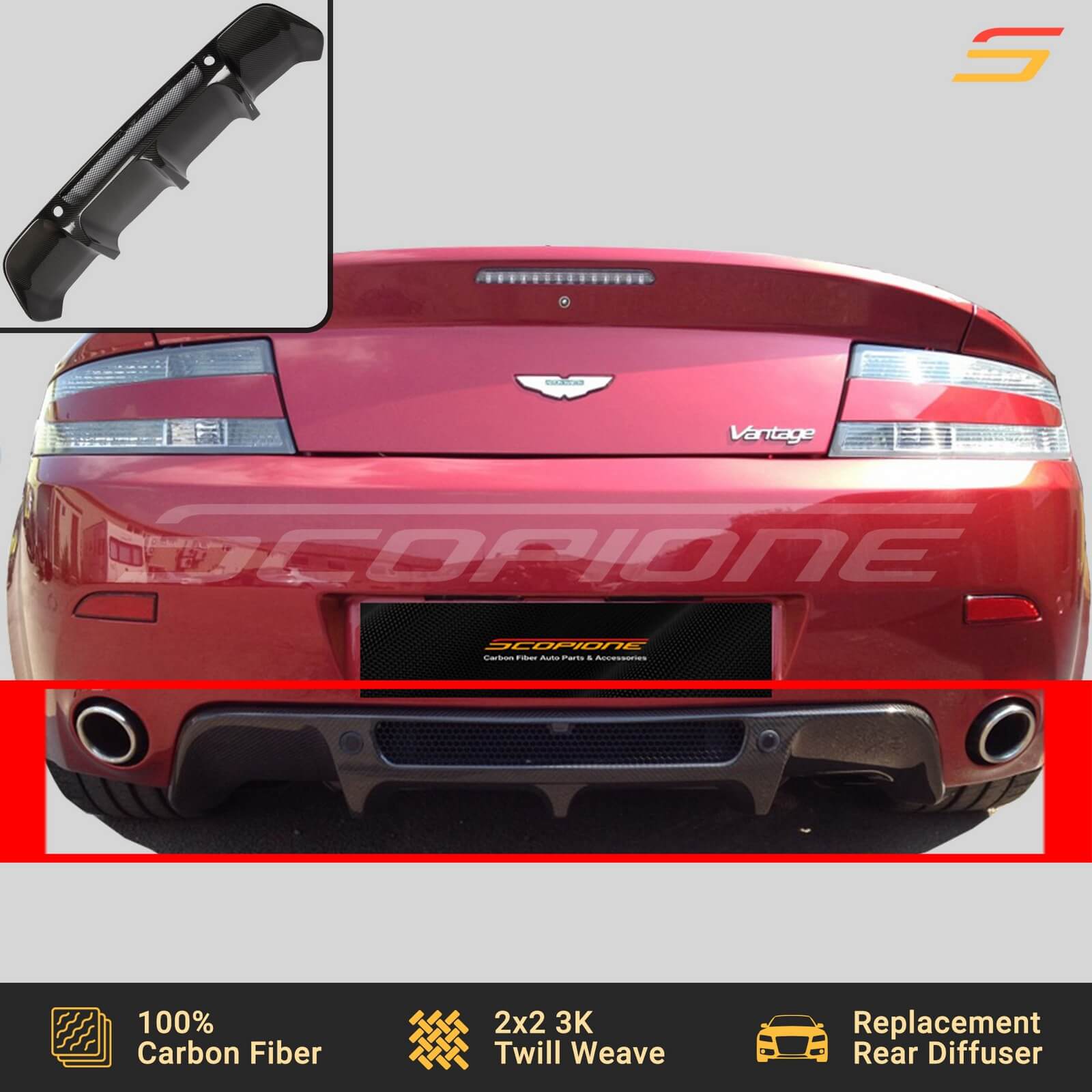
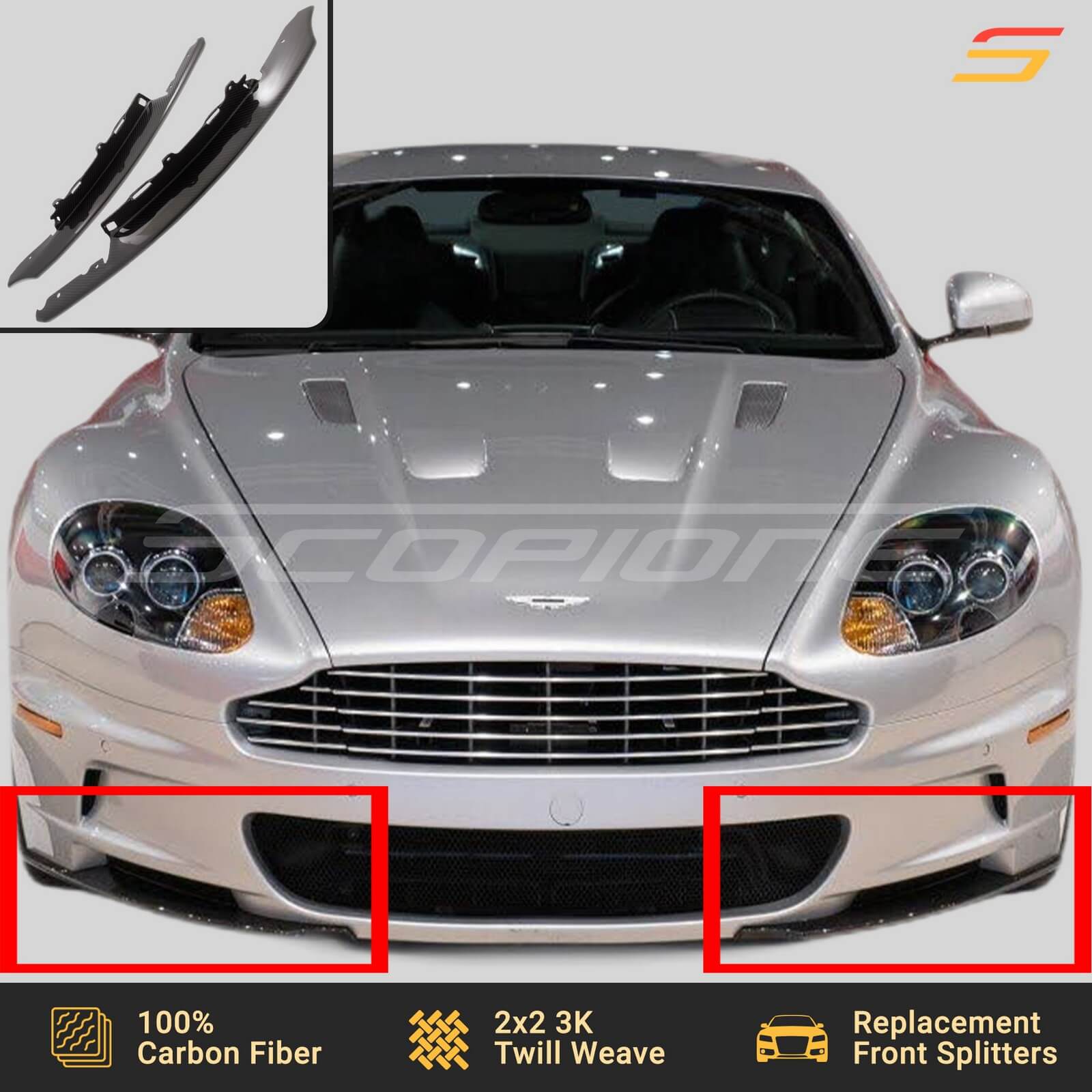
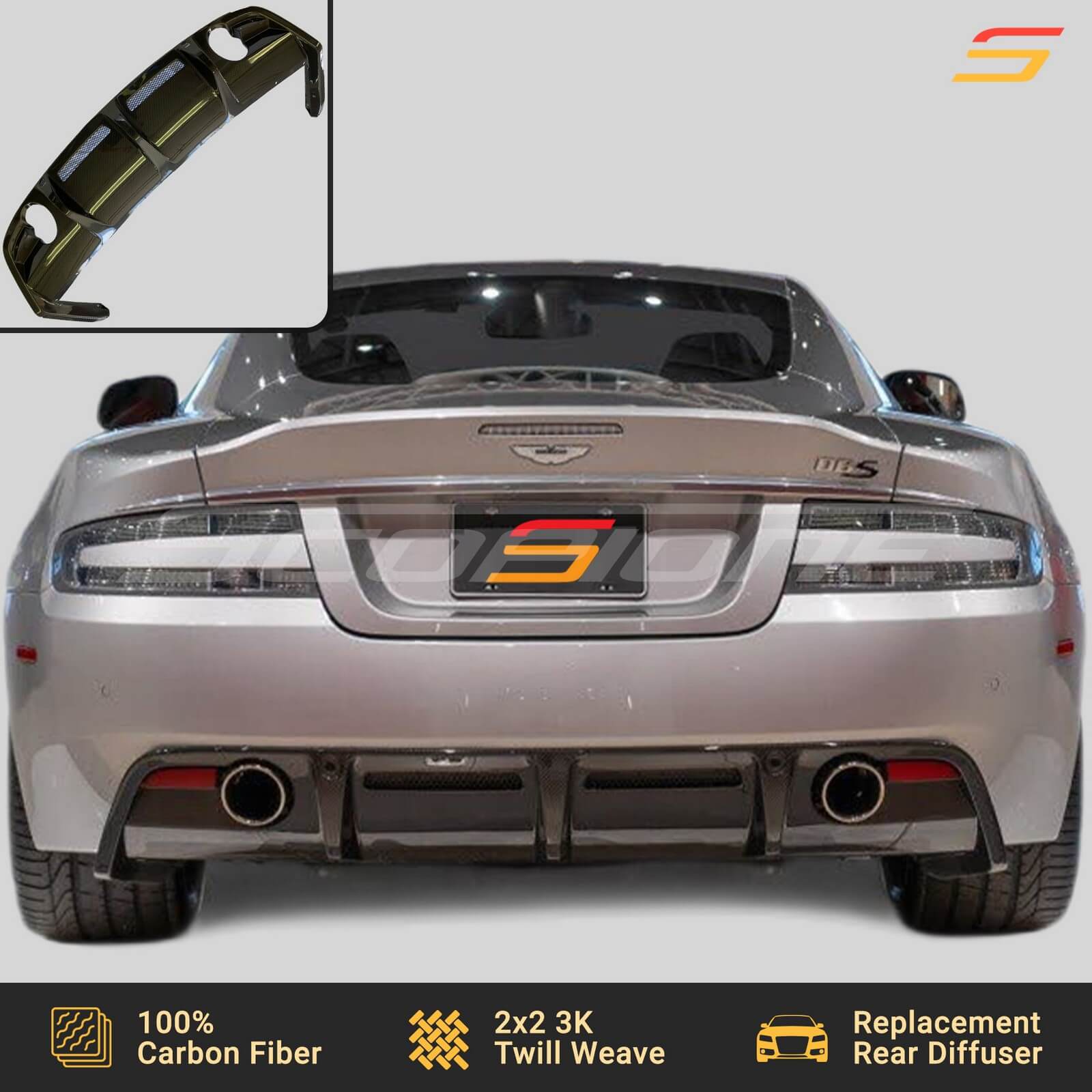
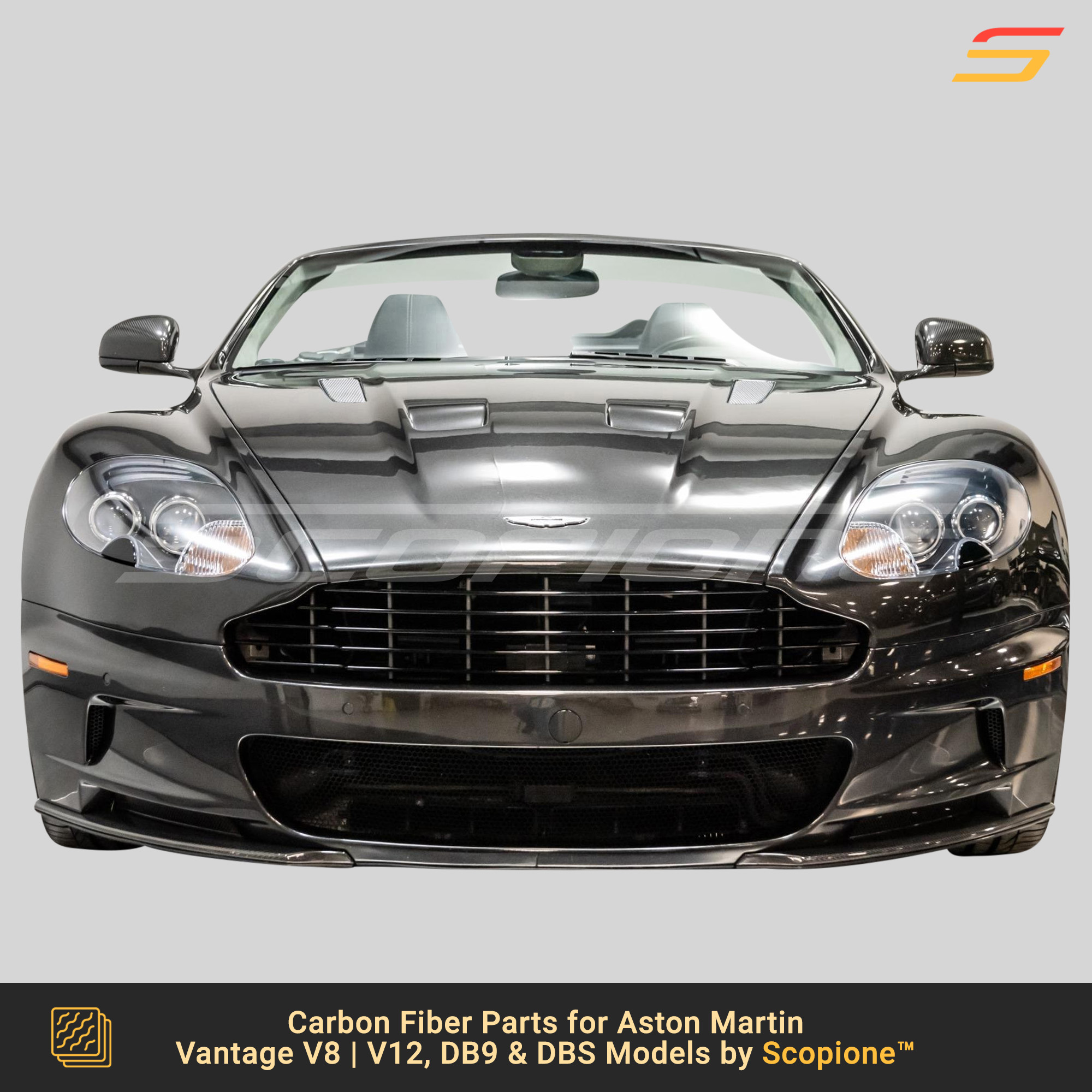
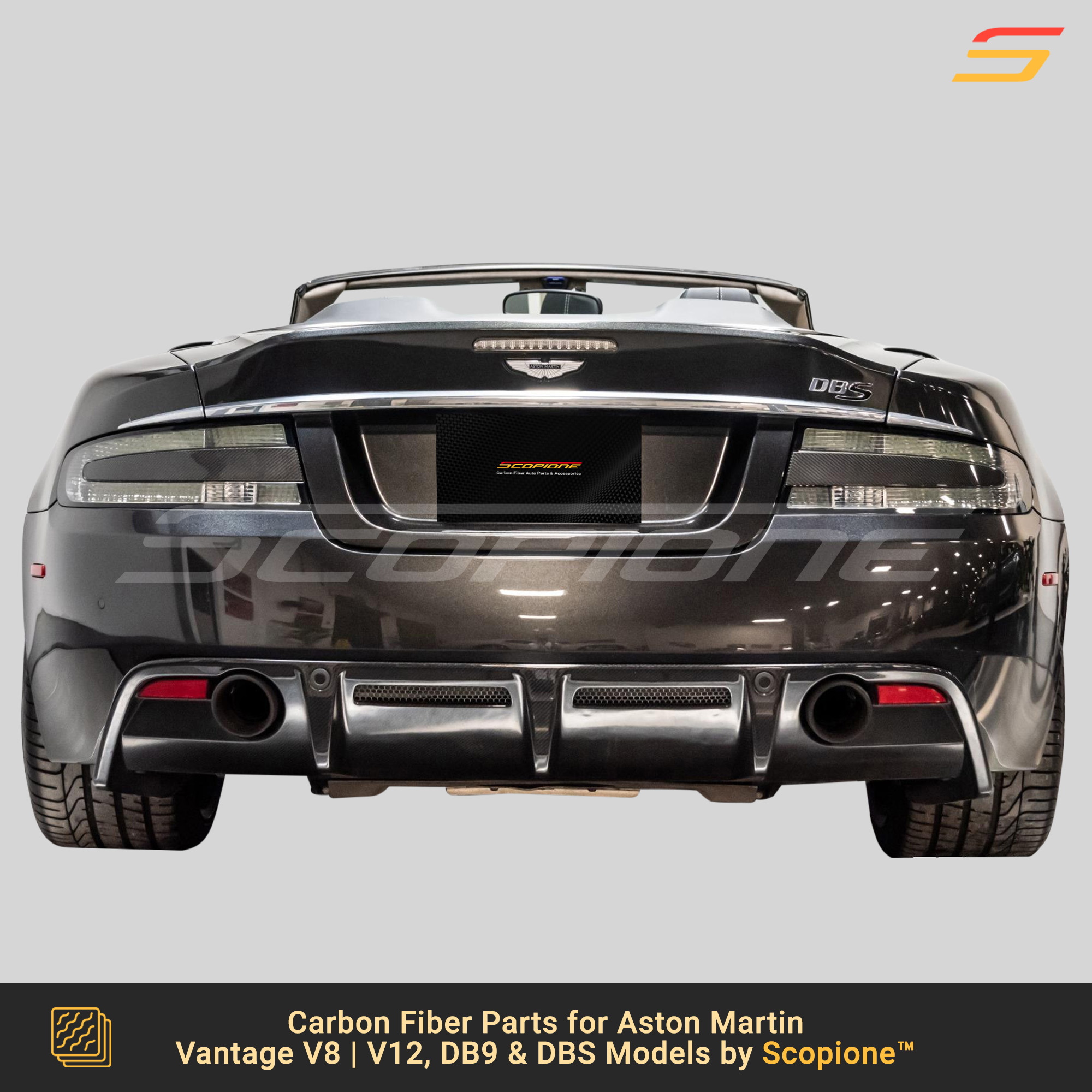
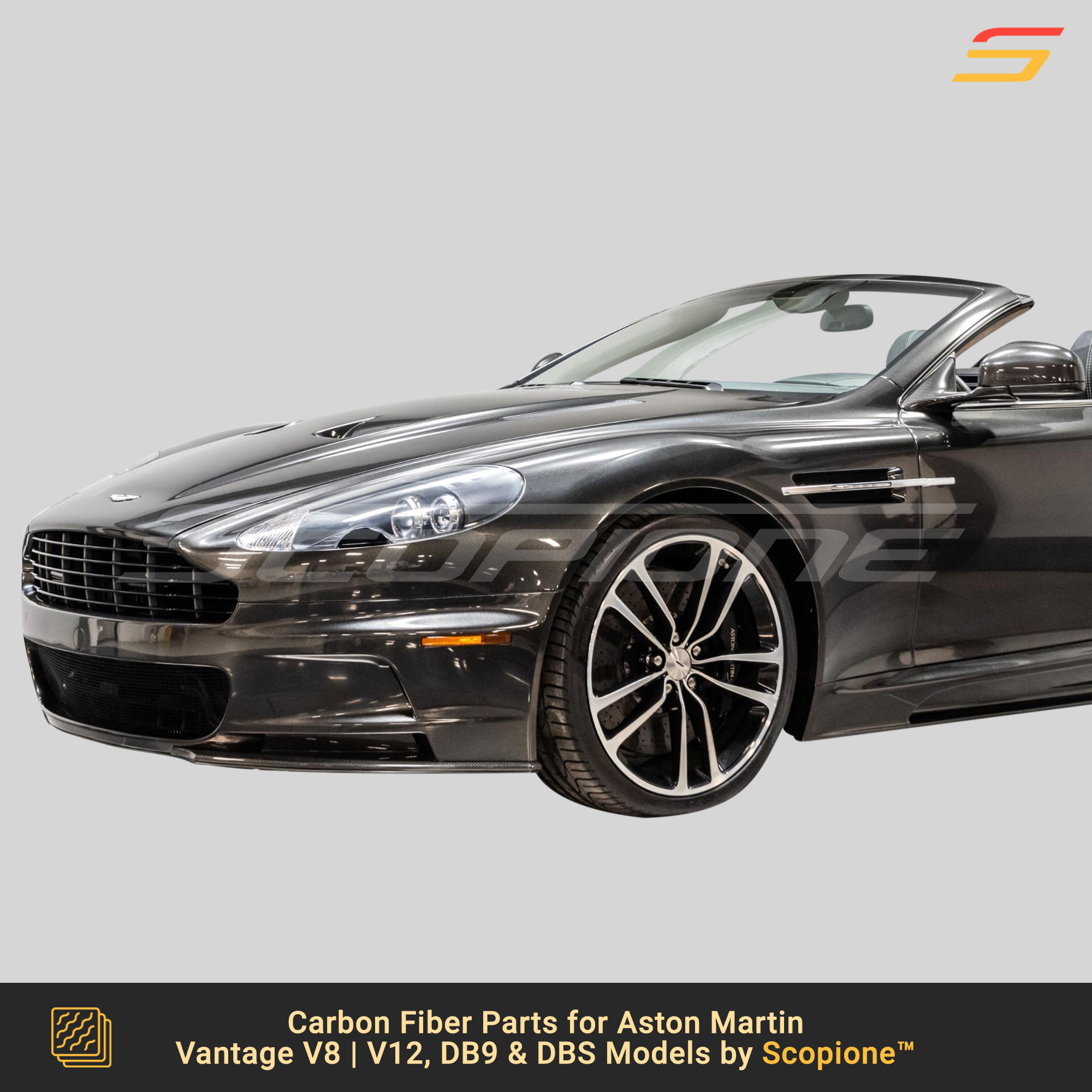
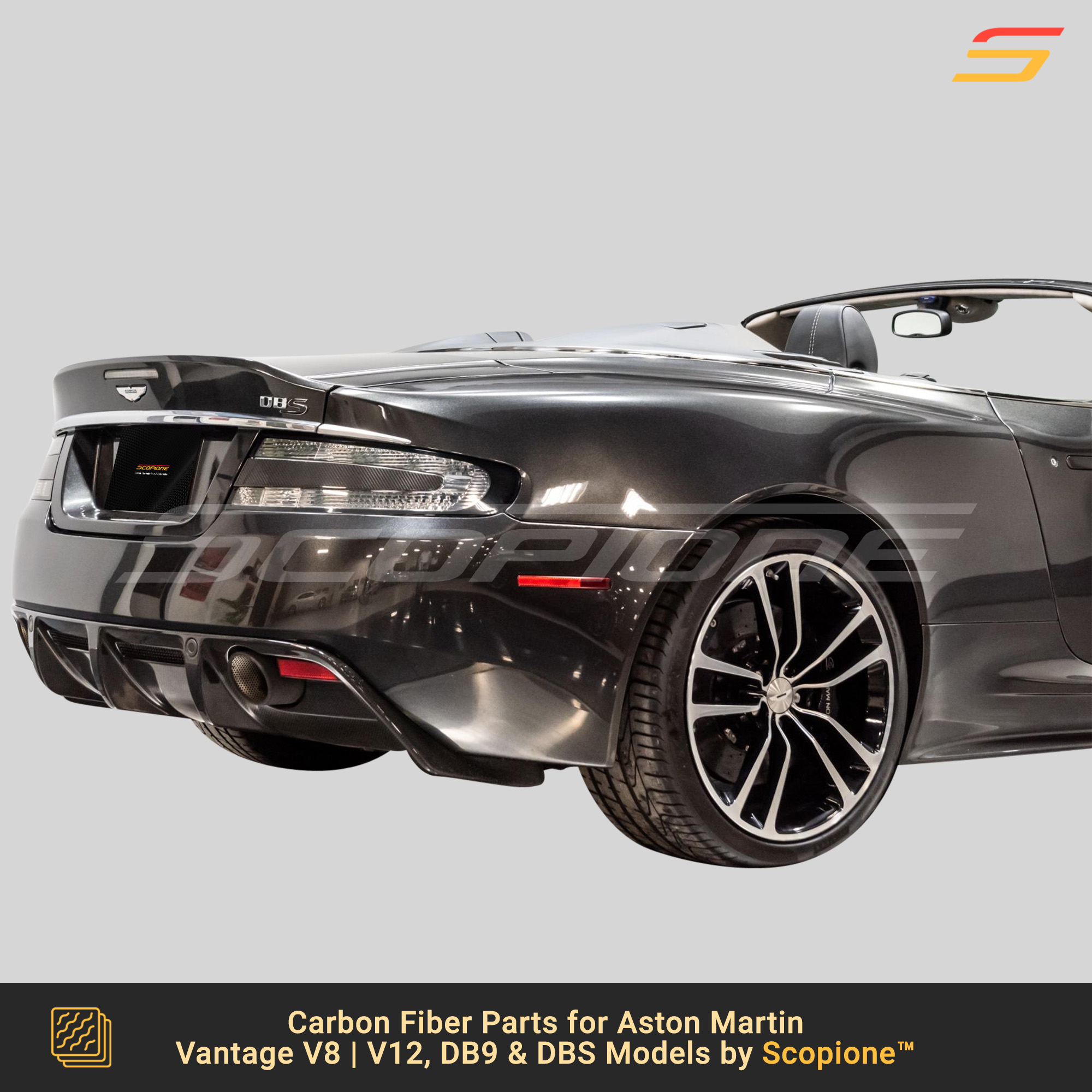
The VH-platform Aston Martins – Vantage, DB9, and DBS – used bonded aluminum rather than carbon fiber for their primary structures, but that aluminum construction makes them particularly responsive to CF aesthetic upgrades. A carbon-fiber front splitter, rear diffuser, or mirror cap on a V8 Vantage adds visual material contrast that stands out against the aluminum body panels. Scopione’s Aston Martin catalog spans front bumper lips and splitters, rear diffusers, fender side strakes, mirror covers in gloss and matte, tail light covers and a deep interior set – each precision-fitted to VH-platform mounting points for direct replacement without modification.


2008–2019: Post-Ford Independence and the One-77
Ford sold Aston Martin in March 2007 to a consortium led by David Richards of Prodrive for $925 million, ending nearly two decades of corporate ownership. Independence brought creative freedom and financial risk in equal measure. The 2008 global financial crisis hit luxury car manufacturers hard, and Aston Martin would navigate multiple ownership restructurings, a troubled 2018 IPO on the London Stock Exchange, and persistent losses through the decade. But the engineering output was extraordinary: the One-77 (full CF monocoque), the Vulcan (track-only CF monocoque), the second-generation Vanquish (full CF body panels), and the DBS Superleggera (72 kg saved through CF panels). Multimatic of Canada emerged as Aston Martin’s consistent CF manufacturing partner.
Aston Martin One-77 (2009-2012): The First Full CF Monocoque
The One-77 was conceived as a halo car – 77 examples, each priced at approximately £1.2 million. The engineering brief centered on a full carbon fiber monocoque chassis, designed at Aston Martin’s Gaydon headquarters and manufactured by Multimatic in Canada. Each monocoque required six workers and approximately three weeks to complete. The layup, curing, and autoclaving process was unforgiving – precision was non-negotiable at every stage.
The CF monocoque accounted for roughly half the value of each car. Each tub weighed approximately 150 kg – comparable to an F1 survival cell, though substantially larger. The layup process used pre-impregnated carbon fiber sheets (prepreg) placed in molds and cured under pressure and heat in an autoclave. Any wrinkle, void, or contamination detected during ultrasonic inspection meant scrapping the entire structure and starting over. Rejection rates during early production were high, contributing to the One-77’s protracted delivery timeline – the first cars were delivered in late 2009, but final deliveries continued into 2012.
The 7.3-liter V12, developed with Cosworth, produced 750 hp – at its launch, the most powerful naturally aspirated engine in a production car. Handcrafted aluminum body panels were shaped over the CF monocoque by hand, using traditional English-wheel techniques adapted to work over a composite substructure rather than a steel frame. Top speed, tested at 354 km/h (220 mph), was verified at Nardo rather than estimated. All 77 units were sold, with reported resale prices exceeding £2 million for low-mileage examples – a substantial premium over the original £1.2 million list price.
- Engine: 7.3L Cosworth-developed V12, 750 hp
- Top speed: 220 mph (verified)
- Weight: 1,630 kg curb
- Production: 77 units at ~£1.2M each
- Chassis: Full CF monocoque (Multimatic, Canada)
The One-77 established two things that would define Aston Martin’s CF trajectory. First, Multimatic of Canada became the company’s primary CF partner – a relationship that continued through the Vulcan and Valkyrie. Second, the engineering capability for a full CF monocoque existed within Aston Martin’s design team, even though manufacturing was outsourced. That internal knowledge would prove critical when Adrian Newey approached Aston Martin about the Valkyrie concept six years later.
Aston Martin Vanquish (2012-2018): CF Body Panels at Volume
The second-generation Vanquish was the first production Aston Martin where every exterior body panel was carbon fiber. Bonnet, roof, front fenders, door skins, trunk lid, rear fenders – all CF, mounted over the familiar VH bonded aluminum platform. The VH structure underneath remained aluminum, but the body was entirely composite. This was a different CF strategy than the One-77’s: rather than a full monocoque visible only to engineers, the Vanquish used CF as a body material visible to owners and visible on the road.
The naturally aspirated 5.9-liter (later 6.0-liter) V12 produced 565-595 hp. Manufacturing CF body panels in-house at Gaydon was a deliberate capability investment. Aston Martin installed autoclave capacity and trained its own composite technicians rather than outsourcing to Multimatic. The panels were produced using prepreg layup in matched molds – a simpler process than the One-77’s structural monocoque but still requiring careful quality control for surface finish consistency. Paint adhesion to CF panels demands different surface preparation than aluminum, and Gaydon’s paint shop adapted its processes for the new material.
The Vanquish S (2016) pushed output to 595 hp and added a revised rear diffuser for additional downforce. A Volante (convertible) variant followed, requiring structural reinforcement to compensate for the removed roof section – a challenge made easier by CF’s high specific stiffness. The second-generation Vanquish bridged the gap between the One-77’s halo-car monocoque and Aston Martin’s production-volume capability.
- Engine: 5.9L/6.0L naturally aspirated V12, 565-595 hp
- Top speed: 201 mph
- 0-60 mph: ~3.6 seconds
- Body: Full carbon fiber exterior panels over VH aluminum platform
Aston Martin Vulcan (2015-2016): Track-Only CF Monocoque
The Vulcan was born from meetings between Aston Martin’s Q Advanced Engineering division and the Motorsport team. One-77 development prototypes were available, and the engineering brief stripped away every road-legal constraint. The result was 24 units, each priced at £1.8 million, powered by a naturally aspirated 7.0-liter V12 producing 820 hp. Track-only. No sound insulation, no emissions equipment, no ride-height compromises.
The Vulcan’s aerodynamic package generated over 1,300 kg of downforce at maximum speed – a figure that required the CF monocoque to carry substantially higher structural loads through the suspension pickup points than any previous Aston Martin. The rear wing alone contributed approximately 400 kg of downforce at 200 mph. Adjustable ride height, accessible through Aston Martin’s telemetry system, allowed owners to configure the car for different circuit characteristics. Racing engineers Ray Mallock Limited (RML) later converted one Vulcan to road specification – demonstrating that the CF structure could meet road-legal standards if required. The Vulcan’s CF monocoque technology fed directly into the Valkyrie program. Its six-stage inboard suspension design later reappeared in the one-off Victor (2020), combined with the One-77’s V12 and its CF monocoque – three generations of Aston Martin CF technology in a single car.
- Engine: 7.0L naturally aspirated V12, 820 hp
- Production: 24 units at £1.8M each
- Application: Track-only (one converted to road spec by RML)
- Chassis: Full CF monocoque
Aston Martin DBS Superleggera (2018-2023): The Name Returns
The DBS Superleggera revived a name with sixty years of history. In the 1950s, “Superleggera” meant Touring of Milan’s aluminum-over-steel-tube technique. In 2018, it meant carbon fiber. Every major body panel on the DBS Superleggera was CF, saving 72 kg (160 lbs) compared to the equivalent aluminum panels on the DB11. The renaming was deliberate: the same philosophy of lightness through material innovation, advanced by six decades of engineering.
The 5.2-liter twin-turbo V12 produced 715 hp (725 PS) and 900 Nm of torque. The CF body generated 180 kg of downforce – the highest figure for a series-production Aston Martin at its launch. The aerodynamic development was conducted in partnership with Aston Martin’s fledgling F1 connections – wind tunnel time and CFD analysis informed the front splitter angle, side strake placement, and Aeroblade rear channeling system that draws cooling air through the C-pillars and exits as a virtual spoiler at the trailing edge. Available CF options included a 2×2 twill gloss roof panel, mirror caps, splitter, diffuser, and rear spoiler – making the DBS Superleggera one of the few cars where the owner could specify nearly complete visible CF coverage from the factory.
The 72 kg weight saving from CF body panels had measurable effects beyond straight-line performance. Lower body mass raised the center-of-gravity position relative to the roll centers, but the overall mass reduction more than compensated – the DBS Superleggera recorded a 3.4-second 0-62 mph time and a 211 mph top speed. Its weight distribution (51:49 front-to-rear) was marginally better than the aluminum-bodied DB11’s. The DBS Superleggera remained in production until 2023, concluding with the DBS 770 Ultimate limited edition (499 units). Across its five-year run, the DBS Superleggera was the highest-volume Aston Martin with a full CF body.
- Engine: 5.2L twin-turbo V12, 715 hp (725 PS)
- 0-62 mph: 3.4 seconds
- Top speed: 211 mph
- Weight savings: 72 kg over DB11 (CF body panels)
- Downforce: 180 kg
Scopione Perspective: From Aluminum to Carbon Fiber
Aston Martin’s transition from aluminum body panels (DB9, V8 Vantage, DB11) to carbon fiber (Vanquish, DBS Superleggera) mirrors the broader shift in the GT car segment. Owners of VH-platform models – the Vantage, DB9, and DBS – can achieve a similar visual transformation through aftermarket CF components. A carbon-fiber front lip, side skirts, or diffuser on a DB9 introduces the material contrast that factory-spec DBS Superleggera buyers receive as standard. Scopione’s Aston Martin components use the same 2×2 weave pattern found on factory CF options, so aftermarket and OEM pieces sit together without a visible pattern clash.
2020s–Present: The Valkyrie Era and Next Generation

Lawrence Stroll’s consortium invested £182 million in Aston Martin in early 2020, preventing the company’s latest financial collapse. Further fundraising rounds through 2022 brought the cumulative investment past £600 million. Stroll – a Canadian billionaire who had built his fortune in fashion (Tommy Hilfiger, Michael Kors) – brought an F1 team along with the investment. Racing Point was rebranded as Aston Martin F1 for the 2021 season, returning the Aston Martin name to Formula 1 for the first time since 1960. The team operates from a purpose-built facility at Silverstone with its own wind tunnel, composites workshop, and autoclave capacity. The F1 connection was not purely symbolic: it accelerated the transfer of aerodynamic and composite technology from motorsport to road cars, particularly through the Valkyrie program’s partnership with Red Bull Advanced Technologies. Engineers moved between the F1 team and the road-car division, carrying manufacturing techniques for complex CF layups – a technology transfer pipeline similar to what McLaren established between its racing team and McLaren Automotive.
The Valkyrie finally entered production after years of development delays. The Valhalla followed – a “son of Valkyrie” with a CF tub derived from the same program but produced by Aston Martin rather than outsourced to Multimatic. The DB12 and third-generation Vanquish continue with bonded aluminum primary structures, but CF body panels and aerodynamic components are increasingly standard. Aston Martin’s CF story is no longer confined to halo cars.
Aston Martin Valkyrie (2021-Present): F1 Technology for the Road
Adrian Newey conceived the Valkyrie as the closest approximation of a Formula 1 car that could legally drive on public roads. Red Bull Advanced Technologies handled the aerodynamic design. Multimatic of Canada – Aston Martin’s CF partner since the One-77 – built the carbon fiber monocoque. Cosworth developed a bespoke 6.5-liter naturally aspirated V12 (designated the RA) that revs to 11,100 rpm and weighs just 206 kg – comparable to a scaled-up F1 engine. Rimac supplied the lightweight hybrid battery system, adding 160 PS to the V12’s 1,000 hp for a combined 1,160 hp.
The CF monocoque features seats molded directly into the tub – driver-fitted, as in an F1 car. Pushrod suspension pickup points are integrated into the CF structure. The underfloor works on ground-effect aerodynamic principles, generating up to 1,800 kg of downforce at high speed. At 1,270 kg dry, the Valkyrie achieves over 900 hp per tonne. It lapped Silverstone in 1 minute 56.42 seconds – the first road-legal car to break the two-minute barrier on the F1 circuit.
- Engine: 6.5L Cosworth RA V12 + KERS hybrid, 1,160 hp combined
- 0-62 mph: Under 2.5 seconds
- Dry weight: 1,270 kg
- Downforce: Up to 1,800 kg (ground effect)
- Production: 150 coupes + 85 Spiders + 40 AMR Pro (275 total)
- Chassis: CF monocoque (Multimatic / Red Bull AT)
The AMR Pro track variant strips the Valkyrie to 1,000 kg dry weight – a figure achieved through further CF optimization, removal of the hybrid system, a 380 mm longer wheelbase, and a fixed rear wing. The forty AMR Pro units generate up to 2,000 kg of downforce – twice the car’s dry mass. The AMR Pro’s CF body incorporates active aerodynamic elements including a DRS-style rear wing that opens on straights to reduce drag.
The Valkyrie AMR-LMH racing variant competed in the World Endurance Championship’s Hypercar class, running against the Toyota GR010, Ferrari 499P, and Porsche 963. The racing program pushed CF manufacturing tolerances beyond what the road car required: the LMH variant’s monocoque incorporates additional CF reinforcement around the roll-hoop and side-impact structures to meet FIA safety regulations. A limited-run Valkyrie LM (10 units) was announced in 2025 at approximately £5 million per car, incorporating aerodynamic lessons from the Le Mans racing program.
Aston Martin Victor (2020): Three Generations in One Car
The Victor was a one-off commission by Q by Aston Martin that combined CF technology from three programs: a refurbished One-77 carbon fiber monocoque, the same car’s 7.3-liter V12 (tuned to 836 hp), and the Vulcan’s six-stage inboard suspension. A manual gearbox – in a car sitting on a full CF tub – was the deliberate provocation. The retro-styled body, hand-formed in aluminum with a silhouette drawn from the 1977 V8 Vantage, was a visual counterpoint to the advanced composite structure underneath.
Q by Aston Martin’s engineers spent over 18 months on the project, much of it devoted to mating the Vulcan’s track-derived suspension to the One-77’s road-car monocoque – two CF structures designed with different load assumptions. The manual gearbox, sourced from the Vantage, required a bespoke bellhousing to interface with both the V12 and the monocoque’s transmission mounting points. Only one Victor was built, but it demonstrated the modularity of Aston Martin’s CF structures: a single monocoque designed in 2008 could accept suspension from a 2015 track car and a gearbox from a 2018 GT without structural compromise.
- Engine: 7.3L V12 (from One-77), 836 hp
- Gearbox: Manual (from Vantage)
- Production: 1 unit
- Chassis: One-77 CF monocoque + Vulcan suspension
Aston Martin Valhalla (2025-Present): In-House CF Production
The Valhalla marks a turning point in Aston Martin’s CF story. Where the One-77, Vulcan, and Valkyrie all relied on Multimatic for monocoque production, the Valhalla’s carbon fiber tub is produced by Aston Martin using combined Resin-Transfer-Molding (RTM) and F1-derived autoclave technology. The upper and lower tub sections are molded from carbon fiber in-house at Aston Martin’s Gaydon facility. RTM offers faster cycle times than traditional prepreg layup – dry carbon fiber fabric is placed in the mold, the mold is closed, and resin is injected under pressure before curing. This reduces per-unit production time compared to the One-77’s labor-intensive hand-layup process while maintaining structural integrity. Aston Martin now controls its own CF supply chain – a capability that McLaren achieved with its Sheffield MCTC in 2018 and that Ferrari has gradually developed through its Modena and Maranello facilities.
The powertrain is Aston Martin’s first plug-in hybrid and first mid-engine production car. A bespoke 4.0-liter flat-plane twin-turbo V8 produces 828 PS – the highest specific output (207 PS per liter) of any Aston Martin engine. Three electric motors (two front-axle, one rear) bring combined output to 1,079 PS. All-wheel drive. F1-style pushrod front suspension. Carbon ceramic brakes. Active aerodynamics with DRS. The first customer car was delivered in December 2025 in the UK, following an extended development period that saw the Valhalla’s specification revised significantly from its original 2019 concept debut at the Geneva Motor Show.
- Engine: 4.0L flat-plane twin-turbo V8 + 3 electric motors, 1,079 PS combined
- 0-62 mph: 2.5 seconds
- Top speed: 217 mph
- Dry weight: 1,655 kg (3,649 lbs)
- Production: 999 units at ~$1M
- Chassis: Bespoke CF tub (in-house RTM + autoclave)
Nine hundred ninety-nine units are planned. The Valhalla bridges the gap between Aston Martin’s limited-production halo cars (77 One-77s, 24 Vulcans, 275 Valkyries) and the company’s bonded-aluminum grand tourers. It is the first Aston Martin where a CF tub is paired with a production volume approaching four figures – evidence that CF monocoque construction is no longer reserved for 77-unit or 24-unit exclusivity.
Aston Martin DB12 and Vanquish (3rd Generation): CF Cascades Down
The DB12 (2023) and third-generation Vanquish (2024) continue with bonded aluminum primary structures – Aston Martin has not yet followed McLaren’s all-CF-chassis approach for its front-engine grand tourers. But carbon fiber content is increasing. The DB12’s AMG-sourced 4.0-liter twin-turbo V8 produces 671 hp, and Aston Martin designated it a “super tourer” rather than a grand tourer – a signal that performance expectations are rising. The Vanquish carries an 824 hp twin-turbo V12, making it the most powerful production front-engine Aston Martin. Both models offer CF aerodynamic components and optional CF body panel elements.
The three generations of Vanquish trace Aston Martin’s entire CF journey in a single model name. The original V12 Vanquish (2001) introduced CF as a structural backbone – a nine-layer tunnel and composite pillars embedded in an aluminum chassis. The second generation (2012) wrapped the entire body in CF panels over a VH aluminum platform. The third generation (2024) integrates CF aerodynamic elements as standard rather than optional, with the underlying structure remaining bonded aluminum. Each generation has increased its CF content without abandoning aluminum entirely – a trajectory that mirrors the company’s broader approach of selectively applying composite materials where the weight-savings benefit justifies the manufacturing complexity.
The DB12 also marks the end of Aston Martin’s naturally aspirated era for its front-engine range. The AMG-sourced twin-turbo V8 is lighter than the outgoing V12, and the weight saved contributes to a lower front-axle load that improves turn-in response. CF components on the DB12 – available as part of the Sport+ Package – include a front splitter, mirror caps, rear diffuser, and exhaust surrounds. The visual effect of exposed carbon weave against the DB12’s painted bodywork creates a distinctly different character than the full-CF body of the DBS Superleggera, where CF was structural rather than decorative.
- DB12: 4.0L AMG twin-turbo V8, 671 hp, 2023-present
- Vanquish (3rd gen): 5.2L twin-turbo V12, 824 hp, 2024-present
- CF integration: Aero components, optional body panels, interior elements
Scopione Perspective: Carbon Fiber Across the Aston Martin Range
Aston Martin’s product range now spans from bonded-aluminum grand tourers (DB12, Vantage) to full CF-tubbed hypercars (Valkyrie, Valhalla). That breadth means CF upgrades serve different purposes depending on the model. On a Vantage or DB9, aftermarket carbon-fiber components add material contrast and visual distinction – the dark weave pattern against painted aluminum body panels creates a visual statement. Each Scopione part ships with a protective clear coat that resists UV yellowing, preserving the deep gloss and weave clarity that distinguish genuine carbon fiber from painted imitations over years of daily driving and sun exposure.
View Scopione’s Complete Aston Martin Carbon Fiber Selection
Frequently Asked Questions
Aston Martin and Carbon Fiber: Common Questions
When did Aston Martin first use carbon fiber?
Aston Martin first incorporated carbon fiber into a production car with the V12 Vanquish in 2001. The Vanquish featured a nine-layer CF transmission tunnel, CF windscreen pillars, and CF crash structures integrated into a bonded aluminum chassis. The first full CF monocoque came with the One-77 in 2009, built by Multimatic of Canada.
What is the Aston Martin Valkyrie’s carbon fiber monocoque?
The Valkyrie’s CF monocoque was designed with Red Bull Advanced Technologies and built by Multimatic of Canada. It features seats molded directly into the tub, F1-derived pushrod suspension pickup points, and ground-effect aerodynamic channels formed into the underbody. At 1,270 kg dry weight with 1,160 hp, the Valkyrie achieves over 900 hp per tonne.
Which Aston Martin models have carbon fiber body panels?
The second-generation Vanquish (2012-2018) was the first production Aston Martin with full CF body panels over its VH aluminum platform. The DBS Superleggera (2018-2023) continued this approach, saving 72 kg over the DB11 through CF panels. The third-generation Vanquish (2024) and Valhalla (2025) also feature extensive carbon fiber body construction.
What carbon fiber parts does Scopione offer for Aston Martin?
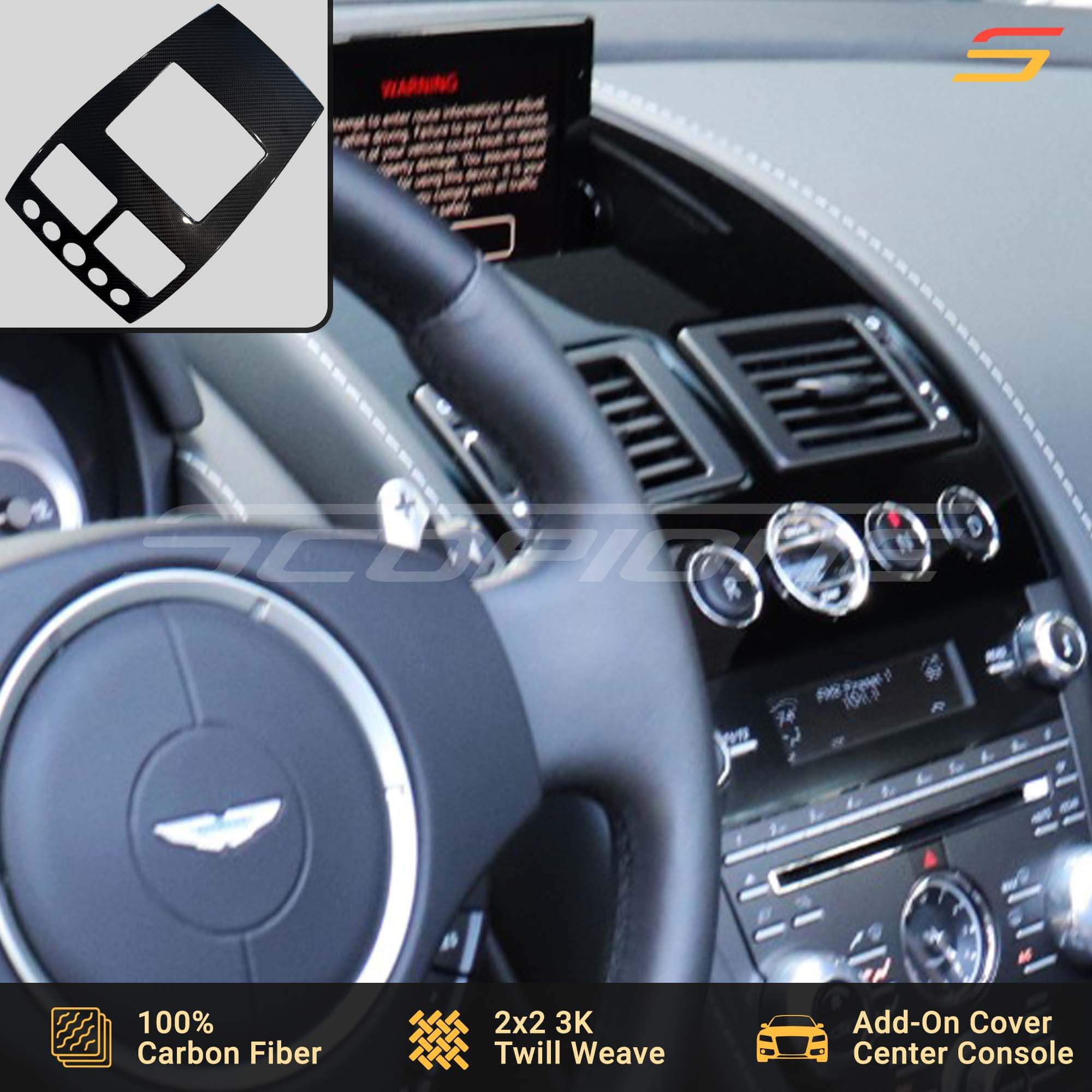
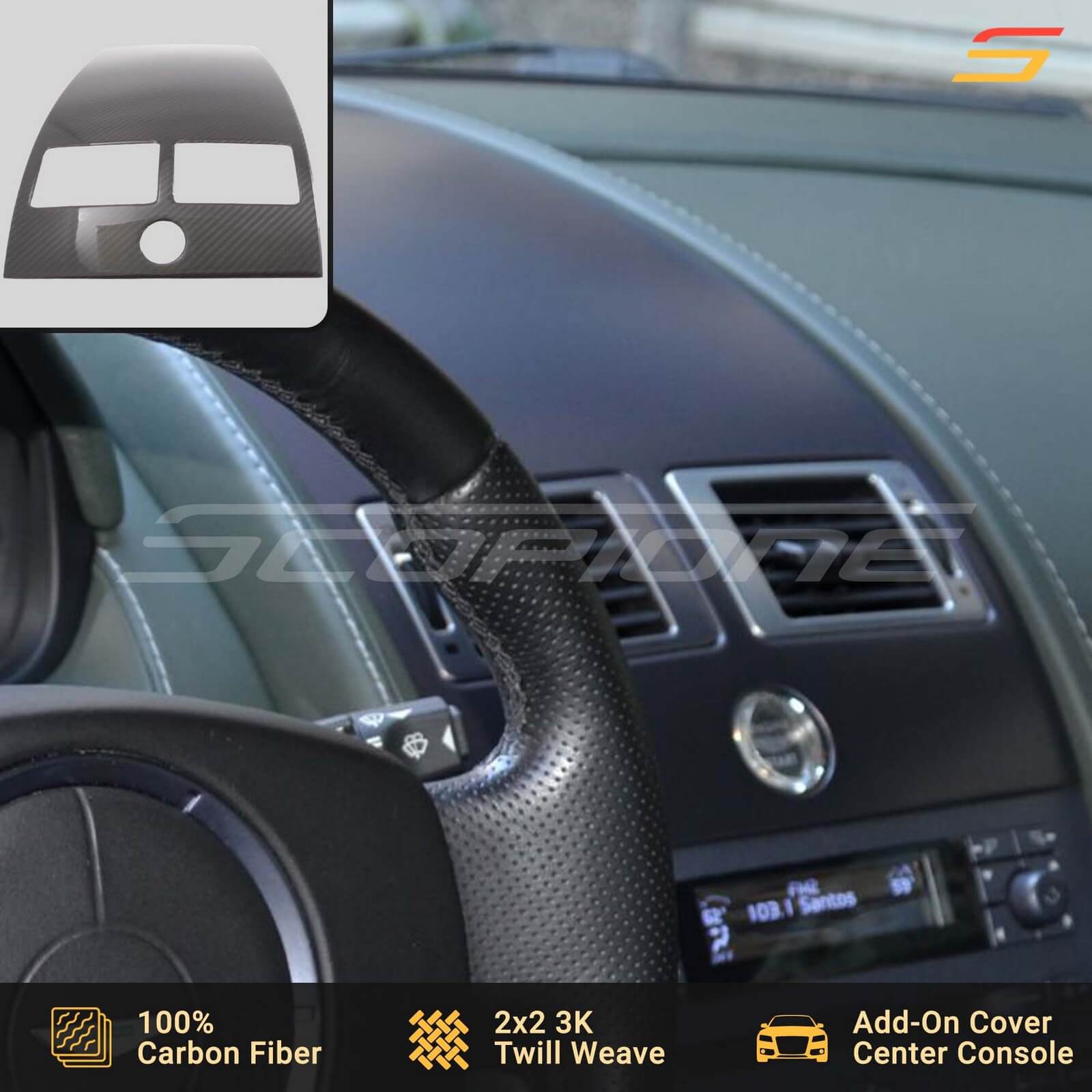
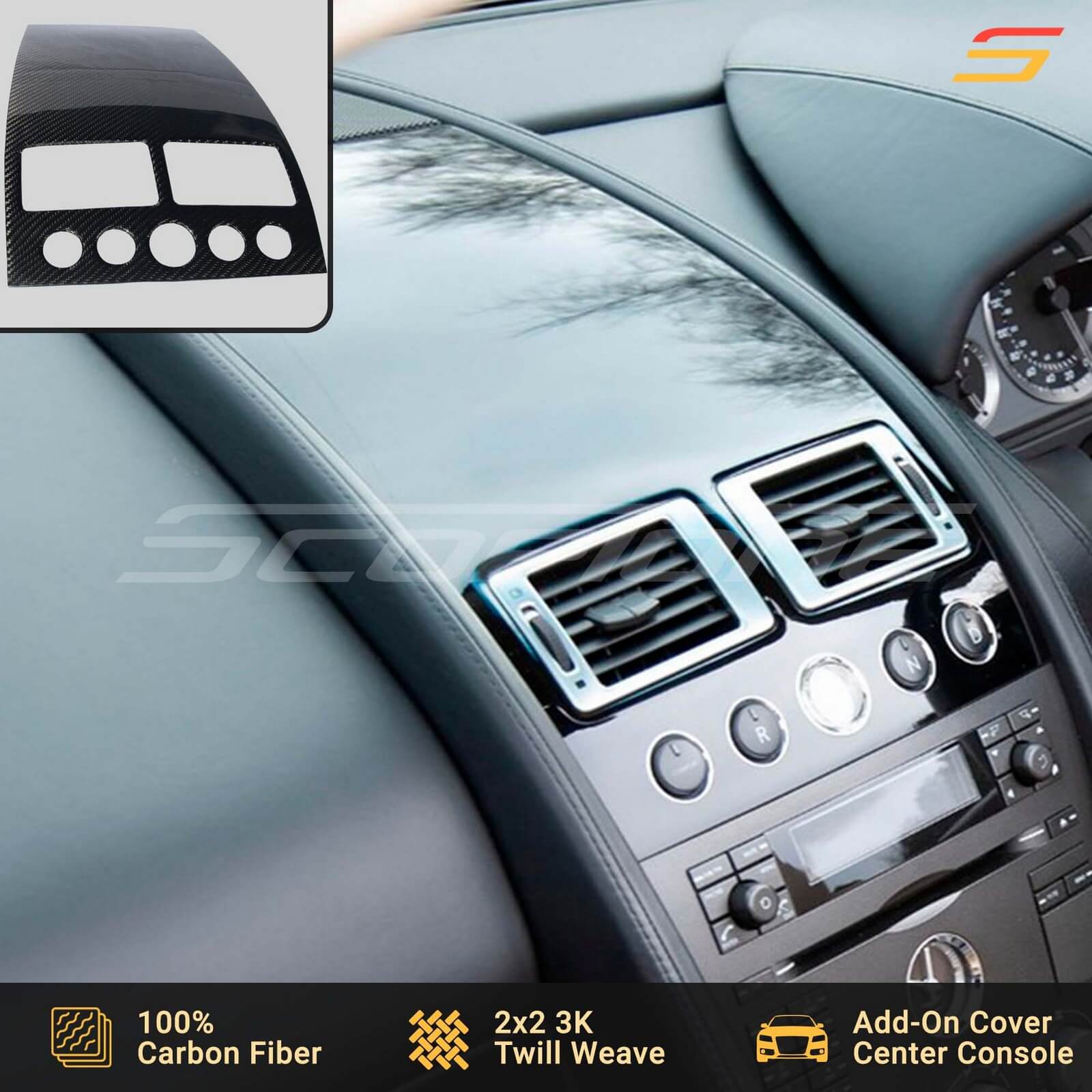
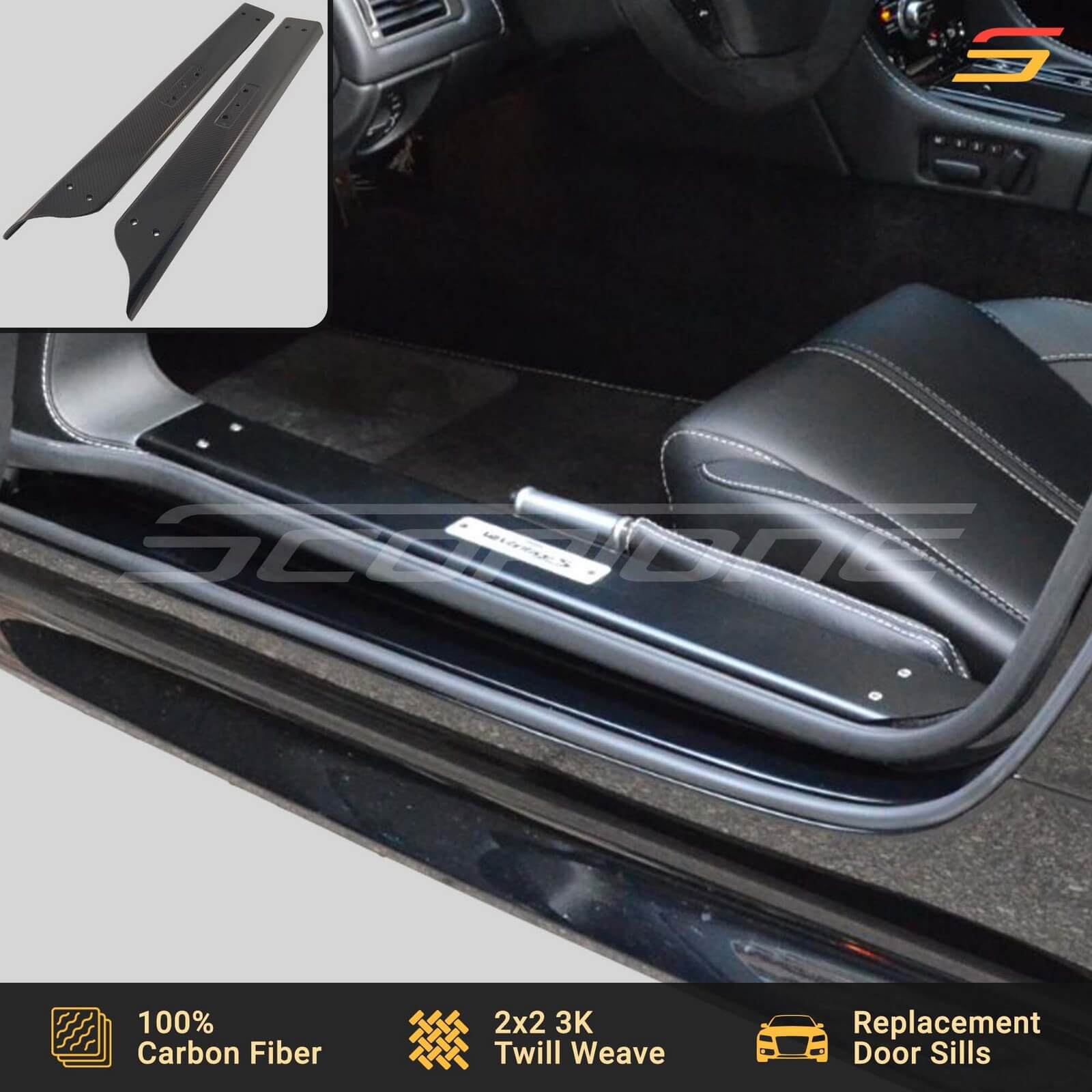
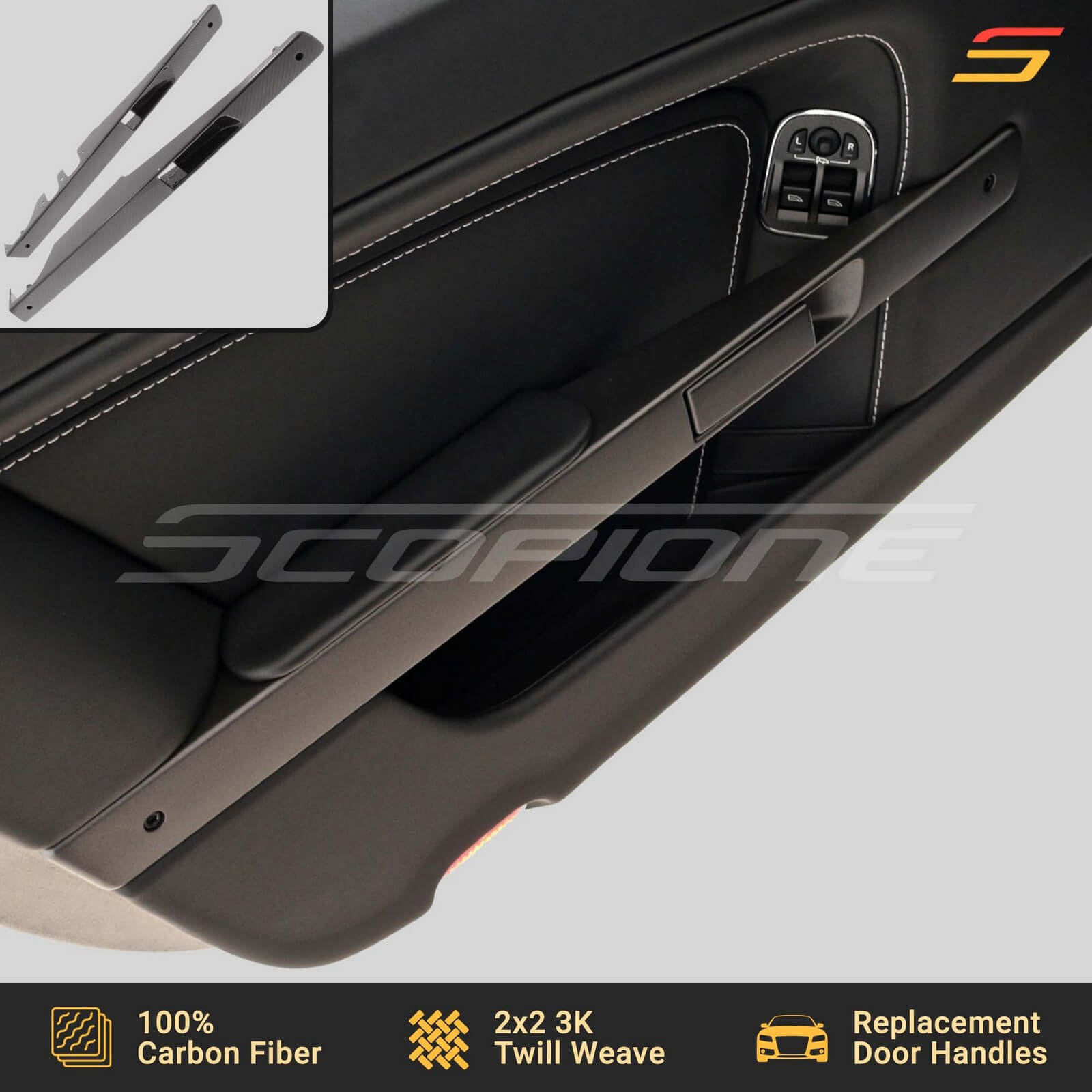
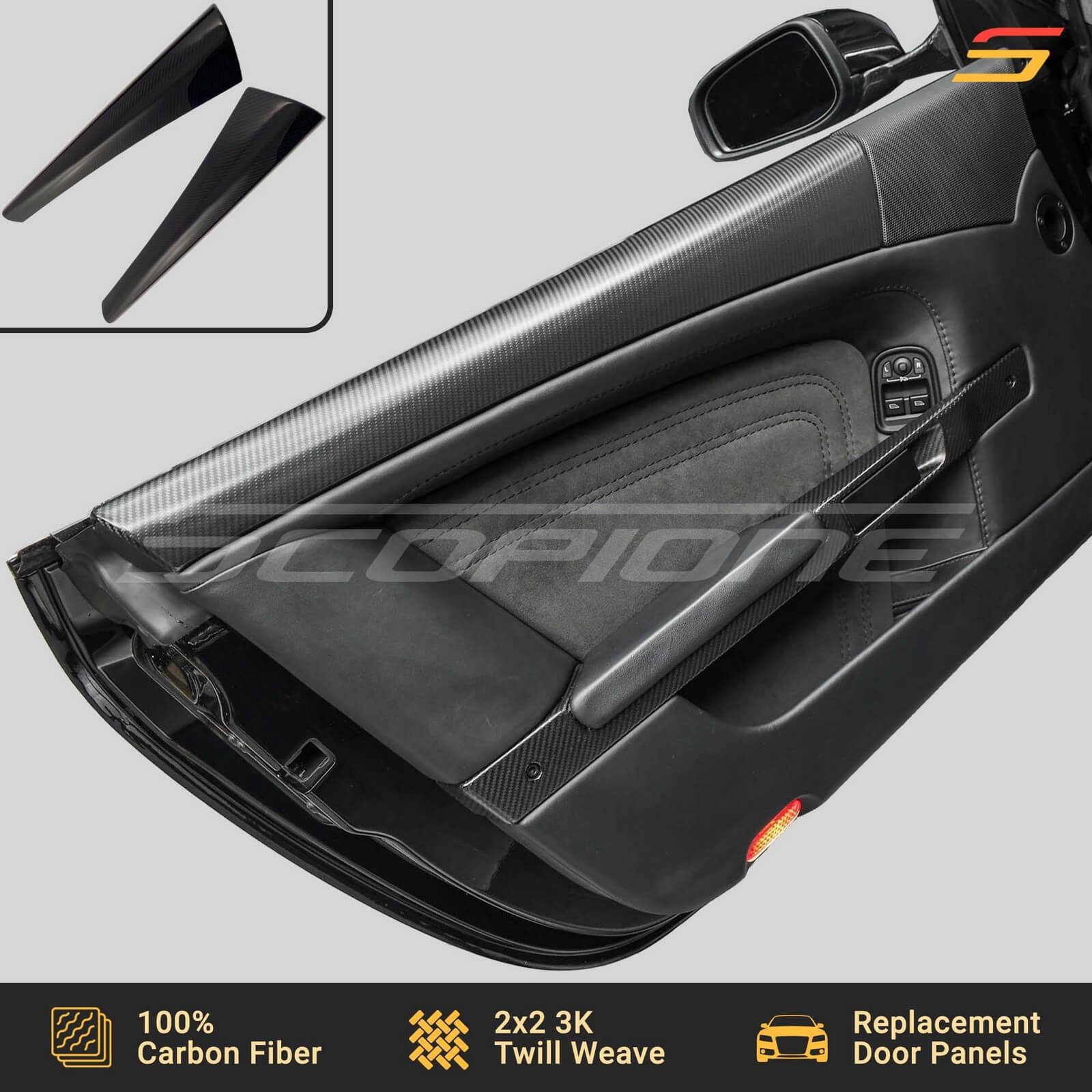
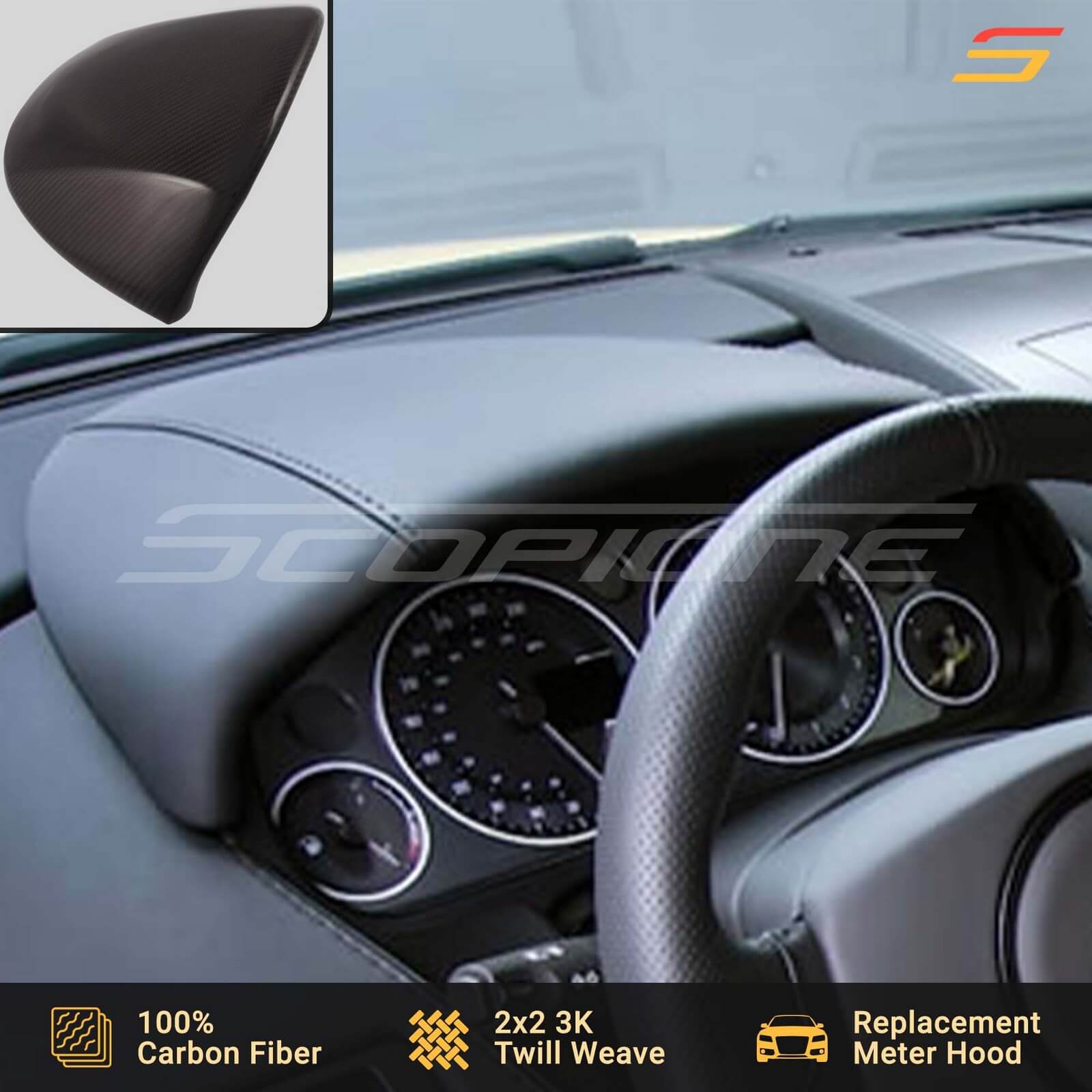
Scopione stocks twill-weave CF components for the Aston Martin Vantage, DB9, DBS, Virage and Rapide — and the mirror covers also fit select 2014–2018 Vanquish models. The range covers exterior aero (front bumper lips and splitters, rear diffusers, fender side strakes, hood scoops), side mirror covers in gloss and matte, tail light covers, and a deep interior set: console and navigation dash panels, door trim inserts, door sills, interior door pulls and a gauge cluster hood. All parts are finished with clear coat for UV protection and visual depth, matching the weave pattern used on factory CF options.
How does Aston Martin’s Superleggera heritage connect to carbon fiber?
Touring of Milan’s original Superleggera technique (1950s-60s) used thin aluminum panels over tubular steel frames for lightweight construction. Aston Martin revived the name for the DBS Superleggera in 2018, where “super lightweight” was now achieved through carbon fiber body panels rather than tubular steel. The same philosophy of lightness through material innovation, advanced by six decades of engineering development.

Explore More Scopione Content
Aston Martin Picture Galleries
- Vantage, DB9 & DBS Picture Gallery – VH-platform models with full parts coverage
More Carbon Fiber Evolution Stories
- Lamborghini’s Carbon Fiber Evolution
- Ferrari’s Carbon Fiber History
- McLaren’s Carbon Fiber Evolution
- Volkswagen’s Carbon Fiber Evolution – Beetle to Golf R, and the XL1’s 230 kg CFRP monocoque
- Honda & Acura’s Carbon Fiber Evolution – The aluminium NSX, and the enthusiast scene that grew around the S2000 and RSX
- MINI’s Carbon Fiber Evolution – 640 kg in 1959, recycled CFRP arches on the JCW GP3
- Mercedes-Benz’s Carbon Fiber Evolution – Silver Arrows to the AMG One’s F1-derived tub
- Cadillac’s Carbon Fiber Evolution – V-Series aero packages and the hand-built CELESTIQ
- Land Rover’s Carbon Fiber Evolution – Seventy-five years of aluminium, and where carbon arrived
- Lotus’s Carbon Fiber Evolution – Add lightness — fiberglass monocoque in 1957, CFRP tub in the Evija
- Audi’s Carbon Fiber Evolution – Thirteen Le Mans wins on CFRP monocoques, and the R8’s structural carbon
- Bentley’s Carbon Fiber Evolution – The Supersports’ 110 kg weight cut to Mulliner’s coachbuilt Batur
- Maserati’s Carbon Fiber Evolution – The Birdcage’s tube frame to the MC20’s own CFRP monocoque
Carbon Fiber, Explained
- Carbon Fiber in the Automotive Industry – How composite construction spread from racing to production cars
- The Pioneers of Carbon Fiber Innovation – The engineers and firms that took composites from aerospace to the road
- The Evolution and Impact of Carbon Fiber: A Comprehensive Guide – The full technical and historical picture
- Carbon Fiber Manufacturing Processes – Autoclave, prepreg and resin transfer moulding — how a Valkyrie-grade tub is made
- Why Carbon Fiber Is Expensive – Why a full monocoque stays hypercar-only while trim reaches the rest of the range
- Real Carbon Fiber vs Cheap Knockoffs – How to tell a moulded 2×2 3K twill part from a hydro-dipped imitation
- Carbon Fiber Maintenance & Cleaning – Keeping a clear-coated panel from fading — gloss and matte alike
Shop Aston Martin Carbon Fiber
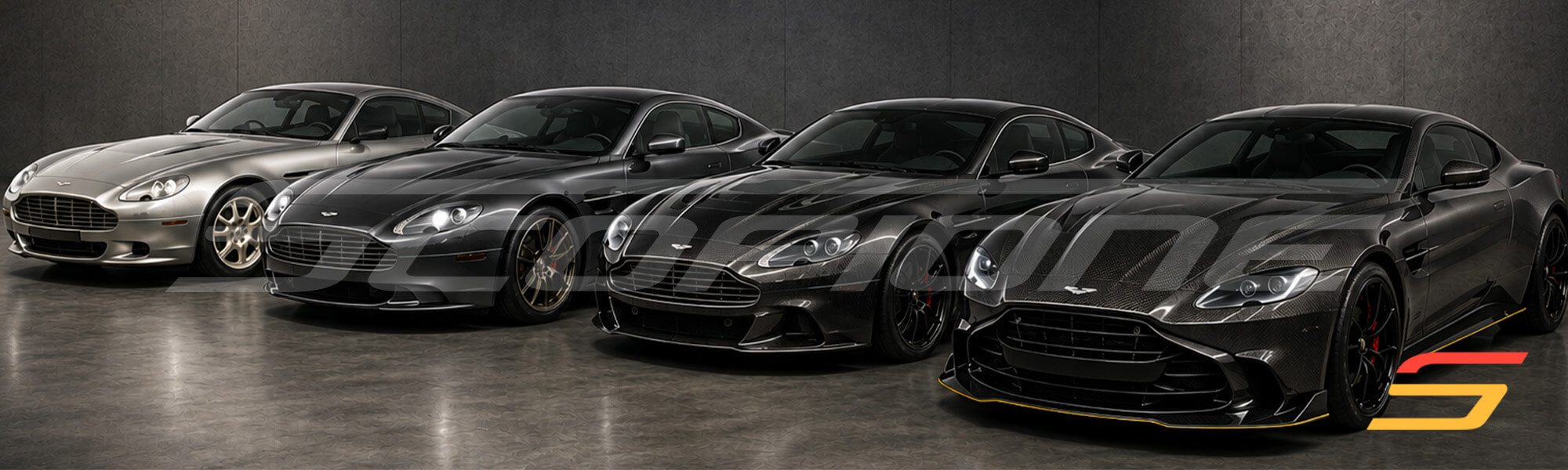
- Aston Martin Carbon Fiber Parts at Scopione – 22 parts for the Vantage, DB9, DBS, Virage and Rapide
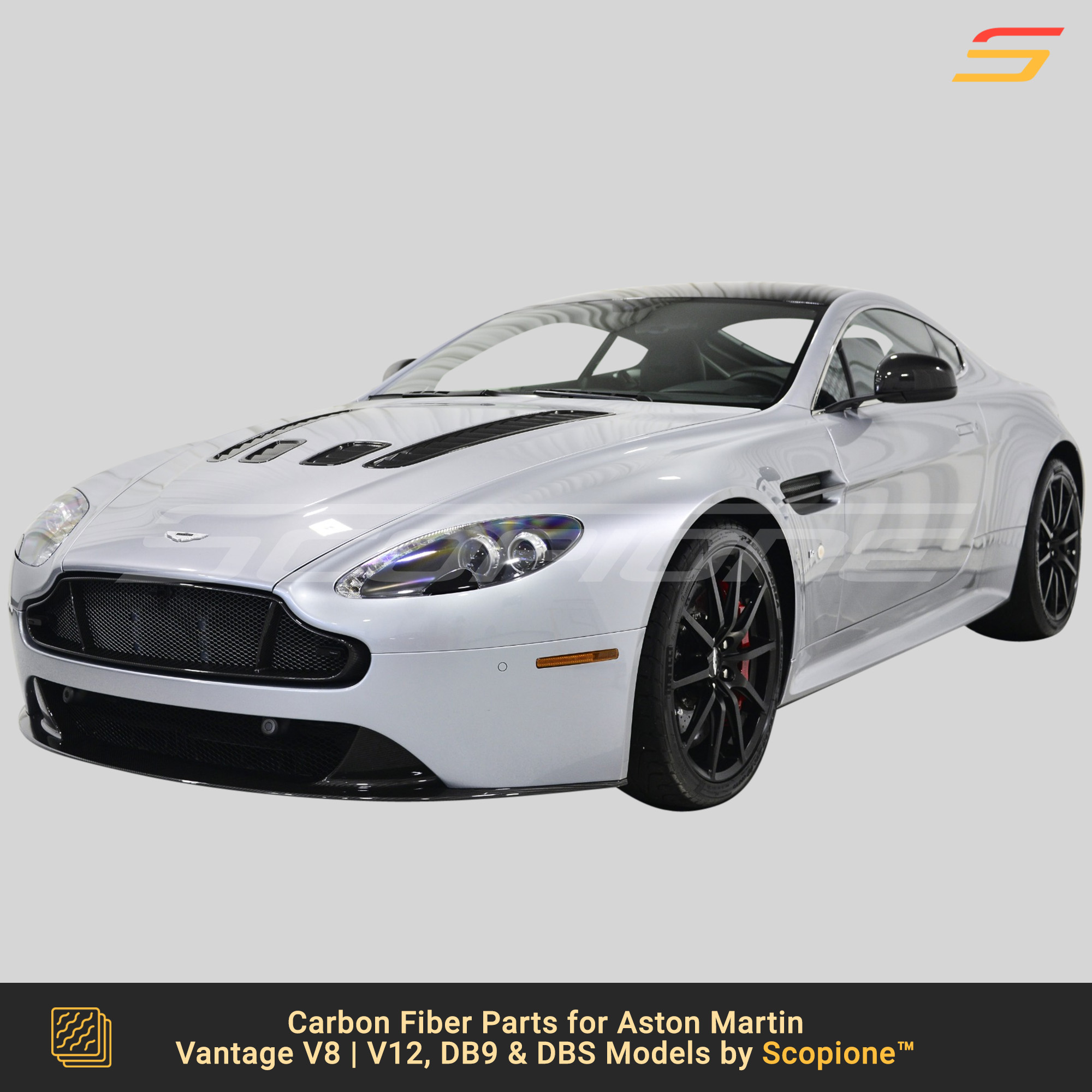
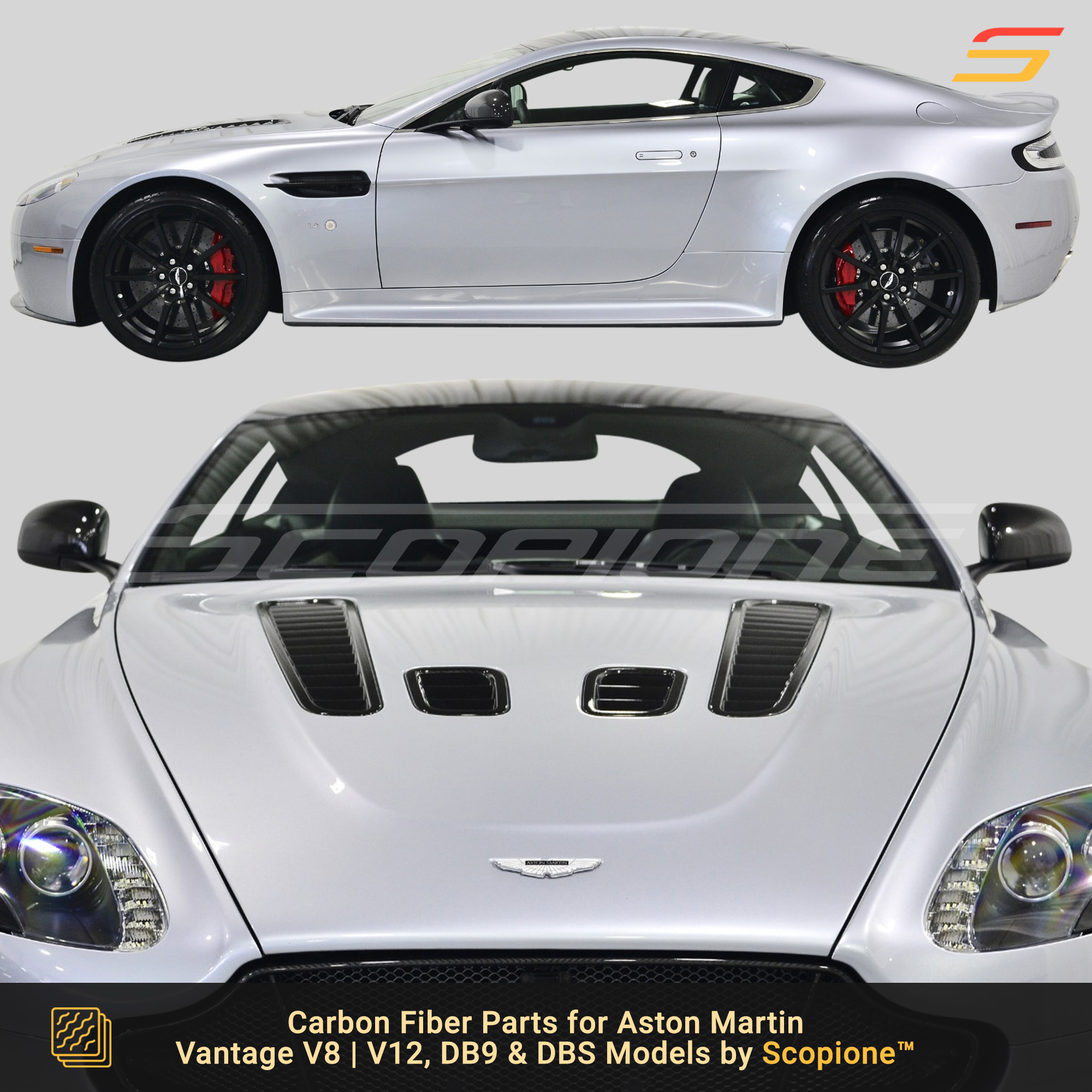
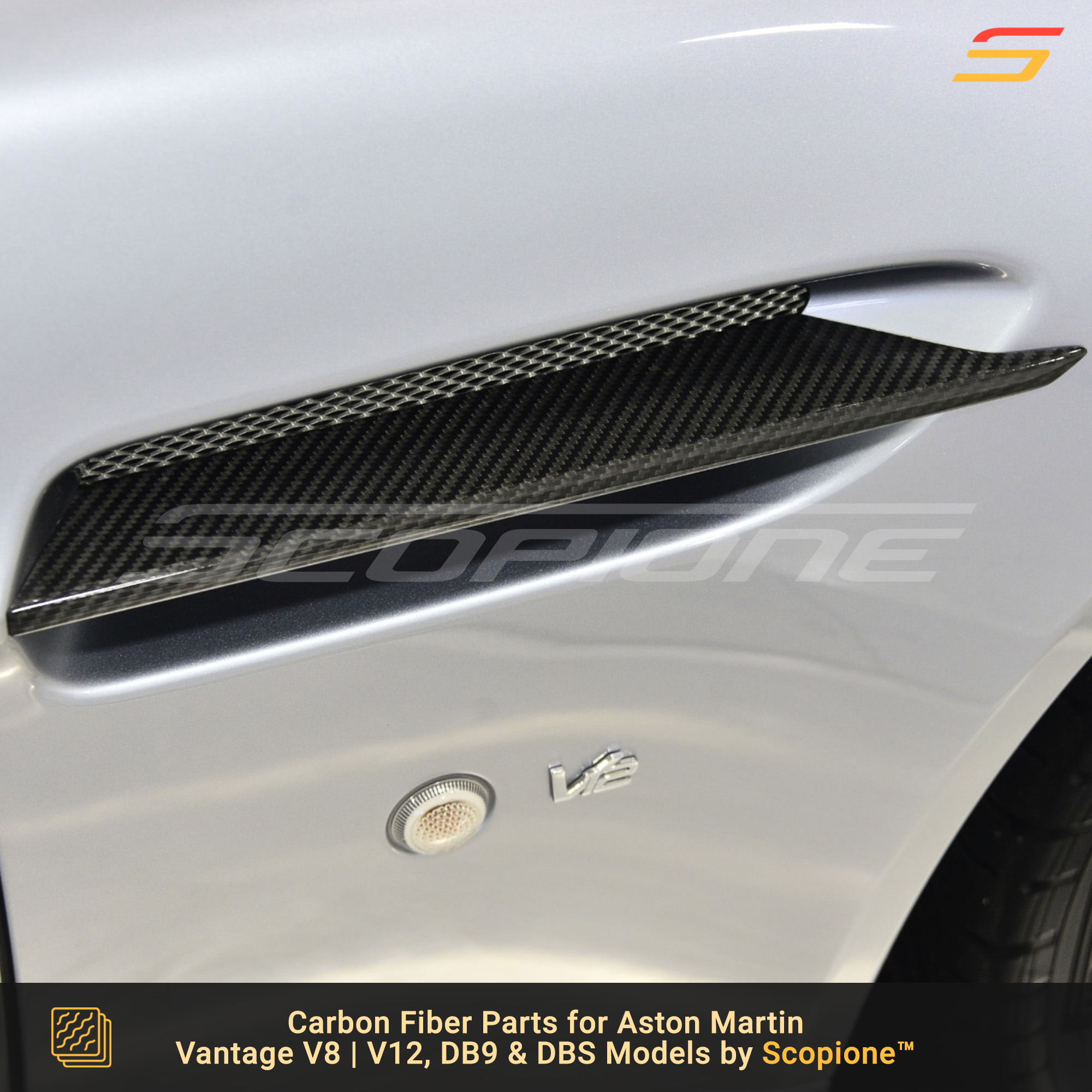
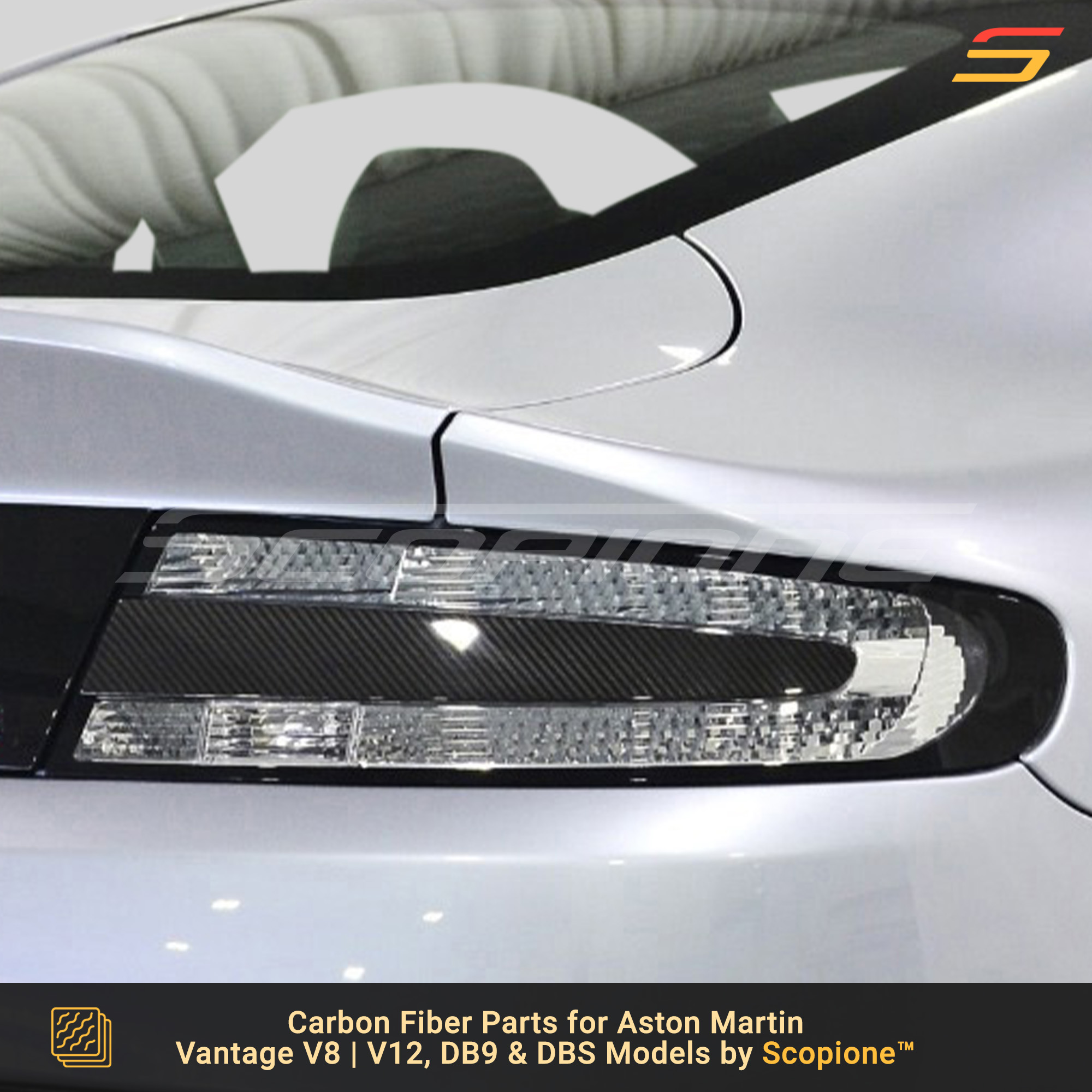
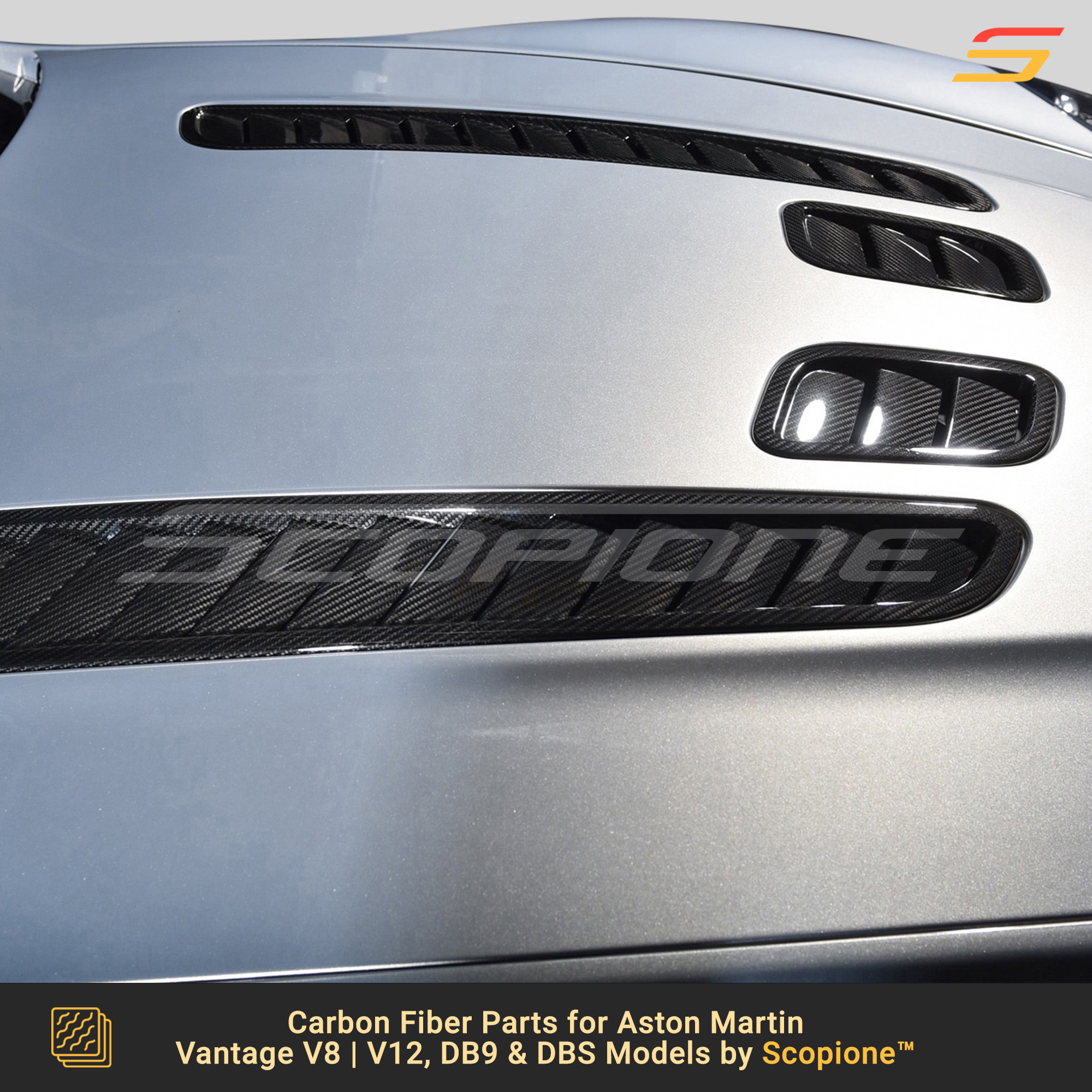
See Scopione carbon fiber on the Aston Martin Vantage, DB9, DBS, Virage and Rapide. The galleries show customer cars fitted with Scopione parts – a reference for finish, fitment and style before choosing an upgrade.
Shop Scopione carbon fiber for your Aston Martin – hand-laid parts made for the factory mounting points.
Back to Top ↑Disclaimer: Technical specifications, production figures, and historical details presented in this article are editorial in nature and may differ from official manufacturer data. Photographs and video show Scopione carbon fiber parts for the Aston Martin Vantage, DB9, DBS, Virage and Rapide, and promotional imagery.