

 Shop
ShopMINI was born from a fuel crisis and a blank sheet of paper. In 1959, Sir Alec Issigonis designed a car that weighed 640 kg, carried four adults, and devoted 80% of its footprint to passengers — a packaging achievement that no advanced material could have improved upon because the material was not the point. The engineering was. Sixty-seven years later, the modern MINI has more than doubled in weight across four generations, and carbon fiber has become the tool to claw back the performance advantage that Issigonis engineered without it. The JCW GP’s evolution tells the story in three acts: a single CF rear wing in 2006, multiple CF components by 2017, and the GP3’s recycled CFRP wheel arches in 2020 — the first BMW Group vehicle with an exposed matte carbon-fiber coating. MINI carbon fiber evolution traces an arc from a lightweight revolution that changed automotive design forever to a brand rediscovering that philosophy through advanced materials. Scopione stocks precision-fitted 2×2 3K twill-weave carbon-fiber accessories for multiple MINI generations – browse the full MINI catalog.
MINI Carbon Fiber Timeline
| Year | Model / Milestone | Carbon Fiber Significance |
|---|---|---|
| 1959 | Original Mini | 640 kg lightweight philosophy established — no CF, but the engineering template for weight reduction |
| 1963 | Mini Cooper S | 76 hp / 650 kg — Monte Carlo Rally victories prove power-to-weight over brute force |
| 2001 | MINI Cooper (R50) | BMW relaunch — Frank Stephenson design, personalization culture drives aftermarket CF demand |
| 2006 | JCW GP (R53) | First factory carbon fiber on a MINI — CF rear wing on 2,000-unit limited edition |
| 2006 | MINI Cooper S (R56) | Second-generation platform expands model range — broadens aftermarket CF ecosystem |
| 2013 | JCW GP2 (R56) | CF spoiler element continues GP tradition — Nürburgring 8:23 (19s faster than GP1) |
| 2014 | JCW (F56) | BMW B48 engine and UKL platform — shared engineering with CF-adopting BMW models |
| 2017 | JCW Challenge | Multi-component CF: air intake, mirror covers, exhaust finishers — 53 units built |
| 2020 | JCW GP3 (F56) | Recycled CFRP wheel arches — first BMW Group vehicle with exposed matte CF coating |
| 2020 | MINI Cooper SE | Electric MINI with BMW i3 motor — CF weight savings directly translate to range |
| 2024 | MINI Cooper (F66) | Generation four — Oliver Heilmer’s “Charismatic Simplicity,” JCW Pro CF accessories |
1959–2000: The Original Lightweight — Issigonis and the Mini Revolution
The Mini arrived in 1959 because petrol was expensive and Alec Issigonis had a particular set of priorities. The Suez Crisis of 1956 had triggered fuel rationing in Britain. Sir Leonard Lord, chairman of the British Motor Corporation, commissioned a small car that could carry four adults on minimal fuel. Issigonis delivered something more fundamental than an economy car. He rethought how a car should be assembled.
The 848cc A-series engine sat transversely — a first for a production car — with the four-speed gearbox housed in the engine’s oil sump. Alex Moulton’s rubber cone suspension replaced conventional springs, saving space in each corner. Ten-inch wheels. Front-wheel drive. The result: a vehicle 3,054 mm long that carried four adults, weighed 640 kg, and cost £496. Over 5.3 million would be built across 41 years of production under BMC, British Leyland, Rover Group, and eventually BMW. The last classic Mini — a red Cooper Sport 500 — rolled off the Longbridge line on 4 October 2000.
Carbon fiber did not exist in any production car during this era. The Mini’s relevance to CFRP is philosophical but significant: Issigonis proved that weight reduction delivers compound performance benefits. A lighter car needs less power, smaller brakes, lighter suspension components, and less fuel. That cascading equation is identical to the engineering argument for carbon fiber in modern performance vehicles.
Mini (1959–2000)
The original Mini was an exercise in subtraction. Everything that did not serve the occupants was either eliminated or miniaturized. The transverse engine layout devoted 80% of the floorplan to passengers and luggage — a proportion that few modern hatchbacks manage to match. The gearbox shared the engine’s oil, eliminating a separate transmission case. The body panels were spot-welded and simple. The result weighed 640 kg in standard form. A Mini Cooper S, with its larger 1,275cc engine and additional equipment, weighed approximately 650 kg.
- Engine: 848cc–1,275cc BMC A-series inline-four, transverse-mounted, 34–76 hp
- Weight: 640 kg (standard) / ~650 kg (Cooper S)
- Production: ~5.3 million units (1959–2000) — best-selling British car of all time
- Designer: Sir Alec Issigonis
No composites of any kind. Pressed-steel monocoque throughout. The engineering was the material innovation — Issigonis achieved what modern manufacturers spend tens of millions on CFRP programs to accomplish. A 640 kg car did not need carbon fiber to be light, engaging, and efficient. It needed clever packaging and an engineer who refused to add a single unnecessary component.
The weight figure deserves context. A 2024 MINI Cooper S (F66) weighs 1,360 kg — more than double the original. That growth reflects genuine improvements: crash structures that protect occupants in impacts the 1959 Mini could not survive, climate control, airbags, infotainment systems, sound insulation, emissions equipment, and a platform engineered to meet global regulatory standards. Every kilogram serves a purpose. But the cumulative effect is a car that has lost the original’s defining characteristic: its featherweight agility. Carbon fiber offers one avenue to recover some of that loss without surrendering the safety and refinement gains.
The cultural impact was equally significant. Peter Sellers owned one. The Beatles drove them. The Italian Job (1969) turned three red, white, and blue Minis into cinematic icons. The Mini crossed class lines in a way that few cars have managed — Lord Snowdon and factory workers drove the same vehicle without irony. When BMW retained the MINI brand after selling the rest of Rover in 2000, they kept the name with the strongest global recognition. Not Rover, not MG, not Triumph. MINI.
Mini Cooper S — Monte Carlo Rally (1963–1971)
John Cooper saw what Issigonis had built and understood its potential on a rally stage. Cooper’s own company had won back-to-back Formula 1 World Championships with Jack Brabham in 1959 and 1960 — he knew the mathematics of power-to-weight as well as anyone in motorsport. The Mini Cooper arrived in 1961 with a 997cc engine producing 55 hp. The Cooper S debuted in April 1963 with a 1,071cc engine producing 70 hp. The definitive 1,275cc variant arrived in early 1964, fitted with twin SU carburetors and producing 76 hp — the version that would dominate international rallying.
On paper, 76 hp is modest. On the Col de Turini at midnight in January, with 34 hairpin bends climbing through snow and ice at 1,600 meters altitude, 76 hp in a 650 kg car proved devastating. Paddy Hopkirk and Henry Liddon won the 1964 Monte Carlo Rally outright, defeating Mercedes-Benz 300 SEs and Ford Falcon V8s with engines producing three times the Cooper S’s output. Timo Mäkinen won in 1965 without collecting a single penalty point. In 1966, Mini Cooper S models finished first, second, and third — only to be controversially disqualified for alleged lighting non-compliance. Rauno Aaltonen completed the redemption by winning in 1967.
- Engine: 1,275cc BMC A-series, twin SU carburetors, 76 hp
- Weight: ~650 kg (rally specification)
- 0–60 mph: 11.2 seconds
- Monte Carlo victories: 1964 (Hopkirk), 1965 (Mäkinen), 1967 (Aaltonen)
No carbon fiber. Rally preparation focused on engine tuning, suspension setup, and weight reduction through component removal — not material substitution. The works rally cars were prepared at BMC’s competitions department in Abingdon, where engineers stripped unnecessary trim, fitted sump guards, and calibrated the twin carburetors for altitude changes across Alpine passes. The Cooper S won through the same principle that drives CFRP adoption in modern hot hatches: superior power-to-weight ratio. A 650 kg car with 76 hp on narrow Dunlop SP tires outhandled 1,500 kg sedans with 230+ hp on mountain roads.
The three primary rally drivers — Hopkirk, Mäkinen, and Aaltonen, nicknamed the “Three Musketeers” — became motorsport legends. Their victories transformed the Mini from an economy car into a performance icon and established the Cooper name as a synonym for small-car speed. John Cooper himself remained involved with MINI until his death in December 2000, just months after the last classic Mini left the production line. His legacy lives on through the John Cooper Works division, which continues to produce MINI’s performance variants — models that now carry carbon-fiber components as standard equipment.
Scopione Perspective: The Lightweight Foundation
The original Mini did not need carbon fiber. It had Alec Issigonis. But the lightweight philosophy he embedded in the car’s engineering — eliminate everything that does not serve the driver — is the same philosophy that informs every carbon-fiber component on a modern MINI. Scopione’s 2×2 3K twill-weave CF accessories for MINI models follow that logic: replace heavier factory trim with lighter, stiffer carbon fiber, improving both visual presence and functional weight reduction. Each component is precision-fitted and finished with UV-resistant clear coat.
2001–2013: BMW Relaunch — The Modern MINI and First Carbon Fiber
BMW’s acquisition of Rover Group in 1994 cost 800 million GBP and produced years of operational losses. When BMW sold Rover to the Phoenix Consortium in 2000, the company retained two things: Plant Oxford in Cowley and the MINI brand. Approximately £300 million went into rebuilding Plant Oxford. The new MINI entered production on 26 April 2001.
Frank Stephenson — a Moroccan-born designer of Norwegian and Spanish parentage who would later create the Ferrari F430, the Fiat 500, the Maserati MC12, and the McLaren P1 — won a 15-designer competition to shape the reborn MINI. His method was evolutionary: weeks spent imagining how the classic Mini might have developed through the 1970s, 1980s, and 1990s to arrive at a modern form. Fourteen executives chose his design unanimously. The second generation (R56, 2006) switched from the Tritec engine to the BMW-PSA Prince engine family, expanded the range to include the Clubman, Countryman, and Convertible, and produced the first two JCW GP limited editions. Carbon fiber arrived on a MINI for the first time in 2006, on the GP1’s rear wing.
MINI Cooper / Cooper S (R50/R53, 2001–2006)
Stephenson’s design introduced the “floating roof” treatment — contrasting body and roof colors separated by a chrome trim strip — fifteen years before the motif became an industry cliché. The round headlights, clamshell hood, and hexagonal grille translated the classic Mini’s character into a modern package without resorting to retro pastiche. One famous anecdote captures Stephenson’s instinct: noticing no exhaust tip on the clay model, he grabbed an empty beer can, stripped the paint, punched a hole, and pressed it into the clay. The board told him not to change a thing.
The Cooper used a 1.6-liter Tritec engine (a BMW/Chrysler joint venture, manufactured in Curitiba, Brazil) producing 116 hp naturally aspirated. The Cooper S added a Roots-type supercharger, boosting output to 163 hp with a distinctive mechanical whine under boost that became the car’s acoustic signature. Both were front-wheel drive with a manual or continuously variable transmission. The R50 Cooper weighed 1,150 kg — nearly double the original Mini’s 640 kg. Safety structures, crash testing compliance, noise insulation, and a cabin substantially larger than Issigonis’s original accounted for the growth. The weight gain was not reckless. It was the cost of building a car that met modern expectations while retaining the spirit of a sixty-year-old design.
- Cooper (R50): 1.6L Tritec, 116 hp / 1,150 kg / 0–62 in 9.8 seconds
- Cooper S (R53): 1.6L supercharged Tritec, 163 hp / 0–62 in 7.4 seconds / 135 mph
- Designer: Frank Stephenson
- On sale: July 2001
No factory carbon fiber on standard models. But the R50/R53 generation established the personalization culture that drives aftermarket CF demand. MINI buyers customized their cars extensively — roof colors, bonnet stripes, mirror caps, interior trim — treating the car as a canvas for self-expression in a way that few automotive brands had encouraged at this price point. The MINI configurator offered dozens of color and trim combinations from the factory, and the aftermarket expanded those options exponentially.
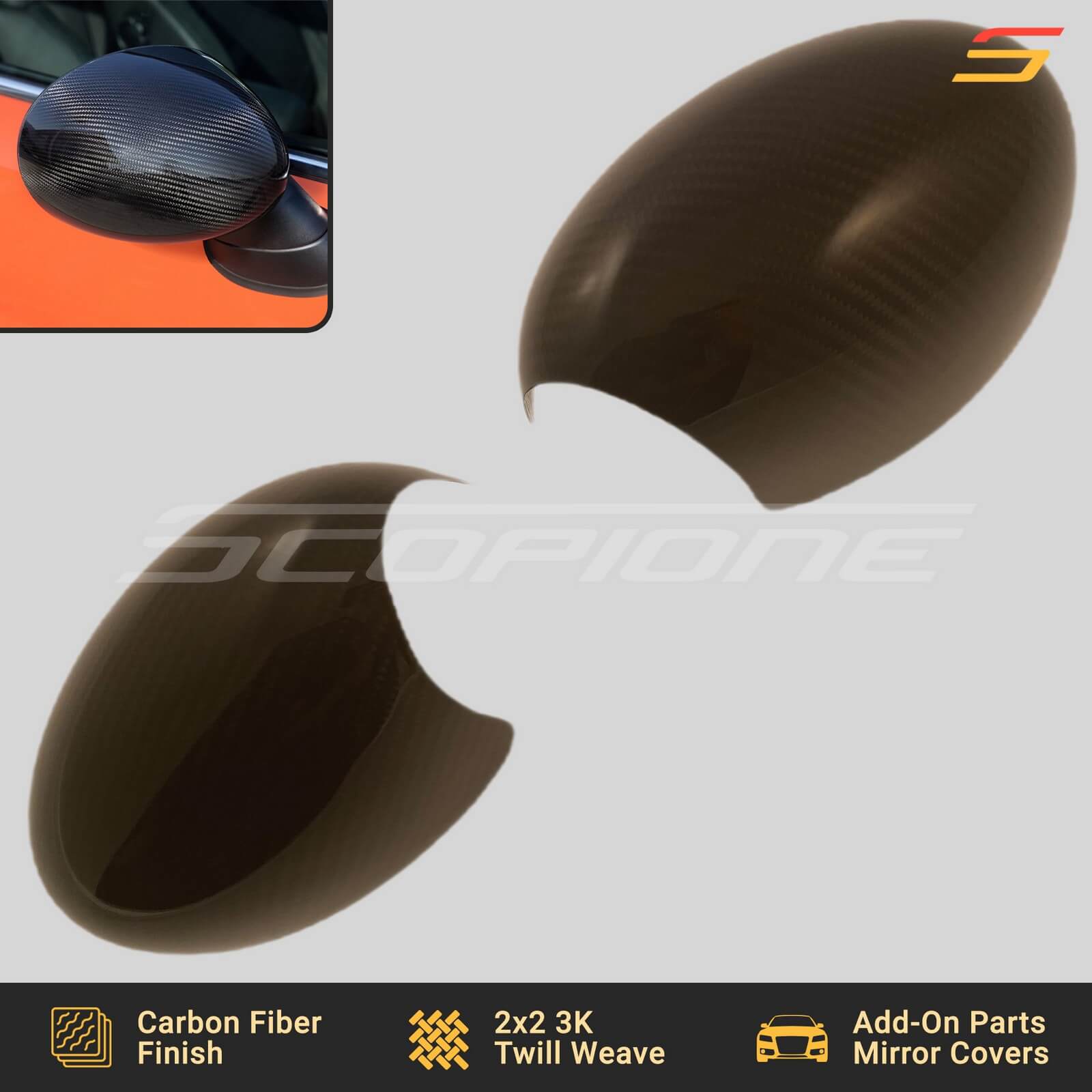
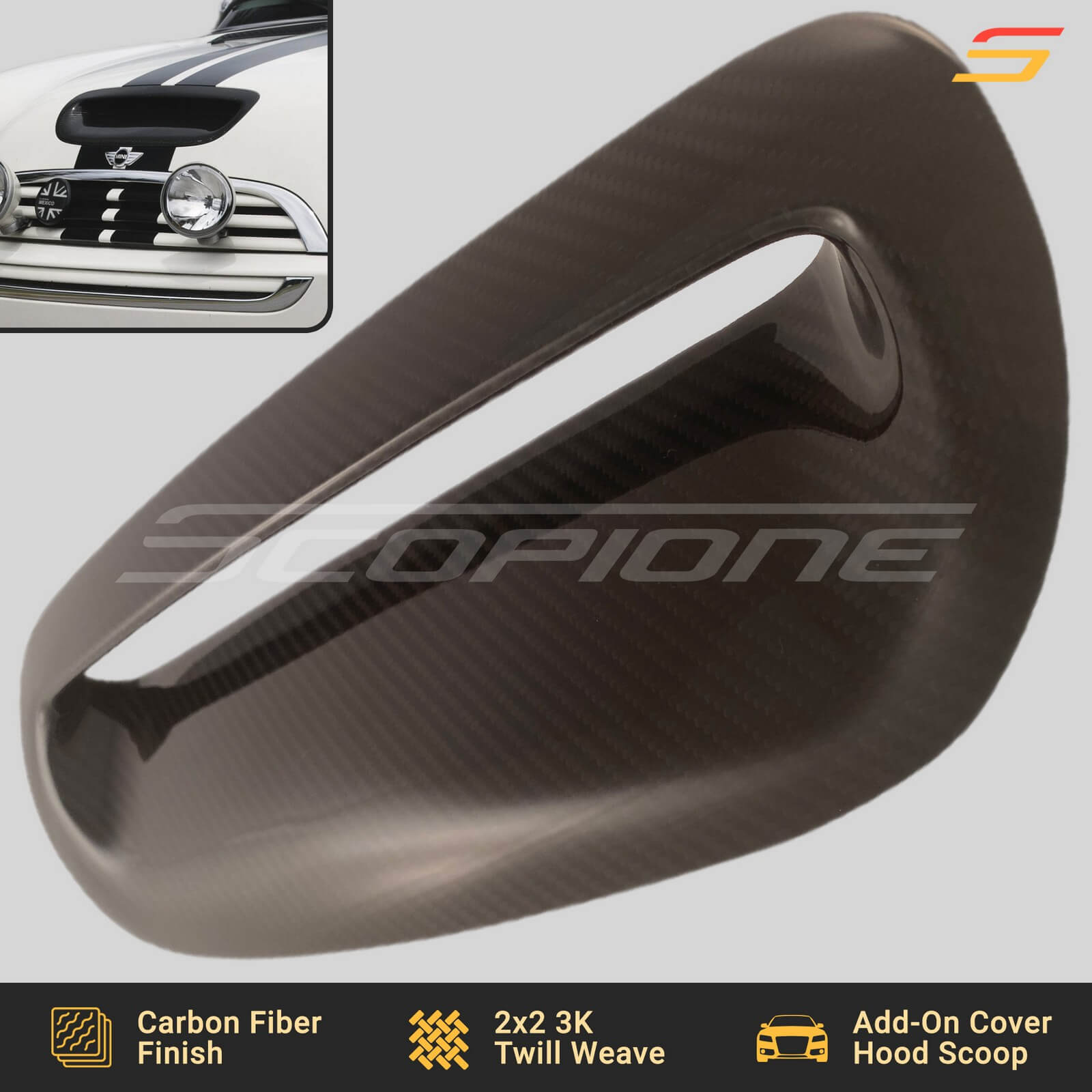
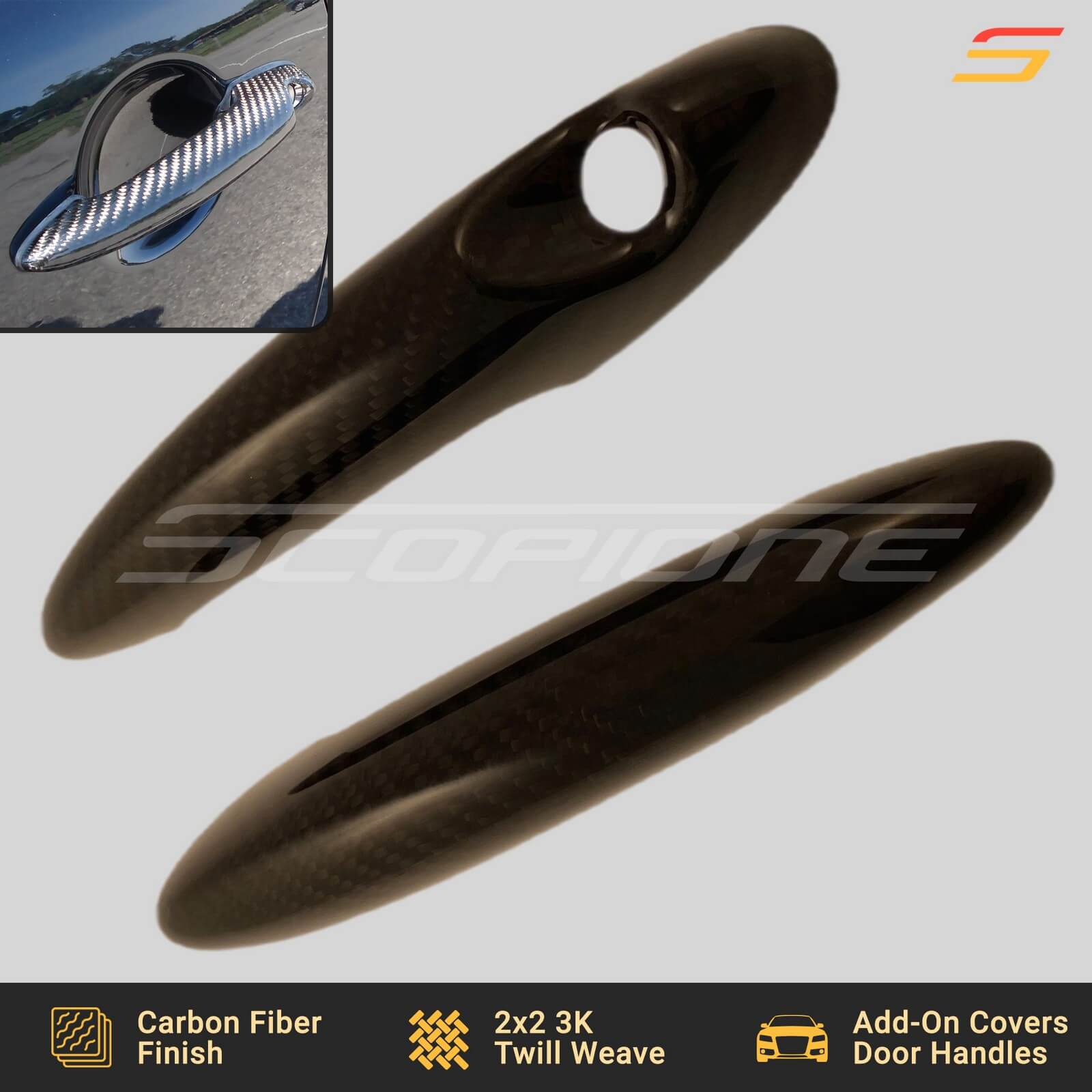
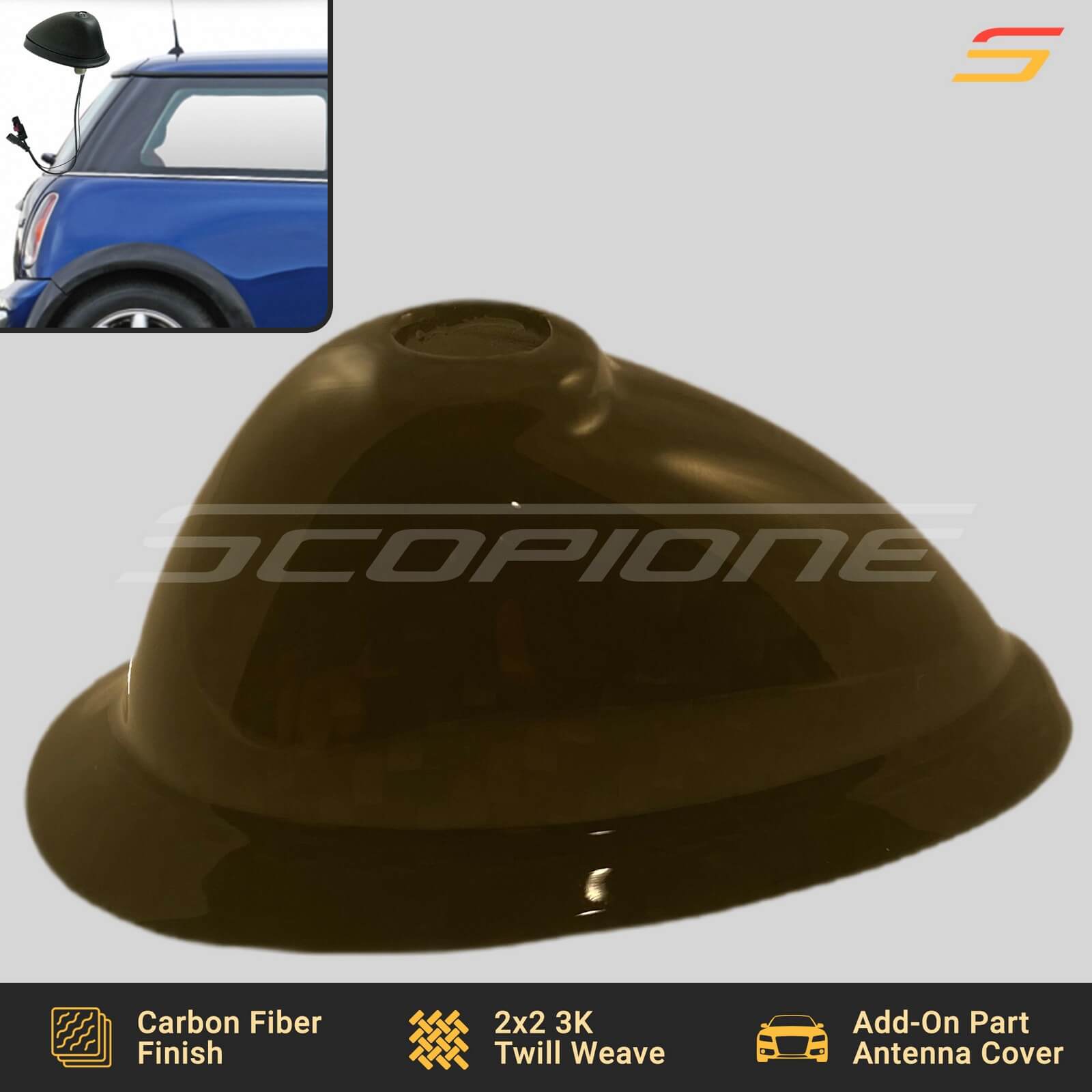
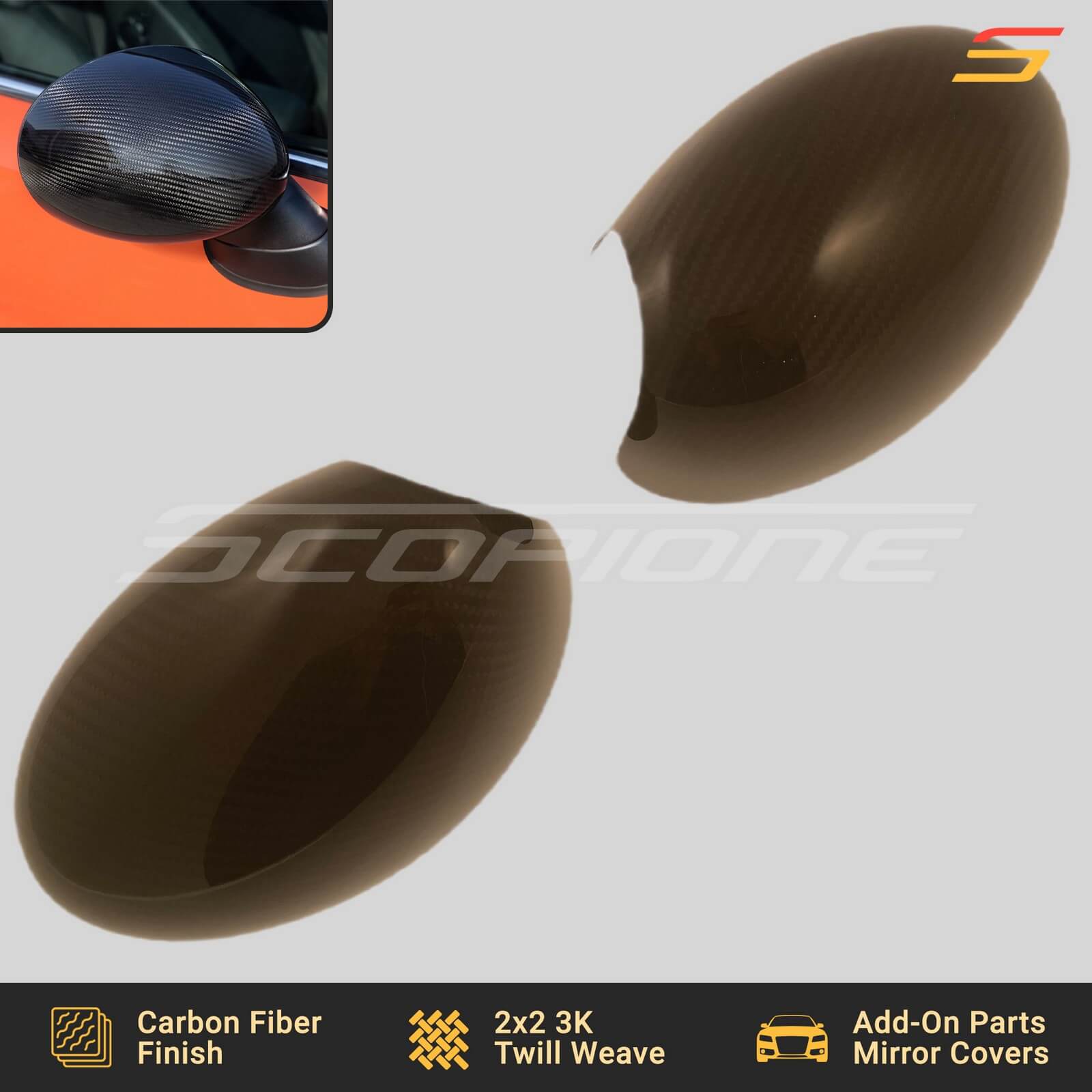
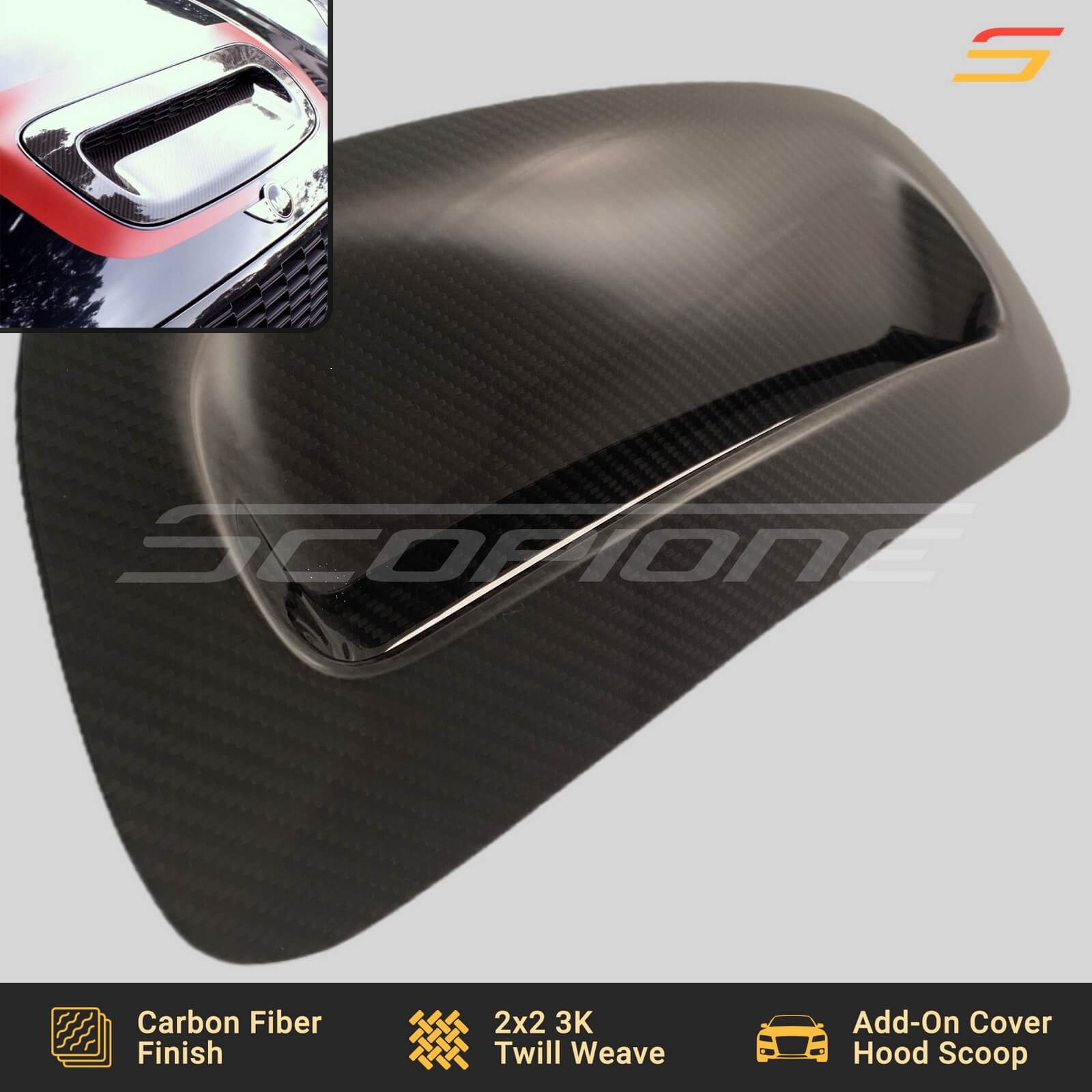
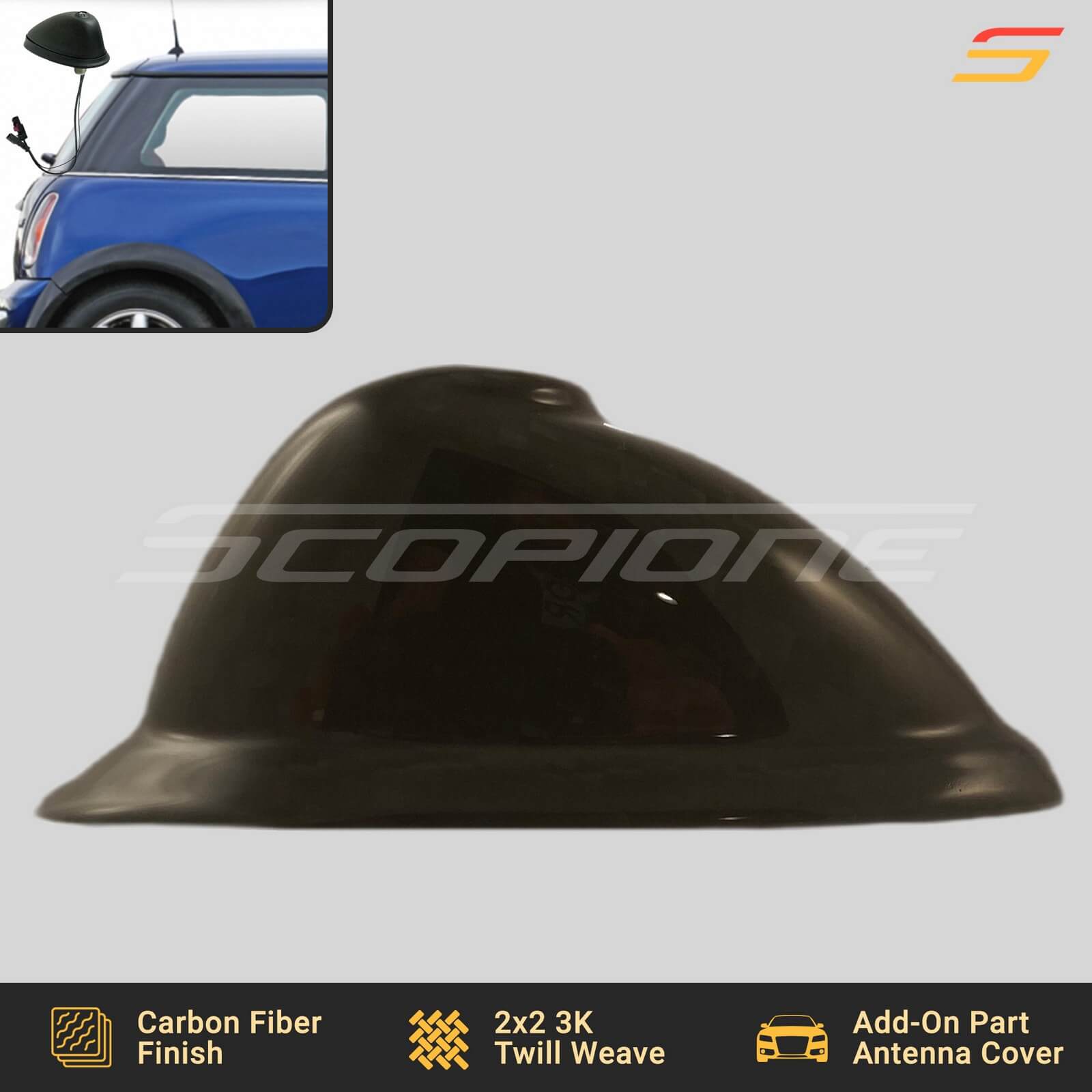
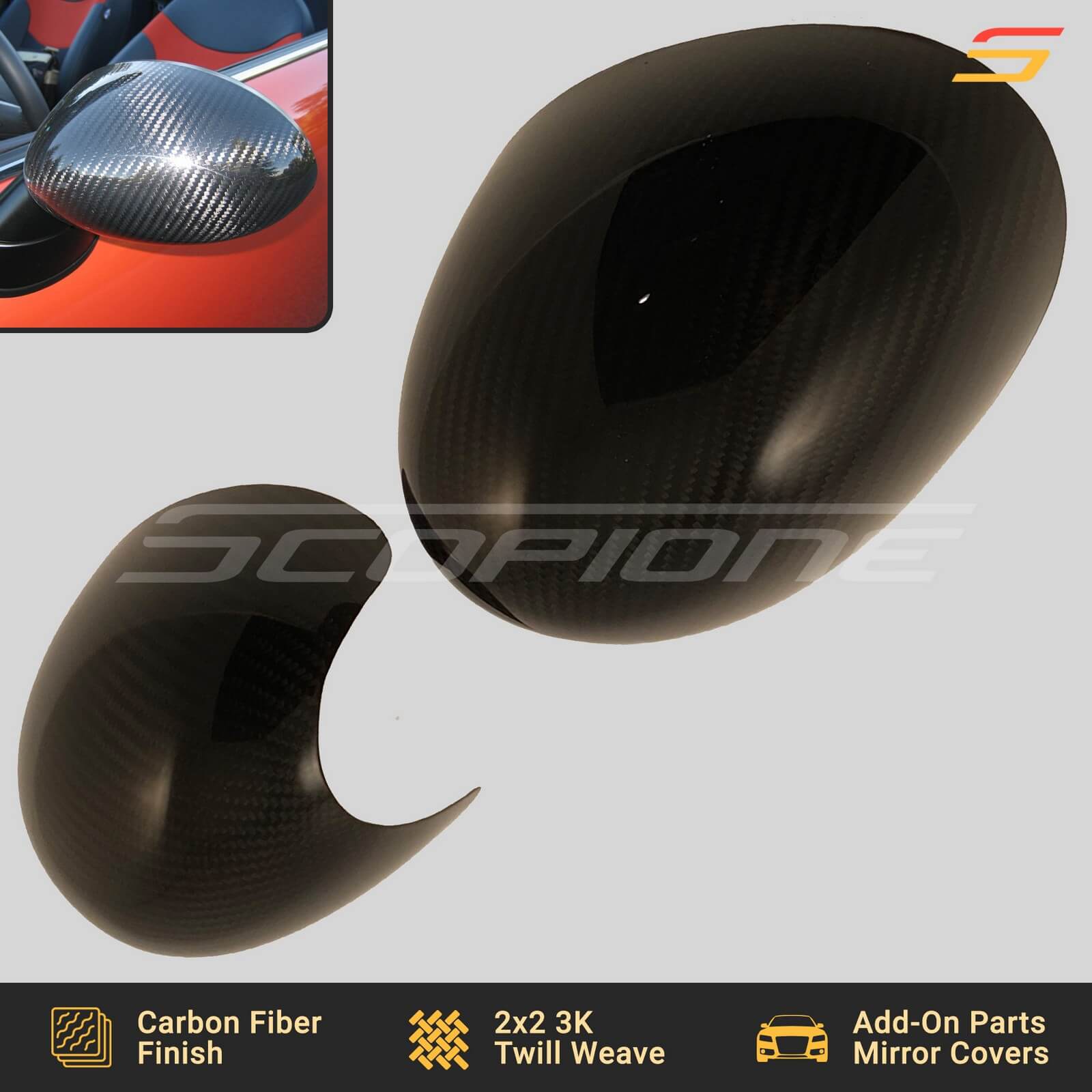
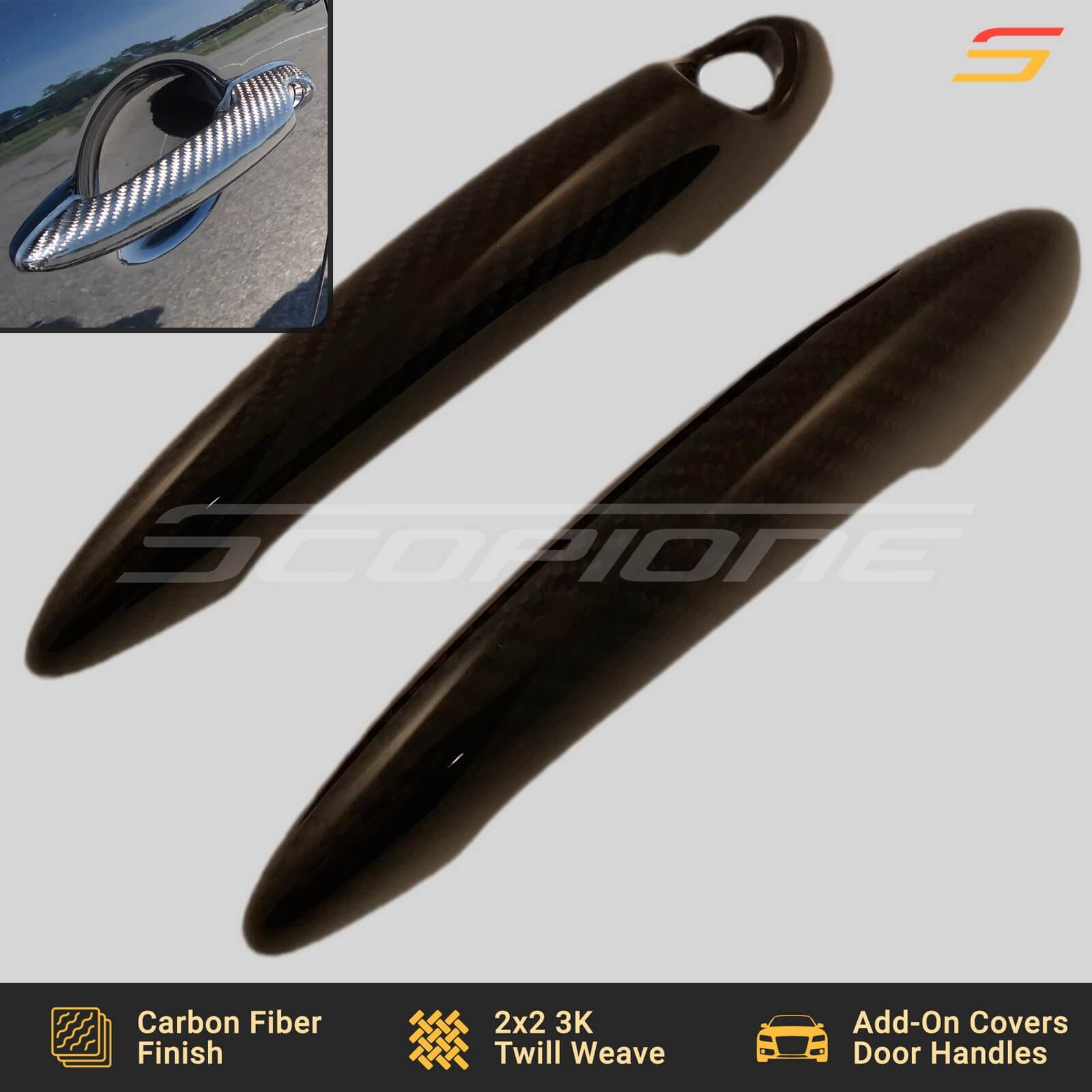
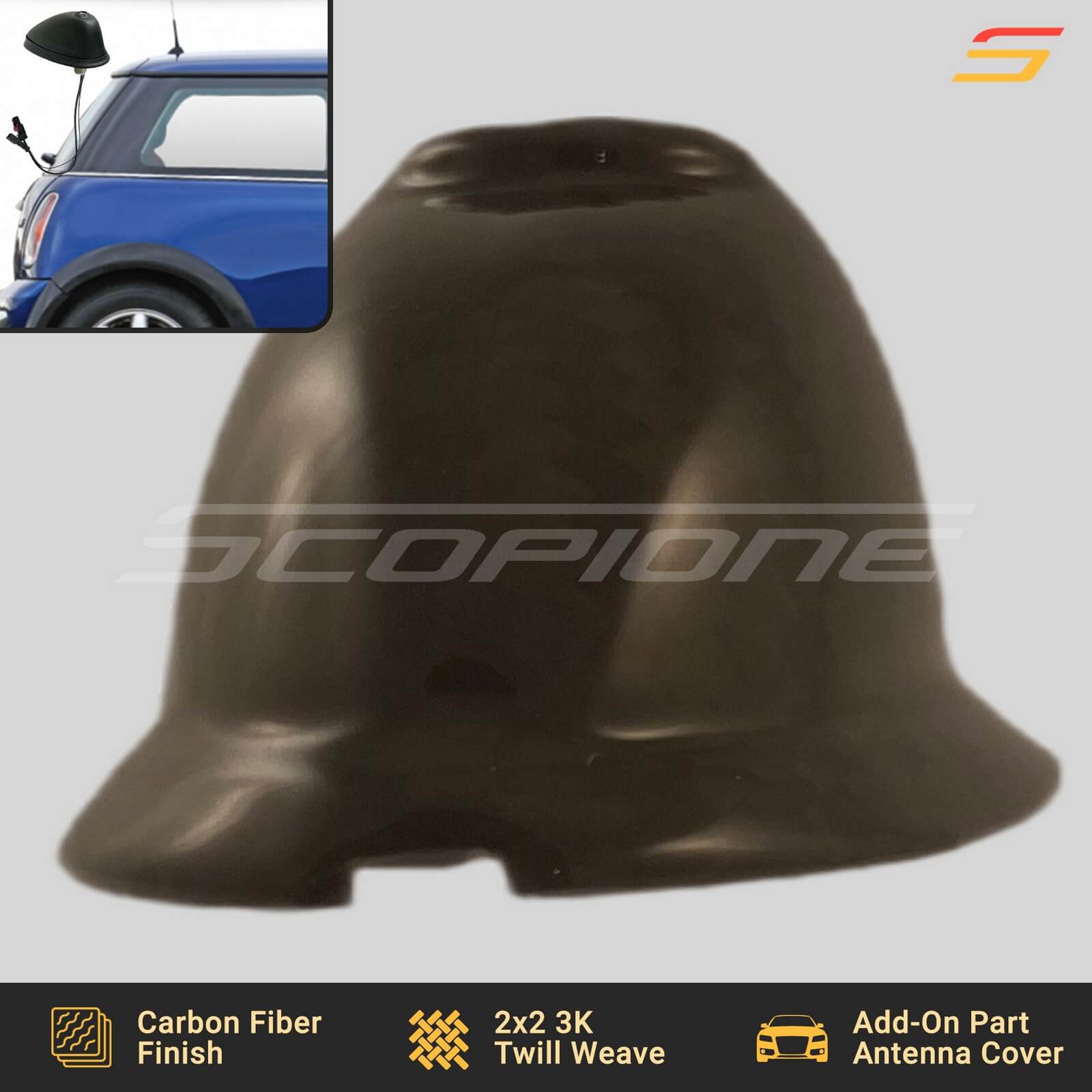
That enthusiasm created the commercial foundation for aftermarket CF components. Scopione’s MINI catalog begins here: carbon-fiber mirror covers, hood scoop covers, door handle covers, and antenna cap covers for R50/R52/R53 models, all in 2×2 3K twill-weave carbon fiber with UV-resistant clear coat. The R52 Convertible (2004–2008) extended the range to open-air driving, and a dealer-installed John Cooper Works kit (2004) offered Cooper S owners 197 hp — foreshadowing the full JCW models that would follow.
MINI John Cooper Works GP (R53, 2006)
The first GP was a calculated act of restraint. Rather than simply adding power, BMW stripped the Cooper S to its essentials: rear seat delete, reduced sound deadening, Recaro sport seats, and a fixed rear wing. Body-in-white shells were built at Plant Oxford, then shipped to Bertone in Italy for hand-finishing, assembly, and painting. Each of the 2,000 units was individually numbered. Thunder Blue paint with a Pure Silver roof and red mirror caps created a livery that signaled serious intent.
The supercharged 1.6-liter engine was tuned to 218 PS (215 bhp), and the car weighed approximately 50 kg less than the Cooper S through component deletion. The approach echoed Issigonis: performance through removal rather than addition.
- Engine: 1.6L supercharged Tritec, 218 PS (215 bhp)
- 0–62 mph: Under 6.5 seconds
- Production: 2,000 units worldwide (415 to US, ~444 to UK)
- Assembly: Plant Oxford (body-in-white) + Bertone, Italy (final assembly)
The GP1 carried the first factory carbon-fiber component on any MINI: a carbon-fiber rear wing mounted to the hatchback. One component. But it was the right one — a functional aero piece that generated downforce at the rear of a front-heavy FWD platform, counteracting the front-drive car’s inherent tendency to lift at the rear under hard cornering. The material choice also connected the GP to BMW Group’s broader CFRP ambitions. The i3 and i8 development programs were already underway at BMW during this period, building the carbon-fiber manufacturing expertise that would eventually flow down to MINI and other brands within the Group portfolio.
The GP1’s CF wing was modest in scale — a single molded component rather than a structural application. But it established an important precedent: carbon fiber on a MINI was not about luxury or exclusivity. It was about function. The wing saved weight compared to a metal equivalent while providing the specific aero profile the engineers required. That functional rationale — CF chosen for engineering reasons, not marketing ones — would define every subsequent MINI carbon-fiber application, culminating in the GP3’s structural CFRP arches fourteen years later.
MINI Cooper S (R56, 2006–2013)
The second-generation MINI replaced the Tritec engine with the Prince engine family, a joint development between BMW and PSA Peugeot-Citroën. The Cooper S gained a twin-scroll turbocharger with direct injection and Valvetronic variable valve timing — technologies that replaced the R53’s supercharger with more sophisticated forced induction. The shift from supercharger to turbocharger changed the Cooper S’s character: the R53’s linear power delivery and mechanical whine gave way to the N14’s sharper mid-range surge. The N14 engine (2007–2010) produced 171 hp; the revised N18 (2011–2013 LCI) reached 181 hp with improved reliability, addressing the N14’s known issues with timing chain stretch and high-temperature oil degradation.
More important for the MINI brand than the engine was the range expansion. The R56 generation spawned the Clubman estate (R55), Convertible (R57), Coupé (R58), Roadster (R59), Countryman (R60), and Paceman (R61). Six body styles where previously there had been one. The Countryman introduced four doors and available ALL4 all-wheel drive. MINI was no longer a single car. It was a brand.
- Cooper S (R56): 1.6L turbocharged Prince, 171–181 hp
- 0–62 mph: ~7.0 seconds
- Body styles: R55 Clubman, R56 Hatch, R57 Convertible, R58 Coupé, R59 Roadster, R60 Countryman, R61 Paceman
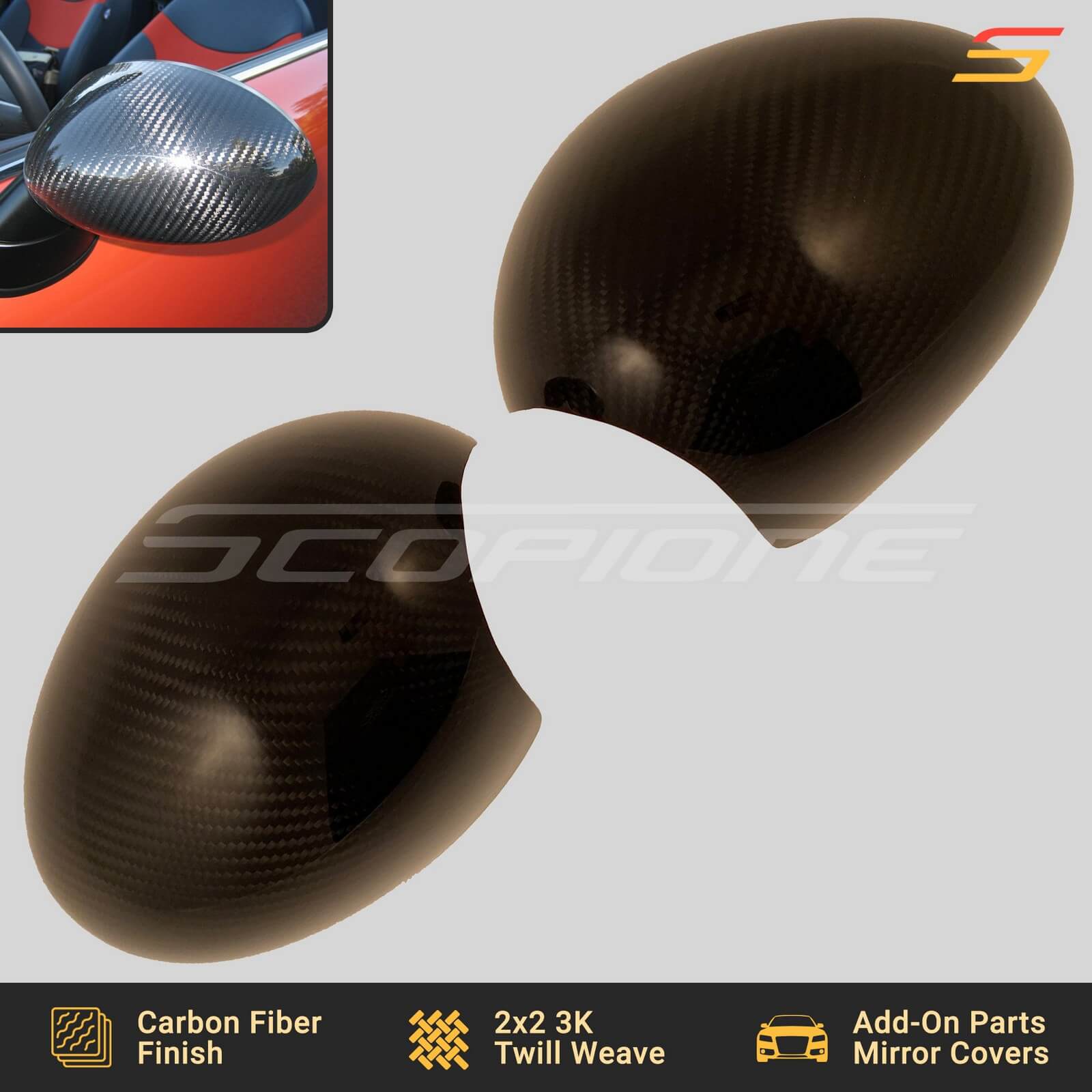
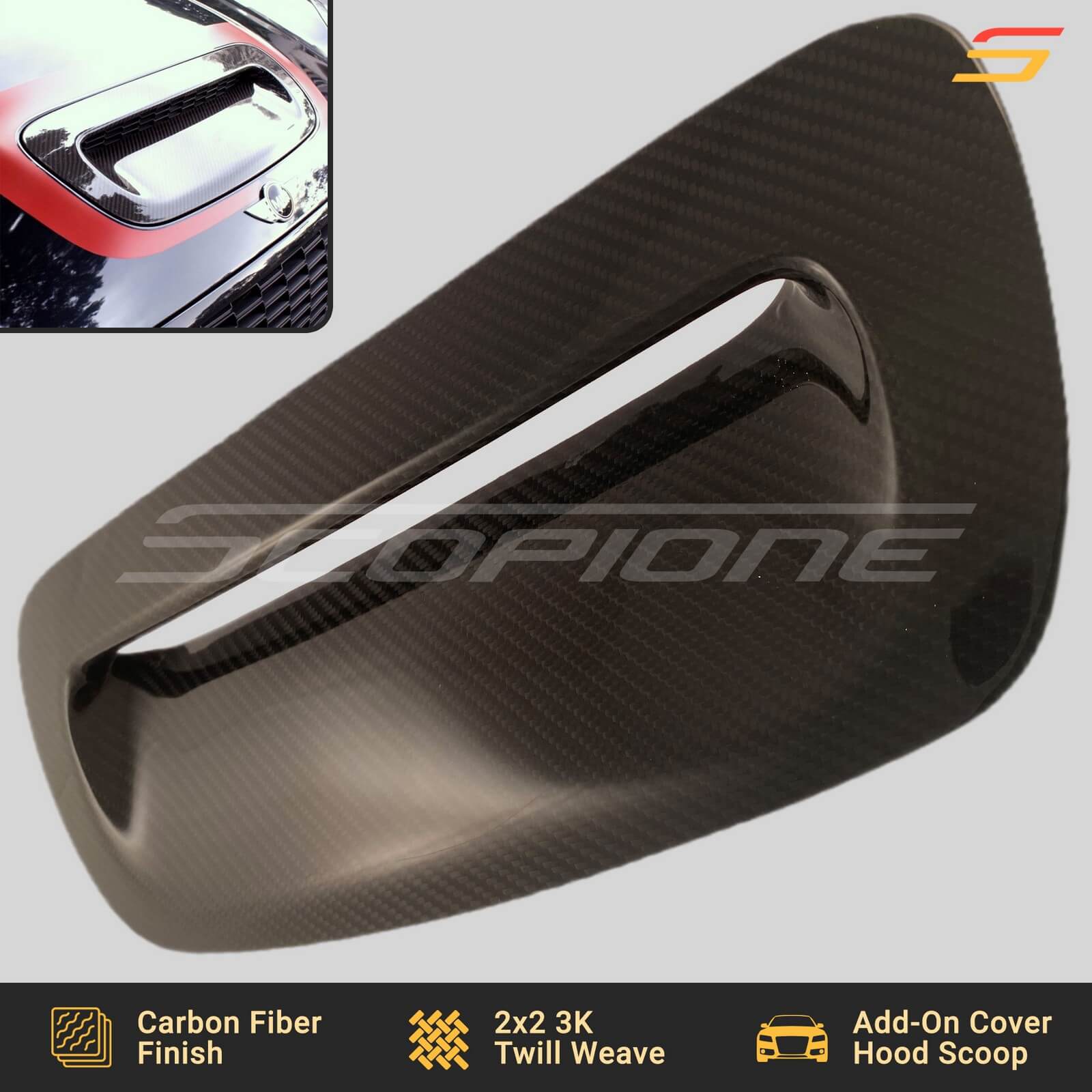
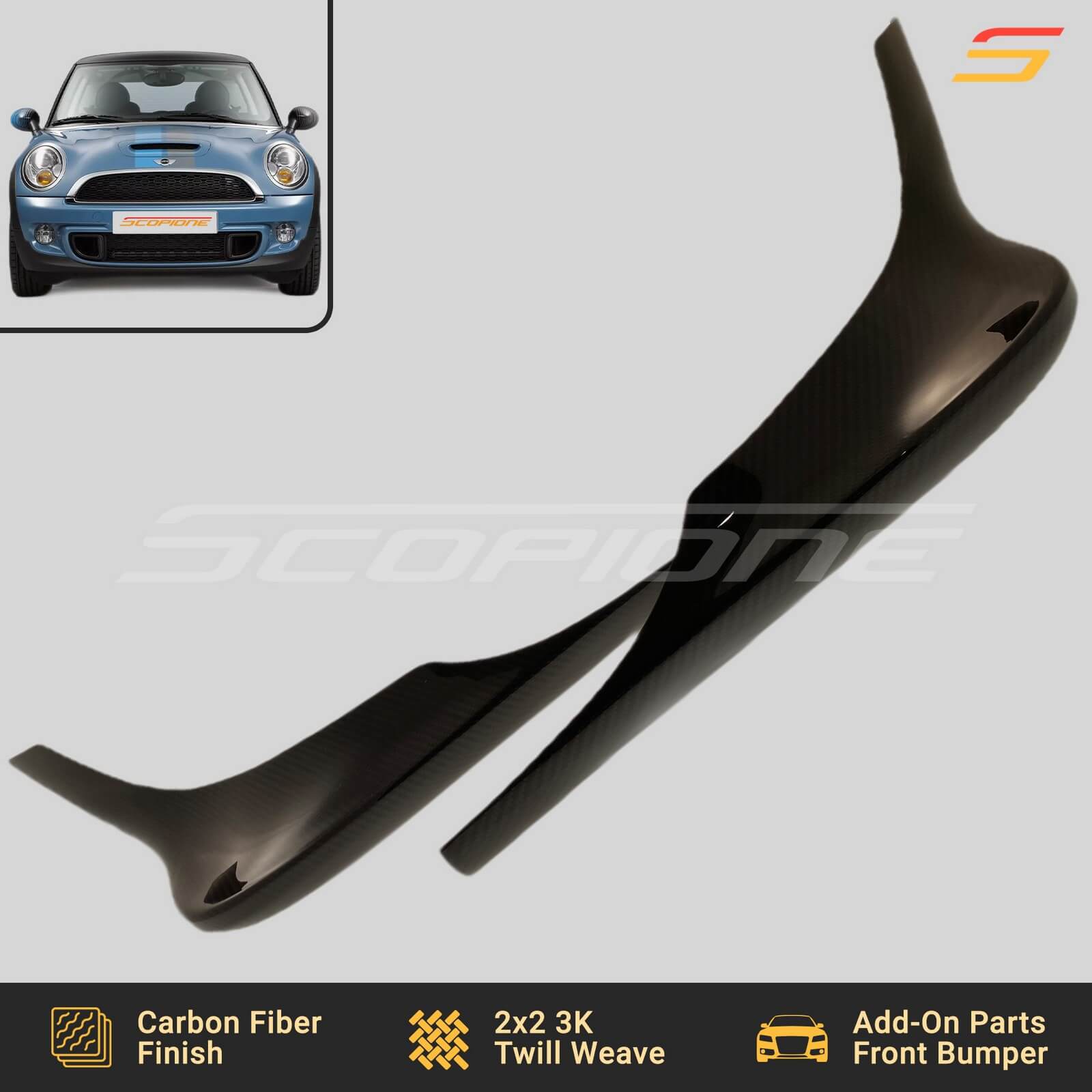
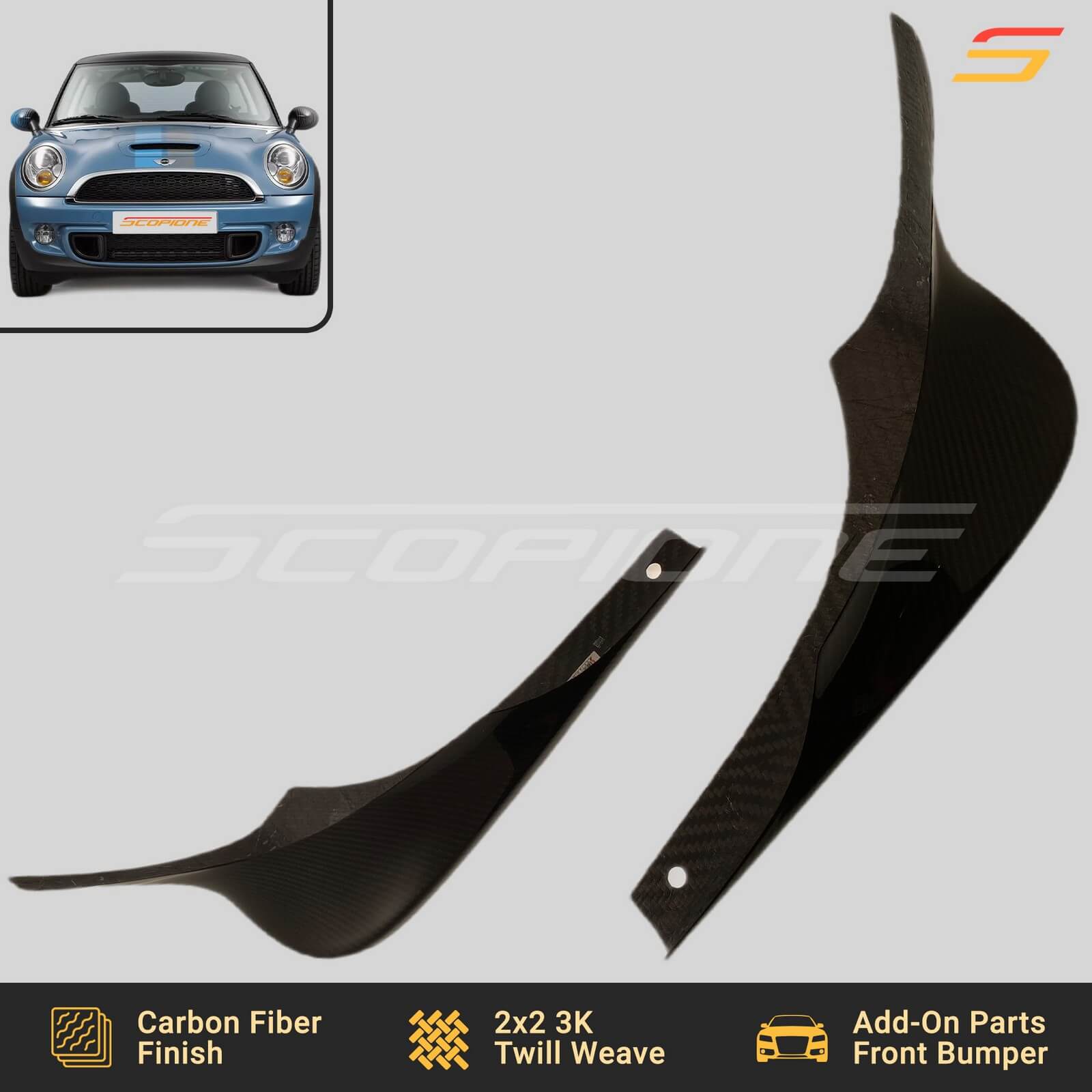
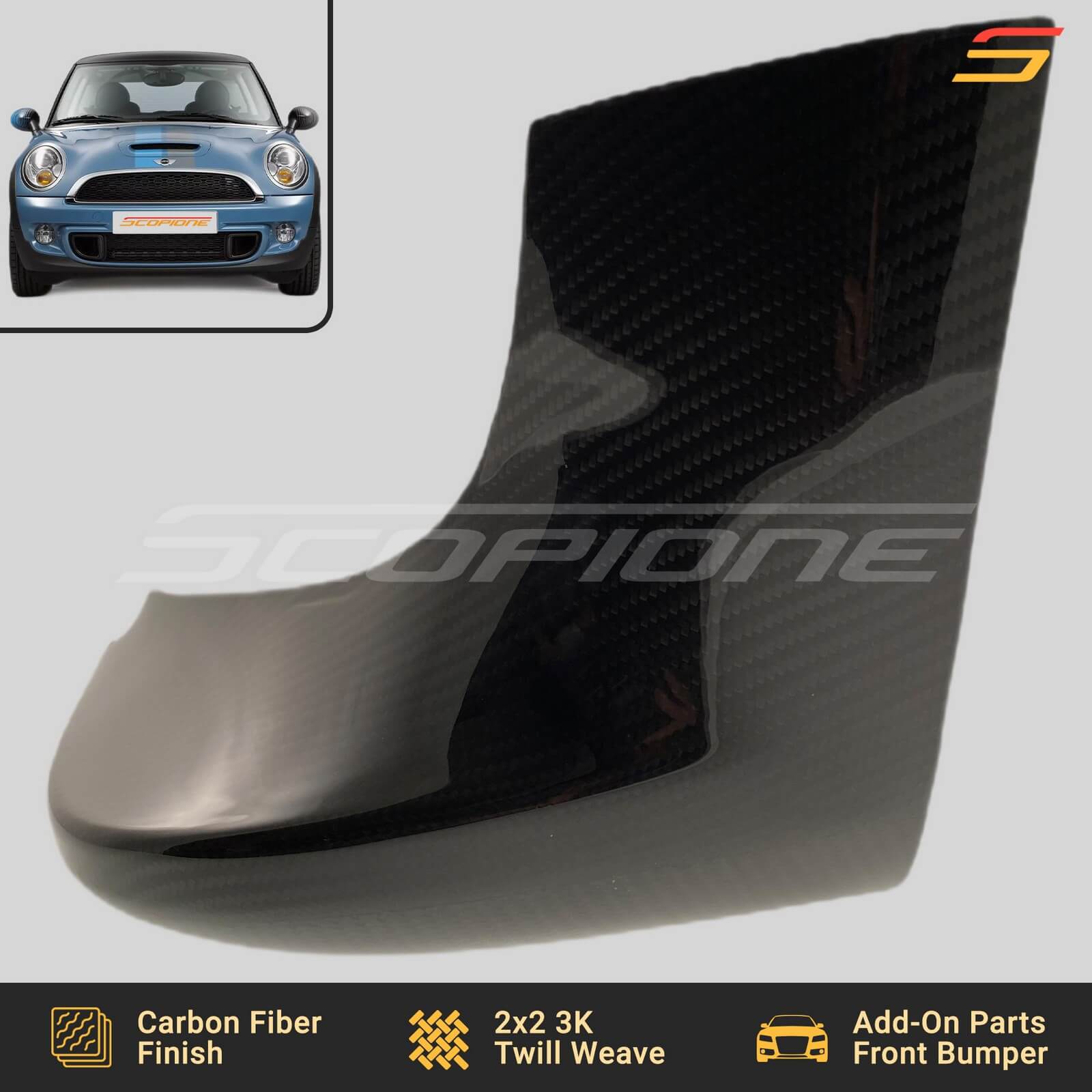
No factory carbon fiber on standard R56 production models. The platform’s CF significance was indirect: expanding the model range broadened the addressable market for aftermarket carbon-fiber accessories. Scopione’s catalog covers R55 through R61 platforms with mirror covers, door handle covers, and a front bumper splitter lip for the 2011–2015 Cooper S LCI. The R56 generation also established the buyer base — particularly Countryman and Clubman owners — that would sustain MINI’s volume through subsequent CF-equipped limited editions.
MINI John Cooper Works GP2 (R56, 2013)
The GP2 refined the formula on the R56 platform. The turbocharged 1.6-liter engine produced the same 218 hp peak as the supercharged GP1, but the turbo’s broader torque curve changed the car’s character from a high-revving screamer to a mid-range puncher. The difference was evident on track: where the GP1 required constant gear changes to stay in the powerband, the GP2 pulled cleanly from 2,000 rpm to its 7,000 rpm limiter with the turbo delivering usable torque across the entire range.
Braking improved substantially: 6-piston Brembo front calipers, borrowed from the BMW 135i, provided the kind of stopping power that the GP1’s standard brakes could not match under repeated track use. Adjustable coilover suspension and a 6-speed manual gearbox — the only transmission offered — maintained the GP’s purist credentials in a market that was rapidly shifting toward dual-clutch automatics. The GP2 lapped the Nürburgring Nordschleife in 8:23, slashing 19 seconds from the GP1’s time — a gap attributable to the improved chassis, better tires, and the turbo engine’s stronger mid-range acceleration out of the Nordschleife’s slower corners.
- Engine: 1.6L turbocharged Prince, 218 hp
- 0–60 mph: 6.1 seconds
- Top speed: 150 mph
- Production: 2,000 units worldwide (500 to US, 288 to UK)
- Nürburgring Nordschleife: 8:23
The GP2 featured a hatch-mounted spoiler with a carbon-fiber element — continuing the GP1’s tradition of CF aero on limited-edition MINI performance cars. Still a single-component application. But the GP2 shifted CF from novelty to expectation: by 2013, carbon fiber was what buyers anticipated on a MINI’s ultimate expression. The GP2 sits at the midpoint of MINI’s CF timeline — more than the GP1’s single wing, but far less than the structural CFRP that the GP3 would deliver seven years later.
Parallel to the GP road cars, the MINI Challenge one-make racing series — launched in 2002 and running as a support package to the British Touring Car Championship since 2020 — created a motorsport pathway that reinforced the Cooper S’s performance credentials. The F56 JCW race car, introduced in 2015, uses a purpose-built 275 bhp version of the 2.0-liter turbo engine with a Quaife sequential dog-engagement gearbox, Alcon brakes, and Nitron three-way adjustable dampers. Aftermarket carbon-fiber rear wings for the Challenge cars weigh under 4 kg, demonstrating the weight savings that CFRP delivers in competition applications where every gram affects lap times.
Scopione Perspective: The Personalization Era
Frank Stephenson’s MINI design invited personalization from the start — the floating roof, contrasting mirror caps, and bonnet stripes were factory options that encouraged owners to make each car distinct. Carbon fiber became a natural extension of that culture. Scopione’s MINI catalog covers both the R50/R52/R53 (2002–2008) and R55–R61 (2007–2016) platform generations with 2×2 3K twill-weave CF mirror covers, hood scoop covers, door handle covers, and bumper splitter lips. The diagonal twill pattern visible through each component’s clear coat adds a material dimension that factory plastic trim cannot replicate.



2014–Present: Carbon Fiber Comes of Age — The GP3, Electric Transition, and Generation Four
The third-generation MINI (F55/F56, 2014) arrived on BMW’s UKL platform, shared with the BMW 2 Series Active Tourer. The platform brought the B38 three-cylinder turbo and B48 four-cylinder turbo — the same engine family powering BMW’s own performance cars. The shared engineering ecosystem mattered more than the specific engines: UKL-platform MINIs sat alongside BMW models that were actively adopting CFRP technology for roofs, structural components, and body panels. Carbon-fiber expertise developed for the M3, M4, i3, and i8 programs was now accessible to every brand within the Group.
The F56 generation produced the carbon-fiber moment that defined MINI’s relationship with advanced materials. The JCW GP3 (2020) used recycled carbon fiber from BMW i3 and i8 production to create structural CFRP wheel arches — the first BMW Group vehicle with an exposed matte carbon-fiber coating. The fourth generation (F66, 2024) introduced Oliver Heilmer’s “Charismatic Simplicity” design language, and the electric MINI Cooper marked the brand’s pivot toward battery propulsion — where every gram saved through CF directly extends driving range.
Two concept cars from this period signaled MINI’s awareness of carbon fiber’s potential beyond limited-edition performance models. The Rocketman Concept (2011, Geneva Motor Show) used a carbon-fiber spaceframe borrowed from BMW’s concurrent i3 CFRP engineering program, packaged in a body just 3.4 meters long — close to the original Mini’s dimensions. The Superleggera Vision Concept (2014, Villa d’Este), a collaboration with the Touring Superleggera coachbuilding house in Turin, was an electric two-seat roadster featuring CFRP front splitter, side sills, and diffuser. Neither reached production, but both demonstrated that MINI’s design team was thinking about CF as a structural material, not merely a decorative one.
MINI John Cooper Works (F56, 2014–2024)
The F56 JCW was the first John Cooper Works model on BMW’s UKL platform, receiving the B48 2.0-liter turbocharged four-cylinder that also served the BMW M235i. Output reached 228 hp and 236 lb-ft — a meaningful jump over the GP2’s 218 hp, delivered as standard equipment rather than in a limited-edition shell. Both 6-speed manual and 8-speed torque converter automatic transmissions were available — the first time a MINI performance car offered a torque converter auto.
- Engine: 2.0L BMW B48 turbo inline-four, 228 hp, 236 lb-ft
- 0–62 mph: 6.1 seconds (automatic)
- Top speed: 153 mph
- Transmission: 6-speed manual or 8-speed automatic
No factory carbon-fiber body components on the standard F56 JCW. Optional JCW accessories included CF mirror caps and interior trim accents. The F56 JCW’s CF relevance is as the platform foundation for both the JCW Challenge and the GP3 — each one layering progressively more carbon fiber onto the base specification. The decade-long F56 JCW production run (2014–2024) spanned an era of rapid CFRP adoption within BMW Group, from the i8’s Carbon Core to the M3/M4’s CFRP roof. MINI benefited from that corporate investment without bearing its development cost.
MINI JCW Challenge (2017)
Originally announced as a 100-unit UK-exclusive special, the JCW Challenge stopped at 53 cars — making it one of the rarest modern MINIs. The specification read more like a race car than a road car: Nitron NTR R1 three-way adjustable coilover suspension, Quaife ATB limited-slip differential, 4-piston Brembo front calipers with 330 mm discs, Mintex brake pads, Team Dynamics 17-inch lightweight wheels (saving 3 lbs per corner over standard), and Michelin Pilot Sport Cup 2 tires. Six-speed manual only. Finished exclusively in White Silver.
- Engine: 2.0L BMW B48 turbo, 231 hp, 320 Nm
- Production: 53 units (UK only)
- Price: £32,000
- Transmission: 6-speed manual only
The JCW Challenge introduced multiple CF components to a MINI for the first time: a carbon-fibre air intake, carbon-fibre mirror covers, and JCW Pro exhaust with carbon-fibre tailpipe finishers. Three distinct CF applications on a single car, serving functional (air intake), cosmetic (mirrors), and signature (exhaust) roles. The GP1 had one CF component. The GP2 had one. The JCW Challenge had three. The trajectory was clear, even with only 53 cars to prove it.
MINI John Cooper Works GP3 (F56, 2020)
The GP3 rewrote what a MINI could be. Three hundred and one horsepower from the 2.0-liter B48 — the first production MINI to exceed 300 hp, and the first to exceed 160 mph. The 8-speed automatic was the only transmission option, a decision that generated heated debate but delivered measurable acceleration benefits: 0–62 mph in 5.2 seconds, with shift speeds that a manual gearbox could not match under racing conditions. Weight dropped to 1,255 kg, 70 kg lighter than the standard F56 JCW automatic, through rear seat deletion, reduced sound deadening, and forged 18-inch wheels weighing under 9 kg each.
The carbon fiber is why the GP3 matters for this story. The flared wheel arch panels used a material combination applied for the first time by the BMW Group: a thermoplastic substructure bonded to an outer shell of carbon fibre-reinforced plastic. The CFRP used recycled carbon fiber sourced from BMW i3 and i8 production waste, processed at BMW Group’s carbon-neutral manufacturing facility in Moses Lake, Washington State. The resulting CFRP fleece uses an omnidirectional weave pattern that provides multi-directional strength. Each GP3’s individual production number (0001–3000) was applied to the CFRP front arch panels via a paint transfer process developed specifically for the car.
- Engine: 2.0L BMW B48 turbo, 301 hp, 332 lb-ft
- 0–62 mph: 5.2 seconds
- Top speed: 164 mph — fastest production MINI ever
- Weight: 1,255 kg (70 kg lighter than JCW auto)
- Production: 3,000 units worldwide (575 to UK, ~500 to US)
- CFRP: Recycled BMW i3/i8 carbon fiber, exposed matte coating, omnidirectional weave
- Price: $44,900 USD
Two firsts matter here. The GP3 was the first BMW Group production vehicle to feature an exposed matte CFRP coating — the visible carbon weave left intentionally unglossed, a raw aesthetic that signaled track purpose through material honesty. And it was the first production application of recycled i3/i8 carbon fiber, demonstrating that CFRP production waste could be reprocessed into structural components for other vehicles within the BMW Group family. The recycling narrative is particularly compelling: carbon-fiber offcuts from the i3’s passenger cell and i8’s Carbon Core — material that would otherwise be industrial waste — became structural body panels on a limited-edition hot hatch. Sustainability and performance served the same engineering goal.
The front arch extensions widened the track by 40 mm over the standard JCW. CFRP enabled the complex curves and thin wall sections required for the flared arches at a weight that sheet metal could not achieve without significant mass penalty. The GP3 was not merely the quickest MINI ever produced. It represented the strongest technical argument for carbon fiber on a hot hatch that any manufacturer had yet delivered — a car where CFRP served a measurable structural function rather than existing purely as visual trim.
MINI Cooper Electric / SE (2020–Present)
The first electric MINI (Cooper SE, 2020) shared its motor with the BMW i3 — a 135 kW (181 hp) unit producing 270 Nm of instant torque. The 32.6 kWh battery provided approximately 110 miles of EPA range, and the center of gravity sat 30 mm lower than the combustion Cooper, noticeably tightening the car’s cornering behavior. The second-generation electric MINI (J01, 2023) expanded the range: the Cooper E offers 40.7 kWh and 189 miles WLTP, the Cooper SE provides 54.2 kWh and 249 miles WLTP.
- Cooper SE (F56): 135 kW / 181 hp, 32.6 kWh battery, ~110 miles EPA range
- Cooper SE (J01): 160 kW / 214 hp, 54.2 kWh battery, 249 miles WLTP range
- Weight: 1,365 kg (F56 SE) — ~130–160 kg heavier than combustion Cooper
No factory carbon fiber on either generation. The electric MINI’s connection to the CF story is mathematical rather than material: every kilogram saved through CFRP or other lightweight measures translates directly into extended battery range. The F56 Cooper SE’s 32.6 kWh battery added roughly 130–160 kg over the combustion Cooper, pushing the curb weight to 1,365 kg. That battery mass affects everything — acceleration, braking distances, tire wear, and ride quality over imperfect surfaces. Carbon-fiber body panels or structural components could offset a meaningful portion of that penalty.
The GP3’s demonstration that recycled carbon fiber can produce structural components at acceptable cost points toward a future where CF weight savings offset battery mass in electric performance variants. The i3 motor in the first electric MINI and the recycled i3 carbon fiber in the GP3 both originated in the same BMW Group EV program — different outputs from the same engineering investment. A future electric JCW GP with recycled CFRP body panels would close the circle completely: EV technology and CFRP weight reduction, both descended from the i3 program, working together on the platform that Issigonis created for lightweight driving.
MINI has signaled plans to become an all-electric brand by the early 2030s. As that transition accelerates, Issigonis’s original insight gains new relevance: lighter cars need less energy. In an EV, “less energy” means smaller batteries, lower cost, and longer range. Carbon fiber is one of the tools available to achieve that.
MINI Cooper / JCW (F66, 2024–Present)
The fourth-generation MINI arrived with Oliver Heilmer’s “Charismatic Simplicity” design philosophy — fewer lines, cleaner surfaces, and a return to the proportional purity that defined Issigonis’s original. Heilmer, a Munich native who joined BMW after graduating from Pforzheim University in 2000, became Head of MINI Design in September 2017 and guided the F66 from concept through production. The design strips away the accumulated visual complexity of the F56 generation, replacing chrome trim with body-colored or contrast-painted elements and simplifying the headlight and taillight graphics.
The Cooper C uses a 1.5-liter three-cylinder turbo producing 154 hp (156 PS), while the Cooper S receives a 2.0-liter four-cylinder turbo at 204 hp. Both drive through a 7-speed dual-clutch transmission — the first DCT in a MINI. The F66 JCW raises output to 231 hp and 280 lb-ft, a 16% torque increase over the previous-generation JCW.
- Cooper C: 1.5L 3-cylinder turbo, 154 hp (156 PS) / 1,335 kg / 0–62 in 7.7 seconds
- Cooper S: 2.0L 4-cylinder turbo, 204 hp / 1,360 kg / 0–62 in 6.6 seconds
- JCW: 2.0L turbo, 231 hp, 280 lb-ft
- Transmission: 7-speed dual-clutch (all variants)
- Designer: Oliver Heilmer
Factory carbon-fiber content on the F66 is limited to JCW Pro accessories, including a genuine carbon-fibre fuel filler cap. The broader CF ecosystem for the F66 is still developing as aftermarket manufacturers tool up for the new body. But the fourth generation’s design language — with its emphasis on clean surfaces and minimal ornamentation — creates natural opportunities for carbon-fiber accent pieces. The F66’s flatter panels and reduced decorative trim lines provide cleaner mounting surfaces than the more sculpted F56, and mirror caps, splitter trims, and diffuser elements in exposed CF weave would complement Heilmer’s simplified aesthetic without adding visual clutter. The MINI Convertible (F67, 2024) and MINI 5-door (F65, 2024) extend the F66 platform to additional body styles, each presenting its own set of CF accessory opportunities.
The Countryman (U25, 2023) also entered its fourth generation, growing to become the largest MINI yet on BMW’s FAAR platform. The JCW Countryman weighs 3,825 lbs — nearly six times the original Mini’s weight. That comparison is extreme but instructive: the Countryman represents how far the brand has traveled from Issigonis’s lightweight imperative, and it underscores why carbon fiber matters for MINI’s future. Every gram of CF replacing heavier conventional material brings the driving experience fractionally closer to the responsiveness that defined the brand at its origin.
Scopione Perspective: Performance and Personalization
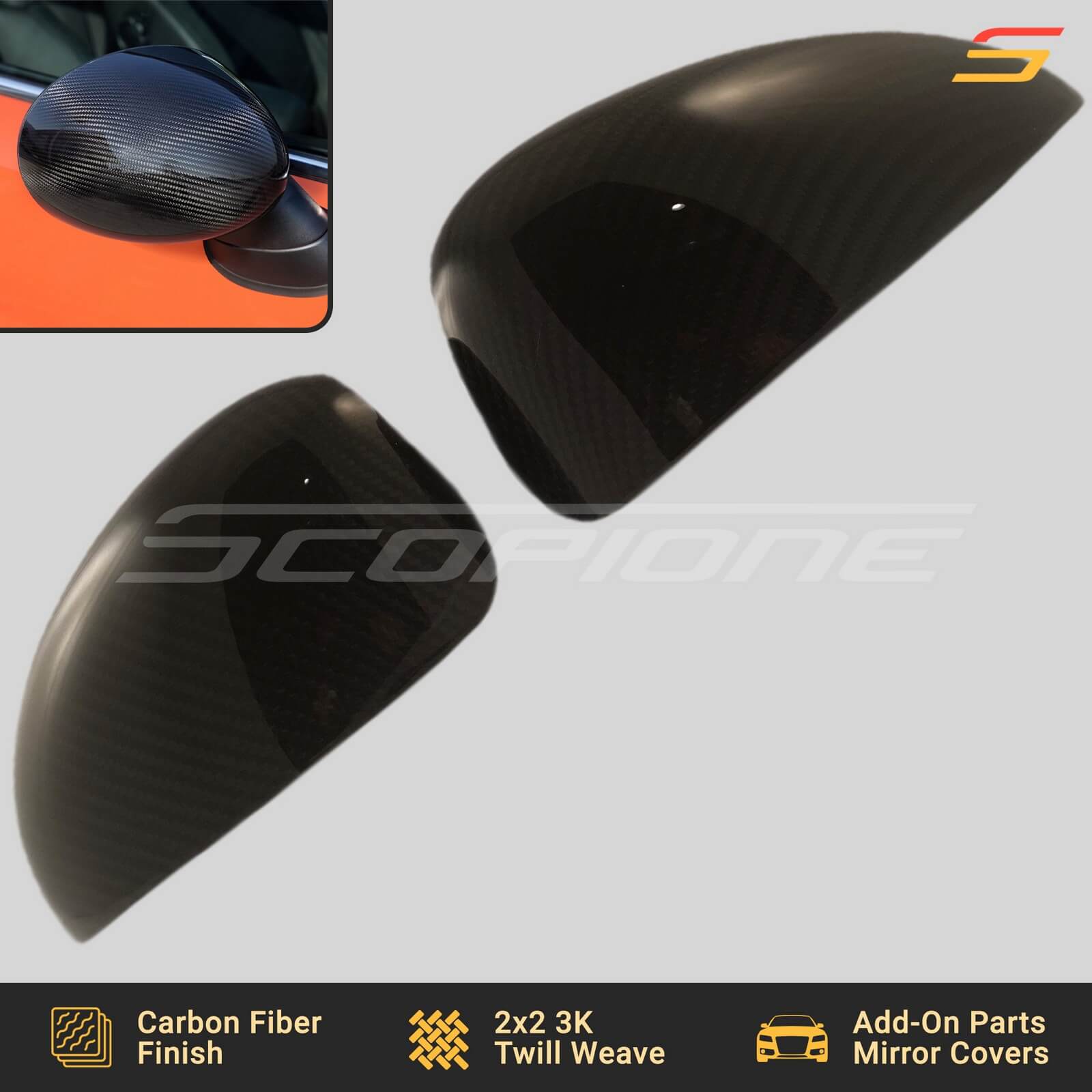
The GP3 demonstrated that carbon fiber on a MINI could be structural, not just cosmetic. But the majority of MINI owners experience CF through accessories — mirror covers, splitter lips, scoop covers, and handle trims that replace factory plastic with 2×2 3K twill-weave carbon fiber. Scopione’s MINI catalog spans R50 through R61 platforms, covering both the first and second generation of the modern MINI with precision-fitted components. Each part is finished with UV-resistant clear coat to maintain the weave’s depth and clarity through years of daily use. The MINI community’s culture of individual expression makes carbon fiber not just a material upgrade but a statement of intent.


Frequently Asked Questions
MINI and Carbon Fiber: Common Questions
When did MINI first use carbon fiber?
The 2006 MINI John Cooper Works GP (GP1) featured the first factory carbon-fiber component on a MINI — a carbon-fiber rear wing on a 2,000-unit limited edition. The defining MINI CF milestone came in 2020 with the GP3’s recycled CFRP wheel arches, which used carbon fiber from BMW i3 and i8 production processed at BMW Group’s Moses Lake facility. The GP3 was the first BMW Group vehicle with an exposed matte carbon-fiber coating.
What is special about the MINI GP3’s carbon fiber?
The GP3’s wheel arches combined a thermoplastic substructure with an outer shell of recycled CFRP — a material combination used for the first time by the BMW Group. The recycled carbon fiber came from i3 and i8 production waste, processed at BMW’s carbon-neutral Moses Lake manufacturing facility in Washington State. The exposed matte CFRP coating was also a Group first, with the omnidirectional weave pattern left unglossed as a deliberate design choice.
What MINI models have factory carbon fiber components?
Four MINI models have featured factory carbon fiber: the JCW GP (2006, CF rear wing), JCW GP2 (2013, CF spoiler element), JCW Challenge (2017, CF air intake, mirror covers, and exhaust tailpipe finishers), and JCW GP3 (2020, recycled CFRP wheel arches). The current F66 JCW offers a JCW Pro carbon-fibre fuel filler cap as an accessory.
Does Scopione sell carbon fiber parts for MINI?
Scopione stocks 2×2 3K twill-weave carbon-fiber accessories for MINI including side mirror covers, hood air scoop covers, door handle covers, antenna cap covers, and front bumper splitter lips. Coverage spans R50/R52/R53 (2002–2008) and R55/R56/R57/R58/R59/R60/R61 (2007–2016) platforms. Each part features UV-resistant clear coat and precision fitment for the specific MINI model – see the full MINI catalog at Scopione.
How does the original Mini’s weight compare to the modern MINI?
The 1959 Mini weighed approximately 640 kg. The current MINI Cooper S (F66, 2024) weighs 1,360 kg — a 112% increase across four generations. The weight growth reflects modern safety requirements (crash structures, airbags), equipment levels (climate control, infotainment, driver assistance), and the broader platform needed to meet current regulatory standards. Carbon fiber offers one path to managing that growth: the GP3 shed 70 kg from the standard JCW through a combination of component deletion and CFRP construction, demonstrating that CF can partially reverse the trend without sacrificing structural integrity.
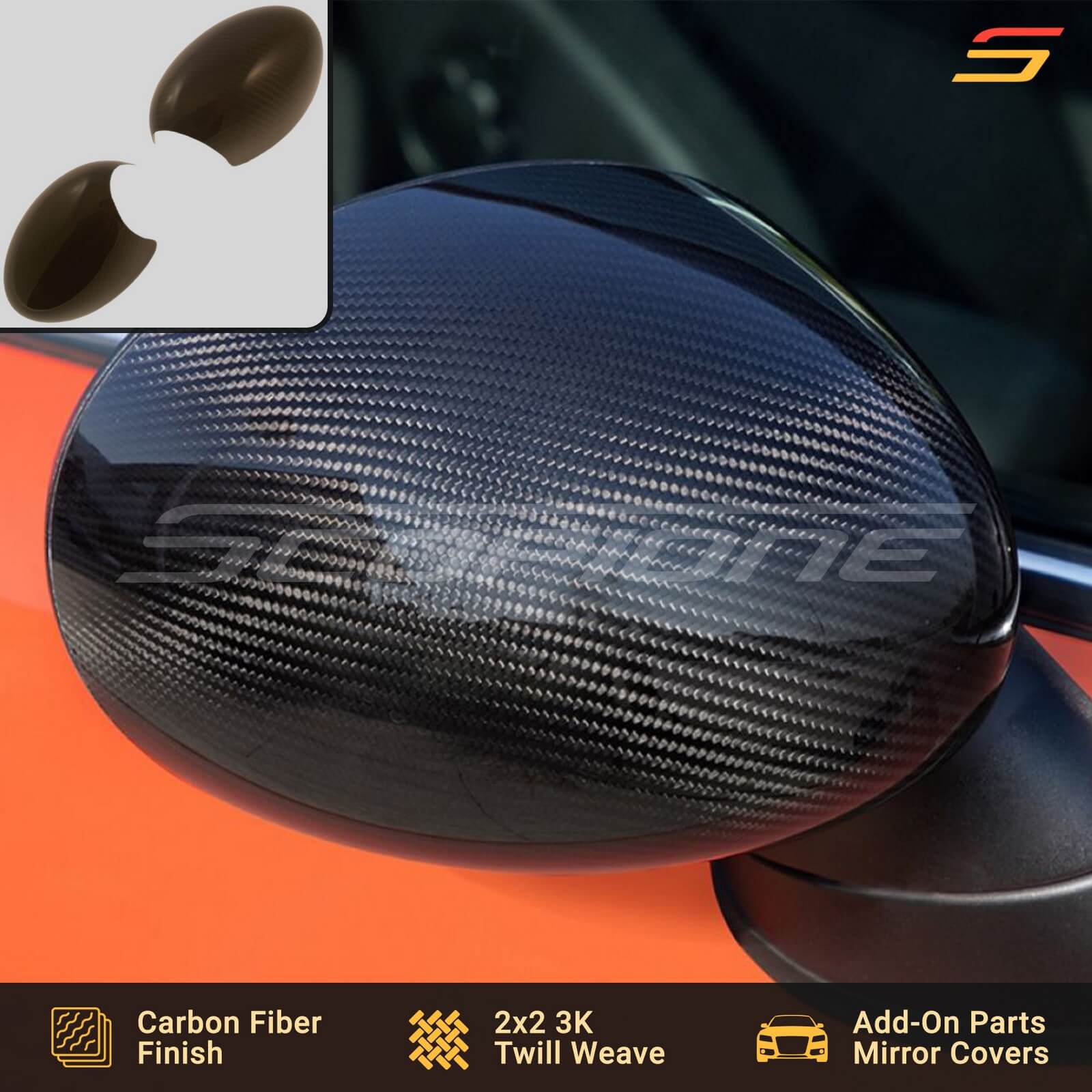
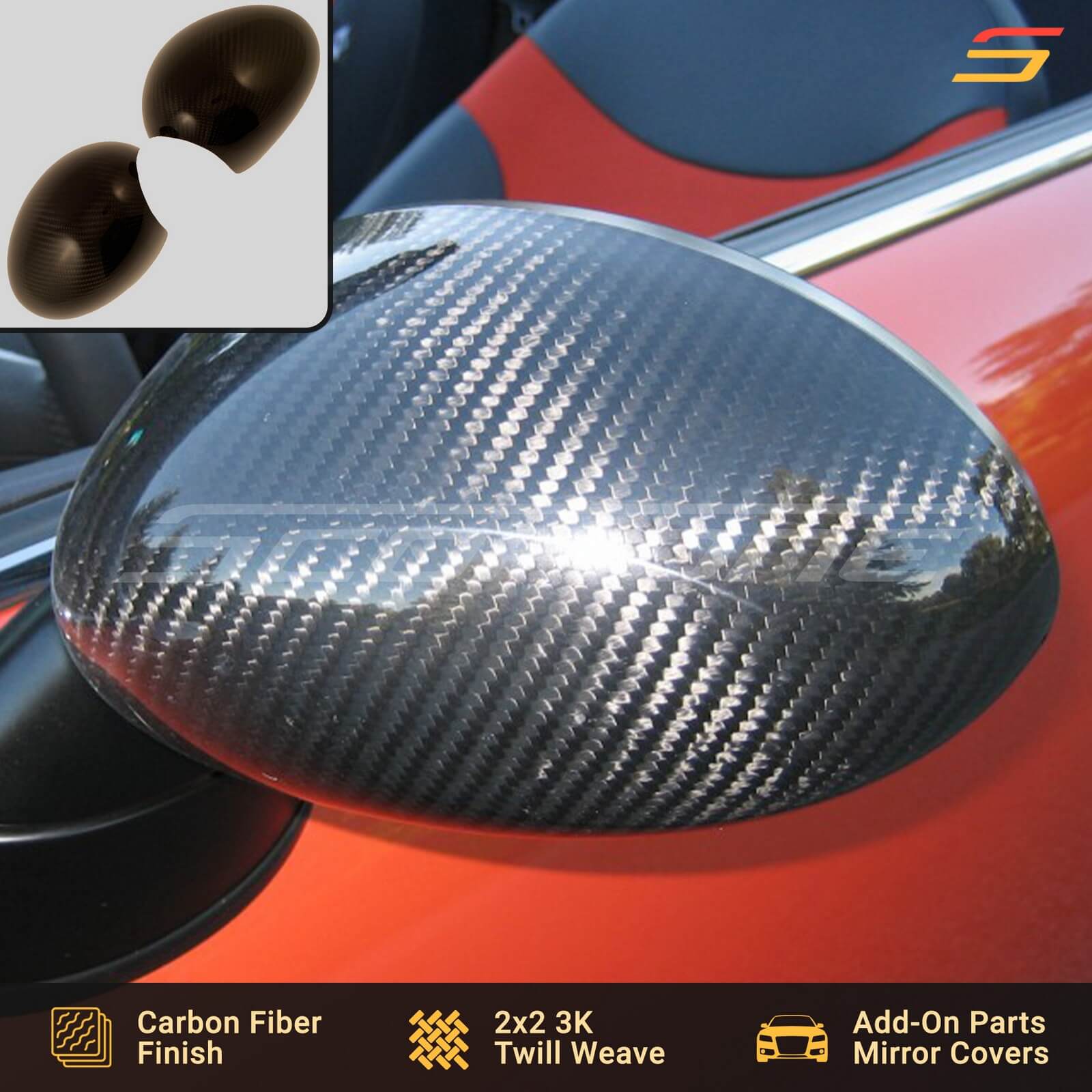
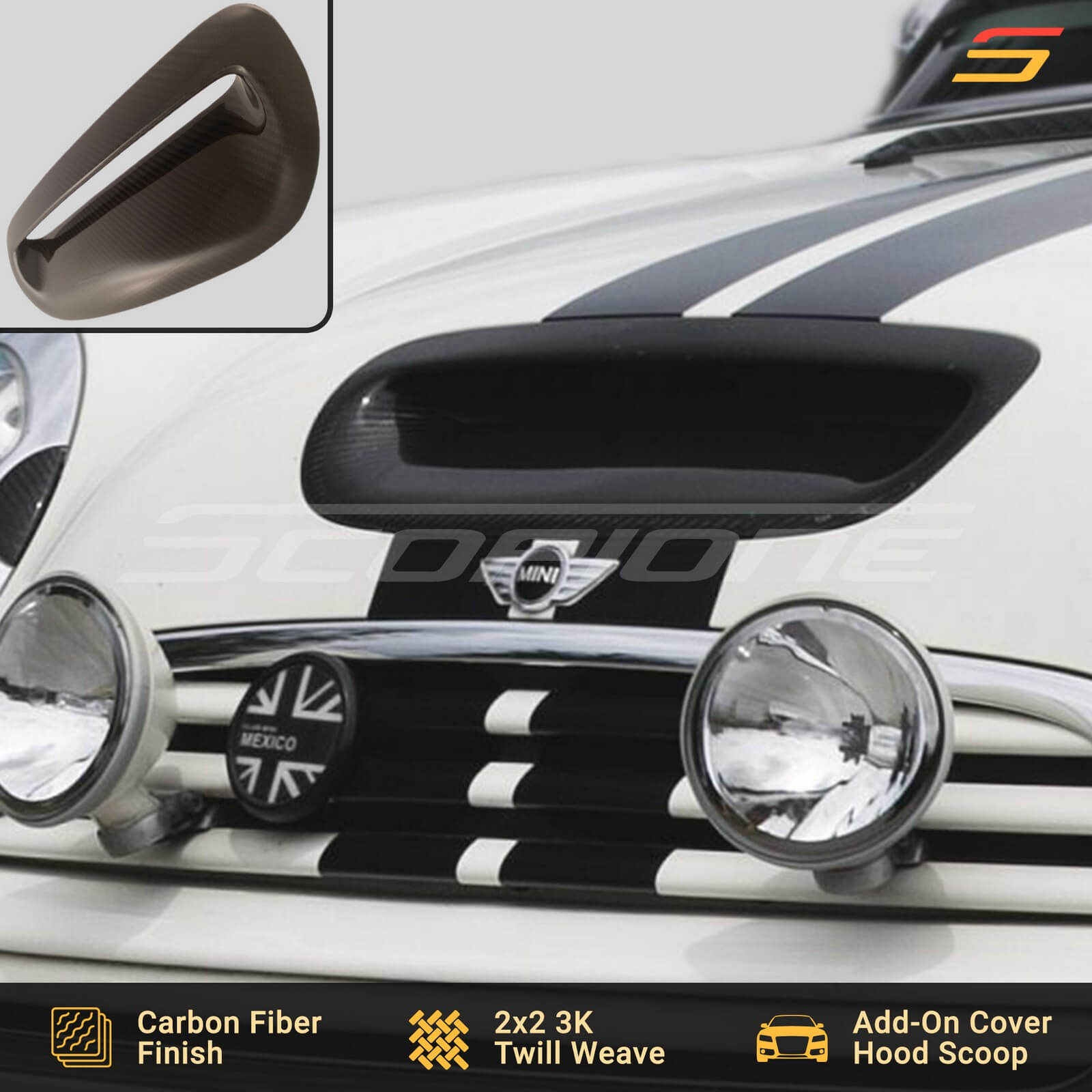
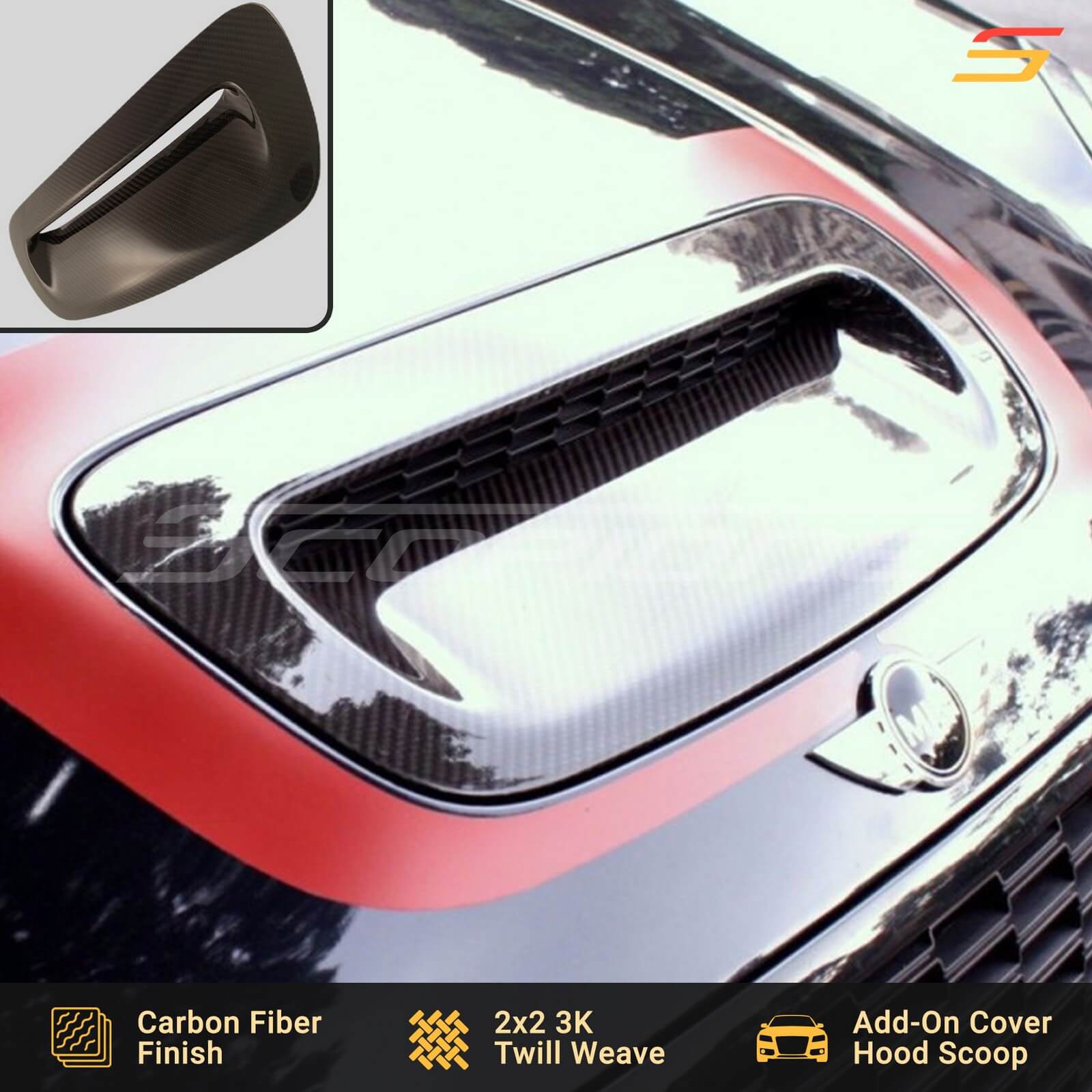
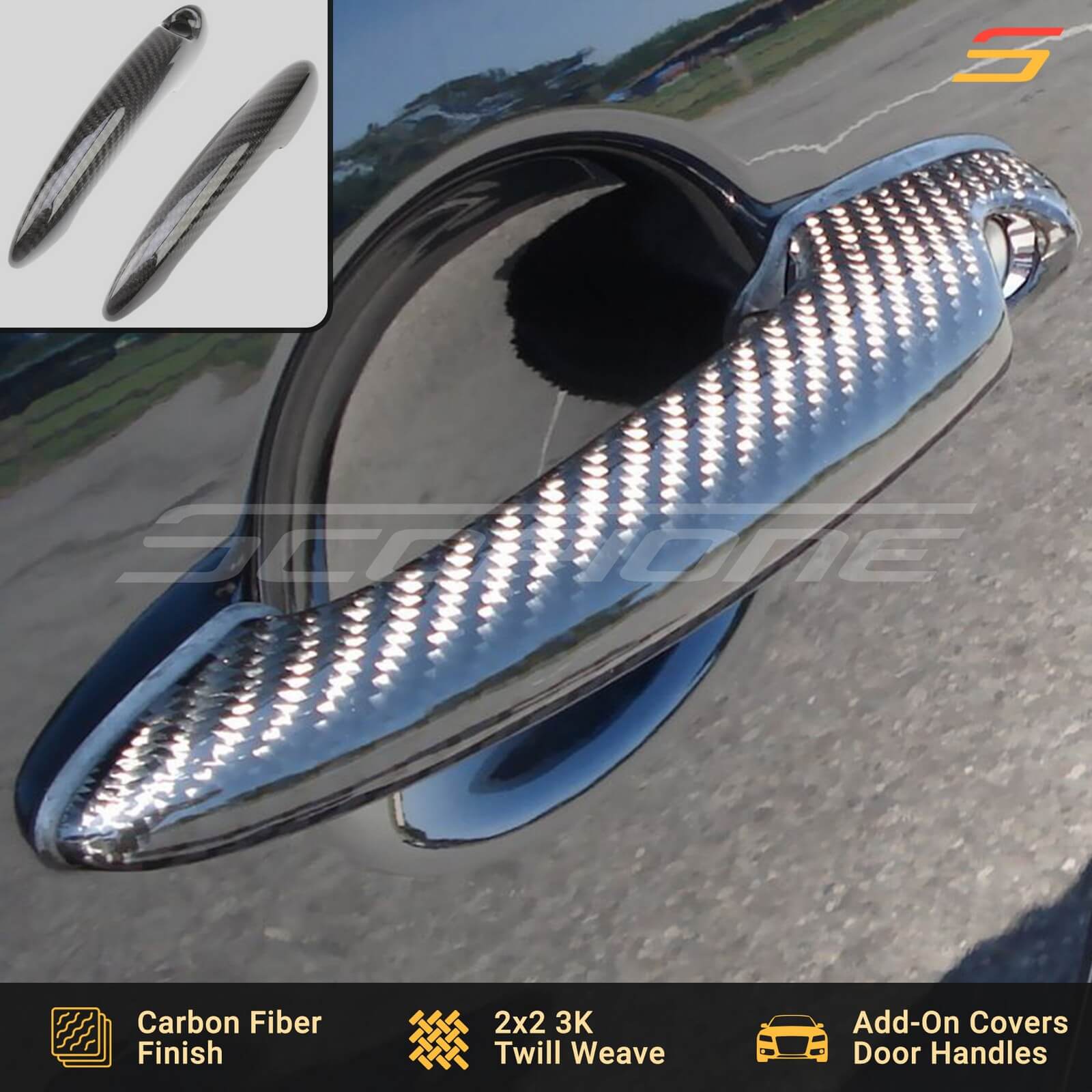
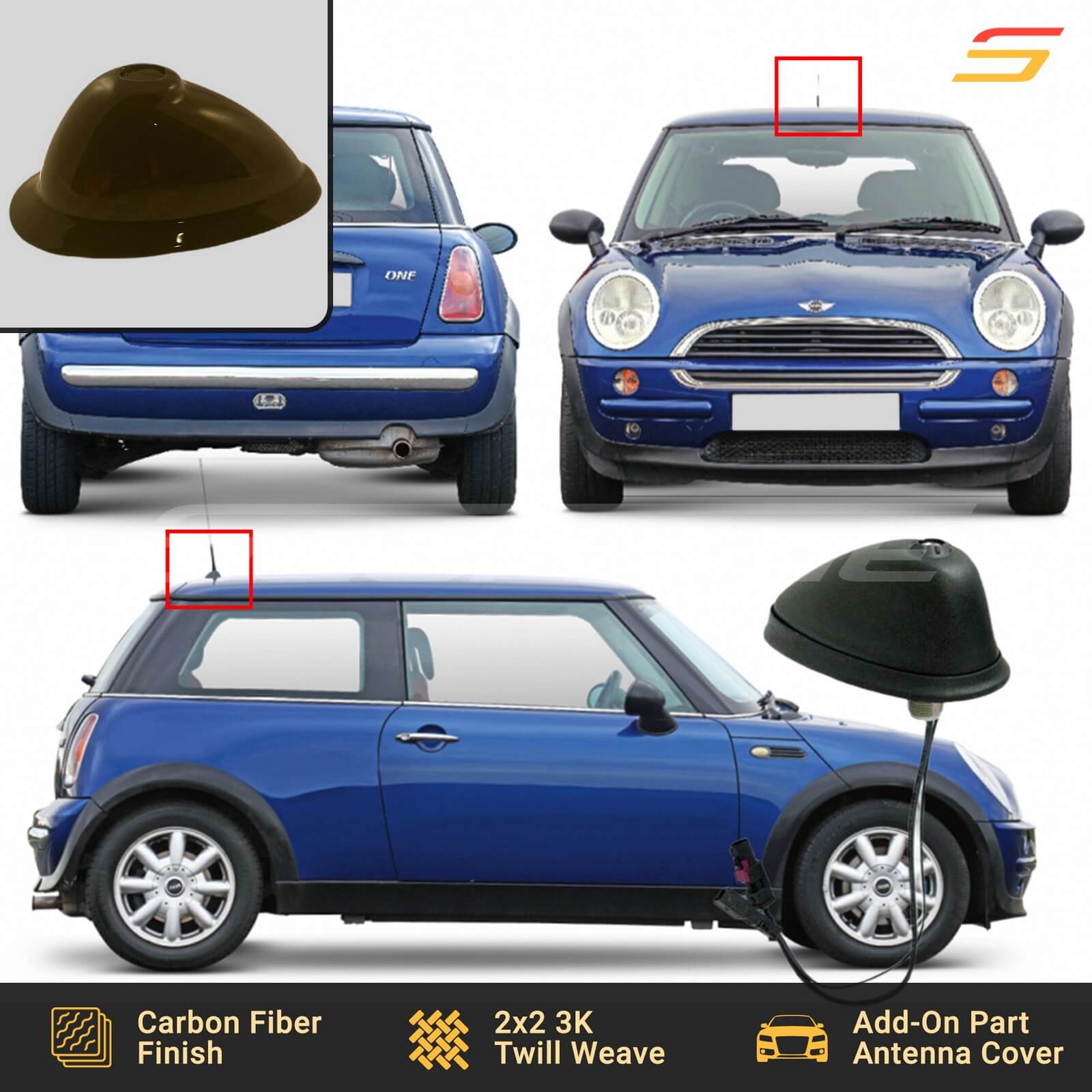
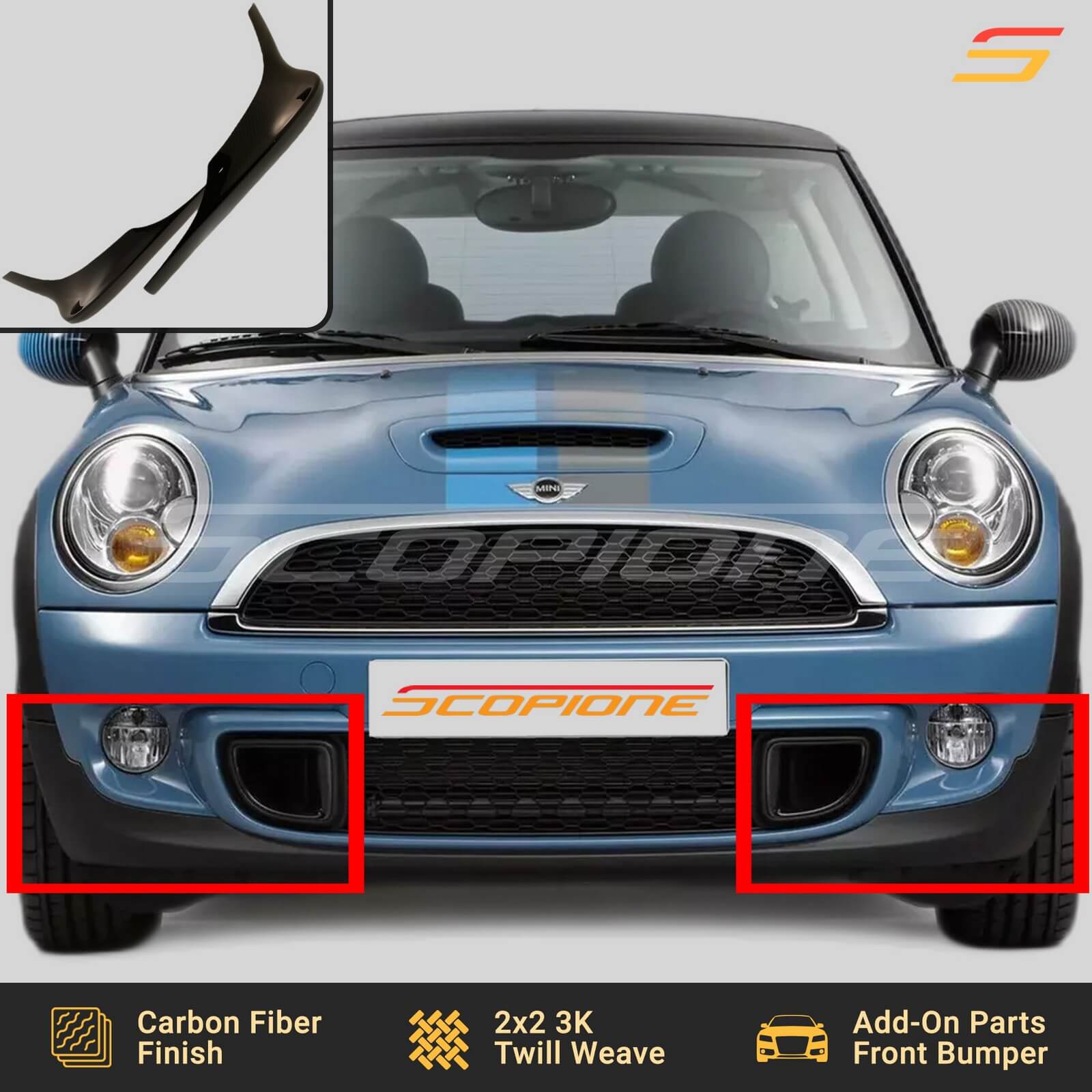
Experience the elegance and performance of the MINI with Scopione. Browse our gallery and get inspired to elevate your supercar with our top-of-the-line carbon fiber upgrades.
Shop now for premium ScopioneCarbon carbon fiber upgrades and experience the ultimate in performance and aesthetics for your MINI!
Back to Top ↑Disclaimer: Technical specifications, production figures, and historical details presented in this article are editorial in nature and may differ from official manufacturer data. Photographs show Scopione carbon fiber parts for the MINI Cooper R50, R52, R53 and R55–R61 platforms.