

 Shop
Shop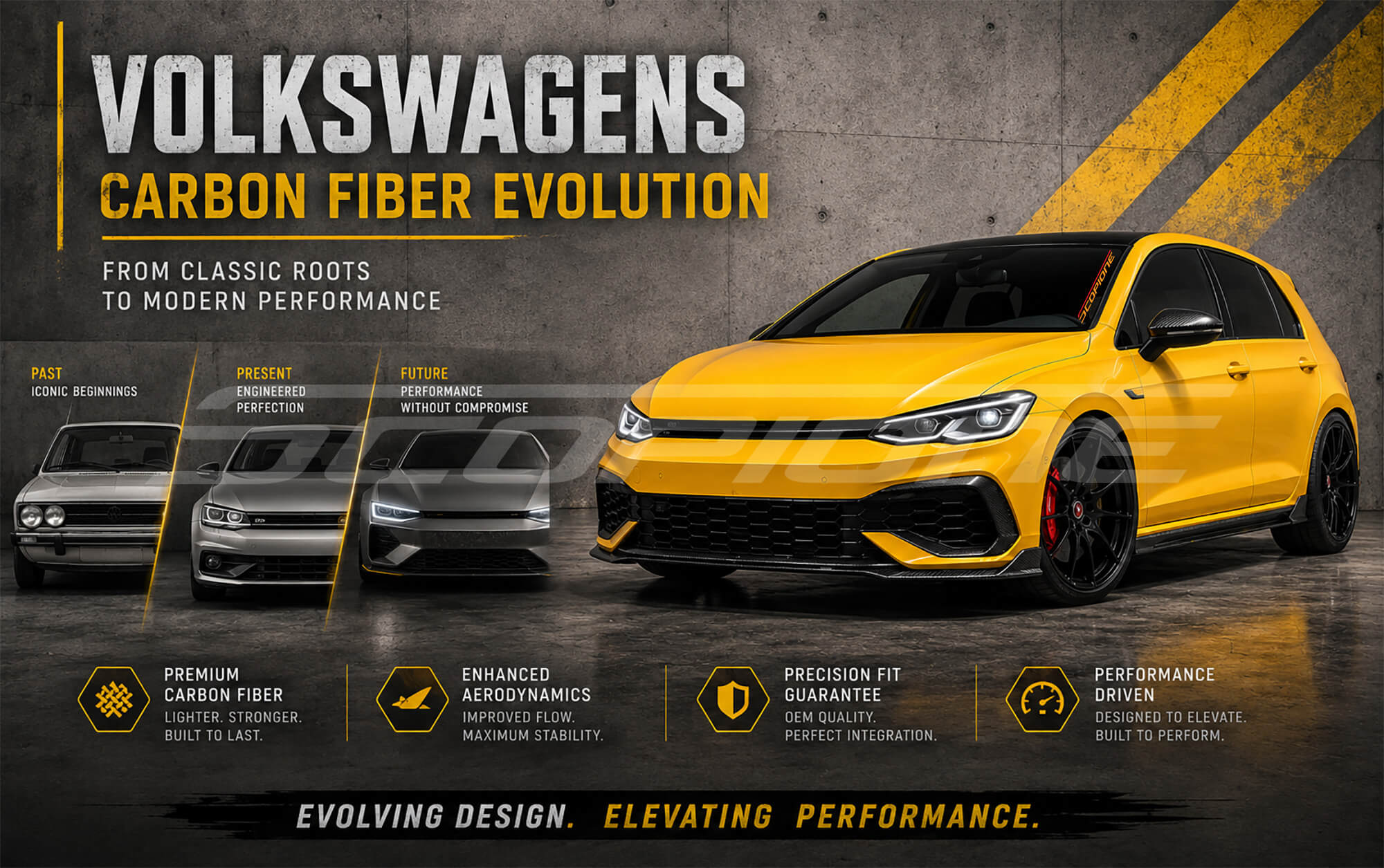
Volkswagen built the world’s best-selling single-platform car (the Beetle, 21.5 million units across 65 years) and then invented an entirely new market segment with the Golf GTI in 1976. Carbon fiber arrived through two unusual channels rather than the typical supercar-cascade route. The XL1 (2014–2016) achieved 261 mpg through a 230 kg CFRP monocoque, the structurally ambitious composite construction VW has ever attempted. The ID.R (2018–2019) used a CF monocoque race chassis to set the outright Pikes Peak record (7:57.148) and the Nurburgring electric-vehicle lap record (6:05.336). The volume CF story, however, belongs to the aftermarket. The Golf GTI and R community has built one of the largest carbon-fiber accessory ecosystems in the tuning world, with specialty manufacturers producing comprehensive CF body kits for MK5 through MK8 platforms. Volkswagen carbon fiber evolution traces a path from people’s-car democratization through hot-hatch culture into a globally distributed CF ecosystem. And it sits today in unusual balance between minimal factory CF and an outsize aftermarket – explore the Scopione catalog.
Volkswagen Carbon Fiber Timeline
| Year | Milestone | Model / Program |
|---|---|---|
| 1937 | Volkswagen founded under Ferdinand Porsche’s technical direction | Corporate |
| 1938 | Beetle (Type 1) production begins; eventual run of 21.5 million units | Beetle Type 1 |
| 1976 | Golf GTI MK1 launches and creates the hot hatch segment | Golf GTI MK1 |
| 1982 | First Worthersee GTI gathering establishes the global VW tuning culture | Worthersee Treffen |
| 2004 | MK5 GTI debuts the 2.0L turbocharged formula and DSG dual-clutch | Golf GTI MK5 |
| 2010 | Golf R MK6 replaces the R32, AWD turbo formula at 266 hp | Golf R MK6 |
| 2014 | XL1 launches with full CFRP monocoque (230 kg) and 261 mpg | Volkswagen XL1 |
| 2016 | Golf GTI Clubsport S sets FWD Nurburgring record at 7:49.21 | GTI Clubsport S |
| 2018 | ID.R sets Pikes Peak outright record of 7:57.148 | VW ID.R |
| 2019 | ID.R sets Nurburgring EV record at 6:05.336 | VW ID.R Nordschleife |
| 2023 | Golf R 333 limited edition (333 units, 333 hp) caps the MK8 era | Golf R 333 |
| 2024 | Aftermarket CF ecosystem reaches industrial maturity for MK8 | Aftermarket CF |
1937–2003: The People’s Car and the Birth of the Hot Hatch
Volkswagen’s first six decades established two foundational identities. The Beetle became the world’s defining democratic automobile, selling 21.5 million units across 65 continuous production years on three continents. The Golf GTI, launched in 1976, invented the hot hatch market segment and created a tuning culture that would later become the foundation of one of the largest carbon-fiber accessory ecosystems in the automotive aftermarket. From a single-model manufacturer in post-war Wolfsburg, Volkswagen grew into a global conglomerate that eventually included Audi, Lamborghini, Bentley, Bugatti, and Porsche.
No carbon fiber appeared on any Volkswagen production vehicle during this era. Lightweight construction relied on steel monocoques, thin-wall panels, and minimal equipment rather than exotic materials. The hot hatch philosophy prioritized accessible performance over premium materials. But the GTI tuning culture that emerged in the 1980s and 1990s, particularly through Germany’s Tuner Grand Prix scene and the annual Worthersee gathering in Austria (from 1982), created the aftermarket infrastructure that would later embrace carbon fiber components. Clubs, organized events, and a generation of specialty fabricators built the distribution channels that the eventual CF industry would inherit.
Volkswagen Beetle Type 1 (1938–2003)
The Beetle is the best-selling single-platform car in history. Over 21.5 million units rolled out of Wolfsburg, Puebla, and other production sites across 65 continuous production years. Designed by Ferdinand Porsche with Erwin Komenda contributing the rounded body, the Beetle established the rear-mounted air-cooled flat-four engine, torsion bar suspension, and integral monocoque body that defined affordable post-war motoring. Engine displacement grew from the original 985cc producing 25 hp to 1,585cc producing 50 hp by the final production years. The last Type 1 rolled off the Puebla, Mexico production line on July 30, 2003.
- Engines: Air-cooled flat-four, 985cc (25 hp) to 1,585cc (50 hp)
- Top speed: ~80 mph (later models)
- Total production: 21,529,464 units across 65 years
- Designer: Ferdinand Porsche / Erwin Komenda
- Final unit produced: July 30, 2003, Puebla, Mexico
No carbon fiber. The Beetle’s significance to the CF story is philosophical rather than material. It established Volkswagen’s identity as a manufacturer of accessible, mass-market vehicles, the polar opposite of the supercar brands that first adopted carbon fiber as a structural material. When CF eventually appeared in VW’s ecosystem decades later, it came through the aftermarket tuning community rather than through factory cascade from a halo model. The Beetle’s commercial revenue also funded VW Group’s eventual acquisition of Audi (1965), Lamborghini (1998), Bentley (1998), Bugatti (1998), and Porsche (2009), creating cross-brand engineering relationships that would later inform VW’s composite expertise.
Volkswagen Golf GTI MK1 (1976–1983)
The Golf GTI MK1 is widely credited as the original hot hatch. A compact, affordable car with genuine sporting performance, it transformed the practical hatchback into a desirable performance vehicle. Giorgetto Giugiaro’s clean hatchback styling was enhanced for the GTI variant with a red-striped grille, tartan-pattern seat upholstery, and a golf-ball-shaped gear knob. The 1.6L fuel-injected inline-four produced 110 hp, allowing the lightweight 840 kg car to reach 60 mph in 8.9 seconds and a top speed of 113 mph. Originally planned as a limited 5,000-unit run reflecting VW management’s skepticism about market demand for a sporting Golf, the GTI’s overwhelming reception pushed total MK1 production to approximately 462,000 units.
- Engine: 1.6L inline-4, fuel-injected, 110 hp
- 0–60 mph: 8.9 seconds
- Top speed: 113 mph
- Curb weight: 840 kg
- Production: ~462,000 units (planned 5,000 internal limited-volume run)
- Designer: Giorgetto Giugiaro (exterior)
No carbon fiber. The MK1 GTI’s lightweight character came from thin steel panels, minimal equipment, and Giugiaro’s efficient packaging rather than advanced materials. Its significance is cultural. The MK1 GTI created the hot hatch tuning scene that would eventually become one of the largest aftermarket carbon fiber markets in the automotive world, with specialty suppliers across Europe, North America, and Asia building businesses around CF accessories for every subsequent Golf generation.
Volkswagen Golf GTI MK2 (1984–1992)
The MK2 GTI grew in size and sophistication while retaining the MK1’s accessible character. The 8-valve 1.8L produced 102 to 139 hp depending on market and year. The 16V variant added a twin-cam cylinder head for 137 hp. The G60 supercharged model pushed output to 160 hp, with a Roots-type supercharger feeding the 1.8L block. The MK2 era saw Volkswagen Motorsport’s rally program take shape and the emergence of organized VW tuning culture in Germany and the UK.
- Engine: 1.8L inline-4: 8V (102–139 hp), 16V (137 hp), G60 supercharged (160 hp)
- 0–60 mph: 7.8 seconds (16V)
- Top speed: ~130 mph (16V)
- G60 supercharger: Roots-type, ~7 psi boost
No carbon fiber. The MK2 era is significant for establishing the organized VW tuning community: clubs, specialty publications, and the first generation of aftermarket body kit manufacturers. The Worthersee GTI meeting, which began in Austria in 1982 during the MK2 era, became the world’s largest VW enthusiast gathering and a launchpad for aftermarket product debuts. This community infrastructure later became the distribution channel for carbon fiber aftermarket parts when CF technology matured at consumer-accessible price points in the 2000s and 2010s.
Volkswagen Golf GTI MK3 (1991–1997)
The MK3 generation introduced the VR6 engine, Volkswagen’s compact narrow-angle six-cylinder that fit within the Golf’s engine bay without significant modifications. The 2.0L base GTI delivered 115 hp, while the 2.8L VR6 variant produced 172 hp and turned the Golf into a genuine six-cylinder performance hatchback. Critics noted the MK3’s weight increase versus the MK1 and MK2, but the VR6 variant offered character and capability that the four-cylinder GTI could not match.
- Engines: 2.0L inline-4 (115 hp); 2.8L VR6 (172 hp)
- 0–60 mph: ~7.5 seconds (VR6)
- Top speed: ~140 mph (VR6)
- VR6 angle: 15-degree narrow-V configuration (compact for transverse mounting)
No carbon fiber. The MK3 era saw continued weight increases, the curse of every subsequent GTI generation as safety, comfort, and refinement requirements added mass. The VR6 engine swap community that emerged during this period developed the mechanical expertise and aftermarket infrastructure that would later embrace composite materials. VR6-into-MK1/MK2 swaps established a tradition of cross-generation modification that the CF era would inherit, with builders pairing modern engines with classic shells dressed in CF body panels.
Volkswagen Golf GTI MK4 (1998–2004)
The MK4 GTI introduced the 1.8T turbocharged engine that became one of the highly tunable powerplants in automotive history. The 20-valve turbocharged inline-four responded dramatically to bolt-on modifications. A simple ECU remap could add 30 to 40 hp without supporting hardware changes. The MK4 also brought dramatically improved interior quality, with materials and fit-and-finish that approached premium German brands. A VR6 24-valve variant continued the six-cylinder option at 204 hp.
- Engines: 1.8T turbocharged inline-4 (180 hp); 2.8L VR6 24V (204 hp)
- 0–60 mph: ~6.7 seconds (1.8T)
- Top speed: ~144 mph
- Tuning headroom: Stage 1 ECU remap typically 220–230 hp from stock 1.8T
No factory carbon fiber. However, the MK4 era saw the first aftermarket CF components appear for the Golf platform. Initial offerings were modest: CF hoods, mirror caps, and small trim pieces sourced primarily from European specialty suppliers. The 1.8T tuning community’s rapid growth created commercial demand for lightweight components, and small fabrication shops began producing CF parts specifically for the Golf. This early aftermarket activity laid the groundwork for the substantially larger CF ecosystem that would emerge with the MK5 and MK6 generations.
Scopione Perspective: The Pre-CF Engineering Foundation
Volkswagen’s first six decades produced no carbon fiber, but the engineering culture they established (lightweight philosophy through the Beetle and MK1 GTI, organized tuning culture through Worthersee and Tuner Grand Prix, mechanical platform sharing across the VW Group) created the institutional foundation that would later embrace CF through both factory and aftermarket channels. Scopione’s 2×2 3K twill-weave components reflect the same material discipline that the broader VW Group’s composite programs eventually established: precision-laid weave, dimensional accuracy, and clear-coat finish capable of meeting the loads that aerodynamic surfaces actually experience on hot hatches and supercars alike.
2004–2013: Turbo Era and the Rise of Aftermarket Carbon Fiber
The MK5 and MK6 generations transformed the Golf GTI from an affordable hot hatch into a genuinely fast performance car. The EA113 and EA888 2.0L turbocharged engines delivered 200 hp as standard, while the new Golf R nameplate (replacing the R32) pushed output to 266 hp with all-wheel drive. The Scirocco R added a sleek three-door coupe body to VW’s performance lineup. This era saw the aftermarket carbon fiber market expand sharply for VW platforms, with CF mirror covers, spoilers, diffusers, and body panels becoming standard fare at Worthersee, Tuner Grand Prix, and SEMA.
Carbon fiber entered the Volkswagen ecosystem through the aftermarket during this era. The MK5 and MK6 GTI/R platforms attracted a growing catalog of CF accessories: mirror covers, rear spoiler extensions, front splitters, rear diffusers, engine covers, and hood vents. European tuners began producing CF body kits specifically for the Golf, while Asian manufacturers entered the market with competitively priced individual components. By the end of the MK6 production run in 2013, the Golf platform supported a global CF aftermarket distributed through specialty retailers in Europe, North America, and Asia. Volkswagen offered no factory CF on any production model during this era; the entire CF story for VW in this period belongs to the tuning industry.
Volkswagen Golf GTI MK5 (2004–2009)
The MK5 GTI was a landmark reset for the nameplate. The new 2.0L turbocharged engine delivered 200 hp, a substantial leap from the MK4’s 180 hp 1.8T, and the optional DSG dual-clutch transmission brought paddle-shift technology to the hot hatch segment for the first time. The chassis was developed on the PQ35 platform, shared with the Audi A3 and Audi TT, and delivered handling quality that rivaled cars costing twice as much. The MK5 launched in 2003 under VW Brand head of design Murat Günak (with Hartmut Warkuss having led prior Group design direction), bringing cleaner exterior lines that distinguished the MK5 from the controversial MK4. Walter de Silva would not become head of VW Group Design until 2007, after the MK5 was already on sale.
- Engine: 2.0L EA113 TSI turbocharged inline-4, 200 hp
- 0–60 mph: 6.4 seconds (DSG)
- Top speed: 149 mph
- Transmission: 6-speed manual or 6-speed DSG dual-clutch
- Platform: PQ35 (shared with Audi A3 / TT)
- Designer: Murat Günak (VW Brand Design 2003–2007)
The MK5 GTI was the first Golf generation with a meaningful aftermarket CF accessories catalog. CF mirror covers, rear spoiler lips, front splitters, and engine covers became available from European aftermarket manufacturers. The DSG-equipped MK5 GTI attracted a more technology-focused owner demographic that proved particularly receptive to carbon-fiber modifications. Worthersee 2007 and 2008 showcased the first wave of fully CF-modified MK5 GTIs, with builds featuring CF hoods, side skirts, and rear diffusers attracting attention well beyond the VW community.
Volkswagen Golf GTI MK6 (2009–2013)
The MK6 GTI refined the MK5’s formula with the updated EA888 engine, sharpened styling, and improved interior materials. Built on the same PQ35 platform as the MK5, the MK6 focused on evolutionary improvements rather than ground-up redesign. European markets received a 210 hp version while North America stuck with 200 hp. The Edition 35 special variant celebrated the GTI’s 35th anniversary with 235 hp, a DSG-only drivetrain, and unique trim. Klaus Bischoff joined Walter de Silva on the design team for the MK6 refresh.
- Engine: 2.0L EA888 TSI turbocharged inline-4, 200 hp (US) / 210 hp (EU)
- 0–60 mph: 6.2 seconds
- Top speed: 149 mph
- Edition 35 anniversary variant: 235 hp, DSG-only
- Platform: PQ35 (carryover from MK5)
The MK6 GTI era saw the largest expansion of aftermarket CF components for the Golf platform to date. CF mirror covers, front lip spoilers, rear diffusers, rear spoiler extensions, side skirts, and CF hoods became widely available from multiple specialty manufacturers. The MK6 GTI’s aftermarket CF catalog reached the depth and breadth previously associated only with European supercar platforms. Specialty retailers, online forums, and Worthersee dealer-display vehicles all contributed to making CF the default modification for serious MK6 owners by the end of the model’s production run.
Volkswagen Golf R MK6 (2010–2013)
The Golf R replaced the R32 nameplate and switched from a naturally aspirated VR6 to a turbocharged 2.0L four-cylinder paired with 4MOTION all-wheel drive. The result was a faster, lighter, and more tunable car. The 266 hp output and Haldex-based AWD system delivered genuine all-weather performance. The understated exterior, distinguished mainly by quad chrome exhaust tips and subtle R badging, appealed to buyers who preferred discretion over aggression. VW Individual GmbH (the predecessor to today’s VW R GmbH) handled the R’s development, signaling Volkswagen’s commitment to a dedicated performance sub-brand.
- Engine: 2.0L EA113 TSI turbocharged inline-4, 266 hp
- Drivetrain: AWD via 4MOTION (Haldex coupling)
- 0–60 mph: 5.5 seconds
- Top speed: 155 mph (electronically limited)
- Sub-brand: VW Individual GmbH (later VW R GmbH)
The Golf R’s performance credentials and higher price point made it a natural market for CF upgrades. Aftermarket CF mirror covers, roof spoilers, rear diffusers, and front splitters became popular modifications. The R’s owner demographic, typically older and higher-income than GTI buyers, proved willing to invest in premium CF components for both aesthetic and weight-reduction benefits. The Golf R MK6 established the R sub-brand as VW’s performance pinnacle, separate from the GTI, and the turbocharged AWD formula proved so successful that every subsequent Golf R has followed the same architecture.
Volkswagen Scirocco R (2009–2017)
The third-generation Scirocco revived VW’s coupe nameplate with a sleek three-door body on the Golf’s PQ35 platform. The R variant matched the Golf R’s 265 hp output (276 hp post-2014 facelift) in a lower, wider body with more aggressive styling. Never sold in North America, the Scirocco R became a cult favorite in Europe and Asia and competed against the Renault Megane RS and Peugeot RCZ R in the sporty coupe segment. Production ended in 2017 without a successor, leaving a gap in VW’s lineup that the brand has not refilled.
- Engine: 2.0L TSI turbocharged inline-4, 265 hp (276 hp post-2014 facelift)
- 0–60 mph: 5.5 seconds
- Top speed: 155 mph (electronically limited)
- Markets: Europe, Asia, Australia (NOT North America)
- Platform: PQ35 (Golf MK5/MK6)
The Scirocco R attracted a dedicated aftermarket following, with CF hoods, roof spoilers, rear diffusers, mirror covers, and front splitters available from European manufacturers. The coupe’s lower roofline and wider fenders made CF aerodynamic components particularly effective from a visual perspective, and the car’s absence from the US market gave it an exclusivity that appealed to CF-equipped show car builds in Europe. The Scirocco R proved that VW’s performance hardware could support multiple body styles beyond the Golf hatchback, even though VW has not revisited the dedicated coupe format since.
Scopione Perspective: The Aftermarket CF Foundation
Between 2004 and 2013, the MK5 and MK6 Golf and Scirocco platforms drove the substantial expansion of carbon-fiber aftermarket products in VW’s history. Specialty manufacturers in Europe and Asia built businesses around CF body panels, aerodynamic components, and interior trim for the Golf platform, with the MK6 generation in particular establishing the deep CF catalog that subsequent generations would inherit and expand. Scopione’s 2×2 3K twill-weave manufacturing approach reflects the same material discipline that this aftermarket ecosystem demanded: precision weave, controlled clear coat, and dimensional accuracy capable of meeting both visual and functional requirements across the hot hatch tuning scene.

2014–2019: MQB Platform, Factory Carbon Fiber, and the ID.R
The MQB modular platform underpinning the MK7 Golf delivered a substantial weight reduction and rigidity improvement that elevated the GTI and R to new performance levels. More significantly for the carbon-fiber story, Volkswagen produced two vehicles with factory CFRP construction during this era. The XL1 (2014–2016) used a full carbon-fiber/aluminum monocoque to achieve 261 mpg US in a 795 kg efficiency-focused production car. The ID.R (2018–2019) employed a CF monocoque race chassis that shattered the Pikes Peak outright record. Meanwhile, the MK7 GTI Clubsport and Golf R became the volume-leading platforms for aftermarket CF in the global hot hatch segment.
This era saw Volkswagen’s first factory carbon-fiber applications. The XL1 used a full CFRP monocoque body weighing just 230 kg, the structurally ambitious CF application by any volume manufacturer outside of dedicated supercar brands. The ID.R Pikes Peak (2018) employed a carbon-fiber monocoque with steel roll cage for its record-breaking electric race car. Simultaneously, the MK7 GTI/R aftermarket CF ecosystem matured into a global industry. Dedicated CF manufacturers began producing comprehensive body kits with engineering quality approaching factory standards. The MQB platform’s global sales volume justified the tooling investments required for such comprehensive CF catalogs.
Volkswagen Golf GTI MK7 (2013–2019)
The MK7 GTI moved to VW’s MQB modular platform, which shed approximately 50 kg versus the MK6 while increasing structural rigidity by approximately 20 percent. The EA888 Gen 3 engine produced 220 hp as standard, with a Performance pack pushing output to 230 hp and adding an electronically controlled limited-slip differential. The MK7 GTI received near-universal acclaim from automotive journalists as one of the leading all-around performance cars under $30,000 USD, with steering feel, ride quality, interior refinement, and pace all improving on the already-excellent MK6.
- Engine: 2.0L EA888 Gen 3 TSI turbocharged inline-4, 220 hp (230 hp Performance pack)
- 0–60 mph: 6.0 seconds (Performance)
- Top speed: 155 mph (electronically limited)
- Platform: MQB modular (~50 kg lighter than MK6, ~20% stiffer)
- Performance pack adds: Electronically controlled LSD, larger brakes
The MK7 GTI became the highest-volume platform for aftermarket CF components in the hot hatch segment globally. The MQB platform’s sales volume attracted the major specialty CF manufacturers, which produced comprehensive CF body kits including front splitters, side skirts, rear diffusers, rear spoiler extensions, mirror covers, and fender flares. The MK7 GTI at Worthersee became a showcase for CF modification, with full builds featuring 6 to 8 separate CF components becoming routine rather than exceptional. By 2019, the MK7 GTI’s aftermarket CF catalog rivaled that of cars costing five times as much.
Volkswagen Golf R MK7 (2014–2019)
The MK7 Golf R delivered a substantial power increase to 300 hp (310 hp after the 2017 facelift) and adopted a new 4MOTION system with a fifth-generation Haldex coupling. The result was a car that could match or beat many sports cars in straight-line acceleration while remaining a practical daily driver. The optional Akrapovic exhaust system signaled the R’s elevated sporting ambitions. The MK7 R also introduced selectable driving modes including a Race profile that sharpened throttle response, suspension damping, and exhaust note.
- Engine: 2.0L EA888 Gen 3 TSI turbocharged inline-4, 300 hp (310 hp post-facelift)
- Drivetrain: AWD via 4MOTION (Gen 5 Haldex)
- 0–60 mph: 4.7 seconds (facelift, DSG)
- Top speed: 155 mph (electronically limited)
- Optional: Akrapovic titanium exhaust system
The Golf R MK7 attracted the era’s leading premium-oriented CF aftermarket catalog of any hot hatch produced to that point. Full CF body kits including widebody conversions, CF hoods with vents, CF rear wing upgrades, and CF interior trim packages became available from multiple manufacturers. The R’s 4MOTION AWD system also attracted track-day enthusiasts who valued CF components for genuine weight reduction rather than purely aesthetic effect. The MK7 R established the model as a legitimate performance car rather than merely a fast hatchback, creating a new market segment that competitors including the Mercedes-AMG A35, BMW M135i, and Audi S3 rushed to address.
Volkswagen Golf GTI Clubsport MK7 (2016–2017)
The GTI Clubsport celebrated the 40th anniversary of the original Golf GTI with the deepest front-wheel-drive Golf yet produced. The 265 hp output (286 hp on a 10-second overboost) was complemented by a revised front differential, stiffer suspension, and aggressive aerodynamic bodywork including a rear wing on the trunk lip. The Clubsport S variant, limited to 400 units globally, set a Nurburgring Nordschleife front-wheel-drive lap record of 7:49.21 in May 2016 and became one of the celebrated FWD performance cars of its era.
- Engine: 2.0L EA888 TSI turbocharged inline-4, 265 hp (286 hp on overboost)
- 0–60 mph: 5.9 seconds
- Top speed: 155 mph (electronically limited)
- Clubsport S Nurburgring: 7:49.21 (FWD record at release, May 2016)
- Clubsport S production: 400 units
The Clubsport and Clubsport S featured factory-fitted aerodynamic components in lightweight materials. The Clubsport S’s Nurburgring record run, which relied on aerodynamic downforce and weight reduction, demonstrated the performance case for CF components on front-wheel-drive platforms. The Clubsport’s aggressive body kit became a template for aftermarket CF replicas produced for standard MK7 GTIs, with several specialty suppliers offering Clubsport-style CF aero kits at price points well below the factory model. The Clubsport proved that front-wheel-drive hot hatches could be taken seriously as track tools, sparking a FWD lap-record competition with Honda (Civic Type R), Renault (Megane RS), and Hyundai (i30 N) that continues to this day.
Volkswagen XL1 (2014–2016)
The XL1 was the world’s leading fuel-efficient production car at release, achieving 0.9 L/100km (261 mpg US) through extreme aerodynamic optimization (drag coefficient 0.186), radical weight reduction (795 kg), and a plug-in hybrid diesel-electric drivetrain. Only 250 units were hand-built at VW’s Osnabruck plant, each priced at approximately EUR 110,000 (about $146,000 USD). The teardrop body, scissor doors, and camera-based rear-view system replacing conventional mirrors made it one of the technically ambitious road cars ever produced by a volume manufacturer. The 800cc two-cylinder TDI diesel engine combined with a 20 kW electric motor produced 68 hp combined.
- Powertrain: 800cc 2-cyl TDI diesel (47 hp) + 20 kW electric motor; 68 hp combined
- 0–60 mph: ~12.7 seconds
- Top speed: 98 mph (electronically limited)
- Curb weight: 795 kg
- Drag coefficient: 0.186 (production car record at release)
- Fuel economy: 261 mpg US (0.9 L/100km)
- Production: 250 hand-built units, Osnabruck plant
The XL1 represents Volkswagen’s structurally ambitious use of carbon fiber. The entire body structure is a CFRP monocoque weighing just 230 kg, with carbon fiber comprising the floor, roof, doors, and primary body panels. Only 23.2 percent of the XL1’s total mass (184 kg) is steel or iron. The CFRP monocoque was produced by Mubea Carbo Tech using resin transfer molding (RTM), the same process used for high-volume composite parts on European supercars and racing applications. The XL1 proved that VW possessed the engineering capability to design and produce structural CF components at limited production volumes, a capability the brand has not yet applied to its mass-market vehicles. The economic challenge proved decisive: the XL1’s $146,000 retail price (more than a base Porsche 911 Carrera at the time) illustrated why CF construction remains impractical for volume production.
Volkswagen ID.R (2018–2019)
The ID.R was Volkswagen Motorsport’s fully electric prototype race car, built to demonstrate VW’s commitment to electric mobility through record-breaking performance. Romain Dumas drove it to an outright Pikes Peak record of 7:57.148 in June 2018, the first sub-8-minute run in the event’s 102-year history. In 2019, the ID.R set the electric vehicle lap record at the Nurburgring Nordschleife with a time of 6:05.336. The dual-motor powertrain (one motor per axle) produced 680 hp combined and 479 lb-ft of torque, accelerating the sub-1,100 kg car from 0 to 60 mph in approximately 2.25 seconds.
- Powertrain: Dual electric motors (front and rear axle), 680 hp combined, 479 lb-ft torque
- 0–60 mph: ~2.25 seconds
- Top speed: 149 mph
- Curb weight: Sub-1,100 kg
- Pikes Peak record: 7:57.148 (Romain Dumas, June 2018, outright record)
- Nurburgring EV record: 6:05.336 (June 2019)
The ID.R features a full carbon-fiber monocoque chassis with a steel roll cage, constructed using composite engineering principles applied to LMP1 prototypes and Formula E cars. The CF monocoque contributes to the sub-1,100 kg total weight despite the heavy battery pack required for the demanding Pikes Peak hill climb. The aerodynamic bodywork, generating significant downforce for the high-altitude course, is entirely CF. The ID.R demonstrated VW Motorsport’s capability to design and produce racing-grade CF structures, even though this expertise has not yet transferred to production vehicles. The CF monocoque construction, like the XL1’s structural CF body, represents an engineering capability VW has chosen not to deploy on its mass-market models.
Scopione Perspective: Factory CF and Aftermarket Maturity
The 2014 to 2019 period saw Volkswagen demonstrate top-tier composite engineering capability through the XL1 and ID.R while the aftermarket CF ecosystem reached industrial maturity for the MK7 GTI and R. A handful of specialty suppliers established themselves globally, serving the largest hot hatch CF market in the world. Scopione’s 2×2 3K twill-weave manufacturing approach reflects the same material standards that VW’s composite engineers, the XL1’s Mubea Carbo Tech CFRP supplier, and the leading aftermarket CF manufacturers have all converged upon: precision weave, dimensional accuracy, and clear-coat finish capable of holding factory specifications across thermal cycling and aerodynamic loads.

2020–Present: MK8, Limited Editions, and the Aftermarket CF Ecosystem
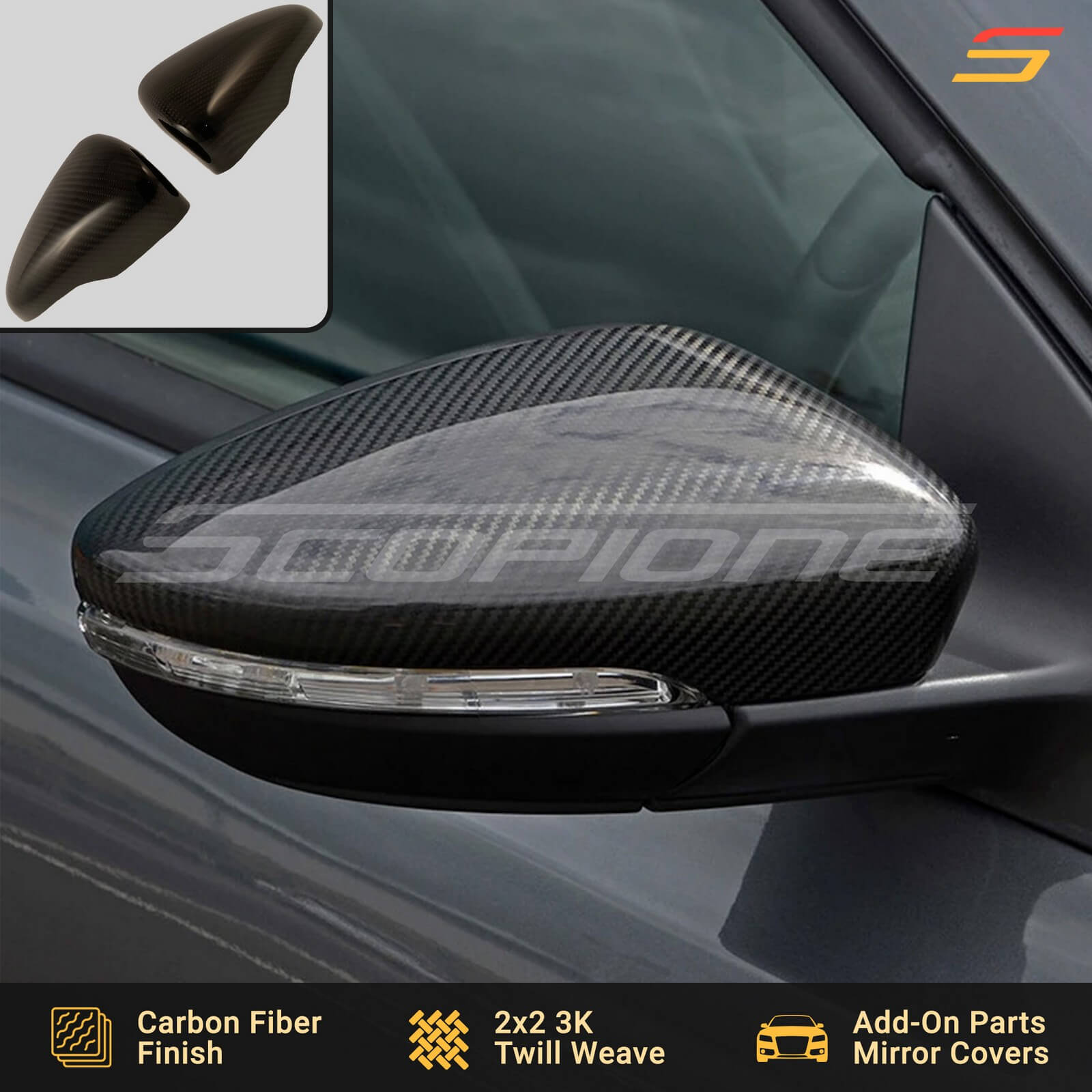
The MK8 Golf generation arrived with a digital-first interior and the highest-output standard GTI and R models in history. The Golf R 333 limited edition, with 333 units producing 333 hp each, demonstrated VW’s willingness to create halo models within the Golf range. The aftermarket CF ecosystem has reached industrial maturity. Dedicated manufacturers produce comprehensive CF catalogs for every MK8 variant. Specialty suppliers offer full CF body kits for the GTI and R, while smaller makers cover individual components from mirror caps to interior trim panels.
While Volkswagen has not extended factory CF applications to the MK8 Golf, the aftermarket carbon-fiber ecosystem for the platform has become one of the deepest in the performance car world. Specialty suppliers produce full CF body kits for the MK8 GTI and R, including front lip, side skirts, rear diffuser, rear spoiler, and mirror covers, and CF widebody kits with substantial fender expansion for tracked builds. Smaller specialty makers supply individual CF components for owners who prefer to assemble customized aftermarket programs. The Golf R 333’s Akrapovic titanium exhaust and Lime Yellow Metallic paintwork attracted a buyer demographic particularly receptive to premium CF aftermarket modifications, with several R 333 owners commissioning extensive CF builds within months of taking delivery.
Volkswagen Golf GTI MK8 (2020–Present)
The MK8 GTI delivered the highest-output standard GTI engine to date, with 241 hp from the EA888 Evo4 in US specification, and introduced a fully digital cockpit with a 10-inch infotainment screen and capacitive touch controls. The controversial interior design (replacing physical buttons with touch sliders for climate and volume) divided opinion among automotive journalists, but the driving dynamics earned near-universal praise. The electronically controlled limited-slip differential from the MK7 Performance pack became standard equipment across all MK8 GTI trims.
- Engine: 2.0L EA888 Evo4 TSI turbocharged inline-4, 241 hp
- 0–60 mph: 5.1 seconds
- Top speed: 155 mph (electronically limited)
- Standard equipment: Electronically controlled LSD (formerly MK7 Performance pack option)
- Designer: Klaus Bischoff / Andreas Mindt
The MK8 GTI has the comprehensive aftermarket CF catalog of any current hot hatch. A full aftermarket body kit typically includes a CF front splitter, vertical canards, side skirts, rear diffuser, rear spoiler extension, and mirror covers, and widebody kits with significantly expanded fender flares are available. Individual components (CF steering wheel trims, CF interior panels, CF shift knobs, CF engine covers) are available from multiple manufacturers in both visible-weave and forged composite finishes. The MK8 GTI is the volume leader in the aftermarket CF hot hatch market, with new product development continuing across multiple suppliers as the platform’s production lifecycle progresses.
Volkswagen Golf R MK8 (2022–Present)
The MK8 Golf R introduced R-Performance Torque Vectoring, a rear-axle system with two multi-plate clutches that independently distribute torque between the left and right rear wheels. This enabled a Drift mode that biases torque to the outer rear wheel during cornering, plus a Special (Nurburgring) driving mode that optimizes torque vectoring for track use. With 315 hp and 310 lb-ft of torque, the MK8 R was the highest-output production Golf ever built at launch, excluding the limited-edition R 333 that arrived in 2023.
- Engine: 2.0L EA888 Evo4 TSI turbocharged inline-4, 315 hp, 310 lb-ft
- Drivetrain: 4MOTION with R-Performance Torque Vectoring (twin multi-plate clutches at rear)
- 0–60 mph: 4.9 seconds
- Top speed: 155 mph (168 mph with R-Performance pack)
- Driving modes: Comfort, Sport, Race, Special (Nurburgring), Drift, Individual
The Golf R MK8 attracts the premium CF aftermarket investment of any hot hatch. Full aftermarket CF body kits, CF interior trim packages, CF engine covers, and CF brake duct surrounds are all available. The R-Performance pack’s raised speed limiter (168 mph) appeals to track-focused owners who value CF weight reduction for genuine performance rather than purely cosmetic enhancement. The MK8 R’s torque-vectoring AWD system delivers handling characteristics that fundamentally change the car’s dynamic character compared to the simpler Haldex systems of previous R generations, encouraging more aggressive track use and the corresponding investment in serious aerodynamic CF components.
Volkswagen Golf R 333 (2023)
The Golf R 333 is the highest-output production Golf in history. Limited to exactly 333 units, each producing 333 hp and 420 Nm of torque, the R 333 featured Lime Yellow Metallic paintwork with a black roof, an Akrapovic titanium exhaust system, 19-inch Warmenau-design forged alloy wheels in matte black with red accent ring, semi-slick Bridgestone Potenza Sport tires, and unique 333 badging on the front fenders, rear panel, and instrument cluster. All 333 units were built at Wolfsburg in September 2023 and priced from EUR 76,410 (approximately $82,000 USD). The car was sold exclusively in European markets.
- Engine: 2.0L EA888 Evo4 TSI turbocharged inline-4, 333 hp, 420 Nm
- 0–100 km/h: 4.6 seconds
- Top speed: 167 mph
- Production: 333 units (all built at Wolfsburg, September 2023)
- Starting price: EUR 76,410 (~$82,000 USD)
- Exclusive features: Lime Yellow Metallic paint, black roof, Akrapovic titanium exhaust, 19-inch Warmenau forged wheels with Potenza Sport semi-slicks
- Markets: European-only
While the R 333 did not include factory CF components, its limited-edition positioning, premium price, and enthusiast buyer demographic make it a natural platform for aftermarket CF modification. The Lime Yellow Metallic paintwork and Akrapovic exhaust system attract owners predisposed to further personalization with CF exterior and interior components. Several R 333 owners have commissioned full aftermarket CF body kits within months of delivery, treating the 333-unit production run as a foundation for highly individualized builds rather than as a finished product. The R 333 demonstrates VW’s ability to create desirable limited-edition models within the Golf range, a strategy previously reserved for brands like BMW M, Mercedes-AMG, and Porsche.
Scopione Perspective: The MK8 Aftermarket Landscape
Volkswagen’s carbon-fiber trajectory follows an unusual path: minimal factory CF (limited to the XL1 and ID.R as low-volume special projects) paired with a vast and globally distributed aftermarket CF ecosystem anchored by the Golf GTI and R communities. The MK8 generation represents the current volume leader in the aftermarket CF hot hatch market, with specialty suppliers producing comprehensive catalogs that rival the depth of factory CF programs from premium brands. Scopione’s 2×2 3K twill-weave manufacturing approach reflects the same material discipline that this established VW aftermarket has demanded for decades: precision-laid weave, dimensional accuracy, and clear-coat finish capable of meeting the visual and structural standards that the Worthersee culture established as benchmarks.
Frequently Asked Questions
Volkswagen and Carbon Fiber: Common Questions
Has Volkswagen ever used carbon fiber in production cars?
Yes. Volkswagen produced two vehicles with structural carbon fiber: the XL1 (2014–2016) used a full CFRP monocoque body weighing just 230 kg, contributing to a 795 kg total curb weight and 261 mpg US fuel economy. The ID.R (2018–2019) used a CF monocoque race chassis to set the outright Pikes Peak record (7:57.148, June 2018) and the Nurburgring electric-vehicle lap record (6:05.336, June 2019). The XL1 had a 250-unit production run; the ID.R was a single race car. Volkswagen has not yet extended factory CF construction to its mass-market vehicles, leaving most of the Volkswagen carbon fiber evolution story to the aftermarket.
What carbon fiber parts are available for the Volkswagen Golf GTI and R?
The MK7 and MK8 Golf GTI and R platforms support one of the deepest aftermarket carbon fiber ecosystems in the performance car world. Specialty manufacturers produce comprehensive CF body kits including front splitters, vertical canards, side skirts, rear diffusers, rear spoilers, mirror covers, hood vents, and fender flares. CF interior trim, steering wheel inserts, shift knobs, and engine covers are also widely available. Several suppliers produce widebody CF kits for tracked builds. The MK8 GTI/R is the current volume leader in this segment.
What is the Volkswagen XL1?
The XL1 is a plug-in hybrid two-seat sports car that VW produced in a 250-unit run from 2014 to 2016. The car achieved 261 mpg US fuel economy through a 0.186 drag coefficient body, an 800cc two-cylinder TDI diesel engine paired with a 20 kW electric motor, and a 795 kg curb weight enabled by a full CFRP monocoque body weighing just 230 kg. The CFRP monocoque was produced by Mubea Carbo Tech using resin transfer molding. Each XL1 was hand-built at VW’s Osnabruck plant and priced at approximately EUR 110,000 (about $146,000 USD). The XL1 represents Volkswagen’s structurally ambitious carbon-fiber application to date.
What carbon fiber parts does Scopione offer for Volkswagen?
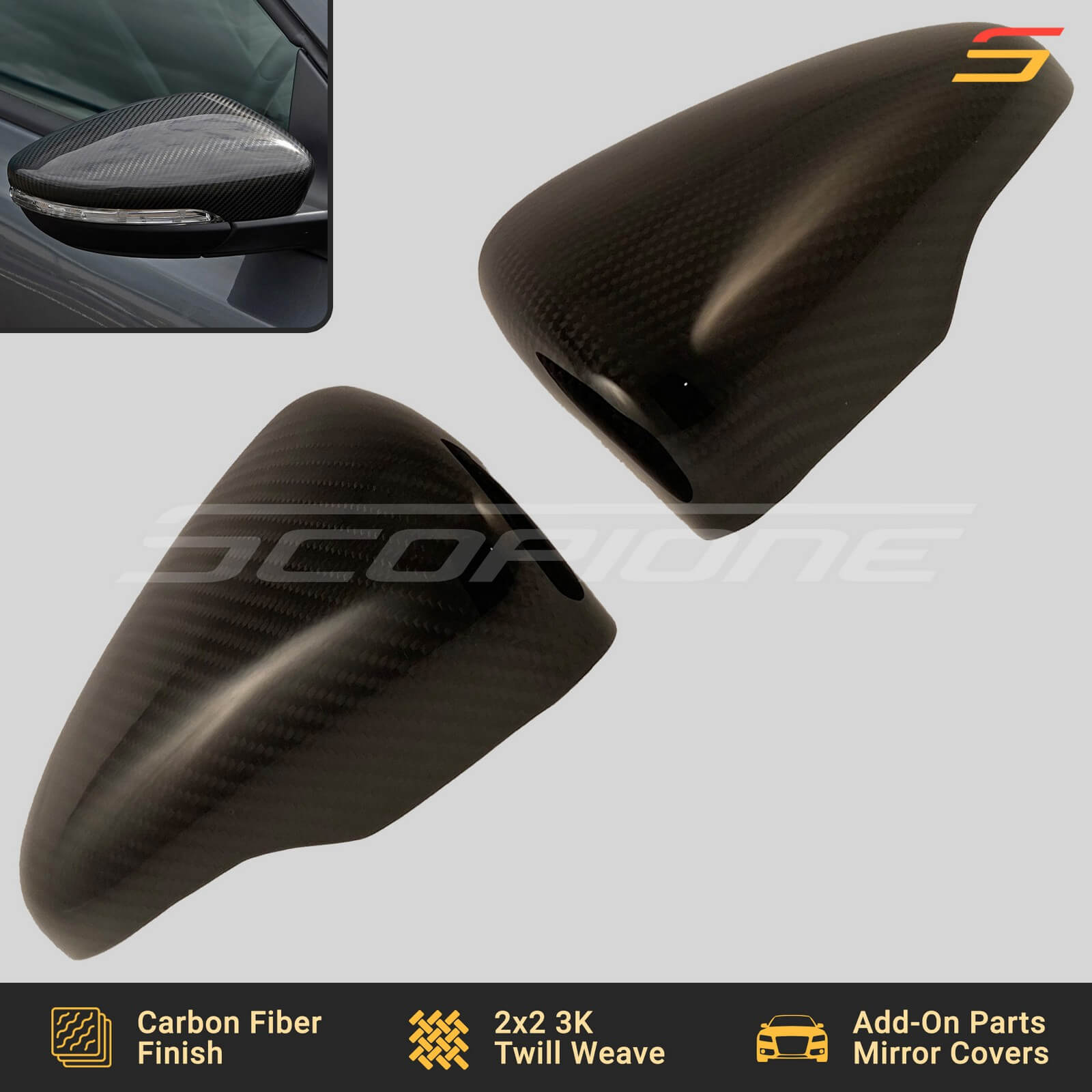
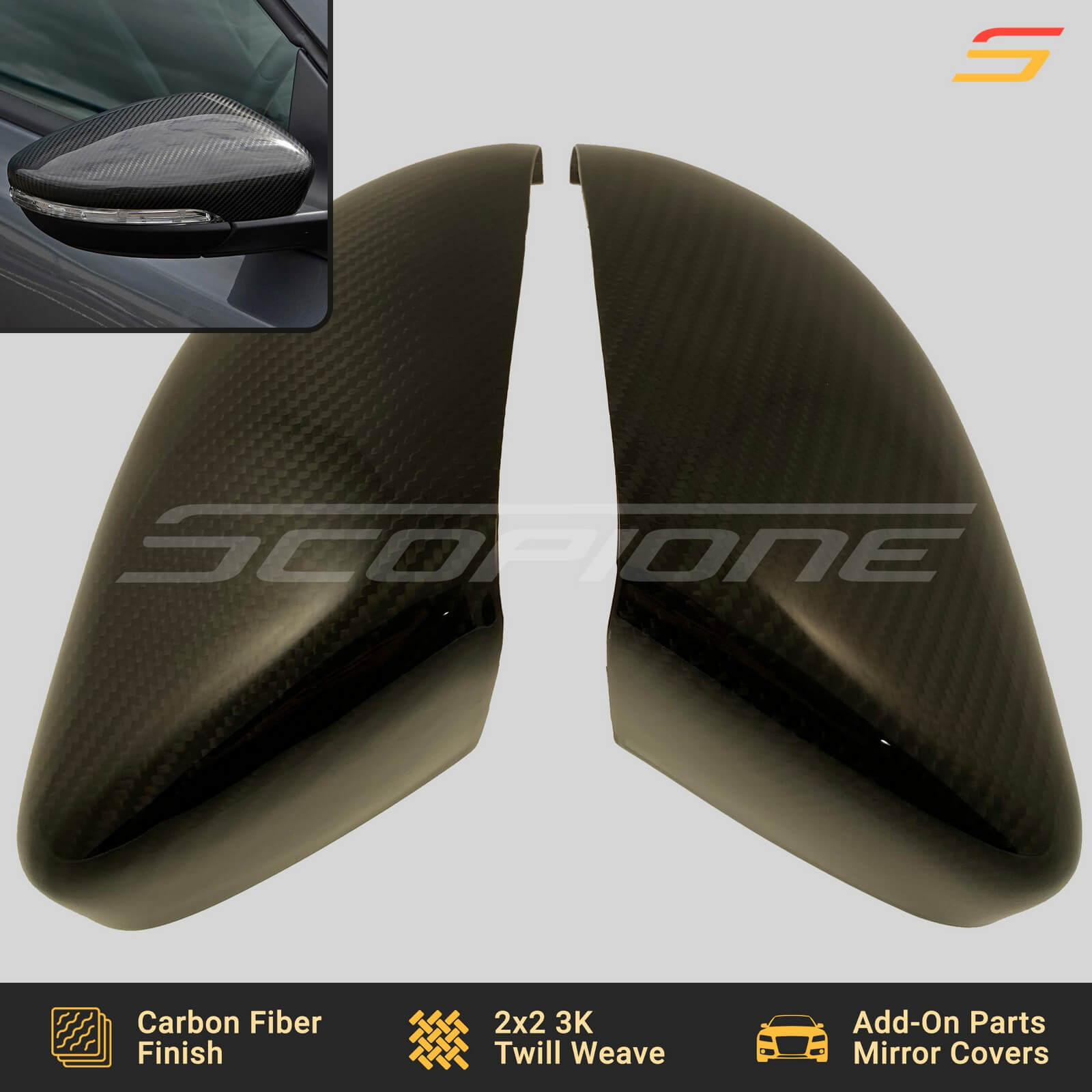
Scopione stocks one Volkswagen part: add-on carbon fiber side mirror covers for the 2010–2014 Golf 6 (MK6), fitting the GTI, the Golf R and the 2.0L TDI and 2.5L Golf, moulded in 2×2 3K twill weave under a glossy, UV-resistant clear coat. They are add-on covers that fit over the factory mirror shells rather than replacing them, and will not fit aftermarket shells. Beyond that single part, Golf GTI and R owners have access to one of the deepest CF aftermarket ecosystems in the performance-car world, with specialty suppliers offering comprehensive body kits and individual components across every Golf generation from MK5 through MK8. Scopione’s broader 2×2 3K twill-weave catalog reflects the same material standards across multiple makes and models – explore the Scopione catalog.
What was the Volkswagen ID.R?
The ID.R was Volkswagen Motorsport’s fully electric prototype race car. Built to showcase VW’s electric mobility credentials through record-breaking performance, the ID.R featured a full carbon-fiber monocoque chassis with steel roll cage, dual electric motors (one per axle) producing 680 hp combined and 479 lb-ft of torque, and a sub-1,100 kg total curb weight. Romain Dumas drove the ID.R to the outright Pikes Peak record of 7:57.148 in June 2018, the first sub-8-minute run in the event’s history. In June 2019, the ID.R also set the electric vehicle lap record at the Nurburgring Nordschleife at 6:05.336. The carbon-fiber monocoque construction matched the engineering quality of LMP1 and Formula E race cars.
Explore More Scopione Content
Related Carbon Fiber Evolution Stories
- Lamborghini’s Carbon Fiber Evolution – VW Group brand, Forged Composite pioneer, Sant’Agata facility informs VW Group’s composite material science
More Carbon Fiber Evolution Stories
- MINI’s Carbon Fiber Evolution – The other small-car icon turned hot hatch — 640 kg in 1959, recycled CFRP arches on the GP3
- Cadillac’s Carbon Fiber Evolution – V-Series aero packages and the hand-built CELESTIQ’s CF body panels
- Land Rover’s Carbon Fiber Evolution – Seventy-five years of aluminium, and where carbon finally arrived
- Lotus’s Carbon Fiber Evolution – Add lightness — the 1957 Elite’s fiberglass monocoque to the Evija’s CFRP tub
- McLaren’s Carbon Fiber Evolution – The MP4/1 put a CFRP monocoque in Formula 1 in 1981
- Ferrari’s Carbon Fiber History – The F1-derived CFRP pipeline from the F40 to the SF90
- Lamborghini’s Carbon Fiber Evolution – Countach experiments, Forged Composite, and the Revuelto’s monofuselage
- Aston Martin’s Carbon Fiber Evolution – The V12 Vanquish’s CF tunnel to the Valkyrie’s F1-derived monocoque
- Audi’s Carbon Fiber Evolution – Thirteen Le Mans wins on CFRP monocoques, and the R8’s structural carbon
- Bentley’s Carbon Fiber Evolution – The Supersports’ 110 kg weight cut to Mulliner’s coachbuilt Batur
- Honda & Acura’s Carbon Fiber Evolution – The aluminium NSX, and a different answer to the lightweight question
- Maserati’s Carbon Fiber Evolution – The Birdcage’s tube frame to the MC20’s own CFRP monocoque
- Mercedes-Benz’s Carbon Fiber Evolution – Silver Arrows to the AMG One’s F1-derived monocoque
Carbon Fiber, Explained
- Carbon Fiber in the Automotive Industry – How composite construction spread from racing to production cars
- The Pioneers of Carbon Fiber Innovation – The engineers and firms that took composites from aerospace to the road
- The Evolution and Impact of Carbon Fiber: A Comprehensive Guide – The full technical and historical picture, from precursor fibre to finished panel
- Carbon Fiber Manufacturing Processes – Autoclave, prepreg and resin transfer moulding — the RTM route the XL1’s tub used
- Why Carbon Fiber Is Expensive – Why a CFRP monocoque stayed a 250-unit special while trim parts reach every Golf
- Real Carbon Fiber vs Cheap Knockoffs – How to tell a moulded 2×2 3K twill part from a hydro-dipped imitation — worth knowing in a market this crowded
- Carbon Fiber Maintenance & Cleaning – Keeping a clear-coated panel from fading
Shop the Volkswagen Part
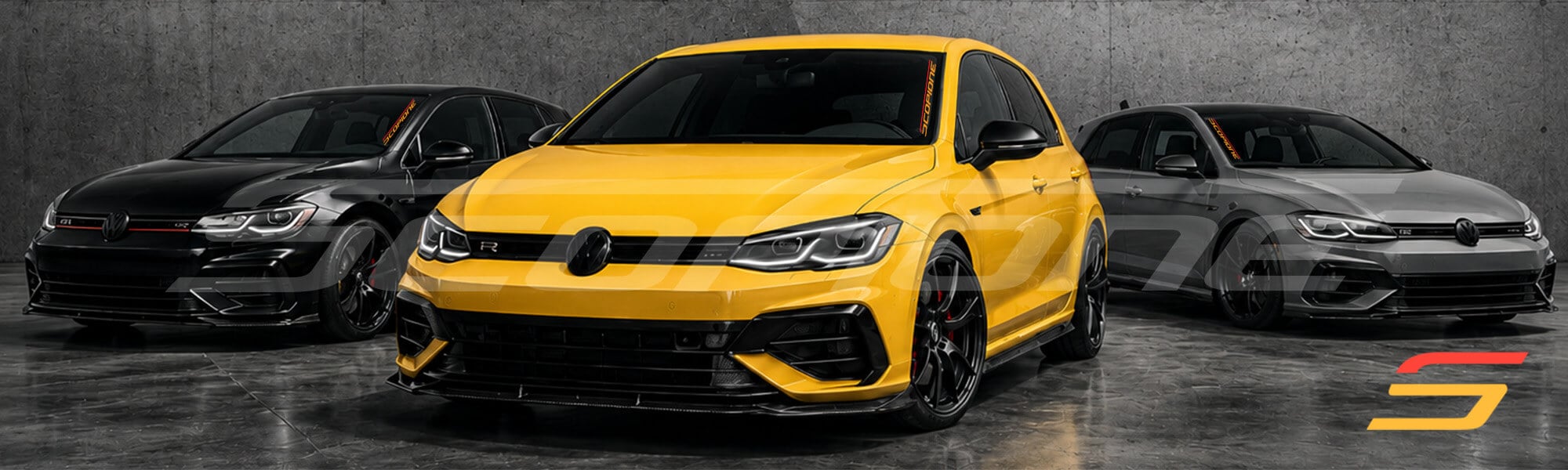
- Carbon Fiber Add-On Side Mirror Covers — 2010–2014 Golf 6 MK6, GTI, R and TDI – the one Volkswagen part in the Scopione catalog
Experience the elegance and performance of the Volkswagen with Scopione. Browse our gallery and get inspired to elevate your supercar with our top-of-the-line carbon fiber upgrades.
Shop now for premium ScopioneCarbon carbon fiber upgrades and experience the ultimate in performance and aesthetics for your Volkswagen!
Back to Top ↑Disclaimer: Technical specifications, production figures, and historical details presented in this article are editorial in nature and may differ from official manufacturer data. Photographs show the Scopione carbon fiber side mirror covers for the 2010–2014 Volkswagen Golf 6 MK6, and promotional imagery.