

 Shop
ShopBentley has built grand tourers for over a century, and the brand’s relationship with carbon fiber reflects something distinct in the automotive world: CFRP adopted not to chase lap times or shave tenths, but to offset the deliberate mass of handcrafted luxury. A Continental GT weighs north of 2,200 kg. A Bentayga exceeds 2,400 kg. Carbon fiber in a Bentley does not replace the structure; it counterbalances the weight of hand-stitched leather, real wood veneers, and W12 engines that defined a generation of grand touring. The trajectory runs from decorative trim on early Continental GTs through the full-CFRP body of the GT3 race car, into Mulliner’s coachbuilt Bacalar and Batur where carbon fiber becomes a craft material finished to the same standard as the brand’s leather and woodwork. This is the Bentley carbon fiber evolution — a story of composites meeting craftsmanship. Scopione stocks 2×2 3K twill-weave carbon-fiber components for the Continental GT and GTC – browse the full Bentley catalog.
Bentley Carbon Fiber Timeline
| Year | Milestone | Model / Program |
|---|---|---|
| 1924–1930 | Five Le Mans victories forge the Bentley Boys legacy | 3 Litre / 4½ Litre / Speed Six |
| 1952 | Aluminum-bodied fastback – fastest four-seat car in the world | R-Type Continental |
| 1998 | Volkswagen Group acquires Bentley | Corporate |
| 2003 | Continental GT launches – transforms the brand | Continental GT (1st gen) |
| 2009 | First meaningful CFRP usage on a Bentley | Continental Supersports |
| 2013 | Full carbon-fiber body on a racing Bentley | Continental GT3 |
| 2018 | Comprehensive CF Styling Specification available | Continental GT (3rd gen) |
| 2019 | Pikes Peak production-car record with CFRP aero | Continental GT3 Pikes Peak |
| 2020 | Highest CFRP content on a Bentley road car (at the time) | Mulliner Bacalar (12 units) |
| 2022 | Peak CFRP content – last W12 Bentley | Mulliner Batur (18 units) |
| 2024 | First standard CFRP exterior on a series-production Bentley | Continental GT Speed (V8 hybrid) |
1919–1997: The Bentley Boys, Le Mans, and a Century of Craftsmanship
Bentley’s first eight decades had nothing to do with carbon fiber. The material did not exist for most of this period. But what those decades established (a commitment to combining serious performance with individually crafted bodywork) would make CFRP a natural addition to the Bentley material palette when the technology matured. W.O. Bentley founded the company in 1919 in Cricklewood, London, with a conviction that he could build a car faster than any other British manufacturer. His background was in aircraft engines during World War I, and he brought an aviator’s sensitivity to power-to-weight ratio into automotive engineering. Within five years, his cars were winning Le Mans.
Five outright victories at the 24 Hours of Le Mans between 1924 and 1930 forged an identity that no subsequent owner could erase. The Bentley Boys (Woolf Barnato, Sir Tim Birkin, Dudley Benjafield, and their contemporaries) combined gentlemen-amateur driving with engineering that prioritized reliability and brute power over the Continental opposition. The 3 Litre, 4½ Litre, and Speed Six models won on raw endurance rather than finesse, often outweighing their French and Italian rivals by hundreds of kilograms. Rolls-Royce acquired Bentley in 1931, and the motorsport heritage was shelved for decades. The materials through this era remained traditional: steel, aluminum, ash frames, leather, and wood. But the organizational willingness to use premium materials for each specific application (aluminum for lightness, leather for durability, wood for tactile warmth) established a mindset that would later embrace carbon fiber as another craft material worthy of handbuilt luxury cars.
Bentley 4½ Litre and Blower Bentley (1927–1931)
The 4½ Litre won Le Mans in 1928. Its supercharged variant, the Blower Bentley championed by Sir Tim Birkin, became one of the pre-war era’s widely recognized racing cars. These machines used aluminum body panels hand-formed over ash and steel frames by specialist coachbuilders: Vanden Plas, Gurney Nutting, H.J. Mulliner. Each car was essentially bespoke. Buyers chose their own coachwork, creating a tradition of individual specification that Mulliner would carry forward for nearly a century.
The 4.4-liter inline-four produced 110 to 130 hp in naturally aspirated form. Birkin’s supercharged version pushed output to roughly 240 hp and a top speed of 125 mph, remarkable for 1929. Woolf Barnato, chairman and lead driver, won Le Mans three consecutive years from 1928 to 1930 and famously never lost a race in a Bentley. Total production across all 4½ Litre variants reached 720 units.
- Engine: 4.4L inline-four, 110–130 hp (Blower: ~240 hp)
- Top speed: 125 mph (Blower)
- Production: 720 units
- Le Mans wins: 1928 (4½ Litre)
No carbon fiber existed in this period. The significance is cultural. Bentley established itself as a brand that unites racing performance with individually crafted bodywork. The Blower’s hand-formed aluminum panels represent the same philosophy that would later drive Mulliner’s adoption of CFRP: use whatever advanced material suits the task not merely for speed, but as a medium for bespoke craftsmanship. The coachbuilding tradition also established Bentley’s relationship with material diversity. Each coachbuilder worked in different metals, different forming techniques, different approaches to panel joinery. That comfort with mixed-material construction carried through the 20th century and made the eventual addition of CFRP to the Bentley material palette a natural step rather than a disruptive one.
Bentley R-Type Continental (1952–1955)
The R-Type Continental was the fastest four-seat car in the world at launch. That fact alone made it significant. But the way H.J. Mulliner’s coachwork achieved that speed matters more for this story. The fastback body was designed in a wind tunnel, one of the earliest examples of aerodynamic optimization applied to a luxury car. Aluminum construction kept the body lighter than equivalent steel panels, and the entire shape served a function: reducing drag to enable 120 mph from a 4.6-liter inline-six producing a modest 153 hp.
Just 208 R-Type Continentals were built. Each one was specified to individual customer order through Mulliner. The car established the Continental nameplate that Bentley would revive in 2003 — the model line that eventually carried the brand’s first carbon-fiber components. It also demonstrated a principle that runs through the entire Bentley carbon fiber evolution: lightweight construction in service of performance, executed through premium materials and individual craftsmanship.
- Engine: 4.6L inline-six, ~153 hp
- Top speed: 120 mph
- Production: 208 units
- Coachwork: H.J. Mulliner, wind-tunnel-developed aluminum fastback
The R-Type Continental also demonstrated Bentley’s willingness to adopt aluminum for its weight advantage and formability, a mixed-material strategy that presaged the steel-aluminum-CFRP construction of modern Continentals. Its fastback silhouette later influenced the design of the third-generation Continental GT (2018), closing a 66-year design loop. The R-Type remains one of the most valuable Bentleys at auction, with well-documented examples selling for over $1 million. That enduring desirability speaks to the quality of H.J. Mulliner’s aluminum craftsmanship and confirms the commercial logic of investing in premium materials and individual specification, a model that Mulliner’s modern coachbuilt program continues with carbon fiber.
Bentley Turbo R (1985–1997)
The Turbo R revived Bentley as a distinct brand. For decades, Bentleys had been little more than rebadged Rolls-Royces with different grilles. The Turbo R changed that. Firmer suspension tuning. Wider tires. A recalibrated turbocharged 6.75-liter V8 that emphasized driving engagement over pure isolation. Bentley described the power output with characteristic British understatement: “adequate.” Independent estimates placed it between 300 and 400 hp depending on specification.
The car weighed approximately 2,300 kg and used a steel body-on-frame construction with hand-finished interior trim. No carbon fiber appeared anywhere on the Turbo R. Its importance is strategic: it proved a Bentley could be a driver’s car, attracting buyers who valued handling alongside luxury. That customer profile (wealthy enthusiasts who value performance alongside craftsmanship) would later represent the core market for carbon-fiber options on the Continental GT and Bentayga. The Turbo R also marked the first time Bentley explicitly positioned one of its models as a performance alternative to its own luxury sibling, the Rolls-Royce Silver Spirit. That willingness to differentiate through driving dynamics rather than badge engineering laid the commercial groundwork for the Continental GT’s 200 mph grand touring concept.
- Engine: 6.75L turbocharged V8, ~300–400 hp
- 0–60 mph: 6.7 seconds
- Top speed: 152 mph
- Weight: ~2,300 kg
The Turbo R’s 2,300 kg curb weight also illustrated the engineering challenge that carbon fiber would eventually help address. Bentley’s commitment to heavyweight luxury (thick leather, dense wood, heavy glass, extensive sound insulation) creates a persistent need for lightweight materials wherever possible. And the Turbo R’s commercial success (it outsold comparable Rolls-Royce models) demonstrated that the Bentley brand had independent value, influencing Volkswagen’s decision to acquire the company in 1998.
Scopione Perspective: Heritage and Craftsmanship
Bentley’s century-long tradition of matching the finest available material to each application created a natural foundation for aftermarket carbon-fiber components. Scopione approaches the Bentley catalog with the same material philosophy: 2×2 3K twill-weave CF finished with UV-resistant clear coat, precision-fitted to complement the handcrafted character of the Continental GT and GTC. The craftsmanship connection is direct: what Mulliner accomplishes at the factory level with bespoke leather and exotic veneers, Scopione extends through carbon-fiber exterior components that honor the same attention to fit and finish.

1998–2012: VW Group Renaissance – The Continental GT Revolution
Volkswagen Group’s 1998 acquisition of Bentley transformed the brand from a low-volume British coachbuilder into a global luxury manufacturer. The instrument of that transformation was the Continental GT. Launched in 2003, it delivered 200 mph capability from a twin-turbocharged W12 engine, all-wheel drive, and a price point that competed with Mercedes-AMG and Porsche rather than Rolls-Royce. The new factory in Crewe produced cars at volumes Bentley had never achieved under previous ownership — over 40,000 first-generation Continental GTs found buyers worldwide.
Carbon fiber entered Bentley’s vocabulary during this era. The first-generation Continental GT offered optional CF interior trim and exterior mirror caps through Mulliner, but these were decorative. The real shift came in 2009 with the Continental Supersports. A carbon-fiber front splitter, rear diffuser, rear spoiler, and engine cover contributed to a 110 kg weight reduction over the Continental GT Speed. For the first time, CFRP served a functional purpose on a Bentley, and the market responded. The Supersports proved that Bentley’s clientele would pay a premium for carbon-fiber componentry that combined visual distinction with measurable weight savings.
Bentley Continental GT – First Generation (2003–2011)
The first-generation Continental GT reshaped Bentley for the 21st century. Dirk van Braeckel’s design referenced the R-Type Continental’s fastback silhouette while incorporating modern proportions: a long hood housing the W12 engine, a compact greenhouse, muscular haunches over the rear wheels, and the signature matrix grille with chrome vertical slats. The platform shared its basic architecture with the Volkswagen Phaeton, a fact that purists debated, though the engineering quality was undeniable.
The 6.0-liter twin-turbocharged W12 produced 552 hp and propelled the GT to 198 mph. Permanent all-wheel drive managed the torque. The body structure combined steel and aluminum. The interior was trimmed entirely by hand at the Crewe factory, with each car requiring approximately 150 hours of leather work alone. That hand-trimming process is relevant to the carbon fiber story because it explains why a Bentley weighs what it weighs. The GT carried real wood veneers (not printed overlays), thick-cut bull hide leather (not split hides), and laminated glass throughout. These materials contribute mass that lighter structural composites can partially offset.
- Engine: 6.0L W12 twin-turbo, 552 hp
- 0–60 mph: 4.7 seconds
- Top speed: 198 mph
- Weight: ~2,350 kg
The first-generation Continental GT launched without carbon fiber. Optional CFRP interior trim (dashboard inserts, center console fascia) became available mid-cycle through Mulliner, along with exterior mirror caps in visible carbon-fiber weave. These were cosmetic upgrades. But the GT’s 2,350 kg curb weight established the engineering context for later CF applications. Every kilogram removed through advanced materials improved acceleration, braking, and handling without compromising the luxurious mass of the hand-trimmed interior. And the GT’s commercial success funded everything that followed: the Supersports, the GT3 racing program, the Mulliner coachbuilt specials.
Bentley Continental Supersports (2009–2012)
The Continental Supersports was the fastest Bentley of its era. It was also the first Bentley where carbon fiber served a genuine engineering purpose. The W12 produced 621 hp on either gasoline or E85 biofuel — Bentley’s first flex-fuel vehicle. The car stripped approximately 110 kg from the Continental GT Speed through a comprehensive weight reduction program that included carbon-fiber exterior components, deleted rear seats (replaced by a fixed parcel shelf), lighter forged wheels, and a titanium exhaust system.
The result was a 2,240 kg grand tourer capable of 204 mph. That speed challenged a persistent assumption about Bentley: that luxury and extreme performance occupied separate categories. The Supersports proved otherwise.
- Engine: 6.0L W12 twin-turbo, 621 hp (flex-fuel)
- 0–60 mph: 3.7 seconds
- Top speed: 204 mph
- Weight reduction: 110 kg vs. Continental GT Speed
CFRP components on the Supersports included a front splitter, rear diffuser, engine cover, rear spoiler, and mirror caps, all manufactured in visible carbon-fiber weave. The combined weight savings from CF components alone was estimated at 15 to 20 kg. A modest absolute figure. But significant as part of the broader 110 kg reduction program, and even more significant as a positioning statement. The Supersports established carbon fiber as a material consistent with Bentley’s brand identity: not just a racing composite, but a premium material worthy of a car costing over $260,000.
The Supersports also carried a deeper implication. It demonstrated that Bentley’s customer base, buyers who typically prioritize refinement over raw speed, would embrace CF componentry when it was presented as an enhancement to the driving experience rather than a compromise of luxury. That insight shaped every subsequent Bentley CF offering, from the Continental GT’s expanding options catalog to the Mulliner coachbuilt program.
Scopione Perspective: The Continental GT Catalog
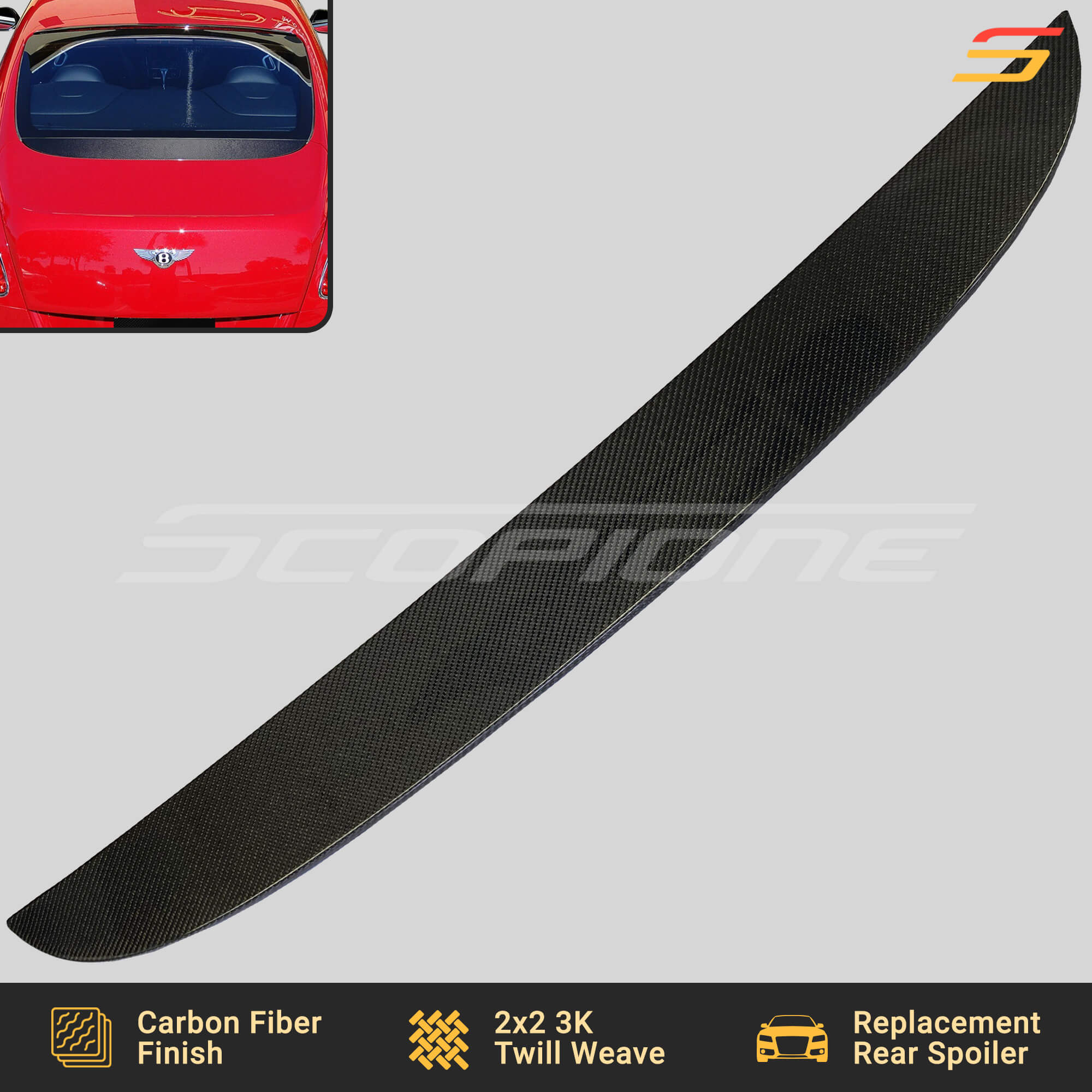
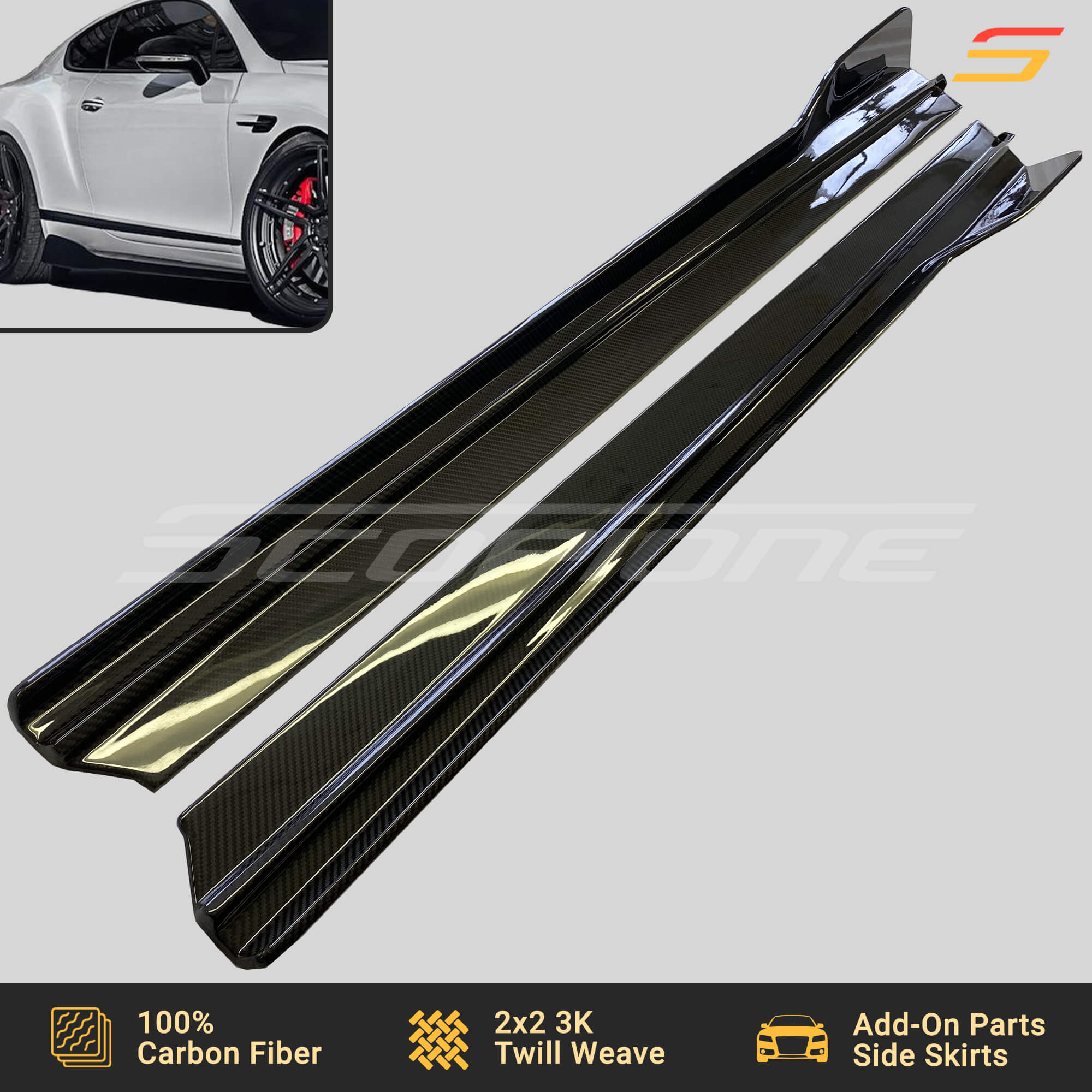
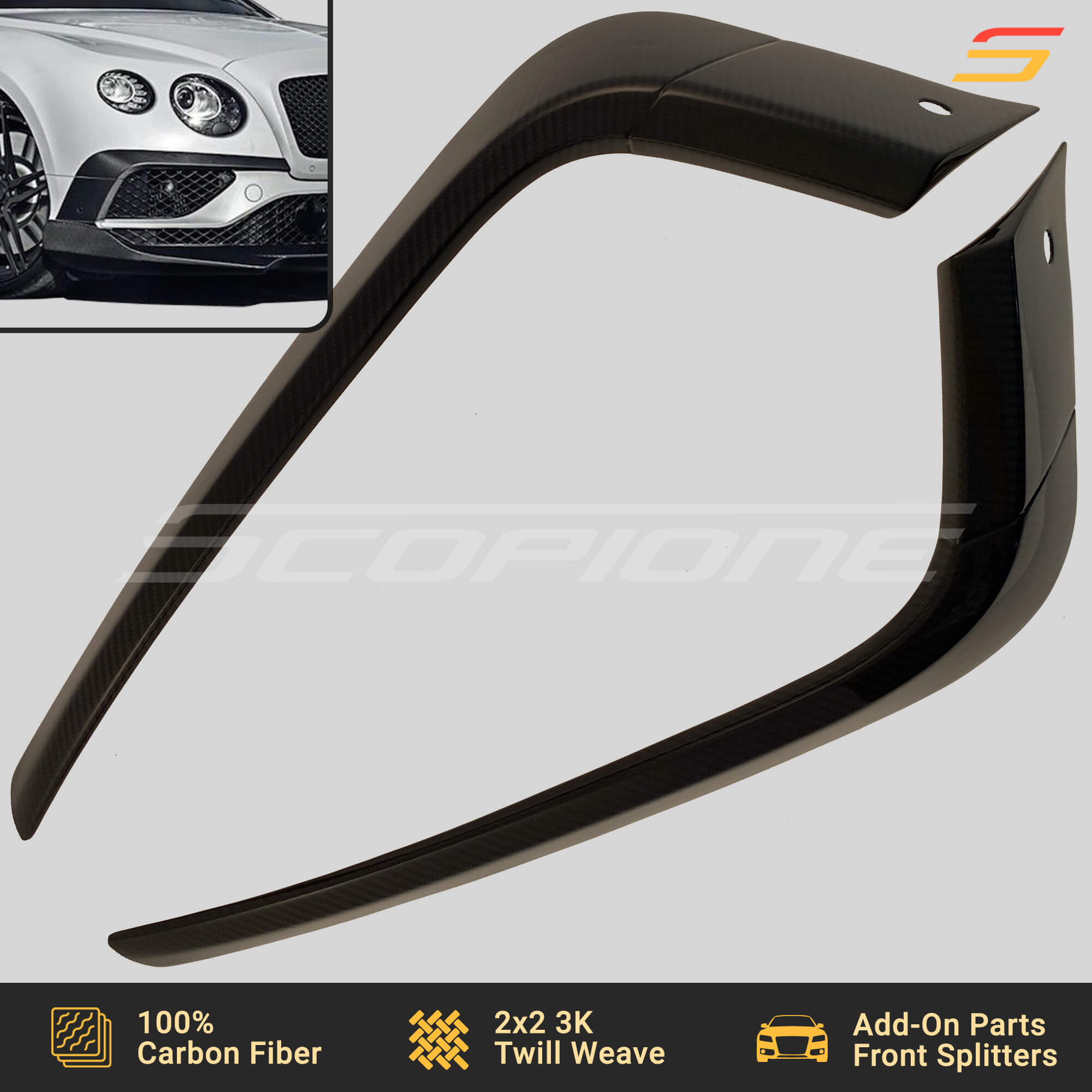
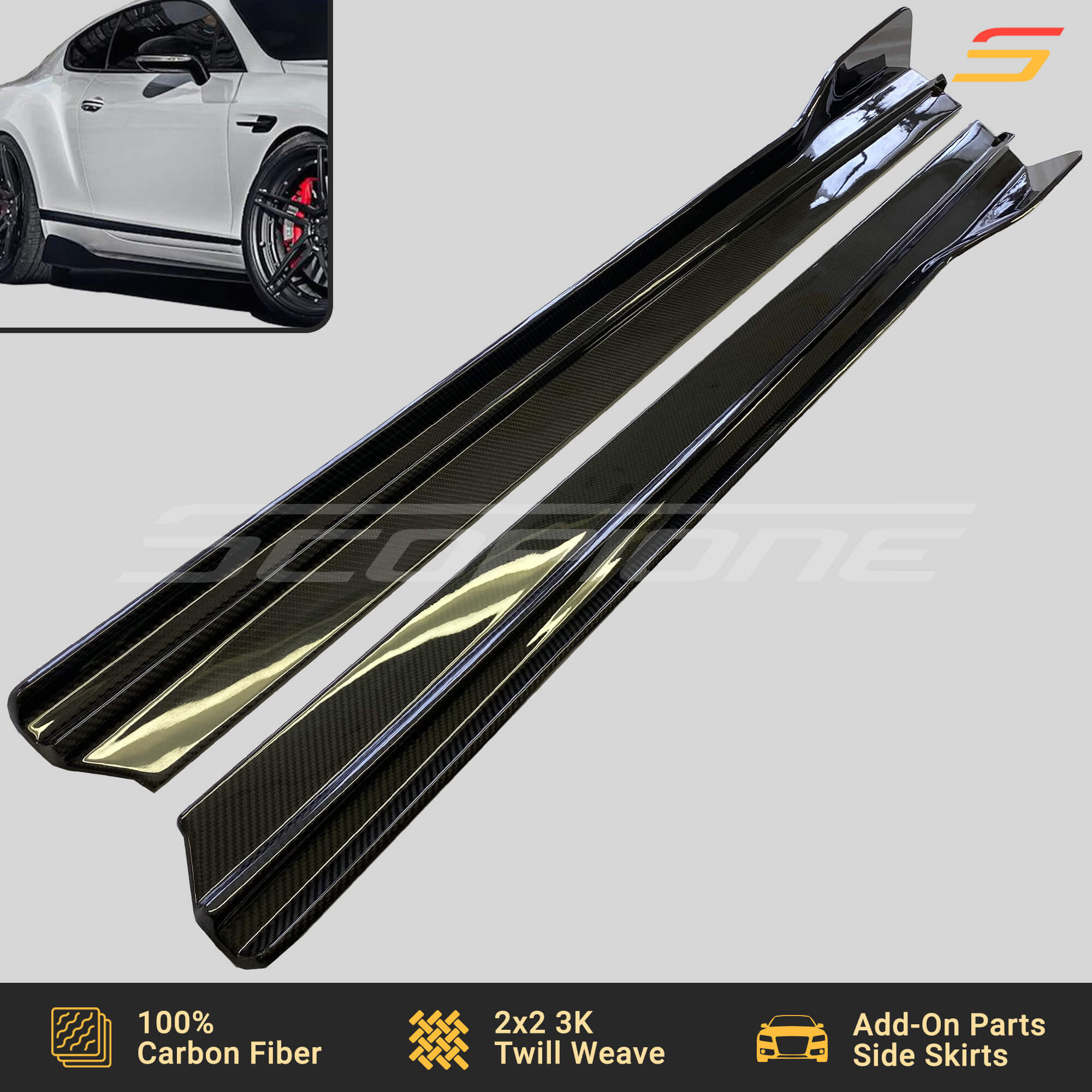
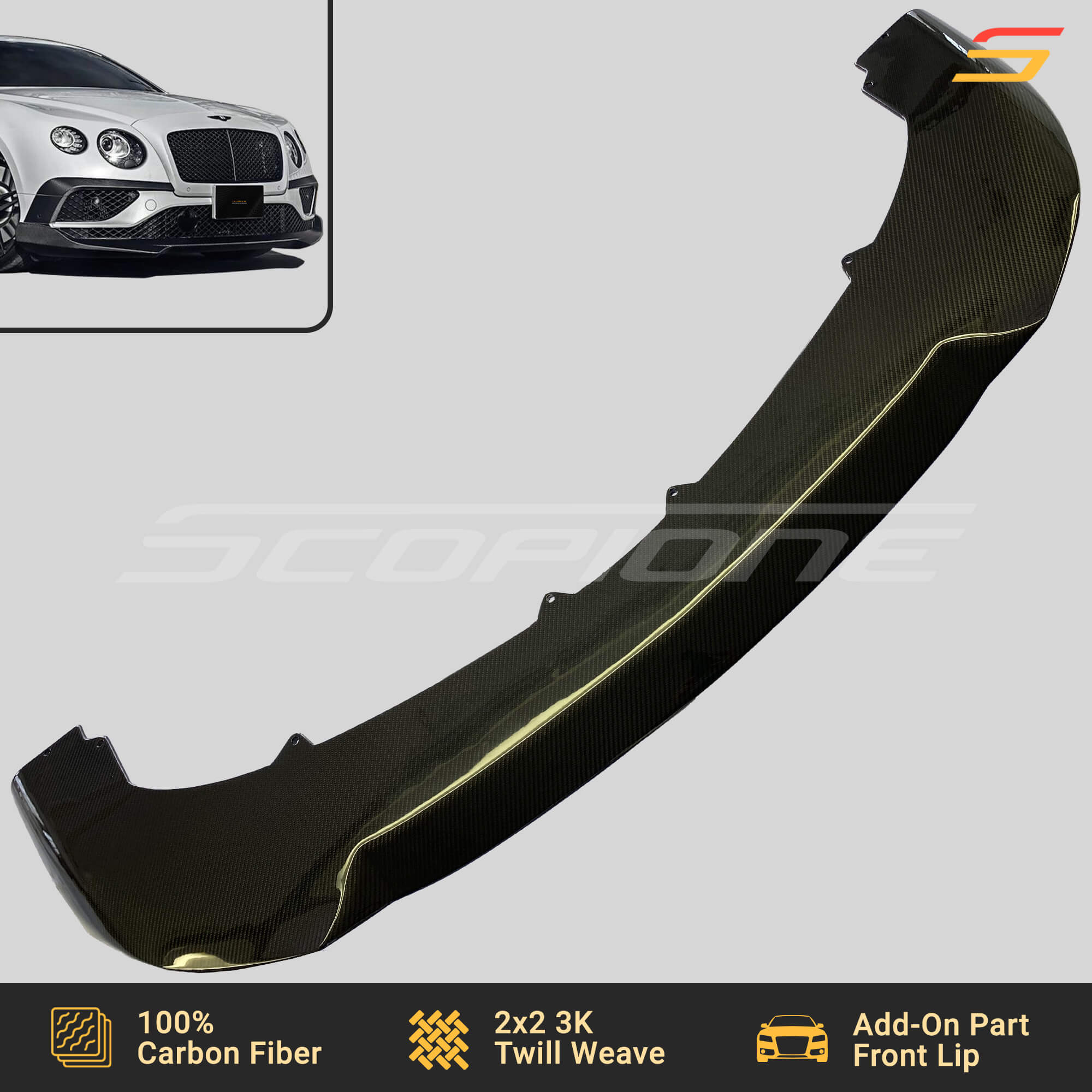
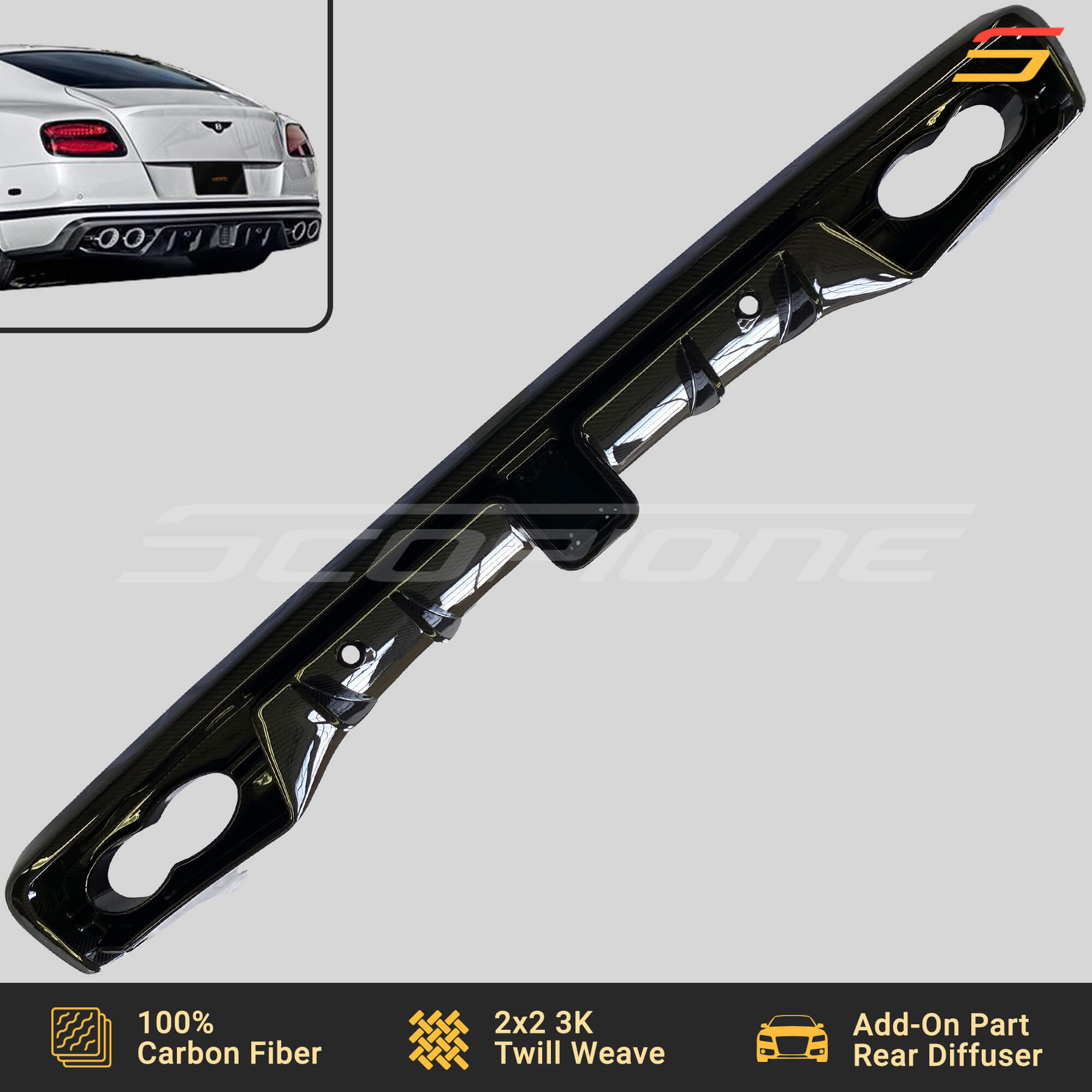
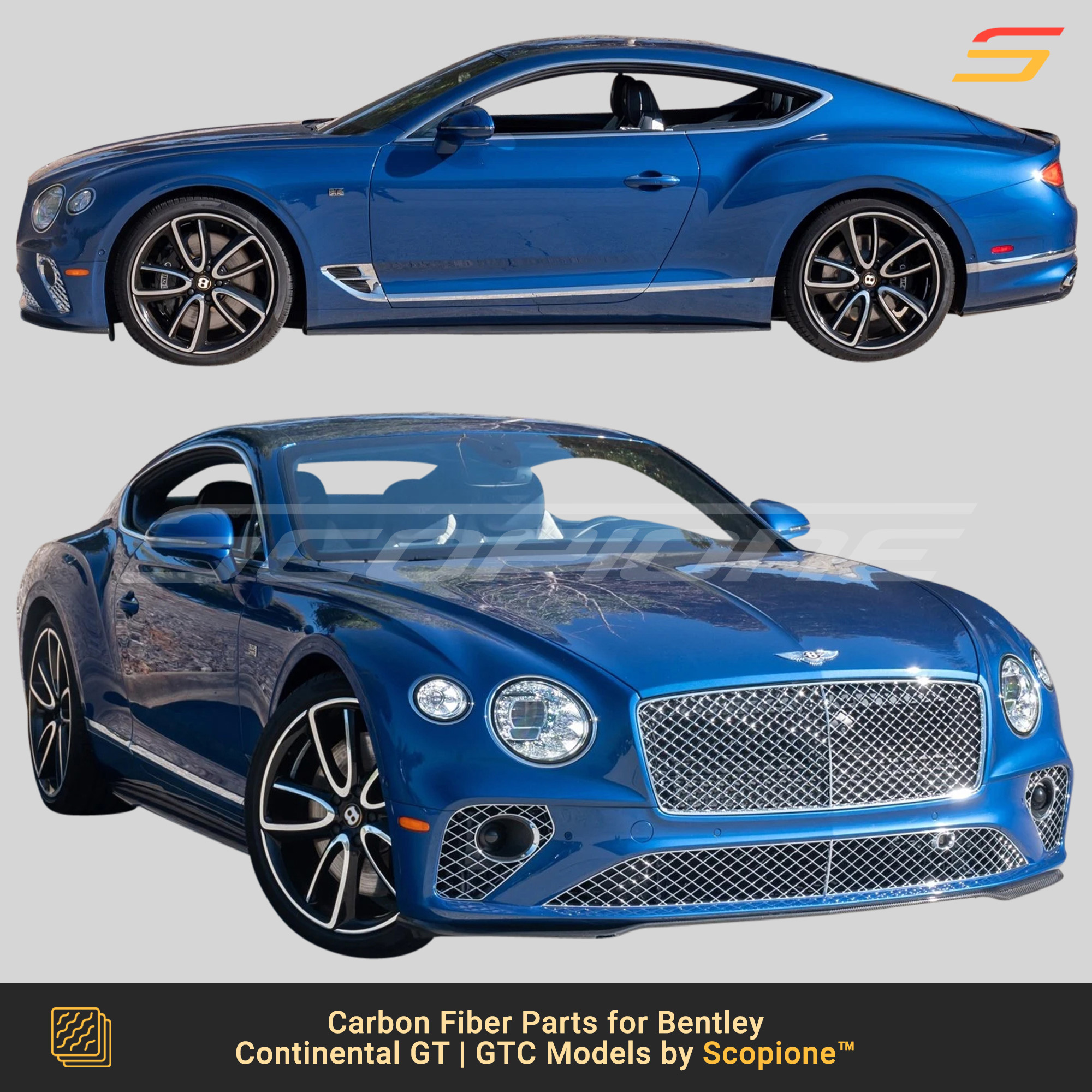
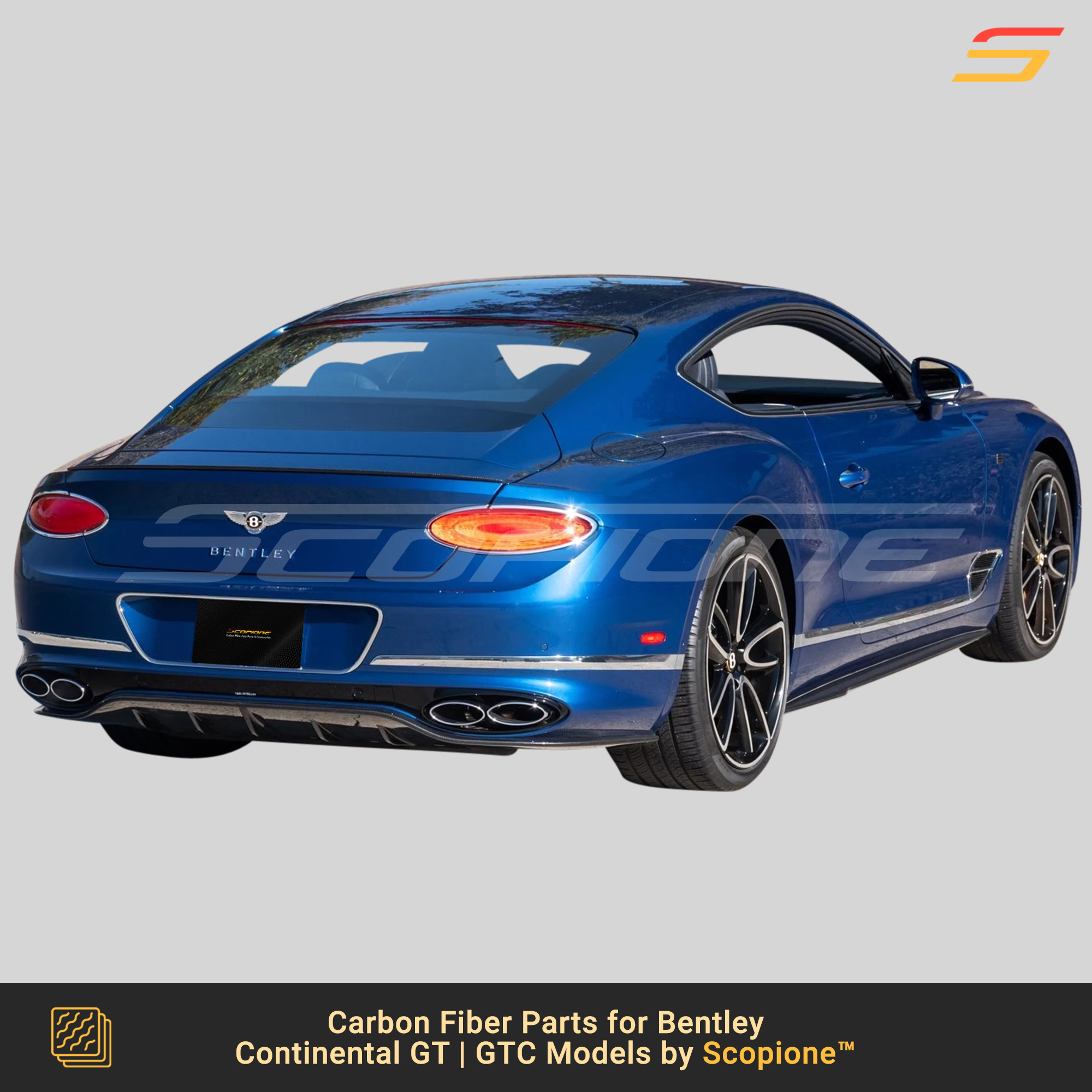
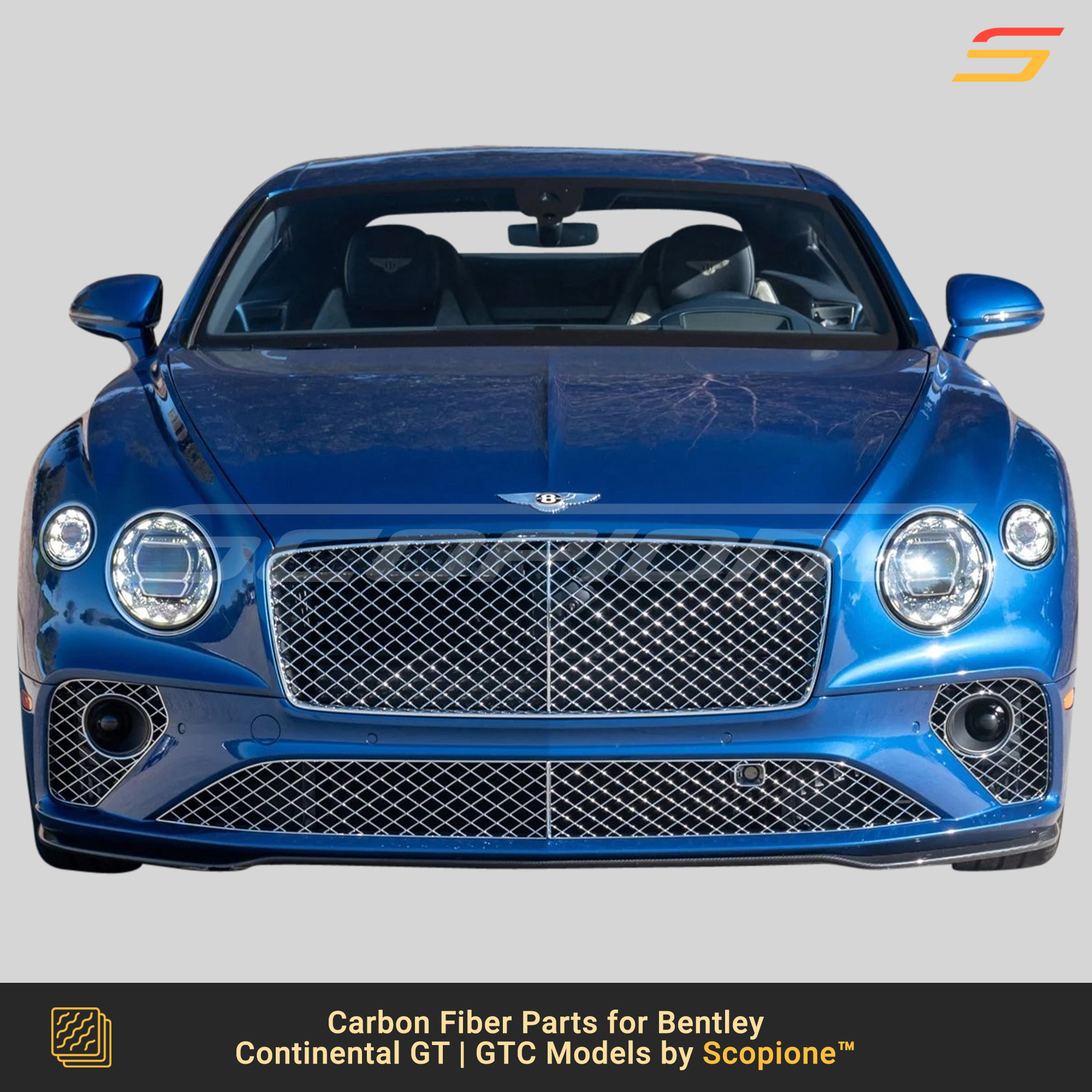
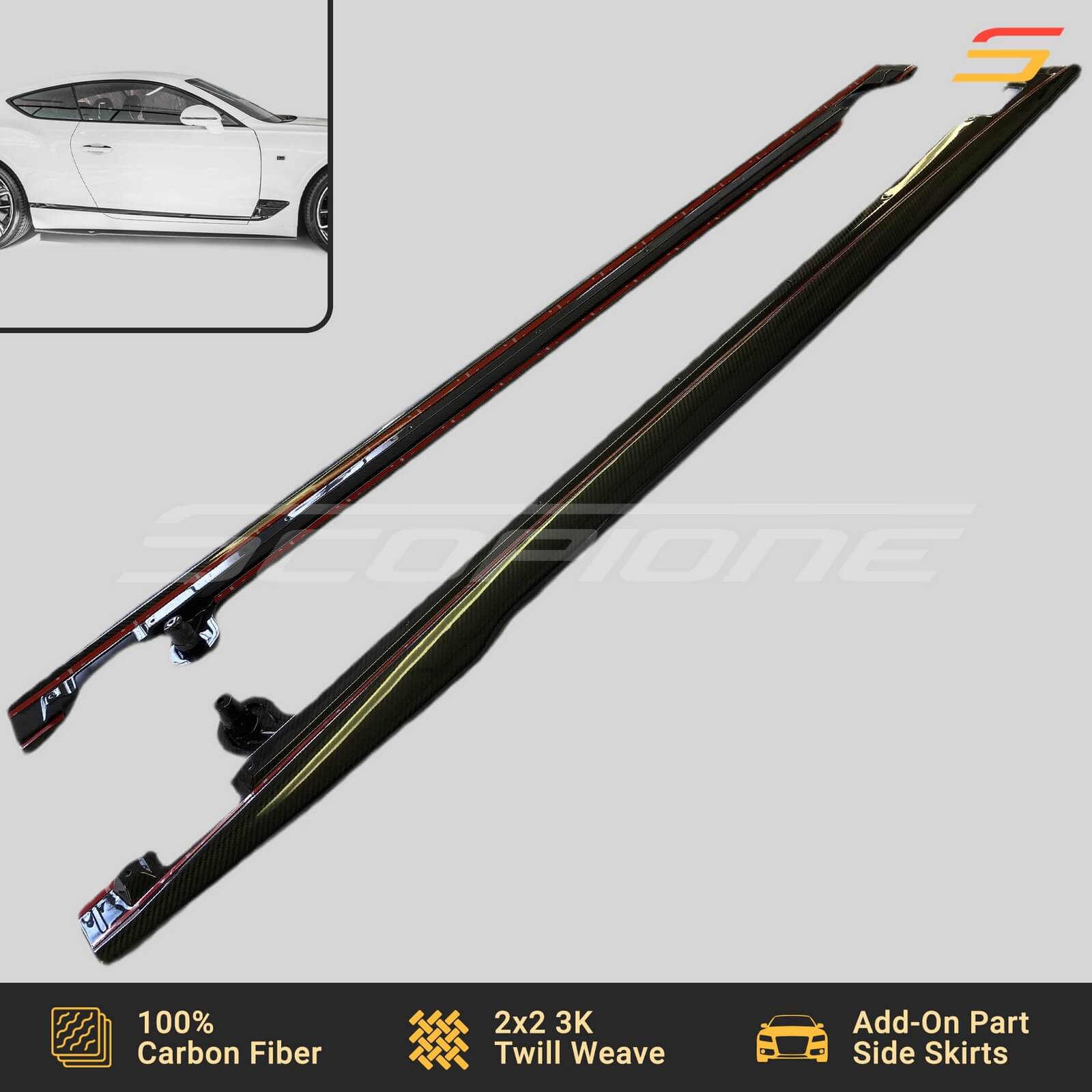
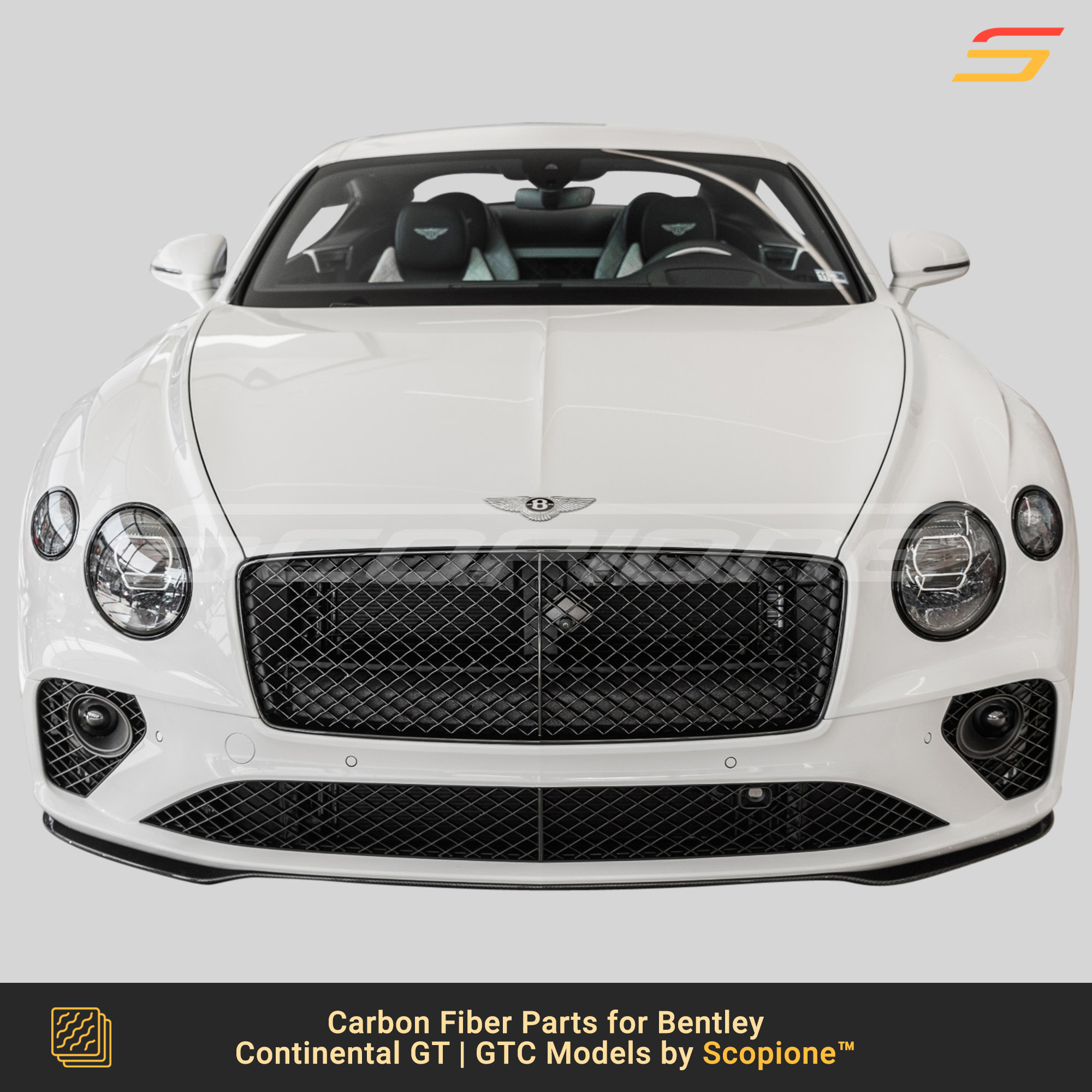
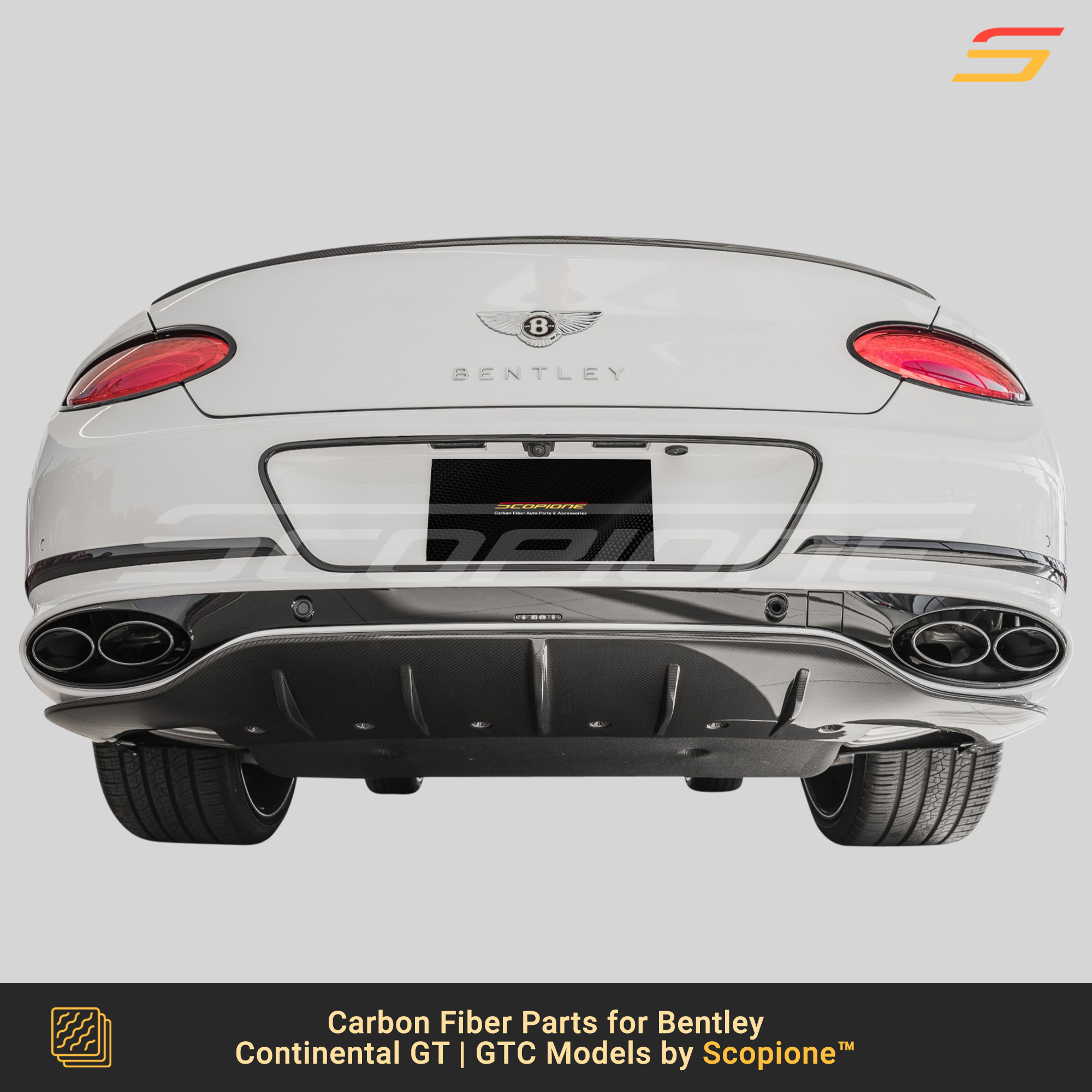
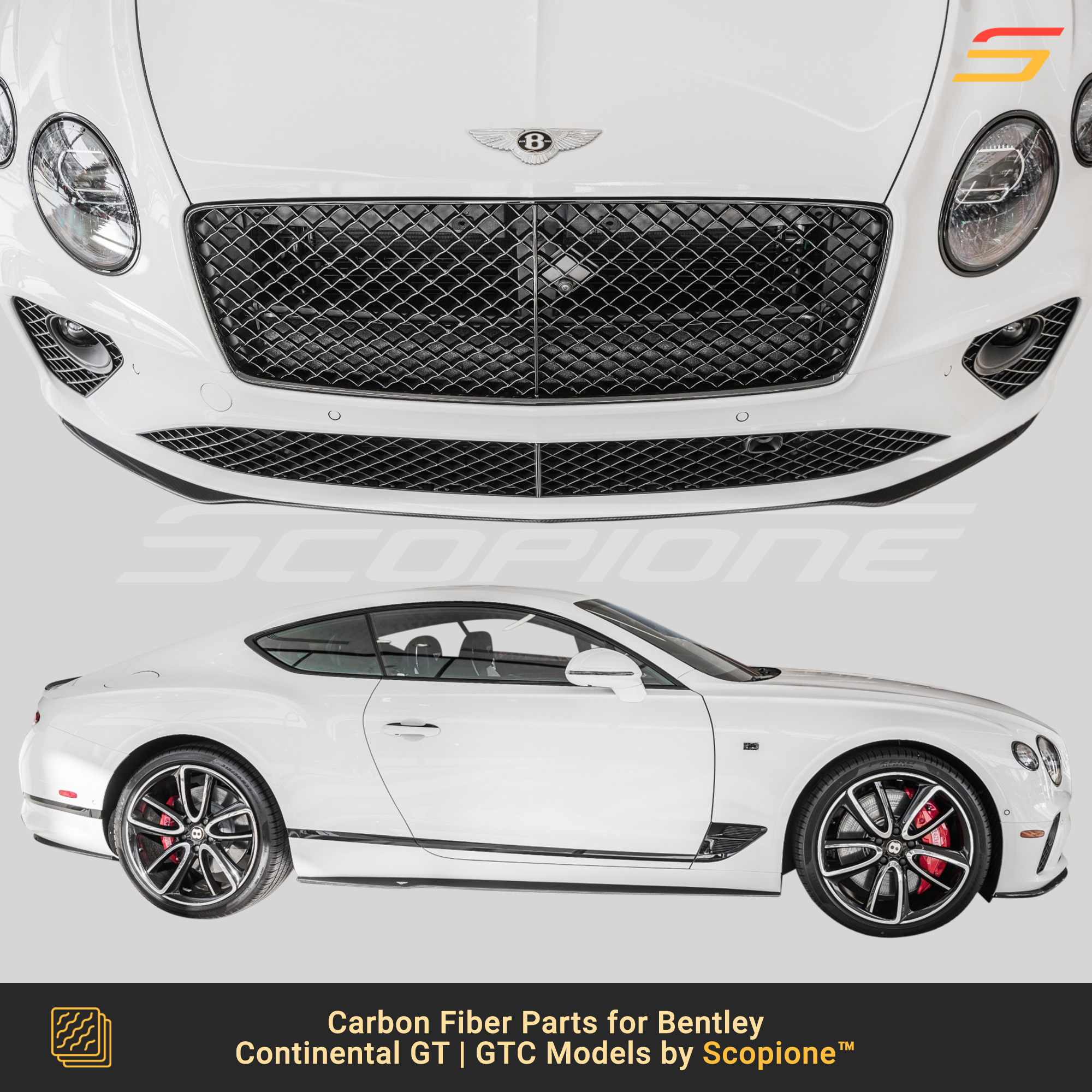
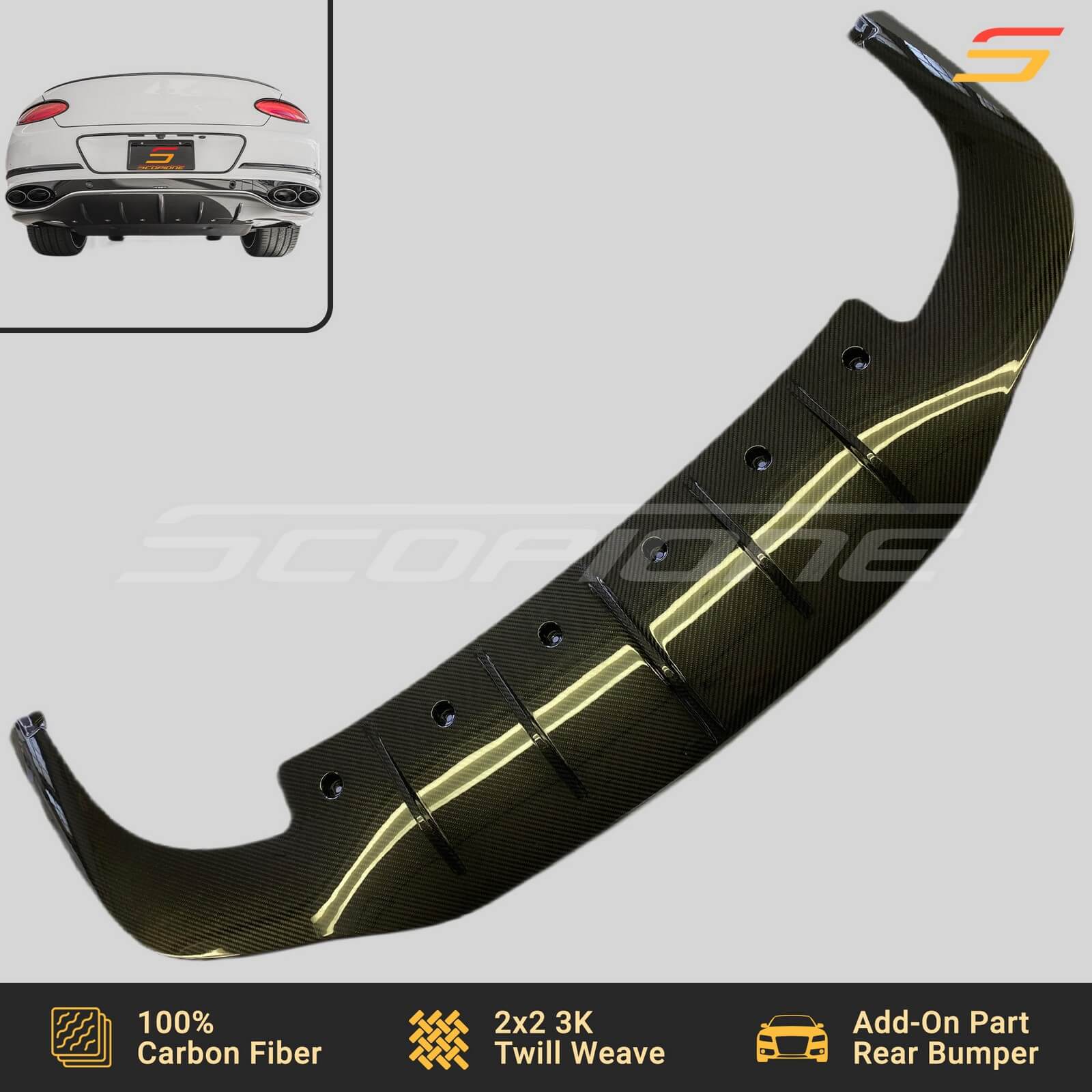
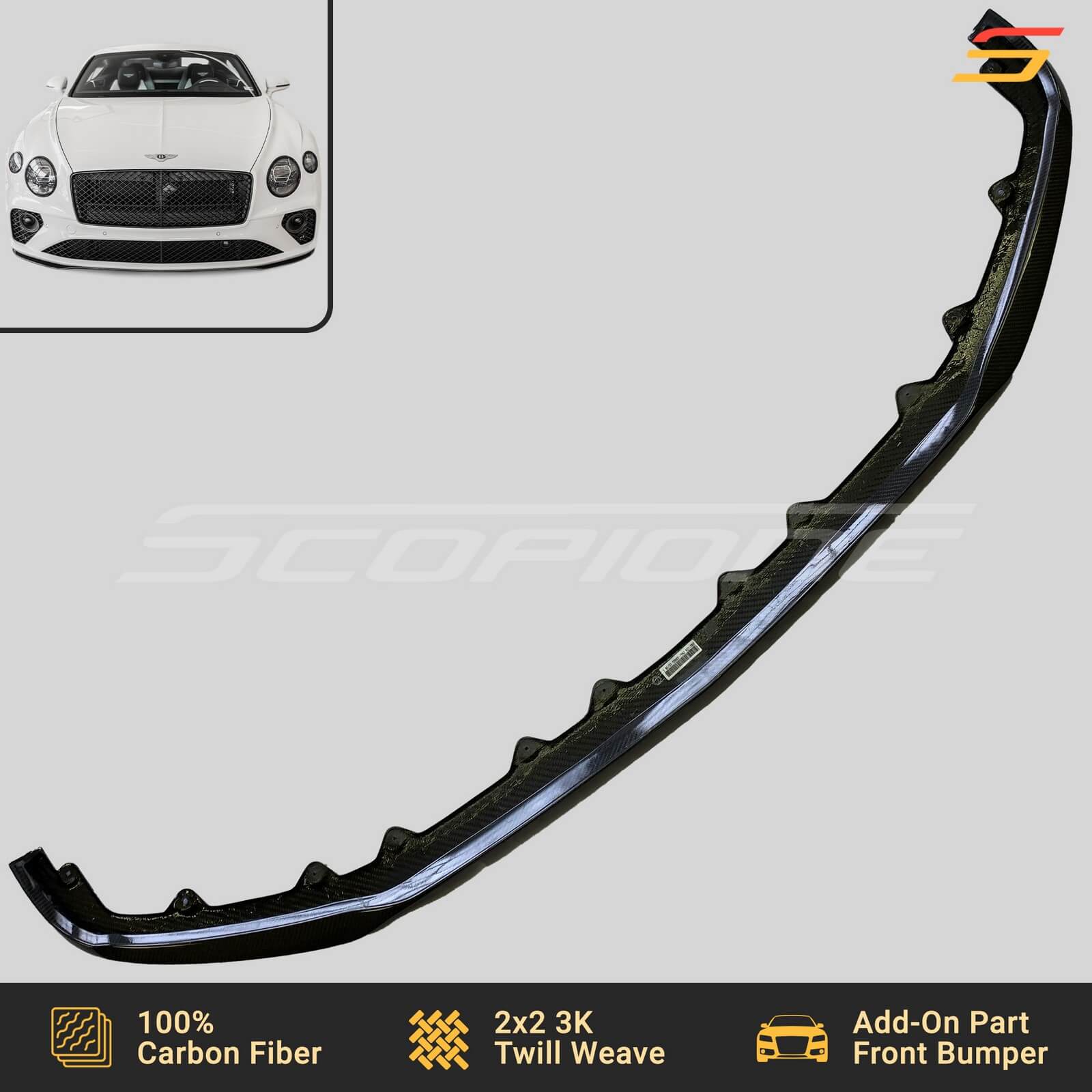
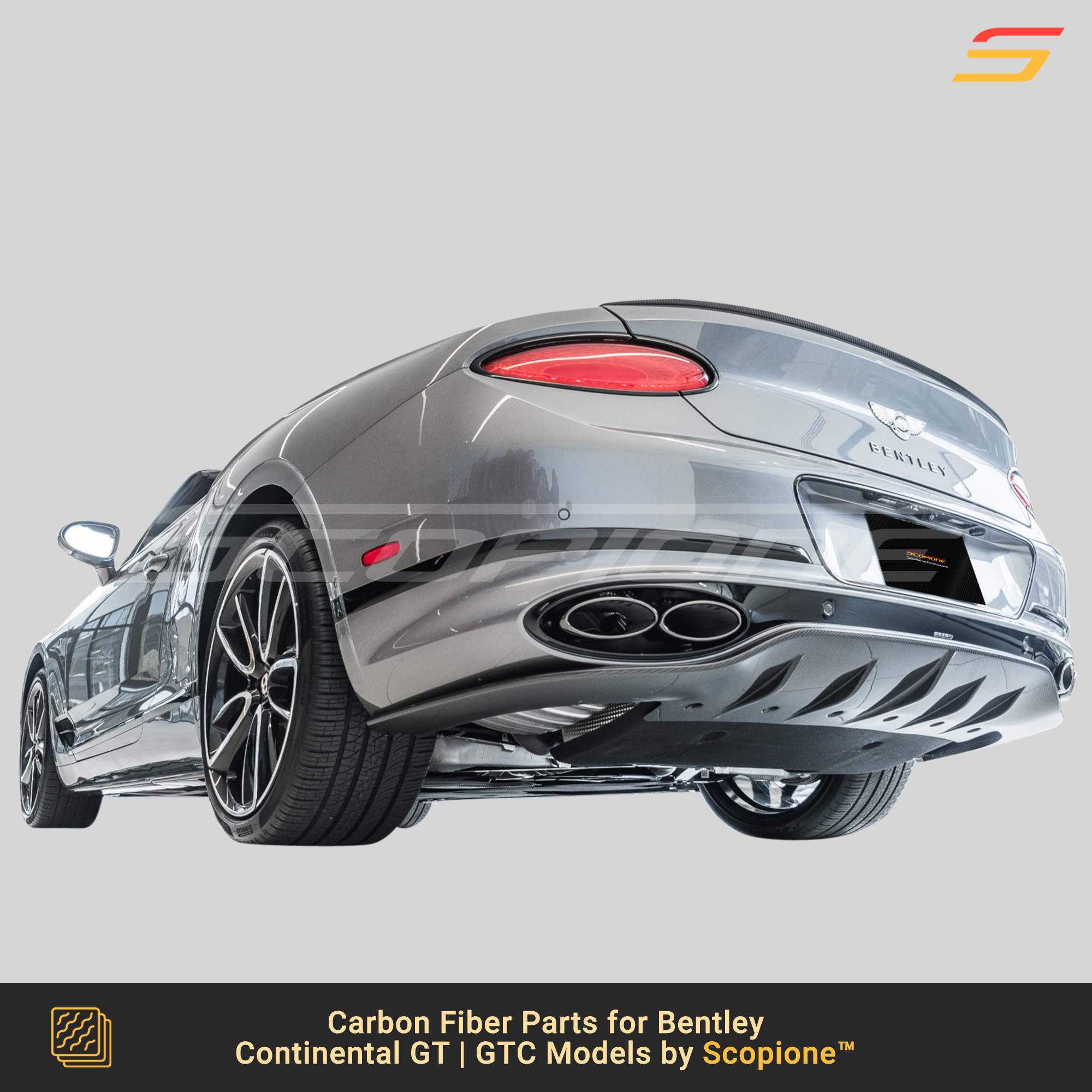
The Continental GT created the modern Bentley aftermarket. Scopione’s catalog for the GT and GTC spans three generations and is exterior aerodynamics throughout — the components that define the car’s visual character: front lip spoilers, front bumper upper splitters, add-on and widened side skirts, rear bumper diffusers, a rear trunk spoiler, a replacement rear spoiler blade, and full add-on body kits that combine them. Each is moulded in genuine 2×2 3K twill weave under a glossy, UV-resistant clear coat, and sized for specific model years and body styles. For Continental GT owners who want the visual and tactile presence of exposed carbon fiber without the factory Mulliner price premium, Scopione provides a direct path.


2013–2021: Racing Returns and Carbon Fiber Expansion
Bentley returned to factory-backed motorsport for the first time since 2003, and the car that carried the brand back to the grid was wrapped in carbon fiber from hood to diffuser. The Continental GT3 race car stripped the road car to its essentials, deleting the leather interior, the W12 engine, and roughly 1,000 kg of curb weight, and replaced everything possible with CFRP. The program proved carbon fiber under competitive stress and generated engineering knowledge that filtered directly into road car development.
On the production side, CF expanded across the entire Bentley lineup during this era. The Bentayga luxury SUV offered a Carbon Fibre Styling Specification. The third-generation Continental GT raised the standard for available CFRP content with a comprehensive exterior and interior options catalog. And the Mulliner division launched the Bacalar, a 12-unit coachbuilt barchetta with extensive carbon-fiber bodywork that signaled where Bentley’s CFRP ambitions were heading. By 2021, carbon fiber had moved from an optional extra on a single model to a material available across every Bentley in the range.
Continental GT3 (2013–present)
The Continental GT3 marked Bentley’s return to factory-backed endurance racing after a decade away from the track. The first-generation car was developed in partnership with M-Sport. The second-generation GT3 (2018 onward) was developed with significantly more involvement from Bentley Motorsport, winning the Bathurst 12 Hour, scoring class victories in the Blancpain GT Series (now GT World Challenge), and competing at the Total 24 Hours of Spa.
The transformation from road car to race car involved a fundamental rethinking of materials. The luxurious interior was stripped entirely and replaced by a roll cage, racing electronics, and a single bucket seat. The W12 was swapped for a 4.0-liter twin-turbo V8 producing approximately 550 hp per GT3-class regulations. And the body was rebuilt in carbon fiber.
- Engine: 4.0L twin-turbo V8, ~550 hp (per regulations)
- Weight: ~1,300 kg (vs. ~2,300 kg road car)
- Body: Full CFRP – fenders, hood, doors, trunk lid, bumpers, splitter, diffuser, rear wing
- Racing series: Blancpain GT / GT World Challenge, Bathurst 12 Hour, Spa 24 Hours
The CFRP body (fenders, hood, doors, trunk lid, bumpers, splitter, diffuser, and rear wing) reduced curb weight from approximately 2,300 kg to roughly 1,300 kg when combined with all other lightweighting measures. The GT3 program gave Bentley Motorsport direct experience with CFRP panel fabrication, aerodynamic development in carbon fiber, and structural load management under racing conditions. Data from competition (how CF panels respond to sustained aerodynamic pressure, thermal cycling from brake heat, and low-speed contact) informed the design of CFRP components on subsequent road cars.
The GT3 also connected modern Bentley to the Le Mans heritage of the 1920s. A racing Bentley, competing in international endurance events, nearly a century after the Bentley Boys. The marketing value was significant. But the engineering output was arguably more valuable: CFRP manufacturing knowledge from the GT3 program flows directly to Mulliner, where the Bacalar and Batur are developed. The GT3’s race results also validated carbon fiber’s durability under conditions far harsher than any road car would encounter. A 12-hour endurance race subjects body panels to vibration, temperature cycling, stone impacts, and aerodynamic stress that would take decades to accumulate in normal road use. The fact that the GT3’s CFRP body survives these conditions without structural compromise gives Bentley’s engineers confidence in specifying carbon fiber for road car applications where durability expectations are measured in decades, not race weekends.
Bentley Bentayga (2016–present)
The Bentayga was the first ultra-luxury SUV to reach production, beating the Rolls-Royce Cullinan, Lamborghini Urus, and Aston Martin DBX to market. The W12-powered Bentayga Speed held the Pikes Peak SUV record at 10:49.902, driven by Rhys Millen in 2018, before the Urus claimed it. Available in W12, V8, and V6 hybrid configurations, the Bentayga extended Bentley’s reach into the segment that now drives a significant portion of luxury car sales globally.
At over 2,400 kg, the Bentayga is the heaviest vehicle in the Bentley lineup. Carbon fiber’s absolute weight savings are proportionally modest on a vehicle this heavy. A full CF exterior package might save 8 to 12 kg on a Bentayga, a fraction of the total mass. But CFRP serves a dual purpose here: functional weight reduction and visual marker of the performance specification. Bentayga buyers who select the Carbon Fibre Styling Specification are signaling a preference for the sportier end of the Bentley range, and the visible weave pattern communicates that preference at a glance.
- Engine options: 6.0L W12 (600–626 hp) / 4.0L V8 (542 hp) / V6 hybrid
- 0–60 mph: 3.5 seconds (Speed)
- Top speed: 190 mph (Speed)
- CF package: Mirror caps, splitter inserts, side skirt extensions, wheel arch trim, rear diffuser, rear spoiler
The Bentayga’s Carbon Fibre Styling Specification includes CFRP mirror caps, front bumper splitter inserts, side skirt extensions, wheel arch trim, rear diffuser, and rear spoiler. Interior CF options extend to dashboard fascia panels, center console trim, and door inserts. The Bentayga S and Speed models offer enhanced packages with additional exterior components. The Bentayga also demonstrated that carbon fiber has a role across the entire Bentley lineup, not just the Continental GT sports models, introducing CFRP to buyers who might not have considered a traditional grand tourer.
Bentley Continental GT – Third Generation (2018–present)
The third-generation Continental GT moved to the MSB platform, shared with the Porsche Panamera architecture, and represented a comprehensive improvement in materials, technology, and refinement. The body uses more aluminum than previous generations, reducing body-in-white weight by approximately 80 kg compared to the second-generation GT. Stefan Sielaff’s design sharpened the Continental GT’s proportions while maintaining the fastback silhouette that traces back to the 1952 R-Type. The relationship between platform sharing and material investment is worth noting: VW Group’s scale allows Bentley to access engineering resources (Porsche’s aluminum expertise, Lamborghini’s CFRP knowledge) that a standalone manufacturer of Bentley’s volume could not afford independently.
The W12 produces 626 hp in standard form and 659 hp in Speed specification. An 8-speed dual-clutch transmission replaced the previous torque-converter automatic. Active all-wheel drive with rear-bias torque distribution transformed the handling balance. And the interior — featuring a rotating center display that presents either a 12.3-inch touchscreen, three analog dials, or a clean veneer panel — represents the intersection of technology and traditional craftsmanship.
- Engine: 6.0L W12 twin-turbo, 626–659 hp / 4.0L V8, 542 hp
- 0–60 mph: 3.5 seconds (W12 Speed)
- Top speed: 208 mph (W12 Speed)
- CF specification: Splitter, side skirts, diffuser, spoiler, interior trim (all available)
This generation offers a broader CF options catalog than any previous standard-production Bentley. The Carbon Fibre Styling Specification includes a CFRP front splitter, side skirts, rear diffuser, and rear spoiler — all in visible 2×2 twill weave with clear coat. The Mulliner specification adds CFRP interior trim covering dashboard fascia, center console, door panel inserts, and seat-back veneer panels in exposed carbon fiber. The GT Speed (2021 onward) enhanced the exterior CF content with additional front bumper elements and a more prominent rear diffuser. Bentley Continental GT and GTC models can now be specified with more carbon fiber than any previous standard-production Bentley.
Continental GT3 Pikes Peak (2019)
A single purpose-built Continental GT3 set a new production-car-based record at the Pikes Peak International Hill Climb: 10:18.488, driven by Rhys Millen, running entirely on renewable biofuel. The modified 4.0-liter twin-turbo V8 produced approximately 750 hp. But the aerodynamic package told the more relevant material story.
The Pikes Peak GT3’s aero was significantly modified from the standard flat-track GT3 specification. Larger front splitter with dive planes. Extended side sills. A massive rear wing with endplates. A rear diffuser generating substantially more downforce than the circuit car required. Every component (splitter, dive planes, side sills, fender vents, rear wing, and diffuser) was constructed entirely from CFRP, designed for maximum downforce in thin air at altitude. The finish line sits at 14,115 feet above sea level.
- Engine: 4.0L twin-turbo V8, ~750 hp (renewable biofuel)
- Record: 10:18.488 (production-car-based record)
- Production: 1 unit
- CFRP: Complete aerodynamic package – splitter, dive planes, sills, fender vents, rear wing, diffuser
The extreme CFRP aero components were never transferred to road cars directly. But the manufacturing processes and aerodynamic data informed subsequent Mulliner and GT Speed carbon-fiber development. The Pikes Peak car demonstrated that Bentley Motorsport could design, fabricate, and validate purpose-built CFRP aerodynamic components in-house, a capability the Mulliner coachbuilt division now draws upon for the Bacalar and Batur programs.
Bentley Mulliner Bacalar (2020)
Twelve cars. Each one uniquely specified by its owner. Each one requiring hundreds of hours of hand-finishing from Mulliner’s craftspeople in Crewe. The Bacalar was the first car in Bentley’s modern Mulliner coachbuilt series, ultra-limited vehicles that push materials and craftsmanship beyond what standard production allows. Named after the Laguna Bacalar in Mexico, the open-top barchetta deleted the Continental GT’s roof and rear window, replacing them with a sculptural rear deck flowing from the cabin into the tail.
Priced at approximately $1.9 million each, all 12 were sold before Bentley publicly revealed the car. The 6.0-liter W12 produced 650 hp, paired with all-wheel drive and a top speed of 200 mph.
- Engine: 6.0L W12 twin-turbo, 650 hp
- 0–60 mph: 3.5 seconds
- Top speed: 200 mph
- Production: 12 units, each bespoke
The Bacalar represented the highest CFRP content of any Bentley road car at the time. Carbon fiber was used for the rear haunches (replacing the Continental GT’s steel panels), the rear deck, side sill extensions, front splitter, and rear diffuser. Interior CFRP was extensive: dashboard panels, center console, door trim, and structural elements of the bespoke tonneau cover. The 5,000-year-old Riverwood veneer was paired with exposed carbon fiber in an interior that treated CFRP as a luxury material on par with exotic wood and hand-stitched leather.
Mulliner’s approach to carbon fiber here was distinctly different from a racing application. Each CF panel was hand-finished and quality-inspected to the same standard as the car’s leather and woodwork. Weave alignment between adjacent panels was checked visually. Surface quality was assessed under multiple lighting conditions. Any imperfection in the weave pattern, any inconsistency in the resin surface, was corrected or the panel was rejected. That level of scrutiny added hours to the production process for each car, but it transformed carbon fiber from an engineering material into a craft material on par with the Riverwood veneer and hand-cross-stitched leather sharing the cabin. The Bacalar established the template for Bentley’s Mulliner coachbuilt series: ultra-limited production, extensive CFRP content, bespoke specification, and pricing that positions Bentley alongside Bugatti and Pagani in the coachbuilt segment.
Scopione Perspective: Racing Knowledge, Road Car Reality
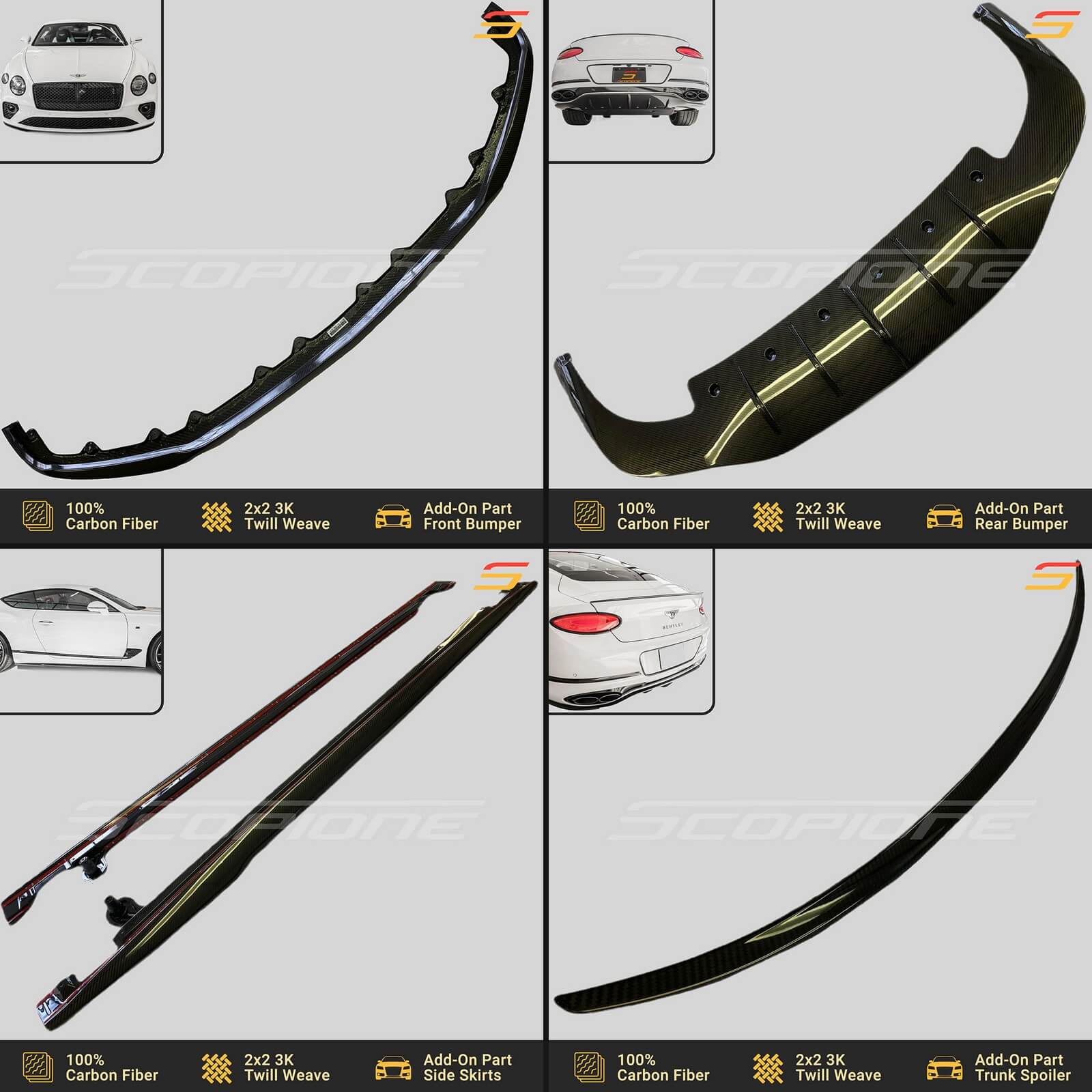
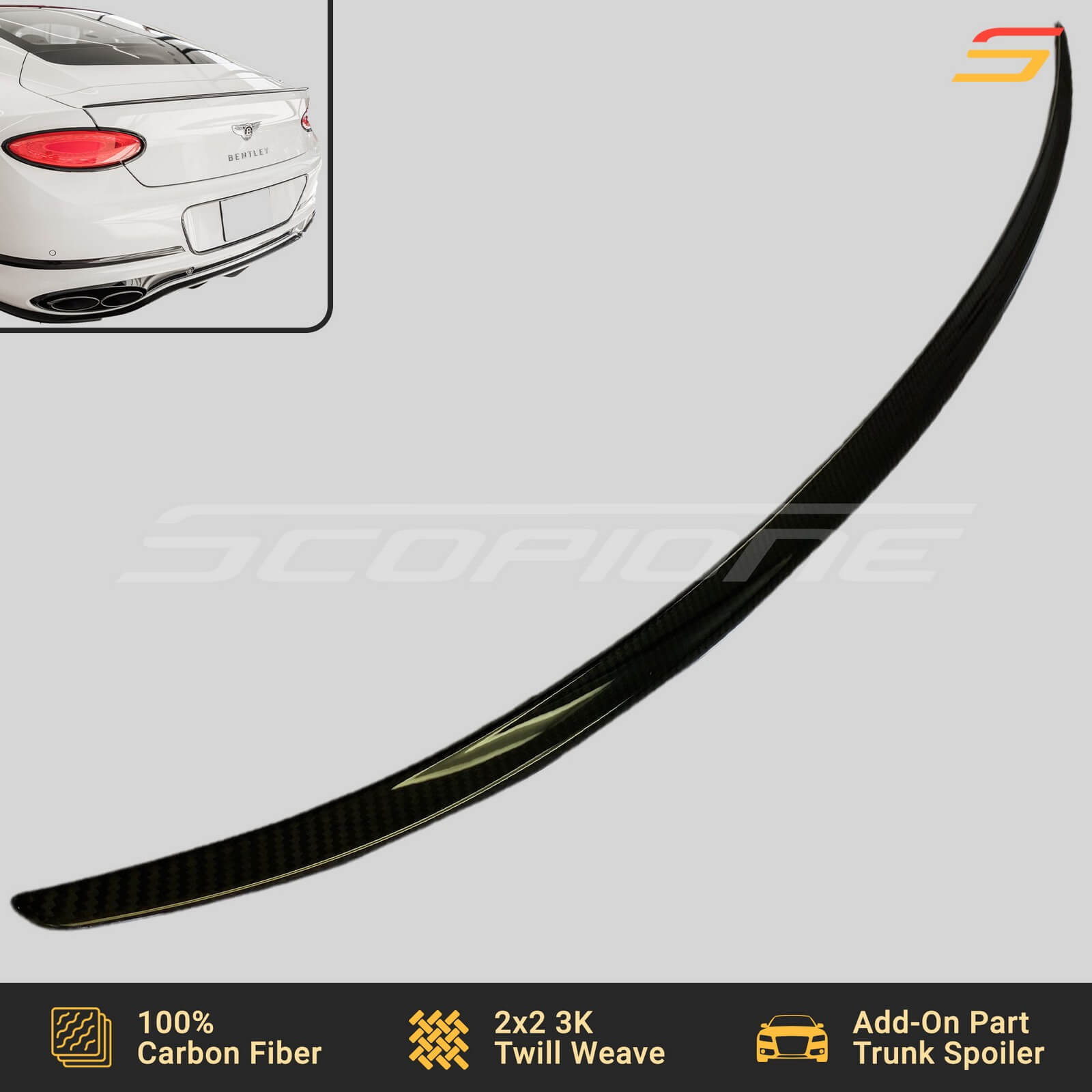
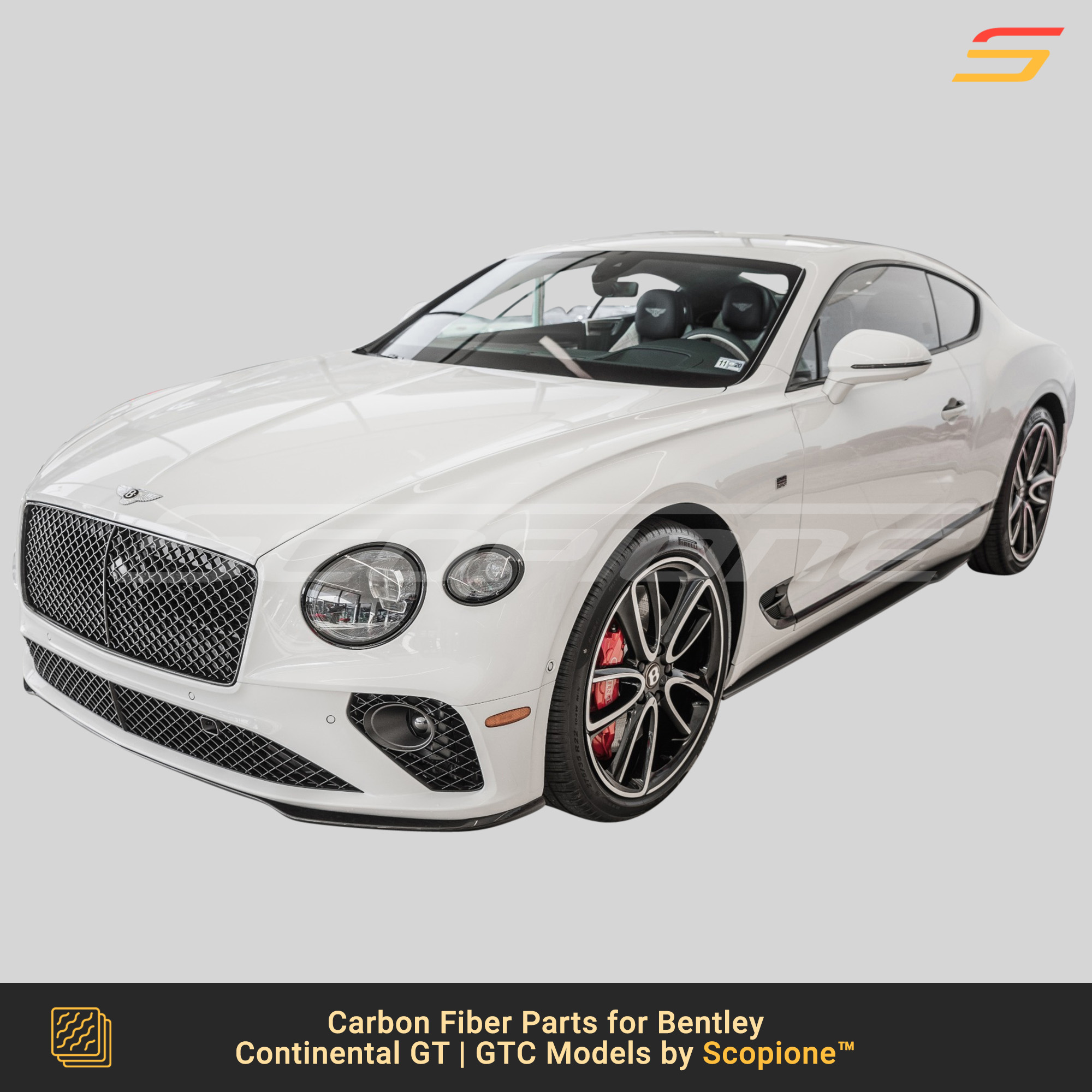
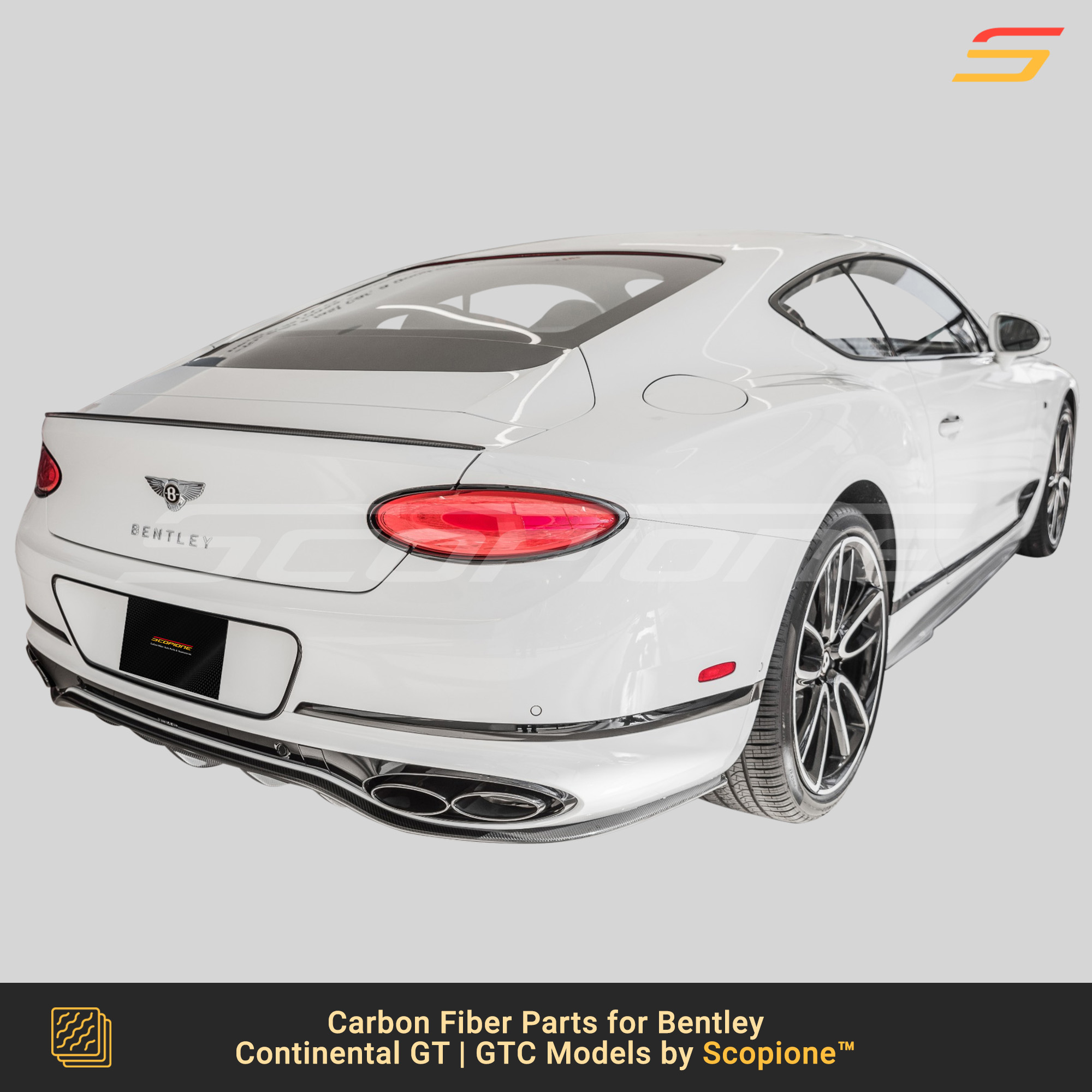
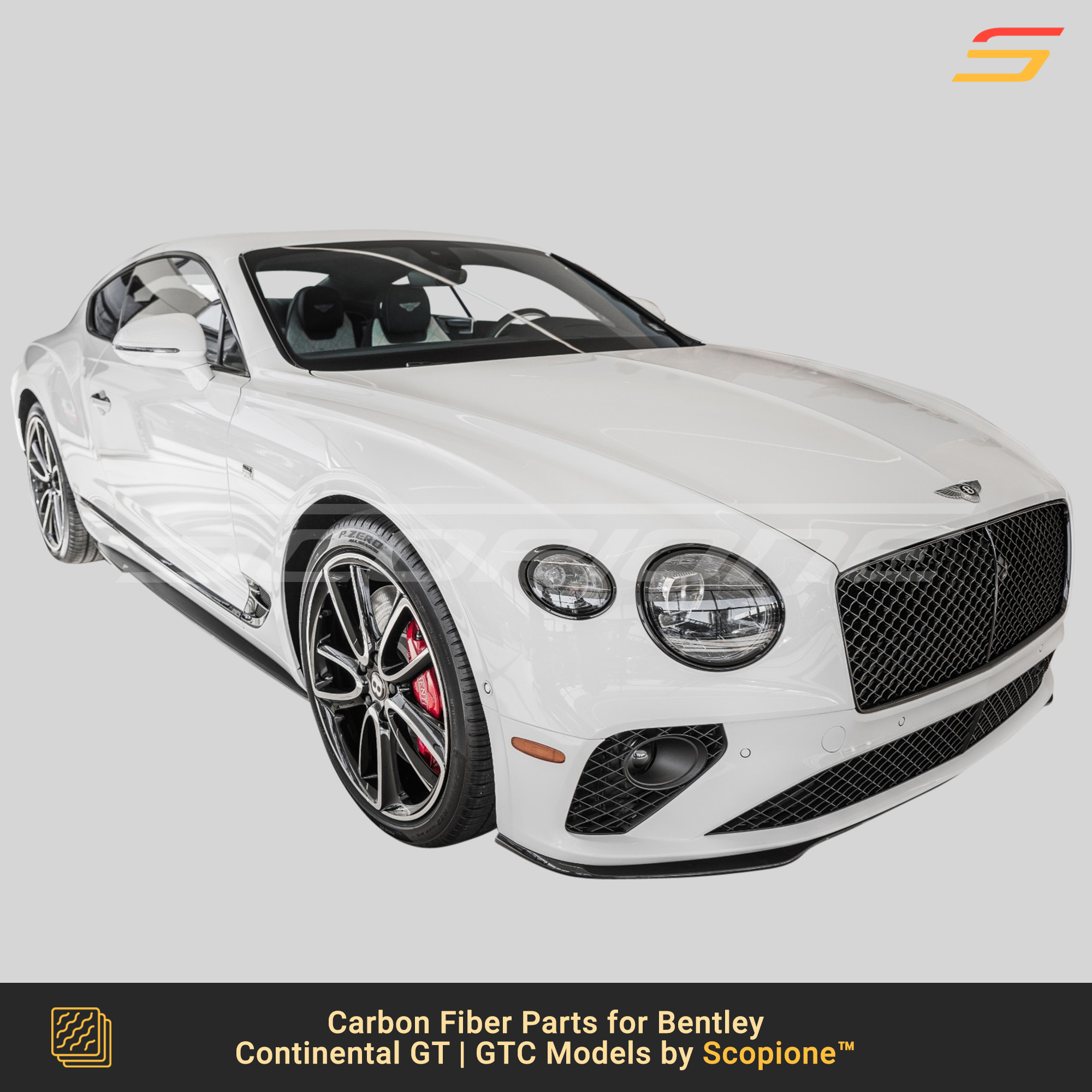
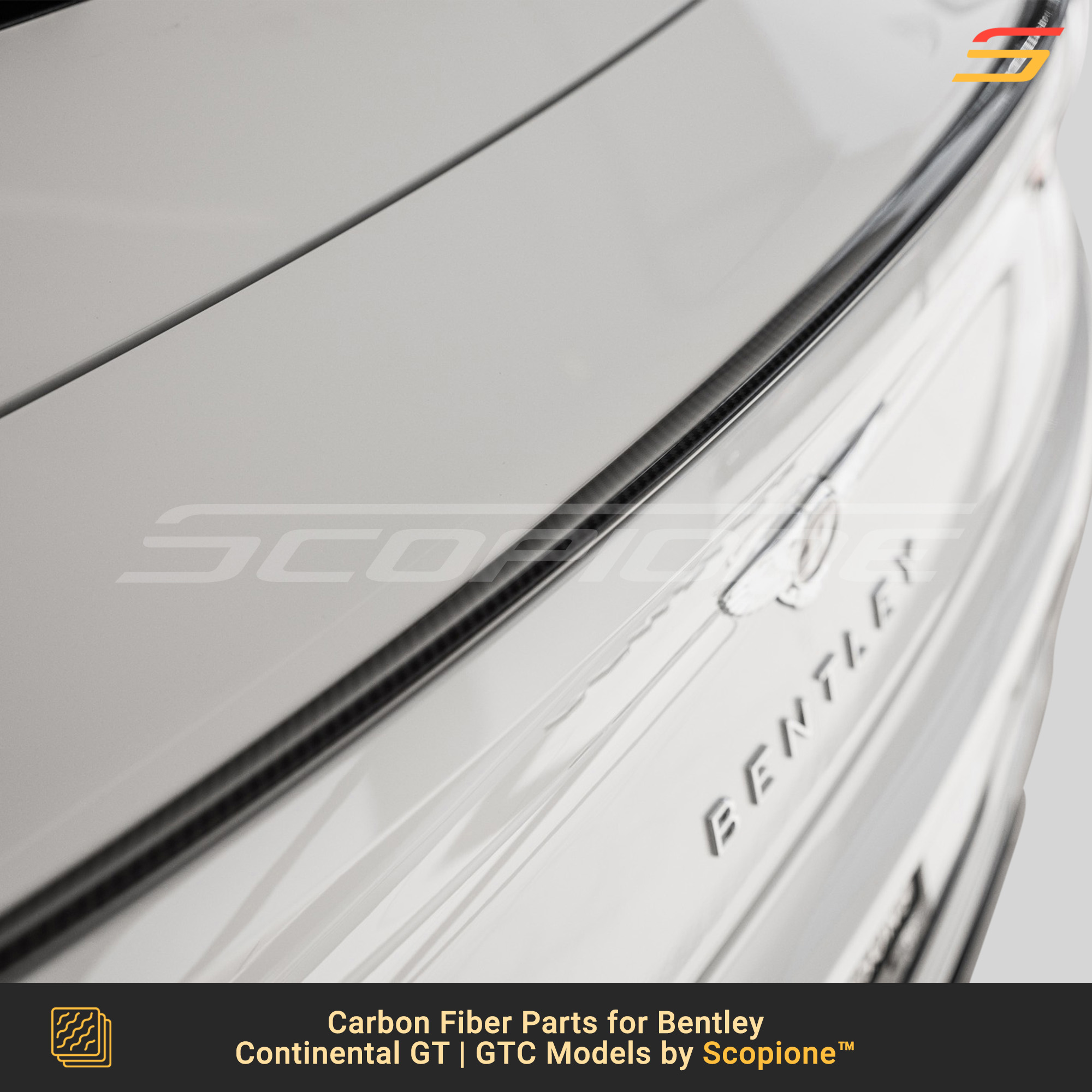
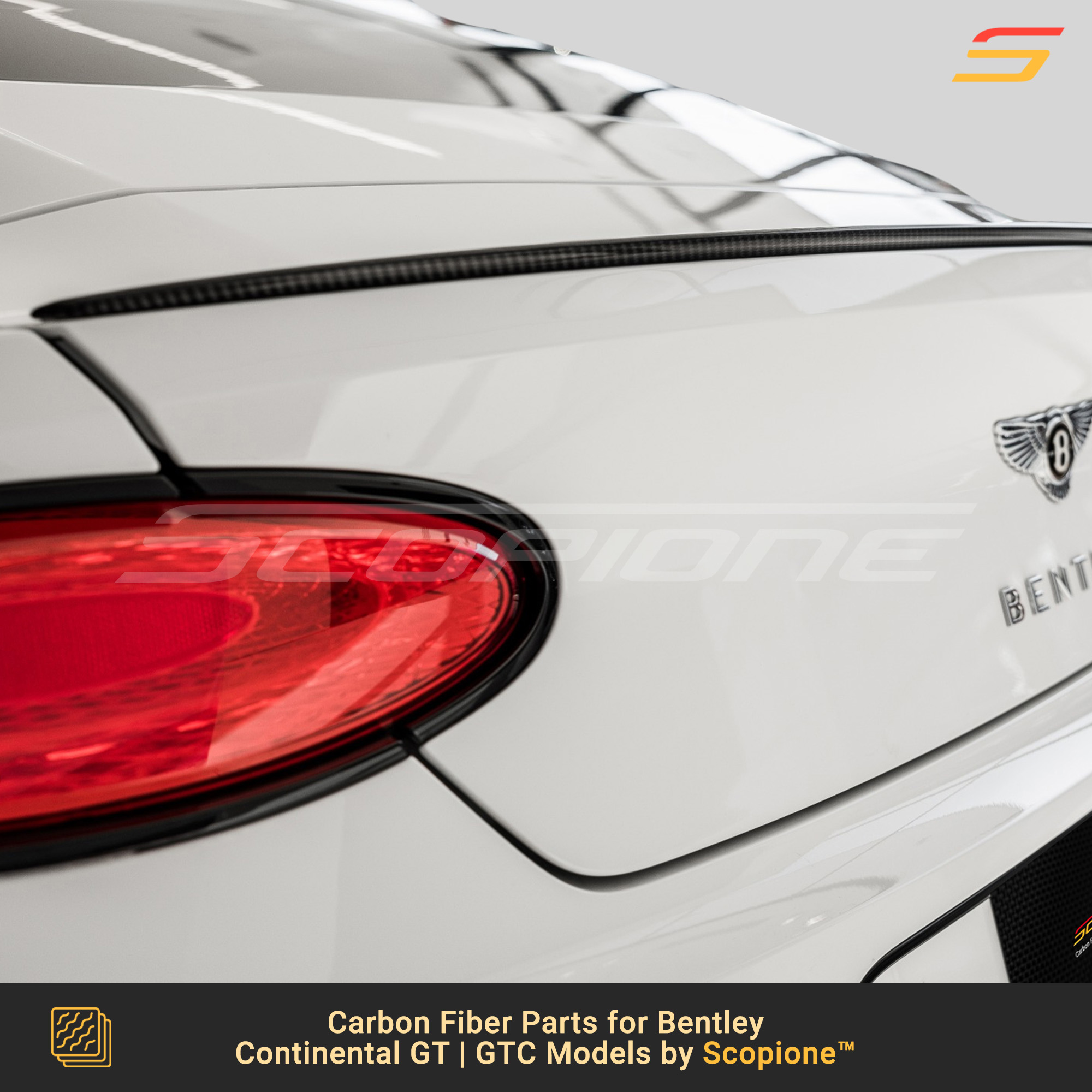
The Continental GT3 program proved that CFRP performs under competitive stress — sustained aerodynamic loads, thermal cycling, and the abrasion of endurance racing. That same material confidence applies to the aftermarket. Scopione’s carbon-fiber components for the Continental GT and GTC are moulded in the same 2×2 3K twill weave found on factory-specification parts, under a glossy, UV-resistant clear coat that keeps its shine outdoors. Front lip spoilers, rear diffusers, side skirts and the full body kits secure to the factory panels with placeholders, clips and 3M tape — no cutting or drilling.

2022–Present: Mulliner’s Carbon Fiber Statement and the Electric Horizon
Bentley’s current era is shaped by two converging forces. The Mulliner coachbuilt program has reached its peak CFRP expression with the Batur — the last W12 Bentley, limited to 18 units, carrying more carbon fiber than any Bentley in history. Simultaneously, the Continental GT Speed has transitioned from a pure W12 to a V8 plug-in hybrid, with carbon fiber playing a standard (not optional) role in its exterior specification for the first time.
An all-electric Bentley is expected around 2026 under the Beyond100 strategy, which commits the brand to offering exclusively electrified models by 2030. Carbon fiber will be essential to managing the weight of battery-electric luxury cars that must maintain the substantial, cosseting character Bentley buyers expect. The Batur’s CFRP body panels and the GT Speed’s standard CF exterior package establish the manufacturing capabilities and supplier relationships needed for higher CFRP volumes in the electric era.
Bentley Mulliner Batur (2022)
The Batur is two things at once: a farewell and a preview. It is the last Bentley powered by the W12 engine that has defined the Continental GT since 2003. Its angular, sharp-creased design language previews the styling direction of Bentley’s forthcoming electric models. The 6.0-liter twin-turbo W12 produces 730 hp, the highest output of any Bentley W12 in history. Just 18 units were built. Each was uniquely specified through Mulliner’s bespoke program, and the car also features 3D-printed titanium exhaust finishers, a first for any Bentley.
- Engine: 6.0L W12 twin-turbo, 730 hp (peak W12 output in Bentley history)
- 0–60 mph: 3.3 seconds
- Top speed: 208 mph
- Production: 18 units, each uniquely specified
The Batur carries the highest carbon-fiber content of any Bentley ever produced. CFRP is used for the front fenders (replacing the Continental GT’s steel panels), side sills, rear deck panel, front splitter, and rear diffuser, all in visible 2×2 twill-weave carbon fiber with clear coat. Interior CFRP extends to dashboard panels, center console, door cards, and seat-back shells. Mulliner treats each panel as a craft object: the weave direction, panel boundaries, and finish quality are individually inspected and aligned so the carbon-fiber pattern flows continuously across adjacent panels.
This level of CFRP finishing is unusual outside of bespoke coachbuilding. Mass-produced CF components rarely receive this degree of hand inspection. BMW’s industrial-scale CFRP production, for instance, prioritizes throughput and cost efficiency, fundamentally different goals from Mulliner’s panel-by-panel visual alignment process. The Batur represents the convergence of two Bentley traditions: the W12 engine (which powered every Continental GT since 2003) and Mulliner’s bespoke craftsmanship (which dates to the 1920s coachbuilding era).
Its extensive CFRP usage also establishes the material standard for Bentley’s electric models. The forthcoming BEV will need carbon fiber’s weight savings to offset heavy battery packs while maintaining the grand touring mass that defines the brand.
Continental GT Speed – Hybrid, Fourth Generation (2024–present)
The fourth-generation Continental GT Speed replaces the W12 with a 4.0-liter twin-turbo V8 plug-in hybrid producing 771 hp combined, the highest output of any production Bentley. The transition from W12 to V8 hybrid mirrors the broader industry shift, with the electric motor providing instant torque fill and a limited all-electric driving range for short-distance trips. The design draws from the Batur’s angular language, with sharper creases and a more sculpted rear end than the outgoing third-generation GT.
- Engine: 4.0L twin-turbo V8 + electric motor, 771 hp combined
- 0–60 mph: 3.2 seconds
- Top speed: 208 mph
- CFRP: Standard carbon-fiber exterior package (first for a series-production Bentley)
The GT Speed carries a standard carbon-fiber exterior package. It is the first time CFRP has been included as standard equipment on a series-production Bentley. The package includes a CFRP front splitter, side skirts, rear diffuser, and rear spoiler lip, all in visible carbon-fiber weave. This marks a shift from carbon fiber as an optional extra to carbon fiber as an integral part of the car’s design specification.
The shift matters because it signals intent. The GT Speed’s hybrid powertrain adds approximately 200 kg of battery and electric motor weight over the outgoing W12 model, pushing total curb weight above 2,400 kg. Standard CF elements partially offset this increase. And if carbon fiber is standard on the GT Speed today, it will likely be standard on the electric Bentley that follows. The W12’s retirement and the V8 hybrid’s arrival close a 21-year chapter that began with the first Continental GT in 2003, opening a new one where CFRP is a default material rather than a premium option.
Bentley’s Electric Future (Beyond100)
The Beyond100 strategy commits Bentley to offering exclusively electrified models by 2030, with the first all-electric Bentley expected around 2026. The challenge is substantial and fundamentally different from what any mass-market EV manufacturer faces. Bentley’s brand identity depends on grand touring mass, refinement, and a sense of cosseting solidity that battery-electric vehicles inherently provide through heavy floor-mounted battery packs. But there is a difference between a car that feels substantial and a car that feels ponderous. That distinction depends on precise weight management.
A luxury EV battery pack weighing 500 to 700 kg, combined with the expected weight of premium interior materials (leather, wood, metal trim, extensive sound insulation) could push an electric Bentley well beyond 2,500 kg without aggressive lightweighting. Carbon fiber will be critical. The Batur’s CFRP body panels and the GT Speed’s standard CF exterior package establish the manufacturing capabilities and supplier relationships for higher CFRP volumes. Industry analysts expect the electric Bentley to use CFRP for body panels, structural reinforcements, and possibly a carbon-fiber-reinforced battery enclosure, leveraging VW Group’s cross-brand CFRP expertise from Lamborghini and Porsche.
Whether carbon fiber becomes a standard structural material in ultra-luxury EVs or remains primarily an exterior styling element will depend in part on what Bentley decides. The brand’s approach, treating CFRP as a craft material rather than purely an engineering one, may define a new category: carbon fiber as luxury, not just as performance. The implications extend beyond Bentley. If the electric Bentley demonstrates that customers will pay a premium for hand-finished CFRP on a battery-electric platform, competing manufacturers in the ultra-luxury segment will follow. The material standards set by Mulliner on the Bacalar and Batur would then become the baseline expectation for CFRP quality in the next generation of luxury EVs.
Scopione Perspective: Carbon Fiber in the Luxury EV Era
As Bentley transitions from combustion to electrification, carbon fiber’s role expands from aesthetic option to functional necessity. Scopione’s Bentley catalog reflects this trajectory. The current range of 2×2 3K twill-weave components for the Continental GT and GTC (front lip spoilers, splitters, rear diffusers, side skirts, trunk and blade spoilers, and full body kits) addresses the same design intent that Bentley now builds into the GT Speed as standard equipment. For Continental GT owners across all generations, Scopione provides CF components that match factory mounting points and finish standards, extending the carbon-fiber specification beyond what the original purchase order included.


Frequently Asked Questions
Bentley and Carbon Fiber: Common Questions
When did Bentley first use carbon fiber?
Bentley’s first meaningful CFRP application was the Continental Supersports in 2009. The car used carbon-fiber components including a front splitter, rear diffuser, engine cover, and rear spoiler as part of a 110 kg weight reduction program over the Continental GT Speed. Optional CF interior trim and mirror caps had been available on the first-generation Continental GT through Mulliner, but these were decorative rather than functional. The Continental GT3 race car (2013) later featured a full carbon-fiber body.
What is the Bentley Mulliner Batur and why is it significant for carbon fiber?
The Batur is an 18-unit Mulliner coachbuilt special, the last W12 Bentley, with the highest CFRP content of any Bentley ever produced. Carbon fiber is used for the front fenders, side sills, rear deck, splitter, and diffuser, all in visible 2×2 twill-weave finish. Mulliner hand-inspects each CFRP panel so the weave pattern flows continuously across adjacent surfaces, treating carbon fiber with the same craft standards applied to leather and wood. The Batur’s 730 hp W12 makes it the most powerful engine in the brand’s history.
What Bentley models currently feature carbon fiber components?
The Continental GT Speed (2024) carries a standard CFRP exterior package, marking the first time carbon fiber has been standard equipment on a series-production Bentley. The Bentayga offers an optional Carbon Fibre Styling Specification covering mirror caps, splitter inserts, side skirts, wheel arch trim, diffuser, and spoiler. The Mulliner coachbuilt Bacalar (12 units) and Batur (18 units) feature extensive CFRP body panels. The Continental GT3 race car uses a full carbon-fiber body for GT3-class endurance competition.
How does Bentley’s carbon fiber approach differ from other manufacturers?
Bentley treats carbon fiber as a luxury craft material, not purely an engineering solution. Mulliner’s CFRP panels are hand-finished and individually inspected for weave alignment and surface quality — the same standard applied to the brand’s leather and woodwork. This contrasts with mass-production CFRP strategies used by manufacturers like BMW (250,000 CFRP i3 passenger cells at industrial scale) or structural monocoques built by McLaren for outright performance. Bentley’s weight challenge is also unique: at 2,200+ kg, carbon fiber offsets the mass of luxury materials rather than enabling a lightweight sports car. Among British luxury rivals, Aston Martin takes a somewhat different approach, using CFRP more aggressively in the Valkyrie hypercar program.
What carbon fiber parts does Scopione offer for Bentley?
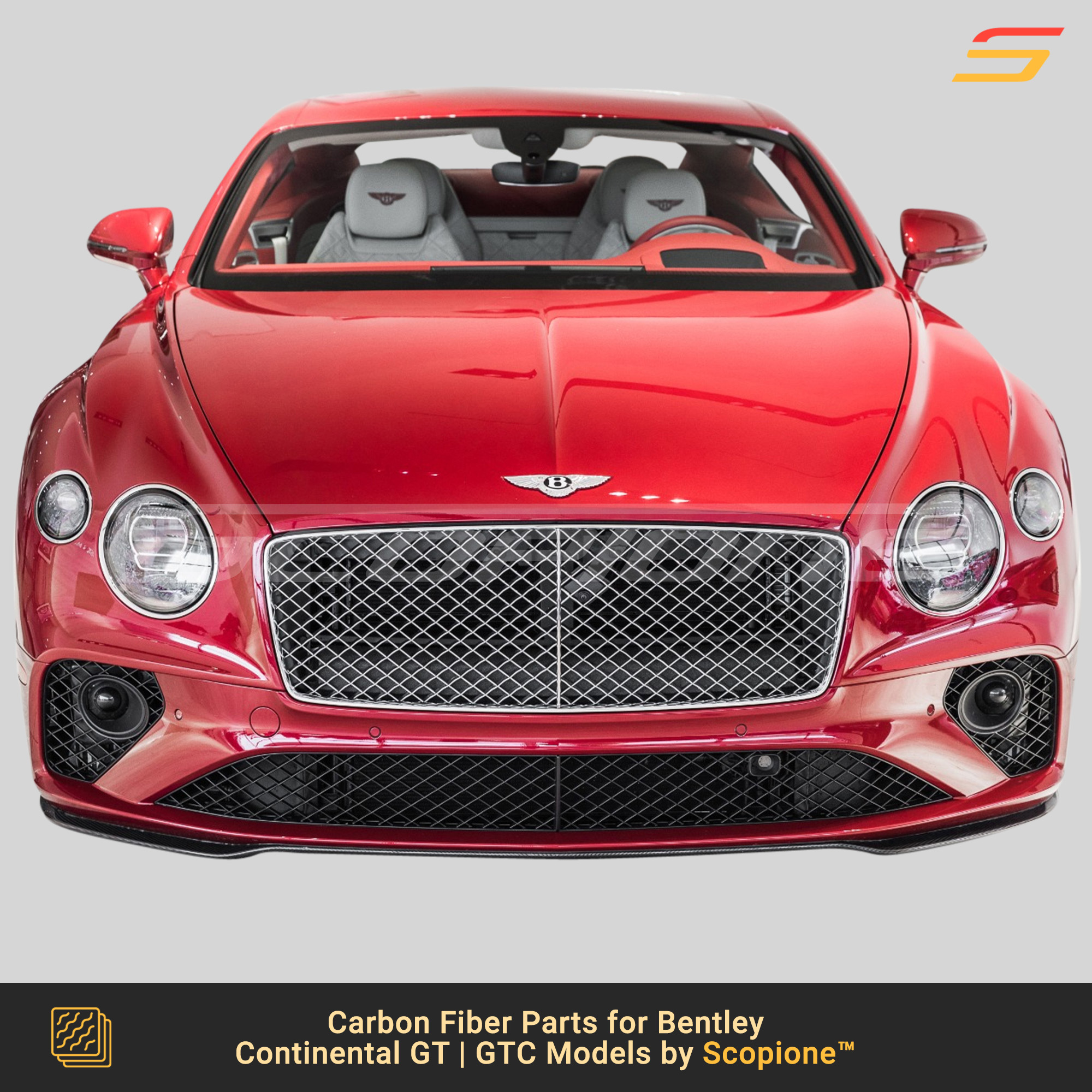
Scopione stocks 2×2 3K twill-weave carbon-fiber components for the Bentley Continental GT and GTC across multiple generations. The catalog is exterior aerodynamics throughout: front lip spoilers, front bumper upper splitters, add-on and widened side skirts, rear bumper diffusers, a rear trunk spoiler, a replacement rear spoiler blade, and full add-on body kits that combine them. All are precision-fitted for specific model years, moulded in genuine 2×2 3K twill weave under a glossy, UV-resistant clear coat, and secure with placeholders, clips and 3M tape — no cutting or drilling – explore the full Scopione Bentley catalog.
Experience the elegance and performance of the Bentley with Scopione. Browse our gallery and get inspired to elevate your supercar with our top-of-the-line carbon fiber upgrades.
Shop now for premium ScopioneCarbon carbon fiber upgrades and experience the ultimate in performance and aesthetics for your Bentley!
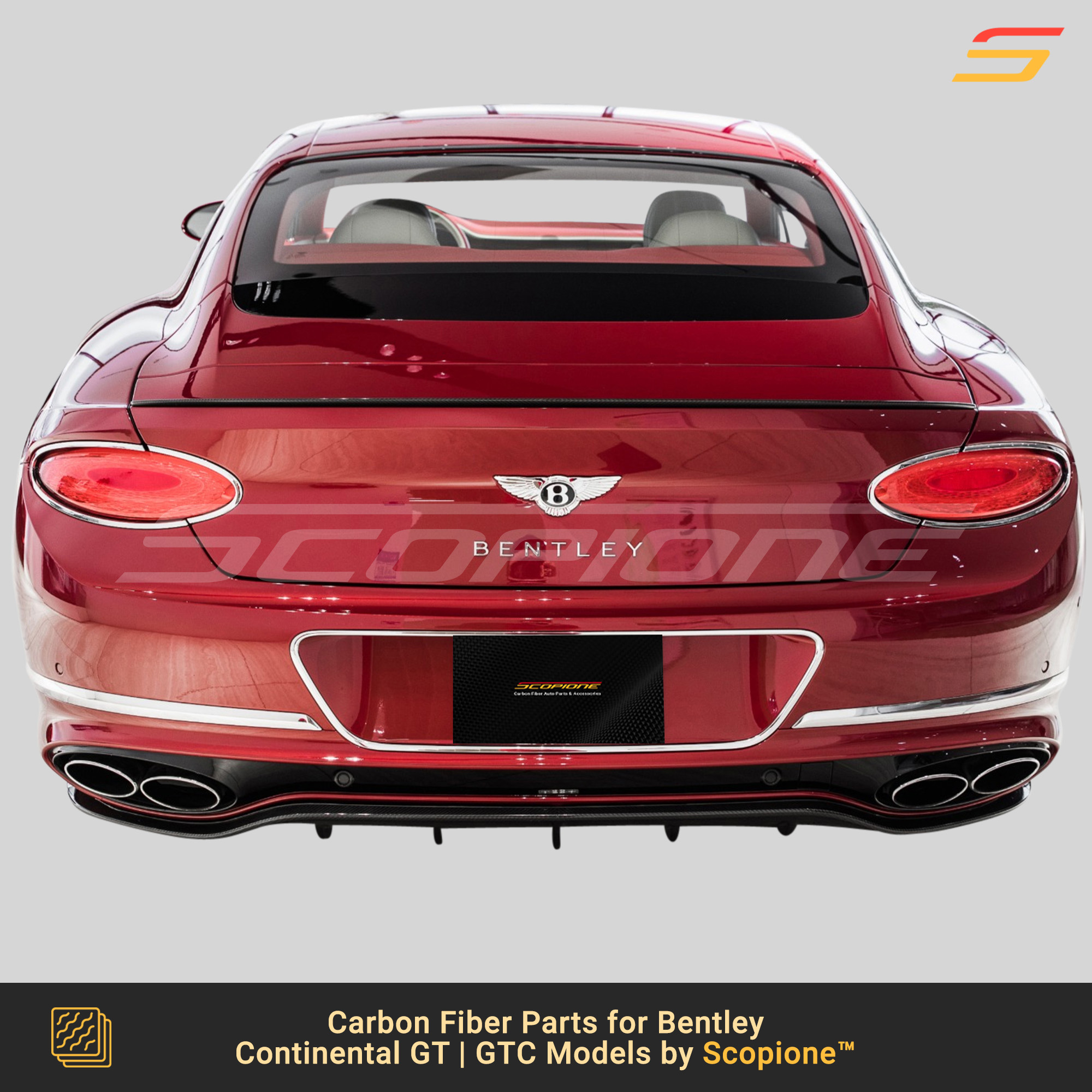
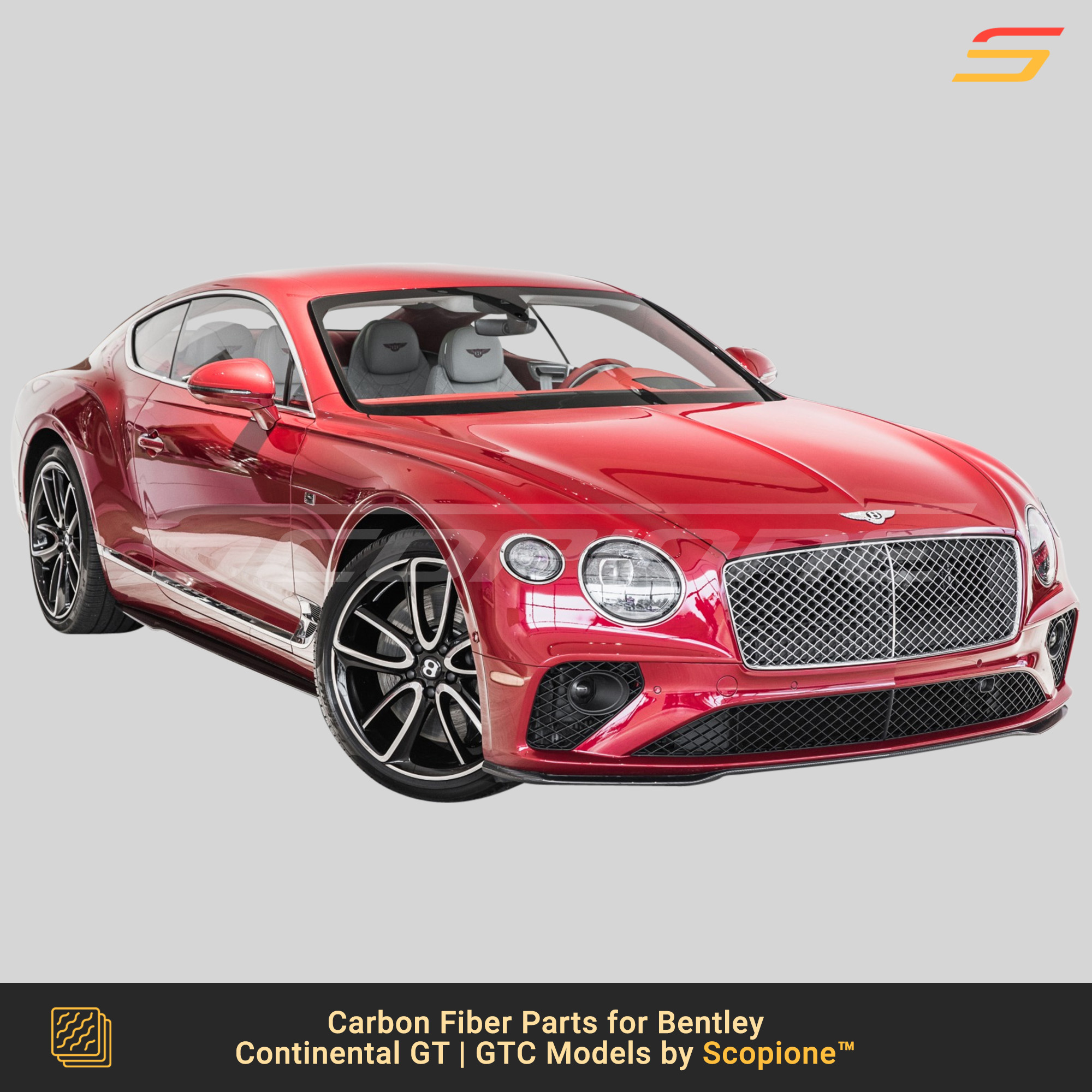
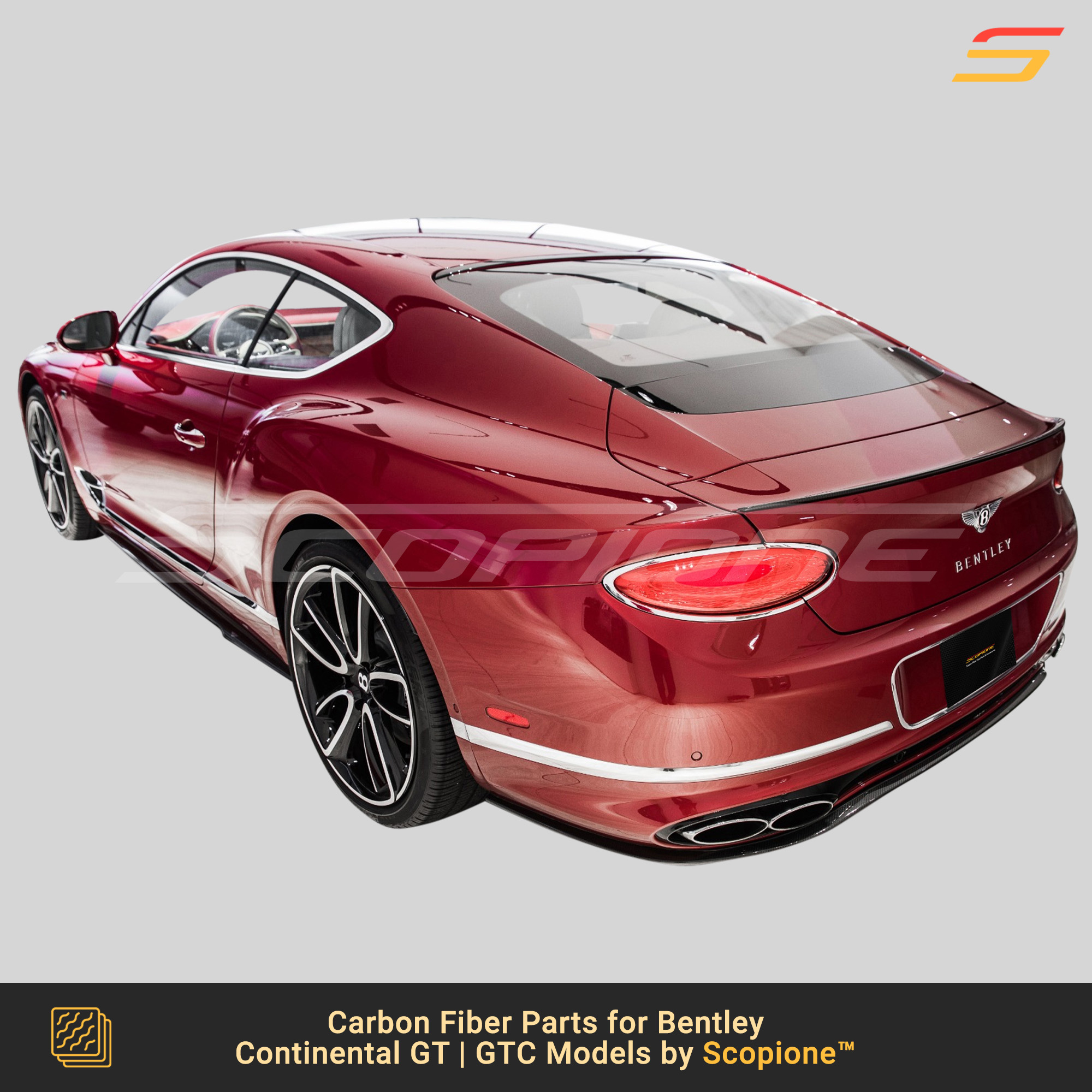
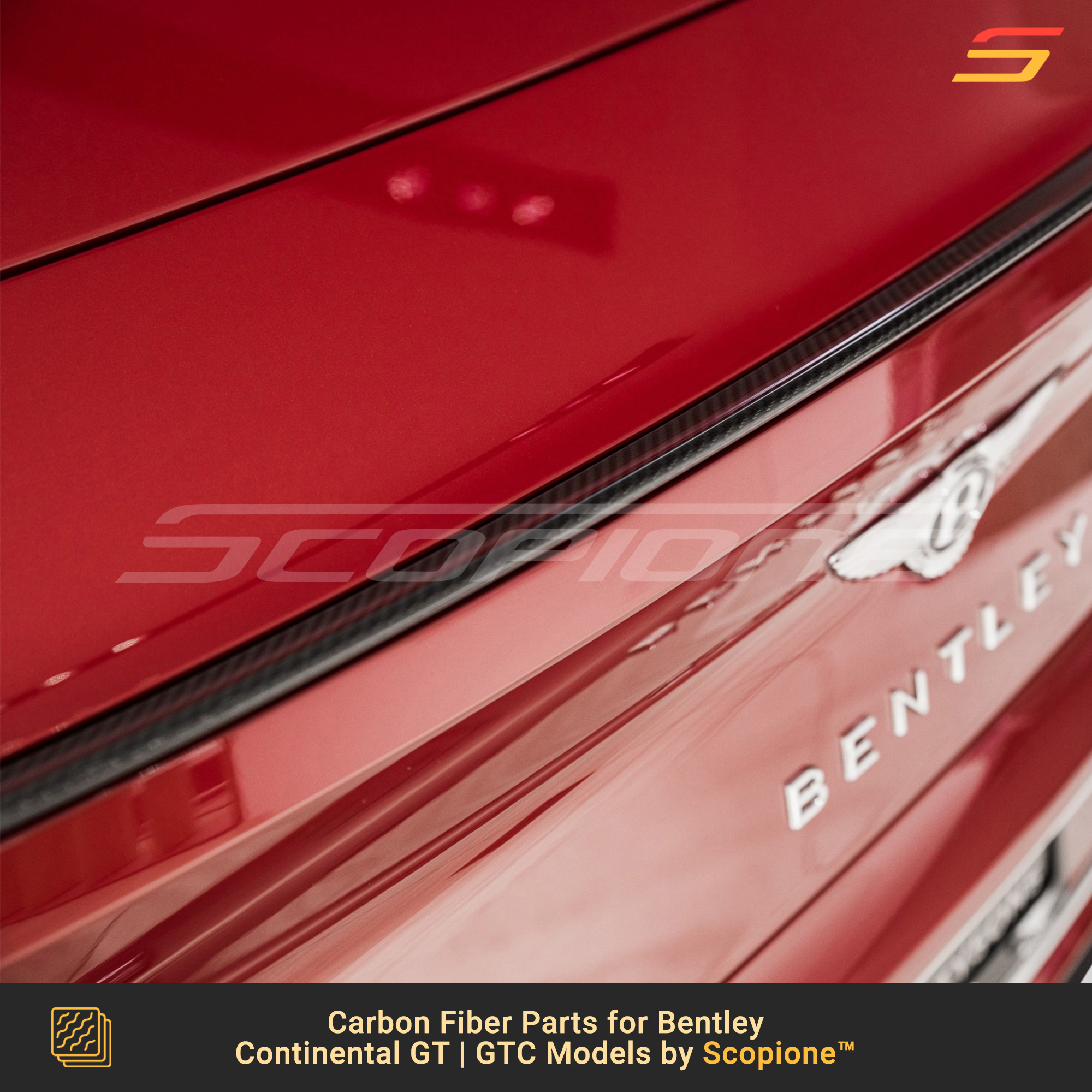
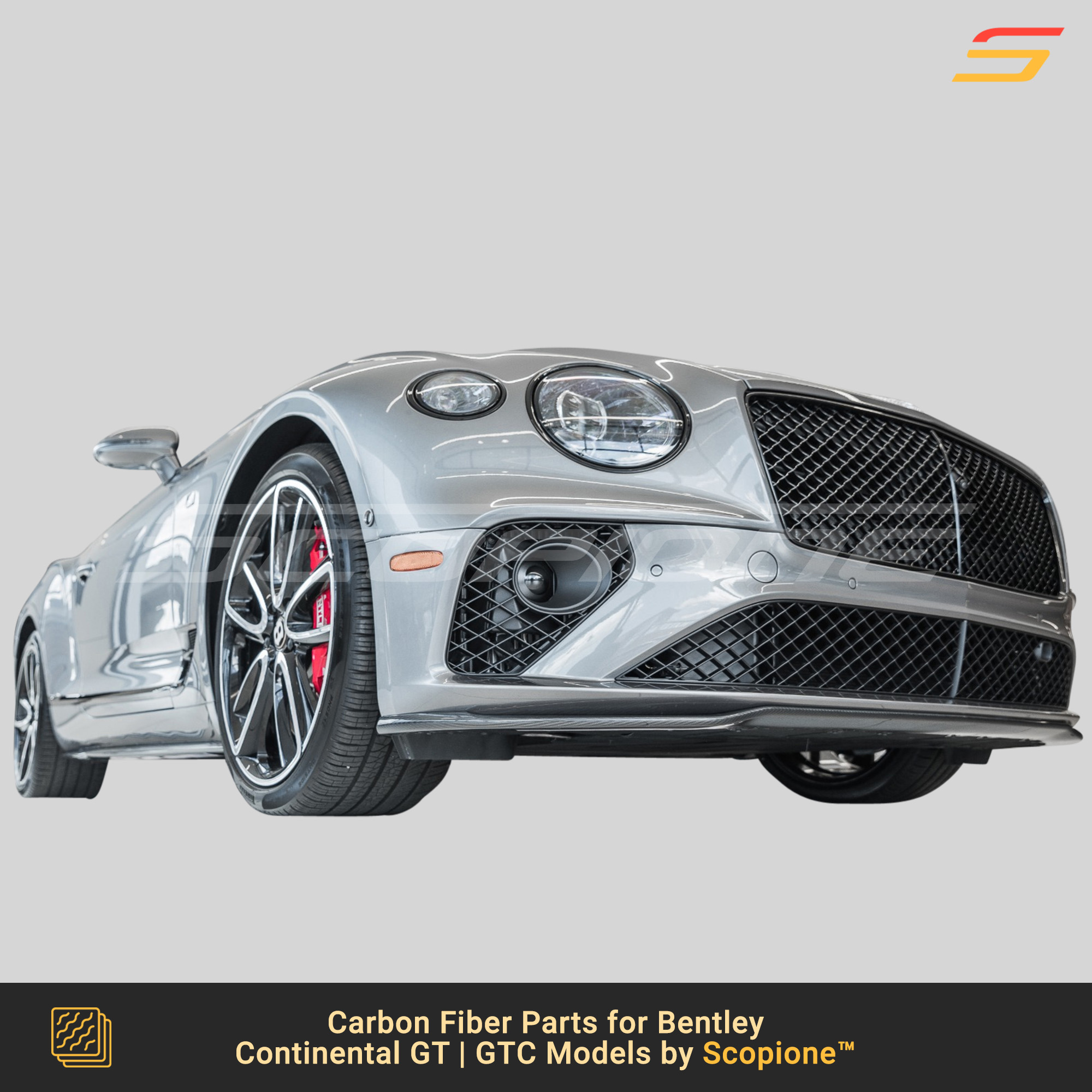
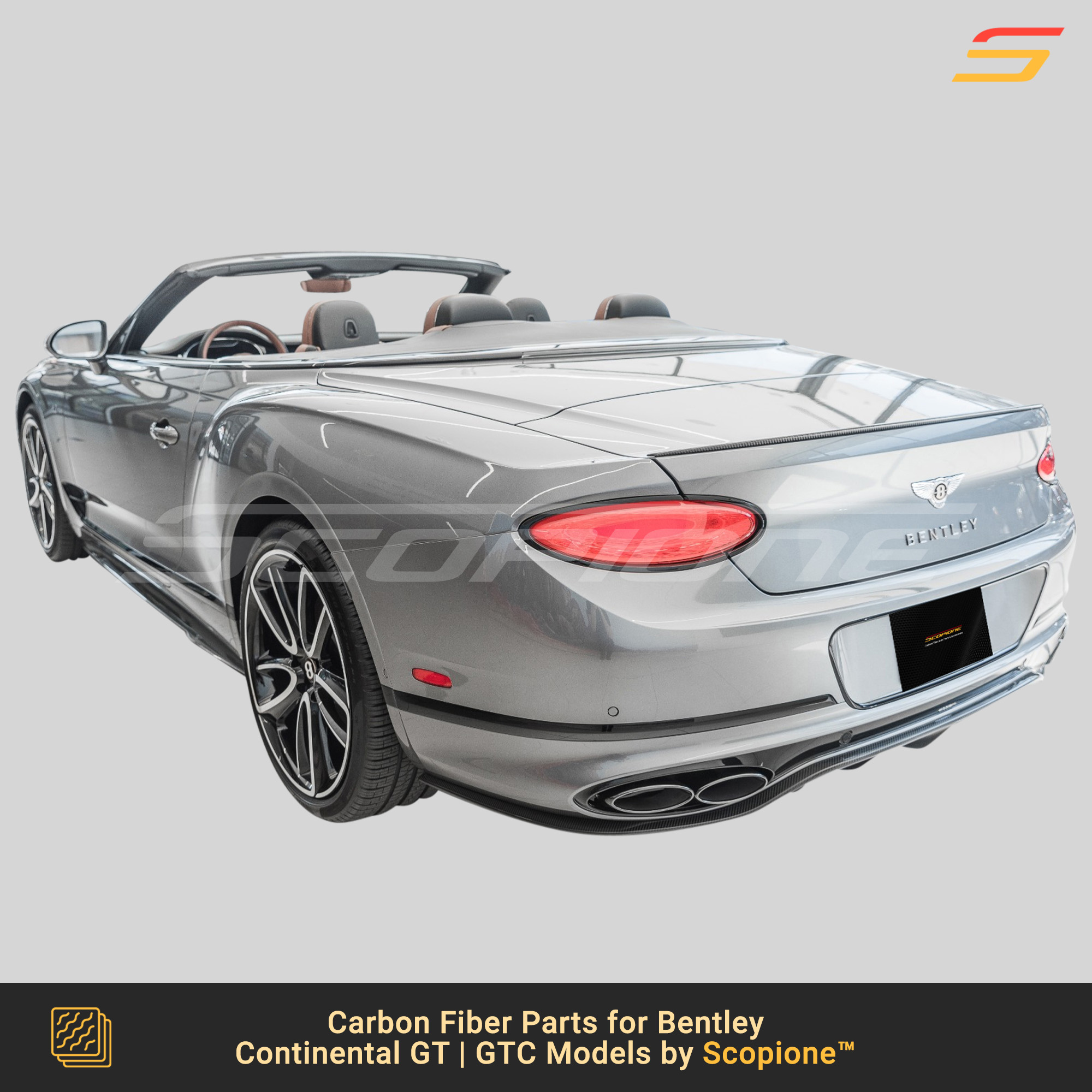
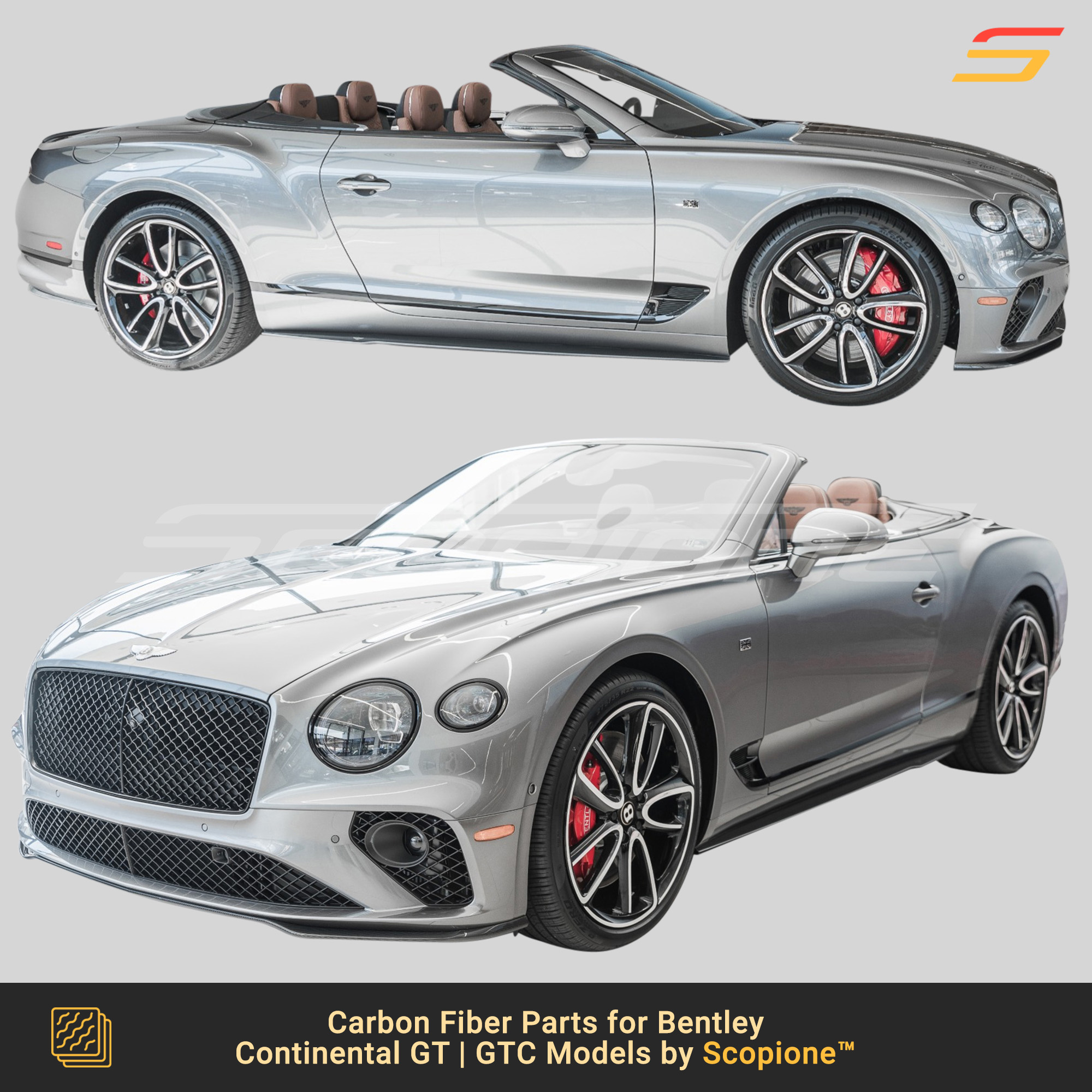
Back to Top ↑Disclaimer: Technical specifications, production figures, and historical details presented in this article are editorial in nature and may differ from official manufacturer data. Photographs show Scopione carbon fiber parts for the Bentley Continental GT and GTC, and cars fitted with them.