

 Shop
ShopMaserati has carried the trident through more than a century of Italian automotive history — from Alfieri Maserati’s first race car in 1926 through financial crises, ownership upheavals, and a partnership with Ferrari that finally brought carbon fiber to the marque in 2004. The MC12’s Enzo-derived carbon composite chassis proved that CFRP belonged beneath the trident. The MC20’s proprietary monocoque, developed with Dallara sixteen years later, proved Maserati could build its own. That distinction — from borrowed technology to in-house capability — defines Maserati carbon fiber evolution. The Tipo 61 Birdcage’s 35 kg space frame established the lightweight imperative. The MC20’s sub-100 kg CFRP tub fulfills it with a material Giulio Alfieri could not have imagined. Scopione stocks precision-fitted 2×2 3K twill-weave carbon-fiber components for Maserati models – browse the full Maserati catalog.
Maserati Carbon Fiber Timeline
| Year | Model / Milestone | Carbon Fiber Significance |
|---|---|---|
| 1926 | Tipo 26 | First Maserati race car — lightweight performance philosophy established |
| 1954 | 250F | Fangio’s 1957 F1 World Championship car — tubular frame, aluminum body |
| 1959 | Tipo 61 “Birdcage” | 35 kg multi-tubular space frame — a radical lightweight chassis without precedent |
| 1966 | Ghibli | Grand touring identity established — steel body, Giugiaro design |
| 1971 | Bora | First mid-engine Maserati road car — layout template for the MC20 |
| 1981 | Biturbo | Mass-market pivot — conventional steel construction, no composites |
| 1998 | 3200 GT | Ferrari-managed revival — restored brand credibility for future CF investment |
| 2004 | MC12 | Enzo-derived CF/Nomex monocoque + full CF body — first CFRP Maserati |
| 2007 | GranTurismo | Volume GT with CF options via MC Stradale — CF enters mainstream Maserati |
| 2020 | MC20 | Proprietary CFRP monocoque with Dallara — sub-100 kg carbon tub |
| 2023 | MC20 Cielo | Spider retains CF monocoque rigidity — validates tub versatility |
| 2024 | GranTurismo Folgore | First electric Maserati — CF aero packs on both ICE and EV variants |
1914–1970s: Racing Royalty — From Bologna to the World Championship
Alfieri Maserati founded Officine Alfieri Maserati in Bologna in 1914. The trident on the badge came from the Fountain of Neptune in the Piazza Maggiore — an appropriate symbol for a company that would spend its first decades building machines designed to conquer the impossible. The Maserati brothers built race cars and spark plugs before building road cars, and that sequence matters. Racing engineering defines problems in grams and milliseconds. Every component exists to serve a measurable function. Decoration is dead weight. That mindset produced cars that won the Indianapolis 500 (Wilbur Shaw, 1939 and 1940), the Formula 1 World Championship (Juan Manuel Fangio, 1957), and dozens of international sports car races before Maserati ever considered selling a vehicle to a private buyer who intended to drive it on public roads.
Grand touring emerged in the 1950s and 1960s as a parallel track. The A6 series, the 5000 GT, the Mistral, and the Ghibli established Maserati’s dual identity: racing constructor and luxury manufacturer. Steel and aluminum served both roles. Carbon fiber did not enter motorsport until 1981, decades after Maserati had left factory racing. But the engineering culture forged in those racing decades — where weight reduction was not an option but an obsession — persisted in the brand’s DNA through every subsequent ownership change.
Maserati Tipo 26 (1926–1932)
The first car to carry the Maserati name won its class on its first outing. Alfieri Maserati entered the Tipo 26 at the 1926 Targa Florio — the brutal Sicilian road race through the Madonie mountains — and came home with a class victory. The formula was compact: a supercharged inline-eight of 1.5 liters producing approximately 120 hp, packaged in the lightest chassis Alfieri could engineer. The Tipo 26 was not the fastest car in absolute terms. It did not need to be. Displacement was modest. Weight was minimal. The combination worked.
- Engine: 1.5–2.0L supercharged inline-eight, 120–175 hp
- Debut: 1926 Targa Florio (class victory)
- Significance: First car to bear the Maserati name and trident emblem
No composites of any kind — the material technology simply did not exist. But the Tipo 26 established a principle that connects directly to the MC20: extract maximum performance from minimum mass. A small engine compensated with forced induction. A light chassis compensated for modest power. The same equation drives carbon-fiber adoption in every modern supercar. The Tipo 26 solved it with steel and aluminum. The MC20 solves it with CFRP.
Maserati 250F (1954–1960)
Fangio drove the 250F to the 1957 World Championship, delivering what many historians consider the greatest single drive in Formula 1 history. At the Nürburgring, he lost over a minute in the pits, rejoined in third place, and broke the lap record repeatedly while hunting down the two Ferraris ahead of him. He passed both on the final lap. The car beneath him used a tubular space frame chassis with hand-formed aluminum body panels — standard 1950s Grand Prix construction, but executed with precision that the lap times confirmed.
The 250F’s 2.5-liter straight-six produced 240–270 hp depending on the specification. Twenty-six chassis were built, making it one of the era’s widely available F1 cars — privateers could buy one and compete against factory entries from Ferrari, Mercedes-Benz, and Vanwall. Stirling Moss and Jean Behra also drove 250Fs to Grand Prix victories.
- Engine: 2.5L inline-six, 240–270 hp
- Chassis: Tubular space frame, aluminum body
- Production: 26 chassis
- Top speed: 180 mph
Carbon fiber was still three decades away from motorsport. The 250F’s relevance is Maserati’s demonstrated capacity at the absolute pinnacle of engineering competition. Building a World Championship-winning F1 car requires mastery of structural dynamics, weight distribution, and material optimization — the same competencies that CFRP monocoque design demands. Maserati withdrew from factory F1 after 1957, driven by financial pressures rather than engineering shortcomings. The capability remained, dormant, for sixty years until the MC20 program reawakened it.
Maserati Tipo 61 “Birdcage” (1959–1961)
The Birdcage represents Maserati’s defining lightweight achievement before the MC20. Chief engineer Giulio Alfieri chose an approach that no one else was willing to attempt at this scale: instead of using a few large-diameter tubes for the space frame (the universal standard), he welded over 200 small-diameter chrome-moly steel tubes into a three-dimensional lattice. Each tube carried a portion of the structural load. The resulting web looked like a birdcage when exposed — hence the nickname — and weighed approximately 35 kg. Thirty-five kilograms for a chassis supporting a full racing car.
An aluminum body shell covered the lattice. The complete Tipo 61 weighed around 600 kg with a 2.9-liter inline-four producing up to 250 hp — a power-to-weight ratio that overwhelmed competitors running larger engines in heavier cars. The Birdcage won at the Nürburgring 1000km and achieved strong results at Sebring and Le Mans.
- Engine: 2.0–2.9L inline-four, 200–250 hp
- Chassis weight: ~35 kg (over 200 small-diameter chrome-moly tubes)
- Total weight: ~600 kg
- Production: 16 units (Tipo 60 and 61 combined)
The engineering logic of the Birdcage is identical to the logic behind a CFRP monocoque: accept manufacturing complexity to achieve minimum structural mass. Alfieri traded fabrication simplicity for weight savings. The 200-tube lattice was extraordinarily labor-intensive to weld, which made it impractical for anything beyond small-batch racing. Carbon fiber resolves that trade-off. A CFRP monocoque delivers Birdcage-level weight savings with superior torsional rigidity, without requiring hundreds of individual tube joints. The Birdcage established the performance target. Carbon fiber, six decades later, provided the material to meet it more efficiently.
Maserati Ghibli (1966–1973)
The Ghibli pivoted Maserati from racing constructor to grand touring manufacturer. Giorgetto Giugiaro designed the body while working at Ghia — a long-hooded, short-decked fastback with concealed headlights and enough presence to challenge the Ferrari Daytona in any hotel forecourt. The 4.7-liter V8 (later 4.9-liter SS) delivered 310–335 hp with the kind of effortless torque that makes continent-crossing feel unremarkable. Top speed exceeded 165 mph. The Ghibli was not the lightest car in its class. It did not need to be. The engine had enough margin that a few hundred kilograms of steel body did not diminish the driving experience.
- Engine: 4.7–4.9L V8, 310–335 hp
- Top speed: 165 mph (SS: 174 mph)
- Body: All-steel over tubular steel chassis
- Production: 1,274 units (Coupé and Spyder)
No composites of any kind. All steel, all hand-formed by Ghia’s craftsmen in Turin. The Ghibli weighed approximately 1,580 kg in coupé form, which was competitive for a full-size V8 grand tourer of the 1960s but significantly heavier than the racing Maseratis that preceded it. Giugiaro’s design prioritized presence and aerodynamic efficiency over weight savings. The long nose accommodated the V8 and its ancillaries with room to spare, creating proportions that communicated speed even at standstill.
The Ghibli’s significance for the carbon-fiber story is the template it established. Every subsequent Maserati grand tourer descended from its formula: powerful engine, elegant body, continental refinement. The Bora adapted the formula to a mid-engine layout. The 3200 GT revived it after the Biturbo detour. The GranTurismo perfected it for volume production. And the new MC20-generation GT carries it into the electric era. Carbon fiber would eventually serve this formula by reducing mass while maintaining the structural rigidity that high-speed cruising demands. The material changed across seven decades. The mission never did.
Scopione Perspective: The Racing Foundation
Maserati’s racing heritage — from the Tipo 26’s Targa Florio debut through Fangio’s World Championship and the Birdcage’s radical lightweight construction — established a culture where weight reduction was not a luxury option but an engineering requirement. Scopione’s 2×2 3K twill-weave carbon-fiber parts for Maserati models extend that tradition into the aftermarket. Each component is precision-fitted and finished with UV-resistant clear coat, maintaining the exacting standards that Italian motorsport demands.



1971–1997: Mid-Engine Experiments, Citroën, and the Biturbo Years
Maserati’s middle decades were defined less by engineering progress than by corporate survival. Citroën acquired the company in 1968, bringing French engineering resources and the SM’s V6 engine program but also institutional instability — Citroën went bankrupt in 1974, nearly taking Maserati with it. Alejandro De Tomaso rescued the brand in 1975 and pivoted to mass-market production with the Biturbo, which brought twin-turbo V6 power and Italian styling to a broader audience but also quality-control problems that took decades to outlive. Fiat acquired a controlling stake in 1993. By 1997, Ferrari had assumed management of the brand. That last transition changed everything.
No carbon fiber appeared on any Maserati during this period. The Bora and Merak used steel monocoque construction. The Biturbo used conventional steel unibody. While Ferrari and McLaren were racing CFRP-reinforced chassis and developing carbon-fiber road cars during the 1980s and 1990s, Maserati was building turbocharged steel sedans and fighting for financial survival. The era’s relevance to the CF story is contextual: the financial instability delayed Maserati’s access to advanced materials by nearly two decades. When carbon fiber finally arrived, it came through Ferrari.
Maserati Bora (1971–1978)
The Bora was Maserati’s first mid-engine road car — a response to the Lamborghini Miura and Ferrari’s mid-engine experiments. Giugiaro designed the body at Italdesign, creating a clean shape with a distinctive stainless-steel roof panel and a glass engine cover revealing the V8 behind the seats. Citroën’s hydraulic systems operated the brakes, headlight pods, and seat adjustment — elegant engineering married to maintenance complexity. The 4.7-liter V8 (later 4.9L) produced 310–330 hp.
Giugiaro delivered a car that felt like a grand tourer despite the mid-engine layout. Refinement first, raw aggression second. The cabin was isolated from engine noise by a glass partition and the stainless-steel roof, creating an atmosphere closer to a luxury saloon than a supercar. Citroën’s high-pressure hydraulic system provided braking feel that was years ahead of conventional servo-assisted systems, though the complexity of maintaining it in the decades after Citroën’s departure would become a persistent ownership challenge.
The Bora proved that Maserati’s V8 could work behind the driver in a road car that prioritized comfort alongside speed. That same fundamental architecture would return fifty years later with the MC20, though with a CFRP tub replacing the steel monocoque and a twin-turbo V6 replacing the naturally aspirated V8.
- Engine: 4.7–4.9L V8, 310–330 hp
- 0–60 mph: 6.5 seconds
- Top speed: 160 mph
- Production: 564 units
Steel monocoque, steel and aluminum panels. No composites anywhere. The Bora’s legacy is its layout and its character. A mid-engine Maserati that prioritized comfort. That concept hibernated for half a century before the MC20 revived it — this time with a carbon-fiber chassis that Colin Chapman would have appreciated, even if the Maserati badge on the nose would have surprised him.
Maserati Merak (1972–1983)
The Merak borrowed the Bora’s structure and Giugiaro’s design, replacing the V8 with a 3.0-liter V6 derived from the Citroën SM. The shorter engine allowed a flying-buttress rear deck and nominal 2+2 seating. The Merak SS improved power to 220 hp and shed weight. A 2.0-liter variant (2000 GT) addressed Italian tax regulations. Production reached 1,832 units — triple the Bora’s output, proving that a mid-engine Maserati could reach a wider market.
- Engine: 2.0–3.0L V6, 150–220 hp
- Top speed: 145 mph (SS)
- Production: 1,832 units
The Bora-Merak platform sharing — same basic structure, different engines, different market positions — foreshadowed the MC20/Cielo relationship four decades later. The MC20’s CFRP monocoque serves as a common structural foundation for both the coupé and the spider, exactly as the Bora’s steel tub served both V8 and V6 variants. The material changed entirely. The platform strategy did not.
Maserati Biturbo (1981–1994)
The Biturbo was Alejandro De Tomaso’s gamble: transform Maserati from a low-volume exotic manufacturer into a mass-market competitor against the BMW 3 Series. Twin turbochargers on a compact V6, Italian styling by Pierangelo Andreani, and a price point that made Maserati ownership theoretically accessible. Production volumes dwarfed anything in the brand’s history. The Biturbo spawned a family of derivatives — the 228, the 430, the Shamal, the Ghibli II, and the Quattroporte IV.
Quality control did not keep pace with ambition. Turbo system failures, electrical gremlins, and premature corrosion became industry cautionary tales. The twin-turbo V6 formula was fundamentally sound — later variants addressed many of the early problems — but the reputational damage lingered for years.
- Engine: 2.0–2.8L twin-turbo V6, 180–285 hp
- 0–60 mph: 5.8 seconds (2.8L)
- Body: Conventional steel unibody
Conventional steel construction throughout. No composites of any kind. The Biturbo era is the period when Maserati fell furthest behind its competitors in material technology. While McLaren was completing the F1 road car with its full CFRP monocoque, Maserati was building mass-market steel coupés with unreliable turbo plumbing. The distance between those two engineering realities measures the gap that Ferrari’s management would later close.
The Biturbo’s twin-turbo V6 concept was sound. The 2.8-liter unit produced 285 hp in its final iterations, delivering genuine performance from a compact engine. The Shamal (1990), powered by a 3.2-liter twin-turbo V8 designed with Ferrari’s assistance, hinted at what a properly developed Maserati could achieve. But by then the reputational damage was done. Fiat’s acquisition and Ferrari’s subsequent management of the brand were direct consequences of the financial trajectory the Biturbo era set in motion. Without the Biturbo era’s financial pressure, Maserati might have adopted carbon fiber a decade earlier. Without its commercial ambition, the production volume that eventually justified the MC12 program might never have materialized.
Scopione Perspective: Grand Touring Through Turbulence
Maserati’s mid-engine and grand touring vehicles from this era — the Bora, the Merak, and the Biturbo family — kept the brand alive through decades of corporate instability. These steel-bodied cars did not use carbon fiber, but they preserved the customer base and brand recognition that future CFRP-equipped models required. Scopione’s carbon-fiber catalog for Maserati serves owners who want to bring modern material technology to vehicles built before carbon fiber reached the marque. Mirror caps, interior trim, and aerodynamic elements in 2×2 3K twill-weave CF bridge the gap between the steel GT tradition and the CFRP era.

1998–2019: The Ferrari Partnership — Carbon Fiber Arrives Under the Trident
Ferrari’s management of Maserati from 1997 transformed a struggling Italian marque into a viable luxury competitor. The 3200 GT restored credibility. The MC12 rewrote the engineering narrative. The GranTurismo and Quattroporte built volume. And through it all, Ferrari’s engines, manufacturing expertise, and — critically — carbon-fiber technology flowed into Maserati’s products. The MC12 used the Enzo’s carbon-fiber chassis. The GranTurismo MC Stradale offered CF body elements. The Quattroporte carried CF interior trim. Carbon fiber entered the Maserati ecosystem through Ferrari’s door, and for two decades, that door was the only way in.
This era established an important pattern: Maserati’s CF capability was Ferrari’s CF capability, supplied through the partnership rather than developed in-house. The MC12’s carbon monocoque was not Maserati engineering. It was Enzo engineering with a Maserati body. That reality motivated the MC20 program. Maserati needed its own carbon fiber.
Maserati 3200 GT (1998–2002)
The 3200 GT was the car that convinced the market to trust Maserati again. Giugiaro returned to design a grand tourer that acknowledged the Ghibli’s proportions while looking entirely contemporary. The boomerang-shaped LED taillights were among the earliest automotive applications of LED rear lighting — a small detail that signaled technological ambition. Under Ferrari’s quality oversight, the 3200 GT achieved build standards that Biturbo-era cars never approached. The twin-turbo 3.2-liter V8 produced 370 hp: smooth, substantial, and reliable.
- Engine: 3.2L twin-turbo V8, 370 hp
- 0–60 mph: 5.1 seconds
- Top speed: 174 mph
- Production: 4,795 units
No carbon fiber. Steel body over a steel monocoque. The 3200 GT’s contribution to the CF story is structural in a different sense: it rebuilt the commercial infrastructure that advanced-material vehicles require. A dealer network capable of selling and servicing a premium Italian GT. A customer base willing to trust the trident after a decade of Biturbo-era skepticism. A service organization with the training and parts logistics to support a product worthy of the Maserati name. Without 4,795 buyers willing to trust a new Maserati, the MC12 program would have lacked justification. Revival had to precede revolution.
The successor Coupé and Spyder (2001–2007) continued the formula with a naturally aspirated 4.2-liter Ferrari V8, moving away from the twin-turbo approach that had defined (and damaged) the Biturbo era. These models sold in sufficient numbers to prove the business case for a permanent Maserati GT lineup, setting the stage for the GranTurismo and, critically, the MC12.
Maserati MC12 (2004–2005)
The MC12 changed what Maserati was. Built on a modified Ferrari Enzo platform with a 150mm longer wheelbase and completely different bodywork, the MC12 was simultaneously a racing homologation special and a statement of engineering intent. Frank Stephenson shaped an exterior more extreme than the Enzo’s — 5.1 meters long, with a central open channel section and a fixed rear wing designed primarily for GT racing aerodynamics. The 6.0-liter naturally aspirated V12 produced 630 hp — 30 hp less than the Enzo, tuned for reliability under racing loads rather than peak output.
Fifty road cars were built. All were pre-sold before the first one left Modena. The MC12 GT1 racing variant dominated FIA GT competition, winning the championship three consecutive years from 2005 to 2007 and taking multiple 24 Hours of Spa victories. The carbon-fiber structure endured thousands of racing kilometers under extreme load without structural failure — a validation no laboratory test can replicate.
- Engine: 6.0L naturally aspirated V12, 630 hp
- 0–60 mph: 3.8 seconds
- Top speed: 205 mph
- Production: 50 road cars
- Chassis: Carbon-fiber/Nomex honeycomb composite monocoque (Enzo-derived)
The MC12 was Maserati’s first carbon-fiber car. The chassis was the Enzo’s carbon/Nomex composite monocoque, adapted for the longer wheelbase. Every external body panel was CFRP — from the front splitter through the doors to the rear diffuser. The combination of a carbon composite monocoque and full carbon bodywork made the MC12 the first structurally advanced CFRP vehicle in Maserati’s history. And the GT1 racing program validated the technology under conditions that simulate decades of road stress in a single season.
The MC12’s significance extends beyond its 50-unit production run. It demonstrated that a carbon-fiber Maserati was not merely possible but desirable. Collectors paid premiums for the MC12 that exceeded the Enzo’s own market price. The racing success built competitive credibility that decades of GranTurismo sales could not. And the MC12’s existence created internal precedent: when Maserati’s engineers proposed the MC20 program a decade later, they could point to the MC12 as evidence that the brand could support a mid-engine supercar with structural CFRP. The MC12 borrowed Ferrari’s carbon technology. The MC20 would build Maserati’s own.
Maserati GranTurismo (2007–2019)
The GranTurismo was Maserati’s volume sports car and one of the last front-engine GTs powered by naturally aspirated Ferrari V8 engines. Pininfarina’s design aged with remarkable grace across a 12-year production run — a rarity in an industry where visual obsolescence typically arrives within five years. The Ferrari-sourced F136 V8 began at 4.2 liters and 405 hp, growing to 4.7 liters and 460 hp in the MC Stradale variant. That final specification reached 60 mph in 4.7 seconds with a distinctive, unfiltered exhaust note that no turbocharged engine could replicate.
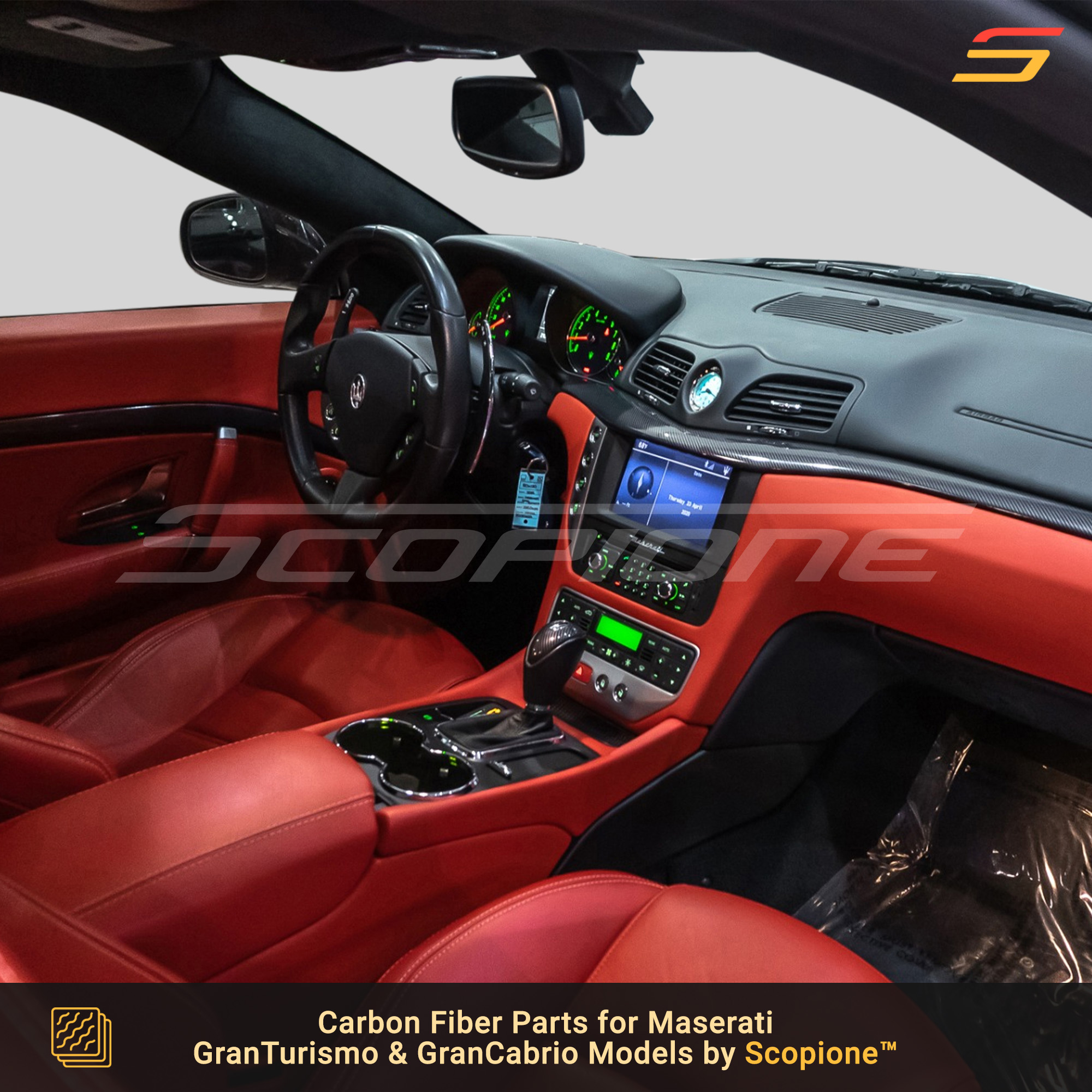
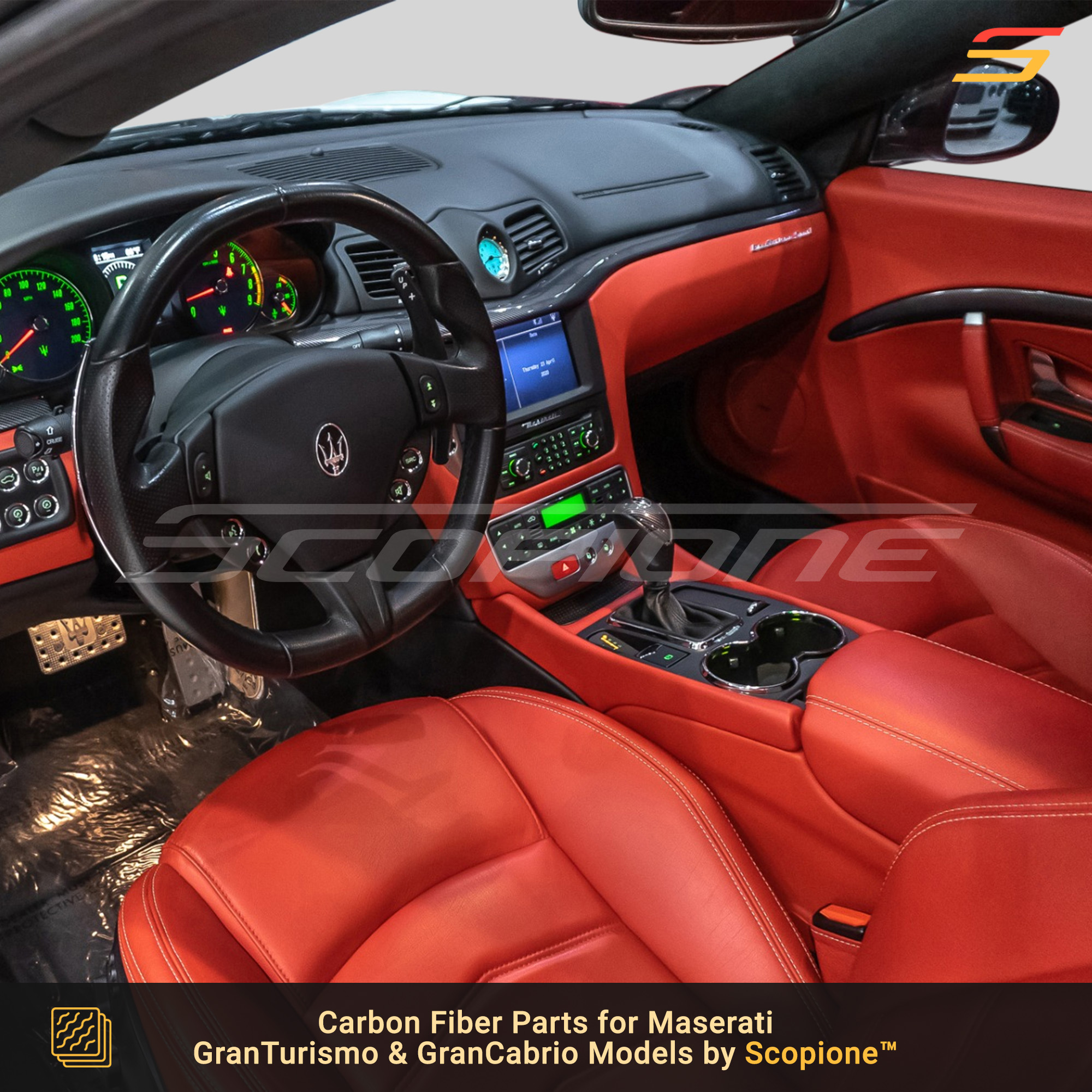
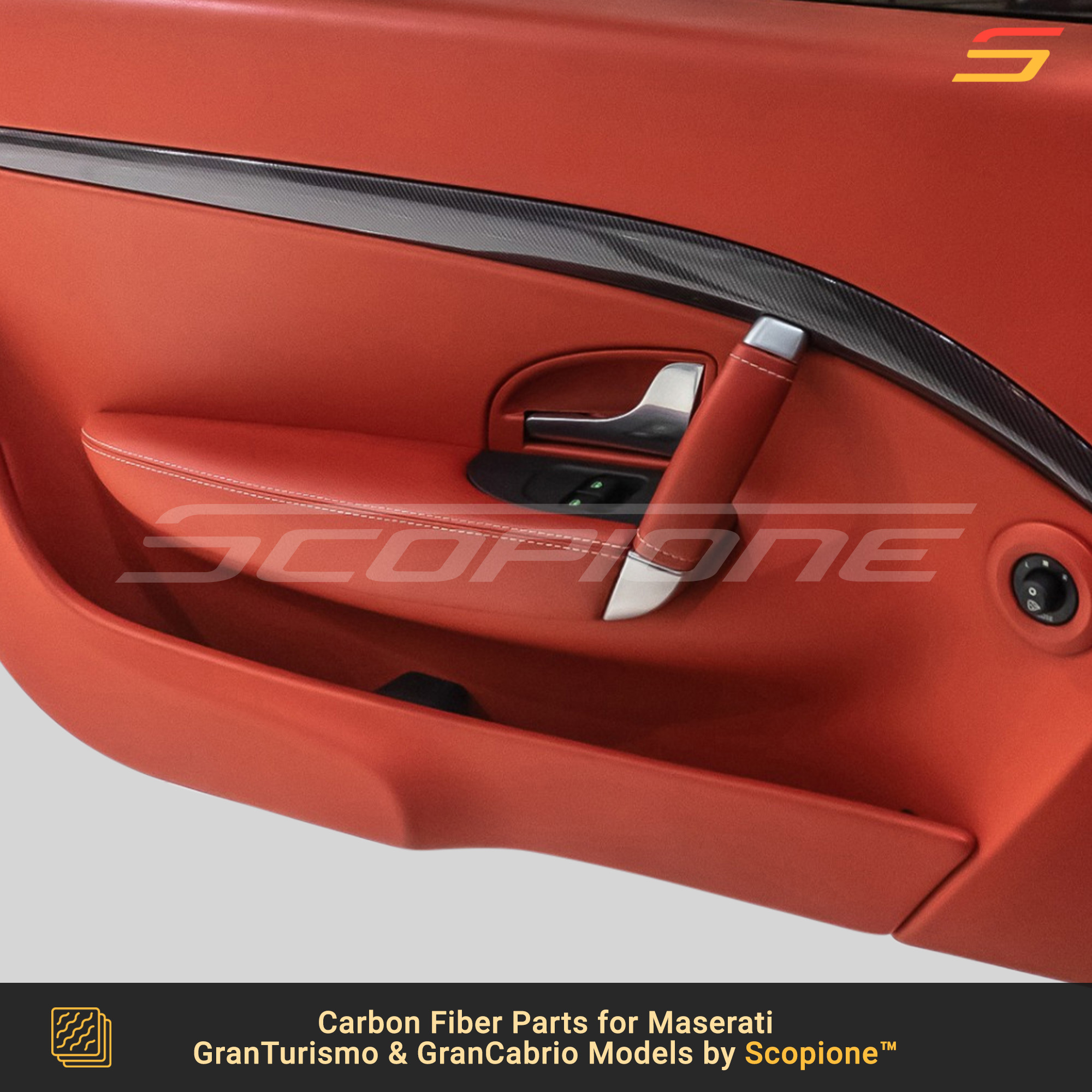
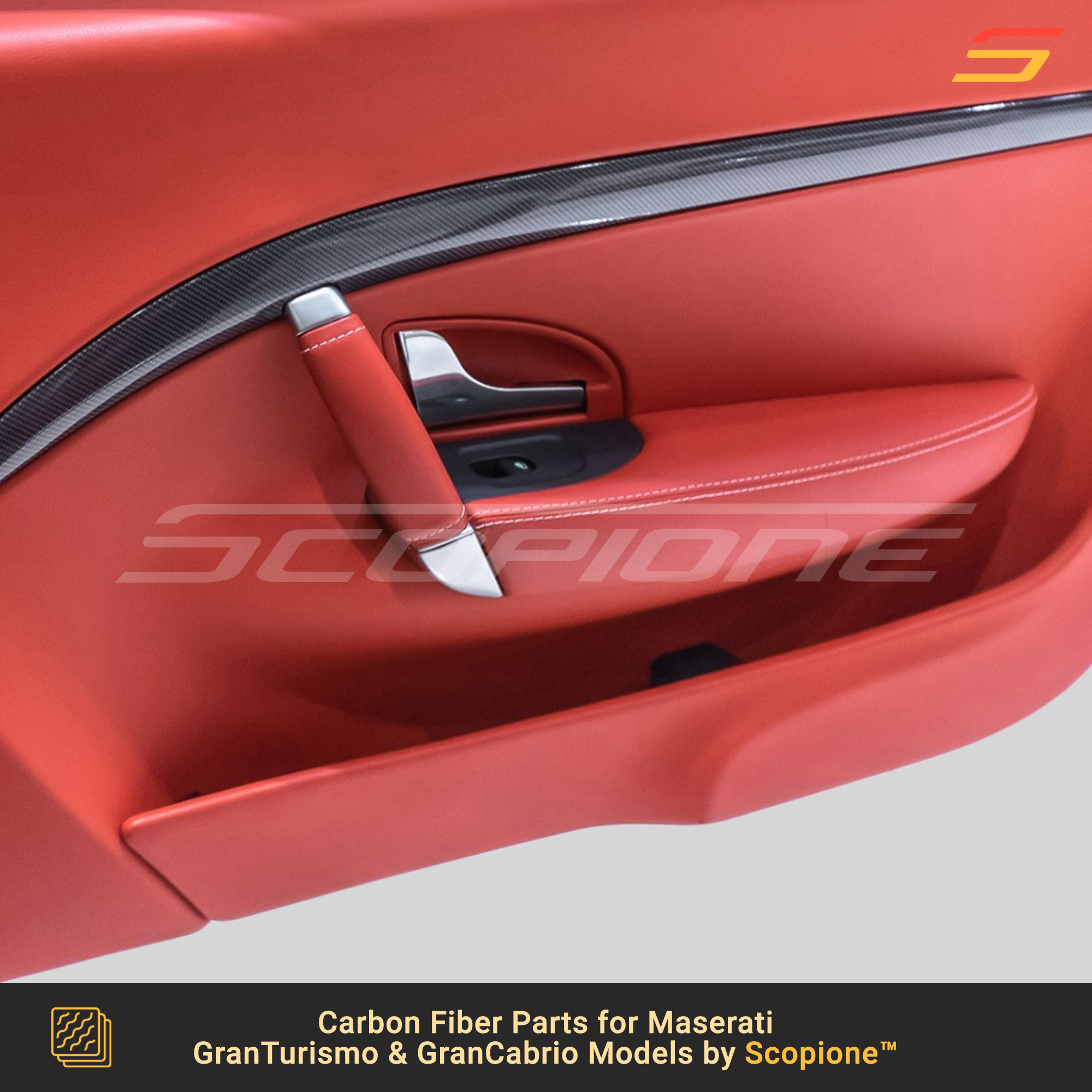
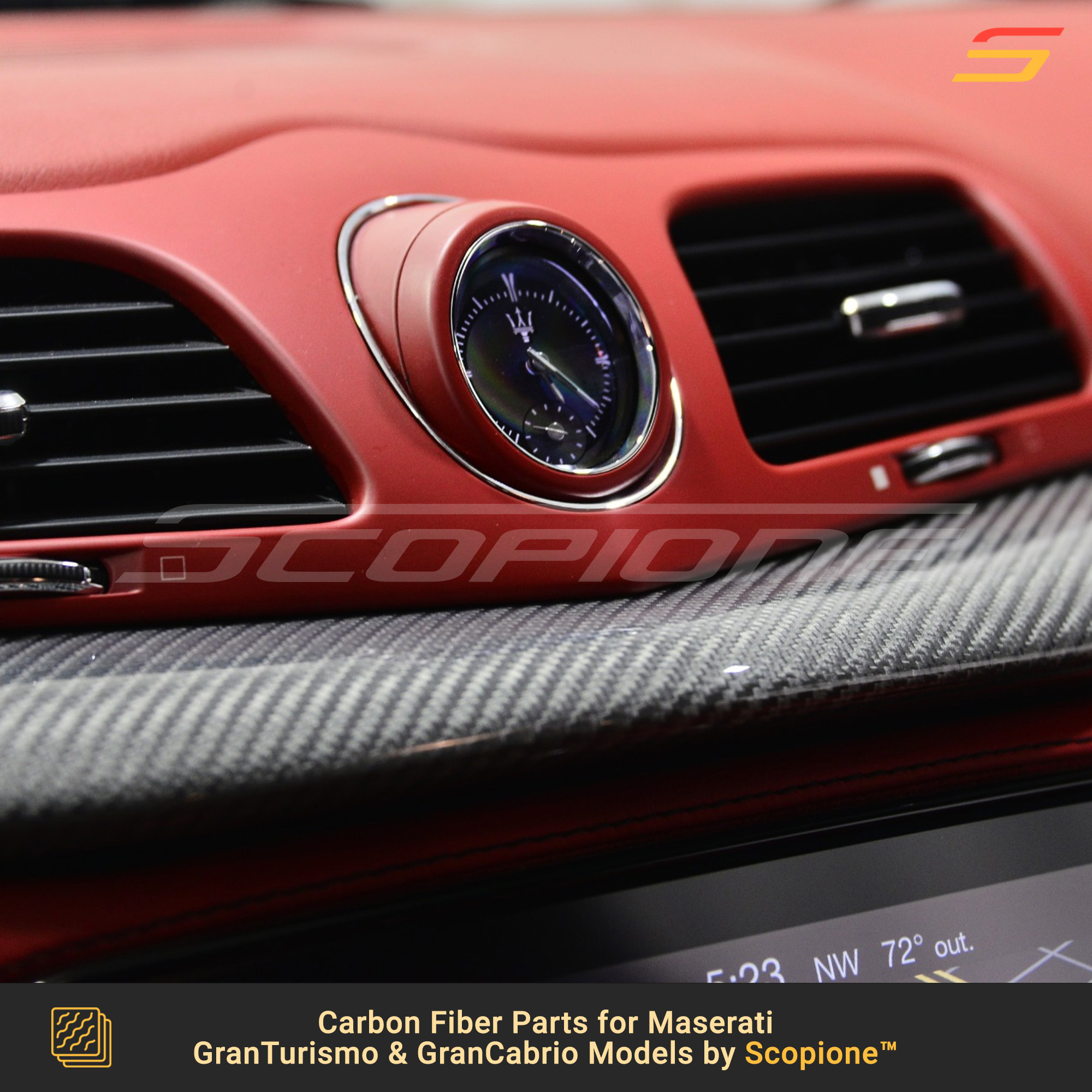
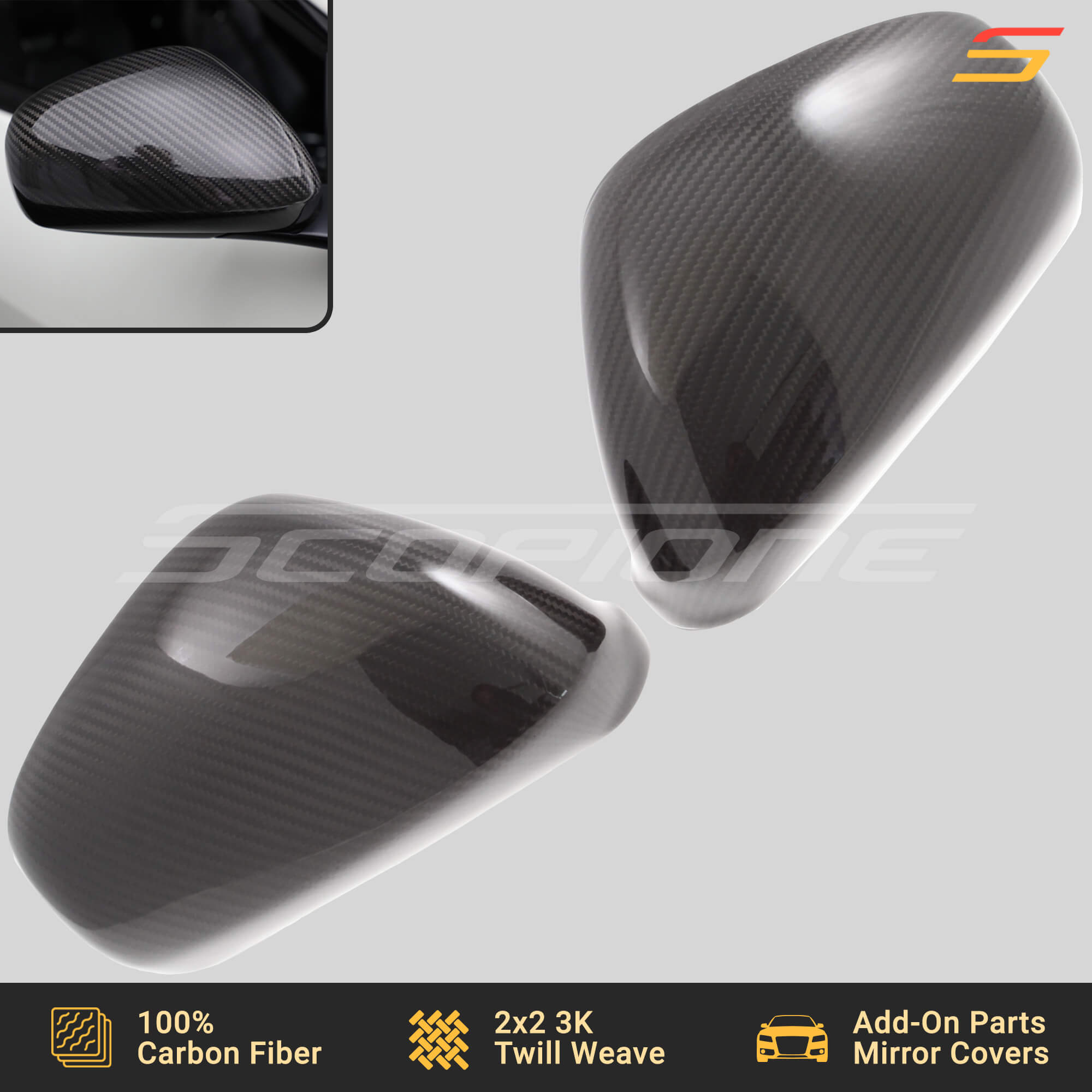
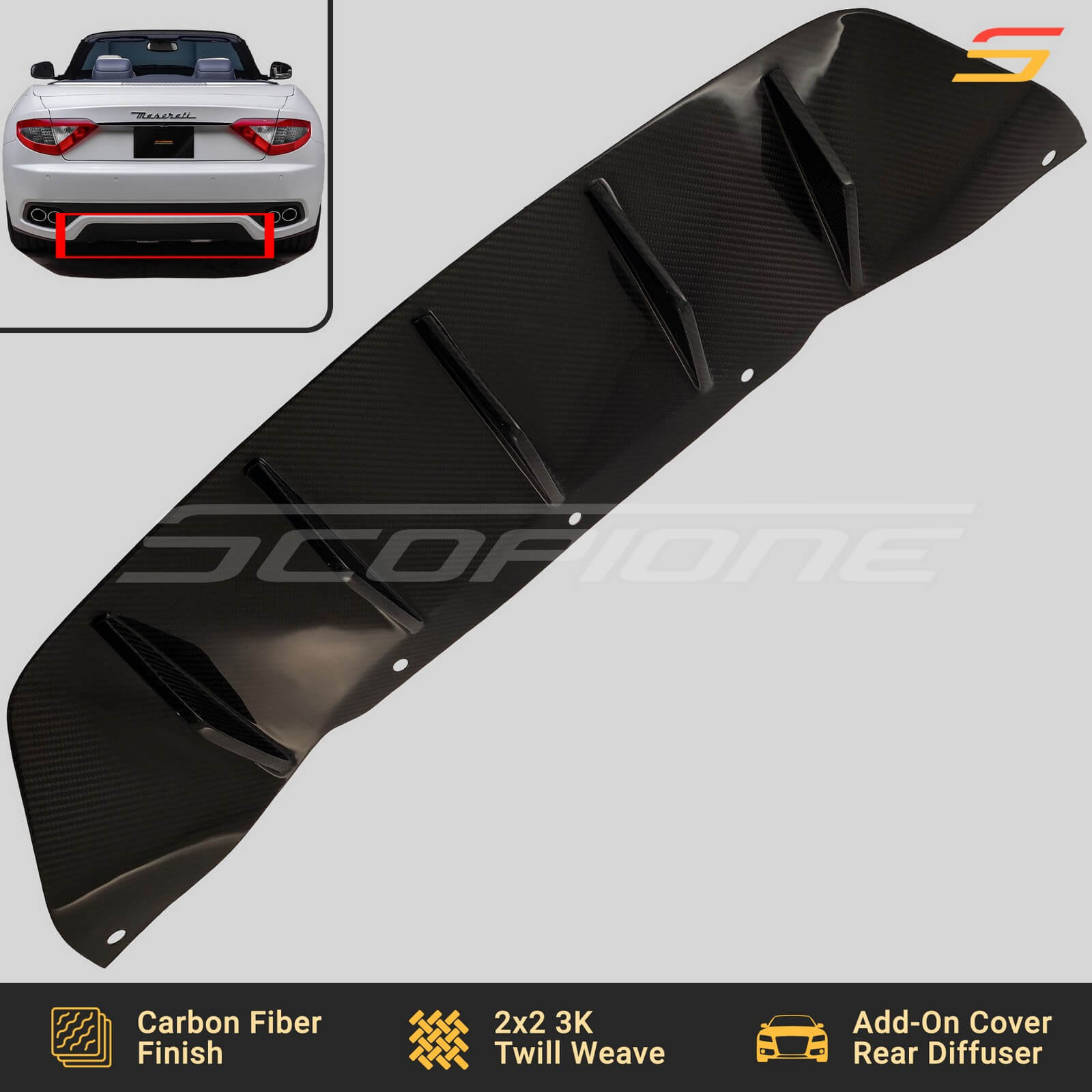
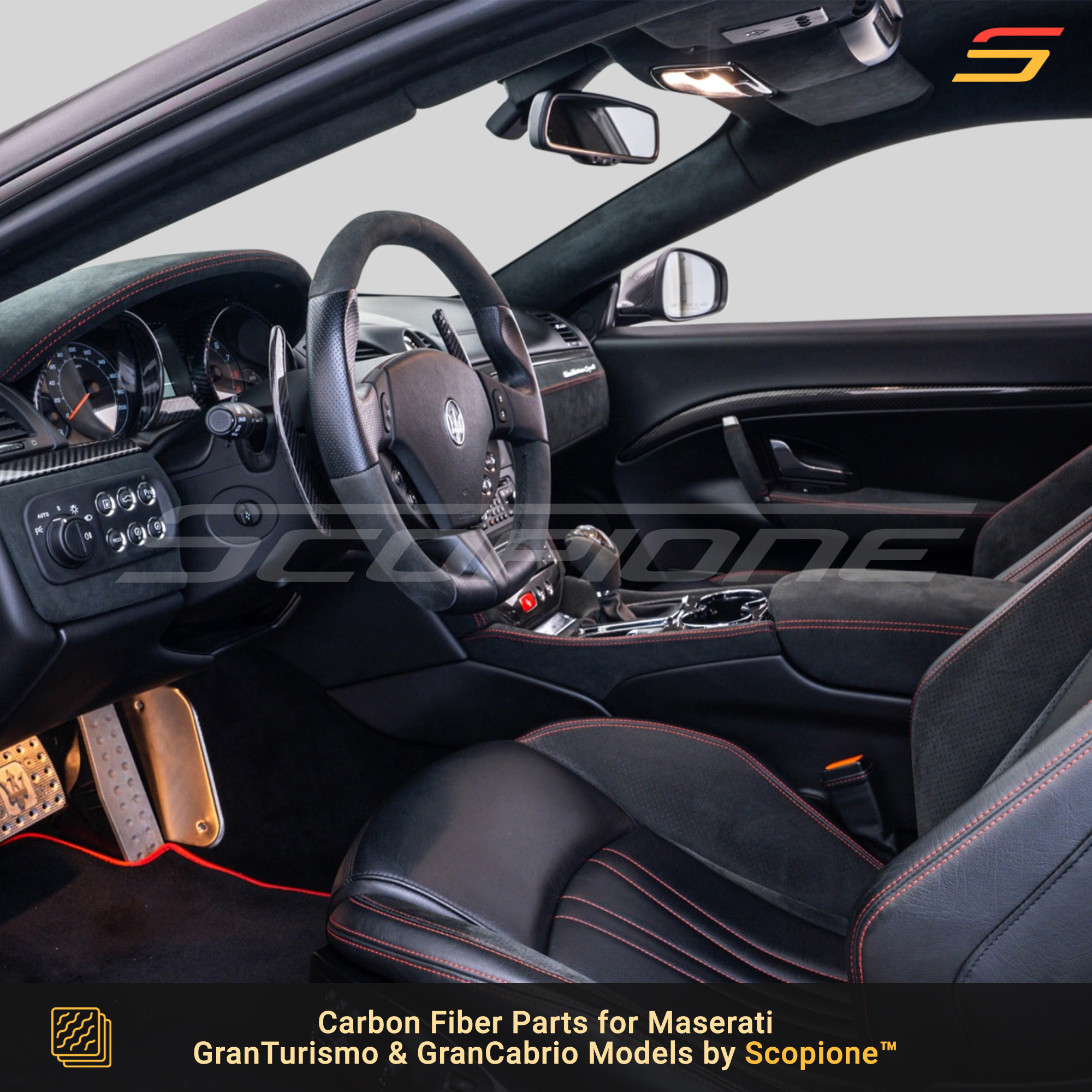
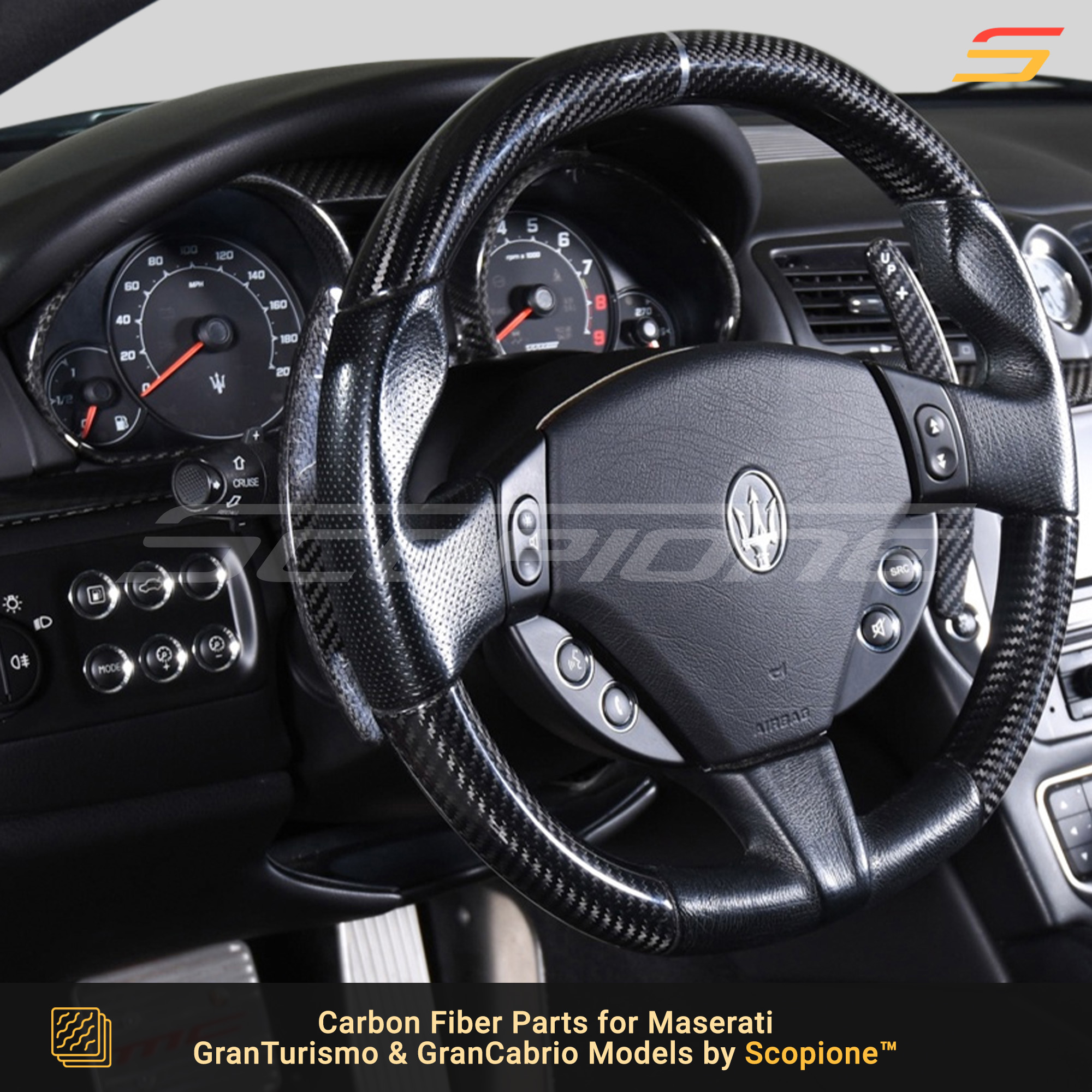
The MC Stradale (2011) brought carbon fiber to the GranTurismo range. A CF hood, CF engine cover, CF rear spoiler, CF mirror caps, CF rear diffuser, CF front splitter, and CF interior trim panels (center console, door pulls, steering wheel accents). None of it was structural — the GranTurismo used a steel and aluminum chassis throughout — but the MC Stradale demonstrated that Maserati buyers valued visible CFRP as a performance signifier. The GranTurismo and GranCabrio became the models for which aftermarket carbon fiber demand was strongest.
- Engine: 4.2–4.7L Ferrari V8 (F136), 405–460 hp
- 0–60 mph: 4.7 seconds (MC Stradale)
- Top speed: 187 mph (MC Stradale)
- CF content: MC Stradale: CF hood, engine cover, spoiler, mirror caps, diffuser, interior trim
The GranCabrio (2010) extended the GranTurismo’s appeal with an open-top variant sharing the same Ferrari V8 and Pininfarina design language. A fabric roof retracted to create one of the era’s more visually harmonious convertibles, maintaining the coupé’s proportions better than many competitors’ folding hardtop solutions. Carbon-fiber trim options were available on GranCabrio Sport and MC variants, mirroring the coupé’s CF packages.
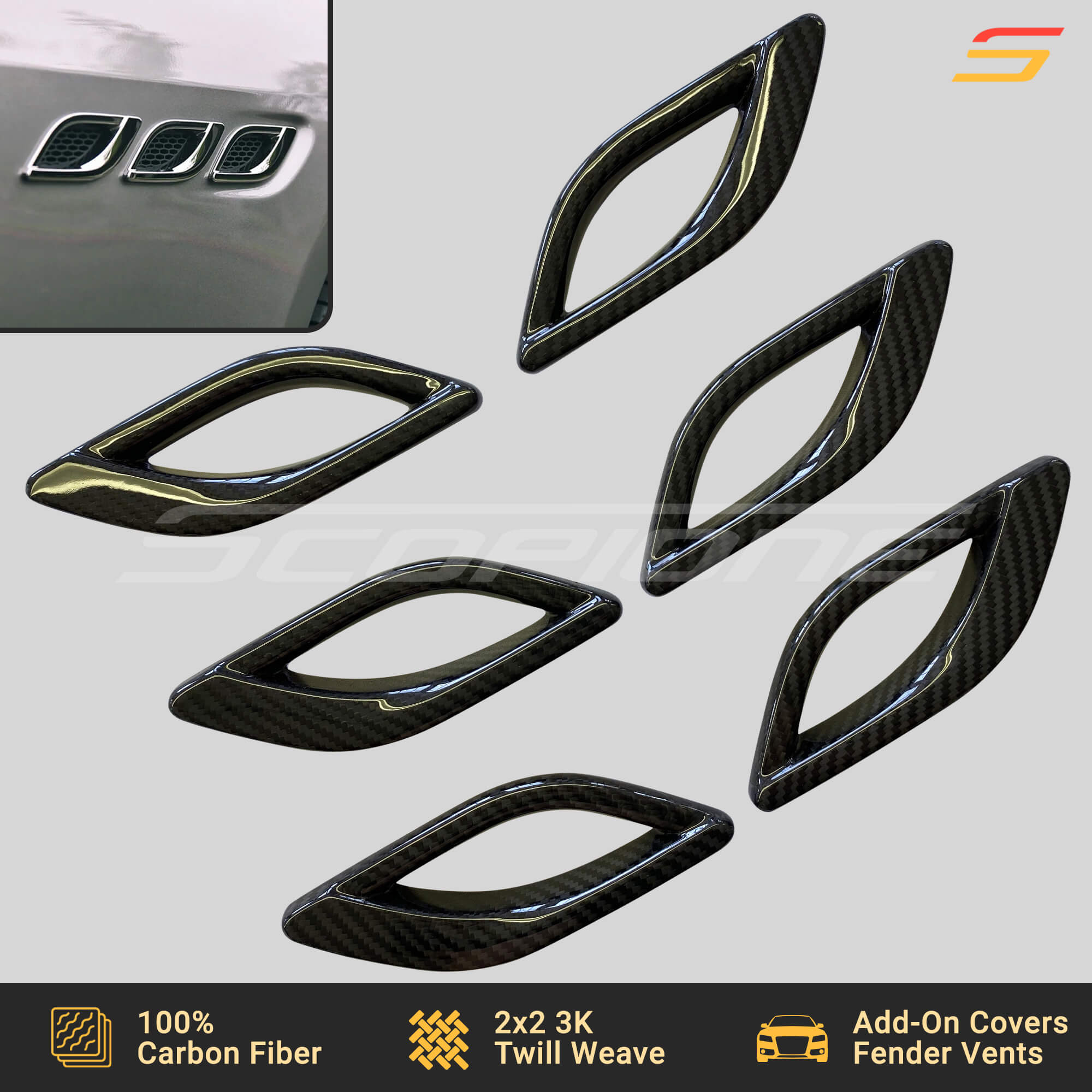
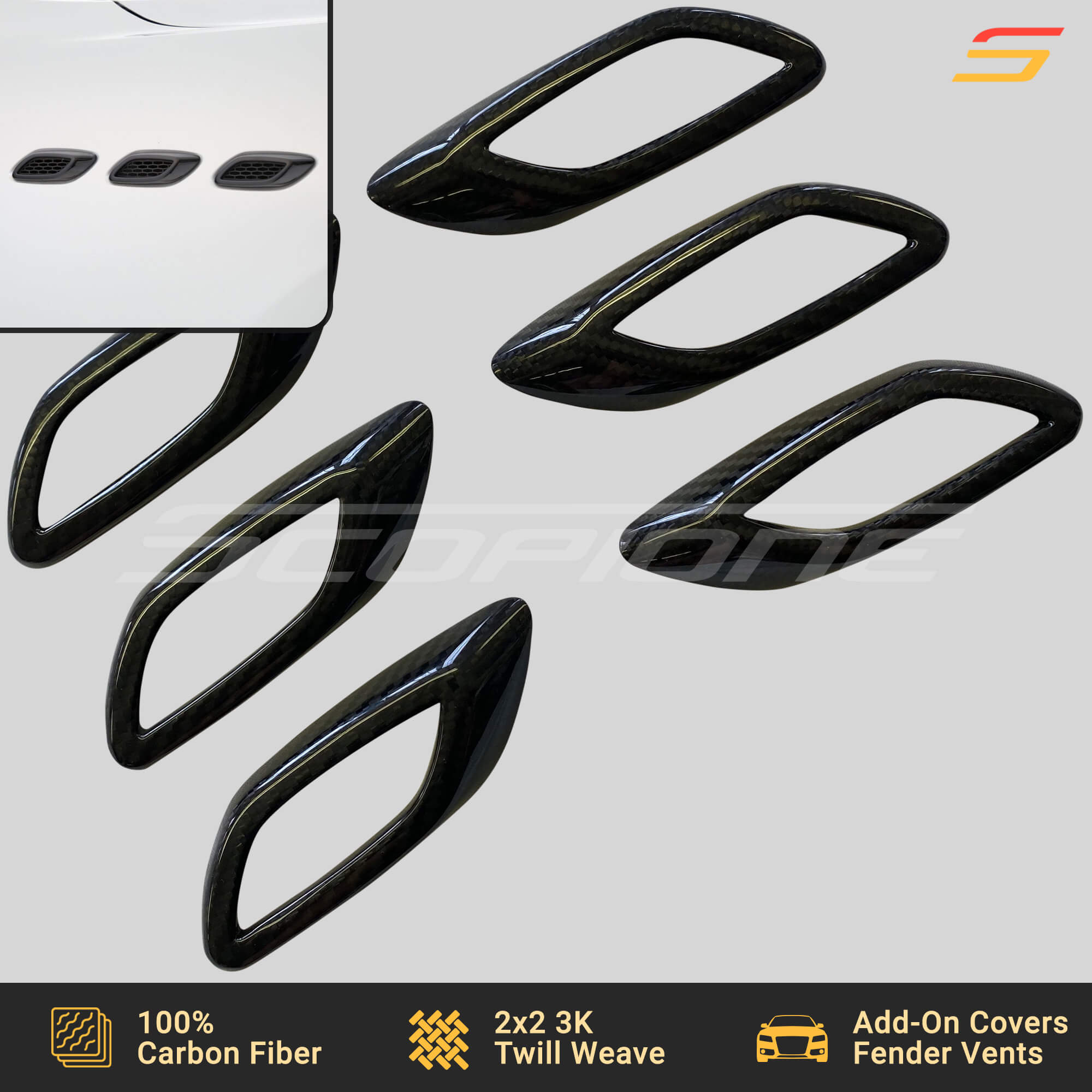
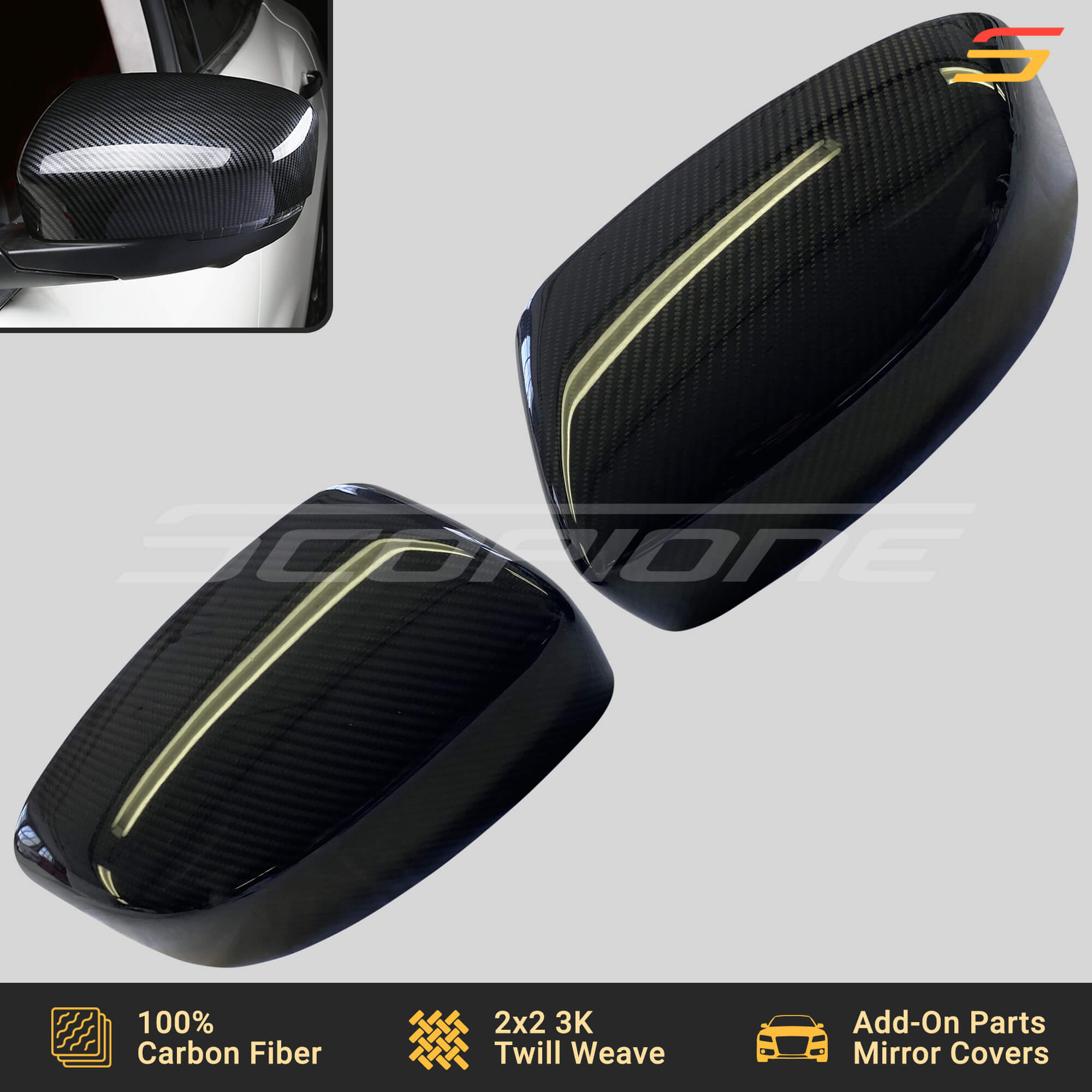
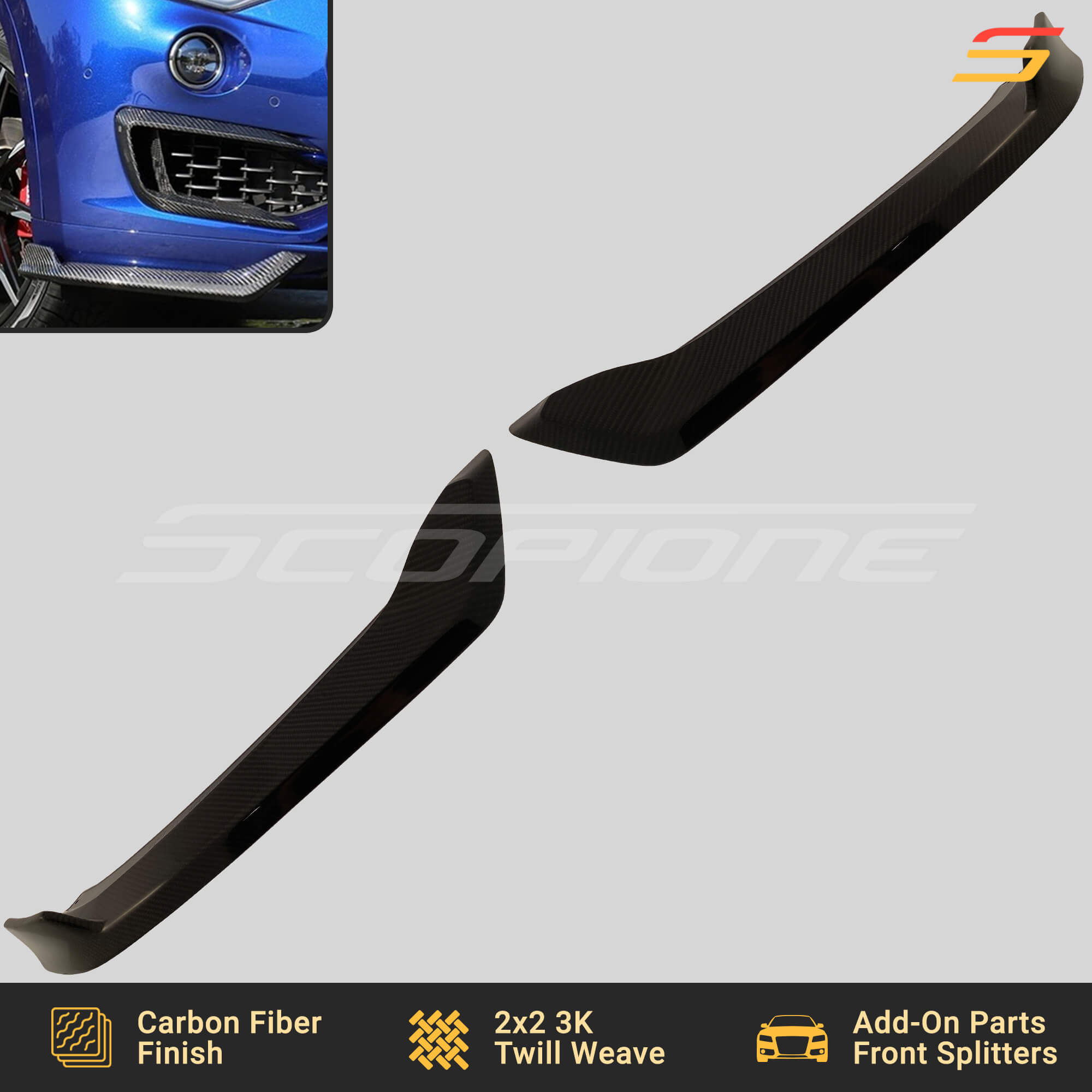
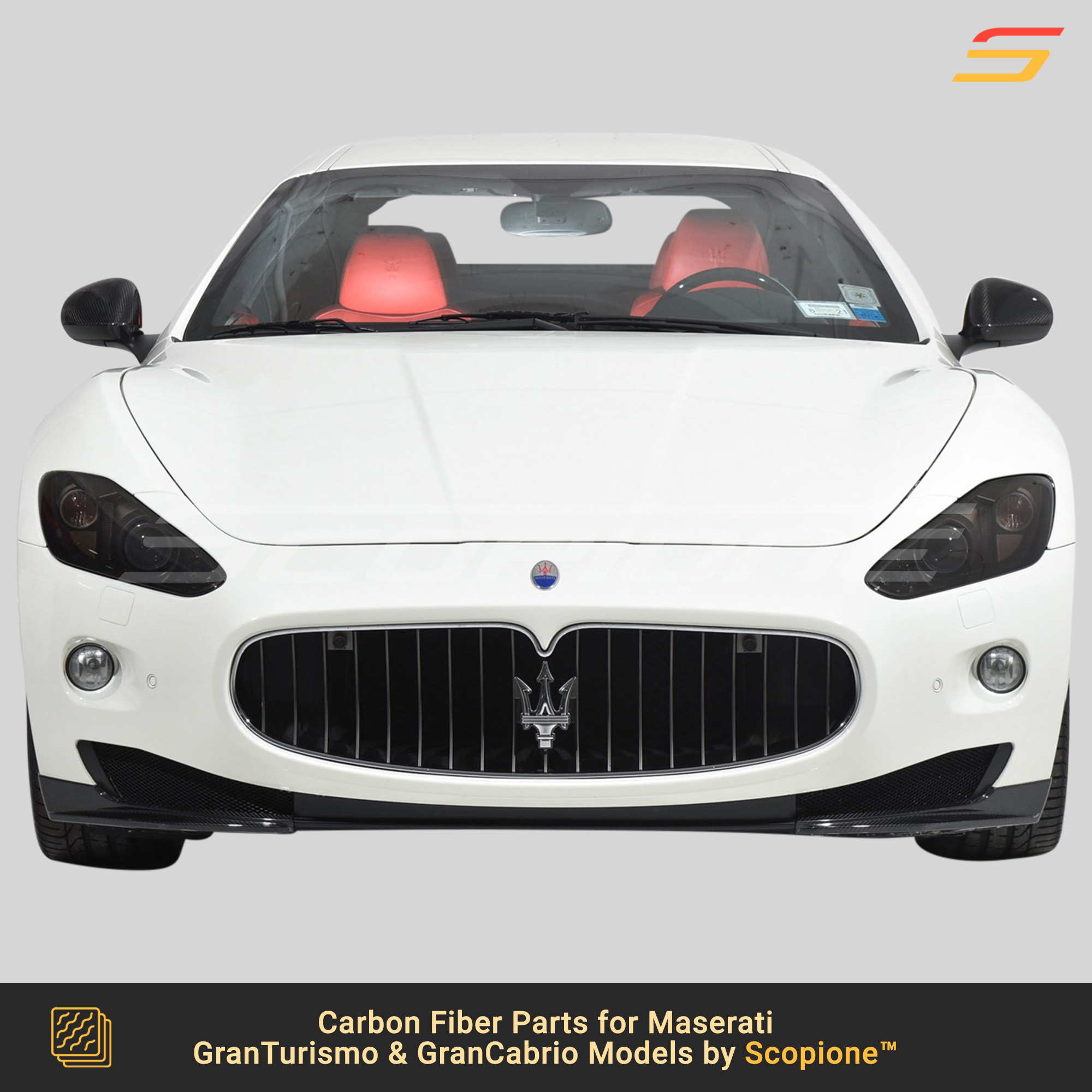
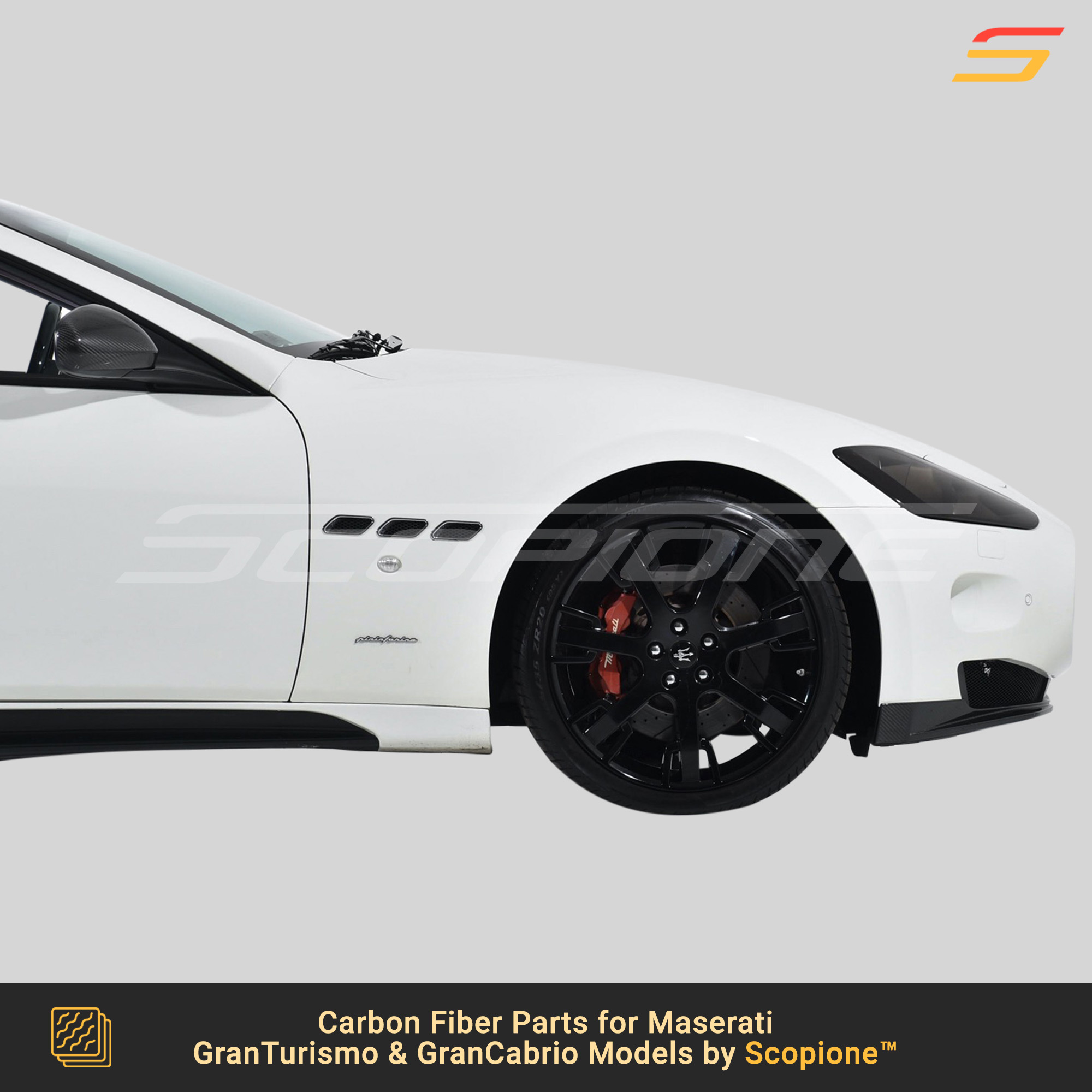
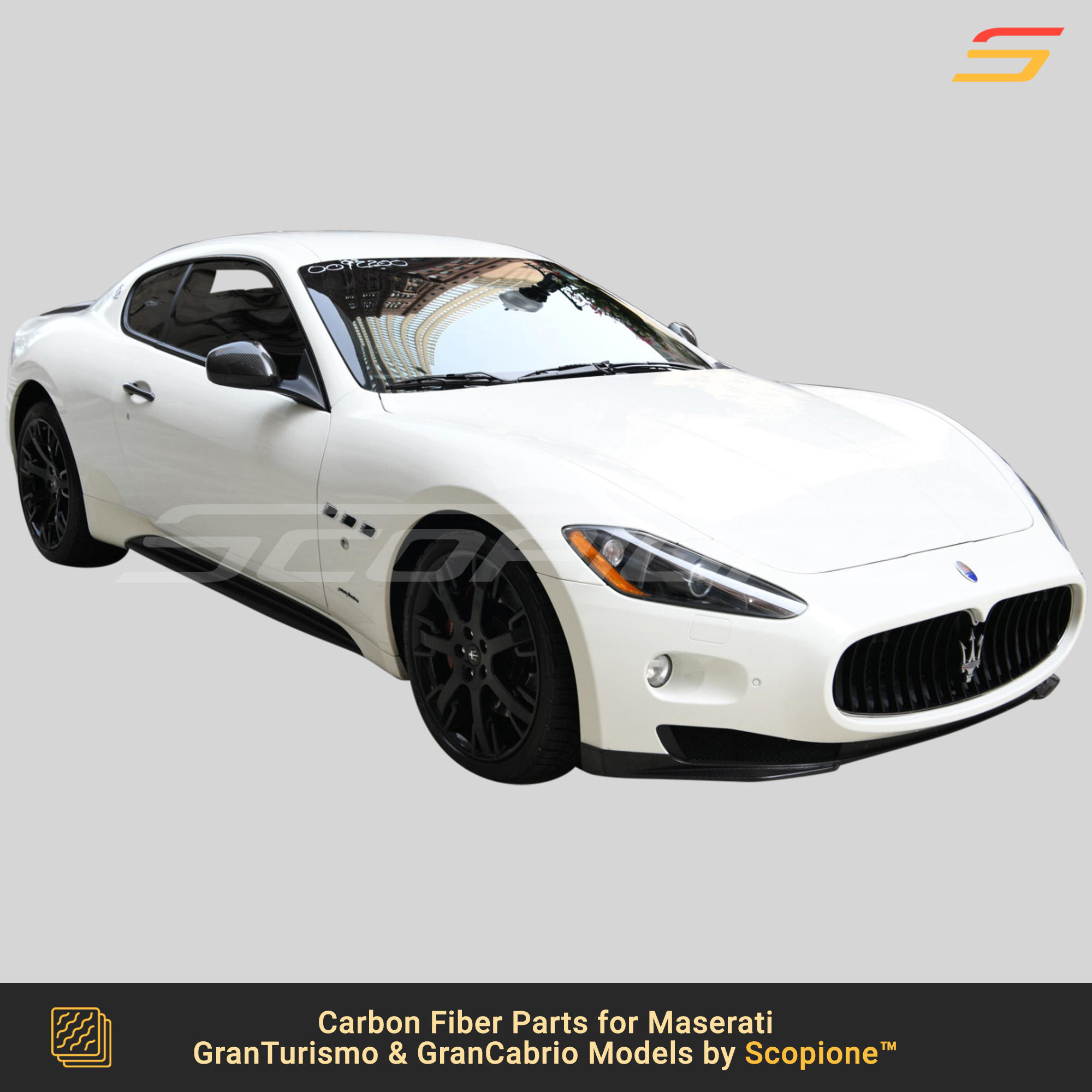
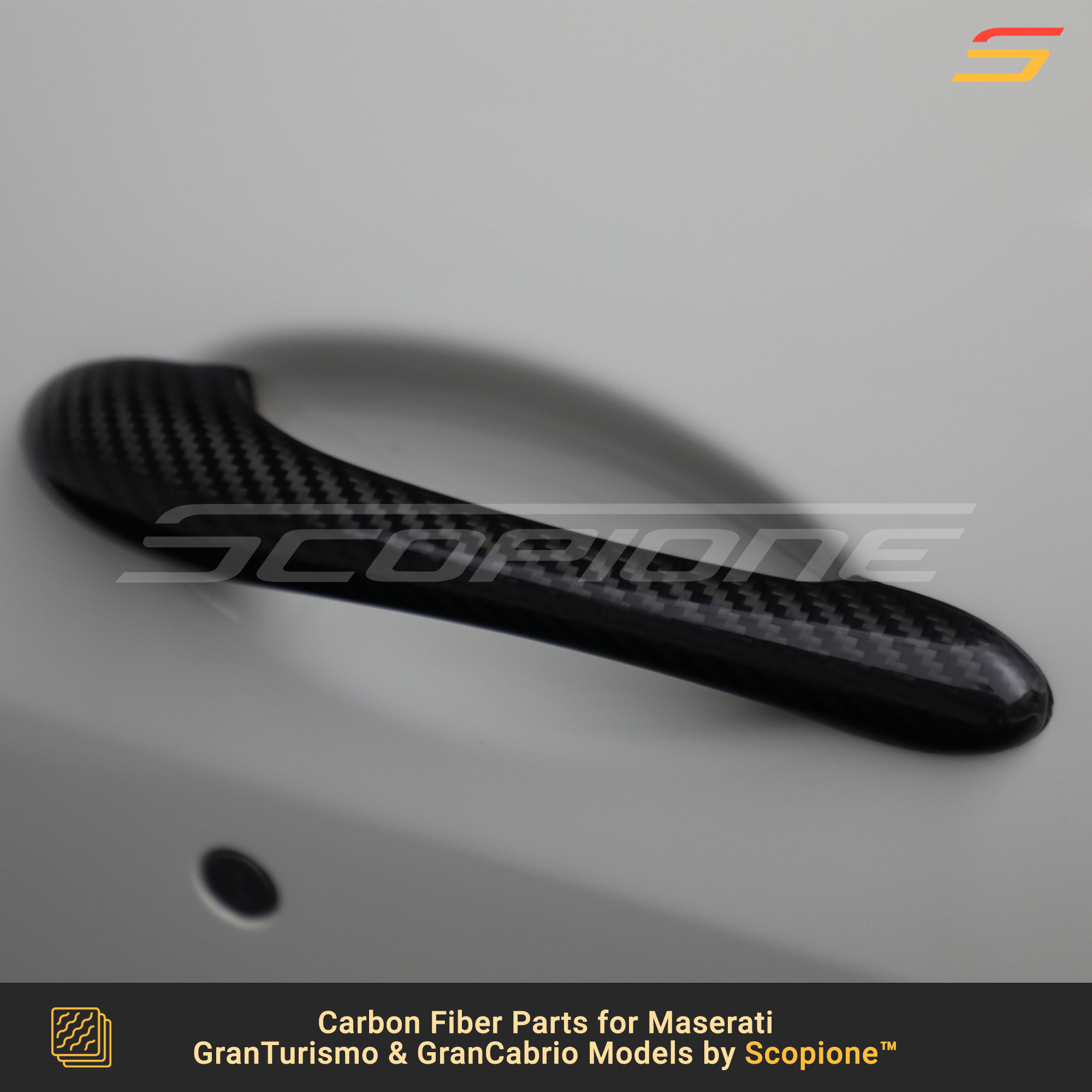
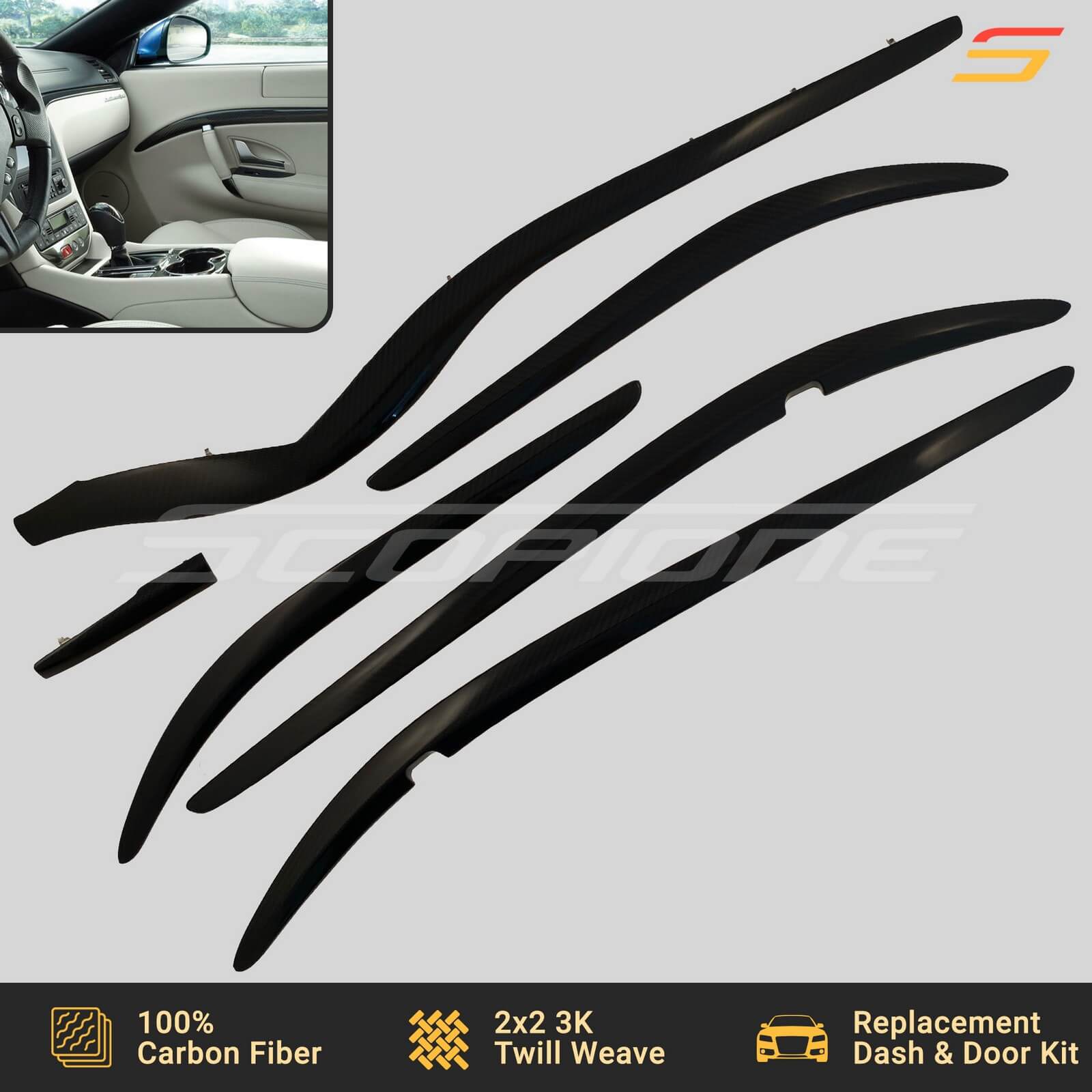
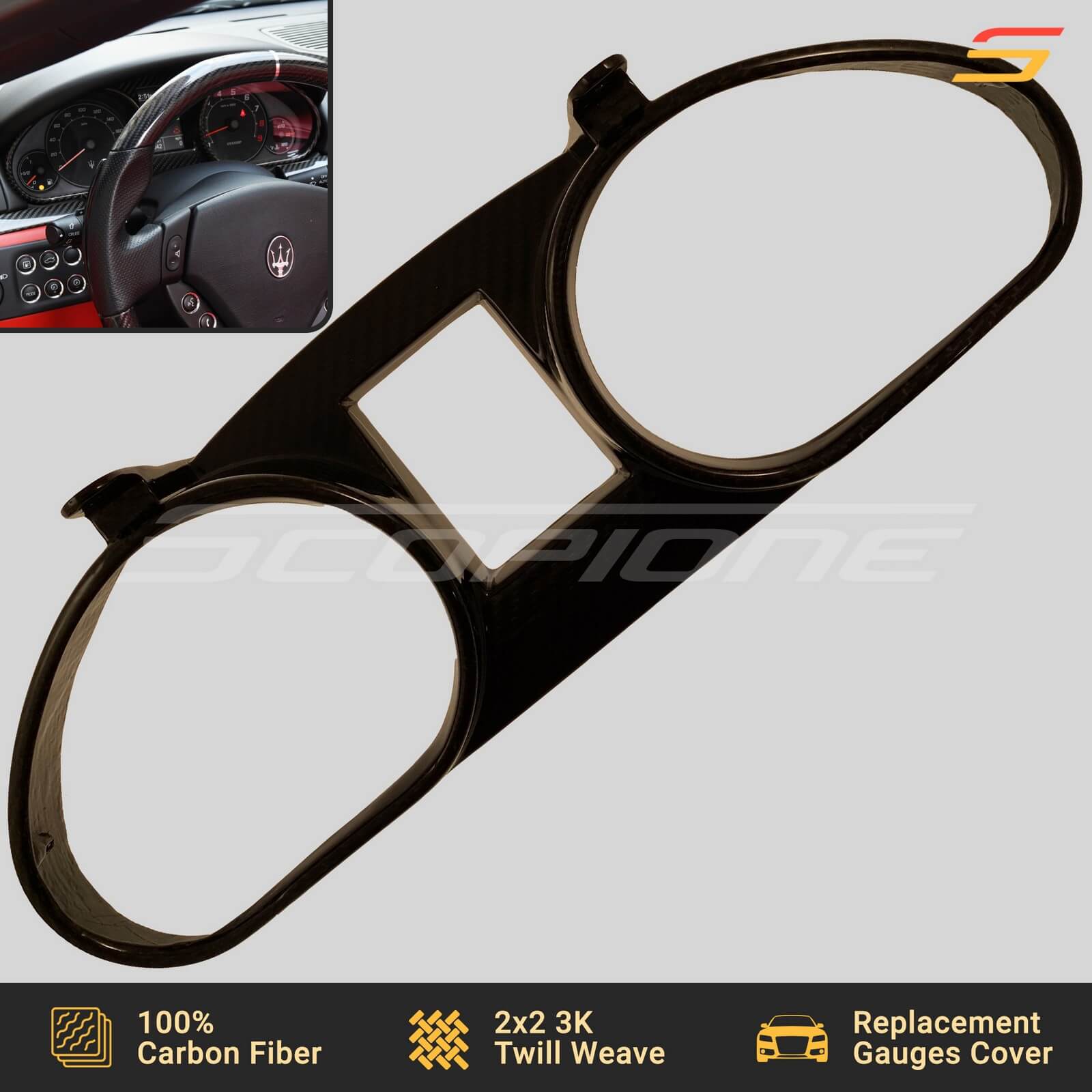
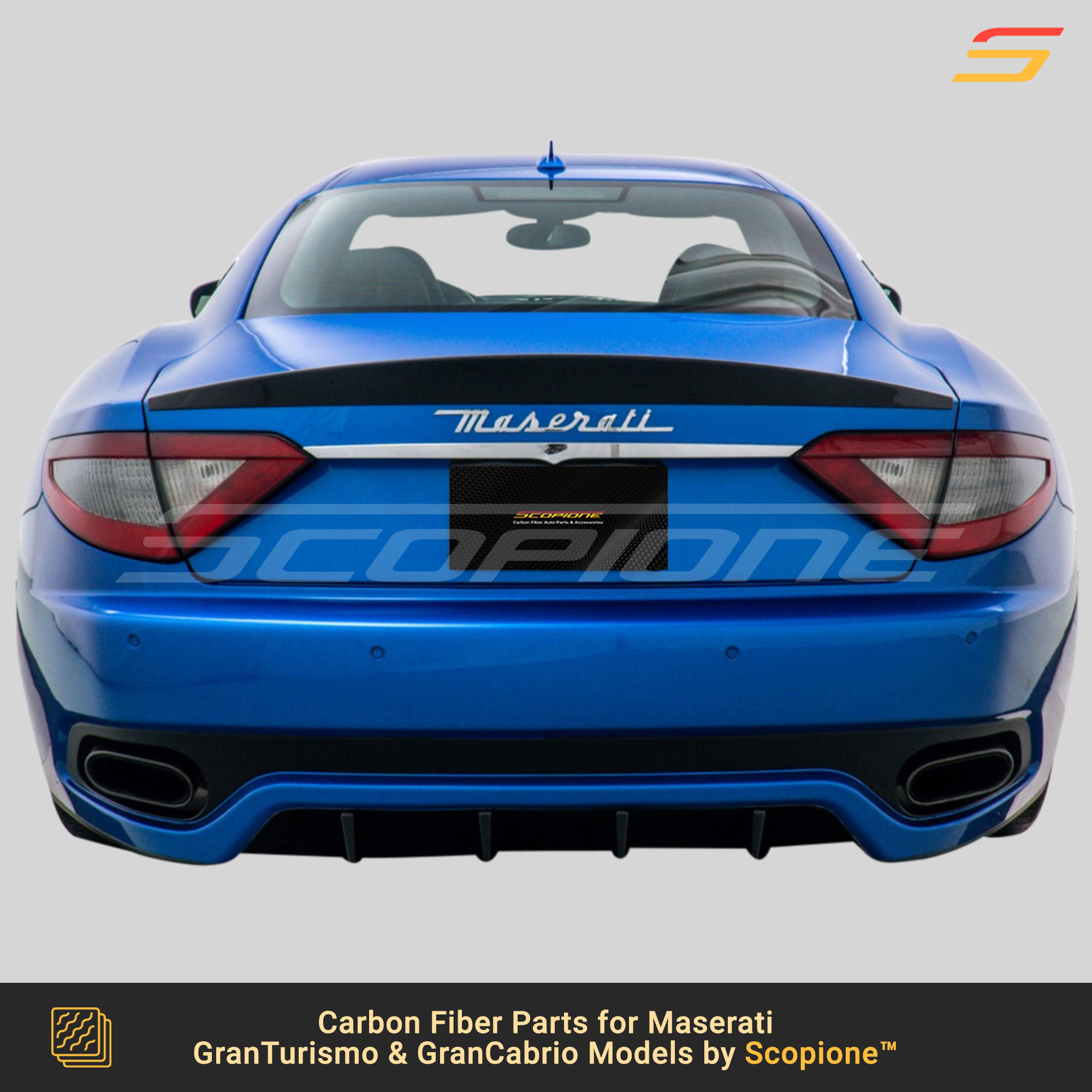
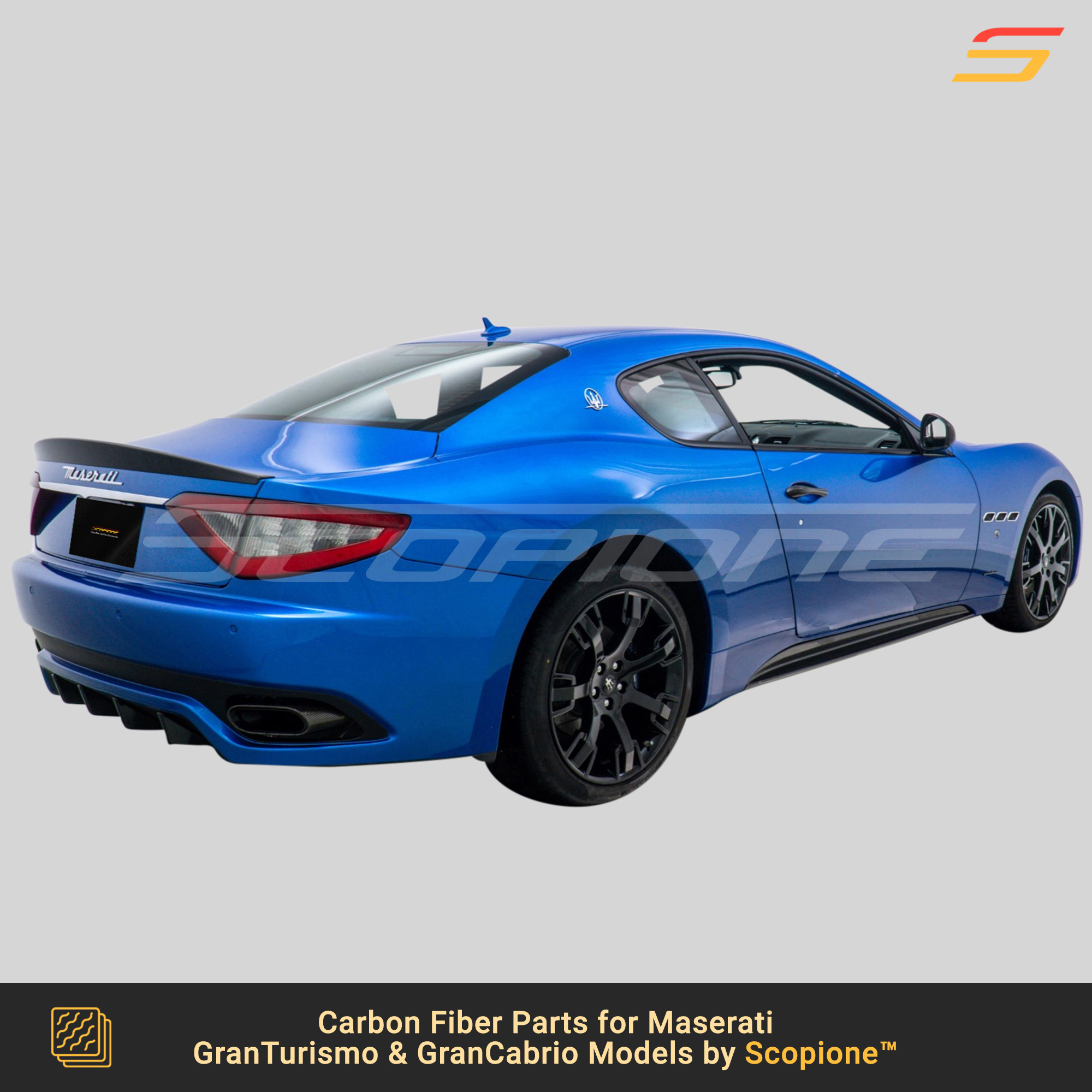
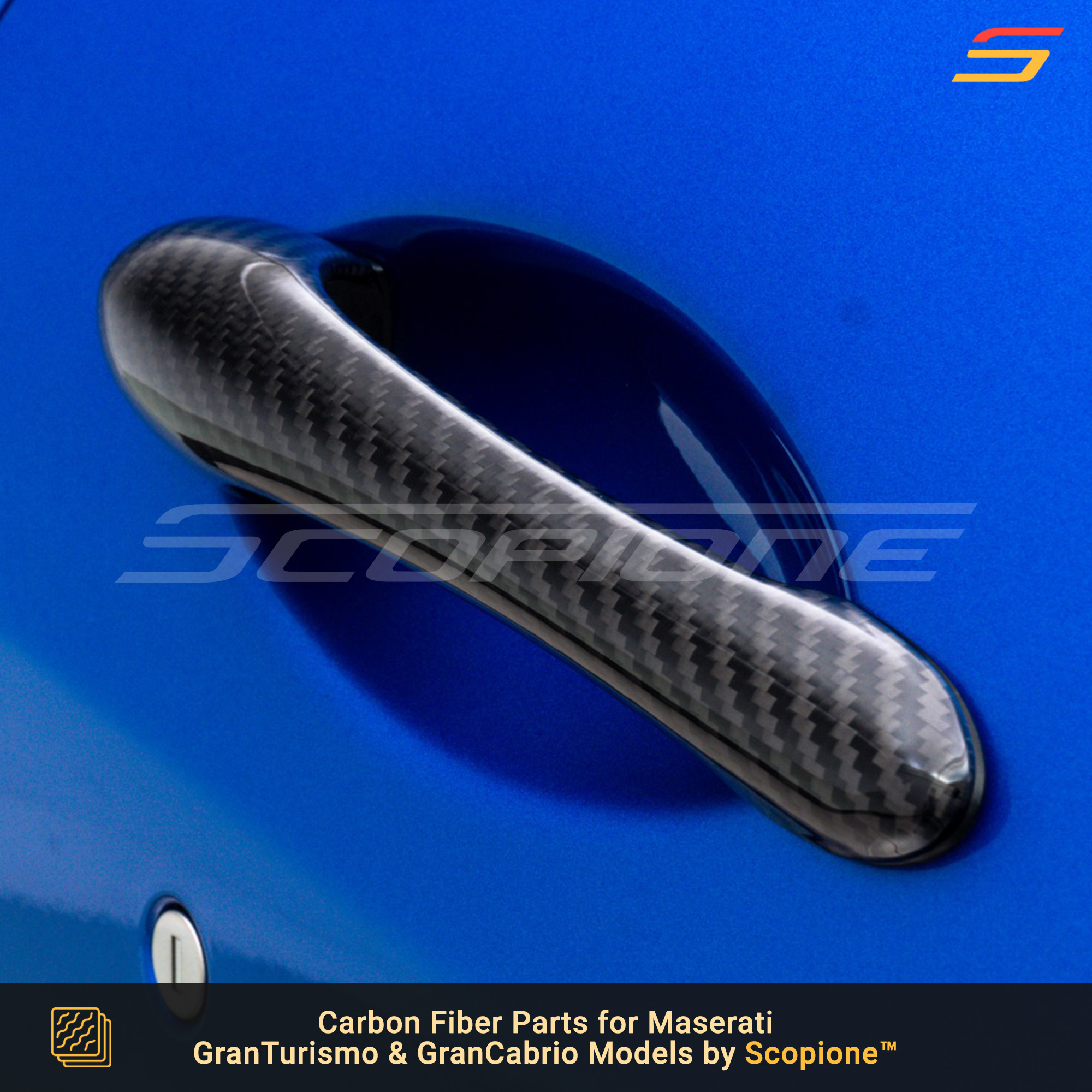
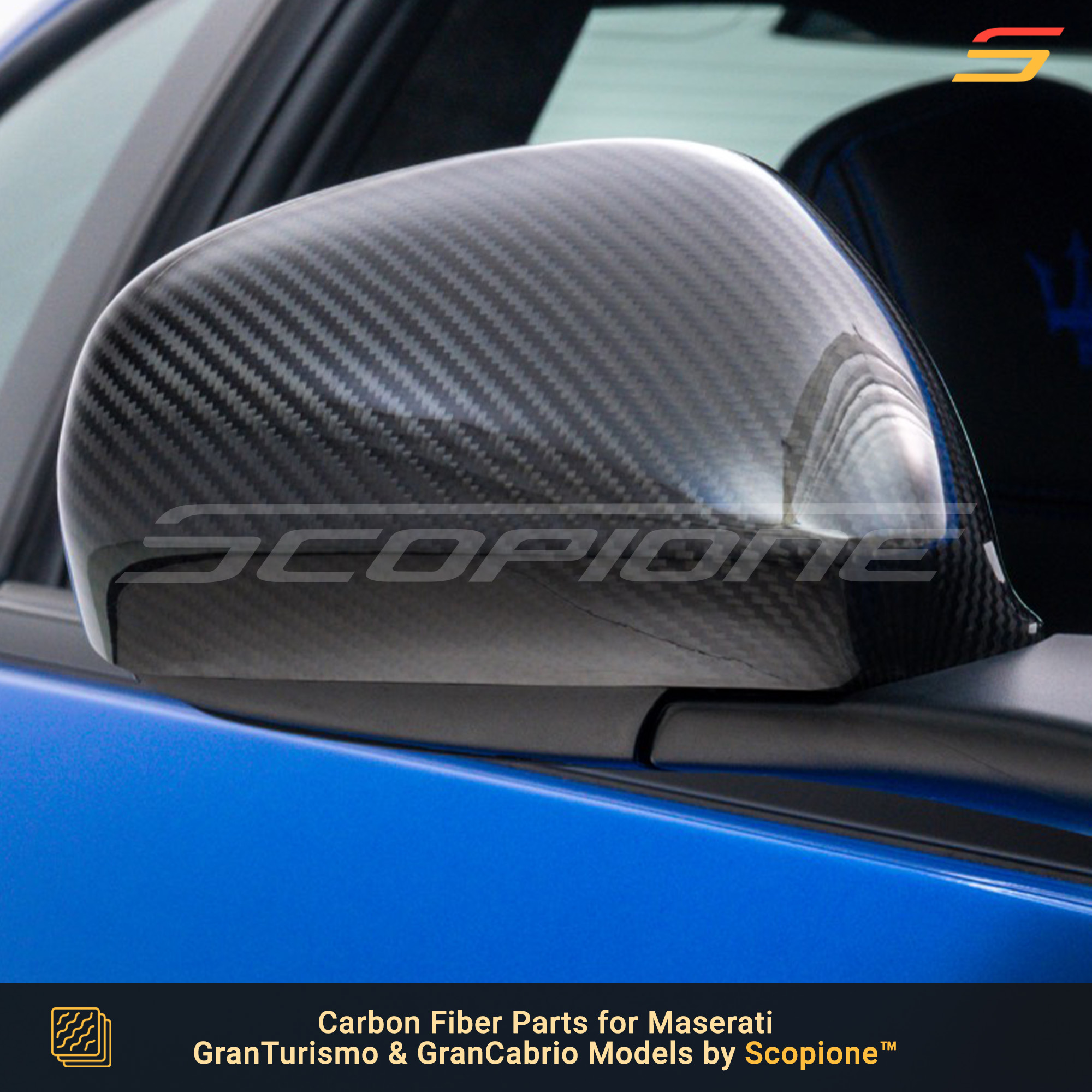
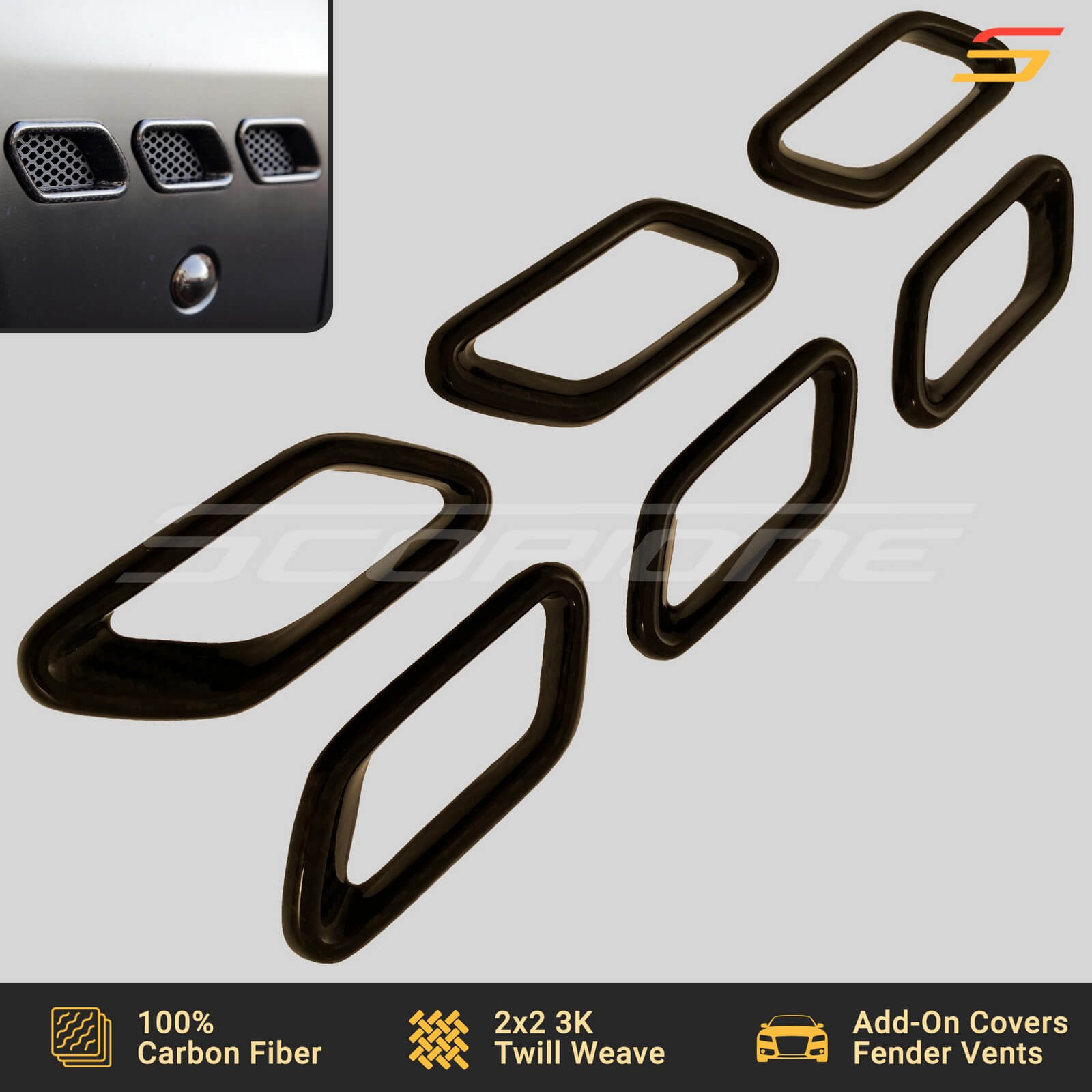
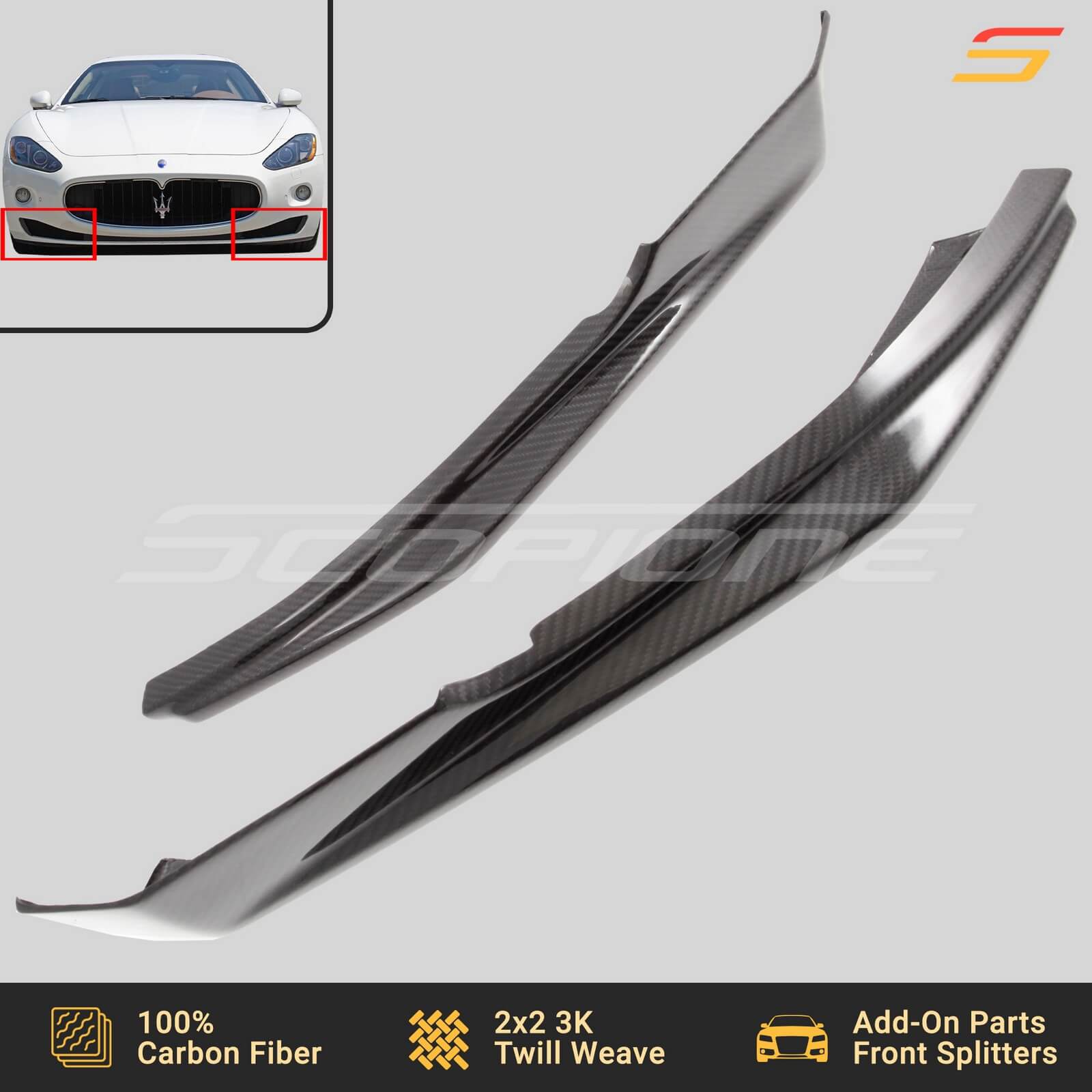
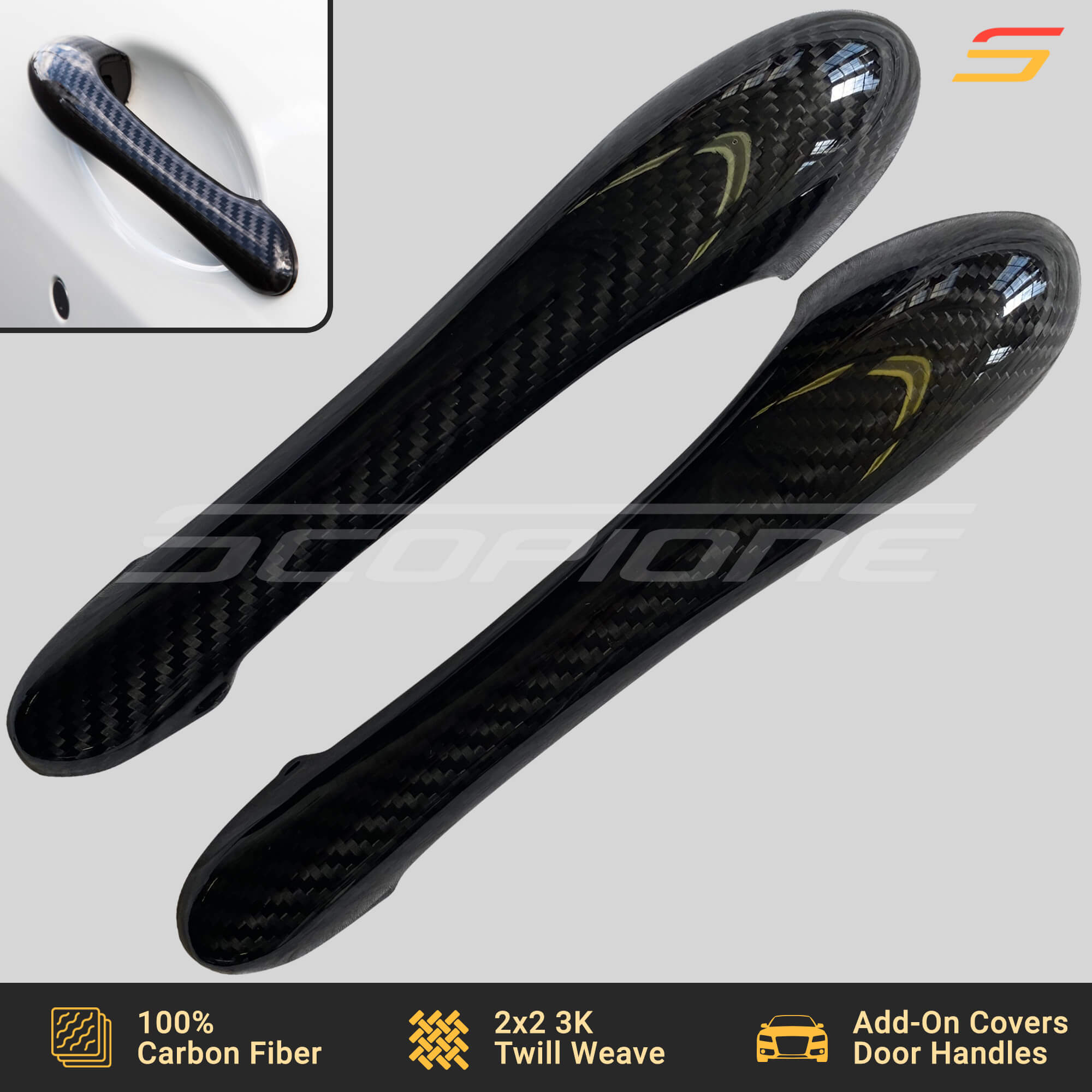
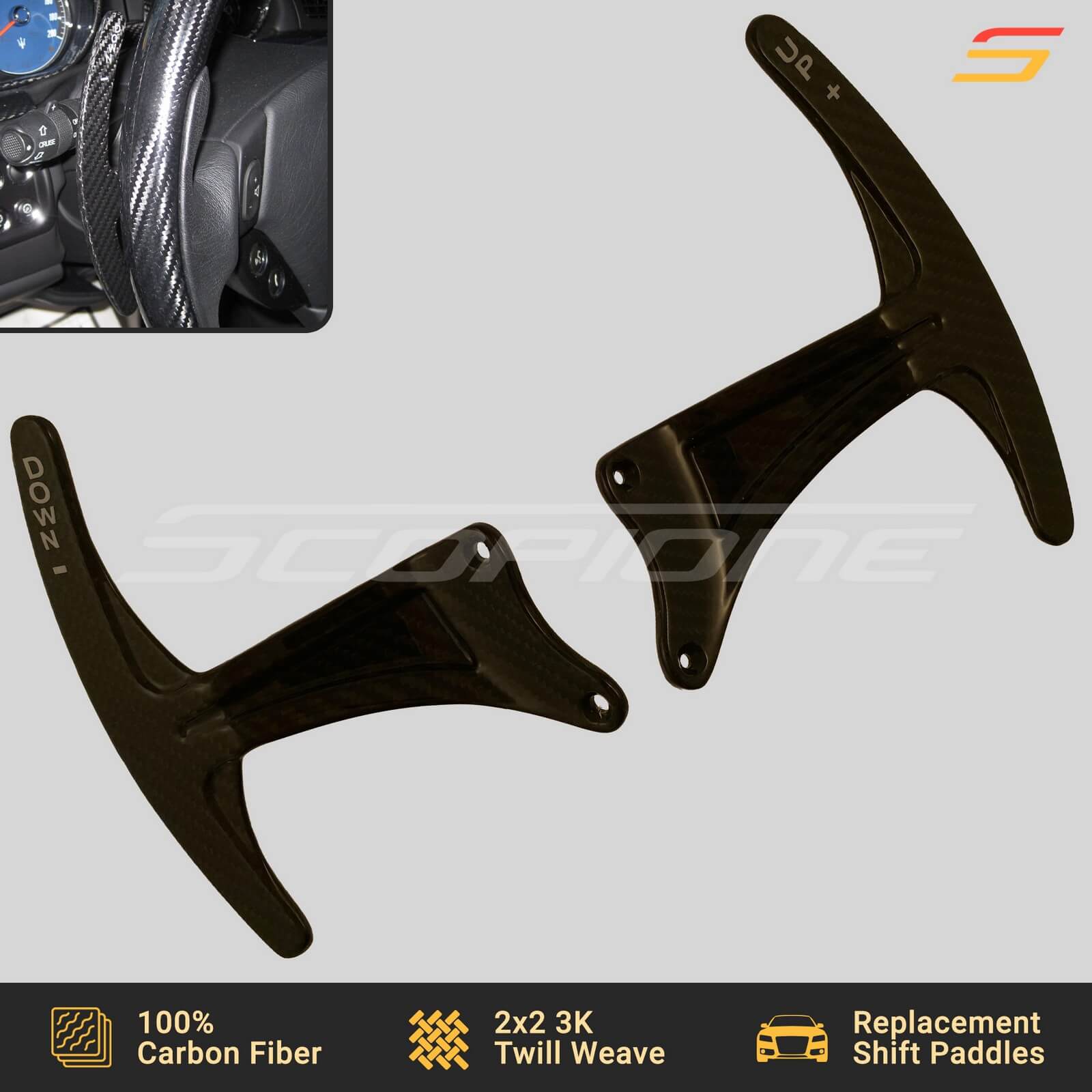
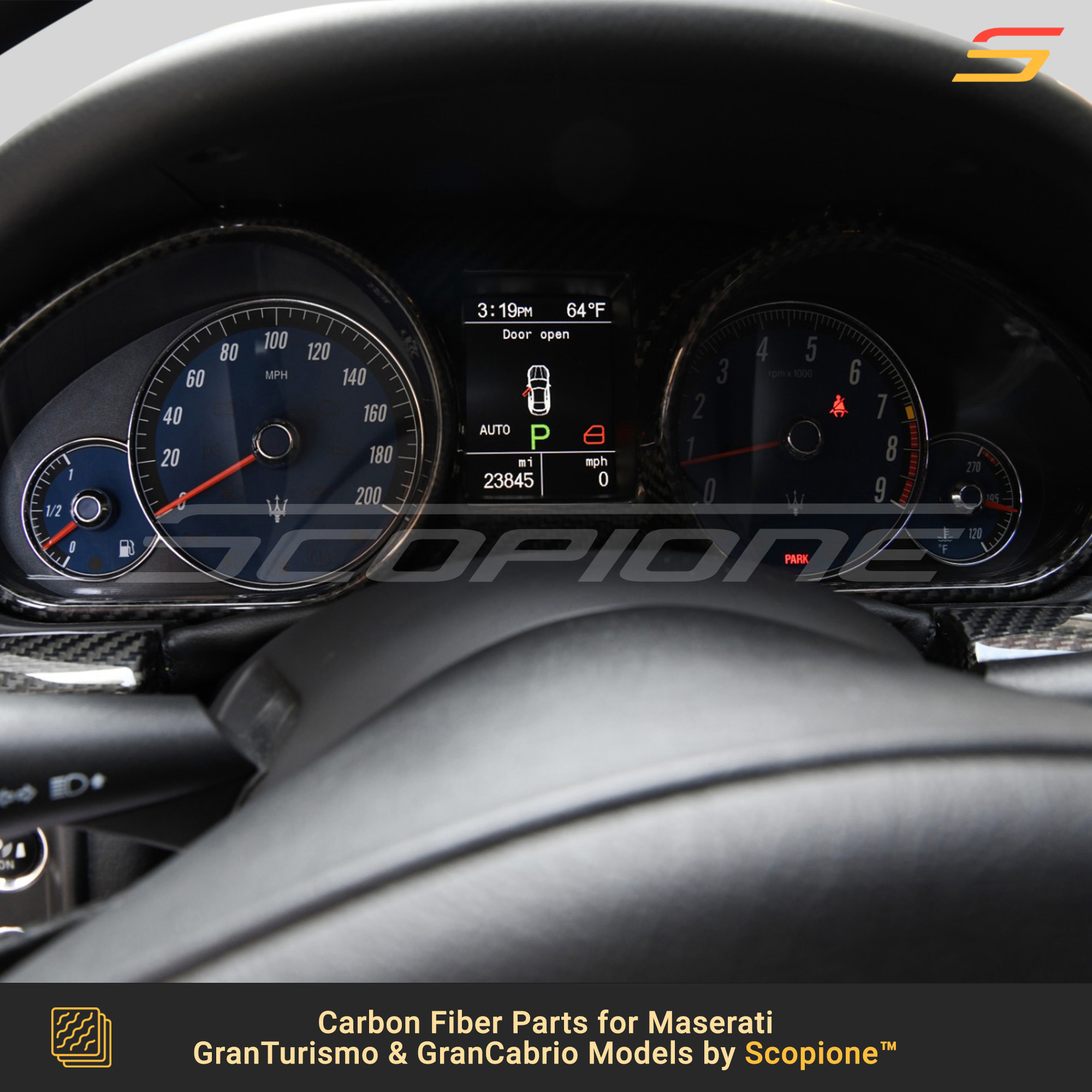
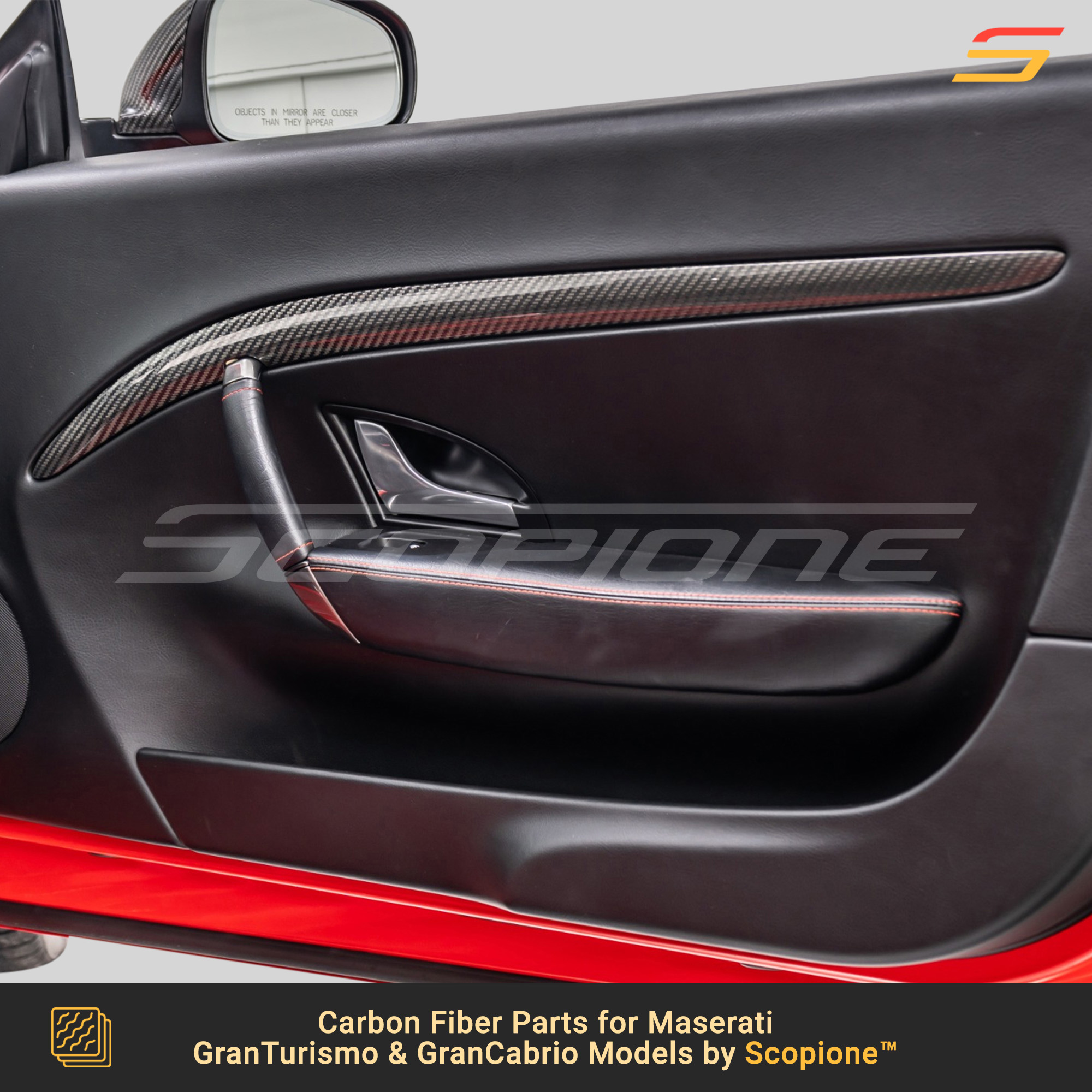
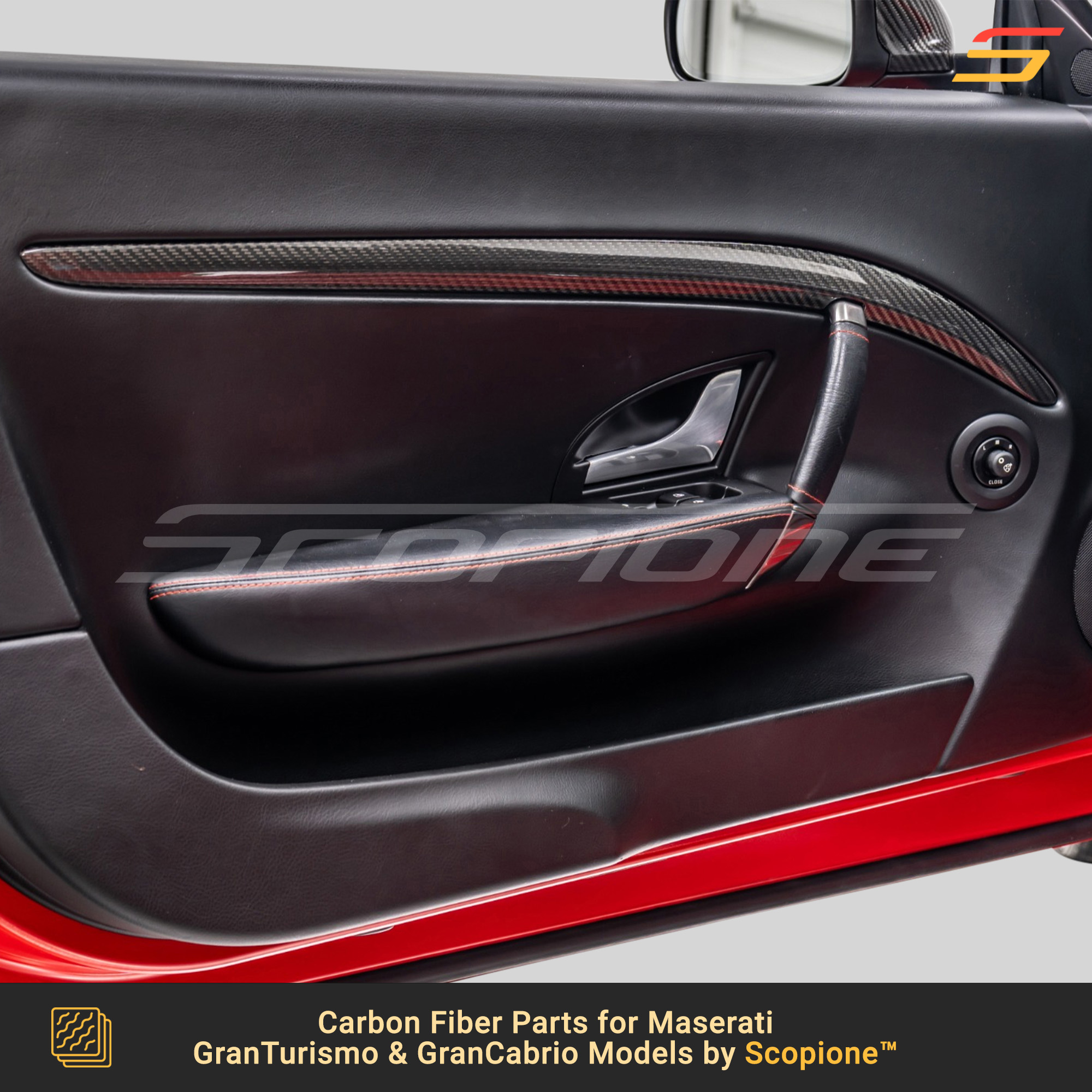
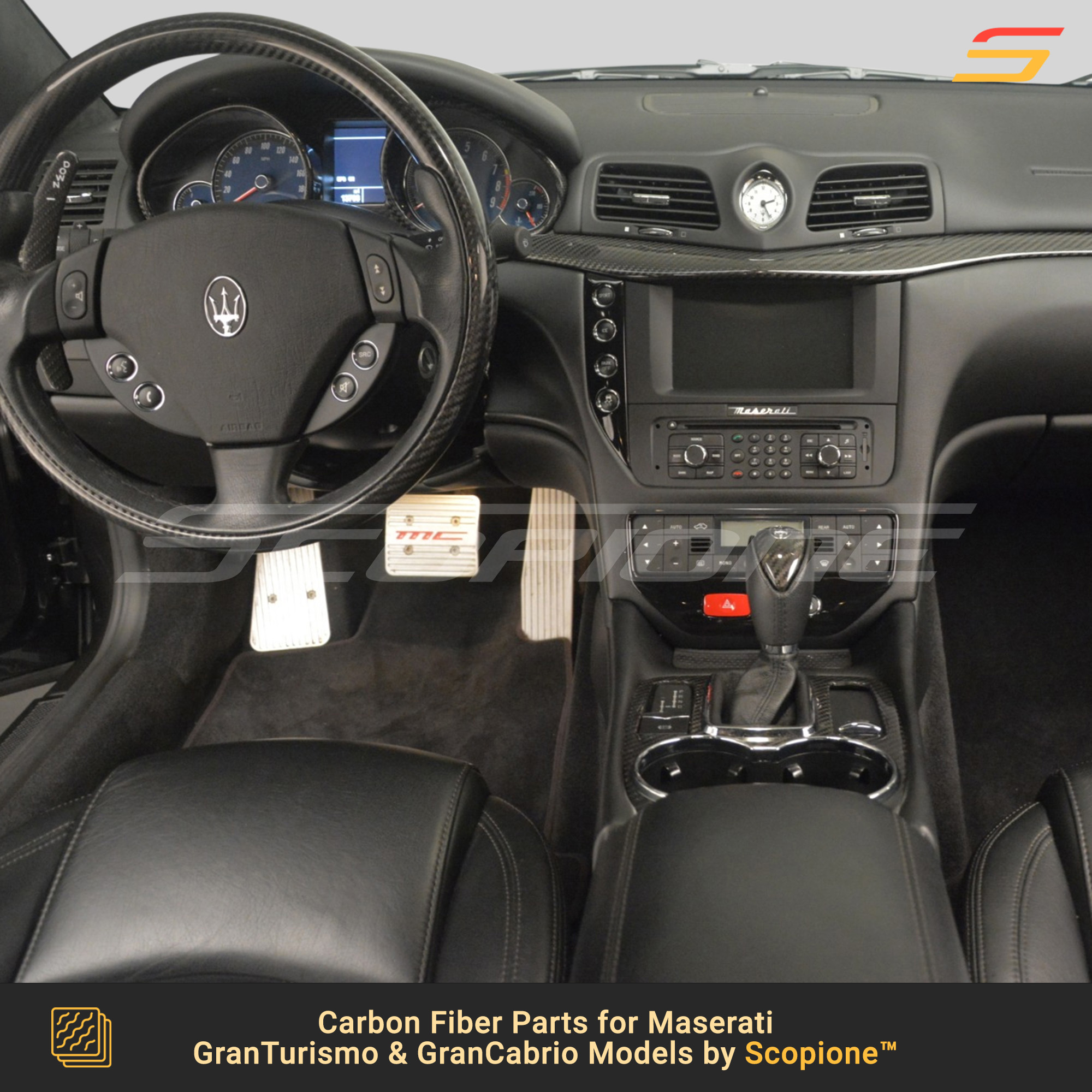
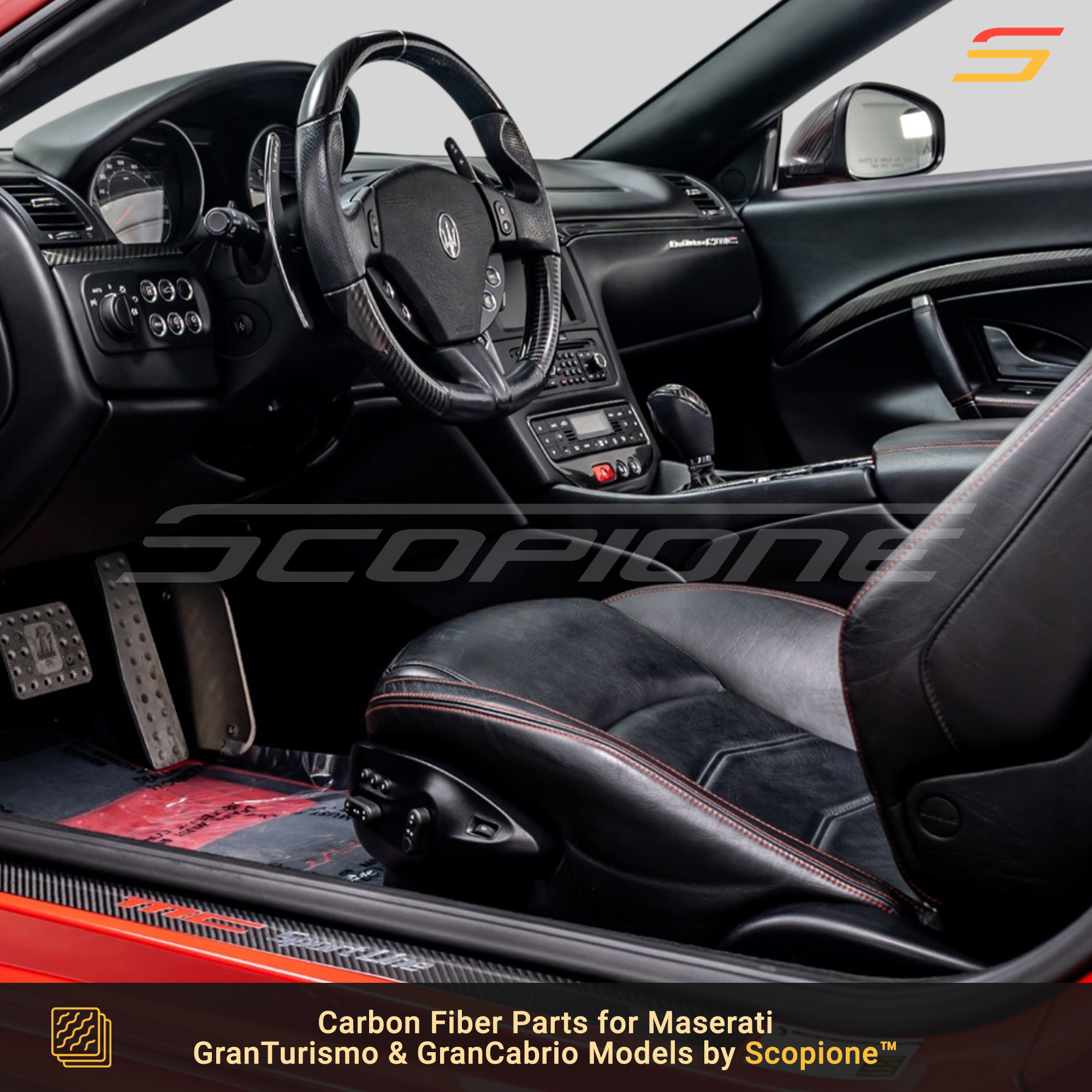
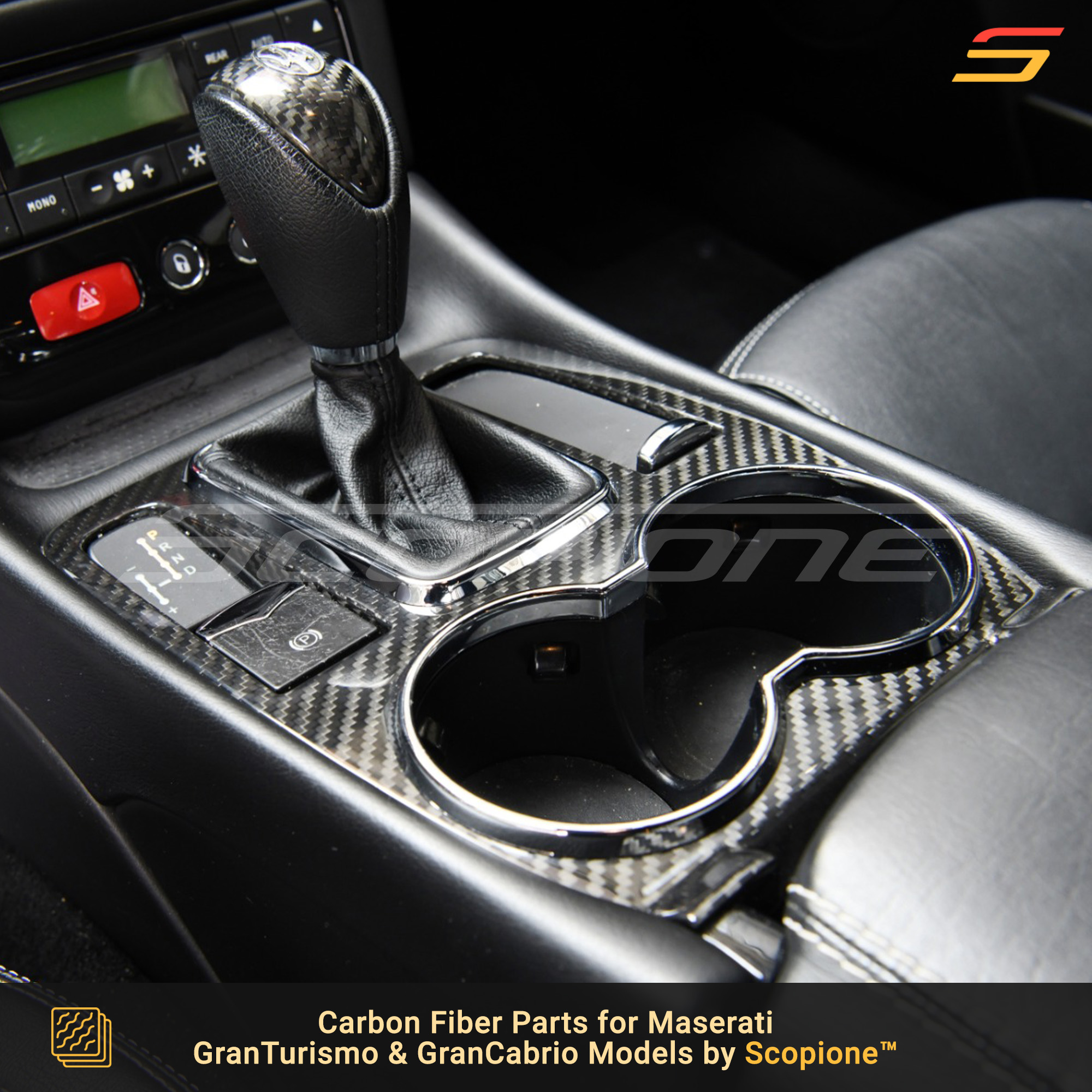
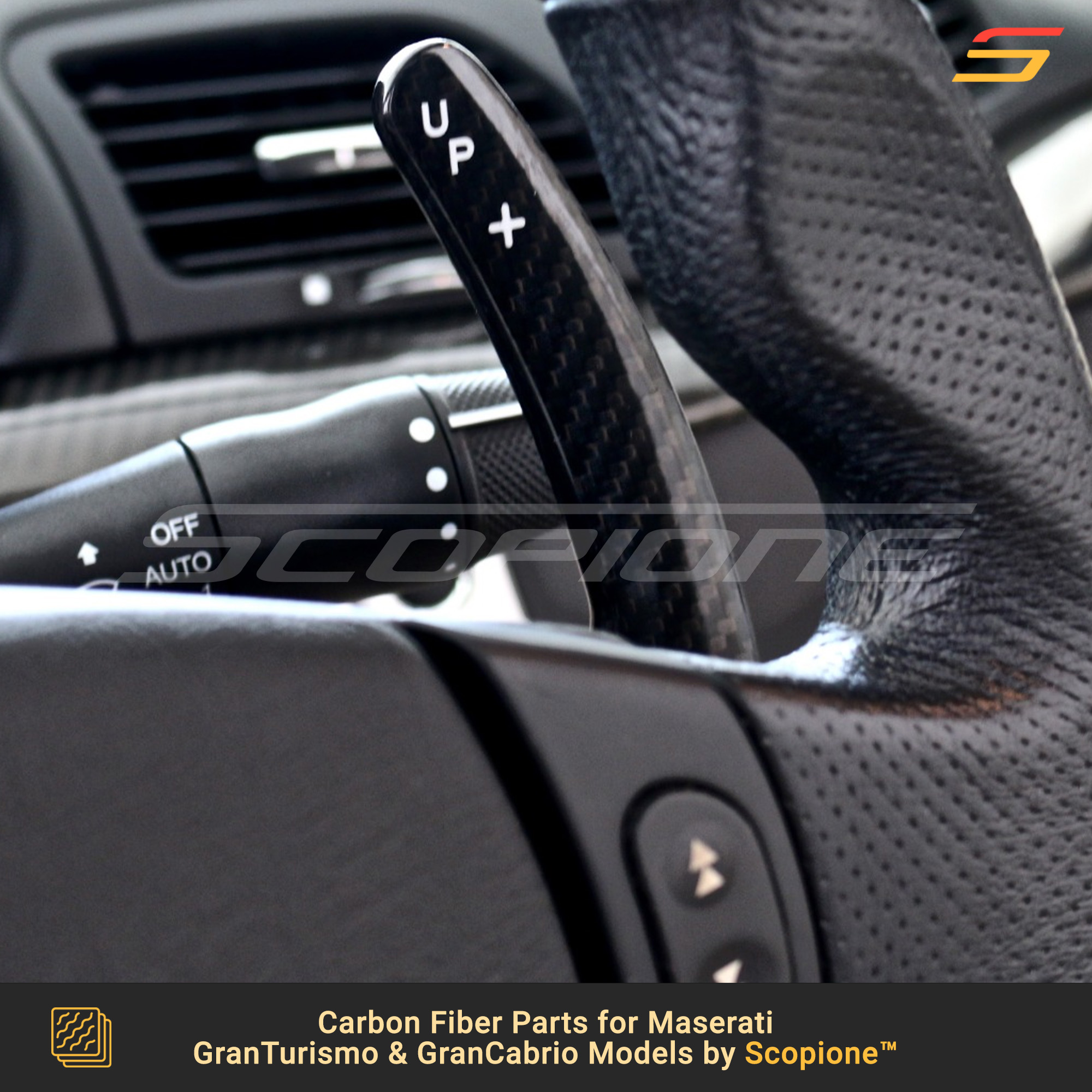
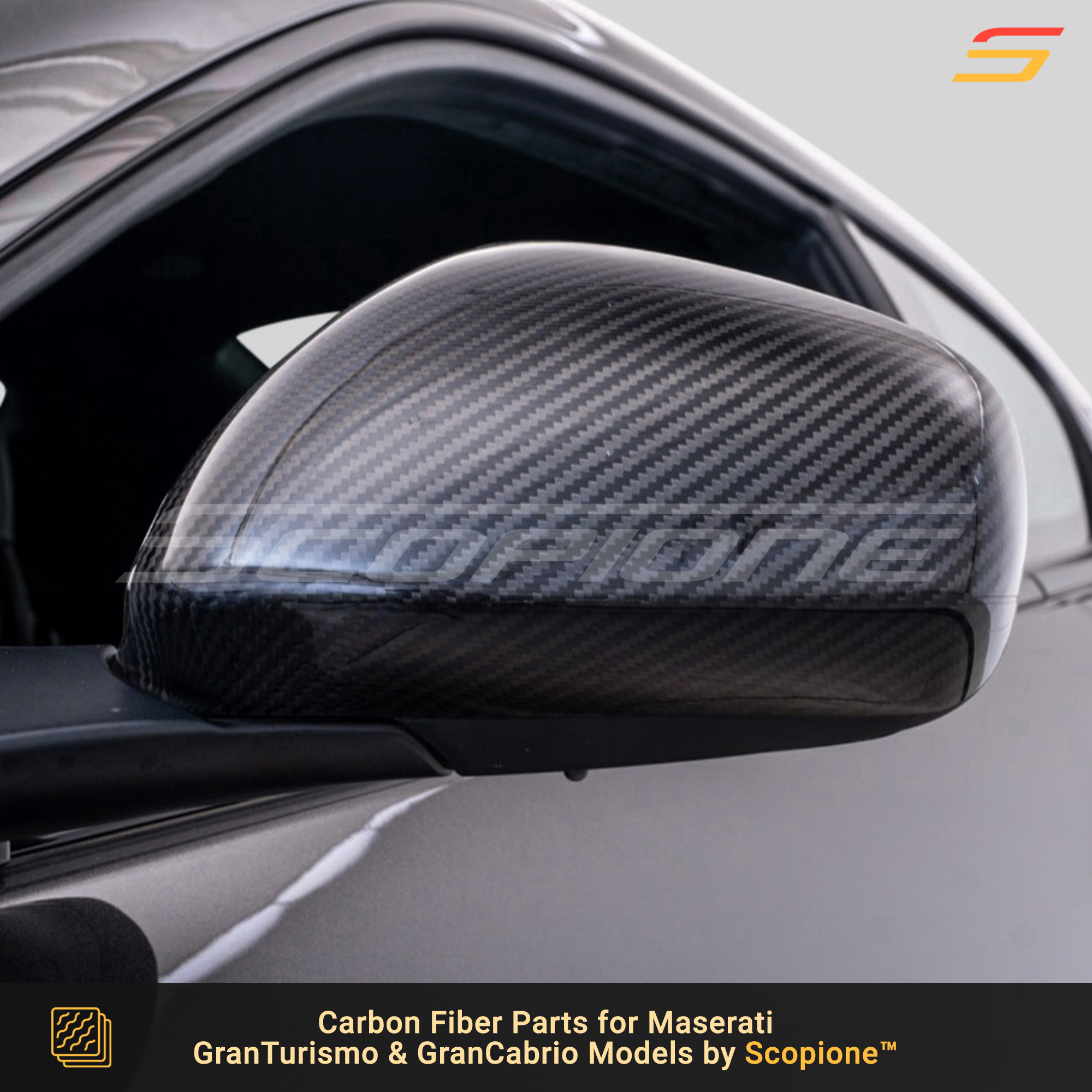
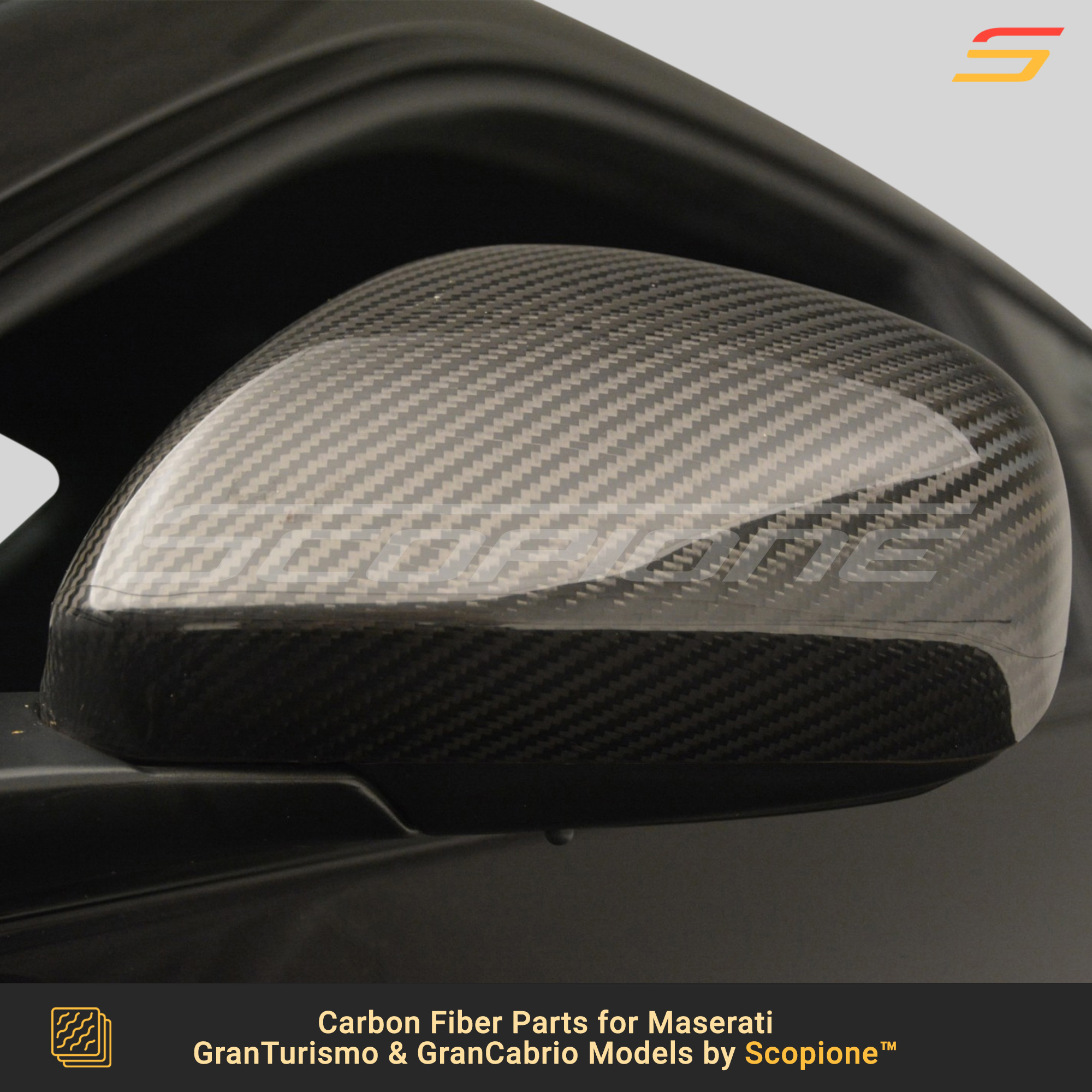
The GranTurismo and GranCabrio anchor Scopione’s Maserati catalog, and the range reaches beyond them: the Levante MK1 and the Quattroporte are covered too. Side mirror covers, fender vent covers, front bumper splitters, a rear diffuser and door handle covers work the exterior; a gauge cluster console, a gear-shift dash trim cover, an interior dash and door panel trim kit and shift paddles work the cabin. All in 2×2 3K twill-weave CF under a UV-resistant clear coat, complementing the Pininfarina coachwork.
Maserati Quattroporte VI (2013–2024)
The sixth-generation Quattroporte aimed at the Mercedes-AMG S-Class and BMW 7 Series. Ferrari-derived twin-turbo engines (3.0L V6 and 3.8L V8) powered the range. The Trofeo variant, introduced in 2020 with 580 hp from the twin-turbo V8, delivered more power than any previous Maserati sedan. Build quality reached levels that would have been unthinkable during the Biturbo era.
- Engine: 3.0L twin-turbo V6 / 3.8L twin-turbo V8, 350–580 hp
- 0–60 mph: 4.2 seconds (Trofeo)
- CF content: Optional CF interior trim; Trofeo: CF mirror caps, rear spoiler
Carbon-fiber content was limited to optional interior trim packages and exterior accents on the Trofeo. Decorative rather than structural. But the Quattroporte, alongside the Ghibli sedan (2013) and Levante SUV (2016), broadened Maserati’s volume base to levels where CF option packages could be offered across the entire product line. The commercial foundation for offering carbon fiber on every Maserati — not just the MC12 or MC20 — was built by these volume models.
Scopione Perspective: The Enzo Inheritance
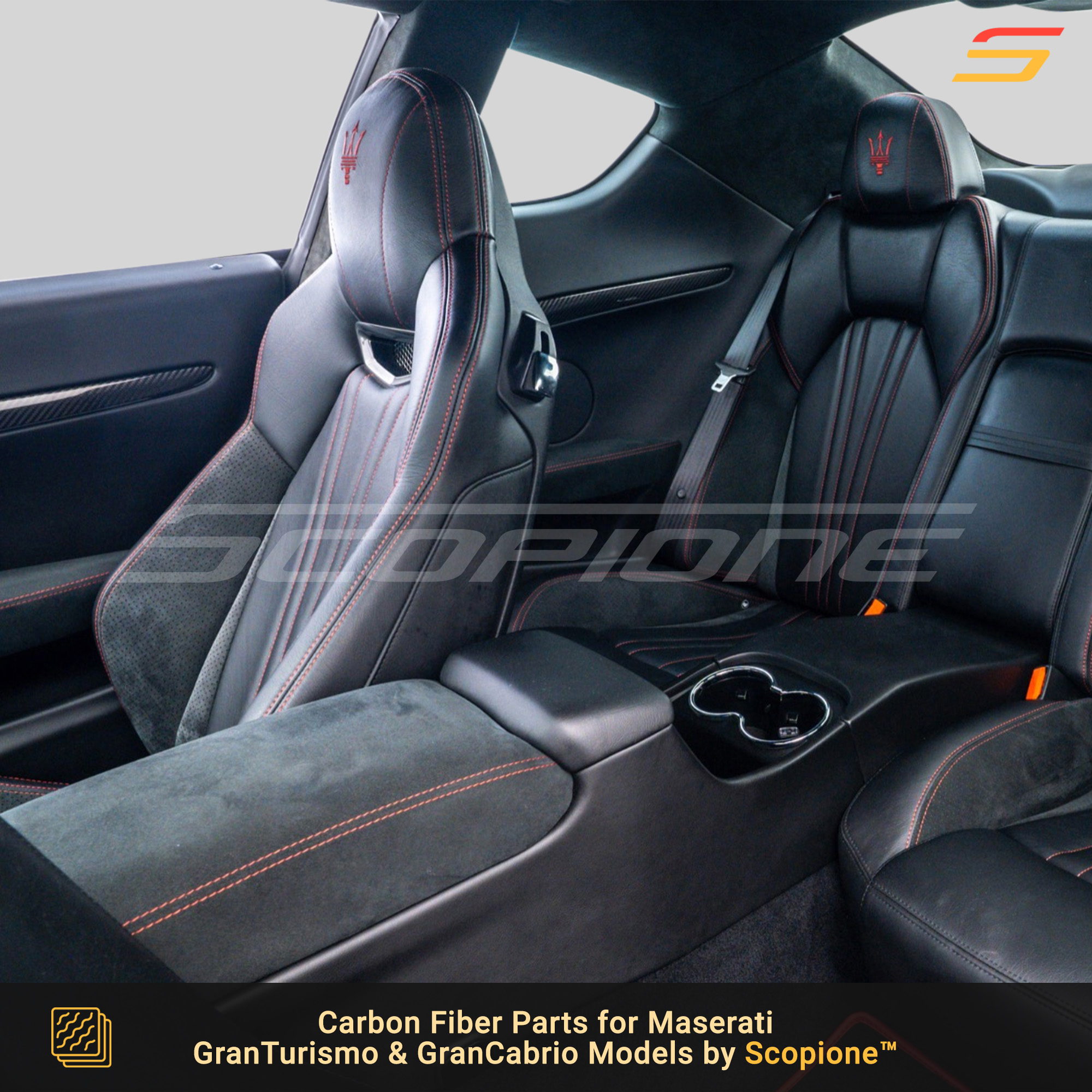
The MC12’s Enzo-derived carbon composite chassis proved that CFRP technology suited the Maserati character — refined rather than raw, fast rather than frantic. The GranTurismo MC Stradale extended that proof to a volume model where carbon-fiber content enhanced both performance and visual presence. Scopione’s carbon-fiber parts for the Maserati GranTurismo and GranCabrio complement the Pininfarina body lines with precision-fitted 2×2 3K twill-weave components. Each piece is finished with UV-resistant clear coat engineered to maintain depth and gloss through years of exposure.


2020–Present: The MC20 Monocoque and the Folgore Revolution
The MC20 represents a break with everything that came before. For the first time since the 250F era, Maserati developed proprietary powertrain and chassis technology rather than sourcing it from a corporate partner. The Nettuno 3.0-liter twin-turbo V6 — with a patented pre-chamber combustion system borrowed from F1 — was designed and manufactured by Maserati. The CFRP monocoque was developed with Dallara, the Italian chassis specialist based 60 km from Modena. Both technologies belong to Maserati. Neither came from Ferrari. That distinction matters for a brand that spent two decades using Ferrari’s engines and the Enzo’s carbon tub.
Under Stellantis ownership, Maserati then launched the Folgore electrification program. The new GranTurismo offers both the Nettuno V6 and a triple-motor all-electric powertrain. The Grecale SUV adds a Folgore variant. Carbon fiber continues as structural on the MC20 platform and decorative/aerodynamic across the wider range. The MC20’s CFRP monocoque is no longer an isolated achievement. It is the engineering foundation for a multi-variant platform strategy.
Maserati MC20 (2020–Present)
The MC20’s carbon-fiber monocoque weighs under 100 kg. That number deserves context. The Tipo 61 Birdcage’s radical multi-tubular chassis — 200 hand-welded steel tubes, the pinnacle of lightweight construction in Maserati’s pre-CFRP history — weighed approximately 35 kg. The MC20’s CFRP tub weighs roughly three times that, but it provides crash structures, engine and transmission mounting, suspension attachment points, and occupant protection systems that the Birdcage never needed. For the structural work the MC20 monocoque performs, under 100 kg is extraordinary.
Dallara developed the monocoque. The Italian chassis firm has built carbon-fiber tubs for IndyCar, GP2/Formula 2, and multiple hypercar programs — bringing a depth of CFRP structural engineering that no first-time monocoque builder could match. The tub uses autoclave-cured carbon-fiber pre-preg laid up in Dallara’s facilities. The result is a structure with torsional rigidity that exceeds conventional aluminum architecture while weighing substantially less.
The Nettuno engine deserves attention alongside the chassis. The 3.0-liter twin-turbo V6 uses a pre-chamber combustion system — a technique adapted from Formula 1 where a small pre-ignition chamber above the main combustion chamber creates a more complete burn. The result is 621 hp (630 PS) from three liters: 207 hp per liter without hybrid assistance. Butterfly doors open upward and forward. Short overhangs, a low roofline, and a rear design that acknowledges the MC12. The dry weight target of 1,475 kg is remarkably light for a 621 hp mid-engine car with a full interior, air conditioning, and road-legal equipment.
- Engine: 3.0L twin-turbo V6 “Nettuno,” 621 hp (630 PS)
- Chassis: Full CFRP monocoque (Dallara), under 100 kg
- 0–60 mph: Under 2.9 seconds
- Top speed: 202 mph
- Dry weight: 1,475 kg
Optional carbon-fiber content extends beyond the monocoque: CF roof panel, CF engine cover, CF mirror caps, CF side skirts, and a CF rear diffuser are available through the options list. The MC20 GT2 racing variant pushes CFRP further, with additional carbon-fiber body panels, a wider aero package, and a rear wing assembly optimized for GT2-class competition. The GT2 debuted in 2023, returning Maserati to international GT racing on its own terms for the first time since the MC12 GT1 program ended. Where the MC12 GT1 raced on Ferrari’s carbon chassis, the MC20 GT2 races on Maserati’s. The symmetry is deliberate.
The monocoque is the defining statement. Maserati spent sixteen years using Ferrari’s carbon-fiber technology (MC12, 2004) before developing its own (MC20, 2020). That transition from borrowed capability to proprietary engineering changed what Maserati means in the context of advanced materials. The MC12 proved that CF suited the trident. The MC20 proved that the trident could build its own.
Maserati MC20 Cielo (2023–Present)
The Cielo — Italian for “sky” — removes the MC20’s fixed roof and replaces it with a retractable glass panel that switches from transparent to opaque via electrochromic technology. The roof stows above the engine bay. Converting a mid-engine supercar from coupé to spider typically imposes a significant structural penalty: steel and aluminum monocoques lose torsional rigidity when the roof is removed, requiring heavy reinforcement that adds 100–150 kg to the curb weight.
The MC20’s CFRP monocoque changes that equation. Carbon-fiber structures can be engineered to compensate for a missing roof panel through reinforced sill sections and A-pillar structures, retaining a much higher percentage of the coupé’s torsional rigidity than steel or aluminum equivalents. The Cielo weighs approximately 65 kg more than the coupé — the roof mechanism and additional reinforcement — rather than the 100–150 kg penalty typical of steel-chassis convertibles.
- Engine: 3.0L twin-turbo V6 “Nettuno,” 621 hp
- 0–60 mph: Under 3.0 seconds
- Top speed: 198 mph
- Weight penalty vs coupé: ~65 kg (vs 100–150 kg typical for steel chassis)
The Cielo validates the MC20 monocoque’s versatility. A single CFRP tub serving coupé and spider variants — with the spider maintaining near-coupé rigidity — builds the engineering case for extending carbon-fiber structures across future Maserati derivatives. The Bora/Merak platform sharing returned, fifty years later, in carbon fiber.
Maserati GranTurismo (2024–Present)
The new GranTurismo replaces both the original GT and the Quattroporte as Maserati’s grand touring flagship. It ships with the MC20’s Nettuno V6 in two tunes: Modena (490 hp) and Trofeo (550 hp). The Folgore variant is Maserati’s first all-electric production car — a triple-motor system producing 750 hp with a 92.5 kWh battery pack. The Folgore reaches 60 mph in 2.7 seconds. The Trofeo does it in 3.5. Both share the same body, the same proportions, and the same optional carbon-fiber packages.
- Engine: 3.0L Nettuno V6, 490–550 hp / Triple electric motor, 750 hp (Folgore)
- 0–60 mph: 3.5 seconds (Trofeo) / 2.7 seconds (Folgore)
- Top speed: 199 mph (both)
- CF content: Optional CF mirror caps, side skirts, splitter, diffuser, rear spoiler; CF interior trim
The GranTurismo does not use a CFRP monocoque — it sits on a steel and aluminum platform. But MC20-derived composite technology informs its aero components. Optional carbon-fiber packages include CF mirror caps, CF side skirts, CF front splitter accents, CF rear diffuser, CF rear spoiler, and CF interior trim. The Folgore variant’s 400 kg battery mass makes every gram of weight savings from CF aero meaningful for dynamic balance. The dual-powertrain strategy puts the same CF options catalog in front of both traditional GT buyers and electric early adopters.
Maserati Grecale (2022–Present)
The Grecale enters the compact luxury SUV market against the Porsche Macan. Built on the Giorgio platform shared with the Alfa Romeo Stelvio, the Grecale is available in GT, Modena, Trofeo, and Folgore specifications. The Trofeo uses a version of the Nettuno V6 producing 523 hp — placing it among the quickest compact SUVs available. The Folgore provides a fully electric alternative.
- Engine: 2.0L turbo-four / 3.0L twin-turbo V6 (Trofeo: 523 hp) / Electric (Folgore)
- 0–60 mph: 3.8 seconds (Trofeo)
- CF content: Optional CF mirror caps, diffuser trim, side skirt inserts; CF interior packages
Carbon-fiber content is decorative and aerodynamic: CF mirror caps, CF rear diffuser trim, CF side skirt inserts, and CF interior packages. None of it carries structural loads. But the Grecale’s significance for the Maserati carbon fiber evolution is market breadth rather than engineering depth. The Grecale brings CF option packages to Maserati’s highest-volume segment, expanding the buyer base for carbon-fiber components beyond the sports car and GT audience.
Combined with the GranTurismo, GranCabrio, and MC20, every current Maserati model line now offers some level of carbon-fiber content. The range runs from the MC20’s structural monocoque to the Grecale’s mirror caps. Material science at one end. Material culture at the other. Both matter for a brand rebuilding its identity around advanced engineering.
Scopione Perspective: From Borrowed Carbon to Built Carbon
The MC20’s proprietary CFRP monocoque marks the point where Maserati’s relationship with carbon fiber shifted from inherited technology to owned capability. The MC12 proved that CF belonged on a Maserati. The MC20 proved that Maserati could engineer it. Across the current lineup — from the MC20’s structural tub through the GranTurismo’s aero packages to the Grecale’s trim options — carbon fiber has become a material that defines the brand rather than merely decorating it. Scopione’s precision-fitted components for Maserati models extend that CF presence into the aftermarket, offering 2×2 3K twill-weave parts that complement the factory options catalog with the same commitment to fitment and finish.
Frequently Asked Questions
Maserati and Carbon Fiber: Common Questions
When did Maserati first use carbon fiber?
The MC12 (2004) was Maserati’s first carbon-fiber car. Its chassis was derived from the Ferrari Enzo’s carbon/Nomex composite monocoque, and every body panel was CFRP. Only 50 road cars were built. The MC20 (2020) then introduced Maserati’s first proprietary CFRP monocoque, developed with Dallara — the first carbon-fiber chassis Maserati designed rather than inherited from a corporate partner.
Does the Maserati MC20 have a carbon fiber chassis?
Yes. The MC20 uses a full CFRP monocoque developed with Dallara that weighs under 100 kg. This carbon-fiber tub serves as the structural core for both the MC20 Coupé and the MC20 Cielo spider. It mounts the engine, transmission, and suspension while providing crash structures and occupant protection. The MC20’s 1,475 kg dry weight — unusually light for a 621 hp mid-engine car with full road equipment — is achievable primarily because of the CFRP monocoque.
How does the MC12’s carbon fiber compare to the MC20’s?
The MC12 used Ferrari’s Enzo-derived carbon/Nomex monocoque — technology that was designed, tooled, and manufactured under Ferrari’s engineering program. The MC20’s CFRP monocoque was developed in partnership with Dallara specifically for the MC20 platform. Both are autoclave-cured carbon-fiber structures, but the MC20’s tub represents Maserati’s own engineering rather than an adaptation of Ferrari’s work.
What Maserati models currently offer carbon fiber options?
Every current Maserati offers some level of carbon-fiber content. The MC20 and MC20 Cielo feature a structural CFRP monocoque with optional CF body panels. The GranTurismo (including the Folgore electric), GranCabrio, and Grecale offer optional CF exterior packages (mirror caps, splitters, diffusers, side skirts) and CF interior trim. The Trofeo variants across the range include additional CF elements as standard.
What carbon fiber parts does Scopione offer for Maserati?
Scopione stocks 2×2 3K twill-weave carbon-fiber components for the Maserati GranTurismo and GranCabrio, and also for the Levante MK1 and the Quattroporte. The range covers side mirror covers, fender vent covers, front bumper splitters, a rear bumper diffuser and door handle covers on the exterior, and a gauge cluster console, gear-shift dash trim cover, interior dash and door panel trim kit and shift paddles in the cabin. Each part is precision-fitted for specific model year applications and finished with UV-resistant clear coat – see the full Maserati catalog at Scopione.
Experience the elegance and performance of the Maserati with Scopione. Browse our gallery and get inspired to elevate your supercar with our top-of-the-line carbon fiber upgrades.
Shop now for premium ScopioneCarbon carbon fiber upgrades and experience the ultimate in performance and aesthetics for your Maserati!
Back to Top ↑Disclaimer: Technical specifications, production figures, and historical details presented in this article are editorial in nature and may differ from official manufacturer data. Photographs show Scopione carbon fiber parts for the Maserati GranTurismo, GranCabrio, Levante and Quattroporte, and cars fitted with them.