

 Shop
ShopLotus built the world’s first fiberglass monocoque production car in 1957. Not fiberglass panels over a metal frame — the fiberglass body was the structure. The Elite Type 14 eliminated the separate chassis entirely, creating a composite-structured road car twenty-four years before McLaren built the first carbon-fiber Formula 1 chassis. That 1957 decision established a principle that runs through every Lotus since: the body material carries loads, and every gram matters. Lotus carbon fiber evolution follows a trajectory unlike any other manufacturer in this series. Colin Chapman’s “simplify, then add lightness” philosophy drove the brand from fiberglass monocoques through bonded aluminum chassis innovation to full CFRP monocoque electric hypercars. The Evija’s autoclave-cured carbon-fiber tub is not a departure from Lotus’s identity. It is the fulfillment of a 67-year composite tradition. Scopione stocks precision-fitted 2×2 3K twill-weave carbon-fiber components for Lotus models – browse the full Lotus catalog.
Lotus Carbon Fiber Timeline
| Year | Model / Milestone | Carbon Fiber Significance |
|---|---|---|
| 1957 | Elite Type 14 | World’s first fiberglass monocoque production car — composite body IS the structure |
| 1962 | Lotus 25 (F1) | First F1 aluminum monocoque — eliminated space-frame chassis from racing |
| 1976 | Esprit (Series 1) | Fiberglass body over backbone chassis — 28-year composite production run begins |
| 1982 | Type 91 (F1) | First Lotus F1 car with CFRP chassis elements, following McLaren MP4/1 |
| 1996 | Elise (Series 1) | 68 kg bonded aluminum chassis — composite body panels, under 725 kg total |
| 2009 | Evora | VVA bonded aluminum platform — larger composite-bodied grand tourer |
| 2017 | Exige Cup 430 / Evora GT430 | First significant factory CFRP on Lotus road cars — CF splitter, wing, diffuser |
| 2022 | Emira | Last ICE Lotus — optional Carbon Pack brings CF to mainstream volume |
| 2024 | Evija (Type 130) | Full CFRP monocoque electric hypercar — 2,000 PS, 130 units |
| 2023–2024 | Eletre / Emeya | Electric SUV and GT with CF styling packs — Lotus’s highest-volume vehicles |
1952–1995: “Add Lightness” — Fiberglass Monocoques and F1 Innovation
Colin Chapman founded Lotus Engineering in a London stable in 1952. His operating principle became the defining philosophy of British lightweight engineering: “simplify, then add lightness.” Chapman didn’t mean lightness as an aesthetic preference. He meant it as physics. A lighter car accelerates faster with the same engine, brakes shorter with the same discs, corners harder on the same tires, and consumes less fuel over the same distance. Every engineering decision at Lotus started from that calculation. And it led Chapman to composite materials before composite materials had a name in the automotive industry.
The Elite Type 14 (1957) used a structural fiberglass monocoque. The Elan (1962) carried fiberglass panels on a steel backbone chassis. The Europa (1966) was a mid-engine sports car with a fiberglass body. The Esprit (1976) maintained fiberglass construction through 28 years of continuous production. In Formula 1, the Lotus 25 (1962) introduced the monocoque chassis to single-seater racing, replacing the tubular space frames that every team had used since the 1930s. The Lotus 78 and 79 (1977–78) pioneered ground-effect aerodynamics. And from 1982, Lotus F1 cars incorporated carbon-fiber composite elements in their chassis structures, following McLaren’s groundbreaking MP4/1. No CFRP reached Lotus road cars during this era. But the institutional experience with composite structures was decades ahead of most competitors.
Lotus Elite Type 14 (1957–1963)
The Elite was a gamble. Chapman decided to build the entire body structure from fiberglass — not panels hung on a separate metal frame, but a single composite shell that carried all structural loads. Peter Kirwan-Taylor shaped the exterior. Frank Costin refined the aerodynamics. The resulting car weighed under 600 kg with a Coventry Climax 1.2-liter four-cylinder producing 75 hp in standard form and up to 105 hp in race trim. Top speed was 118 mph. By any objective measure, the Elite was faster than cars with twice its displacement.
The fiberglass monocoque created manufacturing challenges that Chapman and his team solved through trial and error. Stress cracking at mounting points was a persistent issue. Bonding techniques required refinement. Repair procedures for composite damage had to be developed from scratch, since no automotive manufacturer had attempted anything similar. But the concept worked: the Elite won its class at Le Mans four consecutive years from 1959 to 1962, proving that a fiberglass-bodied car could endure 24-hour racing loads.
- Engine: 1.2L Coventry Climax FWE inline-four, 75–105 hp
- Body: Fiberglass monocoque (world’s first production composite structural body)
- Weight: Under 600 kg
- Production: ~1,030 units
- Top speed: 118 mph
Approximately 1,030 Elites were built. The number is modest, and the manufacturing difficulties were real — inconsistent cure times, stress cracking at suspension pickup points, and warranty claims from resin degradation in damp British winters. Chapman acknowledged the production challenges. He did not, however, abandon the principle. The Elite proved that a composite material could serve as primary structure in a production car. That idea runs directly to the Evija sixty-seven years later. The engineering challenges Chapman faced in 1957 — bonding composite panels into a load-bearing shell, managing stress concentrations at hard points, developing repair procedures for composite body damage — are fundamentally the same challenges Lotus engineers solved for the Evija’s CFRP monocoque. Different material. Same structural philosophy.
Lotus Esprit (1976–2004)
Giorgetto Giugiaro designed the Esprit as a wedge. It became one of the defining shapes of the 1970s and earned a second career as James Bond’s submarine in The Spy Who Loved Me (1977). Four major design iterations spanned 28 years. Giugiaro’s angular original carried through Series 1, 2, and 3 before Peter Stevens’s rounded redesign arrived for the S4 in 1993. Engine options evolved from the naturally aspirated 2.0-liter four-cylinder producing 160 hp in Series 1 through turbocharged variants at 210–264 hp to the Lotus-designed 3.5-liter twin-turbo V8 generating 350 hp in the final V8 models. That last variant reached 175 mph and hit 60 in 4.4 seconds — performance that matched or exceeded cars costing three times as much.
The body was fiberglass throughout all four series. Even the 500 hp V8 Twin Turbo sat beneath fiberglass panels over a steel backbone chassis. The Esprit never received factory carbon fiber. Its relevance to the CF story is industrial: 28 years of continuous production with composite body panels. Forming, bonding, painting, repairing fiberglass at manufacturing scale. Quality control for resin-infused panels across nearly eleven thousand units. That institutional knowledge in composite body manufacturing transferred directly when carbon fiber reached Lotus road cars in the 2010s.
The manufacturing process is worth noting. Fiberglass body panels require lay-up tooling, resin systems, curing procedures, and post-cure finishing — the same fundamental steps used for carbon-fiber pre-preg manufacturing, though with different materials and cure temperatures. Lotus developed in-house expertise in gel-coat application, mold maintenance, and panel fit tolerances across the Esprit’s production life. When the factory later tooled for CFRP components on the Exige and Evora, the conceptual workflow was familiar. The resin chemistry changed. The lay-up precision increased. The autoclave temperatures were higher. But the manufacturing logic — layer composite material in a mold, cure it, trim and fit to the vehicle — was the same logic Lotus had practiced since the Elite.
- Engine: 2.0–2.2L inline-four (NA and turbo) / 3.5L twin-turbo V8, 160–350 hp
- Body: Fiberglass over steel backbone chassis (all series)
- 0–60 mph: 4.4 seconds (V8 Twin Turbo)
- Production: 10,675 units (1976–2004)
The Esprit outlasted multiple ownership upheavals — from Chapman’s original Lotus through the DeLorean scandal, GM’s interest, and eventual Proton acquisition. Through it all, the fiberglass body remained a competitive advantage. Lighter and cheaper to tool than steel or aluminum, it allowed Lotus to deliver supercar performance at prices that undercut Ferrari and Porsche by substantial margins. The cost efficiency of composite bodies was not incidental to the Esprit’s survival. It was central.
Chapman’s Formula 1 program provided a parallel composite education. The Lotus 25 (1962) was the first F1 car to use a monocoque chassis, replacing the tubular space frames that every competitor relied on. The 49 (1967) pioneered the use of the engine as a stressed structural member. The 72 (1970) relocated radiators to the sidepods, establishing the template for every F1 car built since. The 78 and 79 (1977–78) introduced ground-effect aerodynamics, and the 79 won the 1978 constructors’ and drivers’ championships with Mario Andretti. When McLaren introduced the MP4/1 — the first carbon-fiber F1 chassis — in 1981, Lotus was among the fastest to follow. The Type 91 (1982) incorporated CFRP elements, and by 1983 the Type 93T and subsequent cars used progressively more carbon fiber in their chassis structures. Chapman did not live to see the full CFRP transition; he died in December 1982 at 54. But the F1 program he built ensured that CFRP technology entered Lotus’s engineering DNA within a year of its appearance in Formula 1.
Scopione Perspective: The Composite Foundation
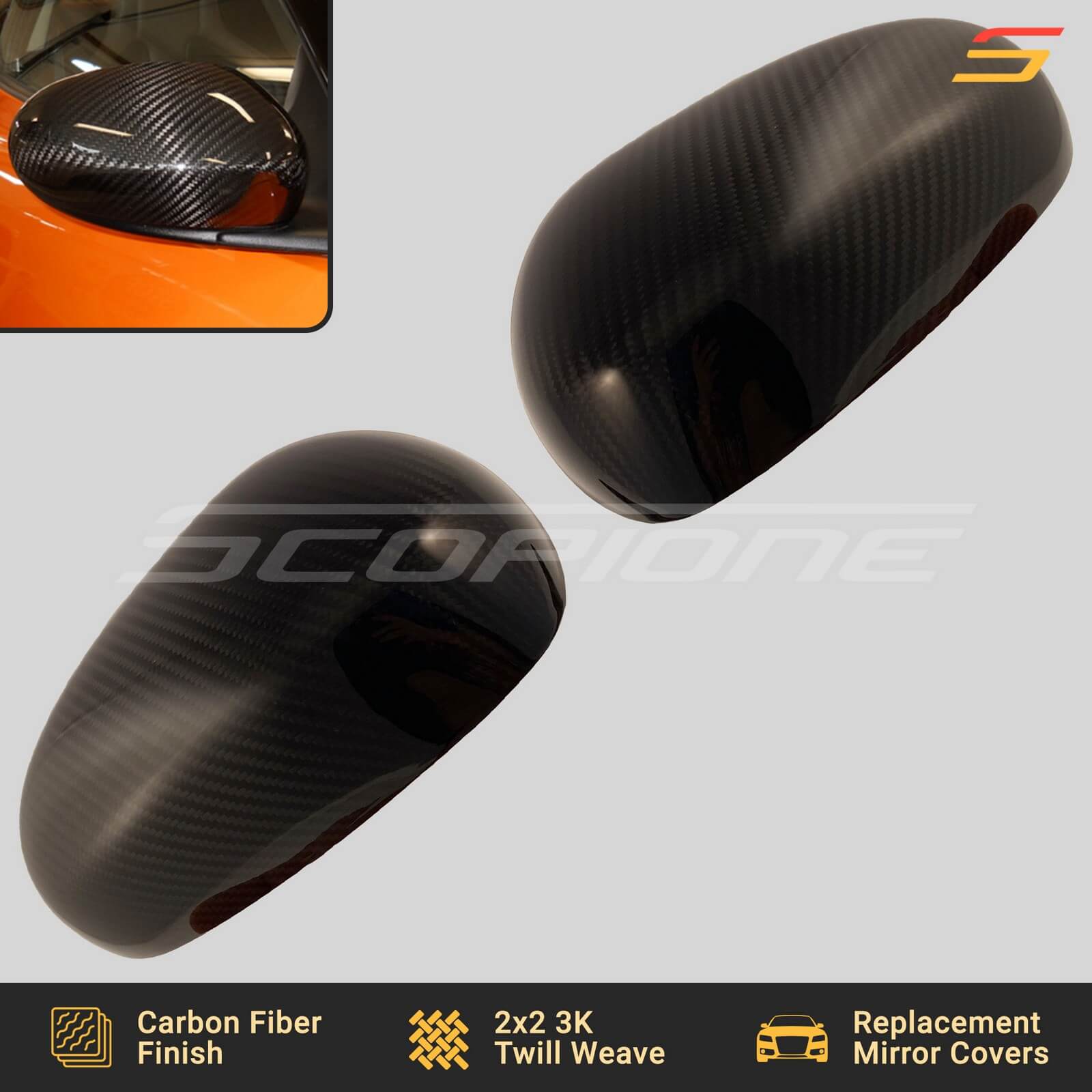
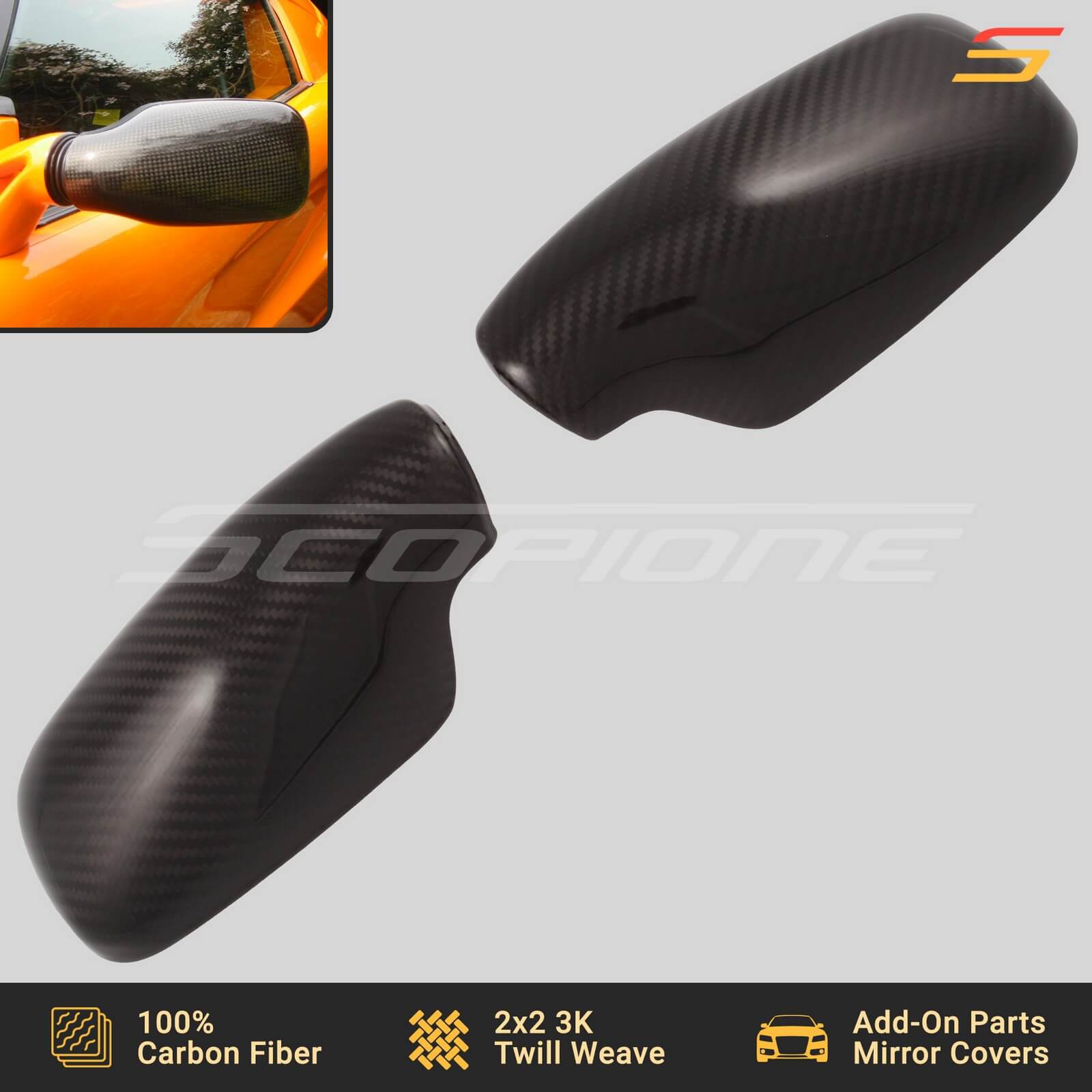
Lotus’s 47-year fiberglass tradition, from the 1957 Elite monocoque through the final Esprit in 2004, represents the longest continuous production history with composite body structures of any manufacturer in this series. That heritage created the engineering culture — forming techniques, bonding expertise, quality control processes — on which carbon-fiber integration later built. Scopione’s 2×2 3K twill-weave carbon-fiber parts for Lotus models are engineered to integrate with vehicles that were designed from inception to carry composite body panels. The precision-fit and UV-resistant clear coat finish complement a manufacturing tradition rooted in non-metallic materials.

1996–2015: The Elise Revolution — Bonded Aluminum and Composite Bodies
The Elise changed sports cars. Richard Rackham at Lotus Engineering designed a chassis from 27 extruded aluminum sections bonded with structural adhesive and mechanically fastened with rivets. The resulting tub weighed 68 kg — roughly half what a comparable steel monocoque would weigh — and delivered torsional rigidity that exceeded many cars with three times its structural mass. Composite body panels (fiberglass, later sheet molding compound) clipped onto the aluminum tub. The complete Series 1 Elise weighed under 725 kg. With 118 hp from a Rover K-Series four-cylinder, the power-to-weight ratio produced an experience that no amount of horsepower could replicate in a heavier car.
The Elise platform spawned an entire ecosystem. The Exige added a hardtop and eventually a supercharged Toyota V6 producing up to 430 hp. The Evora used a larger bonded aluminum architecture (VVA) for a 2+2 grand tourer. The first Tesla Roadster (2008) was built on a modified Elise chassis with carbon-fiber body panels — connecting Lotus’s lightweight engineering directly to the electric vehicle revolution. Carbon fiber remained largely absent from factory Lotus vehicles during this era. But the adhesive bonding techniques developed for the Elise’s aluminum chassis transferred directly to CFRP integration, since carbon-fiber panels are bonded to metallic substructures using similar processes.
Lotus Elise (1996–2021)
Julian Thomson drew the original Elise. Russell Carr refined it across Series 2 and 3. But the chassis was the revolution. Richard Rackham’s bonded aluminum extrusion tub weighed 68 kg. For context: the spare wheel in many contemporary sedans weighed more than half that. The chassis achieved its rigidity through geometry rather than mass — the extruded sections were arranged so that loads traveled through the structure with minimal material. Structural adhesive bonding distributed stress across large areas rather than concentrating it at weld points. Rivets provided mechanical backup.
Engine options evolved from the 1.8-liter Rover K-Series (118 hp) through various Toyota powertrains up to the 1.8-liter supercharged unit producing 243 hp in the Cup 250. That final variant reached 60 mph in 3.9 seconds. A car with 243 hp matching the acceleration of vehicles with twice the power, because it weighed half as much. The physics were simple. Building a car light enough to exploit them was not.
- Engine: 1.8L Rover K-Series / 1.6–1.8L Toyota, 118–243 hp
- Chassis: 68 kg bonded aluminum extrusion tub (27 extruded sections)
- 0–60 mph: 3.9 seconds (Cup 250)
- Curb weight: Under 725 kg (Series 1) to ~920 kg (Cup 250)
The Elise platform survived 25 years of continuous production. It served as the basis for the Exige, the 340R, the 2-Eleven, and in modified form the first Tesla Roadster (2008) and the Hennessey Venom GT. The Tesla connection is worth isolating: Elon Musk licensed the Elise platform and then wrapped it in carbon-fiber body panels to produce 2,450 Roadsters. Those CFRP panels — manufactured by a French firm, Sotira — demonstrated that carbon fiber could coexist with the Elise chassis architecture. No factory CFRP appeared on production Lotus-branded Elise models, but the Tesla program proved the integration concept on a Lotus-derived platform.
The bonding techniques pioneered for the Elise’s aluminum chassis — structural adhesive bonding of extruded sections, rivet-bonding for mechanical backup, epoxy-based jointing at critical nodes — apply directly to carbon-fiber integration. CFRP panels are typically bonded rather than welded. When Lotus engineers began specifying CF components for the Exige Cup 430, they were applying adhesive bonding methods refined over two decades of Elise production to a different material. The process knowledge transferred. The tooling experience transferred. The quality-control standards for structural adhesive joints transferred. Lotus had been bonding composite and metallic structures together since 1996.
Lotus Exige (2000–2021)
The Exige started as a hardtop Elise for track use. By the time the Series 3 V6 variants arrived, it had become something else entirely: a street-legal race car with a supercharged Toyota V6 generating up to 430 hp in a vehicle weighing under 1,100 kg. The Cup 430 accelerated to 60 mph in 3.3 seconds and topped out at 180 mph. The power-to-weight ratio embarrassed cars costing four or five times its price. And it was the first Lotus road car to carry significant factory carbon fiber.
The Exige Cup 430 (2017) used a carbon-fiber front splitter, carbon-fiber rear wing with endplates, a CF roof scoop, and a CF engine cover. These were functional aerodynamic devices generating measurable downforce, not decorative trim. Using CFRP for these components kept their weight minimal — critical on a car whose entire identity depended on extreme lightness. The Sport 410 offered a similar CF aero package. Together, these late-model Exige variants proved that carbon fiber could complement the Elise platform’s aluminum chassis without compromising the mass advantage.
- Engine: 1.8L Toyota supercharged / 3.5L Toyota V6 supercharged, 177–430 hp
- 0–60 mph: 3.3 seconds (Cup 430)
- Top speed: 180 mph (Cup 430)
- Dry weight: 1,056 kg (Cup 430 — lightest production Exige)
The Cup 430 was the lightest production Exige ever manufactured, at 1,056 kg dry. Carbon fiber played a direct role in achieving that figure. The CF aero package weighed significantly less than equivalent fiberglass or aluminum components would have, enabling Lotus to add larger aerodynamic surfaces without increasing total mass. Every component on a Lotus exists in tension with every other component: add downforce, and you need to subtract weight elsewhere to preserve the power-to-weight ratio. Carbon fiber resolved that tension by delivering aerodynamic function at minimal mass penalty. The material’s stiffness-to-weight ratio also meant that the larger wing and splitter surfaces resisted deflection at speed more effectively than equivalent fiberglass components, maintaining their designed aerodynamic profiles under load.
Lotus Evora (2009–2021)
The Evora was Lotus’s first all-new platform since the Elise. The VVA (Versatile Vehicle Architecture) used bonded aluminum construction scaled up from the Elise’s principles to accommodate 2+2 seating and a transversely mounted Toyota V6. Russell Carr shaped a body that served as both daily driver and track weapon. The base Evora produced 276 hp. By 2017, the GT430 had reached 430 hp from a supercharged V6 and carried more factory carbon fiber than any Lotus road car of its era.
The GT430 is the key model. Limited to 60 units worldwide, it used CF front splitter, CF canards, CF barge boards, CF side sills, CF rear wing with CF endplates, CF rear diffuser, and CF rear bumper. The carbon-fiber aero package saved approximately 20 kg compared to the GT410 while simultaneously adding larger aerodynamic devices. The trade was only possible because CF weighed less than the fiberglass equivalents at every mounting point. Sixty units was not high volume. But the GT430 proved that Lotus could specify and manufacture CFRP body components at production quality.
- Engine: 3.5L Toyota V6 / 3.5L supercharged, 276–430 hp
- 0–60 mph: 3.8 seconds (GT430)
- Top speed: 190 mph (GT430)
- GT430: 60 units worldwide, most CF-intensive Lotus road car of its era
The GT410 Sport offered a more accessible level of CF content. Both demonstrated that Lotus could integrate CFRP into a production specification rather than offering it exclusively as aftermarket or limited-edition content. The manufacturing step from the GT430’s bolt-on CF aero to the Evija’s full CFRP monocoque was enormous in engineering terms. But the commercial step — marketing carbon fiber as a Lotus factory option — was established here.
Scopione Perspective: The Elise Platform Legacy
The Elise platform’s 25-year production run established Lotus’s reputation for lightweight construction at a scale that the Elite never achieved. Scopione’s carbon-fiber components for Lotus vehicles build on this foundation, providing 2×2 3K twill-weave CF upgrades that complement the bonded aluminum chassis architecture. Mirror caps, engine covers, and aerodynamic elements finished with UV-resistant clear coat extend the factory lightweight philosophy into the aftermarket. The same precision fitment that defines the Elise platform’s body panels applies to every Scopione part.

2016–2022: Carbon Fiber Goes Factory — From Track Specials to the Last ICE Lotus
Carbon fiber transitioned from limited-run track specials to standard-catalog options during this era. The 3-Eleven, Exige Cup 430, and Evora GT430 established CFRP as a core material for the brand’s highest-performance variants. Then Geely acquired Lotus in 2017, investing billions in a new factory at Hethel, a dedicated electric hypercar program, and three new vehicle platforms. The Emira arrived in 2022 as the final internal-combustion Lotus, carrying an optional Carbon Pack that brought CF to a vehicle designed for substantially higher production volume than any previous CF-equipped Lotus. Carbon fiber was no longer limited to 60-unit specials. It had entered the standard options list.
The era also bridged two structural worlds. The Elise-platform cars (3-Eleven, Exige, final Evora variants) used bolt-on CFRP aero components attached to a bonded aluminum chassis. The Evija program — announced in 2019 — committed Lotus to building a full carbon-fiber monocoque for the first time, where the CFRP would serve as primary structure rather than secondary panels. The engineering gap between those two approaches is substantial, but Lotus’s composite heritage provided the institutional foundation to cross it.
Lotus 3-Eleven (2016–2017)
The 3-Eleven stripped away everything. No roof. No doors. No windscreen on the Race version. An open-cockpit sports car powered by a 3.5-liter supercharged Toyota V6 producing 430 hp (Race) or 410 hp (Road). Limited to 311 units, matching the type number. The Road version reached 60 mph in 3.3 seconds. The Race version lapped Hockenheim faster than a Porsche 918 Spyder — a car costing roughly ten times as much.
Carbon-fiber components on the 3-Eleven included body panels, the rear diffuser, and aerodynamic elements. The open-cockpit format reduced total panel area, which made the CF content proportionally significant relative to the vehicle’s overall surface. As a limited-production track-focused car, the 3-Eleven served as a development platform for the CF integration techniques Lotus applied to the Exige Cup 430 and Evora GT430 a year later.
- Engine: 3.5L Toyota V6 supercharged, 410 hp (Road) / 430 hp (Race)
- 0–60 mph: 3.3 seconds (Road) / 3.1 seconds (Race)
- Production: 311 units
- Top speed: 174 mph (Road) / 180 mph (Race)
The 3-Eleven demonstrated that Chapman’s core philosophy — performance through minimum weight rather than maximum power — remained viable against modern competitors with ten times the budget. The Hockenheim result was not a statistical anomaly. A car weighing under 900 kg with 430 hp and proper aerodynamics will embarrass heavier machinery regardless of horsepower. Carbon fiber contributed to keeping the 3-Eleven under that threshold. And it introduced the supply chain relationships — pre-preg CF suppliers, autoclave facilities, structural bonding specialists — that Lotus expanded for the Emira and Evija programs.
Lotus Emira (2022–Present)
The last ICE Lotus. Every vehicle Lotus builds after the Emira will be fully electric. Designed from the ground up on a new extruded and bonded aluminum platform, the Emira was engineered to be more refined than any previous Lotus without abandoning the lightweight ethos. Two engine options: an AMG-sourced 2.0-liter turbo-four producing 360 hp, and a Toyota-sourced 3.5-liter supercharged V6 producing 400 hp. The V6 First Edition reached 60 mph in 4.2 seconds and 180 mph flat out.
The interior represented a transformation in Lotus build quality. Leather, Alcantara, a modern infotainment system, and a fit-and-finish level competitive with the Porsche Cayman — something no previous Lotus had attempted at this price point. The optional Carbon Pack includes carbon-fiber mirror caps, a CF roof panel insert, and a CF engine cover. An extended package adds a CF front splitter and CF rear diffuser. The CFRP content is modest relative to the GT430, but its significance lies in scale. The Emira is built for substantially higher volume than any previous CF-equipped Lotus.
- Engine: 2.0L AMG turbo-four (360 hp) / 3.5L Toyota V6 supercharged (400 hp)
- 0–60 mph: 4.2 seconds (V6 First Edition)
- Top speed: 180 mph
- CF content: Optional Carbon Pack (mirror caps, roof insert, engine cover, splitter, diffuser)
As the bridge between Lotus’s combustion history and its electric future, the Emira normalizes carbon fiber across the brand’s lineup rather than confining it to special editions. The Carbon Pack is listed on the standard configurator, available to any buyer. That accessibility matters for aftermarket demand: when factory CF options demonstrate the material’s visual and functional qualities to a wider Lotus audience, more owners seek carbon-fiber upgrades for existing and new models.
The Emira also introduced manufacturing processes that informed subsequent Lotus vehicles. The new Hethel production line — funded by Geely’s investment — uses robotic adhesive application for chassis bonding, laser alignment for panel gaps, and environmental controls for composite storage and handling. These systems were designed to accommodate both fiberglass and carbon-fiber panels on the same line, allowing the Emira to mix material types across different option packages without retooling. The production engineering matters because it scales: the techniques validated on the Emira feed forward into the Evija program and future electric platforms where CFRP content will increase. The Emira closes the combustion chapter with carbon fiber firmly embedded in the brand’s production vocabulary.
Scopione Perspective: Factory CF Meets Aftermarket
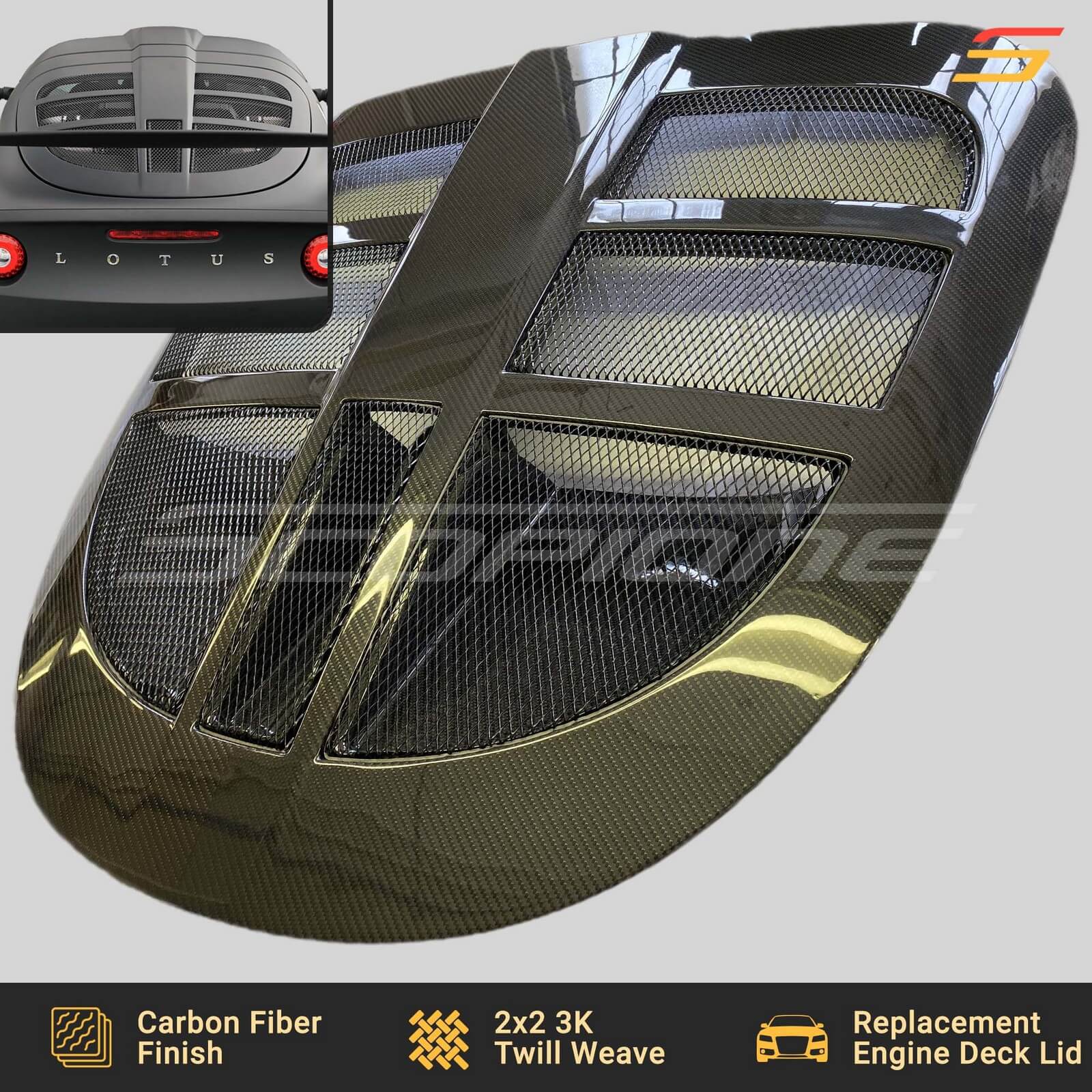
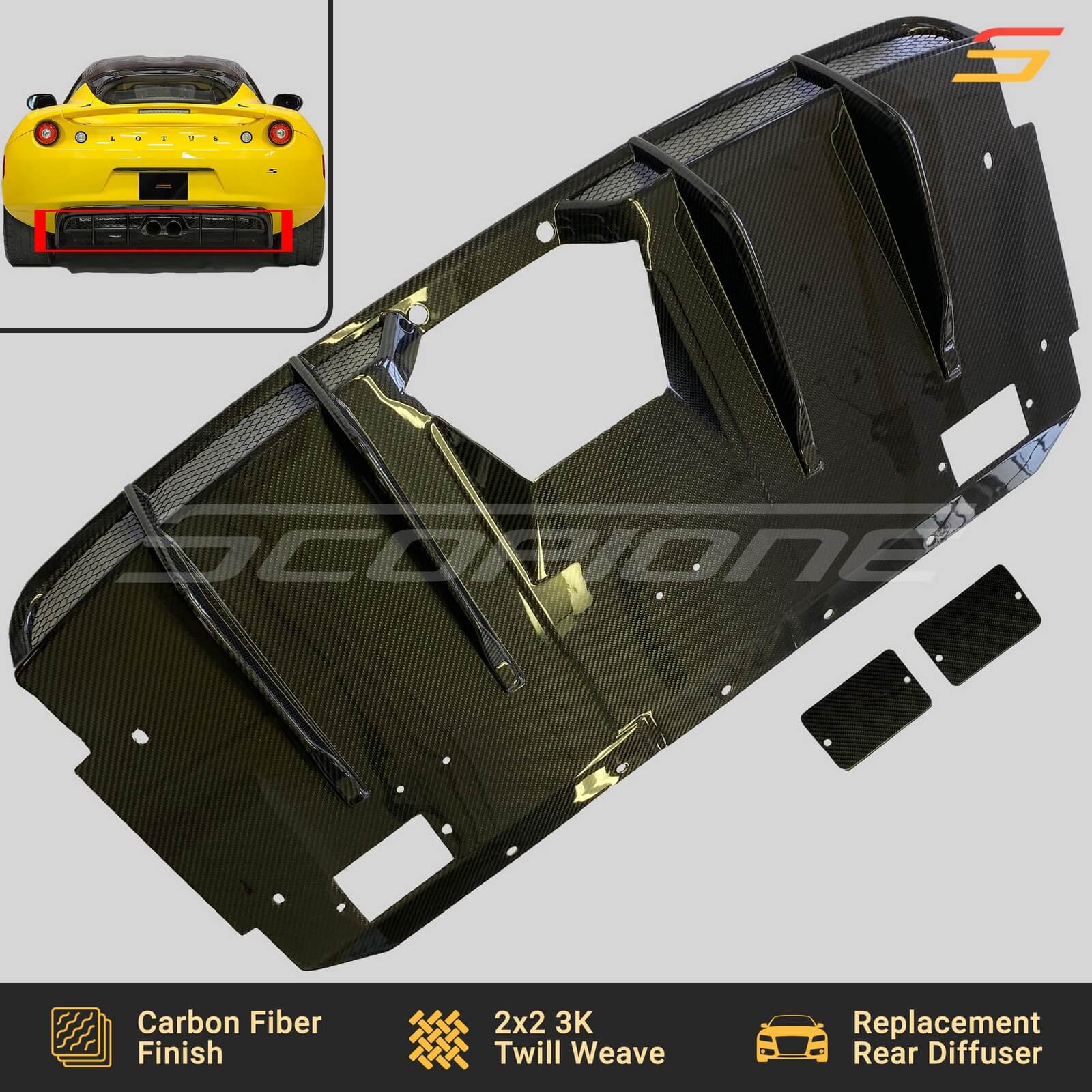
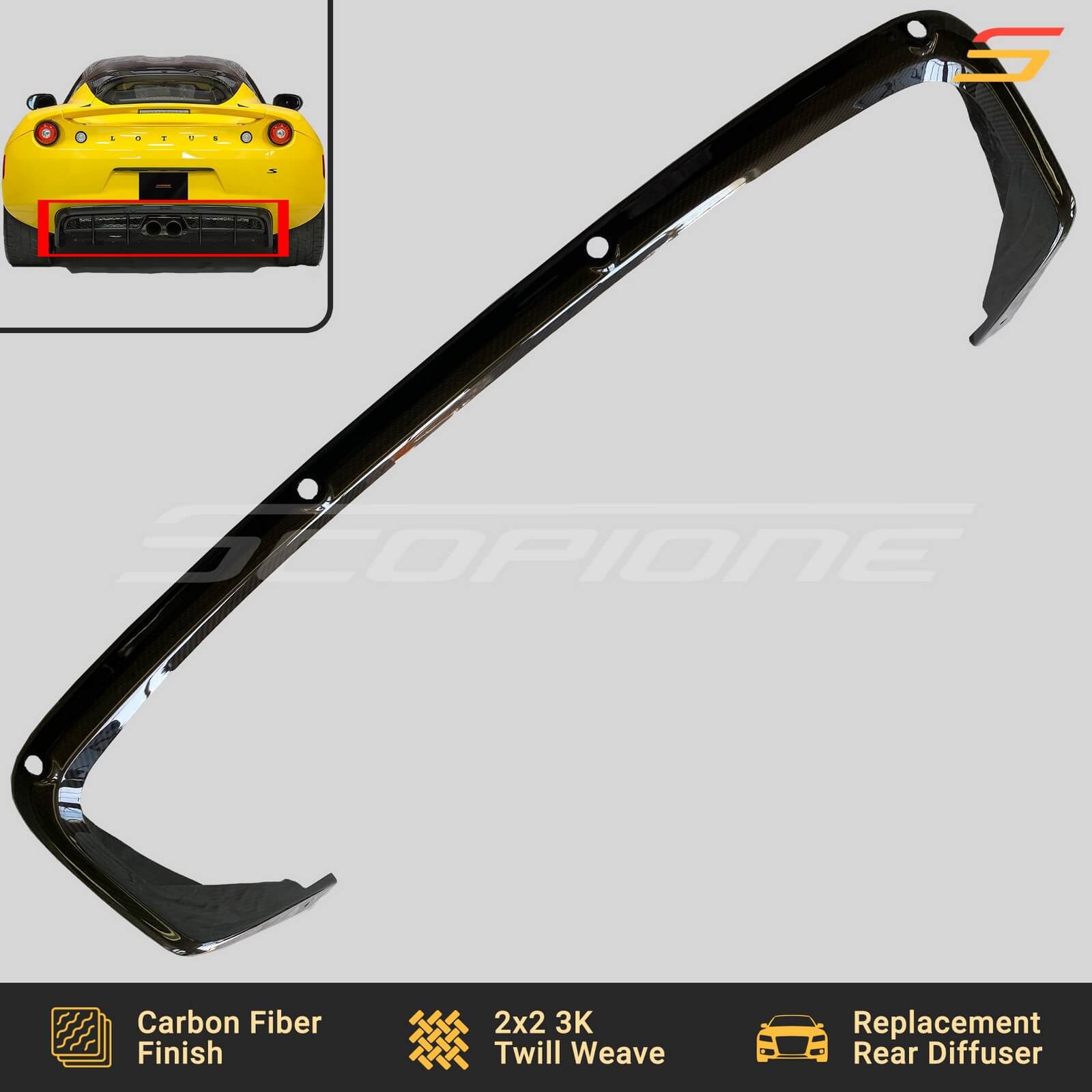
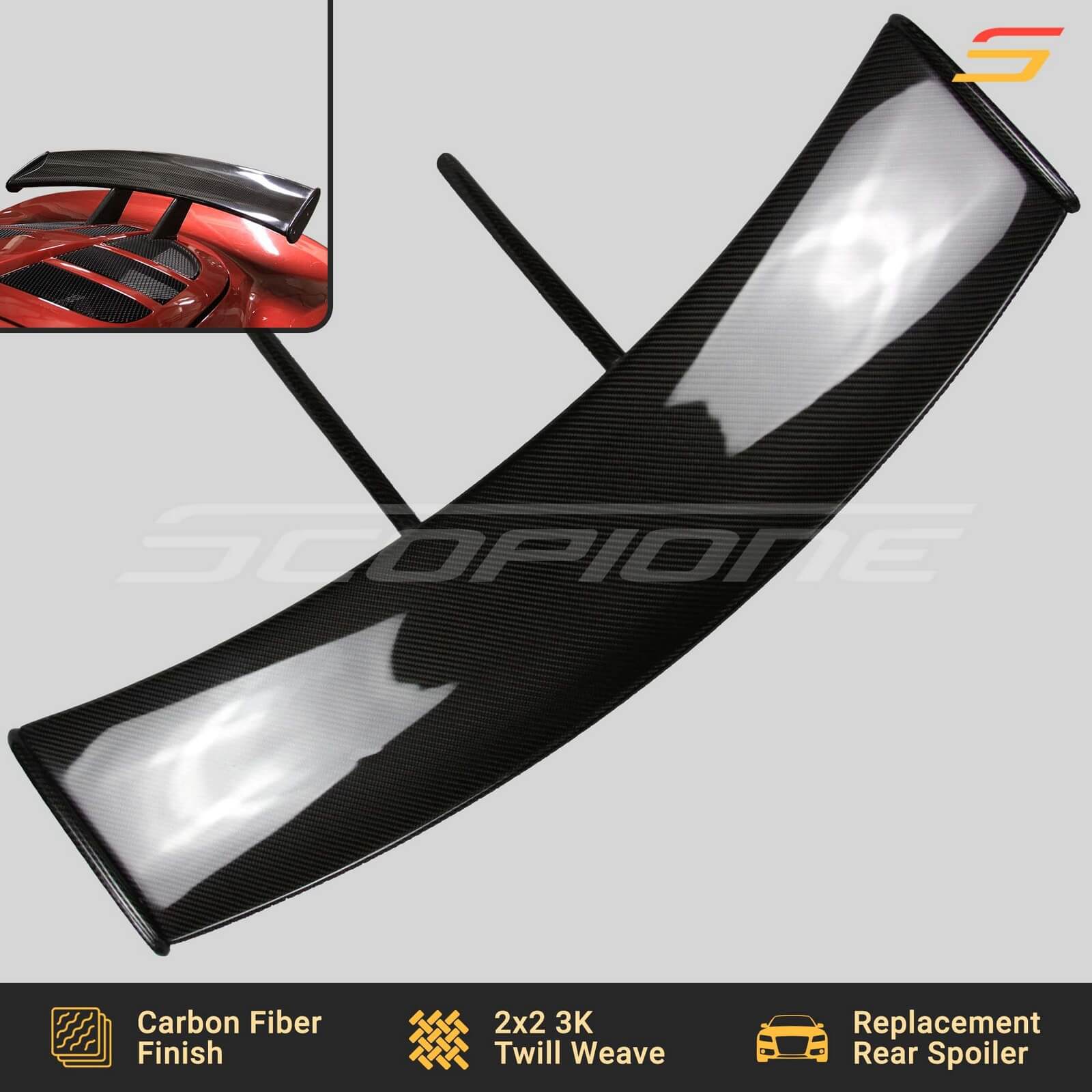
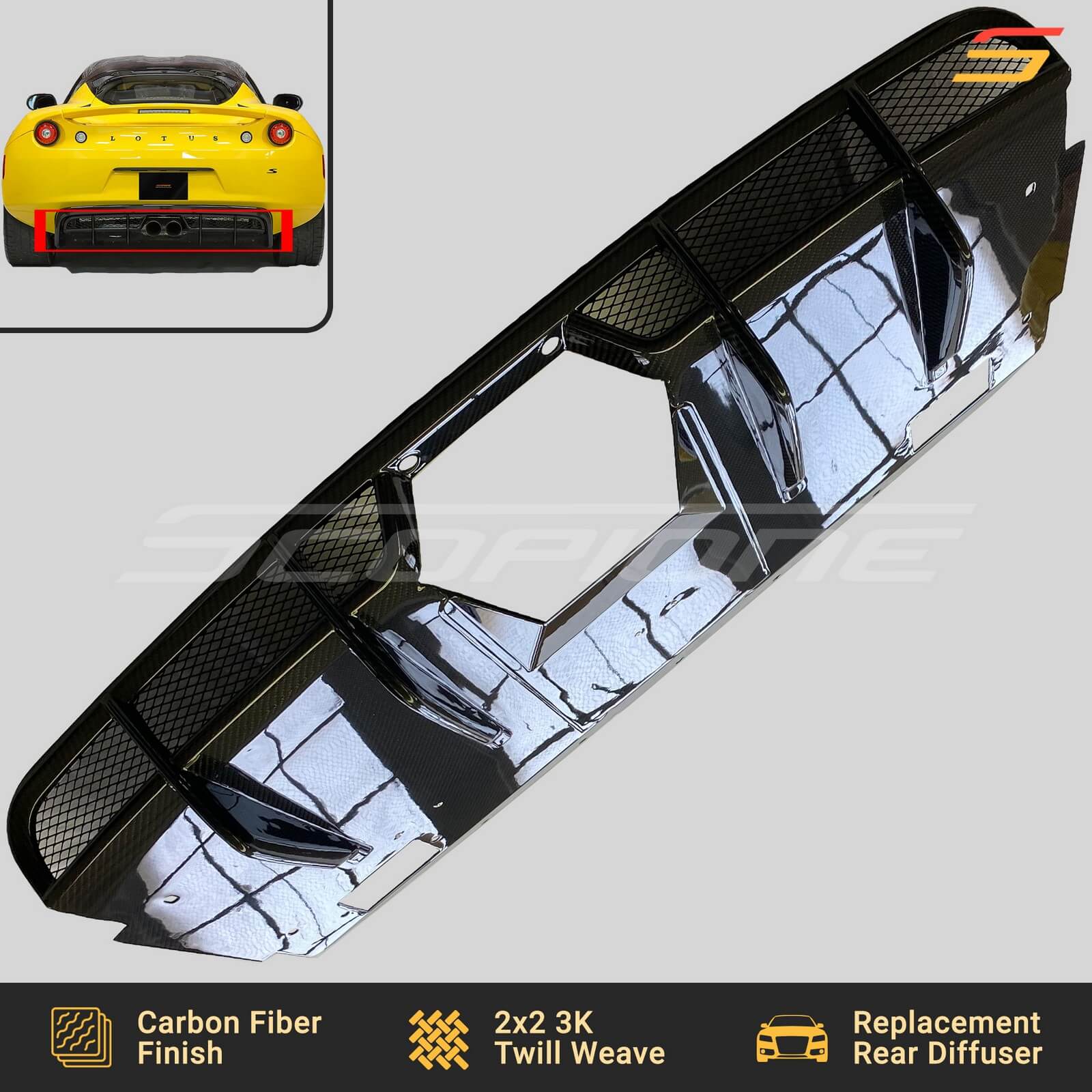
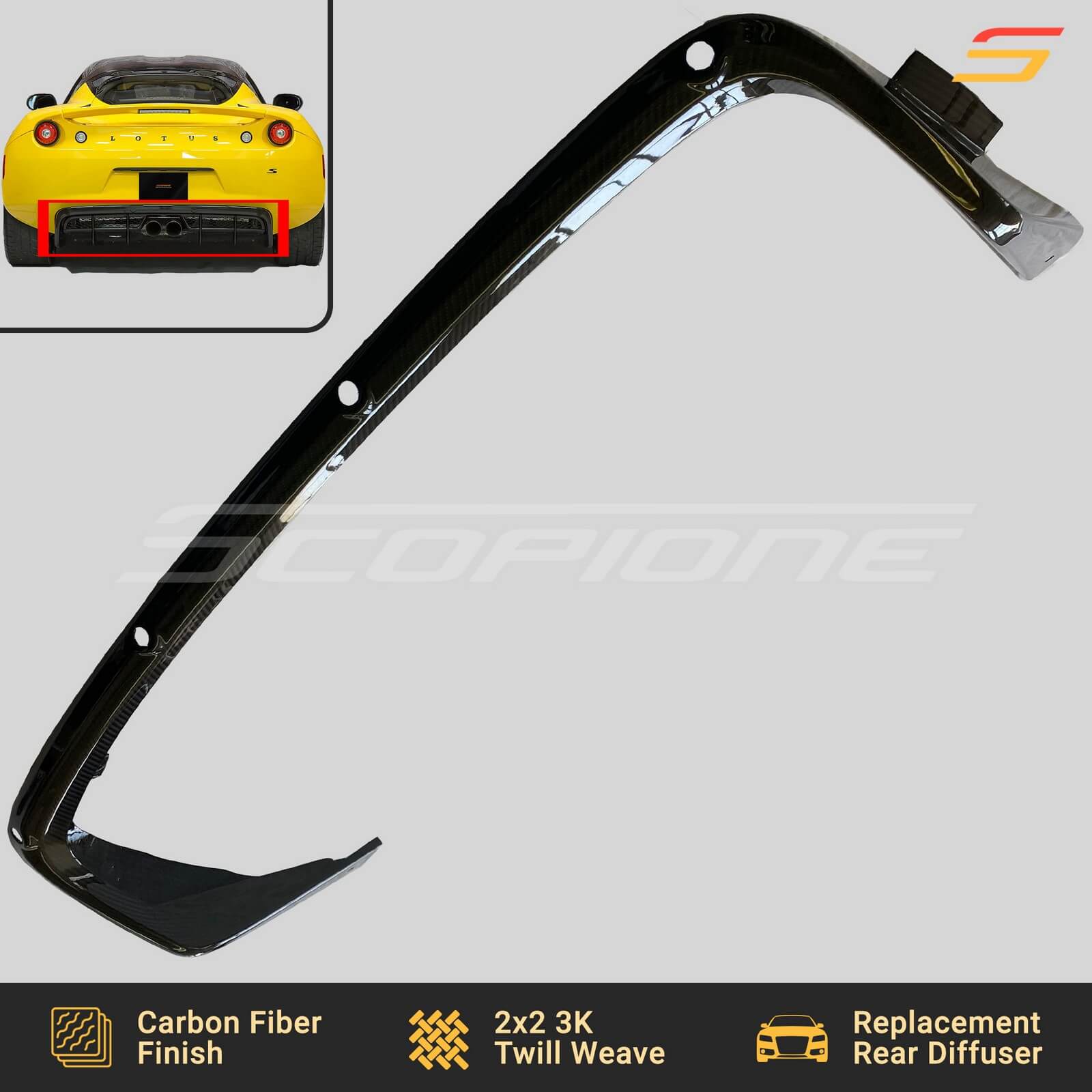
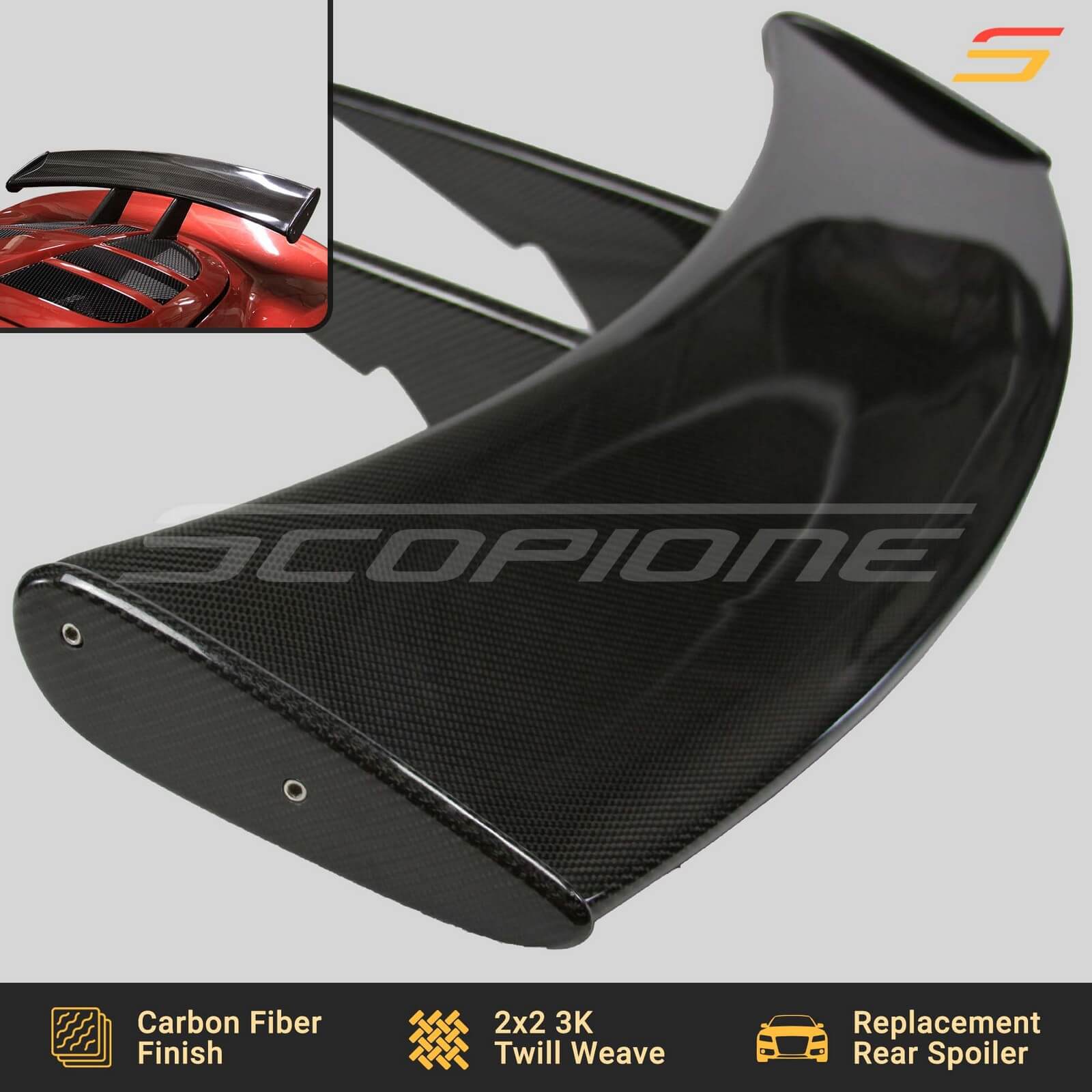
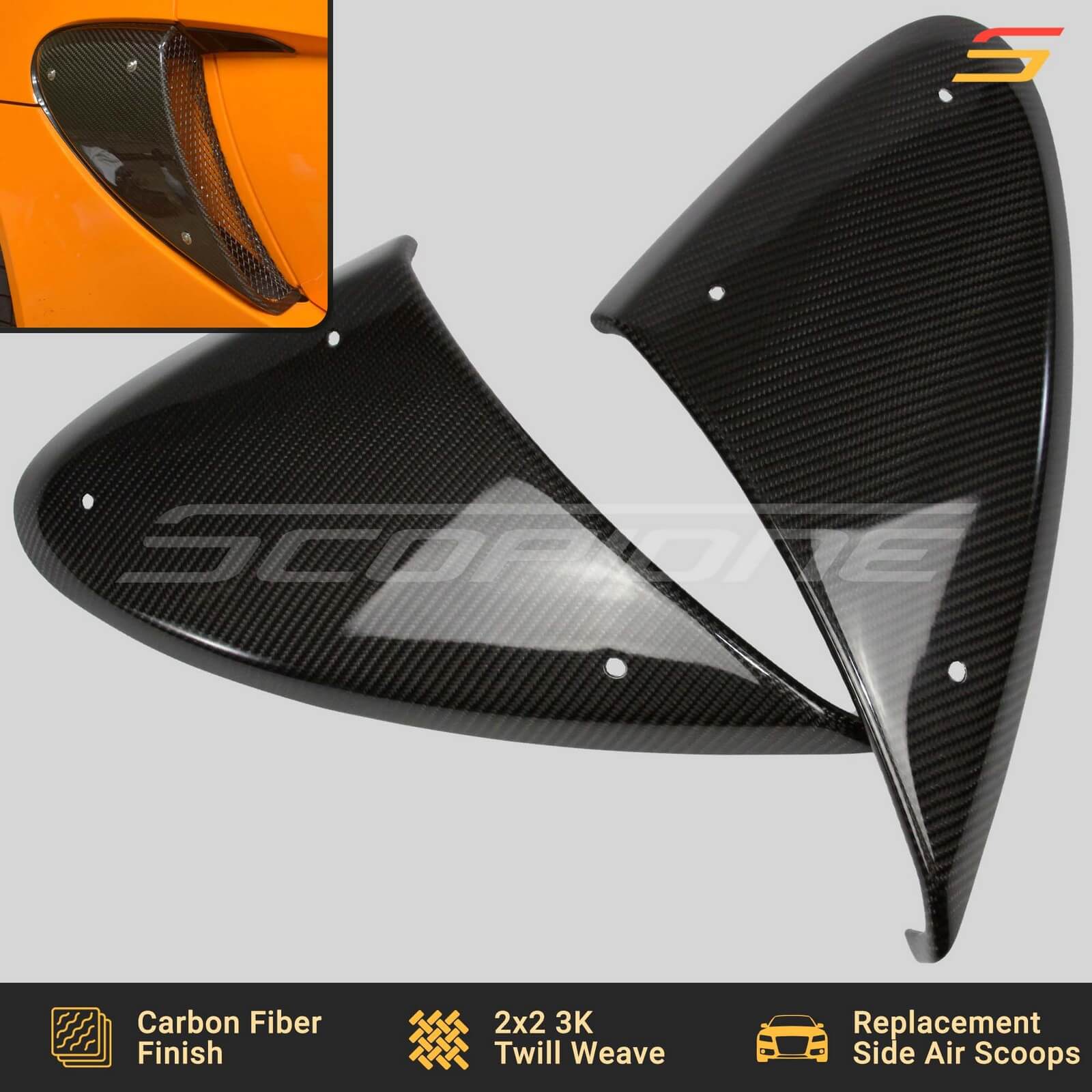
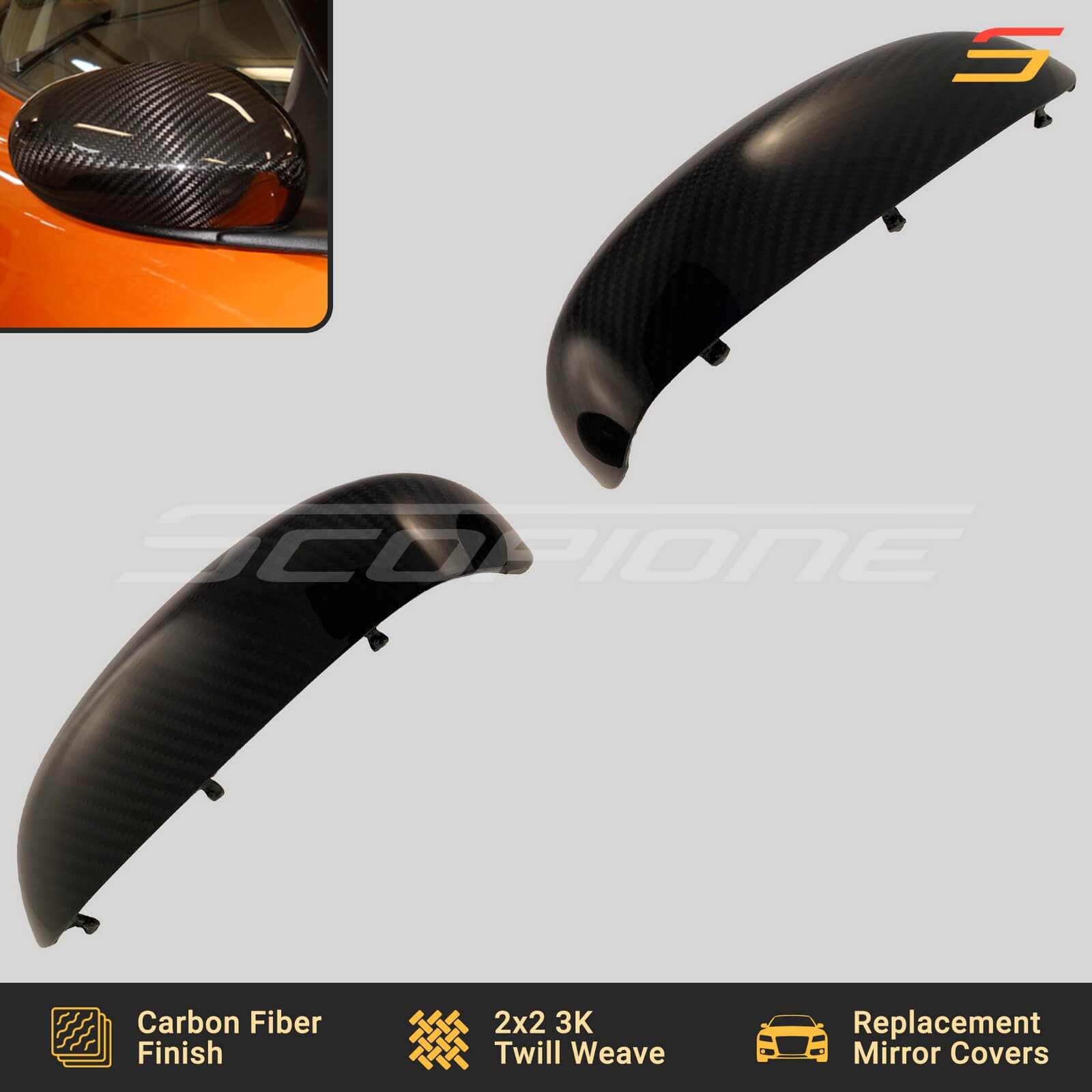
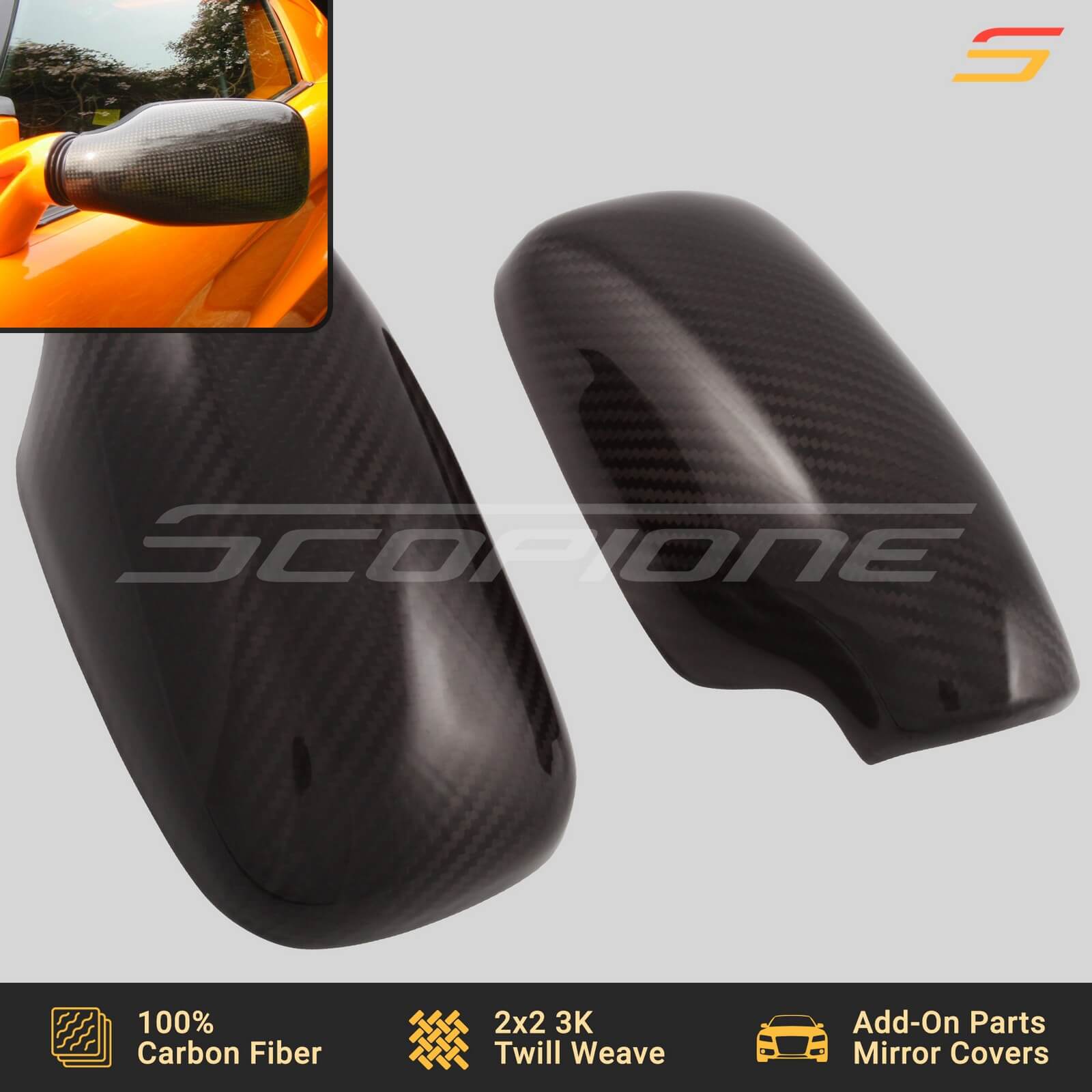
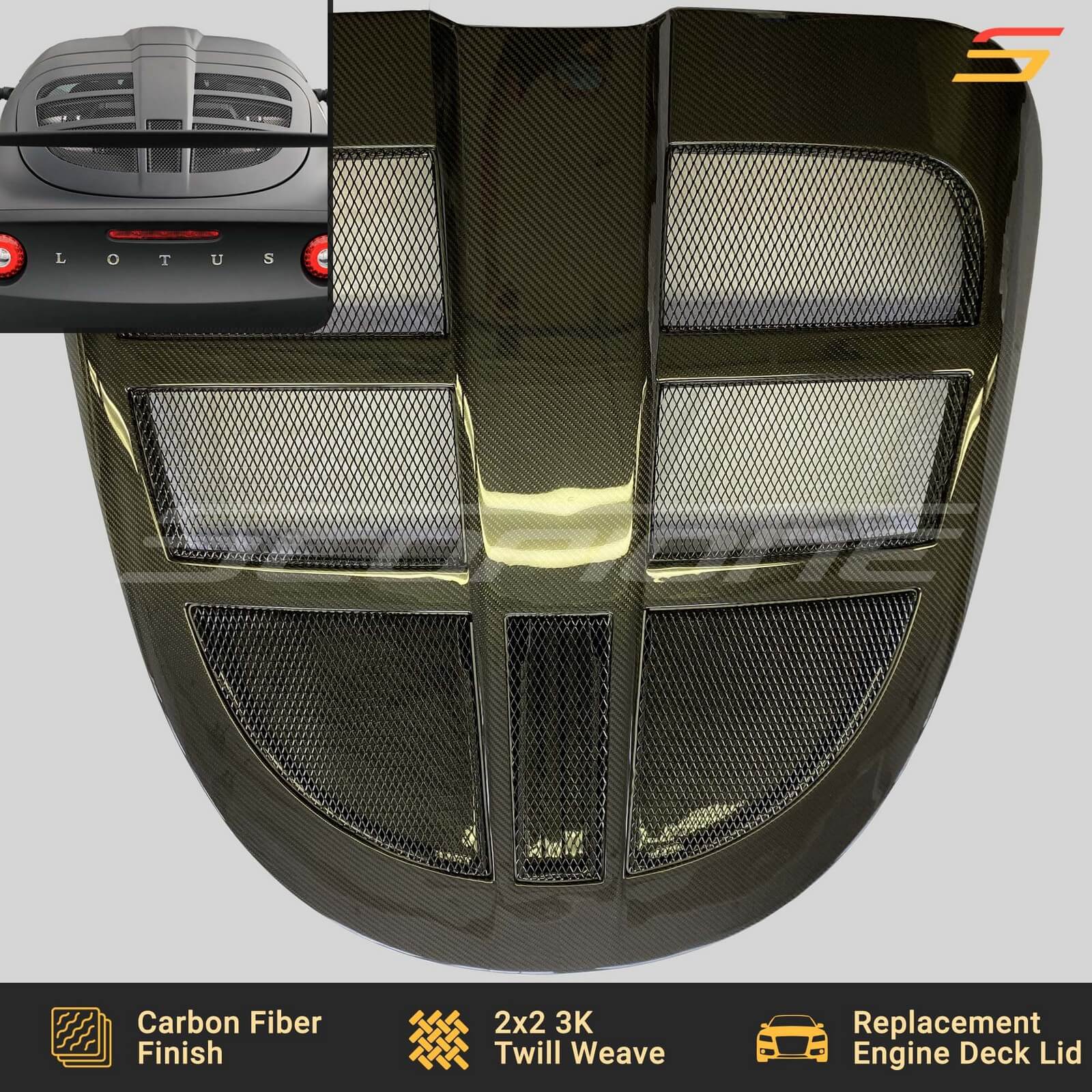
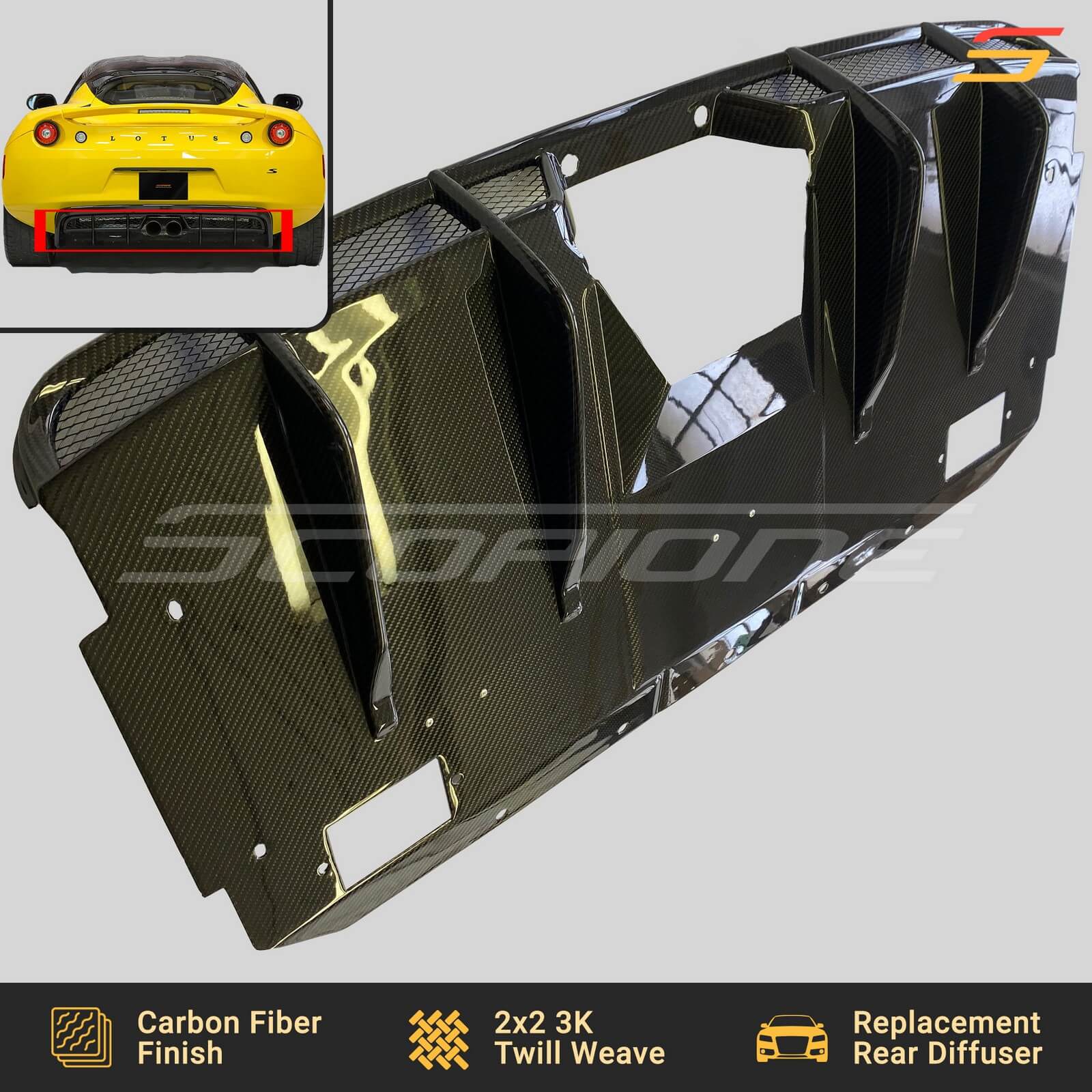
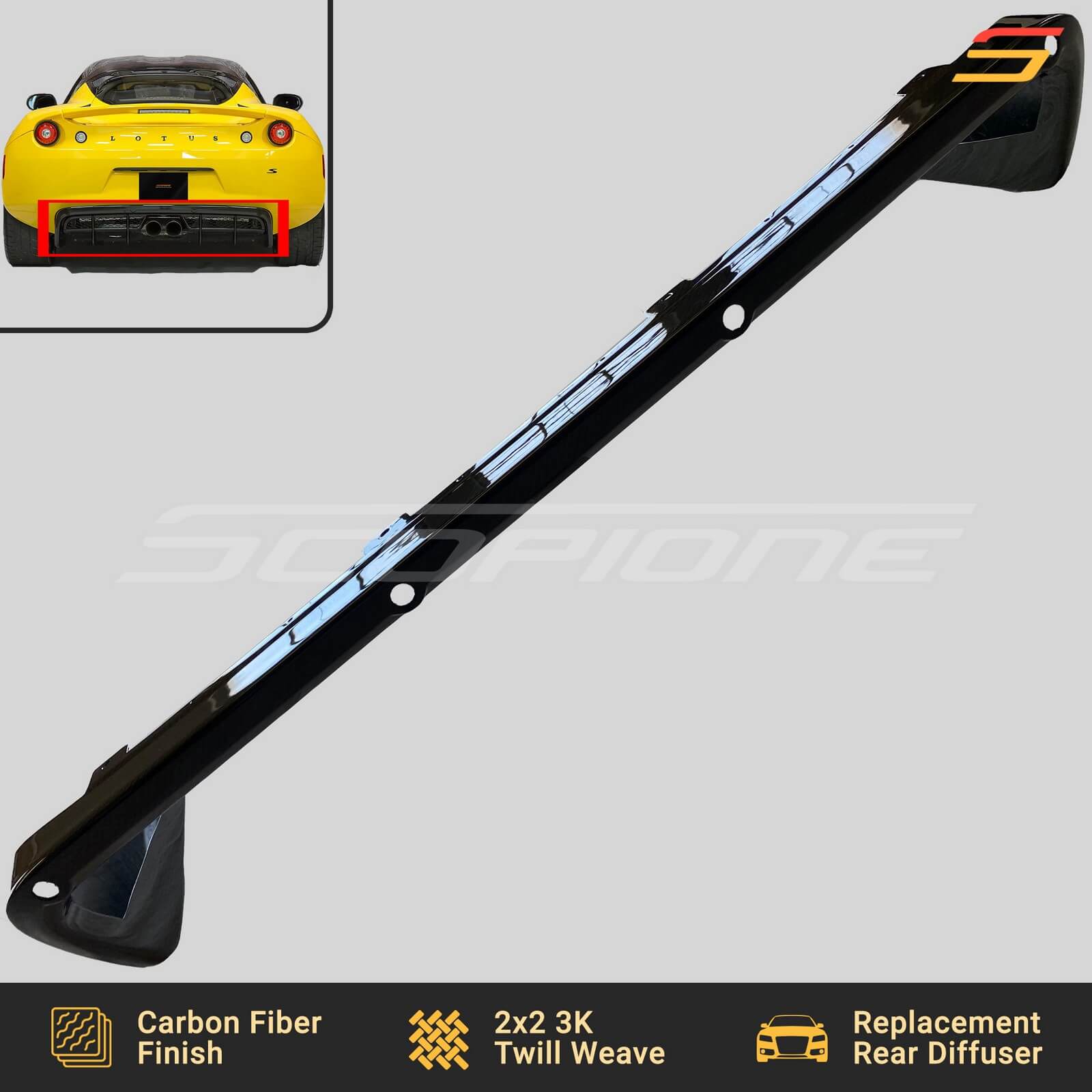
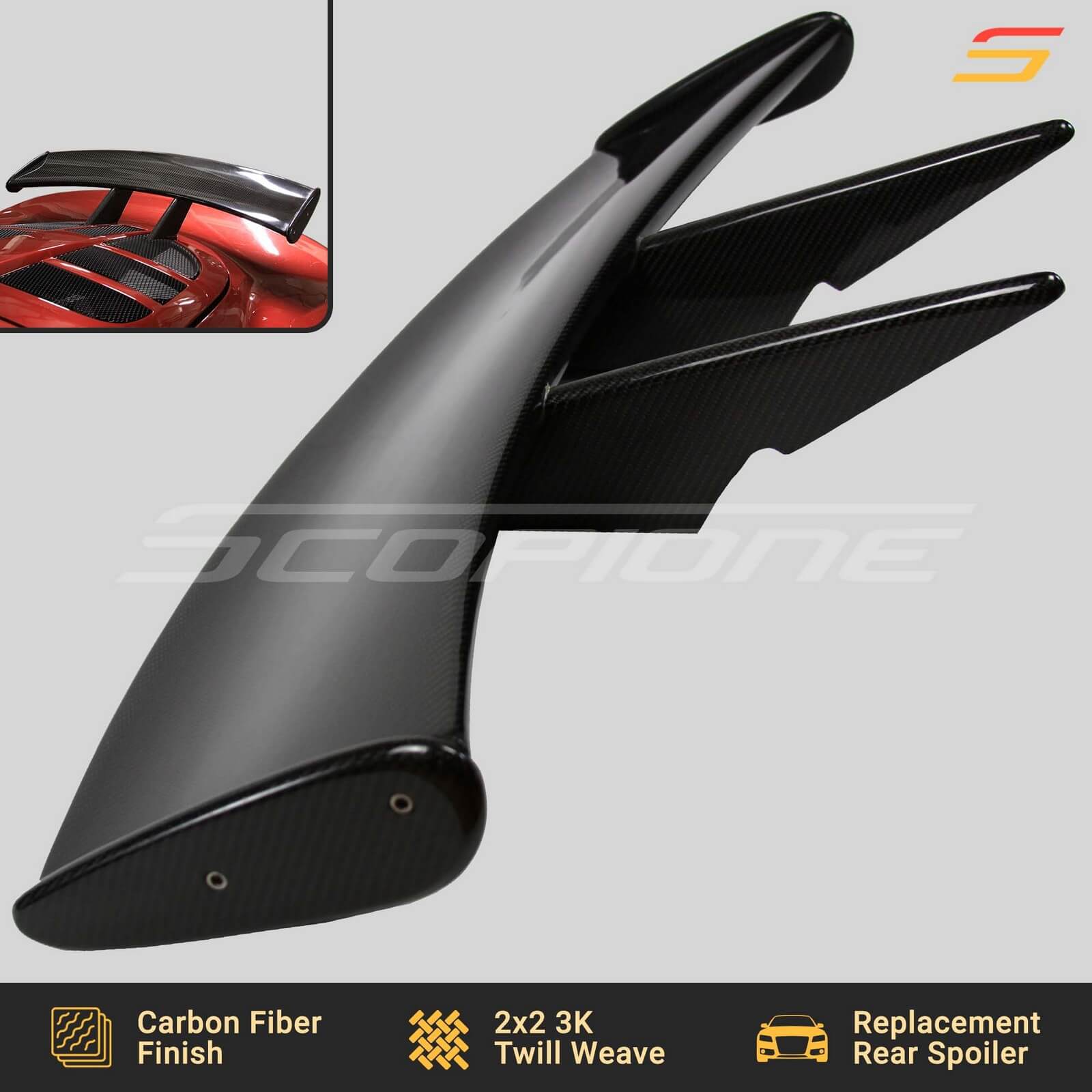
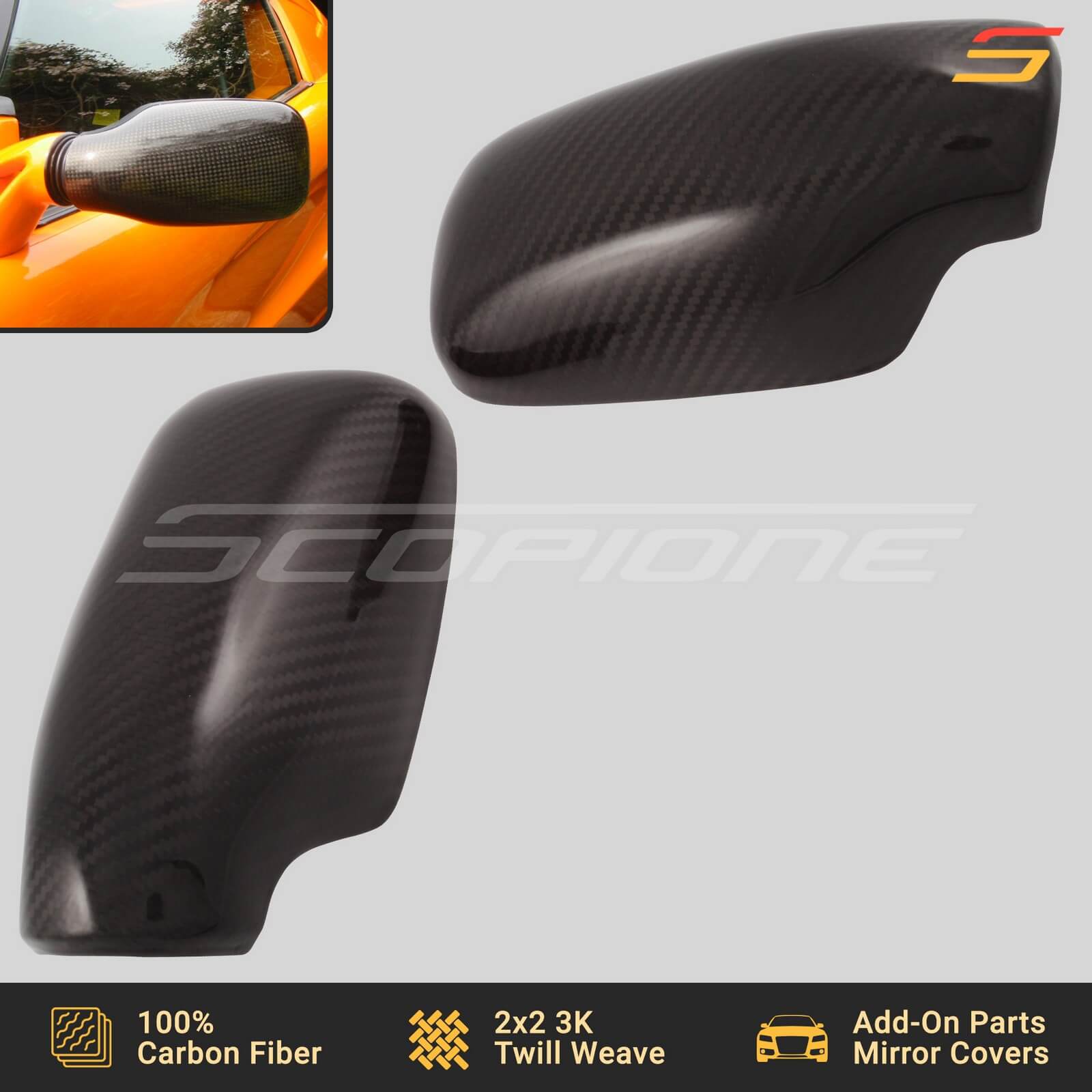
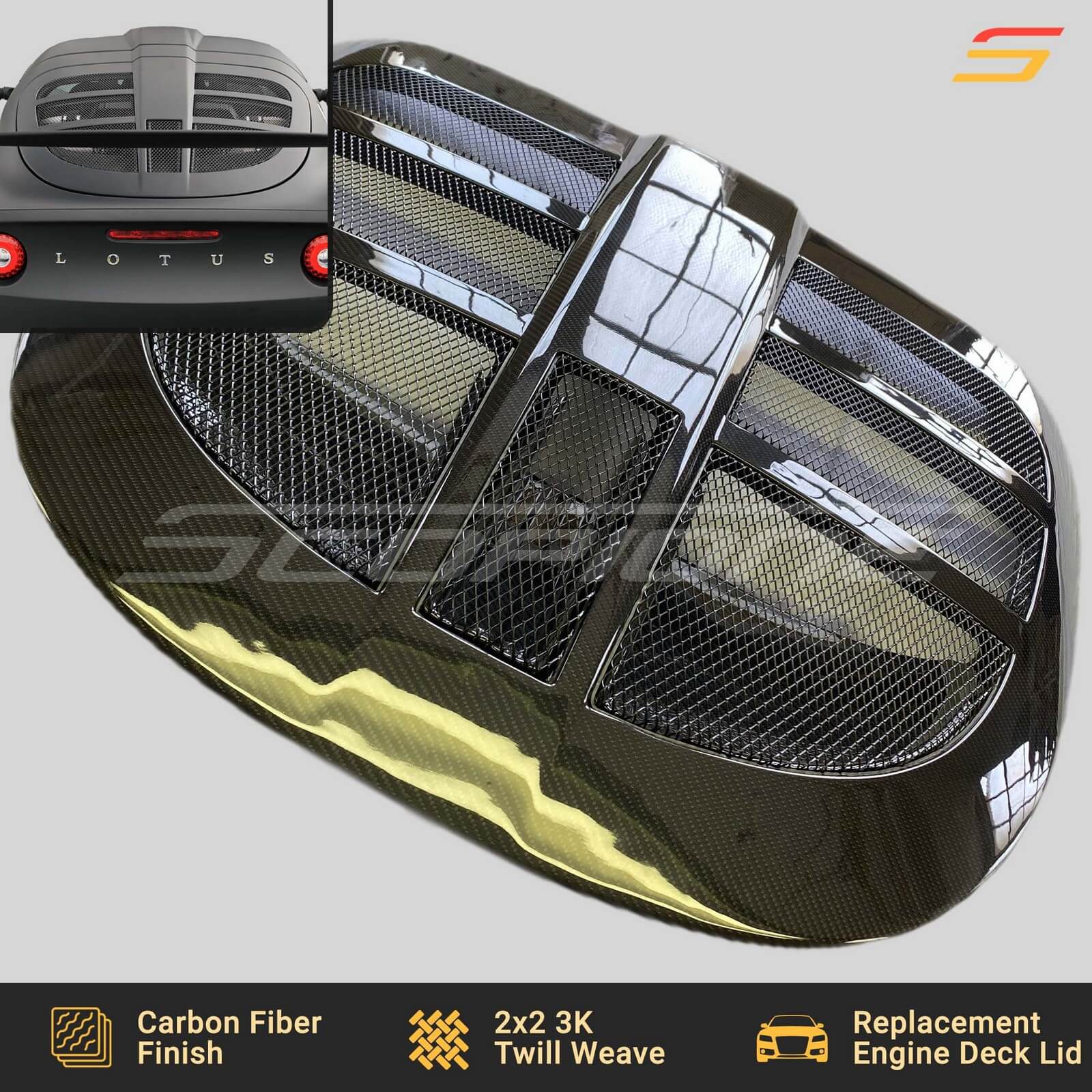
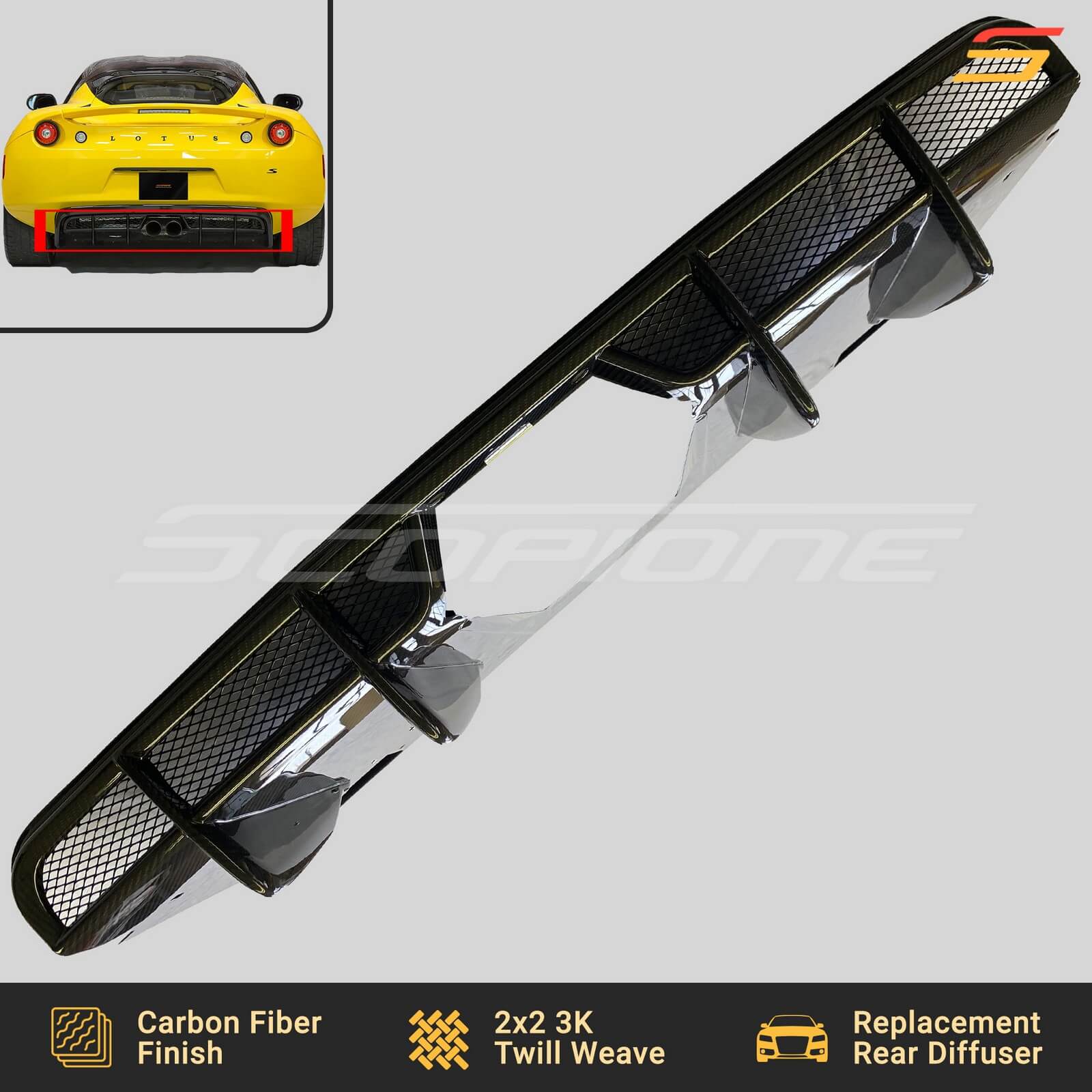
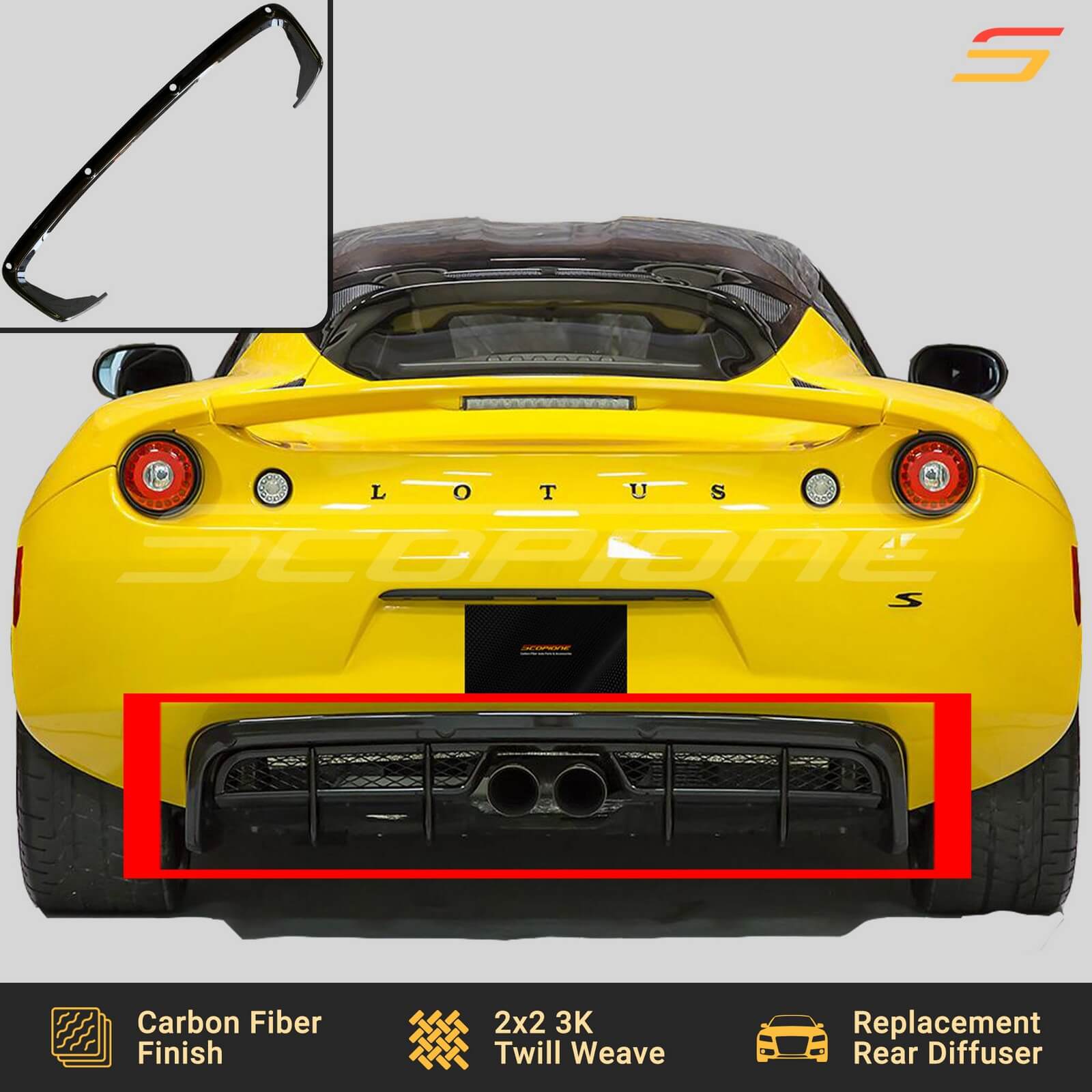
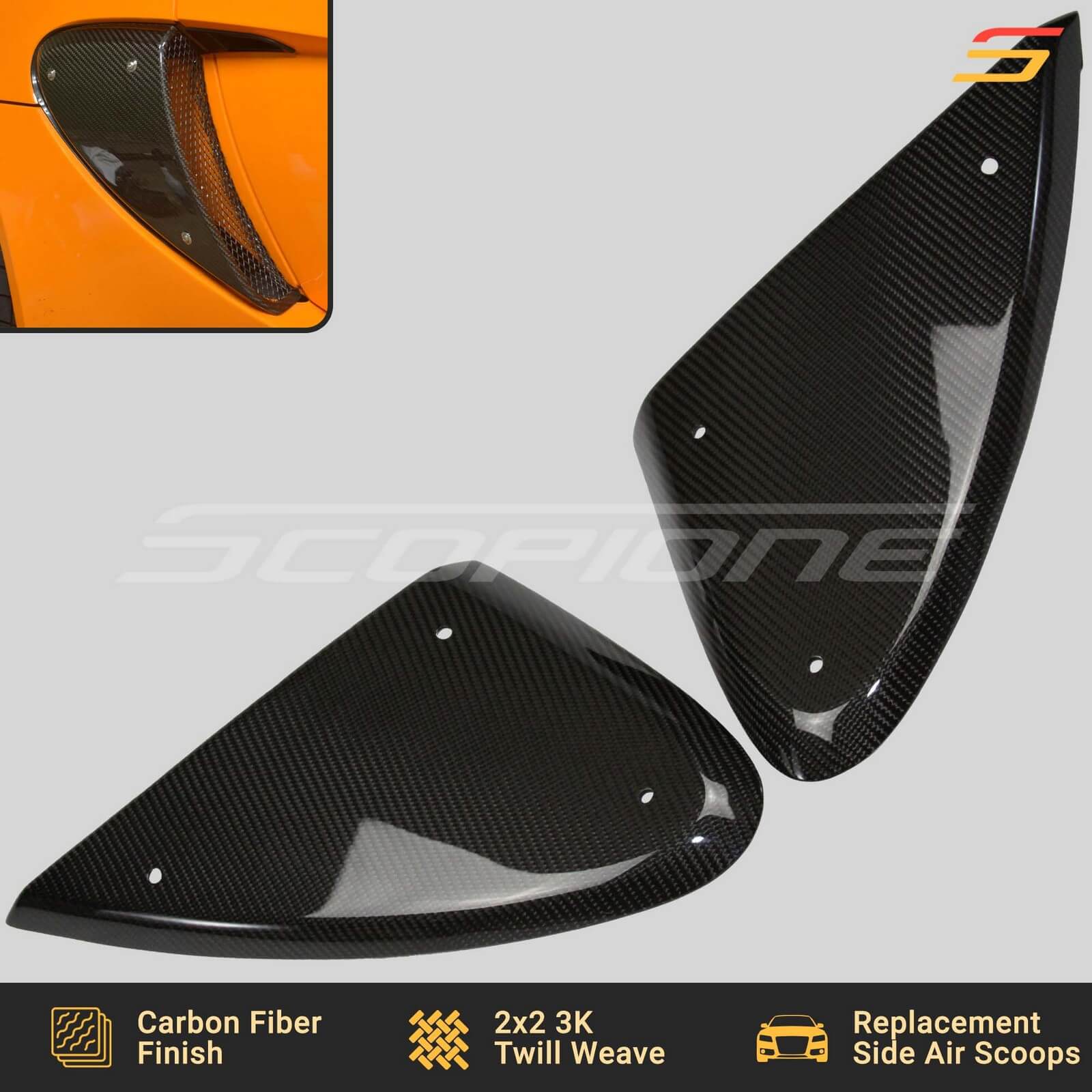
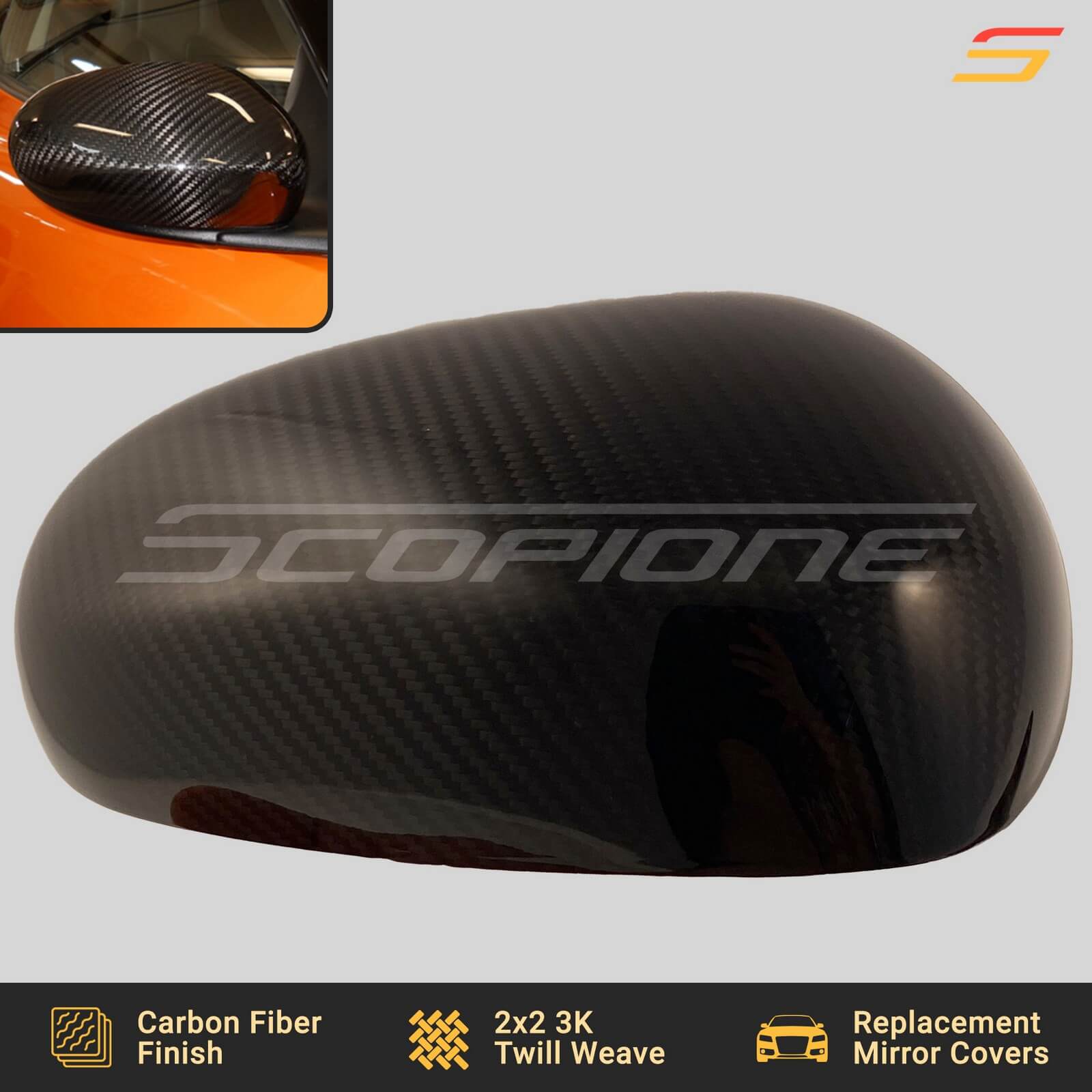
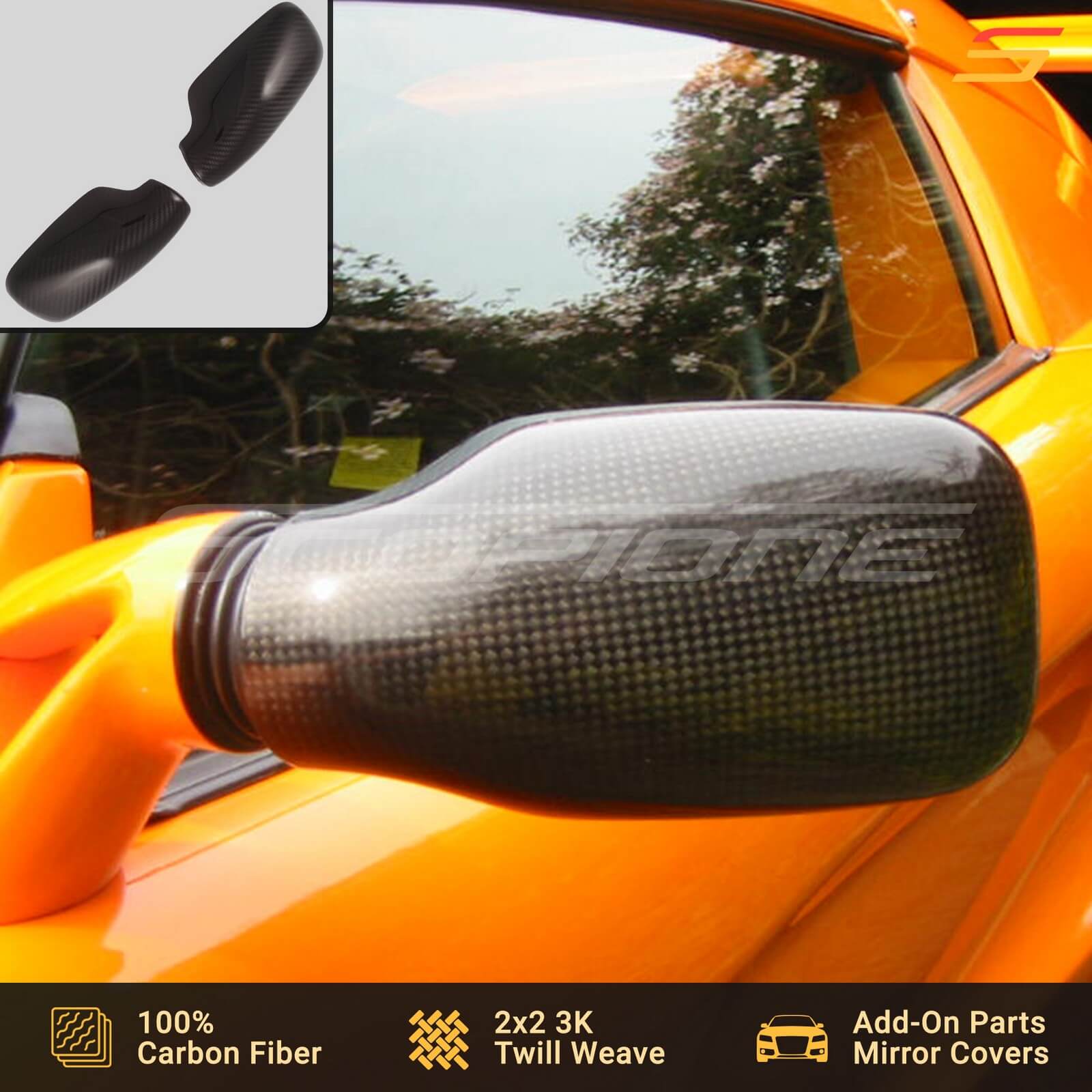
The Emira’s optional Carbon Pack brought factory CFRP to a broader Lotus audience than the 60-unit GT430 or 311-unit 3-Eleven ever could. Scopione’s 2×2 3K twill-weave parts extend that accessibility further, offering CF mirror covers, an engine hood/tailgate cover, side air intake scoops and aerodynamic components — a rear spoiler wing and rear bumper diffusers — for the Elise, Exige, Europa and Evora at price points below the factory options. Each part matches the weave quality and UV-resistant clear coat finish that Lotus buyers associate with carbon fiber from the factory catalog.


2023–Present: CFRP Monocoques and the Electric Transformation
Lotus’s electric pivot is the most ambitious transformation in the sports car industry. The Evija (Type 130) is a 2,000 PS electric hypercar built around a full carbon-fiber monocoque — the most structurally advanced use of CFRP in Lotus history and the direct descendant of the 1957 Elite’s fiberglass monocoque. The Eletre (Type 132) is Lotus’s first SUV. The Emeya (Type 133) is an electric four-door GT. Carbon fiber appears in varying degrees across all three: structural on the Evija, aerodynamic and decorative on the Eletre and Emeya. Geely’s investment — new platforms, new factories, and a design center in Warwickshire — has given Lotus the resources to pursue composites at a scale Chapman could never have achieved from the Hethel facility alone.
The Evija demands attention. Four electric motors. One per wheel. 2,000 PS. A target weight of 1,680 kg for an electric hypercar carrying a substantial battery pack. That weight target is achievable because the monocoque is carbon fiber. An equivalent aluminum structure would weigh more and require a larger battery to deliver the same range, creating a weight spiral that compounds with every kilogram. CFRP breaks that cycle. The same material science advantage that made the 1957 Elite lighter than its metal-framed competitors now makes the Evija lighter than its electric hypercar peers.
Lotus Evija (2024–Present)
Type 130. Full carbon-fiber monocoque. Four electric motors producing 2,000 PS and 1,700 Nm. Zero to 60 in under 3 seconds. Top speed over 200 mph. Limited to 130 units — matching the type number in a Lotus tradition dating to the Seven. Russell Carr shaped the body around a central air tunnel that channels airflow through the car and exits through venturi openings at the rear, generating downforce without a traditional rear wing. Active aerodynamic elements adjust to driving conditions.
The CFRP monocoque is the structural heart. It houses the battery pack, mounts all four electric motors, provides crash structures, and serves as the foundation for every other component. The tub is autoclave-cured for maximum stiffness at minimum weight — the same manufacturing process used by F1 teams and hypercar manufacturers including Lamborghini (Aventador) and McLaren (every road car since the MP4-12C). This is not a metallic chassis with carbon panels bolted on. The carbon fiber IS the chassis. The parallel with the 1957 Elite is direct: both use a composite material as primary structure. The difference is 67 years of material science advancement, from fiberglass at 75 hp to carbon fiber at 2,000 PS.
- Powertrain: Four electric motors, 2,000 PS (1,972 hp) / 1,700 Nm
- Structure: Full CFRP monocoque (autoclave-cured)
- 0–60 mph: Under 3.0 seconds
- Target weight: 1,680 kg
- Production: 130 units
The Evija’s target weight of 1,680 kg positions it as one of the lightest electric hypercars attempted. Battery mass is the dominant constraint in electric vehicle design, and every kilogram saved from the body structure translates to either extended range or reduced battery size — both of which improve the vehicle’s overall efficiency. The CFRP monocoque is not decorative. It is the engineering solution to a physics problem that only composites can solve at this performance level.
Williams Advanced Engineering — the engineering consultancy arm of the Williams F1 team — developed the Evija’s battery pack and electric powertrain system. The collaboration connects Lotus back to Formula 1’s composite expertise through a different path than its own racing history. The battery cells sit within a structural housing integrated into the CFRP monocoque, using the tub itself as a mounting surface rather than adding a separate battery enclosure. This integration reduces parasitic weight: the structure serves double duty as both chassis and battery frame. The engineering approach mirrors aerospace composite design, where multi-functional structures eliminate dedicated mounting hardware. Chapman would recognize the logic.
Lotus Eletre (2023–Present)
Lotus’s first SUV. Built on the EPA (Electric Premium Architecture) platform developed with the Geely group and manufactured in Wuhan, China. Three variants: Eletre (603 hp), Eletre S (603 hp with upgraded specification), and Eletre R (905 hp). The R reaches 60 mph in 2.95 seconds — among the fastest SUV acceleration figures available from any manufacturer. A deployable rear spoiler, air-channeling body surfaces, and active aerodynamic elements reflect Lotus’s racing heritage applied to a vehicle format that Colin Chapman could never have anticipated.
The Eletre carries the highest production volume of any Lotus in history. Carbon-fiber content consists of optional styling packages: CF mirror caps, CF side skirts, CF front splitter accents, and CF rear diffuser trim. The R variant includes additional CF aero elements as standard. The EPA platform’s multi-material construction uses high-strength steel, aluminum, and strategically placed composite reinforcements — an approach similar to what BMW achieves with the CFRP-reinforced passenger cell on the iX. The CF content is aerodynamic and visual rather than structural, but it extends carbon fiber to a vehicle category Lotus has never occupied.
- Powertrain: Dual electric motors, 603–905 hp
- 0–60 mph: 2.95 seconds (R)
- Top speed: 165 mph
- Battery: 112 kWh
- CF content: Optional styling packs (mirror caps, splitter, skirts, diffuser); R adds standard CF aero
The Eletre weighs approximately 2,640 kg — light for an electric SUV with a 112 kWh battery and dual-motor AWD. Carbon-fiber aero elements contribute modestly to that figure, but the greater significance is commercial. The Eletre introduces thousands of new Lotus buyers to carbon fiber as a material associated with the brand. The vehicle’s optional CF packages are configured during the ordering process, exposing buyers to carbon-fiber content as a premium upgrade path. Some of those buyers will seek aftermarket CF upgrades beyond the factory options. Others will move to future Lotus models where CFRP plays a more substantial structural role. The pipeline between the Eletre’s decorative CF and the Evija’s structural CFRP runs in both directions: the Evija validates the engineering, and the Eletre validates the market.
Manufacturing scale matters here. The Eletre is built in Wuhan at volumes Lotus has never approached — tens of thousands of units annually compared to the hundreds or low thousands typical of Hethel production. Processing CF styling components at this volume requires tooling, logistics, and quality-assurance systems that Lotus’s traditional low-volume operation never needed. The experience gained in managing CFRP at Eletre production rates feeds into every future Lotus model where CF content is specified. Volume production teaches lessons that limited runs cannot.
Lotus Emeya (2024–Present)
The Emeya applies the Eletre’s electric architecture to a four-door GT format. Same EPA platform, same Geely group manufacturing, same powertrain options spanning 603 to 905 hp. The R variant accelerates to 60 mph in 2.78 seconds — placing it among the quickest four-door cars available regardless of powertrain type. Active aerodynamics including a retractable rear spoiler and a full-length rear diffuser manage airflow at speeds up to 159 mph.
Carbon-fiber styling packs mirror the Eletre’s offerings: CF mirror caps, CF splitter accents, CF side skirts, CF rear diffuser trim, and CF interior accents. The R variant carries standard CF aero elements. The Emeya’s lower center of gravity (compared to the Eletre SUV) allows more aggressive aerodynamic devices, and carbon fiber’s low mass is particularly advantageous for components operating in airflow. Lighter aero elements respond faster to load changes at speed — a benefit that matters above 120 mph, where aerodynamic forces are dominant.
- Powertrain: Dual electric motors, 603–905 hp
- 0–60 mph: 2.78 seconds (R)
- Top speed: 159 mph
- CF content: Optional styling packs; R includes standard CF aero elements
The Emeya extends Lotus into the luxury GT sedan segment for the first time, competing with the Porsche Taycan Turbo GT and the Aston Martin Rapide lineage. Both the Eletre and Emeya share an EPA platform architecture designed to accept structural composite reinforcement in future iterations. The EPA platform’s modular construction means composite elements can replace metallic panels at specific structural nodes without requiring a full platform redesign. Lotus has publicly discussed increasing CF content across future EPA variants as manufacturing costs decrease and recycled-carbon supply chains mature.
Today’s decorative and aerodynamic CF may become tomorrow’s structural CFRP as battery-electric vehicle weight management drives demand for lighter body structures. The physics are straightforward: electric vehicles carry 400-700 kg of battery mass that combustion cars do not. Every kilogram removed from the body structure partially offsets that penalty. As the Eletre and Emeya compete with the BMW iX and Porsche Taycan — vehicles with substantially larger engineering budgets — Lotus’s 70-year composite heritage positions it to reduce structural mass with more institutional knowledge than almost any competitor. Lighter means further range. Further range means smaller batteries. Smaller batteries mean less weight. Carbon fiber breaks the cycle at step one.
Scopione Perspective: The Electric Frontier
The Evija’s full CFRP monocoque, the Eletre’s CF styling options, and the Emeya’s aerodynamic CF packages signal that carbon fiber will define Lotus’s electric era as fiberglass defined its early decades. Scopione’s precision-fitted 2×2 3K twill-weave parts for Lotus models serve the expanding base of owners who seek CF upgrades beyond the factory options catalog. As each new Lotus leaves the factory with carbon-fiber elements — decorative or structural — the material becomes further embedded in the brand’s identity. And the aftermarket grows in step.

Frequently Asked Questions
Lotus and Carbon Fiber: Common Questions
When did Lotus first use carbon fiber?
In Formula 1 from 1982, when the Type 91 incorporated CFRP chassis elements following McLaren’s MP4/1. In production road cars, the Exige Cup 430 and Evora GT430 (both 2017) were the first Lotus models with significant factory carbon-fiber components — CF front splitters, rear wings, and diffusers. The Evija (2024) introduced a full CFRP monocoque, completing the transition from bolt-on CF aero to carbon fiber as primary structure.
What is the Lotus Evija’s carbon fiber monocoque?
The Evija (Type 130) uses a single-piece autoclave-cured CFRP tub as its primary structure. This monocoque houses the battery pack, mounts all four electric motors, provides crash structures, and serves as the foundation for every other component. The design connects directly to the 1957 Elite, which was the first production car to use a composite (fiberglass) monocoque. Both vehicles share the same structural principle: the composite material IS the chassis.
Does the Lotus Emira have carbon fiber options?
The Emira offers an optional Carbon Pack with CF mirror caps, a CF roof panel insert, and a CF engine cover. An extended carbon-fiber package adds a CF front splitter and CF rear diffuser. The Emira is the last internal-combustion Lotus, and its Carbon Pack normalizes factory CFRP across the range rather than restricting it to limited-edition track specials like the GT430 (60 units) or 3-Eleven (311 units).
How does Lotus’s fiberglass heritage connect to carbon fiber?
Lotus built the world’s first fiberglass monocoque production car in 1957 (the Elite Type 14) and used composite body materials on virtually every model since. That represents over six decades of manufacturing, bonding, tooling, and structural engineering experience with non-metallic body materials. When carbon fiber matured as a viable automotive material, Lotus had institutional knowledge in composite structures that most competitors were still developing. The transition from fiberglass to CFRP was a material upgrade within an existing engineering tradition, not a leap into the unknown.
What carbon fiber parts does Scopione offer for Lotus?
Scopione stocks 2×2 3K twill-weave carbon-fiber components for the Lotus Elise, Exige, Europa and Evora — side mirror covers, an engine hood/trunk/tailgate cover, side air intake vent scoops, a replacement rear spoiler wing and rear bumper diffusers. All parts are precision-fitted for specific model applications and finished with UV-resistant clear coat – see the full Lotus parts range at Scopione.
Experience the elegance and performance of the Lotus with Scopione. Browse our gallery and get inspired to elevate your supercar with our top-of-the-line carbon fiber upgrades.
Shop now for premium ScopioneCarbon carbon fiber upgrades and experience the ultimate in performance and aesthetics for your Lotus!
Back to Top ↑Disclaimer: Technical specifications, production figures, and historical details presented in this article are editorial in nature and may differ from official manufacturer data. Photographs show Scopione carbon fiber parts for the Lotus Elise, Exige, Europa and Evora.