

 Shop
Shop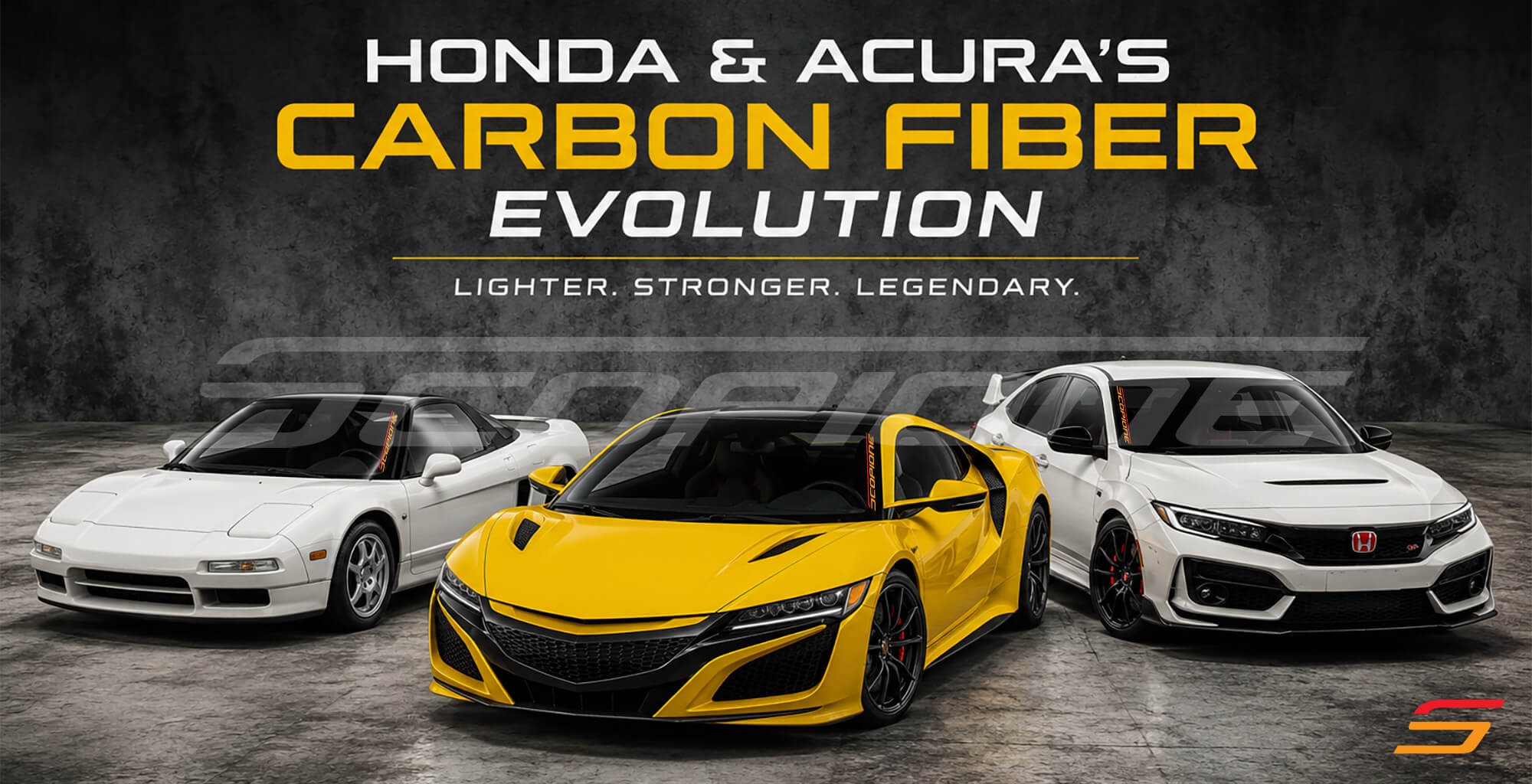
Honda built its identity on lightweight engineering and high-revving precision. Soichiro Honda founded the company in 1948 with motorcycles, transferred the philosophy to cars with the S500 sports car in 1963, and then redefined supercar expectations with the original NSX in 1990. That NSX was the world’s first production car with an all-aluminum monocoque body, designed with input from Formula One champion Ayrton Senna. Carbon fiber arrived later, methodically. The second-generation NSX (2017) integrated a structural CF floor panel into its multi-material spaceframe, the NSX Type S (2022) added CF engine covers and an optional CF roof, and Honda’s Performance Manufacturing Center in Marysville, Ohio hand-built every NSX with composite-grade attention. Around all of this, the global tuner culture built one of the largest aftermarket CF ecosystems in the automotive world, anchored by the S2000, Integra Type R, RSX Type-S, and Civic Type R. Honda Acura carbon fiber evolution is the story of a methodical engineering brand and the enthusiast community that grew alongside it – explore the Scopione catalog.
Honda / Acura Carbon Fiber Timeline
| Year | Milestone | Model / Program |
|---|---|---|
| 1948 | Honda Motor Co. founded by Soichiro Honda in Hamamatsu | Corporate |
| 1963 | S500 launches as Honda’s first production car | Honda S500 |
| 1986 | Acura launches in North America as the first Japanese luxury brand | Acura division |
| 1988 | McLaren-Honda MP4/4 dominates F1 with CF monocoque chassis | F1 program |
| 1990 | NSX launches with world-first all-aluminum monocoque body | Acura NSX (Gen 1) |
| 1999 | S2000 debuts with 240 hp from 2.0L (120 hp/liter record) | Honda S2000 AP1 |
| 2002 | Japan-only NSX-R adds carbon-Kevlar seats and CF engine cover | Honda NSX-R (NA2) |
| 2017 | Gen 2 NSX introduces structural CF floor panel | Acura NSX (Gen 2) |
| 2021 | Civic Type R FK8 Limited Edition claims a 7:43.8 Nordschleife lap | Civic Type R FK8 LE |
| 2022 | NSX Type S (350 units) caps the Gen 2 with broader CF content | Acura NSX Type S |
| 2023 | Civic Type R FL5 launches on the eleventh-gen Civic platform | Civic Type R FL5 |
| 2024 | Integra Type S revives both the Integra and Type S nameplates | Acura Integra Type S |
1948–1998: Lightweight Engineering DNA and the Racing Imperative
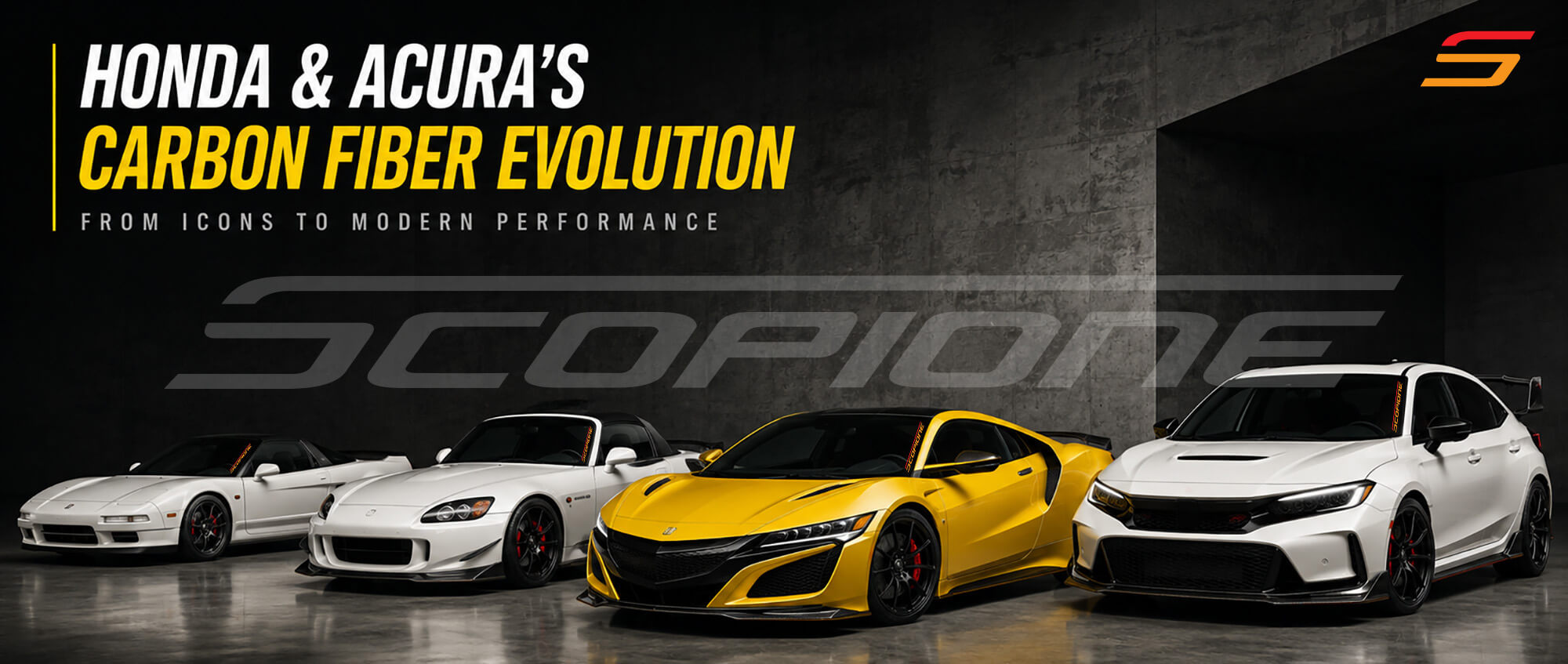
Honda’s first five decades established the lightweight engineering culture that would later embrace carbon fiber. Soichiro Honda founded Honda Motor Co. in 1948 in Hamamatsu, Japan, building motorized bicycles before expanding into motorcycles. By the early 1960s, Honda had won multiple World Grand Prix motorcycle championships. And the company was preparing to enter automobile production. The S500 sports car arrived in 1963, just months after the T360 truck, marking Honda’s entry into car manufacturing with engineering principles drawn from racing motorcycles: high-revving engines, lightweight construction, and mechanical precision.
Through the 1970s and 1980s, Honda established itself as a global automobile manufacturer with the Civic, Accord, and Prelude. The CVCC lean-burn engine technology met 1970 Clean Air Act standards without a catalytic converter, an engineering achievement that demonstrated Honda’s problem-solving approach. Acura launched in 1986 as the first Japanese luxury brand in North America, extending Honda’s engineering precision into the premium segment. The original NSX arrived in 1990 with the world’s first all-aluminum monocoque body in a production car, technology developed with extensive input from Formula One champion Ayrton Senna at Suzuka Circuit.
No carbon fiber appeared on Honda or Acura production vehicles during this era. The lightweight strategy relied on aluminum (NSX monocoque, engine blocks), thin-wall steel stampings, and meticulous engineering to minimize curb weight. Honda’s Formula One program (1964–1968 and 1983–1992) exposed engineers to carbon fiber through racing chassis, with the McLaren-Honda MP4/4 (1988) using a CF monocoque that won 15 of 16 races. That F1 composite knowledge informed Honda’s understanding of the material, even though production applications remained years away. The cultural seeds of Honda’s eventual CF engagement were planted in this period through aluminum mastery and motorsport exposure.
Honda S500 / S600 / S800 (1963–1970)
The S500 (1963) was Honda’s first production car. It arrived just months after the T360 truck and announced the philosophy that would define Honda for decades: tiny, lightweight roadsters with motorcycle-derived engineering. The DOHC inline-four engine displaced just 531cc, used four carburetors, and revved to 9,500 rpm. The S600 followed in 1964 with a slightly larger 606cc unit producing 57 hp at 8,500 rpm, selling 11,284 convertibles and 1,800 coupes. The S800 (1966) became Honda’s first car to exceed 100 mph, powered by a 791cc engine producing 70 hp at 8,000 rpm.
- Engines: 531cc DOHC I4 (S500, 44 hp), 606cc DOHC I4 (S600, 57 hp), 791cc DOHC I4 (S800, 70 hp)
- Top speed: 80 mph (S500), 90 mph (S600), 100 mph (S800)
- Curb weight: ~680 kg (S500)
- Production: S600: 11,284 convertibles + 1,800 coupes
- Engine speed: 9,500 rpm redline (S500)
No carbon fiber. The S-series used conventional steel construction, with lightweight performance achieved through small dimensions and minimal curb weight. The significance is philosophical rather than material. Honda’s founding commitment to high-revving, lightweight sports cars created the engineering culture that would later embrace CF as the next expression of the lightweight imperative. The S-series also established the motorcycle-to-automobile technology transfer that became Honda’s competitive advantage, with engines borrowing rev ceilings, four-valve heads, and roller-bearing crankshafts from Honda’s racing motorcycles.
Honda Civic / CRX (1972–present / 1983–1991)
The Civic launched in 1972 and turned Honda into a global automobile manufacturer almost overnight. The CVCC lean-burn engine technology met 1970 Clean Air Act standards without a catalytic converter, giving Honda a strategic advantage over American competitors during the fuel crisis era. The Civic became Honda’s volume nameplate worldwide, eventually selling more than 27 million units across 11 generations. The CRX (1983–1991) distilled the Civic’s lightweight virtues into a two-seat coupe weighing as little as 1,713 lbs in HF specification. The second-generation CRX Si (1988–1991) produced 105 to 108 hp from a 1.6L engine in a car weighing approximately 2,100 lbs, delivering one of the era’s leading power-to-weight ratios in its class.
- Engines: Various I4: 1.2L (50 hp early Civic) to 1.6L DOHC VTEC (108 hp CRX Si)
- 0–60 mph: ~8–10 seconds (CRX Si)
- Top speed: ~120 mph (CRX Si)
- Curb weight: 1,713 lbs (CRX HF), ~2,100 lbs (CRX Si)
- Total Civic global sales: 27+ million units across 11 generations
No carbon fiber. The Civic and CRX achieved lightweight efficiency through Honda’s expertise in thin-wall steel stampings, compact packaging, and engineering discipline. The Civic platform would eventually become the basis for the Type R, Honda’s accessible performance car, which would generate enormous aftermarket demand for CF components decades later. The CRX’s cult following among tuners helped establish the Honda-centric aftermarket CF industry that exists today, with CRX-specific CF hoods, fenders, and aerodynamic kits available from multiple specialty suppliers throughout the 2000s and into the present.
Honda / Acura NSX Gen 1 (1990–2005)
The NSX was Honda’s masterpiece. The world’s first production car with an all-aluminum monocoque body, it featured titanium connecting rods, VTEC variable valve timing, and an 8,300 rpm redline at launch. Development included extensive input from Formula One champion Ayrton Senna, who provided chassis feedback at Suzuka Circuit and famously requested stiffer torsional rigidity after his initial drive. The aluminum monocoque saved nearly 200 kg over a steel equivalent, establishing Honda as a leader in lightweight production car construction at a time when European supercar competitors were still using steel space frames or hand-formed aluminum panels over steel structures.
- Engine: 3.0L DOHC VTEC V6 (270 hp, 1990–1996), 3.2L DOHC VTEC V6 (290 hp, 1997–2005)
- 0–60 mph: ~5.0 seconds (3.0L), ~4.5 seconds (3.2L)
- Top speed: ~168 mph
- Construction: All-aluminum monocoque (industry first)
- Designer: Masahito Nakano (chief exterior designer)
- Weight savings: ~200 kg vs. steel equivalent
No carbon fiber in the standard NSX. The lightweight strategy relied entirely on aluminum, with the monocoque, body panels, suspension components, and engine block all aluminum alloy. The aluminum expertise developed for the original NSX would later inform Honda’s multi-material approach to the second-generation NSX, where aluminum, high-strength steel, and carbon fiber would coexist in a single spaceframe. The aftermarket CF scene for the Gen 1 NSX became substantial through the 2000s and 2010s, with CF engine covers, hood vents, spoilers, and interior trim widely available from Japanese and North American specialty suppliers serving the original NSX owner community.
The original NSX changed the supercar industry. By proving that a mid-engine exotic could be reliable, comfortable, and daily-drivable without sacrificing performance, the NSX is widely credited with pressuring Ferrari and Lamborghini to address long-standing complaints about build quality and ergonomics. Magazine reviewers consistently praised the NSX for offering Ferrari 348 performance with Honda Civic reliability, an unprecedented combination at the time. The aluminum monocoque technology also informed Honda’s subsequent material strategies across the lineup, with aluminum-intensive construction appearing in later NSX, Acura RL, and various Honda performance applications.
Scopione Perspective: The Pre-CF Engineering Foundation
Honda’s first five decades produced no carbon fiber, but the engineering culture they established (lightweight construction, high-revving precision, aluminum innovation, motorsport-derived problem-solving) created the institutional foundation for CF adoption when the technology matured. The original NSX’s aluminum monocoque was a conceptual ancestor of the second-generation NSX’s multi-material spaceframe with its CF floor panel. Scopione’s 2×2 3K twill-weave components reflect the same material discipline that Honda’s F1 program and aluminum NSX program established: precision-laid weave, dimensional accuracy, and clear-coat finish capable of meeting the loads that aerodynamic and structural surfaces actually experience.
1999–2009: Track Focus and the Explosion of Aftermarket Carbon Fiber Culture
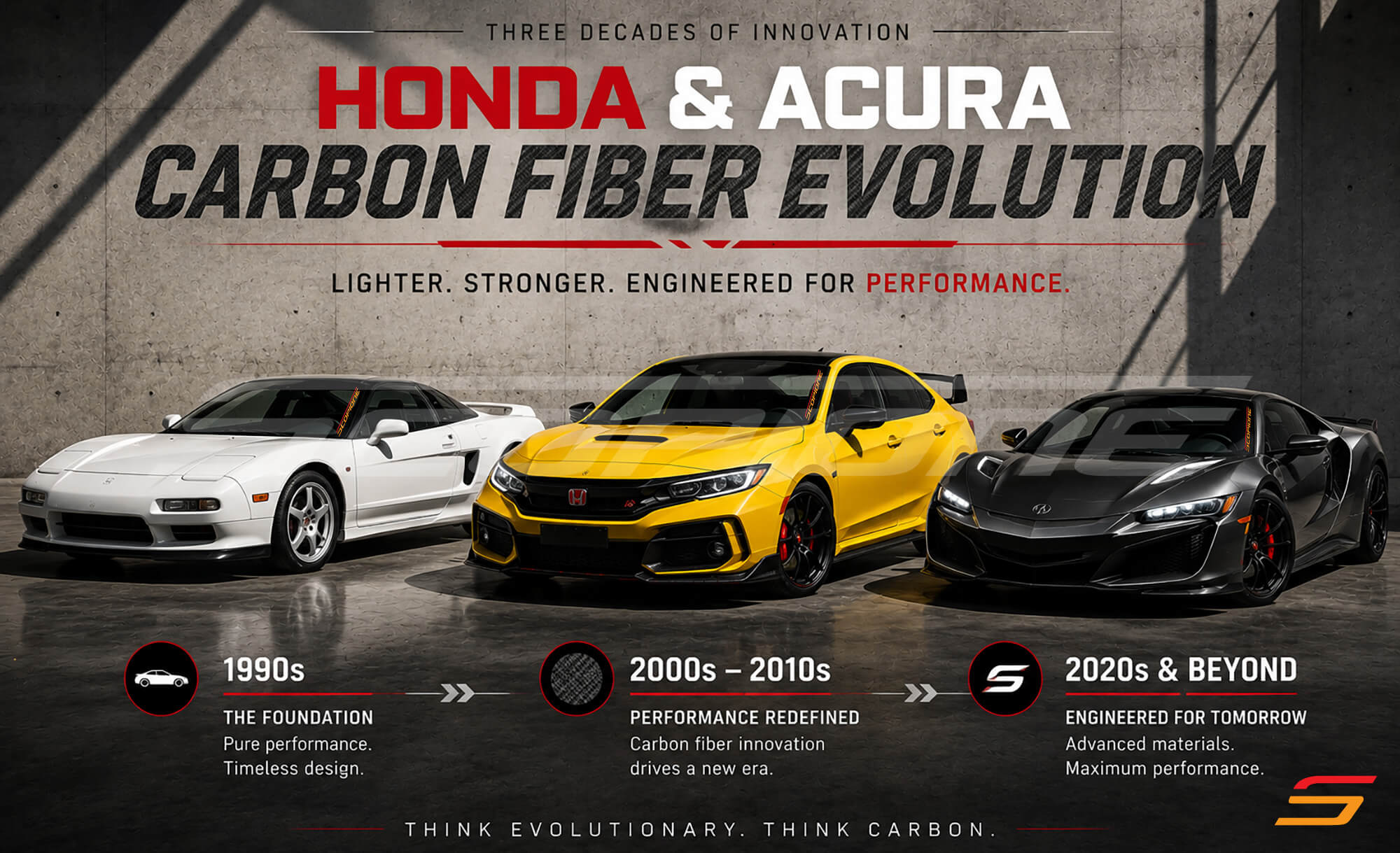
This era produced some of Honda’s defining driver’s cars: the S2000, Integra Type R (DC2), RSX Type-S (DC5), and the NSX-R (2002) refining the original supercar to its lightest specification. These cars, defined by high-revving VTEC engines and razor-sharp chassis tuning, became the foundation of the largest aftermarket carbon fiber culture in the automotive world. Honda offered no factory CF on these vehicles. The global enthusiast community treated carbon fiber as essential modification material for weight reduction, track preparation, and visual differentiation.
The aftermarket CF industry for Honda and Acura vehicles expanded dramatically during this period. The S2000, Integra Type R, and RSX Type-S became the major platforms for aftermarket CF components: hoods, trunk lids, fenders, splitters, diffusers, hardtops, and interior panels. Specialty suppliers and dozens of smaller fabrication shops built substantial businesses around Honda CF accessories. The lightweight, high-revving nature of these cars made every gram of weight reduction perceptible to the driver, creating an enthusiast culture that viewed CF as the definitive performance upgrade. Honda’s only factory CF application during this era appeared on the Japan-only NSX-R (2002), which used carbon-Kevlar Recaro seats and a CF engine cover as standard equipment.
Honda S2000 (AP1 / AP2, 1999–2009)
The S2000 was developed to celebrate Honda’s 50th anniversary and featured the highest specific output of any naturally aspirated production engine at its launch. The AP1’s F20C produced 240 hp from 2.0 liters (120 hp per liter) with an 8,300 rpm redline and a 9,000 rpm fuel cutoff. The front-midship engine layout, 50:50 weight distribution, and short-throw six-speed manual gearbox made it one of the era’s defining driver’s cars. The AP2 revision (2004–2009) increased displacement to 2.2 liters in the F22C1, providing more torque at low rpm at the expense of the AP1’s stratospheric rev ceiling. A track-oriented S2000 Club Racer (CR) variant was produced from 2008 with just 699 units, featuring an aerodynamic body kit, removable hardtop, and chassis stiffening.
- Engine: 2.0L F20C DOHC VTEC I4 (AP1, 240 hp at 8,300 rpm), 2.2L F22C1 DOHC VTEC I4 (AP2, 237 hp at 7,800 rpm)
- 0–60 mph: ~5.8 seconds (AP1), 6.0 seconds (AP2)
- Top speed: 150 mph (electronically limited)
- Specific output (AP1): 120 hp per liter (NA production engine record at launch)
- Curb weight: ~2,800 lbs
- S2000 CR production: 699 units
No factory carbon fiber. The S2000 became one of the leading platforms for aftermarket CF in the world, with CF hardtops, trunk lids, hoods, fenders, splitters, diffusers, and interior panels available from numerous manufacturers. The car’s modest curb weight (around 2,800 lbs) and high-revving character make every gram of CF weight savings immediately perceptible. AP1 and AP2 owners across global markets have driven sustained demand for CF accessories for over two decades, with prices ranging from $200 entry-level CF accents to $4,000+ for premium hand-laid CF hardtops with integrated functional vents.
The S2000’s influence on Honda’s performance identity is substantial. It proved that naturally aspirated precision and driver engagement could compete with forced-induction power. The F20C engine’s specific output record stood for years before turbocharged production engines surpassed it. The S2000 aftermarket CF industry helped establish carbon fiber as a mainstream performance material among Japanese sports car enthusiasts globally, and the S2000 platform remains a fixture among the heavily modified Honda vehicles in time-attack and track-day communities.
Acura Integra Type R DC2 (1997–2001)
The Integra Type R set the benchmark for front-wheel-drive performance in its era. The 1.8L B18C5 VTEC engine produced 195 hp at 8,000 rpm, achieving 108 hp per liter, the highest specific output of any naturally aspirated production engine sold in the US at the time. Honda reduced weight through several careful measures: thinner windshield glass, lighter body panels, hand-ported intake manifolds, and elimination of sound deadening material throughout the cabin. Combined with a close-ratio 5-speed manual transmission and a helical limited-slip differential, the Type R delivered a driving experience that professional testers compared favorably to cars costing three times as much. US production was limited: 320 units in 1997, 1,000 in 1998, 1,350 in 2000, and 1,158 in 2001, totaling fewer than 4,000 units across all model years.
- Engine: 1.8L B18C5 DOHC VTEC I4, 195 hp at 8,000 rpm
- Specific output: 108 hp per liter (US-market NA record at launch)
- 0–60 mph: ~6.2 seconds
- Top speed: 145 mph
- US production: 320 (1997) + 1,000 (1998) + 1,350 (2000) + 1,158 (2001) = ~3,828 total
- Drivetrain: FWD with helical LSD, close-ratio 5MT
No factory carbon fiber. Honda’s weight reduction strategy for the Integra Type R relied on conventional lightweighting through thinner glass, reduced sound deadening, and lighter body panels. However, the DC2 Type R became one of the heavily modified Honda platforms, with CF hoods, trunk lids, and fenders among the popular upgrades sourced from specialty suppliers. The platform’s racing pedigree (used extensively in time attack and SCCA Showroom Stock B competition) created sustained demand for CF aerodynamic improvements over the model’s production run and well beyond.
The Integra Type R established the Type R sub-brand in North America and created the template for front-wheel-drive performance that continues through the Civic Type R today. Its limited US production numbers (fewer than 4,000 total units) have made it a highly collectible vehicle, with concours-grade examples reaching auction values above $80,000 in recent years, a remarkable appreciation curve for a vehicle that originally retailed at approximately $24,000. The DC2 platform’s aftermarket CF industry continues to support the existing fleet decades after production ended.
Acura RSX Type-S DC5 (2002–2006)
The RSX Type-S was the North American successor to the Integra, known in Japan as the fourth-generation Honda Integra (DC5). The Type-S featured the K20A2 engine producing 200 hp (later revised to 210 hp with the K20Z1 in 2005), paired exclusively with a close-ratio six-speed manual transmission and a helical limited-slip differential. While less raw than the DC2 Type R, the RSX Type-S offered improved refinement and daily-driver usability while maintaining Honda’s commitment to high-revving VTEC performance. The K-series engine architecture introduced in this generation became the foundation for one of the popular engine swap platforms in the Honda community, supporting both naturally aspirated builds and forced-induction projects across multiple chassis.
- Engine: 2.0L K20A2 / K20Z1 DOHC i-VTEC I4, 200–210 hp at 7,800 rpm
- 0–60 mph: ~6.5 seconds
- Top speed: ~140 mph
- Drivetrain: FWD with helical LSD, close-ratio 6MT (exclusive)
- Engine architecture: K20 (foundation for popular swap platform)
No factory carbon fiber. The RSX Type-S attracted a substantial aftermarket following, with CF hoods, trunk lids, and engine bay components among the popular modifications. The DC5 platform’s popularity in time attack and road racing created sustained demand for CF body panels, aerodynamic components, and engine bay dress-up parts. K-series engine swaps into older Honda chassis (Civic EG/EK, Integra DC2, S2000 chassis) further extended the aftermarket CF demand by creating new applications for K-series engine covers and intake manifold accessories on cars that originally shipped with B-series or F-series engines.
The RSX Type-S was the last Integra-derived vehicle sold in North America until the Integra nameplate returned in 2023. Its K-series engine became the foundation for one of the popular engine swap platforms in the Honda community, further driving demand for CF accessories across multiple Honda models. The RSX-Integra DC5 chassis also remains a fixture in time-attack racing series globally, with championship-winning builds typically featuring extensive CF body panel substitution to reduce weight at corner-loading-critical locations.
Honda NSX-R NA2 (2002–2005)
The second-generation NSX-R was Honda’s definitive expression of the original NSX formula, a track-focused variant that reduced weight through extensive use of carbon fiber and lighter components. Sold exclusively in Japan, the NSX-R featured a stripped interior, carbon-Kevlar Recaro bucket seats, a stiffer suspension with revised spring rates and damper settings, and revised aerodynamics including a fixed rear wing and front splitter. The NSX-R weighed 1,270 kg (2,800 lbs), approximately 100 kg lighter than the standard NSX, achieved through deletion of comfort features, lighter forged BBS wheels, and the carbon-Kevlar seat structure.
- Engine: 3.2L C32B DOHC VTEC V6, 290 hp at 7,300 rpm
- 0–60 mph: ~4.4 seconds
- Top speed: ~168 mph
- Curb weight: 1,270 kg (2,800 lbs)
- Weight reduction: ~100 kg vs. standard NSX
- Nordschleife lap: 7:56 (claimed)
- Market: Japan-only
The NSX-R was Honda’s first production vehicle to incorporate carbon fiber components as a meaningful part of its specification. Standard equipment included carbon-Kevlar Recaro racing seats, a carbon fiber engine cover, and CF interior elements. While these were not structural applications, the NSX-R demonstrated Honda’s willingness to use CF for weight reduction in a track-focused context. The extremely limited NSX-R GT variant (only 5 units produced for homologation purposes) extended the CF specification further with additional composite elements.
The NSX-R is regarded by many enthusiasts and journalists as one of the era’s defining driver’s cars. Its claimed Nordschleife lap time of 7:56 embarrassed more powerful European competitors and validated the Senna-influenced chassis tuning at the world’s defining road circuit. The use of carbon fiber, though limited in scope, established the precedent for CF integration in Honda’s performance vehicles that would expand significantly with the second-generation NSX over a decade later.
Scopione Perspective: The Aftermarket CF Foundation
Between 1999 and 2009, Honda built a global enthusiast community through the S2000, Integra Type R, RSX Type-S, and NSX-R that became the largest aftermarket carbon fiber market in the automotive world. The cars’ lightweight construction, high-revving VTEC engines, and razor-sharp chassis tuning made every gram of weight reduction perceptible to the driver, creating sustained demand for CF accessories across every model year. Scopione’s 2×2 3K twill-weave manufacturing approach reflects the same material standards that this enthusiast community has demanded for decades: precision weave, controlled clear coat, and dimensional accuracy capable of meeting both visual and functional requirements.

2010–2019: Factory Carbon Fiber Integration and the NSX Gen 2
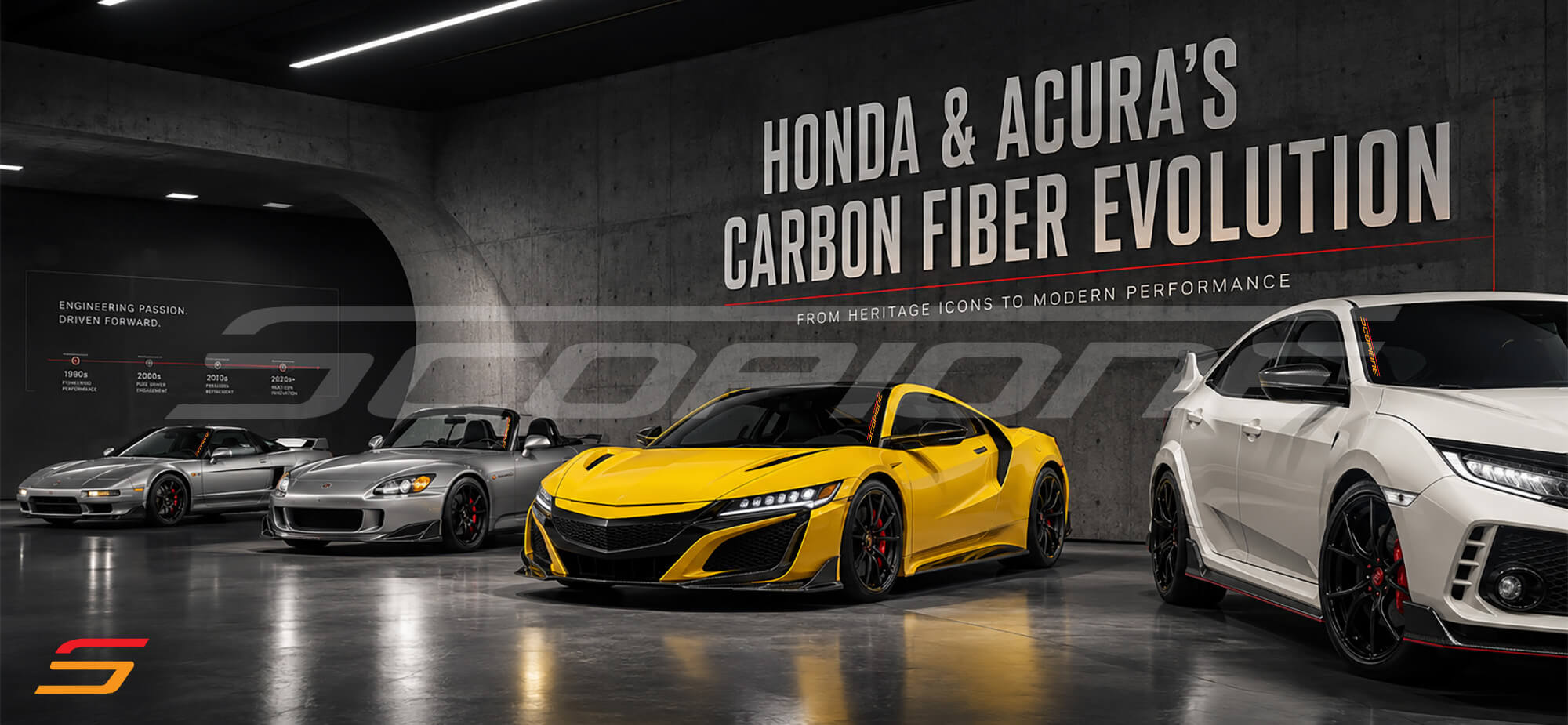
This era marked Honda’s transition from aftermarket-only carbon fiber to factory-integrated CF in production vehicles. The second-generation NSX (2017) introduced a carbon fiber floor panel as part of its multi-material spaceframe, Honda’s first structural CF application in a production car. The Civic Type R returned to global markets with the FK2 in 2015 and the FK8 in 2017, generating renewed demand for CF accessories and bringing the Civic Type R formula to the United States at scale for the first time. Honda established the Performance Manufacturing Center (PMC) in Marysville, Ohio, where every NSX was hand-built with meticulous attention to material integration.
Carbon fiber entered Honda’s production vehicle vocabulary during this era through the second-generation NSX. The multi-material spaceframe incorporated a carbon fiber floor panel alongside aluminum and high-strength steel, marking Honda’s first use of CF as a structural element in a production car. The NSX’s construction at the Performance Manufacturing Center allowed for the hands-on composite integration that CF requires. Meanwhile, the Civic Type R FK8 generated substantial aftermarket CF demand for hoods, splitters, spoilers, mirror caps, and diffusers, continuing the Honda CF culture established in the previous era and extending it to a new generation of enthusiasts.
Acura NSX Gen 2 (2017–2022)
The second-generation NSX represented Honda’s vision of a next-generation supercar. The hybrid powertrain combined a twin-turbocharged 3.5L V6 with three electric motors (one on the crankshaft, two driving the front wheels) for 573 hp and instant-response torque fill from the front-axle electric motors. Built by hand at the Performance Manufacturing Center in Marysville, Ohio, each NSX required approximately 1,000 hours of assembly. The multi-material body and frame construction used aluminum as the primary material, with cast aluminum suspension mounting points, low-density SMC outer panels for the body, and a carbon fiber floor panel for the structural spaceframe. Michelle Christensen was the lead exterior designer, one of very few women to lead exterior design on a supercar at the time. Total production across all model years reached 2,908 units.
- Powertrain: 3.5L twin-turbo DOHC V6 + 3 electric motors, 573 hp combined (2017–2021), 600 hp (Type S 2022)
- 0–60 mph: ~2.9 seconds
- Top speed: 191 mph
- Construction: Multi-material spaceframe with CF floor panel + aluminum + high-strength steel
- Production location: Performance Manufacturing Center, Marysville, Ohio
- Assembly time: ~1,000 hours per car
- Total production: 2,908 units (all years)
- Designer: Michelle Christensen (exterior lead), Ken Aoyama (exterior)
The Gen 2 NSX is Honda’s defining production CF application. The multi-material spaceframe features a carbon fiber floor panel that provides structural rigidity while saving weight below the vehicle’s center of gravity, an ideal location for CF’s high specific stiffness. The NSX Type S (2022 final edition) expanded CF content with a carbon fiber engine cover, carbon fiber interior trim elements, and an available Lightweight Package that added carbon ceramic brakes and additional CF components for a 26 kg (57 lb) weight reduction. A carbon fiber roof was available as an option, contributing both weight savings above the center of gravity and a distinctive visual element. The hand-built PMC production process allowed for the precise composite integration that CF panel bonding and structural validation require.
The Gen 2 NSX served as Honda’s proof of concept for hybrid supercar technology and factory carbon fiber integration. Its 2,908-unit total production and hand-built construction at the PMC make it a rarity, particularly the final 350-unit Type S production run that commands premium prices on the secondary market. The PMC facility itself represents Honda’s investment in domestic composite manufacturing capability, with a workforce trained on multi-material body construction that could inform future Honda performance vehicles even after NSX production concluded in 2022.
Honda Civic Type R FK2 (2015–2017)
The FK2 was the first turbocharged Civic Type R and the first to be officially available in multiple global markets simultaneously. The K20C1 engine, Honda’s first turbocharged Type R unit, produced 310 hp from 2.0 liters with peak torque of 295 lb-ft. The aggressive exterior design, featuring a large rear wing, prominent front splitter, and faux air vents on the rear quarter panels, proved divisive among enthusiasts and journalists but was unapologetically functional. The FK2 was built at Honda’s Swindon plant in the UK on the ninth-generation Civic platform, marking the last Type R built in Europe before production shifted to Japan with the FK8 generation.
- Engine: 2.0L K20C1 turbocharged DOHC VTEC I4, 310 hp, 295 lb-ft
- 0–60 mph: ~5.7 seconds
- Top speed: 167 mph
- Production location: Honda Swindon, UK
- Platform: Ninth-generation Civic
No factory carbon fiber. The FK2 Type R used conventional materials throughout, but its aggressive design and performance positioning generated significant aftermarket CF demand. CF hoods, front splitters, side skirts, and alternative rear wings became popular modifications, particularly among European enthusiasts who received the FK2 before other markets. The FK2 also became the first Civic Type R to attract substantial track-day and time-attack participation outside Japan, further driving CF aftermarket demand for weight-reduction-focused builds.
Honda Civic Type R FK8 (2017–2021)
The FK8 refined the turbocharged Civic Type R formula on the tenth-generation Civic platform with improved ride quality, better steering feedback, and a more sophisticated adaptive damper system. Power increased to 306 hp at launch and 316 hp on later model years, with peak torque holding at 295 lb-ft. The Limited Edition variant (2021) shaved approximately 28 kg through lightweight forged BBS wheels, deleted rear wiper and trunk floor, and lighter sound insulation, achieving a Nurburgring Nordschleife lap time of 7:43.8, which Honda claimed as the front-wheel-drive production car record at release (a position contested by some sources due to lap-configuration differences with prior records). The FK8 was the first Civic Type R widely available in the United States, opening Honda’s halo hatchback to its largest enthusiast market.
- Engine: 2.0L K20C1 turbocharged DOHC VTEC I4, 306–316 hp, 295 lb-ft
- 0–60 mph: ~4.9 seconds (Car and Driver test)
- Top speed: 169 mph
- Limited Edition Nordschleife: 7:43.8 (Honda-claimed FWD record at release; disputed by lap-config differences)
- Limited Edition weight reduction: ~28 kg through BBS wheels and content deletion
- Platform: Tenth-generation Civic
No factory carbon fiber on the standard FK8. But the aftermarket CF ecosystem for this generation became enormous. The FK8 became one of the popular platforms for CF modification globally, with CF hoods, front splitters, side skirts, rear diffusers, rear wings, mirror caps, and interior trim widely available from dozens of manufacturers. The Limited Edition’s focus on weight reduction through conventional means highlighted the potential value of CF substitution, with several specialty suppliers offering full CF body panel kits that approached or exceeded the Limited Edition’s factory weight savings at significantly lower cost than the LE’s production allocation.
The FK8 brought the Civic Type R to the American market at scale for the first time, creating the largest US customer base ever for Honda CF accessories. Its Nurburgring lap performance demonstrated that the front-wheel-drive formula, refined through decades of Type R development, could compete with all-wheel-drive competitors on the world’s defining circuit. The FK8’s commercial success in the US validated Honda’s decision to bring future Type R variants to American showrooms, sustaining continuity for the aftermarket CF industry that built around the platform.
Acura TLX Type S (2021–present)
The TLX Type S revived the Type S performance sub-brand for Acura with a dedicated turbocharged V6 engine available nowhere else in the Honda or Acura lineup. The 3.0L J30A5 dual-scroll turbocharged V6 produces 355 hp and 354 lb-ft, paired with a 10-speed automatic transmission and Acura’s Super Handling All-Wheel Drive (SH-AWD) torque-vectoring system. The TLX Type S positioned Acura against the BMW M340i and Mercedes-AMG C43 in the sport sedan segment, with double-wishbone front suspension and adaptive dampers delivering sharper dynamics than any previous TLX generation. Brembo front brakes and 20-inch forged wheels reinforce the performance specification.
- Engine: 3.0L J30A5 dual-scroll turbocharged V6, 355 hp, 354 lb-ft
- Transmission: 10-speed automatic
- Drivetrain: Super Handling All-Wheel Drive (SH-AWD)
- 0–60 mph: ~4.5–5.1 seconds
- Brakes: Brembo front
- Wheels: 20-inch forged
The TLX Type S offers available carbon fiber interior trim elements and CF-look exterior accents. While not a significant CF vehicle from a structural perspective, the TLX Type S’s premium positioning and performance credentials make it a viable platform for aftermarket CF accessories: splitters, spoilers, mirror caps, and engine bay dress-up components. The dedicated J30A5 turbo V6 architecture also opens potential future CF integration as Acura continues to develop the Type S sub-brand across additional models.
The TLX Type S re-established Acura’s performance credibility in the sport sedan segment, complementing the NSX at the top of the Acura lineup. Its dedicated turbo V6 architecture suggests Honda’s commitment to performance engines that could benefit from CF weight reduction in future iterations, particularly as Acura expands the Type S badge to additional models including the Integra Type S that arrived in 2024.
Scopione Perspective: From Aftermarket Demand to Factory Integration
The 2010s saw Honda transition from aftermarket-only CF (driven by enthusiast demand on the S2000, Integra/RSX, and Civic Type R) to factory-integrated CF (the Gen 2 NSX’s structural floor panel). The Performance Manufacturing Center in Marysville represents the institutional composite expertise that this transition required. Scopione’s 2×2 3K twill-weave manufacturing approach reflects the same material discipline that the NSX program demonstrated: precision-laid weave, dimensional accuracy, and clear-coat finish capable of holding factory specifications across thermal cycling and structural loads.

2020–Present: Growing Carbon Fiber and the Performance Manufacturing Legacy
Honda’s current era builds on the NSX’s carbon fiber foundation while expanding CF presence across the performance lineup. The NSX Type S (2022) represented the culmination of Honda’s first CF-integrated production vehicle before the model’s discontinuation. The Civic Type R FL5 continues to drive aftermarket CF demand on the eleventh-generation Civic platform, while the returned Acura Integra Type S brings the Type S performance badge to a new generation of buyers and creates a new CF accessory platform shared with the Civic Type R powertrain. Honda’s Performance Manufacturing Center, which hand-built every NSX, retains the institutional composite manufacturing expertise that could inform future Honda performance vehicles.
Carbon fiber’s role at Honda continues to expand from the foundation laid by the Gen 2 NSX. The NSX Type S Lightweight Package added CF engine covers, interior elements, and carbon ceramic brakes for a 26 kg weight reduction. The Civic Type R FL5 generates substantial aftermarket CF demand. The Integra Type S, while not featuring factory CF, extends Acura’s performance lineup and creates new platforms for CF accessories that share compatibility with Civic Type R components. Honda’s Performance Manufacturing Center in Marysville retains the composite manufacturing expertise developed during NSX production, positioning Honda for potential CF expansion in future performance models including potential next-generation NSX or other halo vehicles.
Acura NSX Type S (2022)
The NSX Type S was the final edition of the second-generation NSX, a 350-unit sendoff that increased combined output to 600 hp from the standard NSX’s 573 hp, added a sharper 9-speed DCT calibration, and stiffened the chassis for more aggressive handling. The Type S was the highest-output and quickest NSX ever produced. An exclusive Gotham Gray Matte exterior color was limited to just 70 units of the 350-car run, creating a sub-limited collector specification within an already exclusive production allocation. Hand-built at the Performance Manufacturing Center in Marysville, Ohio, each NSX Type S required meticulous assembly of its hybrid powertrain and multi-material body. The Type S launched at $169,500 MSRP, with Lightweight Package examples commanding premiums above sticker on the secondary market shortly after delivery.
- Powertrain: 3.5L twin-turbo DOHC V6 + 3 electric motors, 600 hp combined, 492 lb-ft
- 0–60 mph: ~2.9 seconds
- Top speed: 191 mph
- Production: 350 units (70 in exclusive Gotham Gray Matte)
- Starting MSRP: $169,500
- Lightweight Package weight reduction: 26 kg (57 lbs)
The NSX Type S featured the broadest factory carbon fiber content of any Honda or Acura production vehicle. Standard CF elements included a carbon fiber engine cover and CF interior trim. The available Lightweight Package reduced weight by 26 kg through carbon ceramic brakes, additional CF interior components, and deletion of non-essential items. A carbon fiber roof was available as an option, providing both weight savings above the center of gravity and a distinctive visual element that complemented the existing CF floor panel structure. The Type S represented the culmination of Honda’s first-generation CF production strategy, demonstrating that CF could enhance both performance and exclusivity in a hand-built supercar context.
The NSX Type S marked the end of Honda’s current supercar program and the completion of the Performance Manufacturing Center’s original mission. The 350-unit production run and $169,500 starting price (with Lightweight Package and CF roof options pushing well above $200,000 in some configurations) confirmed market appetite for CF-enhanced Honda or Acura performance vehicles. The PMC facility itself remains operational at the time of writing, retaining the composite manufacturing capability that any future Honda performance program could leverage.
Honda Civic Type R FL5 (2023–present)
The FL5 Civic Type R is built on the eleventh-generation Civic platform with a cleaner, more mature design that moves away from the FK8’s polarizing aesthetics. The K20C1 engine receives a modest power increase to 315 hp and 310 lb-ft with a revised rev-matching system for smoother downshifts. The FL5 retains the 6-speed manual transmission as the only available transmission, the helical limited-slip differential, and adaptive dampers tuned for the new platform’s longer wheelbase. Reviewers across major automotive publications have praised the FL5 as the cleanest and sharpest Civic Type R yet produced, with steering feel and chassis balance that build on the FK8’s strengths while addressing complaints about the previous generation’s busy visual design.
- Engine: 2.0L K20C1 turbocharged DOHC VTEC I4, 315 hp, 310 lb-ft
- Transmission: 6-speed manual (only option)
- 0–60 mph: ~5.0 seconds
- Top speed: 169 mph
- Platform: Eleventh-generation Civic
- Differentials: Helical LSD
No factory carbon fiber on the standard FL5, but the aftermarket CF ecosystem for this generation is already extensive even in its early production years. CF hoods, front splitters, rear diffusers, mirror caps, gear knob surrounds, and interior trim are widely available from established suppliers and a long tail of regional CF fabrication shops. The FL5’s cleaner design language (fewer visual elements competing for attention than the FK8) makes CF accessories more visually impactful, with single CF components like a hood or front splitter providing dramatic visual differentiation without the visual chaos that earlier generations sometimes introduced.
The FL5 continues the Civic Type R’s role as the accessible entry point to Honda’s performance DNA, maintaining the front-wheel-drive, turbocharged formula while refining it to a sophisticated expression. Its global popularity supports continued growth of the Honda aftermarket CF industry, with new product development across multiple suppliers timed to capture the platform’s long expected production lifecycle. The FL5 also continues the platform-sharing relationship with the Acura Integra Type S, creating cross-compatibility for many CF accessories between the two models.
Acura Integra Type S (2024–present)
The Integra Type S revives both the Integra nameplate (last sold in North America in 2006 as the Integra-derived RSX) and the Type S performance badge on a platform shared with the Civic Type R. The K20C1 engine produces 320 hp, a slight increase over the Civic Type R’s 315 hp, paired exclusively with a 6-speed manual transmission and front-wheel drive with a helical limited-slip differential. The Type S adds visual distinction through unique front and rear fascias, a fixed rear wing integrated into the trunk lid (rather than the FL5’s separate spoiler element), Brembo front brakes, and 19-inch alloy wheels in a unique Type S design. The Integra Type S positions Acura in the performance compact segment against the BMW M240i and Volkswagen Golf R.
- Engine: 2.0L K20C1 turbocharged DOHC VTEC I4, 320 hp, 310 lb-ft
- Transmission: 6-speed manual (only option)
- 0–60 mph: ~5.2 seconds
- Drivetrain: FWD with helical LSD
- Brakes: Brembo front
- Power increase over Civic Type R FL5: +5 hp
No factory carbon fiber on the Integra Type S, but the model’s shared K20C1 / 6-speed manual powertrain with the Civic Type R means that many CF accessories are cross-compatible between the two platforms. The Integra’s premium positioning and Acura badge may attract buyers who are more likely to invest in CF personalization, particularly given the model’s higher MSRP positioning relative to the Civic Type R FL5. The return of the Integra nameplate also reinvigorates demand for CF accessories among fans of the original DC2 and DC5 generations who may now be in a position to invest in current-production Acura products.
The Integra Type S connects Acura’s performance heritage (DC2 Type R, DC5 RSX Type-S) to the current era. Its shared platform with the Civic Type R creates a broader ecosystem for aftermarket CF components while positioning Acura as a relevant performance brand for a new generation of buyers. The Integra also demonstrates that Honda’s K-series engine architecture (now in its third decade of production across various K20 and K24 variants) continues to anchor the brand’s performance offerings, providing stability for the aftermarket CF industry that has built around that engine family.
Scopione Perspective: The Honda Tuner Lineage
Honda’s carbon-fiber trajectory traces a clear arc from aluminum NSX innovation in 1990, through Japan-only NSX-R CF integration in 2002, to the Gen 2 NSX’s structural CF floor panel in 2017 and the NSX Type S Lightweight Package in 2022. Around all of this, the global tuner culture built one of the largest aftermarket CF industries in the automotive world. Scopione’s 2×2 3K twill-weave manufacturing approach reflects the same material discipline that this culture has demanded for decades: precision-laid weave, dimensional accuracy, and clear-coat finish capable of meeting both visual and functional requirements across the S2000, Integra, RSX, Civic Type R, and NSX platforms that define Honda’s performance heritage.


Frequently Asked Questions
Honda / Acura and Carbon Fiber: Common Questions
When did Honda start using carbon fiber in production vehicles?
Honda’s first factory carbon fiber application was the second-generation Acura NSX (2017), which features a carbon fiber floor panel as part of its multi-material spaceframe. The Japan-only NSX-R (2002–2005) was the first Honda to include CF components (carbon-Kevlar Recaro seats, CF engine cover), though in extremely limited numbers. The NSX Type S (2022) expanded CF content further with engine covers, interior elements, and an available carbon fiber roof. The Honda Acura carbon fiber evolution accelerated through the Gen 2 NSX program and remains anchored by the Performance Manufacturing Center in Marysville, Ohio.
Does the Acura NSX use carbon fiber?
Yes. The second-generation NSX (2017–2022) features a carbon fiber floor panel integrated into its aluminum-intensive multi-material spaceframe. The NSX Type S (2022, 350 units) added a CF engine cover, CF interior trim, and an optional CF roof. The available Lightweight Package further reduced weight by 26 kg through carbon ceramic brakes and additional CF components. Total Gen 2 NSX production reached 2,908 units across all model years, with the final 350 Type S vehicles representing the broadest factory CF specification.
Does Scopione make carbon fiber parts for Honda and Acura?
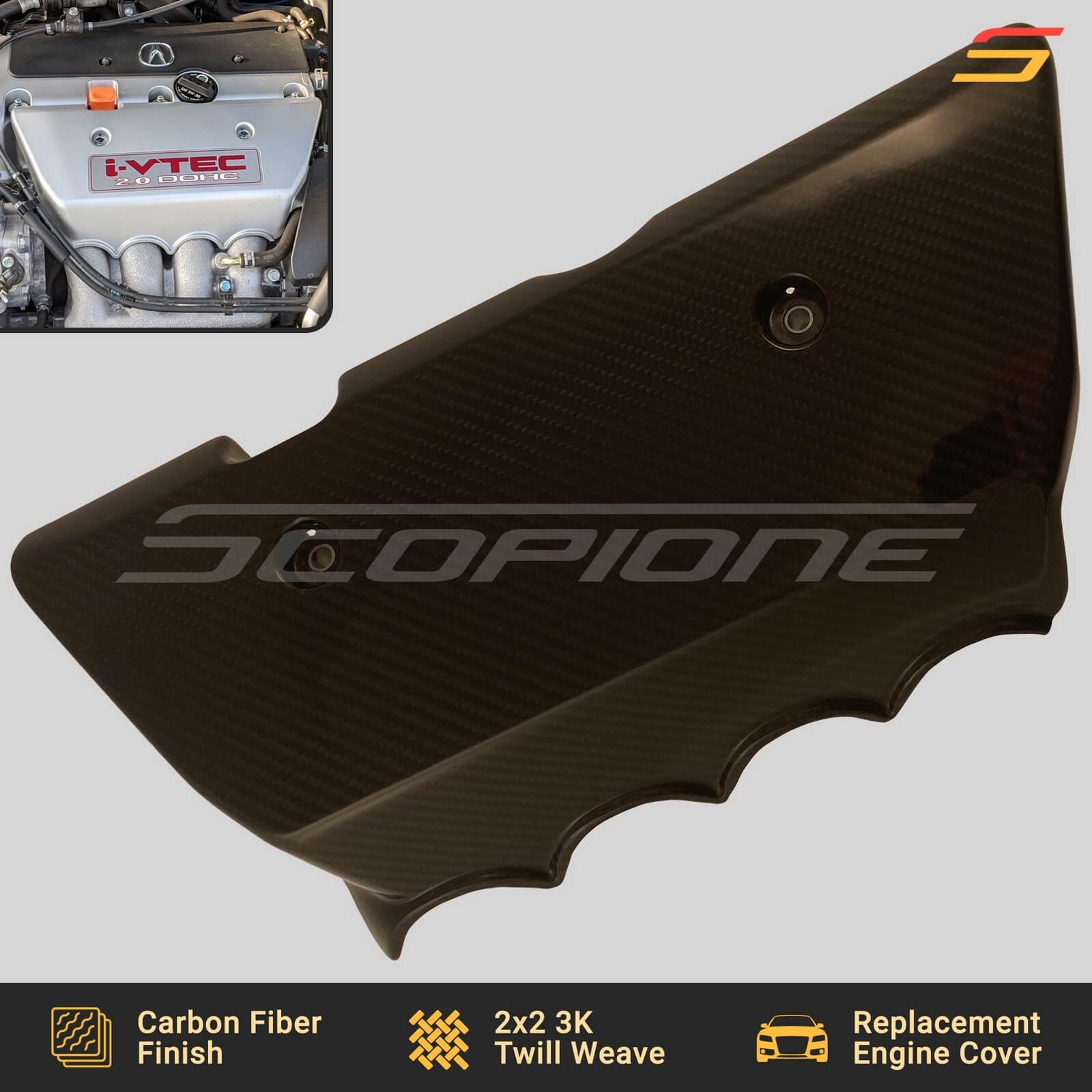
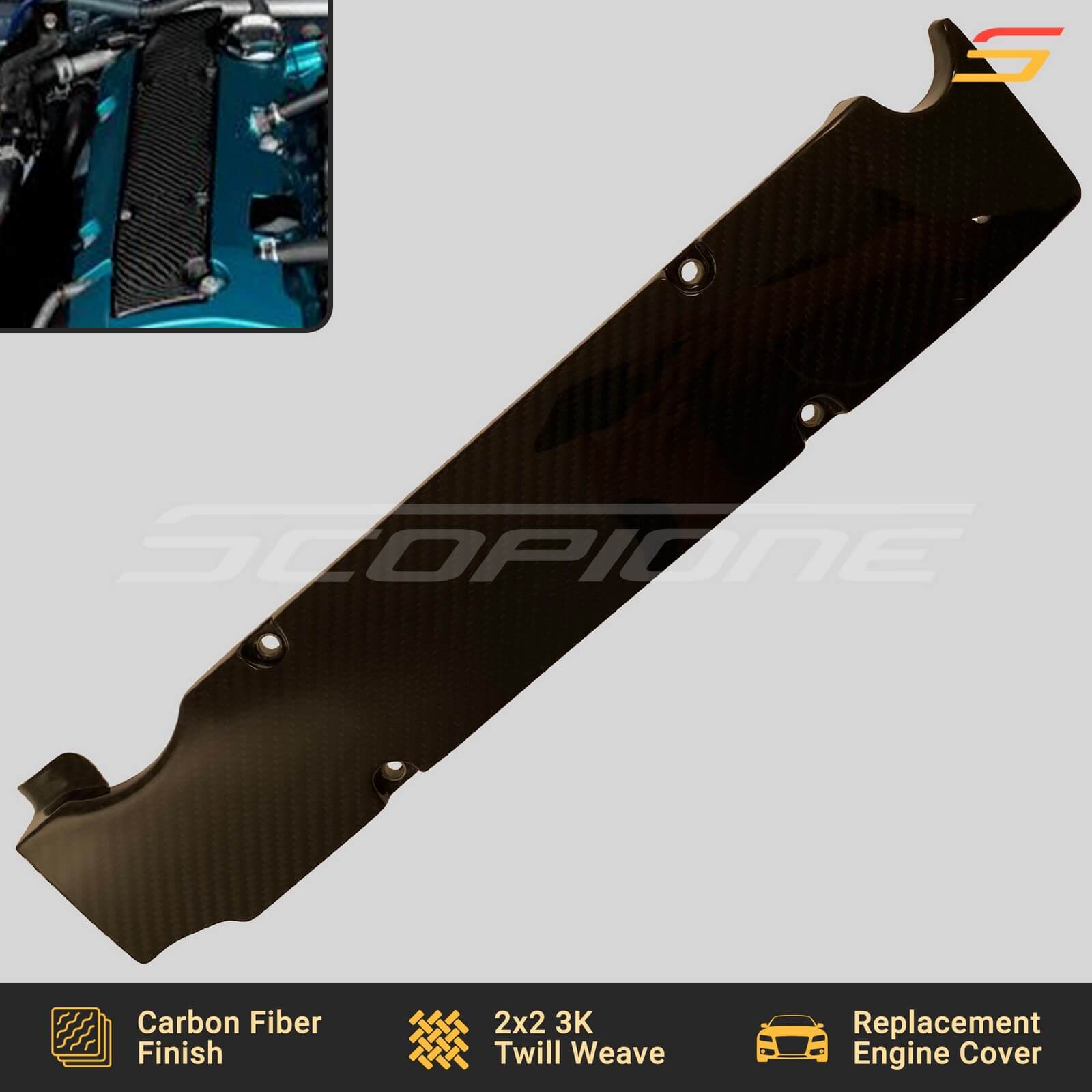
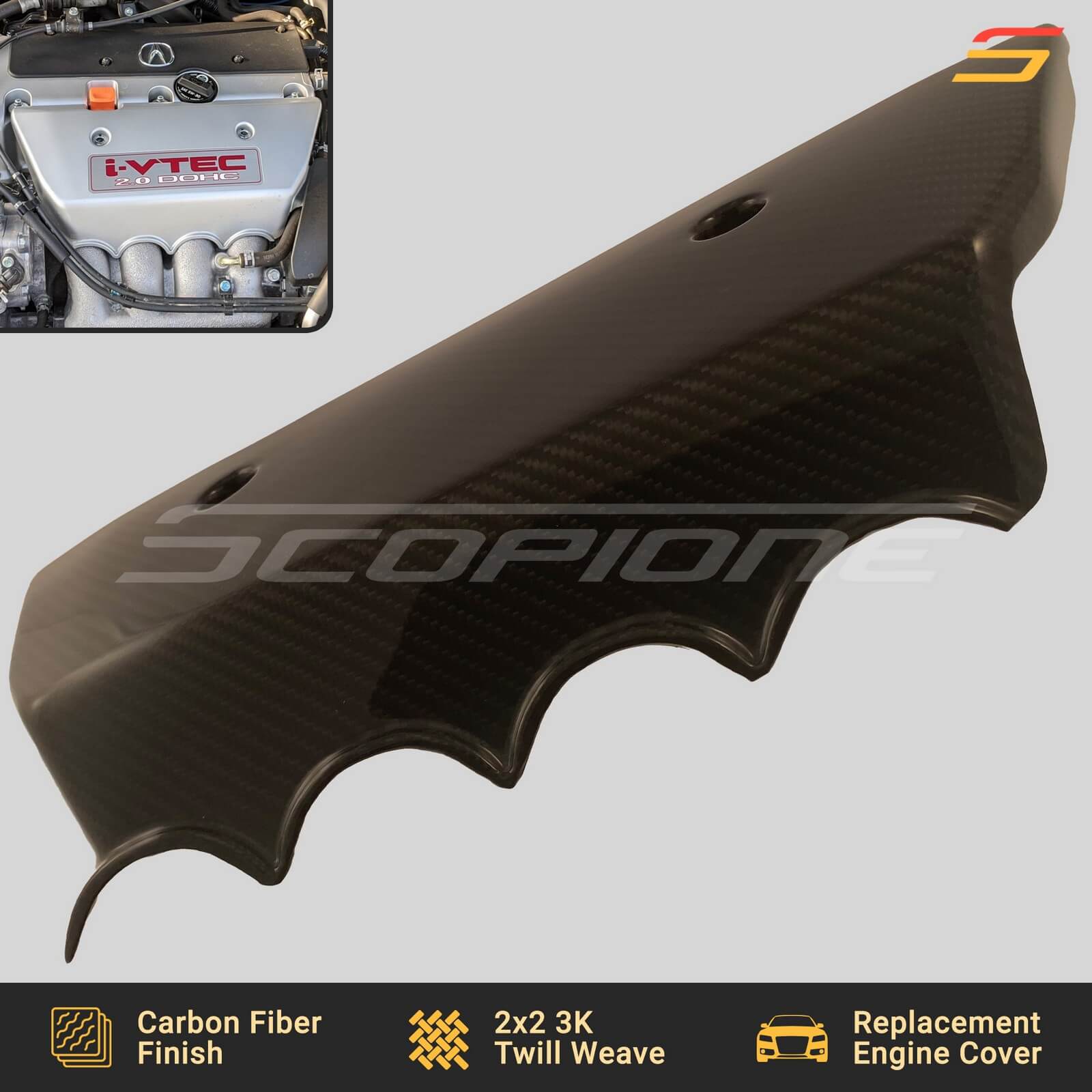
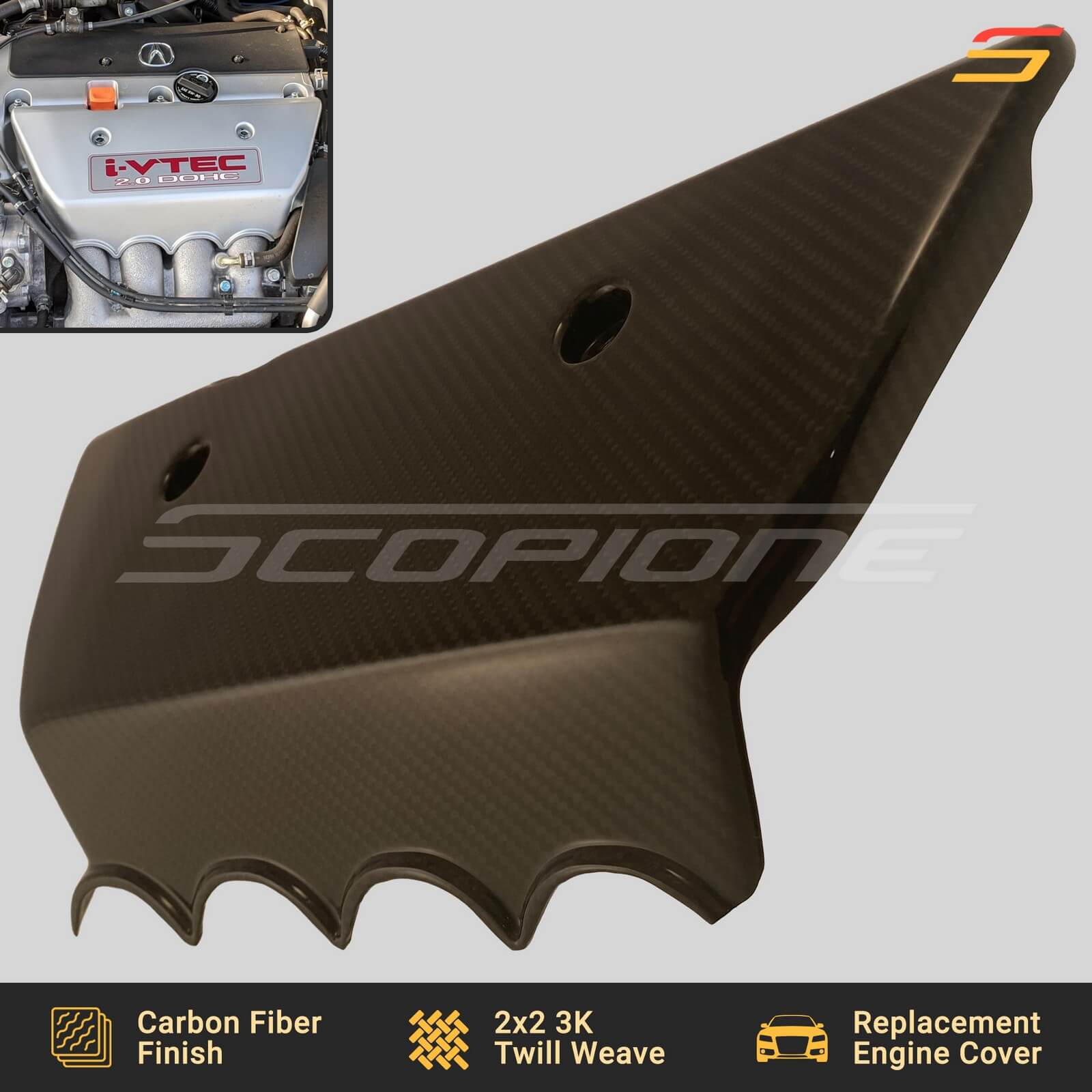
Scopione stocks two Honda and Acura parts, both engine-bay covers moulded in 2×2 3K twill weave under a glossy, UV-resistant clear coat. A replacement intake manifold cover for the 2002–2006 Acura RSX (DC5, K20A), which also fits the 2002–2005 Honda Civic Si (EP3) — it fits the stock and Type-R intake manifolds, but will not fit the RBC manifold. And a replacement spark plug coil cover for the 2000–2008 Honda S2000, covering both the 2.0L AP1 and the 2.2L AP2. Beyond those two, Honda enthusiasts have access to one of the largest specialty CF aftermarket ecosystems in the automotive world, with suppliers serving the S2000, Integra, RSX, Civic Type R, and NSX platforms. Scopione’s broader 2×2 3K twill-weave catalog, available across multiple makes and models, reflects the same material standards that race-derived programs and the Honda tuner culture established for the wider performance industry – explore the Scopione catalog.
Why is the Honda aftermarket carbon fiber scene so large?
Honda and Acura vehicles, particularly the S2000, Integra Type R, RSX Type-S, and Civic Type R, are among the heavily modified cars in the world. Their lightweight construction, high-revving VTEC engines, and global track and time-attack culture create demand for weight reduction through CF components. Every gram saved is perceptible in these driver-focused cars, making carbon fiber the modification of choice for serious Honda enthusiasts. The aftermarket CF industry serving Honda has grown over more than two decades, with established specialty suppliers and a global enthusiast community that drives sustained demand across multiple generations of platforms.
Which Honda and Acura models feature factory carbon fiber?
The Acura NSX (2017–2022) features a CF floor panel as standard equipment integrated into its multi-material spaceframe. The NSX Type S (2022) adds a CF engine cover, interior elements, and an optional CF roof. The Japan-only NSX-R (2002–2005) included carbon-Kevlar Recaro seats and a CF engine cover, marking Honda’s first production CF use. Current models including the Civic Type R FL5 and Integra Type S do not include factory CF but support extensive aftermarket CF ecosystems with hoods, splitters, diffusers, and interior components widely available from established specialty suppliers.
Explore More Scopione Content
Related Carbon Fiber Evolution Stories
- Ferrari’s Carbon Fiber History – The original NSX was designed to match Ferrari’s mid-engine performance with daily-driver reliability, forcing Ferrari to improve build quality
Related Picture Galleries
- Porsche 911, Boxster & Cayman Gallery – The other engineering-led marque whose carbon fiber went from motorsport to the options list
- Toyota Supra MK4 Gallery – Japan’s other icon of the era, and the aftermarket that grew around it
More Carbon Fiber Evolution Stories
- Volkswagen’s Carbon Fiber Evolution – The other people’s-car marque with a vast aftermarket — Beetle to Golf R, plus the XL1’s 230 kg CFRP monocoque
- MINI’s Carbon Fiber Evolution – 640 kg in 1959, recycled CFRP arches on the JCW GP3
- Lotus’s Carbon Fiber Evolution – Add lightness — the philosophy Honda arrived at independently
- Mercedes-Benz’s Carbon Fiber Evolution – Silver Arrows to the AMG One’s F1-derived tub
- Cadillac’s Carbon Fiber Evolution – V-Series aero packages and the hand-built CELESTIQ
- Land Rover’s Carbon Fiber Evolution – Seventy-five years of aluminium, and where carbon arrived
- McLaren’s Carbon Fiber Evolution – The MP4/1 put a CFRP monocoque in Formula 1 in 1981
- Lamborghini’s Carbon Fiber Evolution – Countach-era experiments to today’s forged composites
- Ferrari’s Carbon Fiber History – From the F40’s composite body to the LaFerrari’s hand-laid tub
- Aston Martin’s Carbon Fiber Evolution – The V12 Vanquish’s CF tunnel to the Valkyrie’s F1-derived monocoque
- Audi’s Carbon Fiber Evolution – Thirteen Le Mans wins on CFRP monocoques, and the R8’s structural carbon
- Bentley’s Carbon Fiber Evolution – The Supersports’ 110 kg weight cut to Mulliner’s coachbuilt Batur
- Maserati’s Carbon Fiber Evolution – The Birdcage’s tube frame to the MC20’s own CFRP monocoque
Carbon Fiber, Explained
- Carbon Fiber in the Automotive Industry – How composite construction spread from racing to production cars
- The Pioneers of Carbon Fiber Innovation – The engineers and firms that took composites from aerospace to the road
- The Evolution and Impact of Carbon Fiber: A Comprehensive Guide – The full technical and historical picture
- Carbon Fiber Manufacturing Processes – Autoclave, prepreg and resin transfer moulding
- Why Carbon Fiber Is Expensive – Why factory CF stayed rare on cars built to a price
- Real Carbon Fiber vs Cheap Knockoffs – How to tell a moulded 2×2 3K twill part from a hydro-dipped imitation — worth knowing in a market this large
- Carbon Fiber Maintenance & Cleaning – Keeping a clear-coated engine-bay cover from fading under heat
Shop the Honda & Acura Parts
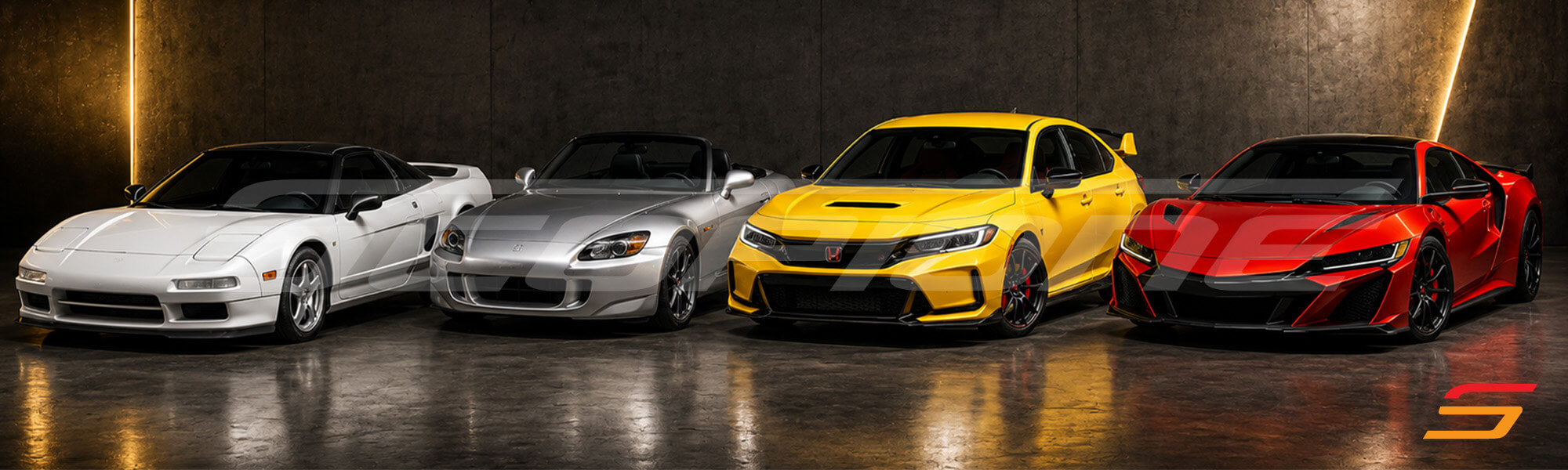
Experience the elegance and performance of the Honda and Acura with Scopione. Browse our gallery and get inspired to elevate your supercar with our top-of-the-line carbon fiber upgrades.
Shop now for premium ScopioneCarbon carbon fiber upgrades and experience the ultimate in performance and aesthetics for your Honda and Acura!
Back to Top ↑Disclaimer: Technical specifications, production figures, and historical details presented in this article are editorial in nature and may differ from official manufacturer data. Photographs show the two Scopione carbon fiber engine covers for the Acura RSX and Honda S2000, and promotional imagery.