

 Shop
Shop
Lamborghini did not plan to become a carbon fiber company. The founding engineers in 1963 were building V12 grand tourers from aluminum and steel. The composite revolution happened because of an outsider – a young Argentine engineer named Horacio Pagani – who arrived in 1983 with ideas the factory lacked the tools to execute. It happened because of a corporate crisis – three ownership changes in a decade – that accidentally brought Audi’s material science resources to Sant’Agata Bolognese. And it happened because a 20-unit concept car named after carbon’s atomic number proved that an entirely new manufacturing process could work. The result is a company that now builds the structure of every supercar around carbon fiber – not because it chose this path from the beginning, but because engineering circumstances, individual ambition, and corporate accident converged into something no one at the 1963 factory could have predicted. Scopione stocks carbon fiber components for multiple Lamborghini models spanning three decades of production – browse the full Lamborghini catalog.
Carbon Fiber Milestones at a Glance
| Year | Milestone | Model / Program |
|---|---|---|
| 1983 | Horacio Pagani joins Lamborghini, begins composite advocacy | – |
| 1988 | First composite elements appear on a production Lamborghini | Countach 25th Anniversary |
| 1999 | First meaningful CF body panel usage | Diablo GT |
| 2007 | Carbon fiber enters the mainstream model lineup | Gallardo Superleggera |
| 2010 | Forged composite technology debuts | Sesto Elemento |
| 2011 | First full carbon fiber monocoque (147.5 kg) | Aventador LP 700-4 |
| 2017 | ALA active aero with motorized CF flaps enters production | Huracan Performante |
| 2023 | Battery-integrated CF monofuselage for hybrid era | Revuelto |
1963–1970s: The Foundations of Lightweight Design
Carbon fiber did not exist in automotive applications during Lamborghini’s founding decade. Aerospace companies in the United States and United Kingdom were just beginning to experiment with CF-reinforced plastics for rocket motor casings and aircraft components; the automotive industry would not adopt them for decades. Lamborghini’s engineers relied on a different approach to low mass: aluminum body panels over tubular steel frames, steel monocoque structures, and construction techniques borrowed from aircraft and coachbuilding traditions. What matters about this era is the engineering culture it embedded at Sant’Agata Bolognese – a reflex toward weight reduction that would later make CF adoption almost inevitable. When carbon-fiber composites became commercially viable in the 1990s and 2000s, Lamborghini’s engineers were predisposed to adopt them. Reducing mass had been a priority at the factory since the day it opened.
Lamborghini 350 GT and Espada: Volume and Ambition
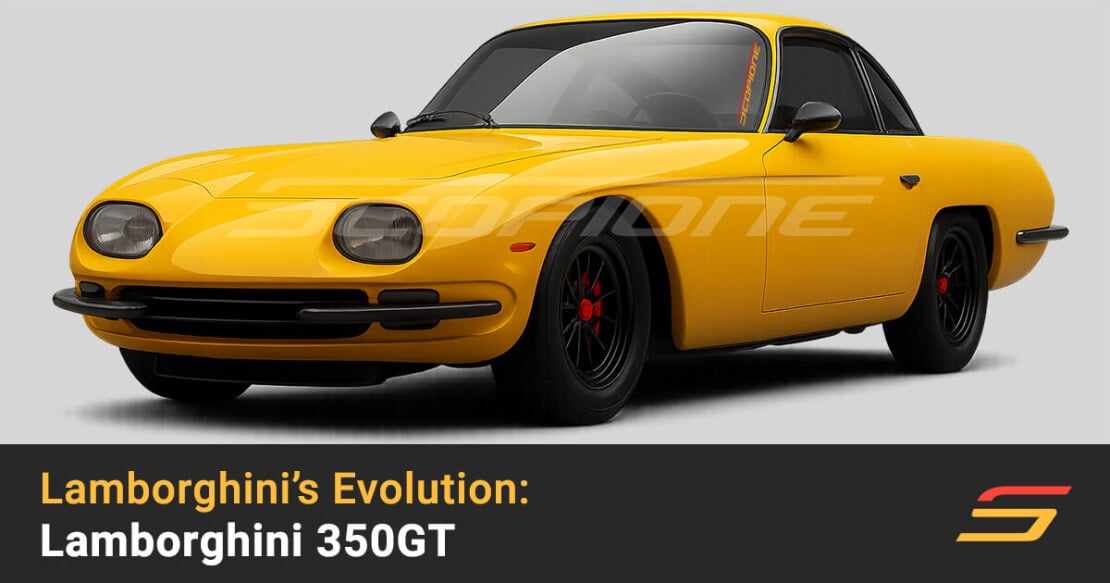
Ferruccio Lamborghini hired Giotto Bizzarrini to design a V12 engine, recruited Gian Paolo Dallara and Paolo Stanzani to engineer the chassis, and commissioned Touring Superleggera to build the body of what became the 350 GT (1964–1966). The Superleggera method – thin aluminum panels draped over a tubular steel skeleton – was a lightweight construction technique patented by Touring decades earlier. Only 120 units left the factory. But the Bizzarrini V12 architecture would serve Lamborghini, in progressively evolved form, for nearly five decades – through the end of Murcielago production in 2010, when the Aventador introduced an all-new V12.
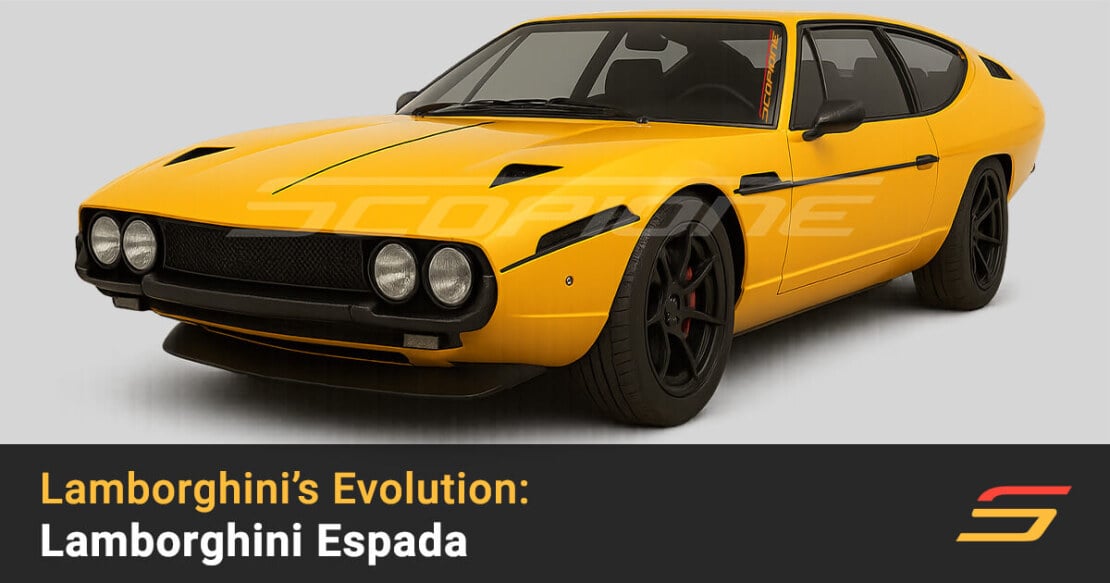
The Espada (1968–1978) demonstrated that Lamborghini could build beyond two-seat exotics. Gandini designed a wide, low body that seated four adults in genuine comfort, powered by a front-mounted 3.9-liter V12 producing 325–350 hp through a conventional drivetrain layout. Customers bought 1,217 Espadas across three series (each with progressive refinements to the dashboard, transmission, and power steering) – making it the brand’s highest-volume single model of its era. Steel construction throughout, no composites. But building 1,217 units of a complex V12 grand tourer in the 1960s and 1970s required production planning, supply chain management, and quality control at a scale most exotic car makers of the era never attempted. Those organizational capabilities proved essential when Lamborghini later needed to manufacture CF monocoques at rates exceeding 1,000 per year for the Aventador.
Lamborghini 400 GT, Islero, and Jarama: The Grand Tourer Line
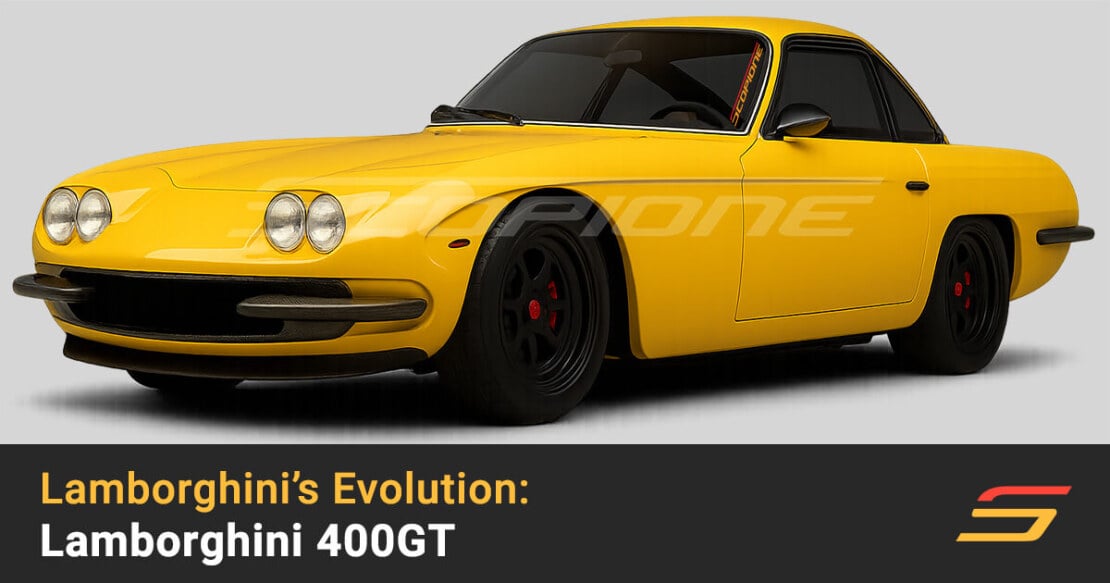
The Miura drew the headlines, but grand tourers paid the bills. The 400 GT (1966–1968) enlarged the V12 to 3.9 liters, added 2+2 seating, and carried the first gearbox and differential Lamborghini designed and built in-house – 23 Interim cars and 224 400 GT 2+2s in total. That do-it-ourselves instinct became a company trait, and it resurfaces later in this story every time Lamborghini chose to build composites itself rather than buy them.
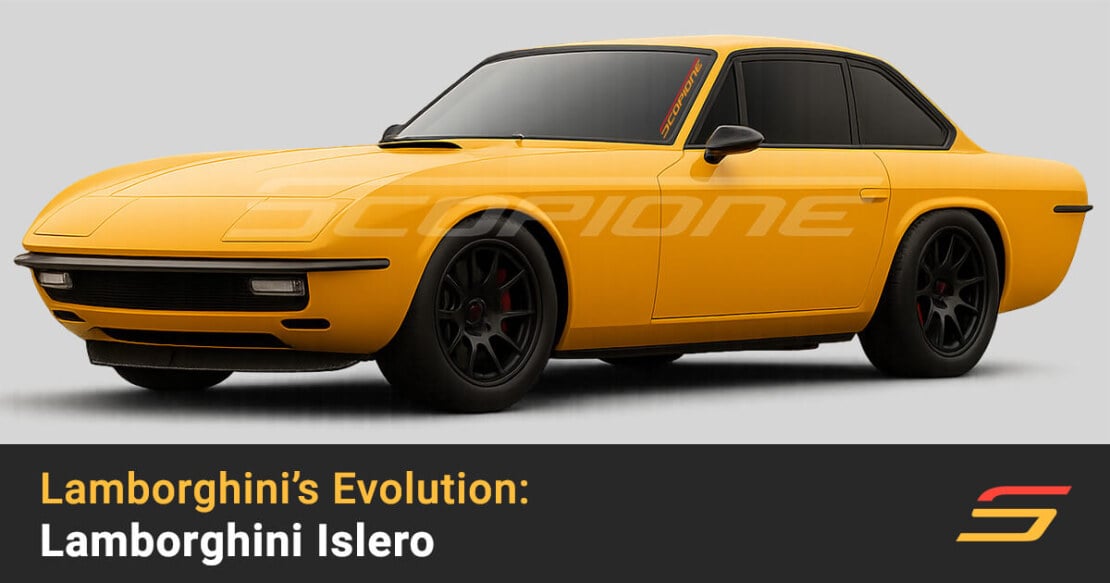
The Islero (1968–1969) replaced it with deliberately restrained bodywork – 225 built in barely two seasons, named for the Miura bull that killed the matador Manolete in 1947.
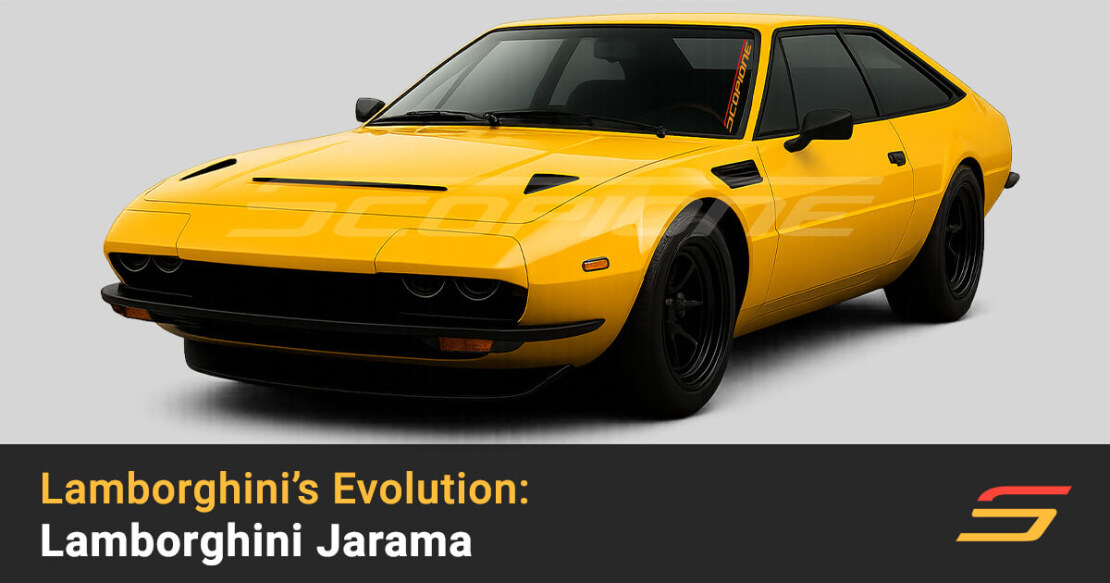
The Jarama (1970–1976) closed the line: 177 standard cars plus 150 higher-output Jarama S models, the last new front-engined V12 grand tourer design Lamborghini ever introduced. All three were built the mid-century way – steel and aluminum shaped by hand – but the revenue they generated kept the engineering payroll alive, and everything after them in this story was paid for by cars like these.
Lamborghini Miura (1966–1973): The Supercar Template
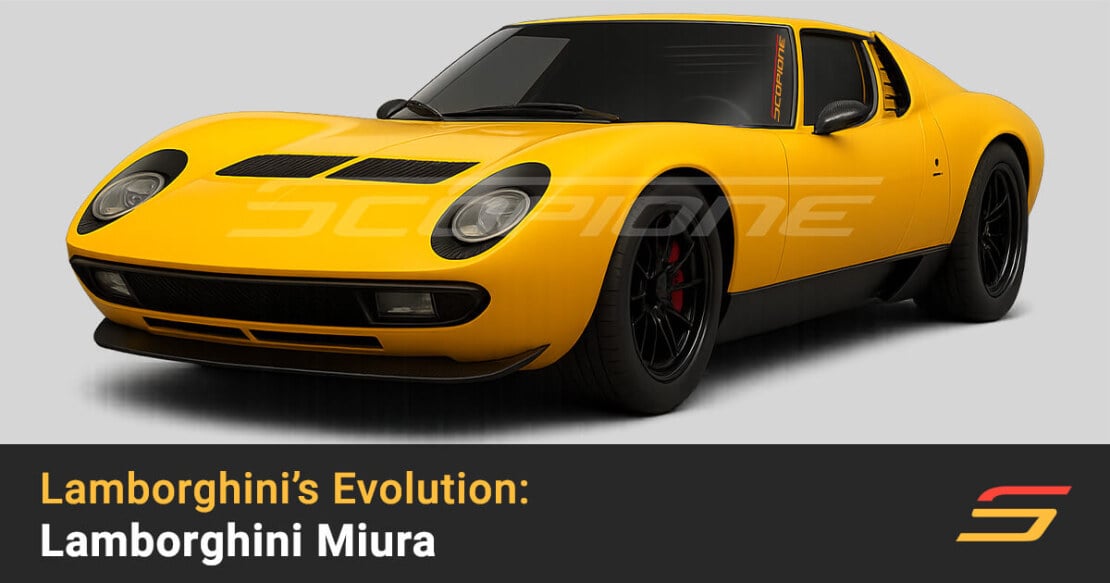
The Miura rewrote the rules. Dallara and Stanzani mounted the 3.9-liter V12 transversely behind the cockpit – a layout no production car had attempted. The idea drew from the Ford GT40 race program, but Dallara and Stanzani went further: they integrated the engine, gearbox, and rear axle into a single removable subassembly. Marcello Gandini at Bertone penned the body, and the result became an icon. Three variants followed: the P400 (350 hp), the S (370 hp), and the SV (385 hp). Curb weight sat around 1,180 kg – light for a V12 GT in 1966.
- Engine: 3.9L V12, transverse mid-mounted, 350–385 hp
- 0–60 mph: 6.7 seconds (P400)
- Top speed: 170 mph (SV)
- Production: 764 units (all variants)
- Curb weight: ~1,180 kg
The transverse mid-engine layout became the template for every Lamborghini supercar that followed. That configuration – engine behind the driver, mass concentrated centrally – is precisely the layout that benefits most from carbon-fiber construction. Every kilogram saved in a mid-engine chassis amplifies the handling advantage the layout provides. The Miura also established Lamborghini’s collaborative approach to design: in-house engineering paired with external design houses. Dallara and Stanzani did the engineering while Gandini handled the aesthetics – a model that continued through the Countach and Diablo before Lamborghini brought design fully in-house with the Centro Stile studio. The Miura set the architecture; CF would later perfect it.
Lamborghini Urraco, Silhouette, and Jalpa: The V8 Junior Line
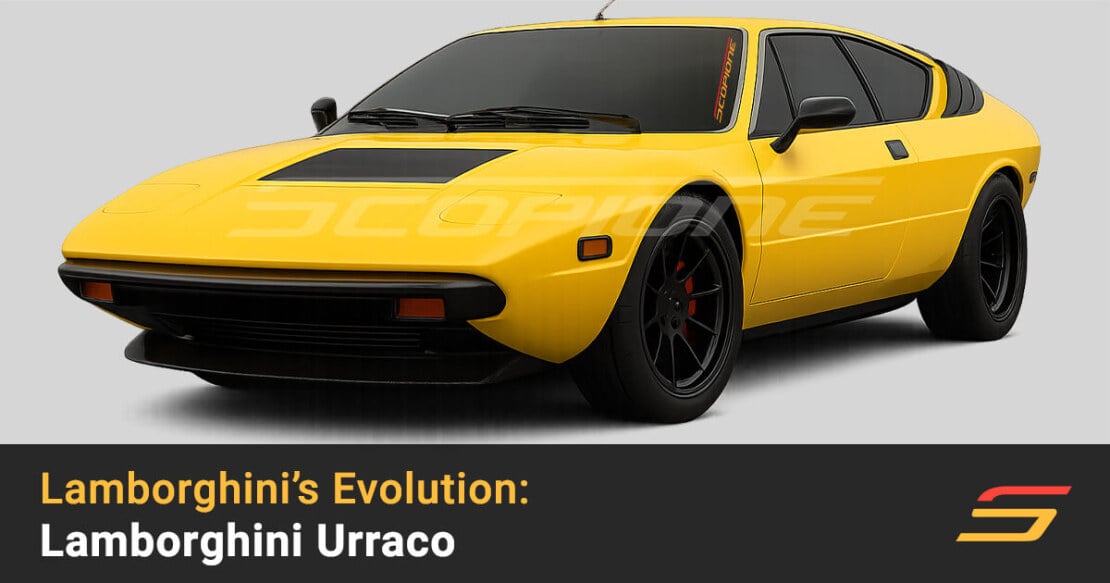
The Urraco (1972–1979) was Lamborghini’s play for the junior-supercar market defined by the Ferrari Dino and Porsche 911 – a 2+2 with a transverse V8, built in 791 units across the P200, P250, and P300 series.
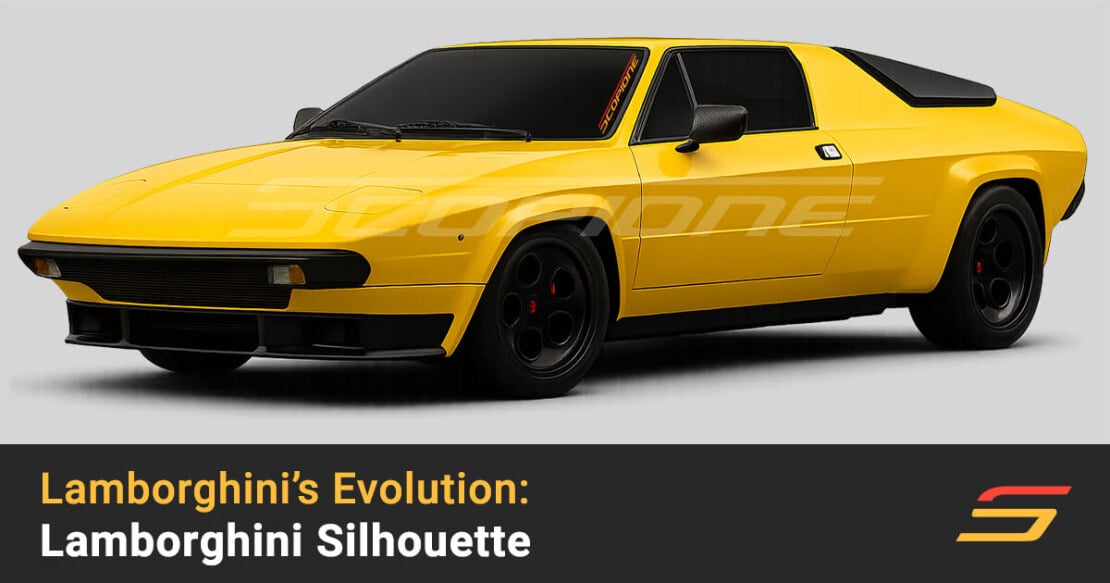
From it came the Silhouette (1976–1979), the first open-top production Lamborghini. Its removable targa panel made it a landmark for the brand and a rarity for collectors: only 54 were ever made.
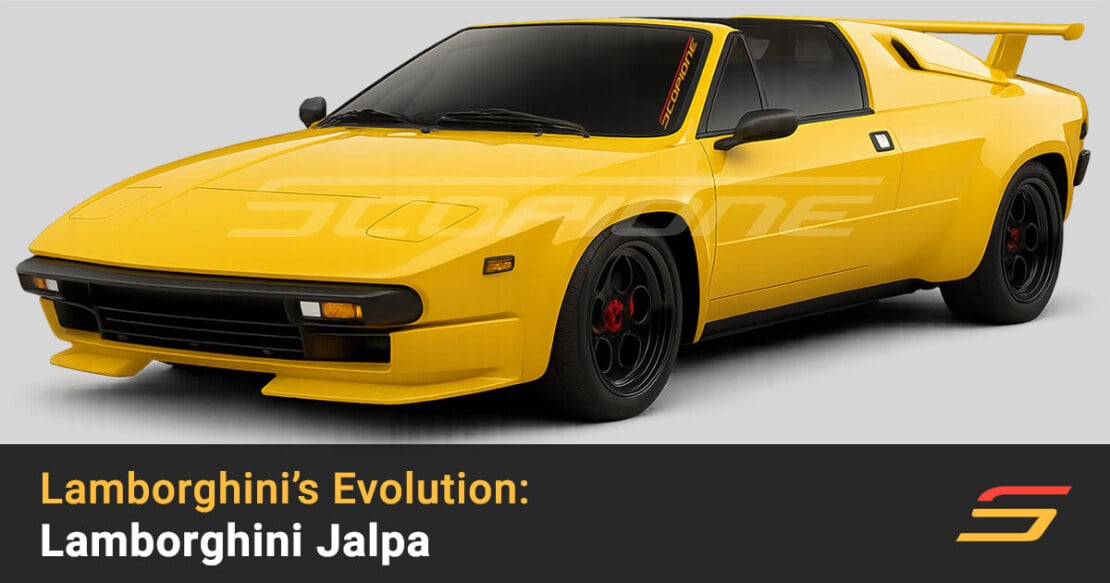
The Jalpa (1981–1988) refined the formula with a 3.5-liter V8 and 410 units sold through the company’s darkest financial decade. When Jalpa production ended in 1988, Lamborghini shelved the junior-Lamborghini idea for thirty years – until the Urus revived it in 2018 and promptly became the volume leader. The V8 line never touched composites, but it kept the company alive long enough to reach them.
Lamborghini Countach (1974–1990): Where Carbon Fiber Enters the Story
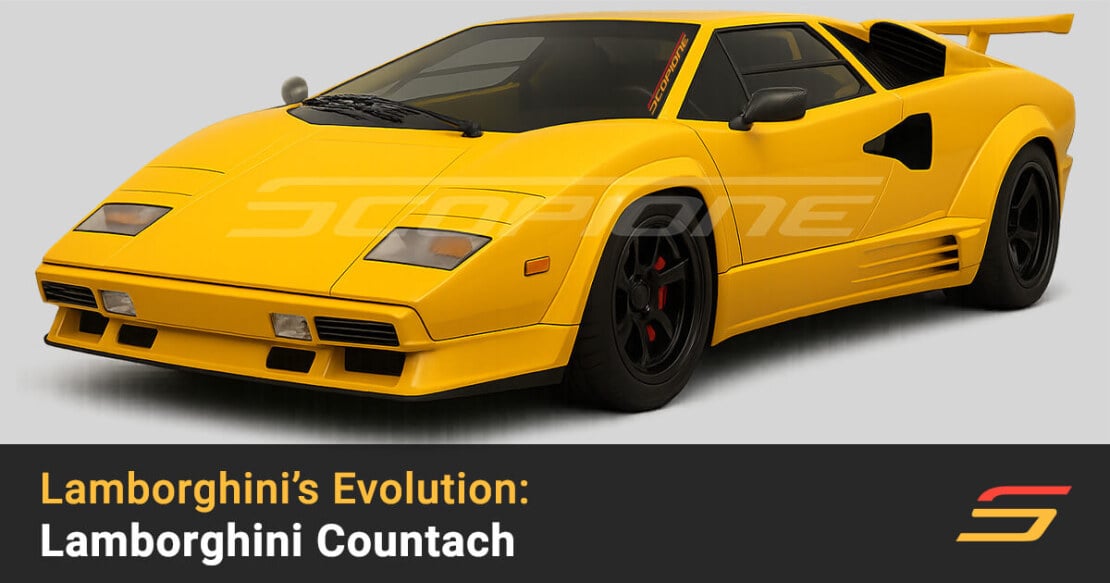
Gandini’s wedge-shaped poster car defined an era and a 16-year production run. The LP400 launched in 1974 with a 3.9-liter V12 producing 375 hp, mounted longitudinally – a departure from the Miura’s transverse layout. The scissor doors, introduced on the Countach prototype, became a Lamborghini signature that persists through the Revuelto. Over four major variants – LP400 S, LP5000 S, LP5000 QV (455 hp), and 25th Anniversary Edition – Lamborghini built 1,999 Countachs.
- Engine: 3.9L–5.2L V12, 375–455 hp
- 0–60 mph: 5.4 seconds (QV)
- Top speed: 183 mph (QV)
- Production: 1,999 units (all variants)
- Designer: Marcello Gandini at Bertone
In 1983, a 28-year-old Argentine engineer named Horacio Pagani arrived at Sant’Agata Bolognese with a background in composite materials and an outsized ambition. Pagani had studied the emerging use of carbon-fiber monocoques in Formula 1 – John Barnard’s McLaren MP4/1 had debuted the concept just two years earlier, and Ron Dennis’s team proved that a CF tub could survive a Grand Prix season of impacts and vibrations. Pagani saw an opportunity to bring the technology to road cars, where the weight savings and structural rigidity could transform the driving experience rather than just improve lap times. At Lamborghini, he found an engineering team that was receptive to composite innovation but lacked the tools, facilities, and budget to act on his ideas at production scale.
Pagani built the Countach Evoluzione (1987) – a running prototype with extensive composite bodywork – to demonstrate the material’s potential to Lamborghini management. The reception was mixed. The factory’s metalworkers had decades of experience shaping aluminum and steel; CF required entirely different skills, tools, and adhesives. But Pagani persisted, and the 25th Anniversary Edition (1988–1990, approximately 657 units) incorporated early composite elements in non-structural areas – making it the first Lamborghini to use advanced composites in any production capacity.
The experiments were modest. CF was expensive, manufacturing processes were immature, and the factory had no dedicated composite equipment. But Pagani’s years at Sant’Agata created something more durable than any single part: institutional knowledge. Engineers who worked alongside him understood CF’s properties, its failure modes, and its potential. When Pagani departed in the early 1990s to found Pagani Automobili – eventually producing the Zonda C12 with a full CF monocoque, beating Lamborghini to the structural milestone by over a decade – the composite DNA he introduced did not leave with him. It stayed in the heads and hands of the people he trained.
Scopione Perspective: The Founding Era
The Touring Superleggera method on the 350 GT. The Miura’s compact mid-engine packaging that would define every subsequent supercar. The Countach’s first steps toward composite materials under Pagani’s influence. Each of these founding-era decisions reflected the same impulse: reduce mass without sacrificing structural rigidity or design intent. Scopione’s carbon fiber catalog for modern Lamborghini models carries forward that principle directly – every component is precision-fitted to factory mounting points, preserving the design geometry and structural characteristics that Sant’Agata’s engineers embedded in each vehicle platform.
1990–2001: The Diablo and Early Composites

The Diablo era was defined by corporate turbulence. Lamborghini passed through three ownership changes in just over a decade: Chrysler (1987–1994), Megatech and Indonesian investors (1994–1998), and finally Volkswagen Group via Audi (1998–present). Each transition disrupted engineering programs and delayed model updates. Despite that instability, this period produced something lasting: Lamborghini’s first meaningful production use of carbon fiber body panels, and the Audi acquisition that would fund everything that followed.
Lamborghini LM002 (1986–1993): The V12 Goes Off-Road

Before the Diablo arrived, Lamborghini spent the late 1980s building the least likely V12 vehicle in its history. The LM002 – roughly 300 units between 1986 and 1993 – dropped the Countach’s 5.2-liter V12 into a military-derived off-roader riding on enormous run-flat tires, earning the nickname “Rambo Lambo.” It was a commercial curiosity then; in hindsight it was a prophecy. When the Urus arrived in 2018 and became the brand’s best-seller, the LM002 stood revealed as the ancestor of the modern super-SUV.
Lamborghini Diablo (1990–2001)

Marcello Gandini drew the original Diablo, though Chrysler’s Tom Gale team substantially revised the design before production – smoothing Gandini’s sharper angles into a more aerodynamically efficient shape. The base model launched in 1990 with a 5.7-liter V12 producing 485 hp, enough for a claimed 202 mph top speed. Over an 11-year run, the Diablo spawned the VT (all-wheel drive, 1993), SE30 (30th anniversary, 1994), SE30 Jota (track-focused, 1994), SV (1995), GT (1999), and the final 6.0-liter VT (550 hp, 2000). Total production: approximately 2,900 units.
- Engine: 5.7L V12 (base), 6.0L V12 (later variants)
- Power: 485–575 hp
- 0–60 mph: 4.5 seconds (base), 3.9 seconds (GT)
- Top speed: 202 mph
- Production: ~2,900 units (all variants)
The SE30 Jota (1994, 28 units) was the first Diablo to use carbon fiber body panels for weight reduction – CF-reinforced bumpers and interior panels that marked a functional application rather than a prototype experiment. Lamborghini produced the SE30 Jota to commemorate the brand’s 30th anniversary, and the CF components signaled a direction for the company’s future special editions: lighter, faster, more track-focused.
Five years later, the Diablo GT (1999, 80 units) pushed much further: CF body panels throughout the exterior, a stripped interior, fixed headlights replacing the pop-up units, and 575 hp from the 6.0-liter V12. Each GT was essentially a road-legal version of Lamborghini’s GT racing car, homologated for the street but engineered for the circuit.
By the Numbers – Diablo GT Weight Savings: At approximately 1,490 kg, the GT was roughly 100 kg lighter than the standard Diablo VT. That difference came primarily from replacing steel and aluminum body panels with carbon fiber. The weight reduction translated directly to performance: the GT’s power-to-weight ratio improved by roughly 10% over the VT, and the car’s handling balance shifted noticeably toward the agile, responsive character that lightweight construction delivers.
The institutional knowledge Pagani introduced survived his departure. Lamborghini’s engineers understood the properties of CF, its manufacturing constraints, and its potential for weight-critical applications. They knew which adhesives bonded CF to metal substructures, how to account for thermal expansion differences between composite and aluminum components, and where CF could replace traditional materials without compromising crash safety. Beyond the parts themselves, the Diablo GT program established a manufacturing workflow for CF body panels – supplier relationships, quality inspection protocols, and tooling processes – that the next generation of engineers could build on rather than start from scratch.
To understand how far behind Lamborghini was at this point, consider the competitive context. Gordon Murray’s McLaren F1 (1992) used a full carbon fiber monocoque designed by Peter Stevens and built with aerospace-grade prepreg – a complete structural CF chassis, not just body panels. Pagani himself left Lamborghini and produced the Zonda C12 (1999) with a CF monocoque manufactured in-house at his small Modena facility. Even Ferrari was incorporating CF structural elements into the F50 (1995). Lamborghini, by contrast, was still limited to bolt-on CF body panels on low-volume special editions. The Diablo GT’s 80 CF-clad units looked modest next to the F1’s complete composite architecture.
The Audi acquisition in 1998 changed the equation. Under Chrysler and Megatech, Lamborghini operated with minimal R&D budget and aging manufacturing equipment. Audi brought VW Group’s material science laboratories, high-volume manufacturing know-how, and an engineering culture that valued rigorous testing and process control. The gap between Lamborghini’s CF capability and its competitors’ was now backed by the resources to close it – and the next decade would prove how rapidly Sant’Agata could move once the funding arrived.
The Diablo also established the naming convention for Lamborghini’s lightweight special editions: GT, SV, SE. That pattern – a standard model refined into a stripped, track-focused variant with progressively more CF content – continues through every model line today. The Gallardo Superleggera, Huracan STO, and Aventador SVJ all follow the formula the Diablo initiated.
Scopione Perspective: The Diablo Era
Every CF body panel Lamborghini built during the 1990s – each SE30 Jota bumper, each Diablo GT hood section – represented manufacturing knowledge that accumulated in Sant’Agata’s engineering teams. That lineage runs directly through to the modern models that Scopione supports: the Gallardo, Huracan, and Aventador. The aftermarket CF parts available for these platforms exist because the Diablo era proved that Lamborghini owners valued carbon fiber as both a functional upgrade and a visual statement – a preference that has only intensified as each successive model increased factory CF content.
2001–2013: Gallardo, Murcielago, and the CF Breakthrough
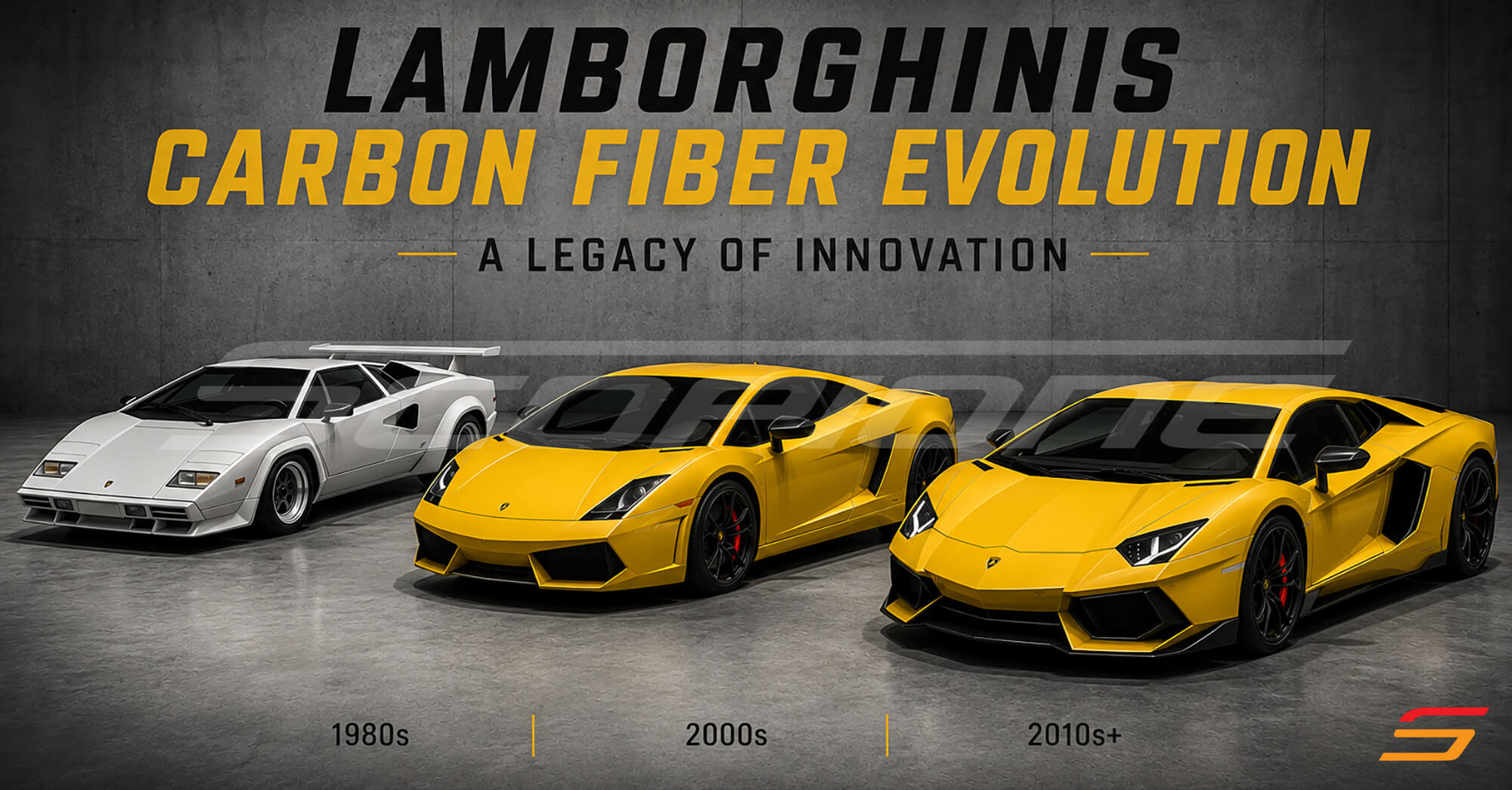
Under Audi’s stewardship, Lamborghini ran two simultaneous model lines for the first time: the flagship Murcielago and the entry-level Gallardo. Maurizio Reggiani – who joined Lamborghini in 1998 and would lead R&D through the Aventador and Huracan programs – described this era as the period when Lamborghini stopped being a small workshop and became an engineering company. The Gallardo alone produced over 14,000 units, more than every Lamborghini built before it combined. Annual revenue roughly quadrupled. And the increased capital flow funded the infrastructure that turned Lamborghini from a company that used carbon fiber into a company that manufactured it.
Lamborghini Murcielago (2001–2010)

Luc Donckerwolke designed the Murcielago as the first clean-sheet Lamborghini flagship under Audi ownership. The base model produced 572 hp from its 6.2-liter V12. A mid-cycle update in 2006 brought the LP640: displacement grew to 6.5 liters, output rose to 631 hp. But the pivotal variant was the LP670-4 SV (Super Veloce, 2009).
- Engine: 6.2L V12 (base), 6.5L V12 (LP640, LP670-4 SV)
- Power: 572–661 hp
- 0–60 mph: 3.8 seconds (base), 3.2 seconds (LP670-4 SV)
- Top speed: 205 mph (base), 212 mph (LP670-4 SV)
- Production: 4,099 units (all variants)
The LP670-4 SV stripped approximately 100 kg from the LP640 through extensive CF deployment: front splitter, rear wing, engine cover, diffuser, door panels, and interior trim. The 6.5-liter V12 received a bump to 661 hp. Production was planned at 350 units, but only around 186 were built before the Aventador took over the assembly line – scarcity that made the SV an instant collectible.
Beyond body panels, the Murcielago’s chassis incorporated a steel and carbon fiber hybrid structure – Lamborghini’s first structural CF application in a production car. Carbon-fiber elements reinforced the central tunnel and door sills, areas where stiffness directly affects both crash performance and handling precision. The SV proved that heavy CF usage could work on a flagship built in meaningful numbers (the SV production run), not just on a limited run of 28 SE30 Jotas. That validation – demonstrated through actual customer deliveries, warranty claims data, and service records – was essential for greenlighting the Aventador’s full CF monocoque two years later.
Lamborghini Gallardo (2003–2013)

The Gallardo changed Lamborghini’s financial trajectory. Donckerwolke penned the exterior. Audi’s engineers contributed the aluminum space frame and the manufacturing discipline required for volumes Lamborghini had never attempted. The 5.0-liter V10 – developed jointly with Audi, a variant of which powered the Audi R8 – delivered 493 hp in the initial model. And customers responded: 14,022 units over a 10-year run.
- Engine: 5.0L V10 (2003–2008), 5.2L V10 (LP 560-4 onward)
- Power: 493–562 hp
- 0–60 mph: 4.0 seconds (base), 3.4 seconds (LP 570-4)
- Top speed: 196 mph (base), 202 mph (LP 570-4)
- Production: 14,022 units
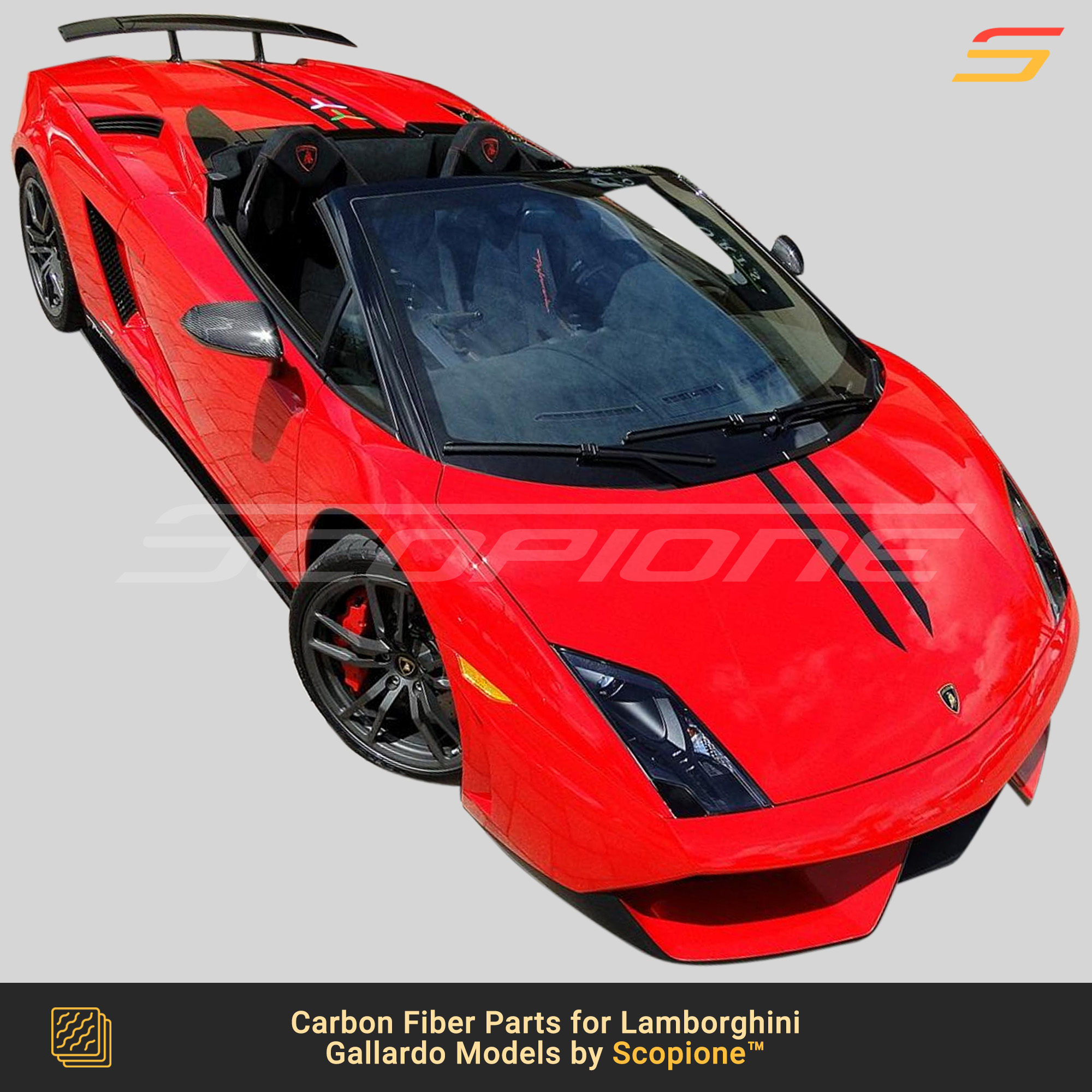
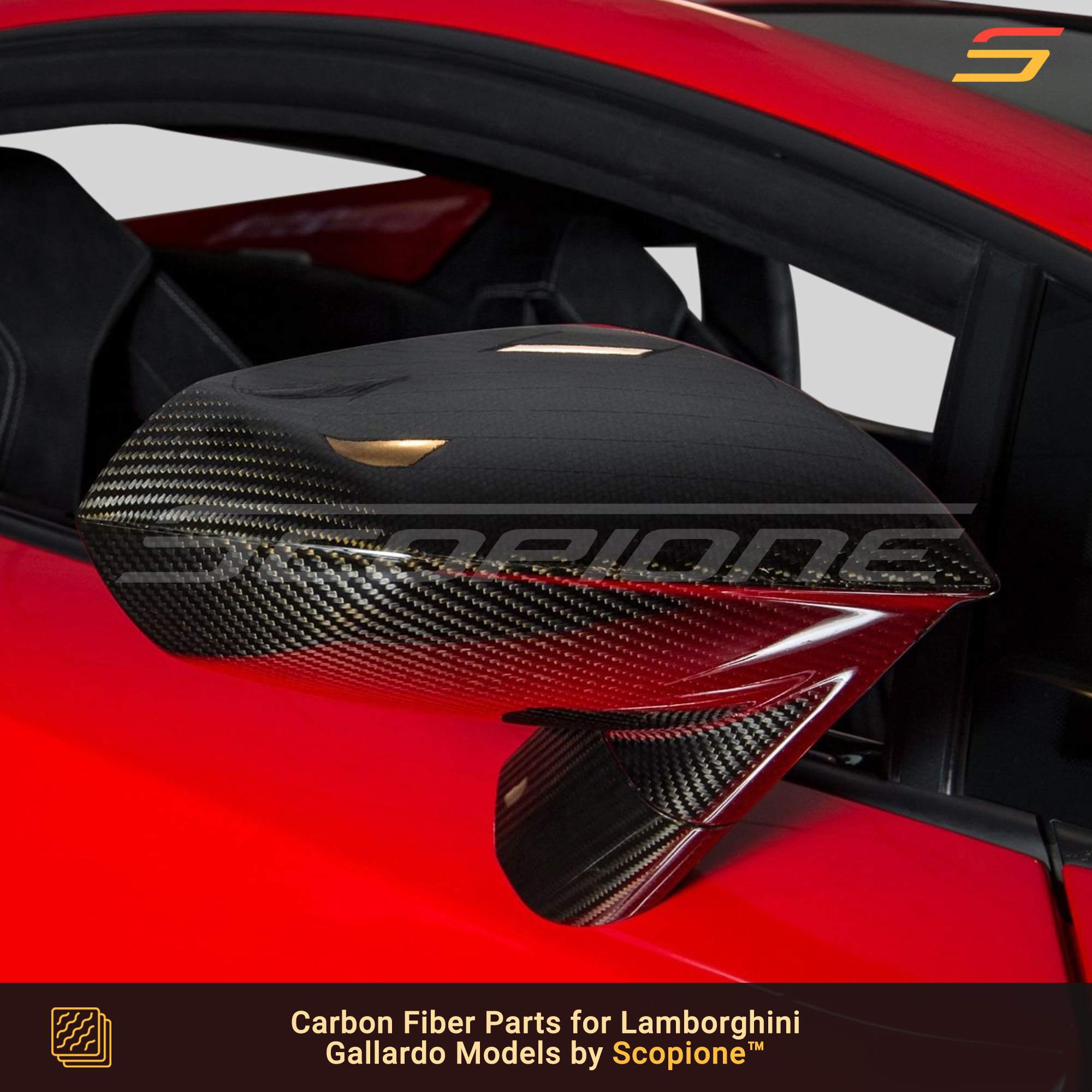
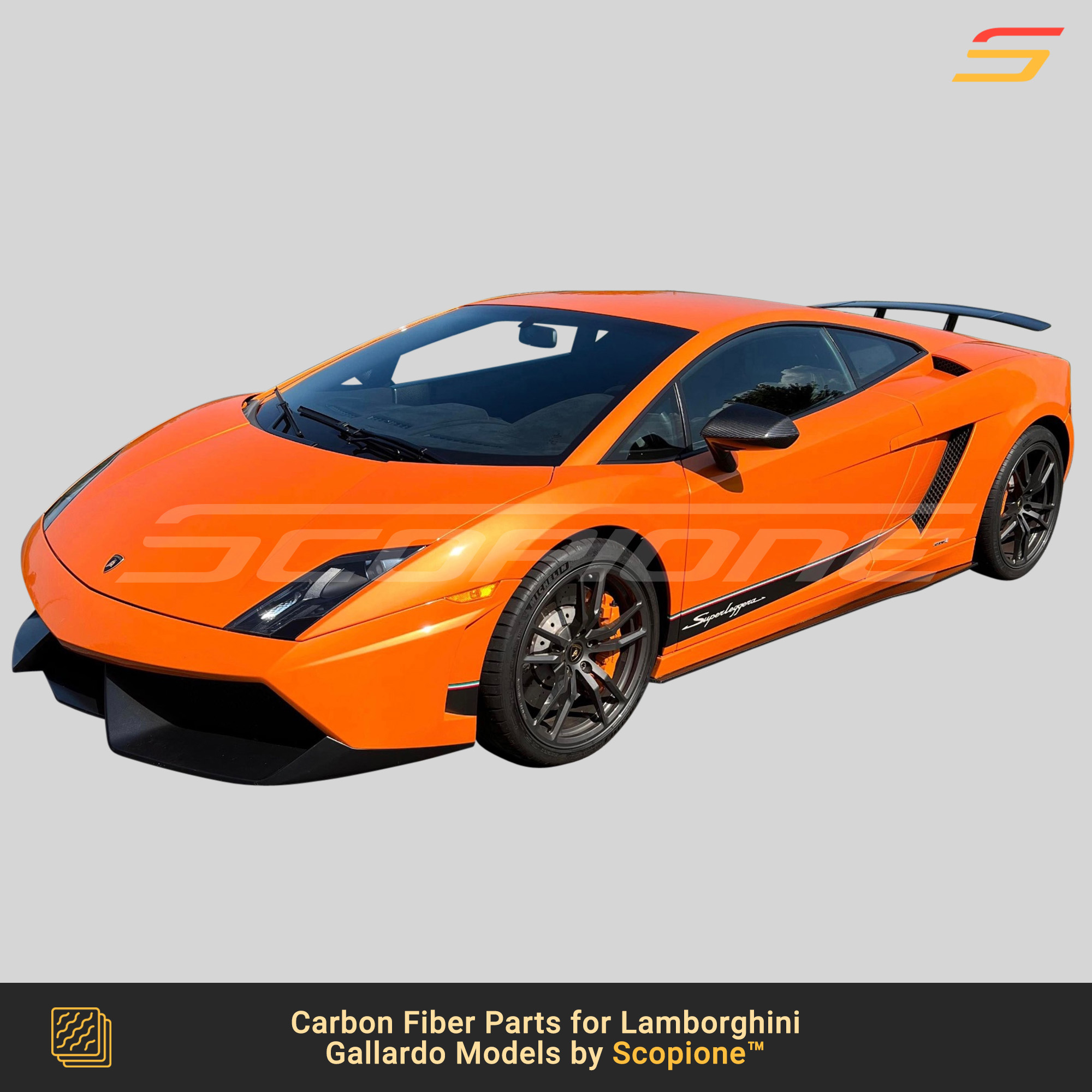
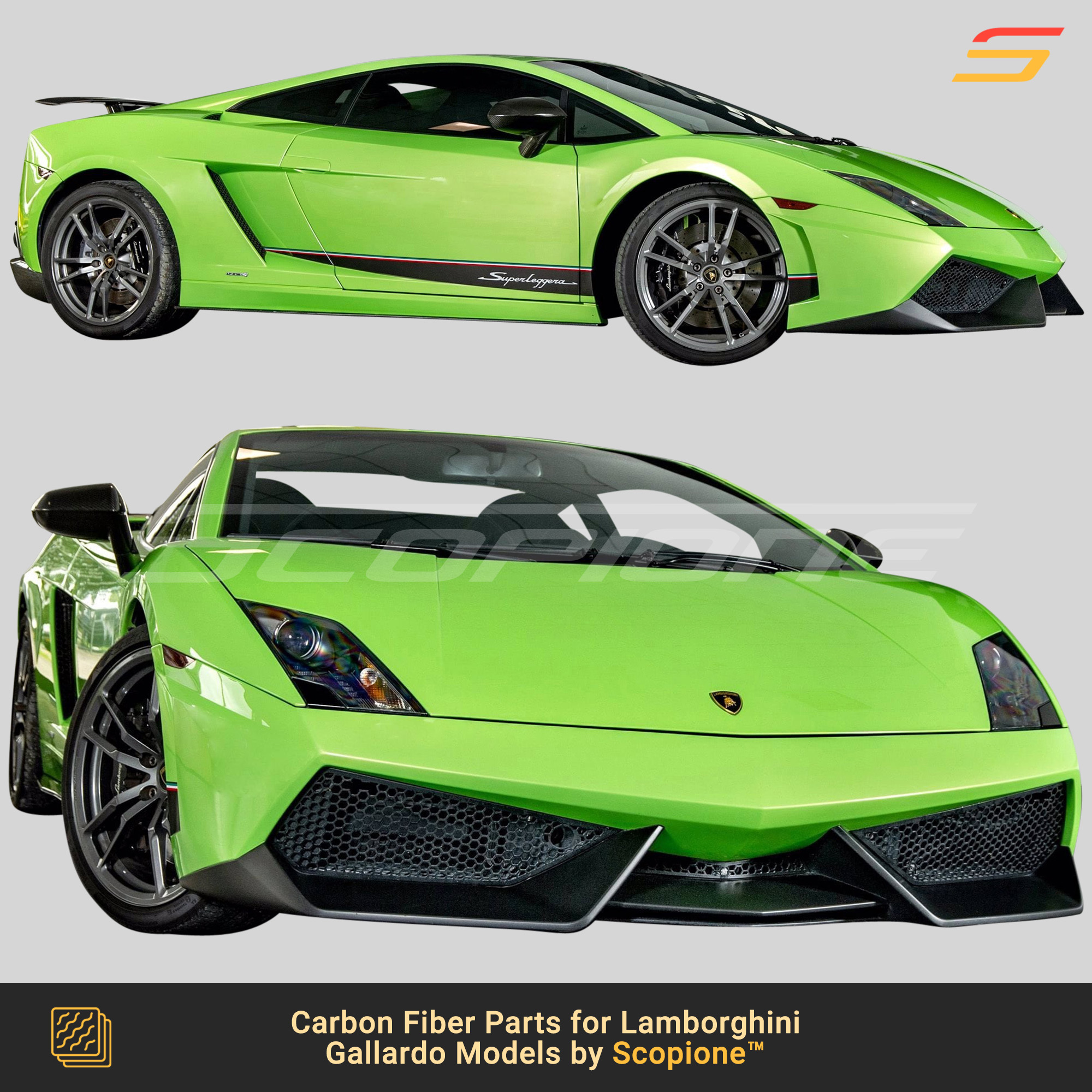
The Gallardo Superleggera (2007) was the inflection point where CF stopped being a special-edition novelty and became a mainstream feature. “Superleggera” – super light – was a deliberate reference to Touring Superleggera, the coachbuilder behind the 350 GT’s body 43 years earlier. CF engine cover, rear diffuser, mirror housings, door panels, interior trim. Thinner exterior glass. Reduced sound deadening. Total weight savings approached 100 kg versus the standard Gallardo.
The LP 570-4 Superleggera (2010) expanded CF content further with a fixed rear wing, additional composite body panels, and a power bump to 562 hp from the updated 5.2-liter V10. The Squadra Corse (2013) – the final, track-focused variant – pushed CF aero to the limit of what the Gallardo platform could accommodate: large rear wing, aggressive front splitter, and a cabin trimmed in bare carbon fiber and Alcantara. Each successive variant increased the CF content, establishing the pattern that would repeat with even greater intensity on the Huracan.
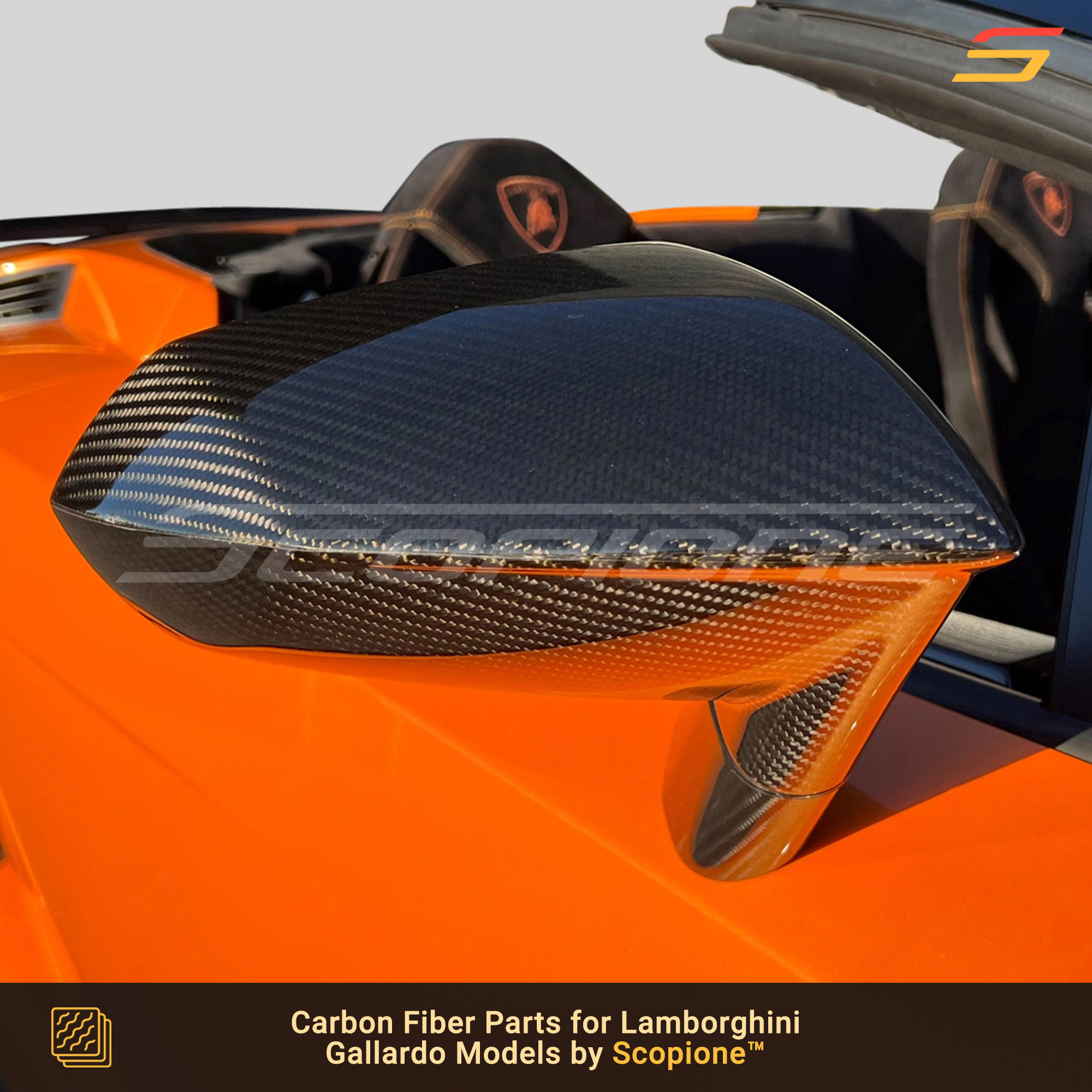
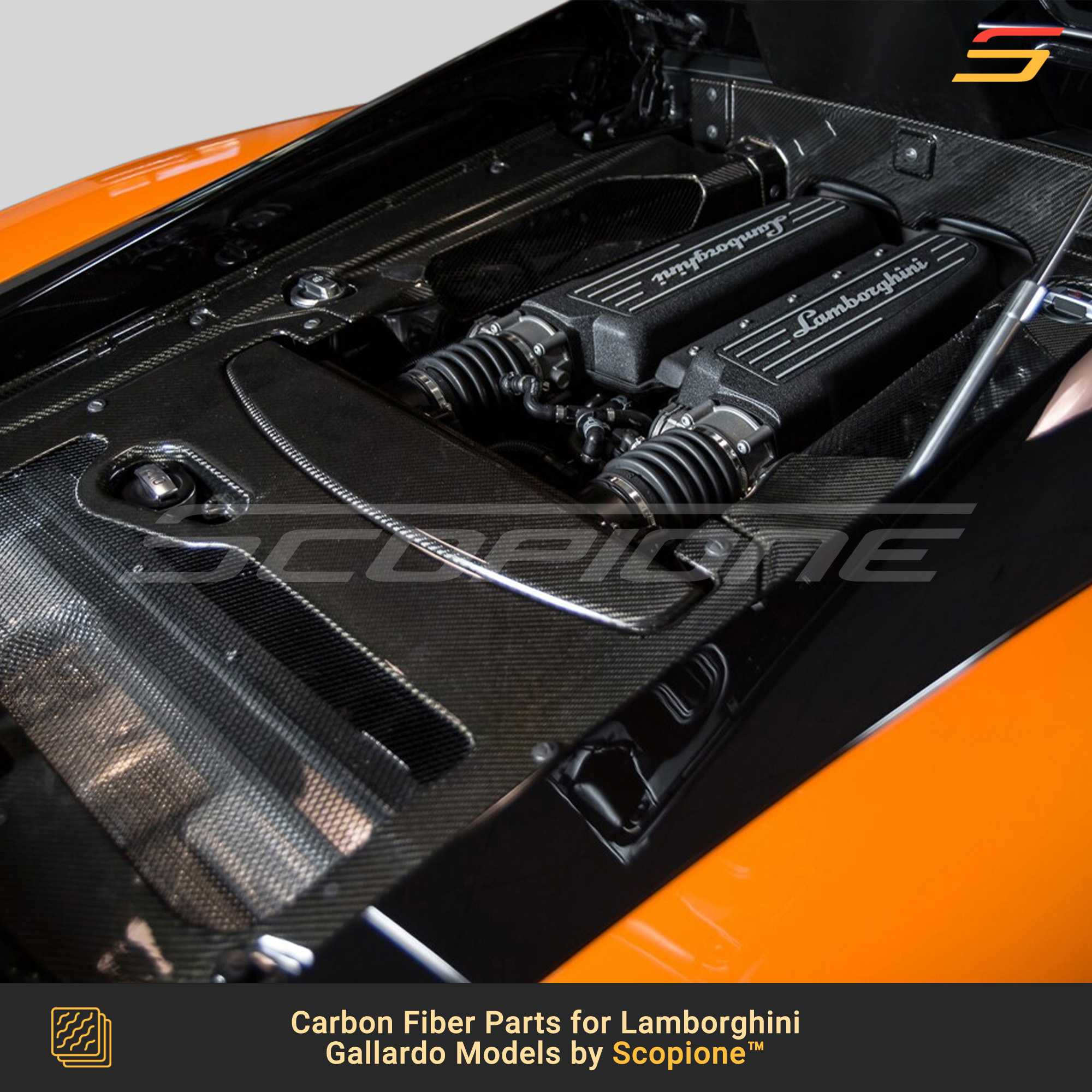
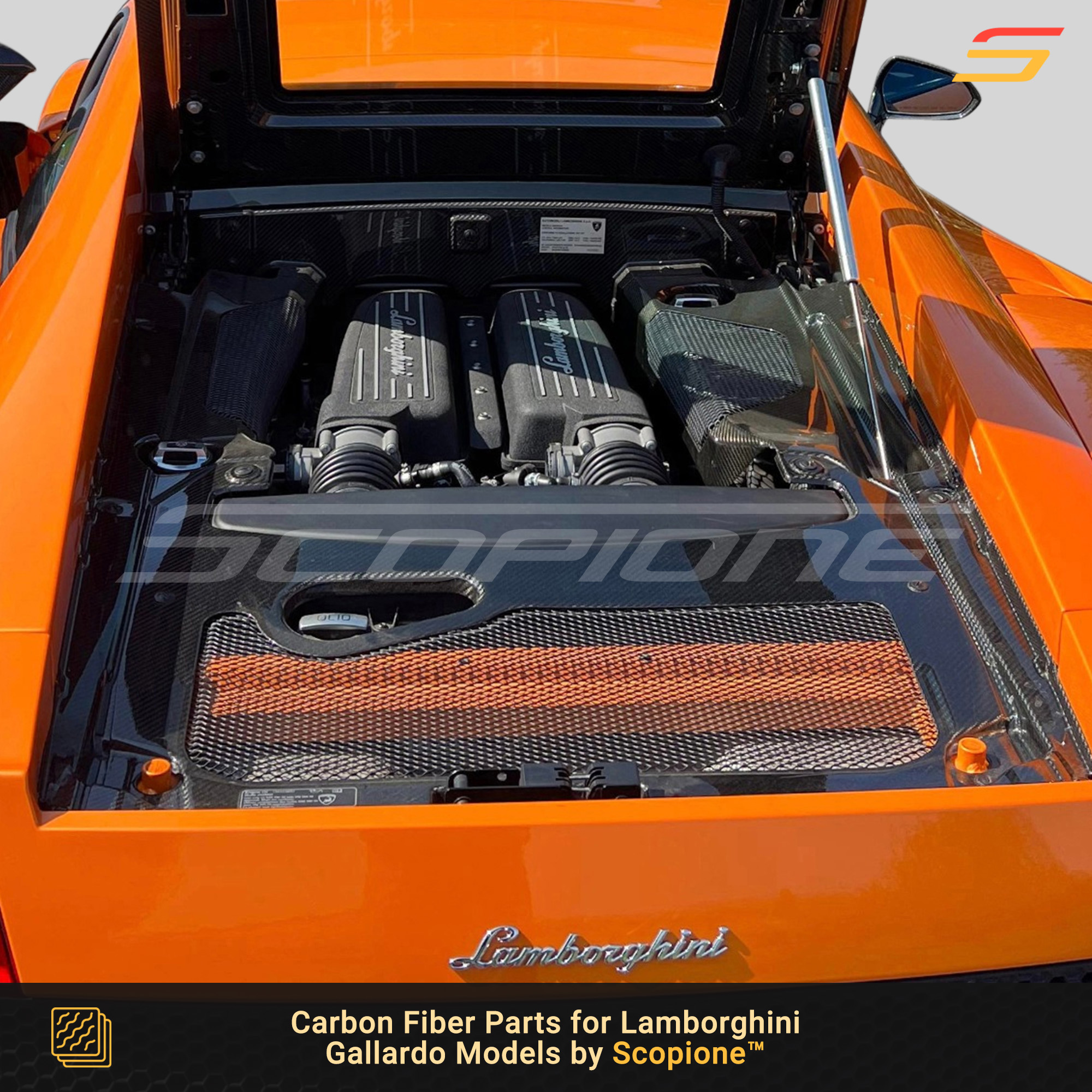
Just as critically, the Gallardo’s commercial success funded everything. At roughly $200,000 per unit, 14,022 Gallardos generated the kind of sustained revenue that a 1,999-unit Countach never could. That financial foundation made it possible for Lamborghini to invest in dedicated composite manufacturing infrastructure – the ACSL facility, the Boeing partnership, the forged composite R&D – rather than outsourcing CF components to third-party suppliers. Explore the full model history and carbon-fiber parts catalog in the Lamborghini Gallardo Picture Gallery.
Lamborghini Reventon (2007): The Carbon Fiber One-Off Era Begins

At the 2007 Frankfurt show Lamborghini invented a business model it still uses today: take the current V12 flagship, reskin it in carbon fiber, and build a handful at several times the price. The Reventon – 21 coupes, one of them kept for the factory museum, plus 15 Roadsters from 2009 – wrapped Murcielago LP640 mechanicals in fighter-jet-inspired bodywork with CFRP exterior panels, down to the carbon housing around its TFT instrument display. Every few-off in the sections that follow descends from this car.
Lamborghini Sesto Elemento (2010–2011): The Sub-Ton Supercar

The name says everything. “Sesto Elemento” – Sixth Element – refers to carbon’s position on the periodic table. Lamborghini unveiled the concept at the 2010 Paris Motor Show, then built approximately 20 track-only production units at around $2.2 million each.
- Engine: 5.2L V10, 562 hp (from Gallardo LP 570-4)
- 0–60 mph: 2.5 seconds
- Top speed: 210 mph
- Curb weight: 999 kg (2,202 lbs) – under one metric ton
- Power-to-weight: 1.78 kg per horsepower
The car was constructed almost entirely from carbon fiber: monocoque tub, body panels, suspension arms, wheel centers, drive shaft, and structural crossmembers. Even the seats were CF shells – fixed-position units padded with a thin layer of material, saving additional kilograms that a conventional adjustable seat frame would have added. For reference, the standard Gallardo LP 560-4 weighed approximately 1,410 kg – 41% heavier than the Sesto Elemento. At 999 kg with 562 hp, the power-to-weight ratio reached territory that even purpose-built track cars rarely achieve. The sub-one-ton figure was deliberately symbolic: Lamborghini named the car after carbon’s atomic number and then built it light enough that the scales confirmed the engineering ambition behind the name.
Engineering First – Forged Composite: The Sesto Elemento debuted Lamborghini’s forged composite technology. Traditional CF manufacturing requires laying up woven prepreg sheets by hand into a mold, then curing them in an autoclave – a process that is labor-intensive, slow, and limited to relatively simple shapes. Forged composite uses a fundamentally different approach: chopped CF strands mixed with resin, compression-molded at high temperature and pressure. The result is faster to produce, cheaper per unit, and capable of forming complex three-dimensional shapes that hand layup cannot achieve. The surface has a distinctive marbled pattern rather than the traditional 2×2 twill weave.
Lamborghini developed forged composite at its Advanced Composite Structures Laboratory (ACSL) in Seattle – established alongside Boeing and the University of Washington – with production engineering at Sant’Agata. Boeing brought decades of experience manufacturing large composite aircraft structures – fuselages, wing components – and shared process knowledge that helped Lamborghini scale CF production beyond the hand-crafted approach that works for 20 track cars but fails at 11,000 road cars. The technology went directly from the Sesto Elemento into the Aventador, the Huracan Performante, and the Revuelto.
Scopione Perspective: The Gallardo and Murcielago Era
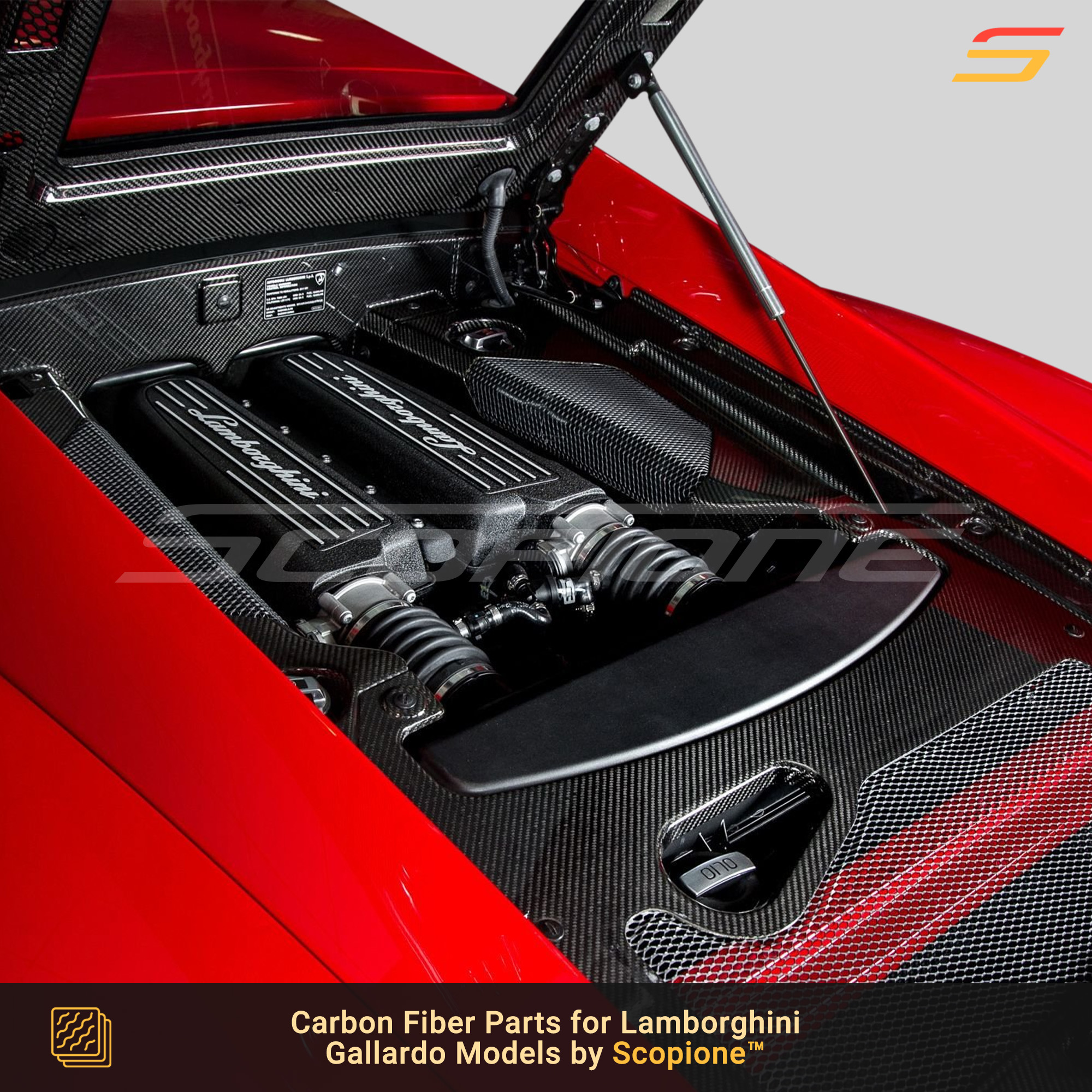
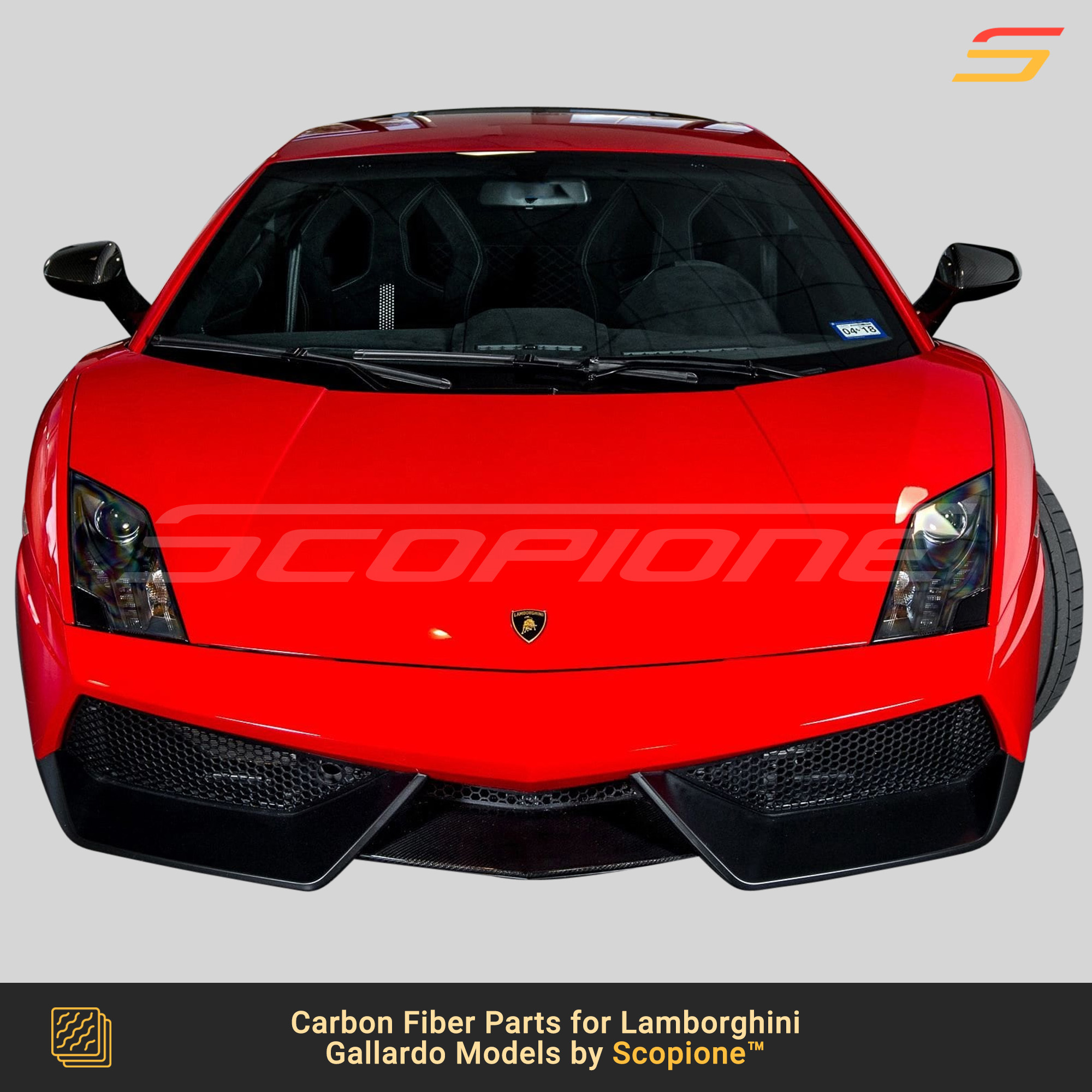
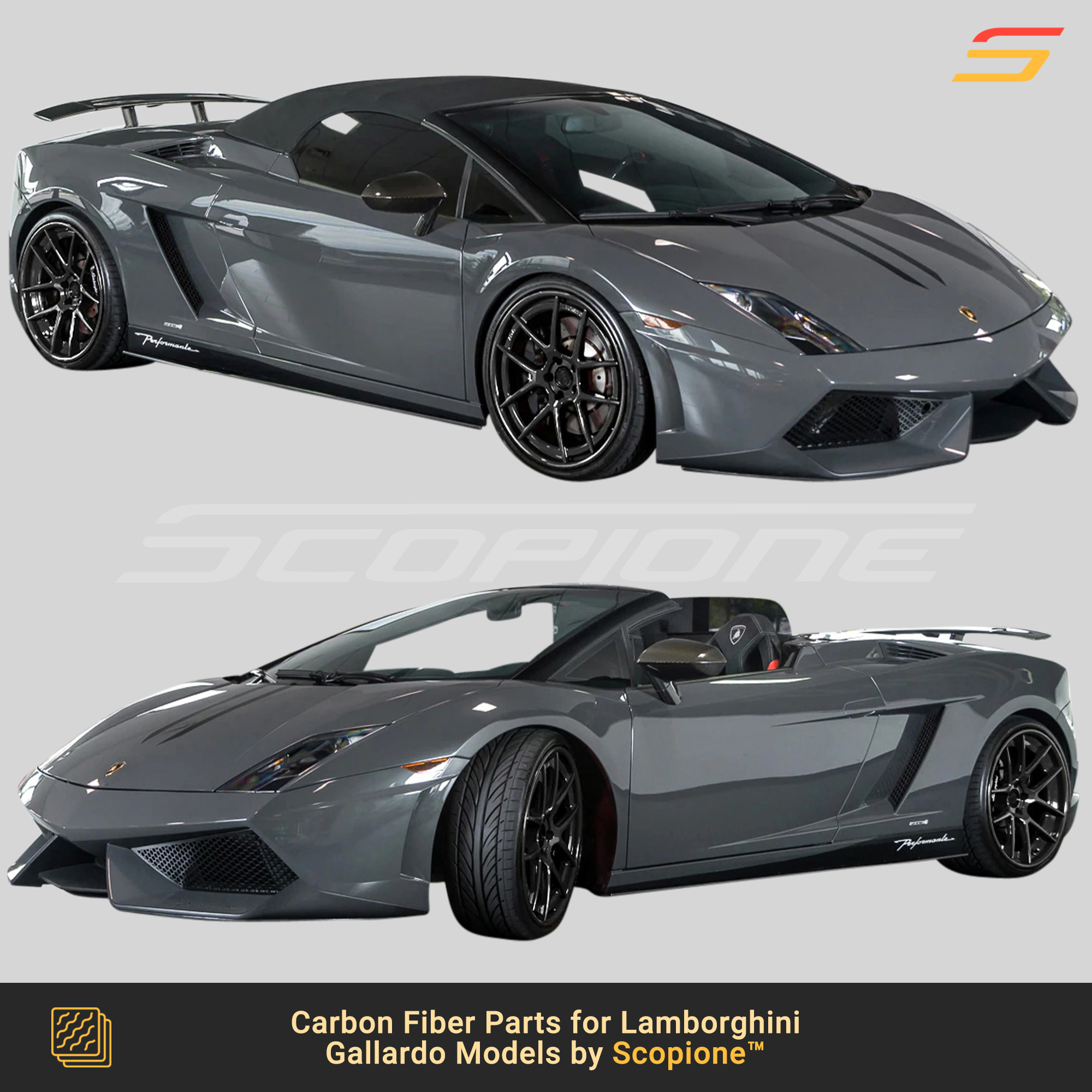
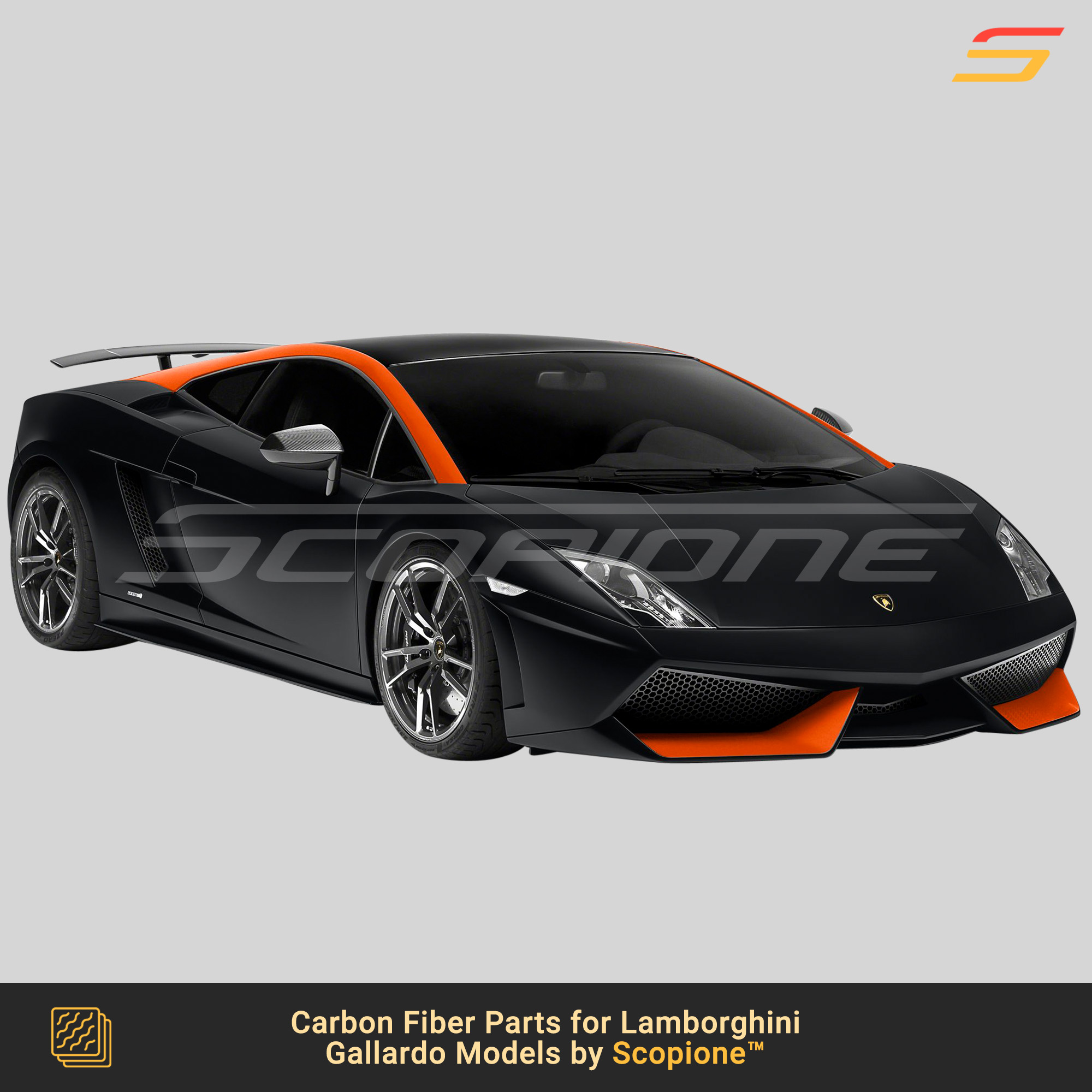
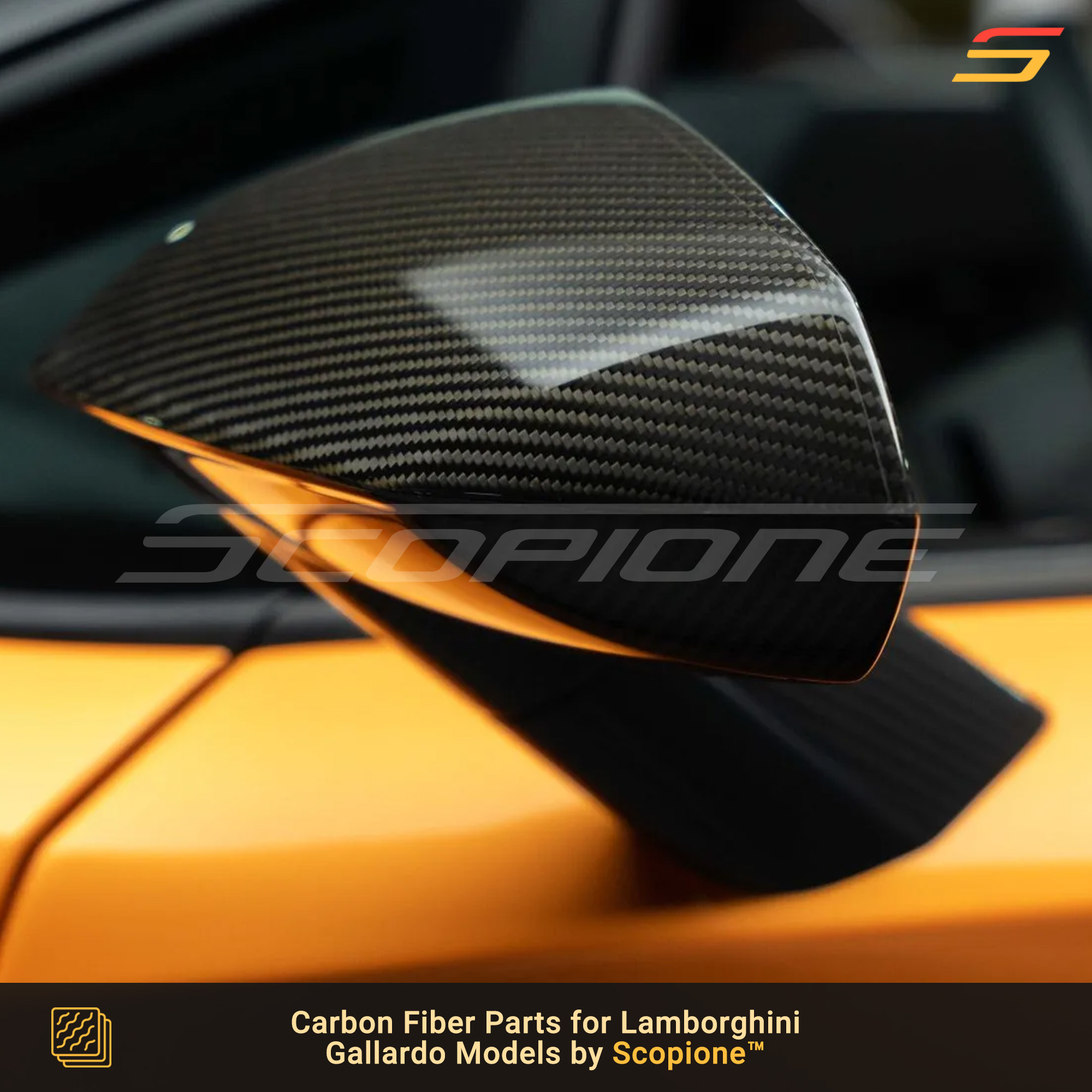
The Gallardo Superleggera made carbon fiber a mainstream Lamborghini feature rather than a special-edition novelty. For the 12,000+ owners of standard Gallardos, adding CF components through the aftermarket became a practical way to bring Superleggera-level visual and functional impact without trading in for the stripped-down variant. A Gallardo LP 560-4 with well-chosen CF upgrades – engine bay covers, mirror shells, rear diffuser, front splitter – can close much of the visual gap to a Superleggera at a fraction of the price premium the factory variant commanded. Scopione carries 2×2 twill-weave CF parts for the Gallardo matched to the weave pattern and finish quality of the factory-installed components on the Superleggera and LP 570-4 variants. The 2×2 3K twill weave pattern matches factory specifications, ensuring aftermarket pieces blend with any existing OEM carbon on the vehicle.
2011–2022: Aventador, Huracan, and the Monocoque Era
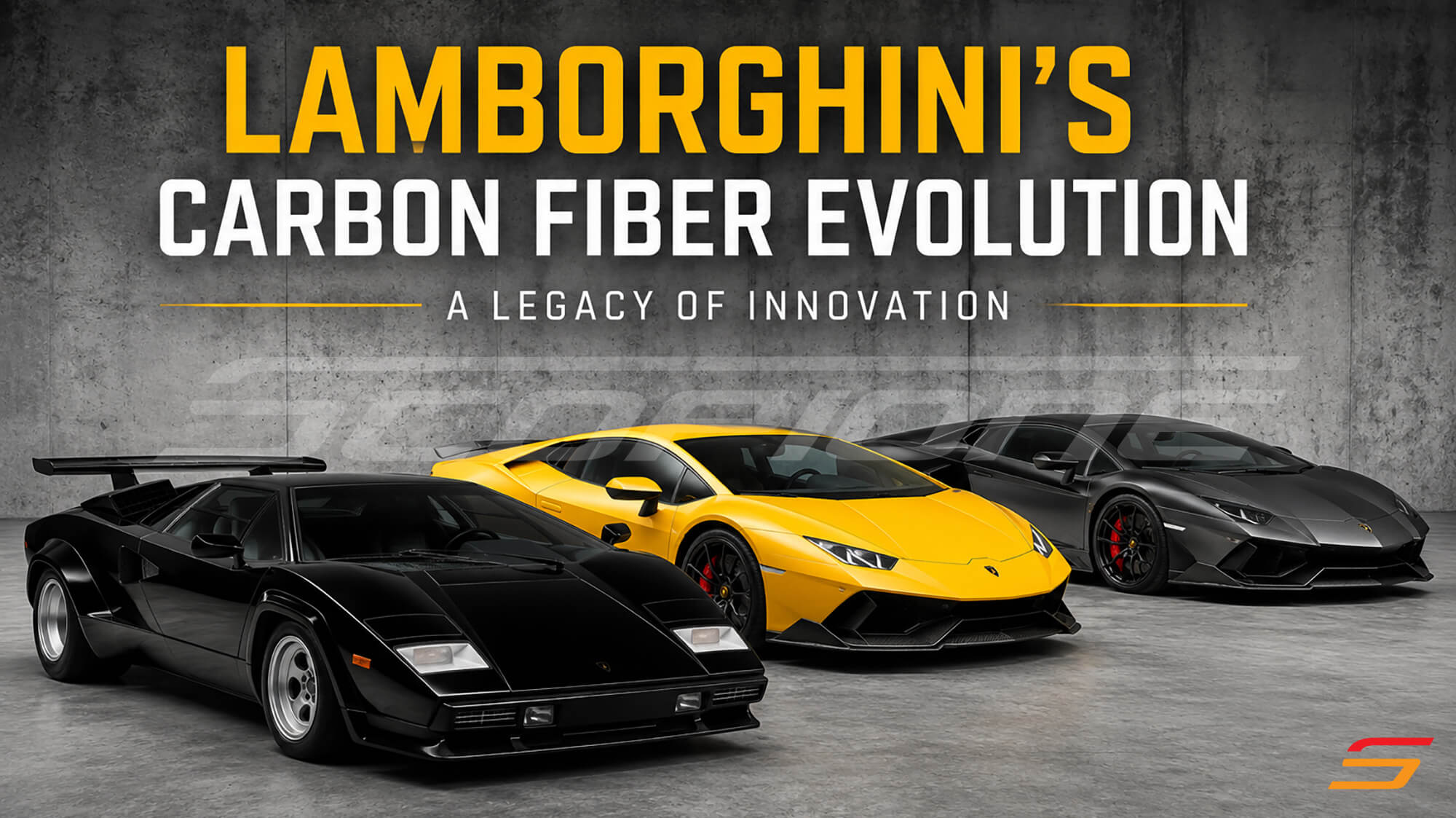
This was the decade where carbon fiber stopped being an option and became the structure. The Aventador introduced a full CF monocoque manufactured in-house. The Huracan brought forged composite to a high-volume model. The Urus expanded CF options into the SUV segment. By 2022, carbon fiber was the structural foundation of every Lamborghini supercar leaving Sant’Agata.
Lamborghini Aventador (2011–2022)

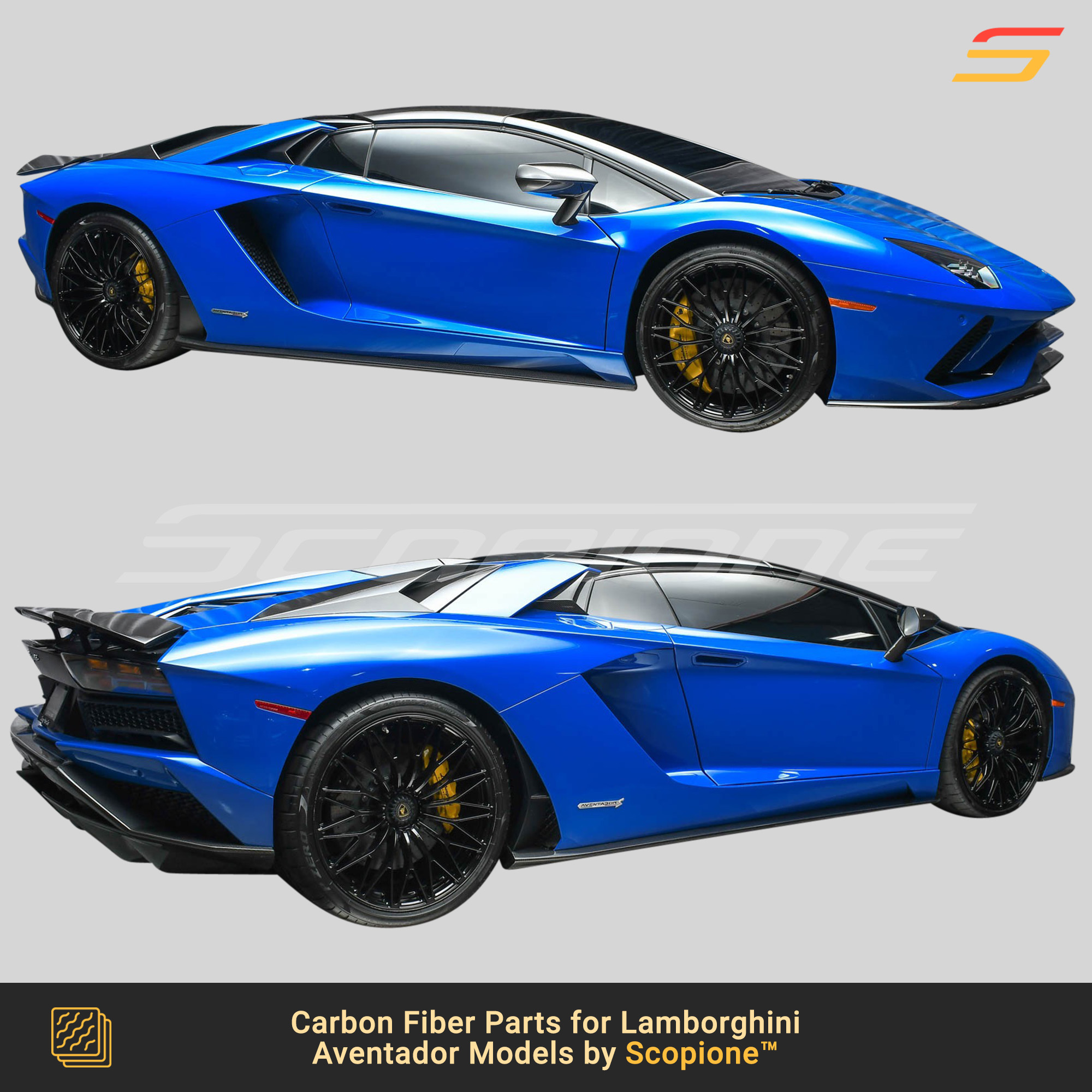
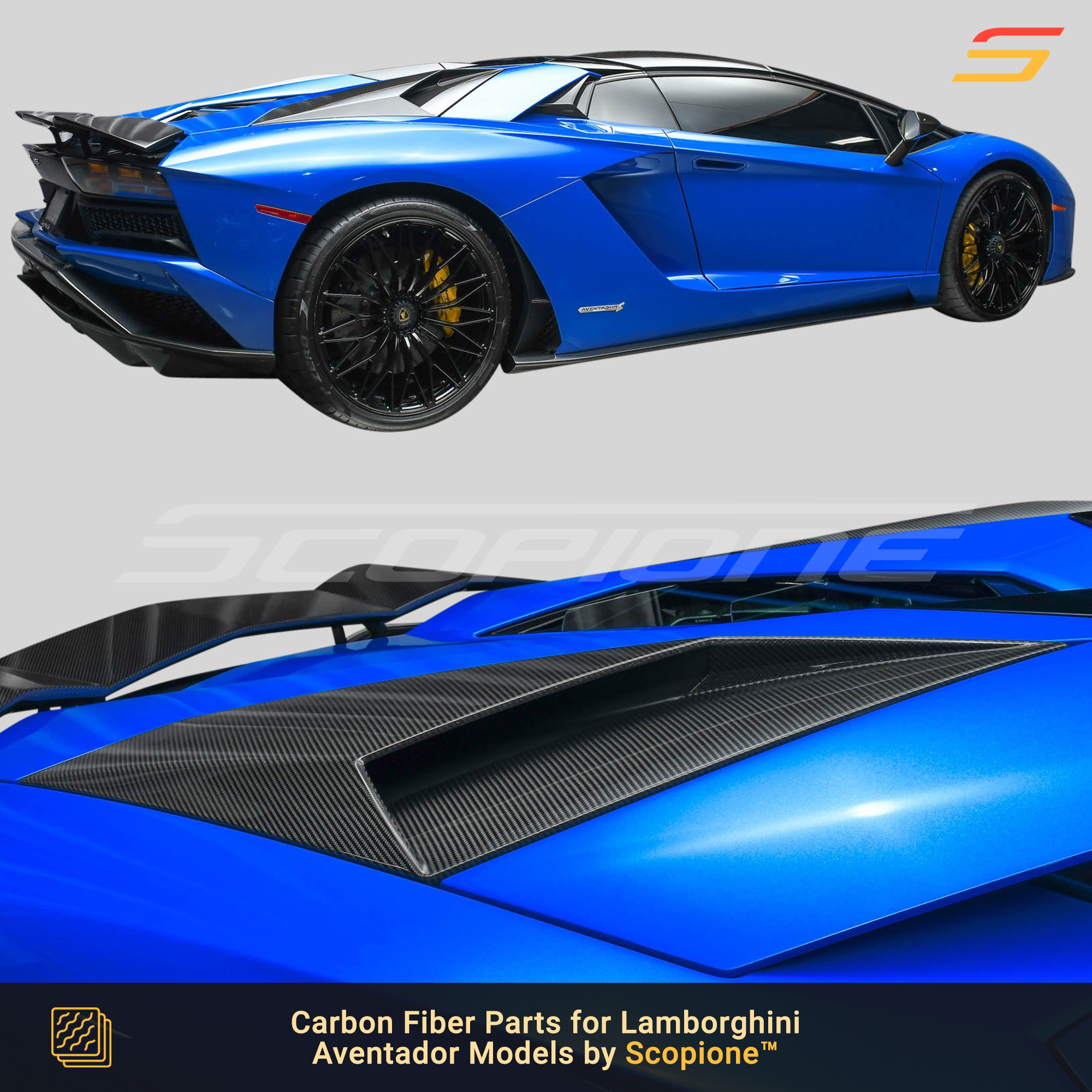
CF Milestone – First Full Carbon Fiber Monocoque: The Aventador was the first Lamborghini built around a single-piece carbon fiber monocoque chassis – not a CF-skinned steel structure, not a partial application. A single CF tub weighing approximately 147.5 kg – roughly the same as the driver and passenger combined – manufactured in-house at Sant’Agata Bolognese. Reggiani’s R&D team had to solve problems that no automotive composite program had faced at this scale: how to produce CF monocoques at a rate of over 1,000 per year with consistent quality, how to integrate metal inserts for suspension and powertrain mounting points without compromising the composite layup, and how to design crash structures that met European and American safety regulations while keeping the tub as light as possible. The technology that the Sesto Elemento validated on 20 track cars went into full series production. Filippo Perini at Lamborghini Centro Stile designed the sharp-edged exterior around the monocoque’s packaging constraints, creating the geometric design language that defined Lamborghini’s visual identity for the following decade.
- Engine: 6.5L naturally aspirated V12, 690–770 hp
- 0–60 mph: 2.9 seconds (LP 700-4), 2.8 seconds (SVJ)
- Top speed: 217 mph (LP 700-4), 218 mph (SVJ)
- Monocoque weight: ~147.5 kg
- Production: 11,465 units (all variants)
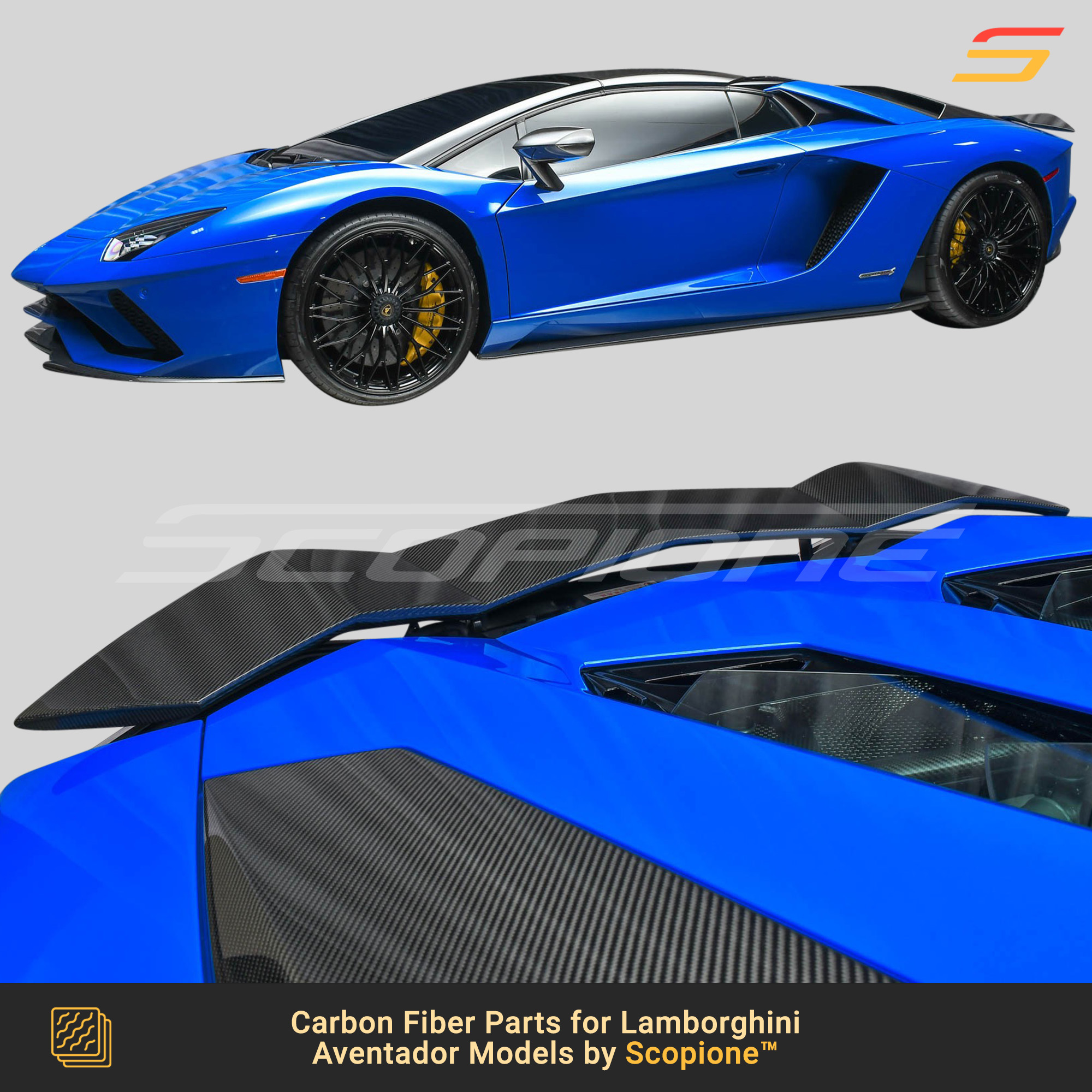
Each Aventador variant pushed the CF envelope further. The LP 750-4 SV (Super Veloce, 2015) added extensive CF aero components – a larger front splitter, fixed rear wing, redesigned diffuser, and engine bay louvers – that cut approximately 50 kg from the standard car while boosting V12 output to 750 hp. The SV produced 600 units, each featuring a more aggressive aero package that generated measurably more downforce than the LP 700-4 while maintaining the same monocoque foundation.
The SVJ (2018) introduced ALA – Aerodinamica Lamborghini Attiva – an active aerodynamics system that represented an entirely new application for carbon fiber. Small motorized CF flaps in the front splitter and rear wing open and close independently to modulate downforce and reduce drag in real time. In corners, the system generates asymmetric downforce by opening flaps on the inside of the turn. On straights, it reduces drag for higher top speed.
By the Numbers – SVJ Nurburgring Record: The SVJ set a Nurburgring Nordschleife production car lap record of 6:44.97 – a time that demonstrated the measurable performance advantage of combining a CF monocoque with active CF aerodynamics. The record stood until the Porsche 911 GT2 RS MR beat it in 2018, but the SVJ’s time remains among the fastest ever recorded for a road-legal car on the Nordschleife.
The Ultimae (2021–2022) closed out the naturally aspirated V12 chapter and the first-generation CF monocoque that made it possible. Limited to 600 coupes and 250 roadsters, the Ultimae combined the SVJ’s 770 hp output with the standard Aventador’s more refined interior. As a final production run, the Ultimae served as both a collector’s milestone and a capstone for the 147.5 kg monocoque platform – the structure that had redefined what production CF engineering could achieve at scale.
Building 11,465 CF monocoques over 11 years proved that this construction method could scale to volumes that matter commercially. For context: McLaren produced its carbon MonoCell in-house at its Composites Technology Centre in Sheffield, but the MP4-12C (2011) and its successors targeted lower volumes – McLaren’s total annual production across all models reached approximately 4,800 units at its peak. Ferrari used CF extensively but relied on aluminum space frames for its volume models (California, Portofino), reserving full CF architectures for limited-series cars like the LaFerrari (499 units). Lamborghini’s achievement was building CF monocoques at genuine mainstream supercar volume – over 1,000 per year at peak Aventador production – without outsourcing the process.
Each monocoque required multiple stages of layup, autoclave curing, and precision machining before final assembly. Sant’Agata’s composite shop refined its processes continuously: cure times shortened, tooling improved, defect detection moved earlier in the cycle. That accumulated manufacturing confidence gave the engineering team the basis to specify an even more complex CF structure for the Revuelto.
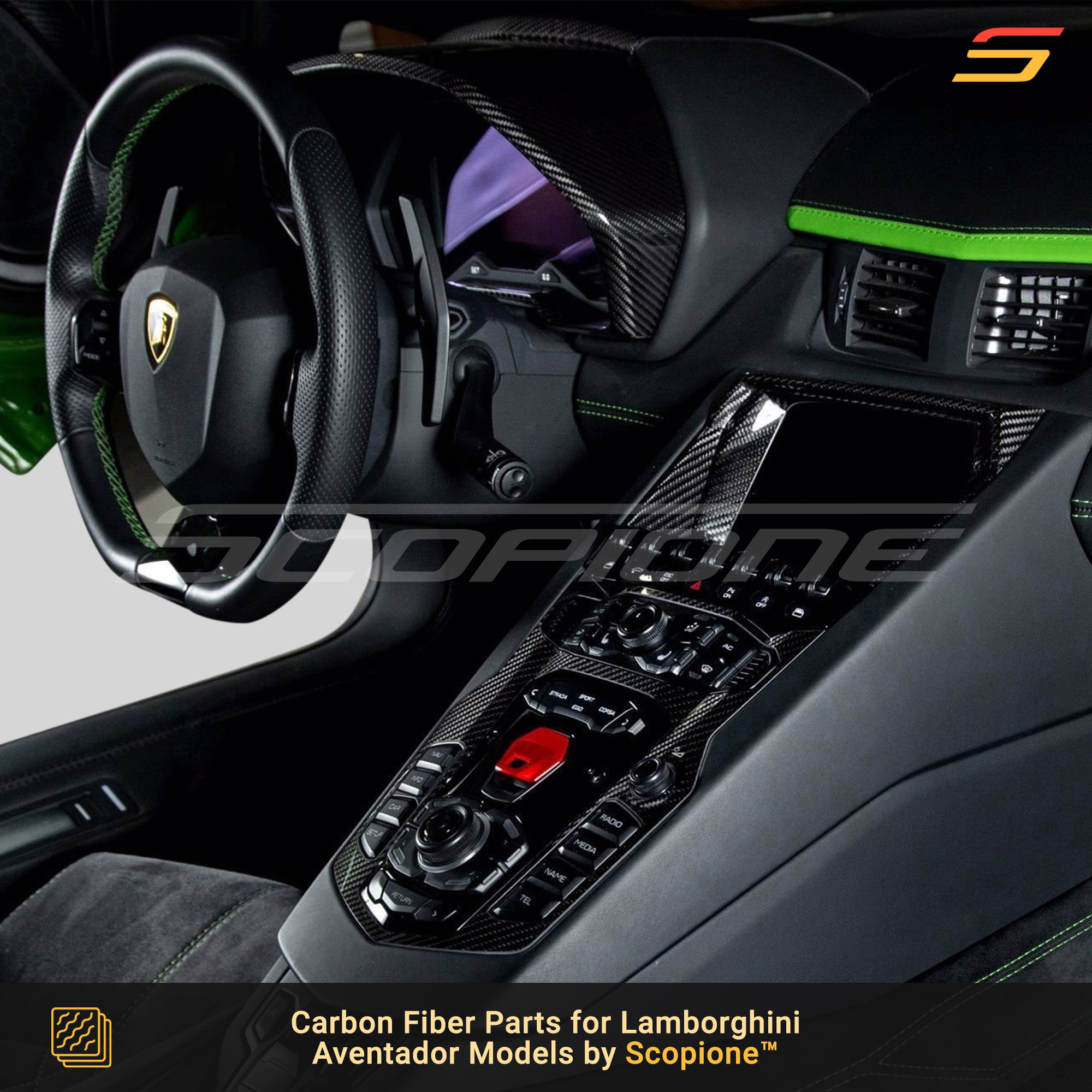
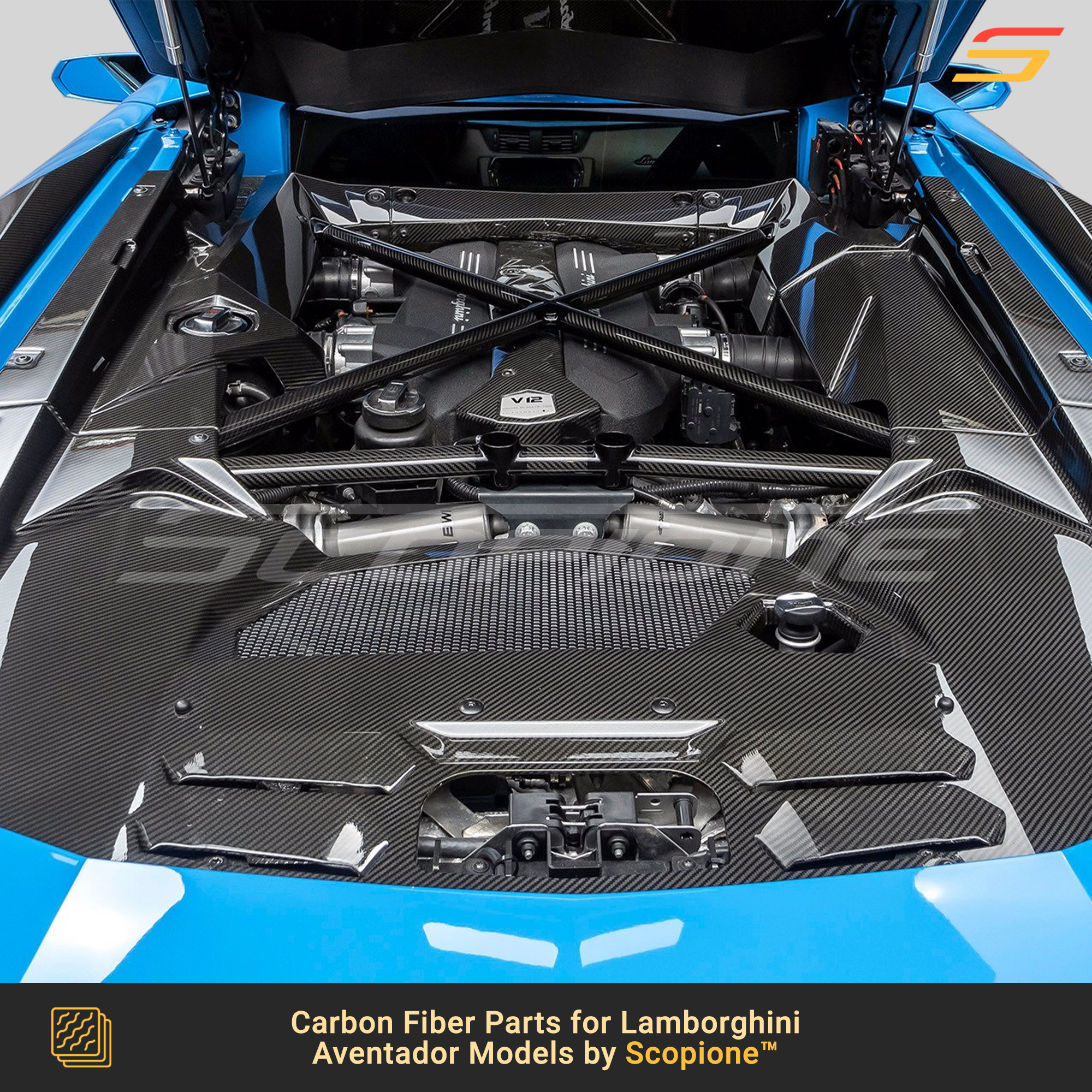
Full model details, variant breakdowns, and the carbon-fiber parts catalog are available in the Lamborghini Aventador Picture Gallery.




Lamborghini Huracan (2014–2024)

The Gallardo’s successor used a hybrid aluminum and carbon fiber chassis – a practical engineering tradeoff. The Huracan needed to be built at higher volumes and a lower price point than the Aventador, so a full CF monocoque would have been cost-prohibitive. Instead, Lamborghini’s engineers used CF where it delivered the largest structural benefit per gram saved. More than 24,000 Huracans left Sant’Agata over a 10-year run, making it the highest-selling Lamborghini supercar in history.
- Engine: 5.2L naturally aspirated V10, 602–640 hp
- 0–60 mph: 3.2 seconds (LP 610-4), 2.9 seconds (Performante)
- Top speed: 202 mph
- Production: 24,000+ units
The Performante (2017) changed the conversation. Forged composite rear wing, front splitter, engine cover, diffuser – all manufactured using the process the Sesto Elemento pioneered seven years earlier. The ALA active aero system debuted here in production form. The Performante held the Nurburgring production car record at 6:52.01 until the SVJ broke it a year later.
Then came the STO (Super Trofeo Omologata, 2020): approximately 75% of its exterior body panels were carbon fiber. The front clamshell – Lamborghini calls it the “cofango,” combining the Italian for hood (cofano) and fender (parafango) – was a single CF piece that tilted forward to expose the front luggage area and suspension. The rear fenders, engine cover, and bumper were all separate CF components. The STO demonstrated that forged composite could be produced at genuine volume on a model selling in the thousands, not just on limited runs of 20 track cars.
| Spec | Huracan EVO | Performante | STO |
|---|---|---|---|
| Power | 631 hp | 631 hp | 631 hp |
| 0–60 mph | 2.9 sec | 2.9 sec | 3.0 sec |
| Drivetrain | AWD | AWD | RWD |
| Aero | Standard | ALA active aero | Fixed CF aero kit |
| CF body panels | Select trim | Wing, splitter, engine cover | ~75% of exterior |
| Key feature | LDVI predictive system | Forged composite debut | Cofango single-piece front |
Later variants continued to expand CF content in different directions. The Tecnica (2022) combined the STO’s rear-wheel-drive layout with less extreme aero – using CF components where they served aerodynamic function without the full track-car commitment. The Tecnica positioned itself as a “street-focused performance” variant between the daily-driver EVO and the track-oriented STO. Even the Sterrato (2023) – Lamborghini’s off-road-oriented Huracan with 44 mm of additional ground clearance and underbody protection plates – incorporated CF elements in its roof-mounted air scoop and rear bumper. The Sterrato proved that CF’s application extended beyond track performance: the material’s strength-to-weight properties served just as well in protecting a rally-inspired supercar from gravel and debris. By the end of the Huracan’s production run in 2024, carbon fiber was standard across the entire variant range, not a feature reserved for special editions.
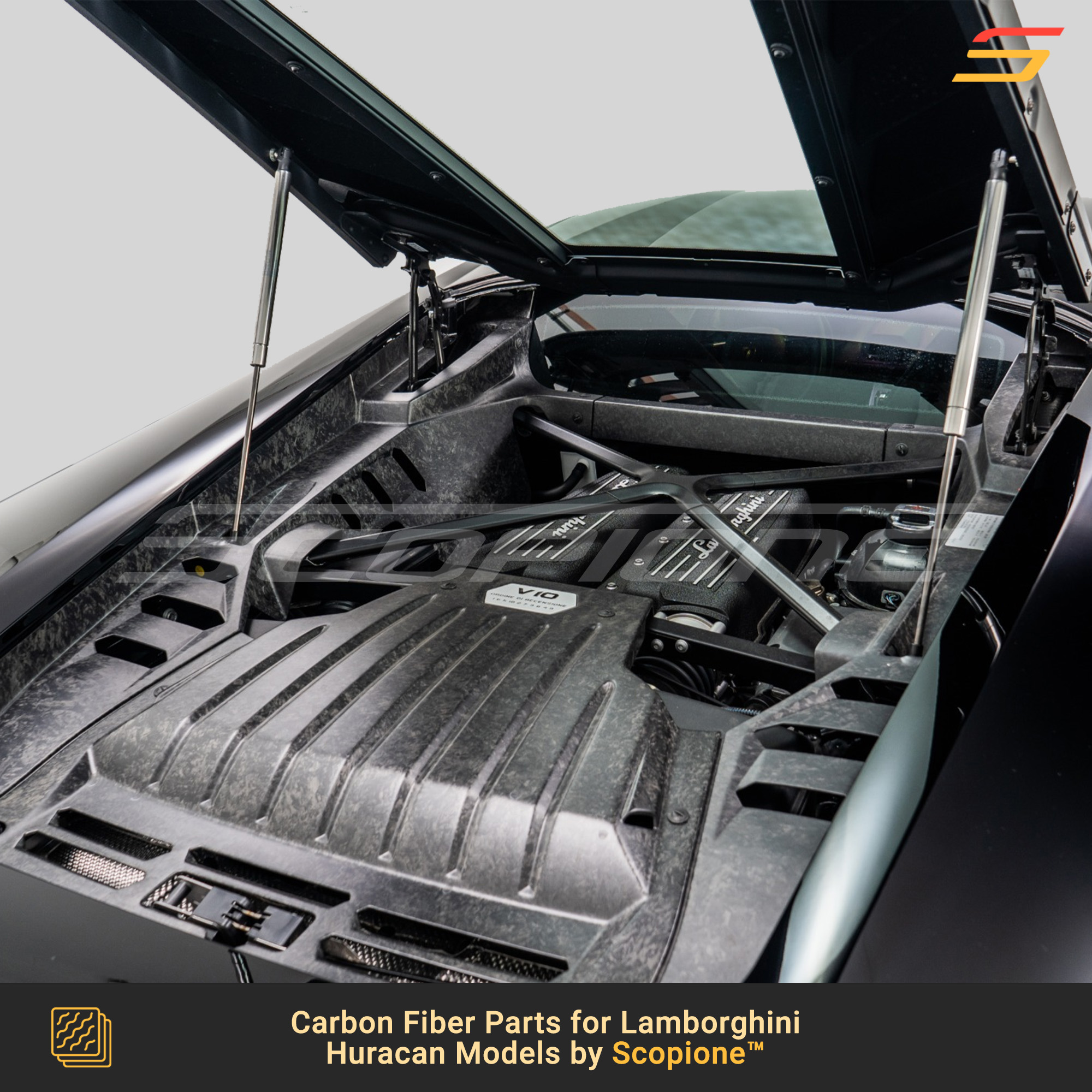
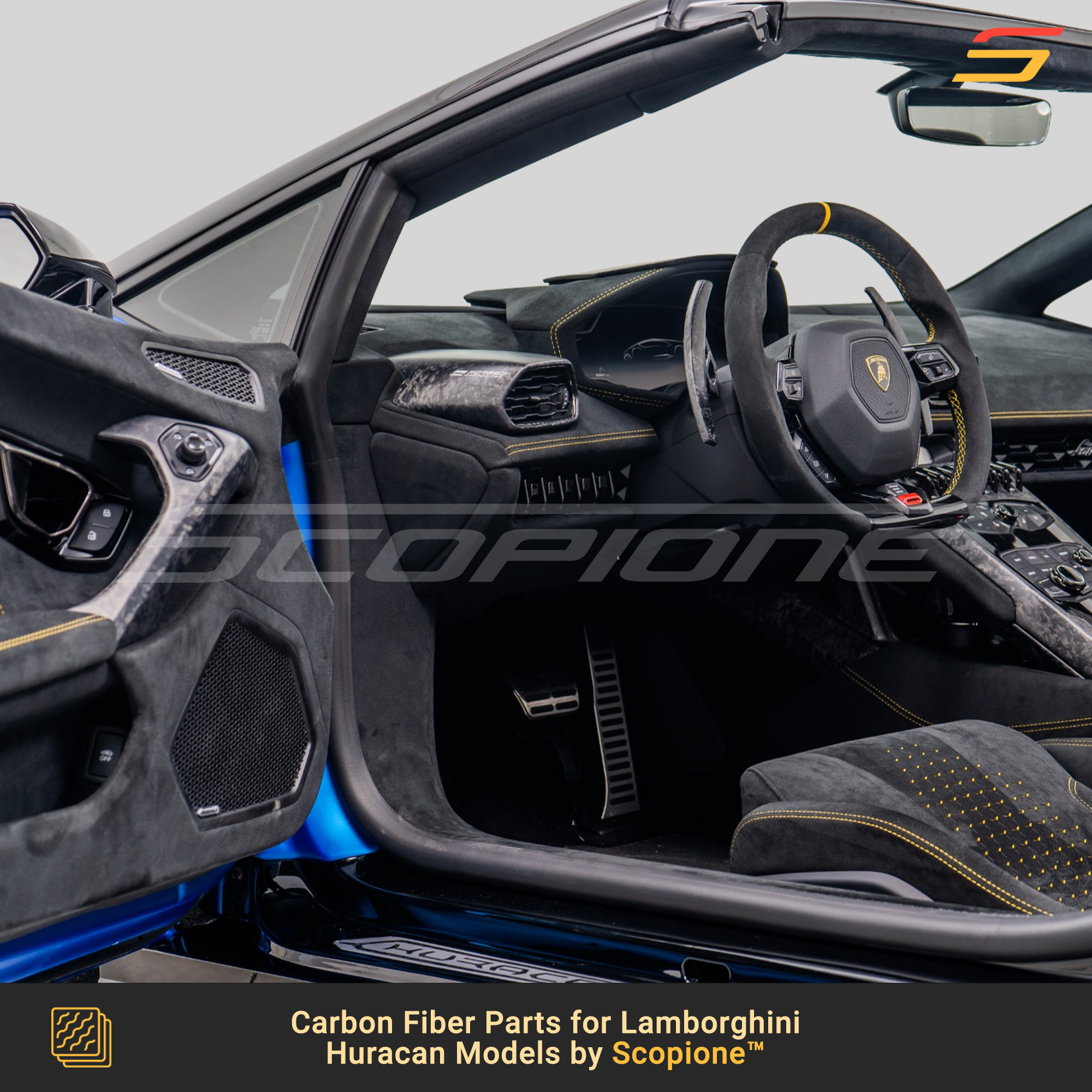
See specs, generation breakdowns, and the full carbon-fiber parts catalog in the Lamborghini Huracan Picture Gallery.
Lamborghini Urus (2018–Present)

Lamborghini’s SUV – the brand’s first since the LM002 left production in 1993 – became its volume leader almost immediately. Powered by a 4.0-liter twin-turbo V8 producing 641–666 hp, the Urus has cleared 25,000 units.
- Engine: 4.0L twin-turbo V8, 641–666 hp
- 0–60 mph: 3.6 seconds (base), 3.3 seconds (Performante)
- Top speed: 190 mph
- Production: 25,000+ units
The Urus Performante (2022) cut approximately 47 kg from the standard Urus S through carbon-fiber components: CF roof panel (which also lowers the center of gravity), front splitter, rear diffuser, wheel arch extensions, and interior trim. A titanium exhaust further contributed to mass reduction. Standard Urus models offer CF elements as factory options through Lamborghini’s Ad Personam customization program, allowing buyers to specify carbon-fiber details on the mirror caps, engine cover, interior trim, and aerodynamic components.
The Urus is less of a carbon-fiber story than the mid-engine supercars, but its role in the CF narrative is financial. By selling over 25,000 units – more than the Huracan and Aventador combined – the Urus generates the revenue that sustains in-house composite production, forged composite development, and the Revuelto’s advanced monofuselage program.



Lamborghini Veneno, Centenario, and Sian FKP 37: The Few-Off Showcase

The Aventador’s carbon fiber monocoque became the platform for the wildest cars Lamborghini has ever sold. The Veneno (2013), built for the 50th anniversary, took it furthest: a full CF monocoque and carbon-skinned body, in a run of 4 coupes (one kept by the factory) and 9 Roadsters.

The Centenario (2016) marked what would have been Ferruccio Lamborghini’s 100th birthday with a 770-CV (759 hp) naturally aspirated V12 under an entirely carbon fiber body – 20 coupes and 20 Roadsters, all sold before the Geneva reveal ended.

The Sian FKP 37 (2019) was the brand’s first hybrid: a supercapacitor – lighter and faster-charging than a battery of equal power – feeding a 48-volt motor. 63 coupes and 19 Roadsters, the numbers honoring 1963 and the initials of Ferdinand Karl Piech.
Lamborghini SC18, SC20, Essenza SCV12, and the Countach LPI 800-4

Squadra Corse, the motorsport division, added its own chapter. The SC18 Alston (2018) was its first one-off – a single car with full carbon fiber bodywork and race-program aerodynamics around the 770-CV (759 hp) V12.
The SC20 (2020) followed for the same collector: a completely open barchetta, again skinned in carbon fiber.

The Essenza SCV12 (2020) went further than either: 40 track-only cars whose free-standing carbon fiber chassis was the first homologated to FIA Hypercar safety standards without a steel roll cage – the monocoque itself is the safety cell.

The Countach LPI 800-4 (2021) closed the group with a nostalgia play: the Sian’s supercapacitor hybrid drivetrain and CF monofuselage under bodywork that reimagined the original Countach. The run of 112 cars – a nod to the original’s LP112 project code – sold out within a week.
Scopione Perspective: The Monocoque Era
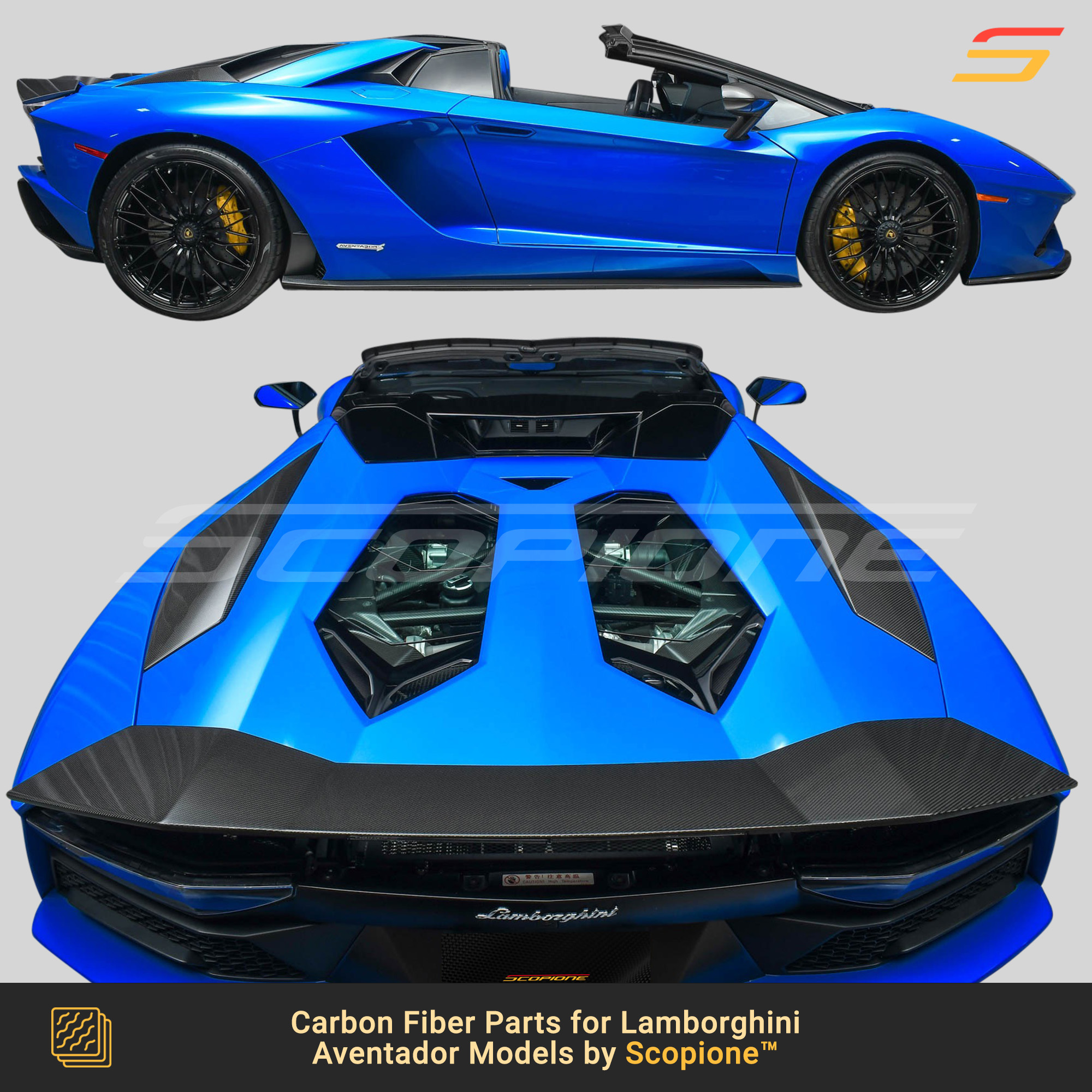
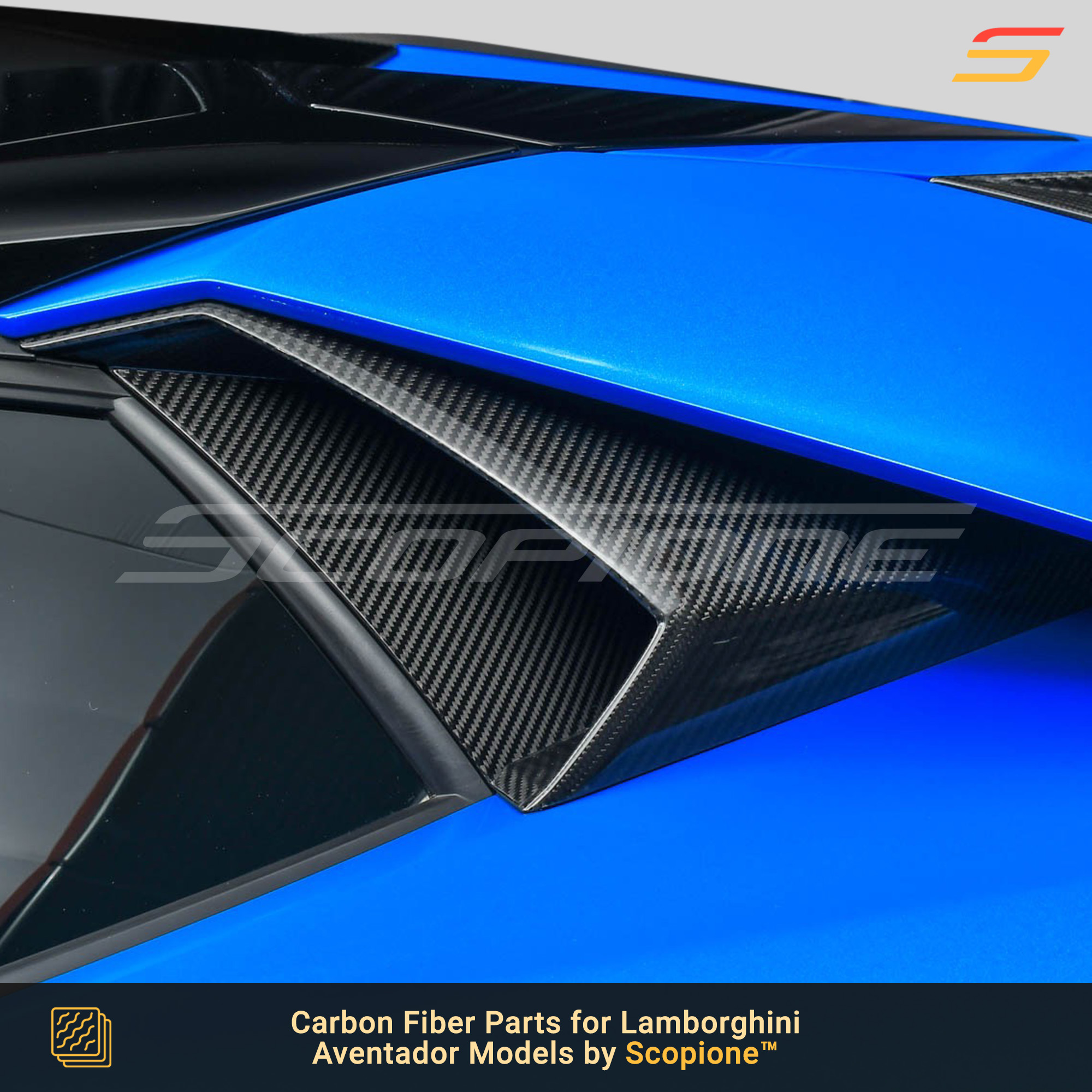
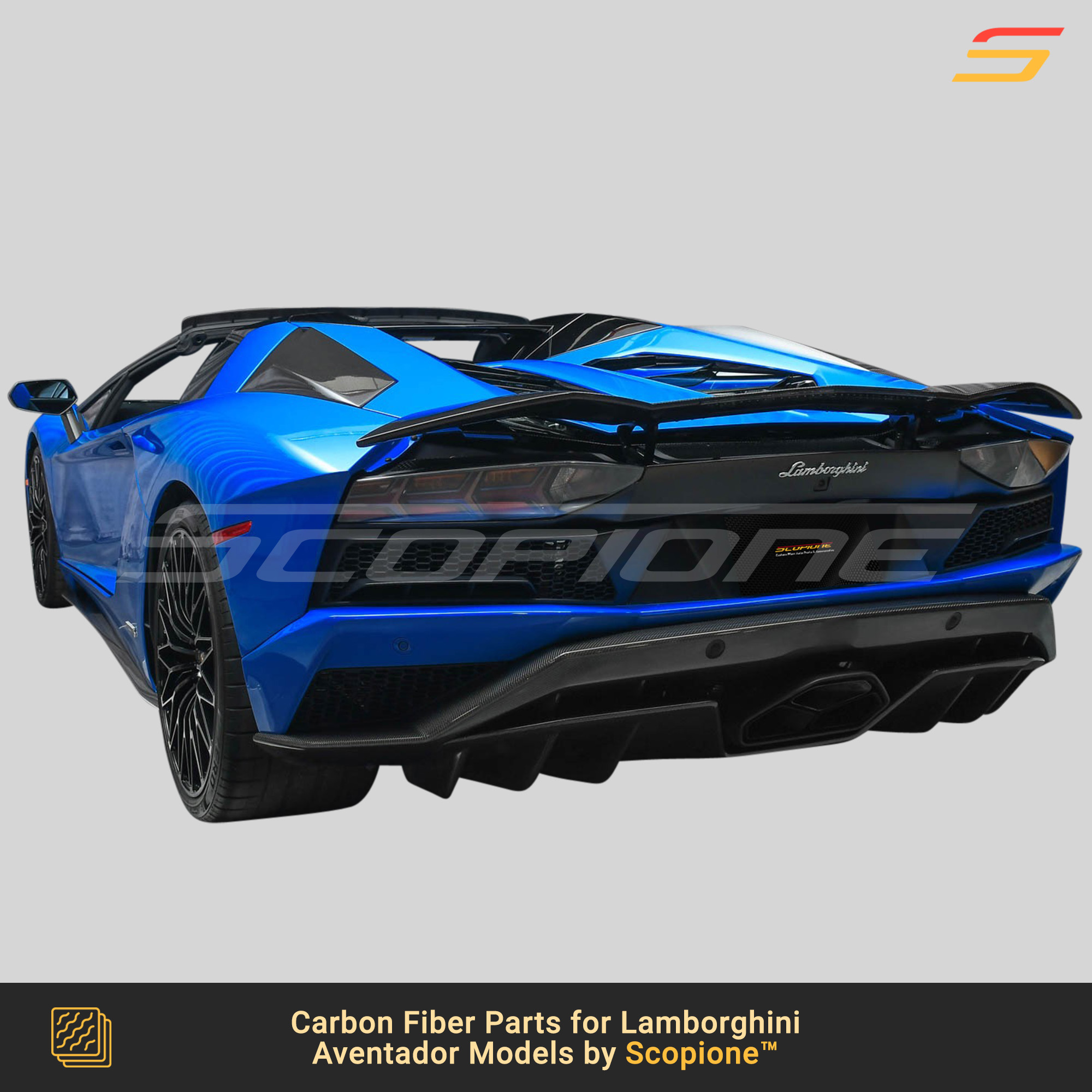
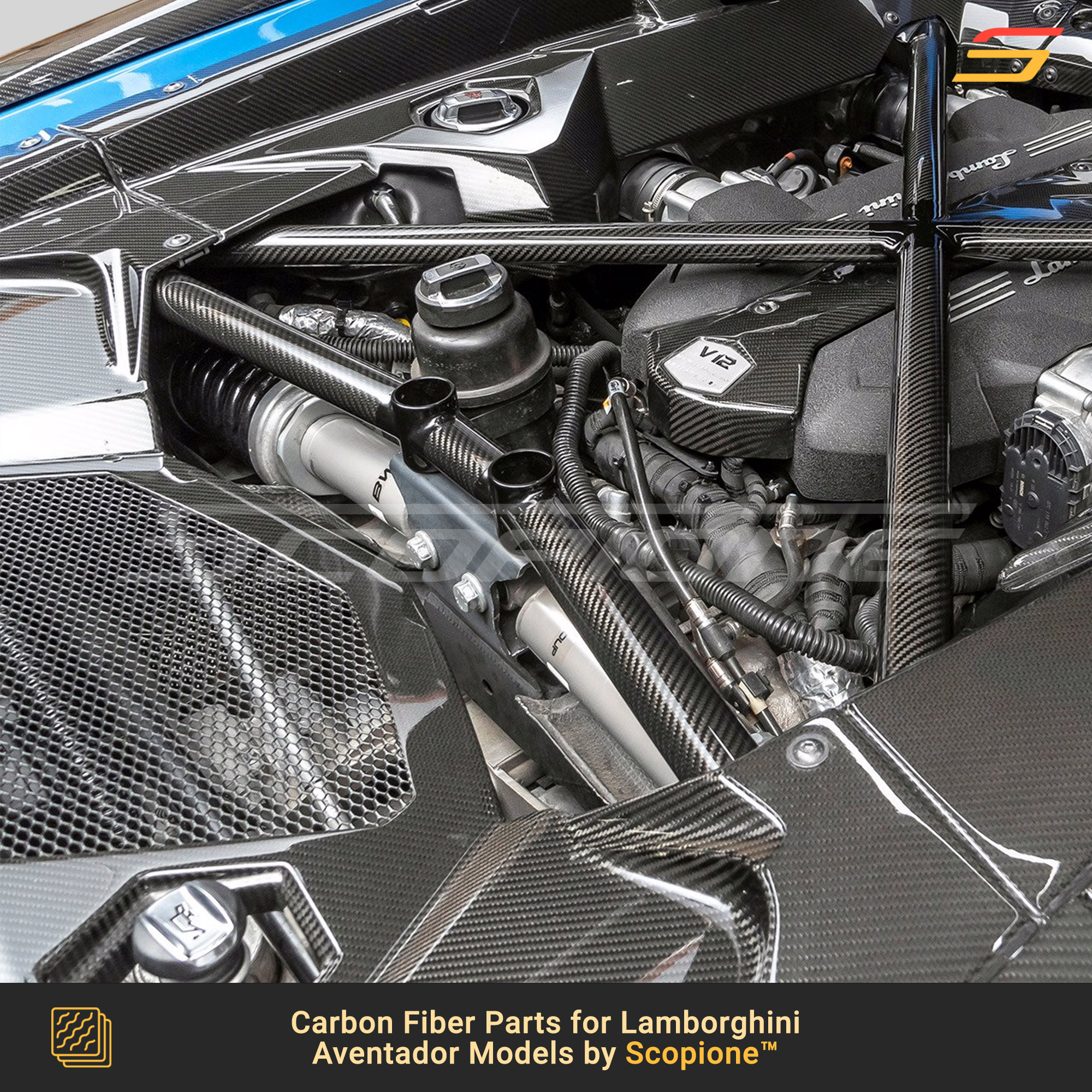
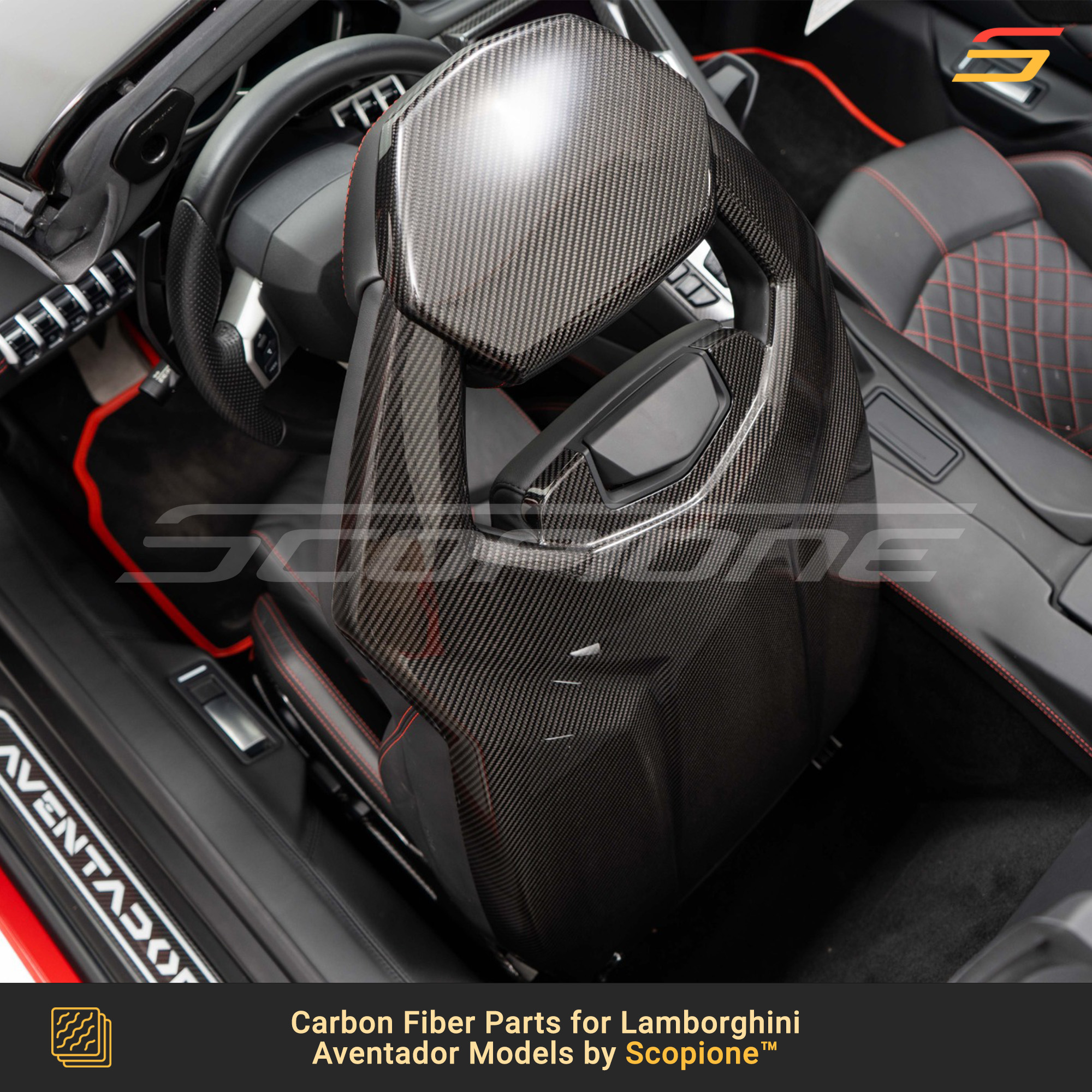
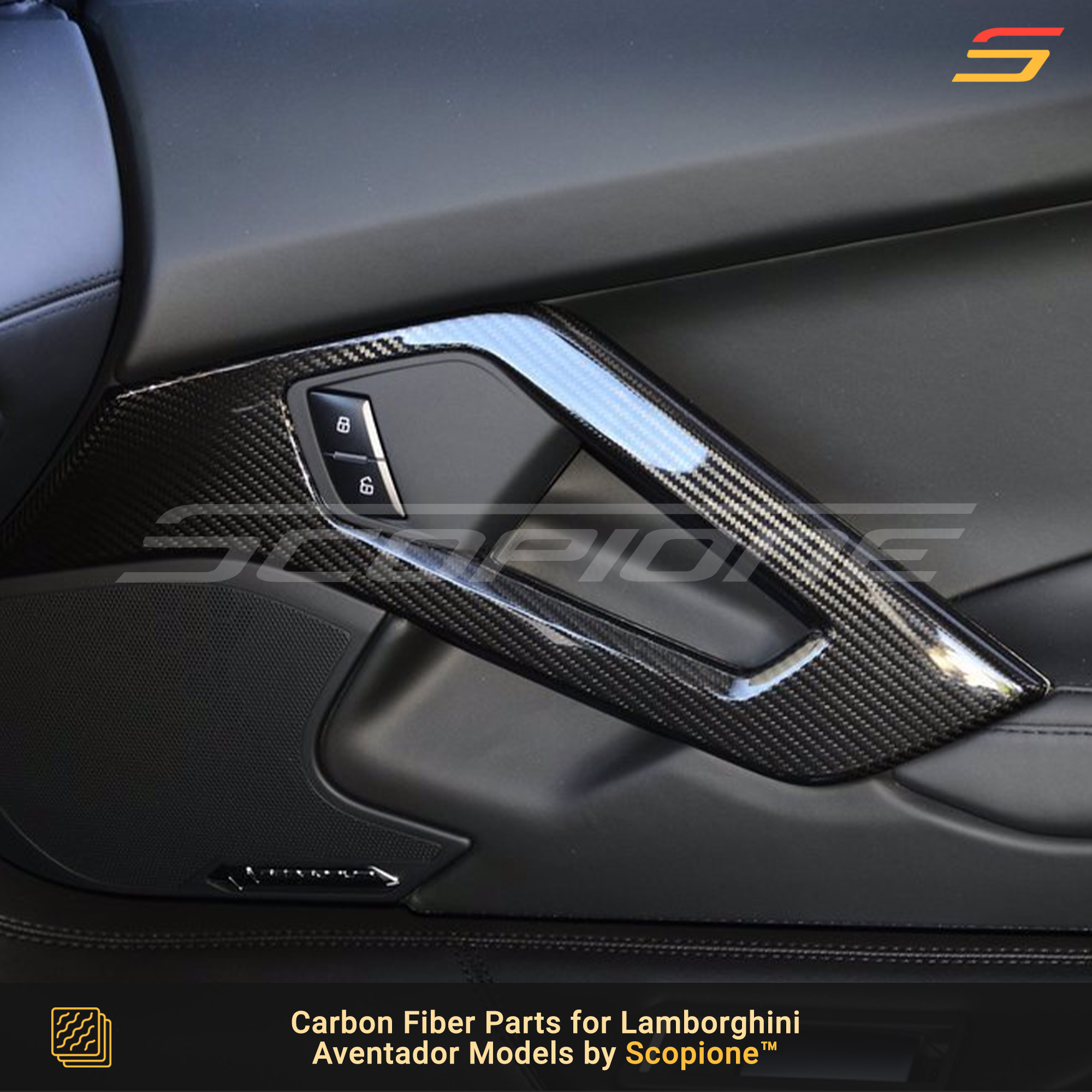
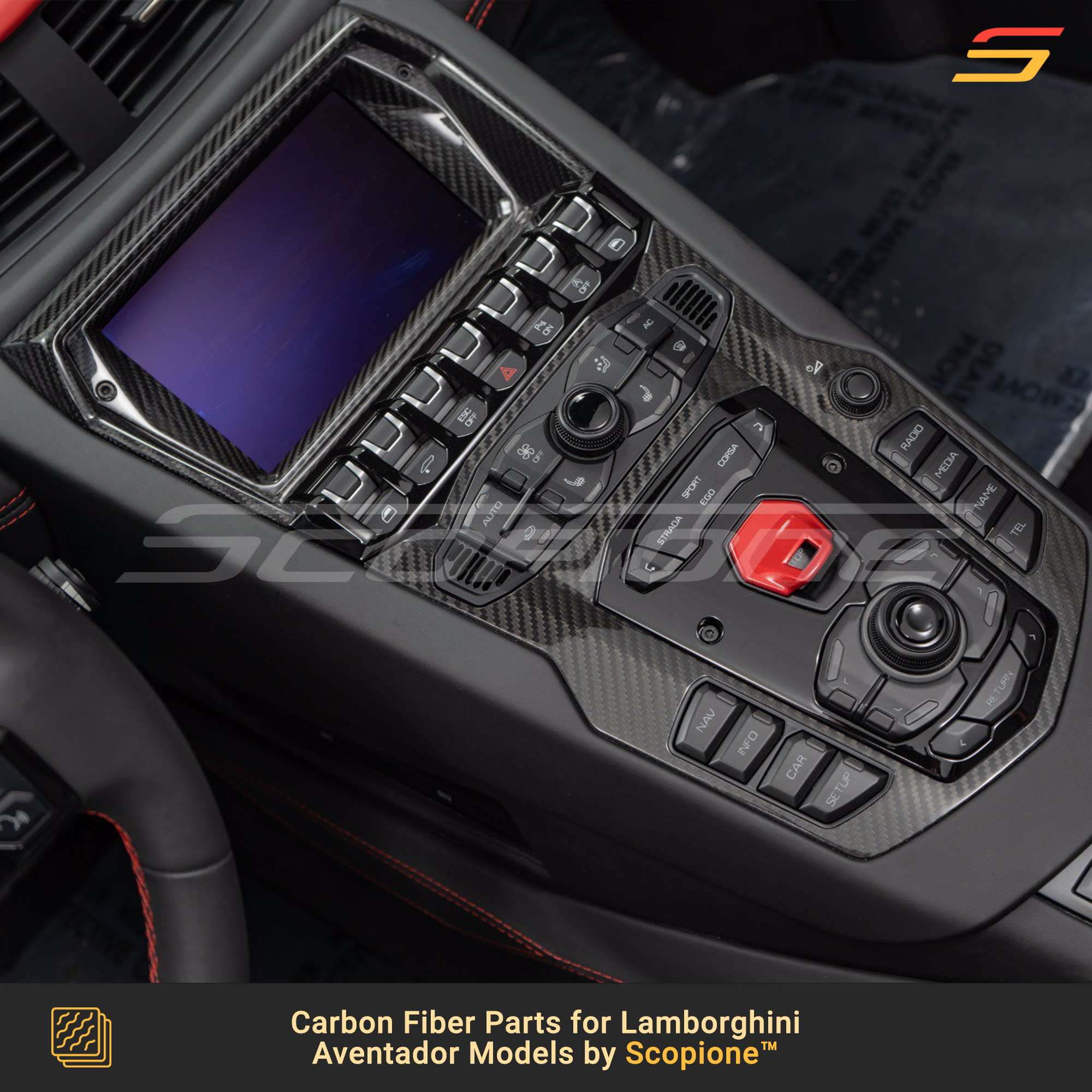
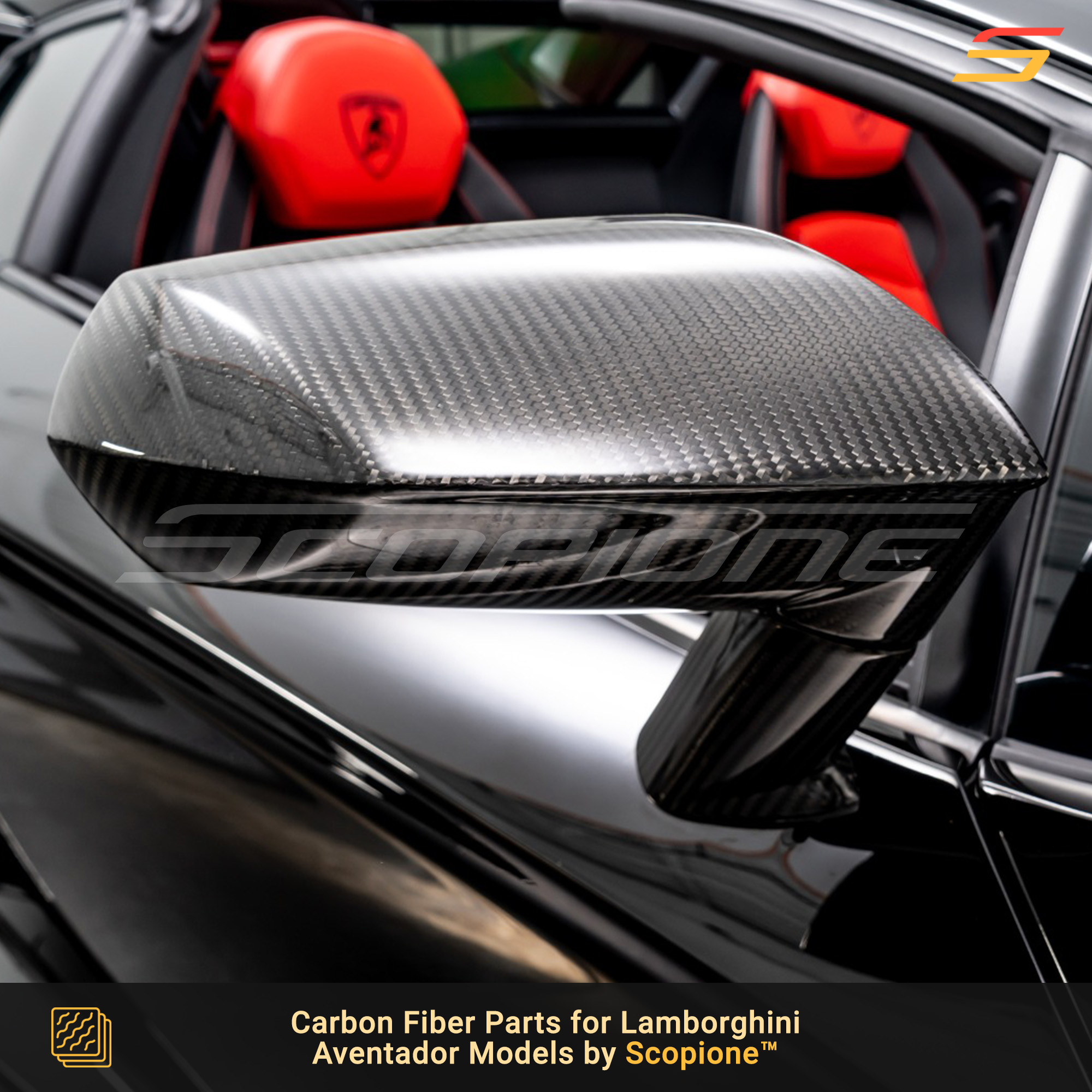
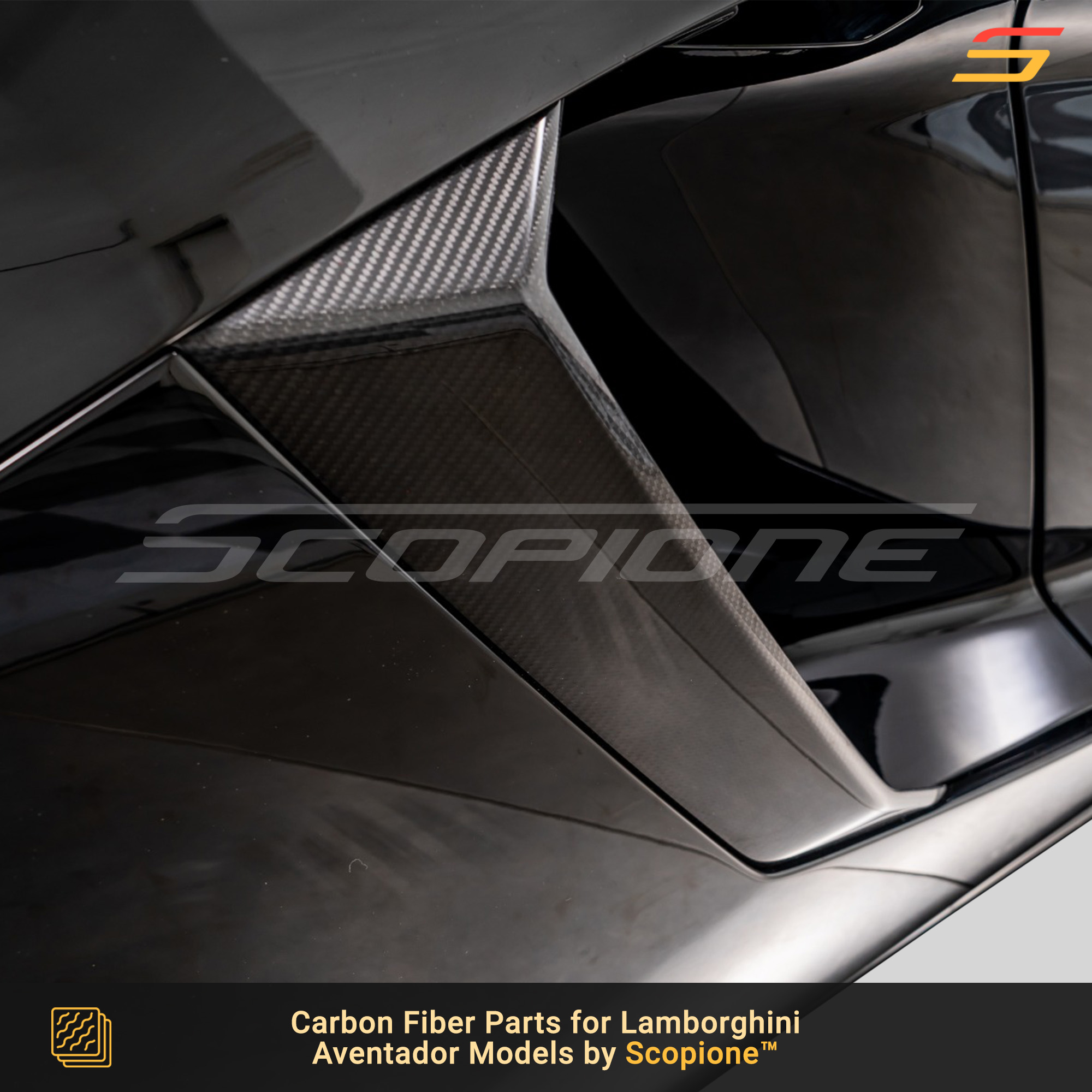
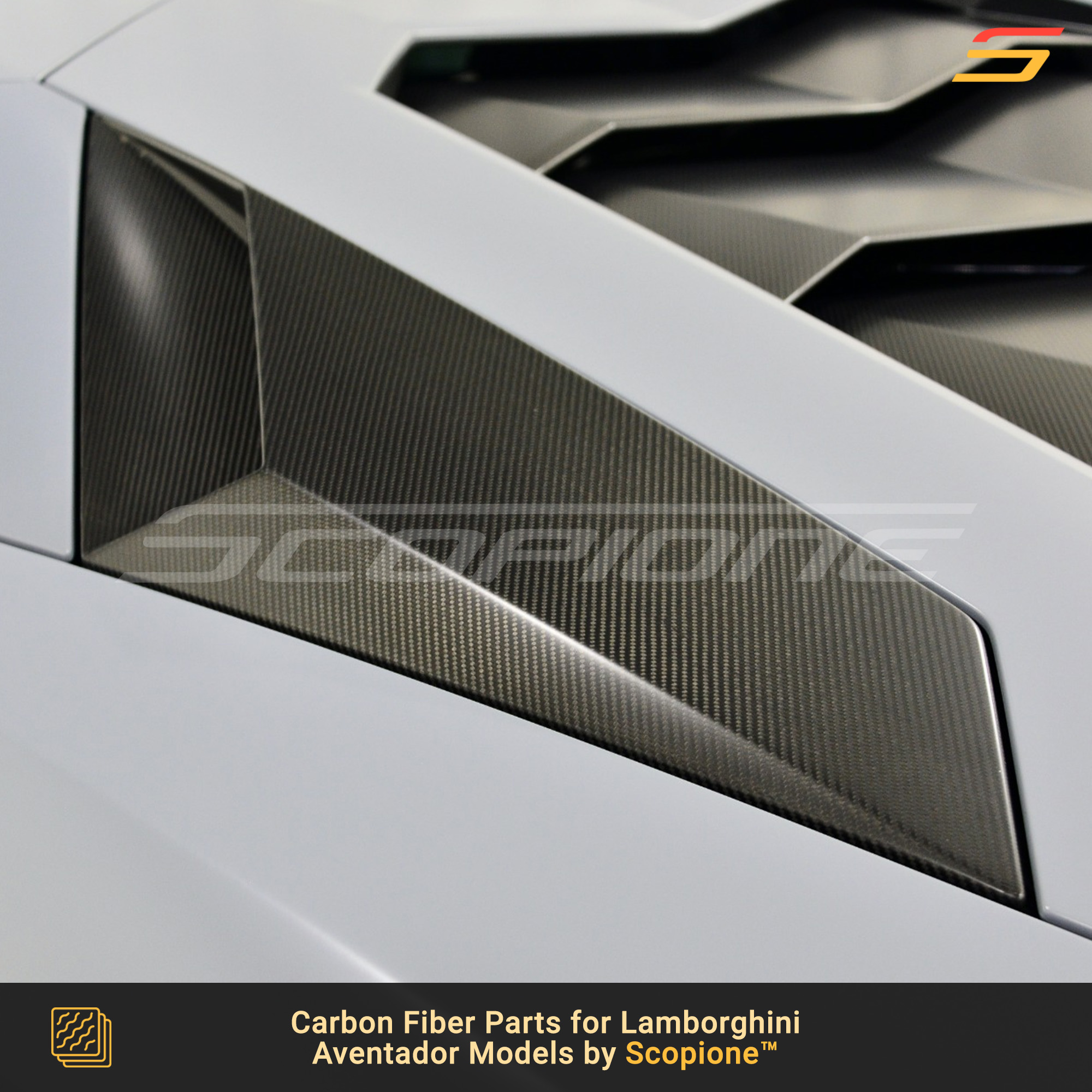
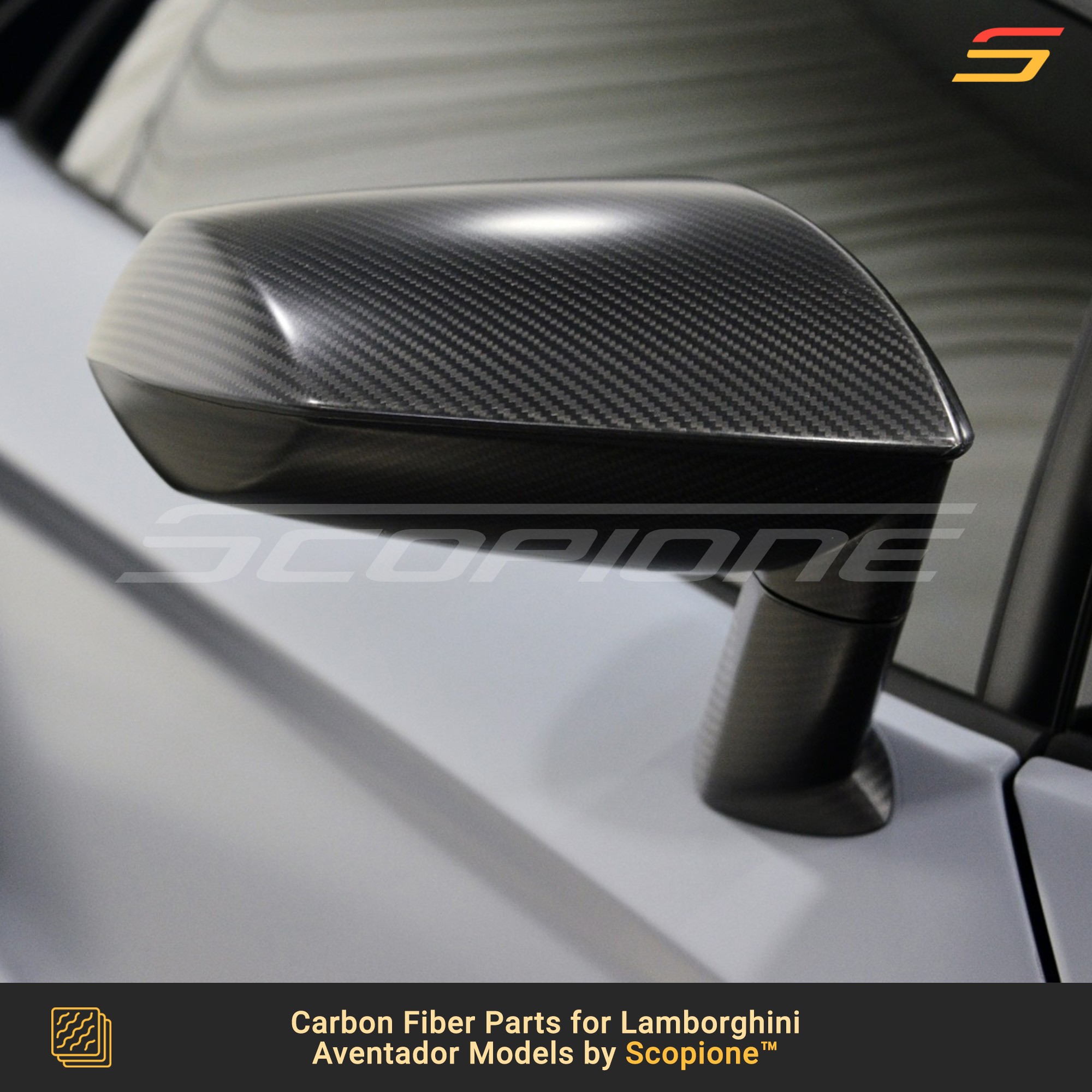
The Aventador and Huracan form the core of Scopione’s Lamborghini catalog. For the Aventador, Scopione offers 2×2 twill-weave CF front lip spoilers, side skirts, rear diffusers, mirror covers, engine bay covers, and interior trim – components that complement the factory CF monocoque with matching material quality on the exterior surfaces. The mirror covers and engine bay accents use the same twill-weave pattern visible on the factory’s SV and SVJ aerodynamic packages, maintaining visual continuity across OEM and aftermarket components.
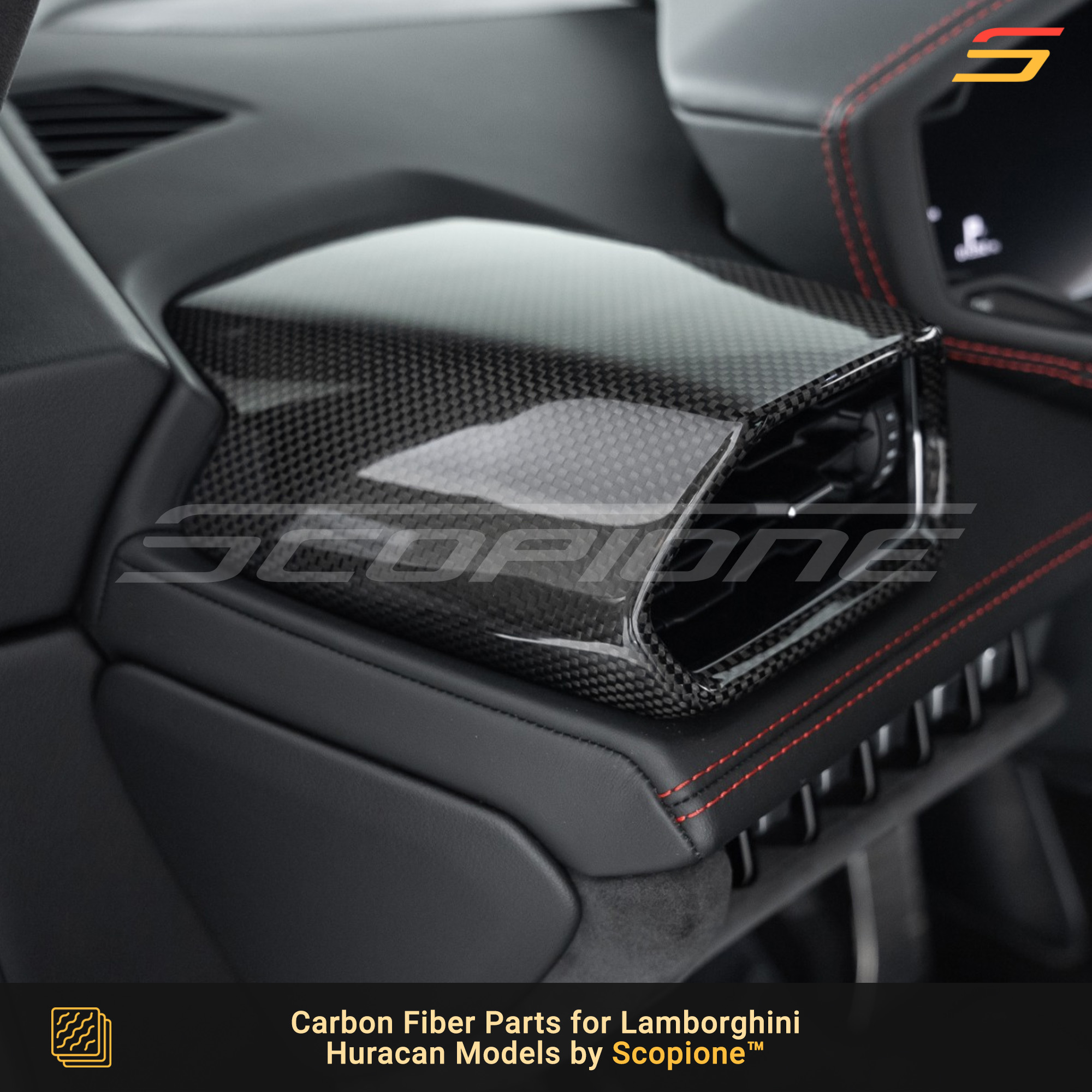
For the Huracan, the Scopione catalog includes widened side skirts, a rear diffuser, mirror shells, engine bay covers and vents, trunk spoiler elements, and cabin accents designed to match the factory CF finishes. The parts catalog centers on the first-generation Huracan (LP 580-2 and LP 610-4). Every part is precision-fitted to factory mounting points with UV-resistant clear coat – the same protective coating that prevents yellowing and delamination from prolonged sun exposure. The 2×2 3K twill weave pattern matches factory-installed CF components for a cohesive appearance.
For Owners – CF Care and Longevity: Carbon fiber components on Lamborghini models require specific maintenance considerations. UV exposure degrades unprotected resin over time, causing yellowing and eventual surface cracking – which is why Scopione applies UV-resistant clear coat to every part. For owners who track their cars, CF aero components should be inspected after any contact with curbing or debris; unlike metal, carbon fiber does not dent visibly before structural compromise. Stone chip damage on front lips and splitters can be repaired with clear coat touch-up if caught early. Interior CF trim is more durable but should be cleaned with pH-neutral products rather than solvent-based cleaners that can cloud the clear coat finish. These practical details matter because CF components on Lamborghini models directly affect both the driving experience and long-term resale value – a well-maintained set of factory or aftermarket CF parts signals careful ownership to buyers in the pre-owned market.
2023–Present: The Hybrid HPEV Revolution

Electrification adds mass. Battery packs, electric motors, inverters, cooling systems – the hardware required for hybrid powertrains weighs hundreds of kilograms. A typical plug-in hybrid battery pack alone adds 150–200 kg. For a company built on lightweight mid-engine performance, that mass penalty could have been devastating.
Lamborghini’s answer was three decades of CF investment paying their largest dividend at the moment they are needed. From Pagani’s early composite experiments in the 1980s through the Sesto Elemento’s forged composite debut and the in-house manufacturing of 11,465 Aventador monocoques – all of that accumulated expertise and infrastructure now serves the electrified era. A lighter CF chassis offsets the battery weight. A stiffer structure maintains the driving dynamics that separate a Lamborghini from a conventional hybrid. Sant’Agata continues manufacturing carbon-fiber monocoques and forged composite components in-house, and these structures are now more critical to Lamborghini’s identity than at any previous point in the brand’s history. Without CF, the Revuelto would weigh too much to feel like a Lamborghini. Without CF, the Temerario’s aero package would surrender the weight savings that offset its hybrid hardware.
Lamborghini Revuelto (2023–Present)

The Aventador’s successor combines a 6.5-liter naturally aspirated V12 – the final evolution of the engine family tracing back to Bizzarrini’s 1963 design – with three electric motors for a combined output of 1,001 hp. That combined output exceeds every previous production Lamborghini by a significant margin. An 8-speed dual-clutch transmission replaces the Aventador’s single-clutch automated manual, and a lithium-ion battery pack provides limited all-electric range for low-speed urban driving. Deliveries began in late 2023.
- Powertrain: 6.5L V12 + 3 electric motors, 1,001 hp combined
- 0–60 mph: 2.5 seconds
- Top speed: 217 mph
- Designer: Mitja Borkert
Engineering First – Battery-Integrated Monofuselage: The Revuelto introduces a redesigned CF monocoque that integrates the battery housing directly into the carbon fiber structure. Rather than mounting batteries on a separate subframe bolted to the chassis, the CF tub itself contains the energy storage. The design reduces part count, eliminates the weight of a separate battery enclosure, and increases torsional rigidity by turning the battery pack into a structural member rather than dead weight.
The front subframe uses forged composite. Suspension pickup points are integrated into the CF monocoque with metal inserts bonded during the cure process – a technique that eliminates the need for post-cure drilling and bolting, preserving the structural integrity of the CF layup. The new monocoque is both lighter and stiffer than the Aventador’s despite being physically larger to accommodate the hybrid hardware. That rigidity is necessary to maintain the precise handling balance that Lamborghini owners expect from a mid-engine flagship, even when the powertrain now includes three electric motors and a lithium-ion battery pack adding significant mass over the purely combustion Aventador.
The engineering challenge was significant: battery cells require precise thermal management, structural protection in crash scenarios (lithium-ion cells must not be punctured), and electrical isolation from the conductive carbon fiber chassis. Integrating those requirements into a CF tub – rather than adding a separate battery case – saved weight, reduced part count, and increased torsional rigidity simultaneously.
The competitive contrast is instructive. Ferrari’s SF90 Stradale (2019) – Maranello’s first plug-in hybrid – mounts its battery pack in a separate enclosure beneath the floor, bolted to an aluminum chassis with CF structural reinforcements. McLaren’s Artura (2022) uses the carbon MCLA architecture but also houses its battery in a dedicated module within the chassis tunnel. The Revuelto’s approach – making the CF structure and battery housing a single integrated component – eliminates the boundary between chassis and energy storage. If the Aventador’s monocoque proved CF could serve as a supercar’s skeleton, the Revuelto’s monofuselage proves it can serve as skeleton and battery enclosure simultaneously – an integration neither Ferrari nor McLaren has yet matched in a production car.
Lamborghini Invencible and Autentica (2023): The Pure V12 Farewell

In February 2023, with the Aventador finished and the hybrid Revuelto months away, Lamborghini said goodbye to the pure V12 with a one-off pair: the Invencible coupe and the Autentica roadster. Both carry entirely carbon fiber bodywork over the Aventador generation’s monocoque, with the final 769-hp version of the non-hybrid 6.5-liter V12 and styling that quotes the Sesto Elemento, Reventon, and Veneno.

They are the last V12 Lamborghinis built without electrification – the full stop at the end of a sixty-year sentence that began with the 350 GT.
Lamborghini Temerario (2025–Present)
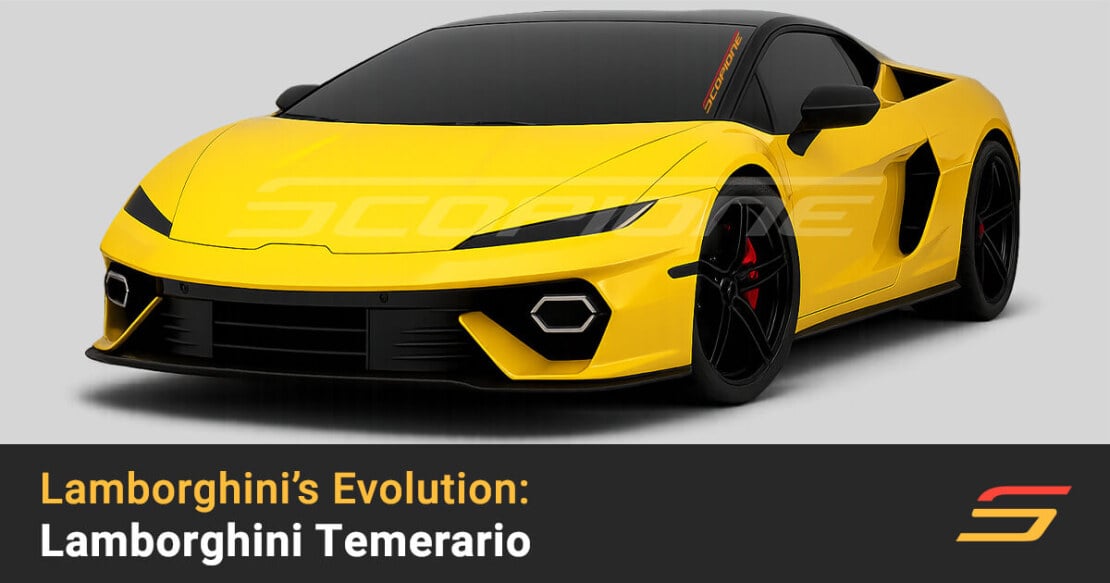
The Huracan’s successor replaces the naturally aspirated V10 – a Lamborghini staple since 2003 – with a 4.0-liter twin-turbo V8 paired with three electric motors for a combined 907 hp. Like the Revuelto, the Temerario uses a dual-clutch transmission and integrates electric motors at both axles. The model marks the end of atmospheric engines in Lamborghini’s entry-level supercar and the beginning of a fully electrified product line across the entire brand.
- Powertrain: 4.0L twin-turbo V8 + 3 electric motors, 907 hp combined
- 0–60 mph: 2.7 seconds
- Top speed: 210 mph
- Designer: Mitja Borkert
The Temerario uses an all-new aluminum spaceframe – 25% stiffer torsionally than the Huracan’s chassis, with 50% fewer components and 80% fewer weld points, built around a new high-strength alloy for its castings. Carbon fiber appears in the bodywork and aero package rather than the primary structure – most extensively in the lightweight Alleggerita specification, which adds CF aerodynamic components in the Performante and STO tradition. The architecture accommodates the electric motors and battery while maintaining the low center of gravity that mid-engine layouts demand, and the twin-turbo V8 is significantly more compact than the Huracan’s V10, freeing volume for the hybrid hardware.
As the high-volume successor to the 24,000-unit Huracan, the Temerario represents the convergence of Lamborghini’s two defining competencies: CF manufacturing at scale and high-performance hybrid integration. The techniques developed for 20 Sesto Elementos, refined across 11,465 Aventadors, and proven on over 24,000 Huracans now enter their broadest commercial application. The progression tells a clear story: from 28 SE30 Jotas with CF bumpers in 1994 to a high-volume hybrid supercar where carbon-fiber structural elements are integral to the platform architecture.
| Spec | Aventador Ultimae (2022) | Revuelto (2023) | Temerario (2025) |
|---|---|---|---|
| Engine | 6.5L V12, 770 hp | 6.5L V12 + 3 motors, 1,001 hp | 4.0L V8 + 3 motors, 907 hp |
| 0–60 mph | 2.8 sec | 2.5 sec | 2.7 sec |
| Chassis | Full CF monocoque | CF monofuselage (battery-integrated) | Aluminum spaceframe (25% stiffer than Huracan) |
| CF innovation | 11,465-unit monocoque scaling | Battery housing within CF tub | CF bodywork + Alleggerita aero package |

Lamborghini Fenomeno (2025): The Few-Off Tradition Continues

The few-off tradition carried straight into the hybrid era. Revealed at Monterey Car Week in August 2025 for the 20th anniversary of the Centro Stile design house, the Fenomeno builds on the Revuelto’s CF monofuselage and hybrid V12, pushed to 1,065 hp – the most powerful Lamborghini to date. All 29 coupes were sold before the covers came off; a 15-unit Roadster followed in 2026. Eighteen years after the Reventon, the formula it invented is still selling out sight unseen.
Scopione Perspective: The Hybrid Era
As Lamborghini’s hybrid models enter production, the aftermarket CF ecosystem grows alongside them. Scopione’s Lamborghini lineup currently covers the Gallardo, Huracan, and Aventador – three platforms spanning 2003 to 2024 that represent the complete modern mid-engine supercar lineage – plus first Urus components (a steering wheel cover and paddle shifters). Each model progressively increased factory CF content during its production run, making aftermarket carbon-fiber upgrades a natural extension of the factory design philosophy. The catalog continues to expand as the Revuelto and Temerario reach the aftermarket development stage.
Frequently Asked Questions
Lamborghini and Carbon Fiber: Common Questions
When Did Lamborghini First Use Carbon Fiber?
Horacio Pagani began advocating for composite materials at Lamborghini in 1983, and the Countach 25th Anniversary Edition (1988–1990) incorporated early composite elements. The first production-meaningful CF usage arrived with the Diablo SE30 Jota (1994, 28 units with CF body panels) and the Diablo GT (1999, 80 units with extensive CF bodywork). The Gallardo Superleggera (2007) was the first mainstream Lamborghini variant where CF was a defining feature rather than a limited-edition novelty.
What Is Lamborghini’s Forged Composite Technology?
Forged composite is a carbon fiber manufacturing process developed at Lamborghini’s ACSL facility in partnership with Boeing and the University of Washington. Instead of laying up woven prepreg sheets by hand, forged composite uses chopped CF strands compression-molded at high pressure to form complex 3D shapes faster and at lower per-unit cost than traditional layup. The surface shows a distinctive marbled pattern rather than the regular 2×2 twill weave. It debuted on the Sesto Elemento (2010) and entered series production on the Huracan Performante (2017) and Aventador SVJ (2018).
Which Lamborghini Was the First with a Carbon Fiber Monocoque?
The Aventador LP 700-4 (2011) carried the first full carbon fiber monocoque in a Lamborghini – a single-piece CF tub weighing approximately 147.5 kg manufactured in-house at Sant’Agata Bolognese. Over 11,465 Aventadors were built on this CF architecture across an 11-year production run. The Revuelto (2023) then introduced a redesigned “monofuselage” that integrates the hybrid battery pack directly into the CF structure.
Does Scopione Make Carbon Fiber Parts for Lamborghini?
Scopione offers 2×2 twill-weave carbon fiber parts for three Lamborghini platforms – the Gallardo (2003–2013), Huracan (2014–2024), and Aventador (2011–2022) – plus steering-wheel components for the Urus. The catalog covers exterior components (mirror covers, front lip spoilers, side skirts, rear diffusers), engine bay parts (engine covers, intake trims), and interior accents. All parts are precision-fitted to factory mounting points with UV-resistant clear coat finish. Browse the full selection at scopione.com.
How Does the Revuelto Use Carbon Fiber Differently from the Aventador?
The Aventador used a single-piece CF monocoque as its primary structure, with hybrid components (if any) mounted separately. The Revuelto’s “monofuselage” integrates the lithium-ion battery housing directly into the carbon fiber tub – the CF structure itself contains the energy storage system. This eliminates the need for a separate battery enclosure, reduces part count, and increases torsional rigidity by turning the battery pack into a load-bearing structural member. The front subframe also uses forged composite, and the overall monocoque is lighter and stiffer than the Aventador’s despite accommodating a full plug-in hybrid drivetrain.
Disclaimer: Technical specifications, production figures, and historical details presented in this article are editorial in nature and may differ from official manufacturer data. Photographs and video show Scopione carbon fiber parts for the Lamborghini Gallardo, Aventador and Huracan, and promotional imagery.